EP4478382A1 - Câble d'alimentation sous-marin - Google Patents
Câble d'alimentation sous-marin Download PDFInfo
- Publication number
- EP4478382A1 EP4478382A1 EP23315249.5A EP23315249A EP4478382A1 EP 4478382 A1 EP4478382 A1 EP 4478382A1 EP 23315249 A EP23315249 A EP 23315249A EP 4478382 A1 EP4478382 A1 EP 4478382A1
- Authority
- EP
- European Patent Office
- Prior art keywords
- water barrier
- buffer layer
- barrier layer
- power cable
- alloy
- Prior art date
- Legal status (The legal status is an assumption and is not a legal conclusion. Google has not performed a legal analysis and makes no representation as to the accuracy of the status listed.)
- Pending
Links
Images

Classifications
-
- H—ELECTRICITY
- H01—ELECTRIC ELEMENTS
- H01B—CABLES; CONDUCTORS; INSULATORS; SELECTION OF MATERIALS FOR THEIR CONDUCTIVE, INSULATING OR DIELECTRIC PROPERTIES
- H01B7/00—Insulated conductors or cables characterised by their form
- H01B7/17—Protection against damage caused by external factors, e.g. sheaths or armouring
- H01B7/18—Protection against damage caused by wear, mechanical force or pressure; Sheaths; Armouring
- H01B7/20—Metal tubes, e.g. lead sheaths
- H01B7/202—Longitudinal lapped metal tubes
-
- H—ELECTRICITY
- H01—ELECTRIC ELEMENTS
- H01B—CABLES; CONDUCTORS; INSULATORS; SELECTION OF MATERIALS FOR THEIR CONDUCTIVE, INSULATING OR DIELECTRIC PROPERTIES
- H01B7/00—Insulated conductors or cables characterised by their form
- H01B7/17—Protection against damage caused by external factors, e.g. sheaths or armouring
- H01B7/28—Protection against damage caused by moisture, corrosion, chemical attack or weather
- H01B7/282—Preventing penetration of fluid, e.g. water or humidity, into conductor or cable
- H01B7/2825—Preventing penetration of fluid, e.g. water or humidity, into conductor or cable using a water impermeable sheath
-
- H—ELECTRICITY
- H01—ELECTRIC ELEMENTS
- H01B—CABLES; CONDUCTORS; INSULATORS; SELECTION OF MATERIALS FOR THEIR CONDUCTIVE, INSULATING OR DIELECTRIC PROPERTIES
- H01B13/00—Apparatus or processes specially adapted for manufacturing conductors or cables
- H01B13/22—Sheathing; Armouring; Screening; Applying other protective layers
-
- H—ELECTRICITY
- H01—ELECTRIC ELEMENTS
- H01B—CABLES; CONDUCTORS; INSULATORS; SELECTION OF MATERIALS FOR THEIR CONDUCTIVE, INSULATING OR DIELECTRIC PROPERTIES
- H01B13/00—Apparatus or processes specially adapted for manufacturing conductors or cables
- H01B13/22—Sheathing; Armouring; Screening; Applying other protective layers
- H01B13/26—Sheathing; Armouring; Screening; Applying other protective layers by winding, braiding or longitudinal lapping
- H01B13/2613—Sheathing; Armouring; Screening; Applying other protective layers by winding, braiding or longitudinal lapping by longitudinal lapping
- H01B13/262—Sheathing; Armouring; Screening; Applying other protective layers by winding, braiding or longitudinal lapping by longitudinal lapping of an outer metallic screen
-
- H—ELECTRICITY
- H01—ELECTRIC ELEMENTS
- H01B—CABLES; CONDUCTORS; INSULATORS; SELECTION OF MATERIALS FOR THEIR CONDUCTIVE, INSULATING OR DIELECTRIC PROPERTIES
- H01B7/00—Insulated conductors or cables characterised by their form
- H01B7/14—Submarine cables
-
- H—ELECTRICITY
- H01—ELECTRIC ELEMENTS
- H01B—CABLES; CONDUCTORS; INSULATORS; SELECTION OF MATERIALS FOR THEIR CONDUCTIVE, INSULATING OR DIELECTRIC PROPERTIES
- H01B7/00—Insulated conductors or cables characterised by their form
- H01B7/17—Protection against damage caused by external factors, e.g. sheaths or armouring
- H01B7/18—Protection against damage caused by wear, mechanical force or pressure; Sheaths; Armouring
- H01B7/189—Radial force absorbing layers providing a cushioning effect
-
- H—ELECTRICITY
- H01—ELECTRIC ELEMENTS
- H01B—CABLES; CONDUCTORS; INSULATORS; SELECTION OF MATERIALS FOR THEIR CONDUCTIVE, INSULATING OR DIELECTRIC PROPERTIES
- H01B7/00—Insulated conductors or cables characterised by their form
- H01B7/17—Protection against damage caused by external factors, e.g. sheaths or armouring
- H01B7/28—Protection against damage caused by moisture, corrosion, chemical attack or weather
- H01B7/2806—Protection against damage caused by corrosion
-
- H—ELECTRICITY
- H01—ELECTRIC ELEMENTS
- H01B—CABLES; CONDUCTORS; INSULATORS; SELECTION OF MATERIALS FOR THEIR CONDUCTIVE, INSULATING OR DIELECTRIC PROPERTIES
- H01B7/00—Insulated conductors or cables characterised by their form
- H01B7/17—Protection against damage caused by external factors, e.g. sheaths or armouring
- H01B7/28—Protection against damage caused by moisture, corrosion, chemical attack or weather
- H01B7/282—Preventing penetration of fluid, e.g. water or humidity, into conductor or cable
Definitions
- the present invention relates to a subsea power cable comprising a water barrier, especially a lead-free water barrier.
- the current carrying parts of subsea power cables may need to be kept dry. Intrusion of humidity or water may cause electrical breakdown of the power cable insulation system.
- the core section of power cables is therefore usually protected by a water barrier arranged radially around the cable core.
- a water barrier arranged radially around the cable core.
- the electrically insulating system may preferably comprise
- Hardening the buffer layer further improves the support provided by the buffer layer to the water barrier layer during production and results in a cable (especially the water barrier layer) that is less prone to deformation, in particular during production and installation of the cable. Hardening the buffer layer also makes the cable more resistant to physical shocks.
- the volume of the buffer layer after hardening in step d) is at least 80%, 90%, 95%, 99% or 99,5% of the volume of the buffer layer after step c).
- the liquid material may comprise polyols based on polyesters (caprolactones, adipates, castor oil and transesterification derivatives thereof), based on polyethers [poly(oxypropylene), poly(oxypropylene-co-oxyethylene), poly(1,4-oxybutylene)] or hydroxy-containing hydrocarbon polymers (hydroxy-containing butadiene homopolymers and copolymers).
- the method may comprise the step of corrugating the water barrier layer.
- the water barrier layer may be made of a Cu-alloy, preferably pure copper or a CuNi-alloy.
- the water barrier layer may have a corrugated geometry.
- a smooth geometry refers to a layer that does not present corrugations or wave pattern.
- the layer has a surface texture without any visible irregularities (other than potential defects), such as any visible ridges or grooves.
- the buffer layer may be directly adjacent to the water barrier layer.
- the liquid material may have a viscosity of at least 1000 mPa.s. In an embodiment, the liquid material may have a viscosity of between 1000 mPa.s and 1 000 000 mPa ⁇ s.
- the liquid material may have a viscosity of between 2000 mPa.s and 200 000 mPa.s.
- the liquid material may comprise a natural or synthetic rubber or a polymer.
- semi-conductive refers to middle level of electric conductivity, i.e. an electric conductivity falling between the electric conductivity of an electric conductor and an electric insulator.
- All these layers may be used in combination with an adhesive layer, for example between the sheath layer and the buffer layer (such as yparex, etc.).
- the second buffer layer may comprise a second liquid material.
- the second liquid material has a viscosity of at least 1000 mPa.s.
- the second liquid material may comprise Styrene-butadiene rubbers (SBR), Nitrile-butadiene rubbers (NBR), Hydrogenated Nitrile rubbers (HNBR), Fluorine rubbers or fluoro-rubbers (FKM), Fluorosilicone Rubbers (FVMQ), Polybutadiene (PBD), Polychloroprene (CR), Polyisoprene (IR/NR), Butyl rubber (IIR), Polyisobutylene (PIB), Silicone rubbers, Poly(a-olefin)s, Ethylene propylene rubber (EPR), Ethylene propylene diene monomer (M-class) rubber (EPDM rubber), Polyethylene and its copolymers, for example polyethyelene copolymers of acrylates (Acrylic copolymers (AC)), methacrylates, acetates (Ethylene-vinyl acetate (EVA)), Low-density polyethylene (LDPE)
- the second liquid is a semi-conductive material.
- first buffer layer and the second buffer layer are made of the same material. In an embodiment, the first buffer layer and the second buffer layer are made of different materials.
- the invention relates to a method for manufacturing of a joint for a subsea power cable, the method comprising the steps of:
- the invention relates to a subsea power cable joint, the power cable joint comprising:
- the current carrying parts of power cables may need to be kept dry. Intrusion of humidity or water may cause electrical breakdown of the power cable insulation system.
- the core section of power cables is therefore usually protected by a water barrier arranged radially around the cable core.
- a water barrier arranged radially around the cable core.
- lead is a rather poisonous material increasingly meeting environmental regulation restrictions.
- An environmentally friendly replacement of lead in water barrier layer in power cables is required.
- the invention therefore relates to a novel method and a novel structure for a power cable 100 comprising a metallic water barrier layer 140.
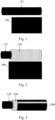
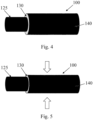
- the method of manufacture for a subsea power cable 100 is illustrated in Fig. 1 to Fig. 5 .
- a first step is to provide a power core 125 and a metal sheet 240.
- the cable core 125 comprising an electrical conductor 110 and an electrically insulating system 120 that is arranged radially outside of the electrical conductor 110.
- the insulating system 120 here comprises
- a liquid material comprising a polymer is added radially outside of the outer layer 123 of the cable core 125, thereby forming a buffer layer 130.
- the metal sheet 240 is applied radially outside the buffer layer 130.
- the metal sheet 240 is then welded, as shown in Fig. 4 , for example by longitudinal welding, thereby forming a water barrier layer 140.
- the metal sheet 240 is first uncoiled around the cable core 125.
- the metal sheet 240 is subsequently continuously welded in the cable axial direction by moving the cable core 125 and formed metal sheet 240 in the process direction.
- the power core 125 is now fully sealed by the water barrier layer 140 which is made from the metallic sheet 240.
- the metallic water barrier layer 140 can be further formed to multiple geometries:
- the water barrier layer 140 can be intentionally non-pressure resistant. That is: the water barrier layer 140 structure would collapse under hydrostatic water pressure. If so, the cable core 125 or other potential buffer layers must support the water barrier layer 140.
- the buffer layer 130 ensures that the water barrier layer 140 is supported. It is advantageous here to use a liquid during manufacture instead of solid material, such as a tape. In this way, the liquid buffer layer 130 takes the shape of the space between the cable core 125 and the water barrier layer 140 and thus ensure a better support of the water barrier layer 140, especially for corrugated geometry.
- the buffer layer 130 may or may not substantially change its properties after application for example by hardening the buffer layer 130.
- the water barrier layer 140 may in addition be reduced in diameter to better fit the diameter of the core.
- the water barrier layer 140 will typically be reduced to a round geometry by draw-down or rolling steps, or a non-round shape if needed (typically if the cable core is not round), as shown in Fig. 5 .
- the power cable 100 comprises a cable core 125 as described above.
- the power cable 100 further comprises a buffer layer 130 arranged radially outside of the cable core 125, and a water barrier layer 140, arranged radially outside of the buffer layer 130, wherein the buffer layer 130 is made of liquid material comprising a polymer.
- a second embodiment/example is shown in fig. 7 .
- the power cable 100 further comprises, as described in figure 7 , a second buffer layer 150 and a polymer sheath 160, the second buffer layer 150 arranged between the polymer sheath 160 and the water barrier layer 140.
- the second buffer layer 150 is preferably produced by applying a liquid material between the water barrier layer 140 and the polymer sheath 160.
- the above methods are also adapted to produce a joint.
Landscapes
- Engineering & Computer Science (AREA)
- Manufacturing & Machinery (AREA)
- Insulated Conductors (AREA)
Priority Applications (2)
| Application Number | Priority Date | Filing Date | Title |
|---|---|---|---|
| EP23315249.5A EP4478382A1 (fr) | 2023-06-15 | 2023-06-15 | Câble d'alimentation sous-marin |
| US18/742,849 US20240420868A1 (en) | 2023-06-15 | 2024-06-13 | Subsea power cable |
Applications Claiming Priority (1)
| Application Number | Priority Date | Filing Date | Title |
|---|---|---|---|
| EP23315249.5A EP4478382A1 (fr) | 2023-06-15 | 2023-06-15 | Câble d'alimentation sous-marin |
Publications (1)
| Publication Number | Publication Date |
|---|---|
| EP4478382A1 true EP4478382A1 (fr) | 2024-12-18 |
Family
ID=87245711
Family Applications (1)
| Application Number | Title | Priority Date | Filing Date |
|---|---|---|---|
| EP23315249.5A Pending EP4478382A1 (fr) | 2023-06-15 | 2023-06-15 | Câble d'alimentation sous-marin |
Country Status (2)
| Country | Link |
|---|---|
| US (1) | US20240420868A1 (fr) |
| EP (1) | EP4478382A1 (fr) |
Citations (7)
| Publication number | Priority date | Publication date | Assignee | Title |
|---|---|---|---|---|
| EP0416728A2 (fr) * | 1989-09-07 | 1991-03-13 | Pirelli Cable Corporation | Câble électrique contenant des substances gonflables à l'eau et des éléments métalliques allongés disposés sur l'isolation du câble |
| EP1649471A1 (fr) * | 2003-07-25 | 2006-04-26 | Pirelli & C. S.p.A. | Procede continu de fabrication de cables electriques |
| EP2312591A1 (fr) | 2009-08-31 | 2011-04-20 | Nexans | Barrière métallique contre l'humidité résistant à la fatigue dans un câble d'alimentation sous-marin |
| US20160217887A1 (en) * | 2013-12-19 | 2016-07-28 | Abb Technology Ltd | Arrangement For A Dynamic High Voltage Subsea Cable And A Dynamic High Voltage Subsea Cable |
| EP3438993A1 (fr) | 2017-08-02 | 2019-02-06 | Nexans | Câ?ble de puissance dynamique |
| EP3786982A1 (fr) | 2019-08-26 | 2021-03-03 | Nexans | Gaine de câble en alliage cunisi |
| EP3885120A1 (fr) * | 2020-03-25 | 2021-09-29 | Nexans | Câble électrique sous-marin pour eaux profondes et procédé de fabrication d'un tel câble électrique sous-marin |
-
2023
- 2023-06-15 EP EP23315249.5A patent/EP4478382A1/fr active Pending
-
2024
- 2024-06-13 US US18/742,849 patent/US20240420868A1/en active Pending
Patent Citations (7)
| Publication number | Priority date | Publication date | Assignee | Title |
|---|---|---|---|---|
| EP0416728A2 (fr) * | 1989-09-07 | 1991-03-13 | Pirelli Cable Corporation | Câble électrique contenant des substances gonflables à l'eau et des éléments métalliques allongés disposés sur l'isolation du câble |
| EP1649471A1 (fr) * | 2003-07-25 | 2006-04-26 | Pirelli & C. S.p.A. | Procede continu de fabrication de cables electriques |
| EP2312591A1 (fr) | 2009-08-31 | 2011-04-20 | Nexans | Barrière métallique contre l'humidité résistant à la fatigue dans un câble d'alimentation sous-marin |
| US20160217887A1 (en) * | 2013-12-19 | 2016-07-28 | Abb Technology Ltd | Arrangement For A Dynamic High Voltage Subsea Cable And A Dynamic High Voltage Subsea Cable |
| EP3438993A1 (fr) | 2017-08-02 | 2019-02-06 | Nexans | Câ?ble de puissance dynamique |
| EP3786982A1 (fr) | 2019-08-26 | 2021-03-03 | Nexans | Gaine de câble en alliage cunisi |
| EP3885120A1 (fr) * | 2020-03-25 | 2021-09-29 | Nexans | Câble électrique sous-marin pour eaux profondes et procédé de fabrication d'un tel câble électrique sous-marin |
Also Published As
| Publication number | Publication date |
|---|---|
| US20240420868A1 (en) | 2024-12-19 |
Similar Documents
| Publication | Publication Date | Title |
|---|---|---|
| EP3786982B1 (fr) | Gaine de câble en alliage cunisi | |
| EP2312591B1 (fr) | Barrière métallique contre l'humidité résistant à la fatigue dans un câble d'alimentation sous-marin | |
| EP3792938B1 (fr) | Procédé de fabrication d'un câble électrique sous-marin et câble électrique ainsi fabriqué | |
| EP3438993B1 (fr) | Câble de puissance dynamique | |
| US20140102749A1 (en) | Electric Submersible Pump Cables for Harsh Environments | |
| US5527995A (en) | Cable for conducting energy | |
| EP3913268A1 (fr) | Câble ombilical adapté pour le transport de gaz hydrogène | |
| NO349632B1 (en) | Power cables for electric submersible pump and systems and methods thereof | |
| EP4478382A1 (fr) | Câble d'alimentation sous-marin | |
| JP2019512859A (ja) | 直流海底ケーブル | |
| FI68133B (fi) | Mot fukt skyddad elektrisk plastisolerad kraftkabel | |
| EP3885120A1 (fr) | Câble électrique sous-marin pour eaux profondes et procédé de fabrication d'un tel câble électrique sous-marin | |
| EP4243038A1 (fr) | Matériaux formant barrière à l'eau pour un câble d'alimentation dynamique destiné aux applications sous-marines | |
| EP3172809A1 (fr) | Isolant électrique tubulaire pour une ligne de transport d'énergie a haute tension | |
| CN203871047U (zh) | 低压防水防油电缆 | |
| US20240112832A1 (en) | Dynamic Submarine Power Cable With Corrugated And Smooth Metallic Water Barrier | |
| EP4715845A1 (fr) | Alliages de zinc et de zinc comme gaine de câble | |
| EP4607541A1 (fr) | Gaine de câble en alliage étain-antimoine | |
| EP4386782A1 (fr) | Câble d'alimentation avec joint de gaine métallique | |
| US20250391587A1 (en) | Transversal reinforcement of a lead-free water barrier for a subsea cable | |
| KR20260035783A (ko) | 동적 고전압 해저 케이블 및 동적 고전압 해저 케이블을 제조하는 방법 | |
| EP4163932A1 (fr) | Câble cvca avec conducteur composite | |
| WO2025215421A1 (fr) | Ombilical d'alimentation sous-marin | |
| CN203858911U (zh) | 中压防水防油电缆 |
Legal Events
| Date | Code | Title | Description |
|---|---|---|---|
| PUAI | Public reference made under article 153(3) epc to a published international application that has entered the european phase |
Free format text: ORIGINAL CODE: 0009012 |
|
| STAA | Information on the status of an ep patent application or granted ep patent |
Free format text: STATUS: THE APPLICATION HAS BEEN PUBLISHED |
|
| AK | Designated contracting states |
Kind code of ref document: A1 Designated state(s): AL AT BE BG CH CY CZ DE DK EE ES FI FR GB GR HR HU IE IS IT LI LT LU LV MC ME MK MT NL NO PL PT RO RS SE SI SK SM TR |
|
| STAA | Information on the status of an ep patent application or granted ep patent |
Free format text: STATUS: REQUEST FOR EXAMINATION WAS MADE |
|
| 17P | Request for examination filed |
Effective date: 20250603 |