EP3914316B1 - Vorrichtung zur beurteilung der herzleistung in der veno-venösen extrakorporalen blutoxygenierung - Google Patents
Vorrichtung zur beurteilung der herzleistung in der veno-venösen extrakorporalen blutoxygenierung Download PDFInfo
- Publication number
- EP3914316B1 EP3914316B1 EP20744707.9A EP20744707A EP3914316B1 EP 3914316 B1 EP3914316 B1 EP 3914316B1 EP 20744707 A EP20744707 A EP 20744707A EP 3914316 B1 EP3914316 B1 EP 3914316B1
- Authority
- EP
- European Patent Office
- Prior art keywords
- blood
- oxygen saturation
- flow rate
- venous
- extracorporeal circuit
- Prior art date
- Legal status (The legal status is an assumption and is not a legal conclusion. Google has not performed a legal analysis and makes no representation as to the accuracy of the status listed.)
- Active
Links
Images
Classifications
-
- A—HUMAN NECESSITIES
- A61—MEDICAL OR VETERINARY SCIENCE; HYGIENE
- A61M—DEVICES FOR INTRODUCING MEDIA INTO, OR ONTO, THE BODY; DEVICES FOR TRANSDUCING BODY MEDIA OR FOR TAKING MEDIA FROM THE BODY; DEVICES FOR PRODUCING OR ENDING SLEEP OR STUPOR
- A61M1/00—Suction or pumping devices for medical purposes; Devices for carrying-off, for treatment of, or for carrying-over, body-liquids; Drainage systems
- A61M1/14—Dialysis systems; Artificial kidneys; Blood oxygenators ; Reciprocating systems for treatment of body fluids, e.g. single needle systems for hemofiltration or pheresis
- A61M1/16—Dialysis systems; Artificial kidneys; Blood oxygenators ; Reciprocating systems for treatment of body fluids, e.g. single needle systems for hemofiltration or pheresis with membranes
- A61M1/1698—Blood oxygenators with or without heat-exchangers
-
- A—HUMAN NECESSITIES
- A61—MEDICAL OR VETERINARY SCIENCE; HYGIENE
- A61M—DEVICES FOR INTRODUCING MEDIA INTO, OR ONTO, THE BODY; DEVICES FOR TRANSDUCING BODY MEDIA OR FOR TAKING MEDIA FROM THE BODY; DEVICES FOR PRODUCING OR ENDING SLEEP OR STUPOR
- A61M1/00—Suction or pumping devices for medical purposes; Devices for carrying-off, for treatment of, or for carrying-over, body-liquids; Drainage systems
- A61M1/14—Dialysis systems; Artificial kidneys; Blood oxygenators ; Reciprocating systems for treatment of body fluids, e.g. single needle systems for hemofiltration or pheresis
- A61M1/16—Dialysis systems; Artificial kidneys; Blood oxygenators ; Reciprocating systems for treatment of body fluids, e.g. single needle systems for hemofiltration or pheresis with membranes
- A61M1/1601—Control or regulation
- A61M1/1603—Regulation parameters
- A61M1/1605—Physical characteristics of the dialysate fluid
- A61M1/1607—Physical characteristics of the dialysate fluid before use, i.e. upstream of dialyser
-
- A—HUMAN NECESSITIES
- A61—MEDICAL OR VETERINARY SCIENCE; HYGIENE
- A61B—DIAGNOSIS; SURGERY; IDENTIFICATION
- A61B5/00—Measuring for diagnostic purposes; Identification of persons
- A61B5/02—Detecting, measuring or recording for evaluating the cardiovascular system, e.g. pulse, heart rate, blood pressure or blood flow
- A61B5/026—Measuring blood flow
- A61B5/029—Measuring blood output from the heart, e.g. minute volume
-
- A—HUMAN NECESSITIES
- A61—MEDICAL OR VETERINARY SCIENCE; HYGIENE
- A61B—DIAGNOSIS; SURGERY; IDENTIFICATION
- A61B5/00—Measuring for diagnostic purposes; Identification of persons
- A61B5/145—Measuring characteristics of blood in vivo, e.g. gas concentration or pH-value ; Measuring characteristics of body fluids or tissues, e.g. interstitial fluid or cerebral tissue
- A61B5/14525—Measuring characteristics of blood in vivo, e.g. gas concentration or pH-value ; Measuring characteristics of body fluids or tissues, e.g. interstitial fluid or cerebral tissue using microdialysis
-
- A—HUMAN NECESSITIES
- A61—MEDICAL OR VETERINARY SCIENCE; HYGIENE
- A61B—DIAGNOSIS; SURGERY; IDENTIFICATION
- A61B5/00—Measuring for diagnostic purposes; Identification of persons
- A61B5/145—Measuring characteristics of blood in vivo, e.g. gas concentration or pH-value ; Measuring characteristics of body fluids or tissues, e.g. interstitial fluid or cerebral tissue
- A61B5/14542—Measuring characteristics of blood in vivo, e.g. gas concentration or pH-value ; Measuring characteristics of body fluids or tissues, e.g. interstitial fluid or cerebral tissue for measuring blood gases
-
- A—HUMAN NECESSITIES
- A61—MEDICAL OR VETERINARY SCIENCE; HYGIENE
- A61B—DIAGNOSIS; SURGERY; IDENTIFICATION
- A61B5/00—Measuring for diagnostic purposes; Identification of persons
- A61B5/68—Arrangements of detecting, measuring or recording means, e.g. sensors, in relation to patient
- A61B5/6846—Arrangements of detecting, measuring or recording means, e.g. sensors, in relation to patient specially adapted to be brought in contact with an internal body part, i.e. invasive
- A61B5/6847—Arrangements of detecting, measuring or recording means, e.g. sensors, in relation to patient specially adapted to be brought in contact with an internal body part, i.e. invasive mounted on an invasive device
- A61B5/6866—Extracorporeal blood circuits, e.g. dialysis circuits
-
- A—HUMAN NECESSITIES
- A61—MEDICAL OR VETERINARY SCIENCE; HYGIENE
- A61M—DEVICES FOR INTRODUCING MEDIA INTO, OR ONTO, THE BODY; DEVICES FOR TRANSDUCING BODY MEDIA OR FOR TAKING MEDIA FROM THE BODY; DEVICES FOR PRODUCING OR ENDING SLEEP OR STUPOR
- A61M1/00—Suction or pumping devices for medical purposes; Devices for carrying-off, for treatment of, or for carrying-over, body-liquids; Drainage systems
- A61M1/36—Other treatment of blood in a by-pass of the natural circulatory system, e.g. temperature adaptation, irradiation ; Extra-corporeal blood circuits
- A61M1/3607—Regulation parameters
- A61M1/3609—Physical characteristics of the blood, e.g. haematocrit, urea
-
- A—HUMAN NECESSITIES
- A61—MEDICAL OR VETERINARY SCIENCE; HYGIENE
- A61M—DEVICES FOR INTRODUCING MEDIA INTO, OR ONTO, THE BODY; DEVICES FOR TRANSDUCING BODY MEDIA OR FOR TAKING MEDIA FROM THE BODY; DEVICES FOR PRODUCING OR ENDING SLEEP OR STUPOR
- A61M1/00—Suction or pumping devices for medical purposes; Devices for carrying-off, for treatment of, or for carrying-over, body-liquids; Drainage systems
- A61M1/36—Other treatment of blood in a by-pass of the natural circulatory system, e.g. temperature adaptation, irradiation ; Extra-corporeal blood circuits
- A61M1/3607—Regulation parameters
- A61M1/3609—Physical characteristics of the blood, e.g. haematocrit, urea
- A61M1/3612—Physical characteristics of the blood, e.g. haematocrit, urea after treatment
-
- A—HUMAN NECESSITIES
- A61—MEDICAL OR VETERINARY SCIENCE; HYGIENE
- A61M—DEVICES FOR INTRODUCING MEDIA INTO, OR ONTO, THE BODY; DEVICES FOR TRANSDUCING BODY MEDIA OR FOR TAKING MEDIA FROM THE BODY; DEVICES FOR PRODUCING OR ENDING SLEEP OR STUPOR
- A61M1/00—Suction or pumping devices for medical purposes; Devices for carrying-off, for treatment of, or for carrying-over, body-liquids; Drainage systems
- A61M1/36—Other treatment of blood in a by-pass of the natural circulatory system, e.g. temperature adaptation, irradiation ; Extra-corporeal blood circuits
- A61M1/3621—Extra-corporeal blood circuits
- A61M1/3623—Means for actively controlling temperature of blood
-
- A—HUMAN NECESSITIES
- A61—MEDICAL OR VETERINARY SCIENCE; HYGIENE
- A61M—DEVICES FOR INTRODUCING MEDIA INTO, OR ONTO, THE BODY; DEVICES FOR TRANSDUCING BODY MEDIA OR FOR TAKING MEDIA FROM THE BODY; DEVICES FOR PRODUCING OR ENDING SLEEP OR STUPOR
- A61M2205/00—General characteristics of the apparatus
- A61M2205/33—Controlling, regulating or measuring
- A61M2205/3306—Optical measuring means
-
- A—HUMAN NECESSITIES
- A61—MEDICAL OR VETERINARY SCIENCE; HYGIENE
- A61M—DEVICES FOR INTRODUCING MEDIA INTO, OR ONTO, THE BODY; DEVICES FOR TRANSDUCING BODY MEDIA OR FOR TAKING MEDIA FROM THE BODY; DEVICES FOR PRODUCING OR ENDING SLEEP OR STUPOR
- A61M2205/00—General characteristics of the apparatus
- A61M2205/33—Controlling, regulating or measuring
- A61M2205/3331—Pressure; Flow
-
- A—HUMAN NECESSITIES
- A61—MEDICAL OR VETERINARY SCIENCE; HYGIENE
- A61M—DEVICES FOR INTRODUCING MEDIA INTO, OR ONTO, THE BODY; DEVICES FOR TRANSDUCING BODY MEDIA OR FOR TAKING MEDIA FROM THE BODY; DEVICES FOR PRODUCING OR ENDING SLEEP OR STUPOR
- A61M2205/00—General characteristics of the apparatus
- A61M2205/33—Controlling, regulating or measuring
- A61M2205/3331—Pressure; Flow
- A61M2205/3334—Measuring or controlling the flow rate
-
- A—HUMAN NECESSITIES
- A61—MEDICAL OR VETERINARY SCIENCE; HYGIENE
- A61M—DEVICES FOR INTRODUCING MEDIA INTO, OR ONTO, THE BODY; DEVICES FOR TRANSDUCING BODY MEDIA OR FOR TAKING MEDIA FROM THE BODY; DEVICES FOR PRODUCING OR ENDING SLEEP OR STUPOR
- A61M2205/00—General characteristics of the apparatus
- A61M2205/33—Controlling, regulating or measuring
- A61M2205/3368—Temperature
-
- A—HUMAN NECESSITIES
- A61—MEDICAL OR VETERINARY SCIENCE; HYGIENE
- A61M—DEVICES FOR INTRODUCING MEDIA INTO, OR ONTO, THE BODY; DEVICES FOR TRANSDUCING BODY MEDIA OR FOR TAKING MEDIA FROM THE BODY; DEVICES FOR PRODUCING OR ENDING SLEEP OR STUPOR
- A61M2205/00—General characteristics of the apparatus
- A61M2205/33—Controlling, regulating or measuring
- A61M2205/3375—Acoustical, e.g. ultrasonic, measuring means
-
- A—HUMAN NECESSITIES
- A61—MEDICAL OR VETERINARY SCIENCE; HYGIENE
- A61M—DEVICES FOR INTRODUCING MEDIA INTO, OR ONTO, THE BODY; DEVICES FOR TRANSDUCING BODY MEDIA OR FOR TAKING MEDIA FROM THE BODY; DEVICES FOR PRODUCING OR ENDING SLEEP OR STUPOR
- A61M2230/00—Measuring parameters of the user
- A61M2230/20—Blood composition characteristics
Definitions
- the present disclosure relates to assessing cardiac output of a patient operably connected to a veno-venous (VV) extracorporeal circuit, and particularly to a veno-venous extracorporeal blood oxygenation circuit such as but not limited to a veno-venous extracorporeal membrane oxygenation (ECMO) circuit.
- VV veno-venous
- ECMO membrane oxygenation
- VV ECMO is a medical procedure employed in patients who are experiencing life-threatening respiratory failure, typically Acute Respiratory Distress Syndrome (ARDS).
- ARDS Acute Respiratory Distress Syndrome
- other indications include infection, such as viral, bacterial, fungus, PCP; primary lung disease, such as cystic fibrosis, hemorrhagic auto immune diseases; idiopathic fibrosis, sickle cell crisis, primary pulmonary hypertension; chest trauma, post pneumonectomy; post-transplant: acute, chronic (bronchiolitis obliterans); chronic respiratory failure bridging to transplant.
- Extracorporeal blood oxygenation such as VV ECMO, supplements or replaces blood oxygenation by the lungs of the patient.
- VV ECMO large cannulas are inserted usually through femoral and/or jugular veins with the tip located in the superior and/or inferior vena cava or in the right atrium. These cannulae are then connected to an extracorporeal circuit which includes a pump and a membrane oxygenator. Blood is usually withdrawn from one (or two locations) and delivered close to the right atria, but there are multiple modifications. The patient blood is continuously circulated through the extracorporeal circuit, by being withdrawn from the patient, then circulated through an oxygenator, such as a membrane oxygenator, where the blood is then oxygenated. The blood is returned to the patient where the now oxygenated blood is pumped by right heart through lungs to left heart which delivers the oxygenated blood to the body tissue.
- an oxygenator such as a membrane oxygenator
- VV ECMO treatment An important consequence of VV ECMO treatment is the occurrence of recirculation.
- Recirculation arises when a portion of the oxygenated blood that is being returned to the patient does not pass into the patient heart but is withdrawn into the extracorporeal circuit. This can occur due to poor positioning of the withdrawal and delivery cannulas, and/or if the patient has insufficient cardiac output to accept the full flow of oxygenated blood.
- Recirculation can be a problem during treatment, as the presence of recirculation means that some portion of the therapy being supplied to the patient is not actually assisting in their recovery.
- VV ECMO The VV ECMO procedure is usually applied to patients that have a good working heart.
- cardiac insufficiency (often right heart) may develop. This can be a life threatening situation.
- Sufficiency of circulation by the heart is typically assessed by measuring the cardiac output.
- Current standard methods to measure cardiac output (CO) such as pulmonary artery thermodilution and transpulmonary thermodilution are invasive as well as often inaccurate. In the VV ECMO setting, these methods may give misleading results, especially at high recirculation levels. As a result, a dramatic heart failure may be missed.
- An identified decrease in CO can be addressed by physicians either by medication therapy or by moving the patient to VA ECMO, where the extracorporeal circuit provides heart support in addition to lung support (though the VA ECMO is more invasive).
- Document US2008033314A1 discloses a method for determining cardiac output in conjunction with flow through an extracorporeal circuit, wherein flow through an arterial line of the extracorporeal circuit is temporarily reversed and an indicator is passed through the cardiopulmonary circuit. A dilution curve is measured in the arterial line of the extracorporeal circuit during the reversed flow, and cardiac output is determined corresponding to the measured dilution curve.
- An apparatus for calculating cardiac output of a patient undergoing veno-venous extracorporeal oxygenation through a veno-venous extracorporeal circuit, wherein the apparatus includes a controller, a pump connected to the veno-venous extracorporeal circuit for generating a blood flow through the veno-venous extracorporeal circuit, the pump operably connected to the controller and configured to generate a first blood flow rate through the veno-venous extracorporeal circuit and a different second blood flow rate through the veno-venous extracorporeal circuit; an oximeter connected to the controller for measuring a first arterial oxygen saturation corresponding to the first blood flow rate and a second arterial oxygen saturation corresponding to the second blood flow rate, wherein the controller is configured to calculate a cardiac output of the patient corresponding to the first measured arterial oxygen saturation, the second measured arterial oxygen saturation, the first blood flow rate and the second blood flow rate.
- the controller is configured to calculate the cardiac output further corresponding to a first amount of recirculation during the first blood flow rate and a second amount of recirculation during the second blood flow rate.
- the controller can be further configured to adjust the calculated cardiac output by an amount corresponding to a first oxygen saturation of mixed venous blood after passing the lungs during the first blood flow rate and a second oxygen saturation of mixed venous blood after passing the lungs during the second blood flow rate.
- the controller is configured to adjust the calculated cardiac output by an amount corresponding to a difference between the first measured arterial oxygen saturation and the second measured arterial oxygen saturation.
- the controller can be further configured to adjust the calculated cardiac output by an amount proportional to a difference between the first measured arterial oxygen saturation and the second measured arterial oxygen saturation.
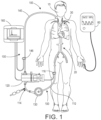
- an extracorporeal blood oxygenation circuit 100 is shown connected to a circulation system 20 of a patient 10.
- the circulation system 20 is a human (or animal) circulatory system including blood, a vascular system, and a heart.
- the circulation system 20 is includes a cardiopulmonary system 30 and a systemic system connecting the cardiopulmonary system to the tissues of the body.
- the systemic system passes the blood though the vascular system (arteries, veins, and capillaries) throughout the body.
- the cardiopulmonary system 30 includes the right heart, the lungs and the left heart, as well as the vascular structure connecting the right heart to the lungs, the lungs to the left heart and some portion of the aorta and large veins located between the extracorporeal circuit and the right and left heart. That is, in theory the cardiopulmonary system 30 would include only the right heart, the lungs, the left heart and the vascular structure directly connecting the right heart to the lungs and the lungs to the left heart. However, in practice it is sometimes impracticable to operably connect the extracorporeal circuit 100 immediately adjacent the large vein at the right heart. Therefore, the cardiopulmonary system 30 often includes a limited length of the vein entering the right heart. For example, the extracorporeal circuit 100 can be connected to a femoral vein, thereby effectively extending the cardiopulmonary system 30 to such femoral vein.
- the term "upstream" of a given position refers to a direction against the flow of blood, and the term “downstream” of a given position is the direction of blood flow away from the given position.
- the "arterial” side or portion is that part in which oxygenated blood flows from the heart to the capillaries.
- the "venous” side or portion is that part in which blood flows from the capillaries to the heart and lungs (to the cardiopulmonary system 30).
- the basic components of the extracorporeal circuit 100 for a conventional extracorporeal oxygenation machine include an access (or venous) line 110, an oxygenator 120 and heat exchanger (not shown), a pump 130, a return (or arterial) 140, a sensor 116 in the venous line, a sensor 146 in the arterial line and a controller 160.
- the extracorporeal circuit 100 is configured to form a veno-venous (W) extracorporeal circuit 100.
- W veno-venous
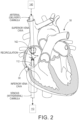
- the site of the withdrawal of blood from the circulation system 20 to the extracorporeal circuit 100 and the site of introduction of blood from the extracorporeal circuit to the circulation system both occur in the venous portion of the circulation system as seen in Figure 2 .
- the site of withdrawal of blood from the circulation system 20 to the extracorporeal circuit 100 is the inferior vena cava and the site of introduction of blood from the extracorporeal circuit to the circulation system is the superior vena cava.
- the VV extracorporeal circuit 100 withdraws blood from the venous portion of the circulation system 20 (or cardiopulmonary system 30), and returns the blood to the venous portion of the circulation system.
- the withdrawn blood can be treated while it is withdrawn, such as through gas exchange or oxygenation (ECMO) before being returned to the venous portion of the circulation system 20.
- the blood treatment can be any of a variety of treatments including, but not limited to, oxygenation (and carbon dioxide withdrawal).
- the access line 110 withdraws or drains blood from the patient and into the extracorporeal circuit 100.
- the access line 110 extends from the venous portion of the circulation system 20, and preferably from a venous portion of the cardiopulmonary system 30.
- the access line 110 typically includes an access cannula 112 providing the fluid connection to the circulation system 20.
- the access line 110 can also include or provide an introduction site such as an indicator introduction port 114 as the site for introducing an indicator into the extra corporeal circuit 100.
- an introduction site such as an indicator introduction port 114 as the site for introducing an indicator into the extra corporeal circuit 100.
- the indicator introduction port 114 for introducing the dilution indicator is upstream to an inlet of the oxygenator 120.
- the introduction site 114 can be integrated into the oxygenator 120.
- the senor 116 can be a dilution sensor for sensing passage of the indicator through the extracorporeal circuit 100.
- the dilution sensor 116 (as well as sensor 146) can be any of a variety of sensors, and can cooperate with the particular indicator.
- the sensor 116 (as well as sensor 146) can measure different blood properties: such as but not limited to temperature, Doppler frequency, electrical impedance, optical properties, density, ultrasound velocity, concentration of glucose, oxygen saturation and other blood substances (any physical, electrical or chemical blood properties). It is also understood the sensor 116 can also measure the blood flow rate. Alternatively, there can a separate flow sensor (not shown) in addition to sensor 116 be to measure the blood flow rate.
- the present system includes a single blood property sensor and a single flow rate sensor. It is further contemplated that a single combined sensor for measuring flow rate and a blood parameter (property) can be used. As set forth herein, in some pumps 130, a rotational speed, RPM (rotations per minute) of the pump can be measured for providing a measurement of blood flow rate.
- RPM rotational speed
- the return line 140 connects the extracorporeal circuit 100 to a venous portion of the circulation system 20 and in one configuration to a venous portion of the cardiopulmonary system 30.
- the return line 140 usually connects to the superior vena cava but may connected to right atria (tip position ) or inferior vena cava.
- the return line 140 typically includes a return (arterial) cannula 142 providing the fluid connection to the circulation system 20.
- the return line 140 can also include a sensor such as the sensor 146.
- the sensor 146 can be any of a variety of sensors, as set forth in the description of the sensor 116, and is typically selected to cooperate with the anticipated indicator.
- the sensors 116, 146 can be located outside of the extracorporeal circuit. That is, the sensors 116, 146 can be remotely located and measure in the extracorporeal circuit 100, the changes produced in the blood from the indicator introduction or values related to the indicator introduction which can be transmitted or transferred by means of diffusion, electro-magnetic or thermal fields or by other means to the location of the sensor.
- two sensors are shown, it is understood only a single sensor is necessary in order to measure a recirculation. While use of two sensors can improve accuracy, it is not necessary that two sensors be employed to calculate recirculation.
- the oxygenator 120 can be broadly classified into bubble type oxygenators and membrane type oxygenators.
- the membrane type oxygenators fall under the laminate type, the coil type, and the hollow fiber type.
- Membrane type oxygenators offer advantages over the bubble type oxygenators as the membrane type oxygenators typically cause less blood damage, such as hemolysis, protein denaturation, and blood coagulation as compared with the bubble type oxygenators.
- the preferred configuration is set forth in terms of a membrane type oxygenator, it is understood any type of oxygenator can be employed.
- the pump 130 can be any of a variety of pumps types, including but not limited to a peristaltic or roller (or impeller or centrifugal) pump.
- the pump 130 induces a blood flow rate through the extracorporeal circuit 100.
- the pump 130 can be directly controlled at the pump or can be controlled through the controller 160 to establish a given blood flow rate in the extracorporeal circuit 100.
- the pump 130 can be at any of a variety of locations in the extracorporeal circuit 100, and is not limited to the position shown in the Figures.
- the pump 130 is a commercially available pump and can be set or adjusted to provide any of a variety of flow rates, wherein the flow rate can be read by a user and/or transmitted to and read by the controller 160.
- the controller 160 is typically connectable to the oxygenator 120, the pump 130 and the sensor(s) 116, 146.
- the controller 160 can be a stand-alone device such as a personal computer, a dedicated device or embedded in one of the components, such as the pump 130 or the oxygenator 120.
- the controller 160 is shown as connected to the sensors 116 and 146, the pump 130 and the oxygenator 120, it is understood the controller can be connected to only the sensors, the sensors or the pump, or any combination of the sensors, the pump and the oxygenator.
- at least one of the pump 130 and the controller 160 provides for control of the pump and the flow rate of the blood through the pump, respectively.
- the controller 160 also can be connected to the oximeter to automatically collect data or oximetry data can be put manually into controller. Alternatively, a pulse oximeter 60 and the controller 160 can be integrated as a single unit.
- the controller 160 is programmed with the equations as set forth herein and can perform the associated calculations based on inputs from the user and/or connected components.
- the normal or forward blood flow through the extracorporeal circuit 100 includes withdrawing blood through the access line 110 from the venous side of the circulation system 20 (and particularly the cardiopulmonary circuit 30), passing the withdrawn blood through the extracorporeal circuit (to treat such as oxygenate), and introducing the withdrawn (or treated or oxygenated) blood through the return line 140 into the venous side of the circulation system.
- the pump 130 thereby induces a blood flow at a known (measured) blood flow rate through the extracorporeal circuit 100 from the access line 110 to the return line 140.
- Cardiac output CO is the amount of blood pumped out by the left ventricle in a given period of time (typically a 1 minute interval).
- the heart capacity (flow) is typically measured by cardiac output CO.
- the term blood flow rate means a rate of blood passage, volume per unit time.
- the blood flow rate is a volumetric flow rate ("flow rate").
- the volumetric flow rate is a measure of a volume of liquid passing a cross-sectional area of a conduit per unit time, and may be expressed in units such as milliliters per min (ml/min) or liters per minute (l/min).
- the present disclosure provides a simple noninvasive technology to measure cardiac output, CO in VV extracorporeal blood oxygenation, such as a VV ECMO setting.
- VV extracorporeal blood oxygenation such as a VV ECMO setting.
- venous oxygen saturation measured pre-oxygenator in the extracorporeal (ECMO) circuit 100 may be different from mixed venous oxygen saturation in the cardiopulmonary system 30 - as well as being subject to influence from the presence of any recirculation.
- Equation 4 can be used with the measured and reliable values of Q b and SaO 2 in conjunction with a measured SvO 2 , such as measured in the access line 110, recognizing the measured surrogate value of SvO 2 value may introduce an unacceptable error in certain instances, especially in the case of the presence of recirculation.
- Equation 4 For low maintenance in the value of measured SvO 2 , or the equation can still be used for CO assessment with an acceptable measurement of SvO 2 , but is less accurate.
- a further configuration of the present system can incorporate an accounting of recirculation.
- recirculation is the withdrawal of reinfused oxygenated blood through the access (drainage) cannula 112 without the reinfused oxygenated blood passing through the circulation system 20. Because recirculated blood does not contribute to oxygen delivery in the circulation system 20, the presence of recirculation decreases the efficiency of the extra corporeal blood oxygenation (ECMO) procedure.
- ECMO extra corporeal blood oxygenation
- venous oxygen saturation measured pre-oxygenator in the extracorporeal (ECMO) circuit 100 will differ even more from the mixed venous oxygen saturation in the presence of recirculation.
- SvO 2 at the inlet of the blood oxygenator 120 (ECMO) one needs to use the following equation:
- SvO 2 in the venous vessel may be used in Eq. 4B instead of SvO 2 , but this substitution will result in an error in the calculated CO from substitution of the mixed venous oxygen saturation by the oxygen saturation from the vessels where the oxygen saturation was sampled.
- the value of Q b (such as via flow rate of the pump 130 in the extracorporeal circuit 100) can be changed, such as by an increase or decrease to deliver a different flow rate of 100% oxygenated blood through the return line 140 and into the heart.
- ⁇ SaO 2 SaO 2 1 ⁇ SaO 2 2
- index "(1)" and "(2)" correspond to a first flow rate delivered by the extracorporeal circuit 100, such as a first pump setting, Q b(1) and a second flow rate delivered by the extracorporeal circuit, such as a second pump setting pump setting Q b(2) , respectively.
- Equations 11-12 and Equations 11A-12A are independent of (eliminates) the need for assumptions of the venous oxygen saturations in Eq.4 (A, B) instead of a mix venous oxygen saturation.
- the CO of the patient on extracorporeal blood oxygenation such as VV-ECMO can be obtained in the following configurations.
- the patient, and particularly the circulation system 20 is operably connected to the extracorporeal circuit 100, wherein the access line 110, which can include the cannula (an access cannula) 112 as known in the art, withdraws blood from the patient, and particularly the venous portion of the circulation system 20 and in one configuration from the inferior vena cava.
- the access line 110 which can include the cannula (an access cannula) 112 as known in the art, withdraws blood from the patient, and particularly the venous portion of the circulation system 20 and in one configuration from the inferior vena cava.
- the withdrawn blood is passed through the access line 110 through the pump 130 and to the oxygenator 120.
- the blood is oxygenated in the oxygenator 120 and then pumped through the return line 140 for introduction of the oxygenated blood to the patient, and particularly the circulation system 20 and more particularly the venous portion of the circulation system 20, and more particularly the venous side of the cardiopulmonary system 30, such as the superior vena cava.
- amount (flow rate) of oxygenated blood introduced into the circulation system 20 is measured, such as by reading the volumetric pump flow setting of the pump 130.
- alternative mechanisms can be used to measure the flow of oxygenated blood, such as by not limited to, flow meters in the extracorporeal circuit 100, dilution measurements, ultrasonic measurements as known in the art.
- the arterial oxygen saturation, SaO 2 is measured such as by pulse oximetry or arterial blood gas analysis. As seen in Figure 1 , a pulse oximeter 60 is connected to the patient to measure arterial oxygen saturation, SaO 2 .
- the venous oxygen saturation, SvO 2 is measured at the inlet of the oxygenator in the extracorporeal circuit 100. It is understood this measurement is not of mixed venous oxygen saturation, but is rather measurement of a surrogate. However, in view of the invasion nature and potential complications inherent in drawing blood from the pulmonary artery, the measurement of oxygen saturation from the blood drawn from the inferior vena cava is used.
- the method for calculating CO is not limited to the manner of measurement of the parameter upon which the CO is calculated.
- the patient is operably connected to the extracorporeal circuit 100 as set forth above. It is further understood that although the present method is set forth with specific manner of obtaining measurements, any available manner of obtaining the identified data can be employed.
- the amount of oxygenated blood introduced into the patient circulation system 20 is identified by the setting of the pump 130.
- Recirculation, R, and arterial oxygen saturation, SaO 2 are measured, such as set forth above.
- the flow rate of oxygenated blood from the extracorporeal circuit 100 and introduced to the circulation system 20 is then changed by an amount sufficient to generate a corresponding change to the measured SaO 2 .
- the amount of change in the flow rate of oxygenated blood from the extracorporeal circuit 100 is sufficient to impart a change in the measured SaO 2 that is greater than operating error, drift or variance.
- the change in flow rate of oxygenated blood from the extracorporeal circuit 100 is at least 10% of the original flow rate, and in further configurations at least 20% of the original flow rate, an in other configurations at least 30% of the original flow rate. It is understood the change in flow rate of oxygenated blood from the extracorporeal circuit 100 can be as depending on the particular set of circumstances in order to generate the corresponding changes in the blood parameter such as arterial oxygen saturation, without deviating from the present system.
- the change in the flow of oxygenated blood from the extracorporeal circuit 100 to the circulation system 20 can be readily imparted by changing the operation of the pump 130.
- a second flow rate of oxygenated blood is introduced into the circulation system 20.
- Recirculation, R, and arterial oxygen saturation, SaO 2 are measured, such as set forth above, during the second flow rate of oxygenated blood passing into the circulation system 20.
- the CO can then be calculated through Eq. 11 and 12 or Eq. 11A and 12A from the measured first and second flow rate of oxygenated blood introduced into the circulation system 20, and the corresponding recirculation and arterial oxygen saturation, SaO 2 for each flow rate.
- the dilution sensors on the access line 110 and the return line 140 are used in conjunction with the introduction of an indicator, such as saline, at the indicator introduction port 114. Recirculation is then measured from the introduced indicator and measurement of the indicator at the sensors as known in the art.
- an indicator such as saline
- the arterial oxygen saturation, SaO 2 is also measured as set forth above.
- a different second flow rate of oxygenated blood is then imposed in the extracorporeal circuit 100 sufficient to impart a change in at least the arterial oxygen saturation, SaO 2 wherein the measured change is outside operating variances or drift, such as set forth above.
- the pump flow rate of the second flow rate is recorded and the recirculation again measured, such as by the dilution technique.
- Arterial oxygen saturation, SaO 2 is also measured during or corresponding to the second flow rate.
- CO can be determined from Eq. 11 and 12 or Eq. 11A and 12A from the measured first and second flow rate of oxygenated blood introduced into the circulation system 20, and the corresponding recirculation and arterial oxygen saturation, SaO 2 for each flow rate.
- any contribution of oxygenation from the lungs was taken as small (negligible).
- accuracy of the assessment or calculation of CO can be further improved if oxygenation contribution from the lungs are taken into account or estimated.
- the first flow is the well oxygenated blood from the extracorporeal circuit 100 and the second flow is the less oxygenated venous (mixed venous) blood from the organs.
- the mixture of these two flows defines the saturation of oxygen in the cardiac output CO.
- Q eff is part of the flow from the extracorporeal circuit (ECMO) flow that enters the heart accounting for recirculation;
- Q eff Q b ⁇ 1 ⁇ R % 100
- CO ⁇ SaO 2 Q eff ⁇ Sa ox O 2 + CO ⁇ Q eff S v O 2 + Res L CO ⁇ Q eff
- a resolution of the single equation and two unknowns is to obtain a second equation, thereby presenting two equations with two unknowns, which can be mathematically solved.
- the extracorporeal circuit flow rate, ECMO flow is changed to present a measurable change in arterial oxygen saturation SaO 2 , which change is greater than normal operating variances or drift.
- index "1" and "2" denote the respective value as related to the first flow rate from the extracorporeal circuit 100 and the second flow rate from the extracorporeal circuit, respectively.
- the change in flow rate in the extracorporeal circuit is taken as Q eff (1) > Q eff(2) . That is, the pump flow can be decreased, thereby decreasing the extracorporeal circuit flow rate.
- Equations 20A and 20B assume that CO does not change during the extracorporeal circuit 100 (pump flow) decrease or the change in CO is negligible. However, there are now two equations and three unknowns: CO, S L O 2(1) and S L O 2(2) . Again, as there are more unknowns than equations, the system of equations cannot be solved directly.
- the next step of the present modeling is to approximate a solution of current system of equations by considering the relationship between S L O 2(1) and S L O 2(2) .
- K ⁇ S v O 2 ⁇ S a O 2
- Equation 24 suggests that even if an actual value of post venous lung oxygen saturation is not known, but the changes of the mixed venous oxygen saturation are known, then the system of equations can be solved.
- Equation 20A and 20B If the value of K is known or estimated, then the system of Equations 20A and 20B can be solved and CO and S L O 2(1) calculated.
- Case 2 where the pre-oxygenator venous oxygen saturation is available, is related to ECMO devices that routinely measure the pre-oxygenator oxygen saturation S VOX O 2 . Also, in some clinics a blood sample is taken to measure pre-oxygenator venous oxygen saturation.
- the controller can be configured to calculate cardiac output based upon equations 1 through 25; and in further configurations, the controller is configured to calculate cardiac output based upon equations 4, 9A, 11, 12, 12A, 19, 20A, 20B, 23 and 24.
- the indicator is any substance that alters a measurable blood property.
- the indicator may alter any measurable parameter of the blood.
- the indicator may be chemical, optical, electrical, thermal or any combination thereof.
- the particular indicator is at least partly dictated by the anticipated operating environment. Available indicators include saline solutions, increased or decreased temperature as well as dyes and various isotopes.
- the use of temperature differentials may be accomplished by locally creating a heat source (such as a heater in the oxygenator 120) or a heat sink in the surrounding flow.
- a heat source such as a heater in the oxygenator 120
- the creation of a local temperature gradient offers the benefit of being able to employ a dilution indicator without introducing any additional volume into the blood flow. That is, a temperature differential may be created without an accompanying introduction of a volume of indicator.
- a volume of heated or cooled blood may be introduced at the indicator introduction port 114 as the indicator.
- a component of the extracorporeal circuit 100 can be controlled to create or induce an indicator within the flow in the extracorporeal circuit. For example, a filtration or treatment rate or heater can be sufficiently changed to create an effective indicator in the extracorporeal circuit 100 which then travels through the cardiopulmonary system 30.
- calculate means determine the amount or number of something mathematically, including to evaluate or estimate the nature, amount or quantity.
- the term measure means how much there is of the relevant parameter, including ascertain the size, amount, or degree of (something) such as by using an instrument or device marked in standard units or by comparing it with an object of known size, wherein the measuring may be of representative or a surrogate value or a surrogate parameter.
- the setting of the pump 130 can be used, a separate flow meter can be used, or dilution measurement can be used. It is further contemplated that measuring can include a calculating step or steps.
- calculate or calculating means to discover or identify a number or an amount using mathematics, a mathematical processes or equations.
- the term surrogate is a parameter which is used as a metric for one or more other parameters. Therefore, for purposes of description, when a specific parameter is recited as measured, it is understood that such measurement includes a representative of the parameter or a surrogate parameter that is measured, without deviating from the present system. Thus, it is understood that measuring a blood flow, recirculation or oxygen saturation encompasses measuring the relevant representative parameter as well as measuring a surrogate parameter. For example, it is understood the oxygen content (which may include contribution from other portions of the blood such as the plasma) can be measured in place of arterial oxygen saturation. Although the present analysis is set forth in terms of oxygen saturation, it is intended that oxygen content can be employed and that the recited oxygen saturation encompasses oxygen saturation as well as oxygen content.
- the present method and equations are set forth in terms of oxygen saturation, it is understood that other parameters and/or gases of the blood can be used in place of the blood oxygen saturation. That is, as soon as blood is pumped by the pump 130 in the extracorporeal circuit 100, there will be different physical/chemical property of the blood than the blood flowing in the veins. For example, if the blood is cooled (or heated) in the oxygenator 120, while the blood temperate flowing in the body is at body temperature, then upon measuring the temperature in the artery, the recorded temperature will be a mixture and the analogous concept of heat balance can be applied.
- a rate of respiration could be changed (decreased or even temporarily halted) to impart a change in a blood parameter to be measured corresponding to the respective blood flows.
- the present system includes providing at least a first and a different second blood flow rate from the extracorporeal circuit 100 wherein a blood parameter is measured on the arterial side of the patient circulation system 20 during or corresponding to the first flow rate and during or corresponding the second flow rate, as well as a recirculation corresponding to each of the first and the second flow rates.
- these values can then be used to calculate CO.
Landscapes
- Health & Medical Sciences (AREA)
- Life Sciences & Earth Sciences (AREA)
- Heart & Thoracic Surgery (AREA)
- Veterinary Medicine (AREA)
- General Health & Medical Sciences (AREA)
- Engineering & Computer Science (AREA)
- Biomedical Technology (AREA)
- Hematology (AREA)
- Public Health (AREA)
- Animal Behavior & Ethology (AREA)
- Physics & Mathematics (AREA)
- Vascular Medicine (AREA)
- Urology & Nephrology (AREA)
- Cardiology (AREA)
- Emergency Medicine (AREA)
- Medical Informatics (AREA)
- Pathology (AREA)
- Biophysics (AREA)
- Molecular Biology (AREA)
- Surgery (AREA)
- Anesthesiology (AREA)
- Optics & Photonics (AREA)
- Physiology (AREA)
- External Artificial Organs (AREA)
- Measurement Of The Respiration, Hearing Ability, Form, And Blood Characteristics Of Living Organisms (AREA)
- Measuring Pulse, Heart Rate, Blood Pressure Or Blood Flow (AREA)
Claims (5)
- Vorrichtung zum Berechnen des Herzzeitvolumens eines Patienten, der sich einer veno-venösen extrakorporalen Oxygenierung durch einen veno-venösen extrakorporalen Kreislauf (100) unterzieht, umfassend:eine Steuereinheit (160); undeine Pumpe (130), die mit dem veno-venösen extrakorporalen Kreislauf (100) verbunden ist, um einen Blutfluss durch den veno-venösen extrakorporalen Kreislauf (100) zu erzeugen;gekennzeichnet durch einen Oximeter (60);wobei die Pumpe (130) funktionsfähig mit dem Steuergerät (160) verbunden ist und so konfiguriert ist, dass sie eine erste Blutflussrate durch den veno-venösen extrakorporalen Kreislauf (100) und eine unterschiedliche zweite Blutflussrate durch den veno-venösen extrakorporalen Kreislauf (100) erzeugt;wobei das Oximeter (60) mit dem Steuergerät (160) verbunden ist, um eine erste arterielle Sauerstoffsättigung entsprechend der ersten Blutflussrate und eine zweite arterielle Sauerstoffsättigung entsprechend der zweiten Blutflussrate zu messen; undwobei der Controller (160) so konfiguriert ist, dass er ein Herzzeitvolumen des Patienten entsprechend der ersten gemessenen arteriellen Sauerstoffsättigung, der zweiten gemessenen arteriellen Sauerstoffsättigung, der ersten Blutflussrate und der zweiten Blutflussrate berechnet.
- Vorrichtung nach Anspruch 1, wobei die Steuerung (160) so konfiguriert ist, dass sie das Herzzeitvolumen weiterhin entsprechend einer ersten Menge an Rezirkulation während der ersten Blutflussrate und einer zweiten Menge an Rezirkulation während der zweiten Blutflussrate berechnet.
- Vorrichtung nach Anspruch 1 oder 2, wobei die Steuereinheit (160) so konfiguriert ist, dass sie das berechnete Herzzeitvolumen um einen Betrag anpasst, der einer ersten Sauerstoffsättigung des gemischten venösen Blutes nach Passieren der Lunge während der ersten Blutflussrate und einer zweiten Sauerstoffsättigung des gemischten venösen Blutes nach Passieren der Lunge während der zweiten Blutflussrate entspricht.
- Vorrichtung nach einem der Ansprüche 1 bis 3, wobei die Steuerung (160) so konfiguriert ist, dass sie das berechnete Herzzeitvolumen um einen Betrag anpasst, der einer Differenz zwischen der ersten gemessenen arteriellen Sauerstoffsättigung und der zweiten gemessenen arteriellen Sauerstoffsättigung entspricht.
- Vorrichtung nach einem der Ansprüche 1 bis 4, wobei die Steuerung (160) ferner so konfiguriert ist, dass sie das berechnete Herzzeitvolumen um einen Betrag anpasst, der proportional zu einer Differenz zwischen der ersten gemessenen arteriellen Sauerstoffsättigung und der zweiten gemessenen arteriellen Sauerstoffsättigung ist.
Applications Claiming Priority (2)
| Application Number | Priority Date | Filing Date | Title |
|---|---|---|---|
| US201962796800P | 2019-01-25 | 2019-01-25 | |
| PCT/US2020/015016 WO2020154638A1 (en) | 2019-01-25 | 2020-01-24 | Method and apparatus for assessing cardiac output in veno-venous extracorporeal blood oxygenation |
Publications (3)
| Publication Number | Publication Date |
|---|---|
| EP3914316A1 EP3914316A1 (de) | 2021-12-01 |
| EP3914316A4 EP3914316A4 (de) | 2022-05-04 |
| EP3914316B1 true EP3914316B1 (de) | 2023-03-08 |
Family
ID=71733144
Family Applications (1)
| Application Number | Title | Priority Date | Filing Date |
|---|---|---|---|
| EP20744707.9A Active EP3914316B1 (de) | 2019-01-25 | 2020-01-24 | Vorrichtung zur beurteilung der herzleistung in der veno-venösen extrakorporalen blutoxygenierung |
Country Status (4)
| Country | Link |
|---|---|
| US (2) | US11439735B2 (de) |
| EP (1) | EP3914316B1 (de) |
| JP (2) | JP7278648B2 (de) |
| WO (1) | WO2020154638A1 (de) |
Cited By (1)
| Publication number | Priority date | Publication date | Assignee | Title |
|---|---|---|---|---|
| WO2025003899A1 (en) * | 2023-06-27 | 2025-01-02 | Bioxy Med Llc-Fz | Combined blood pump and oxygenator system |
Families Citing this family (9)
| Publication number | Priority date | Publication date | Assignee | Title |
|---|---|---|---|---|
| US11439735B2 (en) * | 2019-01-25 | 2022-09-13 | Transonic Systems Inc. | Method and apparatus for assessing cardiac output in veno-venous extracorporeal blood oxygenation |
| WO2020160138A1 (en) | 2019-01-29 | 2020-08-06 | Transonic Systems, Inc. | Method and apparatus for assessing cardiac output in veno-arterial extracorporeal blood oxygenation |
| EP4566535A3 (de) | 2019-05-02 | 2025-06-25 | Transonic Systems Inc. | Berechnung des herzzeitvolumens eines patienten während einer venenvenösen extrakorporalen blutoxygenierung |
| WO2021257347A1 (en) * | 2020-06-17 | 2021-12-23 | Tc1 Llc | Extracorporeal blood pump assembly and methods of assembling same |
| US20230363714A1 (en) * | 2020-10-08 | 2023-11-16 | University Of Pittsburgh - Of The Commonwealth System Of Higher Education | Device for Measurement of Core Body Temperature and Temperature Monitoring Methods |
| WO2022187101A1 (en) * | 2021-03-01 | 2022-09-09 | Transonic Systems Inc. | Method and apparatus employing an extracorporeal blood oxygenation circuit blood flow characteristic for quantitatively assessing a physiological parameter of connected patient |
| JP7747311B2 (ja) * | 2021-07-08 | 2025-10-01 | 泉工医科工業株式会社 | 算出装置、体外循環システム及び算出方法 |
| US20230277740A1 (en) * | 2022-03-01 | 2023-09-07 | Transonic Systems Inc. | Method and apparatus for measurement of an ultrafiltration rate in a renal replacement therapy device |
| JP2023180327A (ja) * | 2022-06-09 | 2023-12-21 | 国立大学法人 東京医科歯科大学 | 体外式膜型人工肺システム |
Family Cites Families (41)
| Publication number | Priority date | Publication date | Assignee | Title |
|---|---|---|---|---|
| US5092357A (en) | 1987-05-28 | 1992-03-03 | Cups, Inc. | Cleaning of the exterior surface of a pipeline to remove coatings |
| US5267417A (en) | 1990-01-26 | 1993-12-07 | Rose James L | Method and apparatus for removing outer coatings from pipe |
| US5398461A (en) | 1990-01-26 | 1995-03-21 | E. B. Thomas | Apparatus and method for cleaning a pipeline |
| US6461231B1 (en) | 1990-08-14 | 2002-10-08 | Crc-Evans Rehabilitation Systems, Inc. | Air abrasive blast line travel machine |
| US5474097A (en) | 1993-11-10 | 1995-12-12 | Atlantic Richfield Company | Scale removal and disposal system and method |
| US5437296A (en) | 1994-06-07 | 1995-08-01 | Pure Oil Engineering & Consultants Company | Self-contained mobile heat exchange tube bundle cleaning device |
| US5685989A (en) * | 1994-09-16 | 1997-11-11 | Transonic Systems, Inc. | Method and apparatus to measure blood flow and recirculation in hemodialysis shunts |
| US6090061A (en) | 1997-10-22 | 2000-07-18 | In-Line Diagnostics Corporation | Disposable extracorporeal conduit for blood constituent monitoring |
| US6309360B1 (en) | 1997-03-17 | 2001-10-30 | James R. Mault | Respiratory calorimeter |
| US5928180A (en) | 1997-03-25 | 1999-07-27 | Krivitski; Nikolai M. | Method and apparatus for real time monitoring of blood volume in a filter |
| AT407960B (de) | 1997-09-22 | 2001-07-25 | Mohl Werner Ddr | Einrichtung zur unterstützung der leistung eines herzens |
| US6718190B2 (en) | 1997-10-14 | 2004-04-06 | Transonic Systems, Inc. | Sensor calibration and blood volume determination |
| US6155984A (en) * | 1999-04-15 | 2000-12-05 | Transonic Systems, Inc. | Method and apparatus for measuring cardiac output through an arterial cannula |
| IT1315206B1 (it) | 1999-04-27 | 2003-02-03 | Salvatore Romano | Metodo e apparato per la misura della portata cardiaca. |
| US7261696B2 (en) | 2004-09-09 | 2007-08-28 | Transonic Systems, Inc. | Method and apparatus for measuring cardiac output via an extracorporeal cardiopulmonary support circuit |
| WO2006096758A2 (en) * | 2005-03-07 | 2006-09-14 | Transonic Systems, Inc. | System and method for determining cardiac output |
| US8412293B2 (en) | 2007-07-16 | 2013-04-02 | Optiscan Biomedical Corporation | Systems and methods for determining physiological parameters using measured analyte values |
| US11446438B2 (en) | 2007-10-20 | 2022-09-20 | Yasser A. SOWB | Systems and methods for patient cardiovascular and respiratory management |
| WO2010027957A2 (en) | 2008-09-03 | 2010-03-11 | Keimar, Inc. | Systems for characterizing physiologic parameters and methods for use therewith |
| US20130066173A1 (en) | 2011-09-09 | 2013-03-14 | Nellcor Puritan Bennett Ireland | Venous oxygen saturation systems and methods |
| US20130310669A1 (en) | 2012-05-20 | 2013-11-21 | Jerusalem College Of Technology | Pulmonary pulse oximetry method for the measurement of oxygen saturation in the mixed venous blood |
| US20150018632A1 (en) | 2012-09-14 | 2015-01-15 | Mohammad Khair | System and Method For Monitoring Cardiac Blood Flow Balance Between The Right and Left Heart Chambers |
| DE102012018628A1 (de) | 2012-09-21 | 2014-03-27 | Fresenius Medical Care Deutschland Gmbh | Vorrichtung und Verfahren zur Erkennung der Rezirkulation während einer extrakorporalen Blutbehandlung |
| WO2014085620A1 (en) | 2012-11-28 | 2014-06-05 | University Of Pittsburgh - Of The Commonwealth System Of Higher Education | Extracorporeal ambulator assist lung |
| US9345436B2 (en) | 2013-03-14 | 2016-05-24 | HighDim GmbH | Apparatus and methods for computing cardiac output of a living subject |
| MX372980B (es) | 2013-03-15 | 2020-06-18 | Childrens Hospital Philadelphia | Sistema de soporte vital extracorporeo y metodos de uso de este. |
| EP2777801B1 (de) | 2013-03-15 | 2019-08-28 | Maquet Cardiopulmonary AG | Vorrichtung zur CO2-Eliminierung von Patientenblut |
| US20150316404A1 (en) * | 2014-05-02 | 2015-11-05 | Transonic Systems, Inc. | Measurement of fluid volume of a blood oxygenator in an extracorporeal circuit |
| EP3148604B1 (de) | 2014-05-29 | 2020-09-30 | St Vincent's Hospital Sydney Limited | Verfahren und einrichtung für ventrikuläre unterstützungsvorrichtung |
| EP3238763B1 (de) | 2014-12-25 | 2019-12-04 | Terumo Kabushiki Kaisha | Vorrichtung zur verwaltung eines extrakorporalen kreislauf und extrakorporale kreislaufvorrichtung damit |
| WO2016196412A1 (en) * | 2015-05-30 | 2016-12-08 | CardioFlow Technologies, LLC | Apparatus and methods for optimizing intra-cardiac filling pressures through controlled regurgitation |
| WO2017084683A1 (en) | 2015-11-20 | 2017-05-26 | Hepa Wash Gmbh | Method for extracorporeal lung support |
| DE102015016854A1 (de) | 2015-12-23 | 2017-06-29 | Fresenius Medical Care Deutschland Gmbh | Dialysegerät mit Mitteln zur Erkennung einer Shunt-Rezirkulation |
| JP2017217296A (ja) | 2016-06-09 | 2017-12-14 | 章敏 小原 | 心拍出量測定装置、心拍出量測定方法、及び心拍出量測定プログラム |
| WO2018001996A1 (en) * | 2016-06-30 | 2018-01-04 | Gambro Lundia Ab | Connection test for blood treatment machines ii |
| US20180353680A1 (en) | 2017-06-08 | 2018-12-13 | Edwards Lifesciences Corporation | Assisted fluid delivery system and method |
| CN111093758B (zh) | 2017-09-20 | 2023-09-05 | 心脏起搏器股份公司 | 用于心力衰竭管理的系统 |
| US20190314567A1 (en) | 2018-04-11 | 2019-10-17 | Duke University | Intravascular Membrane Oxygenator Catheter Systems and Methods |
| US11439735B2 (en) * | 2019-01-25 | 2022-09-13 | Transonic Systems Inc. | Method and apparatus for assessing cardiac output in veno-venous extracorporeal blood oxygenation |
| WO2020160138A1 (en) | 2019-01-29 | 2020-08-06 | Transonic Systems, Inc. | Method and apparatus for assessing cardiac output in veno-arterial extracorporeal blood oxygenation |
| EP4566535A3 (de) | 2019-05-02 | 2025-06-25 | Transonic Systems Inc. | Berechnung des herzzeitvolumens eines patienten während einer venenvenösen extrakorporalen blutoxygenierung |
-
2020
- 2020-01-24 US US16/752,035 patent/US11439735B2/en active Active
- 2020-01-24 JP JP2021543159A patent/JP7278648B2/ja active Active
- 2020-01-24 WO PCT/US2020/015016 patent/WO2020154638A1/en not_active Ceased
- 2020-01-24 EP EP20744707.9A patent/EP3914316B1/de active Active
-
2022
- 2022-08-31 US US17/900,424 patent/US12569600B2/en active Active
- 2022-11-10 JP JP2022180169A patent/JP7522476B2/ja active Active
Cited By (1)
| Publication number | Priority date | Publication date | Assignee | Title |
|---|---|---|---|---|
| WO2025003899A1 (en) * | 2023-06-27 | 2025-01-02 | Bioxy Med Llc-Fz | Combined blood pump and oxygenator system |
Also Published As
| Publication number | Publication date |
|---|---|
| JP2023017953A (ja) | 2023-02-07 |
| JP7278648B2 (ja) | 2023-05-22 |
| US12569600B2 (en) | 2026-03-10 |
| EP3914316A4 (de) | 2022-05-04 |
| JP7522476B2 (ja) | 2024-07-25 |
| EP3914316A1 (de) | 2021-12-01 |
| WO2020154638A1 (en) | 2020-07-30 |
| JP2022523674A (ja) | 2022-04-26 |
| US11439735B2 (en) | 2022-09-13 |
| US20220409791A1 (en) | 2022-12-29 |
| US20200237989A1 (en) | 2020-07-30 |
Similar Documents
| Publication | Publication Date | Title |
|---|---|---|
| EP3914316B1 (de) | Vorrichtung zur beurteilung der herzleistung in der veno-venösen extrakorporalen blutoxygenierung | |
| US20230211060A1 (en) | Method and apparatus for assessing cardiac output in veno-arterial extracorporeal blood oxygenation | |
| US20230248887A1 (en) | Calculating cardiac output of a patient undergoing veno-venous extracorporeal blood oxygenation | |
| US6210591B1 (en) | Method to measure blood flow rate in hemodialysis shunts | |
| US7815852B2 (en) | Method, apparatus and software program for measurement of a parameter relating to a heart-lung system of a mammal | |
| Depner et al. | Hemodialysis access recirculation measured by ultrasound dilution | |
| US7097630B2 (en) | Method and apparatus for determining hemodialysis parameters | |
| US20110004141A1 (en) | Method and arrangement for determining the recirculation in a fistula or the cardiopulmonary recirculation, and a blood treatment device comprising a device for determining the fistula recirculation or the cardiopulmonary recirculation part | |
| JPH09173444A (ja) | 体外血液療法中に血流力学的パラメーターを決定するための血液療法用装置を操作する方法及び体外血液療法中に血流力学的パラメーターを決定するための装置 | |
| US20220280705A1 (en) | Method and apparatus employing an extracorporeal blood oxygenation circuit blood flow characteristic for quantitatively assessing a physiological parameter of a connected patient | |
| US20060052715A1 (en) | Method and apparatus for measuring cardiac output via an extracorporeal cardiopulmonary support circuit | |
| US20130317378A1 (en) | Assessment of Pulmonary Blood Flow and Systemic Blood Flow in a Single Ventricle Patient | |
| JP4909982B2 (ja) | 心拍出量を決定するためのシステム | |
| CN113226167A (zh) | 用于确定心血管参数的系统、计算机系统和计算机程序 | |
| JP2025506840A (ja) | 腎代替療法デバイスにおける限外濾過率を計測するための方法および装置 | |
| Schneditz | Extracorporeal sensing techniques | |
| Maynar et al. | Lithium dilution cardiac output and arterial pulse power analysis | |
| Taylor | Thus QT= CV QToCi | |
| SIMPSON | Monitoring During Anesthesia for Cardiac Surgery |
Legal Events
| Date | Code | Title | Description |
|---|---|---|---|
| STAA | Information on the status of an ep patent application or granted ep patent |
Free format text: STATUS: THE INTERNATIONAL PUBLICATION HAS BEEN MADE |
|
| PUAI | Public reference made under article 153(3) epc to a published international application that has entered the european phase |
Free format text: ORIGINAL CODE: 0009012 |
|
| STAA | Information on the status of an ep patent application or granted ep patent |
Free format text: STATUS: REQUEST FOR EXAMINATION WAS MADE |
|
| 17P | Request for examination filed |
Effective date: 20210824 |
|
| AK | Designated contracting states |
Kind code of ref document: A1 Designated state(s): AL AT BE BG CH CY CZ DE DK EE ES FI FR GB GR HR HU IE IS IT LI LT LU LV MC MK MT NL NO PL PT RO RS SE SI SK SM TR |
|
| A4 | Supplementary search report drawn up and despatched |
Effective date: 20220407 |
|
| DAV | Request for validation of the european patent (deleted) | ||
| DAX | Request for extension of the european patent (deleted) | ||
| RIC1 | Information provided on ipc code assigned before grant |
Ipc: A61B 5/00 20060101ALI20220401BHEP Ipc: A61B 5/145 20060101ALI20220401BHEP Ipc: A61B 5/1455 20060101ALI20220401BHEP Ipc: A61B 5/029 20060101ALI20220401BHEP Ipc: A61M 1/36 20060101ALI20220401BHEP Ipc: A61M 1/16 20060101AFI20220401BHEP |
|
| RIC1 | Information provided on ipc code assigned before grant |
Ipc: A61B 5/00 20060101ALI20220630BHEP Ipc: A61B 5/145 20060101ALI20220630BHEP Ipc: A61B 5/1455 20060101ALI20220630BHEP Ipc: A61B 5/029 20060101ALI20220630BHEP Ipc: A61M 1/36 20060101ALI20220630BHEP Ipc: A61M 1/16 20060101AFI20220630BHEP |
|
| GRAP | Despatch of communication of intention to grant a patent |
Free format text: ORIGINAL CODE: EPIDOSNIGR1 |
|
| STAA | Information on the status of an ep patent application or granted ep patent |
Free format text: STATUS: GRANT OF PATENT IS INTENDED |
|
| INTG | Intention to grant announced |
Effective date: 20220915 |
|
| GRAS | Grant fee paid |
Free format text: ORIGINAL CODE: EPIDOSNIGR3 |
|
| GRAA | (expected) grant |
Free format text: ORIGINAL CODE: 0009210 |
|
| STAA | Information on the status of an ep patent application or granted ep patent |
Free format text: STATUS: THE PATENT HAS BEEN GRANTED |
|
| AK | Designated contracting states |
Kind code of ref document: B1 Designated state(s): AL AT BE BG CH CY CZ DE DK EE ES FI FR GB GR HR HU IE IS IT LI LT LU LV MC MK MT NL NO PL PT RO RS SE SI SK SM TR |
|
| REG | Reference to a national code |
Ref country code: CH Ref legal event code: EP Ref country code: AT Ref legal event code: REF Ref document number: 1552145 Country of ref document: AT Kind code of ref document: T Effective date: 20230315 |
|
| REG | Reference to a national code |
Ref country code: IE Ref legal event code: FG4D |
|
| REG | Reference to a national code |
Ref country code: DE Ref legal event code: R096 Ref document number: 602020008758 Country of ref document: DE |
|
| REG | Reference to a national code |
Ref country code: SE Ref legal event code: TRGR |
|
| REG | Reference to a national code |
Ref country code: LT Ref legal event code: MG9D |
|
| REG | Reference to a national code |
Ref country code: NL Ref legal event code: MP Effective date: 20230308 |
|
| PG25 | Lapsed in a contracting state [announced via postgrant information from national office to epo] |
Ref country code: RS Free format text: LAPSE BECAUSE OF FAILURE TO SUBMIT A TRANSLATION OF THE DESCRIPTION OR TO PAY THE FEE WITHIN THE PRESCRIBED TIME-LIMIT Effective date: 20230308 Ref country code: NO Free format text: LAPSE BECAUSE OF FAILURE TO SUBMIT A TRANSLATION OF THE DESCRIPTION OR TO PAY THE FEE WITHIN THE PRESCRIBED TIME-LIMIT Effective date: 20230608 Ref country code: LV Free format text: LAPSE BECAUSE OF FAILURE TO SUBMIT A TRANSLATION OF THE DESCRIPTION OR TO PAY THE FEE WITHIN THE PRESCRIBED TIME-LIMIT Effective date: 20230308 Ref country code: LT Free format text: LAPSE BECAUSE OF FAILURE TO SUBMIT A TRANSLATION OF THE DESCRIPTION OR TO PAY THE FEE WITHIN THE PRESCRIBED TIME-LIMIT Effective date: 20230308 Ref country code: HR Free format text: LAPSE BECAUSE OF FAILURE TO SUBMIT A TRANSLATION OF THE DESCRIPTION OR TO PAY THE FEE WITHIN THE PRESCRIBED TIME-LIMIT Effective date: 20230308 Ref country code: ES Free format text: LAPSE BECAUSE OF FAILURE TO SUBMIT A TRANSLATION OF THE DESCRIPTION OR TO PAY THE FEE WITHIN THE PRESCRIBED TIME-LIMIT Effective date: 20230308 |
|
| REG | Reference to a national code |
Ref country code: AT Ref legal event code: MK05 Ref document number: 1552145 Country of ref document: AT Kind code of ref document: T Effective date: 20230308 |
|
| PG25 | Lapsed in a contracting state [announced via postgrant information from national office to epo] |
Ref country code: NL Free format text: LAPSE BECAUSE OF FAILURE TO SUBMIT A TRANSLATION OF THE DESCRIPTION OR TO PAY THE FEE WITHIN THE PRESCRIBED TIME-LIMIT Effective date: 20230308 Ref country code: GR Free format text: LAPSE BECAUSE OF FAILURE TO SUBMIT A TRANSLATION OF THE DESCRIPTION OR TO PAY THE FEE WITHIN THE PRESCRIBED TIME-LIMIT Effective date: 20230609 Ref country code: FI Free format text: LAPSE BECAUSE OF FAILURE TO SUBMIT A TRANSLATION OF THE DESCRIPTION OR TO PAY THE FEE WITHIN THE PRESCRIBED TIME-LIMIT Effective date: 20230308 |
|
| PG25 | Lapsed in a contracting state [announced via postgrant information from national office to epo] |
Ref country code: SM Free format text: LAPSE BECAUSE OF FAILURE TO SUBMIT A TRANSLATION OF THE DESCRIPTION OR TO PAY THE FEE WITHIN THE PRESCRIBED TIME-LIMIT Effective date: 20230308 Ref country code: RO Free format text: LAPSE BECAUSE OF FAILURE TO SUBMIT A TRANSLATION OF THE DESCRIPTION OR TO PAY THE FEE WITHIN THE PRESCRIBED TIME-LIMIT Effective date: 20230308 Ref country code: PT Free format text: LAPSE BECAUSE OF FAILURE TO SUBMIT A TRANSLATION OF THE DESCRIPTION OR TO PAY THE FEE WITHIN THE PRESCRIBED TIME-LIMIT Effective date: 20230710 Ref country code: EE Free format text: LAPSE BECAUSE OF FAILURE TO SUBMIT A TRANSLATION OF THE DESCRIPTION OR TO PAY THE FEE WITHIN THE PRESCRIBED TIME-LIMIT Effective date: 20230308 Ref country code: CZ Free format text: LAPSE BECAUSE OF FAILURE TO SUBMIT A TRANSLATION OF THE DESCRIPTION OR TO PAY THE FEE WITHIN THE PRESCRIBED TIME-LIMIT Effective date: 20230308 Ref country code: AT Free format text: LAPSE BECAUSE OF FAILURE TO SUBMIT A TRANSLATION OF THE DESCRIPTION OR TO PAY THE FEE WITHIN THE PRESCRIBED TIME-LIMIT Effective date: 20230308 |
|
| PG25 | Lapsed in a contracting state [announced via postgrant information from national office to epo] |
Ref country code: SK Free format text: LAPSE BECAUSE OF FAILURE TO SUBMIT A TRANSLATION OF THE DESCRIPTION OR TO PAY THE FEE WITHIN THE PRESCRIBED TIME-LIMIT Effective date: 20230308 Ref country code: PL Free format text: LAPSE BECAUSE OF FAILURE TO SUBMIT A TRANSLATION OF THE DESCRIPTION OR TO PAY THE FEE WITHIN THE PRESCRIBED TIME-LIMIT Effective date: 20230308 Ref country code: IS Free format text: LAPSE BECAUSE OF FAILURE TO SUBMIT A TRANSLATION OF THE DESCRIPTION OR TO PAY THE FEE WITHIN THE PRESCRIBED TIME-LIMIT Effective date: 20230708 |
|
| REG | Reference to a national code |
Ref country code: DE Ref legal event code: R097 Ref document number: 602020008758 Country of ref document: DE |
|
| PLBE | No opposition filed within time limit |
Free format text: ORIGINAL CODE: 0009261 |
|
| STAA | Information on the status of an ep patent application or granted ep patent |
Free format text: STATUS: NO OPPOSITION FILED WITHIN TIME LIMIT |
|
| PG25 | Lapsed in a contracting state [announced via postgrant information from national office to epo] |
Ref country code: SI Free format text: LAPSE BECAUSE OF FAILURE TO SUBMIT A TRANSLATION OF THE DESCRIPTION OR TO PAY THE FEE WITHIN THE PRESCRIBED TIME-LIMIT Effective date: 20230308 Ref country code: DK Free format text: LAPSE BECAUSE OF FAILURE TO SUBMIT A TRANSLATION OF THE DESCRIPTION OR TO PAY THE FEE WITHIN THE PRESCRIBED TIME-LIMIT Effective date: 20230308 |
|
| 26N | No opposition filed |
Effective date: 20231211 |
|
| PG25 | Lapsed in a contracting state [announced via postgrant information from national office to epo] |
Ref country code: IT Free format text: LAPSE BECAUSE OF FAILURE TO SUBMIT A TRANSLATION OF THE DESCRIPTION OR TO PAY THE FEE WITHIN THE PRESCRIBED TIME-LIMIT Effective date: 20230308 |
|
| PG25 | Lapsed in a contracting state [announced via postgrant information from national office to epo] |
Ref country code: MC Free format text: LAPSE BECAUSE OF FAILURE TO SUBMIT A TRANSLATION OF THE DESCRIPTION OR TO PAY THE FEE WITHIN THE PRESCRIBED TIME-LIMIT Effective date: 20230308 |
|
| PG25 | Lapsed in a contracting state [announced via postgrant information from national office to epo] |
Ref country code: MC Free format text: LAPSE BECAUSE OF FAILURE TO SUBMIT A TRANSLATION OF THE DESCRIPTION OR TO PAY THE FEE WITHIN THE PRESCRIBED TIME-LIMIT Effective date: 20230308 |
|
| REG | Reference to a national code |
Ref country code: CH Ref legal event code: PL |
|
| PG25 | Lapsed in a contracting state [announced via postgrant information from national office to epo] |
Ref country code: LU Free format text: LAPSE BECAUSE OF NON-PAYMENT OF DUE FEES Effective date: 20240124 |
|
| PG25 | Lapsed in a contracting state [announced via postgrant information from national office to epo] |
Ref country code: LU Free format text: LAPSE BECAUSE OF NON-PAYMENT OF DUE FEES Effective date: 20240124 |
|
| PG25 | Lapsed in a contracting state [announced via postgrant information from national office to epo] |
Ref country code: BE Free format text: LAPSE BECAUSE OF NON-PAYMENT OF DUE FEES Effective date: 20240131 |
|
| PG25 | Lapsed in a contracting state [announced via postgrant information from national office to epo] |
Ref country code: FR Free format text: LAPSE BECAUSE OF NON-PAYMENT OF DUE FEES Effective date: 20240131 |
|
| PG25 | Lapsed in a contracting state [announced via postgrant information from national office to epo] |
Ref country code: CH Free format text: LAPSE BECAUSE OF NON-PAYMENT OF DUE FEES Effective date: 20240131 |
|
| PG25 | Lapsed in a contracting state [announced via postgrant information from national office to epo] |
Ref country code: FR Free format text: LAPSE BECAUSE OF NON-PAYMENT OF DUE FEES Effective date: 20240131 Ref country code: CH Free format text: LAPSE BECAUSE OF NON-PAYMENT OF DUE FEES Effective date: 20240131 Ref country code: BE Free format text: LAPSE BECAUSE OF NON-PAYMENT OF DUE FEES Effective date: 20240131 |
|
| REG | Reference to a national code |
Ref country code: BE Ref legal event code: MM Effective date: 20240131 |
|
| PG25 | Lapsed in a contracting state [announced via postgrant information from national office to epo] |
Ref country code: BG Free format text: LAPSE BECAUSE OF FAILURE TO SUBMIT A TRANSLATION OF THE DESCRIPTION OR TO PAY THE FEE WITHIN THE PRESCRIBED TIME-LIMIT Effective date: 20230308 |
|
| PG25 | Lapsed in a contracting state [announced via postgrant information from national office to epo] |
Ref country code: BG Free format text: LAPSE BECAUSE OF FAILURE TO SUBMIT A TRANSLATION OF THE DESCRIPTION OR TO PAY THE FEE WITHIN THE PRESCRIBED TIME-LIMIT Effective date: 20230308 |
|
| PGFP | Annual fee paid to national office [announced via postgrant information from national office to epo] |
Ref country code: IE Payment date: 20250109 Year of fee payment: 6 Ref country code: SE Payment date: 20250113 Year of fee payment: 6 |
|
| PG25 | Lapsed in a contracting state [announced via postgrant information from national office to epo] |
Ref country code: CY Free format text: LAPSE BECAUSE OF FAILURE TO SUBMIT A TRANSLATION OF THE DESCRIPTION OR TO PAY THE FEE WITHIN THE PRESCRIBED TIME-LIMIT; INVALID AB INITIO Effective date: 20200124 |
|
| PG25 | Lapsed in a contracting state [announced via postgrant information from national office to epo] |
Ref country code: HU Free format text: LAPSE BECAUSE OF FAILURE TO SUBMIT A TRANSLATION OF THE DESCRIPTION OR TO PAY THE FEE WITHIN THE PRESCRIBED TIME-LIMIT; INVALID AB INITIO Effective date: 20200124 |
|
| PG25 | Lapsed in a contracting state [announced via postgrant information from national office to epo] |
Ref country code: TR Free format text: LAPSE BECAUSE OF FAILURE TO SUBMIT A TRANSLATION OF THE DESCRIPTION OR TO PAY THE FEE WITHIN THE PRESCRIBED TIME-LIMIT Effective date: 20230308 |
|
| PGFP | Annual fee paid to national office [announced via postgrant information from national office to epo] |
Ref country code: GB Payment date: 20260202 Year of fee payment: 7 |
|
| PGFP | Annual fee paid to national office [announced via postgrant information from national office to epo] |
Ref country code: DE Payment date: 20260128 Year of fee payment: 7 |