EP3922473B1 - Procédé de production d'une image imprimée sur un support de données pour un document de sécurité ou de valeur - Google Patents
Procédé de production d'une image imprimée sur un support de données pour un document de sécurité ou de valeur Download PDFInfo
- Publication number
- EP3922473B1 EP3922473B1 EP21177288.4A EP21177288A EP3922473B1 EP 3922473 B1 EP3922473 B1 EP 3922473B1 EP 21177288 A EP21177288 A EP 21177288A EP 3922473 B1 EP3922473 B1 EP 3922473B1
- Authority
- EP
- European Patent Office
- Prior art keywords
- image
- photograph
- printed
- data carrier
- specific results
- Prior art date
- Legal status (The legal status is an assumption and is not a legal conclusion. Google has not performed a legal analysis and makes no representation as to the accuracy of the status listed.)
- Active
Links
Images


Classifications
-
- B—PERFORMING OPERATIONS; TRANSPORTING
- B42—BOOKBINDING; ALBUMS; FILES; SPECIAL PRINTED MATTER
- B42D—BOOKS; BOOK COVERS; LOOSE LEAVES; PRINTED MATTER CHARACTERISED BY IDENTIFICATION OR SECURITY FEATURES; PRINTED MATTER OF SPECIAL FORMAT OR STYLE NOT OTHERWISE PROVIDED FOR; DEVICES FOR USE THEREWITH AND NOT OTHERWISE PROVIDED FOR; MOVABLE-STRIP WRITING OR READING APPARATUS
- B42D25/00—Information-bearing cards or sheet-like structures characterised by identification or security features; Manufacture thereof
- B42D25/40—Manufacture
- B42D25/405—Marking
- B42D25/43—Marking by removal of material
- B42D25/435—Marking by removal of material using electromagnetic radiation, e.g. laser
-
- B—PERFORMING OPERATIONS; TRANSPORTING
- B41—PRINTING; LINING MACHINES; TYPEWRITERS; STAMPS
- B41M—PRINTING, DUPLICATING, MARKING, OR COPYING PROCESSES; COLOUR PRINTING
- B41M3/00—Printing processes to produce particular kinds of printed work, e.g. patterns
- B41M3/14—Security printing
- B41M3/144—Security printing using fluorescent, luminescent or iridescent effects
-
- B—PERFORMING OPERATIONS; TRANSPORTING
- B42—BOOKBINDING; ALBUMS; FILES; SPECIAL PRINTED MATTER
- B42D—BOOKS; BOOK COVERS; LOOSE LEAVES; PRINTED MATTER CHARACTERISED BY IDENTIFICATION OR SECURITY FEATURES; PRINTED MATTER OF SPECIAL FORMAT OR STYLE NOT OTHERWISE PROVIDED FOR; DEVICES FOR USE THEREWITH AND NOT OTHERWISE PROVIDED FOR; MOVABLE-STRIP WRITING OR READING APPARATUS
- B42D25/00—Information-bearing cards or sheet-like structures characterised by identification or security features; Manufacture thereof
- B42D25/30—Identification or security features, e.g. for preventing forgery
- B42D25/305—Associated digital information
-
- B—PERFORMING OPERATIONS; TRANSPORTING
- B42—BOOKBINDING; ALBUMS; FILES; SPECIAL PRINTED MATTER
- B42D—BOOKS; BOOK COVERS; LOOSE LEAVES; PRINTED MATTER CHARACTERISED BY IDENTIFICATION OR SECURITY FEATURES; PRINTED MATTER OF SPECIAL FORMAT OR STYLE NOT OTHERWISE PROVIDED FOR; DEVICES FOR USE THEREWITH AND NOT OTHERWISE PROVIDED FOR; MOVABLE-STRIP WRITING OR READING APPARATUS
- B42D25/00—Information-bearing cards or sheet-like structures characterised by identification or security features; Manufacture thereof
- B42D25/30—Identification or security features, e.g. for preventing forgery
- B42D25/328—Diffraction gratings; Holograms
-
- B—PERFORMING OPERATIONS; TRANSPORTING
- B42—BOOKBINDING; ALBUMS; FILES; SPECIAL PRINTED MATTER
- B42D—BOOKS; BOOK COVERS; LOOSE LEAVES; PRINTED MATTER CHARACTERISED BY IDENTIFICATION OR SECURITY FEATURES; PRINTED MATTER OF SPECIAL FORMAT OR STYLE NOT OTHERWISE PROVIDED FOR; DEVICES FOR USE THEREWITH AND NOT OTHERWISE PROVIDED FOR; MOVABLE-STRIP WRITING OR READING APPARATUS
- B42D25/00—Information-bearing cards or sheet-like structures characterised by identification or security features; Manufacture thereof
- B42D25/30—Identification or security features, e.g. for preventing forgery
- B42D25/351—Translucent or partly translucent parts, e.g. windows
-
- B—PERFORMING OPERATIONS; TRANSPORTING
- B42—BOOKBINDING; ALBUMS; FILES; SPECIAL PRINTED MATTER
- B42D—BOOKS; BOOK COVERS; LOOSE LEAVES; PRINTED MATTER CHARACTERISED BY IDENTIFICATION OR SECURITY FEATURES; PRINTED MATTER OF SPECIAL FORMAT OR STYLE NOT OTHERWISE PROVIDED FOR; DEVICES FOR USE THEREWITH AND NOT OTHERWISE PROVIDED FOR; MOVABLE-STRIP WRITING OR READING APPARATUS
- B42D25/00—Information-bearing cards or sheet-like structures characterised by identification or security features; Manufacture thereof
- B42D25/30—Identification or security features, e.g. for preventing forgery
- B42D25/36—Identification or security features, e.g. for preventing forgery comprising special materials
- B42D25/378—Special inks
- B42D25/382—Special inks absorbing or reflecting infrared light
-
- B—PERFORMING OPERATIONS; TRANSPORTING
- B42—BOOKBINDING; ALBUMS; FILES; SPECIAL PRINTED MATTER
- B42D—BOOKS; BOOK COVERS; LOOSE LEAVES; PRINTED MATTER CHARACTERISED BY IDENTIFICATION OR SECURITY FEATURES; PRINTED MATTER OF SPECIAL FORMAT OR STYLE NOT OTHERWISE PROVIDED FOR; DEVICES FOR USE THEREWITH AND NOT OTHERWISE PROVIDED FOR; MOVABLE-STRIP WRITING OR READING APPARATUS
- B42D25/00—Information-bearing cards or sheet-like structures characterised by identification or security features; Manufacture thereof
- B42D25/30—Identification or security features, e.g. for preventing forgery
- B42D25/36—Identification or security features, e.g. for preventing forgery comprising special materials
- B42D25/378—Special inks
- B42D25/387—Special inks absorbing or reflecting ultraviolet light
Definitions
- the invention relates to a method for producing a printed photograph on a data carrier for a security or valuable document that is protected against forgery, and to the security or valuable document.
- the invention also relates to a method for checking the authenticity of an image printed on the data carrier.
- Security documents such as identity cards, driving licenses or passports, which can be in the form of data carrier cards or as book-like documents, have photographs as a security feature.
- the data from the digitized photographs is processed using the Raster Imaging Process (RIP).
- the image visible in the security document is printed using colored inks in the three standardized optimal colors cyan, magenta, yellow and black.
- Security documents are forged, among other things, by applying a photograph of another person over the photograph of the document holder or by changing/manipulating the photograph in such a way that identity theft by another person becomes possible.
- the other person's photograph can be applied directly, for example, by printing it directly onto the card surface using an ink jet printing process, or indirectly, by first printing it onto a transfer film and then covering the image over the actual photograph.
- Particularly good counterfeits leave the other security features, such as luminescent underprint or kinematic holographic structures (Identigram), largely intact, so that the document looks virtually untampered with or a little aged.
- Manipulated documents often have a destroyed chip or the special access rights to the file for the photograph in the chip are not guaranteed by the control level, so that the authenticity of the photograph cannot always be proven via the electronic component.
- a method for producing security features and authenticating them is known, in which a first piece of information is provided as an open, machine-readable first graphic code and further information is provided as a further graphic code that is embedded in a two-dimensional complex function that is Fourier-transformed to a function and the function is binarized to a second image, with the first and second images being linked together. This is intended to make it more difficult to copy security features.
- the DE 10 2014 214 548 A1 teaches a method for producing a document in which a document layer is printed with an ink, the ink is dried, the ink in the area assuming a random surface structure due to the drying, and the surface structure randomly created due to the drying is optically detected and encoded in a code value and stored as a security feature.
- the EP 2 930 699 A1 relates to a security feature with a marking section and a code section with a code element, wherein the marking section has stochastically distributed marking particles, wherein the code section has a contactlessly readable code element with a deterministic code, and wherein furthermore an identification feature formed from the marking section is stored in the code element.
- the US 2003/0173406 A1 relates to a method for checking the authenticity of a printed image on a data carrier of a security document, wherein the data carrier comprises a printed photograph and image contours and a control marking encoded in the printed photograph in a detectable form.
- the invention is based on the object of specifying a method for producing a printed photograph on a data carrier for a security or value document, which is protected against manipulation even independently of the functionality of a chip, to provide such security and value documents and to specify a method for detecting manipulation of the security and value documents, which can be carried out in a simple manner.
- the printed photograph is preferably additionally encoded with the image-specific results, i.e. the contours, landmarks or fingerprint of the photograph, in a detectable form, in particular with a transparent IR-absorbing or luminescent ink.
- steps a) to e) for producing the data carrier with the printed photograph and the data code are described first, followed by the optional additional step f), which describes the production of the additional coding of the printed photograph for the production of the doubly secured photograph with the calculated image-specific results.
- the image-specific results can also be calculated directly from the data of the digitized photograph.
- the calculated image-specific results can also be encoded into the data of the digitized image during image capture. This can be done, for example, by using the LSB (last significant bit). This means that the contour information associated with the image is documented in a traceable manner throughout the entire process and can secure this process.
- the production of the data carrier with the printed photograph, the data code and the additional coding in the printed image provides that the printed image is additionally encoded with the results calculated from the data of the digitized image in a detectable form according to step f).
- the image-specific results In order to be able to check the correspondence of the visible light image printed in step b) with the image-specific results encoded in the image, the image-specific results must be detectable. In order to be able to detect, i.e. observe, recognize, measure or see these image-specific results encoded in the image, the image-specific results can be printed in the printed image, in particular using an ink that is invisible in the visible spectral range and luminescent under UV radiation, or with an ink that absorbs in the infrared (IR-A, IR-visible) if the other components of the light image are infrared-transparent (IR-T).
- the coding of the image-specific results can also be introduced into the layer area above the printed image in the form of a hologram or a milling or in another form that is, for example, visually or haptically perceptible or measurable.
- the printed visible image itself is encoded with the image-specific results and the coding is detectable, the authenticity of the image can be verified based on the image or the layer area above the image alone.
- coding the printed image also includes the coding of a layer located above the image.
- the coding is not carried out in the image itself, but in an area in one or more layers above, ie above the image, ie either in an area of a layer of the data carrier between the Image and the visible side of the data carrier or in the visible side of the data carrier itself above the image, the image is printed first and then the coding takes place in the area in one or more layers above the image.
- Image contours can also be provided as a hologram or volume hologram, whereby a carrier layer film, such as a holographic film, is exposed with the image-specific results, in particular the contours, and this is then applied, glued and sealed precisely onto the photograph.
- a carrier layer film such as a holographic film
- the image-specific results are removed from a layer area above the image, in particular on the visible side of the data carrier, for example by laser ablation.
- the result is a data carrier card with a photograph in which the contours milled into the visible side correspond precisely to the contour of the underlying photograph as tactile depressions in a real document.
- the image is printed and, independently of this, the coding is carried out with the image-specific results of the image in a carrier layer film, which is then positioned and fixed above the image.
- the coding can be visible in visible light or invisible. Invisible coding has the advantage that it is not easy for the counterfeiter to detect.
- the coding of the printed image with the image-specific results in step f) can be carried out in the visible image preferably simultaneously with the printing of the digitized image (step b), but also before or after the printing of the visible image.
- the data carrier has, in addition to the (graphic) data code, a printed image into which the image-specific results calculated from the data of the digitized image are printed using a transparent luminescent ink, ie
- the printed image itself is also encoded by a code that is only visible under UV radiation.
- the image has not only the visible image but also an invisible luminescent contour image that can be made visible under a UV source, allowing the correspondence of the contour image with the visible image to be checked.
- the visible image is thus overprinted with its own invisible contour image.
- a contour image is provided using a luminescent dye that is only visible under UV radiation, any manipulation of the photograph by sticking a film over it or overprinting it under UV light becomes visible, as the clear contour calculated from the data of the digital image only matches the printed photograph. If the photograph is manipulated in the visible area, the contour would no longer match the manipulated photograph and the forgery would be revealed.
- the photograph can thus be additionally (invisibly) encoded using image-specific results and thus secured.
- the contours can also be printed with an ink that is invisible in the visible spectral range but absorbs in the infrared (IR-A, IR-visible) if the other components of the light image are infrared-transparent (IR-T).
- IR-A infrared
- IR-T infrared-transparent
- the contour or landmark image is printed with the transparent and luminescent or IR-absorbing ink together with the printing of the visible image with the colored inks in step b).
- the printer in addition to the color channels for the colors (CMYK), the printer is provided with a further color channel (spot color) for the luminescent or IR-absorbing ink, so that all inks can be printed simultaneously.
- the result is an image that is a "normal" image of the document holder in daylight or when irradiated with white visible light, but under UV excitation or IR irradiation only the relevant contours or landmarks of the image are visible as luminescent or IR absorption lines.
- contour or landmark image can be printed first with the transparent and luminescent or IR-absorbing ink and only then can the visible image be printed into the contour or landmark image, or the visible image can be created first and then the contour or landmark image can be printed into the visible image.
- the contour or landmark image is printed with the luminescent or IR-absorbing transparent ink on a first carrier layer, for example on a polycarbonate basis, and the visible image is printed with the colored inks on a second carrier layer, preferably also on a polycarbonate basis.
- the carrier layers are then positioned relative to one another and then joined together, in particular laminated under increased temperature and pressure, as in the DE 10 2007 052 947 A1 described.
- all inks to which the desired UV-absorbing and luminescent in the visible spectral range and transparent soluble dyes or the dyes that are transparent in the visible spectral range and absorbing in the IR have been added, which are suitable for printing on the respective data carriers, can be used as transparent luminescent or IR-absorbing inks.
- the proportion of dyes is preferably up to 10% by weight.
- the preferred materials are DE 10 2007 052 947 A1 known inks are used.
- Such inks contain up to 20% by weight of a binder with a polycarbonate based on a geminal disubstituted dihydroxydiphenylcycloalkane, at least 30% by weight of an organic solvent, up to 10% by weight based on the dry mass of a colorant or colorant mixture and optionally functional materials, additives and/or auxiliaries.
- Preferred solvents are hydrocarbons and/or ketones and/or organic esters.
- inks can be printed onto polycarbonate polymer layers using inkjet printers and then laminated to form a composite with impressive optical properties.
- the colorants or colorant mixtures are luminescent dyes.
- Luminescent dyes are substances that fluoresce, phosphoresce or glow in the dark.
- the luminescent dye In order for the contour image printed with the ink containing the luminescent dye to be invisible when illuminated in the visible spectral range and thus transparent, the luminescent dye should not absorb or only absorb very slightly in the visible spectral range.
- a pure substance or a mixture of luminescent dyes can be used as a luminescent dye.
- the luminescent dye can be an inorganic or an organic substance, with organic luminescent dyes being preferred.
- the luminescent dye must be excitable with UV radiation and soluble in the respective solvent of the ink.
- the luminescent dye(s) can emit in the visible spectral range in various colors such as yellow, red, green, but also in mixed colors or even almost white.
- luminescences can also be generated that can be detected visually under a UV lamp, but also spectroscopically and can represent a further security feature. If several luminescent dyes are provided that differ in their excitation and emission wavelengths, different luminescence colors can also be generated with different excitation wavelengths in the UV.
- Such a data carrier therefore contains a photograph and two codes, both of which are based on the image-specific results of the photograph, but are coded in different forms.
- These two different codes which are based on the same features, complement each other in such a way that if there are difficulties in decoding one code, the authenticity of the photograph can still be determined using the other code, for example because the necessary special document checking equipment is not available.
- a key advantage of this variant of the security and value document with two complementary codings is that the photograph as such is invisibly encoded and thus secured using characteristic image-specific image elements, and a (different) image-specific coding of the same photograph is stored in a separate data code, for example a graphic data code such as a matrix code.
- a separate data code for example a graphic data code such as a matrix code.
- the data carrier comprises one or more layers made of the following polymers or their derivatives, namely polycarbonate, bisphenol-A polycarbonate, carboxy-modified PC, polyesters such as polyethylene terephthalate (PET), its derivatives such as glycol-modified PET (PETG), carboxy-modified PET, polyethylene naphthalate (PEN), vinyl polymers such as polyvinyl chloride (PVC), polyvinyl butyral (PVB), polymethyl methacrylate (PMMA), polyvinyl alcohol (PVA), polystyrene (PS), polyvinylphenol (PVP), polypropylene (PP), polyethylene (PE), polyacrylonitrile butadiene styrene, polyamides, polyurethanes, polyureas, polyimides or thermoplastic elastomers (TPE), in particular thermoplastic polyurethane (TPU), acrylonitrile butadiene styrene copolymer (ABS), and/or paper and/or cardboard and/or
- the product can also be made of several of these materials. It preferably consists of PC, PET and/or PVC.
- the polymers can be either filled or unfilled. In the latter case, they are preferably transparent or translucent. If the polymers are filled, they are opaque.
- the above information refers both to films to be bonded together and to liquid formulations that are applied to a precursor, such as a protective or topcoat.
- the document is preferably produced from 3 to 12, preferably 4 to 10 substrate layers (films), preferably using a lamination process in which the substrate layers are fused together under the influence of pressure and heat.
- the individual films can consist of the same material or of different materials. Overlay layers formed in this way protect a security feature arranged underneath and/or give the document the required abrasion resistance.
- step f) can be carried out after step b), or steps b) and f) or parts of steps b) and f) can be carried out simultaneously or step c), second alternative, can be carried out before step b).
- the invention also relates to a method for checking the authenticity of a printed photograph on a data carrier of a security and value document, which comprises a printed photograph, a control marking and a data code based on the image-specific results of the printed photograph and the position of the control marking, wherein the printed photograph is read out, the position of the control marking is determined, the image-specific results and their position are calculated and compared with the values stored in the data code.
- the signature of the data code can also be verified.
- the invention also relates to a method for checking the authenticity of a printed image on a data carrier of a security and value document, which comprises a printed photograph, image-specific results encoded in the printed photograph in detectable form, such as a transparent luminescent or IR-absorbing contour image printed in the photograph, a control marking and a data code based on the image-specific results of the printed photograph, for example the contour image, and the control marking, wherein the printed photograph and the detectable image-specific results encoded in the printed photograph, for example a luminescent or IR-absorbing contour image, are read out, and values are calculated from the read out image-specific results and the position of the control marking or from the image-specific results calculated from the read out printed photograph and the position of the control marking, and these calculated values and whose position is compared with the values stored in the data code.
- a data carrier of a security and value document which comprises a printed photograph, image-specific results encoded in the printed photograph in detectable form, such as a transparent luminescent or IR-absorbing
- the photograph is genuine.
- the printed visible photograph is a forgery because the image-specific results calculated or read from it do not match the data code in the coordinate system defined by the control marking, for example because the original photograph was overprinted.
- the calculation should be carried out using the same algorithm as the original calculation of the image-specific results from the digital photograph data.
- the authenticity of the data carrier can be verified using a document verification device, a smartphone, a device with a camera (possibly with a flash) or a scanner to read the printed image, software to evaluate the graphic code, software to calculate the image-specific results and, if necessary, a UV or IR light source.
- a document verification device a smartphone, a device with a camera (possibly with a flash) or a scanner to read the printed image, software to evaluate the graphic code, software to calculate the image-specific results and, if necessary, a UV or IR light source.
- the verification of the authenticity of the coded visible photograph is carried out automatically.
- the verification of the detectable coding can also be carried out visually, provided that it is visible in the visible spectral range or can be made visible by irradiation using electromagnetic radiation, such as UV or IR radiation.
- the detectable coding in the printed image is visible in daylight because it is printed with colour ink, or can be made visible under electromagnetic radiation because it
- the conformity of the printed image with the detectable coding is preferably checked visually in daylight, for example with an RGB camera with white light irradiation or in daylight under additional electromagnetic, in particular UV or IR irradiation.
- a digital image of the printed color photograph in the security document can be taken during verification in order to calculate the contours expected for the printed photograph from the digital data of the printed image.
- the expected contours are then compared with the luminescence contour image of the printed image measured under UV irradiation. If the contours match, the photograph is genuine.
- the document is then stimulated with UV radiation, for example with a wavelength of 365 nm, and the luminescence image of the contour image is recorded and compared with the expected contours calculated from the photograph. Matches between the measured contour image printed with the luminescent ink and the contours calculated from the RGB image verify the photograph or, if there is a mismatch, indicate manipulation.
- the digital recording of the printed photograph in the security document should be carried out under the same conditions as the production of the original digital image, i.e. under white light, preferably with an RGB camera.
- the described process also works if, instead of the luminescent inks, an ink is used that is only absorbing in the infrared and otherwise largely transparent.
- a well-known IR camera is to be used on the detection side and the image comparison is carried out between the image visible in the visible spectral range and the IR contour image.
- the material basis for this is so-called transparent NIR absorbers.
- Security documents in the form of book-like documents such as passports include, in addition to the laminated data carrier, a book cover and a book block that encloses the data carrier.
- the invention also relates to a security or valuable document comprising a data carrier with a control marking on which a photograph is printed and on which a data code is stored which is based on the image-specific results of the photograph and the position of the control marking.
- the invention also relates to a security or value document comprising a data carrier with a control marking, on which a photograph is printed, in which photograph image-specific results are encoded in a detectable form and on which data carrier a control marking is applied and on which data carrier a data code, in particular a graphic code, is stored which is based on the image-specific results of the photograph and the position of the control marking.
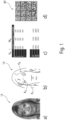
- FIG. 1 a a printed photograph 15 based on the data of a digitized image is shown and in b) a contour image 13 calculated from the printed photograph 15.
- the contours can be calculated, for example, using Canny Edge Detection or another suitable algorithm.
- the contour image 13 has a large number of contours K 1 ... K n that differ in their length, their course, their curvature, their position, etc. Examples are in Figure 1b ) three contours K 1 , K 2 , K 3 are drawn.
- a specific value W 1 ... W n can be calculated.
- the specific values W 1 ... W n of the contours K 1 ... K n are the position of the respective center of gravity (center X, Y) of the contour and the length L of the respective contour.
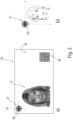
- the position of the center of gravity 50 is specified in relation to a data carrier-internal coordinate system 52, which in this example is based on the center of gravity 50 of the position of the federal eagle 51, which in Figure 2 is based on.
- the center of gravity 50 of the federal eagle 51 is in this example the control marking 50.
- the specified length is the number of pixels times the pixel size of the corresponding contour line.
- Figure d shows the coding of the values W 1 ... W 29 from Figure 1c ) as DataMatrixCode (DMC) 60, which is preferably signed.
- DMC DataMatrixCode
- Figure 2 shows in Figure 2a ) schematically shows the visible side 28 of a data carrier 20 with the federal eagle 51, photograph 15 and the data carrier-internal DMC code 60 based on the image-specific results and the position of the federal eagle 51, which is also printed on the visible side 28.
- the center of gravity 50 of the federal eagle 51 is the control marking 50 and defines the position of the zero point of the data carrier-internal coordinate system 52.
- the positions of the centers of gravity 50 of the contours K n are determined in relation to the data carrier-internal coordinate system 52 defined by the center of gravity 50 of the federal eagle 51. This is shown schematically in Figure 2b The positions of the centers of gravity of the contours K n are then stored on the data carrier 20 in the matrix code 60.
- the matrix code 60 is printed on the data carrier 20 in this embodiment with transparent ink 22 that absorbs in the near infrared (NIR). However, it can also be applied to the data carrier 20 with a luminescent ink 24 or in another way and/or stored in the electronic chip of the data carrier 20.
- a data carrier 20 When producing the data carrier 20, a data carrier 20, a substrate or a data carrier layer 27 is provided and these are printed with the federal eagle 51 and the image 15 using colored ink 16, 17, 18, 19. It is irrelevant whether the federal eagle 51 or the photograph 15 is printed first or both together. The federal eagle 51 and the photograph 15 can also be printed on different layers of the data carrier 20.
- the next step is to determine the center of gravity 50 of the federal eagle 51, which in this case is the control marking 50 and defines the zero point of the data carrier-internal or substrate-internal coordinate system 52, the calculation of the image-specific results, namely the contours K 1 ... K n and the contour-specific values W 1 ...W n , as in Figure 1 and the matrix code 60, which is signed and added to the data carrier 20 in a further personalization step.
- the image-specific values are first calculated from the data of the digitized image and the data code 60 is calculated based on the position of the control marking 50. Then, image 15, control marking 50 and data code 60 are printed, preferably simultaneously, on the data carrier 20.
- Figure 3 is a preferred variant of a data carrier 20 with two codings, namely the one already in Figure 2 described matrix code 60 based on the contour image 13 and the data carrier-internal coordinate system 52 and the contour image 13 printed in the light image 15 preferably with a transparent luminescent ink 24 that is only visible under UV irradiation.
- the data carrier 20 thus has two security features based on the data of the digitized image.
- the two codes correspond and can both be recorded with a suitable recording device such as a camera or a scanner and evaluated with the appropriate software and are therefore independent of the functionality of a data chip.
- the image-specific results (contours) and - based on the desired position of the control marking 50 - the data code 60 are first calculated from the data of the digitized image and then the light image 15 is printed with colored ink 16, 17, 18, 19, the contour image 13 is printed with transparent ink 24 that luminesces under UV irradiation, preferably via an additional color channel, into the light image 15 and preferably also in the same printing process at the same time the control marking 50 and the matrix code 60, wherein the matrix code 60 is preferably printed with a transparent IR-absorbing ink 22 and the control mark 50 are printed with a colored ink 16, 17, 18, 19.
- control marking 50 can also be printed in the photograph 15 itself, but also outside the photograph 15.
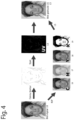
- Figure 4 shows schematically the production of the contour image 13 visible only under UV irradiation in the photograph 15 from Figure 3 .
- the contours are calculated from the data of the digital image using Canny edge detection.
- specific contours or support structures are calculated from the portrait and output as a separate contour image 13 ("Canny contour").
- This contour image 13 is prepared as a separate color channel (spot color) during printing and is printed simultaneously with the color colors (cyan, magenta, yellow, core (CMYK)) with transparent luminescent ink 24, which is only visible under UV irradiation ("spot").
- a printed image 15, 13 is produced which, in the visible spectral range, is a "normal" image 15 of the document holder in the printing colors CMYK, in which the contours are encoded, since these are only visible as luminescent lines under UV excitation.
- the contour image 13 is created from the data of the digitized image according to the first step in Figure 4 generated, and only then are the federal eagle 51, visible image 15 and, with the invisible ink 24, the contour image 13, which is only visible under UV irradiation, printed into the photograph 15, as in Figure 4
- the specific values W 1 ... W n are calculated and recorded as a signed matrix code 60 is deposited in the data carrier 20 or the substrate or the data carrier layer 27.
- Figure 5 shows the structure of a data carrier 20 of a security document 21, which consists of a printed photograph 15 and several layers 27, which are laminated together to form a composite.
- the printed photograph 15 is located within the composite layer in layer 27".
- the center of gravity 50 of the federal eagle 51 which represents the tax marking 50 in this example, is drawn on the right-hand side, and in layer 27", namely the layer with the printed photograph 15, the calculated matrix code 60 is shown schematically.
- the contour image 13 is also printed into the photograph 15 printed with the colored inks 16, 17, 18, 19 using the transparent luminescent ink 24 visible under UV irradiation.
- the matrix code 60 is printed into the layer 27" using ink 22 visible under IR irradiation.
- the verification of the light image 15 in the data carrier 20 can be carried out in relation to the printed visible light image 15 under daylight, in relation to the luminescent contour image 13 under UV irradiation and in relation to the matrix code 60 under IR irradiation.
- the layers 27, 27', 27", 27′′′ are laminated to form a composite.
- the contours 13 are now laser ablated or precisely cut into the finished data carrier 20 using a suitable laser 40, for example a CO 2 laser (wavelength 10 micrometers) or a CO laser (wavelength 5 micrometers).
- the result is a data carrier 20 in which the contours 13 are milled precisely above the printed image 15, whereby the contours represent more or less tactile depressions.
- a holographic film 26, ie a carrier layer film 26, is shown, into which the calculated contours are exposed by means of a laser 40 to produce a hologram 13.
- the holographic film 26 is then applied precisely to the data carrier 20 above the printed image 15, connected to the data carrier 20 by means of an adhesive layer 29 and the surface is then sealed with a scratch-resistant varnish 30.
- the result is a data carrier 20 with a light image 15 and precisely fitting holographic contours above the light image 15.
Landscapes
- Physics & Mathematics (AREA)
- Health & Medical Sciences (AREA)
- Electromagnetism (AREA)
- General Health & Medical Sciences (AREA)
- Optics & Photonics (AREA)
- Toxicology (AREA)
- Engineering & Computer Science (AREA)
- Manufacturing & Machinery (AREA)
- Credit Cards Or The Like (AREA)
Claims (15)
- Procédé de fabrication d'une photographie imprimée (15) sur un support de données (20) pour un document de sécurité ou de valeur (21) à partir des données d'une photographie numérisée, comprenant les étapes suivantes :a) mise à disposition d'un support de données (20),b) Impression de la photo numérisée et mise à disposition d'un marquage de commande (50) sur le support de données (20),c) lecture de la photographie imprimée (15) et calcul de résultats spécifiques à l'image à partir de la photographie imprimée (15) et/ou
calcul de résultats spécifiques à l'image à partir des données de la photographie numérisée, les résultats spécifiques à l'image étant des contours de visage déterminés à partir de la photographie ou des positions de points individuels et déterminés du visage, des vêtements ou des bijoux d'un détenteur de support de données ou des points de repère calculés à partir des contrastes de couleur ou de luminosité de la photographie ou à partir de zones individuelles de la photographie,d) détermination des positions des résultats spécifiques à l'image par rapport au marquage de commande (50),e) dépôt des résultats spécifiques à l'image et de leurs positions sous forme de code de données (60) sur le support de données (20). - Procédé selon la revendication 1, caractérisé en ce que le procédé comprend comme étape supplémentaire f) le codage de la photographie imprimée (15) avec les résultats spécifiques à l'image sous forme détectable (13).
- Procédé selon la revendication 1 ou 2, caractérisé en ce que le marquage de commande (50) est un marquage imprimé, en particulier un élément de design ou de souveraineté (51), une croix, une étoile, une lettre, un chiffre ou une autre position définie ou une autre caractéristique sur le support de données (20), par exemple un bord ou une position, un bord arrondi, et/ou le calcul des résultats spécifiques à l'image est effectué avec la détection de Canny-Edge.
et/ou le code de données (60) est un code graphique (60), en particulier un code matriciel (60), un code DataMatrix (DMC), un code à barres, un code QR ou un graphique, qui est de préférence imprimé, ou est un code de données électronique (60) enregistré sur une puce électronique du support de données (20) et/ou le support de données (20) comporte une ou plusieurs couches (25, 26) des matières plastiques suivantes ou de leurs dérivés, à savoir du polycarbonate, du polycarbonate de bisphénol A, du PC modifié par carboxy, des polyesters comme le polyéthylène téréphtalate (PET), le PET modifié par glycol (PETG), le PET modifié par carboxy, le polyéthylène naphtalate (PEN), des polymères vinyliques comme le polychlorure de vinyle (PVC), le polyvinylbutyral (PVB), polyméthacrylate de méthyle (PMMA), alcool polyvinylique (PVA), polystyrène (PS), polyvinylphénol (PVP), polypropylène (PP), polyéthylène (PE), polyacrylonitrile butadiène styrène, polyamides, polyuréthanes, polyurée, polyimides ou élastomères thermoplastiques (TPE), polyuréthane thermoplastique (TPU), copolymère acrylonitrile-butadiène-styrène (ABS), et/ou le code de données (60) est signé ou présente une signature numérique. - Procédé selon l'une quelconque des revendications précédentes, caractérisé en ce que l'impression de la photographie (15) à l'étape b) est réalisée avec des encres colorées (16), (17), (18), (19).
- Procédé selon l'une quelconque des revendications précédentes, caractérisé en ce que le codage de la photographie imprimée (15) à l'étape f) est réalisé par impression avec une encre transparente dans le domaine spectral visible, notamment une encre luminescente (24) ou une encre absorbant dans l'infrarouge (22), dans l'image visible (15) ou une zone d'une couche (25) située au-dessus de l'image (15), ou sous la forme d'un hologramme ou d'un fraisage, notamment par ablation laser, ou sous toute autre forme visuellement, haptique ou autre forme perceptible ou mesurable dans une zone (25) d'une couche (27) au-dessus de l'image (15), l'impression de l'image (15) à l'étape b) et le codage de l'image imprimée (15) par impression avec une encre transparente dans le domaine spectral visible (22, 24) à l'étape f) et l'impression du code de données (60) à l'étape e) sont réalisées simultanément, l'impression du code de données (60) étant en outre de préférence réalisée dans l'image (15) elle-même ou sur le support de données (20) en dehors de l'image (15).
- Procédé selon la revendication 5, dans lequel le codage de l'image imprimée (15) à l'étape f) est réalisé par impression avec une encre transparente luminescente (24) ou une encre transparente absorbant l'infrarouge (22), caractérisé en ce que l'encre transparente luminescente (24) ou l'encre transparente absorbant l'infrarouge (22) contient jusqu'à 10 % en poids d'encre luminescente (24) ou d'encre absorbant l'infrarouge (22) ou jusqu'à 10 % d'au moins un colorant luminescent soluble excitable par rayonnement UV et émettant dans le domaine spectral visible ou jusqu'à 10 % en poids d'au moins un colorant transparent dans le domaine spectral visible et absorbant dans l'infrarouge et/ou en ce que, lors de l'impression, l'encre transparente luminescente (24) et/ou l'encre transparente absorbant dans l'infrarouge (22) est/sont amenée(s) par un canal de couleur supplémentaire.
- Procédé selon l'une des revendications 4 ou 6, caractérisé en ce que les encres colorées (16, 17, 18, 19) selon la revendication 4 et/ou l'encre luminescente transparente ou transparente absorbant les IR (22, 24) selon la revendication 6 comprennent jusqu'à 20% en poids de liant comprenant un polycarbonate à base d'un dihydroxydiphénylcycloalcane disubstitué par voie géminale et au moins 30% en poids de solvants organiques, notamment des hydrocarbures et/ou des cétones et/ou des esters organiques.
- Procédé selon l'une quelconque des revendications précédentes, caractérisé en ce que les étapes a) à e) ou a) à f) du procédé ne sont pas réalisées successivement dans l'ordre listé.
- Procédé de vérification de l'authenticité d'une image imprimée (15) sur un support de données (20) d'un document de sécurité et de valeur (21), lequel support de données (20) comprend une photographie imprimée (15), un marquage de commande (50) et un code de données (60) basé sur des résultats spécifiques à l'image de la photographie imprimée (15) et une position du marquage de commande (50), caractérisé en ce que la photographie imprimée (15) est lue, la position du marquage de commande (50) est déterminée, les résultats spécifiques à l'image et leur position sont calculés et comparés aux valeurs enregistrées dans le code de données (60), les résultats spécifiques à l'image étant des contours de visage déterminés à partir de la photographie ou des positions de points individuels et déterminés du visage, des vêtements ou des bijoux d'un détenteur de données ou des points de repère calculés à partir des contrastes de couleur ou de luminosité de la photographie ou de zones individuelles de la photographie.
- Procédé selon la revendication 9, caractérisé en ce que la photographie imprimée (15) comprend en outre des résultats spécifiques à l'image codés dans la photographie imprimée (15) sous forme détectable (13) et les résultats spécifiques à l'image détectables (13) codés dans la photographie imprimée (15) sont lus, et à partir des résultats spécifiques à l'image détectables lus (13) et de la position du marquage de commande (50) ou à partir des résultats spécifiques à l'image calculés à partir de la photographie imprimée (15) et de la position du marquage de commande (50), les résultats spécifiques à l'image et leur position sont calculés et comparés avec les valeurs enregistrées dans le code de données (60).
- Procédé selon la revendication 9 ou 10, caractérisé en ce que, en ce que le code de données (60) est signé et la signature du code de données (60) est vérifiée en ce qui concerne la cohérence avec les résultats spécifiques à l'image et en ce qui concerne l'authentification passive ou l'utilisation de clés de signature authentiques et/ou le calcul des résultats spécifiques à l'image à partir de la photographie imprimée (15) lue est effectué avec le même algorithme que celui utilisé pour la fabrication de la photographie imprimée (15) et/ou la lecture de la photographie imprimée (15) est effectuée sous irradiation de lumière blanche avec une caméra RGB et/ou la vérification de l'authenticité de la photographie imprimée (15) est effectuée de manière automatisée et/ou la vérification est effectuée à l'aide d'un appareil de vérification de documents, un smartphone, un dispositif avec un appareil photo, le cas échéant avec flash ou un scanner pour lire la photographie imprimée (15), un logiciel pour évaluer le code de données (60), en particulier le code graphique (60), et éventuellement un logiciel pour calculer les résultats spécifiques à l'image et éventuellement une source de lumière UV.
- Procédé selon l'une des revendications 9 à 11 pour vérifier l'authenticité d'une photographie imprimée (15) selon l'une des revendications 1 à 8 sur un support de données (20).
- Document de sécurité ou de valeur (21) comprenant un support de données (20) avec un marquage de commande (50), sur lequel est imprimée une photographie (15) et sur lequel est déposé un code de données (60) qui se base sur des résultats spécifiques à l'image de la photographie (15) et sur une position du marquage de commande (50), les résultats spécifiques à l'image étant des contours de visage déterminés à partir de la photographie ou des positions de points individuels déterminés du visage, des vêtements ou des bijoux d'un titulaire de support de données ou des points de repère calculés à partir des contrastes de couleur ou de luminosité de la photographie ou de zones individuelles de la photographie.
- Document de sécurité ou de valeur (21) selon la revendication 13, caractérisé en ce que des résultats spécifiques à l'image sont en outre codés sous forme détectable (13) dans la photographie (15) et en ce que le code de données (60) déposé sur le support de données (20) repose sur les résultats spécifiques à l'image de la photographie (15) et sur la position du marquage de commande (50).
- Document de sécurité ou de valeur (21) selon l'une des revendications 13 ou 14, caractérisé en ce que le document de sécurité ou de valeur comprend une carte support de données ou un document de type livre avec un support de données, une couverture de livre et un bloc de livre.
Applications Claiming Priority (3)
| Application Number | Priority Date | Filing Date | Title |
|---|---|---|---|
| DE102020115635.9A DE102020115635A1 (de) | 2020-06-12 | 2020-06-12 | Verfahren zur Herstellung eines gedruckten Bildes auf einem Datenträger für ein Sicherheits- oder Wertdokument |
| DE102020131879 | 2020-12-01 | ||
| DE102020133826.0A DE102020133826A1 (de) | 2020-12-16 | 2020-12-16 | Verfahren zur Herstellung eines gedruckten Bildes auf einem Datenträger für ein Sicherheits- oder Wertdokument |
Publications (2)
| Publication Number | Publication Date |
|---|---|
| EP3922473A1 EP3922473A1 (fr) | 2021-12-15 |
| EP3922473B1 true EP3922473B1 (fr) | 2025-02-26 |
Family
ID=76250146
Family Applications (1)
| Application Number | Title | Priority Date | Filing Date |
|---|---|---|---|
| EP21177288.4A Active EP3922473B1 (fr) | 2020-06-12 | 2021-06-02 | Procédé de production d'une image imprimée sur un support de données pour un document de sécurité ou de valeur |
Country Status (1)
| Country | Link |
|---|---|
| EP (1) | EP3922473B1 (fr) |
Families Citing this family (1)
| Publication number | Priority date | Publication date | Assignee | Title |
|---|---|---|---|---|
| CN117021809B (zh) * | 2023-08-15 | 2024-06-25 | 深圳市大满包装有限公司 | 一种基于数码印刷的二维防伪码印刷调控方法及系统 |
Family Cites Families (8)
| Publication number | Priority date | Publication date | Assignee | Title |
|---|---|---|---|---|
| ATE552120T1 (de) * | 2001-12-24 | 2012-04-15 | L 1 Secure Credentialing Inc | Verdeckte variableninformationen auf id- dokumenten und verfahren zu ihrer herstellung |
| JP2010516823A (ja) | 2007-01-17 | 2010-05-20 | チバ ホールディング インコーポレーテッド | ジチオレン金属錯体の無色ir吸収剤 |
| DE102007052947A1 (de) | 2007-10-31 | 2009-05-07 | Bayer Materialscience Ag | Verfahren zur Herstellung eines Polycarbonat-Schichtverbundes |
| DE102013113340A1 (de) | 2013-12-02 | 2015-06-03 | Adorsys Gmbh & Co. Kg | Verfahren zum Authentifizieren eines Sicherheitselements und optisch variables Sicherheitselement |
| AT515654A2 (de) * | 2014-03-18 | 2015-10-15 | Binder Consulting Gmbh | Sicherheitsmerkmal mit einem Markierungs- und einem Codeabschnitt |
| DE102014214548B4 (de) | 2014-07-24 | 2022-10-13 | Morpho Cards Gmbh | Verfahren zur Herstellung eines Dokuments |
| DE102017206466A1 (de) * | 2017-04-13 | 2018-10-18 | Tesa Scribos Gmbh | Sicherheitsmerkmal mit Kopierschutz |
| DE102017206487B4 (de) | 2017-04-18 | 2020-07-02 | Eberspächer Catem Gmbh & Co. Kg | PTC-Heizelement und Verfahren zu dessen Herstellung |
-
2021
- 2021-06-02 EP EP21177288.4A patent/EP3922473B1/fr active Active
Also Published As
| Publication number | Publication date |
|---|---|
| EP3922473A1 (fr) | 2021-12-15 |
Similar Documents
| Publication | Publication Date | Title |
|---|---|---|
| EP3411245B1 (fr) | Produit de valeur ou de sécurité, procédé de fabrication d'un produit semi-fini et procédé de vérification | |
| EP2459389B2 (fr) | Document d'identification à identification visuelle personnalisée et son procédé de production | |
| EP3615347B1 (fr) | Insert de sécurité pour un document d'identité et procédé de fabrication d'un insert de sécurité pour un document d'identité | |
| DE102017004055B4 (de) | Sicherheitseinlage mit einem UV-Auftrag für ein Ausweisdokument und Verfahren zur Herstellung einer Sicherheitseinlage mit einem UV-Auftrag für ein Ausweisdokument | |
| DE102020133826A1 (de) | Verfahren zur Herstellung eines gedruckten Bildes auf einem Datenträger für ein Sicherheits- oder Wertdokument | |
| EP2903835B1 (fr) | Signe de sécurité et produit de valeur et/ou de sécurité pourvu de ce signe de sécurité | |
| DE102017004037B4 (de) | Sicherheitseinlage mit einer Vertiefung für ein Ausweisdokument und Verfahren zur Herstellung einer Sicherheitseinlage mit einer Vertiefung für ein Ausweisdokument | |
| EP3922473B1 (fr) | Procédé de production d'une image imprimée sur un support de données pour un document de sécurité ou de valeur | |
| EP4215377B1 (fr) | Vérification d'un document de sécurité sur la base de morphologies de gouttelettes | |
| EP3922474B1 (fr) | Procédé de vérification de l'authenticité d'une image imprimée sur un support pour un document de sécurité ou de valeur | |
| EP4163122B1 (fr) | Corps de document avec un identifiant de face frontale visiblement vérifiable | |
| EP3693181B1 (fr) | Document d'identification et procédé de fabrication d'un document d'identification | |
| EP3256329B1 (fr) | Produit de valeur ou de sécurité et procédé de fabrication de celui-ci avec individualisation décentralisée | |
| EP4051507B1 (fr) | Procédé et système de production et de vérification d'un document de sécurité | |
| EP3938217A1 (fr) | Insert de sécurité doté d'un dispositif tactile de vernissage d'un document d'identification et procédé de fabrication d'un tel insert de sécurité | |
| WO2020144000A1 (fr) | Insert de sécurité pour un document d'identité pourvu d'une fenêtre transparente | |
| EP4029702B1 (fr) | Support de données, son procédé de fabrication et document de valeur ou de sécurité | |
| DE102025112853A1 (de) | Sicherheitselement, Datenträger und Verfahren zur Herstellung des Datenträgers | |
| DE102024105533A1 (de) | Sicherheitsdokument, verfahren und vorrichtung zum herstellen eines sicherheitsdokuments |
Legal Events
| Date | Code | Title | Description |
|---|---|---|---|
| PUAI | Public reference made under article 153(3) epc to a published international application that has entered the european phase |
Free format text: ORIGINAL CODE: 0009012 |
|
| STAA | Information on the status of an ep patent application or granted ep patent |
Free format text: STATUS: THE APPLICATION HAS BEEN PUBLISHED |
|
| AK | Designated contracting states |
Kind code of ref document: A1 Designated state(s): AL AT BE BG CH CY CZ DE DK EE ES FI FR GB GR HR HU IE IS IT LI LT LU LV MC MK MT NL NO PL PT RO RS SE SI SK SM TR |
|
| B565 | Issuance of search results under rule 164(2) epc |
Effective date: 20211007 |
|
| STAA | Information on the status of an ep patent application or granted ep patent |
Free format text: STATUS: REQUEST FOR EXAMINATION WAS MADE |
|
| 17P | Request for examination filed |
Effective date: 20220615 |
|
| RBV | Designated contracting states (corrected) |
Designated state(s): AL AT BE BG CH CY CZ DE DK EE ES FI FR GB GR HR HU IE IS IT LI LT LU LV MC MK MT NL NO PL PT RO RS SE SI SK SM TR |
|
| P01 | Opt-out of the competence of the unified patent court (upc) registered |
Effective date: 20230526 |
|
| STAA | Information on the status of an ep patent application or granted ep patent |
Free format text: STATUS: EXAMINATION IS IN PROGRESS |
|
| 17Q | First examination report despatched |
Effective date: 20240327 |
|
| GRAP | Despatch of communication of intention to grant a patent |
Free format text: ORIGINAL CODE: EPIDOSNIGR1 |
|
| STAA | Information on the status of an ep patent application or granted ep patent |
Free format text: STATUS: GRANT OF PATENT IS INTENDED |
|
| GRAJ | Information related to disapproval of communication of intention to grant by the applicant or resumption of examination proceedings by the epo deleted |
Free format text: ORIGINAL CODE: EPIDOSDIGR1 |
|
| STAA | Information on the status of an ep patent application or granted ep patent |
Free format text: STATUS: EXAMINATION IS IN PROGRESS |
|
| GRAP | Despatch of communication of intention to grant a patent |
Free format text: ORIGINAL CODE: EPIDOSNIGR1 |
|
| STAA | Information on the status of an ep patent application or granted ep patent |
Free format text: STATUS: GRANT OF PATENT IS INTENDED |
|
| INTG | Intention to grant announced |
Effective date: 20241115 |
|
| INTC | Intention to grant announced (deleted) | ||
| INTG | Intention to grant announced |
Effective date: 20241213 |
|
| GRAS | Grant fee paid |
Free format text: ORIGINAL CODE: EPIDOSNIGR3 |
|
| GRAA | (expected) grant |
Free format text: ORIGINAL CODE: 0009210 |
|
| STAA | Information on the status of an ep patent application or granted ep patent |
Free format text: STATUS: THE PATENT HAS BEEN GRANTED |
|
| AK | Designated contracting states |
Kind code of ref document: B1 Designated state(s): AL AT BE BG CH CY CZ DE DK EE ES FI FR GB GR HR HU IE IS IT LI LT LU LV MC MK MT NL NO PL PT RO RS SE SI SK SM TR |
|
| REG | Reference to a national code |
Ref country code: GB Ref legal event code: FG4D Free format text: NOT ENGLISH |
|
| REG | Reference to a national code |
Ref country code: CH Ref legal event code: EP |
|
| REG | Reference to a national code |
Ref country code: DE Ref legal event code: R096 Ref document number: 502021006749 Country of ref document: DE |
|
| REG | Reference to a national code |
Ref country code: IE Ref legal event code: FG4D Free format text: LANGUAGE OF EP DOCUMENT: GERMAN |
|
| REG | Reference to a national code |
Ref country code: NL Ref legal event code: MP Effective date: 20250226 |
|
| PG25 | Lapsed in a contracting state [announced via postgrant information from national office to epo] |
Ref country code: RS Free format text: LAPSE BECAUSE OF FAILURE TO SUBMIT A TRANSLATION OF THE DESCRIPTION OR TO PAY THE FEE WITHIN THE PRESCRIBED TIME-LIMIT Effective date: 20250526 |
|
| PG25 | Lapsed in a contracting state [announced via postgrant information from national office to epo] |
Ref country code: FI Free format text: LAPSE BECAUSE OF FAILURE TO SUBMIT A TRANSLATION OF THE DESCRIPTION OR TO PAY THE FEE WITHIN THE PRESCRIBED TIME-LIMIT Effective date: 20250226 |
|
| PG25 | Lapsed in a contracting state [announced via postgrant information from national office to epo] |
Ref country code: PL Free format text: LAPSE BECAUSE OF FAILURE TO SUBMIT A TRANSLATION OF THE DESCRIPTION OR TO PAY THE FEE WITHIN THE PRESCRIBED TIME-LIMIT Effective date: 20250226 |
|
| PGFP | Annual fee paid to national office [announced via postgrant information from national office to epo] |
Ref country code: DE Payment date: 20250618 Year of fee payment: 5 |
|
| PG25 | Lapsed in a contracting state [announced via postgrant information from national office to epo] |
Ref country code: ES Free format text: LAPSE BECAUSE OF FAILURE TO SUBMIT A TRANSLATION OF THE DESCRIPTION OR TO PAY THE FEE WITHIN THE PRESCRIBED TIME-LIMIT Effective date: 20250226 |
|
| PGFP | Annual fee paid to national office [announced via postgrant information from national office to epo] |
Ref country code: GB Payment date: 20250620 Year of fee payment: 5 |
|
| REG | Reference to a national code |
Ref country code: LT Ref legal event code: MG9D |
|
| PG25 | Lapsed in a contracting state [announced via postgrant information from national office to epo] |
Ref country code: NO Free format text: LAPSE BECAUSE OF FAILURE TO SUBMIT A TRANSLATION OF THE DESCRIPTION OR TO PAY THE FEE WITHIN THE PRESCRIBED TIME-LIMIT Effective date: 20250526 Ref country code: IS Free format text: LAPSE BECAUSE OF FAILURE TO SUBMIT A TRANSLATION OF THE DESCRIPTION OR TO PAY THE FEE WITHIN THE PRESCRIBED TIME-LIMIT Effective date: 20250626 |
|
| PG25 | Lapsed in a contracting state [announced via postgrant information from national office to epo] |
Ref country code: NL Free format text: LAPSE BECAUSE OF FAILURE TO SUBMIT A TRANSLATION OF THE DESCRIPTION OR TO PAY THE FEE WITHIN THE PRESCRIBED TIME-LIMIT Effective date: 20250226 |
|
| PG25 | Lapsed in a contracting state [announced via postgrant information from national office to epo] |
Ref country code: HR Free format text: LAPSE BECAUSE OF FAILURE TO SUBMIT A TRANSLATION OF THE DESCRIPTION OR TO PAY THE FEE WITHIN THE PRESCRIBED TIME-LIMIT Effective date: 20250226 |
|
| PG25 | Lapsed in a contracting state [announced via postgrant information from national office to epo] |
Ref country code: LV Free format text: LAPSE BECAUSE OF FAILURE TO SUBMIT A TRANSLATION OF THE DESCRIPTION OR TO PAY THE FEE WITHIN THE PRESCRIBED TIME-LIMIT Effective date: 20250226 Ref country code: PT Free format text: LAPSE BECAUSE OF FAILURE TO SUBMIT A TRANSLATION OF THE DESCRIPTION OR TO PAY THE FEE WITHIN THE PRESCRIBED TIME-LIMIT Effective date: 20250626 |
|
| PGFP | Annual fee paid to national office [announced via postgrant information from national office to epo] |
Ref country code: FR Payment date: 20250626 Year of fee payment: 5 |
|
| PG25 | Lapsed in a contracting state [announced via postgrant information from national office to epo] |
Ref country code: BG Free format text: LAPSE BECAUSE OF FAILURE TO SUBMIT A TRANSLATION OF THE DESCRIPTION OR TO PAY THE FEE WITHIN THE PRESCRIBED TIME-LIMIT Effective date: 20250226 Ref country code: GR Free format text: LAPSE BECAUSE OF FAILURE TO SUBMIT A TRANSLATION OF THE DESCRIPTION OR TO PAY THE FEE WITHIN THE PRESCRIBED TIME-LIMIT Effective date: 20250527 |
|
| PGFP | Annual fee paid to national office [announced via postgrant information from national office to epo] |
Ref country code: AT Payment date: 20250721 Year of fee payment: 5 |
|
| PG25 | Lapsed in a contracting state [announced via postgrant information from national office to epo] |
Ref country code: SE Free format text: LAPSE BECAUSE OF FAILURE TO SUBMIT A TRANSLATION OF THE DESCRIPTION OR TO PAY THE FEE WITHIN THE PRESCRIBED TIME-LIMIT Effective date: 20250226 |
|
| PG25 | Lapsed in a contracting state [announced via postgrant information from national office to epo] |
Ref country code: SM Free format text: LAPSE BECAUSE OF FAILURE TO SUBMIT A TRANSLATION OF THE DESCRIPTION OR TO PAY THE FEE WITHIN THE PRESCRIBED TIME-LIMIT Effective date: 20250226 |
|
| PG25 | Lapsed in a contracting state [announced via postgrant information from national office to epo] |
Ref country code: DK Free format text: LAPSE BECAUSE OF FAILURE TO SUBMIT A TRANSLATION OF THE DESCRIPTION OR TO PAY THE FEE WITHIN THE PRESCRIBED TIME-LIMIT Effective date: 20250226 |
|
| PG25 | Lapsed in a contracting state [announced via postgrant information from national office to epo] |
Ref country code: IT Free format text: LAPSE BECAUSE OF FAILURE TO SUBMIT A TRANSLATION OF THE DESCRIPTION OR TO PAY THE FEE WITHIN THE PRESCRIBED TIME-LIMIT Effective date: 20250226 |
|
| PG25 | Lapsed in a contracting state [announced via postgrant information from national office to epo] |
Ref country code: CZ Free format text: LAPSE BECAUSE OF FAILURE TO SUBMIT A TRANSLATION OF THE DESCRIPTION OR TO PAY THE FEE WITHIN THE PRESCRIBED TIME-LIMIT Effective date: 20250226 Ref country code: EE Free format text: LAPSE BECAUSE OF FAILURE TO SUBMIT A TRANSLATION OF THE DESCRIPTION OR TO PAY THE FEE WITHIN THE PRESCRIBED TIME-LIMIT Effective date: 20250226 |
|
| PG25 | Lapsed in a contracting state [announced via postgrant information from national office to epo] |
Ref country code: RO Free format text: LAPSE BECAUSE OF FAILURE TO SUBMIT A TRANSLATION OF THE DESCRIPTION OR TO PAY THE FEE WITHIN THE PRESCRIBED TIME-LIMIT Effective date: 20250226 |
|
| PG25 | Lapsed in a contracting state [announced via postgrant information from national office to epo] |
Ref country code: SK Free format text: LAPSE BECAUSE OF FAILURE TO SUBMIT A TRANSLATION OF THE DESCRIPTION OR TO PAY THE FEE WITHIN THE PRESCRIBED TIME-LIMIT Effective date: 20250226 |
|
| REG | Reference to a national code |
Ref country code: DE Ref legal event code: R097 Ref document number: 502021006749 Country of ref document: DE |
|
| PLBE | No opposition filed within time limit |
Free format text: ORIGINAL CODE: 0009261 |
|
| STAA | Information on the status of an ep patent application or granted ep patent |
Free format text: STATUS: NO OPPOSITION FILED WITHIN TIME LIMIT |
|
| REG | Reference to a national code |
Ref country code: CH Ref legal event code: L10 Free format text: ST27 STATUS EVENT CODE: U-0-0-L10-L00 (AS PROVIDED BY THE NATIONAL OFFICE) Effective date: 20260107 |
|
| REG | Reference to a national code |
Ref country code: CH Ref legal event code: H13 Free format text: ST27 STATUS EVENT CODE: U-0-0-H10-H13 (AS PROVIDED BY THE NATIONAL OFFICE) Effective date: 20260127 |
|
| PG25 | Lapsed in a contracting state [announced via postgrant information from national office to epo] |
Ref country code: MC Free format text: LAPSE BECAUSE OF FAILURE TO SUBMIT A TRANSLATION OF THE DESCRIPTION OR TO PAY THE FEE WITHIN THE PRESCRIBED TIME-LIMIT Effective date: 20250226 |
|
| 26N | No opposition filed |
Effective date: 20251127 |
|
| PG25 | Lapsed in a contracting state [announced via postgrant information from national office to epo] |
Ref country code: LU Free format text: LAPSE BECAUSE OF NON-PAYMENT OF DUE FEES Effective date: 20250602 |
|
| REG | Reference to a national code |
Ref country code: BE Ref legal event code: MM Effective date: 20250630 |
|
| PG25 | Lapsed in a contracting state [announced via postgrant information from national office to epo] |
Ref country code: IE Free format text: LAPSE BECAUSE OF NON-PAYMENT OF DUE FEES Effective date: 20250602 |
|
| PG25 | Lapsed in a contracting state [announced via postgrant information from national office to epo] |
Ref country code: BE Free format text: LAPSE BECAUSE OF NON-PAYMENT OF DUE FEES Effective date: 20250630 |