EP3932383A1 - Komposite mit verringerter polymerisationsschrumpfungsspannung - Google Patents
Komposite mit verringerter polymerisationsschrumpfungsspannung Download PDFInfo
- Publication number
- EP3932383A1 EP3932383A1 EP20184024.6A EP20184024A EP3932383A1 EP 3932383 A1 EP3932383 A1 EP 3932383A1 EP 20184024 A EP20184024 A EP 20184024A EP 3932383 A1 EP3932383 A1 EP 3932383A1
- Authority
- EP
- European Patent Office
- Prior art keywords
- weight
- radical
- meth
- aliphatic
- linear
- Prior art date
- Legal status (The legal status is an assumption and is not a legal conclusion. Google has not performed a legal analysis and makes no representation as to the accuracy of the status listed.)
- Granted
Links
- KESHZRKRDRMQCR-UHFFFAOYSA-N CCCCCCCCCCCCNC(OCCSCC(C(OCC)=O)=C)=O Chemical compound CCCCCCCCCCCCNC(OCCSCC(C(OCC)=O)=C)=O KESHZRKRDRMQCR-UHFFFAOYSA-N 0.000 description 1
- 0 O=C(N*N=C=O)ONOC(N*N=C=O)=O Chemical compound O=C(N*N=C=O)ONOC(N*N=C=O)=O 0.000 description 1
Classifications
-
- C—CHEMISTRY; METALLURGY
- C08—ORGANIC MACROMOLECULAR COMPOUNDS; THEIR PREPARATION OR CHEMICAL WORKING-UP; COMPOSITIONS BASED THEREON
- C08F—MACROMOLECULAR COMPOUNDS OBTAINED BY REACTIONS ONLY INVOLVING CARBON-TO-CARBON UNSATURATED BONDS
- C08F222/00—Copolymers of compounds having one or more unsaturated aliphatic radicals, each having only one carbon-to-carbon double bond, and at least one being terminated by a carboxyl radical and containing at least one other carboxyl radical in the molecule; Salts, anhydrides, esters, amides, imides, or nitriles thereof
- C08F222/10—Esters
- C08F222/1006—Esters of polyhydric alcohols or polyhydric phenols
- C08F222/102—Esters of polyhydric alcohols or polyhydric phenols of dialcohols, e.g. ethylene glycol di(meth)acrylate or 1,4-butanediol dimethacrylate
- C08F222/1025—Esters of polyhydric alcohols or polyhydric phenols of dialcohols, e.g. ethylene glycol di(meth)acrylate or 1,4-butanediol dimethacrylate of aromatic dialcohols
-
- C—CHEMISTRY; METALLURGY
- C08—ORGANIC MACROMOLECULAR COMPOUNDS; THEIR PREPARATION OR CHEMICAL WORKING-UP; COMPOSITIONS BASED THEREON
- C08F—MACROMOLECULAR COMPOUNDS OBTAINED BY REACTIONS ONLY INVOLVING CARBON-TO-CARBON UNSATURATED BONDS
- C08F222/00—Copolymers of compounds having one or more unsaturated aliphatic radicals, each having only one carbon-to-carbon double bond, and at least one being terminated by a carboxyl radical and containing at least one other carboxyl radical in the molecule; Salts, anhydrides, esters, amides, imides, or nitriles thereof
- C08F222/10—Esters
- C08F222/1006—Esters of polyhydric alcohols or polyhydric phenols
- C08F222/102—Esters of polyhydric alcohols or polyhydric phenols of dialcohols, e.g. ethylene glycol di(meth)acrylate or 1,4-butanediol dimethacrylate
-
- A—HUMAN NECESSITIES
- A61—MEDICAL OR VETERINARY SCIENCE; HYGIENE
- A61K—PREPARATIONS FOR MEDICAL, DENTAL OR TOILETRY PURPOSES
- A61K6/00—Preparations for dentistry
- A61K6/60—Preparations for dentistry comprising organic or organo-metallic additives
- A61K6/62—Photochemical radical initiators
-
- A—HUMAN NECESSITIES
- A61—MEDICAL OR VETERINARY SCIENCE; HYGIENE
- A61K—PREPARATIONS FOR MEDICAL, DENTAL OR TOILETRY PURPOSES
- A61K6/00—Preparations for dentistry
- A61K6/15—Compositions characterised by their physical properties
-
- A—HUMAN NECESSITIES
- A61—MEDICAL OR VETERINARY SCIENCE; HYGIENE
- A61K—PREPARATIONS FOR MEDICAL, DENTAL OR TOILETRY PURPOSES
- A61K6/00—Preparations for dentistry
- A61K6/30—Compositions for temporarily or permanently fixing teeth or palates, e.g. primers for dental adhesives
-
- A—HUMAN NECESSITIES
- A61—MEDICAL OR VETERINARY SCIENCE; HYGIENE
- A61K—PREPARATIONS FOR MEDICAL, DENTAL OR TOILETRY PURPOSES
- A61K6/00—Preparations for dentistry
- A61K6/70—Preparations for dentistry comprising inorganic additives
- A61K6/71—Fillers
- A61K6/73—Fillers comprising sulfur-containing compounds
-
- A—HUMAN NECESSITIES
- A61—MEDICAL OR VETERINARY SCIENCE; HYGIENE
- A61K—PREPARATIONS FOR MEDICAL, DENTAL OR TOILETRY PURPOSES
- A61K6/00—Preparations for dentistry
- A61K6/80—Preparations for artificial teeth, for filling teeth or for capping teeth
- A61K6/802—Preparations for artificial teeth, for filling teeth or for capping teeth comprising ceramics
- A61K6/818—Preparations for artificial teeth, for filling teeth or for capping teeth comprising ceramics comprising zirconium oxide
-
- A—HUMAN NECESSITIES
- A61—MEDICAL OR VETERINARY SCIENCE; HYGIENE
- A61K—PREPARATIONS FOR MEDICAL, DENTAL OR TOILETRY PURPOSES
- A61K6/00—Preparations for dentistry
- A61K6/80—Preparations for artificial teeth, for filling teeth or for capping teeth
- A61K6/831—Preparations for artificial teeth, for filling teeth or for capping teeth comprising non-metallic elements or compounds thereof, e.g. carbon
- A61K6/833—Glass-ceramic composites
-
- A—HUMAN NECESSITIES
- A61—MEDICAL OR VETERINARY SCIENCE; HYGIENE
- A61K—PREPARATIONS FOR MEDICAL, DENTAL OR TOILETRY PURPOSES
- A61K6/00—Preparations for dentistry
- A61K6/80—Preparations for artificial teeth, for filling teeth or for capping teeth
- A61K6/884—Preparations for artificial teeth, for filling teeth or for capping teeth comprising natural or synthetic resins
- A61K6/887—Compounds obtained by reactions only involving carbon-to-carbon unsaturated bonds
-
- C—CHEMISTRY; METALLURGY
- C08—ORGANIC MACROMOLECULAR COMPOUNDS; THEIR PREPARATION OR CHEMICAL WORKING-UP; COMPOSITIONS BASED THEREON
- C08F—MACROMOLECULAR COMPOUNDS OBTAINED BY REACTIONS ONLY INVOLVING CARBON-TO-CARBON UNSATURATED BONDS
- C08F2/00—Processes of polymerisation
- C08F2/46—Polymerisation initiated by wave energy or particle radiation
- C08F2/48—Polymerisation initiated by wave energy or particle radiation by ultraviolet or visible light
-
- C—CHEMISTRY; METALLURGY
- C08—ORGANIC MACROMOLECULAR COMPOUNDS; THEIR PREPARATION OR CHEMICAL WORKING-UP; COMPOSITIONS BASED THEREON
- C08K—Use of inorganic or non-macromolecular organic substances as compounding ingredients
- C08K13/00—Use of mixtures of ingredients not covered by one single of the preceding main groups, each of these compounds being essential
- C08K13/02—Organic and inorganic ingredients
-
- C—CHEMISTRY; METALLURGY
- C08—ORGANIC MACROMOLECULAR COMPOUNDS; THEIR PREPARATION OR CHEMICAL WORKING-UP; COMPOSITIONS BASED THEREON
- C08K—Use of inorganic or non-macromolecular organic substances as compounding ingredients
- C08K3/00—Use of inorganic substances as compounding ingredients
- C08K3/16—Halogen-containing compounds
-
- C—CHEMISTRY; METALLURGY
- C08—ORGANIC MACROMOLECULAR COMPOUNDS; THEIR PREPARATION OR CHEMICAL WORKING-UP; COMPOSITIONS BASED THEREON
- C08K—Use of inorganic or non-macromolecular organic substances as compounding ingredients
- C08K3/00—Use of inorganic substances as compounding ingredients
- C08K3/18—Oxygen-containing compounds, e.g. metal carbonyls
- C08K3/20—Oxides; Hydroxides
- C08K3/22—Oxides; Hydroxides of metals
-
- C—CHEMISTRY; METALLURGY
- C08—ORGANIC MACROMOLECULAR COMPOUNDS; THEIR PREPARATION OR CHEMICAL WORKING-UP; COMPOSITIONS BASED THEREON
- C08K—Use of inorganic or non-macromolecular organic substances as compounding ingredients
- C08K3/00—Use of inorganic substances as compounding ingredients
- C08K3/34—Silicon-containing compounds
- C08K3/36—Silica
-
- C—CHEMISTRY; METALLURGY
- C08—ORGANIC MACROMOLECULAR COMPOUNDS; THEIR PREPARATION OR CHEMICAL WORKING-UP; COMPOSITIONS BASED THEREON
- C08K—Use of inorganic or non-macromolecular organic substances as compounding ingredients
- C08K3/00—Use of inorganic substances as compounding ingredients
- C08K3/40—Glass
-
- C—CHEMISTRY; METALLURGY
- C08—ORGANIC MACROMOLECULAR COMPOUNDS; THEIR PREPARATION OR CHEMICAL WORKING-UP; COMPOSITIONS BASED THEREON
- C08K—Use of inorganic or non-macromolecular organic substances as compounding ingredients
- C08K9/00—Use of pretreated ingredients
- C08K9/04—Ingredients treated with organic substances
- C08K9/06—Ingredients treated with organic substances with silicon-containing compounds
-
- C—CHEMISTRY; METALLURGY
- C08—ORGANIC MACROMOLECULAR COMPOUNDS; THEIR PREPARATION OR CHEMICAL WORKING-UP; COMPOSITIONS BASED THEREON
- C08K—Use of inorganic or non-macromolecular organic substances as compounding ingredients
- C08K3/00—Use of inorganic substances as compounding ingredients
- C08K3/18—Oxygen-containing compounds, e.g. metal carbonyls
- C08K3/20—Oxides; Hydroxides
- C08K3/22—Oxides; Hydroxides of metals
- C08K2003/2244—Oxides; Hydroxides of metals of zirconium
-
- C—CHEMISTRY; METALLURGY
- C08—ORGANIC MACROMOLECULAR COMPOUNDS; THEIR PREPARATION OR CHEMICAL WORKING-UP; COMPOSITIONS BASED THEREON
- C08K—Use of inorganic or non-macromolecular organic substances as compounding ingredients
- C08K2201/00—Specific properties of additives
- C08K2201/002—Physical properties
- C08K2201/005—Additives being defined by their particle size in general
Definitions
- the present invention relates to thermally and / or light-curing composites for the production of dental cements and filling composites, inlays, onlays, crowns, bridges or veneering materials.
- Dental composites which are used, for example, as composite cement or as direct filling material, inlay, onlay, crown or veneering material, contain a polymerizable organic matrix and one or more fillers, which are usually surface-modified with a polymerizable adhesion promoter.
- the degree of filling can vary between approx. 50 to 90% by weight, with cements having a lower degree of filling compared to filling composites.
- the polymerizable organic matrix usually contains a mixture of monomers, initiator components, stabilizers and pigments. Mixtures of dimethacrylates are mostly used as resins. Examples of this are the highly viscous dimethacrylates 2,2-bis [4- (2-hydroxy-3-methacryloyl-oxypropyl) phenyl] propane (Bis-GMA) and 1,6-bis [2-methacryl-oyloxyethoxycarbonylamino] -2, 4,4-trimethylhexane (UDMA) or the low-viscosity dimethacrylates used as thinner monomers, such as bismethacryloyloxymethyltricyclo [5.2.1.] Decane (TCDMA), decanediol-1,10-dimethacrylate (D 3 MA) and triethylene glycol dimethacrylate (TEGDMA) .
- TCDMA triethylene glycol dimethacrylate
- TEGDMA triethylene glycol dimethacrylate
- the polymerization shrinkage ( ⁇ V P ) of the monomers used leads to a volume contraction, which in the case of filling composites can lead to the formation of very disadvantageous marginal gaps.
- this polymerization shrinkage does not lead to the build-up of a polymerization shrinkage stress (PKS) because the volume is reduced can be compensated for by the flow of the macromolecules formed.
- PPS polymerization shrinkage stress
- a three-dimensional polymer network is formed within a few seconds at the so-called gel point, i.e.
- the WO 98/37104 discloses a method for controlling molecular weight in the production of linear polymers by photoinitiated radical polymerization of vinyl monomers, in which the photoinitiator is used together with an addition-fragmentation chain transfer agent.
- WO 2006/086646 A2 is said to be able to reduce the PKS in cross-linked polymers by incorporating groups into the polymer network that enable reversible chain cleavage. After curing, these groups are activated, for example, by exposure to light. This should bring about a reversible cleavage of the polymer chains, through which the PKS is broken down.
- groups for installation of these groups are reversible addition-fragmentation Kettenübertra-gungs- (RAFT; R eversible A ddition- F ragmentation Chain T rans-fer) in the polymer chains agents such as allylic sulfides, dithiocarbamates and thiocarbonates used.
- RAFT reagents are known from controlled radical polymerization (cf. eg Moad, G .; Rizzardo, E .; Thang, SH Polymer 2008, 49, 1079-1131 ).
- the US 2012/0295228 A1 discloses radically polymerizable dental materials which contain ethylenically unsaturated monomers with allyl disulfide groups which are effective as addition fragmentation materials and which are intended to reduce PKS.
- mercaptans such as mercaptobenzene, benzyl mercaptan, methyl mercaptopropionate, 1,6-hexanedithiol or trimethylolpropane tris- (3-mercaptopropionate)
- U.S. 5,932,675 discloses a process for preparing low molecular weight polymers by free radical polymerization.
- the molecular weight is controlled by adding chain transfer agents such as, for example, ⁇ - (t-butanthiomethyl) styrene.
- the invention is based on the object of providing polymerizable dental materials which do not have the above-mentioned disadvantages and which, compared to the prior art, are characterized by a reduced polymerization shrinkage stress (PKS) with comparable mechanical properties and a comparable polymerization rate.
- PPS polymerization shrinkage stress
- the materials should have a more homogeneous network architecture and a narrower range for the glass transition temperature.
- they should have an odor that is acceptable for intraoral use and not a color of their own.
- compositions which contain at least one compound of the formulas I to III:
- W preferably has a molar mass of 500-3000 g / mol.
- the molar mass of W is determined on the basis of the oligomeric building blocks used in the synthesis, for example the OH-telechelic polyether or polyester.
- commercially available OHtelecheles PEG-1000 contains approx. 22 repeating units (HO- (CH 2 -CH 2 -O-) 22 H with a molar mass of 44 g / mol each.
- the molecular weight of the oligomers used for the synthesis is preferably determined by means of vapor pressure osmometry, ebullioscopy or cryoscopy, which is the number-average, absolute molecular weight.
- Preferred polyether groups are oligomers made from ethylene or propylene glycol units or ring-opening homo- or copolymers from ethylene oxide, propylene oxide and / or tetrahydrofuran.
- Preferred polyester groups are polycondensates of aliphatic C 2 -C 10 -diols and C 3 -C 10 -dicarboxylic acids or C 3 -C 8 - ⁇ , ⁇ -hydroxycarboxylic acids and ring-opening polymers of caprolactone.
- Preferred polythioether groups are polycondensates of ⁇ , ⁇ -dihalo-C 2 -C 10 -alkanes with sodium sulfide with a maximum of five sulfur atoms in the building block, the compounds of the formulas I to III according to the invention in all cases preferably not more than five sulfur atoms per molecule contain.
- Preferred halogens are chlorine or bromine.
- the substituents which may be present in the individual radicals are preferably each composed of C 1 -C 3 -alkyl groups, in particular CH 3 - and / or C 2 H 5 -, halogen, -OH, -OCH 3 or -O-COCH 3 , polymerizable vinyl, (meth) acryloyloxy and / or (meth) acrylamide groups are selected.
- the radicals can in each case be substituted with one or more substituents.
- the radicals are preferably substituted or unsubstituted by 1 to 3 substituents, in particular aliphatic radicals are preferably unsubstituted.
- the ratio of allyl sulfide groups to urethane groups is preferably 1: 1 to 1: 2.
- Compounds of the formulas I to III are also referred to herein as urethane allyl sulfides or allyl sulfides.
- Preferred urethane allyl compounds of the formula I according to the invention are:
- Preferred urethane allyl compounds of the formula II are:
- Preferred urethane allyl compounds of the formula III are:
- the compounds of the formulas I to III enable the network structure to be monitored or controlled during free-radical polymerization. Surprisingly, they result in more homogeneous polymer networks with a narrower glass transition, i.e. the glass transition takes place in a narrower temperature range. Accordingly, the PKS is also reduced during the hardening of the materials, which is a great advantage for dental use, e.g. as a filling material.
- the compositions according to the invention preferably contain at least one further free-radically polymerizable monomer, particularly preferably at least one multifunctional (meth) acrylate or a mixture of mono- and multi -functional (meth) acrylates.
- Monofunctional (meth) acrylates are understood to mean compounds with one, and multifunctional (meth) acrylates compounds with two or more, preferably 2 to 4, free-radically polymerizable groups.
- the compositions according to the invention contain at least one dimethacrylate or a mixture of mono- and dimethacrylates.
- Examples of particularly suitable mono- or multifunctional (meth) acrylates are methyl, ethyl, 2-hydroxyethyl, butyl, benzyl, tetrahydrofurfuryl or isobornyl (meth) acrylate, p-cumyl-phenoxyethylene glycol methacrylate (CMP-1E), Bisphenol A di (meth) acrylate, bis G (M) A (an addition product of (meth) acrylic acid and bisphenol A diglycidyl ether), ethoxy or propoxylated bisphenol A di (meth) acrylate, such as bisphenol A dimethacrylate with 3 ethoxy groups (SR-348c, Sartomer) or 2,2-bis [4- (2- (meth) acryloxypropoxy) phenyl] propane, UDMA (an addition product of 2-hydroxyethyl methacrylate and 2,2,4-trimethylhexamethylene diisocyanate), di-, tri- or tetraethylene glycol di ( me
- thermolabile or photolabile di (meth) acrylates such as, for example, the addition product of 2 mol of 2-acetoacetoxyethyl methacrylate and 1 mol of 2,2,4-trimethylhexamethylene-1,6-diisocyanate (thermolabile) or methacrylic acid-2 - [2- (4- ⁇ 2-methyl-2- [2- (methacryloyloxy) -ethylcarbamoyloxy] propionyl ⁇ -phenoxy) -ethoxycarbonylamino] -ethyl ester.
- thermolabile or photolabile di (meth) acrylates such as, for example, the addition product of 2 mol of 2-acetoacetoxyethyl methacrylate and 1 mol of 2,2,4-trimethylhexamethylene-1,6-diisocyanate (thermolabile) or methacrylic acid-2 - [2- (4- ⁇ 2-methyl-2- [2- (methacryloyloxy)
- the dental materials according to the invention can preferably also contain monomers (adhesive monomers) which can be polymerized by free radicals and contain acid groups.
- Preferred acid groups are carboxylic acid groups, phosphonic acid groups and phosphoric acid groups.
- Preferred monomers containing acid groups are 4- (meth) acryloyloxyethyl-trimellitic anhydride, 10-methacryloyloxydecylmalonic acid, N- (2-hydroxy-3-methacryloyloxypropyl) -N-phenylglycine and 4-vinylbenzoic acid.
- monomers containing acid groups are 2-methacryloyloxyethyl-phenyl-hydrogen phosphate, 10-methacryloyloxydecyl dihydrogen phosphate (MDP) or dipenta-erythritol pentamethacryloyloxyphosphate.
- MDP 10-methacryloyloxydecyl dihydrogen phosphate
- dipenta-erythritol pentamethacryloyloxyphosphate 4-vinylbenzylphosphonic acid, 2- [4- (dihydroxyphosphoryl) -2-oxa-butyl] acrylic acid are also preferred.
- amides and esters of the acid group-containing monomers mentioned such as, for example, 2- [4- (dihydroxyphosphoryl) -2-oxa-butyl] -acrylic acid-2,4,6-tri-methylphenyl ester and (meth) ⁇ acrylamide dihydrogen phosphates, such as for example 6-methacrylamidohexyl or 1,3-bis (methacrylamido) propan-2-yl dihydrogen phosphate.
- Adhesive monomers are particularly suitable for the production of self-adhesive fastening cements.
- compositions according to the invention preferably contain an initiator for the radical polymerization, particularly preferably a photoinitiator.
- an initiator for the radical polymerization particularly preferably a photoinitiator.
- photoinitiators are benzophenone, benzoin and their derivatives or ⁇ -diketones or their derivatives, such as 9,10-phenanthrenequinone, 1-phenyl-propane-1,2-dione, diacetyl or 4,4'-dichlorobenzil.
- Camphorquinone (CQ) and 2,2-dimethoxy-2-phenyl-acetophenone are preferred and ⁇ -diketones in combination with amines as reducing agents, such as 4- (dimethylamino) -benzoic acid ester (EDMAB), N, N- Dimethylaminoethyl methacrylate, N, N-dimethyl-sym.-xylidine or triethanolamine, is used.
- EDMAB 4- (dimethylamino) -benzoic acid ester
- N, N- Dimethylaminoethyl methacrylate, N, N-dimethyl-sym.-xylidine or triethanolamine is used.
- Norrish type I photoinitiators are also suitable, especially acyl or bisacylphosphine oxides, and monoacyltrialkyl or diacyldialkylgermanium compounds such as benzoyltrimethylgermanium, dibenzoyldiethylgermanium or bis (4-methoxybenzoyl) diethylgermanium are particularly suitable.
- monoacyltrialkyl or diacyldialkylgermanium compounds such as benzoyltrimethylgermanium, dibenzoyldiethylgermanium or bis (4-methoxybenzoyl) diethylgermanium are particularly suitable.
- Mixtures of the various photoinitiators can also be used, such as bis (4-methoxybenzoyl) diethylgermanium in combination with camphorquinone and ethyl 4-dimethylaminobenzoate.
- the dental materials according to the invention additionally contain at least one organic or preferably inorganic filler. Fibrous and, in particular, particulate fillers are preferred.
- Nanofibers, glass fibers, polyamide fibers and carbon fibers are preferred as fibrous fillers.
- Nanofibers are fibers with a length of less than 100 nm. Fibrous fillers are particularly suitable for the production of composite materials.
- Preferred inorganic fillers are amorphous, spherical, nanoparticulate fillers based on oxides, such as pyrogenic silica or precipitated silica, ZrO 2 and TiO 2 or mixed oxides of SiO 2 , ZrO 2 and / or TiO 2 , microfine fillers, such as quartz, glass ceramic or glass powder, and X-ray opaque fillers such as ytterbium trifluoride, nanoparticulate tantalum (V) oxide or barium sulfate.
- the ytterbium trifluoride preferably has a particle size of 200 to 800 nm.
- Preferred glass powders are X-ray opaque glass powders, in particular of barium or strontium aluminum silicate glasses. Glass powder is obtained by grinding, is of a purely inorganic nature and mostly consists of splinter-shaped parts.
- Particulate fillers preferably have a particle size of 0.01 to 15 ⁇ m.
- Nanoparticulate fillers preferably have a particle size of 10 to 100 nm and microfine fillers preferably a particle size of 0.2 to 5 ⁇ m.
- all particle sizes are weight-average particle sizes (D50 values), the particle size determination in the range from 0.1 ⁇ m to 1000 ⁇ m preferably being carried out by means of static light scattering, for example with a static laser scattering particle size analyzer LA-960 (Horiba, Japan).
- a laser diode with a wavelength of 655 nm and an LED with a wavelength of 405 nm are used as light sources.
- the use of two light sources with different wavelengths enables the entire particle size distribution of a sample to be measured in just one measurement run, with the measurement being carried out as a wet measurement. For this purpose, a 0.1 to 0.5% aqueous dispersion of the filler is produced and its scattered light is measured in a flow cell.
- the scattered light analysis for calculating the particle size and particle size distribution is carried out according to the Mie theory according to DIN / ISO 13320.
- the measurement of the particle size in the range from 5 nm to 0.1 ⁇ m is preferably carried out by dynamic light scattering (DLS) of aqueous particle dispersions, preferably with a He-Ne laser with a wavelength of 633 nm, at a scattering angle of 90 ° and at 25 ° C, for example with a Malvern Zetasizer Nano ZS (Malvern Instruments, Malvern UK).
- DLS dynamic light scattering
- Particle sizes smaller than 0.1 ⁇ m can also be determined using SEM or TEM images.
- Transmission electron microscopy (TEM) is preferably carried out with a Philips CM30 TEM at an accelerating voltage of 300 kV.
- TEM Transmission electron microscopy
- drops of the particle dispersion are placed on a 50 ⁇ thick copper grid (mesh size 300 mesh) that is coated with carbon, and the solvent is then evaporated. The particles are counted and the arithmetic mean is calculated.
- SiO 2 -based fillers can be surface-modified with (meth) acrylate-functionalized silanes.
- silanes is 3- (meth) acryloyloxypropyltrimethoxysilane.
- Functionalized acidic phosphates such as 10- (meth) acryloyloxydecyl dihydrogen phosphate can also be used to modify the surface of non-silicate fillers such as ZrO 2 or TiO 2.
- Filling composites preferably have a filler content of 75-90% by weight and composite cements of 50-75% by weight.
- preferred dental materials also contain at least one free-radically polymerizable monomer, in particular at least one multifunctional (meth) acrylate or a mixture of mono- and multifunctional (meth) acrylates, at least one initiator for radical polymerization and preferably also at least one filler.
- compositions used according to the invention can optionally contain further additives, especially stabilizers, Colorants, microbiocidal active ingredients, additives that release fluoride ions, propellants, optical brighteners, plasticizers and / or UV absorbers.
- the dental materials according to the invention preferably contain 0.1 to 30% by weight, preferably 0.2 to 25% by weight and particularly preferably 0.5 to 20% by weight of at least one compound of the general formula I, II and / or III , preferably I.
- the materials preferably also contain 0.01 to 5.0% by weight, preferably 0.1 to 5.0% by weight and particularly preferably 0.1 to 3.0% by weight of initiator (s) for free-radical polymerization, particularly preferably a photoinitiator, and particularly preferably also 0 to 99.9% by weight, preferably 10 to 95% by weight and particularly preferably 15 to 95% by weight of multifunctional (meth) acrylate ( e).
- initiator (s) for free-radical polymerization particularly preferably a photoinitiator, and particularly preferably also 0 to 99.9% by weight, preferably 10 to 95% by weight and particularly preferably 15 to 95% by weight of multifunctional (meth) acrylate ( e).
- the dental materials according to the invention preferably contain 0 to 90% by weight, preferably 0 to 85% by weight and particularly preferably 0 to 82% by weight filler (s), the filler content depending on the planned use as described above Materials is coordinated.
- the dental materials according to the invention preferably contain 0 to 70% by weight, preferably 0.1 to 70% by weight, particularly preferably 0.1 to 60% by weight, of other additive (s).
- Dental materials which consist of the components mentioned are particularly preferred. Furthermore, those materials are preferred in which the individual components are each selected from the above-mentioned preferred and particularly preferred substances. In addition, particularly preferred materials are those which, in addition to the compounds of the formula I, II and / or III, do not contain any volatile mercaptans, i.e. mercaptans that have a typical mercaptan odor. Compositions which contain no further mercaptans and preferably also no other sulfur compounds are very particularly preferred.
- the dental materials according to the invention are particularly suitable as dental cements, filling composites and veneering materials and as materials for producing inlays, onlays, crowns and bridges. They have similar mechanical properties (flexural strength and modulus of elasticity) to materials based on dimethacrylates and have a comparable polymerisation rate, but are characterized by a reduced polymerisation shrinkage stress (PKS), improved impact strength and low inherent odor .
- PPS polymerisation shrinkage stress
- the dental materials are primarily suitable for intraoral use by the dentist for the restoration of damaged teeth (therapeutic use), for example as dental cements, filling composites and veneering materials. However, they can also be used extraorally, for example in the production or repair of dental restorations such as inlays, onlays, crowns and bridges (non-therapeutic use).
- therapeutic use for example as dental cements, filling composites and veneering materials.
- they can also be used extraorally, for example in the production or repair of dental restorations such as inlays, onlays, crowns and bridges (non-therapeutic use).
- dental restorations such as inlays, onlays, crowns and bridges
- the water phase was extracted with n- heptane (2 ⁇ 150 ml).
- the combined organic phases were over dried anhydrous sodium sulfate and filtered through silica gel.
- the filtrate was concentrated on a rotary evaporator and 22.45 g (71.4 mmol; 71%) of a slightly yellowish liquid were obtained.
- a dimethacrylate mixture consisting of 42.19% Bis-GMA, 37.57% UDMA and 20.33% D 3 MA was produced. The following components were added to 83.85 g of this dimethacrylate mixture: 15 g of the respective allyl sulfide and the photoinitiator components CQ (0.15 g), EDMAB (0.4 g) and Lucirin TPO (0.4 g, 2,4,6-trimethylbenzoyldiphenylphosphine oxide).
- the photopolymerization resin mixture thus produced was used to produce composites in a kneader from Linden. To this end, the following components were added to 33.63 g of photopolymerization resin mixture: 52.21 g of a silanized Ba-Al borosilicate glass filler (GM27884, Schott) with an average particle size of 1.0 ⁇ m, 4.02 g of silanized Ba-Ca Al fluorosilicate glass filler (G018-056, Schott) with an average particle size of 1.0 ⁇ m, 4.02 g of silanized SiO 2 -ZrO 2 mixed oxide with an average particle size of 1.2 ⁇ m (Spnosil, Transparent Materials), 0.80 g of the pyrogenic silica OX-50 (from Evonik), 2.51 g of YbF 3 (ytterbium trifluoride, mean particle size of 0.2 ⁇ m, from Auer Remy) and 2.81 g of rheology modifier (InTen
- BF flexural strength
- BM flexural modulus of elasticity
- the composites with urethane allyl compounds according to the invention are distinguished by a significantly reduced polymerisation shrinkage force compared to the reference composite K-5 (without allyl sulfide) have comparable mechanical properties.
- the composite K-1 based on the allyl sulfide 8 known from the prior art shows a clearly reduced polymerization shrinkage force, but the flexural strength and the flexural modulus of elasticity are significantly reduced.
- the known allyl sulfide V-783 brings about only a relatively small improvement in the polymerization shrinkage force compared to the structurally similar allyl sulfide 6.
Landscapes
- Health & Medical Sciences (AREA)
- Chemical & Material Sciences (AREA)
- Oral & Maxillofacial Surgery (AREA)
- Chemical Kinetics & Catalysis (AREA)
- Medicinal Chemistry (AREA)
- Polymers & Plastics (AREA)
- Organic Chemistry (AREA)
- Life Sciences & Earth Sciences (AREA)
- Animal Behavior & Ethology (AREA)
- Epidemiology (AREA)
- General Health & Medical Sciences (AREA)
- Public Health (AREA)
- Veterinary Medicine (AREA)
- Plastic & Reconstructive Surgery (AREA)
- Ceramic Engineering (AREA)
- Engineering & Computer Science (AREA)
- Biophysics (AREA)
- Inorganic Chemistry (AREA)
- Dental Preparations (AREA)
- Organic Low-Molecular-Weight Compounds And Preparation Thereof (AREA)
Abstract


Description
- Die vorliegende Erfindung betrifft thermisch- und/oder licht-härtende Komposite zur Herstellung von dentalen Zementen und Füllungskompositen, Inlays, Onlays, Kronen, Brücken oder Ver-blendmaterialien.
- Dentale Komposite, die z.B. als Kompositzement oder als direk-tes Füllungsmaterial, Inlay, Onlay, Krone oder Verblendwerk-stoff eingesetzt werden, enthalten eine polymerisierbare orga-nische Matrix und einen oder mehreren Füllstoffe, die meist mit einem polymerisationsfähigen Haftvermittler oberflächenmo-difiziert sind. Je nach Art der Füllstoffe, der Monomermatrix und der Anwendung kann der Füllungsgrad zwischen ca. 50 bis 90 Gew.-% variieren, wobei Zemente im Vergleich zu Fül-lungskompositen einen geringeren Füllungsgrad aufweisen.
- Die polymerisierbare organische Matrix enthält in der Regel eine Mischung von Monomeren, Initiator-Komponenten, Stabilisa-toren und Pigmenten. Als Harze werden meistens Mischungen von Dimethacrylaten eingesetzt. Beispiele hierfür sind die hochviskosen Dimethacrylate 2,2-Bis[4-(2-hydroxy-3-methacryloyl-oxypropyl)phenyl]propan (Bis-GMA) und 1,6-Bis-[2-methacryl-oyloxyethoxycarbonylamino]-2,4,4-trimethylhexan (UDMA) oder die als Verdünnermonomere genutzten niedrigviskosen Dimeth-acrylate, wie z.B. Bismethacryloyloxymethyltricyclo[5.2.1.]-decan (TCDMA), Decandiol-1,10-dimethacrylate (D3MA) und Triethylenglycoldimethacrylat (TEGDMA).
- Bei der radikalischen Polymerisation von dentalen Kompositen kommt es aufgrund des Polymerisationsschrumpfes (ΔVP) der ein-gesetzten Monomere zu einer Volumenkontraktion, was bei Fül-lungskompositen zu einer sehr nachteiligen Randspaltbildung führen kann. Bei der Polymerisation von monofunktionellen Methacrylaten, wie z.B. MMA (ΔVP = 21,0 Vol.-%), führt diese Polymerisationsschrumpfung nicht zum Aufbau einer Polymerisa-tionsschrumpfungsspannung (PKS), weil die Verringerung des Vo-lumens durch Fließen der gebildeten Makromoleküle kompensiert werden kann. Im Falle der vernetzenden Polymerisation von mul-tifunktionellen Methacrylaten bildet sich aber schon innerhalb weniger Sekunden am sogenannten Gelpunkt, d.h. schon bei ge-ringem Monomerumsatz, ein dreidimensionales Polymernetzwerk aus, so dass der Polymerisationsschrumpf nicht mehr durch vis-koses Fließen kompensiert werden kann und sich im Material mit zunehmendem Monomerumsatz eine erhebliche PKS aufbaut. Dabei ist die Entwicklung der PKS bei Füllungskompositen von zahl-reichen Faktoren abhängig, u.a. von der Höhe der Volumenkon-traktion während der Polymerisation (Härtung bzw. Nachhär-tung), den viskoelastischen Eigenschaften (Elastizitätsmodul und Modulaufbau, Glasübergangstemperatur (TG) von Monomer und Polymer, Viskosität und Fließverhalten), der Polymerisations-kinetik der Polymernetzwerkbildung (Harzfunktionalität, Ver-netzungsdichte, Anteil an cyclischen Strukturen, Polymerisati-onsgeschwindigkeit, Temperatur, Monomer- und Doppelbin-dungsumsatz), der Art der Härtung und der Art der Restauration (Schichtdicke, Kavitätengeometrie). Eine besonders hohe PKS wird bei der Lichthärtung beobachtet (vgl. R. R. Braga, R. Y. Ballester, J. L. Ferracane, Dent. Mater. 21 (2005) 962-970; J. W. Stansbury, Dent. Mater. 28 (2012) 13-22).
- Es wurden zahlreiche Strategien zur Reduktion der PKS ver-folgt. Das betrifft klinische Methoden, wie z.B. die Inkre-ment-Schicht-Technik, die Verwendung von Kavitätenlacken mit niedrigem E-Modul zur Bildung einer stressabsorbierden Schicht, der Einsatz von speziellen Belichtungsstrategien (soft-start) oder das Vorerwärmen der Komposite zur Verbesserung der Fließeigenschaften. Der Einsatz von neuen schrump-fungsarmen Monomeren, z.B. von Monomeren mit ringöffnend poly-merisierbaren Gruppen, oder die Verwendung von maßgeschneider-ten Vernetzern, z.B. mit photo- oder thermolabilen Spacern, kann ebenfalls zu Kompositen mit geringer PKS führen.
- Außerdem wurde versucht, die PKS durch den Zusatz von hyper-verzweigten Monomeren, Nanogelen oder Nanotubes sowie von Low-Profile-Additiven oder expandierbaren Füllstoffen zu verrin-gern.
- Die
WO 98/37104 - Gemäß
WO 2006/086646 A2 soll sich die PKS in vernetzten Poly-meren durch den Einbau von Gruppen in das Polymernetzwerk ver-ringern lassen, die eine reversible Kettenspaltung ermögli-chen. Nach der Härtung werden diese Gruppen beispielsweise durch Bestrahlen mit Licht aktiviert. Dies soll eine reversib-le Spaltung der Polymerketten bewirken, durch die die PKS ab-gebaut wird. Zum Einbau dieser Gruppen in die Polymerketten werden reversible Additions-Fragmentierungs-Kettenübertra-gungs- (RAFT; Reversible Addition-Fragmentation Chain Trans-fer) Mittel wie z.B. Allylsulfide, Dithiocarbamate und Thiocarbonate eingesetzt. Solche RAFT-Reagenzien sind aus der kontrollierten radikalischen Polymerisation bekannt (vgl. z.B. Moad, G.; Rizzardo, E.; Thang, S. H. Polymer 2008, 49, 1079-1131) . - Die
US 2012/0295228 A1 offenbart radikalisch polymerisierbare Dentalmaterialien, die ethylenisch ungesättigte Monomere mit Allyldisulfidgruppen enthalten, die als Additions-Fragmentie-rungs-Materialien wirksam sind und die PKS reduzieren sollen. - Außerdem ist bekannt, dass Mercaptane, wie z.B. Mercapto-benzol, Benzylmercaptan, Mercaptopropionsäuremethylester, 1,6-Hexandithiol oder Trimethylolpropantris-(3-mercaptopropionat), zu einer deutlichen Verringerung der Polymerkettenlänge und zur Bildung homogenerer Netzwerke mit geringeren TG-Werten und engerer Verteilung führen (Hacioglu, B.; Berchtold, K. A.; Lo-vell, L. G.; Nie, J.; Bowman, C. N. Biomaterials 2002, 23, 4057-4067; Dean, K. M.; Cook, W. D.; Lin, M. Y. Eur. Polym. J. 2006, 42, 2872-2887).
- Die
US 5,932,675 offenbart ein Verfahren zur Herstellung von Polymeren mit geringem Molekulargewicht durch radikalische Polymerisation. Die Kontrolle des Molekulargewichts erfolgt durch die Zugabe von Kettenübertragungsreagenzien wie z.B. α-(t-Butanthiomethyl) styrol. - Nachteilig an den bekannten Verfahren ist, dass der Zusatz von übertragungsaktiven Verbindungen meist zu einer deutlichen Verringerung der Polymerisationsgeschwindigkeit führt, vor al-lem im Falle von Schwefelverbindungen. Außerdem ist der Ein-satz von Mercaptanen aufgrund Ihres Geruches und der von vie-len anderen RAFT-Reagenzien aufgrund ihrer Farbe für dentale Anwendungen praktisch ausgeschlossen.
- Der Erfindung liegt die Aufgabe zugrunde, polymerisierbare Dentalwerkstoffe bereitzustellen, die die oben genannten Nachteile nicht aufweisen und die sich im Vergleich zum Stand der Technik durch eine verringerte Polymerisationsschrumpfungsspannung (PKS) bei vergleichbaren mechanischen Eigenschaften und vergleichbarer Polymerisationsgeschwindigkeit auszeichnen. Außerdem sollen die Materialien eine homogenere Netzwerkarchi-tektur und einen engeren Bereich für die Glasübergangstempera-tur aufweisen. Sie sollen darüber hinaus einen für die intraorale Anwendung akzeptablen Geruch und keine Eigenfarbe haben.
- Die Aufgabe wird erfindungsgemäß durch Zusammensetzungen ge-löst, die mindestens eine Verbindung der Formeln I bis III enthalten:
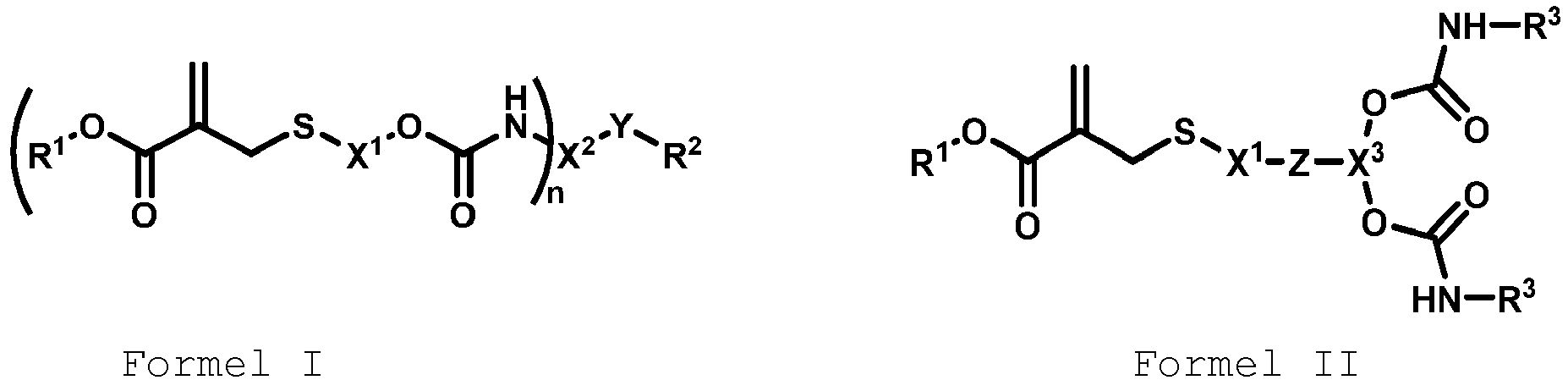

- Darin bedeuten:
- R1
- Wasserstoff, ein aliphatischer linearer oder verzweigter C1-C15-Alkyl-Rest, der durch ein oder mehrere, vorzugsweise 1 bis 3, O oder S unterbrochen und der substituiert oder unsubstituiert sein kann, Benzyl oder Phenyl;
- R2
- Wasserstoff, ein aliphatischer linearer oder verzweigter C1-C15-Alkyl-Rest, der durch ein oder mehrere, vorzugsweise 1 bis 3, O oder S unterbrochen und der substituiert oder unsubstituiert sein kann, Benzyl, ein aromatischer C6-C18-Rest, der substituiert oder unsubstituiert sein kann, oder eine (Meth)acryloyloxy-Gruppe;
- R3
- ein aliphatischer linearer oder verzweigter C1-C15-Alkyl-Rest, der durch ein oder mehrere, vorzugsweise 1 bis 3, O unterbrochen und der substituiert oder unsubstituiert sein kann, Benzyl, oder ein aromatischer C6-C18-Rest, der substituiert oder unsubstituiert sein kann;
- X1
- ein linearer oder verzweigter aliphatischer C1-C15-Alkylen-Rest, der durch ein oder mehrere, vorzugsweise 1 bis 3, O oder S unterbrochen sein kann, oder ein cycloaliphatischer C6-C16-Rest;
- X2
- ein (n+1)-wertiger organischer C1-C20-Rest, vorzugsweise ein aliphatischer C1-C20-Rest, der durch ein oder mehrere, vorzugsweise 1 bis 3, O oder S unterbrochen sein kann, ein cycloaliphatischer C5-C20-Rest, ein aromatischer C6-C20-Rest oder eine Isocyanursäurerest gemäß der folgenden Formel:

- X3
- ein 3-wertiger linearer oder verzweigter aliphatischer C3-C20-Rest;
- X4
- ein 2-wertiger organischer C2-C30-Rest, vorzugsweise ein aliphatischer C2-C20-Rest, ein cycloaliphatischer C5-C20- Rest, ein aromatischer C6-C20-Rest oder Kombinationen davon, wobei diese Reste jeweils durch eine oder mehrere, vorzugsweise 1 bis 3, Methylgruppen substituiert sein können oder unsubstituiert sind;
- Y
- entfällt oder eine Ether- (-O-), Ester- (-COO- oder -OOC-), Urethan- (-NR4-CO-O- oder -O-CO-NR4-) oder Amid-Gruppe (-CONR4- oder -NR4-CO-), wobei R4 jeweils für H oder einen C1-C3-Alkyl-Rest steht;
- Z
- entfällt oder eine Ether- (-O-), Ester- (-COO- oder -OOC-), oder Amid-Gruppe (-CONR5- oder -NR5-CO-), wobei R5 für H oder einen C1-C3-Alkyl-Rest steht;
- W
- eine oligomere Polyester-, Polyether- oder Polythioethergruppe;
- m
- 1, 2, 3, 4, 5 oder vorzugsweise 6;
- n
- 1, 2, 3 oder 4,
- W hat vorzugsweise eine Molmasse von 500-3000 g/mol. Die Mol-masse von W wird anhand der bei der Synthese eingesetzten oli-gomeren Bausteine bestimmt, z.B. des OH-telechelen Polyethers oder Polyesters. Beispielsweise enthält käufliches OHtelecheles PEG-1000 ca. 22 Wiederholungseinheiten (HO-(CH2-CH2-O-)22H mit einer Molmasse von jeweils 44 g/mol. Zusammen mit der endständigen OH-Gruppe und dem endständigen H-Atom ergibt sich ein Molgewicht von 985 g/mol. Die Molmasse der für die Synthese eingesetzten Oligomeren wird vorzugsweise mittels Dampfdruckosmometrie, Ebullioskopie oder Kryoskopie bestimmt. Es handelt sich um die zahlenmittlere, absolute Molmasse.
- Bevorzugte Polyethergruppen sind Oligomere aus Ethylen- oder Propylenglycolbausteinen oder Ringöffnungshomo- oder Copolymerisate aus Ethylenoxid, Propylenoxid und/oder Tetrahydrofuran. Bevorzugte Polyestergruppen sind Polykondensate aus aliphati-schen C2-C10-Diolen und C3-C10-Dicarbonsäuren oder C3-C8-α,ω-Hydroxycarbonsäuren sowie Ringöffnungspolymerisate von Capro-lacton. Bevorzugte Polythioethergruppen sind Polykondensate von α,ω-Dihalogen-C2-C10-alkanen mit Natriumsulfid mit maximal fünf Schwefelatomen im Baustein, wobei die erfindungsgemäßen Verbindungen der Formeln I bis III in allen Fällen vorzugswei-se jeweils nicht mehr als fünf Schwefelatome pro Molekül ent-halten.
- Bevorzugte Halogene sind Chlor oder Brom. Die bei den einzel-nen Resten ggf. vorhandenen Substituenten sind vorzugsweise jeweils aus C1-C3-Alkylgruppen, insbesondere CH3- und/oder C2H5-, Halogen, -OH, -OCH3 oder -O-COCH3, polymerisationsfähigen Vinyl-, (Meth)acryloyloxy- und/oder (Meth)acrylamidgruppen ausgewählt. Die Reste können jeweils mit einem oder mit mehre-ren Substituenten substituiert sein. Vorzugsweise sind die Reste mit 1 bis 3 Substituenten substituiert oder unsubstituiert, wobei insbesondere aliphatische Reste vorzugs-weise nicht substituiert sind.
- Durch die Formeln I, II und III und allen übrigen hierin ge-zeigten Formeln werden sämtliche stereoisomere Formen sowie Gemische verschiedener stereoisomerer Formen, wie z.B. Racema-te, erfasst. Die Formeln erstrecken sich nur auf solche Ver-bindungen, die mit der chemischen Valenzlehre vereinbar sind. Der Hinweis, dass ein Rest z.B. durch ein oder mehrere O- oder S-Atome unterbrochen ist, ist so zu verstehen, dass diese Gruppen in die Kohlenstoffkette des Restes eingeschoben wer-den. Diese Gruppen sind damit beidseitig durch C-Atome be-grenzt und können nicht endständig sein. C1-Reste können bei-spielsweise nicht unterbrochen, verzweigt, cyclisch oder aro-matisch sein. Unter aromatischen Kohlenwasserstoffresten wer-den der üblichen Nomenklatur entsprechend auch solche Reste verstanden, die aromatische und nicht aromatische Gruppen ent-halten.
- Die Verbindungen der Formeln I bis III zeichnen sich dadurch aus, dass sie mindestens eine Allylsulfidgruppe der Formel R1-O-CO-C(=CH2)-CH2-S-X1- und mindestens eine Urethangruppe ent-halten, wobei die Anzahl der Urethangruppen vorzugsweise der Anzahl der Allylsulfidgruppen entspricht oder größer ist. Vor-zugsweise beträgt das Verhältnis von Allylsulfidgruppen zu Urethangruppen 1:1 bis 1:2. Verbindungen der Formeln I bis III werden hierin auch als Urethanallylsulfide oder Allylsulfide bezeichnet.
- Vorzugsweise haben die Variablen die folgenden Bedeutungen:
- R1
- Wasserstoff, ein aliphatischer linearer oder verzweigter C1-C10-Alkyl-Rest, der durch ein oder mehrere, vorzugsweise 1 bis 2, O unterbrochen sein kann und der einen oder mehrere, vorzugsweise 1 bis 3, Substituenten tragen kann, die vorzugsweise aus -CH3, -C2H5 und/oder polymerisationsfähigen (Meth)acryloyloxygruppen ausgewählt sind, oder unsubstituiert ist, Benzyl oder Phenyl;
- R2
- Wasserstoff, ein aliphatischer linearer oder verzweigter C1-C10-Alkyl-Rest, der durch ein oder mehrere, vorzugsweise 1 bis 2, O unterbrochen sein kann und der ein oder mehrere, vorzugsweise 1 bis 3, Substituenten tragen kann, die vorzugsweise aus -CH3, -C2H5 und/oder polymerisationsfähigen (Meth)acryloyloxygruppen ausgewählt sind, oder unsubstituiert ist, Benzyl, oder ein aromatischer C6-C12-Rest, der ein oder mehrere, vorzugsweise 1 bis 3, Substituenten tragen kann, die vorzugsweise aus -CH3, -C2H5, und/oder eine polymerisationsfähigen (Meth)acryloyloxygruppen ausgewählt sind, oder unsubstituiert ist, oder eine (Meth)acryloyloxy-Gruppe;
- R3
- ein aliphatischer linearer oder verzweigter C1-C10-Alkyl-Rest, der ein oder mehrere, vorzugsweise 1 bis 3, Substituenten tragen kann, die vorzugsweise aus -CH3, -C2H5, Halogen und/oder polymerisationsfähigen (Meth)acryloyloxy-gruppen ausgewählt sind, oder unsubstituiert ist, Benzyl, oder ein aromatischer C6-C18-Rest, der ein oder mehrere, vorzugsweise 1 bis 3, Substituenten tragen kann, die vorzugsweise aus -CH3, -C2H5, polymerisationsfähigen Vinyl- und/oder (Meth)acryloyloxygruppen ausgewählt sind, oder unsubstituiert ist;
- X1
- ein linearer oder verzweigter aliphatischer C1-C10 Alkylen-Rest, der durch ein oder mehrere, vorzugsweise 1 bis 2, O unterbrochen sein kann, oder ein cycloaliphatischer C6-C12-Rest;
- X2
- ein (n+1)-wertiger organischer C1-C15-Rest, vorzugsweise ein aliphatischer C1-C15-Rest, der durch ein oder mehrere, vorzugsweise 1 bis 2, O unterbrochen sein kann, ein cycloaliphatischer C5-C10-Rest oder ein aromatischer C6-C14-Rest;
- X3
- ein 3-wertiger linearer oder verzweigter aliphatischer C3-C10-Rest;
- X4
- ein 2-wertiger organischer C2-C20-Rest, vorzugsweise ein aliphatischer C2-C20-Rest Rest, ein cycloaliphatischer C5-C10-Rest Rest, der eine oder mehrere, vorzugsweise 1 bis 2, Methylgruppen als Substituenten tragen kann oder unsubstituiert ist, oder eine Kombination davon;
- Y
- entfällt, oder eine Ester- oder Urethan-Gruppe;
- Z
- entfällt oder eine Ether- oder Ester-Gruppe; W eine oligomere Polyester- oder Polyethergruppe und
- n
- 1, 2 oder 3.
- Besonders bevorzugt haben die Variablen die folgenden Bedeu-tungen:
- R1
- ein aliphatischer linearer oder verzweigter C1-C4-Alkyl-Rest oder Benzyl (Ph-CH2-), ganz besonders bevorzugt Methyl oder Ethyl;
- R2
- Wasserstoff oder eine (Meth)acryloyloxygruppe;
- R3
- ein linearer C1-C3-Alkyl-Rest, Benzyl (Ph-CH2-), Phenyl (Ph-) oder p-Tolyl (H3C-Ph-), wobei diese Reste jeweils durch eine (Meth)acryloyloxygruppe substituiert sein können;
- X1
- ein linearer C1-C3 Alkylen-Rest;
- X2
- ein (n+1)-wertiger, linearer oder verzweigter, aliphatischer C2-C12-Rest, der durch 1 bis 3 O unterbrochen sein kann, oder ein aromatischer C6-C12-Rest;
- X3
- ein 3-wertiger, linearer oder verzweigter, aliphatischer C3-C4-Rest; insbesondere -CH2-CH(-)-CH2-;
- X4
- ein 2-wertiger aliphatischer C2-C10-Rest oder ein cycloaliphatischer C6-Rest, der mit 1 bis 3 Methylgruppen subsituiert sein kann;
- Y
- entfällt, eine Ester- oder Urethan-Gruppe;
- Z
- entfällt; W eine oligomere Polyester- oder Polyethergruppe und
- n
- 1, 2 oder 3, insbesondere 1 oder 2.
- Verbindungen der Formel I sind ganz besonders bevorzugt, und am meisten bevorzugt sind Verbindungen der Formel I, in denen die Variablen die folgenden Bedeutungen haben:
- R1
- ein linearer oder verzweigter C1-C3-Alkyl-Rest oder Benzyl (Ph-CH2-), ganz besonders bevorzugt Methyl oder Ethyl;
- R2
- Wasserstoff oder eine (Meth)acryloyloxygruppe;
- X1
- ein linearer C1-C3 Alkylen-Rest;
- X2
- ein (n+1)-wertiger, linearer, aliphatischer C2-C12-Rest, der durch 1 bis 3 Methylgruppen substituiert sein kann und der durch 1 bis 3 O unterbrochen sein kann, oder ein aromatischer C6-C12-Rest, der durch 1 bis 4 Methylgruppen substituiert sein kann, wobei der aromatische C6-C12-Rest bevorzugt aus -Ph-, -CH2-Ph-, -CH2-Ph-CH2- und -C(CH3)2-Ph-C(CH3)2- ausgewählt ist;
- Y
- entfällt oder -O-;
- n
- 1 oder 2.
- Polymerisationsübertragungsaktive Verbindungen der Formeln I bis III sind nicht bekannt und lassen sich nach bekannten Syn-thesemethoden herstellen. Beispielsweise können Verbindungen der Formel I in zwei Stufen erhalten werden. Im ersten Schritt entsteht durch Veretherung eines α-Chlormethylacrylats mit ei-nem α,ω-Hydroxyalkylmercaptan ein OH-funktionalisiertes Allyl-sulfid, das dann in einer zweiten Stufe mit einem geeigneten Isocyanat zu dem erfindungsgemäßen Urethanallylsulfid der For-mel I umgesetzt wird:
- 1. Stufe:


- 2. Stufe:


- Analog lassen sich die erfindungsgemäßen Urethanallylsulfide der Formel II in zwei Stufen herstellen:
- 1. Stufe:


- 2. Stufe:


- Die erfindungsgemäßen oligomeren Urethanallylsulfide der Formel III lassen sich ebenfalls in zwei Stufen herstellen (z.B. mit Y = Urethan):
- 1. Stufe:


- 2. Stufe:


- Bevorzugte erfindungsgemäße Urethanallylverbindungen der For-mel I sind:


- Bevorzugte Urethanallylverbindungen der Formel II sind:


- Bevorzugter Urethanallylverbindungen der Formel III sind:


- Die Verbindungen der Formeln I bis III ermöglichen eine Kon-trolle bzw. Steuerung der Netzwerkstruktur bei der radikal-ischen Polymerisation. Sie ergeben überraschenderweise homoge-nere Polymernetzwerke mit einem engeren Glasübergang, d.h., dass der Glasübergang in einem engeren Temperaturbereich stattfindet. Dementsprechend wird auch die PKS während der Aushärtung der Materialien verringert, was für eine dentale Anwendung z.B. als Füllungsmaterial ein großer Vorteil ist.
- Die erfindungsgemäßen Zusammensetzungen enthalten neben min-destens einer Verbindung der Formel I, II und/oder III vor-zugsweise mindestens ein weiteres radikalisch polymerisierba-res Monomer, besonders bevorzugt mindestens ein multifunktio-nelles (Meth)acrylat oder eine Mischung von mono- und multi-funktionellen (Meth)acrylaten. Unter monofunktionellen (Meth)-acrylaten werden Verbindungen mit einer, unter multifunktio-nellen (Meth)acrylaten Verbindungen mit zwei oder mehr, vor-zugsweise 2 bis 4 radikalisch polymerisierbaren Gruppen ver-standen. Gemäß einer ganz besonders bevorzugten Ausführungsform enthalten die erfindungsgemäßen Zusammensetzungen mindes-tens ein Dimethacrylat oder eine Mischung von Mono- und Dimethacrylaten.
- Beispiele für besonders geeignete mono- oder multifunktionelle (Meth)acrylate sind Methyl-, Ethyl-, 2-Hydroxyethyl-, Butyl-, Benzyl-, Tetrahydrofurfuryl- oder Isobornyl(meth)acrylat, p-Cumyl-phenoxyethylenglycolmethacrylat (CMP-1E), Bisphenol-A-di(meth)acrylat, Bis-G(M)A (ein Additionsprodukt aus (Meth)-acrylsäure und Bisphenol-A-diglycidylether), ethoxy- oder pro-poxyliertes Bisphenol-A-di(meth)acrylat, wie z.B. Bisphenol-A-dimethacrylat mit 3 Ethoxygruppen (SR-348c, Fa. Sartomer) oder 2,2-Bis[4-(2-(meth)acryloxypropoxy)phenyl]propan, UDMA (ein Additionsprodukt aus 2-Hydroxyethylmethacrylat und 2,2,4-Tri-methylhexamethylendiisocyanat), Di-, Tri- oder Tetraethylen-glycoldi(meth)acrylat, Trimethylolpropantri(meth)acrylat, Pentaerythrittetra(meth)acrylat, sowie Glycerindi- und tri-(meth)acrylat, 1,4-Butandioldi(meth)acrylat, 1,10-Decandiol-di(meth)acrylat (D3MA) oder 1,12-Dodecandioldi(meth)acrylat.
- Geeignet sind außerdem auch thermo- oder photolabile Di(meth)-acrylate, wie z.B. das Additionsprodukt aus 2 mol 2-Acetoacet-oxyethylmethacrylat und 1 mol 2,2,4-Trimethylhexamethylen-1,6-diisocyanat (thermolabil) oder Methacrylsäure-2-[2-(4-{2-methyl-2-[2-(methacryloyloxy)-ethylcarbamoyloxy]propionyl}-phenoxy)-ethoxycarbonylamino]-ethylester. Diese eignen sich besonders zur Herstellung von Werkstoffen mit Debonding-on-Demand-Eigenschaften.
- Die erfindungsgemäßen dentalen Werkstoffe können neben den oben genannten Monomeren vorzugweise auch radikalisch polyme-risierbare, säuregruppenhaltige Monomere (Haftmonomere) ent-halten. Bevorzugte Säuregruppen sind Carbonsäuregruppen, Phosphonsäuregruppen und Phosphorsäuregruppen. Bevorzugte säu-regruppenhaltige Monomere sind 4-(Meth)acryloyloxyethyl-trimellitsäure¬ianhydrid, 10-Methacryloyloxydecylmalonsäure, N-(2-Hydroxy-3-methacryloyloxypro¬pyl)-N-phenylglycin und 4-Vinylbenzoesäure. Weitere bevorzugte säuregruppenhaltige Mono-mere sind 2-Methacryloyloxyethyl-phenyl-hydrogen-phosphat, 10-Methacryloyloxydecyldihydro-genphosphat (MDP) oder Dipenta-erythrit¬pentamethacryloyloxyphosphat. Bevorzugt sind außerdem 4-Vinylbenzylphosphonsäure, 2-[4-(Dihydroxyphosphoryl)-2-oxa-bu¬tyl]-acrylsäure. Weiter bevorzugt sind Amide und Ester der genannten säuregruppenhaltigen Monomere, wie z.B. 2-[4-(Di¬hydroxyphosphoryl)-2-oxa-butyl]-acrylsäure-2,4,6-tri-methylphenylester sowie (Meth)¬acrylamiddihydrogenphosphate, wie z.B. 6-Methacrylamidohexyl- oder 1,3-Bis¬(methacrylamido)-propan-2-yl-dihydrogenphosphat. Haftmonomere eignen sich be-sonders zur Herstellung von selbsthaftenden Befestigungszemen-ten.
- Zur Initiierung der radikalischen Polymerisation enthalten die erfindungsgemäßen Zusammensetzungen vorzugsweise einen Initia-tor für die radikalische Polymerisation, besonders bevorzugt einen Photoinitiator. Als Photoinitiatoren eignen sich insbe-sondere Benzophenon, Benzoin sowie deren Derivate oder α-Diketone oder deren Derivate, wie 9,10-Phenanthrenchinon, 1-Phenyl-propan-1,2-dion, Diacetyl oder 4,4'-Dichlorbenzil. Be-vorzugt werden Campherchinon (CQ) und 2,2-Dimethoxy-2-phenyl-acetophenon und besonders bevorzugt α-Diketone in Kombination mit Aminen als Reduktionsmittel, wie z.B. 4-(Dimethylamino)-benzoesäureester (EDMAB), N,N-Dimethylaminoethylmethacrylat, N,N-Dimethyl-sym.-xylidin oder Triethanolamin, verwendet. Ge-eignet sind auch Norrish-Typ-I-Photoinitiatoren, vor allem Acyl- der Bisacylphosphinoxide, und besonders geeignet sind Monoacyltrialkyl- bzw. Diacyldialkylgermanium-Verbindungen, wie z.B. Benzoyltrimethylgermanium, Dibenzoyldiethylgermanium oder Bis(4-methoxybenzoyl)diethylgermanium (MBDEGe). Dabei lassen sich auch Mischungen der verschiedenen Photoinitiatoren einsetzen, wie z.B. Bis(4-methoxybenzoyl)diethylgermanium in Kombination mit Campherchinon und 4-Dimethylaminobenzoesäureethylester.
- Gemäß einer bevorzugten Ausführungsform enthalten die erfin-dungsgemäßen Dentalwerkstoffe zusätzlich mindestens einen or-ganischen oder vorzugsweise anorganischen Füllstoff. Bevorzugt sind faserförmige und insbesondere partikuläre Füllstoffe.
- Als faserförmige Füllstoffe sind Nanofasern, Glasfasern, Polyamidfasern und Kohlenstofffasern bevorzugt. Unter Nanofa-sern werden Fasern mit einer Länge von weniger als 100 nm ver-standen. Faserförmige Füllstoffe eignen sich besonders zur Herstellung von Verbundmaterialien.
- Bevorzugte anorganische Füllstoffe sind amorphe, kugelförmige, nanopartikuläre Füllstoffe auf der Basis von Oxiden, wie pyro-gene Kieselsäure oder Fällungskieselsäure, ZrO2 und TiO2 oder Mischoxide aus SiO2, ZrO2 und/oder TiO2, mikrofeine Füllstoffe, wie Quarz-, Glaskeramik-, oder Glaspulver, und röntgenopake Füllstoffe, wie Ytterbiumtrifluorid, nanopartikuläres Tan-tal(V)-oxid oder Bariumsulfat. Das Ytterbiumtrifluorid hat vorzugsweise eine Partikelgröße von 200 bis 800 nm.
- Bevorzugte Glaspulver sind röntgenopake Glaspulver, insbeson-dere von Barium- oder Strontiumaluminiumsilikatgläsern. Glas-pulver werden durch Mahlen gewonnen, sind rein anorganischer Natur und bestehen meist aus splitterförmigen Teilen.
- Partikuläre Füllstoffe weisen vorzugsweise eine Partikelgröße von 0,01 bis 15 µm auf. Nanopartikuläre Füllstoffe haben vor-zugsweise eine Partikelgröße von 10 bis 100 nm und mikrofeine Füllstoffe vorzugsweise eine Partikelgröße von 0,2 bis 5 µm. Röntgenopake Füllstoffe haben, soweit es sich nicht um nano-partikuläre Füllstoffe handelt, vorzugsweise eine Partikelgröße von 0,2 bis 5 µm.
- Wenn nicht anders angegeben, handelt es sich bei allen Partikelgrößen um gewichtsmittlere Partikelgrößen (D50-Werte), wobei die Partikelgrößenbestimmung im Bereich von 0,1 µm bis 1000 µm vorzugsweise mittels statischer Lichtstreuung erfolgt, beispielsweise mit einem statischen Laserstreuungs-Partikel-größen-Analysator LA-960 (Horiba, Japan). Hierbei werden als Lichtquellen eine Laser-Diode mit einer Wellenlänge von 655 nm und eine LED mit einer Wellenlänge von 405 nm verwendet. Der Einsatz von zwei Lichtquellen mit unterschiedlichen Wellenlän-gen ermöglicht die Vermessung der gesamten Partikelgrößenverteilung einer Probe in nur einem Messungs-durchgang, wobei die Messung als Nassmessung durchgeführt wird. Hierzu wird eine 0,1 bis 0,5%ige wässrige Dispersion des Füllstoffs hergestellt und deren Streulicht in einer Durch-flusszelle gemessen. Die Streulichtanalyse zur Berechnung von Partikelgröße und Partikelgrößenverteilung erfolgt gemäß der Mie-Theorie nach DIN/ISO 13320. Die Messung der Partikelgröße im Bereich von 5 nm bis 0,1 µm erfolgt vorzugsweise durch Dy-namische Lichtstreuung (DLS) von wässrigen Partikeldispersionen, vorzugsweise mit einem He-Ne-Laser mit einer Wellenlänge von 633 nm, bei einem Streuwinkel von 90° und bei 25°C, z.B. mit einem Malvern Zetasizer Nano ZS (Malvern Instruments, Malvern UK).
- Partikelgrößen kleiner als 0,1 µm können auch anhand von REM- oder TEM-Aufnahmen bestimmt werden. Die Transmissionselektronenmikroskopie (TEM) wird vorzugsweise mit einem Philips CM30 TEM bei einer Beschleunigungsspannung von 300 kV durchgeführt. Für die Probenvorbereitung werden Tropfen der Partikeldispersion auf einem 50 Å dickem Kupfergitter (Maschenweite 300 Mesh) aufgebracht, das mit Kohlenstoff beschichtet ist, und im Anschluss das Lösungsmittel verdampft. Die Partikel werden ausgezählt und der arithmetische Mittelwert berechnet.
- Zur Verbesserung des Verbundes zwischen den Füllstoffpartikeln und der vernetzten Polymerisationsmatrix können SiO2-basierende Füllstoffe mit (Meth)acrylat-funktionalisierten Silanen ober-flächenmodifiziert werden. Ein Beispiel für solche Silane ist 3-(Meth)acryloyloxypropyltrimethoxysilan. Zur Oberflächenmodi-fizierung von nichtsilikatischen Füllstoffen wie z.B. von ZrO2 oder TiO2 können auch funktionalisierte saure Phosphate, wie z.B. 10-(Meth)acryloyloxydecyldihydrogenphosphat eingesetzt werden.
- Der Füllungsgrad richtet sich nach dem gewünschten Anwendungszweck. Füllungskomposite haben vorzugsweise einen Füllstoffge-halt von 75-90 Gew.-% und Kompositzemente von 50-75 Gew.-%.
- Bevorzugte Dentalwerkstoffe enthalten damit neben mindestens einer Verbindung der Formel I, II oder III zusätzlich mindes-tens ein radikalisch polymerisierbares Monomer, insbesondere mindestens ein multifunktionelles (Meth)acrylat oder eine Mi-schungen von mono- und multifunktionellen (Meth)acrylaten, mindestens einen Initiator für die radikalische Polymerisation und vorzugsweise auch mindestens einen Füllstoff.
- Gegebenenfalls können die erfindungsgemäß eingesetzten Zusam-mensetzungen weitere Additive enthalten, vor allem Stabilisa-toren, Farbmittel, mikrobiozide Wirkstoffe, fluoridionenabge-bende Additive, Treibmittel, optische Aufheller, Weichmacher und/oder UV-Absorber.
- Die erfindungsgemäßen Dentalmaterialien enthalten vorzugsweise 0,1 bis 30 Gew.-%, bevorzugt 0,2 bis 25 Gew.-% und besonders bevorzugt 0,5 bis 20 Gew.-% mindestens einer Verbindung der allgemeinen Formel I, II und/oder III, vorzugsweise I.
- Zusätzlich enthalten die Materialien vorzugsweise auch 0,01 bis 5,0 Gew.-%, bevorzugt 0,1 bis 5,0 Gew.-% und besonders be-vorzugt 0,1 bis 3,0 Gew.-% Initiator(en) für die radikalische Polymerisation, besonders bevorzugt einen Photoinitiator, und besonders bevorzugt auch 0 bis 99,9 Gew.-%, bevorzugt 10 bis 95 Gew.-% und besonders bevorzugt 15 bis 95 Gew.-% multifunk-tionelle (Meth)acrylat(e).
- Weiterhin enthalten die erfindungsgemäßen Dentalwerkstoffe vorzugsweise 0 bis 90 Gew.-%, bevorzugt 0 bis 85 Gew.-% und besonders bevorzugt 0 bis 82 Gew.-% Füllstoff(e), wobei der Füllstoffgehalt wie oben beschrieben auf die geplante Verwen-dung der Werkstoffe abgestimmt wird.
- Außerdem enthalten die erfindungsgemäßen Dentalwerkstoffe vor-zugsweise 0 bis 70 Gew.-%, bevorzugt 0,1 bis 70 Gew.-%, beson-ders bevorzugt 0,1 bis 60 Gew.-% sonstige Additiv(e).
- Dabei sind erfindungsgemäß Dentalmaterialien besonders bevor-zugt, welche die folgenden Komponenten enthalten:
- (a) 0,1 bis 30 Gew.-%, bevorzugt 0,2 bis 25 Gew.-% und beson-ders bevorzugt 0,5 bis 20 Gew.-% mindestens einer Verbin-dung der allgemeinen Formel I, II oder III, vorzugsweise I,
- (b) 10 bis 99,1 Gew.-%, bevorzugt 10 bis 95 Gew.-% und beson-ders bevorzugt 15 bis 95 Gew.-% mindestens eines weiteren radikalisch polymerisierbaren Monomers, vorzugsweise min-destens eines multifunktionellen (Meth)acrylats,
- (c) 0,01 bis 5,0 Gew.-%, bevorzugt 0,1 bis 5,0 Gew.-% und besonders bevorzugt 0,1 bis 3,0 Gew.-% mindestens eines Initiators für die radikalische Polymerisation,
- (d) 0 bis 90 Gew.-%, bevorzugt 0 bis 85 Gew.-% und besonders bevorzugt 0 bis 82 Gew.-% mindestens eines Füllstoffs, und
- (e) 0 bis 70 Gew.-%, bevorzugt 0,1 bis 70 Gew.-% und besonders bevorzugt 0,1 bis 60 Gew.-% eines oder mehrerer Additive.
- Wenn nicht anders angegeben beziehen sich alle Mengenangaben auf die Gesamtmasse der Materialien. Die einzelnen Mengenbe-reiche können separat gewählt werden.
- Besonders bevorzugt sind solche Dentalwerkstoffe, welche aus den genannten Komponenten bestehen. Weiterhin sind solche Werkstoffe bevorzugt, bei denen die einzelnen Komponenten je-weils aus den oben genannten bevorzugten und besonders bevor-zugten Stoffen ausgewählt sind. Besonders bevorzugt sind au-ßerdem Werkstoffe, die neben der Verbindung der Formel I, II und/oder III keine flüchtigen Mercaptane enthalten, d.h. Mercaptane, die einen typischen Mercaptangeruch aufweisen. Ganz besonders bevorzugt sind Zusammensetzungen, die keine weiteren Mercaptane und vorzugsweise auch keine anderen Schwe-felverbindungen enthalten.
- Die erfindungsgemäßen Dentalwerkstoffe eignen sich besonders als dentale Zemente, Füllungskomposite und Verblendmaterialien sowie als Materialien zur Herstellung von Inlays, Onlays, Kro-nen und Brücken. Sie haben ähnliche mechanische Eigenschaften (Biegefestigkeit und E-Modul) wie auf Dimethacrylaten basie-rende Materialien und weisen eine vergleichbare Polymerisati-onsgeschwindigkeit auf, zeichnen sich jedoch durch eine ver-ringerte Polymerisationsschrumpfungsspannung (PKS), eine ver-besserte Schlagzähigkeit und geringen Eigengeruch aus.
- Zusammensetzungen, die sich besonders als dentale Zemente eig-nen, enthalten bevorzugt:
- (a) 0,1 bis 20 Gew.-%, bevorzugt 0,2 bis 15 Gew.-% besonders bevorzugt 0,5 bis 10 Gew.-% mindestens eines Urethanallylsulfids der allgemeinen Formel I, II und/oder III,
- (b) 5 bis 50 Gew.-% , bevorzugt 10 bis 50 Gew.-% und besonders bevorzugt 20 bis 40 Gew.-% mindestens eines weiteren radi-kalisch polymerisierbaren Monomers,
- (c) 0,01 bis 5,0 %, bevorzugt 0,1 bis 5,0 Gew.-% und besonders bevorzugt 0,2 bis 3,0 Gew.-% mindestens eines Initiators für die radikalische Polymerisation,
- (d) 10 bis 70 Gew.-%, bevorzugt 20 bis 70 Gew.-% und besonders bevorzugt 30 bis 70 Gew.-% mindestens eines Füllstoffs und
- (e) 0 bis 5 Gew.-%, bevorzugt 0,1 bis 5,0 Gew.-% und besonders bevorzugt 0,2 bis 4,0 Gew.-% eines oder mehrerer Additive.
- Zusammensetzungen, die sich besonders als dentale Komposite eignen, enthalten bevorzugt:
- (a) 0,1 bis 20 Gew.-%, bevorzugt 0,2 bis 15 Gew.-% besonders bevorzugt 0,5 bis 8 Gew.-% mindestens eines Urethanallyl-sulfids der allgemeinen Formel I, II und/oder III,
- (b) 10 bis 50 Gew.-%, bevorzugt 15 bis 40 Gew.-% und besonders bevorzugt 15 bis 30 Gew.-% mindestens eines weiteren radi-kalisch polymerisierbaren Monomers,
- (c) 0,01 bis 5,0 Gew.-%, bevorzugt 0,1 bis 5,0 Gew.-% und be-sonders bevorzugt 0,1 bis 0,3 Gew.-% mindestens eines Ini-tiators für die radikalische Polymerisation,
- (d) 10 bis 85 Gew.-%, bevorzugt 20 bis 85 Gew.-% und besonders bevorzugt 30 bis 85 Gew.-% mindestens eines Füllstoffs und
- (e) 0 bis 5 Gew.-%, bevorzugt 0,1 bis 5,0 Gew.-% und besonders bevorzugt 0,2 bis 3,0 Gew.-% eines oder mehrerer Additive.
- Die Dentalwerkstoffe eignen sich primär zur intraoralen Anwen-dung durch den Zahnarzt zur Restauration geschädigter Zähne (therapeutische Anwendung), z.B. als dentale Zemente, Fül-lungskomposite und Verblendmaterialien. Sie können aber auch extraoral eingesetzt werden, beispielsweise bei der Herstel-lung oder Reparatur von Dentalrestaurationen, wie Inlays, Onlays, Kronen und Brücken (nicht therapeutische Anwendung). Die Erfindung wird im Folgenden anhand von Ausführungsbeispie-len näher erläutert.
-

- Eine Lösung von 2-Chlormethylacrylsäureethylester (7,43 g, 50,0 mmol) in Dichlormethan (50 ml) wurde bei 0°C zu einer Lö-sung von 2-Mercaptoethanol (3,91 g, 50,0 mmol) und Triethyla-min (5,06 g, 50,0 mmol) in Dichlormethan (150 ml) zugetropft. Das Reaktionsgemisch wurde 20 h bei Umgebungstemperatur ge-rührt und anschliessend mit Wasser (2x 100 m) und gesättigter wässriger Natriumchlorid-Lösung (3x 100 ml) gewaschen, über wasserfreiem Natriumsulfat getrocknet und über Kieselgel filt-riert. Das Filtrat wurde am Rotationsverdampfer eingeengt und man erhielt 8,98 g (47,2 mmol;94%) eines farblosen Öls.
1H-NMR (CDCl3, 400 MHz): δ = 6,22 (d, 1H; J = 1,0 Hz; =CH), 5,69 (d, 1H; J = 1.0 Hz; =CH), 4,24 (q, 2H; J = 7,1 Hz; O-CH 2), 3,74 (m, 2H; CH 2OH), 3,43 (s, 2H; CH 2-S), 2,96 (m, 1H; OH), 2,68 (t, 2H; J = 6, 1 Hz; S-CH 2), 1,32 (t, 3H; J = 7.1 Hz; CH 3). 13C-NMR (CDCl3, 100.6 MHz): δ = 166, 0 (C=O) , 136,8 (=C), 126, 0 (=CH2), 60,9 (O-CH2), 60,5 (O-CH2), 34,2 (S-CH2), 32,1 (S-CH2), 13,9 (CH3). -

- 2-[2-(Hydroxyethyl)thiomethyl]acrylsäureethylester (60,0 mmol) wurde in Dichlormethan gelöst und Dibutylzinndilaurat (10 mg) wurde zugegeben. Das Isocyanat 2-Isocyanatoethylmethacrylat (60,0 mmol) wurde zugetropft und das Reaktionsgemisch wurde so lange bei Umgebungstemperatur gerührt, bis mittels IR-Spektroskopie keine N=C=O-Bande mehr detektierbar war (4h-24h). Die Reaktionslösung wurde mit Natronlauge (1N), Salzsäu-re (1N) und Wasser gewaschen, über wasserfreiem Natriumsulfat getrocknet, filtriert und am Rotationverdampfer eingeengt. Das Rohprodukt wurde mittels Säulenchromatographie gereinigt und man erhielt die reine Verbindung 2 als gelbliches Öl (Ausbeute >70%) .
1H-NMR (CDCl3, 400 MHz): δ = 6,22 (d, 1H; J = 0,6 Hz; =CH), 6,13 (s, 1H; =CH), 5,69 (s, 1H; =CH), 5,60 (t, 1H; J = 1,5 Hz; =CH), 5,21 (s, 1H; NH), 4,27-4,18 (m, 6H; O-CH 2), 3,52-3,47 (m, 2H; N-CH 2), 3,42 (s, 2H; CH 2-S) , 2,69 (t, 2H; J = 6,7 Hz; S-CH 2), 1,95 (s, 3H; CH 3), 1,32 (t, 3H; J = 7, 1 Hz; CH 3). 13C-NMR (CDCl3, 100.6 MHz): δ = 167,1 (C=O), 166,0 (C=O), 156,1 (C=O), 136,8 (=C), 135,8 (=C), 126,1 (=CH2), 125,9 (=CH2), 63,5 (O-CH2), 60,9 (O-CH2), 40,0 (N-CH2), 32,6 (S-CH2), 30,0 (S-CH2), 18,2 (CH3), 14,0 (CH3). -

- Analog zu Beispiel 2 wurden als Isocyanat 60 mmol n-Hexylisocyanat eingesetzt und 3 als farblose Flüssigkeit erhalten:
1H-NMR (CDCl3, 400 MHz) : δ = 6,22 (s, 1H; =CH), 5,69 (s, 1H; =CH), 4,81 (s, 1H; NH), 4,24 (q, 2H; J = 7,2 Hz; O-CH 2), 4,19 (t, 2H; J = 6,7 Hz; O-CH 2), 3,43 (s, 2H; CH 2-S), 3,16 (m, 2H; N-CH 2) , 2,68 (t, 2H; J = 6.7 Hz; S-CH 2), 1,48 (m, 2H; CH 2), 1,31 (m, 9H; CH 2-CH 3), 0,88 (t, 3H; J = 6,7 Hz; CH 3).
13C-NMR (CDCl3, 100,6 MHz): δ = 166,0 (C=O), 156,1 (C=O), 136,8 (=C), 126,1 (=CH2), 63,3 (O-CH2), 61,0 (O-CH2), 41,0 (N-CH2), 32,7 (CH2), 31,4 (CH2), 30,2 (CH2), 29,8 (CH2), 26,2 (CH2), 22,5 (CH2), 14,1 (CH3), 13,9 (CH3). - Analog zu Beispiel 2 wurden als Isocyanat 60 mmol Dodecyl-isocyanat eingesetzt und 4 als farblose Flüssigkeit erhalten:

- 1H-NMR (CDCl3, 400 MHz): δ = 6,22 (d, 1H; J = 0,7 Hz; =CH), 5,69 (s, 1H; =CH), 4,73 (s, 1H; NH), 4,24 (q, 2H; J = 7,1 Hz; O-CH 2), 4,19 (t, 2H; J = 6,7 Hz; O-CH 2), 3,43 (s, 2H; CH 2-S), 3,16 (m, 2H; N-CH 2), 2,68 (t, 2H; J = 6,7 Hz; S-CH 2), 1,49 (m, 2H; CH 2), 1, 33-1, 24 (m, 21H; CH 2-CH 3), 0,88 (t, 3H; J = 6,8 Hz; CH 3).
13C-NMR (CDCl3, 100,6 MHz): δ = 166,1 (C=O), 156,2 (C=O), 136,9 (=C), 126,1 (=CH2), 63,3 (O-CH2), 61,0 (O-CH2), 41,0 (N-CH2), 32,7 (CH2), 31,9 (CH2), 30,2 (CH2), 29,9 (CH2), 29,6 (CH2), 29,6 (CH2), 29,5 (CH2), 29,5 (CH2), 29,3 (CH2), 29,2 (CH2), 26,7 (CH2), 22,6 (CH2), 14,1 (CH3), 14,1 (CH3). -

- Analog zu Beispiel 2 wurden als Isocyanat 60 mmol Benzylisocyanat eingesetzt und 5 als farblose Flüssigkeit erhalten:
1H-NMR (CDCl3, 400 MHz): δ = 7,35-7,25 (m, 5H; Ar-H), 6,21 (s, 1H; =CH), 5,67 (s, 1H; =CH), 5,23 (s, 1H; NH), 4,35 (d, 2H; J = 6,0 Hz; N-CH 2), 4,22 (m, 4H; O-CH 2), 3,41 (s, 2H; CH 2-S), 2,68 (t, 2H; J = 6.8 Hz; S-CH 2), 1,30 (t, 3H; J = 7,2 Hz; CH 3). 13C-NMR (CDCl3, 100,6 MHz): δ = 166,1 (C=O), 156,2 (C=O), 138,3 (Ar-C), 136,8 (=C), 128,6 (Ar-CH), 127,4 (Ar-CH), 126,1 (=CH2), 63,5 (O-CH2), 61,0 (O-CH2), 44,9 (N-CH2), 32,7 (S-CH2), 30,1 (S-CH2), 14,1 (CH3). -

- Analog zu Beispiel 2 wurden als Isocyanat 30 mmol 2,2,4-Trimethylhexamethylendiisocyanat eingesetzt und 6 als farbloser Feststoff erhalten:
1H-NMR (CDCl3, 400 MHz): δ = 6,22 (s, 2H; =CH), 5,69 (s, 2H; =CH), 5,10-4,71 (m, 2H; NH), 4,30-4,14 (m, 8H; O-CH 2), 3,43 (s, 4H; CH 2-S), 3,23-2,84 (m, 4H; N-CH 2), 2,68 (t, 4H; J = 7.1 Hz; S-CH 2), 1,64-1,23 (m, 11H, CH, CH 2, CH 3), 0,97-0,85 (m, 9H; CH 3) .
13C-NMR (CDCl3, 100,6 MHz): δ = 166,1 (C=O), 156,5 (C=O), 156,4 (C=O), 156,2 (C=O), 156,1 (C=O), 136,9 (=C), 126,1 (=CH2), 63,4 (O-CH2), 61,0 (O-CH2), 51,3 (CH2), 48,5 (CH2), 46,4 (CH2), 45,9 (CH2), 41,9 (CH2), 39,3 (CH2), 39,0 (CH2), 37,2 (CH2), 35,0 (CH2), 32,8 (C), 32,7 (CH2), 30,2 (CH2), 29,4 (CH3), 27,4 (CH3), 27,4 (CH3), 26,2 (CH), 25,4 (CH), 25,1 (CH3), 22,3 (CH3), 20, 5 (CH3), 14,1 (CH3). -

- Analog zu Beispiel 2 wurden als Isocyanat 30 mmol 1,3-Bis(1-isocyanato-1-methylethyl)benzol eingesetzt und 7 als farbloser Feststoff erhalten:
1H-NMR (CDCl3, 400 MHz): δ = 7,41 (s, 1H; Ar-H) , 7,32-7,25 (m, 3H; Ar-H) , 6,20 (s, 2H; =CH) , 5,65 (s, 2H; =CH) , 5,21 (s, 2H; NH), 4,23 (q, 4H; J = 7,1 Hz; O-CH 2), 4,17-4,07 (m, 4H; O-CH 2) , 3,41 (s, 4H; CH 2-S), 2,66 (s, 4H; S-CH 2), 1,66 (s, 12H; CH 3) , 1,31 (t, 6H; J = 7,2 Hz; CH 3).
13C-NMR (CDCl3, 100,6 MHz): δ = 166,0 (C=O), 154,2 (C=O), 146,9 (Ar-C), 136,8 (=C), 128,3 (Ar-CH), 126,1 (=CH2), 123,2 (Ar-CH), 121,2 (Ar-CH), 62,8 (O-CH2), 61,0 (O-CH2), 55,4 (N-C), 32,6 (S-CH2), 30,2 (S-CH2), 29.2 (CH3), 14,1 (CH3). -

- Eine Lösung von 2-Chlormethylacrylsäureethylester (14,88 g, 0,10 mol) in Tetrahydrofuran (50 ml) wurde bei 0 °C zu einer Lösung von 1-Dodecanthiol (20,24 g, 0,10 mol) und Triethylamin (10,12 g, 0,10 mol) in Tetrahydrofuran (50 ml) zugetropft. Das Reaktionsgemisch wurde 20 h bei Umgebungstemperatur gerührt, dann wurde die Suspension filtriert. Das Filtrat wurde mit Wasser (150 ml) und n-Heptan (150 ml) versetzt und die Phasen wurden getrennt. Die Wasserphase wurde mit n-Heptan (2x 150 ml) extrahiert. Die vereinigten organischen Phasen wurden über wasserfreiem Natriumsulfat getrocknet und über Kieselgel filtriert. Das Filtrat wurde am Rotationsverdampfer eingeengt und man erhielt 22,45 g (71,4 mmol; 71%) einer leicht gelblichen Flüssigkeit.
1H-NMR (CDCl3, 400 MHz): δ = 6,20 (d, 1H; J = 0,9 Hz; =CH), 5,63 (d, 1H; J = 0,9 Hz; =CH), 4,24 (q, 2H; J = 7,1 Hz; O-CH 2), 3,38 (d, 2H; J = 0,6 Hz; CH 2-S) , 2,45 (t, 2H; J = 7,5 Hz; S-CH 2) , 1,56 (m, 2H; CH 2), 1,44-1,16 (m, 24H; CH 2), 0,88 (t, 3H; J = 6,8 Hz; CH 3).
13C-NMR (CDCl3, 100,6 MHz): δ = 166,2 (C=O), 137,3 (=C), 125,4 (=CH2), 60,9 (O-CH2), 32,7 (CH2), 31,9 (CH2), 31,6 (CH2), 29,6 (CH2), 29,5 (CH2), 29,3 (CH2), 29,2 (CH2), 28,9 (CH2), 22, 6 (CH2), 14,1 (CH3). -

-
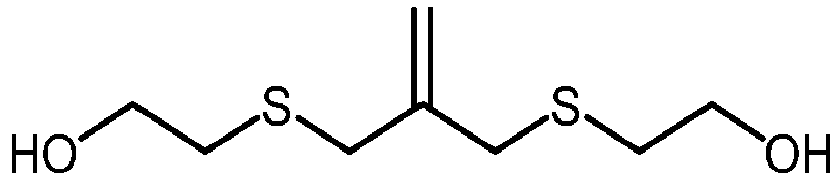
- 2-Mercaptoethanol (32,03 g; 0,41 mol), 3-Chlor-2-chlormethyl-1-propen (25,00 g; 0,20 mol) und 18-Krone-6 (7,95 g; 30,0 mmol) wurden in 2-Butanon (200 ml) gelöst. Kaliumcarbonat (67,72 g; 0,49 mol) wurde zugegeben und das Reaktionsgemisch wurde 20 h am Rückfluss erhitzt. Nach dem Abkühlen wurde die Suspension mit Ethylacetat (200 ml) verdünnt und über Kiesel-gel filtriert. Das Filtrat wurde am Rotationsverdampfer einge-engt. Das Rohprodukt wurde mittels Säulenchromatographie ge-reinigt (SiO2, n-Hexan/Ethylacetat) und man erhielt 32,34 g (0.155 mol; 78%) einer gelblichen Flüssigkeit.
- 1H-NMR (CDCl3, 400 MHz): δ = 5,04 (s, 2H; =CH) , 3,71 (m, 4H; O-CH 2), 3,43 (m, 2H; OH), 3,32 (s, 4H; S-CH 2), 2,62 (t, 4H; J = 6,3 Hz; CH 2-S).
13C-NMR (CDCl3, 100,6 MHz): δ = 140,2 (=C), 115,9 (=CH2), 60,2 (O-CH2), 34,7 (S-CH2), 33,4 (CH2-S). -

- 2-Methylenpropan-1,3-bis(2-hydroxyethylsulfid) der 1. Stufe (7,89 g; 37,9 mmol) und Dibutylzinndilaureat (0,244 g; 2,0 mmol) wurden in Aceton (100 ml) gelöst. Isocyanatoethylmeth-acrylat (11,75 g; 75,7 mmol) und das Reaktionsgemisch wurde bei Umgebungstemperatur gerührt. Nach 3 h wurde Methanol (20 ml) zugegeben und die Lösung wurde am Rotationsverdampfer ein-geengt. Der Rückstand wurde mit n-Hexan (100 ml) versetzt und die Suspension wurde 24 h bei RT gerührt. Die Suspension wurde filtriert. Der Filtrationsrückstand wurde mit n-Hexan (100 ml) gewaschen und im Vakuumtrockenschrank getrocknet. Man erhielt 18,57 g (35,8 mmol; 94%) eines weißen Feststoffs.
1H-NMR (CDCl3, 400 MHz): δ = 6,13 (s, 2H; =CH), 5,60 (m, 2H; =CH), 5,29 (br s, 2H; NH), 5,05 (s, 2H; =CH), 4,25 - 4,16 (m, 8H; CH 2-O), 3,50 (m, 4H; CH 2-N), 3,32 (s, 4H; S-CH 2), 2,65 (t, 4H; J = 6,7 Hz; CH 2-S), 1,95 (s, 6H; CH 3).
13C-NMR (CDCl3, 100,6 MHz): δ = 167,1 (C=O), 156,0 (C=O), 140,1 (=C), 135,8 (=C), 125,9 (=CH2), 116,3 (=CH2), 63,4 (O-CH2), 63,3 (O-CH2), 40,0 (N-CH2), 35,1 (S-CH2), 29,7 (CH2-S), 18,1 (CH3). - Es wurde eine Dimethacrylatmischung bestehend aus 42,19 % Bis-GMA, 37,57 % UDMA und 20,33 % D3MA hergestellt. Zu 83,85 g die-ser Dimethacrylatmischung wurden folgende Komponenten zugege-ben: 15 g des jeweiligen Allylsulfids sowie die Photoinitia-torkomponenten CQ (0,15 g), EDMAB (0,4 g) und Lucirin TPO (0,4 g, 2,4,6-Trimethylbenzoyldiphenylphosphinoxid).
- Mit der so hergestellten Photopolymerisationsharzmischung wur-den in einem Kneter der Firma Linden Komposite hergestellt. Dazu wurden zu 33,63 g Photopolymerisationsharzmischung fol-gende Komponenten zugegeben: 52,21 g eines silanisierten Ba-Al-Borosilikatglasfüllers (GM27884, Fa. Schott) mit einer mittleren Partikelgröße von 1,0 µm, 4,02 g silanisierter Ba-Ca-Al-Fluorosilikatglasfüller (G018-056, Fa. Schott) mit einer mittleren Partikelgröße von 1,0 µm, 4,02 g silanisiertes SiO2-ZrO2-Mischoxid mit einer mittleren Partikelgröße von 1,2 µm (Sphärosil, Fa. Transparent Materials), 0,80 g der pyrogenen Kieselsäure OX-50 (Fa. Evonik), 2,51 g YbF3 (Ytterbiumtrifluorid, mittleren Partikelgröße von 0,2 µm, Fa. Auer Remy) sowie 2,81 g Rheologiemodifizierungsmittel (InTen-S-Bentone).
- Nach der Kompositherstellung wurden Prüfkörper präpariert, die 2 mal 3 Minuten mit einer dentalen Lichtquelle (Spectramat®, Ivoclar Vivadent AG) bestrahlt und damit ausgehärtet wurden. Nach der ISO-Norm ISO-4049 (Dentistry - Polymer-based filling, restorative and luting materials) erfolgte die Bestimmung der Biegefestigkeit (BF) und des Biege-E-Moduls (BM). Zur Bestimmung der Polymerisationsschrumpfungskraft (PKS) wurden die Proben einseitig auf einem silanisierten Objektträger fixiert und mittels eines mit Haftvermittler (Monobond, Fa. Ivoclar Vivadent AG) behandelten Stahlstempel (d = 10 mm) mit einer Zwick Universalprüfmaschine verbunden. Nach dem Einstellen der Schichtdicke (0,8 mm) und dem Entfernen von Überschüssen wurde die Messung gestartet. Die Belichtung (Bluephase 20i, High Po-wer, 10 s) erfolgt durch den Objektträger und startet 120 s nach Messbeginn. Während insgesamt 10 Minuten wurde die Kraft-änderung bei konstant gehaltener Traversenposition regist-riert. Die resultierenden Messwerte sind in der Tabelle 1 zu-sammengestellt
- Die Ergebnisse belegen, dass sich die Komposite mit erfin-dungsgemäßen Urethanallylverbindungen, d.h. die Komposite K-2 bis K-4 und K-6, gegenüber dem Referenzkomposit K-5 (ohne Al-lylsulfid) durch eine signifikant reduzierte Polyme-risationsschrumpfungskraft auszeichnen und vergleichbare me-chanischen Eigenschaften aufweisen. Demgegenüber zeigt das Komposit K-1 auf der Basis des aus dem Stand der Technik be-kannten Allylsulfids 8 zwar eine deutlich reduzierte Polymeri-sationsschrumpfungskraft, jedoch sind die Biegefestigkeit und der Biege-E-Modul deutlich reduziert. Erstaunlicherweise be-wirkt das bekannte Allylsulfid V-783 im Vergleich zu dem strukturähnlichen Allylsulfid 6 nur eine relativ geringe Ver-besserung der Polymerisationsschrumpfungskraft.
Tabelle 1: Eigenschaften der Komposite K-1 bis K-7 K-1*) K-2 K-3 K-4 K-5*) K-6 K-7*) Allylsulfid 8 3 2 6 - 5 V-783 BF (MPa) 24 h 80,7 106,0 107,8 101, 8 119, 7 107,2 114,7 BF (MPa) 24 h WL1) 88,0 130,9 115,3 121,4 132,3 121,9 115,3 BM (GPa) 24 h 3,73 5,20 5,87 4,92 6,26 6,06 7,03 BM (GPa) 24 h WL1 3,90 6,87 6, 61 6,34 7,14 7,13 7,16 PKS (N) nach 125 s 7,0 13,8 16,1 10,1 39,8 10,2 27,7 PKS (N) nach 600 s 39,4 50,5 48,5 40,9 62,8 38,8 60,2 *) Vergleichsbeispiel
1) WL = Wasserlagerung der Prüfkörper
Claims (15)
- Radikalisch polymerisierbarer Dentalwerkstoff, der mindestens eine Verbindung der der Formeln I bis III enthält:


 R1 Wasserstoff, ein aliphatischer linearer oder verzweigter C1-C15-Alkyl-Rest, der durch ein oder mehrere, vorzugsweise 1 bis 3, O oder S unterbrochen und der substituiert oder unsubstituiert sein kann, Benzyl oder Phenyl;R2 Wasserstoff, ein aliphatischer linearer oder verzweigter C1-C15-Alkyl-Rest, der durch ein oder mehrere, vorzugsweise 1 bis 3, O oder S unterbrochen und der substituiert oder unsubstituiert sein kann, Benzyl, ein aromatischer C6-C18-Rest, der substituiert oder unsubstituiert sein kann, oder eine (Meth)acryloyloxy-Gruppe;R3 ein aliphatischer linearer oder verzweigter C1-C15-Alkyl-Rest, der durch ein oder mehrere O unterbrochen und der substituiert oder unsubstituiert sein kann, Benzyl, oder ein aromatischer C6-C18-Rest, der substituiert oder unsubstituiert sein kann;X1 ein linearer oder verzweigter aliphatischer C1-C15-Alkylen-Rest, der durch ein oder mehrere O oder S unterbrochen sein kann, oder ein cycloaliphatischer C6-C16-Rest;X2 ein (n+1)-wertiger organischer C1-C20-Rest, der durch ein oder mehrere O oder S unterbrochen sein kann, ein cycloaliphatischer C5-C20-Rest, ein aromatischer C6-C20-Rest oder eine Isocyanursäurerest gemäß der folgenden Formel:
 x3 ein 3-wertiger linearer oder verzweigter aliphatischer C3-C20-Rest;X4 ein 2-wertiger organischer C2-C30-Rest, der durch eine oder mehrere Methylgruppen substituiert sein kann oder unsubstituiert ist;Y entfällt oder eine Ether- (-O-), Ester- (-COO- oder -OOC-), Urethan- (-NR4-CO-O- oder -O-CO-NR4-) oder Amid-Gruppe (-CONR4- oder -NR4-CO-), wobei R4 jeweils für H oder einen C1-C3-Alkyl-Rest steht;Z entfällt oder eine Ether- (-O-), Ester- (-COO- oder -OOC-), oder Amid-Gruppe (-CONR5- oder -NR5-CO-), wobei R5 für H oder einen C1-C3-Alkyl-Rest steht; W eine oligomere Polyester-, Polyether- oder Polythioethergruppe;m 1, 2, 3, 4, 5 oder 6;n 1, 2, 3 oder 4,wobei dann, wenn X2 ein Isocyanursäurerest ist, Y und R2 entfallen und n gleich 3 ist.
 - Dentalwerkstoff nach Anspruch 1, der mindestens ein zusätzliches radikalisch polymerisierbares Monomer und vorzugsweise auch mindestens einen Initiator für die radikalische Polymerisation enthält.
- Dentalwerkstoff nach Anspruch 1 oder 2, wobei die Variab-len die folgenden Bedeutungen haben:R1 Wasserstoff, ein aliphatischer linearer oder verzweigter C1-C10-Alkyl-Rest, der durch ein oder mehrere, vorzugsweise 1 bis 2, O unterbrochen sein kann und der einen oder mehrere, vorzugsweise 1 bis 3, Substituenten tragen kann, die vorzugsweise aus -CH3, -C2H5 und/oder polymerisationsfähigen (Meth)acryloyloxygruppen ausgewählt sind, oder unsubstituiert ist, Benzyl oder Phenyl;R2 Wasserstoff, ein aliphatischer linearer oder verzweigter C1-C10-Alkyl-Rest, der durch ein oder mehrere, vorzugsweise 1 bis 2, O unterbrochen sein kann und der ein oder mehrere, vorzugsweise 1 bis 3, Substituenten tragen kann, die vorzugsweise aus -CH3, -C2H5 und/oder polymerisationsfähigen (Meth)acryloyloxygruppen ausgewählt sind, oder unsubstituiert ist, Benzyl, oder ein aromatischer C6-C12-Rest, der ein oder mehrere, vorzugsweise 1 bis 3, Substituenten tragen kann, die vorzugsweise aus -CH3, -C2H5, und/oder eine polymerisationsfähigen (Meth)acryloyloxygruppen ausgewählt sind, oder unsubstituiert ist, oder eine (Meth)acryloyloxy-Gruppe;R3 ein aliphatischer linearer oder verzweigter C1-C10-Alkyl-Rest, der ein oder mehrere, vorzugsweise 1 bis 3, Substituenten tragen kann, die vorzugsweise aus -CH3, -C2H5, Halogen und/oder polymerisationsfähigen (Meth)acryloyloxygruppen ausgewählt sind, oder unsubstituiert ist, Benzyl, oder ein aromatischer C6-C18-Rest, der ein oder mehrere, vorzugsweise 1 bis 3, Substituenten tragen kann, die vorzugsweise aus -CH3, -C2H5, polymerisationsfähigen Vinyl- und/oder (Meth)-acryloyloxygruppen ausgewählt sind, oder unsubstituiert ist;X1 ein linearer oder verzweigter aliphatischer C1-C10 Alkylen-Rest, der durch ein oder mehrere, vorzugsweise 1 bis 2, O unterbrochen sein kann, oder ein cycloaliphatischer C6-C12-Rest;X2 ein (n+1)-wertiger organischer C1-C15-Rest, vorzugsweise ein aliphatischer C1-C15-Rest, der durch ein oder mehrere, vorzugsweise 1 bis 2, O unterbrochen sein kann, ein cycloaliphatischer Rest oder ein aromatischer C6-C14-Rest;X3 ein 3-wertiger linearer oder verzweigter aliphatischer C3-C10-Rest;X4 ein 2-wertiger organischer C2-C20-Rest, vorzugsweise ein aliphatischer C2-C20-Rest, ein cycloaliphatischer C5-C10-Rest oder eine Kombination davon, der eine oder mehrere, vorzugsweise 1 bis 2, Methylgruppen als Substituenten tragen kann, oder unsubstituiert ist;Y entfällt, oder eine Ester- oder Urethan-Gruppe;Z entfällt oder eine Ether- oder Ester-Gruppe; W eine oligomere Polyester- oder Polyethergruppe undn 1, 2 oder 3.
- Dentalwerkstoff nach Anspruch 3, wobei die Variablen die folgenden Bedeutungen haben:R1 ein aliphatischer linearer oder verzweigter C1-C4-Alkyl-Rest oder Benzyl (Ph-CH2-), ganz besonders bevorzugt Methyl oder Ethyl;R2 Wasserstoff oder eine (Meth)acryloyloxygruppe;R3 ein linearer C1-C3-Alkyl-Rest, Benzyl (Ph-CH2-), Phenyl (Ph-) oder p-Tolyl (H3C-Ph-), wobei diese Reste jeweils durch eine (Meth)acryloyloxygruppe substituiert sein können;X1 ein linearer C1-C3 Alkylen-Rest;X2 ein (n+1)-wertiger, linearer oder verzweigter, aliphatischer C2-C12-Rest, der durch 1 bis 3 O unterbrochen sein kann, oder ein aromatischer C6-C12-Rest;X3 ein 3-wertiger, linearer oder verzweigter, aliphatischer C3-C4-Rest; insbesondere -CH2-CH(-)-CH2-;X4 ein 2-wertiger aliphatischer C2-C10-Rest oder ein cycloaliphatischer C6-Rest, der mit 1 bis 3 Methyl-gruppen subsituiert sein kann;Y entfällt, eine Ester- oder Urethan-Gruppe;Z entfällt; W eine oligomere Polyester- oder Polyethergruppe undn 1, 2 oder 3, insbesondere 1 oder 2.
- Dentalwerkstoff nach einem der Ansprüche 1 bis 4, wobei die bei den einzelnen Resten vorhandenen Substituenten jeweils aus C1-C3-Alkylgruppen, vorzugsweise CH3- und/oder C2H5-, Halogen, OH, OCH3 oder -O-COCH3, einer polymerisa-tionsfähigen Vinyl-, (Meth)acryloyloxy- und/oder (Meth)-acrylamidgruppen ausgewählt sind.
- Dentalwerkstoff nach einem der Ansprüche 1 bis 5, der mindestens ein multifunktionelles (Meth)acrylat oder eine Mischungen von mono- und multifunktionellen (Meth)-acrylaten enthält.
- Dentalwerkstoff nach einem der Ansprüche 1 bis 6, der mindestens einen Füllstoff enthält.
- Dentalwerkstoff nach einem der Ansprüche 1 bis 7, der zu-sätzlich mindestens einen Photoinitiator für die radikal-ische Polymerisation enthält.
- Dentalwerkstoff nach einem der Ansprüche 1 bis 8, der(a) 0,1 bis 30 Gew.-%, bevorzugt 0,2 bis 25 Gew.-% und besonders bevorzugt 0,5 bis 20 Gew.-% mindestens ei-ner Verbindung der allgemeinen Formel I, II oder III, vorzugsweise I,(b) 10 bis 99,1 Gew.-%, bevorzugt 10 bis 95 Gew.-% und besonders bevorzugt 15 bis 95 Gew.-% mindestens eines weiteren radikalisch polymerisierbaren Monomers, vor-zugsweise mindestens eines multifunktionellen (Meth)acrylats,(c) 0,01 bis 5,0 Gew.-%, bevorzugt 0,1 bis 5,0 Gew.-% und besonders bevorzugt 0,1 bis 3,0 Gew.-% mindestens ei-nes Initiators für die radikalische Polymerisation,(d) 0 bis 90 Gew.-%, bevorzugt 0 bis 85 Gew.-% und beson-ders bevorzugt 0 bis 82 Gew.-% mindestens eines Füll-stoffs, und(e) 0 bis 70 Gew.-%, bevorzugt 0,1 bis 70 Gew.-% und be-sonders bevorzugt 0,1 bis 60 Gew.-% eines oder mehre-rer Additive,
jeweils bezogen auf die Gesamtmasse des Dentalwerkstoffs. - Dentalwerkstoff nach Anspruch 9, der die folgende Zusam-mensetzung aufweist:(a) 0,1 bis 20 Gew.-%, bevorzugt 0,2 bis 15 Gew.-% beson-ders bevorzugt 0,5 bis 10 Gew.-% mindestens eines Urethanallylsulfids der allgemeinen Formel I, II und/oder III, vorzugsweise I,(b) 5 bis 50 Gew.-% , bevorzugt 10 bis 50 Gew.-% und be-sonders bevorzugt 20 bis 40 Gew.-% mindestens eines weiteren radikalisch polymerisierbaren Monomers,(c) 0,01 bis 5,0 %, bevorzugt 0,1 bis 5,0 Gew.-% und be-sonders bevorzugt 0,2 bis 3,0 Gew.-% mindestens eines Initiators für die radikalische Polymerisation,(d) 10 bis 70 Gew.-%, bevorzugt 20 bis 70 Gew.-% und be-sonders bevorzugt 30 bis 70 Gew.-% mindestens eines Füllstoffs und(e) 0 bis 5 Gew.-%, bevorzugt 0,1 bis 5,0 Gew.-% und be-sonders bevorzugt 0,2 bis 4,0 Gew.-% eines oder meh-rerer Additive,
jeweils bezogen auf die Gesamtmasse des Dentalwerkstoffs. - Dentalwerkstoff nach Anspruch 9, der die folgende Zusam-mensetzung aufweist:(a) 0,1 bis 20 Gew.-%, bevorzugt 0,2 bis 15 Gew.-% beson-ders bevorzugt 0,5 bis 8 Gew.-% mindestens eines Urethanallylsulfids der allgemeinen Formel I, II und/oder III, vorzugsweise I,(b) 10 bis 50 Gew.-%, bevorzugt 15 bis 40 Gew.-% und be-sonders bevorzugt 15 bis 30 Gew.-% mindestens eines weiteren radikalisch polymerisierbaren Monomers,(c) 0,01 bis 5,0 Gew.-%, bevorzugt 0,1 bis 5,0 Gew.-% und besonders bevorzugt 0,1 bis 0,3 Gew.-% mindestens ei-nes Initiators für die radikalische Polymerisation,(d) 10 bis 85 Gew.-%, bevorzugt 20 bis 85 Gew.-% und be-sonders bevorzugt 30 bis 85 Gew.-% mindestens eines Füllstoffs und(e) 0 bis 5 Gew.-%, bevorzugt 0,1 bis 5,0 Gew.-% und be-sonders bevorzugt 0,2 bis 3,0 Gew.-% eines oder meh-rerer Additive,
jeweils bezogen auf die Gesamtmasse des Dentalwerkstoffs. - Dentalwerkstoff nach einem der Ansprüche 1 bis 11, der abgesehen von einer oder mehreren Verbindungen der For-meln I, II und III, keine flüchtigen Mercaptane, bevor-zugt überhaupt keine Mercaptane und vorzugsweise auch keine anderen Schwefelverbindungen enthält.
- Dentalwerkstoff nach einem der Ansprüche 1 bis 12 zur in-traoralen Verwendung zur Restauration geschädigter Zähne, vorzugswese als Zement, Füllungskomposit oder Verblendma-terial.
- Verwendung eines Dentalwerkstoffs nach einem der Ansprü-che 1 bis 12 als Material zur extraoralen Herstellung oder Reparatur von Dentalrestaurationen, vorzugsweise von Inlays, Onlays, Kronen oder Brücken.
- Verwendung einer Verbindung der Formel I, II oder III, in der die Variablen wie in Anspruch 1 oder einem der Ansprü-che 3 bis 4 definiert sind, zur Verringerung der Polymeri-sationsschrumpfungsspannung von Dentalwerkstoffen.
Priority Applications (5)
| Application Number | Priority Date | Filing Date | Title |
|---|---|---|---|
| ES20184024T ES2927008T3 (es) | 2020-07-03 | 2020-07-03 | Materiales compuestos con esfuerzo de contracción por polimerización reducido |
| EP20184024.6A EP3932383B1 (de) | 2020-07-03 | 2020-07-03 | Komposite mit verringerter polymerisationsschrumpfungsspannung |
| US17/340,269 US11618799B2 (en) | 2020-07-03 | 2021-06-07 | Composite with reduced polymerization shrinkage stress |
| JP2021109895A JP7560413B2 (ja) | 2020-07-03 | 2021-07-01 | 低減された重合収縮応力を有する複合物 |
| CN202110749337.2A CN113880985B (zh) | 2020-07-03 | 2021-07-02 | 具有降低的聚合收缩应力的复合材料 |
Applications Claiming Priority (1)
| Application Number | Priority Date | Filing Date | Title |
|---|---|---|---|
| EP20184024.6A EP3932383B1 (de) | 2020-07-03 | 2020-07-03 | Komposite mit verringerter polymerisationsschrumpfungsspannung |
Publications (2)
| Publication Number | Publication Date |
|---|---|
| EP3932383A1 true EP3932383A1 (de) | 2022-01-05 |
| EP3932383B1 EP3932383B1 (de) | 2022-08-24 |
Family
ID=71514959
Family Applications (1)
| Application Number | Title | Priority Date | Filing Date |
|---|---|---|---|
| EP20184024.6A Active EP3932383B1 (de) | 2020-07-03 | 2020-07-03 | Komposite mit verringerter polymerisationsschrumpfungsspannung |
Country Status (5)
| Country | Link |
|---|---|
| US (1) | US11618799B2 (de) |
| EP (1) | EP3932383B1 (de) |
| JP (1) | JP7560413B2 (de) |
| CN (1) | CN113880985B (de) |
| ES (1) | ES2927008T3 (de) |
Citations (7)
| Publication number | Priority date | Publication date | Assignee | Title |
|---|---|---|---|---|
| WO1998037104A1 (en) | 1997-02-19 | 1998-08-27 | E.I. Du Pont De Nemours And Company | Molecular weight controlled polymers by photopolymerization |
| US5932675A (en) | 1989-06-05 | 1999-08-03 | Commonwealth Scientific And Industrial Research Organisation | Free-radical chain transfer polymerization process |
| WO2006086646A2 (en) | 2005-02-10 | 2006-08-17 | The Regents Of The University Of Colorado, A Body Corporate | Stress relaxation in crosslinked polymers |
| WO2006122081A1 (en) * | 2005-05-09 | 2006-11-16 | 3M Innovative Properties Company | Dental compositions containing hybrid monomers |
| EP2404916A1 (de) * | 2010-07-08 | 2012-01-11 | Ivoclar Vivadent AG | Dentalmaterialien auf der Basis von Dimersäure-Derivaten mit ringöffnend polymerisierbaren Gruppen |
| US20120295228A1 (en) | 2011-05-18 | 2012-11-22 | Abuelyaman Ahmed S | Disulfide monomers comprising ethylenically unsaturated groups suitable for dental compositions |
| EP2965741A1 (de) * | 2014-07-11 | 2016-01-13 | Ivoclar Vivadent AG | Komposite mit gesteuerter Netzwerkstruktur |
Family Cites Families (4)
| Publication number | Priority date | Publication date | Assignee | Title |
|---|---|---|---|---|
| BR102012002852B1 (pt) * | 2011-02-09 | 2018-05-29 | Dow Agrosciences Llc | Composições pesticidas e processos relacionados das mesmas |
| EP2965740A1 (de) * | 2014-07-11 | 2016-01-13 | Ivoclar Vivadent AG | Dentalmaterialien mit Debonding-on-Demand-Eigenschaften |
| EP2987480B1 (de) * | 2014-08-19 | 2019-06-19 | Ivoclar Vivadent AG | Lichthärtende Dentalkomposite mit zunehmender Opazität |
| ES2718766T3 (es) * | 2016-08-03 | 2019-07-04 | Ivoclar Vivadent Ag | Materiales dentales a base de derivados de vinilciclopropano que contienen grupos uretano |
-
2020
- 2020-07-03 EP EP20184024.6A patent/EP3932383B1/de active Active
- 2020-07-03 ES ES20184024T patent/ES2927008T3/es active Active
-
2021
- 2021-06-07 US US17/340,269 patent/US11618799B2/en active Active
- 2021-07-01 JP JP2021109895A patent/JP7560413B2/ja active Active
- 2021-07-02 CN CN202110749337.2A patent/CN113880985B/zh active Active
Patent Citations (7)
| Publication number | Priority date | Publication date | Assignee | Title |
|---|---|---|---|---|
| US5932675A (en) | 1989-06-05 | 1999-08-03 | Commonwealth Scientific And Industrial Research Organisation | Free-radical chain transfer polymerization process |
| WO1998037104A1 (en) | 1997-02-19 | 1998-08-27 | E.I. Du Pont De Nemours And Company | Molecular weight controlled polymers by photopolymerization |
| WO2006086646A2 (en) | 2005-02-10 | 2006-08-17 | The Regents Of The University Of Colorado, A Body Corporate | Stress relaxation in crosslinked polymers |
| WO2006122081A1 (en) * | 2005-05-09 | 2006-11-16 | 3M Innovative Properties Company | Dental compositions containing hybrid monomers |
| EP2404916A1 (de) * | 2010-07-08 | 2012-01-11 | Ivoclar Vivadent AG | Dentalmaterialien auf der Basis von Dimersäure-Derivaten mit ringöffnend polymerisierbaren Gruppen |
| US20120295228A1 (en) | 2011-05-18 | 2012-11-22 | Abuelyaman Ahmed S | Disulfide monomers comprising ethylenically unsaturated groups suitable for dental compositions |
| EP2965741A1 (de) * | 2014-07-11 | 2016-01-13 | Ivoclar Vivadent AG | Komposite mit gesteuerter Netzwerkstruktur |
Non-Patent Citations (5)
| Title |
|---|
| DEAN, K. M.COOK, W. D.LIN, M. Y., EUR. POLYM. J., vol. 42, 2006, pages 2872 - 2887 |
| HACIOGLU, B.BERCHTOLD, K. A.LOVELL, L. G.NIE, J.BOWMAN, C. N., BIOMATERIALS, vol. 23, 2002, pages 4057 - 4067 |
| J. W. STANSBURY, DENT. MATER., vol. 28, 2012, pages 13 - 22 |
| MOAD, G.RIZZARDO, E.THANG, S. H., POLYMER, vol. 49, 2008, pages 1079 - 1131 |
| R. R. BRAGAR. Y. BALLESTERJ. L. FERRACANE, DENT. MATER., vol. 21, 2005, pages 962 - 970 |
Also Published As
| Publication number | Publication date |
|---|---|
| ES2927008T3 (es) | 2022-10-31 |
| JP7560413B2 (ja) | 2024-10-02 |
| CN113880985A (zh) | 2022-01-04 |
| EP3932383B1 (de) | 2022-08-24 |
| US20220002461A1 (en) | 2022-01-06 |
| US11618799B2 (en) | 2023-04-04 |
| CN113880985B (zh) | 2024-05-17 |
| JP2022013901A (ja) | 2022-01-18 |
Similar Documents
| Publication | Publication Date | Title |
|---|---|---|
| EP3166569B1 (de) | Komposite mit gesteuerter netzwerkstruktur | |
| EP2081541B1 (de) | Mikroverkapselte photoinitiatoren und deren verwendung für dentalmaterialien | |
| EP3150641B1 (de) | Acylgermanium-photoinitiatoren und verfahren zu deren herstellung | |
| EP2910236B1 (de) | Dentalmaterialien auf der Basis von geruchsarmen Thiolen | |
| EP1374829B1 (de) | Dentalmaterialien auf der Basis von Acrylesterphosphonsäuren | |
| EP3293215B1 (de) | Polymerisierbare zusammensetzungen mit acylzinn-photoinitiatoren | |
| EP4085893B1 (de) | Transparente, bruchzähe polymerisationsharze zur herstellung dentaler formkörper | |
| EP3090722B1 (de) | Durch kettenübertragungspolymerisation härtbare dentalmaterialien | |
| EP3166568B1 (de) | Dentalmaterialien mit debonding-on-demand eigenschaften | |
| EP3868767B1 (de) | Langwellig absorbierende photoinitiatoren | |
| EP3659575A1 (de) | Photopolymerisierbare dentale komposite mit schneller aushärtung und geringer schrumpfspannung | |
| EP2289483B1 (de) | Verwendung von polymerisierbaren makrocyclischen Polyethern und makrocyclischen heteroanalogen Polyethern in Dentalmaterialien | |
| EP3424983B1 (de) | Polymerwerkstoffe mit silanbasierenden übertragungsreagenzien | |
| DE102016214389A1 (de) | Dentalmaterialien auf der Basis von monofunktionellen Vinylcyclopropan-Derivaten | |
| EP3861976B1 (de) | Dentalmaterialien auf basis von cyclopolymerisierbaren vernetzern | |
| EP1825843B1 (de) | Dentalmaterialien auf der Basis von multicyclischen Allylsulfiden | |
| EP3932383B1 (de) | Komposite mit verringerter polymerisationsschrumpfungsspannung | |
| EP3278786A1 (de) | Dentalmaterialien auf der basis von urethangruppenhaltigen vinylcyclopropan-derivaten | |
| EP4094748B1 (de) | Dentalwerkstoffe auf basis von redoxsystemen mit oligomeren cumolhydroperoxid-derivaten | |
| DE10234326B3 (de) | Dentalmaterialien auf der Basis von Acrylesterphosphonsäuren | |
| EP3622942B1 (de) | Polymerwerkstoffe mit ungesättigten übertragungsreagenzien | |
| DE10018969B4 (de) | Hydrolysestabile und polymerisierbare Acrylphosphonsäuremonoester | |
| EP2883528B1 (de) | Dentalwerkstoffe auf Basis von polymerisierbaren Aziden und Alkinen |
Legal Events
| Date | Code | Title | Description |
|---|---|---|---|
| PUAI | Public reference made under article 153(3) epc to a published international application that has entered the european phase |
Free format text: ORIGINAL CODE: 0009012 |
|
| STAA | Information on the status of an ep patent application or granted ep patent |
Free format text: STATUS: REQUEST FOR EXAMINATION WAS MADE |
|
| 17P | Request for examination filed |
Effective date: 20201214 |
|
| AK | Designated contracting states |
Kind code of ref document: A1 Designated state(s): AL AT BE BG CH CY CZ DE DK EE ES FI FR GB GR HR HU IE IS IT LI LT LU LV MC MK MT NL NO PL PT RO RS SE SI SK SM TR |
|
| B565 | Issuance of search results under rule 164(2) epc |
Effective date: 20201207 |
|
| GRAP | Despatch of communication of intention to grant a patent |
Free format text: ORIGINAL CODE: EPIDOSNIGR1 |
|
| STAA | Information on the status of an ep patent application or granted ep patent |
Free format text: STATUS: GRANT OF PATENT IS INTENDED |
|
| RIC1 | Information provided on ipc code assigned before grant |
Ipc: A61K 6/833 20200101ALI20220421BHEP Ipc: A61K 6/818 20200101ALI20220421BHEP Ipc: A61K 6/62 20200101ALI20220421BHEP Ipc: C07C 323/12 20060101ALI20220421BHEP Ipc: C07C 321/12 20060101ALI20220421BHEP Ipc: C07C 271/00 20060101ALI20220421BHEP Ipc: A61K 6/889 20200101AFI20220421BHEP |
|
| INTG | Intention to grant announced |
Effective date: 20220509 |
|
| GRAS | Grant fee paid |
Free format text: ORIGINAL CODE: EPIDOSNIGR3 |
|
| GRAA | (expected) grant |
Free format text: ORIGINAL CODE: 0009210 |
|
| STAA | Information on the status of an ep patent application or granted ep patent |
Free format text: STATUS: THE PATENT HAS BEEN GRANTED |
|
| AK | Designated contracting states |
Kind code of ref document: B1 Designated state(s): AL AT BE BG CH CY CZ DE DK EE ES FI FR GB GR HR HU IE IS IT LI LT LU LV MC MK MT NL NO PL PT RO RS SE SI SK SM TR |
|
| REG | Reference to a national code |
Ref country code: CH Ref legal event code: EP |
|
| REG | Reference to a national code |
Ref country code: DE Ref legal event code: R096 Ref document number: 502020001571 Country of ref document: DE |
|
| REG | Reference to a national code |
Ref country code: IE Ref legal event code: FG4D Free format text: LANGUAGE OF EP DOCUMENT: GERMAN |
|
| REG | Reference to a national code |
Ref country code: AT Ref legal event code: REF Ref document number: 1513173 Country of ref document: AT Kind code of ref document: T Effective date: 20220915 |
|
| REG | Reference to a national code |
Ref country code: ES Ref legal event code: FG2A Ref document number: 2927008 Country of ref document: ES Kind code of ref document: T3 Effective date: 20221031 |
|
| REG | Reference to a national code |
Ref country code: LT Ref legal event code: MG9D |
|
| REG | Reference to a national code |
Ref country code: NL Ref legal event code: MP Effective date: 20220824 |
|
| PG25 | Lapsed in a contracting state [announced via postgrant information from national office to epo] |
Ref country code: SE Free format text: LAPSE BECAUSE OF FAILURE TO SUBMIT A TRANSLATION OF THE DESCRIPTION OR TO PAY THE FEE WITHIN THE PRESCRIBED TIME-LIMIT Effective date: 20220824 Ref country code: RS Free format text: LAPSE BECAUSE OF FAILURE TO SUBMIT A TRANSLATION OF THE DESCRIPTION OR TO PAY THE FEE WITHIN THE PRESCRIBED TIME-LIMIT Effective date: 20220824 Ref country code: PT Free format text: LAPSE BECAUSE OF FAILURE TO SUBMIT A TRANSLATION OF THE DESCRIPTION OR TO PAY THE FEE WITHIN THE PRESCRIBED TIME-LIMIT Effective date: 20221226 Ref country code: NO Free format text: LAPSE BECAUSE OF FAILURE TO SUBMIT A TRANSLATION OF THE DESCRIPTION OR TO PAY THE FEE WITHIN THE PRESCRIBED TIME-LIMIT Effective date: 20221124 Ref country code: NL Free format text: LAPSE BECAUSE OF FAILURE TO SUBMIT A TRANSLATION OF THE DESCRIPTION OR TO PAY THE FEE WITHIN THE PRESCRIBED TIME-LIMIT Effective date: 20220824 Ref country code: LV Free format text: LAPSE BECAUSE OF FAILURE TO SUBMIT A TRANSLATION OF THE DESCRIPTION OR TO PAY THE FEE WITHIN THE PRESCRIBED TIME-LIMIT Effective date: 20220824 Ref country code: LT Free format text: LAPSE BECAUSE OF FAILURE TO SUBMIT A TRANSLATION OF THE DESCRIPTION OR TO PAY THE FEE WITHIN THE PRESCRIBED TIME-LIMIT Effective date: 20220824 Ref country code: FI Free format text: LAPSE BECAUSE OF FAILURE TO SUBMIT A TRANSLATION OF THE DESCRIPTION OR TO PAY THE FEE WITHIN THE PRESCRIBED TIME-LIMIT Effective date: 20220824 |
|
| PG25 | Lapsed in a contracting state [announced via postgrant information from national office to epo] |
Ref country code: PL Free format text: LAPSE BECAUSE OF FAILURE TO SUBMIT A TRANSLATION OF THE DESCRIPTION OR TO PAY THE FEE WITHIN THE PRESCRIBED TIME-LIMIT Effective date: 20220824 Ref country code: IS Free format text: LAPSE BECAUSE OF FAILURE TO SUBMIT A TRANSLATION OF THE DESCRIPTION OR TO PAY THE FEE WITHIN THE PRESCRIBED TIME-LIMIT Effective date: 20221224 Ref country code: HR Free format text: LAPSE BECAUSE OF FAILURE TO SUBMIT A TRANSLATION OF THE DESCRIPTION OR TO PAY THE FEE WITHIN THE PRESCRIBED TIME-LIMIT Effective date: 20220824 Ref country code: GR Free format text: LAPSE BECAUSE OF FAILURE TO SUBMIT A TRANSLATION OF THE DESCRIPTION OR TO PAY THE FEE WITHIN THE PRESCRIBED TIME-LIMIT Effective date: 20221125 |
|
| PG25 | Lapsed in a contracting state [announced via postgrant information from national office to epo] |
Ref country code: SM Free format text: LAPSE BECAUSE OF FAILURE TO SUBMIT A TRANSLATION OF THE DESCRIPTION OR TO PAY THE FEE WITHIN THE PRESCRIBED TIME-LIMIT Effective date: 20220824 Ref country code: RO Free format text: LAPSE BECAUSE OF FAILURE TO SUBMIT A TRANSLATION OF THE DESCRIPTION OR TO PAY THE FEE WITHIN THE PRESCRIBED TIME-LIMIT Effective date: 20220824 Ref country code: DK Free format text: LAPSE BECAUSE OF FAILURE TO SUBMIT A TRANSLATION OF THE DESCRIPTION OR TO PAY THE FEE WITHIN THE PRESCRIBED TIME-LIMIT Effective date: 20220824 Ref country code: CZ Free format text: LAPSE BECAUSE OF FAILURE TO SUBMIT A TRANSLATION OF THE DESCRIPTION OR TO PAY THE FEE WITHIN THE PRESCRIBED TIME-LIMIT Effective date: 20220824 |
|
| REG | Reference to a national code |
Ref country code: DE Ref legal event code: R097 Ref document number: 502020001571 Country of ref document: DE |
|
| PG25 | Lapsed in a contracting state [announced via postgrant information from national office to epo] |
Ref country code: SK Free format text: LAPSE BECAUSE OF FAILURE TO SUBMIT A TRANSLATION OF THE DESCRIPTION OR TO PAY THE FEE WITHIN THE PRESCRIBED TIME-LIMIT Effective date: 20220824 Ref country code: EE Free format text: LAPSE BECAUSE OF FAILURE TO SUBMIT A TRANSLATION OF THE DESCRIPTION OR TO PAY THE FEE WITHIN THE PRESCRIBED TIME-LIMIT Effective date: 20220824 |
|
| PG25 | Lapsed in a contracting state [announced via postgrant information from national office to epo] |
Ref country code: AL Free format text: LAPSE BECAUSE OF FAILURE TO SUBMIT A TRANSLATION OF THE DESCRIPTION OR TO PAY THE FEE WITHIN THE PRESCRIBED TIME-LIMIT Effective date: 20220824 |
|
| PLBE | No opposition filed within time limit |
Free format text: ORIGINAL CODE: 0009261 |
|
| STAA | Information on the status of an ep patent application or granted ep patent |
Free format text: STATUS: NO OPPOSITION FILED WITHIN TIME LIMIT |
|
| P01 | Opt-out of the competence of the unified patent court (upc) registered |
Effective date: 20230607 |
|
| 26N | No opposition filed |
Effective date: 20230525 |
|
| PG25 | Lapsed in a contracting state [announced via postgrant information from national office to epo] |
Ref country code: MC Free format text: LAPSE BECAUSE OF FAILURE TO SUBMIT A TRANSLATION OF THE DESCRIPTION OR TO PAY THE FEE WITHIN THE PRESCRIBED TIME-LIMIT Effective date: 20220824 |
|
| PG25 | Lapsed in a contracting state [announced via postgrant information from national office to epo] |
Ref country code: MC Free format text: LAPSE BECAUSE OF FAILURE TO SUBMIT A TRANSLATION OF THE DESCRIPTION OR TO PAY THE FEE WITHIN THE PRESCRIBED TIME-LIMIT Effective date: 20220824 |
|
| REG | Reference to a national code |
Ref country code: BE Ref legal event code: MM Effective date: 20230731 |
|
| PG25 | Lapsed in a contracting state [announced via postgrant information from national office to epo] |
Ref country code: LU Free format text: LAPSE BECAUSE OF NON-PAYMENT OF DUE FEES Effective date: 20230703 |
|
| PG25 | Lapsed in a contracting state [announced via postgrant information from national office to epo] |
Ref country code: LU Free format text: LAPSE BECAUSE OF NON-PAYMENT OF DUE FEES Effective date: 20230703 |
|
| REG | Reference to a national code |
Ref country code: IE Ref legal event code: MM4A |
|
| PG25 | Lapsed in a contracting state [announced via postgrant information from national office to epo] |
Ref country code: BE Free format text: LAPSE BECAUSE OF NON-PAYMENT OF DUE FEES Effective date: 20230731 |
|
| PG25 | Lapsed in a contracting state [announced via postgrant information from national office to epo] |
Ref country code: IE Free format text: LAPSE BECAUSE OF NON-PAYMENT OF DUE FEES Effective date: 20230703 |
|
| PG25 | Lapsed in a contracting state [announced via postgrant information from national office to epo] |
Ref country code: IE Free format text: LAPSE BECAUSE OF NON-PAYMENT OF DUE FEES Effective date: 20230703 |
|
| PG25 | Lapsed in a contracting state [announced via postgrant information from national office to epo] |
Ref country code: BG Free format text: LAPSE BECAUSE OF FAILURE TO SUBMIT A TRANSLATION OF THE DESCRIPTION OR TO PAY THE FEE WITHIN THE PRESCRIBED TIME-LIMIT Effective date: 20220824 |
|
| PG25 | Lapsed in a contracting state [announced via postgrant information from national office to epo] |
Ref country code: BG Free format text: LAPSE BECAUSE OF FAILURE TO SUBMIT A TRANSLATION OF THE DESCRIPTION OR TO PAY THE FEE WITHIN THE PRESCRIBED TIME-LIMIT Effective date: 20220824 |
|
| PG25 | Lapsed in a contracting state [announced via postgrant information from national office to epo] |
Ref country code: CY Free format text: LAPSE BECAUSE OF FAILURE TO SUBMIT A TRANSLATION OF THE DESCRIPTION OR TO PAY THE FEE WITHIN THE PRESCRIBED TIME-LIMIT; INVALID AB INITIO Effective date: 20200703 |
|
| PG25 | Lapsed in a contracting state [announced via postgrant information from national office to epo] |
Ref country code: HU Free format text: LAPSE BECAUSE OF FAILURE TO SUBMIT A TRANSLATION OF THE DESCRIPTION OR TO PAY THE FEE WITHIN THE PRESCRIBED TIME-LIMIT; INVALID AB INITIO Effective date: 20200703 |
|
| PGFP | Annual fee paid to national office [announced via postgrant information from national office to epo] |
Ref country code: ES Payment date: 20250808 Year of fee payment: 6 |
|
| PGFP | Annual fee paid to national office [announced via postgrant information from national office to epo] |
Ref country code: DE Payment date: 20250724 Year of fee payment: 6 |
|
| PGFP | Annual fee paid to national office [announced via postgrant information from national office to epo] |
Ref country code: IT Payment date: 20250715 Year of fee payment: 6 |
|
| PGFP | Annual fee paid to national office [announced via postgrant information from national office to epo] |
Ref country code: GB Payment date: 20250725 Year of fee payment: 6 |
|
| PGFP | Annual fee paid to national office [announced via postgrant information from national office to epo] |
Ref country code: FR Payment date: 20250728 Year of fee payment: 6 Ref country code: AT Payment date: 20251020 Year of fee payment: 5 |
|
| PGFP | Annual fee paid to national office [announced via postgrant information from national office to epo] |
Ref country code: CH Payment date: 20250807 Year of fee payment: 6 |
|
| PG25 | Lapsed in a contracting state [announced via postgrant information from national office to epo] |
Ref country code: TR Free format text: LAPSE BECAUSE OF FAILURE TO SUBMIT A TRANSLATION OF THE DESCRIPTION OR TO PAY THE FEE WITHIN THE PRESCRIBED TIME-LIMIT Effective date: 20220824 |
|
| PG25 | Lapsed in a contracting state [announced via postgrant information from national office to epo] |
Ref country code: SI Free format text: LAPSE BECAUSE OF FAILURE TO SUBMIT A TRANSLATION OF THE DESCRIPTION OR TO PAY THE FEE WITHIN THE PRESCRIBED TIME-LIMIT Effective date: 20220824 |