EP3932994A1 - Composition de résine et corps moulé de celle-ci - Google Patents
Composition de résine et corps moulé de celle-ci Download PDFInfo
- Publication number
- EP3932994A1 EP3932994A1 EP19916975.6A EP19916975A EP3932994A1 EP 3932994 A1 EP3932994 A1 EP 3932994A1 EP 19916975 A EP19916975 A EP 19916975A EP 3932994 A1 EP3932994 A1 EP 3932994A1
- Authority
- EP
- European Patent Office
- Prior art keywords
- resin
- mass
- carbon fiber
- polyarylene ether
- modified
- Prior art date
- Legal status (The legal status is an assumption and is not a legal conclusion. Google has not performed a legal analysis and makes no representation as to the accuracy of the status listed.)
- Pending
Links
- 0 *OP(OC1)OCC11COP(O*)OC1 Chemical compound *OP(OC1)OCC11COP(O*)OC1 0.000 description 1
Images
Classifications
-
- C—CHEMISTRY; METALLURGY
- C08—ORGANIC MACROMOLECULAR COMPOUNDS; THEIR PREPARATION OR CHEMICAL WORKING-UP; COMPOSITIONS BASED THEREON
- C08L—COMPOSITIONS OF MACROMOLECULAR COMPOUNDS
- C08L53/00—Compositions of block copolymers containing at least one sequence of a polymer obtained by reactions only involving carbon-to-carbon unsaturated bonds; Compositions of derivatives of such polymers
- C08L53/02—Compositions of block copolymers containing at least one sequence of a polymer obtained by reactions only involving carbon-to-carbon unsaturated bonds; Compositions of derivatives of such polymers of vinyl-aromatic monomers and conjugated dienes
-
- C—CHEMISTRY; METALLURGY
- C08—ORGANIC MACROMOLECULAR COMPOUNDS; THEIR PREPARATION OR CHEMICAL WORKING-UP; COMPOSITIONS BASED THEREON
- C08L—COMPOSITIONS OF MACROMOLECULAR COMPOUNDS
- C08L25/00—Compositions of, homopolymers or copolymers of compounds having one or more unsaturated aliphatic radicals, each having only one carbon-to-carbon double bond, and at least one being terminated by an aromatic carbocyclic ring; Compositions of derivatives of such polymers
- C08L25/02—Homopolymers or copolymers of hydrocarbons
- C08L25/04—Homopolymers or copolymers of styrene
- C08L25/06—Polystyrene
-
- C—CHEMISTRY; METALLURGY
- C08—ORGANIC MACROMOLECULAR COMPOUNDS; THEIR PREPARATION OR CHEMICAL WORKING-UP; COMPOSITIONS BASED THEREON
- C08L—COMPOSITIONS OF MACROMOLECULAR COMPOUNDS
- C08L71/00—Compositions of polyethers obtained by reactions forming an ether link in the main chain; Compositions of derivatives of such polymers
-
- B—PERFORMING OPERATIONS; TRANSPORTING
- B29—WORKING OF PLASTICS; WORKING OF SUBSTANCES IN A PLASTIC STATE IN GENERAL
- B29C—SHAPING OR JOINING OF PLASTICS; SHAPING OF MATERIAL IN A PLASTIC STATE, NOT OTHERWISE PROVIDED FOR; AFTER-TREATMENT OF THE SHAPED PRODUCTS, e.g. REPAIRING
- B29C45/00—Injection moulding, i.e. forcing the required volume of moulding material through a nozzle into a closed mould; Apparatus therefor
- B29C45/0001—Injection moulding, i.e. forcing the required volume of moulding material through a nozzle into a closed mould; Apparatus therefor characterised by the choice of material
-
- B—PERFORMING OPERATIONS; TRANSPORTING
- B29—WORKING OF PLASTICS; WORKING OF SUBSTANCES IN A PLASTIC STATE IN GENERAL
- B29C—SHAPING OR JOINING OF PLASTICS; SHAPING OF MATERIAL IN A PLASTIC STATE, NOT OTHERWISE PROVIDED FOR; AFTER-TREATMENT OF THE SHAPED PRODUCTS, e.g. REPAIRING
- B29C45/00—Injection moulding, i.e. forcing the required volume of moulding material through a nozzle into a closed mould; Apparatus therefor
- B29C45/0005—Injection moulding, i.e. forcing the required volume of moulding material through a nozzle into a closed mould; Apparatus therefor using fibre reinforcements
-
- B—PERFORMING OPERATIONS; TRANSPORTING
- B32—LAYERED PRODUCTS
- B32B—LAYERED PRODUCTS, i.e. PRODUCTS BUILT-UP OF STRATA OF FLAT OR NON-FLAT, e.g. CELLULAR OR HONEYCOMB, FORM
- B32B27/00—Layered products comprising a layer of synthetic resin
- B32B27/06—Layered products comprising a layer of synthetic resin as the main or only constituent of a layer, which is next to another layer of the same or of a different material
- B32B27/08—Layered products comprising a layer of synthetic resin as the main or only constituent of a layer, which is next to another layer of the same or of a different material of synthetic resin
-
- B—PERFORMING OPERATIONS; TRANSPORTING
- B32—LAYERED PRODUCTS
- B32B—LAYERED PRODUCTS, i.e. PRODUCTS BUILT-UP OF STRATA OF FLAT OR NON-FLAT, e.g. CELLULAR OR HONEYCOMB, FORM
- B32B27/00—Layered products comprising a layer of synthetic resin
- B32B27/18—Layered products comprising a layer of synthetic resin characterised by the use of special additives
- B32B27/20—Layered products comprising a layer of synthetic resin characterised by the use of special additives using fillers, pigments, thixotroping agents
-
- B—PERFORMING OPERATIONS; TRANSPORTING
- B32—LAYERED PRODUCTS
- B32B—LAYERED PRODUCTS, i.e. PRODUCTS BUILT-UP OF STRATA OF FLAT OR NON-FLAT, e.g. CELLULAR OR HONEYCOMB, FORM
- B32B27/00—Layered products comprising a layer of synthetic resin
- B32B27/28—Layered products comprising a layer of synthetic resin comprising synthetic resins not wholly covered by any one of the sub-groups B32B27/30 - B32B27/42
- B32B27/285—Layered products comprising a layer of synthetic resin comprising synthetic resins not wholly covered by any one of the sub-groups B32B27/30 - B32B27/42 comprising polyethers
-
- B—PERFORMING OPERATIONS; TRANSPORTING
- B32—LAYERED PRODUCTS
- B32B—LAYERED PRODUCTS, i.e. PRODUCTS BUILT-UP OF STRATA OF FLAT OR NON-FLAT, e.g. CELLULAR OR HONEYCOMB, FORM
- B32B27/00—Layered products comprising a layer of synthetic resin
- B32B27/30—Layered products comprising a layer of synthetic resin comprising vinyl (co)polymers; comprising acrylic (co)polymers
- B32B27/302—Layered products comprising a layer of synthetic resin comprising vinyl (co)polymers; comprising acrylic (co)polymers comprising aromatic vinyl (co)polymers, e.g. styrenic (co)polymers
-
- B—PERFORMING OPERATIONS; TRANSPORTING
- B32—LAYERED PRODUCTS
- B32B—LAYERED PRODUCTS, i.e. PRODUCTS BUILT-UP OF STRATA OF FLAT OR NON-FLAT, e.g. CELLULAR OR HONEYCOMB, FORM
- B32B27/00—Layered products comprising a layer of synthetic resin
- B32B27/32—Layered products comprising a layer of synthetic resin comprising polyolefins
-
- B—PERFORMING OPERATIONS; TRANSPORTING
- B32—LAYERED PRODUCTS
- B32B—LAYERED PRODUCTS, i.e. PRODUCTS BUILT-UP OF STRATA OF FLAT OR NON-FLAT, e.g. CELLULAR OR HONEYCOMB, FORM
- B32B27/00—Layered products comprising a layer of synthetic resin
- B32B27/34—Layered products comprising a layer of synthetic resin comprising polyamides
-
- B—PERFORMING OPERATIONS; TRANSPORTING
- B32—LAYERED PRODUCTS
- B32B—LAYERED PRODUCTS, i.e. PRODUCTS BUILT-UP OF STRATA OF FLAT OR NON-FLAT, e.g. CELLULAR OR HONEYCOMB, FORM
- B32B27/00—Layered products comprising a layer of synthetic resin
- B32B27/36—Layered products comprising a layer of synthetic resin comprising polyesters
- B32B27/365—Layered products comprising a layer of synthetic resin comprising polyesters comprising polycarbonates
-
- C—CHEMISTRY; METALLURGY
- C08—ORGANIC MACROMOLECULAR COMPOUNDS; THEIR PREPARATION OR CHEMICAL WORKING-UP; COMPOSITIONS BASED THEREON
- C08G—MACROMOLECULAR COMPOUNDS OBTAINED OTHERWISE THAN BY REACTIONS ONLY INVOLVING UNSATURATED CARBON-TO-CARBON BONDS
- C08G65/00—Macromolecular compounds obtained by reactions forming an ether link in the main chain of the macromolecule
- C08G65/34—Macromolecular compounds obtained by reactions forming an ether link in the main chain of the macromolecule from hydroxy compounds or their metallic derivatives
- C08G65/48—Polymers modified by chemical after-treatment
- C08G65/485—Polyphenylene oxides
-
- C—CHEMISTRY; METALLURGY
- C08—ORGANIC MACROMOLECULAR COMPOUNDS; THEIR PREPARATION OR CHEMICAL WORKING-UP; COMPOSITIONS BASED THEREON
- C08J—WORKING-UP; GENERAL PROCESSES OF COMPOUNDING; AFTER-TREATMENT NOT COVERED BY SUBCLASSES C08B, C08C, C08F, C08G or C08H
- C08J5/00—Manufacture of articles or shaped materials containing macromolecular substances
- C08J5/04—Reinforcing macromolecular compounds with loose or coherent fibrous material
- C08J5/0405—Reinforcing macromolecular compounds with loose or coherent fibrous material with inorganic fibres
- C08J5/042—Reinforcing macromolecular compounds with loose or coherent fibrous material with inorganic fibres with carbon fibres
-
- C—CHEMISTRY; METALLURGY
- C08—ORGANIC MACROMOLECULAR COMPOUNDS; THEIR PREPARATION OR CHEMICAL WORKING-UP; COMPOSITIONS BASED THEREON
- C08K—Use of inorganic or non-macromolecular organic substances as compounding ingredients
- C08K7/00—Use of ingredients characterised by shape
- C08K7/02—Fibres or whiskers
- C08K7/04—Fibres or whiskers inorganic
- C08K7/06—Elements
-
- C—CHEMISTRY; METALLURGY
- C08—ORGANIC MACROMOLECULAR COMPOUNDS; THEIR PREPARATION OR CHEMICAL WORKING-UP; COMPOSITIONS BASED THEREON
- C08L—COMPOSITIONS OF MACROMOLECULAR COMPOUNDS
- C08L101/00—Compositions of unspecified macromolecular compounds
-
- C—CHEMISTRY; METALLURGY
- C08—ORGANIC MACROMOLECULAR COMPOUNDS; THEIR PREPARATION OR CHEMICAL WORKING-UP; COMPOSITIONS BASED THEREON
- C08L—COMPOSITIONS OF MACROMOLECULAR COMPOUNDS
- C08L69/00—Compositions of polycarbonates; Compositions of derivatives of polycarbonates
-
- C—CHEMISTRY; METALLURGY
- C08—ORGANIC MACROMOLECULAR COMPOUNDS; THEIR PREPARATION OR CHEMICAL WORKING-UP; COMPOSITIONS BASED THEREON
- C08L—COMPOSITIONS OF MACROMOLECULAR COMPOUNDS
- C08L71/00—Compositions of polyethers obtained by reactions forming an ether link in the main chain; Compositions of derivatives of such polymers
- C08L71/08—Polyethers derived from hydroxy compounds or from their metallic derivatives
- C08L71/10—Polyethers derived from hydroxy compounds or from their metallic derivatives from phenols
- C08L71/12—Polyphenylene oxides
- C08L71/123—Polyphenylene oxides not modified by chemical after-treatment
-
- C—CHEMISTRY; METALLURGY
- C08—ORGANIC MACROMOLECULAR COMPOUNDS; THEIR PREPARATION OR CHEMICAL WORKING-UP; COMPOSITIONS BASED THEREON
- C08L—COMPOSITIONS OF MACROMOLECULAR COMPOUNDS
- C08L71/00—Compositions of polyethers obtained by reactions forming an ether link in the main chain; Compositions of derivatives of such polymers
- C08L71/08—Polyethers derived from hydroxy compounds or from their metallic derivatives
- C08L71/10—Polyethers derived from hydroxy compounds or from their metallic derivatives from phenols
- C08L71/12—Polyphenylene oxides
- C08L71/126—Polyphenylene oxides modified by chemical after-treatment
-
- C—CHEMISTRY; METALLURGY
- C08—ORGANIC MACROMOLECULAR COMPOUNDS; THEIR PREPARATION OR CHEMICAL WORKING-UP; COMPOSITIONS BASED THEREON
- C08L—COMPOSITIONS OF MACROMOLECULAR COMPOUNDS
- C08L77/00—Compositions of polyamides obtained by reactions forming a carboxylic amide link in the main chain; Compositions of derivatives of such polymers
- C08L77/06—Polyamides derived from polyamines and polycarboxylic acids
-
- B—PERFORMING OPERATIONS; TRANSPORTING
- B29—WORKING OF PLASTICS; WORKING OF SUBSTANCES IN A PLASTIC STATE IN GENERAL
- B29K—INDEXING SCHEME ASSOCIATED WITH SUBCLASSES B29B, B29C OR B29D, RELATING TO MOULDING MATERIALS OR TO MATERIALS FOR MOULDS, REINFORCEMENTS, FILLERS OR PREFORMED PARTS, e.g. INSERTS
- B29K2025/00—Use of polymers of vinyl-aromatic compounds or derivatives thereof as moulding material
- B29K2025/04—Polymers of styrene
- B29K2025/06—PS, i.e. polystyrene
-
- B—PERFORMING OPERATIONS; TRANSPORTING
- B29—WORKING OF PLASTICS; WORKING OF SUBSTANCES IN A PLASTIC STATE IN GENERAL
- B29K—INDEXING SCHEME ASSOCIATED WITH SUBCLASSES B29B, B29C OR B29D, RELATING TO MOULDING MATERIALS OR TO MATERIALS FOR MOULDS, REINFORCEMENTS, FILLERS OR PREFORMED PARTS, e.g. INSERTS
- B29K2071/00—Use of polyethers, e.g. PEEK, i.e. polyether-etherketone or PEK, i.e. polyetherketone or derivatives thereof, as moulding material
-
- B—PERFORMING OPERATIONS; TRANSPORTING
- B29—WORKING OF PLASTICS; WORKING OF SUBSTANCES IN A PLASTIC STATE IN GENERAL
- B29K—INDEXING SCHEME ASSOCIATED WITH SUBCLASSES B29B, B29C OR B29D, RELATING TO MOULDING MATERIALS OR TO MATERIALS FOR MOULDS, REINFORCEMENTS, FILLERS OR PREFORMED PARTS, e.g. INSERTS
- B29K2307/00—Use of elements other than metals as reinforcement
- B29K2307/04—Carbon
-
- B—PERFORMING OPERATIONS; TRANSPORTING
- B32—LAYERED PRODUCTS
- B32B—LAYERED PRODUCTS, i.e. PRODUCTS BUILT-UP OF STRATA OF FLAT OR NON-FLAT, e.g. CELLULAR OR HONEYCOMB, FORM
- B32B2260/00—Layered product comprising an impregnated, embedded, or bonded layer wherein the layer comprises an impregnation, embedding, or binder material
- B32B2260/02—Composition of the impregnated, bonded or embedded layer
- B32B2260/021—Fibrous or filamentary layer
-
- B—PERFORMING OPERATIONS; TRANSPORTING
- B32—LAYERED PRODUCTS
- B32B—LAYERED PRODUCTS, i.e. PRODUCTS BUILT-UP OF STRATA OF FLAT OR NON-FLAT, e.g. CELLULAR OR HONEYCOMB, FORM
- B32B2260/00—Layered product comprising an impregnated, embedded, or bonded layer wherein the layer comprises an impregnation, embedding, or binder material
- B32B2260/04—Impregnation, embedding, or binder material
- B32B2260/046—Synthetic resin
-
- B—PERFORMING OPERATIONS; TRANSPORTING
- B32—LAYERED PRODUCTS
- B32B—LAYERED PRODUCTS, i.e. PRODUCTS BUILT-UP OF STRATA OF FLAT OR NON-FLAT, e.g. CELLULAR OR HONEYCOMB, FORM
- B32B2262/00—Composition or structural features of fibres which form a fibrous or filamentary layer or are present as additives
- B32B2262/10—Inorganic fibres
- B32B2262/106—Carbon fibres, e.g. graphite fibres
-
- B—PERFORMING OPERATIONS; TRANSPORTING
- B32—LAYERED PRODUCTS
- B32B—LAYERED PRODUCTS, i.e. PRODUCTS BUILT-UP OF STRATA OF FLAT OR NON-FLAT, e.g. CELLULAR OR HONEYCOMB, FORM
- B32B2270/00—Resin or rubber layer containing a blend of at least two different polymers
-
- C—CHEMISTRY; METALLURGY
- C08—ORGANIC MACROMOLECULAR COMPOUNDS; THEIR PREPARATION OR CHEMICAL WORKING-UP; COMPOSITIONS BASED THEREON
- C08J—WORKING-UP; GENERAL PROCESSES OF COMPOUNDING; AFTER-TREATMENT NOT COVERED BY SUBCLASSES C08B, C08C, C08F, C08G or C08H
- C08J2353/00—Characterised by the use of block copolymers containing at least one sequence of a polymer obtained by reactions only involving carbon-to-carbon unsaturated bonds; Derivatives of such polymers
- C08J2353/02—Characterised by the use of block copolymers containing at least one sequence of a polymer obtained by reactions only involving carbon-to-carbon unsaturated bonds; Derivatives of such polymers of vinyl aromatic monomers and conjugated dienes
-
- C—CHEMISTRY; METALLURGY
- C08—ORGANIC MACROMOLECULAR COMPOUNDS; THEIR PREPARATION OR CHEMICAL WORKING-UP; COMPOSITIONS BASED THEREON
- C08J—WORKING-UP; GENERAL PROCESSES OF COMPOUNDING; AFTER-TREATMENT NOT COVERED BY SUBCLASSES C08B, C08C, C08F, C08G or C08H
- C08J2471/00—Characterised by the use of polyethers obtained by reactions forming an ether link in the main chain; Derivatives of such polymers
- C08J2471/08—Polyethers derived from hydroxy compounds or from their metallic derivatives
- C08J2471/10—Polyethers derived from hydroxy compounds or from their metallic derivatives from phenols
- C08J2471/12—Polyphenylene oxides
-
- C—CHEMISTRY; METALLURGY
- C08—ORGANIC MACROMOLECULAR COMPOUNDS; THEIR PREPARATION OR CHEMICAL WORKING-UP; COMPOSITIONS BASED THEREON
- C08K—Use of inorganic or non-macromolecular organic substances as compounding ingredients
- C08K3/00—Use of inorganic substances as compounding ingredients
- C08K3/02—Elements
- C08K3/04—Carbon
-
- C—CHEMISTRY; METALLURGY
- C08—ORGANIC MACROMOLECULAR COMPOUNDS; THEIR PREPARATION OR CHEMICAL WORKING-UP; COMPOSITIONS BASED THEREON
- C08L—COMPOSITIONS OF MACROMOLECULAR COMPOUNDS
- C08L2207/00—Properties characterising the ingredient of the composition
- C08L2207/04—Thermoplastic elastomer
Definitions
- the present invention relates to a resin composition and a molded body thereof.
- a carbon fiber (which may be hereinafter abbreviated as CFRP) is known as one of the lowest density reinforcing fibers.
- CFRP carbon fiber reinforced composite material
- CFRP carbon fiber reinforced plastic
- CFRP using a thermosetting epoxy resin can have excellent product strength because the uncured epoxy resin itself has a reactive functional group and the interfacial shear strength increases in the curing process.
- CFRP thermosetting epoxy resin
- CFRTP carbon fiber reinforced thermoplastic resin
- thermoplastic resin When a thermoplastic resin is used as a matrix, although there are advantages such as ease of molding processing and ease of recycling as described above, there is a problem in the strength of the obtained member.
- thermoplastic resin does not have a reactive functional group and has a low interfacial shear strength with CF
- a method of improving adhesion between a carbon fiber and a resin by devising a sizing agent for the carbon fiber, adding a thermoplastic resin having a reactive functional group, or the like is used.
- sufficient product strength cannot be obtained yet, and it is required to improve interfacial shear strength and improve product physical properties.
- the present inventors have studied to obtain a resin composition having a high interfacial shear strength at the interface between a resin and a carbon fiber and excellent moldability and mechanical strength.
- a resin composition containing a resin containing a polyarylene ether modified with a functional group and a thermoplastic resin, and a carbon fiber can solve the above-mentioned problems.
- the present inventors have found that the above-mentioned problems can be solved by a production method including a step of preparing a carbon member containing a polyarylene ether not modified with a functional group, and a carbon fiber, and a step of adding a thermoplastic resin to the carbon member.
- the present invention relates to the following [1] to [19].
- the present invention it is possible to obtain a resin composition having high interfacial shear strength at the interface between the resin and the carbon fiber and excellent moldability and mechanical strength, a molded article thereof, and a composite material.
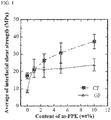
- Fig. 1 is a graph showing the behavior of interfacial shear strength by the micro-droplet method.
- a first embodiment of the present invention provides a resin composition containing a resin (S) containing a polyarylene ether (A) modified with a functional group and a thermoplastic resin (B), and a carbon fiber (C), a molded body (including a laminated body) thereof, and a method for producing the molded body.
- a second embodiment of the present invention provides a method for producing a resin molded body, a molded body thereof, and a laminated body thereof.
- the second embodiment is characterized in that a polyarylene ether not modified with a functional group, a carbon fiber and a thermoplastic resin are used as a molding body material.
- the term "composition” refers to a substance containing the resin (S) and the carbon fiber (C), and the method of containing the resin (S) and the carbon fiber (C) is not limited. Examples thereof include a product obtained by blending the resin (S) and the carbon fiber (C), and a product obtained by immersing the resin (S) in a member containing the carbon fiber (C).
- the carbon fiber (C) is a member having the form of a woven fabric, a non-woven fabric, or a unidirectional material
- a composite material obtained by immersing the resin (S) in the carbon fiber member is also included in the "composition" in the present invention.
- a case where a resin or the like is "immersed" in a carbon fiber or a carbon member includes all forms in which a resin component or the like is added to the carbon fiber (carbon member). For example, it does not matter how it is added, such as simply soaking, immersing, impregnating, dipping, etc.
- the carbon member may be obtained from a step of preparing a carbon member containing a polyarylene ether not modified with a functional group, and a carbon fiber, and a specific method of preparing the carbon member is not particularly limited.
- the resin (S) contained in the resin composition according to the first embodiment of the present invention contains a polyarylene ether (A) modified with a functional group and a thermoplastic resin (B).
- the polyarylene ether (A) modified with a functional group contained in the resin composition according to the first embodiment can be obtained by reacting a polyarylene ether described below with a modifier described below.
- the polyarylene ether used as a raw material for the polyarylene ether (A) modified with a functional group, contained in the resin composition according to the first embodiment is not particularly limited.
- polyarylene ether examples include poly(2,3-dimethyl-6-ethyl-1,4-phenylene ether), poly(2-methyl-6-chloromethyl-1,4-phenylene ether), poly(2-methyl-6-hydroxyethyl-1,4-phenylene ether), poly(2-methyl-6-n-butyl-1,4-phenylene ether), poly(2-ethyl-6-isopropyl-1,4-phenylene ether), poly(2-ethyl-6-n-propyl-1,4-phenylene ether), poly(2,3,6-trimethyl-1,4-phenylene ether), poly[2-(4'-methylphenyl)-1,4-phenylene ether], poly(2-phenyl-1,4-phenylene ether), poly(2-chloro-1,4-phenylene ether), poly(2-methyl-1,4-phenylene ether), poly(2-chloro-6-ethyl-1,4-phenylene ether), poly(2-chlor
- polymers and copolymers described in U.S. Patent Nos. 3,306,874 , 3,306,875 , 3,257,357 , and 3,257,358 are also suitable.
- Further examples include graft copolymers and block copolymers of a vinyl aromatic compound such as polystyrene and the above-mentioned polyphenylene ether.
- poly(2,6-dimethyl-1,4-phenylene ether) is particularly preferably used.
- the degree of polymerization of the polyarylene ether is not particularly limited and may be appropriately selected depending on the intended purpose or the like, and usually can be selected from the range of 60 to 400. When the degree of polymerization is 60 or more, the strength of the resin composition containing the polyarylene ether (A) modified with a functional group can be improved, as will be described later in detail. When it is 400 or less, good moldability can be maintained.
- Examples of the modifier for modifying the polyarylene ether include an acid modifier, an amino group-containing modifier, a phosphorus compound, a hydroxy group-containing modifier, a halogen-containing modifier, an epoxy group-containing modifier, and an unsaturated hydrocarbon group-containing modifier.
- Examples of the acid modifier include a dicarboxylic acid and a derivative thereof.
- Examples of the dicarboxylic acid used as the modifier include maleic anhydride and a derivative thereof, and fumaric acid and a derivative thereof.
- the derivative of maleic anhydride is a compound having an ethylenic double bond and a polar group such as a carboxy group or an acid anhydride group in the same molecule.
- Specific examples thereof include maleic acid, maleic acid monoester, maleic acid diester, maleimide and its N-substituted product (e.g., N-substituted maleimide, maleic acid monoamide, maleic acid diamide), ammonium salt of maleic acid, metal salt of maleic acid, acrylic acid, methacrylic acid, methacrylic acid ester, and glycidyl methacrylate.
- Specific examples of the fumaric acid derivative include fumaric acid diester, fumaric acid metal salt, fumaric acid ammonium salt, and fumaric acid halide. Among them, fumaric acid or maleic anhydride
- the polyarylene ether (A) modified with a functional group can be obtained by reacting the polyarylene ether with a modifier.
- a dicarboxylic acid-modified polyarylene ether is preferable, and a fumaric acid-modified polyarylene ether or a maleic acid-modified polyarylene ether is more preferable.
- modified polyphenylene ether-based polymers such as a (styrene-maleic anhydride)-polyphenylene ether-graft polymer, a maleic anhydride-modified polyphenylene ether, a fumaric acid-modified polyphenylene ether, a glycidyl methacrylate-modified polyphenylene ether, and an amine-modified polyphenylene ether.
- a modified polyphenylene ethe is preferable, a maleic anhydride-modified polyphenylene ether or a fumaric acid-modified polyphenylene ether is more preferable, and a fumaric acid-modified polyphenylene ether is particularly preferable.
- the degree of modification (degree of modification or amount of modification) of the polyarylene ether (A) modified with a functional group can be determined by infrared (IR) absorption spectroscopy or a titration method.
- the degree of modification can be determined from an intensity ratio of spectra of a peak intensity indicating absorption of a compound used as a modifier and a peak intensity indicating absorption of a corresponding polyarylene ether.
- the degree of modification of the polyarylene ether (A) modified with a functional group is preferably 0.05 to 20.
- the amount of modification of the polyarylene ether (A) modified with a functional group is preferably 0.1 to 20% by mass, more preferably 0.5 to 15% by mass, still more preferably 1.0 to 10% by mass, and particularly preferably 1.0 to 5.0% by mass with respect to the mass of the polyarylene ether.
- the polyarylene ether (A) modified with a functional group can be prepared by reacting a polyarylene ether with various modifiers in the presence or absence of a radical generator, optionally in the presence of a solvent or other resins.
- a modification method solution modification or melt modification is known.
- a polyarylene ether is reacted with fumaric acid or a derivative thereof in the presence or absence of a radical generator, optionally in the presence of an aromatic hydrocarbon solvent and another resin to obtain a fumaric acid-modified polyarylene ether.
- the aromatic hydrocarbon solvent is not particularly limited as long as it dissolves the polyarylene ether, fumaric acid or a derivative thereof, and the radical generator optionally used, and is inert to the generated radical. Specific preferred examples thereof include benzene, toluene, ethylbenzene, xylene, chlorobenzene, and tert-butylbenzene.
- benzene, toluene, chlorobenzene, and tert-butylbenzene having a small chain transfer constant are preferably used.
- These solvents may be used alone or in combination of two or more thereof.
- the amount of the aromatic hydrocarbon solvent used is also not particularly limited and may be appropriately selected depending on the situation. In general, it may be determined in the range of 1 to 20 times (mass ratio) with respect to the polyarylene ether to be used.
- the amount of fumaric acid or a derivative thereof used as a modifier is preferably 1 to 20 parts by mass, and more preferably 3 to 15 parts by mass with respect to 100 parts by mass of the polyarylene ether.
- the amount is 1 part by mass or more, a sufficient amount of modification (degree of modification) can be obtained.
- the amount is 20 parts by mass or less, post-treatment such as purification after modification can be appropriately performed.
- the radical generator optionally used for solution modification of the polyarylene ether is not particularly limited.
- a decomposition temperature suitable for the reaction temperature and to effectively graft the modifier onto the polyarylene ether those having a large hydrogen abstraction ability are preferred.
- Specific examples thereof include di-tert-butyl peroxide, dicumyl peroxide, 1,1-bis(tert-butylperoxy)cyclohexane, 1,1-bis(tert-butylperoxy)-3,3,5-trimethylcyclohexane, benzoyl peroxide, and decanoyl peroxide.
- the amount of the radical generator used is preferably 15 parts by mass or less with respect to 100 parts by mass of the polyarylene ether.
- the polyarylene ether and, for example, fumaric acid or a derivative thereof as a modifier are dissolved in an aromatic hydrocarbon solvent to be homogeneous, and then, when a radical generator is used, the radical generator is added at an arbitrary temperature at which the half-life of the radical generator is 1 hour or less, and the reaction is performed at the temperature.
- a temperature at which the half-life of the radical generator used exceeds 1 hour is not preferable because a long reaction time is required.
- the reaction time can be appropriately selected, but in order to allow the radical generator to effectively act, it is preferable to carry out the modification reaction at a predetermined reaction temperature for a time that is three times or more the half-life of the radical generator.
- reaction solution is added to a poor solvent for polyarylene ether, such as methanol, and the precipitated modified polyarylene ether is recovered and dried to obtain the desired polyarylene ether modified with a functional group.
- a poor solvent for polyarylene ether such as methanol
- the polyarylene ether and, for example, fumaric acid or a derivative thereof as a modifier are melt-kneaded in an extruder in the presence or absence of a radical generator to obtain a polyarylene ether modified with a functional group.
- the amount of fumaric acid or a derivative thereof used is preferably 1 to 5 parts by mass, and more preferably 2 to 4 parts by mass with respect to 100 parts by mass of the polyarylene ether.
- the amount is 1 part by mass or more, the amount of modification (degree of modification) is sufficient, and when the amount is 5 parts by mass or less, the modification efficiency of fumaric acid or a derivative thereof can be favorably maintained, and the amount of fumaric acid or the like remaining in the pellet can be suppressed.
- the radical generator used for melt modification of the polyarylene ether preferably has a temperature showing a half-life of 1 minute of 300°C or higher.
- the radical generator having a temperature showing a half-life of 1 minute of less than 300°C, such as a peroxide or an azo compound is used, the effect of modifying the polyarylene ether is insufficient.
- radical generator examples include 2,3-dimethyl-2,3-diphenylbutane, 2,3-diethyl-2,3-diphenylbutane, 2,3-diethyl-2,3-diphenylhexane, and 2,3-dimethyl-2,3-di(p-methylphenyl)butane.
- 2,3-dimethyl-2,3-diphenylbutane having a temperature showing a half-life of 1 minute of 330°C is preferably used.
- the amount of the radical generator used is selected in the range of preferably 0.1 to 3 parts by mass, and more preferably 0.5 to 2 parts by mass with respect to 100 parts by mass of the polyarylene ether.
- the amount is 0.1 parts by mass or more, a high modification effect can be obtained, and when the amount is 3 parts by mass or less, the polyarylene ether can be efficiently modified, and insoluble components are less likely to be generated.
- Examples of the method for melt-modifying a polyarylene ether include a method in which a polyarylene ether, fumaric acid or a derivative thereof, and a radical generator are uniformly dry-blended at room temperature, and then a melt reaction is performed substantially at a kneading temperature of the polyarylene ether in the range of 300 to 350°C.
- a melt reaction is performed substantially at a kneading temperature of the polyarylene ether in the range of 300 to 350°C.
- the temperature is 300°C or higher, the melt viscosity can be appropriately maintained, and when the temperature is 350°C or lower, the decomposition of the polyarylene ether can be suppressed.
- the amount of modification (modifier content) determined by the titration method described above is preferably 0.1 to 20% by mass, more preferably 0.5 to 15% by mass, still more preferably 1 to 10% by mass, and particularly preferably 1.0 to 5.0% by mass.
- the amount of modification is 0.1% by mass or more, a polyarylene ether having sufficient mechanical properties and heat resistance can be obtained.
- the amount of modification is sufficient 20% by mass or less.
- thermoplastic resin (B) contained in the resin composition according to the first embodiment of the present invention is not particularly limited, and specific examples thereof include a polyamide resin, an acrylic resin, a polyphenylene sulfide resin, a polyvinyl chloride resin, a polystyrene-based resin, a polyolefin, a polyacetal resin, a polycarbonate-based resin, a polyurethane, a polybutylene terephthalate, an acrylonitrile butadiene styrene (ABS) resin, a modified polyphenylene ether resin, a phenoxy resin, a polysulfone, a polyethersulfone, a polyetherketone, a polyetheretherketone, and an aromatic polyester.
- a polyamide resin an acrylic resin, a polyphenylene sulfide resin, a polyvinyl chloride resin, a polystyrene-based resin, a polyolefin, a polyacetal
- thermoplastic resin (B) is a polystyrene-based resin or a polyamide.
- the polystyrene-based resin is not particularly limited, and examples thereof include a rubber-modified polystyrene resin (high impact polystyrene) in which a rubber-like polymer is dispersed in the form of particles in a matrix composed of a homopolymer of a styrene-based compound, a copolymer of two or more styrene-based compounds, and a polymer of a styrene-based compound.
- a rubber-modified polystyrene resin high impact polystyrene
- a rubber-like polymer is dispersed in the form of particles in a matrix composed of a homopolymer of a styrene-based compound, a copolymer of two or more styrene-based compounds, and a polymer of a styrene-based compound.
- styrene-based compound as a raw material examples include styrene, o-methylstyrene, p-methylstyrene, m-methylstyrene, ⁇ -methylstyrene, ethylstyrene, ⁇ -methyl-p-methylstyrene, 2,4-dimethylstyrene, monochlorostyrene, and p-tert-butylstyrene.
- the polystyrene-based resin may be a copolymer obtained by using two or more kinds of styrene-based compounds in combination. Among them, polystyrene obtained by polymerizing styrene alone is preferable. Examples thereof include polystyrene having a stereoregular structure such as atactic polystyrene, isotactic polystyrene, and syndiotactic polystyrene. As the thermoplastic resin (B) contained in the resin composition of the present invention, syndiotactic polystyrene is particularly preferable.
- Syndiotactic polystyrene refers to a styrene-based resin having a highly syndiotactic structure (which may be hereinafter abbreviated as SPS).
- SPS syndiotactic
- syndiotacticity the proportion of phenyl rings in adjacent styrene units that are arranged alternately
- Tacticity can be quantitatively identified by a nuclear magnetic resonance method using isotope carbon ( 13 C-NMR method).
- 13 C-NMR method it is possible to quantify the abundance ratio of a plurality of continuous constituent units, for example, two continuous monomer units as diads, three continuous monomer units as triads, and five continuous monomer units as pentads.
- styrene-based resin having a highly syndiotactic structure means polystyrene, poly(hydrocarbon-substituted styrene), poly(halogenated styrene), poly(halogenated alkylstyrene), poly(alkoxystyrene), poly(vinylbenzoic acid ester), hydrogenated polymers or mixtures thereof, or copolymers containing these as a main component, which have a syndiotacticity of usually 75 mol% or more, and preferably 85 mol% or more in racemic diad (r), or usually 30 mol% or more, and preferably 50 mol% or more in racemic pentad (rrrr).
- poly(hydrocarbon-substituted styrene) examples include poly(methylstyrene), poly(ethylstyrene), poly(isopropylstyrene), poly(tert-butylstyrene), poly(phenyl) styrene, poly(vinylnaphthalene), and poly(vinylstyrene).
- poly(halogenated styrene) include poly(chlorostyrene), poly(bromostyrene), and poly(fluorostyrene), and examples of the poly(halogenated alkylstyrene) include poly(chloromethylstyrene).
- poly(alkoxystyrene) examples include poly(methoxystyrene) and poly(ethoxystyrene).
- styrene-based polymer examples include polystyrene, poly(p-methylstyrene), poly(m-methylstyrene), poly(p-tert-butylstyrene), poly(p-chlorostyrene), poly(m-chlorostyrene), and poly(p-fluorostyrene).
- copolymers of styrene and p-methylstyrene copolymers of styrene and p-tert-butylstyrene, copolymers of styrene and divinylbenzene, and the like can be mentioned.
- the molecular weight of the syndiotactic polystyrene is not particularly limited, but the weight average molecular weight is preferably 1 ⁇ 10 4 or more and 1 ⁇ 10 6 or less, more preferably 50,000 or more and 500,000 or less, and still more preferably 50,000 or more and 300,000 or less from the viewpoint of the fluidity of the resin during molding and the mechanical properties of the molded body to be obtained.
- the weight average molecular weight is 1 ⁇ 10 4 or more, a molded article having sufficient mechanical properties can be obtained.
- the weight average molecular weight is 1 ⁇ 10 6 or less, there is no problem in the fluidity of the resin during molding.
- the MFR of syndiotactic polystyrene is measured under conditions of a temperature of 300°C and a load of 1.2 kgf
- the MFR is preferably 2 g/10 min or more, and more preferably 4 g/10 min or more, and within this range, there is no problem with the fluidity of the resin during molding.
- the MFR is 50 g/10 min or less, preferably 40 g/10 min or less, and more preferably 30 g/10 min or less, a molded article having sufficient mechanical properties can be obtained.
- polyamide all known polyamides can be used.
- Suitable polyamides include, for example, polyamide-4, polyamide-6, polyamide-6,6, polyamide-3,4, polyamide-12, polyamide-11, polyamide-6,10, polyamide-4T, polyamide-6T, polyamide-9T, polyamide-10T, and polyamides obtained from adipic acid and m-xylylenediamine. Of these, polyamide-6,6 is preferable.
- the carbon fiber (C) contained in the resin composition according to the first embodiment of the present invention is not particularly limited, and various carbon fibers such as PAN-based carbon fibers using polyacrylonitrile as a raw material, pitch-based carbon fibers using coal tar pitch in petroleum or coal as a raw material, and phenol-based carbon fibers using a thermosetting resin, for example, a phenol resin as a raw material can be used.
- the carbon fiber (C) may be obtained by a vapor phase growth method or may be a recycled carbon fiber (RCF).
- the carbon fiber (C) is not particularly limited, but is preferably at least one carbon fiber selected from the group consisting of a PAN-based carbon fiber, a pitch-based carbon fiber, a thermosetting carbon fiber, a phenol-based carbon fiber, a vapor-grown carbon fiber, and a recycled carbon fiber (RCF).
- Carbon fibers can be used regardless of the degree of graphitization, although the degree of graphitization may be changed depending on the raw material quality and firing temperature during production.
- the shape of the carbon fiber (C) is not particularly limited, and carbon fibers having at least one shape selected from the group consisting of milled fibers, bundled and cut (chopped strands), short fibers, rovings, filaments, tows, whiskers, nanotubes, and the like can be used.
- bundled and cut (chopped strands) those having an average fiber length of 0.1 to 50 mm and an average fiber diameter of 5 to 20 ⁇ m are preferably used.
- the density of the carbon fibers is not particularly limited, but is preferably 1.75 to 1.95 g/cm 3 .
- the form of the carbon fiber (C) may be a single fiber or a fiber bundle, or both a single fiber and a fiber bundle may be mixed.
- the number of single fibers constituting each fiber bundle may be substantially uniform or may be different in each fiber bundle.
- the average fiber diameter of the carbon fiber (C) varies depending on the form, for example, carbon fibers having an average fiber diameter of preferably 0.0004 to 15 ⁇ m, more preferably 3 to 15 ⁇ m, and still more preferably 5 to 10 ⁇ m can be used.
- the "composition" of the first embodiment only needs to contain the resin (S) and the carbon fiber (C), and there is no limitation on the method of containing them.
- a product (composite material) in which the resin (S) is immersed in a member containing the carbon fiber (C) is also included in the "composition” and the "molded article containing the composition” in the present invention. Examples thereof include a product in which the resin (S) is immersed in a carbon fiber member having a form of a woven fabric, a non-woven fabric, or a unidirectional material.
- thermoplastic resin (B) can be added, resulting in a composition containing the resin (S) and the carbon fiber (C).
- the member containing the carbon fiber (C) is a woven fabric, a non-woven fabric, or a unidirectional material
- a single fiber having an average fiber diameter of preferably 3 to 15 ⁇ m, and more preferably 5 to 7 ⁇ m can be used.
- the member containing the carbon fiber (C) has the form of a woven fabric, a non-woven fabric, or a unidirectional material
- a fiber bundle obtained by bundling the carbon fibers in one direction can be used.
- the member containing the carbon fiber (C) As the member containing the carbon fiber (C), a product obtained by bundling 6,000 (6K), 12,000 (12K), 24,000 (24K), 60,000 (60K), or the like single fibers of carbon fibers supplied from a carbon fiber manufacturer as a fiber bundle may be used as it is, or a product obtained by further bundling these may be used.
- the fiber bundle may be any of a non-twisted yarn, a twisted yarn, and a untwisted yarn.
- the fiber bundle may be included in the molded body in an opened state, or may be included as a fiber bundle without being opened.
- the member containing the carbon fiber (C) is a woven fabric, a non-woven fabric, or a unidirectional material
- a molded body can be obtained by immersing the member in the resin (S).
- the member containing the carbon fiber (C), particularly a woven fabric, a non-woven fabric, or a unidirectional material, is preferably thin.
- the member containing the carbon fiber (C) preferably has a thickness of 3 mm or less.
- the thicknesses is preferably 0.2 mm or less.
- the lower limit of the thickness of the member containing the carbon fiber (C) is not particularly limited, but it is preferably 7 ⁇ m or more, and from the viewpoint of quality stability, it is preferably 10 ⁇ m or more, and more preferably 20 ⁇ m or more.
- the carbon fiber (C) contained in the resin composition of the present invention may have a sizing agent attached to the surface thereof.
- the type of the sizing agent can be appropriately selected depending on the types of the carbon fiber and the thermoplastic resin, and is not particularly limited.
- Various types of carbon fibers have been commercialized, such as those treated with an epoxy-based sizing agent, a urethane-based sizing agent, or a polyamide-based sizing agent, or those not containing a sizing agent.
- carbon fibers can be used regardless of the type or presence of a sizing agent.
- the polyarylene ether (A) modified with a functional group is contained in an amount of preferably 0.5 to 30% by mass, more preferably 0.8 to 15% by mass, and still more preferably 1.0 to 10% by mass based on 100% by mass of the resin (S).
- the amount of the polyarylene ether (A) modified with a functional group in the resin (S) is 0.5% by mass or more, excellent interfacial shear strength can be obtained.
- the amount of the polyarylene ether (A) is 30% by mass or less, the mechanical strength and heat resistance of a molded article to be obtained can be favorably maintained.
- the carbon fiber (C) is contained in an amount of preferably 1 to 500 parts by mass, more preferably 1 to 400 parts by mass, still more preferably 1 to 350 parts by mass, yet still more preferably 1 to 200 parts by mass, even more preferably 1 to 100 parts by mass, and yet even more preferably 1 to 50 parts by mass with respect to 100 parts by mass of the resin (S). Further, in order to obtain excellent strength, it is preferably contained in an amount of 15 parts by mass or more, and more preferably 20 parts by mass or more. When the amount of the carbon fiber (C) is within the above range, a molded article or a composite material containing the resin composition of the present invention has excellent mechanical strength.
- a second embodiment of the present invention relates to a production method of a resin molded body, and a molded body and a laminated body obtained by the production method.
- the second embodiment is characterized in that a polyarylene ether not modified with a functional group, a carbon fiber and a thermoplastic resin are used as a molding body material.
- the method includes a step of preparing a carbon member containing a polyarylene ether not modified with a functional group and a carbon fiber, and a step of adding a thermoplastic resin to the carbon member.
- Examples of the polyarylene ether not modified with a functional group (hereinafter, may be simply referred to as "unmodified polyarylene ether”) contained in the carbon member in the present embodiment include those described in detail in the first embodiment as a raw material of the polyarylene ether (A) modified with a functional group.
- poly(2,6-dimethyl-1,4-phenylene ether) can be preferably used as the polyarylene ether.
- the degree of polymerization of the unmodified polyarylene ether is not particularly limited and can be appropriately selected depending on the intended use and the like, and usually can be selected from the range of 60 to 400.
- Examples of the carbon fiber contained in the carbon member in the present embodiment include the same as those described in detail in the first embodiment. Although not particularly limited as in the first embodiment, it is preferably at least one carbon fiber selected from the group consisting of a PAN-based carbon fiber, a pitch-based carbon fiber, a thermosetting carbon fiber, a phenol-based carbon fiber, a vapor-grown carbon fiber, and a recycled carbon fiber (RCF).
- a PAN-based carbon fiber preferably at least one carbon fiber selected from the group consisting of a PAN-based carbon fiber, a pitch-based carbon fiber, a thermosetting carbon fiber, a phenol-based carbon fiber, a vapor-grown carbon fiber, and a recycled carbon fiber (RCF).
- the shape of the carbon fibers is also not particularly limited, and carbon fibers having at least one shape selected from the group consisting of milled fibers, bundled and cut (chopped strands), short fibers, rovings, filaments, tows, whiskers, nanotubes, and the like can be used.
- the form of the carbon fiber may be a single fiber or a fiber bundle, or both a single fiber and a fiber bundle may be mixed. The number of single fibers constituting each fiber bundle may be substantially uniform or may be different in each fiber bundle.
- the average fiber diameter of the carbon fiber varies depending on the form, for example, carbon fibers having an average fiber diameter of preferably 0.0004 to 15 ⁇ m, more preferably 3 to 15 ⁇ m, and still more preferably 5 to 10 ⁇ m can be used.
- the density of the carbon fibers is not particularly limited, but is preferably 1.75 to 1.95 g/cm 3 .
- a sizing agent may be attached to the surface of the carbon fiber.
- the carbon member may be obtained from a step of preparing a carbon member containing an unmodified polyarylene ether and a carbon fiber, and a specific method for preparing the carbon member is not particularly limited.
- the method of adding the unmodified polyarylene ether to the carbon fiber is not particularly limited. Examples thereof include a method in which the unmodified polyarylene ether is immersed in the carbon fiber in the presence of an appropriate solvent, a method in which the unmodified polyarylene ether powder is directly added to the carbon fiber, and a method in which the carbon fiber and the unmodified polyarylene ether are mixed and pressurized.
- thermoplastic resin in the present embodiment is also not particularly limited, and examples thereof include the same resins as those described in detail in the first embodiment. Among these, at least one selected from the group consisting of a polycarbonate-based resin, a polystyrene-based resin, a polyamide, and a polyolefin is preferable, and a polyamide, a polycarbonate-based resin, or a polystyrene-based resin is more preferable. According to one aspect, the thermoplastic resin is a polystyrene-based resin or a polyamide.
- the polystyrene-based resin is not particularly limited, and a preferred aspect thereof is the same as that of the first embodiment. Among them, syndiotactic polystyrene is similarly preferred. Details of the syndiotactic polystyrene are as described in the first embodiment.
- the polyamide is also not particularly limited, and examples thereof include those described in the first embodiment. Among these, polyamide-6,6 is suitable also in the present embodiment.
- the unmodified polyarylene ether is contained in an amount of preferably 0.5 to 30% by mass, more preferably 0.8 to 15% by mass, and still more preferably 1.0 to 10% by mass based on 100% by mass of the total of the thermoplastic resin and the unmodified polyarylene ether.
- the amount of the unmodified polyarylene ether is 0.5% by mass or more, excellent interfacial shear strength can be obtained.
- the amount of the unmodified polyarylene ether is 30% by mass or less, the mechanical strength and heat resistance of a molded article to be obtained can be favorably maintained.
- the carbon fiber is contained in an amount of preferably 1 to 500 parts by mass, more preferably 1 to 400 parts by mass, still more preferably 1 to 350 parts by mass, yet still more preferably 1 to 200 parts by mass, even more preferably 1 to 100 parts by mass, and yet even more preferably 1 to 50 parts by mass with respect to 100 parts by mass of the total of the thermoplastic resin and the polyarylene ether not modified with a functional group.
- it is preferably contained in an amount of 15 parts by mass or more, more preferably 20 parts by mass or more, and still more preferably 40 parts by mass or more.
- the amount of the carbon fiber is within the above range, the molded article or composite material obtained by the second embodiment of the present invention has excellent mechanical strength.
- the resin composition according to the first embodiment of the present invention contains a resin (S) containing a polyarylene ether (A) modified with a functional group and a thermoplastic resin (B), and a carbon fiber (C).
- the resin composition of the present invention may contain any of these components in any way.
- the method for producing a resin molded body according to the second embodiment of the present invention may include a step of preparing a carbon member containing an unmodified polyarylene ether and a carbon fiber and a step of adding a thermoplastic resin to the carbon member, and a specific method for preparing a carbon member is not limited.
- an acid-modified polyarylene ether may be used as a compatibilizer because compatibility with a thermoplastic resin is increased by a reaction between a functional group (alkaline) on the surface of the glass fiber and the acid-modified polyarylene ether.
- the surface of the carbon fiber has almost no functional group like that found in the glass fiber, it is thought that the high interfacial shear strength is exhibited by a mechanism different from the above. It is also surprising that the high interfacial shear strength between the resin (S) and the carbon fiber (C) is exhibited regardless of whether or not the carbon fiber (C) is treated with a sizing agent. Since the sizing agent has many functional groups, it generally tends to increase the affinity with the resin component, but the present inventors have found that the presence or absence of such functional groups does not affect the system of the present invention.
- the horizontal axis represents the amount of polyarylene ether modified with a functional group
- the vertical axis represents the interfacial shear strength value calculated from the test by the micro-droplet method.
- CF indicates the behavior of the carbon fiber
- GF indicates the behavior of the glass fiber.
- the interfacial shear strength is almost flat when the amount of polyarylene ether modified with a functional group is 2% by mass.
- the carbon fiber (CF) increases according to the amount of polyarylene ether modified with a functional group. From this fact as well, it is considered that the mechanism of exhibiting the interfacial shear strength is different from that of the glass fiber.
- the molded body (including the laminated body) obtained in this embodiment has high mechanical strength regardless of whether or not the carbon fiber is treated with the sizing agent.
- the molded body obtained by the production method of the present embodiment exhibits high mechanical strength by a mechanism different from that of the glass fiber.
- the rubber-like elastic materials various materials can be used. Examples thereof include natural rubber, polybutadiene, polyisoprene, polyisobutylene, chloroprene rubber, polysulfide rubber, Thiokol rubber, acrylic rubber, urethane rubber, silicone rubber, epichlorohydrin rubber, a styrene-butadiene block copolymer (SBR), a hydrogenated styrene-butadiene block copolymer (SEB), a styrene-butadiene-styrene block copolymer (SBS), a hydrogenated styrene-butadiene-styrene block copolymer (SEBS), a styrene-isoprene block copolymer (SIR), a hydrogenated styrene-isoprene block copolymer (SEP), a styrene-isoprene-styrene block copolymer
- SBR SBR
- SBS SEB
- SEBS SEBS
- SIR SEP
- SIS SEPS
- core-shell rubber and rubbers obtained by modifying these rubbers, and the like.
- modified rubber-like elastic materials include rubbers obtained by modifying styrene-butyl acrylate copolymer rubber, a styrene-butadiene block copolymer (SBR), a hydrogenated styrene-butadiene block copolymer (SEB), a styrene-butadiene-styrene block copolymer (SBS), a hydrogenated styrene-butadiene-styrene block copolymer (SEBS), a styrene-isoprene block copolymer (SIR), a hydrogenated styrene-isoprene block copolymer (SEP), a styrene-isoprene-styrene block copolymer (SIS), a hydrogenated styrene-isoprene-styrene block copolymer (SEPS), a styrene-buty
- an organic filler in addition to the carbon fiber (C) or carbon fibers, an organic filler can also be added.
- the organic filler include organic synthetic fibers and natural plant fibers. Specific examples of the organic synthetic fibers include wholly aromatic polyamide fibers and polyimide fibers.
- the organic filler may be used alone or in combination of two or more kinds thereof.
- the addition amount thereof is preferably 1 to 350 parts by mass, and more preferably 5 to 200 parts by mass with respect to 100 parts by mass of the resin (S) or 100 parts by mass of the total of the unmodified polyarylene ether and the thermoplastic resin. When the amount is 1 part by mass or more, the effect of the filler can be sufficiently obtained, and when the amount is 350 parts by mass or less, dispersibility is not inferior and moldability is not adversely affected.
- antioxidants there are various antioxidants, but particularly preferred are phosphorus-based antioxidants such as monophosphites and diphosphites such as tris(2,4-di-tert-butylphenyl)phosphite and tris(mono- and di-nonylphenyl)phosphite, and phenol-based antioxidants.
- phosphorus-based antioxidants such as monophosphites and diphosphites such as tris(2,4-di-tert-butylphenyl)phosphite and tris(mono- and di-nonylphenyl)phosphite
- phenol-based antioxidants phenol-based antioxidants.
- phosphorus-based compound represented by the above general formula examples include distearyl pentaerythritol diphosphite; dioctyl pentaerythritol diphosphite; diphenyl pentaerythritol diphosphite; bis(2,4-di-tert-butylphenyl) pentaerythritol diphosphite; bis(2,6-di-tert-butyl-4-methylphenyl) pentaerythritol diphosphite; and dicyclohexyl pentaerythritol diphosphite.
- antioxidants can be used, and specific examples thereof include 2,6-di-tert-butyl-4-methylphenol; 2,6-diphenyl-4-methoxyphenol;
- phosphorus-based antioxidant and phenol-based antioxidant amine-based antioxidants, sulfur-based antioxidants, and the like can be used alone or as a mixture of two or more thereof.
- the amount of the antioxidant is usually 0.005 parts by mass or more and 5 parts by mass or less with respect to 100 parts by mass of the resin (S) or 100 parts by mass of the total of the unmodified polyarylene ether and the thermoplastic resin.
- the blending amount of the antioxidant is 0.005 parts by mass or more, a decrease in the molecular weight of the thermoplastic resin (A) or the thermoplastic resin can be suppressed.
- the amount is 5 parts by mass or less, the mechanical strength can be favorably maintained.
- a plurality of antioxidants are contained in the composition as the antioxidant, it is preferable to adjust the total amount so as to fall within the above range.
- the blending amount of the antioxidant is more preferably 0.01 to 4 parts by mass, and still more preferably 0.02 to 3 parts by mass with respect to 100 parts by mass of the resin (S) or 100 parts by mass of the total of the unmodified polyarylene ether and the thermoplastic resin.
- nucleating agent any of the known nucleating agents such as metal salts of carboxylic acid such as aluminum di(p-tert-butylbenzoate), metal salts of phosphoric acid such as sodium methylenebis(2,4-di-tert-butylphenol) acid phosphate, talc, and phthalocyanine derivatives can be selected and used as desired.
- metal salts of carboxylic acid such as aluminum di(p-tert-butylbenzoate
- metal salts of phosphoric acid such as sodium methylenebis(2,4-di-tert-butylphenol) acid phosphate
- talc metal salts of phosphoric acid such as sodium methylenebis(2,4-di-tert-butylphenol) acid phosphate
- talc methylenebis(2,4-di-tert-butylphenol) acid phosphate
- talc methylenebis(2,4-di-tert-butylphenol) acid phosphate
- the blending amount of the nucleating agent is not particularly limited, but is preferably 0.01 to 5 parts by mass, and more preferably 0.04 to 2 parts by mass with respect to 100 parts by mass of the resin (S) or 100 parts by mass of the total of the unmodified polyarylene ether and the thermoplastic resin.
- any of the known release agents such as polyethylene wax, silicone oil, long chain carboxylic acid, and long chain carboxylic acid metal salt can be selected and used as desired. These release agents may be used alone or in combination of two or more thereof.
- the blending amount of the release agent is not particularly limited, but is preferably 0.1 to 3 parts by mass, and more preferably 0.2 to 1 part by mass with respect to 100 parts by mass of the resin composition or 100 parts by mass of the total of the resin molding body material.
- a method for preparing the resin composition of the present invention is not particularly limited, and may be mixing using a known mixer, or may be melt-kneading using an extruder or the like.
- a molten resin may be immersed in a member containing carbon fibers.
- injection molding can be performed by molding a composition to which the resin (S), the carbon fiber (C), and if necessary, the various components described above are added.
- molding may be performed using a mold having a predetermined shape, and in extrusion molding, a film and a sheet may be T-die-molded, and the obtained film and sheet may be heated and melted and then extruded into a predetermined shape.
- the resin composition can also be press-molded, and known methods such as a cold press method and a hot press method can be used.
- a solution of the resin (S) is immersed in the member containing the carbon fibers (C) (woven fabric, non-woven fabric, UD material, or the like).
- the member into which the resin is immersed may be a single sheet or a laminated body in which two or more sheets are laminated.
- the resin composition of the present invention is a carbon fiber composite material (CFRTP) containing the resin (S) and the carbon fiber (C) and having the thermoplastic resin as a matrix.
- CFRTP carbon fiber composite material
- the mechanism is not specified, but it has a high interfacial shear strength between the resin (S) and the carbon fiber (C).
- the interfacial shear strength can be evaluated by, for example, a "micro-droplet method".
- micro-droplet method is a method for evaluating the interfacial adhesion between a single fiber and a resin by adhering resin particles (droplets) to the single fiber, fixing the droplets, and then performing a pultruding test of the single fiber from the droplets.
- ⁇ is the interfacial shear strength
- F is the maximum pultruding load
- L is the length of a single fiber embedded in the droplet
- D is the fiber diameter
- the resin composition of the present invention has high interfacial shear strength regardless of whether or not the carbon fiber (C) is subjected to sizing treatment.
- the resin composition has an interfacial shear strength of preferably 20 MPa or more, and more preferably 23 MPa or more.
- the test by the micro-droplet method is performed 20 to 30 times, and the average value of the interfacial shear strength obtained as a result is calculated.
- the test by the micro-droplet method under the above conditions can be performed by using an evaluation equipment for interfacial property of composite material, MODEL HM410 manufactured by Tohei Sangyo Co., Ltd. Since the resin composition of the present invention is also excellent in moldability, it is suitable for various applications such as automobile members, specifically, application to large-sized molded articles.
- the molded body of the resin composition according to the first embodiment of the present invention can be obtained by molding the composition by mixing, melt-kneading, or immersing the resin (S) and the carbon fiber (C).
- the molded body can also be molded by a method including a step of preparing a carbon member containing the polyarylene ether (A) modified with a functional group and the carbon fiber (C), and a step of adding the thermoplastic resin (B) to the carbon member.
- Means for preparing a carbon member containing the polyarylene ether (A) modified with a functional group and the carbon fiber (C) is not particularly limited. Examples thereof include a method in which a polyarylene ether modified with a functional group is immersed in a carbon fiber in an appropriate solvent, a method in which a mixture obtained by mixing the polyarylene ether (A) with an appropriate vehicle is applied to a carbon fiber, and a method in which the polyarylene ether (A) modified with a functional group is mixed with a sizing material and added to a carbon fiber.
- examples of the form of the carbon fiber (C) include at least one form selected from chopped strands, woven fabrics, non-woven fabrics, and unidirectional materials.
- thermoplastic resin (B) is added to the carbon member obtained by the above step in a subsequent step.
- a method of adding the thermoplastic resin (B) to the carbon member is not limited, and the thermoplastic resin (B) may be in a solution state or a molten state. Specific examples thereof include a method in which the thermoplastic resin (B) is immersed in a carbon member in an appropriate solvent, a method in which a film containing the thermoplastic resin (B) is laminated and subjected to melt pressing, and a method in which powder of the thermoplastic resin (B) is directly added to a carbon member and then added by melting.
- the thermoplastic resin (B) may be added in the form of a woven fabric, a non-woven fabric, or a unidirectional material, or the thermoplastic resin (B) may be added after a carbon member in the form of a woven fabric or the like is cut into short pieces to obtain a chopped form.
- a molded body After adding the thermoplastic resin (B) to a carbon member, a molded body can be produced by various molding methods described later.
- a molded body can be produced by a method including a step of preparing a carbon member containing an unmodified polyarylene ether and a carbon fiber and a step of adding a thermoplastic resin to the carbon member.
- a method for preparing a carbon member containing an unmodified polyarylene ether and a carbon fiber is the same as the method for preparing the carbon member of the first embodiment described above. Also, as a method of adding a thermoplastic resin to the carbon member obtained in this step, the same method as in the first embodiment can be exemplified. Examples of the form of the carbon fibers include at least one form selected from a woven fabric, a non-woven fabric, and a unidirectional material. After adding the thermoplastic resin to the carbon member, a molded body can be produced by various molding methods described above.
- the shape of the molded body containing the resin composition according to the first embodiment of the present invention or the molded body obtained by the production method according to the second embodiment of the present invention is not particularly limited, and examples thereof include a sheet, a film, a fiber, a woven fabric, a non-woven fabric, a unidirectional material (UD material), a vessel, an injection molded article, and a blow-molded body.
- the molded body containing the resin composition of the present invention may be an injection molded body as described above.
- the molded body may be a molded body including a unidirectional fiber reinforcement or at least one member selected from woven carbon fibers and non-woven carbon fibers.
- a plurality of the molded bodies may be laminated to form a laminated body. This laminated body is also included in the "molded body" in the description herein.
- the molded body including at least one member selected from the group consisting of the unidirectional fiber reinforcement, the woven carbon fiber, and the non-woven carbon fiber of the present invention has high mechanical strength.
- it has a mechanical strength such that the bending strength measured in accordance with ISO 178:2010 at an inter-fulcrum distance of 4 cm, a test speed of 2 mm/min, and a temperature of 23°C is 250 MPa or more, and more preferably 300 MPa or more.
- the molded body formed by molding the resin composition according to the first embodiment of the present invention or the molded body obtained by the production method according to the second embodiment of the present invention is suitable as industrial materials such as electric and electronic materials (connectors, printed circuit boards, etc.), industrial structural materials, automobile parts (connectors for mounting on vehicles, wheel caps, cylinder head covers, etc.), home electric appliances, various machine parts, pipes, sheets, trays, films, etc.
- industrial materials such as electric and electronic materials (connectors, printed circuit boards, etc.), industrial structural materials, automobile parts (connectors for mounting on vehicles, wheel caps, cylinder head covers, etc.), home electric appliances, various machine parts, pipes, sheets, trays, films, etc.
- the molded body containing the resin composition according to the first embodiment of the present invention or the molded body obtained by the production method according to the second embodiment of the present invention can be used as a thermoplastic carbon fiber reinforced plastic (CFRTP) in a wide range of applications such as automobile/aircraft/sporting goods for which further weight reduction is required.
- CFRTP thermoplastic carbon fiber reinforced plastic
- the molded body for this use can also be applied to improvement of engineering plastics for which resistance under a high-load environment such as a high load and a high temperature is required.
- the molded body containing the resin composition according to the first embodiment of the present invention or the molded body obtained by the production method according to the second embodiment of the present invention has a short molding time, excellent recyclability, easy resin immersion during molding, and sufficient mechanical strength, and thus can be practically used in a wide range of applications.
- Specific examples thereof include automobile applications, two wheeled vehicles/bicycles applications, water heaters and EcoCute-related applications, home electric appliances/electronic devices applications, building materials applications, and daily necessities applications.
- Examples of automobile applications include sliding parts such as gears, panel members for automobiles, millimeter-wave radomes, IGBT housings, radiator grills, meter hoods, fender supports, front engine covers, front strut tower panels, transmission center tunnels, radiator core supports, front dashes, door inners, rear luggage back panels, rear luggage side panels, rear luggage floors, rear luggage partitions, roofs, door frame pillars, seat backs, headrest supports, engine parts, crash boxes, front floor tunnels, front floor panels, undercovers, undersupport rods, impact beams, front cowls, and front strut tower bars.
- sliding parts such as gears, panel members for automobiles, millimeter-wave radomes, IGBT housings, radiator grills, meter hoods, fender supports, front engine covers, front strut tower panels, transmission center tunnels, radiator core supports, front dashes, door inners, rear luggage back panels, rear luggage side panels, rear luggage floors, rear luggage partitions, roofs, door frame pillar
- the molded body containing the resin composition according to the first embodiment of the present invention or the molded body obtained by the production method according to the second embodiment of the present invention can suitably constitute, for example, a power electronic unit, a plug for rapid charging, an in-vehicle charger, a lithium ion battery, a battery control unit, a power electronic control unit, a three phase synchronous motor, a plug for home charging, and the like.
- the molded body containing the resin composition according to the first embodiment of the present invention or the molded body obtained by the production method according to the second embodiment of the present invention may further suitably constitute, for example, a solar twilight sensor, alternator, EDU (electronic injector driver unit), electronic throttle, tumble control valve, throttle opening sensor, radiator fan controller, stick coil, A/C pipe joint, diesel particulate collecting filter, headlight reflector, charge air duct, charge air cooling head, intake air temperature sensor, gasoline fuel pressure sensor, cam/crank position sensor, combination valve, engine oil pressure sensor, transmission gear angle sensor, continuously variable transmission oil pressure sensor, ELCM (evaporation leak check module) pump, water pump impeller, steering roll connector, ECU (engine computer unit) connector, ABS (anti-lock brake system) reservoir piston, actuator cover, etc.
- a solar twilight sensor alternator
- EDU electronic injector driver unit
- electronic throttle tumble control valve
- throttle opening sensor throttle opening sensor
- radiator fan controller stick coil
- A/C pipe joint diesel part
- the molded body containing the resin composition according to the first embodiment of the present invention or the molded body obtained by the production method according to the second embodiment of the present invention is also suitably used as, for example, a sealing material for sealing a sensor included in an in-vehicle sensor module.
- the senor include, but are not limited to, an atmospheric pressure sensor (e.g., for highland correction), a boost pressure sensor (e.g., for fuel injection control), an integrated atmospheric pressure sensors (IC), an acceleration sensor (e.g., for airbag), a gauge pressure sensor (e.g., for seat condition control), a tank internal pressure sensor (e.g., for fuel tank leak detection), a refrigerant pressure sensor (e.g., for air conditioner control), a coil driver (e.g., for ignition coil control), an EGR (exhaust gas recirculation) valve sensor, an air flow sensor (e.g., for fuel injection control), a manifold air pressure (MAP) sensor (e.g., for fuel injection control), an oil pan, a radiator cap, and an intake manifold.
- an atmospheric pressure sensor e.g., for highland correction
- a boost pressure sensor e.g., for fuel injection control
- an integrated atmospheric pressure sensors IC
- an acceleration sensor e.
- the molded body containing the resin composition according to the first embodiment of the present invention or the molded body obtained by the production method according to the second embodiment of the present invention is not limited to the automobile parts exemplified above, and is suitably used for, for example, high-voltage (harness) connectors, millimeter wave radomes, IGBT (insulated gate bipolar transistor) housings, battery fuse terminals, radiator grills, meter hoods, inverter cooling water pumps, battery monitoring units, structural parts, intake manifolds, high-voltage connectors, motor control ECUs (engine computer units), inverters, piping parts, canister purge valves, power units, bus bars, motor reducers, canisters, and the like.
- high-voltage (harness) connectors millimeter wave radomes, IGBT (insulated gate bipolar transistor) housings, battery fuse terminals, radiator grills, meter hoods, inverter cooling water pumps, battery monitoring units, structural parts, intake manifolds, high-voltage connectors,
- the molded body containing the resin composition according to the first embodiment of the present invention or the molded body obtained by the production method according to the second embodiment of the present invention is suitably used for two wheeled vehicle parts and bicycle parts, and more specifically, a member for a motorcycle, a cowl for a two wheeled vehicle, a member for a bicycle, and the like are exemplified.
- Examples of applications for two wheeled vehicles/bicycles include members for motorcycles, cowls for two wheeled vehicles, and members for bicycles.
- the molded body containing the resin composition according to the first embodiment of the present invention or the molded body obtained by the production method according to the second embodiment of the present invention has excellent chemical resistance, and thus can be used for various electric appliances.
- it is also preferable to constitute a component of a water heater specifically, a natural refrigerant heat pump water heater known as so-called "EcoCute (registered trademark)" or the like.
- Examples of the component include a shower component, a pump component, and a piping component, and more specifically include a one port circulation connection fitting, a relief valve, a mixing valve unit, a heat-resistant trap, a pump casing, a composite water valve, a water inlet fitting, a resin joint, a piping component, a resin pressure reducing valve, and an elbow for a water tap faucet.
- the molded body containing the resin composition according to the first embodiment of the present invention or the molded body obtained by the production method according to the second embodiment of the present invention can be suitably used for home electric appliances and electronic devices, and more specifically, structural members such as telephones, cellular phones, microwave ovens, refrigerators, vacuum cleaners, office automation equipment, power tool parts, electrical component applications, anti-static applications, high-frequency electronic components, highly heat-dissipating electronic components, high-voltage components, electromagnetic wave shielding components, communication equipment products, AV equipment, personal computers, registers, fans, ventilation fans, sewing machines, ink peripheral components, ribbon cassettes, air cleaner components, warm-water washing toilet seat components, toilet seats, toilet lids, rice cooker components, optical pickup devices, lighting equipment components, DVDs, DVD-RAMs, DVD pickup components, DVD pickup bases, switch components, sockets, displays, video cameras, filaments, plugs, high-speed color copying machines (laser printers), inverters, air-conditioners, keyboards, converters, televisions, facsimiles
- the molded body containing the resin composition according to the first embodiment of the present invention or the molded body obtained by the production method according to the second embodiment of the present invention is suitably used for building materials, and more specifically, structural members such as exterior wall panels, back panels, partition wall panels, signal lamps, emergency lamps, and wall materials can be exemplified.
- the molded body containing the resin composition according to the first embodiment of the present invention or the molded body obtained by the production method according to the second embodiment of the present invention can be suitably used for general goods, daily necessities and the like, and more specifically, structural members such as chopsticks, lunch boxes, tableware containers, food trays, food packaging materials, water tanks, tanks, toys, sports goods, surfboards, door caps, door steps, pachinko machine parts, remote control cars, remote control cases, stationeries, musical instruments, tumblers, dumbbells, helmet box products, shutter blade members for use in cameras and the like, racket members for table tennis, tennis and the like, and plate members for skiing, snowboarding and the like can be exemplified.
- structural members such as chopsticks, lunch boxes, tableware containers, food trays, food packaging materials, water tanks, tanks, toys, sports goods, surfboards, door caps, door steps, pachinko machine parts, remote control cars, remote control cases, stationeries, musical instruments, tumblers, dumbbells, helmet box products
- Each of the various components described above can be partially or entirely constituted by the molded body containing the resin composition according to the first embodiment of the present invention or the molded body obtained by the production method according to the second embodiment of the present invention.
- polyarylene ether 100 parts by mass of polyarylene ether [LXR040 manufactured by BLUESTAR NEW CHEMICAL MATERIALS Co., Ltd.; poly(2,6-dimethyl-1,4-phenyl ether)], 4 parts by mass of a radical generator (NOFMER BC90 manufactured by NOF Corporation; 2,3-dimethyl-2,3-diphenylbutane), and 1 part by mass of a modifier (fumaric acid) were dry blended and melt kneaded using a twin-screw kneader (ZSK 32 MC manufactured by Coperion GmbH) having a cylinder diameter of 32 mm at a screw rotation speed of 200 rpm and a set temperature of 300°C. The resin temperature at this time was about 330°C.
- the strand was cooled and then pelletized to obtain a fumaric acid-modified polyarylene ether.
- amount of modification was determined as the acid content from the neutralization titration measured in accordance with JIS K 0070-1992. The amount of modification was 1.60% by mass.
- Pellets were prepared under the same conditions as in Production Example 1 except that the amount of the modifying agent was 2 parts by mass, and the amount of modification was also measured.
- the amount of modification of the polyarylene ether modified with a functional group was 1.74% by mass.
- Pellets were prepared under the same conditions as in Production Example 1 except that the amount of the modifying agent was 3 parts by mass, and the amount of modification was also measured.
- the amount of modification of the polyarylene ether modified with a functional group was 2.05% by mass.
- the polyarylene ether modified with a functional group obtained in Production Examples 1 to 3 or a fumaric acid-modified polyphenylene ether (CX-1 manufactured by Idemitsu Kosan Co., Ltd.) described later and syndiotactic polystyrene (XAREC 300ZC manufactured by Idemitsu Kosan Co., Ltd.; MFR 30 g/10 min) were mixed using a twin-screw kneader (ZSK 32 MC manufactured by Coperion GmbH) having a cylinder diameter of 32 mm to obtain a resin (S). The interfacial shear strength between the obtained resin (S) and the carbon fiber (C) was measured using a micro-droplet method.
- SPS syndiotactic polystyrene
- the test by the micro-droplet method was performed using MODEL HM410 manufactured by Tohei Sangyo Co., Ltd. in a nitrogen atmosphere at a droplet preparation temperature of 270°C, a pultruding rate of 0.12 mm/min, and a maximum load of 1 N on a load cell. The test was performed 20 times, and the interfacial shear strength was determined from the average value thereof.
- melt flow rate (MFR) of the resins used in Examples and Comparative Examples was measured in accordance with JIS K 7210-1:2014 at a measurement temperature of 300°C and a load of 2.16 kg.
- the unit is g/10 min.
- the above-described micro-droplet test was performed. To be more specific, 100% by mass of the SPS was kneaded with a twin-screw kneader, and then the interfacial shear strength between the resin and the carbon fiber was measured by a micro-droplet method. As shown in Table 1, the interfacial shear strength was 18 MPa.
- a composition was obtained in the same manner as in Example 1 except that the amount of the SPS was changed to 95% by mass and the amount of the polyarylene ether modified with a functional group (Production Example 1) was changed to 5% by mass.
- the interfacial shear strength between the resin and the carbon fiber constituting the composition was measured in the same manner as in Example 1. As shown in Table 1, the interfacial shear strength was 30 MPa.
- the above-described micro-droplet test was performed. To be more specific, 99% by mass of the SPS and 1% by mass of the polyarylene ether modified with a functional group obtained in Production Example 2 were kneaded with the twin-screw kneader, and then the interfacial shear strength between the resin and the carbon fiber was measured by a micro-droplet method. As shown in Table 1, the interfacial shear strength was 24 MPa.
- a composition was obtained in the same manner as in Example 3 except that the amount of the SPS was changed to 95% by mass and the amount of the polyarylene ether modified with a functional group (Production Example 2) was changed to 5% by mass.
- the interfacial shear strength between the resin and the carbon fiber constituting the composition was measured in the same manner as in Example 3. As shown in Table 1, the interfacial shear strength was 31 MPa.
- the above-described micro-droplet test was performed. To be more specific, 99% by mass of the SPS and 1% by mass of the polyarylene ether modified with a functional group obtained in Production Example 3 were kneaded with the twin-screw kneader, and then the interfacial shear strength between the resin and the carbon fiber was measured by a micro-droplet method. As shown in Table 1, the interfacial shear strength was 23 MPa.
- a composition was obtained in the same manner as in Example 5 except that the amount of the SPS was changed to 95% by mass and the amount of the polyarylene ether modified with a functional group (Production Example 3) was changed to 5% by mass.
- the interfacial shear strength between the resin and the carbon fiber constituting the composition was measured in the same manner as in Example 5. As shown in Table 1, the interfacial shear strength was 32 MPa.
- the above-described micro-droplet test was performed. To be more specific, 99% by mass of the SPS and 1% by mass of the polyarylene ether not modified with a functional group were kneaded with the twin-screw kneader, and then the interfacial shear strength between the resin and the carbon fiber was measured by a micro-droplet method. As shown in Table 1, the interfacial shear strength was 17 MPa.
- a composition was obtained in the same manner as in Comparative Example 2 except that the amount of the SPS was changed to 95% by mass and the amount of the polyarylene ether not modified with a functional group was changed to 5% by mass.
- the interfacial shear strength between the resin and the carbon fiber constituting the composition was measured in the same manner as in Comparative Example 2. As shown in Table 1, the interfacial shear strength was 18 MPa.
- the above-described micro-droplet test was performed. To be more specific, 99% by mass of the SPS and 1 % by mass of the fumaric acid-modified polyphenylene ether were kneaded with the twin-screw kneader, and then the interfacial shear strength between the resin and the carbon fiber was measured by a micro-droplet method. As shown in Table 1, the interfacial shear strength was 21 MPa.
- a composition was obtained in the same manner as in Example 7 except that the amount of the SPS was changed to 97.5% by mass and the amount of the fumaric acid-modified PPE was changed to 2.5% by mass.
- the interfacial shear strength between the resin and the carbon fiber constituting the composition was measured in the same manner as in Example 7. As shown in Table 1, the interfacial shear strength was 25 MPa.
- a composition was obtained in the same manner as in Example 7 except that the amount of the SPS was changed to 95% by mass and the amount of the fumaric acid-modified PPE was changed to 5% by mass.
- the interfacial shear strength between the resin and the carbon fiber constituting the composition was measured in the same manner as in Example 7. As shown in Table 1, the interfacial shear strength was 30 MPa.
- a composition was obtained in the same manner as in Example 7 except that the amount of the SPS was changed to 90% by mass and the amount of the fumaric acid-modified PPE was changed to 10% by mass.
- the interfacial shear strength between the resin and the carbon fiber constituting the composition was measured in the same manner as in Example 7. As shown in Table 1, the interfacial shear strength was 39 MPa.
- a composition was obtained in the same manner as in Example 7 except that the amount of the SPS was changed to 90% by mass, the amount of the fumaric acid-modified PPE was changed to 10% by mass, and the carbon fiber from which a sizing agent was removed (desized) was used.
- the interfacial shear strength between the resin and the carbon fiber constituting the composition was measured in the same manner as in Example 7. As shown in Table 1, the interfacial shear strength was 40 MPa. Sizing removal of the carbon fiber was performed by acetone washing.
- the obtained pellets were injection-molded using an injection molding machine (MD100 manufactured by Niigata Machine Techno Co., Ltd.) under the conditions of a cylinder temperature of 290°C and a mold temperature of 80°C to obtain a test piece.
- An ISO mold was used as the mold.
- the tensile strength (MPa) of the test piece was measured by performing a tensile test using a tensile tester (manufactured by Shimadzu Corporation, trade name: Autograph AG5000B) in accordance with ISO 527-1:2012 (2nd edition) under room temperature conditions of an initial chuck-to-chuck spacing of 100 mm and a tensile speed of 5 mm/min. As shown in Table 1, the tensile strength was 79 MPa.
- the tensile strength of a test piece obtained after injection molding was measured in the same manner as in Example 12 except that the amount of the SPS was changed to 96% by mass and the amount of the fumaric acid-modified PPE was changed to 4% by mass. As shown in Table 1, the tensile strength was 91 MPa.
- the tensile strength of a test piece obtained after injection molding was measured in the same manner as in Example 12 except that the amount of the SPS was changed to 92% by mass and the amount of the fumaric acid-modified PPE was changed to 8% by mass. As shown in Table 1, the tensile strength was 118 MPa.
- Examples having the composition of the present invention have high interfacial shear strength and are excellent in mechanical properties because the interfacial shear strength between the resin and the carbon fiber is high. From Comparative Example 1 containing no polyarylene ether and Comparative Examples 2 and 3 containing the polyarylene ether not modified with a functional group, it is found that high interfacial shear strength is not exhibited in the absence of the polyarylene ether (A) modified with a functional group. From the results of Examples 10 and 11, it can be seen that high interfacial shear strength is provided at the interface between the resin and the carbon fiber without being affected by the presence or absence of the sizing agent on the surface of the carbon fiber.
- Pellets obtained by kneading with a twin-screw kneader were injection-molded using an injection molding machine [SH100 manufactured by Sumitomo Heavy Industries, Ltd.] under the conditions of a cylinder temperature of 300°C and a mold temperature of 150°C to obtain a test piece.
- An ISO mold was used as the mold. Using this test piece, the following tests were performed.
- the tensile strength (MPa) of the test piece was measured by performing a tensile test using a tensile tester (manufactured by Shimadzu Corporation, trade name: Autograph AG5000B) in accordance with ISO 527-1:2012 (2nd edition) under the room temperature conditions of an initial chuck-to-chuck spacing of 115 mm and a tensile speed of 5 mm/min. As shown in Table 1, the tensile strength was 79 MPa.
- the obtained pellets were injection-molded under the above-described conditions to prepare a bending test piece (4 mm thickness).
- the bending strength (MPa) and the bending modulus (%) were measured under the conditions of an inter-fulcrum distance of 4 cm, a temperature of 23°C, and a bending speed of 2 mm/min. The larger the numerical value, the better the bending characteristics.
- the obtained pellets were injection-molded under the above-described conditions to prepare a Charpy test piece (4 mm thickness).
- a composition was obtained in the same manner as in Example 15 except that the amount of the SPS and the amount of the fumaric acid-modified PPE were as shown in a table.
- a micro-droplet test, a tensile strength test, a bending test, and an impact resistance test were performed in the same manner as in Example 15. The results are shown in Table 2.
- Example 15 A composition was obtained in the same manner as in Example 15 using the composition ratio described in the table except that the fumaric acid-modified PPE was not included.
- a micro-droplet test, a tensile strength test, a bending test, and an impact resistance test were performed in the same manner as in Example 15. The results are shown in Table 2.
- a composition was obtained in the same manner as in Example 18 except that 40 parts by mass of a glass fiber (CS 3DE-456S manufactured by Nitto Boseki Co., Ltd.; chopped glass fiber) were side-fed instead of the carbon fiber.
- a micro-droplet test, a tensile strength test, a bending test, and an impact resistance test were performed in the same manner as in Example 15. The results are shown in Table 2.
- Examples of the present invention have high interfacial shear strength and are excellent in mechanical properties because the interfacial shear strength between the resin and the carbon fiber is high. It can be seen from the results of Example 18 that the molded body of the present invention has high mechanical properties even when the thermoplastic resin is a mixture of an SPS resin and a polyamide.
- Resin pellets composed of 95% by mass of SPS (XAREC 300ZC manufactured by Idemitsu Kosan Co., Ltd.; MFR: 30 g/10 min) and 5% by mass of a fumaric acid-modified polyphenylene ether (CX-1 manufactured by Idemitsu Kosan Co., Ltd.; amount of modification: 1.7% by mass) were first melted and retained at 300°C for 2 minutes using a press mold, held under a pressure of 1 MPa for 1 minute, and cooled at 40°C for 1 minute to obtain a resin film having a thickness of 200 ⁇ m and a resin film having a thickness of 100 ⁇ m.
- a Kapton film or an aluminum plate was appropriately used as a spacer. The obtained film was cut into 10 cm x 8 cm to prepare a resin film member.
- a carbon cloth manufactured by Mitsubishi Chemical Corporation: PYROFIL woven fabric, TR 3110M, basis weight 200 g/m 2 , thickness of 0.23 mm per sheet
- a desizing treatment using acetone, air-dried for 12 hours, and then dried in an oven at 60°C for 60 minutes.
- the carbon cloth after desizing was cut into 10 cm x 8 cm to prepare a carbon member.
- the laminated member was pressed stepwise with a vacuum press at a vacuum degree of -0.1 MPa or less and 330°C under the conditions of press pressures of 0 MPa for 20 minutes, 5 MPa for 10 minutes, 15 MPa for 28 minutes, and 60 MPa for 2 minutes, and then returned to the atmosphere and cooled to 20°C to obtain a resin laminated body.
- the thickness of the obtained resin laminated body was 1.6 mm.
- the resin laminated body was cut to a 1 cm width and annealed (dried at 120°C for 12 hours) to prepare a test piece.
- the bending strength (MPa) was measured in accordance with ISO 178:2010 under the conditions of a temperature of 23°C, a radius 5 mm of an indenter, an inter-fulcrum distance of 4 cm, and a test speed of 2 mm/min. The results are shown in Table 3.
- SPS (XAREC 300ZC manufactured by Idemitsu Kosan Co., Ltd.; MFR: 30 g/10 min) was first melted and retained at 300°C for 2 minutes using a press mold, held under a pressure of 1 MPa for 1 minute, and cooled at 40°C for 1 minute to obtain a resin film having a thickness of 200 ⁇ m and a resin film having a thickness of 100 ⁇ m.
- a Kapton film or an aluminum plate was appropriately used as a spacer.
- the obtained film was cut into 10 cm x 8 cm to prepare a resin film member.
- a carbon cloth (manufactured by Mitsubishi Chemical Corporation: PYROFIL woven fabric, TR 3110M, basis weight 200 g/m 2 , thickness of 0.23 mm per sheet) was prepared, subjected to a desizing treatment using acetone, air-dried for 12 hours, and then dried in an oven at 60°C for 60 minutes.
- the carbon cloth after desizing was immersed in a 5% by mass fumaric acid-modified polyphenylene ether/chloroform solution for 6 hours and then taken out.
- the fumaric acid-modified polyphenylene ether CX-1 (manufactured by Idemitsu Kosan Co., Ltd.) having an amount of modification of 1.7% by mass was used.
- the carbon cloth immersed in the fumaric acid-modified PPE was air-dried for 12 hours, then dried in an oven at 60°C for 60 minutes, and then cut into 10 cm x 8 cm to prepare a carbon member.
- Example 19 Seven sheets of the obtained resin film members and six sheets of the carbon members were laminated in the same manner as in Example 19 to obtain a laminated body.
- the bending strength (MPa) was measured in the same manner as in Example 19. The results are shown in Table 3.
- a laminated body was obtained in the same manner as in Example 20 except that the carbon cloth after desizing was immersed in 5% by mass unmodified polyphenylene ether (lupiace PX100L manufactured by Mitsubishi Chemical Corporation; polyphenylene ether)/chloroform solution for 6 hours.
- the bending strength (MPa) was measured in the same manner as in Example 19. The results are shown in Table 3.
- a resin member composed of 100% by mass of SPS (XAREC 300ZC manufactured by Idemitsu Kosan Co., Ltd.; MFR: 30 g/10 min) was first melted and retained at 300°C for 2 minutes using a press mold, held under a pressure of 1 MPa for 1 minute, and cooled at 40°C for 1 minute to obtain a resin film having a thickness of 200 ⁇ m and a resin film having a thickness of 100 ⁇ m.
- a Kapton film or an aluminum plate was appropriately used as a spacer. The obtained film was cut into 10 cm x 8 cm to prepare a resin film member.
- a carbon cloth manufactured by Mitsubishi Chemical Corporation: PYROFIL woven fabric, TR 3110M, basis weight 200 g/m 2 , thickness of 0.23 mm per sheet
- a desizing treatment using acetone was prepared, subjected to a desizing treatment using acetone, air-dried for 12 hours, and then dried in an oven at 60°C for 60 minutes. After drying, the product was cut into 10 cm x 8 cm to prepare a carbon member.
- PAE polyarylene ether Carbon fiber: carbon cloth (manufactured by Mitsubishi Chemical Corporation: PYROFIL woven fabric, TR 3110M, basis weight 200 g/m 2 , thickness of 0.23 mm per sheet)
- the molded body of the present invention has excellent mechanical properties even when the carbon fiber is in the form of a woven fabric. Further, it can be seen that a molded body obtained by a production method including a step of preparing a carbon member containing the polyarylene ether and the carbon fiber and a step of adding a thermoplastic resin to the carbon member of the present invention has excellent mechanical strength regardless of whether the polyarylene ether is modified or unmodified due to the presence of these steps.
Landscapes
- Chemical & Material Sciences (AREA)
- Health & Medical Sciences (AREA)
- Chemical Kinetics & Catalysis (AREA)
- Medicinal Chemistry (AREA)
- Polymers & Plastics (AREA)
- Organic Chemistry (AREA)
- Engineering & Computer Science (AREA)
- Manufacturing & Machinery (AREA)
- General Chemical & Material Sciences (AREA)
- Mechanical Engineering (AREA)
- Inorganic Chemistry (AREA)
- Materials Engineering (AREA)
- Compositions Of Macromolecular Compounds (AREA)
- Reinforced Plastic Materials (AREA)
Applications Claiming Priority (2)
| Application Number | Priority Date | Filing Date | Title |
|---|---|---|---|
| JP2019037036 | 2019-02-28 | ||
| PCT/JP2019/042220 WO2020174748A1 (fr) | 2019-02-28 | 2019-10-28 | Composition de résine et corps moulé de celle-ci |
Publications (2)
| Publication Number | Publication Date |
|---|---|
| EP3932994A1 true EP3932994A1 (fr) | 2022-01-05 |
| EP3932994A4 EP3932994A4 (fr) | 2022-11-02 |
Family
ID=72238410
Family Applications (1)
| Application Number | Title | Priority Date | Filing Date |
|---|---|---|---|
| EP19916975.6A Pending EP3932994A4 (fr) | 2019-02-28 | 2019-10-28 | Composition de résine et corps moulé de celle-ci |
Country Status (7)
| Country | Link |
|---|---|
| US (1) | US20220049093A1 (fr) |
| EP (1) | EP3932994A4 (fr) |
| JP (1) | JP7341219B2 (fr) |
| KR (1) | KR102908663B1 (fr) |
| CN (2) | CN113474418B (fr) |
| TW (1) | TWI868082B (fr) |
| WO (1) | WO2020174748A1 (fr) |
Families Citing this family (1)
| Publication number | Priority date | Publication date | Assignee | Title |
|---|---|---|---|---|
| WO2022250126A1 (fr) * | 2021-05-28 | 2022-12-01 | 出光興産株式会社 | Composition de résine, objet moulé, objet multicouche, procédé de production de polyarylène éther, et polyarylène éther |
Family Cites Families (14)
| Publication number | Priority date | Publication date | Assignee | Title |
|---|---|---|---|---|
| JPH04154864A (ja) * | 1990-10-19 | 1992-05-27 | Mitsubishi Gas Chem Co Inc | ポリアミド樹脂組成物 |
| ATE141628T1 (de) * | 1991-02-26 | 1996-09-15 | Dow Chemical Co | Verstärkungsmittel für thermoplastische harze |
| JP3219100B2 (ja) * | 1991-08-16 | 2001-10-15 | 三菱瓦斯化学株式会社 | ポリアミド樹脂組成物 |
| CA2305380A1 (fr) * | 1997-09-29 | 1999-04-22 | National Research Council Of Canada | Inhibiteur de thrombine trivalent |
| JP2001302904A (ja) | 2000-04-26 | 2001-10-31 | Asahi Kasei Corp | 新規な樹脂組成物 |
| JP2004107626A (ja) * | 2002-07-16 | 2004-04-08 | Toray Ind Inc | 炭素繊維強化熱可塑性樹脂組成物、成形材料および成形品 |
| CN1938382B (zh) * | 2004-03-31 | 2010-06-09 | 旭化成化学株式会社 | 聚酰胺/聚苯醚树脂组合物 |
| JP2008106265A (ja) * | 2006-09-29 | 2008-05-08 | Toray Ind Inc | ポリアミド樹脂組成物およびそれからなる、成形品 |
| JP5019585B2 (ja) | 2007-02-26 | 2012-09-05 | 日本化薬株式会社 | エポキシ樹脂組成物及びその硬化物、繊維強化複合材料 |
| KR20130084845A (ko) * | 2012-01-18 | 2013-07-26 | 제일모직주식회사 | 열가소성 수지 조성물 및 이를 포함하는 성형품 |
| JP2015061891A (ja) * | 2012-01-27 | 2015-04-02 | 昭和電工株式会社 | 導電性樹脂組成物マスターバッチの製造方法およびマスターバッチ |
| KR101757578B1 (ko) * | 2015-03-10 | 2017-07-13 | 주식회사 엘지화학 | 변성 폴리(아릴렌 에테르) 수지 조성물 및 이로부터 제조된 성형품 |
| CN107531914B (zh) * | 2015-09-30 | 2019-07-26 | 帝人株式会社 | 压制成型制品和复合材料 |
| JP6910041B2 (ja) | 2017-03-02 | 2021-07-28 | 株式会社三栄興業 | 炭素繊維複合材料 |
-
2019
- 2019-10-28 EP EP19916975.6A patent/EP3932994A4/fr active Pending
- 2019-10-28 TW TW108138916A patent/TWI868082B/zh active
- 2019-10-28 US US17/433,933 patent/US20220049093A1/en active Pending
- 2019-10-28 CN CN201980093062.2A patent/CN113474418B/zh active Active
- 2019-10-28 JP JP2021501553A patent/JP7341219B2/ja active Active
- 2019-10-28 CN CN202311294501.0A patent/CN117304637A/zh active Pending
- 2019-10-28 KR KR1020217026650A patent/KR102908663B1/ko active Active
- 2019-10-28 WO PCT/JP2019/042220 patent/WO2020174748A1/fr not_active Ceased
Also Published As
| Publication number | Publication date |
|---|---|
| CN113474418B (zh) | 2023-10-24 |
| JP7341219B2 (ja) | 2023-09-08 |
| US20220049093A1 (en) | 2022-02-17 |
| EP3932994A4 (fr) | 2022-11-02 |
| TWI868082B (zh) | 2025-01-01 |
| JPWO2020174748A1 (ja) | 2021-12-23 |
| CN113474418A (zh) | 2021-10-01 |
| TW202102610A (zh) | 2021-01-16 |
| KR102908663B1 (ko) | 2026-01-07 |
| WO2020174748A1 (fr) | 2020-09-03 |
| KR20210132656A (ko) | 2021-11-04 |
| CN117304637A (zh) | 2023-12-29 |
Similar Documents
| Publication | Publication Date | Title |
|---|---|---|
| CN115916906B (zh) | 热塑性树脂组合物 | |
| US6998434B2 (en) | Carbon fiber reinforced resin composition, molding compounds and molded products therefrom | |
| EP3677399B1 (fr) | Corps moulé intégré | |
| JP2004107626A (ja) | 炭素繊維強化熱可塑性樹脂組成物、成形材料および成形品 | |
| EP3932994A1 (fr) | Composition de résine et corps moulé de celle-ci | |
| US20240376300A1 (en) | Resin composition, molded object, multilayered object, method for producing poly(arylene ether), and poly(arylene ether) | |
| JP4438302B2 (ja) | 成形材料およびその成形品 | |
| WO2004041929A1 (fr) | Composition de resine thermoplastique et article forme a partir de ladite composition | |
| EP3677398A1 (fr) | Corps moulé intégré et sa méthode de production | |
| JP4878895B2 (ja) | 導電性樹脂組成物 | |
| CN108117738B (zh) | 树脂组合物 | |
| JP2023158352A (ja) | 熱可塑性樹脂組成物及びその成形体 | |
| WO2021187524A1 (fr) | Film de résine, matériau de base en résine renforcé par des fibres, corps multicouche, corps composite et leurs procédés de production | |
| JP7340541B2 (ja) | 繊維強化樹脂ペレット、混合ペレット及び射出成形品 | |
| JP2022038965A (ja) | 熱可塑性樹脂組成物 | |
| JP2002256153A (ja) | 導電性成形体およびその製造方法 | |
| WO2003097432A1 (fr) | Composant de carrosserie et emaillage de ce composant dans un procede d'emaillage de vehicule | |
| JP2003213125A (ja) | スチレン系樹脂組成物及びその成形体 |
Legal Events
| Date | Code | Title | Description |
|---|---|---|---|
| STAA | Information on the status of an ep patent application or granted ep patent |
Free format text: STATUS: THE INTERNATIONAL PUBLICATION HAS BEEN MADE |
|
| PUAI | Public reference made under article 153(3) epc to a published international application that has entered the european phase |
Free format text: ORIGINAL CODE: 0009012 |
|
| STAA | Information on the status of an ep patent application or granted ep patent |
Free format text: STATUS: REQUEST FOR EXAMINATION WAS MADE |
|
| 17P | Request for examination filed |
Effective date: 20210823 |
|
| AK | Designated contracting states |
Kind code of ref document: A1 Designated state(s): AL AT BE BG CH CY CZ DE DK EE ES FI FR GB GR HR HU IE IS IT LI LT LU LV MC MK MT NL NO PL PT RO RS SE SI SK SM TR |
|
| REG | Reference to a national code |
Ref country code: DE Ref legal event code: R079 Free format text: PREVIOUS MAIN CLASS: C08L0101000000 Ipc: C08G0065480000 |
|
| A4 | Supplementary search report drawn up and despatched |
Effective date: 20220929 |
|
| RIC1 | Information provided on ipc code assigned before grant |
Ipc: C08K 7/06 20060101ALI20220926BHEP Ipc: C08K 3/04 20060101ALI20220926BHEP Ipc: C08L 25/06 20060101ALI20220926BHEP Ipc: C08L 77/06 20060101ALI20220926BHEP Ipc: C08L 71/12 20060101ALI20220926BHEP Ipc: C08G 65/48 20060101AFI20220926BHEP |
|
| STAA | Information on the status of an ep patent application or granted ep patent |
Free format text: STATUS: EXAMINATION IS IN PROGRESS |
|
| 17Q | First examination report despatched |
Effective date: 20240712 |