EP3933085A1 - Tresse, et chapeau - Google Patents
Tresse, et chapeau Download PDFInfo
- Publication number
- EP3933085A1 EP3933085A1 EP20762077.4A EP20762077A EP3933085A1 EP 3933085 A1 EP3933085 A1 EP 3933085A1 EP 20762077 A EP20762077 A EP 20762077A EP 3933085 A1 EP3933085 A1 EP 3933085A1
- Authority
- EP
- European Patent Office
- Prior art keywords
- yarn
- monofilament
- braid
- reflection intensity
- synthetic fiber
- Prior art date
- Legal status (The legal status is an assumption and is not a legal conclusion. Google has not performed a legal analysis and makes no representation as to the accuracy of the status listed.)
- Withdrawn
Links
Images
Classifications
-
- A—HUMAN NECESSITIES
- A42—HEADWEAR
- A42C—MANUFACTURING OR TRIMMING HEAD COVERINGS, e.g. HATS
- A42C1/00—Manufacturing hats
-
- D—TEXTILES; PAPER
- D04—BRAIDING; LACE-MAKING; KNITTING; TRIMMINGS; NON-WOVEN FABRICS
- D04C—BRAIDING OR MANUFACTURE OF LACE, INCLUDING BOBBIN-NET OR CARBONISED LACE; BRAIDING MACHINES; BRAID; LACE
- D04C1/00—Braid or lace, e.g. pillow-lace; Processes for the manufacture thereof
- D04C1/02—Braid or lace, e.g. pillow-lace; Processes for the manufacture thereof made from particular materials
-
- D—TEXTILES; PAPER
- D10—INDEXING SCHEME ASSOCIATED WITH SUBLASSES OF SECTION D, RELATING TO TEXTILES
- D10B—INDEXING SCHEME ASSOCIATED WITH SUBLASSES OF SECTION D, RELATING TO TEXTILES
- D10B2201/00—Cellulose-based fibres, e.g. vegetable fibres
- D10B2201/01—Natural vegetable fibres
-
- D—TEXTILES; PAPER
- D10—INDEXING SCHEME ASSOCIATED WITH SUBLASSES OF SECTION D, RELATING TO TEXTILES
- D10B—INDEXING SCHEME ASSOCIATED WITH SUBLASSES OF SECTION D, RELATING TO TEXTILES
- D10B2331/00—Fibres made from polymers obtained otherwise than by reactions only involving carbon-to-carbon unsaturated bonds, e.g. polycondensation products
- D10B2331/04—Fibres made from polymers obtained otherwise than by reactions only involving carbon-to-carbon unsaturated bonds, e.g. polycondensation products polyesters, e.g. polyethylene terephthalate [PET]
-
- D—TEXTILES; PAPER
- D10—INDEXING SCHEME ASSOCIATED WITH SUBLASSES OF SECTION D, RELATING TO TEXTILES
- D10B—INDEXING SCHEME ASSOCIATED WITH SUBLASSES OF SECTION D, RELATING TO TEXTILES
- D10B2403/00—Details of fabric structure established in the fabric forming process
- D10B2403/03—Shape features
- D10B2403/031—Narrow fabric of constant width
- D10B2403/0311—Small thickness fabric, e.g. ribbons, tapes or straps
-
- D—TEXTILES; PAPER
- D10—INDEXING SCHEME ASSOCIATED WITH SUBLASSES OF SECTION D, RELATING TO TEXTILES
- D10B—INDEXING SCHEME ASSOCIATED WITH SUBLASSES OF SECTION D, RELATING TO TEXTILES
- D10B2501/00—Wearing apparel
- D10B2501/04—Outerwear; Protective garments
- D10B2501/042—Headwear
Definitions
- the present invention relates to braids and hats.
- braids prepared using natural fibers such as hemp, Bleeding Heart (Dicentra spectabilis), straw, and raffia or paper-making fibers have superior appearance, and are used in various applications such as hats, bags, baskets, furniture, and seats.
- hats made using braids are superior in air permeability and widely spread as summer hats.
- natural fibers such as hemp have a problem that daily use is difficult due to poor launderability.
- braids comprising a monofilament have stronger flexural hardness and are superior in shape retainability and form recoverability as compared to braids constituted only of natural fibers.
- polyester, polypropylene, nylon 6, etc. having strong flexural rigidity are used for monofilaments, but such monofilaments have strong surface gloss and when used for braids, they glare to deteriorate the appearance quality.
- the braid fabricated using a paper-making yarn is high in the rigidity of the yarn, but is weak against moisture because it has water absorbency.
- One having launderability has a problem that lightweight feeling is impaired because the surface thereof is coated with a resin agent such as a water repellent.
- flexural recoverability is weak, and when once stored, the form is not recovered and the appearance quality is deteriorated.
- an object of the present invention is to provide a braid and a hat superior in rigidity and form stability while suppressing a distinct glossiness generated when a monofilament is used.
- the present invention has the following configurations in order to attain the above object.
- the "glare" drawback which is the greatest drawback of synthetic fiber braids, is improved and it is possible to obtain a braid superior in rigidity and form stability.
- the "glare" drawback which is the greatest drawback of synthetic fiber braids, is particularly improved by combining with the features of the mutual fibers, and a braid superior in form stability and flexural recoverability can be obtained. Furthermore, by using a textured yarn that exhibits a different dyeing difference, it is possible to impart a superior spun-like appearance.
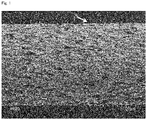
- Fig. 1 is a photograph substituted for drawing that shows the surface condition of the synthetic fiber monofilament A used in Example 1.
- the braid of the present invention is a braid fabricated using a specific synthetic fiber monofilament A and/or a specific covering yarn in which the periphery of a monofilament B is covered with a textured yarn, and thanks to this configuration, the surface gloss of the monofilaments is reduced, so that there is a braid in which "glare", which has conventionally been considered to be difficult to suppress, is suppressed.
- the most important means for constructing the braid of the present invention is to use a monofilament and/or a covering yarn with reduced glare.
- the monofilament with reduced glare is a synthetic fiber monofilament A satisfying the following (1) to (3).
- the maximum reflection intensity at a light receiving angle of 0 to 80 ° is preferably in the above range in view of the glare of the braid.
- the degree of gloss is preferably 20 or less, and preferably 18 or less in reflection intensity at a light receiving angle of 0°.
- the braid does not glare even when illuminated with sunlight or LED illumination and the surface quality of the braid fabricated is good.
- the monofilament when the monofilament is excessively high in degree of gloss, it glares strongly, and when a braid is fabricated, the glossiness of the monofilament is conspicuous and the appearance quality of the braid fabricated tends to be deteriorated. Such glossiness is unpreferable as a synthetic fiber braid. Therefore, it is preferable to have a feature within the above range.
- the synthetic fiber monofilament A to be used in the present invention preferably has a B value of flexural rigidity of 0.002 (N ⁇ cm 2 /yarn) or more. This leads to superior shape retainability of a hat.
- the B value is less than 0.002 (N ⁇ cm 2 /yarn)
- the rigidity of the braid fabricated is low, and when the braid is formed into a shape of a hat or the like, the product is insufficient in bounce, so that it is poor in form stability.
- the flexural rigidity B value exceeds 0.01 (N ⁇ cm 2 /yarn)
- the monofilament has an increased fineness, so that the appearance quality of the braid fabricated tends to be significantly deteriorated.
- More preferred is a monofilament having a flexural rigidity B value of 0.004 to 0.006 (N ⁇ cm 2 /yarn).
- the synthetic fiber filament A to be used in the present invention preferably has a flexural hysteresis 2HB value of 0.003 (N ⁇ cm/yarn) or less.
- the lower limit is preferably 0.0005 (N ⁇ cm/yarn) or more, and more preferably 0.001 (N ⁇ cm/yarn) or more.
- the braid fabricated is superior in rigidity, and when the braid is formed into a shape of a hat or the like, it is preferable from the viewpoint of superior bounce and superior form stability.
- the synthetic fiber monofilament A is not particularly limited as long as the above range is satisfied, but preferred is a monofilament of a polyester-based fiber.
- utilizing a polyester-based fiber is advantageous in that it is superior in productivity because in-draw false twist processing and partial fusion processing can be easily performed, a disperse dye is used for dyeing, and multicolor development can be performed.
- various exhaustion processing such as antibacterial processing, UV cut processing, and water repellent processing can be performed using a cheese dyeing machine as yarn processing and in that it can contribute to product development.
- the synthetic fiber monofilament A to be used for the fabrication of a braid is a polyester-based fiber because of its dyeability and processability as mentioned above and because it can reduce cost, it is superior in launderability such as being superior in shape retainability even by washing from the viewpoint of the rigidity of a monofilament and the heat settability of polyester, or it is superior in drying properties such as quick drying after washing.
- the synthetic fiber monofilament A has fine irregularities on the surface, whereby it can suppress glare and reduce glossiness.
- a monofilament is spun with the addition of particles capable of forming a desired irregular surface, then the monofilament is subjected to weight reduction treatment to solve the surface layer of the monofilament and thereby release the particles.
- weight reduction treatment to solve the surface layer of the monofilament and thereby release the particles.
- the particles and the matting agent examples include silica, titanium oxide, silicon oxide, alumina, alumina sol, calcium carbonate, organic sulfonic acid metal chloride compounds, sulfate, sodium benzenesulfonate, magnesium dicarboxylate, dibasic potassium phosphate, phosphates, and crosslinked polystyrene.
- silica especially, colloidal silica is preferable
- a particulate matting agent such as titanium oxide not only serves as a matting agent, but also leaves to form an irregular surface.
- the monofilament can be produced by producing a monofilament spun with particles and/or a matting agent contained, and then subjecting the monofilament to weight reduction processing to release the particles and/or the matting agent exposed on the surface to form irregularities.
- the monofilament having fine irregularities as described above suppresses glossiness due to irregular reflection of light by irregularities when irradiated with light, and reduces "glare" of the braid.
- the synthetic fiber monofilament A contains a matting agent such as titanium oxide in an amount of 0.01 to 10% by weight with respect to the synthetic fiber monofilament.
- the content is more preferably 0.01 to 8.0% by weight.
- the content of the particles such as silica is 0.01 to 10% by weight with respect to the synthetic fiber monofilament A from the viewpoint of forming fine irregularities on the surface of the synthetic fiber monofilament A by weight reduction processing.
- the content is more preferably 0.01 to 8.0% by weight.
- the synthetic fiber monofilament A contains 0.01 to 10% by weight of titanium oxide and 0.01 to 10.0% by weight of silica based on 100% by weight of the synthetic fiber monofilament A from the viewpoint of the balance between glare reduction and high order processability.
- the monofilament In order to obtain a monofilament with reduced glare, it is extremely effective to produce the monofilament by including 0.01 to 10% by weight of the matting agent described above, such as titanium oxide, and 0.01 to 10% by weight of the particles, such as silica, during spinning, and subjecting the monofilament to weight reduction processing and dyeing using a dyeing machine such as a cheese dyeing machine.
- the matting agent described above such as titanium oxide
- the particles such as silica
- the average particle diameter of the particles is desirably 0.5 to 8 ⁇ m.
- the measurement of other particles is performed by selecting a more suitable method among the above methods, and when it is difficult to perform the measurement by any method, there is employed a value obtained by performing the measurement by a method for determining the average particle diameter of primary particles commonly used in the art.
- a polyethylene terephthalate monofilament containing particles and a matting agent as described above is produced using polyethylene terephthalate (PET) as the material for constituting the synthetic fiber monofilament A, and then the polyethylene terephthalate monofilament is subjected to weight reduction processing and dyeing by using a cheese dyeing machine to afford the synthetic fiber monofilament A with reduced glare.
- PET polyethylene terephthalate
- a method according to the material constituting the monofilament is employed, and for example, in the case of a polyethylene terephthalate monofilament, there may be employed a method of performing weight reduction processing by dissolving the surface of the monofilament using an alkali solution.
- the alkali solution to be used for the weight reduction processing is preferably an aqueous solution of sodium hydroxide, potassium hydroxide, or the like.
- a method of reducing weight in the state of a yarn a method of reducing the weight with an alkali solution using a common yarn dyeing facility can be performed.
- a cheese dyeing machine that treats in the shape of cheese, of a skein dyeing machine, a muff dyeing machine or a star dyeing machine that treats in the shape of a skein. It is particularly preferable to use a cheese dyeing machine in view of the uniformity of weight reduction and the unwinding property of the yarn.
- the formulation for the weight reduction may sufficiently be under the conditions of common weight reduction processing, but in the case of a monofilament, since the surface area is very small with respect to the weight, it is preferable to set a slow weight reduction rate and use a weight reduction accelerator.
- the weight reduction rate is usually 3% or more and 98% or less by weight as compared to that before the weight reduction processing. It is possible to reduce glossiness by releasing the particles contained in the monofilament by weight reduction processing to form a lot of craters, and irregularly reflecting light, but if the weight is excessively reduced, yarn breakage may occur during the fabrication of a braid due to lowering of tensile strength and elongation.
- the weight reduction rate with which the reduction in tensile strength and elongation is minimized while glossiness is reduced is desirably 3 to 30% by weight, more desirably 5 to 30%, and particularly desirably 10 to 30% by weight.
- the braid of the present invention with suppressed glare can be obtained also by using a specific covering yarn in which the periphery of the monofilament B is covered with a textured yarn.
- the covering yarn is a covering yarn in which the periphery of the monofilament B satisfying the above (1) is covered with a textured yarn and which satisfies the following (4) to (5),
- the monofilament B is required to have flexural rigidity and form stability, synthetic fiber monofilaments are preferable, and monofilaments of polyester-based fiber, olefin-based fiber such as polypropylene fiber and polyethylene fiber, polyamide fiber, etc. are more preferable.
- the fineness is 150 dtex or more and 3000 dtex or less, preferably 200 to 1000 dtex, and more preferably 300 to 700 dtex.
- the monofilament B to be used in the present invention preferably has a B value of flexural rigidity of 0.002 (N ⁇ cm 2 /yarn) or more. This leads to superior shape retainability of a hat.
- the B value is less than 0.002 (N ⁇ cm 2 /yarn)
- the rigidity of the braid fabricated is low, and when the braid is formed into a shape of a hat or the like, the product is insufficient in bounce, so that it is poor in form stability.
- the flexural rigidity B value exceeds 0.01 (N ⁇ cm 2 /yarn)
- the monofilament has an increased fineness, so that the appearance quality of the braid fabricated tends to be significantly deteriorated.
- More preferred is a monofilament having a flexural rigidity B value of 0.004 to 0.006 (N ⁇ cm 2 /yarn).
- the synthetic fiber filament B to be used in the present invention preferably has a flexural hysteresis 2HB value of 0.003 (N ⁇ cm/yarn) or less.
- the lower limit is preferably 0.0005 (N ⁇ cm/yarn) or more, and more preferably 0.001 (N ⁇ cm/yarn) or more.
- the braid fabricated is superior in rigidity, and when the braid is formed into a shape of a hat or the like, it is preferable from the viewpoint of superior bounce and superior form stability.
- the textured yarn is not a drawn yarn having a straight fiber form, and it is limited to a textured yarn. If a drawn yarn is used, since the form of its fiber is straight, glare is strong when a braid is fabricated and the surface quality of the braid fabricated is deteriorated. In the case of a textured yarn, glare can be reduced because the fiber form is partially different.
- a multifilament is usually used as the yarn form of the textured yarn.
- a yarn subjected to false twist processing is preferable in order to sufficiently cover the monofilament B and to reduce glossiness.
- Examples of the material of the textured yarn include polyester, polypropylene, and nylon, and polyester and nylon, which are easy to dye due to their superior multicolor development and color developability, are preferable.
- Polyester is preferable because of its superior dyeability and moderate flexural rigidity.
- the fineness of the textured yarn is 50 dtex or more, and is preferably 50 dtex to 2000 dtex in terms of successfully imparting a spun-like texture of a braid and in terms of rigidity.
- 100 dtex to 1000 dtex, and further 100 dtex to 600 dtex are preferable in terms of further glare reduction and productivity of covering.
- the monofilament B maintains lightweight feeling and is superior in high-order processability.
- covering the monofilament B with a textured yarn having a small fineness can suppress "glare" thanks to irregular reflection of light.
- the method for covering the monofilament B with a textured yarn is not limited as long as the conditions specified in the present invention are satisfied, but it is preferable to perform double covering or single covering, which can reduce glare, and especially, double covering is preferable.
- the number of turns of the covering yarn is preferably 300 to 3000 T/m.
- the number of turns of the textured yarn is preferably 300 T/m to 2000 T/m from the viewpoint of balancing an increased coverage of the monofilament B, a maintained lightweight feeling, and high-order processability.
- the glare of the braid is reduced, so that the quality can be improved.
- the ratio of the maximum reflection intensity to the minimum reflection intensity of the covering yarn is 2.8 or less. In addition, a ratio of 2.5 or less is preferable in view of the less glare of the braid.
- Such a covering yarn can be obtained by a method of covering a monofilament with a textured yarn such as a false twisted yarn using a covering machine.
- the degree of gloss is made to have a preferable range of 20 or less in reflection intensity at a light receiving angle of 0°, and in a more preferable embodiment, a more preferable range of 18 or less can be achieved.
- the covering yarn is allowed to have a maximum reflection intensity at a light receiving angle of 0 to 80° within a preferable range of 50 or less because glare is reduced, and in a more preferable embodiment, it is also possible to achieve a more preferable range of 40 or less or a particularly preferable range of 35 or less.
- synthetic fiber monofilament A and/or the covering yarn as described above makes it possible to reduce glare when processed into a braid.
- synthetic fiber monofilament A and covering yarn may be referred to as special monofilament.
- the braid of the present invention can be obtained by fabricating a braid using the special monofilament described above.
- the structure of a braid at the time of fabricating the braid is not particularly limited, and is commonly a flat-braided structure, but is not specified as long as it is in the form of a tape capable of forming a hat by spirally stitching it.
- a braid In the case of flat braiding, a braid can be fabricated using a common flat braiding machine.
- the braid can be formed by braiding one or more fibers including the special monofilament, and particularly, it is preferable to form a braid in which plaited yarns (for example, 6 to 16 yarns) are braided with respect to core yarns (for example, 4 yarns) as cores.
- plaited yarns for example, 6 to 16 yarns
- core yarns for example, 4 yarns
- the special monofilament is preferably used for plaited yarns because the effect of suppressing glare can be sufficiently utilized.
- a multifilament in combination with a special monofilament.
- a mode of the combination there may be employed either a mode in which a special monofilament and a multifilament are combined beforehand and used in the form of a plaited yarn or a mode in which a special monofilament and a multifilament are used as separate plaited yarns.
- a mode in which a special monofilament and a multifilament are adjacently combined is preferable, and an embodiment in which a special monofilament and a multifilament are combined beforehand and used in the form of a plaited yarn is preferable from the viewpoint of productivity of a braid and unwinding property of a yarn.
- the synthetic fiber monofilament A and the multifilament are combined beforehand and then used as a plaited yarn from the viewpoint of the productivity of a braid.
- Examples of such a multifilament preferably include a polyester multifilament and a polyamide multifilament of textured yarns, and a polyester multifilament is particularly preferable from the viewpoint of flexural rigidity and light resistance.
- the multifilament of the textured yarn it is preferable to use a textured yarn rather than a drawn yarn having a straight fiber form.
- a drawn yarn since the form of the fiber is straight, glare tends to be strong when a braid is fabricated and the surface quality of the braid tends to be deteriorated. In the case of a textured yarn, glare can be reduced because the fiber form is partially different.
- a partially fused yarn is preferable as such a yarn having a dyeing difference in the longitudinal direction.
- a method is preferable in which a multifilament is spun, then subjected to partial fusion processing of partially fusing, and then dyed using a cheese dyeing machine. This makes it possible to obtain a crispy feeling and a difference in density of dyeing, and as a result, it is possible to obtain a fineness difference and a color difference like natural fibers.
- the multifilament having such a dyeing difference can be produced by controlling drawing conditions, specifically, by forming a weakly drawn part having a relatively low drawing ratio and a strongly drawn part having a relatively high drawing ratio during drawing. Since the melting point of the weakly drawn part is lower than that of the strongly drawn part, the weakly drawn part is fused by heating in a heat setting step after drawing to form a partially fused yarn that is partially fused. When such a partially fused yarn is used, a dyeing difference can be developed. It is preferable in that a difference in color density is produced by partially having a dye adhesion difference and an appearance like natural fiber such as straw and hemp can be obtained.
- dyeing difference refers to a difference in dye attachment, that is, a difference in ease of attachment of a dye to a fiber. This effect is particularly remarkable when a multifilament of polyester such as polyethylene terephthalate is used.
- a difference in fineness and a difference in color like natural fibers can be obtained by developing a crispy feeling and a difference in density of dyeing by spinning a polyester filament, then partially fusing the polyester filament, and further performing false twist processing. Specifically, it is obtained by partially performing fusion processing and performing dyeing using a cheese dyeing machine.
- the model of the device, process, conditions, etc. to be used for the production may not be specially selected, but it is desirable that there are five or more fused parts per meter. When the number of the fused parts is less than five, the dyeing difference is small and the change in hardness is small, so that a monotonous texture is obtained. Conversely, when the number of fused parts is increased, the hardness of the fused parts is noticeable, so that the texture is poor and the rough hardness is increased.
- a textured yarn prepared by performing yarn processing of partial fusion using a highly oriented undrawn yarn of a normal polyester multifilament, and then performing dyeing and antibacterial processing or UV cut processing using a cheese dyeing machine.
- a spun yarn is preferably used in combination to prevent the yarn constituting the braid from slipping off during the fabrication of the braid, and especially in a plaited braid, a spun yarn is preferably used in combination to prevent a plaited yarn from slipping off from a core yarn.
- the spun yarn is preferably constituted of dyeable fibers such as polyester fibers, polyamide fibers, acrylic fibers, cotton, and wool. These can be used singly or in combination of two or more species thereof.
- dyeable fibers such as polyester fibers, polyamide fibers, acrylic fibers, cotton, and wool.
- an original yarn incapable of being dyed such as polypropylene fibers
- versatility is poor and color development is difficult.
- polyester fibers and polyamide fibers are preferably used.
- the spun yarn a polyester spun yarn and a polyamide spun yarn are preferable, and among them, the polyester spun yarn is particularly preferable because it has strong flexural rigidity, increases the width of a braid, and increases the rigidity of the braid.
- the spun yarn is used as a constituent yarn of a braid, but in a plaited braid, it is suitably used as both a plaited yarn and a core yarn.
- the spun yarn is preferably used as a core yarn. If necessary, the spun yarn can be used in the form of a plaited yarn.
- the fineness of the spun yarn is preferably 50 or less in cotton count, and particularly preferably 4 to 50, for form stability in sewing and hats.
- the fineness is preferably 20 or less, and particularly preferably 4 or more and 20 or less.
- the B value of the flexural rigidity of the braid is desirably 0.002 (N ⁇ cm 2 /yarn) or more.
- the B value of the flexural rigidity of the plaited braid is preferably 0.025 (N ⁇ cm 2 /yarn) or less, and preferably 0.019 (N ⁇ cm 2 /yarn) or less.
- the plaited braid preferably has a flexural hysteresis 2HB value of 0.01 (N ⁇ cm/yarn) or less.
- the lower limit is preferably 0.0005 (N ⁇ cm/yarn) or more, more preferably 0.001 (N ⁇ cm/yarn) or more, and even more preferably 0.003 (N ⁇ cm/yarn) or more.
- the spun yarn can be dyed with a dye suitable for the material of the spun yarn such as a disperse dye using a cheese dyeing machine through a common spinning process. Furthermore, those subjected to various types of processing such as antibacterial processing, UV cut processing, and water repellent processing can also be suitably used.
- a method for producing the spun yarn is described below.
- spinning is carried out using a common ring spinning machine and twist stopping set is carried out.
- the spun yarn When a spun yarn is formed into a braid, the spun yarn is required to have high flexural rigidity and high tensile strength, and is preferably one having lightweight feeling.
- a two ply yarn or a three ply yarn is desirable.
- a hollow polyester is desirable.
- the braid of the present invention can be fabricated using a common braiding machine.
- a braid fabricated using a general flat-braiding machine is preferably a set of seven yarns or a set of nine yarns.
- the width of a plaited braid varies depending on the flexural rigidity of the braid, it is preferable to insert two or more core yarns.
- ease of sewing affects the surface quality of the straw hat, and thus it is preferable to appropriately select the width of the braid and the number of yarns plaited.
- the braid width is preferably 5 mm or more, and the number of yarns plaited is preferably 5 or more and 16 or less.
- the braids prepared using synthetic fibers proposed so far have a problem in glossiness because monofilaments having strong flexural rigidity are used, and when no monofilament is used, the braid is insufficient in flexural rigidity and there is a problem in quality as a hat as described above.
- the content of the synthetic fiber monofilament A and/or the monofilament B in the braid is preferably 3 to 60% by weight.
- the present invention it is possible to suppress the surface gloss of monofilaments by forming fine irregularities on the surface of the synthetic fiber monofilament A by performing weight reduction processing or covering the monofilament B with a bulky textured yarn, to reduce glare peculiar to synthetic fibers and to improve the appearance quality of the braid.
- a special monofilament that is thick and has no glossiness the rigidity of the braid can be maintained and bounce can be obtained.
- a textured yarn of a polyester multifilament is used as a textured yarn together with a monofilament and is partially fused because in this case, the fiber surface of the textured yarn is partially fused and, as a result, a difference in color density occurs due to the dyeing difference between the unfused parts and the fused parts, so that when a braid is fabricated, a touch feeling and a hue of the textured yarn that are non-uniform are imparted to the braid and a spun-like texture is obtained.
- the thus-obtained braid of the present invention can reduce the glossiness of a normal monofilament while using a monofilament, has bounce while having the texture and appearance quality of a textured yarn, forms a braid superior in home washing, storability, and lightweight feeling, eliminates the "glare", which has heretofore been believed as a major defect, establishes the surface quality without "glare” or "shininess", and can afford a braid of a textured yarn without the glossiness of synthetic yarns.
- the spinneret in the spinning step is made to have a modified cross section and is varied in cross-sectional form (various forms such as cloud-like form, hollow form, and octofoil form), or particles (titanium oxide and silica such as colloidal silica are preferable) capable of forming fine irregularities by weight reduction processing are included in an original yarn because the gloss of the yarn can be further reduced and a greater effect is given to the present invention.
- the braid of the present invention has the above characteristics, it is extremely suitable for hats, but its use is not limited thereto, and can be suitably used for bags, baskets, furniture, and seats.
- hats using a braid have bounce like that of straw and hemp, and also have launderability, and thus have more practicality than hats made of natural fibers such as straw hats.
- the monofilaments produced according to the present invention were analyzed by the following methods.
- Degree of gloss and reflection intensity The degree of gloss and the reflection intensity were measured using a gonio photometer GP-200 (manufactured by MURAKAMI COLOR RESEARCH LABORATORY CO., LTD.).
- the reflection intensity the smaller the value thereof, the less the glare and the better the reflection intensity.
- Flexural rigidity, flexural hysteresis The flexural rigidity in the present invention was measured using a KES-FB2 pure bending tester (manufactured by KATO TECH CO., LTD.) as an evaluation instrument. Four monofilaments were aligned at equal intervals in a distance of 1 cm, followed by measurement. A flexural rigidity B value and a flexural hysteresis 2HB value at the time of bending were measured.
- the flexural hysteresis 2HB value when the monofilament is bent is measured. The smaller this value, the less in strain, the more in tenacity, and the higher in repulsion the monofilament.
- the fineness of monofilaments was measured in accordance with the L 1013: 2010 8.3.1 A method.
- the fineness of textured yarns was measured in accordance with the L 1013: 2010 8.3.1 B method.
- the yarn diameter of monofilaments was measured using an optical microscope BH2 manufactured by Olympus Corporation. The diameter was determined from microscopic observation of the side surface of the monofilament, measured 10 times per level, and the yarn diameter was measured by the arithmetic average value.
- the braids fabricated according to the present invention were analyzed by the following methods.
- Flexural rigidity The flexural rigidity in the present invention was measured using a KES-FB2 pure bending tester (manufactured by KATO TECH CO., LTD.) as an evaluation instrument. One braid was set and measured. A flexural rigidity B value and a flexural hysteresis flexural hysteresis 2HB value at the time of bending were measured.
- a flexural hysteresis flexural hysteresis 2HB value at the time of bending a braid is measured. The smaller this value is, the less distorted, the more tenacious, and the more resilient the braid is.
- Hats were analyzed by the following methods.
- PET polyester
- TiO titanium oxide
- dry silica having a yarn diameter before weight reduction of 200 ⁇ m (the cross-sectional shape of a cross section perpendicular to the major axis direction: round cross section).
- the reflection intensity, flexural rigidity and flexural hysteresis of the monofilament were measured. The measurement results are shown in Table 1.
- the surface condition of the monofilament was observed with a scanning electron microscope (SEM) and shown in Fig. 1.
- Fig. 1 is a photograph substituted for drawing that shows the surface condition of the synthetic fiber monofilament A used in Example 1. Fine irregularities are formed on the surface of the polyester monofilament which is a synthetic fiber monofilament A1.
- the braid was spirally sewn with a sewing machine and heat-set at 180°C with a mold to prepare a hat.
- the polyester multifilament was partially fused, and the frequency thereof was 50 sites/m.
- a polyester (PET) monofilament containing only 0.5% by weight of titanium oxide and having a yarn diameter of 200 ⁇ m as a core was double-covered at 800 T/m with a polyester (PET) false twisted yarn of 166 dtex.
- a flat braid having a width of 8 mm and a hat were obtained by the same production methods as in Example 1 except for the above.
- a flat braid having a width of 8 mm and a hat were obtained by the same production methods as in Example 1 except that a polyester (PET) monofilament containing 0.3% by weight of titanium oxide and 1.5% by weight of dry silica and having a yarn diameter of 300 ⁇ m was used.
- PET polyester
- a polyester (PET) monofilament containing only 0.5% by weight of titanium oxide and having a yarn diameter of 150 ⁇ m as a core was double-covered at 800 T/m with a polyester (PET) false twisted yarn of 166 dtex.
- a flat braid having a width of 8 mm and a hat were obtained by the same production methods as in Example 1 except for the above.
- a flat braid having a width of 8 mm and a hat were obtained by the same production methods as in Example 1 except that a polyester (PET) monofilament containing only 0.5% by weight of titanium oxide and having a yarn diameter of 200 ⁇ m was used and weight reduction processing was not performed.
- PET polyester
- a flat braid having a width of 8 mm and a hat were obtained by the same production methods as in Example 1 except that a polyester (PET) monofilament containing only 3% by weight of titanium oxide and having a yarn diameter of 200 ⁇ m was used and weight reduction processing was not performed.
- PET polyester
- a flat braid having a width of 8 mm and a hat were obtained by the same production methods as in Example 1 except that a polyester (PET) monofilament containing 0.3% by weight of titanium oxide and 1.5% by weight of dry silica and having a yarn diameter of 100 ⁇ m was used.
- PET polyester
- a flat braid having a width of 8 mm and a hat were obtained by the same production methods as in Example 1 except that a polyester (PET) monofilament containing only 3% by weight of titanium oxide and having a yarn diameter of 680 ⁇ m was used.
- PET polyester
- a flat braid having a width of 8 mm and a hat were obtained by the same production methods as in Example 1 except for the above.
- Example 1 Example 2
- Example 3 Yarn diameter of monofilament [ ⁇ m] 200 (before weight reduction) 200 300 (before weight reduction) 150 Fineness of monofilament [dtex] 454 (before weight reduction) 444 824 (before weight reduction) 220 386 (after weight reduction) 700 (after weight reduction) Fineness of textured yarn [dtex] None 166 None 166 Flexural rigidity B value of monofilament [N ⁇ cm 2 /yarn] 0.0045 0.0054 0.0321 0.0022 Flexural hysteresis 2HB of monofilament [N • cm/yarn] 0.00118 0.00194 0.0025 0.00155 Special monofilament Reflection intensity at a light receiving angle of 0° 14.3 17.9 17.9 19.3 Minimum reflection intensity 14.2 17.7 16.4 19.3 Maximum reflection intensity 31.5 35.3 38.5 48.5 Maximum reflection intensity/minimum reflection intensity 2.21 1.99 2.35 2.52 [Table 1-2] Comparative Example 1 Comparative Example 2 Comparative Example 3 Comparative Example 1 Compar
- Table 1 shows the comparison of the monofilaments and the covering yarns obtained by the methods described above.
- Example 1 is one having a low degree of gloss and less glare while having flexural rigidity and flexural hysteresis equivalent to those of Comparative Examples 1 and 2.
- Example 1 is equivalent in degree of gloss to Comparative Example 3, but has a high flexural rigidity, and a braid obtained therefrom can be said to be a braid superior in shape retainability and storability.
- Examples 1 and 3 have less glare and superior appearance quality as compared to Comparative Example 4.
- these examples have appropriate flexural rigidity, it can be said that the braids obtained therefrom are braids having superior storability as compared to Comparative Example 4.
- Example 2 the coverage ratio of the false twisted yarn with respect to the monofilament is high while having flexural rigidity equivalent to that of Comparative Example 5, so that a braid that is lower in glossiness and superior in appearance quality than Comparative Example 5 can be obtained.
- the fineness of the false twisted yarn is 166 tex, the productivity of double covering is higher than that of Comparative Example 5.
- Example 1 has flexural rigidity and flexural hysteresis equivalent to those of Comparative Examples 1 and 2, but has remarkably superior low gloss.
- the braid of Example 1 is higher in flexural rigidity and flexural hysteresis value than the braid of Comparative Example 3, and can be said to be a braid superior in shape retainability and storability.
Landscapes
- Engineering & Computer Science (AREA)
- Manufacturing & Machinery (AREA)
- Textile Engineering (AREA)
- Yarns And Mechanical Finishing Of Yarns Or Ropes (AREA)
- Artificial Filaments (AREA)
- Braiding, Manufacturing Of Bobbin-Net Or Lace, And Manufacturing Of Nets By Knotting (AREA)
- Chemical Or Physical Treatment Of Fibers (AREA)
Applications Claiming Priority (2)
| Application Number | Priority Date | Filing Date | Title |
|---|---|---|---|
| JP2019035996 | 2019-02-28 | ||
| PCT/JP2020/008153 WO2020175646A1 (fr) | 2019-02-28 | 2020-02-27 | Tresse, et chapeau |
Publications (1)
| Publication Number | Publication Date |
|---|---|
| EP3933085A1 true EP3933085A1 (fr) | 2022-01-05 |
Family
ID=72240197
Family Applications (1)
| Application Number | Title | Priority Date | Filing Date |
|---|---|---|---|
| EP20762077.4A Withdrawn EP3933085A1 (fr) | 2019-02-28 | 2020-02-27 | Tresse, et chapeau |
Country Status (4)
| Country | Link |
|---|---|
| EP (1) | EP3933085A1 (fr) |
| JP (1) | JPWO2020175646A1 (fr) |
| CN (1) | CN113474502A (fr) |
| WO (1) | WO2020175646A1 (fr) |
Family Cites Families (12)
| Publication number | Priority date | Publication date | Assignee | Title |
|---|---|---|---|---|
| JP3601862B2 (ja) * | 1994-11-29 | 2004-12-15 | ユニチカ株式会社 | 組紐 |
| JP2000017553A (ja) * | 1998-04-27 | 2000-01-18 | Ueda Seibosho:Kk | ブレード |
| JP2005015960A (ja) | 2003-06-26 | 2005-01-20 | Belles Modes:Kk | ブレード |
| JP2005226169A (ja) * | 2004-02-10 | 2005-08-25 | Opelontex Co Ltd | 伸縮性ダブルラッセル紐及びその製造方法 |
| CN101173377A (zh) * | 2007-11-28 | 2008-05-07 | 盛虹集团有限公司 | 减量法织造表面不平纤维的方法 |
| JP2009235591A (ja) * | 2008-03-26 | 2009-10-15 | Toray Ind Inc | カバリング糸 |
| JP5354966B2 (ja) * | 2008-06-13 | 2013-11-27 | 旭化成せんい株式会社 | 伸縮電線 |
| JP5663885B2 (ja) * | 2010-02-05 | 2015-02-04 | 東レ株式会社 | ポリエステル短繊維織物 |
| CN102453975A (zh) * | 2010-10-21 | 2012-05-16 | 东丽纤维研究所(中国)有限公司 | 一种聚酯纤维及其编织物 |
| JP6870957B2 (ja) * | 2016-10-28 | 2021-05-12 | 株式会社アートネイチャー | 人工毛髪、及び、かつら |
| JP7031310B2 (ja) * | 2016-11-15 | 2022-03-08 | 東レ株式会社 | 光沢繊維 |
| JP2019178448A (ja) * | 2018-03-30 | 2019-10-17 | 東レ株式会社 | 光沢織編物 |
-
2020
- 2020-02-27 CN CN202080013554.9A patent/CN113474502A/zh not_active Withdrawn
- 2020-02-27 JP JP2020550184A patent/JPWO2020175646A1/ja active Pending
- 2020-02-27 WO PCT/JP2020/008153 patent/WO2020175646A1/fr not_active Ceased
- 2020-02-27 EP EP20762077.4A patent/EP3933085A1/fr not_active Withdrawn
Also Published As
| Publication number | Publication date |
|---|---|
| JPWO2020175646A1 (ja) | 2021-12-23 |
| WO2020175646A1 (fr) | 2020-09-03 |
| CN113474502A (zh) | 2021-10-01 |
Similar Documents
| Publication | Publication Date | Title |
|---|---|---|
| TWI551742B (zh) | 芯鞘複合纖維、含有同芯鞘複合纖維的假撚加工紗及其製造方法以及包含這些纖維的織編物 | |
| EP2808428B1 (fr) | Fibre composite polyester dotée d'une excellente propriété de protection contre la chaleur et d'une excellente coloration | |
| CN1596326A (zh) | 多色纤维毛绒织物和凹凸形图案多色纤维毛绒织物 | |
| CN1537184A (zh) | 聚酯共轭长丝粗细节花式纱织物及其生产方法 | |
| CN1914363A (zh) | 喷气交缠短纤纱及含有它的纺织品 | |
| EP3933085A1 (fr) | Tresse, et chapeau | |
| JP4143904B2 (ja) | ポリエステル繊維含有布帛及びその製造方法 | |
| JP2008133584A (ja) | ポリエステル繊維含有織編物及びその製造法 | |
| JP2016113714A (ja) | 仮撚中空マルチフィラメント糸、及び織編物 | |
| JP2002105796A (ja) | 遮光性織物 | |
| JP4092635B2 (ja) | フルダル調織物 | |
| JP6409977B2 (ja) | 扁平断面捲縮糸、該捲縮糸の製造方法及び該捲縮糸を含む織編物 | |
| JP4085312B2 (ja) | ポリエステル繊維含有織編物及びその製造法 | |
| JP2001279546A (ja) | 異型断面再生セルロース繊維を含有する複合糸 | |
| JP2022038833A (ja) | 紐および帽子 | |
| JP5324360B2 (ja) | 芯鞘型複合仮撚加工糸を含む布帛および繊維製品 | |
| JP2005320654A (ja) | 新規外観パイル布帛およびカーシート | |
| JP2014177716A (ja) | 遮熱性及び防透性に優れた芯鞘型異形断面複合繊維 | |
| JPH0130935B2 (fr) | ||
| JP7005188B2 (ja) | 仮撚マルチフィラメント糸、その製造方法、及び織編物 | |
| EP3978663B1 (fr) | Tissu tricoté et produit fibreux | |
| JP2010156070A (ja) | 杢調ポリエステル織編物 | |
| JPH11335936A (ja) | 複合仮ヨリ糸およびその製造方法 | |
| JP2001200439A (ja) | ポリエステル異染性混繊糸 | |
| JP4071533B2 (ja) | 着古し外観を有する縫製品 |
Legal Events
| Date | Code | Title | Description |
|---|---|---|---|
| STAA | Information on the status of an ep patent application or granted ep patent |
Free format text: STATUS: THE INTERNATIONAL PUBLICATION HAS BEEN MADE |
|
| PUAI | Public reference made under article 153(3) epc to a published international application that has entered the european phase |
Free format text: ORIGINAL CODE: 0009012 |
|
| STAA | Information on the status of an ep patent application or granted ep patent |
Free format text: STATUS: REQUEST FOR EXAMINATION WAS MADE |
|
| 17P | Request for examination filed |
Effective date: 20210901 |
|
| AK | Designated contracting states |
Kind code of ref document: A1 Designated state(s): AL AT BE BG CH CY CZ DE DK EE ES FI FR GB GR HR HU IE IS IT LI LT LU LV MC MK MT NL NO PL PT RO RS SE SI SK SM TR |
|
| DAV | Request for validation of the european patent (deleted) | ||
| DAX | Request for extension of the european patent (deleted) | ||
| STAA | Information on the status of an ep patent application or granted ep patent |
Free format text: STATUS: THE APPLICATION HAS BEEN WITHDRAWN |
|
| 18W | Application withdrawn |
Effective date: 20221018 |