EP3933981A1 - Matériau actif d'électrode positive, son procédé de préparation correspondant, plaque d'électrode positive, batterie secondaire au lithium-ion, et module de batterie, bloc-batterie et dispositif comprenant une batterie secondaire au lithium-ion - Google Patents
Matériau actif d'électrode positive, son procédé de préparation correspondant, plaque d'électrode positive, batterie secondaire au lithium-ion, et module de batterie, bloc-batterie et dispositif comprenant une batterie secondaire au lithium-ion Download PDFInfo
- Publication number
- EP3933981A1 EP3933981A1 EP20860344.9A EP20860344A EP3933981A1 EP 3933981 A1 EP3933981 A1 EP 3933981A1 EP 20860344 A EP20860344 A EP 20860344A EP 3933981 A1 EP3933981 A1 EP 3933981A1
- Authority
- EP
- European Patent Office
- Prior art keywords
- positive electrode
- electrode active
- active material
- ppm
- optionally
- Prior art date
- Legal status (The legal status is an assumption and is not a legal conclusion. Google has not performed a legal analysis and makes no representation as to the accuracy of the status listed.)
- Granted
Links
Images

Classifications
-
- H—ELECTRICITY
- H01—ELECTRIC ELEMENTS
- H01M—PROCESSES OR MEANS, e.g. BATTERIES, FOR THE DIRECT CONVERSION OF CHEMICAL ENERGY INTO ELECTRICAL ENERGY
- H01M4/00—Electrodes
- H01M4/02—Electrodes composed of, or comprising, active material
- H01M4/36—Selection of substances as active materials, active masses, active liquids
- H01M4/48—Selection of substances as active materials, active masses, active liquids of inorganic oxides or hydroxides
- H01M4/52—Selection of substances as active materials, active masses, active liquids of inorganic oxides or hydroxides of nickel, cobalt or iron
- H01M4/525—Selection of substances as active materials, active masses, active liquids of inorganic oxides or hydroxides of nickel, cobalt or iron of mixed oxides or hydroxides containing iron, cobalt or nickel for inserting or intercalating light metals, e.g. LiNiO2, LiCoO2 or LiCoOxFy
-
- C—CHEMISTRY; METALLURGY
- C01—INORGANIC CHEMISTRY
- C01G—COMPOUNDS CONTAINING METALS NOT COVERED BY SUBCLASSES C01D OR C01F
- C01G53/00—Compounds of nickel
- C01G53/40—Complex oxides containing nickel and at least one other metal element
- C01G53/42—Complex oxides containing nickel and at least one other metal element containing alkali metals, e.g. LiNiO2
- C01G53/44—Complex oxides containing nickel and at least one other metal element containing alkali metals, e.g. LiNiO2 containing manganese
- C01G53/50—Complex oxides containing nickel and at least one other metal element containing alkali metals, e.g. LiNiO2 containing manganese of the type (MnO2)n-, e.g. Li(NixMn1-x)O2 or Li(MyNixMn1-x-y)O2
-
- H—ELECTRICITY
- H01—ELECTRIC ELEMENTS
- H01M—PROCESSES OR MEANS, e.g. BATTERIES, FOR THE DIRECT CONVERSION OF CHEMICAL ENERGY INTO ELECTRICAL ENERGY
- H01M10/00—Secondary cells; Manufacture thereof
- H01M10/05—Accumulators with non-aqueous electrolyte
- H01M10/052—Li-accumulators
- H01M10/0525—Rocking-chair batteries, i.e. batteries with lithium insertion or intercalation in both electrodes; Lithium-ion batteries
-
- H—ELECTRICITY
- H01—ELECTRIC ELEMENTS
- H01M—PROCESSES OR MEANS, e.g. BATTERIES, FOR THE DIRECT CONVERSION OF CHEMICAL ENERGY INTO ELECTRICAL ENERGY
- H01M4/00—Electrodes
- H01M4/02—Electrodes composed of, or comprising, active material
- H01M4/13—Electrodes for accumulators with non-aqueous electrolyte, e.g. for lithium-accumulators; Processes of manufacture thereof
- H01M4/131—Electrodes based on mixed oxides or hydroxides, or on mixtures of oxides or hydroxides, e.g. LiCoOx
-
- H—ELECTRICITY
- H01—ELECTRIC ELEMENTS
- H01M—PROCESSES OR MEANS, e.g. BATTERIES, FOR THE DIRECT CONVERSION OF CHEMICAL ENERGY INTO ELECTRICAL ENERGY
- H01M4/00—Electrodes
- H01M4/02—Electrodes composed of, or comprising, active material
- H01M4/36—Selection of substances as active materials, active masses, active liquids
- H01M4/362—Composites
- H01M4/366—Composites as layered products
-
- H—ELECTRICITY
- H01—ELECTRIC ELEMENTS
- H01M—PROCESSES OR MEANS, e.g. BATTERIES, FOR THE DIRECT CONVERSION OF CHEMICAL ENERGY INTO ELECTRICAL ENERGY
- H01M4/00—Electrodes
- H01M4/02—Electrodes composed of, or comprising, active material
- H01M4/36—Selection of substances as active materials, active masses, active liquids
- H01M4/48—Selection of substances as active materials, active masses, active liquids of inorganic oxides or hydroxides
- H01M4/485—Selection of substances as active materials, active masses, active liquids of inorganic oxides or hydroxides of mixed oxides or hydroxides for inserting or intercalating light metals, e.g. LiTi2O4 or LiTi2OxFy
-
- H—ELECTRICITY
- H01—ELECTRIC ELEMENTS
- H01M—PROCESSES OR MEANS, e.g. BATTERIES, FOR THE DIRECT CONVERSION OF CHEMICAL ENERGY INTO ELECTRICAL ENERGY
- H01M4/00—Electrodes
- H01M4/02—Electrodes composed of, or comprising, active material
- H01M4/36—Selection of substances as active materials, active masses, active liquids
- H01M4/48—Selection of substances as active materials, active masses, active liquids of inorganic oxides or hydroxides
- H01M4/50—Selection of substances as active materials, active masses, active liquids of inorganic oxides or hydroxides of manganese
- H01M4/505—Selection of substances as active materials, active masses, active liquids of inorganic oxides or hydroxides of manganese of mixed oxides or hydroxides containing manganese for inserting or intercalating light metals, e.g. LiMn2O4 or LiMn2OxFy
-
- H—ELECTRICITY
- H01—ELECTRIC ELEMENTS
- H01M—PROCESSES OR MEANS, e.g. BATTERIES, FOR THE DIRECT CONVERSION OF CHEMICAL ENERGY INTO ELECTRICAL ENERGY
- H01M4/00—Electrodes
- H01M4/02—Electrodes composed of, or comprising, active material
- H01M4/62—Selection of inactive substances as ingredients for active masses, e.g. binders, fillers
-
- H—ELECTRICITY
- H01—ELECTRIC ELEMENTS
- H01M—PROCESSES OR MEANS, e.g. BATTERIES, FOR THE DIRECT CONVERSION OF CHEMICAL ENERGY INTO ELECTRICAL ENERGY
- H01M4/00—Electrodes
- H01M4/02—Electrodes composed of, or comprising, active material
- H01M4/62—Selection of inactive substances as ingredients for active masses, e.g. binders, fillers
- H01M4/628—Inhibitors, e.g. gassing inhibitors, corrosion inhibitors
-
- C—CHEMISTRY; METALLURGY
- C01—INORGANIC CHEMISTRY
- C01P—INDEXING SCHEME RELATING TO STRUCTURAL AND PHYSICAL ASPECTS OF SOLID INORGANIC COMPOUNDS
- C01P2002/00—Crystal-structural characteristics
- C01P2002/50—Solid solutions
- C01P2002/52—Solid solutions containing elements as dopants
-
- C—CHEMISTRY; METALLURGY
- C01—INORGANIC CHEMISTRY
- C01P—INDEXING SCHEME RELATING TO STRUCTURAL AND PHYSICAL ASPECTS OF SOLID INORGANIC COMPOUNDS
- C01P2004/00—Particle morphology
- C01P2004/60—Particles characterised by their size
- C01P2004/61—Micrometer sized, i.e. from 1-100 micrometer
-
- C—CHEMISTRY; METALLURGY
- C01—INORGANIC CHEMISTRY
- C01P—INDEXING SCHEME RELATING TO STRUCTURAL AND PHYSICAL ASPECTS OF SOLID INORGANIC COMPOUNDS
- C01P2004/00—Particle morphology
- C01P2004/80—Particles consisting of a mixture of two or more inorganic phases
- C01P2004/82—Particles consisting of a mixture of two or more inorganic phases two phases having the same anion, e.g. both oxidic phases
- C01P2004/84—Particles consisting of a mixture of two or more inorganic phases two phases having the same anion, e.g. both oxidic phases one phase coated with the other
-
- C—CHEMISTRY; METALLURGY
- C01—INORGANIC CHEMISTRY
- C01P—INDEXING SCHEME RELATING TO STRUCTURAL AND PHYSICAL ASPECTS OF SOLID INORGANIC COMPOUNDS
- C01P2006/00—Physical properties of inorganic compounds
- C01P2006/11—Powder tap density
-
- C—CHEMISTRY; METALLURGY
- C01—INORGANIC CHEMISTRY
- C01P—INDEXING SCHEME RELATING TO STRUCTURAL AND PHYSICAL ASPECTS OF SOLID INORGANIC COMPOUNDS
- C01P2006/00—Physical properties of inorganic compounds
- C01P2006/12—Surface area
-
- H—ELECTRICITY
- H01—ELECTRIC ELEMENTS
- H01M—PROCESSES OR MEANS, e.g. BATTERIES, FOR THE DIRECT CONVERSION OF CHEMICAL ENERGY INTO ELECTRICAL ENERGY
- H01M4/00—Electrodes
- H01M4/02—Electrodes composed of, or comprising, active material
- H01M2004/021—Physical characteristics, e.g. porosity, surface area
-
- H—ELECTRICITY
- H01—ELECTRIC ELEMENTS
- H01M—PROCESSES OR MEANS, e.g. BATTERIES, FOR THE DIRECT CONVERSION OF CHEMICAL ENERGY INTO ELECTRICAL ENERGY
- H01M4/00—Electrodes
- H01M4/02—Electrodes composed of, or comprising, active material
- H01M2004/026—Electrodes composed of, or comprising, active material characterised by the polarity
- H01M2004/028—Positive electrodes
-
- H—ELECTRICITY
- H01—ELECTRIC ELEMENTS
- H01M—PROCESSES OR MEANS, e.g. BATTERIES, FOR THE DIRECT CONVERSION OF CHEMICAL ENERGY INTO ELECTRICAL ENERGY
- H01M2220/00—Batteries for particular applications
- H01M2220/20—Batteries in motive systems, e.g. vehicle, ship, plane
-
- Y—GENERAL TAGGING OF NEW TECHNOLOGICAL DEVELOPMENTS; GENERAL TAGGING OF CROSS-SECTIONAL TECHNOLOGIES SPANNING OVER SEVERAL SECTIONS OF THE IPC; TECHNICAL SUBJECTS COVERED BY FORMER USPC CROSS-REFERENCE ART COLLECTIONS [XRACs] AND DIGESTS
- Y02—TECHNOLOGIES OR APPLICATIONS FOR MITIGATION OR ADAPTATION AGAINST CLIMATE CHANGE
- Y02E—REDUCTION OF GREENHOUSE GAS [GHG] EMISSIONS, RELATED TO ENERGY GENERATION, TRANSMISSION OR DISTRIBUTION
- Y02E60/00—Enabling technologies; Technologies with a potential or indirect contribution to GHG emissions mitigation
- Y02E60/10—Energy storage using batteries
Definitions
- This application relates to the field of secondary battery technologies, and specifically to a positive electrode active material and a preparation method thereof, a positive electrode plate, a lithium-ion secondary battery, and a battery module, battery pack, and apparatus containing such lithium-ion secondary battery.
- a lithium-ion secondary battery is a type of rechargeable battery, whose operation mainly relies on movement of lithium ions between a positive electrode and a negative electrode, and is a currently widely applied clean energy source.
- a positive electrode active material provides lithium ions that reciprocate between the positive electrode and the negative electrode for a battery charging and discharging process. Therefore, the positive electrode active material is crucial to performance of the battery.
- a nickel-containing lithium composite oxide has a relatively high theoretical capacity.
- a lithium-ion secondary battery using a nickel-containing lithium composite oxide as the positive electrode active material may be expected to have relatively high energy density, but the lithium-ion secondary battery has relatively poor high-temperature cycling performance in practical applications.
- a first aspect of this application provides a positive electrode active material, including bulk particles and an element M 1 -containing oxide coating layer applied on an exterior surface of the bulk particle.
- the bulk particle includes a nickel-containing lithium composite oxide.
- Bulk phases of the bulk particles are uniformly doped with element M 2 .
- a surface layer of the bulk particle is an exterior doped layer doped with element M 3 .
- Element M 1 and element M 3 are each independently selected from one or more of Mg, Al, Ca, Ce, Ti, Zr, Zn, Y, or B, and element M 2 includes one or more of Si, Ti, Cr, Mo, V, Ge, Se, Zr, Nb, Ru, Rh, Pd, Sb, Te, Ce, and W.
- the positive electrode active material provided in this application includes a nickel-containing lithium composite oxide, can have a characteristic of relatively high specific capacity, and a lithium-ion secondary battery using the positive electrode active material can have a relatively high energy density.
- the bulk phases of the bulk particles are uniformly doped with element M 2 , which can significantly improve structural stability and high-temperature cycling stability of the positive electrode active material.
- the surface layer of the bulk particle is an exterior doped layer doped with element M 3 , and the exterior surface of the bulk particle has an element M 1 -containing oxide coating layer.
- Element M 1 and element M 3 have a high degree of lattice matching with the surface of the bulk particle, which can well protect the bulk particle. Therefore, according to this application, cycle life of the positive electrode active material is extended, and gas production of the battery is reduced, thereby significantly improving high-temperature cycling performance and high-temperature storage performance of the lithium-ion secondary battery.
- element M 2 when the positive electrode active material is in a 78% delithiated state, element M 2 has a valence higher than +3, optionally one or more of +4, +5, +6, +7, and +8; or when the positive electrode active material is in a 78% delithiated state, element M 2 has more than two different valence states, and element M 2 in the highest valence state has one or more valences of +4, +5, +6, +7, and +8.
- the positive electrode active material satisfying the foregoing condition can have higher structural stability and surface stability, and can also release more lithium ions, thereby further improving energy density, high-temperature cycling performance, and high-temperature storage performance of the battery.
- a relative deviation of local mass concentration of element M 2 in the bulk particles may be less than 35%, optionally less than 30%, and further optionally less than 20%.
- Relatively highly uniform distribution of element M 2 in the bulk particles further improves the structural stability of the positive electrode active material, and also enables the positive electrode active material to have a relatively high lithium ion diffusion capability, thereby improving energy density and high-temperature cycling performance of the lithium-ion secondary battery.
- a deviation ⁇ of a concentration of element M 2 in the positive electrode active material with respect to an average mass concentration of element M 2 in the bulk particles may satisfy that ⁇ 50%; optionally ⁇ 30%; and optionally ⁇ 20%.
- the positive electrode active material satisfies that ⁇ is within the foregoing ranges, shows good macro and micro consistency, and high particle stability, and therefore may have relatively high capacity extractablility and high-temperature cycling performance.
- the concentration of element M 2 ranges from 500 ppm to 5000 ppm, and optionally from 2500 ppm to 3500 ppm.
- the positive electrode active material with the concentration of element M 2 within the foregoing ranges can better improve high-temperature cycling performance and high-temperature storage performance of the battery, and can also improve energy density of the battery.
- a concentration of element M 1 ranges from 100 ppm to 2000 ppm, and optionally from 1000 ppm to 1500 ppm.
- the positive electrode active material with the concentration of element M 1 within the foregoing ranges can further improve high-temperature cycling performance and high-temperature storage performance of the battery, and can also enable the battery to have relatively high rate performance and capacity performance.
- a concentration of element M 3 ranges from 400 ppm to 3000 ppm, and optionally from 2000 ppm to 2500 ppm.
- the positive electrode active material with the concentration of element M 3 within the foregoing ranges can further improve high-temperature cycling performance and high-temperature storage performance of the battery, and can also enable the battery to have relatively high rate performance and capacity performance.
- element M 3 in the bulk particle has a mass concentration gradient decreasing from the exterior surface to the core of the bulk particle. Further optionally, a mass concentration of element M 3 in the exterior doped layer is less than a mass concentration of element M 1 in the coating layer.
- the positive electrode active material satisfying the foregoing condition can improve high-temperature cycling performance and high-temperature storage performance of the battery, and make the battery have a relatively high energy density.
- element M 1 and element M 3 are the same and are both elements L, where element L has a mass concentration gradient decreasing from the exterior surface to the core of the particle of the positive electrode active material, and element L is one or more of Mg, Al, Ca, Ce, Ti, Zr, Zn, Y, and B. Both surface stability and lithium ion transfer performance of the positive electrode active material are good, so that high-temperature cycling performance and high-temperature storage performance of the battery can be improved, and energy density of the battery can be also improved.
- a ratio of a sum of the concentration of element M 1 and the concentration of element M 3 in the positive electrode active material to a volume average particle size D v 50 of the positive electrode active material ranges from 25 ppm/ ⁇ m to 1000 ppm/ ⁇ m, optionally from 200 ppm/ ⁇ m to 700 ppm/ ⁇ m, and further optionally from 400 ppm/ ⁇ m to 550 ppm/ ⁇ m.
- the positive electrode active material satisfying the foregoing condition can ensure a relatively high gram capacity and good lithium ion transfer performance while improving surface stability, thereby enabling the battery to have relatively high high-temperature cycling performance, high-temperature storage performance, and energy density.
- a thickness of the exterior doped layer ranges from 10% to 30% of the bulk particle size, and optionally from 15% to 25% of the bulk particle size.
- the thickness of the exterior doped layer within the foregoing ranges is beneficial to improve high-temperature cycling performance and high-temperature storage performance of the battery, and also is beneficial to enable the battery to have a relatively high energy density.
- a thickness of the coating layer ranges from 1 nm to 200 nm, optionally from 50 nm to 160 nm, and further optionally from 90 nm to 120 nm.
- the thickness of the coating layer within the foregoing ranges is beneficial to enable the battery to have a relatively high energy density, high-temperature cycling performance, and high-temperature storage performance.
- a volume average particle size D v 50 of the positive electrode active material ranges from 3 ⁇ m to 20 ⁇ m, optionally from 5 ⁇ m to 11 ⁇ m, and further optionally from 6 ⁇ m to 8 ⁇ m.
- the positive electrode active material with a D v 50 within the foregoing ranges can improve cycling performance and rate performance of the battery, and can also improve energy density of the battery.
- a specific surface area of the positive electrode active material ranges from 0.2 m 2 /g to 1.5 m 2 /g, and optionally from 0.3 m 2 /g to 1 m 2 /g.
- the positive electrode active material with a specific surface area within the foregoing ranges can enable the battery to have relatively high energy density and cycling performance.
- a tap density of the positive electrode active material ranges from 2.3 g/m 3 to 2.8 g/m 3 , and optionally from 2.4 g/m 3 to 2.7 g/m 3 .
- the positive electrode active material with a tap density within the foregoing ranges can enable the battery to have a relatively high energy density.
- the nickel-containing lithium composite oxide is a compound represented by formula 1, Li 1+ a [Ni x Co y Mn z M 2 b M 3 d ]O 2- p X p Formula 1
- a second aspect of this application provides a positive electrode plate, including a positive electrode current collector and a positive electrode active substance layer disposed on the positive electrode current collector, where the positive electrode active substance layer includes the positive electrode active material in this application.
- the positive electrode plate of this application includes the positive electrode active material, thereby enabling a lithium-ion secondary battery using the positive electrode plate to have relatively high high-temperature cycling performance and high-temperature storage performance.
- a third aspect of this application provides a lithium-ion secondary battery, including the positive electrode plate of this application.
- the lithium-ion secondary battery of this application includes the positive electrode plate, thereby having relatively high energy density, high-temperature cycling performance, and high-temperature storage performance.
- a fourth aspect of this application provides a battery module, including the lithium-ion secondary battery of this application.
- a fifth aspect of this application provides a battery pack, including the lithium-ion secondary battery or battery module of this application.
- a sixth aspect of this application provides an apparatus, including at least one of the lithium-ion secondary battery, battery module, or battery pack of this application.
- the battery module, the battery pack, and the apparatus in this application include the lithium-ion secondary battery of this application, and therefore have at least the same or similar effects as the lithium-ion secondary battery.
- a seventh aspect of this application provides a preparation method of a positive electrode active material, including:
- Element M 1 and element M 3 each are independently selected from one or more of Mg, Al, Ca, Ce, Ti, Zr, Zn, Y, and B, and element M 2 includes one or more of Si, Ti, Cr, Mo, V, Ge, Se, Zr, Nb, Ru, Rh, Pd, Sb, Te, Ce, and W.
- a sintering temperature in step (b) ranges from 600°C to 1000°C, optionally from 600°C to 900°C, and further optionally from 650°C to 850°C.
- a sintering temperature in step (c) ranges from 400°C to 750°C, and optionally from 450°C to 700°C.
- a sintering temperature in step (d) ranges from 100°C to 500°C, and optionally from 200°C to 450°C.
- any lower limit may be combined with any upper limit to form a range not expressly recorded; any lower limit may be combined with any other lower limit to form a range not expressly recorded; and any upper limit may be combined with any other upper limit to form a range not expressly recorded.
- each point or individual value between endpoints of a range is included in the range. Therefore, each point or individual value may be used as its own lower limit or upper limit to be combined with any other point or individual value or combined with any other lower limit or upper limit to form a range not expressly recorded.
- the positive electrode active material includes bulk particles and an element M 1 -containing oxide coating layer applied on an exterior surface of the bulk particle.
- the bulk particle includes a nickel-containing lithium composite oxide.
- Bulk phases of the bulk particles are uniformly doped with element M 2 .
- a surface layer of the bulk particle is an exterior doped layer doped with element M 3 .
- Element M 1 and element M 3 are each independently selected from one or more of Mg, Al, Ca, Ce, Ti, Zr, Zn, Y, and B, and element M 2 includes one or more of Si, Ti, Cr, Mo, V, Ge, Se, Zr, Nb, Ru, Rh, Pd, Sb, Te, Ce, and W.
- the bulk phase of the bulk particle refers to the entire bulk particle; and the surface layer of the bulk particle is a zone extending to a predetermined depth from the exterior surface to the core of the bulk particle.
- the positive electrode active material in this application includes a nickel-containing lithium composite oxide, and can have a characteristic of relatively high specific capacity, and therefore a lithium-ion secondary battery using this positive electrode active material can have relatively high energy density.
- the number of moles of nickel ranges from 50% to 95% of the total number of moles of transition metal site elements.
- the number of moles of nickel is greater than or equal to 50%, greater than or equal to 60%, greater than or equal to 65%, greater than or equal to 70%, greater than or equal to 75%, or greater than or equal to 80%.
- the number of moles of nickel is less than or equal to 80%, less than or equal to 85%, less than or equal to 90%, or less than or equal to 95%.
- a battery using a positive electrode active material with high nickel content has a relatively high energy density.
- the nickel-containing lithium composite oxide has a layered structure with lithium sites, transitional metal sites, and oxygen sites.
- the transition metal site elements refer to elements at transition metal sites.
- Element M 2 is uniformly doped in the bulk phases of the bulk particles, which can effectively bind oxygen atoms, make the positive electrode active material difficult to release oxygen during high-temperature cycling, and inhibit an irreversible structural phase change of the material, to ensure that the material structure is maintained in a laminar phase state with strong electrochemical activity, thereby significantly improving structural stability and high-temperature cycling stability of the positive electrode active material, and improving cycling performance and safety performance of the lithium-ion secondary battery, where high-temperature cycling performance of the battery is improved.
- element M 2 may include one or more of Si, Mo, V, Nb, Sb, Te, and W.
- element M 2 may include one or more of Mo, V, Nb, Sb, and W. Appropriate element M 2 can better play the foregoing effects, further improving high-temperature cycling performance of the battery.
- Element M 3 is doped in the surface layer of the bulk particle to form the exterior doped layer, and the exterior surface of the bulk particle has the element M 1 -containing oxide coating layer.
- Element M 1 and element M 3 have a high degree of lattice matching with the surface of the bulk particle, which does not damage the structure of the bulk particle, and well protects the bulk particle.
- the element M 1 -containing oxide coating layer can insulate the bulk particles from contacting with the electrolyte, and the element M 3 -containing exterior doped layer can reduce side reaction activity on the surface of the bulk particle.
- the surface of the positive electrode active material is not prone to be corroded by the electrolyte, and side reactions are reduced, thereby improving high-temperature cycling performance of the battery, effectively suppressing gas production of the battery during high-temperature storage, and improving high-temperature storage performance of the battery.
- element M 1 includes one or more of Al, Ti, Zr, and B. Appropriate element M 1 can better protect the bulk particle, further improving high-temperature cycling performance and high-temperature storage performance of the battery.
- element M 3 includes one or more of Mg, Al, Ca, Ti, Zr, Zn, and B.
- element M 3 includes one or more of Al, Ti, Zr, and B. Appropriate element M 3 can further reduce side reaction activity on the surface of the bulk particle, further improving high-temperature cycling performance and high-temperature storage performance of the battery.
- element M 2 when the positive electrode active material is in a 78% delithiated state, element M 2 has a valence higher than or equal to +3, optionally one or more of +4, +5, +6, +7, and +8, and further optionally, one or more of +4, +5, and +6.
- element M 2 may include one or more of Si, W, and the like.
- “78% delithiated state” refers to a state of a battery during the charging where the number of moles of lithium released from the positive electrode active material is 78% of the theoretical amount of lithium.
- a “fully charged state” is set up, and a “charge cut-off voltage” is correspondingly set, to ensure safe use of the battery.
- “Fully charged state” means that a state of charge (State of Charge, SOC) of the secondary battery is 100%, in other words, a secondary battery with a positive electrode including the positive electrode active material is charged to the charge cut-off voltage within the range allowed by reversible charge and discharge.
- the "fully charged state” or “charge cut-off voltage” may differ due to different positive electrode active materials or different security requirements.
- a secondary battery prepared by using a positive electrode active material with a nickel-containing lithium composite oxide is in a "fully charged state", the positive electrode active material generally is in a "78% delithiated state” to ensure a normal use.
- a research on the positive electrode active material in a "78% delithiated state” is conducted with reference to a correspondence between a "delithiated state” and a charging voltage.
- a series of batteries using the positive electrode active material are separately charged to 2.8V, 2.9V, 3.0V, 3.1V, 3.2V, 3.3V, ..., 4.0V, 4.1V, 4.2V, 4.3V, 4.4V, 4.5V, 4.6V, 4.7V (with a charging voltage increment of 0.1V) at a current rate of 0.1C.
- the positive electrode plates of the batteries are removed, electrolytes are washed away from the positive electrode plates, and the positive electrode active material is digested.
- Mass concentrations of Li, transition metals, and element O in the positive electrode active material are tested by using an inductively coupled plasma-optical emission spectrometer (inductively coupled plasma-Optical Emission spectrometers, ICP-OES), a stoichiometric ratio of elements in the positive electrode active material at the charging voltage is calculated, a chemical formula of the positive electrode active material at the charging voltage is obtained through conversion, and then a charge voltage corresponding to the "78% delithiated state" is obtained.
- ICP-OES inductively coupled plasma-Optical Emission spectrometers
- the battery including the positive electrode active material to be tested is charged to a voltage corresponding to the "78% delithiated state", and then is disassembled to obtain the positive electrode active material in a "78% delithiated state” for further research.
- the valence of element M 2 in the positive electrode active material in the "78% delithiated state” may be obtained through an X-ray photoelectron spectroscopy (XPS) analysis test. More precisely, the valence may be determined through synchrotron radiation photoelectron spectroscopy (Synchrotron radiation photoelectron spectroscopy, SRPES) analysis.
- the valence state of element M 2 in the positive electrode active material in the 78% delithiated state is relatively high, which can better maintain oxygen atoms at their original lattice sites, prevent the positive electrode active material from releasing oxygen during heating and high-temperature cycling after delithiation, and inhibit irreversible structural phase transition, thereby further improving structural stability and high-temperature cycling stability of the positive electrode active material.
- element M 2 can provide more electrons for the positive electrode active material, which can make the structure of the positive electrode active material more stable, reduce surface activity of the positive electrode active material, and reduce gassing due to electrolyte decomposition during high-temperature cycling and high-temperature storage. Therefore, both high-temperature cycling performance and high-temperature storage performance of the battery can be improved.
- electrons contributed by element M 2 can also allow the positive electrode active material to release more lithium ions, thereby further improving the energy density of the battery.
- the valence state of element M 2 may remain unchanged before and after delithiation, and element M 2 does not participate in the redox reaction during the battery charging.
- Element M 2 can stabilize the layered crystal structure of the positive electrode active material.
- Element M 2 in the positive electrode active material may also participate in the redox reaction during the battery charging.
- Element M 2 has more than two stable valence states, and is in a lower valence state in the positive electrode active material before delithiation. During battery charging, element M 2 contributes electrons to the positive electrode active material and its valence state increases.
- element M 2 During battery charging, the electrons contributed by element M 2 enables charge compensation to take place inside the material, which can increase the concentration of lithium ions that can be released from the positive electrode active material, thereby improving the capacity performance and energy density of the battery. Moreover, element M 2 after the increase of valence state may strengthen the binding of oxygen atoms, improve the structural stability of the positive electrode active material, reduce the surface activity of the positive electrode active material, and improve high-temperature cycling performance and high-temperature storage performance of the battery.
- element M 2 in the positive electrode active material in a "78% delithiated state", element M 2 may have more than two different valence states, and element M 2 in the highest valence state has one or more valences of +4, +5, +6, +7 valence, and +8, and further optionally, one or more of +5, and +6.
- element M 2 may include one or more of Mo, V, Nb, Sb, and Te.
- element M 2 may include one or more of Mo, V, Nb, and Sb.
- Element M 2 at a higher valence state and with a variable valence state can contribute more electrons to the positive electrode active material, which can further stabilize the material structure and reduce side reactions on surface of the material, thereby further improving high-temperature cycling performance and high-temperature storage performance of the battery.
- element M 2 when the positive electrode active material is in a 78% delithiated state, element M 2 has more than two different valence states, and element M 2 in a lower valence state can further contribute electrons to allow the positive electrode to release more lithium ions, thereby further improving energy density of the battery.
- a relative deviation of local mass concentration of element M 2 in the bulk particles of the positive electrode active material is less than 35%, and further optionally, less than 30%, or furthermore optionally, less than 20%, less than 16%, less than 13%, less than 12%, less than 11%, or less than 10%.
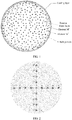
- the local mass concentration of element M 2 in the bulk particles is a mass concentration of element M 2 in all elements in a finite volume element at any selected site in the bulk particles, and may be obtained by testing element concentration distribution through EDX (Energy Dispersive X-Ray Spectroscopy, energy dispersive X-Ray spectroscopy) or EDS (Energy Dispersive Spectrometer, energy dispersive spectrometer) element analysis in combination with TEM (Transmission Electron Microscope, transmission electron microscope) or SEM (Scanning Electron Microscope, scanning electron microscope) single-point scanning, or using other similar methods.
- EDX Electronicgy Dispersive X-Ray Spectroscopy, energy dispersive X-Ray spectroscopy
- EDS Electronicgy Dispersive Spectrometer, energy dispersive spectrometer
- the mass concentrations of element M 2 in ⁇ g/g at different sites in the bulk particles are respectively denoted as ⁇ 1 , ⁇ 2 , ⁇ 3 , ..., ⁇ n , where n is a positive integer greater than or equal to 15.
- An average mass concentration of element M 2 in the bulk particles is a mass concentration of element M 2 in all elements within a single bulk particle, and may be obtained by testing element concentration distribution through EDX or EDS element analysis in combination with TEM or SEM plane scanning, or using other similar methods.
- the testing plane includes all points in the foregoing single-point testing.
- the average mass concentration of element M 2 in the bulk particles is denoted as ⁇ in ⁇ g/g.
- a relative deviation of local mass concentration of element M 2 in the bulk particles is less than 35%, optionally less than 30%, and further optionally less than 20%, which means that element M 2 is highly uniformly distributed in the bulk particles.
- the uniform doping of element M 2 makes the properties of the particles consistent throughout the interior, so that the structural stability of the positive electrode active material may be better improved by element M 2 , effectively preventing the particle from cracking.
- migration and diffusion capabilities of lithium ions at different internal zones of the particle uniformly doped with element M 2 are at the same level, and deformation resistance is close throughout the particle, so that the internal stress distribution of the particle is uniform, thereby improving structural stability of the positive electrode active material, and the particles are not prone to crack. Therefore, both capacity development and high-temperature cycling performance of the positive electrode active material are further improved, thereby improving capacity performance, energy density and high-temperature cycling performance of the lithium-ion secondary battery.
- a smaller relative deviation of the local mass concentration of element M 2 in the bulk particles means a more uniform distribution of the doping element M 2 in the bulk particles, which can better improve capacity development and high-temperature cycling performance of the positive electrode active material.
- a deviation ⁇ of the concentration of element M 2 in the positive electrode active material with respect to an average mass concentration ⁇ of element M 2 in the bulk particles satisfies ⁇ 50%, optionally, ⁇ 30%, and further optionally, ⁇ 20%, ⁇ 15%, ⁇ 13%, ⁇ 12%, or ⁇ 10%.
- ⁇ represents the concentration of element M 2 in overall macroscopic positive electrode active material, including element M 2 doped into the bulk particles of the positive electrode active material, element M 2 enriched in other phases on surfaces of the bulk particles, and element M 2 embedded in the particles of the positive electrode active material.
- ⁇ may be obtained through absorption spectrum tests of the positive electrode active material solution, for example ICP (Inductive Coupled Plasma Atomic Emission Spectrometer, inductive coupled plasma atomic emission spectrometer) test, XAFS (X-ray absorption fine structure spectroscopy, X-ray absorption fine structure spectroscopy) test, or another test.
- the positive electrode active material satisfying ⁇ within the foregoing ranges means that element M 2 is successfully doped in the bulk particles.
- concentration of doping element distributed in other phases on the surface of the bulk particle, and the concentration of doping element embedded in the gaps in the positive electrode active material are relatively low.
- the positive electrode active material shows good macro and micro consistency and has uniform structure and high particle stability, which is beneficial to enable the positive electrode active material to have higher capacity development and high-temperature cycling performance.
- the concentration co of element M 2 in the positive electrode active material optionally ranges from 500 ppm to 5000 ppm.
- the positive electrode active material with the concentration co of element M 2 within the foregoing ranges can better improve high-temperature cycling performance and high-temperature storage performance of the battery, and enable element M 2 to effectively provide charge compensation for the positive electrode active material.
- the positive electrode active material with the concentration co of element M 2 within the foregoing ranges also enables the positive electrode active material to provide a good carrier for delithiation of lithium ions, facilitating the intercalation and deintercalation of lithium ions, so that the positive electrode active material has relatively high initial capacity and cycling capacity retention rate, thereby improving energy density and high-temperature cycling performance of the battery.
- the concentration ⁇ of element M 1 in the positive electrode active material optionally ranges from 100 ppm to 2000 ppm.
- the concentration ⁇ of element M 3 in the positive electrode active material optionally ranges from 400 ppm to 3000 ppm.
- the positive electrode active material with the concentration of element M 1 or element M 3 within the foregoing ranges can improve stability of the positive electrode active material, reduce side reactions of the electrolyte on surface of the material, and improve high-temperature cycling performance and high-temperature storage performance of the battery.
- coating and doping are done in only a small part of the bulk particle surface, and therefore, it may be ensured that the positive electrode active material has a relatively high lithium ion diffusion capability, enabling the battery to have relatively high rate performance, capacity performance, and cycling performance.
- the ppm is a ratio of mass of an element in the positive electrode active material to mass of the positive electrode active material.
- ⁇ and ⁇ may be obtained through absorption spectrum tests of the positive electrode active material solution, for example ICP (Inductive Coupled Plasma Emission Spectrometer, inductive coupled plasma emission spectrometer) test, XAFS (X-ray absorption fine structure spectroscopy, X-ray absorption fine structure spectroscopy) test, or another test.
- a thickness of the coating layer ranges from 1 nm to 200 nm, for example, from 50 nm to 160 nm, from 80 nm to 140 nm, or from 90 nm to 120 nm.
- the coating layer in a thickness within the foregoing ranges can avoid contact between the electrolyte and the bulk particles, reduce side reactions, and enable the positive electrode active material to have a relatively high lithium ion diffusion capability, which is beneficial to enable the battery to have relatively high capacity performance, high-temperature cycling performance, and high-temperature storage performance.
- the thickness of the coating layer may be determined by using a method well known in the art.
- a cross-section polisher for example, IB-09010CP argon ion cross-section polisher from the electronic company JEOL in Japan
- the cross-section passes through the core of the particle of the positive electrode active material.
- a distribution graph of elements in the cross-section is obtained through EDX or EDS element analysis in combination with TEM or SEM (for example, X-Max EDS from Oxford Instruments Group in UK in combination with Sigma-02-33 SEM from ZEISS in German) plane scanning; and the thickness of the coating layer is obtained based on the distribution of elements in the cross-section. More precisely, thickness values of the coating layer at multiple (more than 3, for example, 8, 10, or 12) locations in the cross-section may be determined, and an average thereof is recorded as the thickness of the coating layer.
- a thickness of the exterior doped layer is 10% to 30% of the particle size of the bulk particle, for example, 15% to 25% of the particle size of the bulk particle, 19% to 22% of the particle size of the bulk particle, or the like.
- the thickness of the exterior doped layer within the foregoing ranges is beneficial to improve high-temperature cycling performance and high-temperature storage performance of the battery, and also is beneficial to capacity development of the positive electrode active material, so that the battery has a relatively high energy density.
- the thickness of the exterior doped layer may be determined by using a method well known in the art, for example, it may be determined with reference to the test method for the thickness of the coating layer.
- a cross-section polisher may be used for preparing a cross-section of the positive electrode active material particle or the bulk particle.
- the cross-section passes through the core of the particle.
- a distribution graph of elements in the cross-section is obtained through EDX or EDS element analysis in combination with TEM or SEM plane scanning; and the thickness of the exterior doped layer is obtained based on the distribution of elements in the cross section. More precisely, thicknesses of the exterior doped layer at different (more than 3, for example, 8, 10, or 12) locations in the cross-section may be determined, and an average thereof is recorded as the thickness of the exterior doped layer.
- the particle size of the bulk particle may also be obtained according to the foregoing method.
- diameters of the bulk particle in multiple (more than 3, for example, 8, 10, or 12) different orientations may be determined, and an average thereof is recorded as the particle size of the bulk particle.
- element M 3 in the bulk particle has a mass concentration gradient decreasing from the exterior surface to the core of the bulk particle.
- the mass concentration of element M 3 in the bulk particle has a trend of decrease from the exterior surface to the core of the bulk particle, which can improve lithium ion conduction performance of the positive electrode active material, and improve capacity performance and cycling performance of the battery.
- a mass concentration of element M 3 in the exterior doped layer is less than a mass concentration of element M 1 in the coating layer.
- the modified elements are mainly present on the surface of the positive electrode active material, which is beneficial to form surface protection of the positive electrode active material, improve high-temperature cycling performance and high-temperature storage performance of the battery, and enable the battery to have relatively high capacity development and energy density.
- element M 1 in the coating layer may be the same as or different from element M 3 in the exterior doped layer.
- element M 1 in the coating layer is the same as element M 3 in the exterior doped layer, and both are L element, where L element is one or more of Mg, Al, Ca, Ce, Ti, Zr, Zn, Y, and B.
- the concentration of element L has a mass concentration gradient decreasing from the exterior surface to the core of the particle of the positive electrode active material, which is beneficial to protect the surface of the positive electrode active material, improve high-temperature cycling performance and high-temperature storage performance of the battery, and improve capacity development and energy density of the battery.
- a ratio of a sum of the concentration of element M 1 and the concentration of element M 3 in the positive electrode active material to a volume average particle size D v 50 of the positive electrode active material ranges from 25 ppm/ ⁇ m to 1000 ppm/ ⁇ m, optionally from 200 ppm/ ⁇ m to 700 ppm/ ⁇ m, and further optionally from 300 ppm/ ⁇ m to 600 ppm/ ⁇ m, or from 400 ppm/ ⁇ m to 550 ppm/ ⁇ m, which is beneficial to protect the surface of the positive electrode active material, improve high-temperature cycling performance and high-temperature storage performance of the battery, and improve capacity development of the positive electrode active material, so that the energy density of the battery is improved.
- the positive electrode active material includes secondary particles formed by agglomeration of primary particles.
- the above-mentioned “bulk particles” include the secondary particles.
- the morphology of the positive electrode active material according to the embodiments of this application is one or more of a sphere and a sphere-like body.
- the volume average particle size D v 50 of the positive electrode active material ranges from 3 ⁇ m to 20 ⁇ m, further optionally from 5 ⁇ m to 11 ⁇ m, and further optionally from 6 ⁇ m to 8 ⁇ m.
- the D v 50 of the positive electrode active material is optionally less than 20 ⁇ m, further optionally less than 11 ⁇ m, and further optionally less than 8 ⁇ m.
- the migration path of lithium ions and electrons in the material is relatively short, which can improve transmission and diffusion performance of lithium ions and electrons in the positive electrode active material, thereby improving cycling performance and rate performance of the battery.
- the D v 50 of the positive electrode active material is optionally greater than 3 ⁇ m, further optionally, greater than 5 ⁇ m, or also optionally, greater than 6 ⁇ m.
- the side reactions of the electrolyte on surface of the positive electrode active material are reduced, and the agglomeration among the particles of the positive electrode active material is reduced, thereby improving cycling performance of the positive electrode active material.
- the D v 50 of the positive electrode active material within the foregoing ranges is also beneficial to enable the positive electrode active material to have relatively high compacted density and improve energy density of the battery.
- the specific surface area of the positive electrode active material ranges from 0.2 m 2 /g to 1.5 m 2 /g, further optionally from 0.3 m 2 /g to 1 m 2 /g, or still further optionally from 0.5 m 2 /g to 0.8 m 2 /g.
- the specific surface area of the positive electrode active material within the foregoing ranges ensures that the positive electrode active material has a relatively high active specific surface area, and is beneficial to reduce side reactions of the electrolyte on surface of the positive electrode active material, thereby improving capacity development and cycle life of the positive electrode active material.
- a tap density of the positive electrode active material optionally ranges from 2.3 g/m 3 to 2.8 g/m 3 , and further optionally from 2.4 g/m 3 to 2.7 g/m 3 .
- the positive electrode active material with the tap density within the foregoing ranges is beneficial to enable the battery to have a relatively high energy density.
- the nickel-containing lithium composite oxide is a compound represented by chemical formula 1
- the positive electrode active material has an element M 1 -containing oxide coating layer applied on the exterior surface of the bulk particles including the compound represented by chemical formula 1.
- M 2 is a doping substitute for one or more of a nickel site, a cobalt site, and a manganese site in the bulk phase of the bulk particle
- M 3 is a doping substitute for one or more of a nickel site, a cobalt site, and a manganese site of the bulk phase of the bulk particle
- the battery using this high-nickel ternary material can have relatively high energy density, high-temperature cycling performance, and high-temperature storage
- the D v 50 of the positive electrode active material has the meaning well known in the art, or be known as median particle size, representing a corresponding particle size when a volume distribution of the positive electrode active material particles reaches 50%.
- the D v 50 of the positive electrode active material may be determined by using instruments and methods that are well known in the art, for example, may be easily determined by using a laser particle size analyzer (for example, a Mastersizer 3000 type from Malvern Instruments Ltd in UK).
- the specific surface area of the positive electrode active material has the meaning well known in the art, and may be determined by using instruments and methods that are well known in the art, for example, may be determined by using the nitrogen adsorption specific surface area analysis test method and calculated by using the BET (Brunauer Emmett Teller) method.
- the nitrogen adsorption specific surface area analysis test may be carried out by using the NOVA 2000e specific surface area and pore size analyzer from Quantachrome company in USA.
- the test method is as follows: Approximately 8.000 g to 15.000 g of the positive electrode active material is placed into a weighed empty sample tube. The positive electrode active material is stirred well and weighed. The sample tube is put into the NOVA 2000e degassing station for degassing.
- Mass G of the positive electrode active material after degassing is calculated by subtracting the mass of the empty sample tube from the total mass.
- the sample tube is put into the NOVA 2000e, adsorption amounts of nitrogen on surface of the positive electrode active material at different relative pressures are determined, an adsorption amount of a monomolecular layer is calculated according to the Brunauer-Emmett-Teller multilayer adsorption theory and its equation, then a total surface area A of the positive electrode active material is calculated, and the specific surface area of the positive electrode active material is calculated by A / G.
- the tap density of the positive electrode active material has the meaning well known in the art, and may be tested by using instruments and methods that are well known in the art, for example, may be easily tested by using a tap density meter (for example, FZS4-4B type).
- the following describes a preparation method of a positive electrode active material. Any one of the foregoing positive electrode active materials can be prepared by the preparation method.
- the preparation method includes the following steps.
- the nickel-containing transition metal source is, for example, one or more of an oxide, a hydroxide, or a carbonate containing Ni and optionally Co and/or Mn, for example, a hydroxide containing Ni, Co, and Mn.
- the nickel-containing transition metal source may be obtained through a method known in the art, for example, prepared through a co-precipitation method, a gel method or a solid phase method.
- a mixed solution is obtained by dispersing the Ni source, Co source, and Mn source into solvent. With continuous co-current reaction, the mixed solution, a strong alkali solution, and a complexing agent solution are pumped into a reactor with stirring function at the same time, where the pH value of the reaction solution is controlled to be 10 to 13, the temperature in the reactor controlled to be 25°C to 90°C, and inert gas protection is provided during the reaction. After the reaction is completed, aging, filtering, washing, and vacuum drying are carried out, the hydroxide containing Ni, Co and Mn is obtained.
- the Ni source may be a soluble nickel salt, for example, one or more of nickel sulfate, nickel nitrate, nickel chloride, nickel oxalate, and nickel acetate, for another example, one or more of nickel sulfate and nickel nitrate, and for still another example, nickel sulfate.
- the Co source may be a soluble cobalt salt, for example, one or more of cobalt sulfate, cobalt nitrate, cobalt chloride, cobalt oxalate, and cobalt acetate, for another example, one or more of cobalt sulfate and cobalt nitrate, and for still another example, cobalt sulfate.
- the Mn source may be soluble manganese salt, for example, one or more of manganese sulfate, manganese nitrate, manganese chloride, manganese oxalate, and manganese acetate, for another example, one or more of sulfuric acid manganese and manganese nitrate, and for still another example, manganese sulfate.
- soluble manganese salt for example, one or more of manganese sulfate, manganese nitrate, manganese chloride, manganese oxalate, and manganese acetate, for another example, one or more of sulfuric acid manganese and manganese nitrate, and for still another example, manganese sulfate.
- the strong alkali may be one or more of LiOH, NaOH, and KOH, for example, NaOH.
- the complexing agent may be one or more of ammonia, ammonium sulfate, ammonium nitrate, ammonium chloride, ammonium citrate, and disodium ethylenediaminetetraacetic acid (EDTA), for example, ammonia.
- the solvents of the mixed solution, strong alkali solution, and complexing agent solution are not particularly limited, for example, the solvents of the mixed solution, strong alkali solution, and complexing agent solution each are separately one or more of deionized water, methanol, ethanol, acetone, isopropanol, and n-hexanol, for example, deionized water.
- the inert gas introduced during the reaction is, for example, one or more of nitrogen, argon, and helium.
- the lithium source may be one or more of lithium oxide (Li 2 O), lithium phosphate (Li 3 PO 4 ), lithium dihydrogen phosphate (LiH 2 PO 4 ), lithium acetate (CH 3 COOLi), lithium hydroxide (LiOH), lithium carbonate (Li 2 CO 3 ), and lithium nitrate (LiNO 3 ). Further, the lithium source is one or more of lithium carbonate, lithium hydroxide, and lithium nitrate; and furthermore, the lithium source is lithium carbonate.
- the precursor of element M 2 may be one or more of oxide, nitric acid compound, carbonic acid compound, hydroxide compound, and acetic acid compound of element M 2 , and may be selected based on an actual requirement.
- a ball mill mixer or a high-speed mixer may be used to mix the materials to obtain a well mixed mixture.
- the nickel-containing transition metal source, the lithium source, and the precursor of element M 2 are added into a high-speed mixer for mixing for 0.5 hours to 2 hours.
- the mixture may be sintered in an atmosphere sintering furnace.
- the sintering atmosphere is an atmosphere containing oxygen, for example, an air or oxygen atmosphere.
- An oxygen concentration in the sintering atmosphere is, for example, higher than 70%, further, higher than 80%, or furthermore, higher than 85%.
- the sintering temperature ranges, for example, from 600°C to 1000°C, further, from 600°C to 900°C, or furthermore, from 650°C to 850°C.This is beneficial to enable element M 2 to have relatively high doping uniformity.
- the sintering duration may be adjusted based on an actual situation, for example, 5 hours to 25 hours, or for another example, 5 hours to 15 hours.
- the positive electrode active materials have characteristics of high energy density, thermal stability, and high-temperature cycling stability.
- the positive electrode active material subjected to the doping homogeneity of element M 2 being further controlled and having the characteristics of the valence state of element M 2 in the 78% delithiated state has a better effect.
- the sintered product in step S20 may be crushed and sieved to obtain the positive electrode active material with optimized particle size distribution and specific surface area.
- the crushing method is not particularly limited, and may be selected based on an actual need, for example, using a particle crusher.
- the precursor of element M 3 may be one or more of a chloride, a sulfate, a nitrate, an oxide, a hydroxide, a fluoride, a carbonate, a phosphate, a dihydrogen phosphate, and an organic compound of element M 3 , but not limited thereto.
- a ball mill mixer or a high-speed mixer may be used to mix the materials.
- the matrix material and the precursor of element M 3 are added into a high-speed mixer for mixing.
- the mixing time may range from 0.5 hours to 2 hours.
- the mixed material is added into an atmosphere sintering furnace for sintering.
- the sintering atmosphere is an atmosphere containing oxygen, for example, an air or oxygen atmosphere.
- the sintering temperature ranges, for example, from 400°C to 750°C, or for another example, from 450°C to 700°C.
- the sintering time may range from 3 hours to 25 hours, for example, from 5 hours to 10 hours.
- element M 3 is diffused from the exterior surface to the bulk phase of the matrix particle to a predetermined depth, forming an exterior doped layer.
- the doping of element M 3 is carried out after lithiation is completed, so that it is beneficial to make element M 3 exist on surfaces of the bulk particles as much as possible, and the concentration of element M 3 has a concentration gradient gradually decreasing from the exterior surface to the core of the bulk particle.
- the precursor of element M 1 may be one or more of chloride, sulfate, nitrate, oxide, hydroxide, fluoride, carbonate, phosphate, dihydrogen phosphate, and organic compound of element M 1 , but not limited thereto.
- a ball mill mixer or a high-speed mixer may be used to mix the materials.
- the bulk particles and the precursor of element M 1 are added into a high-speed mixer for mixing.
- the mixing time ranges from 0.5 hours to 2 hours.
- the mixed material is added into an atmosphere sintering furnace for sintering.
- the sintering atmosphere is an atmosphere containing oxygen, for example, an air or oxygen atmosphere.
- the sintering temperature ranges, for example, from 100°C to 500°C, or for another example, from 200°C to 450°C.
- the sintering time may range from 3 hours to 25 hours, for example, from 5 hours to 10 hours. Due to the lower sintering temperature, oxides of element M 1 are hardly diffused into the interior of the bulk particles, but forms a coating layer applied on the exterior surface of the bulk particle.
- the oxides of element M 1 are matched with the surface of the bulk particle, enabling the coating layer to be closely combined with the bulk particle, and the coating layer may not damage the structure of the bulk particle, so that the coating layer reliably protects the bulk particle.
- the mixture in step S10 may include a precursor of an X element, so that the bulk phases of the bulk particles are doped with the X element.
- the mixture in step S30 may include a precursor of element X, so that the surface layer of the bulk particle is doped with element X.
- a concentration of element X may show a concentration gradient decreasing from the exterior surface to the core of the bulk particle.
- the mixture in step S40 may include a precursor of element X, so that the coating layer is doped with element X.
- Types of the precursors containing element X are not specifically limited, and may be selected by those skilled in the art based on an actual need.
- This application provides a positive electrode plate, where the positive electrode plate uses any one or more positive electrode active materials in this application.
- the positive electrode plate in this embodiment of this application uses the positive electrode active material in this application, thereby enabling a lithium-ion secondary battery using the positive electrode plate to have good high-temperature cycling performance and high-temperature storage performance and a relatively high energy density.
- the positive electrode plate may include a positive electrode current collector and a positive electrode active substance layer disposed on at least one surface of the positive electrode current collector.
- the positive electrode current collector includes two opposite surfaces in thickness direction of the positive electrode current collector, and the positive electrode active substance layer is provided on either or both of the two surfaces of the positive electrode current collector.
- the positive electrode active substance layer includes any one or more positive electrode active materials according to this application.
- the positive electrode active substance layer may further include a conductive agent and a binder.
- Types of the conductive agent and binder in the positive electrode active substance layer are not specifically limited in this application, and may be selected as required.
- the conductive agent may be one or more of graphite, superconducting carbon, acetylene black, carbon black, Ketjen black, carbon dots, carbon nanotube, graphene, and carbon nanofiber.
- the binder may be one or more of styrene-butadiene rubber (SBR), water-based acrylic resin (water-based acrylic resin), sodium carboxymethyl cellulose (CMC-Na), polyvinylidene fluoride (PVDF), polytetrafluoroethylene (PTFE), polyvinyl butyral (PVB), ethylene vinyl acetate copolymer (EVA), vinylidene fluoride-tetrafluoroethylene-propylene terpolymer, vinylidene fluoride-hexafluoropropylene-tetrafluoroethylene terpolymer, tetrafluoroethylenehexafluoropropylene copolymer, fluorine-containing acrylic resin, and polyvinyl alcohol (PVA).
- the positive electrode plate may be prepared by using a conventional method in the art.
- the positive electrode active material, the conductive agent, and the binder are dispersed in a solvent which may be N-methylpyrrolidone (NMP), to obtain a uniform positive electrode slurry.
- NMP N-methylpyrrolidone
- the positive electrode slurry is applied on the positive current collector and undergoes processes such as drying by heat and rolling to obtain the positive electrode plate.
- This application provides a lithium-ion secondary battery, where the lithium-ion battery includes a positive electrode plate, a negative electrode plate, a separator, and an electrolyte, and the positive electrode plate is any positive electrode plate in this application.
- the lithium-ion secondary battery uses the positive electrode plate in this application, thereby having good high-temperature cycling performance and high-temperature storage performance and a relatively high energy density.
- the negative electrode plate may be a metal lithium sheet.
- the negative electrode plate may include a negative electrode current collector and a negative electrode active substance layer disposed on at least one surface of the negative electrode current collector.
- the negative electrode current collector includes two opposite surfaces in thickness direction of the negative electrode current collector, and the negative electrode active substance layer is provided on either or both of the two surfaces of the negative electrode current collector.
- the negative electrode active substance layer includes a negative electrode active material.
- the types of the negative electrode active material are not specifically limited in this application, and may be selected based on an actual need.
- MCMB mesocarbon microbead
- the negative electrode active substance layer may further include a conductive agent and a binder.
- Types of the conductive agent and binder in the negative electrode active substance layer are not specifically limited in the embodiments of this application, and may be selected based on an actual requirement.
- the conductive agent is one or more of graphite, superconducting carbon, acetylene black, carbon black, Ketjen black, carbon dots, carbon nanotube, graphene, and carbon nanofiber
- the binder is one or more of styrene butadiene rubber (SBR), polyvinylidene fluoride (PVDF), polytetrafluoroethylene (PTFE), polyvinyl butyral (PVB), and water-based acrylic resin (water-based acrylic resin).
- the negative electrode active substance layer further optionally includes a thickener, for example, sodium carboxymethyl cellulose (CMC-Na).
- a thickener for example, sodium carboxymethyl cellulose (CMC-Na).
- the negative electrode current collector may use a metal foil material or a porous metal plate with good electrical conductivity and mechanical properties, for example, copper foil.
- the negative electrode plate may be prepared by using a conventional method in the art.
- the negative electrode active material, the conductive agent, the binder, and the thickener are dispersed in a solvent which may be N-methylpyrrolidone (NMP) or deionized water, to obtain a uniform negative electrode slurry.
- NMP N-methylpyrrolidone
- the negative electrode slurry is applied on the negative current collector and undergoes processes such as drying by heat and rolling to obtain the negative electrode plate.
- the electrolyte may be a solid electrolyte, such as a polymer electrolyte or an inorganic solid electrolyte, but is not limited thereto.
- the electrolyte may alternatively be a liquid electrolyte.
- the foregoing liquid electrolyte may include a solvent and a lithium salt dissolved in the solvent.
- the solvent may be a non-aqueous organic solvent, for example, one or more of ethylene carbonate (EC), propylene carbonate (PC), ethyl methyl carbonate (EMC), diethyl carbonate (DEC), dimethyl carbonate (DMC), diethyl carbonate (DEC), dipropyl carbonate (DPC), methyl propyl acetate (MPC), ethylene propyl carbonate (EPC), methyl formate (MF), methyl acetate (MA), ethyl acetate (EA), propyl acetate (PA), methyl propionate (MP), ethyl propionate (EP), propyl propionate (PP), methyl butyrate (MB), and ethyl butyrate (EB).
- EC ethylene carbonate
- PC propylene carbonate
- EMC diethyl carbonate
- DMC dimethyl carbonate
- DEC diethyl carbonate
- DPC dipropyl carbonate
- MPC methyl
- the lithium salt may be one or more of LiPF 6 (lithium hexafluorophosphate), LiBF 4 (lithium tetrafluoroborate), LiClO 4 (lithium perchlorate), LiAsF 6 (lithium hexafluoroarsenate), LiFSI (lithium bisfluorosulfonimide), LiTFSI (lithium bistrifluoromethanesulfonimide), LiTFS (lithium trifluoromethanesulfonate), LiDFOB (lithium difluorooxalate), LiBOB (lithium bisoxalate), LiPO 2 F 2 (lithium difluorophosphate), LiDFOP (lithium difluorophosphate), and LiTFOP (lithium tetrafluoro oxalate phosphate), for example, one or more of LiPF 6 (lithium hexafluorophosphate), LiBF 4 (lithium tetrafluoroborate), LiBOB (lithium bisoxalate
- the liquid electrolyte further optionally includes other additives, for example, one or more of vinylene carbonate (VC), vinyl ethylene carbonate (VEC), fluoroethylene carbonate (FEC), difluoroethylene carbonate (DFEC), trifluoromethyl ethylene carbonate (TFPC), succinonitrile (SN), adiponitrile (ADN), glutaronitrile (GLN), hexanetrinitrile (HTN), 1,3-propane sultone (1,3-PS), ethylene sulfate (DTD), methylene methane disulfonate (MMDS), 1-propene-1,3-sultone (PST), 4-methyl ethylene sulfate (PCS), 4-ethyl ethylene sulfate (PES), 4-propyl ethylene sulfate (PEGLST), propylene sulfate (TS), 1,4-butane sultone (1,4-BS), ethylene sulfite (DTO), dimethyl
- the separator is not particularly limited in the lithium-ion secondary battery of the embodiments of this application, and any well-known porous separators with electrochemical and mechanical stability may be selected, for example, a mono-layer or multi-layer membrane including one or more of glass fiber, non-woven fabric, polyethylene (PE), polypropylene (PP), and polyvinylidene fluoride (PVDF).
- a mono-layer or multi-layer membrane including one or more of glass fiber, non-woven fabric, polyethylene (PE), polypropylene (PP), and polyvinylidene fluoride (PVDF).
- the positive electrode plate and the negative electrode plate are alternately stacked with a separator disposed between the positive electrode plate and the negative electrode plate for separation, to obtain a cell, or to obtain a cell after winding.
- the cell is placed into an outer package, the liquid electrolyte is injected, and the package is then sealed, so that a lithium-ion secondary battery is obtained.
- the shape of the lithium-ion secondary battery is not particularly limited in this application, which may be of a cylindrical shape, a square shape, or any other shape.
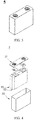
- FIG. 3 shows a lithium-ion secondary battery 5 of a square structure as an example.
- the secondary battery may include an outer package.
- the outer package is used for encapsulating the positive electrode plate, the negative electrode plate, and the electrolyte.
- the outer package may include a housing 51 and a cover plate 53.
- the housing 51 may include a bottom plate and side plates connected to the bottom plate, and the bottom plate and side plates enclose to form an accommodating cavity.
- the housing 51 has an opening communicating with the accommodating cavity, and the cover plate 53 can cover the opening to close the accommodating cavity.
- the positive electrode plate, the negative electrode plate, and the separator may be wound or laminated to form a cell 52.
- the cell 52 is encapsulated in the accommodating cavity.
- the electrolyte may be a liquid electrolyte infiltrated in the cell 52.
- the outer package of the lithium-ion secondary battery may be a hard shell, for example, a hard plastic shell, an aluminum shell, or a steel shell.
- the outer package of the lithium-ion secondary battery may alternatively be a soft package, for example, a soft bag.
- a material of the soft package may be plastic, for example, may include one or more of polypropylene (PP), polybutylene terephthalate (PBT), polybutylene succinate (PBS), and the like.
- PP polypropylene
- PBT polybutylene terephthalate
- PBS polybutylene succinate
- lithium-ion secondary batteries may be assembled into a battery module, and a battery module may include a plurality of lithium-ion secondary batteries. The specific quantity may be adjusted according to the use case and capacity of the battery module.
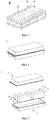
- FIG. 5 shows a battery module 4 as an example.
- a plurality of lithium-ion secondary batteries 5 may be sequentially arranged in a length direction of the battery module 4.
- the plurality of lithium-ion secondary batteries may be arranged in any other manner.
- the plurality of lithium-ion secondary batteries 5 may be fixed by using fasteners.
- the battery module 4 may further include an enclosure with an accommodating space, and the plurality of lithium-ion secondary batteries 5 are accommodated in the accommodating space.
- battery modules may be further assembled into a battery pack, and a quantity of battery modules included in the battery pack may be adjusted based on application and capacity of the battery pack.
- FIG. 6 and FIG. 7 show a battery pack 1 as an example.
- the battery pack 1 may include a battery box and a plurality of battery modules 4 disposed in the battery box.
- the battery box includes an upper box body 2 and a lower box body 3.
- the upper box body 2 can cover the lower box body 3 and form an enclosed space for accommodating the battery modules 4.
- the plurality of battery modules 4 may be arranged in the battery box in any manner.
- This application further provides an apparatus, including at least one of the lithium-ion secondary battery, battery module, or battery pack of this application.
- the lithium-ion secondary battery, battery module, or battery pack may be used as a power source for the apparatus, or an energy storage unit of the apparatus.
- the apparatus may be, but is not limited to, a mobile device (for example, a mobile phone or a notebook computer), an electric vehicle (for example, a battery electric vehicle, a hybrid electric vehicle, a plug-in hybrid electric vehicle, an electric bicycle, an electric scooter, an electric golf vehicle, or an electric truck), an electric train, a ship, a satellite, an energy storage system, and the like.
- a lithium-ion secondary battery, a battery module, or a battery pack may be selected for the apparatus according to requirements for using the apparatus.
- FIG. 8 shows an apparatus as an example.
- the apparatus is a battery electric vehicle, a hybrid electric vehicle, a plug-in hybrid electric vehicle, or the like.
- a battery pack or a battery module may be used.
- the apparatus may be a mobile phone, a tablet computer, a notebook computer, or the like.
- the apparatus is generally required to be light and thin, and may use a lithium-ion secondary battery as its power source.
- EC, DEC, and DMC were mixed at a volume ratio of 1:1:1 to obtain a solvent, and a lithium salt LiPF 6 was dissolved into the solvent to obtain an electrolyte, where a concentration of LiPF 6 was 1 mol/L.
- the positive electrode active material prepared in the foregoing, conductive carbon black, and a binder PVDF were dispersed at a weight ratio of 90:5:5 into a solvent N-methylpyrrolidone (NMP) and stirred well to obtained a positive electrode slurry.
- NMP solvent N-methylpyrrolidone
- the positive electrode slurry was applied uniformly on a positive electrode current collector aluminum foil, and a positive electrode plate was obtained after processes such as drying and cold pressing were performed.
- the positive electrode plate, the separator, and metal lithium sheet were stacked in sequence, the foregoing electrolyte was injected, and a button battery was obtained through assembly.
- the positive electrode active material prepared in the foregoing, a conductive agent acetylene black, and a binder PVDF were dispersed at a weight ratio of 94:3:3 into a solvent NMP and stirred well to obtained a positive electrode slurry.
- the positive electrode slurry was applied uniformly on a positive electrode current collector aluminum foil, and after processes such as drying and cold pressing were performed, a positive electrode plate was obtained.
- a negative electrode active material artificial graphite, hard carbon, a conductive agent acetylene black, a binder styrene-butadiene rubber (SBR), and a thickener sodium carboxymethyl cellulose (CMC) were dispersed at a weight ratio of 90:5:2:2:1 into deionized water and mixed well to obtain a negative electrode slurry.
- the negative electrode slurry was applied uniformly on a negative electrode current collector copper foil, and after processes such as drying and cold pressing were performed, a negative electrode plate was obtained.
- a polyethylene (PE) porous polymer film was used as a separator.
- the positive electrode plate, the separator, and the negative electrode plate were stacked in sequence to obtain a bare cell, the bare cell was placed into an outer package, the electrolyte was injected, and the package was sealed. After processes such as formation were performed, a full battery was obtained.
- PE polyethylene
- Example 1 A difference from Example 1 was that the relevant parameters in the preparation steps of the positive electrode active material were changed to obtain the positive electrode active material with predetermined parameter characteristics. For details, refer to Table 1-1 and Table 1-2.
- Precursors of the positive electrode active materials in Examples 2 to 26 and Comparative Examples 1 to 4 were all [Ni 0.8 Co 0.1 Mn 0.1 ](OH) 2 .
- Precursors of the positive electrode active materials in Example 27 and Comparative Examples 5 to 8 were all [Ni 0.6 Co 0.2 Mn 0.2 ](OH) 2 .
- Precursors of the positive electrode active materials in Example 28 and Comparative Example 9 were both [Ni 0.5 Co 0.2 Mn 0.3 (OH) 2 .
- Precursors of doping element in Example 3 and Examples 24 to 26 were WO 2 and WO 3 .
- Precursors of doping element in Example 4 were SiO and SiO 2 .
- Precursors of doping element in Example 5 and Examples 19 to 21 were NbO 2 and Nb 2 O 5 .
- Precursors of doping element in Example 6 and Examples 22 to 23 were V 2 O 3 and V 2 O 4 .
- Precursors of doping element in Example 7 were TeO 2 and TeO 3 .
- Precursors of doping element in Example 8 were MoO 2 and MoO 3 .
- Precursors of doping element in Example 9 were Sb 2 O 3 , Sb 2 O 5 , WO 2 , and WO 3 , and the four precursors had basically the same amount.
- the other precursors of the doping element M 3 and the coating element M 1 that were different from those in Example 1 were selected from CaO, TiO 2 , B 2 O 3 , MgO, and ZrO 2 .
- Example 20 the sintering temperature was 720°C and the sintering duration was 8 hours in step (1); the sintering temperature was 600°C and the sintering duration was 10 hours in step (2); and the sintering temperature was 380°C and the sintering duration was 11 hours in step (3).
- Example 21 the sintering temperature was 650°C and the sintering duration was 4 hours in step (1); the sintering temperature was 570°C and the sintering duration was 6 hours in step (2); and the sintering temperature was 260°C and the sintering duration was 8 hours in step (3).
- Example 22 the sintering temperature was 710°C and the sintering duration was 7 hours in step (1); the sintering temperature was 520°C and the sintering duration was 9 hours in step (2); and the sintering temperature was 210°C and the sintering duration was 6 hours in step (3).
- Example 23 the sintering temperature was 600°C and the sintering duration was 4 hours in step (1); the sintering temperature was 440°C and the sintering duration was 3 hours in step (2); and the sintering temperature was 120°C and the sintering duration was 3 hours in step (3).
- Example 27 and Comparative Examples 5 to 8 the sintering temperature was 800°C and the sintering duration was 14 hours in step (1); the sintering temperature was 700°C and the sintering duration was 13 hours in step (2); and the sintering temperature was 450°C and the sintering duration was 11 hours in step (3).
- Example 28 and Comparative Example 9 the sintering temperature was 780°C and the sintering duration was 13 hours in step (1); the sintering temperature was 700°C and the sintering duration was 12 hours in step (2); and the sintering temperature was 450°C and the sintering duration was 10 hours in step (3).
- ⁇ represents the relative deviation of the local mass concentration of element M 2 in the bulk particles.
- the thickness percentage of the exterior doped layer is the percentage of the thickness of the exterior doped layer to the particle size of the bulk particle.
- ⁇ represents a ratio of a sum of the concentration of element M 1 and the concentration of element M 3 in the positive electrode active material to a volume average particle size D v 50 of the positive electrode active material, in ppm/ ⁇ m.
- concentrations of element M 1 , element M 2 , and element M 3 all refer to concentrations in the positive electrode active material.
- Example 1 to 26 and Comparative Examples 1 to 4 the cut-off voltage of the button battery ranged from 2.8V to 4.25V, and the cut-off voltage of the full battery ranged from 2.8V to 4.2V
- Examples 27 to 28 and Comparative Examples 5 to 9 the cut-off voltage of the button battery ranged from 2.8V to 4.35V, and the cut-off voltage of the full battery ranged from 2.8V to 4.3V Test results of Examples 1 to 28 and Comparative Examples 1 to 9 are shown in Table 2.
- Example 1 207.2 197.3 93.04 3.5
- Example 2 206.8 195.7 91.83 5.9
- Example 3 205.7 195.2 92.57 4.1
- Example 4 206.3 196.2 91.62 6.1
- Example 5 204.9 195.1 92.84 4.5
- Example 6 205.2 196.4 92.16 4.6
- Example 7 207.1 196.8 91.83 7.5
- Example 8 206.5 195.7 92.76 4.3
- Example 9 207.1 197.1 92.92 3.9
- Example 10 202.7 192.9 86.21 25.7
- Example 11 204.1 194.2 88.53 22.9
- Example 12 206.2 195.7 89.71 20.1
- Example 13 205.1 194.2 87.62 26.4
- Example 14 201.3 190.5 85.94 31.8
- Example 15 206.7 195.2 90.39 28.3
- Example 16 205.8 194.3 89.28 24.5
- Example 17 206.4 196.5 90.45 29.1
- Example 18 Example 18
- the lithium-ion secondary battery not only has a relatively high initial gram capacity, but also has relatively high high-temperature cycling performance and high-temperature storage performance.
- the battery could have relatively high gram capacity, and the high-temperature cycling performance and high-temperature storage performance of the battery can be improved.
Landscapes
- Chemical & Material Sciences (AREA)
- Chemical Kinetics & Catalysis (AREA)
- Electrochemistry (AREA)
- General Chemical & Material Sciences (AREA)
- Inorganic Chemistry (AREA)
- Engineering & Computer Science (AREA)
- Composite Materials (AREA)
- Materials Engineering (AREA)
- Manufacturing & Machinery (AREA)
- Organic Chemistry (AREA)
- Battery Electrode And Active Subsutance (AREA)
Applications Claiming Priority (2)
| Application Number | Priority Date | Filing Date | Title |
|---|---|---|---|
| CN201910825110.4A CN112447950A (zh) | 2019-09-02 | 2019-09-02 | 正极活性材料及其制备方法、正极极片、锂离子二次电池 |
| PCT/CN2020/109855 WO2021042986A1 (fr) | 2019-09-02 | 2020-08-18 | Matériau actif d'électrode positive, son procédé de préparation correspondant, plaque d'électrode positive, batterie secondaire au lithium-ion, et module de batterie, bloc-batterie et dispositif comprenant une batterie secondaire au lithium-ion |
Publications (3)
| Publication Number | Publication Date |
|---|---|
| EP3933981A1 true EP3933981A1 (fr) | 2022-01-05 |
| EP3933981A4 EP3933981A4 (fr) | 2022-11-23 |
| EP3933981B1 EP3933981B1 (fr) | 2024-07-10 |
Family
ID=74734470
Family Applications (1)
| Application Number | Title | Priority Date | Filing Date |
|---|---|---|---|
| EP20860344.9A Active EP3933981B1 (fr) | 2019-09-02 | 2020-08-18 | Matériau actif d'électrode positive et son procédé de préparation correspondant, plaque d'électrode positive, batterie secondaire au lithium-ion, et module de batterie, bloc-batterie, et appareil contenant une telle batterie secondaire au lithium-ion |
Country Status (6)
| Country | Link |
|---|---|
| US (1) | US20220407059A1 (fr) |
| EP (1) | EP3933981B1 (fr) |
| CN (3) | CN115986067A (fr) |
| HU (1) | HUE068440T2 (fr) |
| PL (1) | PL3933981T3 (fr) |
| WO (1) | WO2021042986A1 (fr) |
Cited By (1)
| Publication number | Priority date | Publication date | Assignee | Title |
|---|---|---|---|---|
| US20250183277A1 (en) * | 2023-02-06 | 2025-06-05 | Contemporary Amperex Technology (Hong Kong) Limited | Secondary battery and electric apparatus |
Families Citing this family (22)
| Publication number | Priority date | Publication date | Assignee | Title |
|---|---|---|---|---|
| CN115986067A (zh) | 2019-09-02 | 2023-04-18 | 宁德时代新能源科技股份有限公司 | 正极活性材料及其制备方法、正极极片、锂离子二次电池 |
| KR102930362B1 (ko) * | 2021-04-13 | 2026-02-23 | 에스케이온 주식회사 | 이차 전지용 양극 활물질, 이를 포함하는 양극 및 이를 포함하는 리튬 이차 전지 |
| CN113299907B (zh) * | 2021-07-26 | 2021-10-01 | 浙江帕瓦新能源股份有限公司 | 一种多元素分区掺杂无钴正极材料及其制备方法 |
| CN115832275B (zh) * | 2021-09-18 | 2023-11-21 | 宁德时代新能源科技股份有限公司 | 改性的高镍三元正极材料及其制备方法,以及用电装置 |
| CN114142001B (zh) * | 2021-10-29 | 2023-03-24 | 合肥国轩高科动力能源有限公司 | 一种表面双包覆的三元正极材料及其制备方法 |
| CN114656000B (zh) * | 2022-03-31 | 2024-03-19 | 天津巴莫科技有限责任公司 | 镍钴锰酸锂材料及其制备方法、正极材料和锂离子电池 |
| WO2023184304A1 (fr) * | 2022-03-31 | 2023-10-05 | 宁德时代新能源科技股份有限公司 | Nouvelle plaque d'électrode positive, batterie secondaire, module de batterie, batterie et dispositif électrique |
| CN115286052A (zh) * | 2022-08-10 | 2022-11-04 | 荆门市格林美新材料有限公司 | 一种铈掺杂与镁包覆的镍钴锰前驱体及其制备方法和应用 |
| CN115332504B (zh) * | 2022-08-11 | 2026-03-03 | 万华化学集团股份有限公司 | 一种正极活性材料、其制备方法以及所得的锂离子电池 |
| EP4510230A4 (fr) * | 2022-09-30 | 2025-06-11 | Contemporary Amperex Technology Co., Limited | Matériau actif d'électrode positive, son procédé de préparation, batterie secondaire et dispositif électrique |
| CN116417590B (zh) * | 2023-02-21 | 2025-09-05 | 广东凯金新能源科技股份有限公司 | 阴阳离子共掺杂包覆的钠离子电池正极材料及其制备方法 |
| CN116093309B (zh) * | 2023-03-07 | 2023-06-20 | 中南大学 | 一种锑改性的高镍三元层状复合正极材料及其制备方法和应用 |
| CN121394366A (zh) * | 2023-05-31 | 2026-01-23 | 宁德时代新能源科技股份有限公司 | 正极活性材料及其制备方法、包含其的正极极片、电池和用电装置 |
| JP7819371B2 (ja) * | 2023-06-30 | 2026-02-24 | 北京当升材料科技股▲フン▼有限公司 | リチウムイオン電池の正極材料及びその製造方法、リチウムイオン電池 |
| CN117423827A (zh) * | 2023-09-15 | 2024-01-19 | 宁波容百新能源科技股份有限公司 | 一种正极活性材料及其制备方法和锂离子电池 |
| CN117080416B (zh) * | 2023-10-16 | 2024-02-20 | 宁波容百新能源科技股份有限公司 | 一种正极材料及其制备方法、锂离子电池 |
| CN117199342A (zh) * | 2023-11-07 | 2023-12-08 | 宁波容百新能源科技股份有限公司 | 钠离子电池正极材料及其制备方法和应用 |
| KR20260011431A (ko) * | 2024-07-16 | 2026-01-23 | (주)포스코퓨처엠 | 리튬 이차 전지용 양극 활물질 및 이를 포함하는 리튬 이차 전지 |
| CN119008915B (zh) * | 2024-09-27 | 2025-12-26 | 宁波容百新能源科技股份有限公司 | 一种正极活性材料及其制备方法与应用 |
| CN119008931A (zh) * | 2024-10-25 | 2024-11-22 | 湘潭电化科技股份有限公司 | 多功能层锰酸锂正极材料及其制备方法、正极极片及电池 |
| CN119852486A (zh) * | 2024-10-29 | 2025-04-18 | 宁德时代新能源科技股份有限公司 | 二次电池和用电装置 |
| CN119381445B (zh) * | 2024-12-26 | 2025-07-08 | 深圳市贝特瑞纳米科技有限公司 | 正极材料、制备方法及锂离子电池 |
Family Cites Families (24)
| Publication number | Priority date | Publication date | Assignee | Title |
|---|---|---|---|---|
| CN102119128A (zh) * | 2008-08-04 | 2011-07-06 | 尤米科尔公司 | 高度结晶性的锂过渡金属氧化物 |
| JP2010129471A (ja) | 2008-11-28 | 2010-06-10 | Sony Corp | 正極活物質および非水電解質電池 |
| CN102683667B (zh) * | 2011-12-06 | 2015-04-29 | 中国科学院宁波材料技术与工程研究所 | 一种锂锰铝氧正极材料及其制备方法 |
| CN102569775B (zh) * | 2011-12-23 | 2017-01-25 | 东莞新能源科技有限公司 | 锂离子二次电池及其正极活性材料 |
| KR101409837B1 (ko) * | 2012-12-27 | 2014-06-20 | 한국전자통신연구원 | 폴리도파민을 이용한 리튬 이차전지용 양극 활물질의 표면개질 방법 |
| CN109599555A (zh) | 2013-02-28 | 2019-04-09 | 日产自动车株式会社 | 正极活性物质、正极材料、正极及非水电解质二次电池 |
| KR101785262B1 (ko) * | 2013-07-08 | 2017-10-16 | 삼성에스디아이 주식회사 | 양극 활물질, 그 제조방법, 이를 채용한 양극 및 리튬이차전지 |
| CN103500827B (zh) * | 2013-10-11 | 2017-05-24 | 宁德新能源科技有限公司 | 锂离子电池及其多元正极材料、制备方法 |
| JP2015201431A (ja) * | 2014-03-31 | 2015-11-12 | 戸田工業株式会社 | 非水電解液二次電池用正極活物質粒子粉末及びその製造方法、並びに非水電解液二次電池 |
| CN104409700B (zh) * | 2014-11-20 | 2018-07-24 | 深圳市贝特瑞新能源材料股份有限公司 | 一种镍基锂离子电池正极材料及其制备方法 |
| EP3386014B1 (fr) * | 2015-11-30 | 2024-05-29 | LG Energy Solution, Ltd. | Matériau actif de cathode pour accumulateur et accumulateur comprenant celui-ci |
| CN105304936B (zh) * | 2015-12-10 | 2018-05-15 | 微宏动力系统(湖州)有限公司 | 一种锂离子二次电池 |
| US20210028446A1 (en) * | 2016-02-20 | 2021-01-28 | Xinhua Liang | Lithium ion battery electrode |
| JP6378246B2 (ja) | 2016-05-09 | 2018-08-22 | トヨタ自動車株式会社 | 正極活物質、及び、当該正極活物質を用いたリチウムイオン二次電池 |
| CN108123109B (zh) * | 2016-11-28 | 2020-09-29 | 华为技术有限公司 | 钴酸锂正极材料及其制备方法以及锂离子二次电池 |
| CN106711414A (zh) * | 2016-12-16 | 2017-05-24 | 江南大学 | 一种锂离子电池811型三元正极改性材料及其制备方法 |
| WO2018179936A1 (fr) | 2017-03-31 | 2018-10-04 | パナソニック株式会社 | Matériau actif de cathode pour batterie auxiliaire utilisant un électrolyte non aqueux et son procédé de production |
| US10431820B2 (en) * | 2017-07-10 | 2019-10-01 | Uchicago Argonne, Llc | High valent lithiated surface structures for lithium ion battery electrode materials |
| CN107403913B (zh) * | 2017-07-11 | 2021-02-23 | 中国科学院成都有机化学有限公司 | 一种表面修饰的镍钴铝酸锂正极材料及其制备方法 |
| KR102226429B1 (ko) * | 2018-02-19 | 2021-03-10 | 삼성에스디아이 주식회사 | 리튬 이차 전지용 양극 활물질, 이를 포함하는 양극 및 이를 포함하는 리튬 이차 전지 |
| CN108847477B (zh) * | 2018-05-25 | 2021-09-21 | 彩虹集团新能源股份有限公司 | 一种镍钴锰酸锂三元正极材料及其制备方法 |
| CN110729458B (zh) | 2018-07-17 | 2021-10-01 | 宁德时代新能源科技股份有限公司 | 正极活性物质、其制备方法及正极极片与锂离子二次电池 |
| CN109817906A (zh) * | 2018-12-29 | 2019-05-28 | 深圳市卓能新能源股份有限公司 | 电池正极涂层、电池正极片及锂离子电池 |
| CN115986067A (zh) | 2019-09-02 | 2023-04-18 | 宁德时代新能源科技股份有限公司 | 正极活性材料及其制备方法、正极极片、锂离子二次电池 |
-
2019
- 2019-09-02 CN CN202211215087.5A patent/CN115986067A/zh active Pending
- 2019-09-02 CN CN201910825110.4A patent/CN112447950A/zh active Pending
- 2019-09-02 CN CN202211213785.1A patent/CN116014117B/zh active Active
-
2020
- 2020-08-18 WO PCT/CN2020/109855 patent/WO2021042986A1/fr not_active Ceased
- 2020-08-18 HU HUE20860344A patent/HUE068440T2/hu unknown
- 2020-08-18 EP EP20860344.9A patent/EP3933981B1/fr active Active
- 2020-08-18 PL PL20860344.9T patent/PL3933981T3/pl unknown
-
2022
- 2022-02-25 US US17/680,588 patent/US20220407059A1/en active Pending
Cited By (1)
| Publication number | Priority date | Publication date | Assignee | Title |
|---|---|---|---|---|
| US20250183277A1 (en) * | 2023-02-06 | 2025-06-05 | Contemporary Amperex Technology (Hong Kong) Limited | Secondary battery and electric apparatus |
Also Published As
| Publication number | Publication date |
|---|---|
| WO2021042986A1 (fr) | 2021-03-11 |
| CN116014117B (zh) | 2025-11-11 |
| CN116014117A (zh) | 2023-04-25 |
| PL3933981T3 (pl) | 2025-08-18 |
| CN112447950A (zh) | 2021-03-05 |
| EP3933981A4 (fr) | 2022-11-23 |
| US20220407059A1 (en) | 2022-12-22 |
| CN115986067A (zh) | 2023-04-18 |
| HUE068440T2 (hu) | 2024-12-28 |
| EP3933981B1 (fr) | 2024-07-10 |
Similar Documents
| Publication | Publication Date | Title |
|---|---|---|
| EP3933981B1 (fr) | Matériau actif d'électrode positive et son procédé de préparation correspondant, plaque d'électrode positive, batterie secondaire au lithium-ion, et module de batterie, bloc-batterie, et appareil contenant une telle batterie secondaire au lithium-ion | |
| US11760657B2 (en) | Positive electrode active material, method for preparation thereof, positive electrode plate, lithium-ion secondary battery and related battery module, battery pack and apparatus | |
| US12057576B2 (en) | Positive electrode active material and preparation method thereof, positive electrode plate, lithium-ion secondary battery, and apparatus containing such lithium-ion secondary battery | |
| US12338137B2 (en) | Positive electrode active material and preparation method thereof, positive electrode plate, lithium-ion secondary battery, and battery module, battery pack, and apparatus containing such lithium-ion secondary battery | |
| US11417883B2 (en) | Positive electrode active material, preparation method thereof, positive electrode plate, lithium-ion secondary battery as well as battery module, battery pack and apparatus containing lithium-ion secondary battery | |
| US12391575B2 (en) | Positive electrode active material and preparation method thereof, positive electrode plate, lithium-ion secondary battery, and battery module, battery pack, and apparatus containing such lithium-ion secondary battery | |
| EP4148830B1 (fr) | Matériau actif d'électrode positive, plaque d'électrode positive, batterie secondaire au lithium-ion et appareil | |
| EP3944378B1 (fr) | Matériau actif d'électrode positive et son procédé de préparation, plaque d'électrode positive, batterie secondaire au lithium-ion et module de batterie comprenant une batterie secondaire au lithium-ion, bloc-batterie et appareil | |
| EP3993095A1 (fr) | Matériau actif d'électrode positive et son procédé de fabrication, plaque d'électrode positive, et batterie secondaire au lithium-ion et module de batterie, bloc-batterie et dispositif associé | |
| US12412921B2 (en) | Positive electrode active material and preparation method thereof, positive electrode plate, lithium-ion secondary battery, and apparatus containing such lithium-ion secondary battery |
Legal Events
| Date | Code | Title | Description |
|---|---|---|---|
| STAA | Information on the status of an ep patent application or granted ep patent |
Free format text: STATUS: THE INTERNATIONAL PUBLICATION HAS BEEN MADE |
|
| PUAI | Public reference made under article 153(3) epc to a published international application that has entered the european phase |
Free format text: ORIGINAL CODE: 0009012 |
|
| STAA | Information on the status of an ep patent application or granted ep patent |
Free format text: STATUS: REQUEST FOR EXAMINATION WAS MADE |
|
| 17P | Request for examination filed |
Effective date: 20210928 |
|
| AK | Designated contracting states |
Kind code of ref document: A1 Designated state(s): AL AT BE BG CH CY CZ DE DK EE ES FI FR GB GR HR HU IE IS IT LI LT LU LV MC MK MT NL NO PL PT RO RS SE SI SK SM TR |
|
| A4 | Supplementary search report drawn up and despatched |
Effective date: 20221020 |
|
| RIC1 | Information provided on ipc code assigned before grant |
Ipc: H01M 4/02 20060101ALI20221014BHEP Ipc: H01M 4/505 20100101ALI20221014BHEP Ipc: H01M 4/485 20100101ALI20221014BHEP Ipc: C01G 53/00 20060101ALI20221014BHEP Ipc: H01M 4/525 20100101ALI20221014BHEP Ipc: H01M 4/36 20060101AFI20221014BHEP |
|
| DAV | Request for validation of the european patent (deleted) | ||
| DAX | Request for extension of the european patent (deleted) | ||
| STAA | Information on the status of an ep patent application or granted ep patent |
Free format text: STATUS: EXAMINATION IS IN PROGRESS |
|
| 17Q | First examination report despatched |
Effective date: 20230301 |
|
| GRAP | Despatch of communication of intention to grant a patent |
Free format text: ORIGINAL CODE: EPIDOSNIGR1 |
|
| STAA | Information on the status of an ep patent application or granted ep patent |
Free format text: STATUS: GRANT OF PATENT IS INTENDED |
|
| INTG | Intention to grant announced |
Effective date: 20240216 |
|
| GRAS | Grant fee paid |
Free format text: ORIGINAL CODE: EPIDOSNIGR3 |
|
| GRAA | (expected) grant |
Free format text: ORIGINAL CODE: 0009210 |
|
| STAA | Information on the status of an ep patent application or granted ep patent |
Free format text: STATUS: THE PATENT HAS BEEN GRANTED |
|
| AK | Designated contracting states |
Kind code of ref document: B1 Designated state(s): AL AT BE BG CH CY CZ DE DK EE ES FI FR GB GR HR HU IE IS IT LI LT LU LV MC MK MT NL NO PL PT RO RS SE SI SK SM TR |
|
| RAP3 | Party data changed (applicant data changed or rights of an application transferred) |
Owner name: CONTEMPORARY AMPEREX TECHNOLOGY CO., LIMITED |
|
| REG | Reference to a national code |
Ref country code: CH Ref legal event code: EP |
|
| REG | Reference to a national code |
Ref country code: DE Ref legal event code: R096 Ref document number: 602020033886 Country of ref document: DE |
|
| REG | Reference to a national code |
Ref country code: DE Ref legal event code: R081 Ref document number: 602020033886 Country of ref document: DE Owner name: CONTEMPORARY AMPEREX TECHNOLOGY (HONG KONG) LI, HK Free format text: FORMER OWNER: CONTEMPORARY AMPEREX TECHNOLOGY CO., LIMITED, NINGDE CITY, FUJIAN, CN |
|
| REG | Reference to a national code |
Ref country code: NL Ref legal event code: PD Owner name: CONTEMPORARY AMPEREX TECHNOLOGY (HONG KONG) LIMITED; CN Free format text: DETAILS ASSIGNMENT: CHANGE OF OWNER(S), ASSIGNMENT; FORMER OWNER NAME: CONTEMPORARY AMPEREX TECHNOLOGY CO., LIMITED Effective date: 20240819 |
|
| REG | Reference to a national code |
Ref country code: GB Ref legal event code: 732E Free format text: REGISTERED BETWEEN 20240829 AND 20240904 |
|
| RAP2 | Party data changed (patent owner data changed or rights of a patent transferred) |
Owner name: CONTEMPORARY AMPEREX TECHNOLOGY(HONG KONG) LIMITED |
|
| REG | Reference to a national code |
Ref country code: NL Ref legal event code: FP |
|
| REG | Reference to a national code |
Ref country code: LT Ref legal event code: MG9D |
|
| P01 | Opt-out of the competence of the unified patent court (upc) registered |
Free format text: CASE NUMBER: APP_52999/2024 Effective date: 20240923 |
|
| PG25 | Lapsed in a contracting state [announced via postgrant information from national office to epo] |
Ref country code: PT Free format text: LAPSE BECAUSE OF FAILURE TO SUBMIT A TRANSLATION OF THE DESCRIPTION OR TO PAY THE FEE WITHIN THE PRESCRIBED TIME-LIMIT Effective date: 20241111 |
|
| REG | Reference to a national code |
Ref country code: AT Ref legal event code: MK05 Ref document number: 1702836 Country of ref document: AT Kind code of ref document: T Effective date: 20240710 |
|
| REG | Reference to a national code |
Ref country code: HU Ref legal event code: AG4A Ref document number: E068440 Country of ref document: HU |
|
| PG25 | Lapsed in a contracting state [announced via postgrant information from national office to epo] |
Ref country code: PT Free format text: LAPSE BECAUSE OF FAILURE TO SUBMIT A TRANSLATION OF THE DESCRIPTION OR TO PAY THE FEE WITHIN THE PRESCRIBED TIME-LIMIT Effective date: 20241111 |
|
| PG25 | Lapsed in a contracting state [announced via postgrant information from national office to epo] |
Ref country code: GR Free format text: LAPSE BECAUSE OF FAILURE TO SUBMIT A TRANSLATION OF THE DESCRIPTION OR TO PAY THE FEE WITHIN THE PRESCRIBED TIME-LIMIT Effective date: 20241011 Ref country code: FI Free format text: LAPSE BECAUSE OF FAILURE TO SUBMIT A TRANSLATION OF THE DESCRIPTION OR TO PAY THE FEE WITHIN THE PRESCRIBED TIME-LIMIT Effective date: 20240710 |
|
| PG25 | Lapsed in a contracting state [announced via postgrant information from national office to epo] |
Ref country code: BG Free format text: LAPSE BECAUSE OF FAILURE TO SUBMIT A TRANSLATION OF THE DESCRIPTION OR TO PAY THE FEE WITHIN THE PRESCRIBED TIME-LIMIT Effective date: 20240710 |
|
| PG25 | Lapsed in a contracting state [announced via postgrant information from national office to epo] |
Ref country code: LV Free format text: LAPSE BECAUSE OF FAILURE TO SUBMIT A TRANSLATION OF THE DESCRIPTION OR TO PAY THE FEE WITHIN THE PRESCRIBED TIME-LIMIT Effective date: 20240710 |
|
| PG25 | Lapsed in a contracting state [announced via postgrant information from national office to epo] |
Ref country code: IS Free format text: LAPSE BECAUSE OF FAILURE TO SUBMIT A TRANSLATION OF THE DESCRIPTION OR TO PAY THE FEE WITHIN THE PRESCRIBED TIME-LIMIT Effective date: 20241110 Ref country code: AT Free format text: LAPSE BECAUSE OF FAILURE TO SUBMIT A TRANSLATION OF THE DESCRIPTION OR TO PAY THE FEE WITHIN THE PRESCRIBED TIME-LIMIT Effective date: 20240710 |
|
| PG25 | Lapsed in a contracting state [announced via postgrant information from national office to epo] |
Ref country code: HR Free format text: LAPSE BECAUSE OF FAILURE TO SUBMIT A TRANSLATION OF THE DESCRIPTION OR TO PAY THE FEE WITHIN THE PRESCRIBED TIME-LIMIT Effective date: 20240710 |
|
| PG25 | Lapsed in a contracting state [announced via postgrant information from national office to epo] |
Ref country code: ES Free format text: LAPSE BECAUSE OF FAILURE TO SUBMIT A TRANSLATION OF THE DESCRIPTION OR TO PAY THE FEE WITHIN THE PRESCRIBED TIME-LIMIT Effective date: 20240710 Ref country code: RS Free format text: LAPSE BECAUSE OF FAILURE TO SUBMIT A TRANSLATION OF THE DESCRIPTION OR TO PAY THE FEE WITHIN THE PRESCRIBED TIME-LIMIT Effective date: 20241010 |
|
| PG25 | Lapsed in a contracting state [announced via postgrant information from national office to epo] |
Ref country code: RS Free format text: LAPSE BECAUSE OF FAILURE TO SUBMIT A TRANSLATION OF THE DESCRIPTION OR TO PAY THE FEE WITHIN THE PRESCRIBED TIME-LIMIT Effective date: 20241010 Ref country code: LV Free format text: LAPSE BECAUSE OF FAILURE TO SUBMIT A TRANSLATION OF THE DESCRIPTION OR TO PAY THE FEE WITHIN THE PRESCRIBED TIME-LIMIT Effective date: 20240710 Ref country code: IS Free format text: LAPSE BECAUSE OF FAILURE TO SUBMIT A TRANSLATION OF THE DESCRIPTION OR TO PAY THE FEE WITHIN THE PRESCRIBED TIME-LIMIT Effective date: 20241110 Ref country code: HR Free format text: LAPSE BECAUSE OF FAILURE TO SUBMIT A TRANSLATION OF THE DESCRIPTION OR TO PAY THE FEE WITHIN THE PRESCRIBED TIME-LIMIT Effective date: 20240710 Ref country code: GR Free format text: LAPSE BECAUSE OF FAILURE TO SUBMIT A TRANSLATION OF THE DESCRIPTION OR TO PAY THE FEE WITHIN THE PRESCRIBED TIME-LIMIT Effective date: 20241011 Ref country code: FI Free format text: LAPSE BECAUSE OF FAILURE TO SUBMIT A TRANSLATION OF THE DESCRIPTION OR TO PAY THE FEE WITHIN THE PRESCRIBED TIME-LIMIT Effective date: 20240710 Ref country code: ES Free format text: LAPSE BECAUSE OF FAILURE TO SUBMIT A TRANSLATION OF THE DESCRIPTION OR TO PAY THE FEE WITHIN THE PRESCRIBED TIME-LIMIT Effective date: 20240710 Ref country code: BG Free format text: LAPSE BECAUSE OF FAILURE TO SUBMIT A TRANSLATION OF THE DESCRIPTION OR TO PAY THE FEE WITHIN THE PRESCRIBED TIME-LIMIT Effective date: 20240710 Ref country code: AT Free format text: LAPSE BECAUSE OF FAILURE TO SUBMIT A TRANSLATION OF THE DESCRIPTION OR TO PAY THE FEE WITHIN THE PRESCRIBED TIME-LIMIT Effective date: 20240710 |
|
| REG | Reference to a national code |
Ref country code: DE Ref legal event code: R026 Ref document number: 602020033886 Country of ref document: DE |
|
| PLBI | Opposition filed |
Free format text: ORIGINAL CODE: 0009260 |
|
| PG25 | Lapsed in a contracting state [announced via postgrant information from national office to epo] |
Ref country code: DK Free format text: LAPSE BECAUSE OF FAILURE TO SUBMIT A TRANSLATION OF THE DESCRIPTION OR TO PAY THE FEE WITHIN THE PRESCRIBED TIME-LIMIT Effective date: 20240710 Ref country code: RO Free format text: LAPSE BECAUSE OF FAILURE TO SUBMIT A TRANSLATION OF THE DESCRIPTION OR TO PAY THE FEE WITHIN THE PRESCRIBED TIME-LIMIT Effective date: 20240710 Ref country code: SM Free format text: LAPSE BECAUSE OF FAILURE TO SUBMIT A TRANSLATION OF THE DESCRIPTION OR TO PAY THE FEE WITHIN THE PRESCRIBED TIME-LIMIT Effective date: 20240710 |
|
| PG25 | Lapsed in a contracting state [announced via postgrant information from national office to epo] |
Ref country code: LU Free format text: LAPSE BECAUSE OF NON-PAYMENT OF DUE FEES Effective date: 20240818 |
|
| PLAX | Notice of opposition and request to file observation + time limit sent |
Free format text: ORIGINAL CODE: EPIDOSNOBS2 |
|
| PG25 | Lapsed in a contracting state [announced via postgrant information from national office to epo] |
Ref country code: MC Free format text: LAPSE BECAUSE OF FAILURE TO SUBMIT A TRANSLATION OF THE DESCRIPTION OR TO PAY THE FEE WITHIN THE PRESCRIBED TIME-LIMIT Effective date: 20240710 Ref country code: EE Free format text: LAPSE BECAUSE OF FAILURE TO SUBMIT A TRANSLATION OF THE DESCRIPTION OR TO PAY THE FEE WITHIN THE PRESCRIBED TIME-LIMIT Effective date: 20240710 |
|
| PG25 | Lapsed in a contracting state [announced via postgrant information from national office to epo] |
Ref country code: CZ Free format text: LAPSE BECAUSE OF FAILURE TO SUBMIT A TRANSLATION OF THE DESCRIPTION OR TO PAY THE FEE WITHIN THE PRESCRIBED TIME-LIMIT Effective date: 20240710 |
|
| PG25 | Lapsed in a contracting state [announced via postgrant information from national office to epo] |
Ref country code: SK Free format text: LAPSE BECAUSE OF FAILURE TO SUBMIT A TRANSLATION OF THE DESCRIPTION OR TO PAY THE FEE WITHIN THE PRESCRIBED TIME-LIMIT Effective date: 20240710 Ref country code: IT Free format text: LAPSE BECAUSE OF FAILURE TO SUBMIT A TRANSLATION OF THE DESCRIPTION OR TO PAY THE FEE WITHIN THE PRESCRIBED TIME-LIMIT Effective date: 20240710 |
|
| 26 | Opposition filed |
Opponent name: MITSCHERLICH, PATENT- UND RECHTSANWAELTE PARTMBB Effective date: 20250409 |
|
| REG | Reference to a national code |
Ref country code: BE Ref legal event code: MM Effective date: 20240831 |
|
| PG25 | Lapsed in a contracting state [announced via postgrant information from national office to epo] |
Ref country code: BE Free format text: LAPSE BECAUSE OF NON-PAYMENT OF DUE FEES Effective date: 20240831 |
|
| PG25 | Lapsed in a contracting state [announced via postgrant information from national office to epo] |
Ref country code: IE Free format text: LAPSE BECAUSE OF NON-PAYMENT OF DUE FEES Effective date: 20240818 |
|
| PLBB | Reply of patent proprietor to notice(s) of opposition received |
Free format text: ORIGINAL CODE: EPIDOSNOBS3 |
|
| PG25 | Lapsed in a contracting state [announced via postgrant information from national office to epo] |
Ref country code: SE Free format text: LAPSE BECAUSE OF FAILURE TO SUBMIT A TRANSLATION OF THE DESCRIPTION OR TO PAY THE FEE WITHIN THE PRESCRIBED TIME-LIMIT Effective date: 20240710 |
|
| PGFP | Annual fee paid to national office [announced via postgrant information from national office to epo] |
Ref country code: NL Payment date: 20250826 Year of fee payment: 6 |
|
| PGFP | Annual fee paid to national office [announced via postgrant information from national office to epo] |
Ref country code: HU Payment date: 20250807 Year of fee payment: 6 |
|
| PGFP | Annual fee paid to national office [announced via postgrant information from national office to epo] |
Ref country code: DE Payment date: 20250827 Year of fee payment: 6 |
|
| PGFP | Annual fee paid to national office [announced via postgrant information from national office to epo] |
Ref country code: NO Payment date: 20250819 Year of fee payment: 6 |
|
| PGFP | Annual fee paid to national office [announced via postgrant information from national office to epo] |
Ref country code: PL Payment date: 20250724 Year of fee payment: 6 |
|
| PGFP | Annual fee paid to national office [announced via postgrant information from national office to epo] |
Ref country code: GB Payment date: 20250826 Year of fee payment: 6 |
|
| PGFP | Annual fee paid to national office [announced via postgrant information from national office to epo] |
Ref country code: FR Payment date: 20250826 Year of fee payment: 6 |
|
| PGFP | Annual fee paid to national office [announced via postgrant information from national office to epo] |
Ref country code: CH Payment date: 20250901 Year of fee payment: 6 |
|
| PG25 | Lapsed in a contracting state [announced via postgrant information from national office to epo] |
Ref country code: CY Free format text: LAPSE BECAUSE OF FAILURE TO SUBMIT A TRANSLATION OF THE DESCRIPTION OR TO PAY THE FEE WITHIN THE PRESCRIBED TIME-LIMIT; INVALID AB INITIO Effective date: 20200818 |