EP3936016A1 - Appareil de préparation des aliments destiné à la coupe des denrées alimentaires - Google Patents
Appareil de préparation des aliments destiné à la coupe des denrées alimentaires Download PDFInfo
- Publication number
- EP3936016A1 EP3936016A1 EP20184886.8A EP20184886A EP3936016A1 EP 3936016 A1 EP3936016 A1 EP 3936016A1 EP 20184886 A EP20184886 A EP 20184886A EP 3936016 A1 EP3936016 A1 EP 3936016A1
- Authority
- EP
- European Patent Office
- Prior art keywords
- food preparation
- food
- tool
- vessel
- comminution
- Prior art date
- Legal status (The legal status is an assumption and is not a legal conclusion. Google has not performed a legal analysis and makes no representation as to the accuracy of the status listed.)
- Pending
Links
Images


Classifications
-
- A—HUMAN NECESSITIES
- A47—FURNITURE; DOMESTIC ARTICLES OR APPLIANCES; COFFEE MILLS; SPICE MILLS; SUCTION CLEANERS IN GENERAL
- A47J—KITCHEN EQUIPMENT; COFFEE MILLS; SPICE MILLS; APPARATUS FOR MAKING BEVERAGES
- A47J44/00—Multi-purpose machines for preparing food with several driving units
-
- A—HUMAN NECESSITIES
- A47—FURNITURE; DOMESTIC ARTICLES OR APPLIANCES; COFFEE MILLS; SPICE MILLS; SUCTION CLEANERS IN GENERAL
- A47J—KITCHEN EQUIPMENT; COFFEE MILLS; SPICE MILLS; APPARATUS FOR MAKING BEVERAGES
- A47J43/00—Implements for preparing or holding food, not provided for in other groups of this subclass
- A47J43/04—Machines for domestic use not covered elsewhere, e.g. for grinding, mixing, stirring, kneading, emulsifying, whipping or beating foodstuffs, e.g. power-driven
- A47J43/046—Machines for domestic use not covered elsewhere, e.g. for grinding, mixing, stirring, kneading, emulsifying, whipping or beating foodstuffs, e.g. power-driven with tools driven from the bottom side
-
- A—HUMAN NECESSITIES
- A47—FURNITURE; DOMESTIC ARTICLES OR APPLIANCES; COFFEE MILLS; SPICE MILLS; SUCTION CLEANERS IN GENERAL
- A47J—KITCHEN EQUIPMENT; COFFEE MILLS; SPICE MILLS; APPARATUS FOR MAKING BEVERAGES
- A47J43/00—Implements for preparing or holding food, not provided for in other groups of this subclass
- A47J43/04—Machines for domestic use not covered elsewhere, e.g. for grinding, mixing, stirring, kneading, emulsifying, whipping or beating foodstuffs, e.g. power-driven
- A47J43/07—Parts or details, e.g. mixing tools, whipping tools
- A47J43/0716—Parts or details, e.g. mixing tools, whipping tools for machines with tools driven from the lower side
-
- A—HUMAN NECESSITIES
- A47—FURNITURE; DOMESTIC ARTICLES OR APPLIANCES; COFFEE MILLS; SPICE MILLS; SUCTION CLEANERS IN GENERAL
- A47J—KITCHEN EQUIPMENT; COFFEE MILLS; SPICE MILLS; APPARATUS FOR MAKING BEVERAGES
- A47J43/00—Implements for preparing or holding food, not provided for in other groups of this subclass
- A47J43/04—Machines for domestic use not covered elsewhere, e.g. for grinding, mixing, stirring, kneading, emulsifying, whipping or beating foodstuffs, e.g. power-driven
- A47J43/07—Parts or details, e.g. mixing tools, whipping tools
- A47J43/0716—Parts or details, e.g. mixing tools, whipping tools for machines with tools driven from the lower side
- A47J43/0722—Mixing, whipping or cutting tools
-
- A—HUMAN NECESSITIES
- A47—FURNITURE; DOMESTIC ARTICLES OR APPLIANCES; COFFEE MILLS; SPICE MILLS; SUCTION CLEANERS IN GENERAL
- A47J—KITCHEN EQUIPMENT; COFFEE MILLS; SPICE MILLS; APPARATUS FOR MAKING BEVERAGES
- A47J43/00—Implements for preparing or holding food, not provided for in other groups of this subclass
- A47J43/04—Machines for domestic use not covered elsewhere, e.g. for grinding, mixing, stirring, kneading, emulsifying, whipping or beating foodstuffs, e.g. power-driven
- A47J43/07—Parts or details, e.g. mixing tools, whipping tools
- A47J43/08—Driving mechanisms
- A47J43/085—Driving mechanisms for machines with tools driven from the lower side
-
- A—HUMAN NECESSITIES
- A47—FURNITURE; DOMESTIC ARTICLES OR APPLIANCES; COFFEE MILLS; SPICE MILLS; SUCTION CLEANERS IN GENERAL
- A47J—KITCHEN EQUIPMENT; COFFEE MILLS; SPICE MILLS; APPARATUS FOR MAKING BEVERAGES
- A47J43/00—Implements for preparing or holding food, not provided for in other groups of this subclass
- A47J43/25—Devices for grating
- A47J43/255—Devices for grating with grating discs or drums
Definitions
- the invention relates to a food preparation device with a rotatable chopping tool for chopping food with a control unit.
- the comminution tool is arranged or can be arranged in relation to a vessel in such a way that food comminuted by means of the comminution tool is transported downwards by gravity in order to be caught in the vessel.
- the invention relates to a method for comminuting food using a food preparation device, a computer program product and the use of a comminution attachment.
- Food preparation devices that serve to mince food are known.
- food preparation devices are available that allow for several different food preparation processes such as chopping, mixing and heating, also known as all-in-one food processors.
- attachments for food processors are known that allow the cutting of food. In both cases, the devices have a speed that cannot be adjusted or can only be adjusted in rough steps.
- the processing of the food or the setting of the respective processing process usually takes place independently of the food to be cut.
- kitchen robots are known, ie digitally supported food preparation devices that can guide the user through digital recipes. These also allow the chopping of food.
- a food preparation device according to claim 1 and a method for comminuting a meal, a computer program product and a use according to the independent claims serve to solve the task.
- Advantageous embodiments result from the dependent claims.
- a food preparation device with a rotatable comminuting tool for comminuting food is used to solve the task.
- the comminuting tool is arranged or can be arranged relative to a vessel in such a way that a meal, after being comminuted by means of the comminuting tool, falls down under the force of gravity in order to be caught in the vessel.
- the food preparation appliance has a control unit which is set up to specify a target parameter of a comminution process of a meal using the comminution tool, taking into account information provided.
- the control unit By defining the target parameters, the control unit enables relevant information to be specified for the current comminution process. These can be used to adapt each shredding process individually to the specific circumstances. In this way, a particularly good and reproducible comminution result is achieved.
- Specific properties of the food to be chopped also referred to as cuttings, are taken into account. For example, soft foods can be chopped with less feed force than hard ones.
- a food preparation device is a device with which at least one step of food preparation can be carried out, such as mixing, chopping or heating.
- Food can be solid or liquid. Even a single ingredient or a Amount of an ingredient, for example a potato or 500 g of carrots, is a meal in the sense of the present invention.
- the comminution tool is or can be arranged in relation to the vessel in particular in such a way that food is comminuted by means of the comminution tool when it enters the vessel.
- the food preparation device can include the vessel. After being chopped up, a piece of food falls down due to gravity to be caught in the container. The food thus passes through the comminution tool and is then collected underneath it. The food only passes through the comminution tool once, so that a particularly defined comminution process is possible.
- a food processor with a cutting tool which can be rotated in a food preparation vessel and which is arranged close to the bottom of the food preparation vessel is not a chopping tool according to the claims. By turning such a cutting tool, food can also be conveyed and chopped up in the opposite direction to gravity. Such a cutting tool is therefore intended and suitable for food to pass through the cutting tool several times in order to be chopped up.
- the comminution tool is at a distance of at least 10 cm, in particular at least 15 cm, from a bottom of the vessel. The distance between the lowest point of the ground and the lowest point of the shredding tool is measured. Crushed food thus falls down at least 10 cm.
- the food preparation appliance can have a food preparation vessel. This can be set up to carry out a food preparation process, in which a meal can be processed, for example, by means of an element for mixing and/or chopping and/or can be heated by means of a heating element.
- the vessel can be set up as an attachment to be placed in this food preparation vessel. This means that it can be positioned in or on the food preparation vessel from above and locked if necessary. This is usually done manually. In other words, the vessel can be detached, usually manually. In particular, the vessel can be attached reversibly to or on the food preparation vessel.
- the vessel may be an attachment such as a lid for the food preparation vessel. In this embodiment, comminuted food can be collected in the vessel placed in or above the Food preparation vessel is arranged.
- the vessel can have a central and/or vertical opening through which a drive shaft of the food preparation appliance can run in order to drive the chopping tool.
- the food preparation appliance can be designed in such a way that when the vessel is in such a positioned state, a drive shaft runs through the food preparation vessel in order to drive the comminution tool by means of a motor located below the food preparation vessel.
- the vessel may be the food preparation vessel of the food preparation appliance itself.
- the comminution tool is arranged above a floor for catching the comminuted food, so that it falls down due to the force of gravity and can be caught there.
- the comminution tool is arranged in a housing part that is designed in the form of a jacket or has a substantially annular cross section, so that comminuted food passes through the housing part directly into the food preparation vessel due to gravity and is collected there.
- this housing part can be designed as an attachment for arrangement in the food preparation vessel. In this respect, reference is made to the statements above. Here it is possible to further process the food directly.
- the comminution tool has in particular at least one cutting edge for comminution, for example by cutting and/or grating.
- the comminution tool can be a cutting disc or friction disc. It can have elongate, essentially radially arranged blades for cutting slices, for example potatoes. Alternatively or additionally, it can have locally limited depressions or troughs provided with a blade, for example for grating vegetables. The function can be dependent on the direction of rotation of the disc.
- the crushing tool can be part of a crushing attachment.
- the information provided is information provided or available to the control unit.
- information regarding the current comminution process is meant.
- the information can, for example, Input from a user, a sensor signal from a sensor, information available in an internal or connected database, or information derived from one or more of these pieces of information.
- the determination taking into account the information provided basically allows that further information can be taken into account.
- the control unit can set the target parameters during the comminution process.
- a target parameter means a target value of a parameter.
- a target parameter of a comminution process means in particular a target value of a parameter that is optimal for a current comminution process. This is intended to control or regulate the shredding process. If the comminution process is regulated by the target parameter, a cutting speed of the comminution tool can be adjusted as a result, for example. A cutting speed then depends on the information provided. Alternatively or additionally, a cutting force can depend on the information provided. If, based on the information provided, a cutting force is not to exceed a predetermined value, then the electrical power supplied for operating the comminution tool is regulated in such a way that the predetermined value is not exceeded.
- Defining means determining or defining, for example by calculating, searching from a database, assigning to the information provided, etc.
- the target parameter can be a specific speed of the comminution tool, for example.
- the control unit can, for example, associate this rotational speed with the information provided to it that a certain food item to be minced is present.
- the food preparation appliance also has at least one of the following features: a food preparation vessel, a heating element for heating up food in the food preparation vessel, a mixing tool for mixing and/or chopping up food in a bottom area of the food preparation vessel, a drive shaft for rotating the mixing tool, an electric motor for driving the drive shaft.
- the control unit can be set up to control a heating process of a meal by means of the heating element.
- food can be placed in the food preparation vessel given and the food is prepared in the food preparation vessel. Preparing a food means processing it by mixing, chopping and/or heating.
- the food preparation vessel is not identical to the vessel.
- Food in the food preparation vessel can also be chopped using the blender blade. However, after the crushing, these do not fall down to be caught in the container, but remain in the food preparation container.
- the target parameter is a target cutting speed, a target cutting force, a target feed rate and/or a target feed force.
- the cutting force refers to the force or torque with which the comminution tool is moved in relation to the food to be comminuted or in relation to the container.
- the cutting speed refers to the speed at which the cutting tool is moved in relation to the food to be cut or in relation to the vessel. Since the cutting force and the speed of the shredding tool or motor can be converted into one another, only the cutting force is discussed here. All statements apply accordingly to the speed of the shredding tool or motor. Since the cutting moment and the cutting force can be converted into one another, only the cutting force is discussed here. All versions apply accordingly to the cutting moment.
- the feed speed and the feed force relate to feeding the food to be chopped up to the comminution tool, in particular to introducing the food to be chopped up through an opening in a lid of the food preparation appliance.
- the feed force and feed speed act along the feed direction, i.e. the direction in which the food to be chopped is moved.
- the feed direction is preferably aligned parallel to the axis of rotation of the comminution tool.
- control unit is connected or can be connected to a database and is set up to define the target parameter to take into account the content of the database in addition to the information provided.
- the database includes different foods and a suitable rotational speed for the comminution tool for comminuting the food is assigned to each of them.
- the control unit can now specify a target parameter such as a target speed.
- the comminution tool is then rotated at this target speed during operation.
- the speed of the comminution tool can then be lower, for example if an excessively high resistance occurs.
- the database can be an internal database that is stored in a memory unit of the food preparation device or the control unit.
- the database can be an external database which the control unit can access via a data network such as the Internet. This configuration enables an even better and reproducible comminution result.
- the food preparation appliance has at least one sensor.
- the control unit is set up to define the setpoint parameter, taking into account a sensor signal from the sensor.
- the sensor provides a sensor signal to the control unit. This serves in particular as information that is provided.
- the sensor can be used to detect a sensor signal relating to a property of the food and/or a part of the food preparation appliance.
- a sensor signal can be an analog signal, in particular, whose voltage, current strength and/or frequency correlates with the measured variable.
- the control unit can set a target speed based on a sensor signal from a force sensor. By detecting a sensor signal, this refinement enables a particularly reproducible comminution result, taking measured properties into account.
- a sensor for detecting a compressive force exerted on a part of the food preparation appliance and/or a weight of a comminuted food.
- the food preparation device includes the sensor.
- the sensor can be designed as a force sensor for detecting a weight force.
- the sensor can be set up to record the sum of the weight of the entire food preparation vessel or parts of the food preparation device and the comminuted food.
- the Weight of comminuted food refers to the comminuted food placed in the vessel.
- a sensor for detecting a pressing force means a sensor capable of detecting information on a pressing force. This applies accordingly to all other sensors.
- a sensor is arranged in at least one base and in particular in each base of the food preparation appliance.
- the control unit can be set up to determine the weight of the comminuted food and/or the exerted compressive force by subtracting the known masses of the relevant parts of the food preparation appliance.
- the compressive force is generated in particular by manually pressing food to be comminuted onto the comminuting tool, typically the cutting disk.
- the compressive force can be proportional to the feed rate.
- control unit is set up to determine a fill level in the vessel based on the sensor signal.
- the control unit takes into account, in particular, information relating to the density of the comminuted food. This can, for example, be the information provided or be based on it.
- the food preparation appliance can be set up to output the fill level by means of an output device.
- the control unit can be set up to determine a fill level in the food preparation vessel based on the sensor signal.
- the fill level can refer to solid or liquid food or mixtures thereof.
- Level indicators designed as windows are known. In the case of insert devices, such displays are often not possible due to the opaque wall of the outer vessel, in this case the food preparation vessel.
- This refinement of the invention has the advantage that the level determination further increases user-friendliness.
- a sensor for detecting a motor torque of a motor for driving the crushing tool is provided.
- a sensor in this context is a device capable of detecting information relating to engine torque.
- the sensor can be designed to detect a motor current of the motor in order to detect the motor torque.
- the sensor signal of this sensor can serve as information.
- the food preparation device may include the sensor and/or the motor.
- the food preparation appliance is set up to influence rotation of the comminution tool on the basis of the target parameter.
- the comminution process can thus be controlled taking the information into account.
- the control unit is set up to influence the rotation.
- Influencing the rotation means, for example, changing the speed and/or the torque or setting a specific speed and/or a specific torque.
- the rotation of the comminution tool is specifically influenced by the target parameter.
- the target parameter is defined as a function of a received and/or measured input variable, the information provided. This allows quick and easy control of the shredding process and thus improved user friendliness.
- control unit is set up to regulate the rotation of the comminution tool on the basis of the target parameter and detected status information relating to an actual status.
- the control unit is used to define the target parameters and to influence the rotation of the comminution tool.
- the regulation of the rotation of the comminution tool means the regulation of at least one parameter of the rotation such as the speed or the torque.
- a controlled variable In a control process, a controlled variable must be kept at a setpoint value despite the influence of a disturbance variable.
- the target value is specified by the target parameter. Disturbances can be any environmental influences such as the pressure exerted on the food to be chopped or the nature of the food to be chopped.
- an actual value of the controlled variable is preferably determined continuously during regulation.
- the controlled variable is a state variable that describes a current state, for example a speed or a torque of the comminution tool.
- the actual value of the controlled variable describes the current status and is represented by the detected status information, such as a sensor signal.
- the actual state means the current state of the food preparation appliance, in particular during a comminution process.
- control unit is set up to access a characteristic curve and to take the characteristic curve into account in addition to the information provided in order to define the target parameter.
- the characteristic curve defines a relationship between two physical variables during operation. For example, it defines a relationship between the speed of the shredding tool and the compressive force or the cutting torque. If the information provided is available, the setpoint parameters can be determined using the characteristic curve.
- the information provided can relate to an actual state. You can be a sensor signal such. B. a current engine speed during a crushing process.
- the control unit can be set up to determine a data point based on the information provided and detected status information regarding an actual status and to compare this with the characteristic curve. If the point is on the characteristic or within a tolerance range around the characteristic, the actual parameter corresponds to the target parameter. An output can now be sent to the user. It is not necessary for the food preparation appliance to influence the rotation, as the rotation speed is already optimally set. If the point is outside the characteristic curve or outside the tolerance range, the actual parameter deviates from the target parameter. In this case, a corresponding output to the user or the rotation can be influenced by the food preparation appliance.
- the characteristic curve can be an internal characteristic curve that is stored in a memory unit of the food preparation appliance or the control unit.
- the characteristic can be an external characteristic which the control unit can access via a data network such as the Internet.
- control unit is set up to output output information relating to the setpoint parameter to a user via an output device.
- This can be used for indirect control, in which the setpoint parameter is defined by the control unit and corresponding output information is output, but the actual setting or influencing is carried out by the user.
- the target parameter itself can be output and used as a basis for influencing the manually exerted compressive force on a food item to be comminuted by the user. The user can thus adapt a behavior, for example the pressure force exerted when feeding a meal to be minced, in response to the output.
- Output information can be, for example, the target parameter itself, a value derived from it, such as a compressive force that is suitable for the determined value of the target parameter, or output information based on the target parameter or a derived value, such as a warning or a suggestion for a more appropriate size of the parameter.
- This configuration makes it possible to quickly and easily influence parameters that cannot be set by the device itself, in order to enable a reproducible and satisfactory comminution process.
- the control unit is set up to take into account detected status information of an actual status in order to determine the output information relating to the target parameter.
- Defining the output information means specifying the information that is to be output.
- the detected status information of the actual status can be, for example, a current sensor signal from a sensor of the food preparation appliance. In this way, for example, a current deviation from the target parameter can be output. This further increases the reproducibility of the comminution and the user-friendliness.
- control unit is set up to receive an input from a user via an input device as information and to define the desired parameter on the basis of the input received.
- the input device can be arranged on the food preparation device or be an external input device.
- the input of the user can be, for example, an input of information regarding a meal to be chopped up or an input regarding a recipe step of a recipe to which the control unit has access.
- the food preparation device includes an input device and/or an output device. These can be designed together as an input and output device, for example as a touchscreen.
- control unit is set up to output guide information to a user via an output device.
- the guidance information is used to guide the user through individual preparation and/or work steps of a food preparation process.
- the control unit can also be set up to receive inputs or commands from the user via an input device, for example confirmation that a specific quantity of an ingredient has been added, and to design the guidance through the food preparation process accordingly.
- the comminuting tool is rotatably arranged in a housing part
- the food preparation appliance has a lid for covering the housing part with an opening for inserting food to be comminuted and/or the comminuting tool is arranged or can be arranged in such a way that food introduced through the opening can be passed through of the crushing tool can be collected in the vessel.
- the passage of the comminution tool means, in the case of a rotating comminution tool, in particular the comminution by the comminution tool.
- the comminution tool is arranged or can be arranged in a comminution tool plane and the passage of the comminution tool means the passage of the comminution tool plane through the food.
- the opening is in particular in the form of a socket. It can be closed by a plunger designed to push in the food.
- the comminution tool can be a cutting disk, for example.
- the crushing tool can be rotated in the housing part.
- the housing part serves to enclose the crushing tool.
- the food preparation device includes the housing part.
- the comminution tool is arranged or can be arranged within the housing part.
- the housing part does not have to be completely closed.
- the housing part can be part of the vessel, for example its upper edge.
- a further aspect of the invention is a method for comminuting food using a food preparation device with a rotatable comminution tool for comminuting food.
- the comminuting tool is arranged or can be arranged relative to a vessel in such a way that a meal, after being comminuted by means of the comminuting tool, falls down under the force of gravity in order to be caught in the vessel.
- a target parameter of a comminution process of a meal using the comminution tool is determined by means of a control unit, taking into account information provided.
- the method takes place using the food preparation device according to the invention.
- the features, embodiments and effects of the device described at the outset for solving the task also relate accordingly to this method.
- the method also includes the outputting of output information relating to the target parameter to a user by means of an output device and/or the influencing of a rotation of the comminution tool on the basis of the target parameter by the control unit.
- the method may include the controller controlling the rotation of the crushing tool based on the target parameter.
- the control unit accesses a characteristic curve and takes the characteristic curve into account when determining the target parameter.
- Another aspect of the invention is a computer program product. This comprises instructions which, when the program is executed by a computer, cause the latter to carry out the steps of the method according to the preceding claim.
- the computer is in particular a control unit of a food preparation appliance.
- a further aspect of the invention is a food preparation appliance with a comminution tool rotatable in a housing part for comminuting food, a control device and a sensor for detecting a compressive force exerted on a part of the food preparation appliance and/or a weight of a comminuted food.
- the control device is set up to determine a fill level in a container or a food preparation container based on the sensor signal.
- the control device can be a control unit according to the further aspects of the invention.
- a further aspect of the invention is a food preparation device with a food preparation vessel, a heating element for heating up food in the food preparation vessel, a mixing tool for mixing and/or chopping up food in a bottom area of the food preparation vessel, a drive shaft for rotating the mixing tool and an electric motor for driving the Drive shaft.
- the food preparation device also has a chopping attachment with a rotatable chopping tool for chopping food.
- the chopping attachment can be attached to or on the food preparation vessel so that it can be removed manually.
- the food preparation appliance preferably has an adapter which is set up for the non-rotatable connection of the chopping tool to the drive shaft or at least a part of the mixing tool, so that the electric motor drives the chopping tool of the chopping attachment to rotate.
- the comminution attachment is designed in particular such that the comminution tool is arranged or can be arranged relative to a vessel in such a way that a meal falls down due to gravity after being comminuted by means of the comminution tool in order to be caught in the vessel.
- the features, embodiments and effects of the device described at the outset for solving the task also relate accordingly to this aspect.
- a further aspect is the use of a chopping attachment for manually detachable attachment to or on a food preparation vessel of a food preparation device.
- the chopping attachment includes a rotatable chopping tool for chopping food.
- the shredding tool is arranged or can be arranged relative to a vessel in such a way that a meal, after being comminuted by means of the comminution tool, falls down under the force of gravity in order to be caught in the vessel.
- the food preparation appliance comprises at least one of the following: the food preparation vessel, a heating element for heating up food in the food preparation vessel, a mixing tool for mixing and/or chopping up food in a bottom area of the food preparation vessel, a drive shaft for rotating the mixing tool, an electric motor for driving the drive shaft .
- the manually releasable attachment is in particular a manual, reversible connection, the connection being able to be released manually.
- the vessel can be the food preparation vessel or a separate vessel.
- the invention therefore also relates to: Use of a chopping attachment for manually releasably attaching to or on a food preparation vessel of a food preparation appliance, the chopping attachment comprising a rotatable chopping tool for chopping food, the chopping tool being arranged or arrangable relative to a vessel in such a way that a meal is caused by gravity after being chopped up by means of the chopping tool falls down to be caught in the vessel, wherein the food preparation device has a heating element for heating a food in the food preparation vessel, a mixing tool for mixing and/or chopping a food in a bottom area of the food preparation vessel, a drive shaft for rotating the mixing tool and an electric motor for Drive the drive shaft includes.
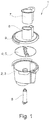
- FIG 1 shows a schematic representation of a chopping attachment as part of a food preparation appliance 1 according to the invention.
- An adapter 8 is shown in the lower area, which is used for the non-rotatable connection of the chopping tool 4, designed here as a cutting disk 5, with the drive shaft or with at least part of the mixing tool.
- the electric motor (not shown here) of the food preparation appliance which drives the drive shaft and thus the mixing tool of the food preparation appliance, can also be used to drive the chopping tool of the chopping attachment in rotation.
- the adapter 8 is designed as a shaft and runs through a vertical cavity inside the vessel 2. It passes through the vessel 2 at the top of the cavity and can be connected to the cutting disc 5 there.
- the vessel 2 has a W-shaped cross section and is used to collect cut food. It is designed as an attachment to be placed in a food preparation vessel of the food preparation appliance 1 .
- the upper area of the vessel 2 serves as a housing part 3 for enclosing the cutting disk 5.
- a cover 9 covers the vessel 2 and seals the cutting disk from the environment. In the lid 9 there are two juxtaposed, different sized openings 6, which are designed as sockets for inserting food to be comminuted. Associated and appropriately dimensioned, interconnected plungers 7 are used to press the food down onto the cutting disc 5.
- the food preparation appliance also includes a control unit (not shown), which is set up to determine the power consumption in order to calculate the torque on the basis of information provided about the food to be chopped, for example a database content or a measured value of the speed and the motor current Food properties set a target parameter of a comminution process, namely a target feed force.
- the control device can determine the actual feed force by means of a sensor signal from a pressure force sensor (likewise not shown) inside the feet of the food preparation appliance. To do this, it can use measured and known compressive force values and, by subtraction and, if necessary, conversion, the current one exerted by the user Determine the compressive force. You can take into account the mass of the vessel or food preparation vessel, the food contained therein and possibly other parts of the food preparation appliance.
- the mass of the food can be known, for example, based on the stored recipe or the weighing history.
- the compressive force currently being exerted can be compared with the target parameter.
- the food preparation appliance has an output device, by means of which it can output output information relating to the target parameter to the user, namely the information: "Pressure too high”, “Pressure just right” or "Pressure too low”.
- the user can sense the dispensing and adjust their pressure on the food accordingly. This can be repeated in very short periods of time, providing the user with real-time feedback on the applied compressive force.
- the desired parameters can be output to the user by an output unit.
- a note can also be issued if the actual value of the corresponding parameter deviates from the target value. This occurs, for example, when one of the values is outside a predetermined tolerance range of the other value, ie when the deviation is too large.
- a note about changing the operating parameter can also be output to the user, or a suggestion with a value for the respective parameter that is more suitable at the moment. This can be done in order to improve the comminution result and/or to protect the food preparation appliance from excessive stress.
- the control unit can take into account the content of a connected database.
- the food preparation appliance can also be set up to influence the rotation of the comminution tool in order to control the comminution process, taking the information into account. In this case, the speed is adjusted independently or automatically in order to adjust the actual value to the target value. In this case, user interaction is not necessary.
- figure 2 shows a flowchart of a user guide of the food preparation appliance 1 output by the control unit on the output device.
- the control unit is set up to output guide information 16, 18 to a user via the output device, which serves to guide the user through individual preparation and/or work steps of a food preparation process respectively.
- a first output A1 the user can choose from a number of electronic prescriptions R1, R2, R3 stored in a database. After selecting a first recipe R1, the note 15 appears in the second output A2 that the chopping attachment is required for the food preparation appliance 1.
- the third output A3 the user is shown as first guidance information 16 that the comminuting attachment is to be attached manually to or on the food preparation vessel.
- a pictogram 19 is shown next to it, which represents this pictorially.
- the fourth output A4 shows output information 17 relating to the target parameter, which is output by the control unit taking into account at least one current compressive force measured value.
- a target compressive force in Newton is initially specified as a target parameter.
- an icon 19 schematically shows the position whose pressing force is represented in the output information 17 .
- the fifth edition A5 shows a second guide information 18, namely the indication that 200 g of potatoes are to be added.
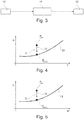
- figure 3 shows a setting of the target parameter 12 carried out by the control unit.
- An input 10 namely an input relating to a meal to be comminuted, is made available to the control unit. This can be specified by the recipe, for example, or entered manually by the user.
- the control unit looks for the size of the appropriate setpoint parameter 12 and defines it.
- figure 4 shows a first characteristic curve 13
- figure 5 shows a second characteristic curve 13.
- the characteristic curve 13 shown in a compressive force-speed diagram defines a relationship between the compressive force F and the speed n of the comminution tool, which is a measure of the cutting speed.
- the compressive force F or feed force typically means the force with which a food to be comminuted along the feed direction to the comminution tool is pressed. It can be proportional to the feed speed of the food to be chopped and can be detected using a weight sensor, for example.
- the speed n is characterized by the engine speed.
- the characteristic curve 13 defines a relationship between the speed n and the cutting torque M.
- the cutting torque M relates to the torque of the comminuting tool in relation to the food to be comminuted.
- the cutting torque M is proportional to the motor torque and can be detected using a motor current sensor, for example.
- a current operating state is determined by the control unit during the comminution process by measuring the motor speed and the compressive force (e.g. via the weight force sensor) or the cutting torque (e.g. via the motor current).
- a current operating point P ACTUAL is thus determined, which is compared with the characteristic curve 13 .
- the desired operating point P SOLL lies on the characteristic curve 13.
- a difference D is determined from the desired speed according to the respective characteristic curve 13 and the measured speed n.
- the rotation of the comminution tool is influenced 14 by the control unit on the basis of the target parameter in order to regulate the comminution process taking the information into account.
- the rotational speed n is changed towards the target rotational speed, so that the characteristic curve 13 is reached with the same pressure force F or constant incremental torque M.
- the food preparation device thus adapts the speed to the pressure force currently being exerted by the user. User interaction is therefore not required and the shredding process takes place in the optimal range.
- FIG 6 shows schematically a food preparation device 1.
- This comprises an electric motor 23, a drive shaft 22 driven by this and a food preparation vessel 24.
- the mixing tool 21 for chopping and mixing food in the food preparation vessel 24 can be attached to the drive shaft 22 that is exposed in the food preparation vessel 24, as shown by the Arrow 26 indicated.
- On the food preparation vessel 24 can manually Crushing attachment 20 are placed and secured, as indicated by the arrow 25.
- the comminution attachment 20 shown here only as an outline comprises a rotatable comminution tool for comminuting food. It includes in particular, as in figure 1 shown, an adapter with which it can be connected to the mixing tool 21 or to the drive shaft 22 in a rotationally fixed manner.
- the vessel can be firmly connected to the food preparation vessel by manually attaching it.
- the axis of rotation of the comminution tool corresponds to the axis of rotation of the drive shaft 22 and of the mixing tool 21.
- the electric motor 23 can thus drive the comminution tool of the comminution attachment 20.
- the comminuting attachment 20 further comprises a vessel, with the comminuting tool being arranged relative to the vessel in such a way that a meal falls down due to gravity after being comminuted by means of the comminuting tool in order to be caught in the vessel, as in FIG 1 shown.
Landscapes
- Engineering & Computer Science (AREA)
- Food Science & Technology (AREA)
- Mechanical Engineering (AREA)
- Food-Manufacturing Devices (AREA)
- Crushing And Pulverization Processes (AREA)
Priority Applications (12)
| Application Number | Priority Date | Filing Date | Title |
|---|---|---|---|
| EP20184886.8A EP3936016A1 (fr) | 2020-07-09 | 2020-07-09 | Appareil de préparation des aliments destiné à la coupe des denrées alimentaires |
| EP21150396.6A EP4026460B8 (fr) | 2020-07-09 | 2021-01-06 | Appareil de préparation des aliments permettant de couper les aliments, pièce rapportée de broyage et procédé |
| EP24189943.4A EP4494536B1 (fr) | 2020-07-09 | 2021-01-06 | Appareil de préparation d'aliments pour couper des aliments, accessoire de broyage et procédé |
| PL21150396.6T PL4026460T3 (pl) | 2020-07-09 | 2021-01-06 | Urządzenie do przygotowywania potraw do krojenia artykułów spożywczych, przystawka do rozdrabniania i sposób |
| ES21150396T ES2987857T3 (es) | 2020-07-09 | 2021-01-06 | Aparato de preparación de alimentos para cortar productos alimenticios, accesorio de trituración y procedimiento |
| EP21180121.2A EP3936014B1 (fr) | 2020-07-09 | 2021-06-17 | Appareil de préparation des aliments permettant de couper les aliments, pièce rapportée de broyage et procédé |
| EP23175746.9A EP4233655A1 (fr) | 2020-07-09 | 2021-06-17 | Appareil de préparation des aliments permettant de couper les aliments, pièce rapportée de broyage et procédé |
| DE202021004229.6U DE202021004229U1 (de) | 2020-07-09 | 2021-06-17 | Speisenzubereitungsgerät zum Schneiden von Lebensmitteln, Zerkleinerungsaufsatz |
| PL21180121.2T PL3936014T3 (pl) | 2020-07-09 | 2021-06-17 | Urządzenie do przygotowywania potraw do krojenia artykułów spożywczych, przystawka do rozdrabniania i sposób |
| ES21180121T ES2948837T3 (es) | 2020-07-09 | 2021-06-17 | Aparato de preparación de alimentos para cortar productos alimenticios, accesorio de trituración y procedimiento |
| US17/370,556 US20220007894A1 (en) | 2020-07-09 | 2021-07-08 | Food preparation apparatus for cutting foods |
| CN202110776038.8A CN113907621A (zh) | 2020-07-09 | 2021-07-08 | 用于切割食物的食物制备设备 |
Applications Claiming Priority (1)
| Application Number | Priority Date | Filing Date | Title |
|---|---|---|---|
| EP20184886.8A EP3936016A1 (fr) | 2020-07-09 | 2020-07-09 | Appareil de préparation des aliments destiné à la coupe des denrées alimentaires |
Publications (1)
| Publication Number | Publication Date |
|---|---|
| EP3936016A1 true EP3936016A1 (fr) | 2022-01-12 |
Family
ID=71574972
Family Applications (2)
| Application Number | Title | Priority Date | Filing Date |
|---|---|---|---|
| EP20184886.8A Pending EP3936016A1 (fr) | 2020-07-09 | 2020-07-09 | Appareil de préparation des aliments destiné à la coupe des denrées alimentaires |
| EP21150396.6A Active EP4026460B8 (fr) | 2020-07-09 | 2021-01-06 | Appareil de préparation des aliments permettant de couper les aliments, pièce rapportée de broyage et procédé |
Family Applications After (1)
| Application Number | Title | Priority Date | Filing Date |
|---|---|---|---|
| EP21150396.6A Active EP4026460B8 (fr) | 2020-07-09 | 2021-01-06 | Appareil de préparation des aliments permettant de couper les aliments, pièce rapportée de broyage et procédé |
Country Status (5)
| Country | Link |
|---|---|
| US (1) | US20220007894A1 (fr) |
| EP (2) | EP3936016A1 (fr) |
| CN (1) | CN113907621A (fr) |
| ES (1) | ES2987857T3 (fr) |
| PL (1) | PL4026460T3 (fr) |
Cited By (1)
| Publication number | Priority date | Publication date | Assignee | Title |
|---|---|---|---|---|
| EP4272614A1 (fr) * | 2022-05-03 | 2023-11-08 | Vorwerk & Co. Interholding GmbH | Robot de cuisine pourvu d'une balance pour l'interface utilisateur |
Families Citing this family (5)
| Publication number | Priority date | Publication date | Assignee | Title |
|---|---|---|---|---|
| EP4316322A1 (fr) * | 2022-08-02 | 2024-02-07 | Vorwerk & Co. Interholding GmbH | Générateur d'écoulement, robot de cuisine et procédé |
| US12611066B2 (en) | 2023-06-09 | 2026-04-28 | Sharkninja Operating Llc | Blender food item texture control |
| USD1075401S1 (en) | 2023-08-01 | 2025-05-20 | Sharkninja Operating Llc | Blender |
| USD1101490S1 (en) | 2023-08-02 | 2025-11-11 | Sharkninja Operating Llc | Blender user interface |
| US12178360B1 (en) | 2023-08-08 | 2024-12-31 | Sharkninja Operating Llc | Intelligent blending and user interface |
Citations (2)
| Publication number | Priority date | Publication date | Assignee | Title |
|---|---|---|---|---|
| EP2636344A1 (fr) * | 2012-03-09 | 2013-09-11 | Whirlpool Corporation | Robot de cuisine et ensemble de coupe réglable |
| WO2018007833A1 (fr) * | 2016-07-08 | 2018-01-11 | Kenwood Limited | Robot culinaire |
Family Cites Families (18)
| Publication number | Priority date | Publication date | Assignee | Title |
|---|---|---|---|---|
| US4194697A (en) | 1979-01-22 | 1980-03-25 | William Lembeck | Food processor and auxiliary mixing bowl therefor |
| DE102008013863A1 (de) | 2008-03-12 | 2009-09-17 | Vorwerk & Co. Interholding Gmbh | Eletromotorisch betriebene Küchenmaschine |
| DE102008040937A1 (de) | 2008-08-01 | 2010-02-11 | BSH Bosch und Siemens Hausgeräte GmbH | Vorrichtung zum Zerteilen von Bearbeitungsgut, insbesondere zum Würfeln von Lebensmitteln, und Küchenmaschine |
| DE102009058258A1 (de) | 2009-12-10 | 2011-06-16 | Vorwerk & Co. Interholding Gmbh | Küchenmaschine |
| EP2335534A1 (fr) | 2009-12-17 | 2011-06-22 | Koninklijke Philips Electronics N.V. | Râpe en forme de disque pour robot-mixeur |
| FR2955475B1 (fr) | 2010-01-22 | 2013-09-06 | Hameur Sa | Appareil multifonctionnel de traitement mecanique d'aliments |
| US8721164B2 (en) * | 2010-07-27 | 2014-05-13 | Euro-Pro Operating Llc | Food processor with attachment |
| DE102010037769B4 (de) | 2010-09-24 | 2019-09-19 | Vorwerk & Co. Interholding Gmbh | Elektrisch betriebene Küchenmaschine sowie Verfahren zum Betreiben einer solchen Küchenmaschine |
| CN202537098U (zh) * | 2012-03-23 | 2012-11-21 | 永庆国际有限公司 | 具有安全防护机制的食物调理机 |
| DE102012106636A1 (de) | 2012-07-23 | 2014-01-23 | Vorwerk & Co. Interholding Gmbh | Elektromotorisch betriebene Küchenmaschine sowie Einsatzgefäß |
| DE202012105011U1 (de) | 2012-12-21 | 2013-01-25 | Vorwerk & Co. Interholding Gmbh | Elektromotorisch betriebene Küchenmaschine |
| DE102015101250A1 (de) * | 2015-01-28 | 2016-07-28 | Vorwerk & Co. Interholding Gmbh | Rührgefäß für eine Küchenmaschine |
| AT518073B1 (de) | 2016-03-25 | 2017-07-15 | Johann Innerhuber | Küchenmaschine |
| US11013371B2 (en) * | 2017-03-10 | 2021-05-25 | Vita-Mix Management Corporation | Wireless food processor discs |
| DE102017123689A1 (de) | 2017-10-11 | 2019-04-11 | Vorwerk & Co. Interholding Gmbh | Elektromotorisch betriebene Küchenmaschine |
| PL3530161T3 (pl) * | 2018-02-21 | 2021-02-08 | Vorwerk & Co. Interholding Gmbh | Urządzenie do przygotowywania potraw z narzędziem do rozdrabniania |
| EP3586688A1 (fr) * | 2018-06-25 | 2020-01-01 | Koninklijke Philips N.V. | Appareil de préparation d'aliments |
| DE202020106270U1 (de) | 2020-11-02 | 2020-12-21 | Timo Plogstedt - Philip Bonmann GbR (vertretungsberechtigter Gesellschafter: Timo Plogstedt, 22767 Hamburg) | Saftpresse |
-
2020
- 2020-07-09 EP EP20184886.8A patent/EP3936016A1/fr active Pending
-
2021
- 2021-01-06 EP EP21150396.6A patent/EP4026460B8/fr active Active
- 2021-01-06 PL PL21150396.6T patent/PL4026460T3/pl unknown
- 2021-01-06 ES ES21150396T patent/ES2987857T3/es active Active
- 2021-07-08 US US17/370,556 patent/US20220007894A1/en active Pending
- 2021-07-08 CN CN202110776038.8A patent/CN113907621A/zh active Pending
Patent Citations (2)
| Publication number | Priority date | Publication date | Assignee | Title |
|---|---|---|---|---|
| EP2636344A1 (fr) * | 2012-03-09 | 2013-09-11 | Whirlpool Corporation | Robot de cuisine et ensemble de coupe réglable |
| WO2018007833A1 (fr) * | 2016-07-08 | 2018-01-11 | Kenwood Limited | Robot culinaire |
Cited By (1)
| Publication number | Priority date | Publication date | Assignee | Title |
|---|---|---|---|---|
| EP4272614A1 (fr) * | 2022-05-03 | 2023-11-08 | Vorwerk & Co. Interholding GmbH | Robot de cuisine pourvu d'une balance pour l'interface utilisateur |
Also Published As
| Publication number | Publication date |
|---|---|
| EP4026460B1 (fr) | 2024-07-24 |
| US20220007894A1 (en) | 2022-01-13 |
| EP4026460A1 (fr) | 2022-07-13 |
| PL4026460T3 (pl) | 2024-12-02 |
| CN113907621A (zh) | 2022-01-11 |
| EP4026460B8 (fr) | 2024-09-11 |
| EP4026460C0 (fr) | 2024-07-24 |
| ES2987857T3 (es) | 2024-11-18 |
| ES2987857T8 (en) | 2025-03-18 |
Similar Documents
| Publication | Publication Date | Title |
|---|---|---|
| EP3936016A1 (fr) | Appareil de préparation des aliments destiné à la coupe des denrées alimentaires | |
| EP3530161B1 (fr) | Appareil de préparation d'aliments pourvu d'outil de broyage | |
| EP3468436B1 (fr) | Procédé pour faire fonctionner un robot ménager | |
| EP2874526B1 (fr) | Machine pour la cuisine | |
| EP3174443B1 (fr) | Préparation d'une denrée alimentaire selon des données de recette prédéterminées au moyen d'un appareil de cuisine électrique | |
| DE2258841C3 (de) | Elektrische schneidemaschine fuer lebensmittel | |
| EP3498138B1 (fr) | Appareil de préparation d'aliments à détection de surpression | |
| EP1472962A1 (fr) | Robot menager comportant un bac a agitation et un mecanisme d'entrainement de l'agitateur du bac | |
| WO2018138078A1 (fr) | Procédé pour faire fonctionner un appareil de cuisson et module pour la mise en oeuvre de ce procédé | |
| DE102010016024A1 (de) | Küchenmaschine | |
| EP2578121B1 (fr) | Machine à café et procédé destiné au fonctionnement d'une machine à café | |
| DE3049915C2 (fr) | ||
| EP3936014B1 (fr) | Appareil de préparation des aliments permettant de couper les aliments, pièce rapportée de broyage et procédé | |
| CH692274A5 (de) | Kontinuierlicher Mischer, Mischanlage mit einem kontinuierlichen Mischer sowie Verfahren zum Betrieb einer solchen Mischanlage. | |
| EP4101349A1 (fr) | Procédé d'épluchage de pommes de terre et robot de cuisine | |
| DE69913526T2 (de) | Eine drehvorrichtung für küchen-schneidmaschinen | |
| EP1838448B1 (fr) | Dispositif de fractionnement a usage unique | |
| DE102021116879B3 (de) | Verfahren zur Steuerung einer Vorrichtung zum Herstellen eines Lebensmittels | |
| DE2444151C2 (de) | Getreidemühle als Zusatzgerät für eine Küchenmaschine | |
| EP0247342B1 (fr) | Dispositif broyeur pour la fabrication de masse pâteuse | |
| DE919615C (de) | Vorrichtung zum Zerkleinern landwirtschaftlicher Produkte | |
| EP3607824A1 (fr) | Fabrication de produits moulés en forme de disque | |
| EP3503777B1 (fr) | Disque de traitement pourvu de zones d'outil sélectionnables | |
| DE102012220996A1 (de) | Küchengerät | |
| EP3585177B1 (fr) | Procédé de barattage |
Legal Events
| Date | Code | Title | Description |
|---|---|---|---|
| PUAI | Public reference made under article 153(3) epc to a published international application that has entered the european phase |
Free format text: ORIGINAL CODE: 0009012 |
|
| STAA | Information on the status of an ep patent application or granted ep patent |
Free format text: STATUS: THE APPLICATION HAS BEEN PUBLISHED |
|
| AK | Designated contracting states |
Kind code of ref document: A1 Designated state(s): AL AT BE BG CH CY CZ DE DK EE ES FI FR GB GR HR HU IE IS IT LI LT LU LV MC MK MT NL NO PL PT RO RS SE SI SK SM TR |
|
| B565 | Issuance of search results under rule 164(2) epc |
Effective date: 20200903 |
|
| STAA | Information on the status of an ep patent application or granted ep patent |
Free format text: STATUS: REQUEST FOR EXAMINATION WAS MADE |
|
| 17P | Request for examination filed |
Effective date: 20220210 |
|
| RBV | Designated contracting states (corrected) |
Designated state(s): AL AT BE BG CH CY CZ DE DK EE ES FI FR GB GR HR HU IE IS IT LI LT LU LV MC MK MT NL NO PL PT RO RS SE SI SK SM TR |
|
| STAA | Information on the status of an ep patent application or granted ep patent |
Free format text: STATUS: EXAMINATION IS IN PROGRESS |
|
| 17Q | First examination report despatched |
Effective date: 20230907 |