EP3936588A1 - Procédés de production d'éthylène et de propylène à partir de naphta - Google Patents
Procédés de production d'éthylène et de propylène à partir de naphta Download PDFInfo
- Publication number
- EP3936588A1 EP3936588A1 EP21194572.0A EP21194572A EP3936588A1 EP 3936588 A1 EP3936588 A1 EP 3936588A1 EP 21194572 A EP21194572 A EP 21194572A EP 3936588 A1 EP3936588 A1 EP 3936588A1
- Authority
- EP
- European Patent Office
- Prior art keywords
- hzsm
- catalyst
- naphtha
- reactor
- propylene
- Prior art date
- Legal status (The legal status is an assumption and is not a legal conclusion. Google has not performed a legal analysis and makes no representation as to the accuracy of the status listed.)
- Pending
Links
Images
Classifications
-
- C—CHEMISTRY; METALLURGY
- C10—PETROLEUM, GAS OR COKE INDUSTRIES; TECHNICAL GASES CONTAINING CARBON MONOXIDE; FUELS; LUBRICANTS; PEAT
- C10G—CRACKING HYDROCARBON OILS; PRODUCTION OF LIQUID HYDROCARBON MIXTURES, e.g. BY DESTRUCTIVE HYDROGENATION, OLIGOMERISATION, POLYMERISATION; RECOVERY OF HYDROCARBON OILS FROM OIL-SHALE, OIL-SAND, OR GASES; REFINING MIXTURES MAINLY CONSISTING OF HYDROCARBONS; REFORMING OF NAPHTHA; MINERAL WAXES
- C10G11/00—Catalytic cracking, in the absence of hydrogen, of hydrocarbon oils
- C10G11/02—Catalytic cracking, in the absence of hydrogen, of hydrocarbon oils characterised by the catalyst used
- C10G11/04—Oxides
- C10G11/05—Crystalline alumino-silicates, e.g. molecular sieves
-
- B—PERFORMING OPERATIONS; TRANSPORTING
- B01—PHYSICAL OR CHEMICAL PROCESSES OR APPARATUS IN GENERAL
- B01J—CHEMICAL OR PHYSICAL PROCESSES, e.g. CATALYSIS OR COLLOID CHEMISTRY; THEIR RELEVANT APPARATUS
- B01J29/00—Catalysts comprising molecular sieves
- B01J29/04—Catalysts comprising molecular sieves having base-exchange properties, e.g. crystalline zeolites
- B01J29/06—Crystalline aluminosilicate zeolites; Isomorphous compounds thereof
- B01J29/40—Crystalline aluminosilicate zeolites; Isomorphous compounds thereof of the pentasil type, e.g. types ZSM-5, ZSM-8 or ZSM-11, as exemplified by patent documents US3702886, GB1334243 and US3709979, respectively
- B01J29/405—Crystalline aluminosilicate zeolites; Isomorphous compounds thereof of the pentasil type, e.g. types ZSM-5, ZSM-8 or ZSM-11, as exemplified by patent documents US3702886, GB1334243 and US3709979, respectively containing rare earth elements, titanium, zirconium, hafnium, zinc, cadmium, mercury, gallium, indium, thallium, tin or lead
-
- B—PERFORMING OPERATIONS; TRANSPORTING
- B01—PHYSICAL OR CHEMICAL PROCESSES OR APPARATUS IN GENERAL
- B01J—CHEMICAL OR PHYSICAL PROCESSES, e.g. CATALYSIS OR COLLOID CHEMISTRY; THEIR RELEVANT APPARATUS
- B01J29/00—Catalysts comprising molecular sieves
- B01J29/89—Silicates, aluminosilicates or borosilicates of titanium, zirconium or hafnium
-
- C—CHEMISTRY; METALLURGY
- C10—PETROLEUM, GAS OR COKE INDUSTRIES; TECHNICAL GASES CONTAINING CARBON MONOXIDE; FUELS; LUBRICANTS; PEAT
- C10G—CRACKING HYDROCARBON OILS; PRODUCTION OF LIQUID HYDROCARBON MIXTURES, e.g. BY DESTRUCTIVE HYDROGENATION, OLIGOMERISATION, POLYMERISATION; RECOVERY OF HYDROCARBON OILS FROM OIL-SHALE, OIL-SAND, OR GASES; REFINING MIXTURES MAINLY CONSISTING OF HYDROCARBONS; REFORMING OF NAPHTHA; MINERAL WAXES
- C10G9/00—Thermal non-catalytic cracking, in the absence of hydrogen, of hydrocarbon oils
- C10G9/34—Thermal non-catalytic cracking, in the absence of hydrogen, of hydrocarbon oils by direct contact with inert preheated fluids, e.g. with molten metals or salts
- C10G9/36—Thermal non-catalytic cracking, in the absence of hydrogen, of hydrocarbon oils by direct contact with inert preheated fluids, e.g. with molten metals or salts with heated gases or vapours
-
- B—PERFORMING OPERATIONS; TRANSPORTING
- B01—PHYSICAL OR CHEMICAL PROCESSES OR APPARATUS IN GENERAL
- B01J—CHEMICAL OR PHYSICAL PROCESSES, e.g. CATALYSIS OR COLLOID CHEMISTRY; THEIR RELEVANT APPARATUS
- B01J2229/00—Aspects of molecular sieve catalysts not covered by B01J29/00
- B01J2229/10—After treatment, characterised by the effect to be obtained
- B01J2229/18—After treatment, characterised by the effect to be obtained to introduce other elements into or onto the molecular sieve itself
-
- B—PERFORMING OPERATIONS; TRANSPORTING
- B01—PHYSICAL OR CHEMICAL PROCESSES OR APPARATUS IN GENERAL
- B01J—CHEMICAL OR PHYSICAL PROCESSES, e.g. CATALYSIS OR COLLOID CHEMISTRY; THEIR RELEVANT APPARATUS
- B01J2229/00—Aspects of molecular sieve catalysts not covered by B01J29/00
- B01J2229/10—After treatment, characterised by the effect to be obtained
- B01J2229/22—After treatment, characterised by the effect to be obtained to destroy the molecular sieve structure or part thereof
-
- B—PERFORMING OPERATIONS; TRANSPORTING
- B01—PHYSICAL OR CHEMICAL PROCESSES OR APPARATUS IN GENERAL
- B01J—CHEMICAL OR PHYSICAL PROCESSES, e.g. CATALYSIS OR COLLOID CHEMISTRY; THEIR RELEVANT APPARATUS
- B01J2229/00—Aspects of molecular sieve catalysts not covered by B01J29/00
- B01J2229/30—After treatment, characterised by the means used
- B01J2229/38—Base treatment
-
- C—CHEMISTRY; METALLURGY
- C10—PETROLEUM, GAS OR COKE INDUSTRIES; TECHNICAL GASES CONTAINING CARBON MONOXIDE; FUELS; LUBRICANTS; PEAT
- C10G—CRACKING HYDROCARBON OILS; PRODUCTION OF LIQUID HYDROCARBON MIXTURES, e.g. BY DESTRUCTIVE HYDROGENATION, OLIGOMERISATION, POLYMERISATION; RECOVERY OF HYDROCARBON OILS FROM OIL-SHALE, OIL-SAND, OR GASES; REFINING MIXTURES MAINLY CONSISTING OF HYDROCARBONS; REFORMING OF NAPHTHA; MINERAL WAXES
- C10G2400/00—Products obtained by processes covered by groups C10G9/00 - C10G69/14
- C10G2400/20—C2-C4 olefins
-
- Y—GENERAL TAGGING OF NEW TECHNOLOGICAL DEVELOPMENTS; GENERAL TAGGING OF CROSS-SECTIONAL TECHNOLOGIES SPANNING OVER SEVERAL SECTIONS OF THE IPC; TECHNICAL SUBJECTS COVERED BY FORMER USPC CROSS-REFERENCE ART COLLECTIONS [XRACs] AND DIGESTS
- Y02—TECHNOLOGIES OR APPLICATIONS FOR MITIGATION OR ADAPTATION AGAINST CLIMATE CHANGE
- Y02P—CLIMATE CHANGE MITIGATION TECHNOLOGIES IN THE PRODUCTION OR PROCESSING OF GOODS
- Y02P20/00—Technologies relating to chemical industry
- Y02P20/50—Improvements relating to the production of bulk chemicals
- Y02P20/52—Improvements relating to the production of bulk chemicals using catalysts, e.g. selective catalysts
Definitions
- the presently disclosed subject matter relates to methods for producing ethylene and propylene from naphtha.
- Naphtha can be a low value petrochemical stream found in petroleum distillate streams from oil refinery processes.
- Naphtha that is derived from the distillate of the crude still, i.e., straight run naphtha can contain a variety of components, depending on the composition of the crude source.
- Straight run naphtha typically includes large amounts of straight and branched paraffins, and can further include olefins and/or aromatics.
- FCC fluid catalytic cracking
- DCC deep catalytic cracking
- ACO advanced catalytic olefins
- European Patent No. 1117750 discloses a catalytic naphtha cracking process for producing olefins using a zeolite catalyst including phosphorus and a promoter metal.
- U.S. Patent Publication No. 2007/0082809 discloses hydrothermally stable porous molecular sieve catalysts, which can be used in catalytic cracking reactions, including producing light olefins from naphtha.
- U.S. Patent Publication No. 2007/0010699 discloses a process for producing light olefins from hydrocarbon feedstock using porous molecular sieve catalysts having a water-insoluble metal salt and a phosphate compound.
- WO 2011/162717 discloses a method of producing alkenes by the dehydration of alcohols using a metal-modified zeolite.
- U.S. Patent Publication No. 2007/0209969 discloses a catalyst for use in cracking heavy feedstocks to produce lower olefins that can include an alkaline treated zeolite having a silica to alumina ratio of less than 45.
- the presently disclosed subject matter provides methods for producing ethylene and propylene from naphtha using an HZSM-5 catalyst.
- an exemplary method includes providing a naphtha feedstock and steam, providing a catalyst including phosphorus modified titanium-containing HZSM-5, feeding the naphtha feedstock and steam to a reactor containing the catalyst, and removing an effluent with a combined yield of ethylene and propylene greater than about 45 wt-% from the reactor.
- the naphtha feedstock can include light straight run naphtha.
- the steam can be co-fed with the naphtha feedstock.
- the catalyst can have a Si/Al 2 ratio of about 27 to about 30.
- the catalyst can contain from about 1.0 wt-% to about 5.0 wt-% titanium (Ti) and from about 1.0 wt-% to about 10.0 wt-% phosphoric anhydride (P 2 O 5 ).
- the catalyst is prepared by titanium modification followed by phosphorus modification.
- the phosphorus modification can use mono-ammonium phosphate.
- coke deposits on the catalyst can be less than about 5 wt-%.
- the catalyst is not steamed prior to feeding the naphtha feedstock to the reactor.
- the presently disclosed subject matter also provides a method including providing a naphtha feedstock and steam, providing a catalyst including phosphorus modified mesoporous HZSM-5, feeding the naphtha feedstock and steam to a reactor containing the catalyst, and removing an effluent with a combined yield of ethylene and propylene greater than about 45 wt-% from the reactor.
- the naphtha feedstock can include light straight run naphtha.
- the steam can be co-fed with the naphtha feedstock.
- the catalyst can have a Si/Al 2 ratio of about 27 to about 30.
- the catalyst can contain from about 1.0 wt-% to about 5.0 wt-% Ti and from about 1.0 wt-% to about 10.0 wt-% P 2 O 5 .
- the catalyst can be treated with 0.5M NaOH.
- the catalyst can be prepared by alkaline treatment followed by phosphorus modification. In certain embodiments, the phosphorus modification uses mono-ammonium phosphate.
- coke deposits on the catalyst can be less than about 5 wt-%.
- the catalyst is not steamed prior to feeding the naphtha feedstock to the reactor.
- the presently disclosed subject matter provides methods for producing ethylene and propylene from naphtha.
- the presently disclosed subject matter relates to methods for the catalytic steam cracking of naphtha to light olefins, e.g., ethylene and propylene, using an HZSM-5 catalyst.
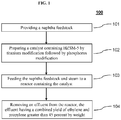
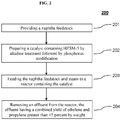
- FIGS. 1 and 2 are schematic representations of methods according to non-limiting embodiments of the disclosed subject matter.
- the method 100, 200 includes providing a naphtha feedstock 101, 201.
- Naphtha for use in the presently disclosed subject matter can originate from a variety of sources, including natural gas condensates, petroleum distillates, coal tar distillates, and/or peat.
- the naphtha for use in the presently disclosed subject matter can be light straight run naphtha.
- the naphtha feedstock includes alkanes and iso-alkanes.
- the naphtha feedstock can also include other components, such as naphthenes and/or aromatics.
- the naphtha feedstock can contain from about 20 wt-% to about 90 wt-%, from about 30 wt-% to about 80 wt-%, from about 40 wt-% to about 70 wt-%, or from about 50 wt-% to about 60 wt-% alkanes.
- the naphtha feedstock can contain from about 5 wt-% to about 75 wt-%, from about 15 wt-% to about 65 wt-%, from about 25 wt-% to about 55 wt-%, or from about 35 wt-% to about 45 wt-% iso-alkanes.
- the naphtha feedstock can contain less than about 10 wt-% naphthenes and less than about 2 wt-% aromatics.
- the term “about” or “approximately” means within an acceptable error range for the particular value as determined by one of ordinary skill in the art, which will depend in part on how the value is measured or determined, i.e., the limitations of the measurement system. For example, “about” can mean a range of up to 20%, up to 12%, up to 10%, up to 5%, and or up to 1% of a given value.
- the initial boiling point of the naphtha feedstock is from about 30°C to about 65°C, from about 40°C to about 55°C, or from about 45°C to about 50°C.
- the end boiling point of the naphtha feedstock can be from about 70°C to about 130°C, from about 80°C to about 110°C, or from about 85°C to about 90°C.
- the saturated vapor pressure (at 20°C) of the naphtha feedstock can be from about 50 kPa to about 90 kPa, from about 60 kPa to about 80 kPa, or from about 65 kPa to about 75 kPa.
- the method 100, 200 further includes providing an HZSM-5 catalyst.
- the HZSM-5 catalyst can be a zeolite having a silica to alumina ratio (Si/Al 2 ) from about 10 to about 50, from about 20 to about 40, from about 25 to 35, or from about 27 to 30.
- the HZSM-5 catalyst can be mesoporous, i.e., can have pore diameters from about 2 to about 50 nanometers.
- the method 100 can include preparing a catalyst including HZSM-5 by titanium (Ti) modification 102.
- the HZSM-5 catalyst can be prepared by treatment with a Ti compound.
- the Ti compound can be titanium tetrachloride, titanium oxychloride, titanium methoxide, titanium ethoxide, titanium isopropoxide, titanium butoxide, or mixtures thereof.
- the Ti compound is titanium oxychloride.
- the Ti compound can be present in a solvent. Solvents for use in the presently disclosed methods can be any solvent suitable for dissolving a Ti compound. Such solvents include, but are not limited to, water, alcohols, organic sulfoxides or sulfones, carboxylic acids, and/or esters.
- the Ti modified HZSM-5 catalyst is prepared by treating an HZSM-5 catalyst with a solution including a Ti compound.
- the method can further include removing the solvent from the Ti-modified HZSM-5 catalyst by filtration and/or evaporation.
- the method can further include calcinating the Ti-modified HZSM-5 catalyst.
- the Ti-modified HZSM-5 catalyst can contain from about 0.1 wt-% to about 20 wt-%, from about 0.5 wt-% to about 10 wt-%, or from about 1 wt-% to about 5 wt-% Ti.
- the HZSM-5 catalyst can contain about 2 wt-% Ti.
- the method 200 can include preparing a catalyst including HZSM-5 by alkaline treatment 202.
- Alkaline treatment can result in increased mesoporosity and desilication of the HZSM-5 catalyst.
- the alkaline treatment can include preparing an alkaline solution with the HZSM-5 catalyst.
- the alkaline solution can contain NaOH.
- the NaOH can be present in the alkaline solution at a concentration from about 0.02 M to about 0.20 M.
- the method can further include removing the solvent from the alkaline treated HZSM-5 catalyst by filtration and/or evaporation.
- the method can further include calcinating the alkaline treated HZSM-5 catalyst.
- Ti modification and/or alkaline treatment can be followed by phosphorus modification.
- the method can include treating the HZSM-5 catalyst with a source of phosphate ions.
- the source of phosphate ions can be mono-ammonium phosphate.
- the method can include treating the HZSM-5 catalyst with a solution containing phosphate ions.
- the method can further include removing the solvent from the phosphorus modified HZSM-5 catalyst by filtration and/or evaporation.
- the method can further include calcinating the phosphorus modified HZSM-5 catalyst.
- the phosphorus modified HZSM-5 catalyst can contain from about 0.1 wt-% to about 20 wt-%, from about 0.5 wt-% to about 15 wt-%, or from about 1 wt-% to about 10 wt-% of a phosphorus oxide.
- the phosphorus oxide can be phosphoric anhydride (P 2 O 5 ).
- the HZSM-5 catalyst contains about 5 wt-% P 2 O 5 .
- the method 100, 200 further includes feeding the naphtha feedstock to a reactor containing the catalyst 103, 203.
- the reactor can be any reactor type known to be suitable for the catalytic steam cracking of naphtha.
- the reactor can be a fixed bed reactor, such as a tubular fixed bed reactor or multi-tubular fixed bed reactor, fluidized bed reactor, such as an entrained fluidized bed reactor or a fixed fluidized bed reactor, or a slurry bed reactor, such as three-phase slurry bubble columns or an ebullated bed reactor.
- the dimensions and structure of the reactor of the presently disclosed subject matter can vary depending on the capacity of the reactor.
- the capacity of the reactor can be determined by the reaction rate, the stoichiometric quantities of the reactants and/or the feed flow rate.
- the method further includes the catalytic steam cracking of naphtha to form ethylene and propylene.
- the method can include providing steam to the reactor.
- the ratio of steam to naphtha provided to the reactor can be from about 0.25 to about 0.75, from about 0.35 to about 0.65, or from about 0.4 to about 0.6.
- the ratio of steam to naphtha fed to the reactor is about 0.5.
- the reaction can be carried out at a temperature from about 400°C to about 900°C, from about 500°C to about 800°C, from about 550°C to about 750°C, or from about 600°C to about 700°C.
- the reaction can be carried out at a pressure from about atmospheric pressure to about 30 psig.
- the reaction can be carried out at a weight hourly space velocity of about 5 to about 7 per hour naphtha feedstock.
- the method 100, 200 further includes removing an effluent from the reactor 104, 204.
- the effluent can contain ethylene and propylene.
- the effluent can contain from about 5 wt-% to about 35 wt-%, from about 10 wt-% to about 30 wt-%, or from about 15 wt-% to about 25 wt-% ethylene.
- the effluent can contain from about 10 wt-% to about 50 wt-%, from about 20 wt-% to about 40 wt-%, or from about 25 wt-% to about 35 wt-% propylene.
- the effluent can further include other components, such as higher olefins, paraffins, and/or aromatics, e.g., benzene, toluene, and/or xylene.
- the effluent can contain from about 5 wt-% to about 10 wt-% higher olefins, from about 0.1 wt-% to about 5 wt-% aromatics, from about 20 wt-% to about 30 wt-% C 1 to C 4 alkanes, and/or from about 15 wt-% to about 30 wt-% higher alkanes.
- the combined yield of ethylene and propylene in the effluent is greater than about 30 wt-%, greater than about 35 wt-%, greater than about 40 wt-%, or greater than about 45 wt-%.
- the methods of the presently disclosed subject matter can provide advantages over certain existing technologies. Exemplary advantages include eliminating catalyst steaming prior to use, superior time-on-stream stability, and high ethylene and propylene yield.
- the catalytic steam cracking was carried out at a reaction temperature of 650°C with a time-on-stream (TOS) of 6 hours.
- TOS time-on-stream
- the ratio of steam to naphtha in the feed was 0.5.
- the reaction had a weight hourly space velocity (WHSV) of about 6.1 h -1 .
- Table 1 displays the physical properties of the naphtha feedstock.
- HZSM-5 (Zeolyst, NH 4 form, CBV3024E) having a Si/Al 2 ratio of 27 was calcined at 550°C with a heating rate of 3°C per minute and a holding time of 5 hours.
- Table 2 displays the catalytic performance of unmodified HZSM-5 in the catalytic steam cracking process of Example 1.
- Table 2 Catalytic performance of unmodified HZSM-5 catalysts.
- HZSM-5 zeolite having a Si/Al 2 ratio of 27 was stirred in a solution containing a Ti precursor (titanium oxychloride). The amount of titanium oxychloride in the solution was calibrated to produce a metal loading of 2.0 wt-%. The mixture was stirred for 3 hours. The solvent was removed by filtration. The product was then dried at 90°C overnight followed by calcination at 650 °C (heating rate of 3°C per minute, holding time of 5 hours).
- the Na + -containing zeolites were transformed into ammonium form by two-fold ion-exchange with 2.20 M of NH 4 Cl at 80°C for 5 hours without calcination between the ion-exchange procedures.
- the ion-exchange was carried out at a concentration of 1.0 g zeolite per 50 mL NH 4 Cl solution. The samples were then subjected to drying treatments followed by calcination to produce the H-form.
- Table 3 displays the catalytic performance of Ti/HZSM-5 and alkaline treated HZSM-5 compared to the unmodified HZSM-5 of Example 2 after undergoing the catalytic steam cracking process of Example 1.
- Table 3 Catalytic - performance of Ti/HZSM-5, alkaline treated HZSM-5, and unmodified hzsm-5 catalysts.
- titanium modified and alkaline treated HZSM-5 catalysts in accordance with the disclosed subject matter provide improved combined yields of ethylene and propylene compared to unmodified HZSM-5 catalysts. Further, titanium modification and alkaline treatment provide improved conversion of naphtha compared to unmodified HZSM-5 catalysts.
- a slurry was prepared containing 35 wt-% of the solid unmodified HZSM-5 of Example 2.
- Mono-ammonium phosphate (MAP) was added to the slurry such that the slurry contained 5 wt-% P 2 O 5 .
- the solution was heated to 95°C with continuous stirring for 1 hour. Water was then removed by slow evaporation.
- the product was dried at 90°C overnight followed by calcination at 650°C (heating rate of 3°C per minute, holding time of 3 hours).
- Table 4 displays the catalytic performance of the phosphorus modified HZSM-5 compared to the unmodified HZSM-5 of Example 2 after undergoing the catalytic steam cracking process of Example 1.
- Table 4 Catalytic performance of unmodified HZSM-5 and HZSM-5-P 2 O 5 catalysts.
- a slurry was prepared containing 35 wt-% of the solid alkaline treated HZSM-5 of Example 3.
- Mono-ammonium phosphate (MAP) was added to the slurry such that the slurry contained 5 wt-% P 2 O 5 .
- the solution was heated to 95°C with continuous stirring for 1 hour. Water was then removed by slow evaporation.
- the product was dried at 90°C overnight followed by calcination at 650°C (heating rate of 3°C per minute, holding time of 3 hours).
- Table 5 displays the catalytic performance of the phosphorus modified alkaline treated HZSM-5 compared to the alkaline treated HZSM-5 of Example 3 after undergoing the catalytic steam cracking process of Example 1.
- Table 5 Catalytic performance of alkaline treated HZSM-5 and alkaline treated HZSM-5-P 2 O 5 catalysts.
- phosphorus modification of alkaline treated HZSM-5 catalysts in accordance with the disclosed subject matter provides improved combined yields of ethylene and propylene compared to alkaline treated HZSM-5 catalysts. Further, phosphorus modification provides improved conversion of naphtha compared to alkaline treated HZSM-5 catalysts.
- a slurry was prepared containing 35 wt-% of the solid Ti/HZSM-5 of Example 3. Mono-ammonium phosphate (MAP) was added to the slurry such that the slurry contained 5 wt-% P 2 O 5 .
- the solution was heated to 95°C with continuous stirring for 1 hour. Water was then removed by slow evaporation. The product was dried at 90°C overnight followed by calcination at 650°C (heating rate of 3°C per minute, holding time of 3 hours).
- Table 6 displays the catalytic performance of the phosphorus modified Ti/HZSM-5 compared to the Ti/HZSM-5 of Example 3 after undergoing the catalytic steam cracking process of Example 1.
- Table 6 Catalytic performance of Ti/HZSM-5 and Ti/HZSM-5-P 2 O 5 catalsts.
- phosphorus modification of Ti/HZSM-5 catalysts in accordance with the disclosed subject matter provides improved combined yields of ethylene and propylene compared to Ti/HZSM-5 catalysts. Further, phosphorus modification provides improved conversion of naphtha compared to Ti/ HZSM-5 catalysts.
- Example 7 Steamed HZSM-5 and HZSM-5-P 2 O 5 Catalysts
- Example 2 1.0 g of the unmodified HZSM-5 of Example 2 was subjected to steam at 700°C for 3 hours (100% steam, heating rate of 10°C per minute). The steamed catalysts were dried overnight at 100°C. 1.0 g of the phosphorus modified HZSM-5-P 2 O 5 of Example 4 was also subjected to steam and dried in the same manner. Table 7 displays the catalytic performance of the steamed HZSM-5 and steamed HZSM-5-P 2 O 5 compared to the unmodified HZSM-5 of Example 2 and the HZSM-5-P 2 O 5 of Example 4 after undergoing the catalytic steam cracking process of Example 1.
- Table 7 Catalytic performance of steamed and unsteamed HZSM-5 and HZSM-5-P 2 O 5 catalysts.
- Catalyst Unmodified HZSM-5 (Example 2)
- Steamed HZSM-5 HZSM-5-P 2 O 5 (Example 4)
- Example 8 Steamed Alkaline Treated HZSM-5 and HZSM-5-P 2 O 5 Catalysts
- Example 3 1.0 g of the alkaline treated HZSM-5 of Example 3 was subjected to steam at 700°C for 3 hours (100% steam, heating rate of 10°C per minute). The steamed catalysts were dried overnight at 100°C. 1.0 g of the phosphorus modified alkaline treated HZSM-5-P 2 O 5 of Example 5 was also subjected to steam and dried in the same manner. Table 8 displays the catalytic performance of the steamed alkaline treated HZSM-5 and steamed alkaline treated HZSM-5-P 2 O 5 compared to the alkaline treated HZSM-5 of Example 3 and the alkaline treated HZSM-5-P 2 O 5 of Example 5 after undergoing the catalytic steam cracking process of Example 1.
- Table 8 Catalytic performance of steamed and unsteamed alkaline treated HZSM-5 and HZSM-5-P 2 O 5 catalysts.
- Example 3 1.0 g of the Ti/HZSM-5 of Example 3 was subjected to steam at 700°C for 3 hours (100% steam, heating rate of 10°C per minute). The steamed catalysts were dried overnight at 100°C. 1.0 g of the phosphorus modified Ti/HZ SM-5-P 2 O 5 of Example 6 was also subjected to steam and dried in the same manner. Table 9 displays the catalytic performance of the steamed Ti/HZSM-5 and steamed Ti/HZ SM-5-P 2 O 5 compared to the Ti/HZSM-5 of Example 3 and the Ti/HZ SM-5-P 2 O 5 of Example 6 after undergoing the catalytic steam cracking process of Example 1.
- Table 9 Catalytic performance of steamed and unsteamed Ti/HZSM-5 and Ti/HZSM-5-P 2 O 5 catalysts.
- Example 2 Unmodified HZSM-5 5.41
- Example 3 Alkaline Treated HZSM-5 6.68
- Example 3 Ti/HZSM-5 7.11
- Example 4 HZSM-5-P 2 O 5 3.39
- Example 5 Alkaline Treated HZSM-5-P 2 O 5 4.32
- Example 6 Ti/HZ SM-5-P 2 O 5 3.88
- Example 7 Steamed HZSM-5 4.72
- Example 7 Steamed HZSM-5-P 2 O 5 4.78
- Example 8 Steamed Alkaline Treated HZSM-5 6.31
- Example 8 Steamed Alkaline Treated HZSM-5-P 2 O 5 4.11
- Example 9 Steamed Ti-HZSM-5 4.52
- Example 9 Steamed Ti-HZSM-5-P 2 O 5 3.41
- phosphorus modification in accordance with the disclosed subject matter provides reduced coke deposits after six hours of catalytic steam cracking.
- Phosphorus modified HZSM-5 catalysts showed less coke deposits by weight percent compared to unmodified HZSM-5 catalysts.
- Phosphorus modified alkaline treated HZSM-5 catalysts showed less coke deposits by weight percent compared to alkaline treated HZSM-5 catalysts.
- Phosphorus modified Ti/HZSM-5 catalysts showed less coke deposits by weight percent compared to Ti/HZSM-5 catalysts.
Landscapes
- Chemical & Material Sciences (AREA)
- Oil, Petroleum & Natural Gas (AREA)
- Organic Chemistry (AREA)
- Chemical Kinetics & Catalysis (AREA)
- Engineering & Computer Science (AREA)
- Crystallography & Structural Chemistry (AREA)
- General Chemical & Material Sciences (AREA)
- Materials Engineering (AREA)
- Physics & Mathematics (AREA)
- Thermal Sciences (AREA)
- Catalysts (AREA)
- Low-Molecular Organic Synthesis Reactions Using Catalysts (AREA)
- Production Of Liquid Hydrocarbon Mixture For Refining Petroleum (AREA)
- Organic Low-Molecular-Weight Compounds And Preparation Thereof (AREA)
Applications Claiming Priority (3)
| Application Number | Priority Date | Filing Date | Title |
|---|---|---|---|
| US201562270722P | 2015-12-22 | 2015-12-22 | |
| EP16815954.9A EP3394210A1 (fr) | 2015-12-22 | 2016-12-13 | Procédés de production d'éthylène et de propylène à partir de naphta |
| PCT/IB2016/057582 WO2017109640A1 (fr) | 2015-12-22 | 2016-12-13 | Procédés de production d'éthylène et de propylène à partir de naphta |
Related Parent Applications (1)
| Application Number | Title | Priority Date | Filing Date |
|---|---|---|---|
| EP16815954.9A Division EP3394210A1 (fr) | 2015-12-22 | 2016-12-13 | Procédés de production d'éthylène et de propylène à partir de naphta |
Publications (1)
| Publication Number | Publication Date |
|---|---|
| EP3936588A1 true EP3936588A1 (fr) | 2022-01-12 |
Family
ID=57589090
Family Applications (2)
| Application Number | Title | Priority Date | Filing Date |
|---|---|---|---|
| EP16815954.9A Pending EP3394210A1 (fr) | 2015-12-22 | 2016-12-13 | Procédés de production d'éthylène et de propylène à partir de naphta |
| EP21194572.0A Pending EP3936588A1 (fr) | 2015-12-22 | 2016-12-13 | Procédés de production d'éthylène et de propylène à partir de naphta |
Family Applications Before (1)
| Application Number | Title | Priority Date | Filing Date |
|---|---|---|---|
| EP16815954.9A Pending EP3394210A1 (fr) | 2015-12-22 | 2016-12-13 | Procédés de production d'éthylène et de propylène à partir de naphta |
Country Status (4)
| Country | Link |
|---|---|
| US (2) | USRE50515E1 (fr) |
| EP (2) | EP3394210A1 (fr) |
| CN (3) | CN108431177B (fr) |
| WO (1) | WO2017109640A1 (fr) |
Families Citing this family (3)
| Publication number | Priority date | Publication date | Assignee | Title |
|---|---|---|---|---|
| US20220017829A1 (en) * | 2020-07-20 | 2022-01-20 | Saudi Arabian Oil Company | Systems and processes for direct converting distillate fractions of crude oil to olefins |
| WO2023111951A1 (fr) * | 2021-12-15 | 2023-06-22 | Sabic Global Technologies B.V. | Systèmes et procédés de valorisation de pétrole de déchets plastiques mélangés en oléfines légères par l'intermédiaire d'un procédé de craquage catalytique conjointement avec du naphta en tant que co-alimentation/mélange |
| WO2024168329A1 (fr) | 2023-02-10 | 2024-08-15 | Exelus Inc. | Catalyseur multifonctionnel pour craquage de naphta |
Citations (9)
| Publication number | Priority date | Publication date | Assignee | Title |
|---|---|---|---|---|
| US4302620A (en) * | 1980-10-29 | 1981-11-24 | Mobil Oil Corporation | Reactions involving zeolite catalysts modified with group IV A metals |
| EP1117750A1 (fr) | 1998-09-28 | 2001-07-25 | Bp Amoco Corporation | Processus de production d'olefines utilisant un catalyseur a base de zeolite pentasile |
| US20070010699A1 (en) | 2005-07-10 | 2007-01-11 | Sk Corporation | Process for production of light olefins from hydrocarbon feedstock |
| US20070082809A1 (en) | 2005-10-07 | 2007-04-12 | Sk Corporation | Hydrothermally stable microporous molecular sieve catalyst and preparation method thereof |
| US20070209969A1 (en) | 2006-03-10 | 2007-09-13 | State Key Laboratory Of Heavy Oil Processing (China University Of Petroleum) | Catalyst composition for treating heavy feedstocks |
| CN101491772B (zh) * | 2008-01-23 | 2011-09-21 | 中国石油化工股份有限公司 | 用于石脑油催化裂解的催化剂 |
| WO2011162717A1 (fr) | 2010-06-23 | 2011-12-29 | Agency For Science, Technology And Research | Procédé de production d'alcènes par déshydratation d'un mélange d'alcools |
| US20130085311A1 (en) * | 2011-09-29 | 2013-04-04 | Honam Petrochemical Corporation | Zsm-5 catalyst with micropores and mesopores, preparation method thereof and production method of light olefins through catalytic cracking of hydrocarbons using the catalyst |
| US20140296599A1 (en) * | 2011-08-03 | 2014-10-02 | Total Research & Technology Feluy | Catalyst Comprising a Phosphorous Modified Zeolite and Having Partly an Alpo Structure |
Family Cites Families (9)
| Publication number | Priority date | Publication date | Assignee | Title |
|---|---|---|---|---|
| US4276437A (en) | 1980-05-23 | 1981-06-30 | Mobil Oil Corporation | Shape selective reactions involving zeolite catalyst modified with group IIIB metal |
| US4590321A (en) * | 1985-06-12 | 1986-05-20 | Mobil Oil Corporation | Aromatization reactions with zeolites containing phosphorus oxide |
| US6835863B2 (en) * | 1999-07-12 | 2004-12-28 | Exxonmobil Oil Corporation | Catalytic production of light olefins from naphtha feed |
| JP2003525323A (ja) | 2000-03-02 | 2003-08-26 | エクソンモービル・ケミカル・パテンツ・インク | 流動接触分解プロセスにおけるナフサ/スチーム供給物から選択的に製造されるc3オレフィンからポリプロピレンを製造する方法 |
| WO2007004341A1 (fr) | 2005-07-01 | 2007-01-11 | Shinka Soyaku Inc. | Peptide se liant a l'arn |
| KR100651329B1 (ko) * | 2005-10-07 | 2006-11-30 | 에스케이 주식회사 | 탄화수소 원료로부터 경질 올레핀을 제조하는 공정 |
| US9284492B2 (en) * | 2012-05-25 | 2016-03-15 | Saudi Arabian Oil Company | Catalyst for enhanced propylene in fluidized catalytic cracking |
| CN103962170A (zh) * | 2013-01-31 | 2014-08-06 | 上海碧科清洁能源技术有限公司 | 一种高c4烯烃选择性的用来由甲醇制烯烃的催化剂及其制备方法 |
| CN105228743B (zh) | 2013-05-10 | 2019-02-15 | 沙特基础工业公司 | 改性沸石催化剂及其制备和使用方法 |
-
2016
- 2016-12-13 WO PCT/IB2016/057582 patent/WO2017109640A1/fr not_active Ceased
- 2016-12-13 EP EP16815954.9A patent/EP3394210A1/fr active Pending
- 2016-12-13 CN CN201680075632.1A patent/CN108431177B/zh active Active
- 2016-12-13 US US17/591,192 patent/USRE50515E1/en active Active
- 2016-12-13 CN CN202110270964.8A patent/CN113046114B/zh active Active
- 2016-12-13 EP EP21194572.0A patent/EP3936588A1/fr active Pending
- 2016-12-13 CN CN202310387829.0A patent/CN116478719B/zh active Active
- 2016-12-13 US US16/061,592 patent/US10550333B2/en not_active Ceased
Patent Citations (9)
| Publication number | Priority date | Publication date | Assignee | Title |
|---|---|---|---|---|
| US4302620A (en) * | 1980-10-29 | 1981-11-24 | Mobil Oil Corporation | Reactions involving zeolite catalysts modified with group IV A metals |
| EP1117750A1 (fr) | 1998-09-28 | 2001-07-25 | Bp Amoco Corporation | Processus de production d'olefines utilisant un catalyseur a base de zeolite pentasile |
| US20070010699A1 (en) | 2005-07-10 | 2007-01-11 | Sk Corporation | Process for production of light olefins from hydrocarbon feedstock |
| US20070082809A1 (en) | 2005-10-07 | 2007-04-12 | Sk Corporation | Hydrothermally stable microporous molecular sieve catalyst and preparation method thereof |
| US20070209969A1 (en) | 2006-03-10 | 2007-09-13 | State Key Laboratory Of Heavy Oil Processing (China University Of Petroleum) | Catalyst composition for treating heavy feedstocks |
| CN101491772B (zh) * | 2008-01-23 | 2011-09-21 | 中国石油化工股份有限公司 | 用于石脑油催化裂解的催化剂 |
| WO2011162717A1 (fr) | 2010-06-23 | 2011-12-29 | Agency For Science, Technology And Research | Procédé de production d'alcènes par déshydratation d'un mélange d'alcools |
| US20140296599A1 (en) * | 2011-08-03 | 2014-10-02 | Total Research & Technology Feluy | Catalyst Comprising a Phosphorous Modified Zeolite and Having Partly an Alpo Structure |
| US20130085311A1 (en) * | 2011-09-29 | 2013-04-04 | Honam Petrochemical Corporation | Zsm-5 catalyst with micropores and mesopores, preparation method thereof and production method of light olefins through catalytic cracking of hydrocarbons using the catalyst |
Also Published As
| Publication number | Publication date |
|---|---|
| US20180355259A1 (en) | 2018-12-13 |
| CN108431177B (zh) | 2021-04-20 |
| WO2017109640A1 (fr) | 2017-06-29 |
| EP3394210A1 (fr) | 2018-10-31 |
| CN113046114B (zh) | 2024-04-16 |
| CN113046114A (zh) | 2021-06-29 |
| US10550333B2 (en) | 2020-02-04 |
| USRE50515E1 (en) | 2025-08-05 |
| CN108431177A (zh) | 2018-08-21 |
| CN116478719A (zh) | 2023-07-25 |
| CN116478719B (zh) | 2025-07-15 |
Similar Documents
| Publication | Publication Date | Title |
|---|---|---|
| JP5497667B2 (ja) | 結晶性シリケート上でのアルコールの脱水 | |
| CN101939276B (zh) | 由乙醇制造烯烃的方法 | |
| CN102531821B (zh) | 采用改性zsm-5分子筛催化剂催化甲醇耦合石脑油催化裂解反应的方法 | |
| KR101227221B1 (ko) | 에탄올로부터의 올레핀의 제조 방법 | |
| JP2020509122A (ja) | ゼオライト混合物を含む触媒を利用して原油のような炭化水素流を分解するためのシステムおよび方法 | |
| JP5518727B2 (ja) | 連続的な2段階反応を利用した合成ガスからの軽質オレフィンの製造方法 | |
| CN101767038B (zh) | 一种甲醇转化制备对二甲苯的催化剂及其制备方法与应用 | |
| CN105793218A (zh) | 用于选择性转化氧合物为芳族化合物的氧化铝粘结型催化剂 | |
| JP2011511037A (ja) | 不活性成分の存在下でのアルコールの脱水 | |
| EA016179B1 (ru) | Модифицированные фосфором молекулярные сита и их применение в конверсии органических соединений в олефины | |
| EP2991762B1 (fr) | Methodes catalytiques de conversion du naphte vers olefines | |
| US10550333B2 (en) | Methods for producing ethylene and propylene from naphtha | |
| EP1931750B1 (fr) | Procede de production d'olefines legeres a partir d'une charge d'hydrocarbures | |
| WO2011113837A1 (fr) | Procédé pour fabriquer du propylène à partir d'éthylène et soit d'oxyde de diméthyle soit de méthanol et d'oxyde de diméthyle | |
| KR100651329B1 (ko) | 탄화수소 원료로부터 경질 올레핀을 제조하는 공정 | |
| WO2011103697A1 (fr) | Catalyseur pour la préparation de propylène et d'éthylène par craquage catalytique d'oléfines en c4 et son utilisation | |
| CN100395314C (zh) | 一种芳构化催化剂及其制法与应用 | |
| CN117358296B (zh) | 一种多产丙烯的轻烃转化催化剂、制备方法及其应用 | |
| CN105582998B (zh) | 石脑油催化裂解产丙烯的方法 | |
| CN104557400A (zh) | 一种石脑油催化裂解产丙烯的方法 | |
| Rahimi et al. | Influence of different modification methods in the catalytic cracking of LPG over modified La/, and P/HZSM-5 |
Legal Events
| Date | Code | Title | Description |
|---|---|---|---|
| PUAI | Public reference made under article 153(3) epc to a published international application that has entered the european phase |
Free format text: ORIGINAL CODE: 0009012 |
|
| STAA | Information on the status of an ep patent application or granted ep patent |
Free format text: STATUS: THE APPLICATION HAS BEEN PUBLISHED |
|
| AC | Divisional application: reference to earlier application |
Ref document number: 3394210 Country of ref document: EP Kind code of ref document: P |
|
| AK | Designated contracting states |
Kind code of ref document: A1 Designated state(s): AL AT BE BG CH CY CZ DE DK EE ES FI FR GB GR HR HU IE IS IT LI LT LU LV MC MK MT NL NO PL PT RO RS SE SI SK SM TR |
|
| B565 | Issuance of search results under rule 164(2) epc |
Effective date: 20210927 |
|
| STAA | Information on the status of an ep patent application or granted ep patent |
Free format text: STATUS: REQUEST FOR EXAMINATION WAS MADE |
|
| 17P | Request for examination filed |
Effective date: 20220705 |
|
| RBV | Designated contracting states (corrected) |
Designated state(s): AL AT BE BG CH CY CZ DE DK EE ES FI FR GB GR HR HU IE IS IT LI LT LU LV MC MK MT NL NO PL PT RO RS SE SI SK SM TR |
|
| STAA | Information on the status of an ep patent application or granted ep patent |
Free format text: STATUS: EXAMINATION IS IN PROGRESS |
|
| 17Q | First examination report despatched |
Effective date: 20250114 |