EP3950596A1 - Oxyde composite à base de zircone et méthode de fabrication d'oxyde composite à base de zircone - Google Patents
Oxyde composite à base de zircone et méthode de fabrication d'oxyde composite à base de zircone Download PDFInfo
- Publication number
- EP3950596A1 EP3950596A1 EP20846819.9A EP20846819A EP3950596A1 EP 3950596 A1 EP3950596 A1 EP 3950596A1 EP 20846819 A EP20846819 A EP 20846819A EP 3950596 A1 EP3950596 A1 EP 3950596A1
- Authority
- EP
- European Patent Office
- Prior art keywords
- zirconia
- composite oxide
- based composite
- less
- stirring
- Prior art date
- Legal status (The legal status is an assumption and is not a legal conclusion. Google has not performed a legal analysis and makes no representation as to the accuracy of the status listed.)
- Pending
Links
Images
Classifications
-
- B—PERFORMING OPERATIONS; TRANSPORTING
- B01—PHYSICAL OR CHEMICAL PROCESSES OR APPARATUS IN GENERAL
- B01J—CHEMICAL OR PHYSICAL PROCESSES, e.g. CATALYSIS OR COLLOID CHEMISTRY; THEIR RELEVANT APPARATUS
- B01J21/00—Catalysts comprising the elements, oxides, or hydroxides of magnesium, boron, aluminium, carbon, silicon, titanium, zirconium, or hafnium
- B01J21/06—Silicon, titanium, zirconium or hafnium; Oxides or hydroxides thereof
- B01J21/066—Zirconium or hafnium; Oxides or hydroxides thereof
-
- C—CHEMISTRY; METALLURGY
- C04—CEMENTS; CONCRETE; ARTIFICIAL STONE; CERAMICS; REFRACTORIES
- C04B—LIME, MAGNESIA; SLAG; CEMENTS; COMPOSITIONS THEREOF, e.g. MORTARS, CONCRETE OR LIKE BUILDING MATERIALS; ARTIFICIAL STONE; CERAMICS; REFRACTORIES; TREATMENT OF NATURAL STONE
- C04B35/00—Shaped ceramic products characterised by their composition; Ceramics compositions; Processing powders of inorganic compounds preparatory to the manufacturing of ceramic products
- C04B35/01—Shaped ceramic products characterised by their composition; Ceramics compositions; Processing powders of inorganic compounds preparatory to the manufacturing of ceramic products based on oxide ceramics
- C04B35/48—Shaped ceramic products characterised by their composition; Ceramics compositions; Processing powders of inorganic compounds preparatory to the manufacturing of ceramic products based on oxide ceramics based on zirconium or hafnium oxides, zirconates, zircon or hafnates
-
- C—CHEMISTRY; METALLURGY
- C01—INORGANIC CHEMISTRY
- C01G—COMPOUNDS CONTAINING METALS NOT COVERED BY SUBCLASSES C01D OR C01F
- C01G25/00—Compounds of zirconium
-
- B—PERFORMING OPERATIONS; TRANSPORTING
- B01—PHYSICAL OR CHEMICAL PROCESSES OR APPARATUS IN GENERAL
- B01J—CHEMICAL OR PHYSICAL PROCESSES, e.g. CATALYSIS OR COLLOID CHEMISTRY; THEIR RELEVANT APPARATUS
- B01J21/00—Catalysts comprising the elements, oxides, or hydroxides of magnesium, boron, aluminium, carbon, silicon, titanium, zirconium, or hafnium
- B01J21/06—Silicon, titanium, zirconium or hafnium; Oxides or hydroxides thereof
-
- B—PERFORMING OPERATIONS; TRANSPORTING
- B01—PHYSICAL OR CHEMICAL PROCESSES OR APPARATUS IN GENERAL
- B01J—CHEMICAL OR PHYSICAL PROCESSES, e.g. CATALYSIS OR COLLOID CHEMISTRY; THEIR RELEVANT APPARATUS
- B01J23/00—Catalysts comprising metals or metal oxides or hydroxides, not provided for in group B01J21/00
- B01J23/10—Catalysts comprising metals or metal oxides or hydroxides, not provided for in group B01J21/00 of rare earths
-
- B—PERFORMING OPERATIONS; TRANSPORTING
- B01—PHYSICAL OR CHEMICAL PROCESSES OR APPARATUS IN GENERAL
- B01J—CHEMICAL OR PHYSICAL PROCESSES, e.g. CATALYSIS OR COLLOID CHEMISTRY; THEIR RELEVANT APPARATUS
- B01J35/00—Catalysts, in general, characterised by their form or physical properties
- B01J35/60—Catalysts, in general, characterised by their form or physical properties characterised by their surface properties or porosity
- B01J35/61—Surface area
- B01J35/615—100-500 m2/g
-
- B—PERFORMING OPERATIONS; TRANSPORTING
- B01—PHYSICAL OR CHEMICAL PROCESSES OR APPARATUS IN GENERAL
- B01J—CHEMICAL OR PHYSICAL PROCESSES, e.g. CATALYSIS OR COLLOID CHEMISTRY; THEIR RELEVANT APPARATUS
- B01J35/00—Catalysts, in general, characterised by their form or physical properties
- B01J35/60—Catalysts, in general, characterised by their form or physical properties characterised by their surface properties or porosity
- B01J35/63—Pore volume
- B01J35/635—0.5-1.0 ml/g
-
- B—PERFORMING OPERATIONS; TRANSPORTING
- B01—PHYSICAL OR CHEMICAL PROCESSES OR APPARATUS IN GENERAL
- B01J—CHEMICAL OR PHYSICAL PROCESSES, e.g. CATALYSIS OR COLLOID CHEMISTRY; THEIR RELEVANT APPARATUS
- B01J35/00—Catalysts, in general, characterised by their form or physical properties
- B01J35/60—Catalysts, in general, characterised by their form or physical properties characterised by their surface properties or porosity
- B01J35/63—Pore volume
- B01J35/638—Pore volume more than 1.0 ml/g
-
- C—CHEMISTRY; METALLURGY
- C04—CEMENTS; CONCRETE; ARTIFICIAL STONE; CERAMICS; REFRACTORIES
- C04B—LIME, MAGNESIA; SLAG; CEMENTS; COMPOSITIONS THEREOF, e.g. MORTARS, CONCRETE OR LIKE BUILDING MATERIALS; ARTIFICIAL STONE; CERAMICS; REFRACTORIES; TREATMENT OF NATURAL STONE
- C04B35/00—Shaped ceramic products characterised by their composition; Ceramics compositions; Processing powders of inorganic compounds preparatory to the manufacturing of ceramic products
- C04B35/01—Shaped ceramic products characterised by their composition; Ceramics compositions; Processing powders of inorganic compounds preparatory to the manufacturing of ceramic products based on oxide ceramics
- C04B35/48—Shaped ceramic products characterised by their composition; Ceramics compositions; Processing powders of inorganic compounds preparatory to the manufacturing of ceramic products based on oxide ceramics based on zirconium or hafnium oxides, zirconates, zircon or hafnates
- C04B35/486—Fine ceramics
- C04B35/488—Composites
-
- C—CHEMISTRY; METALLURGY
- C04—CEMENTS; CONCRETE; ARTIFICIAL STONE; CERAMICS; REFRACTORIES
- C04B—LIME, MAGNESIA; SLAG; CEMENTS; COMPOSITIONS THEREOF, e.g. MORTARS, CONCRETE OR LIKE BUILDING MATERIALS; ARTIFICIAL STONE; CERAMICS; REFRACTORIES; TREATMENT OF NATURAL STONE
- C04B35/00—Shaped ceramic products characterised by their composition; Ceramics compositions; Processing powders of inorganic compounds preparatory to the manufacturing of ceramic products
- C04B35/50—Shaped ceramic products characterised by their composition; Ceramics compositions; Processing powders of inorganic compounds preparatory to the manufacturing of ceramic products based on rare-earth compounds
-
- B—PERFORMING OPERATIONS; TRANSPORTING
- B01—PHYSICAL OR CHEMICAL PROCESSES OR APPARATUS IN GENERAL
- B01J—CHEMICAL OR PHYSICAL PROCESSES, e.g. CATALYSIS OR COLLOID CHEMISTRY; THEIR RELEVANT APPARATUS
- B01J2523/00—Constitutive chemical elements of heterogeneous catalysts
-
- B—PERFORMING OPERATIONS; TRANSPORTING
- B01—PHYSICAL OR CHEMICAL PROCESSES OR APPARATUS IN GENERAL
- B01J—CHEMICAL OR PHYSICAL PROCESSES, e.g. CATALYSIS OR COLLOID CHEMISTRY; THEIR RELEVANT APPARATUS
- B01J35/00—Catalysts, in general, characterised by their form or physical properties
- B01J35/40—Catalysts, in general, characterised by their form or physical properties characterised by dimensions, e.g. grain size
-
- C—CHEMISTRY; METALLURGY
- C01—INORGANIC CHEMISTRY
- C01P—INDEXING SCHEME RELATING TO STRUCTURAL AND PHYSICAL ASPECTS OF SOLID INORGANIC COMPOUNDS
- C01P2004/00—Particle morphology
- C01P2004/51—Particles with a specific particle size distribution
-
- C—CHEMISTRY; METALLURGY
- C01—INORGANIC CHEMISTRY
- C01P—INDEXING SCHEME RELATING TO STRUCTURAL AND PHYSICAL ASPECTS OF SOLID INORGANIC COMPOUNDS
- C01P2004/00—Particle morphology
- C01P2004/60—Particles characterised by their size
- C01P2004/61—Micrometer sized, i.e. from 1-100 micrometer
-
- C—CHEMISTRY; METALLURGY
- C01—INORGANIC CHEMISTRY
- C01P—INDEXING SCHEME RELATING TO STRUCTURAL AND PHYSICAL ASPECTS OF SOLID INORGANIC COMPOUNDS
- C01P2006/00—Physical properties of inorganic compounds
- C01P2006/11—Powder tap density
-
- C—CHEMISTRY; METALLURGY
- C01—INORGANIC CHEMISTRY
- C01P—INDEXING SCHEME RELATING TO STRUCTURAL AND PHYSICAL ASPECTS OF SOLID INORGANIC COMPOUNDS
- C01P2006/00—Physical properties of inorganic compounds
- C01P2006/12—Surface area
-
- C—CHEMISTRY; METALLURGY
- C01—INORGANIC CHEMISTRY
- C01P—INDEXING SCHEME RELATING TO STRUCTURAL AND PHYSICAL ASPECTS OF SOLID INORGANIC COMPOUNDS
- C01P2006/00—Physical properties of inorganic compounds
- C01P2006/16—Pore diameter
-
- C—CHEMISTRY; METALLURGY
- C01—INORGANIC CHEMISTRY
- C01P—INDEXING SCHEME RELATING TO STRUCTURAL AND PHYSICAL ASPECTS OF SOLID INORGANIC COMPOUNDS
- C01P2006/00—Physical properties of inorganic compounds
- C01P2006/16—Pore diameter
- C01P2006/17—Pore diameter distribution
-
- C—CHEMISTRY; METALLURGY
- C04—CEMENTS; CONCRETE; ARTIFICIAL STONE; CERAMICS; REFRACTORIES
- C04B—LIME, MAGNESIA; SLAG; CEMENTS; COMPOSITIONS THEREOF, e.g. MORTARS, CONCRETE OR LIKE BUILDING MATERIALS; ARTIFICIAL STONE; CERAMICS; REFRACTORIES; TREATMENT OF NATURAL STONE
- C04B2235/00—Aspects relating to ceramic starting mixtures or sintered ceramic products
- C04B2235/70—Aspects relating to sintered or melt-casted ceramic products
- C04B2235/74—Physical characteristics
- C04B2235/77—Density
Definitions
- the present invention relates to a zirconia-based composite oxide and a method for manufacturing a zirconia-based composite oxide.
- Exhaust gas discharged from internal combustion engines of automobiles and the like, or combustion engines such as boilers contains hazardous substances such as carbon monoxide (CO), hydrocarbon (HC), and nitrogen oxide (NOx) which cause air pollution and the like. Efficient purification of these hazardous substances is an important issue from the viewpoint of preventing environmental contamination and the like. Exhaust gas purification techniques which can purify the three hazardous substances at the same time have been actively studied.
- the honeycomb structure includes a filter collecting particulate matters (for example, gasoline particulate filter (GPF) and diesel particulate filter (DPF)) and having ternary catalytic performance for purifying carbon monoxide, hydrocarbon, and nitrogen oxide.
- a catalyst material is used in a state where the honeycomb structure is coated with the catalyst material in a slurry state.
- Patent Document 1 discloses a zirconia-based porous body having peaks in pore diameters of 8 to 20 nm and 30 to 100 nm in a pore distribution based on the BJH method and a total pore volume of 0.4 cc/g or more, and a zirconia-based porous body having a peak in a pore diameter of 20 to 110 nm in a pore distribution based on the BJH method and a total pore volume of 0.4 cc/g or more (particularly see claim 1).
- Patent Document 1 discloses that a specific surface area after firing at 1000°C for 3 hours is at least 30 m 2 /g (particularly see claim 6).
- Patent Document 2 discloses a zirconia-based porous body which has a total pore volume of at least 0.75 ml/g after heat treatment at 1000°C for 3 hours and in which the pore volume of pores having a diameter of 10 to 100 nm after heat treatment at 1000°C for 3 hours is at least 30% of the total pore volume (particularly see claim 1).
- Patent Document 2 discloses that a specific surface area after heat treatment at 1000°C for 3 hours is at least 35 m 2 /g (particularly see claim 2).
- Patent Document 3 discloses a zirconia-based porous body having (1) a peak in a pore diameter of 20 to 100 nm in a pore distribution based on the BJH method, a P/W ratio of 0.05 or more, wherein W represents a half width of a peak obtained in a measured pore distribution curve and P represents a height of the peak, and a total pore volume of 0.5 cm 3 /g or more; and (2) a peak in a pore diameter of 20 to 100 nm, the P/W ratio of 0.03 or more, a specific surface area of at least 40 m 2 /g, and a total pore volume of 0.3 cm 3 /g or more, after heat treatment at 1000°C for 12 hours (particularly see claim 1).
- Patent Document 3 discloses that the zirconia-based porous body has a specific surface area of at least 20 m 2 /g after heat treatment at 1100°C for 12 hours (particularly see claim 2).
- the zirconia-based porous bodies disclosed in Patent Document 1 to 3 have a high specific surface area even after heat treatment. Therefore, when these zirconia-based porous bodies are used as a catalyst carrier, the catalyst can be said to have high catalyst performance even after being exposed to a high temperature.
- Patent Documents 1 to 3 in order to obtain a high specific surface area even after heat treatment, the pore volume of mesopores (diameter: 2 to 50 nm) to macropores (diameter: 50 nm or more) of the zirconia-based porous body is increased.
- a catalyst layer needs to have a certain degree of thickness in order to form an amount of catalyst sufficiently functioning for exhaust gas treatment on a wall of a honeycomb structure while having high catalyst performance even after being exposed to a high temperature.
- a pressure loss of exhaust gas occurs, whereby the ventilation amount of the exhaust gas in the honeycomb structure decreases, which disadvantageously causes reduction in engine output and deterioration in exhaust gas purification performance.
- Patent Documents 1 to 3 there is room for improvement from the viewpoint of achieving both the exhaust gas purifying ability and the reduction in the pressure loss.
- the present invention has been made in view of the above-described problems, and an object of the present invention is to provide a zirconia-based composite oxide capable of forming an amount of catalyst sufficiently functioning for exhaust gas treatment on a wall of a honeycomb structure even if the thickness of a catalyst layer is reduced. Another object of the present invention is to provide a method for manufacturing the zirconia-based composite oxide.
- the present inventors have intensively studied a zirconia-based composite oxide. As a result, the present inventors surprisingly found that the use of a zirconia-based composite oxide having a high specific surface area even after heat treatment and a high tap bulk density makes it possible to form an amount of catalyst sufficiently functioning for exhaust gas treatment on a wall of a honeycomb structure even if the thickness of a catalyst layer is reduced, thereby completing the present invention.
- a zirconia-based composite oxide according to the present invention has a tap bulk density of 0.75 g/ml or more and a specific surface area of 45 m 2 /g or more after heat treatment at 1000°C for 3 hours.
- a honeycomb structure is coated with a slurry which contains a composite oxide supporting a catalyst such as a noble metal, and a catalyst layer is formed through drying and firing steps.
- a catalyst layer is formed through drying and firing steps.
- the present inventors have paid attention to a tap bulk density, and have considered that the thickness of the catalyst layer can be reduced by increasing the tap bulk density.
- the tap bulk density of 0.75 g/ml or more makes it possible to increase the amount of a catalyst supported per unit volume while reducing a coating thickness when forming a slurry and applying the slurry to the honeycomb structure.
- the catalyst layer has sufficient exhaust gas purifying ability even if the catalyst layer is thin.
- the specific surface area after heat treatment at 1000°C for 3 hours is 45 m 2 /g or more, whereby the zirconia-based composite oxide can be said to have a high specific surface area even after heat treatment. Therefore, the catalyst can be said to have high catalytic performance even after being exposed to a high temperature.
- the above configuration makes it possible to form an amount of catalyst sufficiently functioning for exhaust gas treatment on a wall of the honeycomb structure even if the thickness of the catalyst layer is reduced.
- the tap bulk density is preferably 0.8 g/ml or more and 1.3 g/ml or less.
- the tap bulk density is preferably 0.83 g/ml or more and 1.27 g/ml or less.
- the specific surface area after heat treatment at 1000°C for 3 hours is preferably 47 m 2 /g or more and 100 m 2 /g or less.
- zirconia-based composite oxide preferably has a specific surface area of 15 m 2 /g or more and 70 m 2 /g or less after heat treatment at 1100°C for 3 hours.
- the catalyst can be said to have high catalyst performance even after being exposed to a higher temperature.
- the zirconia-based composite oxide preferably has a specific surface area of 45 m 2 /g or more and 150 m 2 /g or less.
- the zirconia-based composite oxide can be said to have a relatively high specific surface area in a state before heat treatment (before being exposed to a higher temperature).
- a ratio of a pore volume of pores having a diameter of 100 nm or more and 1000 nm or less to a total pore volume in a pore distribution based on a mercury intrusion method is preferably 17% or less of the total pore volume.
- the tap bulk density of 0.75 g/ml or more and the specific surface area of 45 m 2 /g or more after heat treatment at 1000°C for 3 hours can be easily achieved. This is due to the fact that the present inventors have found the following.
- the present inventors have found the following related to the relationship between the pore size and physical properties of the zirconia-based composite oxide:
- the present inventors have considered that the tap bulk density can be increased by reducing the volume of the pores having a diameter of 100 nm or more according to the above findings. That is, the present inventors have considered that, by increasing the volume of the pores having a diameter of 10 to 100 nm, of the zirconia-based composite oxide and decreasing the volume of the pores of 100 nm or more, the specific surface area of the zirconia-based composite oxide after heat treatment can be highly maintained, and the tap bulk density can be increased.
- the present inventors have found that, when the pore volume of pores having a diameter of 100 nm or more and 1000 nm or less in a pore distribution based on a mercury intrusion method is 17% or less of the total pore volume, the tap bulk density of 0.75 g/ml or more and the specific surface area of 45 m 2 /g or more after heat treatment at 1000°C for 3 hours can be easily achieved.
- the particle size D 50 is preferably 5 ⁇ m or more and 25 ⁇ m or less.
- the tap bulk density is likely to be increased.
- the content of zirconia is preferably 30 mass% or more and 95 mass% or less based on 100 mass% of the entire zirconia-based composite oxide.
- the zirconia-based composite oxide can be suitably used as a catalyst carrier.
- the zirconia-based composite oxide preferably contains oxides of one or more selected from rare earth elements other than Pm.
- the thermal stability of the specific surface area can be improved. That is, the amount of a change in the specific surface area can be reduced before and after being exposed to a high temperature, and as a result, the catalytic performance can be prevented from being significantly reduced.
- a method for manufacturing a zirconia-based composite oxide according to the present invention is a method for manufacturing the zirconia-based composite oxide. The method includes:
- the sulfating agent is added to the zirconium salt solution having a temperature of 100°C or higher while stirring the zirconium salt solution at stirring Reynolds number of 400 or more and 2000 or less in the first step.
- the first step is a step of controlling the formation/aggregation of the primary particles, in other words, a step of controlling the volume of pores having a diameter of 10 to 100 nm. Therefore, the reaction conditions of the first step greatly affect the heat resistance for maintaining the specific surface area (specific surface area after heat treatment).
- the aggregation state of the primary particles is dominated by chemical factors such as a reaction temperature and physical factors such as a shear stress due to a turbulence flow.
- the aggregation state of the primary particles is controlled by controlling the temperature to 100°C or higher and the stirring Reynolds number to 400 or more and 2000 or less, and the volume of the pores having a diameter of 10 to 100 nm is controlled to fall within a suitable range (to be increased).
- the cooled solution obtained in the first step is heated to a temperature of 100°C or higher while being stirred at stirring Reynolds number of 10 or more and 350 or less.
- the second step is a step of further controlling the aggregation state of a basic zirconium sulfate slurry obtained in the first step.
- the stirring is performed with a laminar flow having stirring Reynolds number of 10 or more and 350 or less to control the size of secondary or higher-order particles, and the volume of the pores having a diameter of 100 nm or more is controlled to fall within a suitable range (to be reduced).
- a zirconia-based composite oxide having a large volume of pores having a diameter of 10 to 100 nm and a small volume of pores having a diameter of 10 to 100 nm can be easily manufactured, whereby a zirconia-based composite oxide having a tap bulk density of 0.75 g/ml or more and a specific surface area of 45 m 2 /g or more after heat treatment at 1000°C for 3 hours can be easily manufactured.
- the stirring Reynolds number in the second step is preferably 50 or more and 300 or less.
- the stirring Reynolds number in the first step is preferably 600 or more and 1800 or less.
- the temperature during stirring in the first step is preferably 105°C or higher and 200°C or lower.
- the temperature during stirring in the second step is preferably 105°C or higher and 180°C or lower.
- the present invention can provide a zirconia-based composite oxide capable of forming an amount of catalyst sufficiently functioning for exhaust gas treatment on a wall of a honeycomb structure even if the thickness of a catalyst layer is reduced.
- the present invention can provide a method for manufacturing the zirconia-based composite oxide.
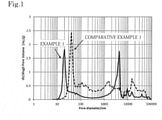
- Fig. 1 is a diagram showing the pore distribution of a zirconia-based composite oxide of each of Example 1 and Comparative Example 1.
- zirconia-based composite oxide contains zirconia as an essential component, and is a composite oxide with an oxide other than zirconia (other metal oxide).
- the application of the zirconia-based composite oxide according to the present embodiment is not particularly limited, but the zirconia-based composite oxide is useful as a catalyst carrier for exhaust gas purification.
- examples of a catalyst which can be supported include a noble metal catalyst.
- the zirconia-based composite oxide according to the present embodiment has a tap bulk density of 0.75 g/ml or more.
- the tap bulk density of 0.75 g/ml or more makes it possible to increase the amount of the catalyst carrier per unit volume while reducing a coating thickness when forming a slurry and applying the slurry to a honeycomb structure. As a result, the catalyst layer has sufficient exhaust gas purifying ability even if the catalyst layer is thin.
- the present inventors confirm that the amount of the catalyst carrier per unit volume in the catalyst layer after applying the slurry containing the zirconia-based composite oxide is proportional to the tap bulk density of the zirconia-based composite oxide.
- the tap bulk density is preferably 0.8 g/ml or more, more preferably 0.83 g/ml or more, still more preferably 0.85 g/ml or more, and particularly preferably 0.9 g/ml or more.
- the upper limit of the tap bulk density is not particularly limited, but is preferably 1.3 g/ml or less, more preferably 1.27 g/ml or less, still more preferably 1.25 g/ml or less, particularly preferably 1.2 g/ml or less, and especially preferably 1.15 g/ml.
- the zirconia-based composite oxide has a specific surface area of 45 m 2 /g or more after heat treatment at 1000°C for 3 hours.
- the zirconia-based composite oxide has a specific surface area of 45 m 2 /g or more after heat treatment at 1000°C for 3 hours, whereby the zirconia-based composite oxide can be said to have a high specific surface area even after heat treatment. That is, it is possible to suppress deterioration (aggregation and enlargement) in a noble metal supported on the zirconia-based composite oxide as the carrier. Therefore, the catalyst can be said to have high catalytic performance even after being exposed to a high temperature.
- the specific surface area after heat treatment at 1000°C for 3 hours is preferably 47 m 2 /g or more, more preferably 50 m 2 /g or more, and still more preferably 53 m 2 /g or more.
- the upper limit of the specific surface area after heat treatment at 1000°C for 3 hours is not particularly limited, but is preferably 100 m 2 /g or less, more preferably 95 m 2 /g or less, and still more preferably 90 m 2 /g or less.
- the specific surface area after heat treatment at 1000°C for 3 hours is generally lower than that before heat treatment.
- the zirconia-based composite oxide preferably has a specific surface area of 15 m 2 /g or more after heat treatment at 1100°C for 3 hours.
- the specific surface area after heat treatment at 1100°C for 3 hours is 15 m 2 /g or more, the catalyst can be said to have high catalyst performance even after being exposed to a higher temperature.
- the specific surface area after heat treatment at 1100°C for 3 hours is more preferably 17 m 2 /g or more, still more preferably 20 m 2 /g or more, and particularly preferably 23 m 2 /g or more.
- the upper limit of the specific surface area after heat treatment at 1100°C for 3 hours is not particularly limited, but is preferably 70 m 2 /g or less, more preferably 65 m 2 /g or less, and still more preferably 60 m 2 /g or less.
- the specific surface area after heat treatment at 1100°C for 3 hours is generally lower than that before heat treatment or after heat treatment at 1000°C for 3 hours.
- the zirconia-based composite oxide preferably has a specific surface area (initial specific surface area) of 45 m 2 /g or more and 150 m 2 /g or less.
- the specific surface area is 45 m 2 /g or more and 150 m 2 /g or less
- the zirconia-based composite oxide can be said to have a relatively high specific surface area in a state before heat treatment (before being exposed to a high temperature).
- the specific surface area (initial specific surface area) refers to a specific surface area in a state where heat treatment or pulverization treatment or the like is not performed after the zirconia-based composite oxide is manufactured.
- the specific surface area is preferably 45 m 2 /g or more, more preferably 50 m 2 /g or more, and still more preferably 55 m 2 /g or more.
- the upper limit of the specific surface area is not particularly limited, but is preferably 150 m 2 /g or less, more preferably 145 m 2 /g or less, still more preferably 140 m 2 /g or less, particularly preferably 135 m 2 /g or less, and especially preferably 130 m 2 /g or less.
- the specific surface area after heat treatment at 1000°C for 3 hours, the specific surface area after heat treatment at 1100°C for 3 hours, and the specific surface area (initial specific surface area) refer to values obtained by a method described in Examples.
- a ratio of a pore volume of pores having a diameter of 100 nm or more and 1000 nm or less to a total pore volume (hereinafter, also referred to as "pore volume ratio A”) is preferably 17% or less of the total pore volume.
- the tap bulk density of 0.75 g/ml or more and the specific surface area of 45 m 2 /g or more after heat treatment at 1000°C for 3 hours can be easily achieved. This is also clear from Examples.
- the pore volume ratio A is more preferably 15% or less, still more preferably 12% or less, and particularly preferably 10% or less.
- the lower limit of the pore volume ratio A is not particularly limited, but is preferably 0.1% or more, and more preferably 0.3% or more.
- the total pore volume is preferably 0.5 ml/g or more, more preferably 0.7 ml/g or more, and still more preferably 0.8 ml/g or more.
- the total pore volume is preferably 2.0 ml/g or less, more preferably 1.9 ml/g or less, and still more preferably 1.8 ml/g or less.
- the pore volume of the pores having a diameter of 100 nm or more and 1000 nm or less is preferably 0.01 ml/g or more, more preferably 0.02 ml/g or more, and still more preferably 0.03 ml/g or more.
- the pore volume of the pores having a diameter of 100 nm or more and 1000 nm or less is preferably 0.20 ml/g or less, more preferably 0.19 ml/g or less, and still more preferably 0.18 ml/g or less.
- the pore volume of pores having a diameter of 10 nm or more and less than 100 nm is preferably 0.20 ml/g or more, more preferably 0.25 ml/g or more, and still more preferably 0.30 ml/g or more.
- the specific surface area after heat treatment at 1000°C for 3 hours can be further increased.
- the pore volume of the pores having a diameter of 10 nm or more and less than 100 nm is preferably 1.00 ml/g or less, more preferably 0.95 ml/g or less, and still more preferably 0.90 ml/g or less.
- the particle size D 50 of the zirconia-based composite oxide is preferably 5 ⁇ m to 100 ⁇ m, more preferably 8 ⁇ m to 90 ⁇ m, and still more preferably 10 ⁇ m to 80 ⁇ m.
- the tap bulk density is likely to be increased. That is, when the particle size D 50 is too small, the tap bulk density tends to be low, but by relatively increasing the particle size D 50 (for example, 5 ⁇ m to 100 ⁇ m) as in the present embodiment, the tap bulk density is likely to be increased.
- the zirconia-based composite oxide As the particle size D 50 is smaller, the zirconia-based composite oxide is not likely to be densely packed. Rather, the zirconia-based composite oxide is porous, whereby the zirconia-based composite oxide has a light mass per unit volume, and does not have a true sphere shape. Therefore, the tap bulk density tends to be smaller as the particle size D 50 is smaller.
- the particle size D 50 refers to a particle size in a state where the zirconia-based composite oxide is manufactured, and then not pulverized or heat-treated.
- the above “pulverizing” refers to finely pulverizing, and pulverizing due to a general technique such as a planetary mill, a ball mill, or a jet mill.
- the particle size D 50 refers to a value obtained by a method described in Examples.
- the zirconia-based composite oxide contains zirconia.
- the content of the zirconia is preferably 30 mass% or more, more preferably 35 mass% or more, still more preferably 40 mass% or more, and particularly preferably 45 mass% or more, based on 100 mass% of the entire zirconia-based composite oxide.
- the upper limit of the content of the zirconia is not particularly limited, but the content of the zirconia is preferably 95 mass% or less, more preferably 92 mass% or less, still more preferably 90 mass% or less, and particularly preferably 85 mass% or less.
- the zirconia can be suitably used as the catalyst carrier.
- the zirconia-based composite oxide preferably contains oxides of one or more selected from rare earth elements.
- the rare earth elements refer to Sc, Y, La, Ce, Pr, Nd, Pm, Sm, Eu, Gd, Tb, Dy, Ho, Er, Tm, Yb, and Lu.
- the zirconia-based composite oxide does not contain Pm. That is, it is more preferable that the zirconia-based composite oxide contains oxides of one or more selected from rare earth elements other than Pm.
- the thermal stability of the specific surface area can be improved. That is, the amount of a change in the specific surface area can be reduced before and after being exposed to a high temperature, and as a result, the catalytic performance can be prevented from being significantly reduced.
- the rare earth elements Y (yttrium), La (lanthanum), Ce (cerium), Nd (neodymium), and Pr (praseodymium) are preferable.
- Y, La, and Ce are more preferable; La and Ce are still more preferable; and Ce is particularly preferable.
- the zirconia-based composite oxide preferably contains one or more oxides selected from the group consisting of lanthanum oxide, cerium oxide, neodymium oxide, praseodymium oxide, and yttrium oxide.
- the zirconia-based composite oxide can contain, in addition to zirconia and the oxides of the rare earth elements, oxides of one or more elements selected from the group consisting of
- the elements shown in A) to C) are referred to as "other elements" herein.
- the content of the oxides of the other elements may be 0.1 mass% or more in terms of oxide based on 100 mass% of the entire zirconia-based composite oxide.
- the upper limit of the content of the oxides of the other elements is not particularly limited, but may be 20 mass% or less, 10 mass% or less, 7 mass% or less, or 5 mass% or less or the like.
- transition metal examples include Ti, V, Cr, Mn, Fe, Co, Ni, Cu, Nb, Mo, Ta, and W.
- alkaline earth metal examples include Mg, Ca, Sr, and Ba.
- composition ratios of the zirconia-based composite oxide include combinations not exceeding 100% in total exemplified in the following (1) to (4).
- composition of the zirconia-based composite oxide is specified by a method described in Examples.
- the tap bulk density is 0.75 g/ml or more, and the specific surface area after heat treatment at 1000°C for 3 hours is 45 m 2 /g or more, whereby an amount of catalyst sufficiently functioning for exhaust gas treatment can be formed on the wall of the honeycomb structure even if the thickness of the catalyst layer is reduced.
- a pressure loss caused by the thickness of the catalyst layer can be reduced, whereby the fuel consumption of an automobile or the like can be improved.
- the amount of the catalyst that can be coated per unit volume increases, whereby oxygen storage capacity (OSC) per unit volume can be improved.
- the OSC per unit volume is improved, and as a result, the catalyst performance can be improved.
- the method for manufacturing a zirconia-based composite oxide of the present invention is not limited to the following exemplification.
- a sulfating agent is added to a zirconium salt solution having a temperature of 100°C or higher while the zirconium salt solution is stirred at stirring Reynolds number of 400 or more and 2000 or less (first-first step).
- the stirred solution is in a strict laminar flow state where a flow in a rotation direction is mainly generated.
- the stirring Reynolds number exceeds 10
- a discharge flow from a blade is gradually generated, whereby a circulating flow occurs in a tank.
- the stirring Reynolds number is 400 or more
- a turbulence flow starts to occur.
- the stirring Reynolds number of from several hundreds to several thousands is considered as a transition state, and is a state where a turbulence flow starts to be generated in the vicinity of the blade and a laminar flow remains in the vicinity of a tank wall and a tank bottom placed away from the blade.
- the first-first step is a step of controlling the formation/aggregation of primary particles, in other words, a step of controlling the volume of pores having a diameter of 10 to 100 nm. Therefore, the reaction conditions of the first step greatly affect the heat resistance for maintaining the specific surface area (specific surface area after heat treatment).
- the aggregation state of the primary particles is dominated by chemical factors such as a reaction temperature and physical factors such as a shear stress due to a turbulence flow.
- the aggregation state of the primary particles is controlled by controlling the temperature to 100°C or higher and the stirring Reynolds number to 400 or more and 2000 or less, and the volume of the pores having a diameter of 10 to 100 nm is controlled to fall within a suitable range (to be increased).
- the sulfating agent is added to the zirconium salt solution having a temperature of 100°C or higher while the zirconium salt solution is stirred at stirring Reynolds number of 400 or more and 2000 or less, which is turbulence flow, so that fine primary particles are likely to be generated.
- the stirring Reynolds number in the first-first step is preferably 500 or more, more preferably 600 or more, still more preferably 700 or more, and particularly preferably 800 or more.
- the stirring Reynolds number in the first-first step is preferably 1900 or less, more preferably 1800 or less, still more preferably 1700 or less, and particularly preferably 1600 or less.
- a temperature during stirring in the first-first step is preferably 105°C or higher, more preferably 110°C or higher, and still more preferably 115°C or higher.
- the temperature during stirring in the first-first step is preferably 200°C or lower, more preferably 195°C or lower, and still more preferably 190°C or lower.
- the zirconium salt solution and the sulfating agent usually react with each other at a temperature of 65°C or higher to form basic zirconium sulfate. Therefore, in the present embodiment, by setting the temperature during stirring in the first step to 100°C or higher, a sulfation reaction is appropriately accelerated, whereby fine primary particles are likely to be formed. When the temperature during stirring in the first step is too low, the sulfation reaction is delayed, whereby large aggregated particles tend to be easily formed.
- a pressure in the first-first step is not particularly limited, but is preferably 1.0 ⁇ 10 5 Pa or more, and more preferably 1.2 ⁇ 10 5 or more.
- the pressure is not particularly limited, but is preferably 1.5 ⁇ 10 6 Pa or less, and more preferably 1.4 ⁇ 10 6 Pa or less.
- the sulfating agent is preferably added at the same temperature as that of the zirconium salt solution.
- the zirconium salt solution reacts with the sulfating agent to form basic zirconium sulfate.
- the zirconium salt is only required to supply zirconium ions, and for example, zirconium oxynitrate, zirconium oxychloride, and zirconium nitrate and the like can be used. One or two or more thereof may be used. Among these, zirconium oxychloride is preferable in terms of its high productivity on an industrial scale.
- a solvent for forming a zirconium salt solution may be selected according to the type of the zirconium salt. Usually, water (pure water or ion-exchanged water, the same applies hereinafter) is preferable.
- the concentration of the zirconium salt solution is not particularly limited, but generally, 5 to 250 g (particularly, 20 to 150 g) of zirconium oxide (ZrO 2 ) is desirably contained in 1000 g of the solvent.
- the sulfating agent is not limited as long as the sulfating agent reacts with zirconium ions to form a sulfate (that is, a sulfating reagent), and examples thereof include sodium sulfate, potassium sulfate, and ammonium sulfate.
- the sulfating agent may be in any form such as a powder or solution form, but a solution (particularly, an aqueous solution) is preferable. The concentration of the solution to be used can be appropriately set.
- the sulfating agent is preferably added so that the weight ratio of sulfate radical (SO 4 2- ) to ZrO 2 is 0.3 to 0.6.
- the free acid concentration of a mixed solution is preferably 0.2 to 2.2 N (normal).
- Examples of the free acid include sulfuric acid, nitric acid, and hydrochloric acid.
- the type of the free acid is not limited, but hydrochloric acid is preferable in terms of its high productivity on an industrial scale.
- the reaction liquid is preferably held for 10 to 60 minutes to age the formed basic zirconium sulfate (first-second step).
- the basic zirconium sulfate is not limited, and examples thereof include hydrates of compounds such as ZrOSO 4 ⁇ ZrO 2 , 5ZrO 2 ⁇ 3SO 3 , and 7ZrO 2 ⁇ 3SO 3 .
- the basic zirconium sulfate may be one or a mixture of two or more thereof.
- step of holding the reaction liquid for 10 to 60 minutes it is preferable to continue the stirring in the first-first step as it is.
- reaction liquid is cooled to 60°C or lower (first-third step).
- the cooling is preferably 50°C or lower, and more preferably 40°C or lower.
- the lower limit temperature for the cooling is not particularly limited, but is preferably a temperature at which the reaction liquid is not frozen, and examples thereof include 10°C or higher and 20°C or higher.
- the cooling rate does not need to be particularly controlled, and may be natural cooling. However, when the scale is large, it takes time to perform natural cooling, whereby the cooling may be performed using a heat exchanger or the like. In this case, the cooling rate may be appropriately set within a range of, for example, 0.1°C/min or more and 20°C/min or less.
- the first step has been described above.
- the cooled solution obtained in the first step is heated to a temperature of 100°C or higher while being stirred at stirring Reynolds number of 10 or more and 350 or less (second-first step).
- the second-first step is a step of further controlling the aggregation state of the basic zirconium sulfate slurry obtained in the first step.
- the stirring is performed with a laminar flow having stirring Reynolds number of 10 or more and 350 or less to control the size of secondary or higher-order particles, and the volume of the pores having a diameter of 100 nm or more is controlled to fall within a suitable range (to be reduced).
- the solution in order to accelerate the aggregation of the particles, the solution is heated to a temperature of 100°C or higher while being stirred at stirring Reynolds number of 10 or more and 350 or less so that only a laminar flow occurs without generating a turbulence flow.
- a heating rate is not particularly limited, but may be appropriately set in a range of 0.1°C/min or more and 10°C/min or less.
- the stirring Reynolds number in the second-first step is 10 or more, preferably 20 or more, more preferably 50 or more, and still more preferably 100 or more.
- the stirring Reynolds number in the second-first step is 350 or less, preferably 300 or less, more preferably 250 or less, and still more preferably 220 or less.
- the stirring is performed at stirring Reynolds number of 10 or more and 350 or less to generate a laminar flow in a reaction tank, whereby the aggregation can be accelerated in the sulfation reaction.
- the volume of the pores having a diameter of 100 nm or more can be reduced to provide a powder having a high tap bulk density.
- a heating temperature in the second-first step is preferably 105°C or higher, more preferably 110°C or higher, and still more preferably 115°C or higher.
- a temperature during stirring in the second-first step is preferably 180°C or lower, more preferably 175°C or lower, and still more preferably 170°C or lower.
- a pressure in the second-first step is not particularly limited, but is preferably 1.0 ⁇ 10 5 Pa or more, and more preferably 1.2 ⁇ 10 5 or more.
- the pressure is not particularly limited, but is preferably 1.5 ⁇ 10 6 Pa or less, and more preferably 1.4 ⁇ 10 6 Pa or less.
- reaction liquid is preferably held for 10 to 60 minutes to age the formed basic zirconium sulfate (second-second step).
- step of holding the reaction liquid for 10 to 60 minutes it is preferable to continue the stirring in the second-first step as it is.
- reaction liquid is cooled to 50°C or lower (second-third step).
- second-third step a basic zirconium sulfate slurry is obtained.
- the cooling may be performed in the same manner as in the first-second step.
- the second step has been described above.
- the zirconia-based composite oxide contains oxides of one or more selected from the group consisting of rare earth elements and other elements
- salt solutions or compounds of one or two or more metals selected from the group consisting of rare earth elements and other elements are added in predetermined amounts to the basic zirconium sulfate-containing slurry after the second step before a neutralization step to be described later.
- the first step and the second step are preferably performed in an autoclave in which a temperature and a pressure are easily managed.
- zirconium hydroxide is formed by neutralizing the basic zirconium sulfate.
- zirconium hydroxide is formed by neutralizing the basic zirconium sulfate with an alkali.
- the alkali is not limited, and for example, ammonium hydroxide, ammonium bicarbonate, sodium hydroxide, and potassium hydroxide and the like can be used. Among these, sodium hydroxide is preferable from the viewpoint of industrial cost.
- the amount of the alkali added is not particularly limited as long as zirconium hydroxide can be formed as a precipitate from a basic zirconium sulfate solution.
- the alkali is added so that the pH of the solution is 11 or more, and preferably 12 or more.
- the zirconium hydroxide-containing solution is preferably held at 35 to 60°C for 1 hour or more. As a result, the formed precipitate is aged while also facilitating filtration.
- the zirconium hydroxide is recovered by a solid-liquid separation method.
- filtration, centrifugation, and decantation and the like can be used.
- the zirconium hydroxide is preferably washed with water to remove adhered impurities.
- the zirconium hydroxide may be dried by natural drying or heat drying.
- the zirconium hydroxide is subjected to heat treatment (fired) to obtain a zirconia-based composite oxide.
- the heat treatment temperature is not particularly limited, but the zirconium hydroxide is preferably subjected to heat treatment at about 400 to 900°C for about 1 to 5 hours.
- the heat treatment atmosphere is preferably air or an oxidizing atmosphere.
- the obtained zirconia-based composite oxide may be subjected to treatment for disaggregating for the purpose of improving handleability, if necessary.
- a zirconia-based composite oxide obtained in each of Examples and Comparative Examples contains 1.3 to 2.5 mass% of hafnium oxide as an unavoidable impurity with respect to zirconium oxide (calculated by the following formula (X)). Mass of Hafnium Oxide / Mass of Zirconium Oxide + Mass of Hafnium Oxide ⁇ 100 %
- zirconium oxychloride-octahydrate 144 g (55 g in terms of ZrO 2 ) of zirconium oxychloride-octahydrate was dissolved in ion-exchanged water, and an acid concentration and a ZrO 2 concentration were then respectively adjusted to 0.67 N and 4 w/v% (mass-volume percent concentration) by 35 mass% hydrochloric acid and ion-exchanged water to obtain a zirconium salt solution.
- the obtained zirconium salt solution was placed in an autoclave, and heated to 120°C with stirring so that stirring Reynolds number was set to 1000. During this time, a pressure was maintained at 2 ⁇ 10 5 Pa. A temperature at the start of temperature rise was room temperature (25°C), and a time from the start of temperature rise until the temperature reached 120°C was 1.5 hours.
- stirring conditions were changed so that stirring Reynolds number was set to 200, and the temperature was risen to 120°C with stirring. During this time, a pressure was maintained at 2 ⁇ 10 5 Pa. A time from the start of temperature rise until the temperature reached 120°C was 1.5 hours.
- the obtained hydroxide precipitate was filtered, and sufficiently washed with water.
- the obtained hydroxide was dried at 105°C for 24 hours.
- the dried hydroxide was subjected to heat treatment (fired) at 600°C in air for 5 hours.
- the obtained fired product was loosened with a hammer type head (MF 10.2 hammer type head manufactured by IKA) to obtain a zirconia-based composite oxide according to Example 1.
- a zirconia-based composite oxide according to Example 2 was obtained in the same manner as in Example 1 except that a stirring condition in a second step was changed to stirring Reynolds number of 100.
- zirconium oxychloride-octahydrate 155 g (60 g in terms of ZrO 2 ) of zirconium oxychloride-octahydrate was dissolved in ion-exchanged water, and an acid concentration and a ZrO 2 concentration were then respectively adjusted to 0.67 N and 4 w/v% (mass-volume percent concentration) by 35 mass% hydrochloric acid and ion-exchanged water to obtain a zirconium salt solution.
- the obtained zirconium salt solution was placed in an autoclave, and heated to 120°C with stirring so that stirring Reynolds number was set to 1000. During this time, a pressure was maintained at 2 ⁇ 10 5 Pa. A temperature at the start of temperature rise was room temperature (25°C), and a time from the start of temperature rise until the temperature reached 120°C was 1.5 hours.
- stirring conditions were changed so that stirring Reynolds number was set to 200, and the temperature was risen to 120°C with stirring. During this time, a pressure was maintained at 2 ⁇ 10 5 Pa. A time from the start of temperature rise until the temperature reached 120°C was 1.5 hours.
- the obtained hydroxide precipitate was filtered, and sufficiently washed with water.
- the obtained hydroxide was dried at 105°C for 24 hours.
- the dried hydroxide was subjected to heat treatment (fired) at 500°C in air for 5 hours.
- the obtained fired product was loosened with a hammer type head (MF 10.2 hammer type head manufactured by IKA) to obtain a zirconia-based composite oxide according to Example 3.
- zirconium oxychloride-octahydrate 126 g (48 g in terms of ZrO 2 ) was dissolved in ion-exchanged water, and an acid concentration and a ZrO 2 concentration were then respectively adjusted to 0.67 N and 4 w/v% (mass-volume percent concentration) by 35 mass% hydrochloric acid and ion-exchanged water to obtain a zirconium salt solution.
- the obtained zirconium salt solution was placed in an autoclave, and heated to 120°C with stirring so that stirring Reynolds number was set to 1500. During this time, a pressure was maintained at 2 ⁇ 10 5 Pa. A temperature at the start of temperature rise was room temperature (25°C), and a time from the start of temperature rise until the temperature reached 120°C was 1.5 hours.
- stirring conditions were changed so that stirring Reynolds number was set to 200, and the temperature was risen to 120°C with stirring. During this time, a pressure was maintained at 2 ⁇ 10 5 Pa. A time from the start of temperature rise until the temperature reached 120°C was 1.5 hours.
- the obtained hydroxide precipitate was filtered, and sufficiently washed with water.
- the obtained hydroxide was dried at 105°C for 24 hours.
- the dried hydroxide was subjected to heat treatment (fired) at 600°C in air for 5 hours.
- the obtained fired product was loosened with a hammer type head (MF 10.2 hammer type head manufactured by IKA) to obtain a zirconia-based composite oxide according to Example 4.
- the obtained zirconium salt solution was placed in an autoclave, and heated to 120°C with stirring so that stirring Reynolds number was set to 1000. During this time, a pressure was maintained at 2 ⁇ 10 5 Pa. A temperature at the start of temperature rise was room temperature (25°C), and a time from the start of temperature rise until the temperature reached 120°C was 1.5 hours.
- the obtained hydroxide precipitate was filtered, and sufficiently washed with water.
- the obtained hydroxide was dried at 105°C for 24 hours.
- the dried hydroxide was subjected to heat treatment (fired) at 500°C in air for 5 hours.
- the obtained fired product was loosened with a hammer type head (MF 10.2 hammer type head manufactured by IKA) to obtain a zirconia-based composite oxide according to Example 5.
- zirconium oxychloride-octahydrate 84 g (32 g in terms of ZrO 2 ) of zirconium oxychloride-octahydrate was dissolved in ion-exchanged water, and an acid concentration and a ZrO 2 concentration were then respectively adjusted to 0.67 N and 4 w/v% (mass-volume percent concentration) by 35 mass% hydrochloric acid and ion-exchanged water to obtain a zirconium salt solution.
- the obtained zirconium salt solution was placed in an autoclave, and heated to 120°C with stirring so that stirring Reynolds number was set to 500. During this time, a pressure was maintained at 2 ⁇ 10 5 Pa. A temperature at the start of temperature rise was room temperature (25°C), and a time from the start of temperature rise until the temperature reached 120°C was 1.5 hours.
- stirring conditions were changed so that stirring Reynolds number was set to 200, and the temperature was risen to 120°C with stirring. During this time, a pressure was maintained at 2 ⁇ 10 5 Pa. A time from the start of temperature rise until the temperature reached 120°C was 1.5 hours.
- the obtained hydroxide precipitate was filtered, and sufficiently washed with water.
- the obtained hydroxide was dried at 105°C for 24 hours.
- the dried hydroxide was subjected to heat treatment (fired) at 500°C in air for 5 hours.
- the obtained fired product was loosened with a hammer type head (MF 10.2 hammer type head manufactured by IKA) to obtain a zirconia-based composite oxide according to Example 6.
- a zirconia-based composite oxide according to Example 7 was obtained in the same manner as in Example 1 except that a temperature risen in a first step was changed to 150°C.
- a zirconia-based composite oxide according to Example 8 was obtained in the same manner as in Example 1 except that a temperature risen in a second step was changed to 150°C.
- zirconium oxychloride-octahydrate 145 g (56 g in terms of ZrO 2 ) of zirconium oxychloride-octahydrate was dissolved in ion-exchanged water, and an acid concentration and a ZrO 2 concentration were then respectively adjusted to 0.67 N and 4 w/v% (mass-volume percent concentration) by 35 mass% hydrochloric acid and ion-exchanged water to obtain a zirconium salt solution.
- the obtained zirconium salt solution was placed in an autoclave, and heated to 120°C with stirring so that stirring Reynolds number was set to 1000. During this time, a pressure was maintained at 2 ⁇ 10 5 Pa. A temperature at the start of temperature rise was room temperature (25°C), and a time from the start of temperature rise until the temperature reached 120°C was 1.5 hours.
- the obtained hydroxide precipitate was filtered, and sufficiently washed with water.
- the obtained hydroxide was dried at 105°C for 24 hours.
- the dried hydroxide was subjected to heat treatment (fired) at 600°C in air for 5 hours.
- the obtained fired product was loosened with a hammer type head (MF 10.2 hammer type head manufactured by IKA) to obtain a zirconia-based composite oxide according to Comparative Example 1.
- a zirconia-based composite oxide according to Comparative Example 2 was obtained in the same manner as in Example 3 except that a second step was not performed.
- a zirconia-based composite oxide according to Comparative Example 3 was obtained in the same manner as in Example 4 except that a second step was not performed.
- a zirconia-based composite oxide according to Comparative Example 4 was obtained in the same manner as in Example 1 except that a stirring condition in a second step was changed to stirring Reynolds number of 1000.
- a zirconia-based composite oxide according to Comparative Example 5 was obtained in the same manner as in Example 1 except that a temperature risen in a first step was changed to 80°C.
- a zirconia-based composite oxide according to Comparative Example 6 was obtained in the same manner as in Example 1 except that a temperature risen in a second step was changed to 80°C.
- a first step was performed in the same manner as in Example 1 except that a stirring condition in the first step was changed to stirring Reynolds number of 200, but a uniform slurry was not obtained, and a desired product was not obtained.
- composition (in terms of oxide) of the zirconia-based composite oxide of each of Examples and Comparative Examples was analyzed using ICP-AES ("ULTIMA-2" manufactured by HORIBA LTD.). The results are shown in Tables 1 and 2.
- the pore distribution of the zirconia-based composite oxide of each of Examples and Comparative Examples was obtained by a mercury intrusion method using a pore distribution measuring device ("Autopore IV9500" manufactured by Micromeritics). The measurement conditions were as follows.
- the total pore volume, the pore volume of pores having a diameter of 10 nm or more and less than 100 nm, and the pore volume of pores having a diameter of 100 nm or more and 1000 nm or less were determined.
- the results are shown in Tables 1 and 2.
- Tables 1 and 2 also showed the ratio of the pore volume of the pores having a diameter of 100 nm or more and 1000 nm or less to a total pore volume (pore volume ratio).
- Pore volume ratio pore volume of pores having diameter of 100 nm or more and 1000 nm or less / total pore volume ⁇ 100 %
- TAPDENSER KYT-3000 manufactured by Seishin Enterprise Co., Ltd.
- 15 g of a sample powder was filled in a tapping cell, and the height of a spacer was then set to 3 cm.
- the tapping cell was set on a tapping table, and tapping was performed 800 times with the measuring device. After the completion of the tapping, the scale of the cell was read, and [(powder weight)/(volume)] was calculated to obtain the tap bulk density. More detailed measurement conditions were as follows. The results are shown in Tables 1 and 2.
- the zirconia-based composite oxide of each of Examples and Comparative Examples was heat-treated at 1000°C for 3 hours under atmospheric pressure (0.1013 MPa).
- the specific surface area of the zirconia-based composite oxide after heat treatment at 1000°C for 3 hours was measured in the same manner as in "Measurement of Specific Surface Area before Heat Treatment". The results are shown in Tables 1 and 2.
- the zirconia-based composite oxide of each of Examples and Comparative Examples was heat-treated at 1100°C for 3 hours under atmospheric pressure (0.1013 MPa).
- the specific surface area of the zirconia-based composite oxide after heat treatment at 1100°C for 3 hours was measured in the same manner as in "Measurement of Specific Surface Area before Heat Treatment". The results are shown in Tables 1 and 2.
- Example 1 Example 2 Example 3
- Example 4 Example 5
- Example 6 Example 7
- Example 8 Composition ZrO 2 (Mass%) 55 55 60 48 80 32 55 55 CeO 2 (Mass%) 40 40 25 48 - 50
- 40 40 La 2 O 3 (Mass%) 5 5 5 4 - 6 5 5 Y 2 O 3 (Mass%) - - 10 - - 12 - - Nd 2 O 3 (Mass%) - - - - 10 - - - Pr 6 O 11 (Mass%) - - - - 10 - - - - Pore Volume Total Pore Volume (ml/g) 1.00 0.97 1.09 1.07 0.99 1.05 1.01 0.98 10-100 nm (ml/g) 0.42 0.47 0.52 0.56 0.51 0.48 0.45 0.40 100-1000 nm (ml/g) 0.09 0.05 0.08 0.09 0.08 0.07 0.09 0.06 Volume Ratio of Pores of 100-1000 nm (%) 9 5 7 9 8 7 9 6 Particle Size D
Landscapes
- Chemical & Material Sciences (AREA)
- Engineering & Computer Science (AREA)
- Organic Chemistry (AREA)
- Materials Engineering (AREA)
- Ceramic Engineering (AREA)
- Chemical Kinetics & Catalysis (AREA)
- Manufacturing & Machinery (AREA)
- Structural Engineering (AREA)
- Composite Materials (AREA)
- Inorganic Chemistry (AREA)
- Inorganic Compounds Of Heavy Metals (AREA)
- Catalysts (AREA)
Applications Claiming Priority (2)
| Application Number | Priority Date | Filing Date | Title |
|---|---|---|---|
| JP2019140119 | 2019-07-30 | ||
| PCT/JP2020/027337 WO2021020104A1 (fr) | 2019-07-30 | 2020-07-14 | Oxyde composite à base de zircone et méthode de fabrication d'oxyde composite à base de zircone |
Publications (2)
| Publication Number | Publication Date |
|---|---|
| EP3950596A1 true EP3950596A1 (fr) | 2022-02-09 |
| EP3950596A4 EP3950596A4 (fr) | 2023-02-01 |
Family
ID=74229895
Family Applications (1)
| Application Number | Title | Priority Date | Filing Date |
|---|---|---|---|
| EP20846819.9A Pending EP3950596A4 (fr) | 2019-07-30 | 2020-07-14 | Oxyde composite à base de zircone et méthode de fabrication d'oxyde composite à base de zircone |
Country Status (4)
| Country | Link |
|---|---|
| EP (1) | EP3950596A4 (fr) |
| JP (2) | JP7451533B2 (fr) |
| CN (1) | CN114127030B (fr) |
| WO (1) | WO2021020104A1 (fr) |
Cited By (2)
| Publication number | Priority date | Publication date | Assignee | Title |
|---|---|---|---|---|
| US11958039B2 (en) | 2021-08-12 | 2024-04-16 | Daiichi Kigenso Kagaku Kogyo Co., Ltd. | Zirconia-based porous body and method for manufacturing zirconia-based porous body |
| EP4378895A4 (fr) * | 2021-07-28 | 2025-07-30 | Daiichi Kigenso Kagaku Kogyo | Oxyde composite de zirconium et procédé de production d'oxyde composite de zirconium |
Families Citing this family (4)
| Publication number | Priority date | Publication date | Assignee | Title |
|---|---|---|---|---|
| JP7203180B1 (ja) * | 2021-11-01 | 2023-01-12 | 第一稀元素化学工業株式会社 | 水酸化ジルコニウム粉末、及び、水酸化ジルコニウム粉末の製造方法 |
| JP7162716B1 (ja) * | 2021-11-01 | 2022-10-28 | 第一稀元素化学工業株式会社 | 水酸化ジルコニウム粉末 |
| JP7137035B1 (ja) | 2022-03-25 | 2022-09-13 | 第一稀元素化学工業株式会社 | ジルコニア系粉末材料 |
| JP7178526B1 (ja) | 2022-06-06 | 2022-11-25 | 第一稀元素化学工業株式会社 | 多孔質ジルコニア系複合酸化物、及び、多孔質ジルコニア系複合酸化物の製造方法 |
Family Cites Families (25)
| Publication number | Priority date | Publication date | Assignee | Title |
|---|---|---|---|---|
| US3963508A (en) * | 1974-11-18 | 1976-06-15 | Kaiser Aluminum & Chemical Corporation | Calcium aluminate cement |
| JPS59111922A (ja) * | 1982-12-14 | 1984-06-28 | Dowa Chem Kk | 酸化ジルコニウム微粉末の製造法 |
| US4631267A (en) * | 1985-03-18 | 1986-12-23 | Corning Glass Works | Method of producing high-strength high surface area catalyst supports |
| US4952389A (en) * | 1989-09-15 | 1990-08-28 | Norton Company | Alumina particles |
| JPH06293554A (ja) * | 1993-04-02 | 1994-10-21 | Hitachi Ltd | セラミックス焼結体の製法 |
| FR2736343B1 (fr) * | 1995-07-03 | 1997-09-19 | Rhone Poulenc Chimie | Composition a base d'oxyde de zirconium et d'oxyde de cerium, procede de preparation et utilisation |
| JP4053623B2 (ja) * | 1996-12-27 | 2008-02-27 | 阿南化成株式会社 | ジルコニウム−セリウム系複合酸化物及びその製造方法 |
| FR2841547B1 (fr) * | 2002-06-26 | 2005-05-06 | Rhodia Elect & Catalysis | Composition a base d'oxyde de zirconium et d'oxydes de cerium, de lanthane et d'une autre terre rare, son procede de preparation et son utilisation comme catalyseur |
| JP4660135B2 (ja) | 2004-07-26 | 2011-03-30 | 第一稀元素化学工業株式会社 | ジルコニア系多孔質体及びその製造方法 |
| EP1894620B2 (fr) * | 2006-08-22 | 2023-06-07 | Daiichi Kigenso Kagaku Kogyo Co., Ltd. | Procédé de production d'une poudre de zircone poreuse |
| JP5063252B2 (ja) | 2006-08-22 | 2012-10-31 | 第一稀元素化学工業株式会社 | 多孔質ジルコニア系粉末及びその製造方法 |
| JP5075043B2 (ja) * | 2007-08-08 | 2012-11-14 | トヨタ自動車株式会社 | 触媒担体の製造方法 |
| JP5356665B2 (ja) * | 2007-08-27 | 2013-12-04 | 東ソー株式会社 | ジルコニア焼結体 |
| JP5164665B2 (ja) * | 2008-04-09 | 2013-03-21 | 第一稀元素化学工業株式会社 | セリウム−ジルコニウム系複合酸化物及びその製造方法 |
| JP5638746B2 (ja) * | 2008-08-20 | 2014-12-10 | 堺化学工業株式会社 | 有機物を熱分解するための触媒と方法と、そのような触媒を製造する方法 |
| CN102471089B (zh) * | 2009-08-24 | 2015-02-25 | 国立大学法人北海道大学 | 金属氧化物粒子的制造方法和制造装置 |
| JP5547539B2 (ja) * | 2010-04-13 | 2014-07-16 | 株式会社豊田中央研究所 | セリア−ジルコニア系複合酸化物及びその製造方法、並びにそのセリア−ジルコニア系複合酸化物を用いた排ガス浄化用触媒 |
| FI123812B (fi) * | 2012-02-17 | 2013-11-15 | Ecocat Oy | Pinnoite typen oksidien pelkistämiseksi |
| CN103191712B (zh) * | 2013-04-03 | 2014-12-31 | 潮州三环(集团)股份有限公司 | 一种具有良好抗老化性能、高还原活性的氧化铈氧化锆基复合稀土氧化物及其制备方法 |
| JP5706546B1 (ja) * | 2013-06-04 | 2015-04-22 | 新日本電工株式会社 | セリア−ジルコニア系複合酸化物及びその製造方法 |
| JP5744274B1 (ja) | 2014-03-28 | 2015-07-08 | 第一稀元素化学工業株式会社 | ジルコニア系多孔質体及びその製造方法 |
| GB201518996D0 (en) | 2015-10-27 | 2015-12-09 | Magnesium Elektron Ltd | Zirconia-based compositions for use as three-way catalysts |
| EP3266519B1 (fr) * | 2016-06-16 | 2025-11-12 | Pacific Industrial Development Corporation | Matériau de support de catalyseur à base de oxyde de cérium-zircone-alumine dopée avec capacité de stockage d'oxygène (osc) et revêtement de celui-ci |
| US11583831B2 (en) | 2016-12-23 | 2023-02-21 | Rhodia Operations | Mixed cerium- and zirconium-based oxide |
| CN107321982B (zh) * | 2017-06-22 | 2019-10-18 | 华南理工大学 | 一种基于数值优化的多孔金属纤维烧结板制备方法 |
-
2020
- 2020-07-14 CN CN202080051440.3A patent/CN114127030B/zh active Active
- 2020-07-14 EP EP20846819.9A patent/EP3950596A4/fr active Pending
- 2020-07-14 JP JP2021536905A patent/JP7451533B2/ja active Active
- 2020-07-14 WO PCT/JP2020/027337 patent/WO2021020104A1/fr not_active Ceased
-
2023
- 2023-12-11 JP JP2023208226A patent/JP2024023614A/ja not_active Withdrawn
Cited By (2)
| Publication number | Priority date | Publication date | Assignee | Title |
|---|---|---|---|---|
| EP4378895A4 (fr) * | 2021-07-28 | 2025-07-30 | Daiichi Kigenso Kagaku Kogyo | Oxyde composite de zirconium et procédé de production d'oxyde composite de zirconium |
| US11958039B2 (en) | 2021-08-12 | 2024-04-16 | Daiichi Kigenso Kagaku Kogyo Co., Ltd. | Zirconia-based porous body and method for manufacturing zirconia-based porous body |
Also Published As
| Publication number | Publication date |
|---|---|
| JP7451533B2 (ja) | 2024-03-18 |
| CN114127030B (zh) | 2024-01-30 |
| US20220177372A1 (en) | 2022-06-09 |
| EP3950596A4 (fr) | 2023-02-01 |
| JP2024023614A (ja) | 2024-02-21 |
| CN114127030A (zh) | 2022-03-01 |
| JPWO2021020104A1 (ja) | 2021-12-02 |
| WO2021020104A1 (fr) | 2021-02-04 |
Similar Documents
| Publication | Publication Date | Title |
|---|---|---|
| EP3950596A1 (fr) | Oxyde composite à base de zircone et méthode de fabrication d'oxyde composite à base de zircone | |
| EP3885317B1 (fr) | Corps poreux à base de zircone | |
| EP1921044B1 (fr) | Oxyde mixte à base de zirconium-cérium-yttrium et son procédé de fabrication | |
| EP1801074A1 (fr) | Oxyde composite a base de cerium-zirconium, procede de production de celui-ci, materiau de stockage/liberation d'oxygene utilisant ledit oxyde composite a base de cerium-zirconium, catalyseur de purification de gaz d'echappement, et procede de purification de gaz d'echappement | |
| CN109641758B (zh) | 氧化铝系复合氧化物及其制造方法 | |
| KR20120029475A (ko) | 비다공도를 갖는, 산화세륨 및 산화지르코늄을 포함하는 조성물, 그의 제조 방법 및 촉매작용에서의 그의 용도 | |
| US11958039B2 (en) | Zirconia-based porous body and method for manufacturing zirconia-based porous body | |
| EP3581268A1 (fr) | Composition de catalyseur d'épuration de gaz d'échappement, son procédé de fabrication, et catalyseur d'épuration de gaz d'échappement pour automobiles | |
| EP4484379A1 (fr) | Oxyde composite poreux à base de zircone et procédé de fabrication d'oxyde composite poreux à base de zircone | |
| JP6325010B2 (ja) | アルミナ系複合酸化物及びその製造方法 | |
| US12617726B2 (en) | Zirconia-based composite oxide and method for manufacturing zirconia-based composite oxide | |
| EP2827983A1 (fr) | Catalyseur de purification de gaz d'échappement | |
| EP3530351B1 (fr) | Catalyseur de purification de gaz d'échappement et procédé de purification de gaz d'échappement | |
| JP4928931B2 (ja) | セリア−ジルコニア系複合酸化物及びその製造方法 | |
| EP4378895A1 (fr) | Oxyde composite de zirconium et procédé de production d'oxyde composite de zirconium | |
| CN121155564A (zh) | 一种具有高活性的铈锆复合氧化物及其制备方法和催化应用 |
Legal Events
| Date | Code | Title | Description |
|---|---|---|---|
| STAA | Information on the status of an ep patent application or granted ep patent |
Free format text: STATUS: THE INTERNATIONAL PUBLICATION HAS BEEN MADE |
|
| PUAI | Public reference made under article 153(3) epc to a published international application that has entered the european phase |
Free format text: ORIGINAL CODE: 0009012 |
|
| STAA | Information on the status of an ep patent application or granted ep patent |
Free format text: STATUS: REQUEST FOR EXAMINATION WAS MADE |
|
| 17P | Request for examination filed |
Effective date: 20211105 |
|
| AK | Designated contracting states |
Kind code of ref document: A1 Designated state(s): AL AT BE BG CH CY CZ DE DK EE ES FI FR GB GR HR HU IE IS IT LI LT LU LV MC MK MT NL NO PL PT RO RS SE SI SK SM TR |
|
| DAV | Request for validation of the european patent (deleted) | ||
| DAX | Request for extension of the european patent (deleted) | ||
| A4 | Supplementary search report drawn up and despatched |
Effective date: 20230105 |
|
| RIC1 | Information provided on ipc code assigned before grant |
Ipc: B01J 35/10 20060101ALI20221223BHEP Ipc: B01J 35/02 20060101ALI20221223BHEP Ipc: B01J 23/10 20060101ALI20221223BHEP Ipc: C04B 35/50 20060101ALI20221223BHEP Ipc: C04B 35/488 20060101ALI20221223BHEP Ipc: B01J 32/00 20060101ALI20221223BHEP Ipc: B01J 21/06 20060101ALI20221223BHEP Ipc: C01G 25/00 20060101AFI20221223BHEP |
|
| TPAC | Observations filed by third parties |
Free format text: ORIGINAL CODE: EPIDOSNTIPA |