EP3955498A1 - Verfahren zur übertragung von steuerinformationen, neuübertragungsverfahren und -vorrichtung, endgerät und speichermedium - Google Patents
Verfahren zur übertragung von steuerinformationen, neuübertragungsverfahren und -vorrichtung, endgerät und speichermedium Download PDFInfo
- Publication number
- EP3955498A1 EP3955498A1 EP19924865.9A EP19924865A EP3955498A1 EP 3955498 A1 EP3955498 A1 EP 3955498A1 EP 19924865 A EP19924865 A EP 19924865A EP 3955498 A1 EP3955498 A1 EP 3955498A1
- Authority
- EP
- European Patent Office
- Prior art keywords
- control information
- terminal
- uplink data
- resource position
- designated
- Prior art date
- Legal status (The legal status is an assumption and is not a legal conclusion. Google has not performed a legal analysis and makes no representation as to the accuracy of the status listed.)
- Granted
Links
Images


Classifications
-
- H—ELECTRICITY
- H04—ELECTRIC COMMUNICATION TECHNIQUE
- H04W—WIRELESS COMMUNICATION NETWORKS
- H04W72/00—Local resource management
- H04W72/50—Allocation or scheduling criteria for wireless resources
- H04W72/54—Allocation or scheduling criteria for wireless resources based on quality criteria
-
- H—ELECTRICITY
- H04—ELECTRIC COMMUNICATION TECHNIQUE
- H04L—TRANSMISSION OF DIGITAL INFORMATION, e.g. TELEGRAPHIC COMMUNICATION
- H04L5/00—Arrangements affording multiple use of the transmission path
- H04L5/003—Arrangements for allocating sub-channels of the transmission path
- H04L5/0053—Allocation of signalling, i.e. of overhead other than pilot signals
- H04L5/0055—Physical resource allocation for ACK/NACK
-
- H—ELECTRICITY
- H04—ELECTRIC COMMUNICATION TECHNIQUE
- H04L—TRANSMISSION OF DIGITAL INFORMATION, e.g. TELEGRAPHIC COMMUNICATION
- H04L1/00—Arrangements for detecting or preventing errors in the information received
- H04L1/08—Arrangements for detecting or preventing errors in the information received by repeating transmission, e.g. Verdan system
-
- H—ELECTRICITY
- H04—ELECTRIC COMMUNICATION TECHNIQUE
- H04L—TRANSMISSION OF DIGITAL INFORMATION, e.g. TELEGRAPHIC COMMUNICATION
- H04L1/00—Arrangements for detecting or preventing errors in the information received
- H04L1/12—Arrangements for detecting or preventing errors in the information received by using return channel
- H04L1/16—Arrangements for detecting or preventing errors in the information received by using return channel in which the return channel carries supervisory signals, e.g. repetition request signals
- H04L1/1607—Details of the supervisory signal
- H04L1/1671—Details of the supervisory signal the supervisory signal being transmitted together with control information
-
- H—ELECTRICITY
- H04—ELECTRIC COMMUNICATION TECHNIQUE
- H04L—TRANSMISSION OF DIGITAL INFORMATION, e.g. TELEGRAPHIC COMMUNICATION
- H04L1/00—Arrangements for detecting or preventing errors in the information received
- H04L1/12—Arrangements for detecting or preventing errors in the information received by using return channel
- H04L1/16—Arrangements for detecting or preventing errors in the information received by using return channel in which the return channel carries supervisory signals, e.g. repetition request signals
- H04L1/18—Automatic repetition systems, e.g. Van Duuren systems
- H04L1/1829—Arrangements specially adapted for the receiver end
- H04L1/1854—Scheduling and prioritising arrangements
-
- H—ELECTRICITY
- H04—ELECTRIC COMMUNICATION TECHNIQUE
- H04L—TRANSMISSION OF DIGITAL INFORMATION, e.g. TELEGRAPHIC COMMUNICATION
- H04L1/00—Arrangements for detecting or preventing errors in the information received
- H04L1/12—Arrangements for detecting or preventing errors in the information received by using return channel
- H04L1/16—Arrangements for detecting or preventing errors in the information received by using return channel in which the return channel carries supervisory signals, e.g. repetition request signals
- H04L1/18—Automatic repetition systems, e.g. Van Duuren systems
- H04L1/1829—Arrangements specially adapted for the receiver end
- H04L1/1864—ARQ related signaling
-
- H—ELECTRICITY
- H04—ELECTRIC COMMUNICATION TECHNIQUE
- H04L—TRANSMISSION OF DIGITAL INFORMATION, e.g. TELEGRAPHIC COMMUNICATION
- H04L5/00—Arrangements affording multiple use of the transmission path
- H04L5/003—Arrangements for allocating sub-channels of the transmission path
- H04L5/0053—Allocation of signalling, i.e. of overhead other than pilot signals
-
- H—ELECTRICITY
- H04—ELECTRIC COMMUNICATION TECHNIQUE
- H04W—WIRELESS COMMUNICATION NETWORKS
- H04W72/00—Local resource management
- H04W72/04—Wireless resource allocation
- H04W72/044—Wireless resource allocation based on the type of the allocated resource
- H04W72/0446—Resources in time domain, e.g. slots or frames
-
- H—ELECTRICITY
- H04—ELECTRIC COMMUNICATION TECHNIQUE
- H04W—WIRELESS COMMUNICATION NETWORKS
- H04W72/00—Local resource management
- H04W72/04—Wireless resource allocation
- H04W72/044—Wireless resource allocation based on the type of the allocated resource
- H04W72/0453—Resources in frequency domain, e.g. a carrier in FDMA
-
- H—ELECTRICITY
- H04—ELECTRIC COMMUNICATION TECHNIQUE
- H04W—WIRELESS COMMUNICATION NETWORKS
- H04W72/00—Local resource management
- H04W72/20—Control channels or signalling for resource management
-
- H—ELECTRICITY
- H04—ELECTRIC COMMUNICATION TECHNIQUE
- H04W—WIRELESS COMMUNICATION NETWORKS
- H04W72/00—Local resource management
- H04W72/20—Control channels or signalling for resource management
- H04W72/23—Control channels or signalling for resource management in the downlink direction of a wireless link, i.e. towards a terminal
-
- H—ELECTRICITY
- H04—ELECTRIC COMMUNICATION TECHNIQUE
- H04W—WIRELESS COMMUNICATION NETWORKS
- H04W72/00—Local resource management
- H04W72/50—Allocation or scheduling criteria for wireless resources
- H04W72/54—Allocation or scheduling criteria for wireless resources based on quality criteria
- H04W72/542—Allocation or scheduling criteria for wireless resources based on quality criteria using measured or perceived quality
-
- H—ELECTRICITY
- H04—ELECTRIC COMMUNICATION TECHNIQUE
- H04W—WIRELESS COMMUNICATION NETWORKS
- H04W76/00—Connection management
- H04W76/20—Manipulation of established connections
- H04W76/27—Transitions between radio resource control [RRC] states
-
- H—ELECTRICITY
- H04—ELECTRIC COMMUNICATION TECHNIQUE
- H04L—TRANSMISSION OF DIGITAL INFORMATION, e.g. TELEGRAPHIC COMMUNICATION
- H04L5/00—Arrangements affording multiple use of the transmission path
- H04L5/0001—Arrangements for dividing the transmission path
- H04L5/0003—Two-dimensional division
- H04L5/0005—Time-frequency
- H04L5/0007—Time-frequency the frequencies being orthogonal, e.g. OFDM(A) or DMT
-
- H—ELECTRICITY
- H04—ELECTRIC COMMUNICATION TECHNIQUE
- H04L—TRANSMISSION OF DIGITAL INFORMATION, e.g. TELEGRAPHIC COMMUNICATION
- H04L5/00—Arrangements affording multiple use of the transmission path
- H04L5/003—Arrangements for allocating sub-channels of the transmission path
- H04L5/0053—Allocation of signalling, i.e. of overhead other than pilot signals
- H04L5/0057—Physical resource allocation for CQI
-
- H—ELECTRICITY
- H04—ELECTRIC COMMUNICATION TECHNIQUE
- H04W—WIRELESS COMMUNICATION NETWORKS
- H04W72/00—Local resource management
- H04W72/12—Wireless traffic scheduling
- H04W72/1263—Mapping of traffic onto schedule, e.g. scheduled allocation or multiplexing of flows
- H04W72/1268—Mapping of traffic onto schedule, e.g. scheduled allocation or multiplexing of flows of uplink data flows
Definitions
- the present disclosure relates to the field of communications, and in particular to a method for transmitting control information, a method for retransmitting control information, an apparatus, a terminal, and a storage medium.
- Enhanced Ultra Reliable Low Latency Communication (eURLLC) has high requirements for transmission reliability and transmission delay. End-to-end transmission delay is even required to be 0.5 ms.
- uplink data is retransmitted directly by a base station through a manner of scheduling a terminal.
- PUSCH Physical Uplink Shared Channel
- the requirement of transmission delay of the eURLLC service is high, and the end-to-end delay is even required to be 0.5 ms.
- the method of scheduling the terminal to perform retransmission by the base station cannot meet the requirement for transmission delay.
- Embodiments of the present disclosure provide a method for transmitting control information, a transmission method, an apparatus, a terminal, and a storage medium, which can solve a problem of long retransmission delay of uplink data.
- the technical solutions are as follows.
- a method for transmitting control information includes the following operations.
- the uplink data sent by a terminal is received in a time slot n of aPUSCH.
- the control information is sent to the terminal at designated frequency domain positions of a time slot n+k of a Physical Downlink Shared Channel (PDSCH).
- PDSCH Physical Downlink Shared Channel
- control information includes at least one of the following:
- the method further includes the following operations.
- the k is configured to the terminal by using a target PDCCH format.
- the target Physical Downlink Control Channel (PDCCH) format is a PDCCH format 0_0 or a PDCCH format 0_1 that is used for configuring the PUSCH.
- the k is configured to the terminal by using Radio Resource Control (RRC) signaling.
- RRC Radio Resource Control
- the value of k is 0.
- the designated frequency domain positions are located on two sides of a frequency domain resource position occupied by a pilot signal.
- the method further includes the following operations.
- the next uplink data sent by the terminal at a designated resource position is received.
- the next uplink data is sent by the terminal after receiving the ACK in the control information.
- the uplink data retransmitted by the terminal at a designated resource position is received.
- the uplink data is sent by the terminal after receiving the NACK in the control information.
- the designated resource position is a resource position that is configured by using a PDCCH.
- the designated resource position is a preconfigured resource position used for unauthorized transmission.
- a method for transmitting control information includes the following operations.
- the uplink data is sent to a base station in a time slot n of a PUSCH.
- the control information sent by the base station is received at designated frequency domain positions of a time slot n+k of the PDSCH.
- the n and k are integers.
- control information includes at least one of the following:
- the method further includes the following operations.
- a target PDCCH format sent by the base station is received.
- the target PDCCH format is used for configuring the k
- the target PDCCH format is a PDCCH format 0_0 or a PDCCH format 0_1 that is used for configuring the PUSCH.
- RRC signaling sent by the base station is received.
- the RRC signaling is used for configuring the k.
- the value of the k is 0.
- the designated frequency domain positions are located on two sides of a frequency domain resource position occupied by a pilot signal.
- the method further includes the following operation.
- next uplink data is sent at a designated resource position.
- the uplink data is retransmitted at the designated resource position.
- the designated resource position is a resource position that is configured by using a PDCCH.
- the designated resource position is a preconfigured resource position used for unauthorized transmission.
- an apparatus for transmitting control information includes a receiving module and a sending module.
- the receiving module is configured to receive uplink data sent by a terminal in a time slot n of a PUSCH.
- the sending module is configured to send control information to the terminal at specified frequency domain position of a time slot n+k of the PDSCH.
- n and k are integers.
- control information includes at least one of the following:
- the sending module is further configured to configure the k to the terminal by using a target PDCCH format.
- the target PDCCH format is a PDCCH format 0_0 or a PDCCH format 0_1 that is used for configuring the PUSCH.
- the sending module is further configured to configure the k to the terminal by using RRC signaling.
- the value of the k is 0.
- the designated frequency domain positions are located on two sides of a frequency domain resource position occupied by a pilot signal.
- the receiving module is further configured to receive next uplink data sent by the terminal at a designated resource position.
- the next uplink data is sent by the terminal after receiving an ACK feedback in the control information.
- the receiving module is further configured to receive the uplink data retransmitted by the terminal at the designated resource position.
- the uplink data is sent by the terminal after receiving a NACK feedback in the control information.
- the designated resource position is a resource position that is configured by using a PDCCH.
- the designated resource position is a preconfigured resource position used for unauthorized transmission.
- an apparatus for transmitting control information includes a sending module and a receiving module.
- the sending module is configured to send uplink data to a base station in a time slot n of a PUSCH.
- the receiving module is configured to receive control information sent by the base station at designated frequency domain positions of a time slot n+k of the PDSCH.
- the n and k are integers.
- control information includes at least one of the following:
- the receiving module is configured to receive a target PDCCH format sent by the base station.
- the target PDCCH is used for configuring the k
- the target PDCCH format is a PDCCH format 0_0 or a PDCCH format 0_1 that is used for configuring to configure the PUSCH.
- the receiving module is configured to receive RRC signaling sent by the base station. The RRC signaling is used for configuring the k.
- the value of the k is 0.
- the designated frequency domain positions are located on two sides of a frequency domain resource position occupied by a pilot signal.
- the sending module is configured to: when the control information includes an ACK feedback, send next uplink data at a designated resource position; or when the control information includes a NACK feedback, retransmit the uplink data at the designated resource position.
- the designated resource position is a resource position configured by using a PDCCH.
- the designated resource position is a preconfigured resource position used for unauthorized transmission.
- a terminal includes a processor, a transceiver and a memory.
- the transceiver is connected to the processor.
- the memory is used for storing instructions executable by the processor.
- the processor is configured to load and execute the executable instructions to implement the method for transmitting control information as described in the above aspects.
- an access network device includes a processor, a transceiver and a memory.
- the transceiver is connected to the processor.
- the memory is used for storing instructions executable by the processor.
- the processor is configured to load and execute the executable instructions to implement the method for transmitting control information as described in the above aspects.
- a computer readable storage medium stores at least one instruction, at least one segment of a program, a code set, or an instruction set, and the at least one instruction, the at least one segment of a program, the code set, or the instruction set is loaded by the processor and is executed to implement the method for transmitting control information as described in the above aspects.
- a computer readable storage medium stores at least one instruction, at least one segment of a program, a code set, or an instruction set, and the at least one instruction, the at least one segment of a program, the code set, or the instruction set is loaded by the processor and is executed to implement the method for transmitting control information as described in the above aspects.
- the control information is sent to the terminal in the time slot n+k of the PDSCH to make the terminal learn the feedback information of the uplink data in as little time as possible.
- the control information may be feedback information (ACK or NACK) of the uplink data.
- the uplink data is retransmitted when the feedback information is NACK, thereby ensuring the timeliness of the retransmission process and meeting the delay requirement of the eURLLC service.
- the communication system and the service scenario described in the embodiments of the present disclosure are intended to describe the technical solutions of the embodiments of the present disclosure more clearly, and do not constitute a limitation on the technical solutions provided in the embodiments of the present disclosure.
- a person of ordinary skill in the art will appreciate that the technical solutions provided in the embodiments of the present disclosure are also applicable to similar technical problems with the evolution of the communication system and the emergence of a new service scenario.
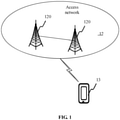
- FIG. 1 is a system configuration diagram of a communication system according to an exemplary embodiment of the present disclosure. As shown in FIG. 1 , the communication system may include an access network 12 and a terminal 13.
- the access network 12 includes several access network devices 120.
- the access network device 120 and the core network device 110 communicate with each other via some interface technique, such as an S1 interface in a Long-Term Evolution (LTE) system, and a NG interface in a New Radio (NR) system.
- the access network device 120 may be a base station, which is an apparatus deployed in the access network for providing a wireless communication function for a terminal.
- the base station may include various forms of Acer stations, micro base stations, relay stations, access points, and the like.
- the names of devices having a base station function may vary, for example, in an LTE system, referred to as an eNodeB or an eNB, and in 5G NR systems, referred to as gNodeB or gNB.
- eNodeB Long Term Evolution
- gNodeB 5G NR systems
- the description of the name "base station” may vary.
- the embodiments of the present disclosure take a "base station” for example, the base station may be understood as an access network device used to provide user access function in various communication systems.
- the terminal 13 may include various handheld devices, vehicle-mounted devices, wearable devices, computing devices that have wireless communication functions or other processing devices connected to a wireless modem, as well as various forms of User Equipment (UE), Mobile Station (MS), Terminal device and the like.
- UE User Equipment
- MS Mobile Station
- Terminal device and the like.
- the access network device 120 and the terminal 13 communicate with each other via a certain air interface technique such as a Uu interface.
- the above communication system has a higher requirement for the transmission delay, such as an uplink communication system supporting eURLLC service.
- the eURLLC service requires an end-to-end delay of 0.5 ms.
- a PDCCH carries Downlink Control information (DCI) sent by the base station to the UE.
- DCI Downlink Control information
- the DCI includes eight DCI formats: DCI format 0_0, DCI format 0_1, DCI format 1_0, DCI format 1_1, DCI format 2_0, DCI format 2_1, DCI format 2_2, and DCI format 2_3.
- the DCI carried by the PDCCH has the following functions: scheduling the PUSCH, scheduling the PDSCH, indicating the Slot Format Indicator (SFI), indicating the Pre-emption Indicator (PI), and power control command.
- SFI Slot Format Indicator
- PI Pre-emption Indicator
- the CCE is a basic unit constituting a PDCCH and occupies six REGs on a frequency domain resource.
- a given PDCCH may consist of one, two, four, eight, and sixteen CCEs, the specific number of which are determined by the DCI payload size and the desired encoding rate.
- the number of CCEs constituting the PDCCH is referred to as the aggregation level.
- the base station may adjust the aggregation level of the PDCCH according to the radio channel state of the actual transmission to implement link adaptive transmission.
- the aggregation level of the PDCCH actually transmitted by the base station is variable over time. Since there is no related signaling to inform the UE, the UE needs to blindly detect the PDCCH at different aggregation levels.
- the PDCCH to be blindly detected is referred to as a candidate PDCCH.
- the UE decodes all candidate PDCCHs in the Search Space. If the CRC check is passed, the content of the decoded PDCCH is considered to be valid for the UE, and subsequent operations are performed using the information (such as the scheduling indication, the time slot format indication/power control command, etc.) obtained by the decoding.
- the initial CCE number of the candidate PDCCH needs to be divisible by the number of CCEs of the candidate PDCCH.
- the UE detects the PDCCH at limited CCE positions, thereby avoiding an increase in the complexity of blind detection.
- this is not sufficient.
- the control information format/aggregation level, the number of candidate control channels corresponding to the aggregation level, and the detection period of the Search Space in the time domain may be configured through higher layer parameters. Based on the configuration information, the complexity of blind detection may be flexibly controlled. Simply summed up, not every DCI format requires blind detection within the set of candidate CCEs.
- FIG. 2 shows a flowchart of a method for transmitting control information according to a schematic embodiment of the present disclosure.
- the feedback method may be performed by the communication system shown in FIG. 1 .
- the method includes the following steps.
- a terminal sends uplink data to a base station in a time slot n of a PUSCH.
- step 202 the base station receives the uplink data sent by the terminal in the time slot n of the PUSCH.
- the base station In step 203, the base station generates feedback information of the uplink data, the feedback information including ACK or NACK.
- the base station When the uplink data is successfully received, the base station generates an ACK, and when the uplink data is not received, or when the uplink data is received and the CRC of the uplink data fails, the base station generates a NACK.
- step 204 the base station sends the control information to the terminal at designated frequency domain positions of the time slot n+k of the PDSCH.
- control information includes an ACK or a NACK.
- control information may be used to carry other information, such as channel quality information of the PUSCH, power control information of the terminal, and the like.
- k is less than a threshold value.
- step 205 the terminal receives the control information sent by the base station at the designated frequency domain positions in the time slot n+k of the PDSCH.
- the terminal retransmits the uplink data.
- the terminal may learn the feedback information of the uplink data in as short a time as possible.
- the uplink data is retransmitted when the feedback information is a NACK, thereby ensuring the timeliness of the retransmission process and meeting the delay requirement of the eURLLC service.
- the step 201 and the step 205 may be implemented alone as a method for transmitting the control information on the terminal side, and the step 202, the step 203, and the step 204 may be implemented alone as a method for transmitting the control information on the base station side.
- FIG. 3 shows a flowchart of a method for transmitting control information according to a schematic embodiment of the present disclosure.
- the feedback method may be performed by the communication system shown in FIG. 1 .
- the method includes the following steps.
- step 301 a base station configures k to a terminal.
- a manner in which the base station configures the k to the terminal includes, but is not limited to, any one of the following two manners.
- the base station configures k to the terminal by using a target PDCCH format.
- the target PDCCH format is a PDCCH format of a resource that is used for configuring a PUSCH to a terminal.
- the target PDCCH format may be a PDCCH format 0_0 or a PDCCH format 0_1.
- the target PDCCH format may be understood as DCI using the target PDCCH format.
- N bits are added to the DCI format 0_0 and the DCI format 0_1 to indicate the value of k.
- the value of k is 0 or 1
- the value of N is 1, that is, one bit may be used for characterization.
- the present disclosure does not exclude that the value of n is an integer greater than 1.
- the base station configures k to the terminal by using RRC signaling.
- step 302 the terminal receives the k configured by the base station.
- the step 301 and step 302 are optional steps.
- the value of k may be configured by default, for example, the default value is 0. That is, ACK/NACK feedback must be performed on a PDSCH within a specified time slot.
- the specified time slot is a time slot in which the last symbol of the PUSCH used to transmit uplink data is located.
- step 303 the terminal sends uplink data to the base station in time slot n of the PUSCH.
- the terminal determines the time-frequency resource in the time slot n of the PUSCH according to the target PDCCH, and transmits the uplink data to the base station by using the time-frequency resource in the time slot n.
- step 304 the base station receives the uplink data sent by the terminal in the time slot n of the PUSCH.
- the base station In step 305, the base station generates feedback information of the uplink data, the feedback information including an ACK or a NACK.
- the base station When the uplink data is successfully received, the base station generates an ACK. When the uplink data is not received, or when the uplink data is received and the CRC of the uplink data fails, the base station generates a NACK.
- step 306 the base station sends the control information to the terminal at designated frequency domain positions of time slot n+k of the PDSCH.
- control information includes an ACK or a NACK.
- control information may be used to carry other information, such as channel quality information of the PUSCH, power control information of the terminal, and the like.
- control information includes an ACK or a NACK, but the specific content carried in the control information is not limited.
- step 307 the terminal receives the control information sent by the base station at the designated frequency domain positions of the slot n+k of the PDSCH.
- Step 308 when the control information includes an ACK, the terminal sends the next uplink data at the designated resource position.
- the designated resource position is a resource position configured by the base station using a PDCCH.
- the designated resource position is a preconfigured resource position used for unauthorized transmission.
- step 309 the base station receives next uplink data sent by the terminal at the designated resource position.
- step 310 when the control information includes a NACK, the terminal retransmits the uplink data at the designated resource position.
- step 311 the base station receives the uplink data retransmitted by the terminal at the designated resource position.
- the terminal may learn the feedback information of the uplink data in as short a time as possible.
- the uplink data is retransmitted when the feedback information is a NACK, thereby ensuring the timeliness of the retransmission process and meeting the delay requirement of the eURLLC service.
- the k by setting the k to be 0 by default, it is ensured that the ACK and NACK of the uplink data can be transmitted to the terminal in time, thereby instructing the terminal to start the retransmission of the uplink data in as short a time as possible, and saving consumption of control signaling between the base station and the terminal.
- the steps performed by the terminal may be implemented alone as a retransmission method of the uplink data on the terminal side
- the steps performed by the base station may be implemented alone as a feedback method of the uplink data on the base station side.
- the above designated frequency domain positions are located on two sides of frequency domain resource positions occupied by a pilot signal.
- the bits that may be occupied by ACK/NACK do not need to be considered.
- the bits originally occupied by the PDSCH are directly occupied.
- FIG. 5 shows a block diagram of a feedback apparatus for uplink transmission according to a schematic embodiment of the present disclosure.
- the apparatus may be implemented as all or part of a base station (or of an access network device) by software, hardware, or a combination of both.
- the apparatus includes a receiving module 520 and a sending module 540.
- the receiving module 520 and the sending module 540 may be hardware devices such as a radio frequency antenna.
- a receiving module 520 is configured to receive uplink data sent by a terminal in a time slot n of a PUSCH.
- a sending module 540 is configured to send control information to the terminal at designated frequency domain positions of the slot n+k of a PDSCH.
- the n and k are integers.
- control information includes at least one of the following:
- the sending module 540 is further configured to configure the k to the terminal by using a target PDCCH format.
- the target PDCCH format is a PDCCH format 0_0 or a PDCCH format 0_1 that is used for configuring the PUSCH.
- the sending module 540 is further configured to configure the k to the terminal by using RRC signaling.
- the value of k is 0.
- the designated frequency domain positions are located on two sides of a frequency domain resource position occupied by the pilot signal.
- the receiving module 520 is further configured to receive next uplink data sent by the terminal at a designated resource position.
- the next uplink data is sent by the terminal after receiving an ACK feedback in the control information.
- the receiving module 520 is further configured to receive the uplink data retransmitted by the terminal at the designated resource position.
- the uplink data is sent by the terminal after receiving a NACK feedback in the control information.
- the designated resource position is a resource position configured by using a PDCCH.
- the designated resource position is a preconfigured resource position used for unauthorized transmission.
- FIG. 6 shows a block diagram of a retransmission apparatus for uplink transmission according to a schematic embodiment of the present disclosure.
- the apparatus may be implemented as all or a part of a terminal by software, hardware, or a combination both.
- the apparatus includes a sending module 620 and a receiving module 640.
- the sending module 620 and the receiving module 640 may be hardware devices such as a radio frequency antenna.
- the sending module 620 is configured to send uplink data to a base station in a time slot n of a PUSCH;
- the receiving module 640 is configured to receive control information sent by the base station at designated frequency domain positions of a time slot n+k of the PDSCH.
- n and k are integers
- control information includes at least one of the following:
- the receiving module 640 is configured to receive a target PDCCH format sent by the base station.
- the target PDCCH is used for configuring the k
- the target PDCCH format is a PDCCH format 0_0 or a PDCCH format 0_1 that is used for configuring the PUSCH.
- the receiving module 660 is configured to receive RRC signaling sent by the base station, and the RRC signaling is used for configuring the k.
- the value of k is 0.
- the designated frequency domain positions are located on two sides of a frequency domain resource position occupied by a pilot signal.
- the sending module 620 is configured to: when the control information includes an ACK, send next uplink data at a designated resource position, or when the control information comprises a NACK, retransmit the uplink data at the designated resource position.
- the designated resource position is a resource position configured by using a PDCCH; or, the designated resource position is a preconfigured resource position used for unauthorized transmission.
- FIG. 7 illustrates a block diagram of a terminal according to an exemplary embodiment of the present disclosure.
- the terminal includes a processor 101, a receiver 102, a transmitter 103, a memory 104, and a bus 105.
- the processor 101 includes one or more processing cores.
- the processor executes various functional applications and information processing by running software programs and modules.
- the receiver 102 and the transmitter 103 may be implemented as a communication component.
- the communication component may be a communication chip.
- the memory 104 is connected to the processor 101 via the bus 105.
- the memory 104 may be used to store at least one instruction, and the processor 101 may be used to execute the at least one instruction to implement the various steps in the method embodiments described above.
- the memory 104 may be implemented by any type of volatile or non-volatile storage device or a combination of both.
- the volatile or non-volatile storage device includes, but is not limited to, a magnetic disk or optical disk, an electrically erasable programmable read-only memory (EEPROM), an erasable programmable read-only memory (EPROM), a static anytime access memory (SRAM), a read-only memory (ROM), a magnetic memory, a flash memory, and a programmable read-only memory (PROM).
- a computer readable storage medium stores at least one instruction, at least one segment of a program, a code set, or an instruction set.
- the at least one instruction, the at least one segment of a program, the code set, or the instruction set is loaded by the processor and is executed to implement a method for transmitting control information provided by the above-described various method embodiments.
- FIG. 8 is a block diagram of an access network device 1000 according to an exemplary embodiment.
- the access network device 1000 may include a processor 1001, a receiver 1002, a transmitter 1003, and a memory 1004.
- the receiver 1002, the transmitter 1003, and the memory 1004 are connected to the processor 1001 respectively via a bus.
- the processor 1001 includes one or more processing cores, and the processor 1001 executes the method performed by the access network device in the transmission configuration method provided by the embodiments of the present disclosure by running software programs and modules.
- the memory 1004 may be used to store software programs and modules.
- the memory 1004 may store an operating system 10041, an application module 10042 required for at least one function.
- the receiver 1002 is used to receive communication data sent by other devices, and the transmitter 1003 is used to send communication data to the other devices.
- a computer readable storage medium stores at least one instruction, at least one segment of a program, a code set, or an instruction set.
- the at least one instruction, the at least one segment of a program, the code set, or the instruction set is loaded by the processor and is executed to implement steps in a method for transmitting control information provided by the above-described various method embodiments.
Landscapes
- Engineering & Computer Science (AREA)
- Signal Processing (AREA)
- Computer Networks & Wireless Communication (AREA)
- Quality & Reliability (AREA)
- Mobile Radio Communication Systems (AREA)
Applications Claiming Priority (1)
| Application Number | Priority Date | Filing Date | Title |
|---|---|---|---|
| PCT/CN2019/082918 WO2020210991A1 (zh) | 2019-04-16 | 2019-04-16 | 控制信息的传输方法、重传方法、装置、终端及存储介质 |
Publications (3)
| Publication Number | Publication Date |
|---|---|
| EP3955498A1 true EP3955498A1 (de) | 2022-02-16 |
| EP3955498A4 EP3955498A4 (de) | 2022-04-27 |
| EP3955498B1 EP3955498B1 (de) | 2025-09-17 |
Family
ID=68544577
Family Applications (1)
| Application Number | Title | Priority Date | Filing Date |
|---|---|---|---|
| EP19924865.9A Active EP3955498B1 (de) | 2019-04-16 | 2019-04-16 | Verfahren zur übertragung von steuerinformationen, neuübertragungsverfahren und -vorrichtung, endgerät und speichermedium |
Country Status (4)
| Country | Link |
|---|---|
| US (1) | US12127228B2 (de) |
| EP (1) | EP3955498B1 (de) |
| CN (1) | CN110495130B (de) |
| WO (1) | WO2020210991A1 (de) |
Families Citing this family (2)
| Publication number | Priority date | Publication date | Assignee | Title |
|---|---|---|---|---|
| WO2021168659A1 (zh) | 2020-02-25 | 2021-09-02 | Oppo广东移动通信有限公司 | 信息发送方法、信息接收方法、装置、设备及存储介质 |
| CN116137562B (zh) * | 2023-04-03 | 2025-10-14 | 北京星移联信科技发展有限公司 | 混合自动重传请求非自适应重传方法及装置 |
Family Cites Families (22)
| Publication number | Priority date | Publication date | Assignee | Title |
|---|---|---|---|---|
| CN100372434C (zh) * | 2004-09-08 | 2008-02-27 | 华为技术有限公司 | 一种多载频专用信道配置方法 |
| CN102739374B (zh) | 2011-04-12 | 2017-02-01 | 中兴通讯股份有限公司 | 一种载波聚合下确认信息的反馈方法、用户设备和系统 |
| CN102263616B (zh) * | 2011-08-15 | 2018-07-20 | 中兴通讯股份有限公司 | 指示控制信道的方法及装置 |
| TW201322681A (zh) | 2011-09-26 | 2013-06-01 | Innovative Sonic Corp | 無線通訊系統中處理通道狀態資訊之方法和通訊設備 |
| CN102546134B (zh) * | 2011-12-29 | 2015-07-22 | 电信科学技术研究院 | 基于增强phich传输反馈信息的方法及装置 |
| RU2641666C1 (ru) * | 2014-01-28 | 2018-01-19 | Хуавэй Текнолоджиз Ко., Лтд. | Способ расширенной передачи физического канала произвольного доступа, сетевое устройство и терминал |
| US10560229B2 (en) | 2015-06-17 | 2020-02-11 | Apple Inc. | ACK/NACK signals for next generation LTE devices and systems |
| WO2017045571A1 (zh) * | 2015-09-17 | 2017-03-23 | 中兴通讯股份有限公司 | 参考信号的发送方法及装置、接收方法及装置 |
| KR20170112945A (ko) * | 2016-04-01 | 2017-10-12 | 삼성전자주식회사 | 이동통신 시스템에서 기기 간 통신과 셀룰라 통신의 공존 방법 및 장치 |
| CN107332646B (zh) | 2016-04-29 | 2021-05-11 | 中兴通讯股份有限公司 | Harq-ack的发送方法及装置 |
| WO2018018620A1 (zh) | 2016-07-29 | 2018-02-01 | 广东欧珀移动通信有限公司 | 反馈ack/nack信息的方法、终端设备和网络侧设备 |
| CN108282879B (zh) * | 2017-01-06 | 2022-11-18 | 中兴通讯股份有限公司 | 数据传输方法及装置 |
| WO2018143174A1 (ja) | 2017-02-03 | 2018-08-09 | シャープ株式会社 | 基地局装置、端末装置およびその通信方法 |
| WO2018201369A1 (zh) * | 2017-05-04 | 2018-11-08 | 华为技术有限公司 | 一种控制信息传输的方法、终端设备和网络设备 |
| CN109152033B (zh) * | 2017-06-16 | 2021-07-09 | 华为技术有限公司 | 发送信息以及确定信息的方法和装置 |
| KR102338507B1 (ko) | 2017-08-04 | 2021-12-13 | 삼성전자 주식회사 | 무선 통신 시스템에서 하향링크 제어정보를 송수신하는 방법 및 장치 |
| US10764896B2 (en) * | 2017-11-08 | 2020-09-01 | Samsung Electronics Co., Ltd. | Method and apparatus for beam management in the unlicensed spectrum |
| CN109802819B (zh) | 2017-11-16 | 2024-03-05 | 北京三星通信技术研究有限公司 | 上行控制信息处理方法及终端 |
| WO2019224876A1 (ja) * | 2018-05-21 | 2019-11-28 | 株式会社Nttドコモ | 送信装置及び受信装置 |
| EP3925323B1 (de) * | 2019-02-14 | 2025-09-10 | Telefonaktiebolaget Lm Ericsson (Publ) | Verfahren zur konfigurierung der parameter von nachbarzellensynchronisationssignalen (rss) |
| EP4240101A4 (de) * | 2020-11-09 | 2024-01-03 | Guangdong Oppo Mobile Telecommunications Corp., Ltd. | Verfahren zur bestimmung einer zeitbereichsressource einer uplink-übertragung sowie endgerätevorrichtung und netzwerkvorrichtung |
| US12389410B2 (en) * | 2021-05-10 | 2025-08-12 | Qualcomm Incorporated | Multi-PDSCH or multi-PUSCH grant for non-contiguous resources on multiple slots |
-
2019
- 2019-04-16 US US17/594,316 patent/US12127228B2/en active Active
- 2019-04-16 CN CN201980000683.1A patent/CN110495130B/zh active Active
- 2019-04-16 WO PCT/CN2019/082918 patent/WO2020210991A1/zh not_active Ceased
- 2019-04-16 EP EP19924865.9A patent/EP3955498B1/de active Active
Also Published As
| Publication number | Publication date |
|---|---|
| WO2020210991A1 (zh) | 2020-10-22 |
| CN110495130A (zh) | 2019-11-22 |
| EP3955498B1 (de) | 2025-09-17 |
| CN110495130B (zh) | 2022-06-03 |
| US20220167356A1 (en) | 2022-05-26 |
| US12127228B2 (en) | 2024-10-22 |
| EP3955498A4 (de) | 2022-04-27 |
Similar Documents
| Publication | Publication Date | Title |
|---|---|---|
| US11916678B2 (en) | Method and apparatus for HARQ-ACK feedback for carrier aggregation | |
| US11483096B2 (en) | Method and apparatus for HARQ-ack codebook determination | |
| US11405162B2 (en) | Transmission of uplink control information in carrier aggregation with a large number of cells | |
| US11444727B2 (en) | Method and apparatus for HARQ-ACK payload reduction for semi-static HARQ-ACK codebook determination | |
| US12284134B2 (en) | Method and apparatus for fallback operation for semi-static HARQ-ACK codebook determination | |
| EP3738245B1 (de) | Verfahren und vorrichtung zur bestimmung eines harq-ack codebuchs für trägeraggregation | |
| EP3101982A1 (de) | Basisstation, übertragungsverfahren, mobilstation und rückübertragungssteuerungsverfahren | |
| US10873437B2 (en) | Systems and methods for frequency-division duplex transmission time interval operation | |
| EP4048002B1 (de) | Uplink-datenübertragungsverfahren und -vorrichtung, endgerät und speichermedium | |
| JP7149970B2 (ja) | フィードバック応答情報の伝送方法、装置及びシステム | |
| CN111491375A (zh) | 通信方法及通信装置 | |
| US12127228B2 (en) | Control information transmission method, retransmission method and apparatus, terminal, and storage medium | |
| EP3955490B1 (de) | Verfahren und vorrichtungen für uplink-übertragungsrückkopplung und neuübertragung, endgerät und speichermedium | |
| US12009934B2 (en) | Method and apparatus for transmitting HARQ-ACK feedback on unlicensed spectrum |
Legal Events
| Date | Code | Title | Description |
|---|---|---|---|
| STAA | Information on the status of an ep patent application or granted ep patent |
Free format text: STATUS: THE INTERNATIONAL PUBLICATION HAS BEEN MADE |
|
| PUAI | Public reference made under article 153(3) epc to a published international application that has entered the european phase |
Free format text: ORIGINAL CODE: 0009012 |
|
| STAA | Information on the status of an ep patent application or granted ep patent |
Free format text: STATUS: REQUEST FOR EXAMINATION WAS MADE |
|
| 17P | Request for examination filed |
Effective date: 20211110 |
|
| AK | Designated contracting states |
Kind code of ref document: A1 Designated state(s): AL AT BE BG CH CY CZ DE DK EE ES FI FR GB GR HR HU IE IS IT LI LT LU LV MC MK MT NL NO PL PT RO RS SE SI SK SM TR |
|
| A4 | Supplementary search report drawn up and despatched |
Effective date: 20220325 |
|
| RIC1 | Information provided on ipc code assigned before grant |
Ipc: H04L 1/18 20060101ALI20220321BHEP Ipc: H04W 72/12 20090101ALI20220321BHEP Ipc: H04L 5/00 20060101AFI20220321BHEP |
|
| DAV | Request for validation of the european patent (deleted) | ||
| DAX | Request for extension of the european patent (deleted) | ||
| RIC1 | Information provided on ipc code assigned before grant |
Ipc: H04L 1/1607 20230101ALI20250515BHEP Ipc: H04L 1/1829 20230101ALI20250515BHEP Ipc: H04W 72/1268 20230101ALI20250515BHEP Ipc: H04L 5/00 20060101AFI20250515BHEP |
|
| GRAP | Despatch of communication of intention to grant a patent |
Free format text: ORIGINAL CODE: EPIDOSNIGR1 |
|
| STAA | Information on the status of an ep patent application or granted ep patent |
Free format text: STATUS: GRANT OF PATENT IS INTENDED |
|
| INTG | Intention to grant announced |
Effective date: 20250703 |
|
| GRAS | Grant fee paid |
Free format text: ORIGINAL CODE: EPIDOSNIGR3 |
|
| GRAA | (expected) grant |
Free format text: ORIGINAL CODE: 0009210 |
|
| STAA | Information on the status of an ep patent application or granted ep patent |
Free format text: STATUS: THE PATENT HAS BEEN GRANTED |
|
| P01 | Opt-out of the competence of the unified patent court (upc) registered |
Free format text: CASE NUMBER: UPC_APP_2261_3955498/2025 Effective date: 20250804 |
|
| AK | Designated contracting states |
Kind code of ref document: B1 Designated state(s): AL AT BE BG CH CY CZ DE DK EE ES FI FR GB GR HR HU IE IS IT LI LT LU LV MC MK MT NL NO PL PT RO RS SE SI SK SM TR |
|
| REG | Reference to a national code |
Ref country code: GB Ref legal event code: FG4D |
|
| REG | Reference to a national code |
Ref country code: CH Ref legal event code: EP |
|
| REG | Reference to a national code |
Ref country code: DE Ref legal event code: R096 Ref document number: 602019075981 Country of ref document: DE |
|
| REG | Reference to a national code |
Ref country code: IE Ref legal event code: FG4D |
|
| REG | Reference to a national code |
Ref country code: NL Ref legal event code: FP |
|
| PG25 | Lapsed in a contracting state [announced via postgrant information from national office to epo] |
Ref country code: NO Free format text: LAPSE BECAUSE OF FAILURE TO SUBMIT A TRANSLATION OF THE DESCRIPTION OR TO PAY THE FEE WITHIN THE PRESCRIBED TIME-LIMIT Effective date: 20251217 |
|
| REG | Reference to a national code |
Ref country code: LT Ref legal event code: MG9D |
|
| PG25 | Lapsed in a contracting state [announced via postgrant information from national office to epo] |
Ref country code: FI Free format text: LAPSE BECAUSE OF FAILURE TO SUBMIT A TRANSLATION OF THE DESCRIPTION OR TO PAY THE FEE WITHIN THE PRESCRIBED TIME-LIMIT Effective date: 20250917 |
|
| PG25 | Lapsed in a contracting state [announced via postgrant information from national office to epo] |
Ref country code: HR Free format text: LAPSE BECAUSE OF FAILURE TO SUBMIT A TRANSLATION OF THE DESCRIPTION OR TO PAY THE FEE WITHIN THE PRESCRIBED TIME-LIMIT Effective date: 20250917 |
|
| PG25 | Lapsed in a contracting state [announced via postgrant information from national office to epo] |
Ref country code: GR Free format text: LAPSE BECAUSE OF FAILURE TO SUBMIT A TRANSLATION OF THE DESCRIPTION OR TO PAY THE FEE WITHIN THE PRESCRIBED TIME-LIMIT Effective date: 20251218 |
|
| PG25 | Lapsed in a contracting state [announced via postgrant information from national office to epo] |
Ref country code: SE Free format text: LAPSE BECAUSE OF FAILURE TO SUBMIT A TRANSLATION OF THE DESCRIPTION OR TO PAY THE FEE WITHIN THE PRESCRIBED TIME-LIMIT Effective date: 20250917 |
|
| PG25 | Lapsed in a contracting state [announced via postgrant information from national office to epo] |
Ref country code: LV Free format text: LAPSE BECAUSE OF FAILURE TO SUBMIT A TRANSLATION OF THE DESCRIPTION OR TO PAY THE FEE WITHIN THE PRESCRIBED TIME-LIMIT Effective date: 20250917 |
|
| PG25 | Lapsed in a contracting state [announced via postgrant information from national office to epo] |
Ref country code: BG Free format text: LAPSE BECAUSE OF FAILURE TO SUBMIT A TRANSLATION OF THE DESCRIPTION OR TO PAY THE FEE WITHIN THE PRESCRIBED TIME-LIMIT Effective date: 20250917 |
|
| PG25 | Lapsed in a contracting state [announced via postgrant information from national office to epo] |
Ref country code: RS Free format text: LAPSE BECAUSE OF FAILURE TO SUBMIT A TRANSLATION OF THE DESCRIPTION OR TO PAY THE FEE WITHIN THE PRESCRIBED TIME-LIMIT Effective date: 20251217 |
|
| REG | Reference to a national code |
Ref country code: AT Ref legal event code: MK05 Ref document number: 1839321 Country of ref document: AT Kind code of ref document: T Effective date: 20250917 |
|
| PGFP | Annual fee paid to national office [announced via postgrant information from national office to epo] |
Ref country code: NL Payment date: 20260227 Year of fee payment: 8 |
|
| PG25 | Lapsed in a contracting state [announced via postgrant information from national office to epo] |
Ref country code: SM Free format text: LAPSE BECAUSE OF FAILURE TO SUBMIT A TRANSLATION OF THE DESCRIPTION OR TO PAY THE FEE WITHIN THE PRESCRIBED TIME-LIMIT Effective date: 20250917 |
|
| PGFP | Annual fee paid to national office [announced via postgrant information from national office to epo] |
Ref country code: GB Payment date: 20260303 Year of fee payment: 8 |
|
| PG25 | Lapsed in a contracting state [announced via postgrant information from national office to epo] |
Ref country code: ES Free format text: LAPSE BECAUSE OF FAILURE TO SUBMIT A TRANSLATION OF THE DESCRIPTION OR TO PAY THE FEE WITHIN THE PRESCRIBED TIME-LIMIT Effective date: 20250917 |
|
| PG25 | Lapsed in a contracting state [announced via postgrant information from national office to epo] |
Ref country code: AT Free format text: LAPSE BECAUSE OF FAILURE TO SUBMIT A TRANSLATION OF THE DESCRIPTION OR TO PAY THE FEE WITHIN THE PRESCRIBED TIME-LIMIT Effective date: 20250917 |
|
| PG25 | Lapsed in a contracting state [announced via postgrant information from national office to epo] |
Ref country code: IT Free format text: LAPSE BECAUSE OF FAILURE TO SUBMIT A TRANSLATION OF THE DESCRIPTION OR TO PAY THE FEE WITHIN THE PRESCRIBED TIME-LIMIT Effective date: 20250917 |
|
| PG25 | Lapsed in a contracting state [announced via postgrant information from national office to epo] |
Ref country code: IS Free format text: LAPSE BECAUSE OF FAILURE TO SUBMIT A TRANSLATION OF THE DESCRIPTION OR TO PAY THE FEE WITHIN THE PRESCRIBED TIME-LIMIT Effective date: 20260117 |
|
| PGFP | Annual fee paid to national office [announced via postgrant information from national office to epo] |
Ref country code: FR Payment date: 20260223 Year of fee payment: 8 |
|
| PG25 | Lapsed in a contracting state [announced via postgrant information from national office to epo] |
Ref country code: CZ Free format text: LAPSE BECAUSE OF FAILURE TO SUBMIT A TRANSLATION OF THE DESCRIPTION OR TO PAY THE FEE WITHIN THE PRESCRIBED TIME-LIMIT Effective date: 20250917 Ref country code: PT Free format text: LAPSE BECAUSE OF FAILURE TO SUBMIT A TRANSLATION OF THE DESCRIPTION OR TO PAY THE FEE WITHIN THE PRESCRIBED TIME-LIMIT Effective date: 20260119 |
|
| PG25 | Lapsed in a contracting state [announced via postgrant information from national office to epo] |
Ref country code: PL Free format text: LAPSE BECAUSE OF FAILURE TO SUBMIT A TRANSLATION OF THE DESCRIPTION OR TO PAY THE FEE WITHIN THE PRESCRIBED TIME-LIMIT Effective date: 20250917 |
|
| PG25 | Lapsed in a contracting state [announced via postgrant information from national office to epo] |
Ref country code: EE Free format text: LAPSE BECAUSE OF FAILURE TO SUBMIT A TRANSLATION OF THE DESCRIPTION OR TO PAY THE FEE WITHIN THE PRESCRIBED TIME-LIMIT Effective date: 20250917 Ref country code: SK Free format text: LAPSE BECAUSE OF FAILURE TO SUBMIT A TRANSLATION OF THE DESCRIPTION OR TO PAY THE FEE WITHIN THE PRESCRIBED TIME-LIMIT Effective date: 20250917 |