EP3955823B1 - Verbesserte detektion und analyse biologischer akustischer signale - Google Patents
Verbesserte detektion und analyse biologischer akustischer signale Download PDFInfo
- Publication number
- EP3955823B1 EP3955823B1 EP20791291.6A EP20791291A EP3955823B1 EP 3955823 B1 EP3955823 B1 EP 3955823B1 EP 20791291 A EP20791291 A EP 20791291A EP 3955823 B1 EP3955823 B1 EP 3955823B1
- Authority
- EP
- European Patent Office
- Prior art keywords
- patient
- data
- spectral
- audio
- sounds
- Prior art date
- Legal status (The legal status is an assumption and is not a legal conclusion. Google has not performed a legal analysis and makes no representation as to the accuracy of the status listed.)
- Active
Links
Images











Classifications
-
- A—HUMAN NECESSITIES
- A61—MEDICAL OR VETERINARY SCIENCE; HYGIENE
- A61B—DIAGNOSIS; SURGERY; IDENTIFICATION
- A61B5/00—Measuring for diagnostic purposes; Identification of persons
- A61B5/42—Detecting, measuring or recording for evaluating the gastrointestinal, the endocrine or the exocrine systems
- A61B5/4222—Evaluating particular parts, e.g. particular organs
- A61B5/4255—Intestines, colon or appendix
-
- A—HUMAN NECESSITIES
- A61—MEDICAL OR VETERINARY SCIENCE; HYGIENE
- A61B—DIAGNOSIS; SURGERY; IDENTIFICATION
- A61B5/00—Measuring for diagnostic purposes; Identification of persons
- A61B5/68—Arrangements of detecting, measuring or recording means, e.g. sensors, in relation to patient
- A61B5/6801—Arrangements of detecting, measuring or recording means, e.g. sensors, in relation to patient specially adapted to be attached to or worn on the body surface
- A61B5/6813—Specially adapted to be attached to a specific body part
- A61B5/6823—Trunk, e.g., chest, back, abdomen, hip
-
- A—HUMAN NECESSITIES
- A61—MEDICAL OR VETERINARY SCIENCE; HYGIENE
- A61B—DIAGNOSIS; SURGERY; IDENTIFICATION
- A61B5/00—Measuring for diagnostic purposes; Identification of persons
- A61B5/72—Signal processing specially adapted for physiological signals or for diagnostic purposes
- A61B5/7203—Signal processing specially adapted for physiological signals or for diagnostic purposes for noise prevention, reduction or removal
-
- A—HUMAN NECESSITIES
- A61—MEDICAL OR VETERINARY SCIENCE; HYGIENE
- A61B—DIAGNOSIS; SURGERY; IDENTIFICATION
- A61B5/00—Measuring for diagnostic purposes; Identification of persons
- A61B5/72—Signal processing specially adapted for physiological signals or for diagnostic purposes
- A61B5/7271—Specific aspects of physiological measurement analysis
- A61B5/7275—Determining trends in physiological measurement data; Predicting development of a medical condition based on physiological measurements, e.g. determining a risk factor
-
- A—HUMAN NECESSITIES
- A61—MEDICAL OR VETERINARY SCIENCE; HYGIENE
- A61B—DIAGNOSIS; SURGERY; IDENTIFICATION
- A61B5/00—Measuring for diagnostic purposes; Identification of persons
- A61B5/74—Details of notification to user or communication with user or patient; User input means
- A61B5/7405—Details of notification to user or communication with user or patient; User input means using sound
-
- A—HUMAN NECESSITIES
- A61—MEDICAL OR VETERINARY SCIENCE; HYGIENE
- A61B—DIAGNOSIS; SURGERY; IDENTIFICATION
- A61B5/00—Measuring for diagnostic purposes; Identification of persons
- A61B5/74—Details of notification to user or communication with user or patient; User input means
- A61B5/742—Details of notification to user or communication with user or patient; User input means using visual displays
-
- A—HUMAN NECESSITIES
- A61—MEDICAL OR VETERINARY SCIENCE; HYGIENE
- A61B—DIAGNOSIS; SURGERY; IDENTIFICATION
- A61B5/00—Measuring for diagnostic purposes; Identification of persons
- A61B5/74—Details of notification to user or communication with user or patient; User input means
- A61B5/746—Alarms related to a physiological condition, e.g. details of setting alarm thresholds or avoiding false alarms
-
- A—HUMAN NECESSITIES
- A61—MEDICAL OR VETERINARY SCIENCE; HYGIENE
- A61B—DIAGNOSIS; SURGERY; IDENTIFICATION
- A61B7/00—Instruments for auscultation
- A61B7/008—Detecting noise of gastric tract, e.g. caused by voiding
-
- A—HUMAN NECESSITIES
- A61—MEDICAL OR VETERINARY SCIENCE; HYGIENE
- A61B—DIAGNOSIS; SURGERY; IDENTIFICATION
- A61B7/00—Instruments for auscultation
- A61B7/02—Stethoscopes
- A61B7/04—Electric stethoscopes
-
- A—HUMAN NECESSITIES
- A61—MEDICAL OR VETERINARY SCIENCE; HYGIENE
- A61B—DIAGNOSIS; SURGERY; IDENTIFICATION
- A61B2503/00—Evaluating a particular growth phase or type of persons or animals
- A61B2503/40—Animals
-
- A—HUMAN NECESSITIES
- A61—MEDICAL OR VETERINARY SCIENCE; HYGIENE
- A61B—DIAGNOSIS; SURGERY; IDENTIFICATION
- A61B5/00—Measuring for diagnostic purposes; Identification of persons
- A61B5/07—Endoradiosondes
- A61B5/073—Intestinal transmitters
-
- A—HUMAN NECESSITIES
- A61—MEDICAL OR VETERINARY SCIENCE; HYGIENE
- A61B—DIAGNOSIS; SURGERY; IDENTIFICATION
- A61B5/00—Measuring for diagnostic purposes; Identification of persons
- A61B5/07—Endoradiosondes
- A61B5/076—Permanent implantation
Definitions
- Postoperative ileus is acute paralysis of the GI tract that develops 2-6 days after surgery causing unwanted side-effects such as nausea and vomiting, abdominal pain and distention. This occurs most frequently in gastrointestinal surgery. There is a lack of ability to predict which patients are likely to develop these intestinal issues results in increased incidents of postoperative complications, hospital stays, and readmission rates. There is a further lack of an intestinal audio analysis device and methods that more accurately provide risk level analysis by limiting and/or eliminating ambient noise that causes false data points, wherein the devices and methods are more self-contained.
- US 2016/089107 A1 discloses that predicting gastrointestinal impairment may involve obtaining intestinal sounds of a patient to generate audio data, identifying predefined spectral events in the audio data that are predictive of subsequent gastrointestinal impairment, the spectral events being defined by predefined parameters, and that predicting the likelihood of subsequent gastrointestinal impairment relative to the identified spectral events.
- the present invention provides an intestinal audio analysis device, and an associated method as defined in the appended independent claims.
- Optional features are defined in the appended dependent claims.
- an intestinal audio analysis device has a patient interface adapted to attach to a surface of a patient's abdomen for a duration of time post-surgery.
- the device has a diaphragm that vibrates in response to intestinal sounds to create acoustic pressure waves that amplify intestinal sounds made within a patient's abdomen. This allows audio data related to the intestinal sounds to be collected through an acoustic chamber that receives the amplified sound, which passes to an audio collection device located in or near the acoustic chamber.
- the intestinal audio analysis device has an exterior housing and internal computer, as well as memory and one or more algorithms for providing instructions to the system to perform the variously required steps to provide accurate collection data and analysis.
- the one or more algorithms can analyze collected audio data for false signals due to ambient noise, analyze two or more spectral event values over time (e.g., MH4), produce a slope of a linear regression analysis for comparison to a pre-determined slope threshold for making a binary prediction related to likelihood and risk of GII, with the risk conveyed, for example, on a user interface display.
- two or more spectral event values over time e.g., MH4
- a slope of a linear regression analysis for comparison to a pre-determined slope threshold for making a binary prediction related to likelihood and risk of GII, with the risk conveyed, for example, on a user interface display.
- a method of using the intestinal audio analysis device is provided.
- a method of predicting the likelihood and risk level of GII occurring prior to clinical symptoms Intestinal sounds are recorded to generate audio data of a patient's intestinal sounds.
- the audio data is processed to identify certain predictive spectral events (e.g., MH4), and the audio data is analyzed for false signals due to ambient noise.
- certain embodiments provide mitigation for the false signals to ensure acquiring a more accurate total number of identified predictive spectral events for linear regression analysis.
- the resulting slope of spectral event values over time is used to correlate the slope with likelihood of a gastrointestinal impairment occurring (e.g., post-surgery), and based on the correlation, a user is provided with a risk level based on the likelihood.
- the embodiments provide improved control over ambient noise, which increases accuracy of data used to make correlations upon which predictions of post-surgery GII are made prior to clinical symptoms.
- Gastrointestinal impairment is a common concern following surgical procedures.
- Disclosed herein are systems and methods for predicting GII based upon the patient's intestinal sounds. As is described below, the disclosed systems and methods identify discrete acoustic spectral events within the intestinal sounds, which can be used to predict subsequent GII, and in some instances, post-operative GIL Those spectral events are good indicators of intestinal tract function and/or dysfunction because the sounds are produced by motor activity within the bowel.
- Certain embodiments comprise a device comprising a housing; a display; a processor; and at least one audio collection device. In certain embodiments, there is a primary audio collection device and a secondary audio collection device. In some embodiments, a primary audio collection device can be attached or inserted into a subject.
- Figs. 1-2 provide an example of an embodiment of a device.
- Fig. 1 and Fig. 2 in-part shows an example of a device comprising a housing 101, and at least one button 102 for a user to interact and control the operations of the device, and a user interface 103.
- a user interface can be a graphical user interface (GUI).
- a device comprises a secondary audio collection device.
- the secondary audio collection device can be a microphone or other sound receiving mechanism that can collect ambient noise.
- a signal subtraction is performed of ambient noise from the primary microphone data to achieve true noise cancellation.
- devices described herein can be used in methods of predicting or diagnosing GIL
- systems and methods described herein can comprise predicting GII before symptoms have developed.
- a secondary audio collection device can remove interference associated with ambient noise that may interfere with the collection of intestinal sounds. Such a configuration can produce the surprising and unexpected results of more accurately predicting GII.
- the GII prediction can be post-operative.
- an ambient audio collection device further comprises a diaphragm.
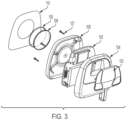
- Figs. 3-4 show an exploded view of an example of a device.
- Figs. 3 and 4 show a device comprising a user interface 103, a separable top portion of a housing 104, a computer 105, a lower portion of a housing 106, at least one fastening means 107, a diaphragm 108, a gasket 109, and an adhesive wafer 110.
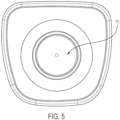
- Fig. 5 shows an example of a device having a secondary audio collection device 111.
- a GUI can be configured to allow a user to interact with the device and collect audio data from a subject.
- Certain embodiments comprise a housing.
- a housing can comprise an upper portion and an adhesive wafer.
- the adhesive wafer may range in size (width and length).
- the wafer may be the same width and length as the bottom surface area of the unit, or smaller than the bottom surface area of the unit.
- the wafer may be of differing thicknesses.
- the wafer is shaped to best fit the unit to the patient for a secured monitoring/recording/collecting of GII events.
- a housing can comprise a separable top portion and lower portion.
- attachment means can comprise screws, fasteners, pins, brackets, pegs, rivets, clips, and the like.
- An embodiment of a system can be used for predicting gastrointestinal impairment.
- Embodiments of the system comprise a data collection device, a patient interface and a computer 105.
- a computer 105 or a data collection device might be a separate device that collects and/or stores data retrieved from a patient interface and computer 105.
- a patient interface can comprise any device that is capable of collecting audio data that is generated within a patient's intestinal tract.
- the patient interface comprises a portable (e.g., handheld) digital audio recorder.
- the patient interface can comprise an integral microphone (not shown) that is used to capture the intestinal sounds, and wherein an integral microphone can be housed in or near an acoustic chamber.
- An acoustic chamber is formed, for example, between a diaphragm 108 and a lower portion of housing 106.
- the acoustic chamber greatly increases the data collection by amplifying the patient's gut sounds relative to ambient noise; increases the ability to reduce ambient noise at the point of audio collection; provides simplicity in audio data collection through reduction in inventory of extraneous components; and provides the ability of continuous audio data collection in combination with a patient interface, diaphragm and an audio data collection device, e.g., a microphone housed within the device of the invention in or near the acoustic chamber.
- a patient interface can be a device that can be directly applied to a patient's abdomen for the purpose of detecting intestinal sounds.
- the patient interface comprises, or is similar in design and function to, a stethoscope head.
- Stethoscope heads can comprise a diaphragm that is placed in contact with the patient and that vibrates in response sounds generated within the body. Those sounds can be delivered to a microphone that can transmit a signal to computer 105, which can optionally transmit data to a data collection device.
- a patient interface can transmit sound via tubing that extends between the patient interface and a sound collection device, such as a microphone that can be located within an acoustic chamber.
- a patient interface can convert soundwaves into a digital signal that can be processed by computer 105.
- acoustic pressure waves created by diaphragm vibrations can travel within an inner lumen of tubing to a microphone.
- a patient interface can comprise a microphone or other device that converts acoustic pressure waves into a digital signal that can be processed and analyzed by the system to predict GII.
- a microphone or other device for converting acoustic pressure waves into digital signals can be housed in or in communication with an acoustic chamber positioned between a diaphragm 108 and a lower portion of housing 106.
- all or part of the patient interface can be disposable to avoid cross-contamination between patients.
- a patient interface can be used with a disposable sheath or cover (not shown) that can be discarded after use.
- the audio data collected by the computer 105 can be stored within internal memory comprised by the computer.
- memory may be separate from computer 105 but is in data communication with computer 105.
- the audio data can be stored within nonvolatile memory (e.g. , flash memory) of the device. That data can then be transmitted to computer 105 for processing.
- the data and data analysis are transmitted via a wire or cable that is used to physically connect the computer 105 to a separate processor or computer, such as a laptop or desktop computer or handheld or portable devices with necessary components for receiving and conveying the data and data analysis.
- the data and data analysis can be wirelessly transmitted from the device to a separate processor or computer via a suitable wireless protocol, such as Bluetooth or Wi-Fi (IEEE 802.11), or via suitable cellular protocols, such as Global System for Mobile communication (GSM), General Packet Radio Service (GPRS), Enhanced Data Rates for GSM Evolution (EDGE), Universal Mobile Telecommunications Service (UMTS), High Speed Packet Access (HSPA), Code-Division Multiple Access (CDMA), Evolution-Data Optomized (EV-DO, EVDO, 1xEV-DO), Short Message Service (SMS), and Wi-MAX, for example.
- GSM Global System for Mobile communication
- GPRS General Packet Radio Service
- EDGE Enhanced Data Rates for GSM Evolution
- UMTS Universal Mobile Telecommunications Service
- HSPA High Speed Packet Access
- CDMA Code-Division Multiple Access
- EV-DO Evolution-Data Optomized
- EV-DO EVDO, 1xEV-DO
- SMS Short Message Service
- the separate computer can, in some embodiments, comprise a desktop computer. It is noted, however, that substantially any computing device that is capable of receiving and processing the audio data collected by the computer 105 can be used. Therefore, a separate computer can, alternatively, take the form of a mobile computer, such as a notebook computer, a tablet computer, a smartphone, or a handheld computer. In some embodiments, computer 105 can process any data produced from acoustic sounds received from a patient and output information via a user interface 103.
- the user interface comprises a display function and can also be a touchscreen that allows a user to interact with and control the operation of the device.
- the device can be provided with a digital signal processor and appropriate software/firmware that can be used to analyze the collected audio data.
- patient sounds can be transmitted to the device wirelessly from a patient interface.
- a patient interface can have an adhesive surface that enables the interface to be temporarily adhered to the patient's skin in similar manner to an electrocardiogram (EKG) lead.
- patient data can be transmitted from a patient interface to computer 105 via a wired connection (via wire or cable) or wirelessly.
- a patient interface can comprise a device having its own integral microphone (not shown) and patient sounds picked up by the microphone can be electronically transmitted along a wire or cable to the device.
- the device can comprise a component that is designed to dock with a patient monitoring system, which may be located beside a patient for a continuous period of time, such as hours, days, or weeks.
- a patient monitoring system can comprise a docking station and an associated display. In certain embodiments, this enables a warning or notification to be received at a secondary location, for example, at a nurse's station.
- the device can also be designed to dock within a free bay of a station prior to use.
- Other means of connecting a device of the invention is through various ports known in the industry for these types of electronic systems including, for example: PS/2; serial port (e.g., DB-25, DE-9 or RS-232 or COM Port); parallel port or centronics 36 pin port; audio ports; S/PDIF; TOSLINK; video ports; Digital Video Interface (DVI) (e.g ., mini-DVI, micro-DVI); display port; RCA connector; component video; S-video; HDMI; USB ( e.g., Type A, Type C); RJ-45; RJ-11; e-SATA; and the like.
- DVI Digital Video Interface
- Types of patient monitoring systems are known and include, for example: standard hospital patient monitoring systems for fixed-in place systems as well as mobile and/or portable monitoring systems; remote and/or wireless; home systems; and/or combinations thereof.
- the device may comprise no internal power supply and therefore can only collect patient data when docked.
- the device can comprise a power connection such as an A/C connection or can comprise an internal power source such as a battery.
- the device can comprise photovoltaic and/or thermoelectric sources of power, such as a solar cell.
- a patient interface may comprise a power source such as a battery, photovoltaic device, and/or thermoelectric device that can be used to collect acoustic sound waves and/or process the acoustic sound waves into data that can be used to predict GII.
- the device can have electrical pins that electrically couple the device to a patient monitoring system for purposes of receiving power and transferring collected data to the patient monitoring system.
- Patient data can be stored in memory of the patient monitoring system and/or can be transmitted to a central computer for storage in association with a patient record in an associated medical records database.
- the device can comprise an electrical port that can receive a plug of a wire or cable.
- the device can comprise one or more indicators, such as light-emitting diode (LED) indicators that convey information to the operator, such as positive electrical connection with the patient monitoring system and patient signal quality.
- LED light-emitting diode
- the device can couple with a patient monitoring system.
- the device can comprise an internal patient interface that is designed to collect sounds from within the peritoneal cavity.
- the patient interface can comprise a small diameter microphone catheter that is left in place after surgery has been completed, in similar manner to a drainage catheter.
- the patient interface can comprise a laser microphone.
- a laser beam is directed through the catheter and reflects off a target within the body.
- the reflected light signal can be received by a receiver that converts the light signal to an audio signal. Minute differences in the distance traveled by the light as it reflects from the target are detected interferometrically.
- a patient interface can comprise a microphone that is positioned at the tip of the catheter.
- the device can comprise a central processing unit (CPU) such as computer 105 or other processing device, such as a microprocessor or digital signal processor.
- CPU central processing unit
- the device can comprise memory that can comprise any one of or a combination of volatile memory elements (e.g., RAM) and nonvolatile memory elements (e.g., flash, hard disk, ROM).
- a user interface 103 can comprise components with which a user interacts with the device.
- the user interface 103 can comprise, for example, a keyboard, mouse (mouse pad), interactive touch display, and/or a display device, such as a liquid crystal display (LCD).
- the device may comprise one or more buttons 102 that can allow a user to use the device and manipulate the user interface 103, such as to navigate through menus, view data, etc.
- the user interface 103 can comprise one or more buttons and/or a touch screen.
- One or more I/O devices can be adapted to facilitate communication with other devices and may include one or more electrical connectors and a wireless transmitter and/or receiver.
- I/O devices can comprise a microphone.
- memory can be a computer-readable medium and can store various programs ( i.e., logic), including an operating system and an intestinal sound analyzer.
- An operating system can control the execution of other programs and can also provide scheduling, input-output control, file and data management, memory management, and communication control and related services.
- An intestinal sound analyzer can comprise one or more algorithms that are configured to analyze intestinal audio data for the purpose of predicting the likelihood of a patient developing GII.
- an analyzer can conduct an analysis relative to correlation data stored in a database (and such database can be stored in computer 105 ) and can present to the user (e.g., physician, hospital staff and/or clinician) a predictive index of GII risk.
- an analyzer can identify particular spectral events of interest using target signal parameters, signal-to-noise ratio parameters, and noise power estimation parameters. Decision tree analysis of the number of predictive spectral events during a specified time interval can then be used to communicate a high-risk, intermediate-risk, or low-risk of GII.
- the risk associated with each level of risk is 83%, 30%, and 0%, respectively, or approximately thereabouts.
- patient intestinal sounds can be recorded to generate audio data.
- the sounds can be obtained non-invasively, for example using a stethoscope head or other patient interface that is applied to the patient's skin on or near the abdomen.
- the sounds can be collected with a device that extends into the patient's peritoneal cavity.
- the sounds can be recorded early in the postoperative period, for example, the day of or a day immediately following surgery, and for any required length of time thereafter.
- acoustic sounds are obtained immediately following an operation and may continue being monitored and analyzed for hours, days, or weeks as would be understood by the skilled artisan in view of the instant disclosure.
- the sounds are collected continuously.
- the sounds are collected for a period of time at a predetermined interval. Regardless of when the sounds are recorded, they can be recorded for a duration of time that is sufficient to enable identification of spectral events that are predictive of intestinal function and/or impairment occurring. By way of example, sounds are recorded for a period of approximately 4 to 6 minutes. In some embodiments, all sounds within the 20-20,000 Hz range are recorded. In some embodiments, sounds outside of the range audible to the human ear are collected and analyzed. Filters can be applied to reduce the range of frequencies that are recorded, and therefore reduce the amount of data that is analyzed. In some embodiments, a secondary audio device 111 can work in conjunction with a patient interface to provide improved analytical results.
- a secondary audio collection device can comprise a microphone that can measure the ambient noise in the vicinity of a patient. Then, the ambient noise can be subtracted from the acoustic sounds collected from a patient to assure that any acoustic sounds analyzed by the device are actually collected from a patient and not any external source.
- the secondary microphone and the unit's integral microphone collect audio data independently in a synchronized manner. Both sets of audio data are run through the MH4 detector to determine if ambient noise is potentially triggering false MH4 event counts coming from the integral microphone, and wherein the ambient data counts can be subtracted from the final count if certain criteria are met by the ambient sound(s).
- filters can be used so that only sounds with frequencies from approximately 700 to 1500 Hz are recorded or analyzed, but a filter can be incorporated that allows the device to only analyze sounds in a predetermined frequency range.
- a warning indicator or alert mechanism can be part of the device, wherein the warning indicator or alert mechanism notifies a doctor, caregiver, nurse or clinician, for example, that an ambient noise(s) must be reduced.
- ambient noise levels are too high for the device's noise mitigation strategies to work. In such scenarios, meaningful MH4 values cannot be obtained.
- a warning indicator which may be any combination of a light, a noise, audible sound, or a graphic on the device display, can be used to indicate to the user that the ambient noise needs to be reduced and/or controlled.
- the threshold for triggering the warning indicator can be based, for example, on: a present ambient noise decibel level from an outward-pointing microphone; analysis of the signal/noise ratio from primary versus outward-pointing microphone; processing the sound from the outward-pointing microphone for false-triggering MH4 values above a preset threshold.
- the data can be processed, for example in real-time, to identify one or more predictive spectral signals.
- Real-time can mean that data is processed while being acquired via the device as the sounds are generated by the patient.
- sounds that are generated by the intestines can be the result of peristalsis, from which the device can predict the likelihood of GII, meaning that device indicates (pre-GII) the likelihood of a GII occurring post-data collection and analysis. Sounds collected and/or analyzed by the device therefore can provide an indication of how the bowels are functioning.
- each of the predefined spectral events is defined by particular characteristics or parameters, such as their frequency, amplitude, duration, and separation in time from other spectral events.
- spectral events After spectral events have been identified, their number during a specified duration of time (e.g., the total duration of the recording) can be totaled.
- the totaled number of identified predictive spectral events are time stamped and written to a data buffer (buffer) of a device of the invention.
- the buffer for example, can be in the physical memory storage used to temporarily store data, while it is understood that a buffer can be in a fixed memory of a hardware or as a virtual data buffer in software pointing at a location in the physical memory.
- the total number of spectral events can be compared to correlation data that correlates the number of spectral events with the likelihood of later GII.
- a spectral event designated as "MH4" was identified in a study described below.
- MH4 a high risk of GII exists if the number of observed MH4 events is less than approximately 21 times during four minutes of recording, an intermediate risk of GII exists if the number of observed MH4 events is greater than approximately 21 but less than approximately 131 times during four minutes of recording, and a low risk of GII exists if the number of observed MH4 events is greater than approximately 131 times during four minutes of recording.
- the number of predefined spectral events therefore can be used as an index that conveys the magnitude of the risk for GII, with a lower number indicating greater risk and a higher number indicating lower risk.
- the computer 105 or other device can be used to perform the analysis and can display the risk level on an associated display, such as user interface 103, although the prediction can be shown on a separate display such as a separate computer monitor.
- the prediction can be automatically conveyed to a hospital charting and/or recording system so that the prediction is automatically stored with the patient records.
- the data can be anonymized and used as aggregated data.
- the risk can be conveyed as an index ( i.e., a number).
- the risk can be indicated as being "high,” “moderate,” or “low.” Regardless, appropriate action can then be taken relative to the indication and may comprise permitting or prohibiting oral feeding. Notably, further recordings and analysis can be performed on the patient in the ensuing days after surgery to evaluate bowel function and confirm the initial patient assessment.
- the risk of GII can be assessed much in the same way that the risk of heart problems can be non-invasively assessed with an EKG.
- the risk assessment can be performed in real-time.
- a clinical study was performed to evaluate the viability of the disclosed systems and methods.
- One goal of the study was to confirm that spectral events present in intestinal sounds early in postoperative period do in fact correlate with GII subsequently, before clinical signs and symptoms develop.
- Another goal of the study was to develop a model for predicting GII that can be implemented as a simple, noninvasive, point-of-care test that will enable hospitals and other institutions to risk stratify patients for development of clinically significant GII using analysis of intestinal sounds.
- a device for digitally recording abdominal sounds was assembled using a dual-channel digital audio recorder (Microtrak II, M-Audio Corp., Irwindale, CA), condenser microphone (ATR35s, Audio-Technica Ltd, Leeds, UK), stethoscope tubing, and stethoscope heads.
- the stethoscope heads were applied to the upper and lower anterior abdominal wall and both channels were recorded simultaneously for a period of 5-6 minutes.
- a standardized tone was also applied to each recording to calibrate audio levels.
- Audio recordings were subsequently processed using digital signal processing algorithms.
- the algorithms were applied in an iterative fashion focusing on identifying spectral events preoperatively or in the early postoperative period that would predict the development of GII during the remainder of the hospital stay.
- Five types of spectral events that span different portions of the audible spectrum were ultimately used for the analyses.
- Each type of spectral event was defined by unique target signal parameters (minimum and maximum frequency, minimum and maximum duration, and minimum separation), signal-to-noise ratio parameters (minimum occupancy, signal-to-noise threshold), and noise power estimation parameters (block size, hop size, percentile).
- the five spectral events were designated H4, M4, L4, ML4, and MH4, and the parameters for each are shown in Table 2.
- Spectral events were counted over a four-minute interval of time.
- GII was defined as the presence of emesis, the need for nasogastric intubation, or the reversal of the diet.
- RavenPro 1.4 software was used for visualization, analysis, and measurement of the recorded audio signals.
- Statistical analyses were performed using PASW 18 and Clementine 10.1.
- Spectral events obtained from POD0 did not correlate with subsequent development of GII.
- Spectral events obtained from POD1 did prove to correlate with subsequent development of GII.
- Fig. 16 shows an example of a prediction of GII based on the collection of data as described herein and shows a graph that plots temporal changes in MH4 spectral events.
- the results of the study confirmed that spectral events present in intestinal sounds early in the surgical stay do in fact correlate with GII before clinical signs and symptoms develop.
- a predictive model based on MH4 measurement therefore can be used to evaluate patients as being of high-, intermediate-, and low-risk for GII.
- no patients in the low-risk group developed GII.
- the predictive value of low-risk classification for no GII was 100%, while the predictive value of high-risk classification for GII was 83%. Thirty percent (30%) of the intermediate-risk patients experienced GII.
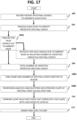
- Fig. 17 provides a flow diagram of an embodiment of a method of the invention for predicting GII.
- a patient's intestinal sounds are recorded to generate audio data in block 100.
- the sounds can be obtained non-invasively through the patient interface against the patient's skin, at or effectively near the patient's abdomen.
- the recorded audio data from block 100 is then processed to identify predictive spectral events (e.g., MH4) in block 102.
- the processed audio data of block 102 is then analyzed for false signals due to ambient noise in block 104A.
- a device of the invention does not indicate such false signals are in need of mitigation, then a total number of identified predictive spectral events is computed in block 106. If, however, a device of the present invention detects a threshold-exceeding number of false signals in block 104A, then mitigation of false signals due to ambient noise is performed and the device recalculates by adjusting the number of identified predictive spectral events to account for false signals in block 104B, while alerting/warning the user of a need to reduce or control ambient noise. Once mitigation in block 104B is complete, the total number of identified predictive spectral events is provided in block 106, as described for the non-mitigation determination from block 104A, discussed above.
- a time stamp and number of spectral events are written to a buffer in block 108A, and a slope of spectral event values over time is generated from a regression analysis of buffered data in block 108B. Then the slope value is compared to data that correlates the slope with a likelihood of a GII occurring in the future in block 110.
- This aspect provides a significant improvement over other methods by analyzing the slope of two or more spectral event values (i.e., MH4 values) over time. For example, MH4 values between about 7 to about 12 hours post-surgery are obtained, and the slope of the linear regression analysis of these points is calculated.
- the calculated slope of the present invention is compared to a pre-determined slope threshold for making a binary prediction.
- This aspect of the invention corrects for potential erroneous interpretations due to a single MH4 value, which may be falsely elevated by ambient noise interference; however, the present invention provides analysis based on multiple values and results with analysis results that are more resilient to outside interference such as ambient noise. This ability of mitigating false signals greatly increases risk level analysis and strategies, especially when used in a device of the invention comprising an acoustic chamber as herein defined.
- a device of the invention indicates a risk level to the user in block 112, for decision making regarding preparation, prevention, treatment and other strategies for addressing the likelihood of a predicted GII event occurring.
- devices and methods are provided that allow for real-time data collection, analysis, correlation to provide a result that is predictive of a GII occurring at a particular risk level.
- Fig. 18 illustrates an example architecture for a device 72 that can be used in a system for predicting gastrointestinal impairment to analyze collected patient data.
- the architecture shown in Fig. 18 can be the architecture of a device of the invention comprising the computer 105 and user interface 103 of Figs. 3-4 , for example, as well as the data collection device, processing device, user interface, I/O device(s) (including microphone), memory (including operating system, intestinal sound analyzer, a database, etc.) as described herein.
- the illustrated architecture can be distributed across one or more devices.
- the device 72 generally comprises a processing device 74, memory 76, a user interface 78, and input/output devices 80, each of which is coupled to a local interface 82, such as a local bus.
- the processing device 74 can include a central processing unit (CPU) or other processing device, such as a microprocessor or digital signal processor.
- the memory 76 includes any one of or a combination of volatile memory elements (e.g., RAM) and nonvolatile memory elements (e.g., flash, hard disk, ROM).
- the user interface 78 comprises the components with which a user interacts with the device 72.
- the user interface 78 can comprise, for example, a keyboard, mouse, and a display device, such as a liquid crystal display (LCD).
- the user interface 78 can comprise one or more buttons and/or a touch screen.
- the one or more I/O devices 80 are adapted to facilitate communication with other devices and may include one or more electrical connectors and a wireless transmitter and/or receiver.
- the I/O devices 80 can comprise one or more of microphone 84.
- the memory 76 is a computer-readable medium and stores various programs (i.e., logic), including an operating system 86 and an intestinal sound analyzer 88.
- the operating system 86 controls the execution of other programs and provides scheduling, input-output control, file and data management, memory management, and communication control and related services.
- the device 72, and preferably memory 86 comprises a data buffer to which time stamped spectral events are written to for analysis via one or more algorithms and/or other software for slope value comparison to data for correlation of slope with likelihood of a later GII, from which risk level is determined.
- the intestinal sound analyzer 88 comprises one or more algorithms that are configured to analyze intestinal audio data for the purpose of predicting the likelihood of a patient developing GII.
- the analyzer 88 conducts that analysis relative to correlation data stored in a database 90 and presents to the user (e.g ., physician or hospital staff) a predictive index of GII risk.
- the analyzer 88 identifies particular spectral events of interest using target signal parameters, signal-to-noise ratio parameters, and noise power estimation parameters. Decision tree analysis of the number of predictive spectral events during a specified time interval can then be used to communicate a high-, intermediate-, or low-risk of GII.
- the risk associated with each level of risk is 83%, 30%, and 0%, respectively, or approximately thereabout.
- Colic is the leading cause of premature death in horses. While colic refers to abdominal pain, it may reflect a number of underlying disorders affecting the large intestine including blockage, spasm, or torsion. Early diagnosis is the key to preventing death; however, early diagnosis in the larger mammals, such as horses is challenging. Because the underlying causes of colic reflect mechanical changes in the intestine, these are recognizable as subtle differences in the types of noise generated from the regular contractions of the intestine.
- a device and system of the present invention can be modified to perform audio spectrum analysis of intestinal sounds in a large mammal, such as a horse.
- a series of devices can be used to monitor multiple horses at the same or overlapping times, wherein the devices are networked to a gateway device for transmission of data and/or analysis to at least one other receiving system.
- the device and system would be configured to be attached ( i.e., via straps, adhesion, elastic bands, other similar mechanisms and/or combinations thereof) to the body (e.g., torso or abdomen/underbelly) of the horse with the device microphone positioned toward the body.
- the data collected by the device can be analyzed by the device.
- the resulting analysis can be accessed and reviewed off of the device as described herein, or the data analysis can be transmitted to a gateway device located, for example, in a barn, animal shelter, field, pasture, or essentially in an area where a gateway device can receive information from the device attached to the horse and transmit that information to a device at another cite for caregivers to review the analysis for deciding necessary action for the horse.
- the audio spectral analysis algorithms are to be specifically tuned for early identification of spectral events that are predictive of the likelihood of colic beginning to occur or the early stages of colic, and would have a power consumption strategy that allows for weeks up to months of use before changing the device.
- the device of the invention can be readily adjusted to account ambient noises near and around a horse.
- the use of warning indicators relating to notifications and/or alerts of the need to control ambient noises are described herein above.
Landscapes
- Health & Medical Sciences (AREA)
- Life Sciences & Earth Sciences (AREA)
- Engineering & Computer Science (AREA)
- General Health & Medical Sciences (AREA)
- Veterinary Medicine (AREA)
- Public Health (AREA)
- Biomedical Technology (AREA)
- Heart & Thoracic Surgery (AREA)
- Medical Informatics (AREA)
- Molecular Biology (AREA)
- Surgery (AREA)
- Animal Behavior & Ethology (AREA)
- Physics & Mathematics (AREA)
- Biophysics (AREA)
- Pathology (AREA)
- Physiology (AREA)
- Signal Processing (AREA)
- Psychiatry (AREA)
- Computer Vision & Pattern Recognition (AREA)
- Artificial Intelligence (AREA)
- Acoustics & Sound (AREA)
- Endocrinology (AREA)
- Gastroenterology & Hepatology (AREA)
- Measuring And Recording Apparatus For Diagnosis (AREA)
- Measurement Of The Respiration, Hearing Ability, Form, And Blood Characteristics Of Living Organisms (AREA)
Claims (15)
- Ein intestinales Audioanalysengerät, das Folgendes umfasst:eine Patientenschnittstelle (78, 103), die dazu angepasst ist, an einer Oberfläche des Abdomens eines Patienten angebracht zu werden;eine Membran (108), die dazu angepasst ist, als Reaktion auf Darmgeräusche zu vibrieren, um akustische Druckwellen zu erzeugen, die die im Abdomen eines Patienten erstellten Darmgeräusche verstärken, was in Audiodaten zur Erfassung resultiert;eine akustische Kammer, die dazu angepasst ist, akustische Druckwellen zu empfangen, die durch Vibrationen der Membran (108) ausgelöst werden, welche die Darmgeräusche verstärken;ein Audioerfassungsgerät (84), das sich in der oder in der Nähe der akustischen Kammer befindet;ein Gehäuse (101), das einen Computer (74, 105) umfasst;einen Speicher (76), der einen oder mehrere Algorithmen umfasst,wobei der Computer (105) dazu angepasst ist, den einen oder die mehreren Algorithmen, die in dem Speicher gespeichert sind, auszuführen,wobei mindestens einer von dem einen oder den mehreren Algorithmen erfasste Audiodaten auf falsche Signale, die durch Umgebungsrauschen bedingt sind, analysiert,wobei mindestens einer von dem einen oder den mehreren Algorithmen zwei oder mehr Spektralereigniswerte im Zeitverlauf analysiert,wobei mindestens einer von dem einen oder den mehreren Algorithmen dazu dient, eine Steigung einer linearen Regressionsanalyse der zwei oder mehr Spektralereigniswerte im Zeitverlauf zu produzieren,wobei die Steigung der linearen Regression mit einem zuvor bestimmten Steigungsschwellenwert zur Erstellung einer binären Vorhersage verglichen wird; undeine Benutzerschnittstelle, die ein Display umfasst, wobei das Display eine grafische Benutzerschnittstelle umfasst.
- Gerät nach Anspruch 1, wobei das Gerät dazu ausgelegt ist, Audiosignale von einem Patienten zu erfassen und analysieren, um die Wahrscheinlichkeit einer gastrointestinalen Schädigung vorherzusagen, bevor klinische Zeichen der gastrointestinalen Schädigung auftreten.
- Gerät nach Anspruch 1, wobei das Gehäuse (101) einen oberen Abschnitt und einen Untersatz umfasst.
- Gerät nach Anspruch 1, wobei das Gerät ferner ein sekundäres Audioerfassungsgerät (111) umfasst.
- Gerät nach Anspruch 4, wobei das sekundäre Audioerfassungsgerät (111) dazu ausgelegt ist, Umgebungsrauschen zu erfassen.
- Gerät nach Anspruch 1, wobei die Patientenschnittstelle akustische Schallwellen erfasst und das mindestens eine Audioerfassungsgerät aus den akustischen Schallwellen verarbeitete Audiodaten erfasst.
- Gerät nach Anspruch 4, wobei das sekundäre Audioerfassungsgerät (111) ferner eine Membran (108) umfasst.
- Gerät nach Anspruch 1, wobei das Gehäuse (101) ferner einen abnehmbaren obersten Abschnitt (104) und unteren Abschnitt (106) umfasst.
- Ein Verfahren zum Vorhersagen einer Wahrscheinlichkeit des Auftretens einer gastrointestinalen Schädigung, wobei das Verfahren Folgendes umfasst:Aufnehmen (100) von Darmgeräuschen, um Audiodaten eines Patienten zu erzeugen;Verarbeiten (102) der Audiodaten, um prädiktive Spektralereignisse zu identifizieren;Analysieren (104A) der Audiodaten auf falsche Signale, die durch Umgebungsrauschen bedingt sind, und Abmildern von Wirkungen der falschen Signale, wenn das Analysieren auf falsche Signale darauf hinweist, dass eine Wirkungsabmilderung erforderlich ist;Akquirieren (106) einer Gesamtzahl identifizierter prädiktiver Spektralereignisse;Durchführen (108B) einer linearen Regressionsanalyse, was in einer Steigung von Spektralereigniswerten im Zeitverlauf resultiert;Korrelieren (110) der Steigung mit der Wahrscheinlichkeit des Auftretens einer gastrointestinalen Schädigung; undBereitstellen (112) eines Risikograds für einen Benutzer auf der Grundlage der Wahrscheinlichkeit,wobei das Verfahren mit dem Gerät nach Anspruch 1 durchgeführt wird.
- Verfahren nach Anspruch 9, wobei der Schritt der Wirkungsabmilderung das Abstimmen (104B) der Zahl identifizierter prädiktiver Spektralereignisse durch Berücksichtigen der falschen Signale, die durch Umgebungsrauschen bedingt sind, umfasst, was in der Gesamtzahl identifizierter prädiktiver Spektralereignisse resultiert.
- Verfahren nach Anspruch 9, wobei der Schritt des Durchführens das Bereitstellen (108A) eines Zeitstempels und das Schreiben der Gesamtzahl der identifizierten Spektralereignisse in einen Zwischenspeicher des Geräts umfasst, um zwischengespeicherte Daten zu erzeugen, und wobei die lineare Regressionsanalyse unter Verwendung der zwischengespeicherten Daten durchgeführt wird.
- Verfahren nach Anspruch 9, wobei der Schritt des Korrelierens durchgeführt wird, indem der Steigungswert mit Daten verglichen wird, die die Steigung mit der Wahrscheinlichkeit einer später auftretenden gastrointestinalen Schädigung korrelieren.
- Verfahren nach Anspruch 11, wobei das Verfahren ferner den Schritt des Warnens eines Benutzers umfasst, wenn das Analysieren auf falsche Signale darauf hinweist, dass eine Wirkungsabmilderung erforderlich ist, wobei die Warnung mit einem Warnindikator als Teil des Geräts bereitgestellt wird, wobei der Warnindikator aus der Liste ausgewählt ist, die eine Lampe, ein Geräusch, eine Grafik auf dem Benutzerschnittstellen-Display oder Kombinationen davon umfasst, und wobei der Schritt des Warnens durch Folgendes aktiviert wird: 1) einen zuvor festgelegten Umgebungsrauschen-Dezibelpegel von einem sekundären Audioerfassungsgerät (111); 2) Analyse eines Signal-Rausch-Abstands von einem primären Audioerfassungsgerät gegenüber einem sekundären Audioerfassungsgerät (111);
3) Verarbeiten des von dem sekundären Audioerfassungsgerät (111) empfangenen Rauschens bezüglich einer Fehlauslösung eines Spektralereignisses oberhalb eines zuvor festgelegten Schwellenwerts. - Verfahren nach Anspruch 9, wobei das prädiktive Spektralereignis MH4 ist, das Folgendes aufweist: eine Mindestfrequenz von 900 Hz, eine Höchstfrequenz von 20 000 Hz, eine Mindestdauer von 5,8 ms, eine Höchstdauer von 600 ms, eine Mindesttrennung von 20 ms, eine Mindestbelegung von 70%, einen Signal-Rausch-Abstand-Schwellenwert von 10,0 dB, eine Blocklänge von 1198 ms, eine Hop-Länge von 600 ms und ein Perzentil von 20%.
- Gerät nach Anspruch 1, wobei das Gerät einen Warnindikator für falsche Signale, die durch übermäßiges Umgebungsrauschen bedingt sind, umfasst.
Priority Applications (1)
| Application Number | Priority Date | Filing Date | Title |
|---|---|---|---|
| EP25163103.2A EP4582016A3 (de) | 2019-04-16 | 2020-04-16 | Verbesserte detektion und analyse biologischer akustischer signale |
Applications Claiming Priority (2)
| Application Number | Priority Date | Filing Date | Title |
|---|---|---|---|
| US201962834906P | 2019-04-16 | 2019-04-16 | |
| PCT/US2020/028600 WO2020214866A1 (en) | 2019-04-16 | 2020-04-16 | Enhanced detection and analysis of biological acoustic signals |
Related Child Applications (1)
| Application Number | Title | Priority Date | Filing Date |
|---|---|---|---|
| EP25163103.2A Division EP4582016A3 (de) | 2019-04-16 | 2020-04-16 | Verbesserte detektion und analyse biologischer akustischer signale |
Publications (4)
| Publication Number | Publication Date |
|---|---|
| EP3955823A1 EP3955823A1 (de) | 2022-02-23 |
| EP3955823A4 EP3955823A4 (de) | 2023-01-11 |
| EP3955823B1 true EP3955823B1 (de) | 2025-03-12 |
| EP3955823C0 EP3955823C0 (de) | 2025-03-12 |
Family
ID=72833290
Family Applications (2)
| Application Number | Title | Priority Date | Filing Date |
|---|---|---|---|
| EP25163103.2A Pending EP4582016A3 (de) | 2019-04-16 | 2020-04-16 | Verbesserte detektion und analyse biologischer akustischer signale |
| EP20791291.6A Active EP3955823B1 (de) | 2019-04-16 | 2020-04-16 | Verbesserte detektion und analyse biologischer akustischer signale |
Family Applications Before (1)
| Application Number | Title | Priority Date | Filing Date |
|---|---|---|---|
| EP25163103.2A Pending EP4582016A3 (de) | 2019-04-16 | 2020-04-16 | Verbesserte detektion und analyse biologischer akustischer signale |
Country Status (12)
| Country | Link |
|---|---|
| US (2) | US11918408B2 (de) |
| EP (2) | EP4582016A3 (de) |
| JP (2) | JP7603997B2 (de) |
| KR (1) | KR20210153638A (de) |
| CN (2) | CN119679446A (de) |
| AU (1) | AU2020259453B2 (de) |
| BR (1) | BR112021020315A2 (de) |
| CA (1) | CA3136549A1 (de) |
| ES (1) | ES3025108T3 (de) |
| MX (2) | MX2021012707A (de) |
| PL (1) | PL3955823T3 (de) |
| WO (1) | WO2020214866A1 (de) |
Families Citing this family (7)
| Publication number | Priority date | Publication date | Assignee | Title |
|---|---|---|---|---|
| DK2557988T3 (da) | 2010-04-16 | 2020-08-10 | Univ Tennessee Res Found | System til forudsigelse af gastrointestinal dysfunktion |
| WO2020214866A1 (en) * | 2019-04-16 | 2020-10-22 | Entac Medical, Inc. | Enhanced detection and analysis of biological acoustic signals |
| KR102830354B1 (ko) * | 2020-02-03 | 2025-07-04 | 삼성메디슨 주식회사 | 초음파 프로브 |
| CA3186024A1 (en) | 2020-06-04 | 2021-12-09 | Entac Medical, Inc. | Apparatus and methods for predicting in vivo functional impairments and events |
| US12295690B2 (en) * | 2021-06-15 | 2025-05-13 | Covidien Lp | Systems and methods leveraging audio sensors to facilitate surgical procedures |
| CN115767697B (zh) * | 2022-11-04 | 2025-08-12 | 北京一雄信息科技有限公司 | 一种通讯定位设备的功耗管理方法、系统及通讯定位设备 |
| KR20240152607A (ko) | 2023-04-13 | 2024-10-22 | 스마트사운드주식회사 | 청진용 전자 장치 및 그의 동작 방법 |
Family Cites Families (54)
| Publication number | Priority date | Publication date | Assignee | Title |
|---|---|---|---|---|
| GB8724687D0 (en) | 1987-10-21 | 1987-11-25 | Campbell F C | Surface vibration analysis |
| US5301679A (en) | 1991-05-31 | 1994-04-12 | Taylor Microtechnology, Inc. | Method and system for analysis of body sounds |
| US6776766B2 (en) | 1996-04-03 | 2004-08-17 | Rush-Presbyterian-St. Luke's Medical Center | Method and apparatus for characterizing gastrointestinal sounds |
| US6056703A (en) | 1996-04-03 | 2000-05-02 | Rush Presbyterian-St Luke's Medical Center | Method and apparatus for characterizing gastrointestinal sounds |
| US5853005A (en) | 1996-05-02 | 1998-12-29 | The United States Of America As Represented By The Secretary Of The Army | Acoustic monitoring system |
| US6228040B1 (en) * | 1998-08-04 | 2001-05-08 | Western Research Company, Inc. | Method and apparatus for diagnosis of irritable bowel syndrome |
| RU2145426C1 (ru) * | 1998-10-19 | 2000-02-10 | Камчатский гидрофизический институт | Способ обнаружения сигналов шумоизлучения морских объектов |
| AU7845900A (en) | 1999-09-29 | 2001-04-30 | Siemens Corporate Research, Inc. | Multi-modal cardiac diagnostic decision support system and method |
| US6572560B1 (en) | 1999-09-29 | 2003-06-03 | Zargis Medical Corp. | Multi-modal cardiac diagnostic decision support system and method |
| KR100387201B1 (ko) | 2000-11-16 | 2003-06-12 | 이병훈 | 자동판독 기록진단장치 |
| US6840913B2 (en) * | 2001-03-09 | 2005-01-11 | Biomedical Acoustic Research Corp. | Acoustic detection of gastric motility dysfunction |
| US7160258B2 (en) | 2001-06-26 | 2007-01-09 | Entrack, Inc. | Capsule and method for treating or diagnosing the intestinal tract |
| US20040032957A1 (en) * | 2002-08-14 | 2004-02-19 | Mansy Hansen A. | Sensors and sensor assemblies for monitoring biological sounds and electric potentials |
| ES2291670T3 (es) | 2002-10-03 | 2008-03-01 | Etview Ltd. | Tubo endotraqueal con sensor de imagenes. |
| US8078465B2 (en) * | 2007-01-23 | 2011-12-13 | Lena Foundation | System and method for detection and analysis of speech |
| DE102005053109A1 (de) | 2005-11-04 | 2007-05-10 | Koehler, Ullrich, Prof. Dr. | Körpergeräusch-Feststellung |
| US8920343B2 (en) | 2006-03-23 | 2014-12-30 | Michael Edward Sabatino | Apparatus for acquiring and processing of physiological auditory signals |
| WO2007147049A2 (en) | 2006-06-14 | 2007-12-21 | Think-A-Move, Ltd. | Ear sensor assembly for speech processing |
| US8078283B2 (en) | 2006-06-20 | 2011-12-13 | Ebr Systems, Inc. | Systems and methods for implantable leadless bone stimulation |
| US20100172839A1 (en) | 2006-11-20 | 2010-07-08 | Smithkline Beecham Corporation | Method and system for evaluating gastrointestinal motility |
| US20080306355A1 (en) | 2006-11-20 | 2008-12-11 | Smithkline Beecham Corporation | Method and System for Monitoring Gastrointestinal Function and Physiological Characteristics |
| JP2008139447A (ja) * | 2006-11-30 | 2008-06-19 | Mitsubishi Electric Corp | 音声符号化装置及び音声復号装置 |
| IL188033A0 (en) | 2007-12-10 | 2008-12-29 | Hadasit Med Res Service | Method and system for detection of pre-fainting conditions |
| RU2508044C2 (ru) | 2008-05-29 | 2014-02-27 | Итамар Медикал Лтд. | Способ и устройство обследования пациентов для выявления определенного физиологического состояния |
| US8298153B2 (en) | 2008-07-09 | 2012-10-30 | Medtronic, Inc. | System and method for the detection of acute myocardial infarction |
| US20130131532A1 (en) | 2009-08-28 | 2013-05-23 | Aniekan Umana | Medical Diagonstic System |
| KR20100103331A (ko) | 2009-10-20 | 2010-09-27 | 이병훈 | 병명이 표시되는 무선 청진기 |
| EP2595707B1 (de) * | 2010-03-07 | 2023-04-19 | Leaf Healthcare, Inc. | Systeme zur verhinderung, erkennung und behandlung von druckinduzierter ischämie, druckgeschwüren und anderen leiden |
| DK2557988T3 (da) | 2010-04-16 | 2020-08-10 | Univ Tennessee Res Found | System til forudsigelse af gastrointestinal dysfunktion |
| KR101183709B1 (ko) | 2010-10-26 | 2012-09-17 | 전북대학교산학협력단 | 장음 분석을 통한 비침습적인 장 운동성 측정 장치 및 방법 |
| US20120156398A1 (en) | 2010-12-21 | 2012-06-21 | Kim Ryong | Method and apparatus for coating utensils using magnetic force |
| US20120163622A1 (en) * | 2010-12-28 | 2012-06-28 | Stmicroelectronics Asia Pacific Pte Ltd | Noise detection and reduction in audio devices |
| WO2012162740A1 (en) | 2011-05-31 | 2012-12-06 | Sonomedical Pty Ltd | Electronic monitoring system for the production of data packages for analytic and diagnostic purposes |
| JP5877511B2 (ja) * | 2012-01-25 | 2016-03-08 | シャープ株式会社 | 蠕動音検出装置、蠕動音検出方法、プログラム、および記録媒体 |
| KR101151191B1 (ko) * | 2012-01-27 | 2012-07-13 | 전북대학교산학협력단 | 장음 분석을 통한 비침습적인 장 운동성 측정을 위한 정보 제공 방법 |
| EP2830496B1 (de) | 2012-03-29 | 2023-04-26 | The University of Queensland | Verfahren und vorrichtung zur verarbeitung von tonaufnahmen eines patienten |
| BR112014027723A2 (pt) * | 2012-05-11 | 2017-06-27 | 3M Innovative Properties Co | sensor bioacústico com controle de vibração de ruído |
| ES2645646T3 (es) | 2012-09-07 | 2017-12-07 | The Regents Of The University Of California | Sistema multisensor de vigilancia abdominal |
| US20140276150A1 (en) | 2013-03-15 | 2014-09-18 | Ying Sun | Apparatus for Acoustic Measurements of Physiological Signals with Automated Interface Controls |
| RU2539994C1 (ru) | 2013-09-23 | 2015-01-27 | Государственное бюджетное образовательное учреждение высшего профессионального образования "Ивановская государственная медицинская академия" Министерства здравоохранения Российской Федерации | Способ оценки моторно-эвакуаторной функции толстого и тонкого отделов кишечника у детей от 7 до 15 лет |
| EP3076855A1 (de) | 2013-12-06 | 2016-10-12 | Cardiac Pacemakers, Inc. | Prädiktion von herzversagen mittels klassifikatorfusion |
| JP2016036637A (ja) | 2014-08-10 | 2016-03-22 | 国立大学法人徳島大学 | 腸音測定装置および腸音の測定方法 |
| CN104305961B (zh) | 2014-10-20 | 2017-09-22 | 清华大学 | 肠鸣音监测识别系统 |
| WO2016112127A1 (en) * | 2015-01-06 | 2016-07-14 | The Regents Of The University Of California | Abdominal statistics physiological monitoring system and methods |
| WO2016187456A1 (en) | 2015-05-20 | 2016-11-24 | Gravitas Medical, Inc. | Methods and apparatus for guiding medical care based on sensor data from the gastrointestinal tract |
| WO2017068582A1 (en) | 2015-10-20 | 2017-04-27 | Healthymize Ltd | System and method for monitoring and determining a medical condition of a user |
| JP6908243B2 (ja) | 2016-02-01 | 2021-07-21 | 国立大学法人徳島大学 | 生体音響抽出装置、生体音響解析装置、生体音響抽出プログラム及びコンピュータで読み取り可能な記録媒体並びに記録した機器 |
| WO2018011631A2 (en) | 2016-07-14 | 2018-01-18 | Insightec, Ltd. | Precedent-based ultrasound focusing |
| EP3687412B1 (de) * | 2017-09-28 | 2023-06-28 | Heroic Faith Medical Science Co., Ltd. | Netzwerkverbundene elektronische stethoskopsysteme |
| AU2018409049A1 (en) * | 2018-02-14 | 2020-09-03 | The University Of Western Australia | Method and system for indicating the likelihood of a gastrointestinal condition |
| US10799169B2 (en) | 2018-06-08 | 2020-10-13 | Timothy J. Wahlberg | Apparatus, system and method for detecting onset Autism Spectrum Disorder via a portable device |
| US20210219925A1 (en) | 2018-06-14 | 2021-07-22 | Srados Labs, Inc. | Apparatus and method for detection of physiological events |
| AU2019360358B2 (en) | 2018-10-17 | 2025-05-22 | The University Of Queensland | A method and apparatus for diagnosis of maladies from patient sounds |
| WO2020214866A1 (en) | 2019-04-16 | 2020-10-22 | Entac Medical, Inc. | Enhanced detection and analysis of biological acoustic signals |
-
2020
- 2020-04-16 WO PCT/US2020/028600 patent/WO2020214866A1/en not_active Ceased
- 2020-04-16 CN CN202411645395.0A patent/CN119679446A/zh active Pending
- 2020-04-16 AU AU2020259453A patent/AU2020259453B2/en active Active
- 2020-04-16 EP EP25163103.2A patent/EP4582016A3/de active Pending
- 2020-04-16 EP EP20791291.6A patent/EP3955823B1/de active Active
- 2020-04-16 ES ES20791291T patent/ES3025108T3/es active Active
- 2020-04-16 CN CN202080029144.3A patent/CN113710162B/zh active Active
- 2020-04-16 MX MX2021012707A patent/MX2021012707A/es unknown
- 2020-04-16 CA CA3136549A patent/CA3136549A1/en active Pending
- 2020-04-16 BR BR112021020315A patent/BR112021020315A2/pt unknown
- 2020-04-16 US US16/851,085 patent/US11918408B2/en active Active
- 2020-04-16 PL PL20791291.6T patent/PL3955823T3/pl unknown
- 2020-04-16 JP JP2021561723A patent/JP7603997B2/ja active Active
- 2020-04-16 KR KR1020217035434A patent/KR20210153638A/ko active Pending
-
2021
- 2021-10-15 MX MX2025006125A patent/MX2025006125A/es unknown
-
2024
- 2024-03-05 US US18/595,932 patent/US20240197283A1/en active Pending
- 2024-12-04 JP JP2024211032A patent/JP7820848B2/ja active Active
Also Published As
| Publication number | Publication date |
|---|---|
| MX2025006125A (es) | 2025-07-01 |
| JP2022530855A (ja) | 2022-07-04 |
| EP3955823A4 (de) | 2023-01-11 |
| CN119679446A (zh) | 2025-03-25 |
| JP7820848B2 (ja) | 2026-02-26 |
| CA3136549A1 (en) | 2020-10-22 |
| EP3955823A1 (de) | 2022-02-23 |
| EP4582016A2 (de) | 2025-07-09 |
| AU2020259453B2 (en) | 2026-01-29 |
| CN113710162A (zh) | 2021-11-26 |
| KR20210153638A (ko) | 2021-12-17 |
| EP4582016A3 (de) | 2025-10-01 |
| CN113710162B (zh) | 2024-12-17 |
| WO2020214866A1 (en) | 2020-10-22 |
| AU2020259453A1 (en) | 2021-10-28 |
| PL3955823T3 (pl) | 2025-07-14 |
| ES3025108T3 (en) | 2025-06-06 |
| JP7603997B2 (ja) | 2024-12-23 |
| US20240197283A1 (en) | 2024-06-20 |
| US20200330066A1 (en) | 2020-10-22 |
| BR112021020315A2 (pt) | 2021-12-14 |
| JP2025037993A (ja) | 2025-03-18 |
| EP3955823C0 (de) | 2025-03-12 |
| US11918408B2 (en) | 2024-03-05 |
| MX2021012707A (es) | 2021-11-12 |
Similar Documents
| Publication | Publication Date | Title |
|---|---|---|
| US20240215943A1 (en) | Systems and methods for predicting gastrointestinal impairment | |
| EP3955823B1 (de) | Verbesserte detektion und analyse biologischer akustischer signale | |
| AU2019357278B2 (en) | An intelligent cardio-pulmonary screening device for telemedicine applications | |
| US11272876B2 (en) | Mulitfactorial telehealth care pregnancy and birth monitoring | |
| CN111031905A (zh) | 用于检测心脏异常的ecg和pcg监视系统 | |
| US20080114266A1 (en) | Inner-Body Sound Monitor and Storage | |
| KR20140146782A (ko) | 동물 무선 청진진단 시스템 | |
| HK40124031A (zh) | 生物声学信号的增强检测和分析 | |
| HK40064346A (en) | Enhanced detection and analysis of biological acoustic signals | |
| HK40064346B (zh) | 生物声学信号的增强检测和分析 | |
| CN106137245A (zh) | 一种参考多种心电测量仪信号分析的听诊方法 | |
| CN121015220A (zh) | 一种穿戴式肠鸣音监测系统 | |
| HK1181284B (en) | Systems and methods for predicting gastrointestinal impairment |
Legal Events
| Date | Code | Title | Description |
|---|---|---|---|
| STAA | Information on the status of an ep patent application or granted ep patent |
Free format text: STATUS: THE INTERNATIONAL PUBLICATION HAS BEEN MADE |
|
| PUAI | Public reference made under article 153(3) epc to a published international application that has entered the european phase |
Free format text: ORIGINAL CODE: 0009012 |
|
| STAA | Information on the status of an ep patent application or granted ep patent |
Free format text: STATUS: REQUEST FOR EXAMINATION WAS MADE |
|
| 17P | Request for examination filed |
Effective date: 20211116 |
|
| AK | Designated contracting states |
Kind code of ref document: A1 Designated state(s): AL AT BE BG CH CY CZ DE DK EE ES FI FR GB GR HR HU IE IS IT LI LT LU LV MC MK MT NL NO PL PT RO RS SE SI SK SM TR |
|
| DAV | Request for validation of the european patent (deleted) | ||
| DAX | Request for extension of the european patent (deleted) | ||
| A4 | Supplementary search report drawn up and despatched |
Effective date: 20221212 |
|
| RIC1 | Information provided on ipc code assigned before grant |
Ipc: A61B 5/00 20060101ALI20221206BHEP Ipc: A61B 7/00 20060101ALI20221206BHEP Ipc: A61B 7/04 20060101AFI20221206BHEP |
|
| GRAP | Despatch of communication of intention to grant a patent |
Free format text: ORIGINAL CODE: EPIDOSNIGR1 |
|
| STAA | Information on the status of an ep patent application or granted ep patent |
Free format text: STATUS: GRANT OF PATENT IS INTENDED |
|
| INTG | Intention to grant announced |
Effective date: 20240417 |
|
| GRAJ | Information related to disapproval of communication of intention to grant by the applicant or resumption of examination proceedings by the epo deleted |
Free format text: ORIGINAL CODE: EPIDOSDIGR1 |
|
| STAA | Information on the status of an ep patent application or granted ep patent |
Free format text: STATUS: REQUEST FOR EXAMINATION WAS MADE |
|
| INTC | Intention to grant announced (deleted) | ||
| RAP3 | Party data changed (applicant data changed or rights of an application transferred) |
Owner name: ENTAC MEDICAL, INC. |
|
| GRAP | Despatch of communication of intention to grant a patent |
Free format text: ORIGINAL CODE: EPIDOSNIGR1 |
|
| STAA | Information on the status of an ep patent application or granted ep patent |
Free format text: STATUS: GRANT OF PATENT IS INTENDED |
|
| INTG | Intention to grant announced |
Effective date: 20241004 |
|
| GRAS | Grant fee paid |
Free format text: ORIGINAL CODE: EPIDOSNIGR3 |
|
| GRAA | (expected) grant |
Free format text: ORIGINAL CODE: 0009210 |
|
| STAA | Information on the status of an ep patent application or granted ep patent |
Free format text: STATUS: THE PATENT HAS BEEN GRANTED |
|
| AK | Designated contracting states |
Kind code of ref document: B1 Designated state(s): AL AT BE BG CH CY CZ DE DK EE ES FI FR GB GR HR HU IE IS IT LI LT LU LV MC MK MT NL NO PL PT RO RS SE SI SK SM TR |
|
| REG | Reference to a national code |
Ref country code: GB Ref legal event code: FG4D |
|
| REG | Reference to a national code |
Ref country code: CH Ref legal event code: EP |
|
| REG | Reference to a national code |
Ref country code: DE Ref legal event code: R096 Ref document number: 602020047643 Country of ref document: DE |
|
| REG | Reference to a national code |
Ref country code: IE Ref legal event code: FG4D |
|
| U01 | Request for unitary effect filed |
Effective date: 20250409 |
|
| REG | Reference to a national code |
Ref country code: ES Ref legal event code: FG2A Ref document number: 3025108 Country of ref document: ES Kind code of ref document: T3 Effective date: 20250606 |
|
| U07 | Unitary effect registered |
Designated state(s): AT BE BG DE DK EE FI FR IT LT LU LV MT NL PT RO SE SI Effective date: 20250513 |
|
| U20 | Renewal fee for the european patent with unitary effect paid |
Year of fee payment: 6 Effective date: 20250527 |
|
| PG25 | Lapsed in a contracting state [announced via postgrant information from national office to epo] |
Ref country code: RS Free format text: LAPSE BECAUSE OF FAILURE TO SUBMIT A TRANSLATION OF THE DESCRIPTION OR TO PAY THE FEE WITHIN THE PRESCRIBED TIME-LIMIT Effective date: 20250612 |
|
| PGFP | Annual fee paid to national office [announced via postgrant information from national office to epo] |
Ref country code: PL Payment date: 20250418 Year of fee payment: 6 |
|
| PGFP | Annual fee paid to national office [announced via postgrant information from national office to epo] |
Ref country code: GB Payment date: 20250428 Year of fee payment: 6 Ref country code: ES Payment date: 20250505 Year of fee payment: 6 |
|
| PG25 | Lapsed in a contracting state [announced via postgrant information from national office to epo] |
Ref country code: NO Free format text: LAPSE BECAUSE OF FAILURE TO SUBMIT A TRANSLATION OF THE DESCRIPTION OR TO PAY THE FEE WITHIN THE PRESCRIBED TIME-LIMIT Effective date: 20250612 |
|
| PG25 | Lapsed in a contracting state [announced via postgrant information from national office to epo] |
Ref country code: HR Free format text: LAPSE BECAUSE OF FAILURE TO SUBMIT A TRANSLATION OF THE DESCRIPTION OR TO PAY THE FEE WITHIN THE PRESCRIBED TIME-LIMIT Effective date: 20250312 |
|
| PG25 | Lapsed in a contracting state [announced via postgrant information from national office to epo] |
Ref country code: GR Free format text: LAPSE BECAUSE OF FAILURE TO SUBMIT A TRANSLATION OF THE DESCRIPTION OR TO PAY THE FEE WITHIN THE PRESCRIBED TIME-LIMIT Effective date: 20250613 |
|
| PGFP | Annual fee paid to national office [announced via postgrant information from national office to epo] |
Ref country code: CH Payment date: 20250501 Year of fee payment: 6 |
|
| PGFP | Annual fee paid to national office [announced via postgrant information from national office to epo] |
Ref country code: IE Payment date: 20250428 Year of fee payment: 6 |
|
| PG25 | Lapsed in a contracting state [announced via postgrant information from national office to epo] |
Ref country code: SM Free format text: LAPSE BECAUSE OF FAILURE TO SUBMIT A TRANSLATION OF THE DESCRIPTION OR TO PAY THE FEE WITHIN THE PRESCRIBED TIME-LIMIT Effective date: 20250312 |
|
| PG25 | Lapsed in a contracting state [announced via postgrant information from national office to epo] |
Ref country code: CZ Free format text: LAPSE BECAUSE OF FAILURE TO SUBMIT A TRANSLATION OF THE DESCRIPTION OR TO PAY THE FEE WITHIN THE PRESCRIBED TIME-LIMIT Effective date: 20250312 |
|
| PG25 | Lapsed in a contracting state [announced via postgrant information from national office to epo] |
Ref country code: SK Free format text: LAPSE BECAUSE OF FAILURE TO SUBMIT A TRANSLATION OF THE DESCRIPTION OR TO PAY THE FEE WITHIN THE PRESCRIBED TIME-LIMIT Effective date: 20250312 |
|
| PG25 | Lapsed in a contracting state [announced via postgrant information from national office to epo] |
Ref country code: IS Free format text: LAPSE BECAUSE OF FAILURE TO SUBMIT A TRANSLATION OF THE DESCRIPTION OR TO PAY THE FEE WITHIN THE PRESCRIBED TIME-LIMIT Effective date: 20250712 |
|
| PG25 | Lapsed in a contracting state [announced via postgrant information from national office to epo] |
Ref country code: MC Free format text: LAPSE BECAUSE OF FAILURE TO SUBMIT A TRANSLATION OF THE DESCRIPTION OR TO PAY THE FEE WITHIN THE PRESCRIBED TIME-LIMIT Effective date: 20250312 |
|
| PLBE | No opposition filed within time limit |
Free format text: ORIGINAL CODE: 0009261 |
|
| STAA | Information on the status of an ep patent application or granted ep patent |
Free format text: STATUS: NO OPPOSITION FILED WITHIN TIME LIMIT |
|
| REG | Reference to a national code |
Ref country code: CH Ref legal event code: L10 Free format text: ST27 STATUS EVENT CODE: U-0-0-L10-L00 (AS PROVIDED BY THE NATIONAL OFFICE) Effective date: 20260121 |
|
| 26N | No opposition filed |
Effective date: 20251215 |