EP3960809A1 - Composition de résine de polyamide et article moulé obtenu par moulage de celle-ci - Google Patents
Composition de résine de polyamide et article moulé obtenu par moulage de celle-ci Download PDFInfo
- Publication number
- EP3960809A1 EP3960809A1 EP20795402.5A EP20795402A EP3960809A1 EP 3960809 A1 EP3960809 A1 EP 3960809A1 EP 20795402 A EP20795402 A EP 20795402A EP 3960809 A1 EP3960809 A1 EP 3960809A1
- Authority
- EP
- European Patent Office
- Prior art keywords
- resin composition
- polyamide resin
- acid
- polyamide
- semi
- Prior art date
- Legal status (The legal status is an assumption and is not a legal conclusion. Google has not performed a legal analysis and makes no representation as to the accuracy of the status listed.)
- Withdrawn
Links
- 239000011342 resin composition Substances 0.000 title claims abstract description 80
- 229920006122 polyamide resin Polymers 0.000 title claims abstract description 45
- 238000000465 moulding Methods 0.000 title claims description 25
- 229920006012 semi-aromatic polyamide Polymers 0.000 claims abstract description 45
- 238000002844 melting Methods 0.000 claims abstract description 38
- 230000008018 melting Effects 0.000 claims abstract description 38
- 239000012779 reinforcing material Substances 0.000 claims abstract description 19
- 238000005259 measurement Methods 0.000 claims abstract description 7
- KKEYFWRCBNTPAC-UHFFFAOYSA-N Terephthalic acid Chemical compound OC(=O)C1=CC=C(C(O)=O)C=C1 KKEYFWRCBNTPAC-UHFFFAOYSA-N 0.000 claims description 50
- 229920000049 Carbon (fiber) Polymers 0.000 claims description 27
- OFOBLEOULBTSOW-UHFFFAOYSA-N Malonic acid Chemical compound OC(=O)CC(O)=O OFOBLEOULBTSOW-UHFFFAOYSA-N 0.000 claims description 27
- 239000004917 carbon fiber Substances 0.000 claims description 27
- 150000004985 diamines Chemical class 0.000 claims description 23
- YQLZOAVZWJBZSY-UHFFFAOYSA-N decane-1,10-diamine Chemical compound NCCCCCCCCCCN YQLZOAVZWJBZSY-UHFFFAOYSA-N 0.000 claims description 8
- 239000000470 constituent Substances 0.000 claims description 5
- VNWKTOKETHGBQD-UHFFFAOYSA-N methane Chemical compound C VNWKTOKETHGBQD-UHFFFAOYSA-N 0.000 claims description 2
- 238000000034 method Methods 0.000 description 24
- 239000000835 fiber Substances 0.000 description 23
- -1 aliphatic diamine Chemical class 0.000 description 20
- 150000002762 monocarboxylic acid derivatives Chemical class 0.000 description 20
- 238000012360 testing method Methods 0.000 description 17
- 235000021355 Stearic acid Nutrition 0.000 description 16
- QIQXTHQIDYTFRH-UHFFFAOYSA-N octadecanoic acid Chemical compound CCCCCCCCCCCCCCCCCC(O)=O QIQXTHQIDYTFRH-UHFFFAOYSA-N 0.000 description 16
- OQCDKBAXFALNLD-UHFFFAOYSA-N octadecanoic acid Natural products CCCCCCCC(C)CCCCCCCCC(O)=O OQCDKBAXFALNLD-UHFFFAOYSA-N 0.000 description 16
- 239000008117 stearic acid Substances 0.000 description 16
- 238000001746 injection moulding Methods 0.000 description 13
- 230000000052 comparative effect Effects 0.000 description 12
- 238000004898 kneading Methods 0.000 description 12
- 229920006119 nylon 10T Polymers 0.000 description 12
- 239000008188 pellet Substances 0.000 description 12
- 239000004952 Polyamide Substances 0.000 description 9
- 238000005452 bending Methods 0.000 description 9
- 229920002647 polyamide Polymers 0.000 description 9
- 238000006116 polymerization reaction Methods 0.000 description 9
- 230000007423 decrease Effects 0.000 description 8
- 239000000463 material Substances 0.000 description 8
- 239000007795 chemical reaction product Substances 0.000 description 7
- 230000003247 decreasing effect Effects 0.000 description 7
- 230000000694 effects Effects 0.000 description 7
- 239000003063 flame retardant Substances 0.000 description 7
- 239000000203 mixture Substances 0.000 description 7
- 238000012545 processing Methods 0.000 description 7
- 238000006243 chemical reaction Methods 0.000 description 6
- 230000005484 gravity Effects 0.000 description 6
- 238000004519 manufacturing process Methods 0.000 description 6
- 239000002994 raw material Substances 0.000 description 6
- 229920005989 resin Polymers 0.000 description 6
- 239000011347 resin Substances 0.000 description 6
- XLYOFNOQVPJJNP-UHFFFAOYSA-N water Substances O XLYOFNOQVPJJNP-UHFFFAOYSA-N 0.000 description 6
- 229920002302 Nylon 6,6 Polymers 0.000 description 5
- 239000004696 Poly ether ether ketone Substances 0.000 description 5
- 125000004432 carbon atom Chemical group C* 0.000 description 5
- 238000000354 decomposition reaction Methods 0.000 description 5
- 239000000178 monomer Substances 0.000 description 5
- 229920002530 polyetherether ketone Polymers 0.000 description 5
- 239000000843 powder Substances 0.000 description 5
- 150000003839 salts Chemical class 0.000 description 5
- RNFJDJUURJAICM-UHFFFAOYSA-N 2,2,4,4,6,6-hexaphenoxy-1,3,5-triaza-2$l^{5},4$l^{5},6$l^{5}-triphosphacyclohexa-1,3,5-triene Chemical compound N=1P(OC=2C=CC=CC=2)(OC=2C=CC=CC=2)=NP(OC=2C=CC=CC=2)(OC=2C=CC=CC=2)=NP=1(OC=1C=CC=CC=1)OC1=CC=CC=C1 RNFJDJUURJAICM-UHFFFAOYSA-N 0.000 description 4
- WPYMKLBDIGXBTP-UHFFFAOYSA-N benzoic acid Chemical compound OC(=O)C1=CC=CC=C1 WPYMKLBDIGXBTP-UHFFFAOYSA-N 0.000 description 4
- 229910052799 carbon Inorganic materials 0.000 description 4
- 238000001125 extrusion Methods 0.000 description 4
- 239000007789 gas Substances 0.000 description 4
- QQVIHTHCMHWDBS-UHFFFAOYSA-N isophthalic acid Chemical compound OC(=O)C1=CC=CC(C(O)=O)=C1 QQVIHTHCMHWDBS-UHFFFAOYSA-N 0.000 description 4
- 229910052751 metal Inorganic materials 0.000 description 4
- 239000002184 metal Substances 0.000 description 4
- 239000002685 polymerization catalyst Substances 0.000 description 4
- 229920005992 thermoplastic resin Polymers 0.000 description 4
- IJGRMHOSHXDMSA-UHFFFAOYSA-N Atomic nitrogen Chemical compound N#N IJGRMHOSHXDMSA-UHFFFAOYSA-N 0.000 description 3
- MUBZPKHOEPUJKR-UHFFFAOYSA-N Oxalic acid Chemical compound OC(=O)C(O)=O MUBZPKHOEPUJKR-UHFFFAOYSA-N 0.000 description 3
- 229920000297 Rayon Polymers 0.000 description 3
- 229910000831 Steel Inorganic materials 0.000 description 3
- 239000000654 additive Substances 0.000 description 3
- 239000000956 alloy Substances 0.000 description 3
- 229910045601 alloy Inorganic materials 0.000 description 3
- 125000003118 aryl group Chemical group 0.000 description 3
- 238000003763 carbonization Methods 0.000 description 3
- 238000005520 cutting process Methods 0.000 description 3
- 239000003365 glass fiber Substances 0.000 description 3
- 230000020169 heat generation Effects 0.000 description 3
- 238000010438 heat treatment Methods 0.000 description 3
- 239000003112 inhibitor Substances 0.000 description 3
- 239000007788 liquid Substances 0.000 description 3
- 229920001643 poly(ether ketone) Polymers 0.000 description 3
- 239000010959 steel Substances 0.000 description 3
- 230000003746 surface roughness Effects 0.000 description 3
- LNETULKMXZVUST-UHFFFAOYSA-N 1-naphthoic acid Chemical compound C1=CC=C2C(C(=O)O)=CC=CC2=C1 LNETULKMXZVUST-UHFFFAOYSA-N 0.000 description 2
- 239000005711 Benzoic acid Substances 0.000 description 2
- NBIIXXVUZAFLBC-UHFFFAOYSA-N Phosphoric acid Chemical compound OP(O)(O)=O NBIIXXVUZAFLBC-UHFFFAOYSA-N 0.000 description 2
- OAICVXFJPJFONN-UHFFFAOYSA-N Phosphorus Chemical compound [P] OAICVXFJPJFONN-UHFFFAOYSA-N 0.000 description 2
- 239000004695 Polyether sulfone Substances 0.000 description 2
- 239000004697 Polyetherimide Substances 0.000 description 2
- XLOMVQKBTHCTTD-UHFFFAOYSA-N Zinc monoxide Chemical compound [Zn]=O XLOMVQKBTHCTTD-UHFFFAOYSA-N 0.000 description 2
- WNLRTRBMVRJNCN-UHFFFAOYSA-N adipic acid Chemical compound OC(=O)CCCCC(O)=O WNLRTRBMVRJNCN-UHFFFAOYSA-N 0.000 description 2
- LJCFOYOSGPHIOO-UHFFFAOYSA-N antimony pentoxide Chemical compound O=[Sb](=O)O[Sb](=O)=O LJCFOYOSGPHIOO-UHFFFAOYSA-N 0.000 description 2
- ADCOVFLJGNWWNZ-UHFFFAOYSA-N antimony trioxide Chemical compound O=[Sb]O[Sb]=O ADCOVFLJGNWWNZ-UHFFFAOYSA-N 0.000 description 2
- 239000003963 antioxidant agent Substances 0.000 description 2
- JUPQTSLXMOCDHR-UHFFFAOYSA-N benzene-1,4-diol;bis(4-fluorophenyl)methanone Chemical compound OC1=CC=C(O)C=C1.C1=CC(F)=CC=C1C(=O)C1=CC=C(F)C=C1 JUPQTSLXMOCDHR-UHFFFAOYSA-N 0.000 description 2
- 235000010233 benzoic acid Nutrition 0.000 description 2
- VHRGRCVQAFMJIZ-UHFFFAOYSA-N cadaverine Chemical compound NCCCCCN VHRGRCVQAFMJIZ-UHFFFAOYSA-N 0.000 description 2
- 239000003086 colorant Substances 0.000 description 2
- 238000001816 cooling Methods 0.000 description 2
- 238000005336 cracking Methods 0.000 description 2
- 230000006866 deterioration Effects 0.000 description 2
- UKMSUNONTOPOIO-UHFFFAOYSA-N docosanoic acid Chemical compound CCCCCCCCCCCCCCCCCCCCCC(O)=O UKMSUNONTOPOIO-UHFFFAOYSA-N 0.000 description 2
- POULHZVOKOAJMA-UHFFFAOYSA-N dodecanoic acid Chemical compound CCCCCCCCCCCC(O)=O POULHZVOKOAJMA-UHFFFAOYSA-N 0.000 description 2
- JBKVHLHDHHXQEQ-UHFFFAOYSA-N epsilon-caprolactam Chemical compound O=C1CCCCCN1 JBKVHLHDHHXQEQ-UHFFFAOYSA-N 0.000 description 2
- 238000005755 formation reaction Methods 0.000 description 2
- 239000012760 heat stabilizer Substances 0.000 description 2
- IPCSVZSSVZVIGE-UHFFFAOYSA-N hexadecanoic acid Chemical compound CCCCCCCCCCCCCCCC(O)=O IPCSVZSSVZVIGE-UHFFFAOYSA-N 0.000 description 2
- NAQMVNRVTILPCV-UHFFFAOYSA-N hexane-1,6-diamine Chemical compound NCCCCCCN NAQMVNRVTILPCV-UHFFFAOYSA-N 0.000 description 2
- 238000002347 injection Methods 0.000 description 2
- 239000007924 injection Substances 0.000 description 2
- 238000002156 mixing Methods 0.000 description 2
- 150000002763 monocarboxylic acids Chemical class 0.000 description 2
- SXJVFQLYZSNZBT-UHFFFAOYSA-N nonane-1,9-diamine Chemical compound NCCCCCCCCCN SXJVFQLYZSNZBT-UHFFFAOYSA-N 0.000 description 2
- BDJRBEYXGGNYIS-UHFFFAOYSA-N nonanedioic acid Chemical compound OC(=O)CCCCCCCC(O)=O BDJRBEYXGGNYIS-UHFFFAOYSA-N 0.000 description 2
- FBUKVWPVBMHYJY-UHFFFAOYSA-N nonanoic acid Chemical compound CCCCCCCCC(O)=O FBUKVWPVBMHYJY-UHFFFAOYSA-N 0.000 description 2
- WWZKQHOCKIZLMA-UHFFFAOYSA-N octanoic acid Chemical compound CCCCCCCC(O)=O WWZKQHOCKIZLMA-UHFFFAOYSA-N 0.000 description 2
- 229910052698 phosphorus Inorganic materials 0.000 description 2
- 239000011574 phosphorus Substances 0.000 description 2
- XNGIFLGASWRNHJ-UHFFFAOYSA-N phthalic acid Chemical compound OC(=O)C1=CC=CC=C1C(O)=O XNGIFLGASWRNHJ-UHFFFAOYSA-N 0.000 description 2
- WLJVNTCWHIRURA-UHFFFAOYSA-N pimelic acid Chemical compound OC(=O)CCCCCC(O)=O WLJVNTCWHIRURA-UHFFFAOYSA-N 0.000 description 2
- 229920006393 polyether sulfone Polymers 0.000 description 2
- 229920001601 polyetherimide Polymers 0.000 description 2
- KIDHWZJUCRJVML-UHFFFAOYSA-N putrescine Chemical compound NCCCCN KIDHWZJUCRJVML-UHFFFAOYSA-N 0.000 description 2
- CXMXRPHRNRROMY-UHFFFAOYSA-N sebacic acid Chemical compound OC(=O)CCCCCCCCC(O)=O CXMXRPHRNRROMY-UHFFFAOYSA-N 0.000 description 2
- 239000007787 solid Substances 0.000 description 2
- 238000007711 solidification Methods 0.000 description 2
- 230000008023 solidification Effects 0.000 description 2
- 239000003381 stabilizer Substances 0.000 description 2
- TYFQFVWCELRYAO-UHFFFAOYSA-N suberic acid Chemical compound OC(=O)CCCCCCC(O)=O TYFQFVWCELRYAO-UHFFFAOYSA-N 0.000 description 2
- XFNJVJPLKCPIBV-UHFFFAOYSA-N trimethylenediamine Chemical compound NCCCN XFNJVJPLKCPIBV-UHFFFAOYSA-N 0.000 description 2
- LWBHHRRTOZQPDM-UHFFFAOYSA-N undecanedioic acid Chemical compound OC(=O)CCCCCCCCCC(O)=O LWBHHRRTOZQPDM-UHFFFAOYSA-N 0.000 description 2
- JYEUMXHLPRZUAT-UHFFFAOYSA-N 1,2,3-triazine Chemical compound C1=CN=NN=C1 JYEUMXHLPRZUAT-UHFFFAOYSA-N 0.000 description 1
- GEYOCULIXLDCMW-UHFFFAOYSA-N 1,2-phenylenediamine Chemical compound NC1=CC=CC=C1N GEYOCULIXLDCMW-UHFFFAOYSA-N 0.000 description 1
- PWGJDPKCLMLPJW-UHFFFAOYSA-N 1,8-diaminooctane Chemical compound NCCCCCCCCN PWGJDPKCLMLPJW-UHFFFAOYSA-N 0.000 description 1
- XQUPVDVFXZDTLT-UHFFFAOYSA-N 1-[4-[[4-(2,5-dioxopyrrol-1-yl)phenyl]methyl]phenyl]pyrrole-2,5-dione Chemical compound O=C1C=CC(=O)N1C(C=C1)=CC=C1CC1=CC=C(N2C(C=CC2=O)=O)C=C1 XQUPVDVFXZDTLT-UHFFFAOYSA-N 0.000 description 1
- GYSCBCSGKXNZRH-UHFFFAOYSA-N 1-benzothiophene-2-carboxamide Chemical compound C1=CC=C2SC(C(=O)N)=CC2=C1 GYSCBCSGKXNZRH-UHFFFAOYSA-N 0.000 description 1
- RTBFRGCFXZNCOE-UHFFFAOYSA-N 1-methylsulfonylpiperidin-4-one Chemical compound CS(=O)(=O)N1CCC(=O)CC1 RTBFRGCFXZNCOE-UHFFFAOYSA-N 0.000 description 1
- GUOSQNAUYHMCRU-UHFFFAOYSA-N 11-Aminoundecanoic acid Chemical compound NCCCCCCCCCCC(O)=O GUOSQNAUYHMCRU-UHFFFAOYSA-N 0.000 description 1
- QFGCFKJIPBRJGM-UHFFFAOYSA-N 12-[(2-methylpropan-2-yl)oxy]-12-oxododecanoic acid Chemical compound CC(C)(C)OC(=O)CCCCCCCCCCC(O)=O QFGCFKJIPBRJGM-UHFFFAOYSA-N 0.000 description 1
- GAGWMWLBYJPFDD-UHFFFAOYSA-N 2-methyloctane-1,8-diamine Chemical compound NCC(C)CCCCCCN GAGWMWLBYJPFDD-UHFFFAOYSA-N 0.000 description 1
- UOBYKYZJUGYBDK-UHFFFAOYSA-N 2-naphthoic acid Chemical compound C1=CC=CC2=CC(C(=O)O)=CC=C21 UOBYKYZJUGYBDK-UHFFFAOYSA-N 0.000 description 1
- ZQVKTHRQIXSMGY-UHFFFAOYSA-N 4-Ethylbenzoic acid Chemical compound CCC1=CC=C(C(O)=O)C=C1 ZQVKTHRQIXSMGY-UHFFFAOYSA-N 0.000 description 1
- JCHCIOJFCCQEKZ-UHFFFAOYSA-N 4-dodecylbenzoic acid Chemical compound CCCCCCCCCCCCC1=CC=C(C(O)=O)C=C1 JCHCIOJFCCQEKZ-UHFFFAOYSA-N 0.000 description 1
- MFLPJYVJCGPBHI-UHFFFAOYSA-N 4-dodecylcyclohexane-1-carboxylic acid Chemical compound CCCCCCCCCCCCC1CCC(C(O)=O)CC1 MFLPJYVJCGPBHI-UHFFFAOYSA-N 0.000 description 1
- UNROFSAOTBVBBT-UHFFFAOYSA-N 4-ethylcyclohexane-1-carboxylic acid Chemical compound CCC1CCC(C(O)=O)CC1 UNROFSAOTBVBBT-UHFFFAOYSA-N 0.000 description 1
- CPEPWESLFZVUEP-UHFFFAOYSA-N 4-hexylbenzoic acid Chemical compound CCCCCCC1=CC=C(C(O)=O)C=C1 CPEPWESLFZVUEP-UHFFFAOYSA-N 0.000 description 1
- POEBGIQSFIJHAX-UHFFFAOYSA-N 4-hexylcyclohexane-1-carboxylic acid Chemical compound CCCCCCC1CCC(C(O)=O)CC1 POEBGIQSFIJHAX-UHFFFAOYSA-N 0.000 description 1
- SLXKOJJOQWFEFD-UHFFFAOYSA-N 6-aminohexanoic acid Chemical compound NCCCCCC(O)=O SLXKOJJOQWFEFD-UHFFFAOYSA-N 0.000 description 1
- 229920002972 Acrylic fiber Polymers 0.000 description 1
- 241000609240 Ambelania acida Species 0.000 description 1
- 235000017166 Bambusa arundinacea Nutrition 0.000 description 1
- 235000017491 Bambusa tulda Nutrition 0.000 description 1
- 229920002748 Basalt fiber Polymers 0.000 description 1
- 235000021357 Behenic acid Nutrition 0.000 description 1
- ZOXJGFHDIHLPTG-UHFFFAOYSA-N Boron Chemical compound [B] ZOXJGFHDIHLPTG-UHFFFAOYSA-N 0.000 description 1
- 229910001369 Brass Inorganic materials 0.000 description 1
- WKBOTKDWSSQWDR-UHFFFAOYSA-N Bromine atom Chemical compound [Br] WKBOTKDWSSQWDR-UHFFFAOYSA-N 0.000 description 1
- 244000025254 Cannabis sativa Species 0.000 description 1
- 235000012766 Cannabis sativa ssp. sativa var. sativa Nutrition 0.000 description 1
- 235000012765 Cannabis sativa ssp. sativa var. spontanea Nutrition 0.000 description 1
- 239000005635 Caprylic acid (CAS 124-07-2) Substances 0.000 description 1
- OKTJSMMVPCPJKN-UHFFFAOYSA-N Carbon Chemical compound [C] OKTJSMMVPCPJKN-UHFFFAOYSA-N 0.000 description 1
- 239000005749 Copper compound Substances 0.000 description 1
- GHVNFZFCNZKVNT-UHFFFAOYSA-N Decanoic acid Natural products CCCCCCCCCC(O)=O GHVNFZFCNZKVNT-UHFFFAOYSA-N 0.000 description 1
- PIICEJLVQHRZGT-UHFFFAOYSA-N Ethylenediamine Chemical compound NCCN PIICEJLVQHRZGT-UHFFFAOYSA-N 0.000 description 1
- 240000000797 Hibiscus cannabinus Species 0.000 description 1
- 239000005639 Lauric acid Substances 0.000 description 1
- JHWNWJKBPDFINM-UHFFFAOYSA-N Laurolactam Chemical compound O=C1CCCCCCCCCCCN1 JHWNWJKBPDFINM-UHFFFAOYSA-N 0.000 description 1
- 229920006154 PA11T Polymers 0.000 description 1
- 235000021314 Palmitic acid Nutrition 0.000 description 1
- 244000082204 Phyllostachys viridis Species 0.000 description 1
- 235000015334 Phyllostachys viridis Nutrition 0.000 description 1
- 239000004962 Polyamide-imide Substances 0.000 description 1
- 239000004698 Polyethylene Substances 0.000 description 1
- 239000004642 Polyimide Substances 0.000 description 1
- 239000004372 Polyvinyl alcohol Substances 0.000 description 1
- KDYFGRWQOYBRFD-UHFFFAOYSA-N Succinic acid Natural products OC(=O)CCC(O)=O KDYFGRWQOYBRFD-UHFFFAOYSA-N 0.000 description 1
- NINIDFKCEFEMDL-UHFFFAOYSA-N Sulfur Chemical compound [S] NINIDFKCEFEMDL-UHFFFAOYSA-N 0.000 description 1
- GWEVSGVZZGPLCZ-UHFFFAOYSA-N Titan oxide Chemical compound O=[Ti]=O GWEVSGVZZGPLCZ-UHFFFAOYSA-N 0.000 description 1
- GKXVJHDEWHKBFH-UHFFFAOYSA-N [2-(aminomethyl)phenyl]methanamine Chemical compound NCC1=CC=CC=C1CN GKXVJHDEWHKBFH-UHFFFAOYSA-N 0.000 description 1
- 239000002253 acid Substances 0.000 description 1
- 150000007513 acids Chemical class 0.000 description 1
- 230000000996 additive effect Effects 0.000 description 1
- 239000001361 adipic acid Substances 0.000 description 1
- 235000011037 adipic acid Nutrition 0.000 description 1
- 230000002411 adverse Effects 0.000 description 1
- 150000001298 alcohols Chemical class 0.000 description 1
- PNEYBMLMFCGWSK-UHFFFAOYSA-N aluminium oxide Inorganic materials [O-2].[O-2].[O-2].[Al+3].[Al+3] PNEYBMLMFCGWSK-UHFFFAOYSA-N 0.000 description 1
- 229910000147 aluminium phosphate Inorganic materials 0.000 description 1
- 125000003277 amino group Chemical group 0.000 description 1
- 229960002684 aminocaproic acid Drugs 0.000 description 1
- JFCQEDHGNNZCLN-UHFFFAOYSA-N anhydrous glutaric acid Natural products OC(=O)CCCC(O)=O JFCQEDHGNNZCLN-UHFFFAOYSA-N 0.000 description 1
- 230000003466 anti-cipated effect Effects 0.000 description 1
- 239000002216 antistatic agent Substances 0.000 description 1
- 239000004760 aramid Substances 0.000 description 1
- 229920006231 aramid fiber Polymers 0.000 description 1
- 150000004984 aromatic diamines Chemical class 0.000 description 1
- 239000010425 asbestos Substances 0.000 description 1
- 239000010905 bagasse Substances 0.000 description 1
- 239000011425 bamboo Substances 0.000 description 1
- 229940116226 behenic acid Drugs 0.000 description 1
- 238000000071 blow moulding Methods 0.000 description 1
- 229910052796 boron Inorganic materials 0.000 description 1
- 150000001642 boronic acid derivatives Chemical class 0.000 description 1
- 239000010951 brass Substances 0.000 description 1
- GDTBXPJZTBHREO-UHFFFAOYSA-N bromine Substances BrBr GDTBXPJZTBHREO-UHFFFAOYSA-N 0.000 description 1
- 229910052794 bromium Inorganic materials 0.000 description 1
- KDYFGRWQOYBRFD-NUQCWPJISA-N butanedioic acid Chemical compound O[14C](=O)CC[14C](O)=O KDYFGRWQOYBRFD-NUQCWPJISA-N 0.000 description 1
- 235000009120 camo Nutrition 0.000 description 1
- 239000006229 carbon black Substances 0.000 description 1
- 239000000919 ceramic Substances 0.000 description 1
- 235000005607 chanvre indien Nutrition 0.000 description 1
- 230000006835 compression Effects 0.000 description 1
- 238000007906 compression Methods 0.000 description 1
- 150000001880 copper compounds Chemical class 0.000 description 1
- YMHQVDAATAEZLO-UHFFFAOYSA-N cyclohexane-1,1-diamine Chemical compound NC1(N)CCCCC1 YMHQVDAATAEZLO-UHFFFAOYSA-N 0.000 description 1
- QYQADNCHXSEGJT-UHFFFAOYSA-N cyclohexane-1,1-dicarboxylate;hydron Chemical compound OC(=O)C1(C(O)=O)CCCCC1 QYQADNCHXSEGJT-UHFFFAOYSA-N 0.000 description 1
- 229910001873 dinitrogen Inorganic materials 0.000 description 1
- NJLLQSBAHIKGKF-UHFFFAOYSA-N dipotassium dioxido(oxo)titanium Chemical compound [K+].[K+].[O-][Ti]([O-])=O NJLLQSBAHIKGKF-UHFFFAOYSA-N 0.000 description 1
- 238000002845 discoloration Methods 0.000 description 1
- 239000006185 dispersion Substances 0.000 description 1
- 238000009826 distribution Methods 0.000 description 1
- QFTYSVGGYOXFRQ-UHFFFAOYSA-N dodecane-1,12-diamine Chemical compound NCCCCCCCCCCCCN QFTYSVGGYOXFRQ-UHFFFAOYSA-N 0.000 description 1
- 239000000975 dye Substances 0.000 description 1
- 230000008030 elimination Effects 0.000 description 1
- 238000003379 elimination reaction Methods 0.000 description 1
- 238000011156 evaluation Methods 0.000 description 1
- 239000012530 fluid Substances 0.000 description 1
- 239000006260 foam Substances 0.000 description 1
- 238000010528 free radical solution polymerization reaction Methods 0.000 description 1
- 125000000524 functional group Chemical group 0.000 description 1
- 238000000227 grinding Methods 0.000 description 1
- 239000011487 hemp Substances 0.000 description 1
- PWSKHLMYTZNYKO-UHFFFAOYSA-N heptane-1,7-diamine Chemical compound NCCCCCCCN PWSKHLMYTZNYKO-UHFFFAOYSA-N 0.000 description 1
- 230000002209 hydrophobic effect Effects 0.000 description 1
- 125000002887 hydroxy group Chemical group [H]O* 0.000 description 1
- 239000011261 inert gas Substances 0.000 description 1
- 150000003951 lactams Chemical class 0.000 description 1
- 239000004611 light stabiliser Substances 0.000 description 1
- 238000000691 measurement method Methods 0.000 description 1
- 229910000000 metal hydroxide Inorganic materials 0.000 description 1
- 150000004692 metal hydroxides Chemical class 0.000 description 1
- 150000002739 metals Chemical class 0.000 description 1
- WQEPLUUGTLDZJY-UHFFFAOYSA-N n-Pentadecanoic acid Natural products CCCCCCCCCCCCCCC(O)=O WQEPLUUGTLDZJY-UHFFFAOYSA-N 0.000 description 1
- GKTNLYAAZKKMTQ-UHFFFAOYSA-N n-[bis(dimethylamino)phosphinimyl]-n-methylmethanamine Chemical class CN(C)P(=N)(N(C)C)N(C)C GKTNLYAAZKKMTQ-UHFFFAOYSA-N 0.000 description 1
- KYTZHLUVELPASH-UHFFFAOYSA-N naphthalene-1,2-dicarboxylic acid Chemical compound C1=CC=CC2=C(C(O)=O)C(C(=O)O)=CC=C21 KYTZHLUVELPASH-UHFFFAOYSA-N 0.000 description 1
- 229910052757 nitrogen Inorganic materials 0.000 description 1
- 229960002446 octanoic acid Drugs 0.000 description 1
- 235000006408 oxalic acid Nutrition 0.000 description 1
- 230000001590 oxidative effect Effects 0.000 description 1
- TXRPLFBVYIKTSU-UHFFFAOYSA-N pentadecane-1,15-diamine Chemical compound NCCCCCCCCCCCCCCCN TXRPLFBVYIKTSU-UHFFFAOYSA-N 0.000 description 1
- 239000002530 phenolic antioxidant Substances 0.000 description 1
- ACVYVLVWPXVTIT-UHFFFAOYSA-N phosphinic acid Chemical compound O[PH2]=O ACVYVLVWPXVTIT-UHFFFAOYSA-N 0.000 description 1
- 239000000049 pigment Substances 0.000 description 1
- 229920003192 poly(bis maleimide) Polymers 0.000 description 1
- 229920006128 poly(nonamethylene terephthalamide) Polymers 0.000 description 1
- 229920002312 polyamide-imide Polymers 0.000 description 1
- 229920002577 polybenzoxazole Polymers 0.000 description 1
- 229920000728 polyester Polymers 0.000 description 1
- 229920000573 polyethylene Polymers 0.000 description 1
- 229920001721 polyimide Polymers 0.000 description 1
- 230000000379 polymerizing effect Effects 0.000 description 1
- 229920002451 polyvinyl alcohol Polymers 0.000 description 1
- 230000035484 reaction time Effects 0.000 description 1
- 238000011084 recovery Methods 0.000 description 1
- 229910052895 riebeckite Inorganic materials 0.000 description 1
- 229920006395 saturated elastomer Polymers 0.000 description 1
- HBMJWWWQQXIZIP-UHFFFAOYSA-N silicon carbide Chemical compound [Si+]#[C-] HBMJWWWQQXIZIP-UHFFFAOYSA-N 0.000 description 1
- 229910010271 silicon carbide Inorganic materials 0.000 description 1
- KOUDKOMXLMXFKX-UHFFFAOYSA-N sodium oxido(oxo)phosphanium hydrate Chemical compound O.[Na+].[O-][PH+]=O KOUDKOMXLMXFKX-UHFFFAOYSA-N 0.000 description 1
- 239000002689 soil Substances 0.000 description 1
- 239000007790 solid phase Substances 0.000 description 1
- 239000000243 solution Substances 0.000 description 1
- 239000010935 stainless steel Substances 0.000 description 1
- 229910001220 stainless steel Inorganic materials 0.000 description 1
- 238000003756 stirring Methods 0.000 description 1
- 239000011593 sulfur Substances 0.000 description 1
- 229910052717 sulfur Inorganic materials 0.000 description 1
- 239000012756 surface treatment agent Substances 0.000 description 1
- 239000000725 suspension Substances 0.000 description 1
- ISIJQEHRDSCQIU-UHFFFAOYSA-N tert-butyl 2,7-diazaspiro[4.5]decane-7-carboxylate Chemical compound C1N(C(=O)OC(C)(C)C)CCCC11CNCC1 ISIJQEHRDSCQIU-UHFFFAOYSA-N 0.000 description 1
- MSVPBWBOFXVAJF-UHFFFAOYSA-N tetradecane-1,14-diamine Chemical compound NCCCCCCCCCCCCCCN MSVPBWBOFXVAJF-UHFFFAOYSA-N 0.000 description 1
- TUNFSRHWOTWDNC-HKGQFRNVSA-N tetradecanoic acid Chemical compound CCCCCCCCCCCCC[14C](O)=O TUNFSRHWOTWDNC-HKGQFRNVSA-N 0.000 description 1
- OGIDPMRJRNCKJF-UHFFFAOYSA-N titanium oxide Inorganic materials [Ti]=O OGIDPMRJRNCKJF-UHFFFAOYSA-N 0.000 description 1
- BPSKTAWBYDTMAN-UHFFFAOYSA-N tridecane-1,13-diamine Chemical compound NCCCCCCCCCCCCCN BPSKTAWBYDTMAN-UHFFFAOYSA-N 0.000 description 1
- NSBGJRFJIJFMGW-UHFFFAOYSA-N trisodium;stiborate Chemical compound [Na+].[Na+].[Na+].[O-][Sb]([O-])([O-])=O NSBGJRFJIJFMGW-UHFFFAOYSA-N 0.000 description 1
- BIKXLKXABVUSMH-UHFFFAOYSA-N trizinc;diborate Chemical compound [Zn+2].[Zn+2].[Zn+2].[O-]B([O-])[O-].[O-]B([O-])[O-] BIKXLKXABVUSMH-UHFFFAOYSA-N 0.000 description 1
- KLNPWTHGTVSSEU-UHFFFAOYSA-N undecane-1,11-diamine Chemical compound NCCCCCCCCCCCN KLNPWTHGTVSSEU-UHFFFAOYSA-N 0.000 description 1
- 239000013585 weight reducing agent Substances 0.000 description 1
- 239000011787 zinc oxide Substances 0.000 description 1
- BNEMLSQAJOPTGK-UHFFFAOYSA-N zinc;dioxido(oxo)tin Chemical compound [Zn+2].[O-][Sn]([O-])=O BNEMLSQAJOPTGK-UHFFFAOYSA-N 0.000 description 1
Images
Classifications
-
- C—CHEMISTRY; METALLURGY
- C08—ORGANIC MACROMOLECULAR COMPOUNDS; THEIR PREPARATION OR CHEMICAL WORKING-UP; COMPOSITIONS BASED THEREON
- C08L—COMPOSITIONS OF MACROMOLECULAR COMPOUNDS
- C08L77/00—Compositions of polyamides obtained by reactions forming a carboxylic amide link in the main chain; Compositions of derivatives of such polymers
- C08L77/06—Polyamides derived from polyamines and polycarboxylic acids
-
- C—CHEMISTRY; METALLURGY
- C08—ORGANIC MACROMOLECULAR COMPOUNDS; THEIR PREPARATION OR CHEMICAL WORKING-UP; COMPOSITIONS BASED THEREON
- C08G—MACROMOLECULAR COMPOUNDS OBTAINED OTHERWISE THAN BY REACTIONS ONLY INVOLVING UNSATURATED CARBON-TO-CARBON BONDS
- C08G69/00—Macromolecular compounds obtained by reactions forming a carboxylic amide link in the main chain of the macromolecule
- C08G69/02—Polyamides derived from amino-carboxylic acids or from polyamines and polycarboxylic acids
- C08G69/26—Polyamides derived from amino-carboxylic acids or from polyamines and polycarboxylic acids derived from polyamines and polycarboxylic acids
- C08G69/265—Polyamides derived from amino-carboxylic acids or from polyamines and polycarboxylic acids derived from polyamines and polycarboxylic acids from at least two different diamines or at least two different dicarboxylic acids
-
- C—CHEMISTRY; METALLURGY
- C08—ORGANIC MACROMOLECULAR COMPOUNDS; THEIR PREPARATION OR CHEMICAL WORKING-UP; COMPOSITIONS BASED THEREON
- C08J—WORKING-UP; GENERAL PROCESSES OF COMPOUNDING; AFTER-TREATMENT NOT COVERED BY SUBCLASSES C08B, C08C, C08F, C08G or C08H
- C08J5/00—Manufacture of articles or shaped materials containing macromolecular substances
- C08J5/04—Reinforcing macromolecular compounds with loose or coherent fibrous material
- C08J5/0405—Reinforcing macromolecular compounds with loose or coherent fibrous material with inorganic fibres
- C08J5/042—Reinforcing macromolecular compounds with loose or coherent fibrous material with inorganic fibres with carbon fibres
-
- C—CHEMISTRY; METALLURGY
- C08—ORGANIC MACROMOLECULAR COMPOUNDS; THEIR PREPARATION OR CHEMICAL WORKING-UP; COMPOSITIONS BASED THEREON
- C08K—Use of inorganic or non-macromolecular organic substances as compounding ingredients
- C08K7/00—Use of ingredients characterised by shape
- C08K7/02—Fibres or whiskers
-
- C—CHEMISTRY; METALLURGY
- C08—ORGANIC MACROMOLECULAR COMPOUNDS; THEIR PREPARATION OR CHEMICAL WORKING-UP; COMPOSITIONS BASED THEREON
- C08K—Use of inorganic or non-macromolecular organic substances as compounding ingredients
- C08K7/00—Use of ingredients characterised by shape
- C08K7/02—Fibres or whiskers
- C08K7/04—Fibres or whiskers inorganic
- C08K7/06—Elements
-
- F—MECHANICAL ENGINEERING; LIGHTING; HEATING; WEAPONS; BLASTING
- F01—MACHINES OR ENGINES IN GENERAL; ENGINE PLANTS IN GENERAL; STEAM ENGINES
- F01D—NON-POSITIVE DISPLACEMENT MACHINES OR ENGINES, e.g. STEAM TURBINES
- F01D5/00—Blades; Blade-carrying members; Heating, heat-insulating, cooling or antivibration means on the blades or the members
- F01D5/02—Blade-carrying members, e.g. rotors
- F01D5/04—Blade-carrying members, e.g. rotors for radial-flow machines or engines
-
- C—CHEMISTRY; METALLURGY
- C08—ORGANIC MACROMOLECULAR COMPOUNDS; THEIR PREPARATION OR CHEMICAL WORKING-UP; COMPOSITIONS BASED THEREON
- C08J—WORKING-UP; GENERAL PROCESSES OF COMPOUNDING; AFTER-TREATMENT NOT COVERED BY SUBCLASSES C08B, C08C, C08F, C08G or C08H
- C08J2377/00—Characterised by the use of polyamides obtained by reactions forming a carboxylic amide link in the main chain; Derivatives of such polymers
- C08J2377/06—Polyamides derived from polyamines and polycarboxylic acids
-
- C—CHEMISTRY; METALLURGY
- C08—ORGANIC MACROMOLECULAR COMPOUNDS; THEIR PREPARATION OR CHEMICAL WORKING-UP; COMPOSITIONS BASED THEREON
- C08K—Use of inorganic or non-macromolecular organic substances as compounding ingredients
- C08K2201/00—Specific properties of additives
- C08K2201/002—Physical properties
-
- F—MECHANICAL ENGINEERING; LIGHTING; HEATING; WEAPONS; BLASTING
- F05—INDEXING SCHEMES RELATING TO ENGINES OR PUMPS IN VARIOUS SUBCLASSES OF CLASSES F01-F04
- F05D—INDEXING SCHEME FOR ASPECTS RELATING TO NON-POSITIVE-DISPLACEMENT MACHINES OR ENGINES, GAS-TURBINES OR JET-PROPULSION PLANTS
- F05D2300/00—Materials; Properties thereof
- F05D2300/40—Organic materials
- F05D2300/43—Synthetic polymers, e.g. plastics; Rubber
- F05D2300/433—Polyamides, e.g. NYLON
Definitions
- the present invention relates to a polyamide resin composition containing a semi-aromatic polyamide and a fibrous reinforcing material, and a molded article obtained by molding the same.
- thermoplastic resins instead of metals have been applied to materials constituting rotating bodies such as impellers and fans.
- rotating bodies have been rotated at high speed, and, for example, a rotating body having a maximum outer diameter of about 25 mm has been rotated at a high speed of 100000 rpm.
- Such rotating bodies rotating at high speed need heat resistance, strength in the centrifugal direction, dimensional accuracy, and low specific gravity and are required to have higher strength in the centrifugal direction and a smaller amount of tensile creep strain corresponding to dimensional accuracy than conventional materials, particularly in high temperature environments around 100°C.
- thermoplastic resins used for the materials of impellers capable of high speed rotation alloys of nylon 66 and polyethersulfone are disclosed in Patent Literature 1
- alloys of polyetherketone and polyetherimide are disclosed in Patent Literature 2
- polyetheretherketone, polyetherketone, and alloys of polyetherketone and polyetherimide are disclosed in Patent Literature 3
- polyimides, polyamide-imides, bismaleimide triazine, and polyethersulfone are disclosed in Patent Literature 4.
- thermoplastic resins are generally expensive, need a high temperature mold during molding, and further have poor fluidity during molding and therefore the designability of the shape of rotating bodies such as impellers is low.
- thermoplastic resins generally have high specific gravity, and therefore not only does the weight of the obtained rotating bodies increase, but larger centrifugal force is applied when the rotating bodies rotate at high speed, and therefore the number of revolutions cannot be increased to a certain value or more.
- the present inventors have diligently repeated studies in order to solve the problems, and as a result found that a resin composition containing a particular resin and a particular reinforcing material and having a particular amount of creep strain can solve the problems, and arrived at the present invention.
- the polyamide resin composition of the present invention includes a semi-aromatic polyamide (A) having a melting point of 290 to 330°C and a fibrous reinforcing material (B), and has an amount of creep strain of 2.0% or less after a lapse of 100 hours under the measurement conditions of a temperature of 100°C and a tensile load of 75 MPa.
- A semi-aromatic polyamide
- B fibrous reinforcing material
- the semi-aromatic polyamide (A) contains a dicarboxylic acid component and a diamine component as constituents, the dicarboxylic acid component includes terephthalic acid as the main component, and the diamine component includes 1,10-decanediamine as the main component.
- the fibrous reinforcing material (B) is preferably a carbon fiber having a tensile strength of 4000 to 4800 MPa.
- the molded article of the present invention is obtained by molding the polyamide resin composition.
- the molded article of the present invention is preferably a rotating body.
- the rotating body is preferably an impeller.
- the rotating body is preferably a fan.
- the present invention it is possible to provide a resin composition having high heat resistance and low specific gravity, excellent in fluidity, and having a small amount of creep strain in high temperature environments around 100°C, and a molded article excellent in appearance consisting of the same, and the molded article of the present invention can be preferably used for rotating bodies such as impellers and fans.
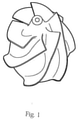
- FIG. 1 is a perspective view of an impeller being one example of a molded article according to the present invention.
- the polyamide resin composition of the present invention contains a semi-aromatic polyamide (A) and a fibrous reinforcing material (B).
- the semi-aromatic polyamide (A) contains a dicarboxylic acid component and a diamine component as constituents, and the dicarboxylic acid component contains an aromatic dicarboxylic acid, and the diamine component contains an aliphatic diamine.
- the dicarboxylic acid component constituting the semi-aromatic polyamide (A) preferably includes terephthalic acid (T) as the main component, and the content of terephthalic acid is preferably 75 mol % or more, more preferably 85 mol % or more, and further preferably 100 mol % in the dicarboxylic acid component from the viewpoint of heat resistance and creep characteristics.
- T terephthalic acid
- the diamine component in the semi-aromatic polyamide (A) is preferably an aliphatic diamine having 8 to 12 carbon atoms, from the viewpoint of heat resistance and processability.
- Examples of the aliphatic diamine having 8 to 12 carbon atoms include 1,8-octanediamine, 1,9-nonanediamine, 1,10-decanediamine, 1,11-undecanediamine, and 1,12-dodecanediamine. These may be used singly or in combination.
- the diamine component preferably includes 1,10-decanediamine as the main component because of high versatility, and from the viewpoint of heat resistance and creep characteristics, the content of 1,10-decanediamine is preferably 75 mol % or more, more preferably 85 mol % or more, and further preferably 100 mol % in the diamine component.
- semi-aromatic polyamide (A) examples include polyamide 8T, polyamide 9T, polyamide 10T, polyamide 11T, and polyamide 12T.
- the dicarboxylic acid component of the semi-aromatic polyamide (A) may contain a dicarboxylic acid other than terephthalic acid.
- the dicarboxylic acid other than terephthalic acid include aromatic dicarboxylic acids such as phthalic acid, isophthalic acid, and naphthalenedicarboxylic acid, aliphatic dicarboxylic acids such as oxalic acid, malonic acid, succinic acid, glutaric acid, adipic acid, pimelic acid, suberic acid, azelaic acid, sebacic acid, undecanedioic acid, and dodecanedioic acid, and alicyclic dicarboxylic acids such as cyclohexanedicarboxylic acid.
- the content of the dicarboxylic acid other than terephthalic acid is preferably less than 25 mol %, more preferably less than 15 mol %, in the dicarboxylic acid component, and the dicarboxylic acid component further preferably does not substantially include dicarboxylic acid other than terephthalic acid.
- the diamine component of the semi-aromatic polyamide (A) may contain another diamine other than an aliphatic diamine having 8 to 12 carbon atoms.
- another diamine include aliphatic diamines such as 1,2-ethanediamine, 1,3-propanediamine, 1,4-butanediamine, 1,5-pentanediamine, 1,6-hexanediamine, 1,7-heptanediamine, 1,13-tridecanediamine, 1,14-tetradecanediamine, and 1,15-pentadecanediamine, alicyclic diamines such as cyclohexanediamine, and aromatic diamines such as xylylenediamine and benzenediamine.
- the content of another diamine other than an aliphatic diamine having 8 to 12 carbon atoms is preferably less than 25 mol %, more preferably less than 15 mol %, in the diamine component, and the diamine component further preferably does not substantially include another diamine other than an aliphatic diamine having 8 to 12 carbon atoms.
- the semi-aromatic polyamide (A) may contain lactams such as caprolactam and laurolactam, and ⁇ -aminocarboxylic acids such as aminocaproic acid and 11-aminoundecanoic acid, as needed.
- lactams such as caprolactam and laurolactam
- ⁇ -aminocarboxylic acids such as aminocaproic acid and 11-aminoundecanoic acid, as needed.
- the content of these is preferably less than 10 mol % based on the total number of moles of the raw material monomers, and the semi-aromatic polyamide (A) more preferably does not substantially include these.
- the semi-aromatic polyamide (A) preferably contains a monocarboxylic acid component as a constituent.
- the amount of terminal free amino groups can be kept low, and the decomposition and discoloration of the polyamide due to thermal deterioration and oxidative deterioration when the polyamide is subjected to heat are suppressed, and the terminals are hydrophobic, and therefore the polyamide can have low water absorbency. As a result, the heat resistance and low water absorbency of the obtained resin composition can be improved.
- the content of the monocarboxylic acid component is preferably 0.3 to 4.0 mol %, more preferably 0.3 to 3.0 mol %, further preferably 0.3 to 2.5 mol %, and particularly preferably 0.8 to 2.5 mol % based on all the monomer components constituting the semi-aromatic polyamide (A) .
- the content of the monocarboxylic acid component is 0.3 to 4.0 mol %, the molecular weight distribution during polymerization can be decreased, the releasability during molding processing can be improved, and the amount of gas generated can be suppressed during molding processing.
- the content of the monocarboxylic acid component is more than 4.0 mol %, the mechanical characteristics may decrease.
- the content of the monocarboxylic acid refers to the proportion of the residue of the monocarboxylic acid, that is, the moiety obtained by the elimination of the terminal hydroxyl group from the monocarboxylic acid, in the semi-aromatic polyamide (A).
- the monocarboxylic acid component examples include aliphatic monocarboxylic acids, alicyclic monocarboxylic acids, and aromatic monocarboxylic acids. Especially, aliphatic monocarboxylic acids are preferred because the amount of generated gases of semi-aromatic polyamide-derived components can be decreased, the fluidity of the resin composition can be improved, mold soil can be reduced, and the releasability can be improved.
- monocarboxylic acids having a molecular weight of 140 or more are preferred, and monocarboxylic acids having a molecular weight of 170 or more are more preferred.
- a monocarboxylic acid having a molecular weight of 140 or more the releasability improves, the amount of gas generated can be suppressed at the temperature during molding processing, and the molding fluidity can also be improved.
- Examples of aliphatic monocarboxylic acids having a molecular weight of 140 or more include caprylic acid, nonanoic acid, decanoic acid, lauric acid, myristic acid, palmitic acid, stearic acid, and behenic acid.
- Examples of alicyclic monocarboxylic acids having a molecular weight of 140 or more include 4-ethylcyclohexanecarboxylic acid, 4-hexylcyclohexanecarboxylic acid, and 4-laurylcyclohexanecarboxylic acid.
- aromatic monocarboxylic acids having a molecular weight of 140 or more include 4-ethylbenzoic acid, 4-hexylbenzoic acid, 4-laurylbenzoic acid, 1-naphthoic acid, 2-naphthoic acid, and derivatives thereof.
- the monocarboxylic acid components may be used singly or in combination.
- a monocarboxylic acid having a molecular weight of 140 or more and a monocarboxylic acid having a molecular weight of less than 140 may be used in combination.
- the molecular weight of the monocarboxylic acid refers to the molecular weight of the raw material monocarboxylic acid.
- the semi-aromatic polyamide (A) needs to have a melting point of 290 to 330°C.
- the polyamide resin composition of the present invention can have a decreased amount of creep strain by containing the semi-aromatic polyamide (A) having a melting point of 290 to 330°C and the fibrous reinforcing material (B).
- the melting point of the semi-aromatic polyamide (A) is less than 290°C, the polyamide resin composition has low heat resistance and an increased amount of creep strain.
- the semi-aromatic polyamide (A) having a melting point of more than 330°C is not preferred because the melting processing temperature is close to the decomposition temperature, and the semi-aromatic polyamide (A) decomposes during melting processing and is difficult to process.
- the semi-aromatic polyamide (A) used in the present invention can be produced using a conventionally known heat polymerization method or solution polymerization method.
- the heat polymerization method is preferably used in terms of being industrially advantageous.
- Examples of the heat polymerization method include a method consisting of the step (i) of obtaining a reaction product from an aromatic dicarboxylic acid component and a diamine component, and the step (ii) of polymerizing the obtained reaction product.
- Examples of the step (i) include a method of previously heating a dicarboxylic acid powder to a temperature equal to or more than the melting point of a diamine and equal to or less than the melting point of the dicarboxylic acid, and adding the diamine to the dicarboxylic acid powder at this temperature with water not substantially contained so as to keep the powder state of the dicarboxylic acid.
- Examples of another method include a method of stirring and mixing a suspension consisting of a diamine in a molten state and a solid dicarboxylic acid to obtain a mixed liquid, and then performing a salt formation reaction by the reaction of the dicarboxylic acid and the diamine, and an oligomer formation reaction by the polymerization of the formed salt at a temperature less than the melting point of the finally formed semi-aromatic polyamide to obtain a mixture of the salt and the oligomer.
- crushing may be performed while the reactions are performed, or crushing may be performed after the reaction product is once taken out after the reactions.
- the former with easy control of the shape of the reaction product is preferred.
- Examples of the step (ii) include a method of solid phase-polymerizing the reaction product obtained in the step (i) at a temperature less than the melting point of the finally formed semi-aromatic polyamide to perform polymerization to a predetermined molecular weight to obtain the semi-aromatic polyamide.
- the solid phase polymerization is preferably performed in a gas flow of an inert gas such as nitrogen with a polymerization temperature of 180 to 270°C and a reaction time of 0.5 to 10 hours.
- reaction apparatuses in the step (i) and the step (ii) are not particularly limited, and known apparatuses should be used.
- the step (i) and the step (ii) may be carried out by the same apparatus or different apparatuses.
- a polymerization catalyst may be used in order to increase the efficiency of polymerization.
- the polymerization catalyst include phosphoric acid, phosphorous acid, hypophosphorous acid, or salts thereof.
- the amount of the polymerization catalyst added is usually preferably 2.0 mol % or less based on all the monomers constituting the semi-aromatic polyamide (A).
- the polyamide resin composition of the present invention needs to contain the fibrous reinforcing material (B) .
- fibrous reinforcing material (B) examples include glass fibers, carbon fibers, boron fibers, asbestos fibers, polyvinyl alcohol fibers, polyester fibers, acrylic fibers, aramid fibers, polybenzoxazole fibers, kenaf fibers, bamboo fibers, hemp fibers, bagasse fibers, high strength polyethylene fibers, alumina fibers, silicon carbide fibers, potassium titanate fibers, brass fibers, stainless steel fibers, steel fibers, ceramic fibers, and basalt fibers.
- the fibrous reinforcing material (B) is preferably carbon fibers having a tensile strength of 4000 to 4800 MPa.
- the polyamide resin composition is likely to have an amount of creep strain of 2.0% or less in the flow direction after a lapse of 100 hours under the measurement conditions of a temperature of 100°C and a tensile load of 75 MPa.
- the carbon fibers contained in the polyamide resin composition preferably have a tensile strength of not more than 4800 MPa for the following reasons.
- the melting point of the semi-aromatic polyamide (A) is 290 to 330°C, and therefore the actual processing temperature in melting and kneading reaches about 330 to 400°C.
- the resin composition contains high strength carbon fibers having a tensile strength of more than 4800 MPa
- excessive shear heat generation is caused during melting and kneading, and the temperature increases further, and the decomposition of the resin and the decomposition of the surface treatment agent on the fibers may occur, and poor dispersion of the fibers due to viscosity decrease may occur. Therefore, even if the resin composition contains high strength carbon fibers having a tensile strength of more than 4800 MPa, the effect of improving the amount of strain and other mechanical characteristics is not only not obtained but may decrease.
- the resin composition hardens under the influence of the strength of the carbon fibers and has decreased fluidity. It is also possible to perform melting and kneading by a small scale extruder or perform melting and kneading with the discharge and the number of revolutions set low, in order to suppress shear heat generation, but the productivity decreases significantly.
- the carbon fibers having a tensile strength of 4000 to 4800 MPa preferably have a fiber length of 0.1 to 7 mm, more preferably 0.5 to 6 mm.
- the carbon fibers preferably have a fiber diameter of 3 to 20 ⁇ m, more preferably 5 to 13 ⁇ m.
- the mechanical characteristics of the resin composition can be improved while breakage is decreased during melting and kneading.
- the carbon fibers preferably have a circular cross section but may have a rectangular cross section, an elliptical cross section, or an irregularly shaped cross section other than a rectangular cross section and an elliptical cross section, as needed.
- the content of the carbon fibers having a tensile strength of 4000 to 4800 MPa is preferably 1 to 60% by mass, and is more preferably 1 to 50% by mass because the mechanical strength improves. Especially, the content of the carbon fibers is further preferably 15 to 50% by mass because the specific gravity is low compared with conventional resin compositions, and the effect of improving mechanical strength increases.
- the content of these carbon fibers is more than 60% by mass in the polyamide resin composition, the effect of improving mechanical characteristics is saturated, and not only can a more improving effect not be anticipated, but the fluidity decreases extremely, and therefore it may be difficult to obtain a molded article.
- the polyamide resin composition of the present invention may further contain additives such as a stabilizer, a colorant, an antistatic agent, a flame retardant, a flame-retardant aid, and a carbonization inhibitor, as needed.
- a stabilizer examples include hindered phenolic antioxidants, phosphorus-based antioxidants, sulfur-based antioxidants, light stabilizers, heat stabilizers consisting of copper compounds, and heat stabilizers consisting of alcohols.
- the flame retardant include bromine-based flame retardants, phosphorus-based flame retardants consisting of metal phosphinates, and flame retardants consisting of phosphazene compounds.
- Examples of the flame-retardant aid include metal salts such as zinc stannate, zinc borate, antimony trioxide, antimony pentoxide, and sodium antimonate.
- the carbonization inhibitor is an additive for improving tracking resistance, and examples of the carbonization inhibitor include inorganic matter such as metal hydroxides and metal borates.
- the polyamide resin composition of the present invention needs to have an amount of creep strain of 2.0% or less after a lapse of 100 hours under the measurement conditions of a temperature of 100°C and a tensile load of 75 MPa and preferably has an amount of creep strain of 1.5% or less, more preferably 1.0% or less.
- the amount of strain of the polyamide resin composition is more than 2.0%, the obtained rotating body such as impeller or fan, or the like may have limited rotation speed.
- the polyamide resin composition of the present invention contains the semi-aromatic polyamide (A) and the fibrous reinforcing material (B), the amount of strain can be 2.0% or less.
- the polyamide resin composition of the present invention preferably has a bending strength of 180 MPa or more, more preferably 250 MPa or more, as measured in accordance with ISO 178 and preferably has a bending modulus of 5 GPa or more, more preferably 10 GPa or more, as measured in accordance with ISO 178.
- the obtained rotating body such as impeller or fan, or the like has a small dimensional change and can be rotated at higher speed.
- the method for producing the polyamide resin composition of the present invention a method of blending the semi-aromatic polyamide (A), the fibrous reinforcing material (B), and additives and the like added as needed, and melting and kneading the blend is preferred.
- Examples of the melting and kneading method include methods using a batch type kneader such as Brabender, a Banbury mixer, a Henschel mixer, a helical rotor, a roll, a single-screw extruder, a twin-screw extruder, and the like.
- a batch type kneader such as Brabender, a Banbury mixer, a Henschel mixer, a helical rotor, a roll, a single-screw extruder, a twin-screw extruder, and the like.
- Examples of the method for processing the polyamide resin composition into various shapes include a method of extruding a molten mixture in the form of strands and converting the strands into a pellet shape, a method of hot-cutting or underwater-cutting a molten mixture into a pellet shape, a method of extrusion in the form of a sheet and cutting, and a method of extrusion in the form of a block and grinding into a powdery shape.
- the molded article of the present invention is obtained by molding the polyamide resin composition and can be applied to rotating bodies such as impellers and fans.
- an impeller is housed in a housing, and when the impeller rotates, a flow occurs in the space between the outer surface of the impeller and the inner surface of the housing. As the rotation of the impeller becomes faster, and as the space becomes smaller, the occurring flow becomes faster.
- centrifugal force Large stress (centrifugal force) is applied to an impeller rotating at high speed, in the centrifugal direction in proportion to mass, and further bending stress is applied in the direction opposite to the rotation by resistance to the fluid, and the impeller constantly deforms slightly during rotation. When high speed rotation is continued for a long period, the impeller deforms gradually in the centrifugal direction.
- the degree of this continuous deformation can be evaluated by the creep deformation of the material of the impeller.
- the degree of instantaneous deformation can be evaluated by the elastic modulus of the material of the impeller.
- the polyamide resin composition of the present invention has high heat resistance and high creep strength and therefore can be preferably used as rotating bodies such as propellers, impellers, fans, axial flow fans, blades, and bladed wheels, and the sliding members of actuators, bearings, and the like.
- the polyamide resin composition of the present invention can be particularly preferably used in applications for such rotating bodies as to be small, have thin blades, and further be used in high speed rotation at 10,000 or more revolutions per minute.
- Examples of the method for molding the polyamide resin composition to produce a molded article include an injection molding method, an extrusion method, a blow molding method, and a sinter molding method. Especially, the injection molding method is preferred because the effect of improving mechanical characteristics and moldability is large.
- the injection molding machine is not particularly limited, and examples of the injection molding machine include a screw in-line type injection molding machine and a plunger type injection molding machine.
- the polyamide resin composition heated and melted in the cylinder of an injection molding machine is measured for each shot, injected into a mold in a molten state, cooled and solidified in a predetermined shape, and then taken out of the mold as a molded article.
- the resin temperature during the injection molding is preferably the melting point (Tm) of the semi-aromatic polyamide (A) or more, more preferably less than (Tm + 50°C).
- the mold temperature during the molding is not particularly limited but is preferably 80 to 150°C.
- the polyamide resin composition of the present invention With the polyamide resin composition of the present invention, with the mold in this temperature range, a molded article having a high degree of crystallinity can be obtained, and in turn, a molded article excellent in high heat resistance and low water absorbency can be obtained.
- the mold temperature during molding needs to be 200°C or more.
- the polyamide resin composition of the present invention can be molded with a low temperature mold compared with the conventional resins, and the reduction of energy cost during molding mass production is possible.
- sufficiently dried resin composition pellets are preferably used.
- the moisture percentage of the resin composition pellets used in injection molding is preferably less than 0.3% by mass, more preferably less than 0.1% by mass.
- the temperature was increased to 360°C at a temperature increasing rate of 20°C/minute, then maintained at 360°C for 5 minutes, decreased to 25°C at a temperature decrease rate of 20°C/minute, further maintained at 25°C for 5 minutes, and then increased again at a temperature increasing rate of 20°C/minute for measurement, using a differential scanning calorimeter (model DSC-7 manufactured by PerkinElmer Inc.). The top of the endothermic peak at the time was taken as the melting point.
- Obtained pellets of a resin composition were sufficiently dried and then injection-molded under the conditions of a cylinder temperature of (melting point + 15°C) and a molding cycle of 35 seconds using an injection molding machine (model S2000i-100B manufactured by FANUC CORPORATION), to make a dumbbell test piece.
- a cylinder temperature of (melting point + 15°C) melting point + 15°C
- a molding cycle of 35 seconds using an injection molding machine (model S2000i-100B manufactured by FANUC CORPORATION), to make a dumbbell test piece.
- the mold temperature was 120°C
- Comparative Example 11 the mold temperature was 90°C.
- the density was measured in accordance with ISO 1183.
- dumbbell test piece made by the same method as the method described in the (2), the bending strength and the bending modulus were measured in accordance with ISO 178.
- dumbbell test piece made, with reference to ISO 899-1, a tensile creep test under a temperature atmosphere of 100°C and at a tensile load of 75 MPa was carried out, and the amount of creep strain after a lapse of 100 hours was measured.
- Obtained pellets of a resin composition were sufficiently dried, and then a 40 mm ⁇ 40 mm ⁇ 3.0 mmt test piece was made at a cylinder temperature of (melting point + 15°C), a mold surface roughness (arithmetic mean height (Sa)) of 1 ⁇ m, and a mold temperature of 180°C under the condition of a molding cycle of 30 seconds using an injection molding machine (J35-AD manufactured by The Japan Steel Works, Ltd.).
- test piece was also made at a mold temperature of 120°C.
- the arithmetic mean height (Sa) was measured within the range of 25 mm ⁇ 25 mm in the central portion of each test piece at 12x magnification using a 3D shape measuring machine (VR-3200 manufactured by KEYENCE CORPORATION).
- an arithmetic mean height (Sa) of 5 ⁇ m or less was considered acceptable.
- Obtained pellets of a resin composition were sufficiently dried, and then a 0.5 mm thick test piece for flow length measurement was made at a cylinder temperature of (melting point + 15°C) and a mold temperature of 120°C under the condition of a molding cycle of 30 seconds using an injection molding machine (J35-AD manufactured by The Japan Steel Works, Ltd.).
- a flow length of 8 mm or more is considered acceptable, and the flow length is preferably 15 mm or more.
- An impeller having a maximum outer diameter of 25 mm was made by the molding method described in the (2) except that a mold for molding the impeller in FIG. 1 was used instead of the mold for making a dumbbell test piece.
- the obtained impeller was housed in a housing having a gap of 500 ⁇ m formed by the dimensional difference between the impeller outer diameter and the housing inner diameter, and subjected to a 200 hour continuous durability test at a number of revolutions of 100,000 rpm using a spin tester.
- the continuous durability of the impeller was evaluated by the time until the impeller broke due to the fatigue or creep life of the impeller, the cracking of the impeller or the chipping of the impeller due to the contact of the impeller with the housing due to the deformation of the vane portion, or the like.
- TPA powdery terephthalic acid
- STA stearic acid
- 9.3 g of sodium hypophosphite monohydrate as a polymerization catalyst were placed in a ribbon blender type reaction apparatus, and heated to 170°C in a nitrogen-sealed state while being stirred at a number of revolutions of 30 rpm.
- the obtained reaction product was polymerized by heating using the same reaction apparatus under a nitrogen gas flow at 250°C and a number of revolutions of 30 rpm for 8 hours to make a polyamide powder.
- the obtained polyamide powder was converted into the form of strands using a twin-screw kneader, and the strands were passed through a water tank for cooling and solidification.
- the cooled and solidified strands were cut by a pelletizer to obtain semi-aromatic polyamide (PA10T-1) pellets.
- PA10T-2 PA10T/10I-1, 2, and 3
- PA10T/6T-1 and 2 PA9T-1, 2, 3, and 4
- polyamide 66 (UNITIKA Nylon 66 A125J manufactured by UNITIKA LTD.), melting point 260°C
- the cooled and solidified strands were cut by a pelletizer to obtain pellets of a resin composition.
- the barrel temperature of the extruder was set at (melting point of PA10T-1 -5 to +15°C), the number of revolutions of the screw was 250 rpm, and the amount of discharge was 25 kg/h.
- Example 2 The same operations as Example 1 were performed except as shown in Table 2, to obtain pellets of resin compositions.
- the constituents were within the ranges defined in the present invention, and therefore the amount of creep strain was 2.0% or less, and the molded articles obtained by molding at mold temperatures of 120°C and 180°C had small surface roughness (arithmetic mean height (Sa)) and were excellent in appearance.
- the tensile strength of the carbon fibers was high, and therefore the fluidity was somewhat poor.
- the content of the fibrous reinforcing material was low, and in the polyamide resin compositions of Examples 6 to 10, the melting point of the semi-aromatic polyamide resin was low, and the heat resistance was low, and therefore all had a somewhat large amount of creep strain.
- the resin compositions of Examples 3 and 9 contained a semi-aromatic polyamide (A) in which the monocarboxylic acid component is stearic acid, and therefore each had long flow length compared with the resin compositions of Examples 5 and 10 containing a semi-aromatic polyamide (A) in which the monocarboxylic acid component is benzoic acid.
- the resin composition of Comparative Example 1 contained no fibrous reinforcing material, the resin compositions of Comparative Examples 2 and 3 used carbon fibers having a tensile strength of less than 4000 MPa, and the resin compositions of Comparative Examples 4 and 5 used glass fibers without using carbon fibers, and therefore all had a large amount of creep strain.
- Comparative Example 6 the content of the fibrous reinforcing material was too high, and therefore melting and kneading could not be performed, and a resin composition could not be obtained.
- the resin compositions of Comparative Examples 7 to 11 used a polyamide resin having a low melting point and therefore had a large amount of creep strain.
- the resin composition of Comparative Example 12 used polyetheretherketone and therefore had high density, and the molded article obtained by molding with the low temperature mold had large surface roughness (Sa) and was poor in appearance.
- the impellers obtained by molding the resin compositions obtained in the Comparative Examples broke before 50 hours in the continuous durability test, but the impellers obtained by molding the resin compositions of the Examples had a life of 100 hours or more.
- load application is discontinuous, the influence of heat generation decreases, and a strain recovery effect can be expected, and therefore it can be said that when an impeller has a life of 100 hours or more in the continuous durability test, the impeller has sufficient durability.
- the gap between the impeller and the housing can be changed from 500 ⁇ m to 100 ⁇ m, and compressors using these impellers can have improved compression efficiency.
Landscapes
- Chemical & Material Sciences (AREA)
- Engineering & Computer Science (AREA)
- Medicinal Chemistry (AREA)
- Health & Medical Sciences (AREA)
- Chemical Kinetics & Catalysis (AREA)
- Polymers & Plastics (AREA)
- Organic Chemistry (AREA)
- General Engineering & Computer Science (AREA)
- Mechanical Engineering (AREA)
- Inorganic Chemistry (AREA)
- Manufacturing & Machinery (AREA)
- Materials Engineering (AREA)
- Compositions Of Macromolecular Compounds (AREA)
Applications Claiming Priority (2)
| Application Number | Priority Date | Filing Date | Title |
|---|---|---|---|
| JP2019084798 | 2019-04-26 | ||
| PCT/JP2020/016926 WO2020218209A1 (fr) | 2019-04-26 | 2020-04-17 | Composition de résine de polyamide et article moulé obtenu par moulage de celle-ci |
Publications (2)
| Publication Number | Publication Date |
|---|---|
| EP3960809A1 true EP3960809A1 (fr) | 2022-03-02 |
| EP3960809A4 EP3960809A4 (fr) | 2022-06-22 |
Family
ID=72942705
Family Applications (1)
| Application Number | Title | Priority Date | Filing Date |
|---|---|---|---|
| EP20795402.5A Withdrawn EP3960809A4 (fr) | 2019-04-26 | 2020-04-17 | Composition de résine de polyamide et article moulé obtenu par moulage de celle-ci |
Country Status (6)
| Country | Link |
|---|---|
| US (1) | US20220195187A1 (fr) |
| EP (1) | EP3960809A4 (fr) |
| JP (1) | JP7554485B2 (fr) |
| CN (1) | CN113748162A (fr) |
| TW (1) | TW202104355A (fr) |
| WO (1) | WO2020218209A1 (fr) |
Families Citing this family (1)
| Publication number | Priority date | Publication date | Assignee | Title |
|---|---|---|---|---|
| CN121108731A (zh) * | 2025-10-20 | 2025-12-12 | 浙江欧星环美汽车部件有限公司 | 一种抗冲击耐刮花汽车轮毂盖及其制备方法 |
Family Cites Families (17)
| Publication number | Priority date | Publication date | Assignee | Title |
|---|---|---|---|---|
| JPH068317Y2 (ja) | 1986-10-16 | 1994-03-02 | 日産自動車株式会社 | インペラ |
| JPH0640881Y2 (ja) | 1988-01-21 | 1994-10-26 | 日産自動車株式会社 | 樹脂製インペラ |
| JP2667247B2 (ja) | 1989-04-12 | 1997-10-27 | 三井東圧化学株式会社 | 内燃機関部品並びに補機部品 |
| JPH0642302A (ja) | 1992-07-23 | 1994-02-15 | Nissan Motor Co Ltd | 繊維強化樹脂製インペラ |
| JP5851767B2 (ja) * | 2011-08-30 | 2016-02-03 | 帝人株式会社 | 繊維強化基材 |
| JP2013049793A (ja) * | 2011-08-31 | 2013-03-14 | Unitika Ltd | 半芳香族ポリアミド樹脂組成物ペレットおよびそれを成形してなる成形体 |
| EP2759562B1 (fr) * | 2011-09-22 | 2015-11-18 | Unitika, Ltd. | Polyamide semi-aromatique et corps moulé le comprenant |
| CN103958612B (zh) * | 2011-11-29 | 2016-08-24 | 东丽株式会社 | 碳纤维增强热塑性树脂组合物、该组合物的粒料和成型品 |
| EP3026084B1 (fr) * | 2013-07-26 | 2020-02-19 | Mitsui Chemicals, Inc. | Composition de résine polyamide semi-aromatique et article moulé formé à partir de celle-ci |
| WO2015053181A1 (fr) * | 2013-10-11 | 2015-04-16 | 東レ株式会社 | Composition de résine renforcée par des fibres de carbone, pellets, objet moulé et boîtier pour dispositif électronique |
| JP2016102194A (ja) * | 2014-11-12 | 2016-06-02 | ユニチカ株式会社 | 複合構造体 |
| JP6490980B2 (ja) * | 2015-02-18 | 2019-03-27 | ユニチカ株式会社 | ポリアミド樹脂組成物 |
| JP6630989B2 (ja) * | 2016-03-25 | 2020-01-15 | 三菱重工エンジン&ターボチャージャ株式会社 | 繊維強化部材のめっき方法 |
| CN107057343A (zh) * | 2017-01-20 | 2017-08-18 | 金发科技股份有限公司 | 一种半芳香族聚酰胺树脂及其制备方法和由其组成的聚酰胺模塑组合物 |
| JP2018145292A (ja) * | 2017-03-06 | 2018-09-20 | 三井化学株式会社 | ポリアミド樹脂組成物及びその成形品 |
| JP7093104B2 (ja) * | 2017-05-15 | 2022-06-29 | ユニチカ株式会社 | 熱可塑性樹脂組成物およびそれを成形してなる成形体 |
| CN111201286B (zh) * | 2017-11-30 | 2022-12-30 | 尤尼吉可株式会社 | 聚酰胺树脂组合物和将其成型而成的成型体 |
-
2020
- 2020-04-17 EP EP20795402.5A patent/EP3960809A4/fr not_active Withdrawn
- 2020-04-17 CN CN202080031582.3A patent/CN113748162A/zh active Pending
- 2020-04-17 US US17/603,399 patent/US20220195187A1/en not_active Abandoned
- 2020-04-17 JP JP2021516083A patent/JP7554485B2/ja active Active
- 2020-04-17 WO PCT/JP2020/016926 patent/WO2020218209A1/fr not_active Ceased
- 2020-04-21 TW TW109113324A patent/TW202104355A/zh unknown
Also Published As
| Publication number | Publication date |
|---|---|
| JPWO2020218209A1 (fr) | 2020-10-29 |
| US20220195187A1 (en) | 2022-06-23 |
| TW202104355A (zh) | 2021-02-01 |
| WO2020218209A1 (fr) | 2020-10-29 |
| JP7554485B2 (ja) | 2024-09-20 |
| EP3960809A4 (fr) | 2022-06-22 |
| CN113748162A (zh) | 2021-12-03 |
Similar Documents
| Publication | Publication Date | Title |
|---|---|---|
| EP2479219B1 (fr) | Composition de résine polyamide ignifuge | |
| CN104629353B (zh) | 对热和光稳定的聚酰胺组合物 | |
| US9624416B2 (en) | Polyamide resin composition and molded article comprising the same | |
| JP5371683B2 (ja) | ポリアミド樹脂組成物ペレットの製造方法 | |
| JP6767496B2 (ja) | ポリアミド樹脂組成物 | |
| EP2920237B1 (fr) | Procédé pour l'augmentation de la résistance à la fatigue de polyamides | |
| JP5621449B2 (ja) | ポリアミド樹脂組成物ペレットの製造方法 | |
| JP2021059707A (ja) | 半芳香族ポリアミド樹脂組成物およびそれからなる成形体、摺動部材 | |
| JP2023103598A (ja) | 半芳香族ポリアミド樹脂組成物およびそれを用いた成形品 | |
| JP6854032B1 (ja) | ポリアミド樹脂組成物ならびにそれからなる成形体および車載カメラ用部品 | |
| EP3960809A1 (fr) | Composition de résine de polyamide et article moulé obtenu par moulage de celle-ci | |
| JP7525290B2 (ja) | ポリアミド樹脂組成物及び成形品 | |
| JP7808852B2 (ja) | ポリアミド樹脂組成物およびそれからなる成形体、車載カメラ用部品 | |
| JP7514449B2 (ja) | 炭素繊維強化ポリアミド樹脂組成物およびその成形品 | |
| JP2022116418A (ja) | 樹脂歯車 | |
| EP2398852B1 (fr) | Composition de polyester améliorée renforcée par fibres | |
| CN112592582B (zh) | 聚酰胺树脂组合物和由其构成的成型体及车载照相机用部件 | |
| JP2022186617A (ja) | 半芳香族ポリアミド樹脂組成物およびそれを成形してなる摺動部品。 | |
| JP2021195496A (ja) | 摺動部材用樹脂組成物 | |
| EP3024890A1 (fr) | Composition polyamide | |
| JP2014181242A (ja) | 半芳香族ポリアミドおよびその成形体 | |
| JP2023128809A (ja) | シールリング | |
| JP6823860B2 (ja) | ポリアミド樹脂組成物、その製造方法およびそれからなる成形体 | |
| JP2023029105A (ja) | ポリアミド樹脂組成物 | |
| CN114787214A (zh) | 改进的聚酯 |
Legal Events
| Date | Code | Title | Description |
|---|---|---|---|
| STAA | Information on the status of an ep patent application or granted ep patent |
Free format text: STATUS: THE INTERNATIONAL PUBLICATION HAS BEEN MADE |
|
| PUAI | Public reference made under article 153(3) epc to a published international application that has entered the european phase |
Free format text: ORIGINAL CODE: 0009012 |
|
| STAA | Information on the status of an ep patent application or granted ep patent |
Free format text: STATUS: REQUEST FOR EXAMINATION WAS MADE |
|
| 17P | Request for examination filed |
Effective date: 20211026 |
|
| AK | Designated contracting states |
Kind code of ref document: A1 Designated state(s): AL AT BE BG CH CY CZ DE DK EE ES FI FR GB GR HR HU IE IS IT LI LT LU LV MC MK MT NL NO PL PT RO RS SE SI SK SM TR |
|
| A4 | Supplementary search report drawn up and despatched |
Effective date: 20220524 |
|
| RIC1 | Information provided on ipc code assigned before grant |
Ipc: H02K 9/00 20060101ALI20220518BHEP Ipc: F24F 7/00 20210101ALI20220518BHEP Ipc: C08K 7/06 20060101ALI20220518BHEP Ipc: F01D 5/04 20060101ALI20220518BHEP Ipc: C08J 5/04 20060101ALI20220518BHEP Ipc: C08L 77/06 20060101ALI20220518BHEP Ipc: C08K 7/02 20060101AFI20220518BHEP |
|
| DAV | Request for validation of the european patent (deleted) | ||
| DAX | Request for extension of the european patent (deleted) | ||
| STAA | Information on the status of an ep patent application or granted ep patent |
Free format text: STATUS: EXAMINATION IS IN PROGRESS |
|
| 17Q | First examination report despatched |
Effective date: 20230130 |
|
| STAA | Information on the status of an ep patent application or granted ep patent |
Free format text: STATUS: THE APPLICATION HAS BEEN WITHDRAWN |
|
| 18W | Application withdrawn |
Effective date: 20230424 |