EP3961705A1 - Mehrfarbige beleuchtungsvorrichtung - Google Patents
Mehrfarbige beleuchtungsvorrichtung Download PDFInfo
- Publication number
- EP3961705A1 EP3961705A1 EP20193561.6A EP20193561A EP3961705A1 EP 3961705 A1 EP3961705 A1 EP 3961705A1 EP 20193561 A EP20193561 A EP 20193561A EP 3961705 A1 EP3961705 A1 EP 3961705A1
- Authority
- EP
- European Patent Office
- Prior art keywords
- light emitting
- emitting element
- lighting device
- color
- insulating layer
- Prior art date
- Legal status (The legal status is an assumption and is not a legal conclusion. Google has not performed a legal analysis and makes no representation as to the accuracy of the status listed.)
- Pending
Links
Images


Classifications
-
- H—ELECTRICITY
- H10—SEMICONDUCTOR DEVICES; ELECTRIC SOLID-STATE DEVICES NOT OTHERWISE PROVIDED FOR
- H10W—GENERIC PACKAGES, INTERCONNECTIONS, CONNECTORS OR OTHER CONSTRUCTIONAL DETAILS OF DEVICES COVERED BY CLASS H10
- H10W90/00—Package configurations
-
- H—ELECTRICITY
- H10—SEMICONDUCTOR DEVICES; ELECTRIC SOLID-STATE DEVICES NOT OTHERWISE PROVIDED FOR
- H10H—INORGANIC LIGHT-EMITTING SEMICONDUCTOR DEVICES HAVING POTENTIAL BARRIERS
- H10H20/00—Individual inorganic light-emitting semiconductor devices having potential barriers, e.g. light-emitting diodes [LED]
- H10H20/80—Constructional details
- H10H20/85—Packages
- H10H20/858—Means for heat extraction or cooling
-
- H—ELECTRICITY
- H10—SEMICONDUCTOR DEVICES; ELECTRIC SOLID-STATE DEVICES NOT OTHERWISE PROVIDED FOR
- H10H—INORGANIC LIGHT-EMITTING SEMICONDUCTOR DEVICES HAVING POTENTIAL BARRIERS
- H10H20/00—Individual inorganic light-emitting semiconductor devices having potential barriers, e.g. light-emitting diodes [LED]
- H10H20/80—Constructional details
- H10H20/85—Packages
- H10H20/857—Interconnections, e.g. lead-frames, bond wires or solder balls
Definitions
- the present disclosure relates to a lighting device, in particular a light-emitting diode (LED) based lighting device, to an automotive lighting system, and to a method for producing a lighting device.
- a lighting device in particular a light-emitting diode (LED) based lighting device
- an automotive lighting system and to a method for producing a lighting device.
- LED light-emitting diode
- Lighting devices based on Light Emitting Diodes are advantageous in terms of light output and energy efficiency and are therefore welcome replacements of conventional light sources like filament lamps in automotive applications. Thereby, a provision of such lighting devices faces challenges in particular in placement accuracy of light sources with respect to complementary optical systems (such as reflectors or light guides) and thermal management.
- LED based automotive lighting systems such as daytime running lights or turn signal lights often rely on customized and complex solutions hampering their provision by mass-production.
- a lighting device comprising an electrically insulating layer; at least one first light emitting element configured to emit light of a first color, and at least one second light emitting element configured to emit light of a second color, the at least one first light emitting element and the at least one second light emitting element being arranged on the electrically insulating layer; and at least one electrical contact element, wherein the at least one electrical contact element is arranged at least in part on the electrically insulating layer and is electrically connected to the at least one first light emitting element and/or to the at least one second light emitting element.
- an automotive lighting system in particular headlight, comprising the lighting device according to the first aspect is provided.
- a method for producing a lighting device comprising: providing an electrically insulating layer; providing at least one first light emitting element configured to emit light of a first color, and at least one second light emitting element configured to emit light of a second color, the at least one first light emitting element and the at least one second light emitting element being arranged on the electrically insulating layer; and providing at least one electrical contact element; wherein the at least one electrical contact element is arranged at least in part on the electrically insulating layer and is electrically connected to the at least one first light emitting element and/or to the at least one second light emitting element.
- Exemplary embodiments of the first, the second and the third aspect of the invention may have one or more of the properties described below.
- the electrically insulating layer serves as a support structure for the at least one first light emitting element and/or for the at least one second light emitting element and may thus be seen as backbone of the lighting device.
- the electrically insulating layer may be formed of any suitable material, e.g. a suitable plastic material, it turned out that ceramic materials are of particular advantage.
- the electrically insulating layer comprises or consists of a ceramic material and/or a material with a thermal conductivity of more than 10 W/(m*K), in particular more than 100 W/(m ⁇ K).
- the electrically insulating layer comprises or consists of aluminum nitride (AlN). In this way, suitable mechanical stiffness and reliability can be achieved using a material with high thermal conductivity.
- the electrically insulating layer and/or the lighting device does not comprise an Insulated Metal Substrate (IMS).
- IMS Insulated Metal Substrate
- the lighting device further comprises an interface layer, the electrically insulating layer being arranged on the interface layer.
- the interface layer is thermally conductive.
- a thermal conductivity of the interface layer is in an exemplary embodiment larger than 100 W/(m ⁇ K).
- Suitable thermal conductivity can be achieved by appropriately selecting a material of or comprised by the interface layer.
- the interface layer comprises or consists of metal, in particular aluminum (Al), copper (Cu) and/or gold (Au).
- the interface layer comprises or consists of gold-coated copper.
- the interface layer is in direct mechanical contact with the electrically insulating layer.
- a thermal coupling between the interface layer and the electrically insulating layer is achieved which enables an improved thermal management of the lighting device as heat generated by the at least one first and the at least one second light emitting element arranged on the insulating layer is advantageously guided away via the interface layer.
- a thickness of the electrically insulating layer is less than or equal to 0.5 mm, in particular 0.4 mm, in particular 0.3 mm. Such a thin electrically insulating layer is particularly beneficial for an improved heat transport through the electrically insulating layer.
- the interface layer corresponds to or comprises a plate or substrate which allows an improved coupling between this structure and the electrically insulating layer.
- the interface layer is further coupled with a heatsink for further guiding heat away from the lighting device.
- the at least one first light emitting element and/or the at least one second light emitting element corresponds to or comprises a light emitting diode (LED).
- the at least one first light emitting element and/or the at least one second light emitting element corresponds to or comprises one or more LED dies.
- the light emitting elements may comprise further components, the light emitted by the light emitting elements is, in an exemplary embodiment, generated by LEDs. LEDs are in particular advantageous in terms of energy efficiency and in that LEDs allow for realizing different shapes and colors in accordance with desired applications.
- the at least one first light emitting element and the at least one second light emitting element are configured to emit light of a first and a second color, respectively.
- at least one of the at least one first and the at least one second light emitting element further comprises a respective phosphor layer arranged on a corresponding light output surface of the respective at least one of the at least one first light emitting element and the at least one second light emitting element.
- a phosphor coating By appropriately selecting a phosphor coating, a color of light emitted from a corresponding light emitting element may be suitably adjusted.
- at least one of the at least one first and the at least one second light emitting element is configured as a light emitting element for directly emitting light of the first and/or the second color.
- the at least one first light emitting element and the at least one second light emitting element are arranged on and in direct mechanical contact with the electrically insulating layer.
- the at least one first light emitting element and the at least one second light emitting element are in direct thermal coupling with the electrically insulating layer such that heat generated by the light emitting elements can be efficiently dissipated away by the described combined effect of the electrically insulating layer and the interface layer.
- the at least one electrical contact element is arranged on, in particular in direct mechanical contact with, the electrically insulating layer, and is configured for electrically connecting the at least one first light emitting element and/or the at least one second light emitting element to a power source.
- the interface layer corresponds to or comprises a thermal pad, in particular a thermal pad comprising or consisting of a metal.
- the thermal pad covers essentially an entire bottom face of the lighting device, in particular wherein the bottom face is opposite of a face of the lighting device at which the at least one first and the at least one second light emitting elements are arranged.
- the first color is different from the second color, wherein the first and/or the second color are selected from: a white color; an amber color; a cyan color.
- the first color is a white color, the at least one first light emitting element thus being configured to emit white light.
- light of the white color is light comprising a superposition of at least two, in particular more than two, optical wavelength spectra (e.g. spectral colors).
- a white color may be realized by a light emitting diode configured for emitting light of blue color provided with a phosphor coating that converts part of the blue light into yellow light, the mixture of blue and yellow light generating a white appearance.
- Different white colors may be characterized by a respective color temperature.
- the first color is a white color having a correlated color temperature, CCT, in between 4000K and 6700K.
- the first and/or second color is a cyan color, i.e. a color in between blue and green, the at least one first and/or second light emitting element thus being respectively configured to emit light of a cyan color.
- light of a cyan color can be characterized by a spectrum of optical wavelengths with a dominant wavelength between 490 nm and 510 nm.
- the second color may be chosen from a red/magenta, green, blue/cyan, orange and/or yellow color or any combination thereof.
- the at least one second light emitting element is configured to emit red/magenta, green, blue/cyan, orange, yellow and/or amber light.
- the second color is an amber color, e.g. in between yellow and orange, the at least one second light emitting element thus being configured to emit light of an amber color.
- light of an amber color can be characterized by a spectrum of optical wavelengths with a dominant wavelength between 585 nm and 600 nm.
- the at least one second light emitting element is a light emitting diode, LED, provided with a suitable phosphor coating and thus configured to emit light of amber color, in particular light with a spectrum of optical wavelength with a dominant wavelength between 585 nm and 600 nm.
- a white light generated by the lighting device may be used to allow for an illumination function
- a cyan light may be used to allow for an autonomous driving mode
- an amber light may be used to allow for a signaling function.
- the at least one first light emitting element is in particular suitable to be employed in a daytime running light mode or an autonomous driving mode
- the at least one second light emitting element being configured for amber or cyan light emission
- the at least one second light emitting element is in particular suitable to be employed in a turn signal mode or an autonomous driving mode.
- the interface layer is an interface plate, in particular comprising or essentially consisting of a metal.
- the metal has a thermal conductivity of equal to or more than 100 W/(m ⁇ K), in particular more than 300 W/(m ⁇ K).
- the electrically insulating layer is in direct mechanical contact with the interface plate.
- direct mechanical contact between the electrical insulating layer and the interface layer enables advantageous thermal coupling of these components and in turn allows for heat generated by the at least one first and the at least one second light emitting element to be advantageously guided away.
- the lighting device in particular the electrically insulating layer, comprises a connection portion for electrically connecting the lighting device and a mounting portion for mounting the at least one first light emitting element and the at least one second light emitting element, wherein a thickness of the connection portion is smaller than a thickness of the mounting portion.
- the connection portion comprises respective portions of the interface layer and the electrically insulating layer and at least one electrical contact element.
- the different thickness of connection portion and mounting portion advantageously allow for electrically connecting the at least one electrical contact element to a power supply without hampering light emission and/or propagation, i.e. without having electrical contact means, e.g.
- the mounting portion comprises respective portions of the interface layer and the electrically insulating layer.
- the portions of the interface layer and the electrically insulating layer comprised by the connection portion are different from the portions of the interface layer and the electrically insulating layer comprised by the mounting portion.
- the at least one first light emitting element and the at least one second light emitting element are at least in part received inside of at least one corresponding portion of the mounting portion.
- the mounting portion thus supports a secure mechanically adjustment of respective positions of the light emitting elements with respect to the lighting device which enables a precise placement of the light emitting elements with respect to corresponding (external) optical systems. Further, being at least partially received by or embedded within the mounting portion, corresponding enhanced contact surfaces advantageously contribute to a beneficial heat transport by the mounting portion away from the light emitting elements.
- the mounting portion and the connection portion are arranged mutually adjacent forming a step at a transition from the connection portion to the mounting portion.
- a step may to be understood as a bump and/or notch, wherein in an exemplary embodiment a height of the lighting device within the connection portion is smaller than a height of the lighting device within the mounting portion.
- the step may form a surface perpendicular to the upper surface of the lighting device.
- a height of the step corresponds to at least 10% of a maximum thickness of the lighting device, in particular to at least 20% of a maximum thickness of the lighting device, in particular to at least 40% of a maximum thickness of the lighting device.
- a lighting device comprising a step as described above advantageously allows for a less complex manufacturing process while protecting the at least one first and/or at least one second light emitting element against environmental conditions such as dust or humidity.
- the at least one first light emitting element and the at least one second light emitting element are respectively received at least in part inside of the mounting portion.
- the mounting portion thus supports a secure mechanical adjustment of respective positions of the light emitting elements with respect to the lighting device which enables a precise placement of the light emitting elements with respect to corresponding (external) optical systems.
- corresponding enhanced contact surfaces advantageously contribute to a beneficial heat transport by the mounting portion away from the light emitting elements.
- the at least one electrical contact element comprises an essentially planar contact portion and is arranged on the electrically insulating layer within the connection portion.
- essentially planar may be understood such that in an exemplary embodiment, a height of the essentially planar contact portion is significantly smaller than a length and/or width of the essentially planar contact portion. In an exemplary embodiment, the height of the essentially planar contact portion amounts to less than or equal to 10% of the length and/or width of the essentially planar contact portion, in particular less than or equal to 5%.
- the essentially planar contact portion is arranged essentially parallel to a bottom surface of the lighting device and/or to respective light emitting surfaces of the at least one first light emitting element and/or the at least one second light emitting element. Being arranged essentially parallel may be understood such that in an exemplary embodiment, an angle formed by the essentially planar contact portion and respective light emitting surfaces is smaller than 10°, in particular smaller than 5°, in particular smaller than 3°. Arranging the essentially planar contact portion essentially parallel to a bottom surface of the lighting device and/or to respective light emitting surfaces advantageously results in a uniform shape of the lighting device, thereby offering reduced complexity in terms of an overall shape of the lighting device and simplifying the electrical connection of the lighting device.
- the at least one essentially planar electrical contact element corresponds to or comprises at least one contact pad and/or bond pad.
- essentially planar electrical contact elements turned out to be advantageous as it in particular supports enhancing robustness of the lighting device and contributes to achieving a particularly reliable electrical connection. Using such contacts elements may avoid for example that portions of the contact element stick out and helps to provide the lighting device less prone to damage e.g. during manufacturing and/or upon mounting.
- the at least one electrical contact element is located on a topside of the lighting device, wherein the topside of the lighting device corresponds to a light emitting side of the lighting device.
- the at least one electrical contact element is configured for being electrically contacted from the top.
- the at least one first light emitting element and the at least one second light emitting element are arranged adjacent to each other, such that respective light emission surfaces of the at least one first and the at least one second light emitting element are arranged in a common plane. Being arranged adjacent, the at least one first light emitting element and the at least one second light emitting element are mutually arranged in close proximity, e.g. in direct contact or with only a thin gap provided in between the at least one first light emitting element and the at least one second light emitting element.
- the gap between the at least one first light emitting element and the at least one second light emitting element has a width equal to or less than 25% of a width of the at least one first light emitting element and/or of the at least one second light emitting element, in particular less than 10%, in particular less than 5%. It is noted that the gap may be filled with air or a different material.
- the lighting device comprises at least three electrical contact elements, two of which are respectively electrically connected with a corresponding one of the at least one first and the at least one second light emitting element, and wherein one of the at least three electrical contact elements is electrically connected to both of the at least one first light emitting element and the at least one second light emitting element.
- the lighting device comprises at least a first, a second, a third and a fourth electrical contact element, wherein the at least one first light emitting element is electrically connected to the first and the second contact element, and wherein the at least one second light emitting element is electrically connected to the third and the fourth contact element.
- Three or more electrical contact elements advantageously enable independently contacting the at least one first light emitting element and the at least one second light emitting element.
- the electrical contact elements serve as anode and/or cathode for the at least one first light emitting element and/or for the at least one second light emitting element, respectively.
- Independently contacting the light emitting elements advantageously enables independently turning the light emitting elements ON or OFF and thus enables use of the light emitting elements in accordance with one or more predetermined modes of operation.
- a mode of operation may e.g. correspond to a daytime running light mode, an autonomous driving mode and/or a mode of using e.g. the at least one second light emitting element as turn signal light.
- the at least one electrical contact element is electrically connected with the at least one first light emitting element and/or the at least one second light emitting element by means of a lead frame.
- a lead frame corresponds to or comprises a metal structure, in particular a metal structure embedded in the lighting device, being configured for carrying electrical power from a power source to the at least one first light emitting element and/or the at least one second light emitting element via the at least one electrical contact element.
- the lead frame serves for electrically connecting the lighting device to a power source.
- a lead frame in particular a metal lead frame embedded in the lighting device, for electrically connecting the at least one electrical contact element with the at least one first light emitting element and/or the at least one second light emitting element enables a compact architecture and enhanced thermal conductivity.
- the automotive lighting system corresponds to or comprises an automotive daylight running system, an automotive autonomous driving indication system, an automotive turn signal lighting system and/or an automotive headlight lighting system.
- automotive lighting system comprises necessary components including e.g. a controller for controlling power supply to the at least one first and/or the at least one second light emitting element, the controller being a separate component and/or integrated in an automotive control system for controlling further functions.
- the automotive lighting system further comprises at least one optical element configured for shaping a beam of light emitted from the at least one first light emitting element and the at least one second light emitting element.
- Shaping a beam of light is to be understood as adjusting for example a direction, intensity, shape or pattern of a beam of light emitted from the at least one first and/or the at least one second light emitting element. Shaping a beam of light emitted from each of the at least one first light emitting element and the at least one second light emitting element with at least one common optical element advantageously supports use of the at least one first light emitting element and the at least one second light emitting element in the automotive lighting system in the at least two predetermined modes of operation.
- the at least one optical element comprises one or more reflectors and/or lens elements.
- one or more lens elements may be incorporated in an outer glass portion through which the beam of light is outwards.
- the automotive lighting system further comprises a controller configured to respectively control the at least one first and/or the at least one second light emitting element to be turned ON and/or OFF in accordance with at least one predetermined mode of operation.
- the controller may be a separate controller or may be a subcomponent of a control system.
- the controller may correspond to a suitable dedicated controller or may correspond to or be comprised by a microprocessor.
- the predetermined mode of operation comprises at least one of: a daytime running mode wherein the first color is a white color and according to which the at least one first light emitting element is turned ON and the at least one second light emitting element is turned OFF; a turn-signal mode wherein the second color is an amber color and according to which the at least one second light emitting element is, in particular periodically, turned ON and OFF and the at least one first light emitting element is turned OFF; a first autonomous driving mode wherein the first color is a cyan color and according to which the at least one first light emitting element is turned ON and the at least one second light emitting element is turned OFF; a second autonomous driving mode wherein the second color is a cyan color and according to which the at least one first light emitting element is turned OFF and the at least one second light emitting element is turned ON.
- the lighting device comprises at least one first light emitting element configured to emit either light of a white color (e.g. for use in the daytime running mode) and/or light of a cyan color (e.g. for use in the first autonomous driving mode), and at least one second light emitting element configured to emit either light of an amber color (e.g. for use in the turn signal mode) or light of a cyan color (e.g. for use in the second autonomous driving mode).
- a white color e.g. for use in the daytime running mode
- a cyan color e.g. for use in the first autonomous driving mode
- second light emitting element configured to emit either light of an amber color (e.g. for use in the turn signal mode) or light of a cyan color (e.g. for use in the second autonomous driving mode).
- the at least one first light emitting element when used as daytime running light or when used in the first autonomous driving mode, the at least one first light emitting element is turned ON, whereby the at least one second light emitting element is turned OFF.
- the at least one first light emitting element in turn signal mode, may be turned OFF, and the at least one second light emitting element may be (e.g. periodically) turned ON and OFF to indicate a turn of a vehicle.
- the at least one first light emitting element may be turned OFF, and the at least one second light emitting element may be turned ON to indicate that the vehicle is driving autonomously.
- the automotive lighting system further comprises a heatsink, whereby the interface layer is arranged in contact, in particular in direct mechanical contact, with the heat sink for guiding heat generated by the at least one first light emitting element and/or the at least one second light emitting element to the heatsink.
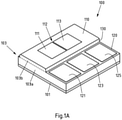
- Fig. 1A shows a lighting device 100 comprising an interface layer 101 and an electrically insulating layer 103 arranged on the interface layer 101.
- the lighting device 100 further comprises a mounting portion 110 comprising respective portions of the interface layer 101 and the electrically insulating layer 103.
- a first light emitting element 111 and a second light emitting element 113 are mounted to the mounting portion 110, thereby mechanically adjusting their respective positions within the lighting device 100.
- a gap 112 is provided in between the first and second light emitting elements 111, 113.
- electrically insulating layer 103 comprises a supporting portion 103a and a covering portion 103b. While supporting portion 103a advantageously provides the overall mechanical stability of lighting device 100, covering portion 103b protects first light emitting element 111 and second light emitting element 113 against environmental conditions such as dust or humidity and enhances heat dissipation by increasing the contact area of the first and second light emitting element 111, 113 with electrically insulating layer 103.
- the lighting device 100 further comprises a connection portion 120 also comprising respective portions of the interface layer 101 and the electrically insulating layer 103.
- Connection portion 120 further comprises electrical contact elements 121, 123, 125, thereby allowing for electrically connecting the lighting device 100 to a power supply (not shown).
- the electrical contact elements 121, 123, 125 are respectively in electrical contact with the first and second light emitting elements 111, 113 via a lead frame which is embedded in interface layer 101 and electrically insulating layer 103 and therefore not visible in the figures.
- a thickness of the connection portion 120 is smaller than a thickness of the mounting portion 110, and the connection portion 120 and the mounting portion 110 are arranged mutually adjacent, thereby forming a step 130 at a transition from the connection portion 120 to the mounting portion 110.
- Fig. 1B shows an exemplary circuit diagram which illustrates an example of electrically connecting the lighting device 100.
- Reference numerals 211 and 213 denote the first light emitting element 111 and the second light emitting element 113 of Fig. 1A in this circuit diagram.
- the light emitting element are electrically connected to a power source (not shown) by electrical contact elements 221, 223, 225, thereby allowing for carrying electrical power from the power source to the first light emitting element 211 and the second light emitting element 213.
- electrical contact element 223 is electrically connected to both the first light emitting element 211 and the second light emitting element 213.
- Fig. 1C shows the circuit diagram of Fig. 1B where a direction of an electrical current is reversed as indicated by a direction illustrated by light emitting elements 211, 213.
- Fig. 2A shows a lighting device 100' comprising an interface layer 101' and an electrically insulating layer 103' arranged thereon.
- the lighting device 100' further comprises a mounting portion 110' comprising respective portions of the interface layer 101' and the electrically insulating layer 103'.
- First and second light emitting elements 111' and 113' are mounted to the mounting portion 110', whereby a gap 112' is formed in between the first and second light emitting elements 111', 113'.
- Electrically insulating layer 103' comprises a supporting portion 103a' and a covering portion 103b' offering the same advantages as described above for Fig. 1A .
- the lighting device 100' further comprises a connection portion 120' comprising respective portions of the interface layer 101' and the electrically insulating layer 103'.
- Connection portion 120' comprises electrical contact elements 121', 123', 124', 125', thereby allowing for electrically connecting the lighting device 100' to a power supply.
- a thickness of the connection portion 120' is smaller than a thickness of the mounting portion 110', and the connection portion 120' and the mounting portion 110' are arranged mutually adjacent, thereby forming a step 130' at a transition from the connection portion 120' to the mounting portion 110'.
- Fig. 2B shows an exemplary circuit diagram which may be used for electrically connecting the lighting device 100'.
- a first light emitting element 211' and a second light emitting element 213' are electrically connected to a power source (not shown) by electrical contact elements 221', 223', 224', 225', thereby allowing for carrying electrical power from the power source to the first light emitting element 211' and the second light emitting element 213'.
- Lighting device 100 100' Interface layer 101, 101' Electrically insulating layer 103, 103' Supporting portion 103a, 103a' Covering portion 103b, 103b' Mounting portion 110, 110' First light emitting element 111, 111', 211, 211' Gap 112, 112' Second light emitting element 113, 113', 213, 213' Connection portion 120, 120' Electrical contact element 121, 123, 125, 121', 123', 124', 125', 221, 223, 225, 221', 223', 224', 225' Step 130, 130'
Landscapes
- Non-Portable Lighting Devices Or Systems Thereof (AREA)
Priority Applications (6)
| Application Number | Priority Date | Filing Date | Title |
|---|---|---|---|
| EP20193561.6A EP3961705A1 (de) | 2020-08-31 | 2020-08-31 | Mehrfarbige beleuchtungsvorrichtung |
| KR1020237009705A KR102974797B1 (ko) | 2020-08-21 | 2021-08-23 | 다색 조명 디바이스, 시스템 및 제조 방법 |
| CN202180071932.3A CN116420046A (zh) | 2020-08-21 | 2021-08-23 | 多色照明设备、系统和制造方法 |
| EP21859274.9A EP4200558A4 (de) | 2020-08-21 | 2021-08-23 | Mehrfarbige beleuchtungsvorrichtung, system und verfahren zur herstellung |
| PCT/US2021/047162 WO2022040632A1 (en) | 2020-08-21 | 2021-08-23 | Multi-color lighting device, system and method of manufacture |
| JP2023512296A JP7797773B2 (ja) | 2020-08-21 | 2021-08-23 | 多色照明装置、システム及び製造方法 |
Applications Claiming Priority (1)
| Application Number | Priority Date | Filing Date | Title |
|---|---|---|---|
| EP20193561.6A EP3961705A1 (de) | 2020-08-31 | 2020-08-31 | Mehrfarbige beleuchtungsvorrichtung |
Publications (1)
| Publication Number | Publication Date |
|---|---|
| EP3961705A1 true EP3961705A1 (de) | 2022-03-02 |
Family
ID=72292326
Family Applications (1)
| Application Number | Title | Priority Date | Filing Date |
|---|---|---|---|
| EP20193561.6A Pending EP3961705A1 (de) | 2020-08-21 | 2020-08-31 | Mehrfarbige beleuchtungsvorrichtung |
Country Status (1)
| Country | Link |
|---|---|
| EP (1) | EP3961705A1 (de) |
Citations (4)
| Publication number | Priority date | Publication date | Assignee | Title |
|---|---|---|---|---|
| US20100244731A1 (en) * | 2008-02-13 | 2010-09-30 | Canon Components, Inc. | White light emitting diode, white light emitting apparatus, and linear illuminator using the same |
| EP2535954A1 (de) * | 2010-02-09 | 2012-12-19 | Nichia Corporation | Lichtemittierende vorrichtung und verfahren zur herstellung einer lichtemittierenden vorrichtung |
| US20190371974A1 (en) * | 2018-05-30 | 2019-12-05 | Cree, Inc. | Led systems, apparatuses, and methods |
| US20200119239A1 (en) * | 2017-03-24 | 2020-04-16 | Osram Opto Semiconductors Gmbh | Method of producing optoelectronic semiconductor components |
-
2020
- 2020-08-31 EP EP20193561.6A patent/EP3961705A1/de active Pending
Patent Citations (4)
| Publication number | Priority date | Publication date | Assignee | Title |
|---|---|---|---|---|
| US20100244731A1 (en) * | 2008-02-13 | 2010-09-30 | Canon Components, Inc. | White light emitting diode, white light emitting apparatus, and linear illuminator using the same |
| EP2535954A1 (de) * | 2010-02-09 | 2012-12-19 | Nichia Corporation | Lichtemittierende vorrichtung und verfahren zur herstellung einer lichtemittierenden vorrichtung |
| US20200119239A1 (en) * | 2017-03-24 | 2020-04-16 | Osram Opto Semiconductors Gmbh | Method of producing optoelectronic semiconductor components |
| US20190371974A1 (en) * | 2018-05-30 | 2019-12-05 | Cree, Inc. | Led systems, apparatuses, and methods |
Similar Documents
| Publication | Publication Date | Title |
|---|---|---|
| US8690392B2 (en) | Light source unit and lighting system | |
| JP4966656B2 (ja) | 複数のヒートシンクを有する発光ダイオードパッケージ | |
| CN101714597B (zh) | 用于制造发光二极管封装的方法 | |
| KR101764803B1 (ko) | 개선된 히트 싱크를 가지는 고체 조명 장치 | |
| US9190394B2 (en) | LED module | |
| JP2007324137A (ja) | 照明装置 | |
| US20070041185A1 (en) | Vehicle Lighting Device and LED Light Source Therefor | |
| JP5407993B2 (ja) | 車両用ヘッドランプ | |
| JP2006054211A (ja) | 発光装置 | |
| JP2011171276A (ja) | 車両用灯具の半導体型光源の光源ユニット、車両用灯具 | |
| JP2012022797A (ja) | 車両用灯具の半導体型光源の光源ユニット、車両用灯具 | |
| WO2012057038A1 (ja) | 発光モジュール、および照明器具 | |
| US9013097B2 (en) | Light-emitting module, lighting device, and lighting fixture | |
| US20100061114A1 (en) | Two-Dimensional Luminaire | |
| US9559083B2 (en) | Semiconductor light-emitting device | |
| JP3938100B2 (ja) | Ledランプおよびled照明具 | |
| KR20090086989A (ko) | 반도체 발광모듈 | |
| JP7113216B2 (ja) | 発光装置及び移動体 | |
| US20220057060A1 (en) | Multi-color lighting device | |
| US11175019B2 (en) | Carrier for lighting modules and lighting device | |
| JP7444744B2 (ja) | 灯具ユニットおよび車両用灯具 | |
| JP7797773B2 (ja) | 多色照明装置、システム及び製造方法 | |
| CN1989618A (zh) | 发光二极管组件 | |
| JP5412618B2 (ja) | 車両用灯具の半導体型光源の光源ユニット、車両用灯具 | |
| JP6076605B2 (ja) | Led発光装置 |
Legal Events
| Date | Code | Title | Description |
|---|---|---|---|
| PUAI | Public reference made under article 153(3) epc to a published international application that has entered the european phase |
Free format text: ORIGINAL CODE: 0009012 |
|
| STAA | Information on the status of an ep patent application or granted ep patent |
Free format text: STATUS: THE APPLICATION HAS BEEN PUBLISHED |
|
| AK | Designated contracting states |
Kind code of ref document: A1 Designated state(s): AL AT BE BG CH CY CZ DE DK EE ES FI FR GB GR HR HU IE IS IT LI LT LU LV MC MK MT NL NO PL PT RO RS SE SI SK SM TR |