EP3961766A1 - Matériau actif d'électrode positive de pile secondaire et pile secondaire - Google Patents
Matériau actif d'électrode positive de pile secondaire et pile secondaire Download PDFInfo
- Publication number
- EP3961766A1 EP3961766A1 EP20793967.9A EP20793967A EP3961766A1 EP 3961766 A1 EP3961766 A1 EP 3961766A1 EP 20793967 A EP20793967 A EP 20793967A EP 3961766 A1 EP3961766 A1 EP 3961766A1
- Authority
- EP
- European Patent Office
- Prior art keywords
- positive electrode
- composite oxide
- active material
- electrode active
- secondary battery
- Prior art date
- Legal status (The legal status is an assumption and is not a legal conclusion. Google has not performed a legal analysis and makes no representation as to the accuracy of the status listed.)
- Granted
Links
Images
Classifications
-
- C—CHEMISTRY; METALLURGY
- C01—INORGANIC CHEMISTRY
- C01G—COMPOUNDS CONTAINING METALS NOT COVERED BY SUBCLASSES C01D OR C01F
- C01G53/00—Compounds of nickel
- C01G53/40—Complex oxides containing nickel and at least one other metal element
- C01G53/42—Complex oxides containing nickel and at least one other metal element containing alkali metals, e.g. LiNiO2
- C01G53/44—Complex oxides containing nickel and at least one other metal element containing alkali metals, e.g. LiNiO2 containing manganese
- C01G53/50—Complex oxides containing nickel and at least one other metal element containing alkali metals, e.g. LiNiO2 containing manganese of the type (MnO2)n-, e.g. Li(NixMn1-x)O2 or Li(MyNixMn1-x-y)O2
-
- H—ELECTRICITY
- H01—ELECTRIC ELEMENTS
- H01M—PROCESSES OR MEANS, e.g. BATTERIES, FOR THE DIRECT CONVERSION OF CHEMICAL ENERGY INTO ELECTRICAL ENERGY
- H01M10/00—Secondary cells; Manufacture thereof
- H01M10/05—Accumulators with non-aqueous electrolyte
- H01M10/052—Li-accumulators
- H01M10/0525—Rocking-chair batteries, i.e. batteries with lithium insertion or intercalation in both electrodes; Lithium-ion batteries
-
- H—ELECTRICITY
- H01—ELECTRIC ELEMENTS
- H01M—PROCESSES OR MEANS, e.g. BATTERIES, FOR THE DIRECT CONVERSION OF CHEMICAL ENERGY INTO ELECTRICAL ENERGY
- H01M4/00—Electrodes
- H01M4/02—Electrodes composed of, or comprising, active material
- H01M4/13—Electrodes for accumulators with non-aqueous electrolyte, e.g. for lithium-accumulators; Processes of manufacture thereof
- H01M4/131—Electrodes based on mixed oxides or hydroxides, or on mixtures of oxides or hydroxides, e.g. LiCoOx
-
- H—ELECTRICITY
- H01—ELECTRIC ELEMENTS
- H01M—PROCESSES OR MEANS, e.g. BATTERIES, FOR THE DIRECT CONVERSION OF CHEMICAL ENERGY INTO ELECTRICAL ENERGY
- H01M4/00—Electrodes
- H01M4/02—Electrodes composed of, or comprising, active material
- H01M4/36—Selection of substances as active materials, active masses, active liquids
- H01M4/48—Selection of substances as active materials, active masses, active liquids of inorganic oxides or hydroxides
- H01M4/50—Selection of substances as active materials, active masses, active liquids of inorganic oxides or hydroxides of manganese
- H01M4/505—Selection of substances as active materials, active masses, active liquids of inorganic oxides or hydroxides of manganese of mixed oxides or hydroxides containing manganese for inserting or intercalating light metals, e.g. LiMn2O4 or LiMn2OxFy
-
- H—ELECTRICITY
- H01—ELECTRIC ELEMENTS
- H01M—PROCESSES OR MEANS, e.g. BATTERIES, FOR THE DIRECT CONVERSION OF CHEMICAL ENERGY INTO ELECTRICAL ENERGY
- H01M4/00—Electrodes
- H01M4/02—Electrodes composed of, or comprising, active material
- H01M4/36—Selection of substances as active materials, active masses, active liquids
- H01M4/48—Selection of substances as active materials, active masses, active liquids of inorganic oxides or hydroxides
- H01M4/52—Selection of substances as active materials, active masses, active liquids of inorganic oxides or hydroxides of nickel, cobalt or iron
- H01M4/525—Selection of substances as active materials, active masses, active liquids of inorganic oxides or hydroxides of nickel, cobalt or iron of mixed oxides or hydroxides containing iron, cobalt or nickel for inserting or intercalating light metals, e.g. LiNiO2, LiCoO2 or LiCoOxFy
-
- C—CHEMISTRY; METALLURGY
- C01—INORGANIC CHEMISTRY
- C01P—INDEXING SCHEME RELATING TO STRUCTURAL AND PHYSICAL ASPECTS OF SOLID INORGANIC COMPOUNDS
- C01P2002/00—Crystal-structural characteristics
- C01P2002/20—Two-dimensional structures
- C01P2002/22—Two-dimensional structures layered hydroxide-type, e.g. of the hydrotalcite-type
-
- C—CHEMISTRY; METALLURGY
- C01—INORGANIC CHEMISTRY
- C01P—INDEXING SCHEME RELATING TO STRUCTURAL AND PHYSICAL ASPECTS OF SOLID INORGANIC COMPOUNDS
- C01P2004/00—Particle morphology
- C01P2004/80—Particles consisting of a mixture of two or more inorganic phases
-
- C—CHEMISTRY; METALLURGY
- C01—INORGANIC CHEMISTRY
- C01P—INDEXING SCHEME RELATING TO STRUCTURAL AND PHYSICAL ASPECTS OF SOLID INORGANIC COMPOUNDS
- C01P2006/00—Physical properties of inorganic compounds
- C01P2006/40—Electric properties
-
- H—ELECTRICITY
- H01—ELECTRIC ELEMENTS
- H01M—PROCESSES OR MEANS, e.g. BATTERIES, FOR THE DIRECT CONVERSION OF CHEMICAL ENERGY INTO ELECTRICAL ENERGY
- H01M4/00—Electrodes
- H01M4/02—Electrodes composed of, or comprising, active material
- H01M2004/026—Electrodes composed of, or comprising, active material characterised by the polarity
- H01M2004/028—Positive electrodes
-
- Y—GENERAL TAGGING OF NEW TECHNOLOGICAL DEVELOPMENTS; GENERAL TAGGING OF CROSS-SECTIONAL TECHNOLOGIES SPANNING OVER SEVERAL SECTIONS OF THE IPC; TECHNICAL SUBJECTS COVERED BY FORMER USPC CROSS-REFERENCE ART COLLECTIONS [XRACs] AND DIGESTS
- Y02—TECHNOLOGIES OR APPLICATIONS FOR MITIGATION OR ADAPTATION AGAINST CLIMATE CHANGE
- Y02E—REDUCTION OF GREENHOUSE GAS [GHG] EMISSIONS, RELATED TO ENERGY GENERATION, TRANSMISSION OR DISTRIBUTION
- Y02E60/00—Enabling technologies; Technologies with a potential or indirect contribution to GHG emissions mitigation
- Y02E60/10—Energy storage using batteries
Definitions
- the present disclosure relates to a positive electrode active material for secondary battery, and a secondary battery using the positive electrode active material.
- Patent Literature 1 discloses a lithium transition metal composite oxide having a crystal structure defined by an O2 structure and containing Li in the transition metal layer.
- a lithium transition metal composite oxide having a crystal structure defined by an O3 structure which contains lithium in the transition metal layer.
- a lithium transition metal composite oxide which contains lithium in the transition metal layer is generally referred to as a lithium-rich composite oxide.
- a positive electrode active material for secondary battery is a secondary battery positive electrode active material containing a lithium transition metal composite oxide.
- the lithium transition metal composite oxide is represented by general formula Li ⁇ [Li x Mn y Co z Me (1-x-y-z) ]O 2 (where Me is at least one selected from Ni, Fe, Ti, Bi, and Nb, and 0.5 ⁇ 1, 0.05 ⁇ x ⁇ 0.25, 0.4 ⁇ y ⁇ 0.7, and 0 ⁇ z ⁇ 0.25 hold true), and has at least one crystal structure selected from O2 structure, T2 structure, and O6 structure.
- a ratio (Co2/Co1) of a Co molar ratio (Co2) at a surface of the oxide to a Co molar ratio (Co1) in the entire lithium transition metal composite oxide satisfies 1.2 ⁇ (Co2/Co1) ⁇ 6.0.
- a secondary battery includes a positive electrode containing the above-described positive electrode active material, a negative electrode, and an electrolyte.
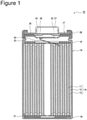
- FIG. 1 is a cross-sectional view of a non-aqueous electrolyte secondary battery according to an example embodiment.
- the positive electrode active material for secondary battery according to the present disclosure and an example embodiment of a secondary battery using the positive electrode active material will now be described in detail.
- the outer housing is not limited to a cylindrical outer can, and may for example be a rectangular outer can, or may be an outer housing made of a laminate sheet including a metal layer and a resin layer.
- the electrode assembly may be a laminate-type electrode assembly in which a plurality of positive electrodes and a plurality of negative electrodes are alternately laminated via separators.
- FIG. 1 is a cross-sectional view of a secondary battery 10 according to an example embodiment.
- the secondary battery 10 comprises a spiral-type electrode assembly 14, an electrolyte, and an outer can 16 that houses the electrode assembly 14 and the electrolyte.
- the electrode assembly 14 includes a positive electrode 11, a negative electrode 12, and separators 13, and has a winding structure in which the positive electrode 11 and the negative electrode 12 are wound in a spiral shape with the separators 13 located between the electrodes 11, 12.
- the outer can 16 is a bottomed cylindrical metal container having an opening on one side in the axial direction, and the opening of the outer can 16 is closed off by a sealing assembly 17.
- the sealing assembly 17 side of the battery is described as the top
- the bottom portion side of the outer can 16 is described as the bottom.
- a gasket 28 is provided between the outer can 16 and the sealing assembly 17 so as to ensure airtightness inside the battery.
- the outer can 16 has formed thereon a grooved portion 22, in which a part of a side surface portion protrudes inward and supports the sealing assembly 17.
- the grooved portion 22 is preferably formed in an annular shape along the circumferential direction of the outer can 16, and supports the sealing assembly 17 on its upper surface.
- the sealing assembly 17 is fixed to an upper part of the outer can 16 by means of the grooved portion 22 and an opening end portion of the outer can 16 which is crimped to the sealing assembly 17.
- the sealing assembly 17 has a structure obtained by laminating, in order from the electrode assembly 14 side, the internal terminal plate 23, a lower valve member 24, an insulation member 25, an upper valve member 26, and the cap 27.
- Each of the members constituting the sealing assembly 17 has, for example, a disk shape or a ring shape, and the respective members except the insulation member 25 are mutually electrically connected.
- the lower valve member 24 and the upper valve member 26 are connected to each other at their central portions, and the insulation member 25 is interposed between peripheral edge portions of these valve members.
- the lower valve member 24 deforms and ruptures in a manner pushing up the upper valve member 26 toward the cap 27, and the current path between the lower valve member 24 and the upper valve member 26 is thereby cut off.
- the upper valve member 26 ruptures, and gas is discharged from an opening in the cap 27.
- the positive electrode active material is composed of a lithium transition metal composite oxide.
- the lithium transition metal composite oxide is represented by general formula Li ⁇ [Li x Mn y Co z Me (1-x-y-z) ]O 2 (where Me is at least one selected from Ni, Fe, Ti, Bi, and Nb, and 0.5 ⁇ 1, 0.05 ⁇ x ⁇ 0.25, 0.4 ⁇ y ⁇ 0.7, and 0 ⁇ z ⁇ 0.25 hold true), and has at least one crystal structure selected from O2 structure, T2 structure, and O6 structure.
- the composite oxide A has at least one crystal structure selected from O2 structure, T2 structure, and O6 structure.
- the main crystal structure is the O2 structure.
- at least 50 vol.% of the crystal structure of the composite oxide A, or substantially the entirety thereof, has the O2 structure.
- the O2 structure is a layered crystal structure in which lithium is present in the center of an oxygen octahedron, in which two manners of overlap between oxygen and transition metals exist per unit cell, and which belongs to the space group P6 3 mc.
- Such a layered crystal structure has a lithium layer, a transition metal layer, and an oxygen layer. Referring to the above-noted general formula of the composite oxide A, the lithium layer contains Li ⁇ , the transition metal layer contains Li x Mn y Co z Me (1-x-y-z) , and the oxygen layer contains O 2 .
- the metal element Me other than Li, Mn, and Co contained in the composite oxide A is preferably at least one selected from Ni, Fe, Ti, Bi, and Nb. Among these, Ni and Fe are preferable.
- the Me content is preferably more than 3 mol% and less than 20 mol% relative to the total number of moles of the metal elements contained in the transition metal layer.
- the composite oxide A may contain metal elements other than the above so long as the object of the present disclosure is not undermined.
- a Co molar ratio means a ratio of the number of moles of Co to the total number of moles of metal elements excluding Li.
- the number of moles of metal elements in the entire particle of the composite oxide A is measured by inductively coupled plasma (ICP) optical emission spectroscopy, and the number of moles of metal elements at the particle surface of the composite oxide A is measured by X-ray photoelectron spectroscopy (XPS).
- ICP inductively coupled plasma
- XPS X-ray photoelectron spectroscopy
- the Mn content at the particle surface is more than 0.5 times and less than 1.0 times the Mn content at the central portion of the particle.
- the composite oxide A may have a concentration distribution in which the concentration of Mn gradually decreases from the central portion of the particle toward the surface, or may have a concentration distribution in which the concentration of Mn decreases sharply at the particle surface and in the vicinity of the surface.
- Mn2/Mn1 is more preferably higher than 0.55 and lower than 0.85, and particularly preferably higher than 0.60 and lower than 0.80.
- the binder contained in the negative electrode mixture layer fluororesins, PAN, polyimides, acrylic resins, polyolefins, and the like can be used as with the positive electrode 11, but styrene-butadiene rubber (SBR) is preferably used.
- the negative electrode mixture layer preferably additionally contains CMC or a salt thereof, polyacrylic acid (PAA) or a salt thereof, polyvinyl alcohol (PVA), or the like.
- PVA polyvinyl alcohol
- An electrode assembly was prepared by attaching lead wires respectively to the above-described positive electrode and a counter electrode made of Li metal, and by arranging the positive electrode and the counter electrode facing each other via a polyolefin separator. This electrode assembly and the above-described non-aqueous electrolyte solution were sealed in an outer housing made of an aluminum laminate film, and a test cell was thereby produced.
- a positive electrode and a test cell were prepared in the same manner as in Example 1 except that, in synthesizing the positive electrode active material, the added amount of lithium iodide was set to 30 % by atomic ratio.
- a positive electrode and a test cell were prepared in the same manner as in Example 1 except that, in synthesizing the positive electrode active material, lithium hydroxide was added, instead of lithium iodide, at an atomic ratio of 500 %.
- each positive electrode active material was analyzed using XPS, and the number of moles of each metal element relative to the total number of moles of metal elements excluding Li was calculated to determine Co2 and Mn2 of each material. Furthermore, by performing XPS measurement after carrying out etching with Ar ions, the thickness of the region having unevenly densely distributed Co as observed from the particle surface was measured, and it was found that, in all of the materials except the positive electrode active materials of Comparative Examples 1 and 3, the thickness of the unevenly densely distributed region having a higher Co concentration than the other regions was 100 nm or greater from the particle surface.
Landscapes
- Chemical & Material Sciences (AREA)
- Chemical Kinetics & Catalysis (AREA)
- Electrochemistry (AREA)
- General Chemical & Material Sciences (AREA)
- Inorganic Chemistry (AREA)
- Engineering & Computer Science (AREA)
- Materials Engineering (AREA)
- Organic Chemistry (AREA)
- Manufacturing & Machinery (AREA)
- Battery Electrode And Active Subsutance (AREA)
Applications Claiming Priority (2)
| Application Number | Priority Date | Filing Date | Title |
|---|---|---|---|
| JP2019085367 | 2019-04-26 | ||
| PCT/JP2020/016666 WO2020218136A1 (fr) | 2019-04-26 | 2020-04-16 | Matériau actif d'électrode positive de pile secondaire et pile secondaire |
Publications (3)
| Publication Number | Publication Date |
|---|---|
| EP3961766A1 true EP3961766A1 (fr) | 2022-03-02 |
| EP3961766A4 EP3961766A4 (fr) | 2022-06-29 |
| EP3961766B1 EP3961766B1 (fr) | 2025-10-08 |
Family
ID=72942021
Family Applications (1)
| Application Number | Title | Priority Date | Filing Date |
|---|---|---|---|
| EP20793967.9A Active EP3961766B1 (fr) | 2019-04-26 | 2020-04-16 | Matériau actif d'électrode positive de pile secondaire et pile secondaire |
Country Status (5)
| Country | Link |
|---|---|
| US (1) | US12230794B2 (fr) |
| EP (1) | EP3961766B1 (fr) |
| JP (1) | JP7478976B2 (fr) |
| CN (1) | CN113597692B (fr) |
| WO (1) | WO2020218136A1 (fr) |
Families Citing this family (2)
| Publication number | Priority date | Publication date | Assignee | Title |
|---|---|---|---|---|
| JP7616039B2 (ja) * | 2021-12-17 | 2025-01-17 | トヨタ自動車株式会社 | 正極活物質、リチウムイオン二次電池、及び、正極活物質の製造方法 |
| JP7622717B2 (ja) * | 2022-09-08 | 2025-01-28 | トヨタ自動車株式会社 | 正極活物質粒子、正極活物質粒子の製造方法、及び、リチウムイオン二次電池 |
Family Cites Families (17)
| Publication number | Priority date | Publication date | Assignee | Title |
|---|---|---|---|---|
| US6103422A (en) | 1995-12-26 | 2000-08-15 | Kao Corporation | Cathode active material and nonaqueous secondary battery containing the same |
| JP4161382B2 (ja) * | 1997-02-25 | 2008-10-08 | 堺化学工業株式会社 | 2層構造粒子状組成物の製造方法 |
| JP5002872B2 (ja) | 2001-08-09 | 2012-08-15 | トヨタ自動車株式会社 | リチウム二次電池用正極活物質、リチウム二次電池用正極及びリチウム二次電池並びにリチウム二次電池用正極活物質の製造方法 |
| JP5260850B2 (ja) * | 2006-09-27 | 2013-08-14 | 三洋電機株式会社 | 非水電解質二次電池、正極および正極の製造方法 |
| CN102013481A (zh) * | 2010-10-22 | 2011-04-13 | 北京工业大学 | 一种球形梯度富锂正极材料的合成方法 |
| JP2012204281A (ja) | 2011-03-28 | 2012-10-22 | Tokyo Univ Of Science | 複合金属酸化物、リチウム二次電池用正極活物質、リチウム二次電池用正極、及びリチウム二次電池 |
| JP5871186B2 (ja) | 2012-03-01 | 2016-03-01 | 株式会社Gsユアサ | 非水電解質二次電池用活物質、その活物質の製造方法、非水電解質二次電池用電極及び非水電解質二次電池 |
| EP2634148B1 (fr) | 2012-03-01 | 2015-04-01 | GS Yuasa International Ltd. | Matériau actif pour batterie secondaire à électrolyte non-aqueux, procédé de production du matériau actif, électrode pour batterie secondaire à électrolyte non-aqueux et batterie secondaire à électrolyte non-aqueux |
| JP6112858B2 (ja) * | 2012-12-25 | 2017-04-12 | 日立マクセル株式会社 | 非水電解質二次電池 |
| JP2014186937A (ja) | 2013-03-25 | 2014-10-02 | Sanyo Electric Co Ltd | 非水電解質二次電池用正極活物質及びこれを用いた非水電解質二次電池 |
| WO2014155988A1 (fr) | 2013-03-25 | 2014-10-02 | 三洋電機株式会社 | Matériau actif d'électrode positive pour cellule secondaire à électrolyte non aqueux, et cellule secondaire à électrolyte non aqueux utilisant celui-ci |
| JP6478090B2 (ja) | 2013-09-30 | 2019-03-06 | パナソニックIpマネジメント株式会社 | 非水電解質二次電池用正極活物質、非水電解質二次電池、及び非水電解質二次電池用正極活物質の製造方法 |
| WO2015115025A1 (fr) | 2014-01-31 | 2015-08-06 | 三洋電機株式会社 | Batterie rechargeable à électrolyte non aqueux |
| CN104009230B (zh) * | 2014-05-30 | 2017-01-04 | 深圳市巨兆数码有限公司 | 锂离子电池正极材料和锂离子电池 |
| KR102314045B1 (ko) * | 2014-12-18 | 2021-10-18 | 삼성에스디아이 주식회사 | 복합 양극 활물질, 그 제조방법, 이를 포함한 양극 및 리튬 전지 |
| EP3324465A1 (fr) * | 2016-11-18 | 2018-05-23 | SK Innovation Co., Ltd. | Batterie lithium-air et son procédé de fabrication |
| CN107331858B (zh) * | 2017-06-23 | 2019-08-09 | 海南大学 | 一种锂离子电池三元正极梯度分布材料前驱体及其应用 |
-
2020
- 2020-04-16 JP JP2021516044A patent/JP7478976B2/ja active Active
- 2020-04-16 EP EP20793967.9A patent/EP3961766B1/fr active Active
- 2020-04-16 WO PCT/JP2020/016666 patent/WO2020218136A1/fr not_active Ceased
- 2020-04-16 US US17/604,654 patent/US12230794B2/en active Active
- 2020-04-16 CN CN202080021967.1A patent/CN113597692B/zh active Active
Also Published As
| Publication number | Publication date |
|---|---|
| CN113597692A (zh) | 2021-11-02 |
| JP7478976B2 (ja) | 2024-05-08 |
| US20220216467A1 (en) | 2022-07-07 |
| JPWO2020218136A1 (fr) | 2020-10-29 |
| US12230794B2 (en) | 2025-02-18 |
| WO2020218136A1 (fr) | 2020-10-29 |
| CN113597692B (zh) | 2024-01-05 |
| EP3961766A4 (fr) | 2022-06-29 |
| EP3961766B1 (fr) | 2025-10-08 |
Similar Documents
| Publication | Publication Date | Title |
|---|---|---|
| CN113597409B (zh) | 二次电池用的正极活性物质和二次电池 | |
| EP4053080B1 (fr) | Matière active d'électrode positive pour batterie rechargeable et batterie rechargeable | |
| WO2020202745A1 (fr) | Batterie secondaire à électrolyte non aqueux | |
| EP4270529A1 (fr) | Batterie rechargeable à électrolyte non aqueux | |
| WO2022209894A1 (fr) | Matériau actif d'électrode positive destiné à des batteries secondaires à électrolyte non aqueux, et batterie secondaire à électrolyte non aqueux | |
| EP4456196A1 (fr) | Matériau actif d'électrode positive pour batterie secondaire et procédé de production de matériau actif d'électrode positive pour batterie secondaire | |
| EP3961766B1 (fr) | Matériau actif d'électrode positive de pile secondaire et pile secondaire | |
| EP4112559A1 (fr) | Matériau actif d'électrode positive pour batterie secondaire à électrolyte non aqueux, et batterie secondaire à électrolyte non aqueux | |
| EP4593117A1 (fr) | Matériau actif d'électrode positive pour batteries secondaires, et batterie secondaire | |
| EP4411888A1 (fr) | Matériau actif d'électrode positive destiné à des batteries secondaires à électrolyte non aqueux, et batterie secondaire à électrolyte non aqueux | |
| EP4053081B1 (fr) | Matériau actif d'électrode positive pour batterie secondaire, et batterie secondaire | |
| EP4287315A1 (fr) | Matériau actif pour batteries secondaires à électrolyte non aqueux, et batterie secondaire à électrolyte non aqueux | |
| EP4661107A1 (fr) | Matériau actif d'électrode positive pour batterie secondaire à électrolyte non aqueux et batterie secondaire à électrolyte non aqueux | |
| EP4485575A1 (fr) | Matériau actif d'électrode positive pour batterie secondaire à électrolyte non aqueux, et batterie secondaire à électrolyte non aqueux | |
| EP4287312A1 (fr) | Matériau actif pour batteries secondaires à électrolyte non aqueux, procédé de production de matériau actif pour batteries secondaires à électrolyte non aqueux, et batterie secondaire à électrolyte non aqueux | |
| EP4657568A1 (fr) | Matériau actif d'électrode positive pour batteries secondaires à électrolyte non aqueux, et batterie secondaire à électrolyte non aqueux | |
| US20260100362A1 (en) | Positive electrode active material for non-aqueous electrolyte secondary battery, method for producing positive electrode active material for non-aqueous electrolyte secondary battery, and non-aqueous electrolyte secondary battery | |
| EP4661105A1 (fr) | Matériau actif d'électrode positive pour batteries secondaires à électrolyte non aqueux, et batterie secondaire à électrolyte non aqueux | |
| EP4287314A1 (fr) | Matériau actif pour batterie secondaire à électrolyte non aqueux et batterie secondaire à électrolyte non aqueux | |
| EP4593116A1 (fr) | Matériau actif d'électrode positive pour batterie secondaire et batterie secondaire | |
| US20230110150A1 (en) | Positive electrode active material for non-aqueous electrolyte secondary battery, and non-aqueous electrolyte secondary battery | |
| WO2024162132A1 (fr) | Matériau actif d'électrode positive pour batterie secondaire à électrolyte non aqueux, et batterie secondaire à électrolyte non aqueux |
Legal Events
| Date | Code | Title | Description |
|---|---|---|---|
| STAA | Information on the status of an ep patent application or granted ep patent |
Free format text: STATUS: THE INTERNATIONAL PUBLICATION HAS BEEN MADE |
|
| PUAI | Public reference made under article 153(3) epc to a published international application that has entered the european phase |
Free format text: ORIGINAL CODE: 0009012 |
|
| STAA | Information on the status of an ep patent application or granted ep patent |
Free format text: STATUS: REQUEST FOR EXAMINATION WAS MADE |
|
| 17P | Request for examination filed |
Effective date: 20211020 |
|
| AK | Designated contracting states |
Kind code of ref document: A1 Designated state(s): AL AT BE BG CH CY CZ DE DK EE ES FI FR GB GR HR HU IE IS IT LI LT LU LV MC MK MT NL NO PL PT RO RS SE SI SK SM TR |
|
| REG | Reference to a national code |
Ref country code: DE Ref legal event code: R079 Free format text: PREVIOUS MAIN CLASS: H01M0004505000 Ipc: C01G0053000000 Ref document number: 602020060175 Country of ref document: DE |
|
| A4 | Supplementary search report drawn up and despatched |
Effective date: 20220531 |
|
| RIC1 | Information provided on ipc code assigned before grant |
Ipc: H01M 4/525 20100101ALI20220524BHEP Ipc: H01M 4/505 20100101ALI20220524BHEP Ipc: C01G 53/00 20060101AFI20220524BHEP |
|
| DAV | Request for validation of the european patent (deleted) | ||
| DAX | Request for extension of the european patent (deleted) | ||
| STAA | Information on the status of an ep patent application or granted ep patent |
Free format text: STATUS: EXAMINATION IS IN PROGRESS |
|
| 17Q | First examination report despatched |
Effective date: 20250211 |
|
| GRAP | Despatch of communication of intention to grant a patent |
Free format text: ORIGINAL CODE: EPIDOSNIGR1 |
|
| STAA | Information on the status of an ep patent application or granted ep patent |
Free format text: STATUS: GRANT OF PATENT IS INTENDED |
|
| INTG | Intention to grant announced |
Effective date: 20250507 |
|
| P01 | Opt-out of the competence of the unified patent court (upc) registered |
Free format text: CASE NUMBER: APP_26808/2025 Effective date: 20250605 |
|
| GRAS | Grant fee paid |
Free format text: ORIGINAL CODE: EPIDOSNIGR3 |
|
| GRAA | (expected) grant |
Free format text: ORIGINAL CODE: 0009210 |
|
| STAA | Information on the status of an ep patent application or granted ep patent |
Free format text: STATUS: THE PATENT HAS BEEN GRANTED |
|
| AK | Designated contracting states |
Kind code of ref document: B1 Designated state(s): AL AT BE BG CH CY CZ DE DK EE ES FI FR GB GR HR HU IE IS IT LI LT LU LV MC MK MT NL NO PL PT RO RS SE SI SK SM TR |
|
| REG | Reference to a national code |
Ref country code: GB Ref legal event code: FG4D Ref country code: CH Ref legal event code: F10 Free format text: ST27 STATUS EVENT CODE: U-0-0-F10-F00 (AS PROVIDED BY THE NATIONAL OFFICE) Effective date: 20251008 |
|
| REG | Reference to a national code |
Ref country code: DE Ref legal event code: R096 Ref document number: 602020060175 Country of ref document: DE |
|
| REG | Reference to a national code |
Ref country code: IE Ref legal event code: FG4D |
|
| REG | Reference to a national code |
Ref country code: NL Ref legal event code: MP Effective date: 20251008 |
|
| REG | Reference to a national code |
Ref country code: AT Ref legal event code: MK05 Ref document number: 1844689 Country of ref document: AT Kind code of ref document: T Effective date: 20251008 |
|
| PG25 | Lapsed in a contracting state [announced via postgrant information from national office to epo] |
Ref country code: NL Free format text: LAPSE BECAUSE OF FAILURE TO SUBMIT A TRANSLATION OF THE DESCRIPTION OR TO PAY THE FEE WITHIN THE PRESCRIBED TIME-LIMIT Effective date: 20251008 |
|
| PG25 | Lapsed in a contracting state [announced via postgrant information from national office to epo] |
Ref country code: ES Free format text: LAPSE BECAUSE OF FAILURE TO SUBMIT A TRANSLATION OF THE DESCRIPTION OR TO PAY THE FEE WITHIN THE PRESCRIBED TIME-LIMIT Effective date: 20251008 |
|
| REG | Reference to a national code |
Ref country code: LT Ref legal event code: MG9D |
|
| PG25 | Lapsed in a contracting state [announced via postgrant information from national office to epo] |
Ref country code: NO Free format text: LAPSE BECAUSE OF FAILURE TO SUBMIT A TRANSLATION OF THE DESCRIPTION OR TO PAY THE FEE WITHIN THE PRESCRIBED TIME-LIMIT Effective date: 20260108 |
|
| PG25 | Lapsed in a contracting state [announced via postgrant information from national office to epo] |
Ref country code: AT Free format text: LAPSE BECAUSE OF FAILURE TO SUBMIT A TRANSLATION OF THE DESCRIPTION OR TO PAY THE FEE WITHIN THE PRESCRIBED TIME-LIMIT Effective date: 20251008 Ref country code: FI Free format text: LAPSE BECAUSE OF FAILURE TO SUBMIT A TRANSLATION OF THE DESCRIPTION OR TO PAY THE FEE WITHIN THE PRESCRIBED TIME-LIMIT Effective date: 20251008 Ref country code: HR Free format text: LAPSE BECAUSE OF FAILURE TO SUBMIT A TRANSLATION OF THE DESCRIPTION OR TO PAY THE FEE WITHIN THE PRESCRIBED TIME-LIMIT Effective date: 20251008 |
|
| PG25 | Lapsed in a contracting state [announced via postgrant information from national office to epo] |
Ref country code: RS Free format text: LAPSE BECAUSE OF FAILURE TO SUBMIT A TRANSLATION OF THE DESCRIPTION OR TO PAY THE FEE WITHIN THE PRESCRIBED TIME-LIMIT Effective date: 20260108 |
|
| PG25 | Lapsed in a contracting state [announced via postgrant information from national office to epo] |
Ref country code: IS Free format text: LAPSE BECAUSE OF FAILURE TO SUBMIT A TRANSLATION OF THE DESCRIPTION OR TO PAY THE FEE WITHIN THE PRESCRIBED TIME-LIMIT Effective date: 20260208 |
|
| PG25 | Lapsed in a contracting state [announced via postgrant information from national office to epo] |
Ref country code: PT Free format text: LAPSE BECAUSE OF FAILURE TO SUBMIT A TRANSLATION OF THE DESCRIPTION OR TO PAY THE FEE WITHIN THE PRESCRIBED TIME-LIMIT Effective date: 20260209 |
|
| PG25 | Lapsed in a contracting state [announced via postgrant information from national office to epo] |
Ref country code: PL Free format text: LAPSE BECAUSE OF FAILURE TO SUBMIT A TRANSLATION OF THE DESCRIPTION OR TO PAY THE FEE WITHIN THE PRESCRIBED TIME-LIMIT Effective date: 20251008 |
|
| PG25 | Lapsed in a contracting state [announced via postgrant information from national office to epo] |
Ref country code: LV Free format text: LAPSE BECAUSE OF FAILURE TO SUBMIT A TRANSLATION OF THE DESCRIPTION OR TO PAY THE FEE WITHIN THE PRESCRIBED TIME-LIMIT Effective date: 20251008 |