EP3964246B1 - Procédé d'amorçage d'un circuit sanguin extracorporel et dispositifs - Google Patents
Procédé d'amorçage d'un circuit sanguin extracorporel et dispositifs Download PDFInfo
- Publication number
- EP3964246B1 EP3964246B1 EP20194067.3A EP20194067A EP3964246B1 EP 3964246 B1 EP3964246 B1 EP 3964246B1 EP 20194067 A EP20194067 A EP 20194067A EP 3964246 B1 EP3964246 B1 EP 3964246B1
- Authority
- EP
- European Patent Office
- Prior art keywords
- control device
- blood
- closed
- priming
- loop control
- Prior art date
- Legal status (The legal status is an assumption and is not a legal conclusion. Google has not performed a legal analysis and makes no representation as to the accuracy of the status listed.)
- Active
Links
Images

Classifications
-
- A—HUMAN NECESSITIES
- A61—MEDICAL OR VETERINARY SCIENCE; HYGIENE
- A61M—DEVICES FOR INTRODUCING MEDIA INTO, OR ONTO, THE BODY; DEVICES FOR TRANSDUCING BODY MEDIA OR FOR TAKING MEDIA FROM THE BODY; DEVICES FOR PRODUCING OR ENDING SLEEP OR STUPOR
- A61M1/00—Suction or pumping devices for medical purposes; Devices for carrying-off, for treatment of, or for carrying-over, body-liquids; Drainage systems
- A61M1/36—Other treatment of blood in a by-pass of the natural circulatory system, e.g. temperature adaptation, irradiation ; Extra-corporeal blood circuits
- A61M1/3621—Extra-corporeal blood circuits
- A61M1/3643—Priming, rinsing before or after use
-
- A—HUMAN NECESSITIES
- A61—MEDICAL OR VETERINARY SCIENCE; HYGIENE
- A61M—DEVICES FOR INTRODUCING MEDIA INTO, OR ONTO, THE BODY; DEVICES FOR TRANSDUCING BODY MEDIA OR FOR TAKING MEDIA FROM THE BODY; DEVICES FOR PRODUCING OR ENDING SLEEP OR STUPOR
- A61M1/00—Suction or pumping devices for medical purposes; Devices for carrying-off, for treatment of, or for carrying-over, body-liquids; Drainage systems
- A61M1/36—Other treatment of blood in a by-pass of the natural circulatory system, e.g. temperature adaptation, irradiation ; Extra-corporeal blood circuits
- A61M1/3621—Extra-corporeal blood circuits
- A61M1/3643—Priming, rinsing before or after use
- A61M1/3644—Mode of operation
- A61M1/3649—Mode of operation using dialysate as priming or rinsing liquid
-
- A—HUMAN NECESSITIES
- A61—MEDICAL OR VETERINARY SCIENCE; HYGIENE
- A61M—DEVICES FOR INTRODUCING MEDIA INTO, OR ONTO, THE BODY; DEVICES FOR TRANSDUCING BODY MEDIA OR FOR TAKING MEDIA FROM THE BODY; DEVICES FOR PRODUCING OR ENDING SLEEP OR STUPOR
- A61M1/00—Suction or pumping devices for medical purposes; Devices for carrying-off, for treatment of, or for carrying-over, body-liquids; Drainage systems
- A61M1/36—Other treatment of blood in a by-pass of the natural circulatory system, e.g. temperature adaptation, irradiation ; Extra-corporeal blood circuits
- A61M1/3621—Extra-corporeal blood circuits
- A61M1/3653—Interfaces between patient blood circulation and extra-corporal blood circuit
- A61M1/3659—Cannulae pertaining to extracorporeal circulation
- A61M1/3661—Cannulae pertaining to extracorporeal circulation for haemodialysis
-
- A—HUMAN NECESSITIES
- A61—MEDICAL OR VETERINARY SCIENCE; HYGIENE
- A61M—DEVICES FOR INTRODUCING MEDIA INTO, OR ONTO, THE BODY; DEVICES FOR TRANSDUCING BODY MEDIA OR FOR TAKING MEDIA FROM THE BODY; DEVICES FOR PRODUCING OR ENDING SLEEP OR STUPOR
- A61M1/00—Suction or pumping devices for medical purposes; Devices for carrying-off, for treatment of, or for carrying-over, body-liquids; Drainage systems
- A61M1/14—Dialysis systems; Artificial kidneys; Blood oxygenators ; Reciprocating systems for treatment of body fluids, e.g. single needle systems for hemofiltration or pheresis
- A61M1/30—Single needle dialysis ; Reciprocating systems, alternately withdrawing blood from and returning it to the patient, e.g. single-lumen-needle dialysis or single needle systems for hemofiltration or pheresis
-
- A—HUMAN NECESSITIES
- A61—MEDICAL OR VETERINARY SCIENCE; HYGIENE
- A61M—DEVICES FOR INTRODUCING MEDIA INTO, OR ONTO, THE BODY; DEVICES FOR TRANSDUCING BODY MEDIA OR FOR TAKING MEDIA FROM THE BODY; DEVICES FOR PRODUCING OR ENDING SLEEP OR STUPOR
- A61M2205/00—General characteristics of the apparatus
- A61M2205/33—Controlling, regulating or measuring
- A61M2205/3368—Temperature
Definitions
- the present invention relates to a method according to claim 1. It also relates to a control device or closed-loop control device according to claim 6 and a blood treatment apparatus according to claim 7. Furthermore the present invention relates to a digital storage medium according to claim 10, a computer program product according to claim 11 as well as a computer program according to claim 12.
- Extracorporeal blood treatment using dialysis is known from practice such as in US 2017 021086 .
- the blood filter comprises a blood chamber through which blood is guided, and a dialysis liquid chamber, through which dialysis liquid is guided. Both chambers are separated from each other by a semi-permeable membrane. Blood and dialysis liquid are mostly guided through the blood filter by the counter-current principle.
- the blood is purified in the blood filter, on exiting the blood filter the dialysis liquid, from now on referred to as effluate or effluent, is regarded as used and is discarded.
- the effluent to be discarded also comprises filtrate (or ultra-filtrate), which comprises water that has been withdrawn from the blood in the blood filter.
- filtrate or ultra-filtrate
- Filtrate and dialysate will be referred to individually or collectively in the following simply as effluent.
- dialysis is mainly used with patients who have end-stage renal failure.
- the extracorporeal circuit typically before a dialysis patient is connected to the dialysis equipment the extracorporeal circuit has to be primed.
- the purpose of priming the circuit is to remove air from the blood lines and the dialyzer as well as to remove possible fragments of remaining sterilising agents or other residuals from the disposables elements, such as blood lines and dialyzers that form the extracorporeal circuit, before the patient is connected.
- An object of the present invention is to recommend a method for priming an extracorporeal blood circuit before the blood treatment session starts.
- control device or closed-loop control device a blood treatment apparatus, a suitable digital storage medium, a suitable computer program product and a suitable computer program are to be specified.
- the object according to the present invention may be achieved with the method having the features of claim 1, a control device or closed-loop control device having the features of claim 6 and a blood treatment apparatus having the features of claim 7. Further, the object according to the present invention may be achieved with a digital storage medium, a computer program product as well as a computer program according to claims 10, 11 and 12.
- the method according to the present invention relates to priming an extracorporeal blood circuit using or providing a blood treatment apparatus comprising a dialysis liquid preparation system.
- the dialysis liquid preparation system comprises or consists of a source of water, a source of bicarbonate concentrate (e.g., one container, bag or the like) and a source of acid concentrate (e.g., one container, bag or the like), the latter including sodium chloride, an acid, for example citric or acetic acid and further electrolytes, like magnesium chloride and or calcium chloride.
- the dialysis liquid preparation system does not use a source of sodium chloride only.
- the dialysis liquid preparation system is configured to prepare a dialysis liquid from those three sources mentioned (water, said bicarbonate concentrate source and said acid concentrate source) only.
- the extracorporeal blood circuit comprises an arterial line section, connectable to a patient. It serves to withdraw blood from the patient. Further, the extracorporeal blood circuit comprises a venous line section which is connectable to the patient for returning the blood to her. Moreover, a blood side compartment or blood chamber of a blood filter is comprised by the extracorporeal blood circuit.
- the method according to the present invention encompasses the steps of a first phase as follows:
- the present invention further relates to a control device or closed-loop control device. It is configured or programmed to carry out and/or to initiate the method according to the present invention or its mechanical steps, in particular in each of the embodiments described herein and in each possible combination of the herein disclosed features, in particular method steps.
- the control device or closed-loop control device may comprise devices or may be connected in signal communication with such devices, which can execute the individual method steps or method features which are disclosed herein - and particularly in the claims - and are designed, configured and/or programmed accordingly for this purpose.
- the present invention further relates to a blood treatment apparatus for the extracorporeal treatment of a patient's blood which comprises a control device or closed-loop control device according to the present invention.
- a digital, in particular non-volatile storage medium, according to the present invention particularly in the form of a machine readable carrier, particularly in the form of a diskette, storage card, CD, DVD Blu-ray disc or (E)EPROM, FRAM (Ferroelectric RAM) or SSD (Solid-State-Drive) with electronically readable control signals, may be configured to interact with a programmable control device or closed-loop control device in such a way that the, particularly mechanical, steps of the method according to the present invention are initiated or executed.
- the digital storage medium according to the present invention may be configured so that a conventional control device or closed-loop control device can be reprogrammed into a control device or closed-loop control device according to the present invention.
- a computer program product comprises a transient, volatile program code or a program code saved on a machine readable carrier for initiating or executing the, particularly mechanical, steps of the method according to the present invention, when the computer program product is running on a control device or closed-loop control device.
- the computer program product according to the present invention can be understood, for example, as a computer program stored on a carrier, an embedded system being a comprehensive system with a computer program (e.g., electronic device with a computer program), a network of computer-implemented computer programs (e.g. client/server-system, a cloud computing system etc.), or a computer on which a computer program is loaded, run, stored, executed or developed.
- a computer program stored on a carrier
- an embedded system being a comprehensive system with a computer program
- a network of computer-implemented computer programs e.g. client/server-system, a cloud computing system etc.
- the computer program product according to the present invention may be configured to reprogram a conventional control device or closed-loop control device into a control device or closed-loop control device according to the present invention.
- machine-readable carrier refers in certain embodiments of the present invention to a carrier, which contains data or information interpretable by software and/or hardware.
- the carrier may be a data carrier, such as a diskette, a CD, DVD, a USB stick, a flashcard, an SD card or the like, as well as any other storage referred to herein or any other storage medium referred to herein.
- a computer program according to the present invention comprises a program code to initiate or execute the steps of the method according to the present invention, particularly the mechanical steps, when the computer program is running on a control device or closed-loop control device.
- a computer program can be understood to mean, for example, a physical, ready-for-distribution software product that comprises a program.
- the computer program according to the present invention may be configured in order to reprogram a conventional control device or closed-loop control device into a control device or closed-loop control device according to the present invention.
- Embodiments according to the present invention may comprise one or several of the aforementioned or following features in any combination, unless the person skilled in the art recognizes their combination as technically impossible. Embodiments according to the present invention are further subject-matter of the dependent claims.
- the subject-matter according to the present invention comprises one or several features in a certain embodiment, it is also respectively disclosed herein that the subject-matter according to the present invention does, in other embodiments, likewise according to the present invention, explicitly not comprise this or these features, for example, in the sense of a disclaimer. Therefore, for every embodiment mentioned herein it applies that the converse embodiment, e.g. formulated as negation, is also disclosed.
- the temperature of the priming solution is kept below 35°C, preferably between 25°C and 30°C during the first phase of the method according to the present invention.
- the method according to the present invention further encompasses adding bicarbonate from the source of bicarbonate concentrate to the priming solution in a second phase following the first phase.
- the temperature of the priming solution is raised to more than 30°C, preferably more than 35°C, for example to 36°C to 37°C, during the second phase.
- the priming solution prepared in the first phase and/or prepared in the second phase is being circulated within the extracorporeal circuit for at least 5 minutes before the priming is considered as completed.
- the blood treatment apparatus according to the present invention is embodied as a hemodialysis apparatus, hemofiltration apparatus or hemodiafiltration apparatus.
- it is embodied as an apparatus for acute or chronic renal replacement therapy.
- the blood treatment apparatus comprises sensors, arranged and configured in order to measure the sodium concentration of the priming solution.
- the blood treatment apparatus comprises sensors inserted upstream and/or downstream of the dialyzer of the blood treatment apparatus to measure the electrolyte and/or fluid balance, e.g. on the dialysis liquid side or machine side and/or on the blood side. They can be used to determine the sodium concentration as discussed herein.
- control device or closed-loop control device may be programmed and/or configured in order to control or regulate the blood treatment device in addition to carrying out or causing or initiating the method according to the present invention in cooperation with other devices.
- the present invention also comprises corresponding programming or a configuration of a suitable device according to the present invention or a section thereof.
- air is removed from the blood lines and the blood chamber of the dialyzer of the extracorporeal blood circuit. Also, possible fragments of remaining sterilising agents or other residuals are removed from the disposable elements, such as blood lines and dialyzers that form the extracorporeal circuit, before the patient is connected.
- a priming solution could be suggested by the present disclosure.
- an almost bubble-free rinsing solution which applies to both bicarbonate and CO 2 bubbles, may be provided and used before starting a dialysis treatment.
- formation of microbubbles that could remain in the extracorporeal blood circuit even beyond the priming procedure is minimised or avoided.
- This may contribute to the patient's safety and may help to reduce nursing preparation time.
- typical nursing steps such as setting up the tubing, dialyzer, or the blood treatment apparatus altogether, and degassing of the same may be facilitated, and time needed for such steps may be significantly reduced.
- a further advantage of the present invention may be seen in the two-step use of the on-line produced bicarbonate dialysis liquid. It may be firstly used as an acidic liquid for priming and maintaining the extracorporeal blood circuit and secondly as a regular bicarbonate dialysis liquid during a dialysis session.
- an additional interpatient disinfection thereof may be omitted. This may help to save time and money.
- the risk of micro-bacterial or micro-organism contamination and/or bacterial growth within the extracorporeal circuit may be advantageously prevented. This may contribute to the patient's safety.
- Providing and monitoring the conductivity cell as disclosed herein may further contribute to the patient's safety.
- a further advantage of the present invention is that it is easy to implement.
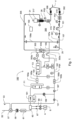
- Fig. 1 shows an extracorporeal blood circuit 300, which can be connected to the vascular system of the patient (not shown) for a treatment via double-needle access, or via single-needle access, using, for example, an additional Y-connector (reference numeral Y) as shown in Fig. 1 .
- the blood circuit 300 can optionally be present in sections thereof in or on a blood cassette.
- Pumps, actuators and/or valves in the area of the blood circuit 300 are connected to a blood treatment apparatus 100 according to the present invention or for example, to a control device 150 comprised within.
- the blood circuit 300 comprises (or is connected to) an arterial patient tubing clamp 302 and an arterial connection needle of an arterial section or of an arterial patient line, a blood withdrawal line or a first line 301.
- the blood circuit 300 further comprises (or is connected to) a venous patient tubing clamp 306 and a venous connection needle of a venous section, a venous patient line, blood return line or second line 305.
- a blood pump 101 is provided in or on the first line 301, a substituate pump 111 is connected to a dialysis liquid inlet line 104 for conveying fresh dialysis liquid, which is filtered through a further filter (F2) (substituate).
- a substituate line 105 can be in fluid communication with the inlet line 104.
- substituate can be introduced by pre-dilution via a pre-dilution valve 107, or by post-dilution via a post-dilution valve 109, into line sections via corresponding lines 107a or 109a, for example into the arterial line section 301 or into the venous line section 305 (here between a blood chamber 303b of a blood filter 303 and a venous air separation chamber or venous blood chamber 29) of the blood circuit 300.
- the blood filter 303 comprises the blood chamber 303b which is connected to the arterial line section 301 and the venous line section 305.
- a dialysis liquid chamber 303a of the blood filter 303 is connected to the dialysis liquid inlet line 104 leading to the dialysis liquid chamber 303a and a dialysate outlet line 102 leading away from the dialysis liquid chamber 303a which guides dialysate, i.e. used dialysis liquid.
- Dialysis liquid chamber 303a and blood chamber 303b are separated by a mostly semi-permeable membrane 303c. This membrane is what separates the blood side with the extracorporeal blood circuit 300 and the machine side with the dialysis liquid circuit or dialysate circuit, which is shown in Fig. 1 to the left of the membrane 303c.
- the arrangement in Fig. 1 encompasses an optional detector 315 for detecting air and/or blood.
- the arrangement in Fig. 1 further encompasses one or two pressure sensors PS1 (upstream of the blood pump 101) and PS2 (downstream of the blood pump 101, which measures the pressure upstream of the blood filter 303 ("pre-hemofilter")) at the positions shown in Fig. 1 .
- Further pressure sensors may be provided, e.g. the pressure sensor PS3 downstream of the venous blood chamber 29.
- An optional single-needle chamber 317 is used in Fig. 1 as a buffer and/or a compensating reservoir in a single-needle procedure in which the patient is connected to the extracorporeal blood circuit 300 via only one of the two blood lines 301, 305.
- the arrangement in Fig. 1 additionally comprises an optional detector 319 for detecting air bubbles and/or blood.
- An addition point 25 for Heparin may be optionally provided.
- a mixing apparatus 63 being a dialysis liquid preparation system which, from containers A (for A concentrate via the concentrate supply 67) and B (for B concentrate via the concentrate supply 69), provides a predetermined mixture for the respective solution for use by the blood treatment apparatus 100.
- the mixing apparatus 63 as such can be omitted, and the two concentrates can be delivered successively into any fluid line and may come into contact with each other in any component of the blood treatment apparatus 100.
- the so generated solution may be optionally thoroughly mixed or stirred, e. g., in a device 161 for balancing (e.g., a balancing chamber) as set forth below.
- a device 161 for balancing e.g., a balancing chamber
- the mixing apparatus 63 as mentioned herein is not restricted to a chamber as shown in Fig. 1 . Rather, it may be any other vessel such as the fluid line denoted with 63 in Fig. 2 or Fig. 3 .
- the solution may contain, in the heater 61 for example, warmed water from the water source 55 (on-line, e.g. as reverse osmosis water or from bags).
- a pump 71 that may be referred to as a concentrate pump or sodium pump is in fluid communication with the mixing apparatus 63 and with a source having sodium, such as the container B, and/or conveys therefrom.
- FIG. 1 An outlet 53 for the effluent can be seen in Fig. 1 .
- a further pressure sensor for measuring the filtrate pressure or the membrane pressure of the blood filter 303 may be provided as PS4 downstream of the blood filter 303 on the water-side, however preferably upstream of the ultrafiltration pump 131 in the dialysate outlet line 102. Further optional pressure measuring points P may also be provided.
- Blood which leaves the blood filter 303, passes through an optional venous blood chamber 29, which can comprise a de-aeration device 31 and/or may be in fluid communication with a further pressure sensor PS3.
- the exemplary arrangement shown in Fig. 1 comprises a control device or closed-loop control device 150.
- This can be in wired or wireless signal communication with any of the components referred to herein - in particular or especially to the blood pump 101 - in order to control or regulate the blood treatment apparatus 100. It is optionally configured in order to carry out the method described herein, particularly automatically.
- the device for on-line mixing of the dialysis liquid By using the device for on-line mixing of the dialysis liquid, a variation in the sodium content thereof controlled by the control device 150, is possible within certain limits. For this purpose, measurements determined via the conductivity sensors 163a, 163b may particularly be taken into account. Should an adjustment of the sodium content of the dialysis liquid (sodium concentration) or of the substituate be required or desired, this can be done by adjusting the delivery rate of the sodium pump 71.
- the blood treatment apparatus 100 comprises means for conveying fresh dialysis liquid as well as dialysate.
- the first flow pump 59 which conveys fresh dialysis liquid towards the blood filter 303, is provided upstream of the blood filter 303.
- a first valve may be provided between the first flow pump 59 and the blood filter 303, which opens or closes the inlet to the blood filter 303 on the inlet side.
- a second optional flow pump 169 is provided, for example downstream of the blood filter 303, which conveys dialysate to the outlet 53.
- a second valve may be provided between the blood filter 303 and the second flow pump 169, which opens or closes the outlet on the outlet side.
- the blood treatment apparatus 100 optionally comprises a device 161 for balancing the flow going into and coming out of the dialyzer 303 on the machine side.
- the device 161 for balancing is preferably arranged in a line section between the first flow pump 59 and the second flow pump 169.
- the blood treatment apparatus 100 further encompasses means, such as the ultrafiltration pump 131, for the precise removal of a fluid volume from the balanced circuit as specified by the user and/or by the control device 150.
- Sensors such as the optional conductivity sensors 163a, 163b serve to determine the conductivity, which in some embodiments is temperature-compensated, as well as the liquid flow upstream and downstream of the dialyzer 303.
- Temperature sensors 165a, 165b can be provided individually or in groups. Temperature readings supplied by them can be used according to the present invention to determine a temperature-compensated conductivity.
- a leakage sensor 167 is optionally provided.
- a row of optional valves is each indicated in Fig. 1 with a V.
- Bypass valves are indicated with a VB.
- control device 150 determines the electrolyte and/or liquid balancing based on the measurement readings of the afore-mentioned, optional sensors.
- Filters F1 and F2 may be provided in series-connection.
- the filter F1 here serves exemplarily, via the mixing apparatus 63, to produce sufficiently pure dialysis liquid, even when using impure water, which then flows through the blood filter 303, e.g. according to the counter-current principle.
- the filter F2 serves to generate a sterile or sufficiently filtered substituate from the sufficiently pure dialysis liquid, which leaves the first filter F1, by filtering out pyrogenic substances, for example.
- This substituate can safely be added to the patient's blood flowing extracorporeally and thus ultimately be supplied to the patient's body.
- the blood treatment apparatus 100 is shown in Fig. 1 as a device for hemo(dia)filtration.
- hemodialysis devices also fall within the scope of the present invention, even though they are not specifically shown in the figures.
- arrows shown in Fig. 1 generally indicate the direction of flow in Fig. 1 .
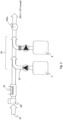
- Fig. 2 shows a schematic representation of an exemplary implementation of the first phase of the method according to the present invention.
- the components shown are all part of the hydraulic unit of the blood treatment apparatus 100 according to the present invention.
- Fig. 1 shows the mixing apparatus 63 used for preparing the priming liquid.
- the mixing apparatus 63 is not limited to the one shown in Fig. 1 . Rather, the mixing can take place anywhere within the blood treatment apparatus 100 or the tubing attached to it.
- a fluid line into which the concentrates may be fed downstream the water source 55 is used as a mixing chamber.
- the priming liquid contains no bicarbonate, a priming takes place with acid concentrate diluted in water only.
- Water gained from a reverse-osmosis (RO) process or any other type of water such as tap water enters the mixing apparatus 63 from the water source 55.
- RO reverse-osmosis
- the water may be heated in a heating apparatus 61 such that the temperature of the eventually generated priming liquid is between 25°C and 35°C (degrees Celsius).
- a conductivity cell 163a may be used to monitor and control the [Na + ] concentration of the priming liquid prepared in the mixing apparatus 63. In the first phase, a conductivity of 14.0 [mS] is measured.
- a desirable [Na + ] concentration is 137 mmol/l.
- the [Na + ] concentration of the priming liquid originates exclusively from the source A since no fluid and, hence, no sodium chloride or sodium [Na + ] is contributed to the priming liquid from source B.
- the container A comprises an acid concentrate for dialysis with sodium chloride in a concentration of 263 g/l NaCl. Further the container A comprises an acid, like citric acid or acetic acid, and preferably one or more of the following electrolytes, like magnesium chloride, calcium chloride and potassium chloride.
- the concentrate is diluted with water (33:1) to result in a priming solution comprising 137 mmol/l sodium.
- Fig. 3 shows a schematic representation of an exemplary implementation of the second phase of the method according to the present invention.
- the components shown in Fig. 3 are those of Fig. 2 .
- bicarbonate concentrate is added to the priming liquid in preparation of the extracorporeal blood circuit 300 as is indicated by the icon representing the pump corresponding to the source B.
- the container A comprises 263 g/l NaCl. Its concentrate is used with a dilution factor 45:1 contributing 100 mmol/l sodium chloride, whereas the flow from container B contributes 37 mmol/l in an exemplary dilution having a dilution factor 25:1.
- the [Na + ] concentration of the priming liquid is 137 mmol/l.
- the contribution from container A amounts to 100 mmol/l [Na + ] and is, hence, less than before.
- sodium chloride is contributed from the container B as well.
- it also provides the lacking 37 mmol/l [Na + ] needed for preparing a priming solution having a concentration of 137 mmol/l [Na + ] as in the first phase.
- the bicarbonate concentrate of container B may be saturated.
- its sodium bicarbonate concentration may, in one exemplary embodiment, amount to 95,5 g/l at 20°C. Those number are, however, not intended to be limiting, of course.
- the priming solution prepared in the first phase may be used when circulating a liquid through parts of the extracorporeal blood circuit 300 and/or of the hydraulic system while a patient is temporarily disconnected from the blood treatment apparatus 100. Also, a solution used for rinsing parts of the extracorporeal blood circuit 300 and/or of the hydraulic system between two patients that are consecutively treated with more or less the same equipment. Before connecting the next patient to said equipment, the solution prepared by the mixing apparatus 63 will have been mixed as set forth with respect to the second phase, e.g., as described supra.
Landscapes
- Health & Medical Sciences (AREA)
- Heart & Thoracic Surgery (AREA)
- Vascular Medicine (AREA)
- Biomedical Technology (AREA)
- Engineering & Computer Science (AREA)
- Anesthesiology (AREA)
- Cardiology (AREA)
- Hematology (AREA)
- Life Sciences & Earth Sciences (AREA)
- Animal Behavior & Ethology (AREA)
- General Health & Medical Sciences (AREA)
- Public Health (AREA)
- Veterinary Medicine (AREA)
- Urology & Nephrology (AREA)
- External Artificial Organs (AREA)
Claims (12)
- Un procédé d'amorçage d'un circuit sanguin extracorporel (300) utilisant un appareil de traitement du sang (100) qui comprend un système de préparation de liquide de dialyse ayant une source (55) d'eau, une source (B) de concentré de bicarbonate ainsi qu'une source (A) de concentré acide incluant du chlorure de sodium, et configuré pour préparer un liquide de dialyse uniquement à partir d'eau, dudit concentré de bicarbonate et dudit concentré acide,ledit circuit sanguin extracorporel (300) comprend une section de conduite artérielle (301), raccordable à un patient, pour prélever le sang du patient, une section de conduite veineuse (305), raccordable au patient, pour renvoyer le sang au patient, ainsi qu'un compartiment côté sang ou une chambre à sang (303b) d'un filtre sanguin (303), ledit procédé englobant les étapes d'une première phase consistant à :- préparer une solution d'amorçage uniquement à partir de ladite source (55) d'eau et de ladite source (A) de concentré acide, pour obtenir une solution acide/eau,- raccorder ladite section de conduite artérielle (301) à une sortie du système de préparation du liquide de dialyse de l'appareil de traitement du sang (100) et,- remplir le circuit sanguin extracorporel (300) avec ladite solution d'amorçage.caractérisé en ce que :- le système de préparation du liquide de dialyse ne possède pas, ou n'est pas raccordé à, une source qui comprend uniquement ou exclusivement du chlorure de sodium;et en ce que :- le bicarbonate provenant de la source (B) de concentré de bicarbonate est absent de ladite solution.
- Le procédé selon la première revendication, où, pendant la première phase, la température de la solution d'amorçage est maintenue en dessous de 35°C, de préférence entre 25°C et 30°C.
- Le procédé selon l'une quelconque des revendications précédentes, englobant en outre l'étape suivante d'une seconde phase, suivant la première phase, consistant à :- ajouter du bicarbonate provenant de la source (B) de concentré de bicarbonate à la solution d'amorçage.
- Le procédé selon la revendication 3, où pendant la seconde phase, la température de la solution d'amorçage est élevée à au moins 35°C.
- Le procédé selon la revendication 3 ou 4, où l'amorçage et notamment la circulation de la solution d'amorçage dans le circuit extracorporel (300) se poursuit pendant au moins 5 minutes avant que l'amorçage ne soit considéré comme terminé.
- Un dispositif de commande ou un dispositif de commande en boucle fermée (150), configuré pour exécuter ou pour initier le procédé selon l'une quelconque des revendications 1 à 5, en interaction avec un appareil de traitement du sang (100).
- Un appareil de traitement du sang (100) pour le traitement extracorporel du sang d'un patient, comprenant :- un dispositif de commande ou un dispositif de commande en boucle fermée (150), selon la revendication 6.
- L'appareil de traitement du sang (100) selon la revendication 7, où l'appareil de traitement du sang (100) est conçu sous la forme d'un appareil d'hémodialyse, d'un appareil d'hémofiltration ou d'un appareil d'hémodiafiltration, notamment sous la forme d'un appareil pour la thérapie de remplacement rénal aiguë ou chronique.
- L'appareil de traitement du sang (100) selon l'une quelconque des revendications 7 à 8, avec des capteurs (163a, 163b, 165a, 165b), agencés et configurés pour mesurer la concentration de sodium ([Na+]) dans la solution d'amorçage.
- Un support de stockage numérique, notamment sous la forme d'une disquette, d'une carte mémoire, d'un CD, d'un DVD, d'un disque Blu-ray ou d'une EPROM (E), avec des signaux de commande lisibles électroniquement, configuré pour interagir avec un dispositif de commande programmable ou un dispositif de commande en boucle fermée, de sorte que les étapes du procédé selon l'une quelconque des revendications 1 à 5 soient initiées, ou qu'un dispositif de commande conventionnel ou un dispositif de commande en boucle fermée soit reprogrammé en un dispositif de commande ou un dispositif de commande en boucle fermée (150) selon la revendication 6.
- Un produit de programme informatique comportant un code de programme, enregistré sur un support lisible par machine, pour initier les étapes du procédé selon l'une quelconque des revendications 1 à 5 lorsque le produit de programme informatique est exécuté sur un dispositif de commande ou sur un dispositif de commande en boucle fermée, ou pour engendrer la reprogrammation d'un dispositif de commande conventionnel ou d'un dispositif de commande en boucle fermée en un dispositif de commande ou un dispositif de commande en boucle fermée (150) selon la revendication 6.
- Un programme informatique comportant un code de programme pour initier les étapes du procédé selon l'une quelconque des revendications 1 à 5 si le programme informatique est exécuté sur un dispositif de commande ou sur un dispositif de commande en boucle fermée, ou pour engendrer la reprogrammation d'un dispositif de commande conventionnel ou d'un dispositif de commande en boucle fermée en un dispositif de commande ou un dispositif de commande en boucle fermée (150) selon la revendication 6.
Priority Applications (4)
| Application Number | Priority Date | Filing Date | Title |
|---|---|---|---|
| EP20194067.3A EP3964246B1 (fr) | 2020-09-02 | 2020-09-02 | Procédé d'amorçage d'un circuit sanguin extracorporel et dispositifs |
| PCT/EP2021/073845 WO2022049018A1 (fr) | 2020-09-02 | 2021-08-30 | Procédé d'amorçage d'un circuit sanguin extracorporel et dispositifs |
| CN202180054248.4A CN116096440A (zh) | 2020-09-02 | 2021-08-30 | 用于灌注体外血液回路的方法和装置 |
| US18/024,239 US20230302213A1 (en) | 2020-09-02 | 2021-08-30 | Method for Priming an Extracorporeal Blood Circuit and Devices |
Applications Claiming Priority (1)
| Application Number | Priority Date | Filing Date | Title |
|---|---|---|---|
| EP20194067.3A EP3964246B1 (fr) | 2020-09-02 | 2020-09-02 | Procédé d'amorçage d'un circuit sanguin extracorporel et dispositifs |
Publications (2)
| Publication Number | Publication Date |
|---|---|
| EP3964246A1 EP3964246A1 (fr) | 2022-03-09 |
| EP3964246B1 true EP3964246B1 (fr) | 2025-05-14 |
Family
ID=72340262
Family Applications (1)
| Application Number | Title | Priority Date | Filing Date |
|---|---|---|---|
| EP20194067.3A Active EP3964246B1 (fr) | 2020-09-02 | 2020-09-02 | Procédé d'amorçage d'un circuit sanguin extracorporel et dispositifs |
Country Status (4)
| Country | Link |
|---|---|
| US (1) | US20230302213A1 (fr) |
| EP (1) | EP3964246B1 (fr) |
| CN (1) | CN116096440A (fr) |
| WO (1) | WO2022049018A1 (fr) |
Family Cites Families (4)
| Publication number | Priority date | Publication date | Assignee | Title |
|---|---|---|---|---|
| US7476210B2 (en) * | 2001-01-04 | 2009-01-13 | Transvivo Inc. | Apparatus and method for in-vivo plasmapheresis using periodic backflush containing anticoagulant |
| US7657163B2 (en) * | 2006-09-26 | 2010-02-02 | Nellcor Puritan Bennett Llc | Fluid warming system and technique for using the same |
| DE102014113728B4 (de) * | 2014-09-23 | 2023-08-17 | Fresenius Medical Care Deutschland Gmbh | Verfahren und Vorrichtungen zum Vorbereiten eines extrakorporalen Blutkreislaufs für die Blutbehandlung |
| WO2017019635A1 (fr) * | 2015-07-24 | 2017-02-02 | Medtronic, Inc. | Étapes d'amorçage de dialyse au moyen d'un chariot de perfusat |
-
2020
- 2020-09-02 EP EP20194067.3A patent/EP3964246B1/fr active Active
-
2021
- 2021-08-30 CN CN202180054248.4A patent/CN116096440A/zh active Pending
- 2021-08-30 US US18/024,239 patent/US20230302213A1/en active Pending
- 2021-08-30 WO PCT/EP2021/073845 patent/WO2022049018A1/fr not_active Ceased
Also Published As
| Publication number | Publication date |
|---|---|
| CN116096440A (zh) | 2023-05-09 |
| US20230302213A1 (en) | 2023-09-28 |
| EP3964246A1 (fr) | 2022-03-09 |
| WO2022049018A1 (fr) | 2022-03-10 |
Similar Documents
| Publication | Publication Date | Title |
|---|---|---|
| EP2377563B1 (fr) | Appareil de dialyse | |
| EP0951303B1 (fr) | Dispositif de preparation d'une solution de substitution | |
| KR101244119B1 (ko) | 투석기 작동 방법 | |
| EP2142234B1 (fr) | Procédé et dispositif d'amorçage d'un circuit sanguin extracorporel | |
| US10960119B2 (en) | Method for operating a blood treatment apparatus, control unit and treatment apparatus for executing the method | |
| US11471576B2 (en) | Extracorporeal blood treatment apparatus | |
| JP2018042624A (ja) | 血液浄化装置 | |
| JP2024514600A (ja) | 血液処置デバイスを制御するための方法およびデバイス | |
| EP1415673A1 (fr) | Dispositif utilisable pour le traitement d'hémofiltration | |
| CN118401266A (zh) | 具有热量调节的血液治疗设备 | |
| EP3964246B1 (fr) | Procédé d'amorçage d'un circuit sanguin extracorporel et dispositifs | |
| ES2939648T3 (es) | Aparato para el tratamiento de sangre extracorpóreo | |
| CN120731097A (zh) | 具有环境温度变化补偿的血液处理设备 | |
| CN115697429B (zh) | 用于体外血液处理的装置 | |
| JP7789683B2 (ja) | 圧力測定値を収集する時を決定するための方法およびデバイス | |
| CN118401265A (zh) | 具有联接的血液泵和压缩空气装置的血液治疗设备 | |
| ES2937293T3 (es) | Aparato para el tratamiento de sangre extracorpóreo | |
| CN120569229A (zh) | 用于血液处理设备以调节透析期间清除率的控制或调节装置 | |
| JP2021073030A (ja) | 血液浄化装置 | |
| Circuit | Single-Patient Hemodialysis Machines |
Legal Events
| Date | Code | Title | Description |
|---|---|---|---|
| PUAI | Public reference made under article 153(3) epc to a published international application that has entered the european phase |
Free format text: ORIGINAL CODE: 0009012 |
|
| STAA | Information on the status of an ep patent application or granted ep patent |
Free format text: STATUS: THE APPLICATION HAS BEEN PUBLISHED |
|
| AK | Designated contracting states |
Kind code of ref document: A1 Designated state(s): AL AT BE BG CH CY CZ DE DK EE ES FI FR GB GR HR HU IE IS IT LI LT LU LV MC MK MT NL NO PL PT RO RS SE SI SK SM TR |
|
| STAA | Information on the status of an ep patent application or granted ep patent |
Free format text: STATUS: REQUEST FOR EXAMINATION WAS MADE |
|
| 17P | Request for examination filed |
Effective date: 20220905 |
|
| RBV | Designated contracting states (corrected) |
Designated state(s): AL AT BE BG CH CY CZ DE DK EE ES FI FR GB GR HR HU IE IS IT LI LT LU LV MC MK MT NL NO PL PT RO RS SE SI SK SM TR |
|
| GRAP | Despatch of communication of intention to grant a patent |
Free format text: ORIGINAL CODE: EPIDOSNIGR1 |
|
| STAA | Information on the status of an ep patent application or granted ep patent |
Free format text: STATUS: GRANT OF PATENT IS INTENDED |
|
| INTG | Intention to grant announced |
Effective date: 20240715 |
|
| GRAS | Grant fee paid |
Free format text: ORIGINAL CODE: EPIDOSNIGR3 |
|
| GRAJ | Information related to disapproval of communication of intention to grant by the applicant or resumption of examination proceedings by the epo deleted |
Free format text: ORIGINAL CODE: EPIDOSDIGR1 |
|
| GRAL | Information related to payment of fee for publishing/printing deleted |
Free format text: ORIGINAL CODE: EPIDOSDIGR3 |
|
| STAA | Information on the status of an ep patent application or granted ep patent |
Free format text: STATUS: REQUEST FOR EXAMINATION WAS MADE |
|
| GRAP | Despatch of communication of intention to grant a patent |
Free format text: ORIGINAL CODE: EPIDOSNIGR1 |
|
| STAA | Information on the status of an ep patent application or granted ep patent |
Free format text: STATUS: GRANT OF PATENT IS INTENDED |
|
| INTC | Intention to grant announced (deleted) | ||
| INTG | Intention to grant announced |
Effective date: 20241209 |
|
| P01 | Opt-out of the competence of the unified patent court (upc) registered |
Free format text: CASE NUMBER: APP_10409/2025 Effective date: 20250303 |
|
| GRAA | (expected) grant |
Free format text: ORIGINAL CODE: 0009210 |
|
| STAA | Information on the status of an ep patent application or granted ep patent |
Free format text: STATUS: THE PATENT HAS BEEN GRANTED |
|
| AK | Designated contracting states |
Kind code of ref document: B1 Designated state(s): AL AT BE BG CH CY CZ DE DK EE ES FI FR GB GR HR HU IE IS IT LI LT LU LV MC MK MT NL NO PL PT RO RS SE SI SK SM TR |
|
| REG | Reference to a national code |
Ref country code: GB Ref legal event code: FG4D |
|
| REG | Reference to a national code |
Ref country code: CH Ref legal event code: EP |
|
| REG | Reference to a national code |
Ref country code: IE Ref legal event code: FG4D |
|
| REG | Reference to a national code |
Ref country code: DE Ref legal event code: R096 Ref document number: 602020051181 Country of ref document: DE |
|
| REG | Reference to a national code |
Ref country code: NL Ref legal event code: MP Effective date: 20250514 |
|
| PG25 | Lapsed in a contracting state [announced via postgrant information from national office to epo] |
Ref country code: PT Free format text: LAPSE BECAUSE OF FAILURE TO SUBMIT A TRANSLATION OF THE DESCRIPTION OR TO PAY THE FEE WITHIN THE PRESCRIBED TIME-LIMIT Effective date: 20250915 Ref country code: ES Free format text: LAPSE BECAUSE OF FAILURE TO SUBMIT A TRANSLATION OF THE DESCRIPTION OR TO PAY THE FEE WITHIN THE PRESCRIBED TIME-LIMIT Effective date: 20250514 Ref country code: FI Free format text: LAPSE BECAUSE OF FAILURE TO SUBMIT A TRANSLATION OF THE DESCRIPTION OR TO PAY THE FEE WITHIN THE PRESCRIBED TIME-LIMIT Effective date: 20250514 |
|
| PGFP | Annual fee paid to national office [announced via postgrant information from national office to epo] |
Ref country code: DE Payment date: 20250820 Year of fee payment: 6 |
|
| REG | Reference to a national code |
Ref country code: LT Ref legal event code: MG9D |
|
| PG25 | Lapsed in a contracting state [announced via postgrant information from national office to epo] |
Ref country code: NO Free format text: LAPSE BECAUSE OF FAILURE TO SUBMIT A TRANSLATION OF THE DESCRIPTION OR TO PAY THE FEE WITHIN THE PRESCRIBED TIME-LIMIT Effective date: 20250814 Ref country code: GR Free format text: LAPSE BECAUSE OF FAILURE TO SUBMIT A TRANSLATION OF THE DESCRIPTION OR TO PAY THE FEE WITHIN THE PRESCRIBED TIME-LIMIT Effective date: 20250815 |
|
| PG25 | Lapsed in a contracting state [announced via postgrant information from national office to epo] |
Ref country code: NL Free format text: LAPSE BECAUSE OF FAILURE TO SUBMIT A TRANSLATION OF THE DESCRIPTION OR TO PAY THE FEE WITHIN THE PRESCRIBED TIME-LIMIT Effective date: 20250514 Ref country code: PL Free format text: LAPSE BECAUSE OF FAILURE TO SUBMIT A TRANSLATION OF THE DESCRIPTION OR TO PAY THE FEE WITHIN THE PRESCRIBED TIME-LIMIT Effective date: 20250514 |
|
| REG | Reference to a national code |
Ref country code: AT Ref legal event code: MK05 Ref document number: 1794298 Country of ref document: AT Kind code of ref document: T Effective date: 20250514 |
|
| PG25 | Lapsed in a contracting state [announced via postgrant information from national office to epo] |
Ref country code: BG Free format text: LAPSE BECAUSE OF FAILURE TO SUBMIT A TRANSLATION OF THE DESCRIPTION OR TO PAY THE FEE WITHIN THE PRESCRIBED TIME-LIMIT Effective date: 20250514 |
|
| PG25 | Lapsed in a contracting state [announced via postgrant information from national office to epo] |
Ref country code: HR Free format text: LAPSE BECAUSE OF FAILURE TO SUBMIT A TRANSLATION OF THE DESCRIPTION OR TO PAY THE FEE WITHIN THE PRESCRIBED TIME-LIMIT Effective date: 20250514 |
|
| PG25 | Lapsed in a contracting state [announced via postgrant information from national office to epo] |
Ref country code: AT Free format text: LAPSE BECAUSE OF FAILURE TO SUBMIT A TRANSLATION OF THE DESCRIPTION OR TO PAY THE FEE WITHIN THE PRESCRIBED TIME-LIMIT Effective date: 20250514 |
|
| PGFP | Annual fee paid to national office [announced via postgrant information from national office to epo] |
Ref country code: FR Payment date: 20250820 Year of fee payment: 6 |
|
| PG25 | Lapsed in a contracting state [announced via postgrant information from national office to epo] |
Ref country code: RS Free format text: LAPSE BECAUSE OF FAILURE TO SUBMIT A TRANSLATION OF THE DESCRIPTION OR TO PAY THE FEE WITHIN THE PRESCRIBED TIME-LIMIT Effective date: 20250814 |
|
| PG25 | Lapsed in a contracting state [announced via postgrant information from national office to epo] |
Ref country code: IS Free format text: LAPSE BECAUSE OF FAILURE TO SUBMIT A TRANSLATION OF THE DESCRIPTION OR TO PAY THE FEE WITHIN THE PRESCRIBED TIME-LIMIT Effective date: 20250914 |
|
| PG25 | Lapsed in a contracting state [announced via postgrant information from national office to epo] |
Ref country code: LV Free format text: LAPSE BECAUSE OF FAILURE TO SUBMIT A TRANSLATION OF THE DESCRIPTION OR TO PAY THE FEE WITHIN THE PRESCRIBED TIME-LIMIT Effective date: 20250514 |
|
| REG | Reference to a national code |
Ref country code: CH Ref legal event code: W10 Free format text: ST27 STATUS EVENT CODE: U-0-0-W10-W00 (AS PROVIDED BY THE NATIONAL OFFICE) Effective date: 20251224 |
|
| PG25 | Lapsed in a contracting state [announced via postgrant information from national office to epo] |
Ref country code: DK Free format text: LAPSE BECAUSE OF FAILURE TO SUBMIT A TRANSLATION OF THE DESCRIPTION OR TO PAY THE FEE WITHIN THE PRESCRIBED TIME-LIMIT Effective date: 20250514 Ref country code: SM Free format text: LAPSE BECAUSE OF FAILURE TO SUBMIT A TRANSLATION OF THE DESCRIPTION OR TO PAY THE FEE WITHIN THE PRESCRIBED TIME-LIMIT Effective date: 20250514 |
|
| PG25 | Lapsed in a contracting state [announced via postgrant information from national office to epo] |
Ref country code: CZ Free format text: LAPSE BECAUSE OF FAILURE TO SUBMIT A TRANSLATION OF THE DESCRIPTION OR TO PAY THE FEE WITHIN THE PRESCRIBED TIME-LIMIT Effective date: 20250514 |
|
| RAP4 | Party data changed (patent owner data changed or rights of a patent transferred) |
Owner name: FRESENIUS MEDICAL CARE DEUTSCHLAND GMBH |
|
| PG25 | Lapsed in a contracting state [announced via postgrant information from national office to epo] |
Ref country code: EE Free format text: LAPSE BECAUSE OF FAILURE TO SUBMIT A TRANSLATION OF THE DESCRIPTION OR TO PAY THE FEE WITHIN THE PRESCRIBED TIME-LIMIT Effective date: 20250514 |
|
| PG25 | Lapsed in a contracting state [announced via postgrant information from national office to epo] |
Ref country code: SK Free format text: LAPSE BECAUSE OF FAILURE TO SUBMIT A TRANSLATION OF THE DESCRIPTION OR TO PAY THE FEE WITHIN THE PRESCRIBED TIME-LIMIT Effective date: 20250514 Ref country code: RO Free format text: LAPSE BECAUSE OF FAILURE TO SUBMIT A TRANSLATION OF THE DESCRIPTION OR TO PAY THE FEE WITHIN THE PRESCRIBED TIME-LIMIT Effective date: 20250514 |
|
| PG25 | Lapsed in a contracting state [announced via postgrant information from national office to epo] |
Ref country code: IT Free format text: LAPSE BECAUSE OF FAILURE TO SUBMIT A TRANSLATION OF THE DESCRIPTION OR TO PAY THE FEE WITHIN THE PRESCRIBED TIME-LIMIT Effective date: 20250514 |
|
| REG | Reference to a national code |
Ref country code: DE Ref legal event code: R097 Ref document number: 602020051181 Country of ref document: DE |
|
| PLBE | No opposition filed within time limit |
Free format text: ORIGINAL CODE: 0009261 |
|
| STAA | Information on the status of an ep patent application or granted ep patent |
Free format text: STATUS: NO OPPOSITION FILED WITHIN TIME LIMIT |
|
| REG | Reference to a national code |
Ref country code: CH Ref legal event code: L10 Free format text: ST27 STATUS EVENT CODE: U-0-0-L10-L00 (AS PROVIDED BY THE NATIONAL OFFICE) Effective date: 20260325 |
|
| 26N | No opposition filed |
Effective date: 20260217 |