EP3965025A1 - Verfahren und system zur multisensorfusion mittels transformationslernen - Google Patents
Verfahren und system zur multisensorfusion mittels transformationslernen Download PDFInfo
- Publication number
- EP3965025A1 EP3965025A1 EP21192295.0A EP21192295A EP3965025A1 EP 3965025 A1 EP3965025 A1 EP 3965025A1 EP 21192295 A EP21192295 A EP 21192295A EP 3965025 A1 EP3965025 A1 EP 3965025A1
- Authority
- EP
- European Patent Office
- Prior art keywords
- fusing
- sensor specific
- transform
- coefficient
- learning
- Prior art date
- Legal status (The legal status is an assumption and is not a legal conclusion. Google has not performed a legal analysis and makes no representation as to the accuracy of the status listed.)
- Pending
Links
Images




Classifications
-
- G—PHYSICS
- G06—COMPUTING OR CALCULATING; COUNTING
- G06N—COMPUTING ARRANGEMENTS BASED ON SPECIFIC COMPUTATIONAL MODELS
- G06N20/00—Machine learning
-
- G—PHYSICS
- G06—COMPUTING OR CALCULATING; COUNTING
- G06N—COMPUTING ARRANGEMENTS BASED ON SPECIFIC COMPUTATIONAL MODELS
- G06N20/00—Machine learning
- G06N20/20—Ensemble learning
-
- B—PERFORMING OPERATIONS; TRANSPORTING
- B23—MACHINE TOOLS; METAL-WORKING NOT OTHERWISE PROVIDED FOR
- B23K—SOLDERING OR UNSOLDERING; WELDING; CLADDING OR PLATING BY SOLDERING OR WELDING; CUTTING BY APPLYING HEAT LOCALLY, e.g. FLAME CUTTING; WORKING BY LASER BEAM
- B23K20/00—Non-electric welding by applying impact or other pressure, with or without the application of heat, e.g. cladding or plating
- B23K20/12—Non-electric welding by applying impact or other pressure, with or without the application of heat, e.g. cladding or plating the heat being generated by friction; Friction welding
- B23K20/122—Non-electric welding by applying impact or other pressure, with or without the application of heat, e.g. cladding or plating the heat being generated by friction; Friction welding using a non-consumable tool, e.g. friction stir welding
- B23K20/123—Controlling or monitoring the welding process
-
- G—PHYSICS
- G05—CONTROLLING; REGULATING
- G05B—CONTROL OR REGULATING SYSTEMS IN GENERAL; FUNCTIONAL ELEMENTS OF SUCH SYSTEMS; MONITORING OR TESTING ARRANGEMENTS FOR SUCH SYSTEMS OR ELEMENTS
- G05B23/00—Testing or monitoring of control systems or parts thereof
- G05B23/02—Electric testing or monitoring
- G05B23/0205—Electric testing or monitoring by means of a monitoring system capable of detecting and responding to faults
- G05B23/0218—Electric testing or monitoring by means of a monitoring system capable of detecting and responding to faults characterised by the fault detection method dealing with either existing or incipient faults
- G05B23/0243—Electric testing or monitoring by means of a monitoring system capable of detecting and responding to faults characterised by the fault detection method dealing with either existing or incipient faults model based detection method, e.g. first-principles knowledge model
- G05B23/0245—Electric testing or monitoring by means of a monitoring system capable of detecting and responding to faults characterised by the fault detection method dealing with either existing or incipient faults model based detection method, e.g. first-principles knowledge model based on a qualitative model, e.g. rule based; if-then decisions
-
- G—PHYSICS
- G06—COMPUTING OR CALCULATING; COUNTING
- G06F—ELECTRIC DIGITAL DATA PROCESSING
- G06F17/00—Digital computing or data processing equipment or methods, specially adapted for specific functions
- G06F17/10—Complex mathematical operations
- G06F17/16—Matrix or vector computation, e.g. matrix-matrix or matrix-vector multiplication, matrix factorization
Definitions
- the disclosure herein generally relates to multi-sensor fusion, and, more particularly, to multi-sensor fusion using transform learning.
- Multi-sensor fusion is a technique which combines sensory data from disparate sensors to obtain more useful information that may not be possible by a single sensor.
- the useful information thus obtained may be more accurate, complete or dependable 'view' of an entity or a system being sensed.
- This technique also offers several advantages associated with enhancing the data availability and authenticity with relatively lesser complexity.
- multi-sensor fusion techniques encounter challenges related to data imperfection, diversity of sensing mechanism and nature of the application environment. Hence, depending on the nature of the problem and the available information from the sensors, various fusion architectures may be adopted.
- prevalent solutions for multi-sensor fusion are computationally complex and may not perform well in all scenarios.
- Embodiments of the present disclosure present technological improvements as solutions to one or more of the above-mentioned technical problems recognized by the inventors in conventional systems.
- a processor implemented method comprising the steps of: receiving, via one or more hardware processors, a plurality of training data ( X 1 , X 2 , ... X n )from a plurality of sensors connected to a monitored system with a training output (y); performing, via the one or more hardware processors, a joint optimization of a set of parameters including (i) sensor specific transforms ( T 1 , T 2 , ... T n ) and (ii) sensor specific coefficients ( Z 1 , Z 2 , Across Z n ), wherein each of the sensor specific transforms and the sensor specific coefficients correspond to a training data in the plurality of training data ( X 1 , X 2 , ... .
- the joint optimization comprises: initializing the sensor specific transforms ( T 1 , T 2 , ... .. T n ) and the fusing transform ( T ( f ) ) with a random matrix comprising real numbers between 0 and 1; estimating the sensor specific coefficients ( Z 1 , Z 2 , ... .. Z n ) based on the initialized sensor specific transforms ( T 1 , T 2 , ...
- the joint learning comprising: learning each of the sensor specific transforms ( T 1 , T 2 , ... .. T n ) based on a corresponding sensor specific coefficient ( Z 1 , Z 2 , ... .. Z n ) and the plurality of training data ( X 1 , X 2 , ... .. X n ); learning each of the sensor specific coefficients ( Z 1 , Z 2 , ... ...
- the termination criterion is one of (i) completion of a predefined number of iterations (Maxiter) and (ii) difference of the fusing transform ( T ( f ) ) of a current iteration and the fusing transform ( T ( f ) ) of a previous iteration being less than an empirically determined threshold value ( Tol ); to obtain jointly (i) the learnt sensor specific transforms ( T 1 , T 2 , Across T n ), (ii) the learnt fusing transform ( T ( f ) ) and (iii) the learnt weight matrix (w) for the monitored system being sensed by the plurality of sensors.
- a system comprising: memory storing instructions; one or more communication interfaces; one or more hardware processors coupled to the memory via the one or more communication interfaces, wherein the one or more hardware processors are configured by the instructions to: receive a plurality of training data ( X 1 , X 2 , ... .. X n ) from a plurality of sensors connected to a monitored system with a training output (y); perform a joint optimization of a set of parameters including (i) sensor specific transforms ( T 1 , T 2 , Across T n ) and (ii) sensor specific coefficients ( Z 1 , Z 2 , ... ..
- each of the sensor specific transforms and the sensor specific coefficients correspond to a training data in the plurality of training data ( X 1 , X 2 , ... .. X n ), (iii) a fusing transform ( T ( f ) ), (iv) a fusing coefficient ( Z ( f ) ), and (v) a weight matrix (w), and wherein the joint optimization comprises: initializing the sensor specific transforms ( T 1 , T 2 , Across T n ) and the fusing transform ( T ( f ) ) with a random matrix comprising real numbers between 0 and 1; estimating the sensor specific coefficients ( Z 1 , Z 2 , ...
- the joint learning comprising: learning each of the sensor specific transforms ( T 1 , T 2 , ... .. T n ) based on a corresponding sensor specific coefficient ( Z 1 , Z 2 , ... .. Z n ) and the plurality of training data ( X 1 , X 2 , ... ..
- the termination criterion is one of (i) completion of a predefined number of iterations (Maxiter) and (ii) difference of the fusing transform ( T ( f ) ) of a current iteration and the fusing transform ( T ( f ) ) of a previous iteration being less than an empirically determined threshold value ( Tol ); to obtain jointly (i) the learnt sensor specific transforms ( T 1 , T 2 , Across T n ), (ii) the learnt fusing transform ( T ( f ) ) and (iii) the learnt weight matrix (w) for the monitored system being sensed by the plurality of sensors.
- a computer program product comprising a non-transitory computer readable medium having a computer readable program embodied therein, wherein the computer readable program, when executed on a computing device, causes the computing device to: receive a plurality of training data ( X 1 , X 2 , ... .. X n ) from a plurality of sensors connected to a monitored system with a training output (y); perform a joint optimization of a set of parameters including (i) sensor specific transforms ( T 1 , T 2 , ... .. T n ) and (ii) sensor specific coefficients ( Z 1 , Z 2 , ... ..
- each of the sensor specific transforms and the sensor specific coefficients correspond to a training data in the plurality of training data ( X 1 , X 2 , ... .. X n ), (iii) a fusing transform ( T ( f ) ), (iv) a fusing coefficient ( Z ( f ) ), and (v) a weight matrix (w), and wherein the joint optimization comprises: initializing the sensor specific transforms ( T 1 , T 2 , Across T n ) and the fusing transform ( T ( f ) ) with a random matrix comprising real numbers between 0 and 1; estimating the sensor specific coefficients ( Z 1 , Z 2 , ... ..
- the joint learning comprising: learning each of the sensor specific transforms ( T 1 , T 2 , ... T n ) based on a corresponding sensor specific coefficient ( Z 1 , Z 2 , ... . . Z n ) and the plurality of training data ( X 1 , X 2 , ... . . Z n ); learning each of the sensor specific coefficients ( Z 1 , Z 2 , ...
- the termination criterion is one of (i) completion of a predefined number of iterations (Maxiter) and (ii) difference of the fusing transform ( T ( f ) ) of a current iteration and the fusing transform ( T ( f ) ) of a previous iteration being less than an empirically determined threshold value ( Tol ); to obtain jointly (i) the learnt sensor specific transforms ( T 1 , T 2 , Across T n ), (ii) the learnt fusing transform ( T ( f ) ) and (iii) the learnt weight matrix (w) for the monitored system being sensed by the plurality of sensors.
- the joint optimization is represented as min T 1 , T 2 , ... T n , T f Z 1 , Z 2 , ... Z n , Z f , w ⁇ T 1 X 1 ⁇ Z 1 ⁇ F 2 + ⁇ T 2 X 2 ⁇ Z 2 ⁇ F 2 + ⁇ + ⁇ T n X n ⁇ Z n ⁇ F 2 + ⁇ 1 ⁇ T 1 ⁇ F 2 ⁇ log det T 1 + ⁇ 2 ⁇ T 2 ⁇ F 2 ⁇ log det T 2 + ⁇ + ⁇ ⁇ n ⁇ T n ⁇ F 2 ⁇ log det T n + ⁇ ⁇ T f Z 1 Z 2 ⁇ ⁇ Z n ⁇ Z f ⁇ F 2 + ⁇ ⁇ T f ⁇ F 2 ⁇ log det T f + ⁇ ⁇ y ⁇ wZ f ⁇ 2 2 , and wherein T 1 ⁇ R K 1
- the learning of the weight matrix (w) is represented as w ⁇ min w ⁇ ⁇ y ⁇ wZ f ⁇ 2 2 .
- the one or more processors are further configured to estimate an output ( y new ) of the monitored system for a plurality of new data ( x 1 , x 2 , ... x n ) by: receiving, via the one or more hardware processors, the plurality of new data ( x 1 , x 2 , ... .. x n ) from the plurality of sensors connected to the monitored system; estimating the sensor specific coefficients ( z 1 , z 2 , Vietnamese z n ) corresponding to the plurality of new data ( x 1 , x 2 , Across x n ) using the plurality of new data ( x 1 , x 2 , .
- the plurality of training data ( X 1 , X 2 , ...X n ) and the plurality of new data ( x 1 , x 2 , ... x n ) are kernelized using a kernel function.
- the plurality of sensors include sensors configured to capture the new data pertaining to force, torque and power for a welding process implemented by the FSW machine, the output (y) is a value representing Ultimate Tensile Strength (UTS) indicative of the quality of the weld performed by the FSW machine.
- UTS Ultimate Tensile Strength
- Solutions for multi-sensor fusion may be broadly classified into three levels: Data-level, Feature-level and Decision-level.
- the data-driven representations may be learnt by employing representation learning techniques.
- representation learning techniques There has been some work on multi-sensor fusion at raw data level. Fusion at feature level has also been utilized in the art, wherein an output from different sensor signal pipelines, processed individually by deep learning, are fused by a fully connected layer for time series classification. Deep network models are computationally intensive and complex.
- Dictionary Learning (DL), Transform Learning (TL) provide compact representation of data in many scenarios and may perform well in different application domains.
- a two-stage approach is employed for better modeling of the sensor data, wherein in the first stage, representation of the individual sensor time series is learnt using dedicated transforms and their associated coefficients and in the second stage, all the representations are fused together using a fusing (common) transform and its associated coefficients to effectively capture correlation between the different sensor representations for deriving an inference.
- Formulations of both non-kernel and kernelized versions i.e., Transform Learning for Fusion (TLF) and the Kernel Transform Learning for Fusion (KTLF) are addressed in the present disclosure.
- Applicant has further evaluated performance of the method and system of the present disclosure in comparison with standard DL techniques for regression (where a single transform or dictionary is learnt for an entire multi-variate data) and also with the TLR and KTLR techniques of the Applicant's Application No. 201921035106 .
- TL Basic Transform Learning Framework
- the appropriate transform matrix T and sparse coefficients Z is learnt by solving the following optimization problem: min T , Z ⁇ TX ⁇ Z ⁇ F 2 + ⁇ ⁇ T ⁇ F 2 ⁇ logdetT + ⁇ ⁇ Z ⁇ 0 wherein the additional regularization term ⁇ T ⁇ F 2 ⁇ logdetT ) prevents trivial solution by controlling the condition number of the transform matrix T and ⁇ Z ⁇ 0 enforces sparsity on the learnt coefficient Z.
- the above minimization equation (2) is solved for T and Z employing an alternative minimization framework.
- TX wherein the term in the bracket is hard thresholded against a threshold ⁇ and '.' denotes element-wise product.
- T 0.5 V S + S 2 + 2 ⁇ I 1 / 2 U T L ⁇ 1
- the transform thus learnt may be used to carry out classification or regression tasks depending on whether an associated output is discrete or continuous.
- KTL Kernel Transform Learning Framework
- FIG. 1 through FIG.5B where similar reference characters denote corresponding features consistently throughout the figures, there are shown preferred embodiments and these embodiments are described in the context of the following exemplary system and/or method.
- FIG. 1 illustrates an exemplary block diagram of a system 100 for multi-sensor fusion using Transform Learning (TL), in accordance with some embodiments of the present disclosure.
- the system 100 for multi-sensor fusion includes one or more processors 104, communication interface device(s) or input/output (I/O) interface(s) 106, and one or more data storage devices or memory 102 operatively coupled to the one or more processors 104.
- the one or more processors 104 that are hardware processors can be implemented as one or more microprocessors, microcomputers, microcontrollers, digital signal processors, central processing units, state machines, graphics controllers, logic circuitries, and/or any devices that manipulate signals based on operational instructions.
- the processor(s) are configured to fetch and execute computer-readable instructions stored in the memory.
- the expressions 'processors' and 'hardware processors' may be used interchangeably.
- the system for multi-sensor fusion 100 can be implemented in a variety of computing systems, such as laptop computers, notebooks, hand-held devices, workstations, mainframe computers, servers, a network cloud and the like.
- I/O interface(s) 106 can include a variety of software and hardware interfaces, for example, a web interface, a graphical user interface, and the like and can facilitate multiple communications within a wide variety of networks N/W and protocol types, including wired networks, for example, LAN, cable, etc., and wireless networks, such as WLAN, cellular, or satellite.
- the I/O interface(s) can include one or more ports for connecting a number of devices to one another or to another server.
- the memory 102 may include any computer-readable medium known in the art including, for example, volatile memory, such as static random-access memory (SRAM) and dynamic random-access memory (DRAM), and/or non-volatile memory, such as read only memory (ROM), erasable programmable ROM, flash memories, hard disks, optical disks, and magnetic tapes.
- volatile memory such as static random-access memory (SRAM) and dynamic random-access memory (DRAM)
- non-volatile memory such as read only memory (ROM), erasable programmable ROM, flash memories, hard disks, optical disks, and magnetic tapes.
- ROM read only memory
- erasable programmable ROM erasable programmable ROM
- flash memories hard disks
- optical disks optical disks
- magnetic tapes magnetic tapes
- FIG.2 is a high-level flow diagram 200 of a method for multi-sensor fusion using TL according to some embodiments of the present disclosure.
- an exemplary monitored system such as a Friction Stir Welding (FSW) machine
- ( X 1 , X 2 , ... ..X n ) represent an input (a plurality of training data referred later in the description) to the exemplary monitored system, wherein the input is received from the plurality of sensors.
- T 1 , T 2 , Across T n ) represent sensor specific transforms that are learnt to represent the corresponding sensor data.
- the sensor specific transforms are appropriately fused using a fusing transform ( T ( f ) ) which is learnt by utilizing the knowledge of an output (y) or a final inference (or training output referred later in the description).
- T ( f ) a fusing transform
- the illustrated flow diagram in FIG.2 represents a supervised learning framework, where the transforms and weight matrix (for classification or regression) are learnt in a training phase and later utilized practically for carrying out multi-sensor fusion.
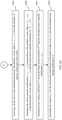
- FIG.3A through FIG.3D illustrate an exemplary flow diagram of a computer implemented method 300 for multi-sensor fusion using Transform Learning, in accordance with some embodiments of the present disclosure.
- the system for multi-sensor fusion 100 includes one or more data storage devices or memory 102 operatively coupled to the one or more processors 104 and is configured to store instructions configured for execution of steps of the method 300 by the one or more processors 104.
- the steps of the method 300 will now be explained in detail with reference to the components of the system for multi-sensor fusion 100 of FIG.1 and the flow diagram 200 of FIG.2 .
- process steps, method steps, techniques or the like may be described in a sequential order, such processes, methods and techniques may be configured to work in alternate orders. In other words, any sequence or order of steps that may be described does not necessarily indicate a requirement that the steps be performed in that order.
- the steps of processes described herein may be performed in any order practical. Further, some steps may be performed simultaneously.
- the one or more processors 104 are configured to receive, at step 302, the plurality of training data ( X 1 , X 2 , .... X n ) from the plurality of sensors connected to a monitored system with a training output (y).
- the training data ( X 1 , X 2 , ... X n ) in the context of the present disclosure is a time series data.
- the one or more processors 104 are configured to perform, at step 304, a joint optimization of a set of parameters including (i) sensor specific transforms ( T 1 , T 2 , Across T n ) and (ii) sensor specific coefficients ( Z 1 , Z 2 , .
- each of the sensor specific transforms and the sensor specific coefficients correspond to a training data in the plurality of training data ( X 1 , X 2 , ... .. X n ), (iii) a fusing transform ( T ( f ) ), (iv) a fusing coefficient ( Z ( f ) ), and (v) a weight matrix (w).
- the joint optimization may be expressed as: min T 1 , T 2 , ... T n , T f Z 1 , Z 2 , ... Z n , Z f , w ⁇ T 1 X 1 ⁇ Z 1 ⁇ F 2 + ⁇ T 2 X 2 ⁇ Z 2 ⁇ F 2 + ⁇ + ⁇ T n X n ⁇ Z n ⁇ F 2 + ⁇ 1 ⁇ T 1 ⁇ F 2 ⁇ log det T 1 + ⁇ 2 ⁇ T 2 ⁇ F 2 ⁇ log det T 2 + ⁇ + ⁇ n ⁇ T n ⁇ F 2 ⁇ log det T n + ⁇ ⁇ T f Z 1 Z 2 ⁇ ⁇ Z n ⁇ Z f ⁇ F 2 + ⁇ ⁇ T f ⁇ F 2 ⁇ log det T f + ⁇ ⁇ y ⁇ wZ f ⁇ 2 2 , wherein T 1 ⁇ R K 1 ⁇
- the joint optimization comprises initializing and estimating some of the parameters from the set of parameters followed by iteratively learning all of the parameters.
- the sensor specific transforms ( T 1 , T 2 , ?? T n ) and the fusing transform ( T ( f ) ) are initialized, at step 304a, with a random matrix comprising real numbers between 0 and 1. In an embodiment, the real numbers may be chosen from a uniform distribution.
- the sensor specific coefficients ( Z 1 , Z 2 , ... .. Z n ) are estimated, at step 304b, based on the initialized sensor specific transforms ( T 1 , T 2 , ).
- the fusing coefficient ( Z ( f ) ) is estimated, at step 304c, based on the initialized fusing transform ( T ( f ) ) and the estimated sensor specific coefficients ( Z 1 , Z 2 , ... Z n ).
- the weight matrix (w) is estimated, at step 304d, based on the training output (y) and the estimated fusing coefficient ( Z ( f ) ).
- joint learning is performed iteratively, at step 304e, using the initialized parameters from step 304a and the estimated parameters from steps 304b through 304d in a first iteration and learnt parameters thereafter until a termination criterion is met to obtain jointly (i) the learnt sensor specific transforms ( T 1 , T 2 , ... T n ), (ii) the learnt fusing transform ( T ( f ) ) and (iii) the learnt weight matrix (w) for the monitored system being sensed by the plurality of sensors.
- the joint learning comprises learning each of the sensor specific transforms ( T 1 , T 2 , across T n ), at step 304e-1, based on a corresponding sensor specific coefficient ( Z 1 , Z 2 ,... .. Z n ) and the plurality of training data ( X 1 , X 2 , across X n ).
- each of the sensor specific coefficients ( Z 1 , Z 2 , ... Z n ) are learnt based on the fusing transform ( T ( f ) ), a corresponding sensor specific transform ( T 1 , T 2 , ... T n ), the fusing coefficient ( Z ( f ) ) and a corresponding training data from the plurality of training data ( X 1 , X 2 , ... . . X n ), and remaining of the sensor specific coefficients ( Z 1 , Z 2 , Across Z n ).
- the fusing transform ( T ( f ) ) is learnt based on the sensor specific coefficient ( Z 1 , Z 2 , ... Z n ) and the fusing coefficient ( Z ( f ) ).
- the fusing coefficient ( Z ( f ) ) is learnt based on the fusing transform ( T ( f ) ), the sensor specific coefficient ( Z 1 , Z 2 , ... Z n ), the weight matrix (w) and the training output (y).
- the weight matrix (w) is learnt based on the fusing coefficient ( Z ( f ) ) and the training output (y).
- the learning of the weight matrix (w) may be represented as: w ⁇ min w ⁇ ⁇ y ⁇ wZ f ⁇ 2 2
- the termination criterion is one of (i) completion of a predefined number of iterations (Maxiter) and (ii) difference of the fusing transform ( T ( f ) ) of a current iteration and the fusing transform ( T ( f ) ) of a previous iteration being less than an empirically determined threshold value ( Tol ).
- the empirically determined threshold value is a very low value e.g. 0.001.
- the one or more processors 104 are configured to estimate, at step 306, an output ( y new ) of the monitored system for a plurality of new data ( x 1 , x 2 , ... x n ).
- the new data is also a time series data.
- the step of estimating the output ( y new ) of the monitored system represents application of the method 300 of the present disclosure to the monitored system using new data which is different from the training data ( X 1 , X 2 , ... X n ) that was used in the earlier steps.
- the one or more hardware processors are configured to receive the plurality of new data ( x 1 , x 2 , across x n ) from the plurality of sensors connected to the monitored system.
- the sensor specific coefficients ( z 1 , z 2 , ... z n ) corresponding to the plurality of new data ( x 1 , x 2 , ... .. x n ) are estimated, at step 306b, using the plurality of new data ( x 1 , x 2 , Vietnamese x n ) and the learnt sensor specific transforms ( T 1 , T 2 , ... .. T n ).
- a new fusing coefficient z ( f ) is then estimated, at step 306c, using the learnt fusing transform ( T ( f ) ) and the estimated sensor specific coefficients ( z 1 , z 2 , ... z n ).
- the output ( y new ) is estimated, at step 306d, for the monitored system based on the learnt weight matrix (w) and the estimated new fusing coefficient z ( f ).
- Kernel Transform Learning Framework for Fusion To capture complex non-linear relationship in the data, in accordance with an embodiment of the present disclosure, the plurality of training data ( X 1 , X 2 , ... .. X n ) and the plurality of new data ( x 1 , x 2 , across x n ) are kernelized using a kernel function.
- the kernel function may be a radial basis function, a polynomial kernel, and the like.
- a kernel version of the joint optimization of Equation (12) may be represented as:
- the sensor specific coefficients ( z 1 , z 2 , ... .. z n ) corresponding to the plurality of new data ( x 1 , x 2 , ... .. x n ) in the kernelized version may be represented as:
- Input Set of training data, ( X 1 , X 2 , X 3 ), training output (y), size of transforms (atoms) K 1 , K 2 , K 3 , hyperparameters ⁇ 1 , ⁇ 2 , ⁇ 3 , ⁇ , ⁇ , predefined number of iterations (Maxiter), kernel function and new data for which output needs to be estimated ( x 1 , x 2 , x 3 ),
- Output Learnt sensor specific transforms ( T 1 , T 2 , T 3 ) or ( B 1 , B 2 , B 3 ), (ii) the learnt fusing transform ( T ( f ) ) (iii) the learnt weight matrix (w) and the estimated output ( y new ) .
- the applicability of the method 300 and system 200 of the present disclosure for multi-sensor fusion is demonstrated using two different real-life scenarios.
- the performance of the method is evaluated using Mean Square Error (MSE) and Mean Absolute Error (MAE) metrics.
- MSE Mean Square Error
- MAE Mean Absolute Error
- a comparative study is presented with the regression techniques based on TL i.e., Transform Learning for Regression (TLR) and Kernel Transform Learning for regression (KTLR). Since DL based techniques are more prevalent, a comparison against the DL counterparts i.e., Dictionary Learning for Regression (DLR) and the Kernel Dictionary Learning for Regression (KDLR) are also provided.
- DLR Dictionary Learning for Regression
- KDLR Kernel Dictionary Learning for Regression
- FSW is an advanced technique used for joining two similar or dis-similar materials. FSW machines are known to produce superior quality weld compared to other techniques using lesser energy. Owing to the various advantages of this solid-state joining process, there is a need to assess the quality of the weld and control the defects. Relevant sensors were connected to these machines to study the health of the machine and the welding process in real-time. The experimental data was collected for weld quality assessment using the FSW machine. Data from three sensors; Force, Torque and Power are captured at 10 Hz for each welding process. They served as an input to the method of the present disclosure. The output is a single value for weld quality which is measured manually in terms of Ultimate Tensile Strength (UTS). A total of 40 experiments were carried out on an aluminum alloy for different values of spindle RPM (Rotations Per Minute) and welding speed to create weld samples.
- UTS Ultimate Tensile Strength
- the data contains 1000 samples of Force, Torque and Power signals for each experiment or welding process. This data was normalized and split into windows of 50 samples each, serving as the feature length for all the sensors.
- the sensor specific transforms were learnt for the three sensors along with the fusing transform and regression weights relating the UTS value to sensor data. 5-fold cross-validation was carried out to generate the results.
- Table I presents the comparative results for UTS estimation using MSE and MAE for different techniques.
- FIG.4A illustrates Ultimate Tensile Strength (UTS) of welded joints estimated using kernel-based methods known in the art and the kernel-based method according to some embodiments of the present disclosure.
- FIG.4B illustrates Ultimate Tensile Strength (UTS) of welded joints estimated using sensors individually versus all sensors by the multi-sensor fusion using the kernel-based method according to some embodiments of the present disclosure.
- Building Energy Consumption Data Aggregate power consumption data from office building is considered for half day ahead load forecasting.
- Load forecasting is framed as a regression problem where previous day power (PDay Power) consumption measurements from smart meter and day ahead temperature forecast are treated as different sensors and taken as model input.
- a virtual sensor was created using one-week lag values of the power data with respect to the forecast day and considered as an additional input. This corresponds to previous week same day power consumption measurements (PWDay Power).
- the output is half day ahead power consumption forecast of the building.
- the office building data comprised of 6.5 months aggregate active power consumption measurements taken every 15 minutes.
- the data is normalized and half day data which corresponds to 48 samples are considered as feature length for all the sensors.
- 6 months data is considered for training, where the transforms and the regression weights are learnt.
- the regression weights are w ⁇ R 48 ⁇ K with K being the number of atoms of the transform or dictionary. Similar to the previous case, 5-fold cross-validation was carried out to generate the results.
- Table II presents the comparative results for half day ahead load forecasting using MSE and MAE for different techniques for both multi-sensor and sensors individually case.
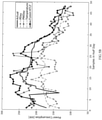
- FIG.5A illustrates half day ahead building power consumption forecast obtained using kernel-based methods known in the art and the multi-sensor fusion using the methods according to some embodiments of the present disclosure.
- FIG.5B illustrates half day ahead building power consumption forecast obtained using sensors individually versus all sensors by the multi-sensor fusion using the kernel-based method according to some embodiments of the present disclosure.
- the kernel versions of the techniques perform better than the basic or non-kernelized versions.
- the method TLF of the present disclosure has better performance compared to the other basic versions.
- the KTLF of the present disclosure has the best performance both in terms of MSE and MAE, thus demonstrating the potential of the method and system of the present disclosure for multi-sensor fusion.
- the weights may be then specified as regression or classification weights depending on the task.
- the UTS estimation results may also be considered for a classification task by quantizing the continuous output y new and creating labels e.g. classification of weld - good/average/bad.
- multi-sensor fusion is increasingly finding its usage in several areas such as in many biomedical applications, sensor networks, robotics, etc.
- it also plays a significant role in emerging instances of cyber-physical systems like smart grid and smart manufacturing; primarily employed to improve the decision-making capability of predictive and prescriptive analytics built on such systems.
- the method and system of the present disclosure can find application in all such areas employing multiple sensors that are mostly heterogeneous in nature.
- the hardware device can be any kind of device which can be programmed including e.g. any kind of computer like a server or a personal computer, or the like, or any combination thereof.
- the device may also include means which could be e.g. hardware means like e.g. an application-specific integrated circuit (ASIC), a field-programmable gate array (FPGA), or a combination of hardware and software means, e.g.
- ASIC application-specific integrated circuit
- FPGA field-programmable gate array
- the means can include both hardware means and software means.
- the method embodiments described herein could be implemented in hardware and software.
- the device may also include software means.
- the embodiments may be implemented on different hardware devices, e.g. using a plurality of CPUs.
- the embodiments herein can comprise hardware and software elements.
- the embodiments that are implemented in software include but are not limited to, firmware, resident software, microcode, etc.
- the functions performed by various components described herein may be implemented in other components or combinations of other components.
- a computer-usable or computer readable medium can be any apparatus that can comprise, store, communicate, propagate, or transport the program for use by or in connection with the instruction execution system, apparatus, or device.
- a computer-readable storage medium refers to any type of physical memory on which information or data readable by a processor may be stored.
- a computer-readable storage medium may store instructions for execution by one or more processors, including instructions for causing the processor(s) to perform steps or stages consistent with the embodiments described herein.
- the term "computer-readable medium” should be understood to include tangible items and exclude carrier waves and transient signals, i.e., be non-transitory. Examples include random access memory (RAM), read-only memory (ROM), volatile memory, nonvolatile memory, hard drives, CD ROMs, DVDs, flash drives, disks, and any other known physical storage media.
Landscapes
- Engineering & Computer Science (AREA)
- Physics & Mathematics (AREA)
- General Physics & Mathematics (AREA)
- Theoretical Computer Science (AREA)
- Mathematical Physics (AREA)
- Software Systems (AREA)
- Data Mining & Analysis (AREA)
- Computing Systems (AREA)
- General Engineering & Computer Science (AREA)
- Mathematical Analysis (AREA)
- Mathematical Optimization (AREA)
- Computational Mathematics (AREA)
- Pure & Applied Mathematics (AREA)
- Evolutionary Computation (AREA)
- Artificial Intelligence (AREA)
- Computer Vision & Pattern Recognition (AREA)
- Medical Informatics (AREA)
- Databases & Information Systems (AREA)
- Automation & Control Theory (AREA)
- Mechanical Engineering (AREA)
- Algebra (AREA)
- Testing Or Calibration Of Command Recording Devices (AREA)
- Complex Calculations (AREA)
Applications Claiming Priority (1)
| Application Number | Priority Date | Filing Date | Title |
|---|---|---|---|
| IN202021036163 | 2020-08-21 |
Publications (1)
| Publication Number | Publication Date |
|---|---|
| EP3965025A1 true EP3965025A1 (de) | 2022-03-09 |
Family
ID=77431157
Family Applications (1)
| Application Number | Title | Priority Date | Filing Date |
|---|---|---|---|
| EP21192295.0A Pending EP3965025A1 (de) | 2020-08-21 | 2021-08-20 | Verfahren und system zur multisensorfusion mittels transformationslernen |
Country Status (2)
| Country | Link |
|---|---|
| US (1) | US12499388B2 (de) |
| EP (1) | EP3965025A1 (de) |
Families Citing this family (2)
| Publication number | Priority date | Publication date | Assignee | Title |
|---|---|---|---|---|
| AT522421A1 (de) * | 2019-02-25 | 2020-10-15 | Stirtec Gmbh | Verfahren zum Fügen oder Zerspanen sowie Vorrichtung hierzu |
| FR3121855B1 (fr) * | 2021-04-16 | 2024-04-19 | Stirweld | Tête de soudage par friction malaxage et procédé l’utilisant |
Family Cites Families (1)
| Publication number | Priority date | Publication date | Assignee | Title |
|---|---|---|---|---|
| US8838508B2 (en) | 2011-10-13 | 2014-09-16 | Nec Laboratories America, Inc. | Two-stage multiple kernel learning method |
-
2021
- 2021-08-20 EP EP21192295.0A patent/EP3965025A1/de active Pending
- 2021-08-20 US US17/407,219 patent/US12499388B2/en active Active
Non-Patent Citations (5)
| Title |
|---|
| "Neural Information Processing : 25th International Conference, ICONIP 2018, Siem Reap, Cambodia, December 13-16, 2018, Proceedings, Part III", vol. 11303, 18 November 2018, SPRINGER INTERNATIONAL PUBLISHING, article MAGGU JYOTI ET AL: "Convolutional Transform Learning", pages: 1 - 13, XP055882191 * |
| JYOTI MAGGU ET AL: "Kernel Transform Learning", ARXIV.ORG, CORNELL UNIVERSITY LIBRARY, 201 OLIN LIBRARY CORNELL UNIVERSITY ITHACA, NY 14853, 11 December 2019 (2019-12-11), XP081566668 * |
| KUMAR KRITI ET AL: "TransFuse: A Transform Learning Based Multisensor Fusion Framework", IEEE SENSORS LETTERS, IEEE, vol. 4, no. 12, 19 November 2020 (2020-11-19), pages 1 - 4, XP011826304, DOI: 10.1109/LSENS.2020.3039300 * |
| POOJA GUPTA ET AL: "DeConFuse: a deep convolutional transform-based unsupervised fusion framework", EURASIP JOURNAL ON ADVANCES IN SIGNAL PROCESSING, BIOMED CENTRAL LTD, LONDON, UK, vol. 2020, no. 1, 29 May 2020 (2020-05-29), pages 1 - 32, XP021277194, DOI: 10.1186/S13634-020-00684-5 * |
| SEBASTIAN MUNZNER ET AL: "CNN-based sensor fusion techniques for multimodal human activity recognition", PROCEEDINGS OF THE 2017 ACM INTERNATIONAL SYMPOSIUM ON WEARABLE COMPUTERS, ISWC '17, 1 January 2017 (2017-01-01), New York, New York, USA, pages 158 - 165, XP055692786, ISBN: 978-1-4503-5188-1, DOI: 10.1145/3123021.3123046 * |
Also Published As
| Publication number | Publication date |
|---|---|
| US12499388B2 (en) | 2025-12-16 |
| US20220101205A1 (en) | 2022-03-31 |
Similar Documents
| Publication | Publication Date | Title |
|---|---|---|
| EP4120138A1 (de) | System und verfahren zur vorhersage von molekularen eigenschaften unter verwendung eines neuronalen hypergraph-nachrichtenaustausch-netzes (hmpnn) | |
| Tkachenko et al. | Model and principles for the implementation of neural-like structures based on geometric data transformations | |
| US12159232B2 (en) | Apparatus and method with neural network implementation of domain adaptation | |
| EP4198820A1 (de) | Trainingsverfahren für halbüberwachtes lernmodell, bildverarbeitungsverfahren und vorrichtung | |
| EP3537346A1 (de) | Verfahren und system zur integration der regression in gestapelten autoencoder (sae) | |
| Mageed et al. | Shallow learning vs. deep learning in finance, marketing, and e-commerce | |
| Zhang et al. | Fault detection and recognition of multivariate process based on feature learning of one-dimensional convolutional neural network and stacked denoised autoencoder | |
| US20250013862A1 (en) | Method and apparatus with neural network layer contraction | |
| US20190196892A1 (en) | System and method for facilitating prediction data for device based on synthetic data with uncertainties | |
| EP3751467A1 (de) | Maschinenlernsystem | |
| EP3570223B1 (de) | Effektive quanten-ram-architektur für eine quantendatenbank | |
| EP4163918B1 (de) | Kantenbedingte dynamische nachbarschaftsaggregationsbasierte molekulare eigenschaftsvorhersage | |
| US12566972B2 (en) | Data denoising method and related device | |
| CN110796497A (zh) | 检测异常操作行为的方法以及装置 | |
| EP3965025A1 (de) | Verfahren und system zur multisensorfusion mittels transformationslernen | |
| US12147915B2 (en) | Systems and methods for modelling prediction errors in path-learning of an autonomous learning agent | |
| US20220366314A1 (en) | Quantum Computing Device in a Support Vector Machine Algorithm | |
| US12307376B2 (en) | Training spectral inference neural networks using bilevel optimization | |
| EP4163919B1 (de) | System und verfahren zur vorhersage von molekularen eigenschaften unter verwendung eines neuronalen netzwerks mit kantenbedingter graphenaufmerksamkeit | |
| CN111164710A (zh) | 促进量子断层摄影 | |
| US12306956B2 (en) | Transfer anomaly detection using online deep sets | |
| Baumann et al. | A computationally lightweight safe learning algorithm | |
| Jia et al. | Globally q-linear gauss-newton method for overparameterized non-convex matrix sensing | |
| EP4290414B1 (de) | Verfahren und system zur multisensorfusion in gegenwart von fehlenden und verrauschten etiketten | |
| Shi et al. | A small-sample cross-domain bearing fault diagnosis method based on knowledge-enhanced domain adversarial learning |
Legal Events
| Date | Code | Title | Description |
|---|---|---|---|
| PUAI | Public reference made under article 153(3) epc to a published international application that has entered the european phase |
Free format text: ORIGINAL CODE: 0009012 |
|
| STAA | Information on the status of an ep patent application or granted ep patent |
Free format text: STATUS: THE APPLICATION HAS BEEN PUBLISHED |
|
| AK | Designated contracting states |
Kind code of ref document: A1 Designated state(s): AL AT BE BG CH CY CZ DE DK EE ES FI FR GB GR HR HU IE IS IT LI LT LU LV MC MK MT NL NO PL PT RO RS SE SI SK SM TR |
|
| STAA | Information on the status of an ep patent application or granted ep patent |
Free format text: STATUS: REQUEST FOR EXAMINATION WAS MADE |
|
| 17P | Request for examination filed |
Effective date: 20220722 |
|
| RBV | Designated contracting states (corrected) |
Designated state(s): AL AT BE BG CH CY CZ DE DK EE ES FI FR GB GR HR HU IE IS IT LI LT LU LV MC MK MT NL NO PL PT RO RS SE SI SK SM TR |
|
| STAA | Information on the status of an ep patent application or granted ep patent |
Free format text: STATUS: EXAMINATION IS IN PROGRESS |
|
| 17Q | First examination report despatched |
Effective date: 20240617 |
|
| 17Q | First examination report despatched |
Effective date: 20240625 |