EP3965373A1 - Procédé de détection d'anomalie et programme de détection d'anomalie - Google Patents
Procédé de détection d'anomalie et programme de détection d'anomalie Download PDFInfo
- Publication number
- EP3965373A1 EP3965373A1 EP21180795.3A EP21180795A EP3965373A1 EP 3965373 A1 EP3965373 A1 EP 3965373A1 EP 21180795 A EP21180795 A EP 21180795A EP 3965373 A1 EP3965373 A1 EP 3965373A1
- Authority
- EP
- European Patent Office
- Prior art keywords
- queue
- information
- packet
- queues
- multiple processes
- Prior art date
- Legal status (The legal status is an assumption and is not a legal conclusion. Google has not performed a legal analysis and makes no representation as to the accuracy of the status listed.)
- Granted
Links
Images








Classifications
-
- H—ELECTRICITY
- H04—ELECTRIC COMMUNICATION TECHNIQUE
- H04L—TRANSMISSION OF DIGITAL INFORMATION, e.g. TELEGRAPHIC COMMUNICATION
- H04L43/00—Arrangements for monitoring or testing data switching networks
- H04L43/08—Monitoring or testing based on specific metrics, e.g. QoS, energy consumption or environmental parameters
- H04L43/0823—Errors, e.g. transmission errors
- H04L43/0829—Packet loss
Definitions
- the embodiment discussed herein is related to an abnormality detection method and an abnormality detection program.
- a business operator that provides the cloud service rents virtual machines and containers (hereinafter, also referred to as virtual machine or the like) to, for example, a user who constructs an information processing system (hereinafter, simply referred to as cloud user).
- the cloud user operates the information processing system constructed by the virtual machine or the like rent from the cloud operator so as to provide various services, for example, to a user who uses the service (hereinafter, also referred to as service user).
- the cloud operator monitors, for example, a virtual infrastructure used when the virtual machine or the like transmits or receives a packet in view of stably providing a service.
- the cloud operator for example, performs anomaly detection for detecting a behavior deviated from a normal behavior as an abnormality so as to detect an abnormality occurred in a virtual infrastructure.
- Examples of the related art include International Publication Pamphlet No. WO 2019/142331 .
- an information processing device in which a receiving thread operates learns, for example, a correlation between a behavior of a receiving thread in a normal state and the number of packet losses occurred in a physical network interface card (hereinafter, also referred to as physical NIC) mounted on the information processing device (own device) (hereinafter, simply referred to as correlation) in advance. Then, for example, in a case of determining that the current correlation is deviated from a range of the correlation that has been learned in advance, the information processing device determines that an abnormality is assumed to occur in the receiving thread.
- a physical network interface card hereinafter, also referred to as physical NIC mounted on the information processing device (own device)
- the information processing device in a case where the physical NIC mounted on the information processing device is a physical NIC compatible with multi-queue (multi-que compatible NIC), it is preferable for the information processing device to perform the anomaly detection on each receiving thread corresponding to each queue, for example.
- information that can be acquired from the receiving thread and the physical NIC does not include all pieces of information needed for performing the anomaly detection on each receiving thread. Therefore, in a case where the physical NIC mounted on the information processing device is the multi-que compatible NIC, it is not possible for the information processing device to detect an abnormality in the receiving thread with high accuracy.
- an object of the embodiment is to provide an abnormality detection method and an abnormality detection program that can detect an abnormality in a receiving thread with high accuracy even in a case where a physical NIC compatible with multi-queue is used.
- the method includes: calculating an occurrence degree of a packet loss in each of multiple queues on the basis of a first time period in which each of multiple processes that receives a packet is in a waiting state and an arrival frequency of a packet in each of the multiple queues that stores the packets received by the multiple processes; distributing the number of packet losses occurred in a communication device that includes the multiple queues to each of the multiple queues on the basis of the calculated occurrence degree; and determining whether or not an abnormality occurs in each of the multiple processes on the basis of a correspondence relationship between an operation state of each process and the number of packet losses distributed to the queue that corresponds to each process among the multiple queues for each of the multiple processes.
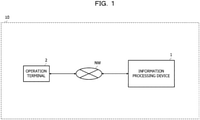
- FIG. 1 is a diagram for explaining the configuration of the information processing system 10.
- the information processing system 10 illustrated in FIG. 1 includes an information processing device 1 and an operation terminal 2 to which a cloud operator inputs necessary information or the like.
- the operation terminal 2 can access the information processing device 1 via a network NW such as the Internet.
- one or more physical machines, managed by the cloud operator such as virtual machines (not illustrated) to be rent to cloud users or the like operate.
- the cloud user provides various services to service providers using the virtual machines or the like rent from the cloud operator.
- the information processing device 1 monitors virtual infrastructures by performing anomaly detection. Specifically, for example, the information processing device 1 monitors behaviors of a receiving thread, for example, by performing anomaly detection.
- the information processing device 1 monitors behaviors of a receiving thread, for example, by performing anomaly detection.
- a specific example of the configuration of the information processing device 1 will be described.
- FIG. 2 is a diagram for explaining the specific example of the configuration of the information processing device 1.
- a physical NIC 13 attached to the information processing device 1 includes queues 14a, 14b, and 14c (hereinafter, also collectively referred to as queue 14) that are RING buffers for storing packets.
- the physical NIC 13 executes reception processing 14d that is processing for receiving packets transmitted from outside (for example, network NW) and sorting processing 14e for sorting the packets received in the reception processing 14d. Moreover, the physical NIC 13 executes enqueue processing 14f, 14g, and 14h for respectively storing the packets sorted in the sorting processing 14e in the queues 14a, 14b, and 14c. Note that, in the example illustrated in FIG. 2 , the enqueue processing 14f is processing for storing the packet in the queue 14a, the enqueue processing 14g is processing for storing the packet in the queue 14b, and the enqueue processing 14h is processing for storing the packet in the queue 14c.
- receiving threads 12a, 12b, and 12c operate that are processes for extracting the packets stored in the queues 14a, 14b, and 14c and transferring the packets to destination virtual machines or the like.
- the receiving thread 12a extracts the packet stored in the queue 14a
- the receiving thread 12b extracts the packet stored in the queue 14b
- the receiving thread 12c extracts the packet stored in the queue 14c.
- the physical NIC 13 illustrated in FIG. 2 is a multi-que compatible NIC including three queues. Therefore, in this case, the information processing device 1 makes the receiving threads 12a, 12b, and 12c in the OS 11 operate in parallel so that processing associated with the reception of the packet transmitted from outside is executed at high speed.
- the information processing device 1 includes the physical NIC 13 that is the multi-que compatible NIC as described above, it is preferable to perform the anomaly detection performed on the receiving thread 12 for each receiving thread 12.
- the anomaly detection on the receiving thread 12 will be described.
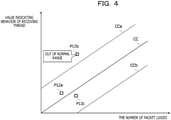
- FIGs. 3 and 4 are diagrams for explaining specific examples of the anomaly detection on the receiving thread 12. Specifically, for example, FIG. 3 is a diagram for explaining a specific example in a case where the anomaly detection is performed on the entire receiving thread 12, and FIG. 4 is a diagram for explaining a specific example in a case where the anomaly detection is performed on each receiving thread 12.
- a straight line CC is a straight line specified by learning a correlation between a behavior of the receiving thread 12 in a normal state and the number of packet losses of the physical NIC 13.
- a straight line CCa indicates a straight line that indicates an upper limit of a range where it can be determined that the correlation is normal
- a straight line CCb is a straight line that indicates a lower limit of the range where it can be determined that the correlation is normal.
- a point P12 corresponding to a value indicating the behavior of the entire receiving thread 12 (total value of values indicating behaviors of respective receiving threads 12) and the number of packet losses occurred in the entire physical NIC 13 is included in a region between the straight lines CCa and CCb. Therefore, in this case, the information processing device 1 determines that an abnormality is not assumed to occur in the receiving thread 12.
- a point P12a corresponding to a value indicating a behavior of the receiving thread 12a and the number of packet losses occurred in the queue 14a and a point P12c corresponding to a value indicating a behavior of the receiving thread 12c and the number of packet losses occurred in the queue 14c are included in the region between the straight lines CCa and CCb.
- a point P12b corresponding to a value indicating a behavior of the receiving thread 12b and the number of packet losses occurred in the queue 14b is not included in the region between the straight lines CCa and CCb. Therefore, in this case, the information processing device 1 determines that an abnormality is assumed to occur in the receiving thread 12b.
- the information processing device 1 includes the physical NIC 13 that is the multi-que compatible NIC as illustrated in FIG. 2 , it is preferable to perform the anomaly detection on each receiving thread 12, rather than performing the anomaly detection on the entire receiving thread 12.
- information that can be acquired from the OS 11 and the physical NIC 13 does not include all pieces of information needed for performing the anomaly detection on each receiving thread 12. Specifically, for example, it is not possible for the information processing device 1 to acquire the number of packet losses occurred in each queue 14.
- the information processing device 1 calculates a packet loss occurrence degree (probability of occurrence of packet loss) in each of the multiple queues 14 on the basis of a time period when each of the receiving threads 12 is in a waiting state (hereinafter, also referred to as first time period) or a packet arrival frequency of each of the multiple queues 14 that stores the packets received by the multiple receiving threads 12.
- the information processing device 1 distributes the number of packet losses occurred in the physical NIC 13 in which the multiple queues 14 operates to each of the multiple queues 14 on the basis of the calculated occurrence degree.
- the information processing device 1 determines whether or not an abnormality occurs in the multiple receiving threads 12 on the basis of a correspondence relationship between an operation state of each receiving thread 12 and the number of packet losses distributed to the queue 14 corresponding to each process among the multiple queues 14 for each of multiple receiving threads 12.
- the information processing device 1 estimates the number of packet losses occurred in each queue 14 from the information that can be acquired from the OS 11 and the physical NIC 13. Specifically, for example, the information processing device 1 estimates the number of packet losses occurred in each queue 14, for example, by combining the information that can be acquired from the OS 11 and the information that can be acquired from the physical NIC 13. Then, the information processing device 1 performs the anomaly detection on each receiving thread 12 using the estimated value of the number of packet losses in each queue 14.
- the information processing device 1 can perform the anomaly detection on each receiving thread 12 even in a case where the physical NIC 13 compatible with a multi-queue is used. Therefore, the information processing device 1 can detect an abnormality in the receiving thread 12 with high accuracy.
- FIG. 5 is a diagram for explaining the hardware configuration of the information processing device 1.
- the information processing device 1 includes a CPU 101 as a processor, a memory 102, a communication device 103, and a storage medium 104. Each of the units is connected to each other via a bus 105.
- the storage medium 104 has, for example, a program storage region (not illustrated) where a program 110 that executes processing for performing the anomaly detection on each receiving thread 12 (hereinafter, also referred to as abnormality detection processing) is stored. Furthermore, the storage medium 104 includes, for example, an information storage region 130 where information used when the abnormality detection processing is executed is stored. Note that the storage medium 104 may be, for example, a hard disk drive (HDD) or a solid state drive (SSD).
- HDD hard disk drive
- SSD solid state drive
- the CPU 101 executes the program 110 loaded from the storage medium 104 into the memory 102 to execute the abnormality detection processing.
- the communication device 103 communicates with the operation terminal 2 via the network NW, for example.
- FIG. 6 is a block diagram of the functions of the information processing device 1.
- the information processing device 1 implements various functions including an information acquisition unit 111, a degree calculation unit 112, a number of losses distribution unit 113, a condition determination unit 114, and an information output unit 115 through organic collaboration between hardware such as the CPU 101 or the memory 102 and the program 110.
- the information processing device 1 stores total waiting time information 131, number of times information 132, average waiting time information 133, execution time information 134, number of arrivals information 135, arrival frequency information 136, occurrence degree information 137, total number of losses information 138, number of losses information 139, and determination result information 140 in the information storage region 130.
- the information acquisition unit 111 acquires the total waiting time information 131 that indicates a total time of a time when each receiving thread 12 is in a waiting state within a predetermined time from the OS 11 (each receiving thread 12).
- the predetermined time may be, for example, a time of three minutes or the like.
- the information acquisition unit 111 acquires the number of times information 132 indicating the number of times when an execution state of each receiving thread 12 is switched to the waiting state within a predetermined period from the OS 11 (each receiving thread 12).
- the information acquisition unit 111 acquires the execution time information 134 indicating an execution time (hereinafter, also referred to as second time period) when each receiving thread 12 is in the execution state within the predetermined period from the OS 11 (each receiving thread 12).
- the information acquisition unit 111 acquires the number of arrivals information 135 indicating the total number of packets that have arrived at the physical NIC 13 from outside the information processing device 1 from the physical NIC 13.
- the information acquisition unit 111 acquires the total number of losses information 138 indicating the number of packet losses occurred in the physical NIC 13 from the physical NIC 13.
- the degree calculation unit 112 acquires, for each receiving thread 12, the average waiting time information 133 that is calculated by dividing the total time indicated by the total waiting time information 131 corresponding to each receiving thread 12 by the number of times indicated by the number of times information 132 corresponding to each receiving thread 12.
- the average waiting time information 133 is information indicating an average time of the waiting time in a case where the execution state of each receiving thread 12 is switched to the waiting state.
- the degree calculation unit 112 acquires, for each receiving thread 12, a rate calculated by dividing an execution time indicated by the execution time information 134 corresponding to each receiving thread by a total value of the execution times indicated by the execution time information 134 corresponding all the receiving threads 12. Then, the degree calculation unit 112 acquires, for each queue 14, a product of the ratio of the receiving thread 12 corresponding to each queue 14 and the total number of packets indicated by the number of arrivals information 135 as the arrival frequency information 136 that indicates an arrival frequency of the packets at each queue 14.
- the degree calculation unit 112 acquires, for each queue 14, an occurrence degree of the packet loss (probability of occurrence of packet loss) in each queue 14 as the occurrence degree information 137 on the basis of the average time indicated by the average waiting time information 133 regarding the receiving thread 12 corresponding to each queue 14 or the arrival frequency indicated by the arrival frequency information 136 of each queue 14.
- the degree calculation unit 112 acquires, for each queue 14, a product of the average time indicated by the average waiting time information 133 regarding the receiving thread 12 corresponding to each queue 14 and the arrival frequency indicated by the arrival frequency information 136 of each queue 14 as the occurrence degree information 137 that indicates the occurrence degree of the packet loss in each queue 14.
- the number of losses distribution unit 113 acquires a rate calculated by dividing the occurrence degree indicated by the occurrence degree information 137 corresponding to each queue 14 by the total value of the occurrence degrees indicated by the occurrence degree information 137 corresponding to all the queues 14. Then, for each queue 14, the number of losses distribution unit 113 acquires a product of the rate corresponding to each queue 14 and the number of packet losses indicated by the total number of losses information 138 as the number of losses information 139 indicating the number of packet losses corresponding to each queue 14 (estimated value of the number of packet losses).
- the condition determination unit 114 determines whether or not an abnormality occurs in each receiving thread 12 on the basis of the correspondence relationship between the operation state of each receiving thread 12 and the number of packet losses of the queue 14 corresponding to each receiving thread 12 (the number of packet losses corresponding to the number of losses information 139) for each receiving thread 12.
- the information output unit 115 outputs, for example, the determination result information 140 that indicates the result of the determination made by the condition determination unit 114 to the operation terminal 2.
- each of the information acquisition unit 111, the degree calculation unit 112, the number of losses distribution unit 113, the condition determination unit 114, and the information output unit 115 may be a function of the OS 11 or a function of an application that operates on the OS 11.
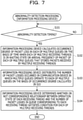
- FIG. 7 is a flowchart for explaining an outline of abnormality detection processing according to the first embodiment.
- the abnormality detection timing may be, for example, a timing when information indicating that a business operator executes the abnormality detection processing is input to the information processing device 1. Furthermore, the abnormality detection timing may be, for example, every predetermined time such as 10 minutes.
- the information processing device 1 calculates the occurrence degree of the packet loss in each of the multiple queues 14 on the basis of the time when each of the multiple receiving threads 12 is in the waiting state or the arrival frequency of the packet of each of the multiple queues 14 that stores the packets received by each of the multiple receiving threads 12 (S102).
- the information processing device 1 distributes the number of packet losses occurred in the physical NIC 13 in which the multiple queues 14 operates to each of the multiple queues 14 on the basis of the occurrence degree calculated in the processing in S102 (S103).
- the information processing device 1 determines whether or not the correspondence relationship between the operation state of each receiving thread 12 and the number of packet losses in the queue 14 corresponding to each receiving thread 12 satisfies a predetermined condition (S104).
- the information processing device 1 estimates the number of packet losses occurred in each queue 14 from the information that can be acquired from the OS 11 and the physical NIC 13. Specifically, for example, the information processing device 1 estimates the number of packet losses occurred in each queue 14, for example, by combining the information that can be acquired from the OS 11 and the information that can be acquired from the physical NIC 13. Then, the information processing device 1 performs the anomaly detection on each receiving thread 12 using the estimated value of the number of packet losses in each queue 14.
- the information processing device 1 can perform the anomaly detection on each receiving thread 12 even in a case where the physical NIC 13 compatible with a multi-queue is used. Therefore, the information processing device 1 can detect an abnormality in the receiving thread 12 with high accuracy.
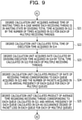
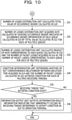
- FIGs. 8 to 10 are flowcharts for explaining details of the abnormality detection processing according to the first embodiment.
- FIGs. 11A to 18B are diagrams for explaining details of the abnormality detection processing according to the first embodiment.
- abnormality detection is performed on all the receiving threads 12 .
- abnormality detection may be performed on only one of the receiving threads 12 (for example, receiving thread 12 specified by business operator).
- the information acquisition unit 111 of the information processing device 1 waits until the abnormality detection timing comes (NO in S11).
- the information acquisition unit 111 acquires the total waiting time information 131 that indicates a total time of a time when each receiving thread 12 is in a waiting state within a predetermined time from the OS 11 (each of multiple receiving threads 12)(S12).
- the information acquisition unit 111 acquires the number of times information 132 indicating the number of times when an execution state of each receiving thread 12 is switched to the waiting state within a predetermined period from the OS 11 (each of multiple receiving threads 12)(S13).
- the information acquisition unit 111 acquires the execution time information 134 indicating an execution time when each receiving thread 12 is in the execution state within the predetermined period from the OS 11 (each of multiple receiving threads 12)(S14).
- the information acquisition unit 111 acquires the number of arrivals information 135 indicating the total number of packets that have arrived at the physical NIC 13 from outside the information processing device 1 from the physical NIC 13 (S15).
- the information acquisition unit 111 acquires the total number of losses information 138 indicating the number of packet losses in the physical NIC 13 from the physical NIC 13 (S16).
- the degree calculation unit 112 of the information processing device 1 acquires the average waiting time information 133 that indicates an average time of the waiting times in a case where the execution state of each receiving thread 12 is switched to the waiting state by dividing the total time indicated by the total waiting time information 131 acquired in the processing in S12 by the number of times indicated by the number of times information 132 acquired in the processing in S13 for each of multiple receiving threads 12 (S21).
- S21 the degree calculation unit 112 of the information processing device 1 acquires the average waiting time information 133 that indicates an average time of the waiting times in a case where the execution state of each receiving thread 12 is switched to the waiting state by dividing the total time indicated by the total waiting time information 131 acquired in the processing in S12 by the number of times indicated by the number of times information 132 acquired in the processing in S13 for each of multiple receiving threads 12 (S21).
- S21 a specific example of the processing in S21 will be described.
- FIGs. 11A to 11C are diagrams for explaining specific examples of the total waiting time information 131, the number of times information 132, and the average waiting time information 133.
- FIG. 11A is a diagram for explaining a specific example of the total waiting time information 131
- FIG. 11B is a diagram for explaining a specific example of the number of times information 132
- FIG. 11C is a diagram for explaining a specific example of the average waiting time information 133.
- the total waiting time information 131 and the number of times information 132 illustrated in FIGs. 11A and 11B are specific examples of acquired information about one of the receiving threads 12.
- the average waiting time information 133 illustrated in FIG. 11C is a specific example of calculated information about one of the receiving threads 12.
- the degree calculation unit 112 acquires "1.44 (ms)" calculated by dividing "3.43 (ms)” by "2.9 (times)" as the average waiting time information 133 as illustrated in FIG. 11C .
- the degree calculation unit 112 calculates a total time of the execution time indicated by the execution time information 134 acquired in the processing in S14 (S22).
- the degree calculation unit 112 acquires a rate calculated by dividing the execution time indicated by the execution time information 134 acquired in the processing in S14 by the total time calculated in the processing in S22 for each of multiple receiving threads 12 (S23).
- the degree calculation unit 112 calculates a product of the rate of the receiving thread 12 corresponding to each queue 14 acquired in the processing in S23 and the total number of packets indicated by the number of arrivals information 135 acquired in the processing in S15 as the arrival frequency information 136 that indicates the arrival frequency of each queue 14 for each of multiple queues 14 (S24).
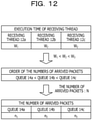
- the receiving thread 12 of which the execution time is longer than those of other receiving threads 12 processes more packets than the other receiving threads 12. Therefore, it can be determined that the more packets arrive at the queue 14 corresponding to the receiving thread 12 that processes more packets than the other receiving threads 12 than the other queues 14.
- the order of the numbers of arrived packets is the order of the queues 14c, 14b, and 14a.
- the degree calculation unit 112 distributes the number of arrived packets of the physical NIC 13 to each queue 14 so that a ratio of the numbers of the arrived packets of the respective queues 14 is equal to a ratio of the lengths of the execution times of the respective receiving threads 12.
- the degree calculation unit 112 calculates each of "n 1 ", “n 2 “, and “n 3 " so that a ratio of "n 1 ", “n 2 “, and “n 3 " that are the numbers of arrived packets of the respective queues 14a, 14b, and 14c is equal to a ratio of "W 1 ", "W 2 ", and "W 3 ".
- the degree calculation unit 112 can estimate the number of arriving packets of each queue 14.
- the degree calculation unit 112 may calculate the arrival frequency information 136 by further dividing the product of the rate of the receiving thread 12 corresponding to each queue 14 acquired in the processing in S23 and the total number of packets indicated by the number of arrivals information 135 acquired in the processing in S15 by the predetermined time used in the processing in S12 or the like.
- the processing in S24 will be described.
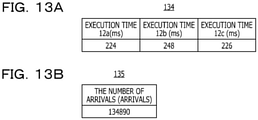
- FIGs. 13A and 13B are diagrams for explaining specific examples of the execution time information 134 and the number of arrivals information 135.
- FIG. 13A is a diagram for explaining a specific example of the execution time information 134
- FIG. 13B is a diagram for explaining a specific example of the number of arrivals information 135.
- FIG. 14 is a diagram for explaining a specific example of the arrival frequency information 136.
- the degree calculation unit 112 calculates "698 (ms)" that is a total of "224 (ms)” that is the execution time of the receiving thread 12a, "248 (ms)” that is the execution time of the receiving thread 12b, and "226 (ms)” that is the execution time of the receiving thread 12c.
- the degree calculation unit 112 calculates "43288" calculated by dividing "248 (ms)” that is the execution time of the receiving thread 12a by the total value "698 (ms)” calculated in the processing in S22 and further multiplying "134890" indicated by the number of arrivals information 135 as the arrival frequency of the queue 14a corresponding to the receiving thread 12a.
- the degree calculation unit 112 sets "43288" to an "arrival frequency 14a" that indicates the arrival frequency of the queue 14a.
- the degree calculation unit 112 calculates a product of the average time indicated by the average waiting time information 133 of the receiving thread 12 corresponding to each queue 14 acquired in the processing in S21 and the arrival frequency indicated by the arrival frequency information 136 corresponding to each queue 14 calculated in the processing in S24 as the occurrence degree information 137 that indicates the occurrence degree of the packet loss in each queue 14 (S25).
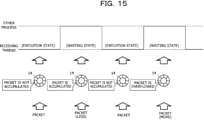
- the packet stored in the queue 14 is extracted by the receiving thread 12. Therefore, in the queue 14, in this case, the arrived packets are not accumulated.
- the packet stored in the queue 14 is not extracted by the receiving thread 12. Therefore, in this case, the arrived packets are sequentially accumulated in the queue 14.
- the packet loss in the queue 14 is assumed to occur more easily as the waiting time of the receiving thread 12 is longer. Furthermore, it can be determined that the packet loss in the queue 14 more easily occurs as the arrival frequency of the packet (the number of arrivals) in the queue 14 is higher.
- the degree calculation unit 112 calculates a product of the average time indicated by the average waiting time information 133 corresponding to each queue 14 and the arrival frequency indicated by the arrival frequency information 136 corresponding to each queue 14 as the occurrence degree of the packet loss in each queue (probability of occurrence of packet loss).
- the degree calculation unit 112 can estimate the occurrence degree of the packet loss in each queue 14.
- the processing in S25 will be described.
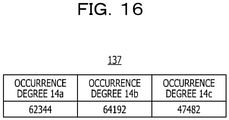
- FIG. 16 is a diagram for explaining a specific example of the occurrence degree information 137.
- the degree calculation unit 112 calculates "62344" calculated by multiplying "1.44 (ms)" by "43288” as the occurrence degree of the packet loss in the queue 14a.
- the degree calculation unit 112 sets "62344" to an "occurrence degree 14a" that indicates the occurrence degree of the packet loss in the queue 14a in the occurrence degree information 137.
- the number of losses distribution unit 113 of the information processing device 1 calculates a total value of the occurrence degree indicated by the occurrence degree information 137 calculated in the processing in S25 (S31).
- each of "62344", "64192”, and “47482” is set to the occurrence degree information 137 illustrated in FIG. 16 . Therefore, in this case, the number of losses distribution unit 113 calculates "174018" that is the total of "62344", "64192", and "47482".
- the number of losses distribution unit 113 acquires a rate calculated by dividing the occurrence degree indicated by the occurrence degree information 137 of each queue 14 calculated in the processing in S25 by the total value calculated in the processing in S31 (S32).
- the number of losses distribution unit 113 calculates a product of the rate corresponding to each queue 14 calculated in the processing in S32 and the number of packet losses indicated by the total number of losses information 138 acquired in the processing in S16 as the number of losses information 139 that indicates the number of packet losses corresponding to each queue 14 (S33).
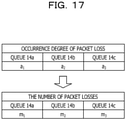
- the number of losses distribution unit 113 distributes the number of packet losses occurred in the physical NIC 13 to each queue 14 so that the ratio of the numbers of packet losses occurred in the respective queues 14 is equal to the ratio of the occurrence degrees of the packet losses in the respective queues 14.
- each of “m 1 ", “m 2 “, and “m 3” is calculated so that a ratio of ""a 1 ", “a 2 “, and “a 3 " that are the occurrence degrees of the packet losses in the respective queues 14 is equal to a ratio of "m 1 ", "m 2 ", and “m 3 " that are the numbers of packet losses occurred in the respective queues 14.
- a ratio of "m 1 ", "m 2 ", and “m 3” that are the numbers of packet losses occurred in the respective queues 14.
- FIGs. 18A and 18B are diagrams for explaining specific examples of the total number of losses information 138 and the number of losses information 139.
- FIG. 18A is a diagram for explaining a specific example of the total number of losses information 138
- FIG. 18B is a diagram for explaining a specific example of the number of losses information 139.
- the number of losses distribution unit 113 calculates (estimate) "8.6” calculated by multiplying "24” by "0.358" as the number of packet losses occurred in the queue 14a.
- condition determination unit 114 of the information processing device 1 determines whether or not a correspondence relationship between the execution time indicated by the execution time information 134 acquired in the processing in S14 and the number of packet losses indicated by the number of losses information 139 calculated in the processing in S33 satisfies a condition for each of multiple receiving threads 12 (S34).
- the condition determination unit 114 determines whether or not the points P12a, P12b, and P12c respectively corresponding to the values indicating the behavior of each receiving thread 12 (execution time indicated by execution time information 134 corresponding to each receiving thread 12) and the numbers of packet losses occurred in the queue 14 corresponding to each receiving thread 12 are included in the region between the straight lines CCa and CCb for each of multiple receiving threads 12.
- the information output unit 115 of the information processing device 1 outputs the determination result information 140 that indicates that an abnormality occurs in the receiving thread 12 that is determined to satisfy the condition in the processing in S34 to the operation terminal 2 (S36).
- the condition determination unit 114 determines that an abnormality occurs in the receiving thread 12b. Then, in this case, the information output unit 115 outputs the determination result information 140 indicating that an abnormality occurs in the receiving thread 12b to the operation terminal 2.
- the information output unit 115 does not execute the processing in S36.
- the information processing device 1 calculates the occurrence degree of the packet loss in each of the multiple queues 14 on the basis of the time when each of the multiple receiving threads 12 that receives packets is in the waiting state or the arrival frequency of the packets of each of the multiple queues 14 that stores the packets received by the multiple receiving threads 12.
- the information processing device 1 distributes the number of packet losses occurred in the physical NIC 13 in which the multiple queues 14 operates to each of the multiple queues 14 on the basis of the calculated occurrence degree.
- the information processing device 1 determines whether or not an abnormality occurs in the multiple receiving threads 12 on the basis of a correspondence relationship between an operation state of each receiving thread 12 and the number of packet losses distributed to the queue 14 corresponding to each process among the multiple queues 14 for each of multiple receiving threads 12.
- the information processing device 1 estimates the number of packet losses occurred in each queue 14 from the information that can be acquired from the OS 11 and the physical NIC 13. Specifically, for example, the information processing device 1 estimates the number of packet losses occurred in each queue 14, for example, by combining the information that can be acquired from the OS 11 and the information that can be acquired from the physical NIC 13. Then, the information processing device 1 performs the anomaly detection on each receiving thread 12 using the estimated value of the number of packet losses in each queue 14.
- the information processing device 1 can perform the anomaly detection on each receiving thread 12 even in a case where the physical NIC 13 compatible with a multi-queue is used. Therefore, the information processing device 1 can detect an abnormality in the receiving thread 12 with high accuracy.
Landscapes
- Engineering & Computer Science (AREA)
- Environmental & Geological Engineering (AREA)
- Computer Networks & Wireless Communication (AREA)
- Signal Processing (AREA)
- Data Exchanges In Wide-Area Networks (AREA)
- Computer And Data Communications (AREA)
- Debugging And Monitoring (AREA)
Applications Claiming Priority (1)
| Application Number | Priority Date | Filing Date | Title |
|---|---|---|---|
| JP2020147255A JP7481627B2 (ja) | 2020-09-02 | 2020-09-02 | 異常検知方法及び異常検知プログラム |
Publications (2)
| Publication Number | Publication Date |
|---|---|
| EP3965373A1 true EP3965373A1 (fr) | 2022-03-09 |
| EP3965373B1 EP3965373B1 (fr) | 2023-06-28 |
Family
ID=76623867
Family Applications (1)
| Application Number | Title | Priority Date | Filing Date |
|---|---|---|---|
| EP21180795.3A Active EP3965373B1 (fr) | 2020-09-02 | 2021-06-22 | Procédé de détection d'anomalie et programme de détection d'anomalie |
Country Status (3)
| Country | Link |
|---|---|
| US (1) | US11637764B2 (fr) |
| EP (1) | EP3965373B1 (fr) |
| JP (1) | JP7481627B2 (fr) |
Families Citing this family (4)
| Publication number | Priority date | Publication date | Assignee | Title |
|---|---|---|---|---|
| US12426111B2 (en) | 2021-10-08 | 2025-09-23 | Roland Corporation | Communication system, terminal, communication device and connection method |
| JP2023067272A (ja) | 2021-10-29 | 2023-05-16 | ローランド株式会社 | サーバ、電子機器、サーバ通信方法、機器通信方法および通信システム |
| JP2023070554A (ja) | 2021-11-09 | 2023-05-19 | ローランド株式会社 | 電子機器およびデータ利用方法 |
| KR20240112667A (ko) * | 2023-01-12 | 2024-07-19 | 한국전자통신연구원 | 우선순위 기반 스케줄링 방법 및 상기 방법을 수행하는 스케줄러 |
Citations (1)
| Publication number | Priority date | Publication date | Assignee | Title |
|---|---|---|---|---|
| WO2019142331A1 (fr) | 2018-01-19 | 2019-07-25 | 株式会社日立製作所 | Système et procédé de prédiction de défaillance |
Family Cites Families (8)
| Publication number | Priority date | Publication date | Assignee | Title |
|---|---|---|---|---|
| JP4429095B2 (ja) * | 2004-06-25 | 2010-03-10 | 富士通株式会社 | 障害解析プログラム、障害解析装置、記録媒体及び障害解析方法 |
| JP4729413B2 (ja) | 2006-02-22 | 2011-07-20 | 古野電気株式会社 | パケット通信装置 |
| JP2014127790A (ja) | 2012-12-26 | 2014-07-07 | Univ Of Electro-Communications | 情報処理装置および方法、並びにプログラム |
| US9282052B2 (en) * | 2013-05-29 | 2016-03-08 | Verizon Patent And Licensing Inc. | End-to-end quality of service optimization and reporting |
| US20160323189A1 (en) | 2013-10-28 | 2016-11-03 | Kt Corporation | Method for controlling qos by handling traffic depending on service |
| JP2016052029A (ja) | 2014-09-01 | 2016-04-11 | 日本電信電話株式会社 | 通信用lsi検証装置、通信用lsiの検証方法、およびプログラム |
| JP2016149698A (ja) | 2015-02-13 | 2016-08-18 | 富士通株式会社 | パケット通信装置およびパケット受信処理方法 |
| US11171869B2 (en) * | 2019-04-10 | 2021-11-09 | At&T Intellectual Property I, L.P. | Microburst detection and management |
-
2020
- 2020-09-02 JP JP2020147255A patent/JP7481627B2/ja active Active
-
2021
- 2021-06-22 EP EP21180795.3A patent/EP3965373B1/fr active Active
- 2021-06-28 US US17/359,802 patent/US11637764B2/en active Active
Patent Citations (1)
| Publication number | Priority date | Publication date | Assignee | Title |
|---|---|---|---|---|
| WO2019142331A1 (fr) | 2018-01-19 | 2019-07-25 | 株式会社日立製作所 | Système et procédé de prédiction de défaillance |
Non-Patent Citations (1)
| Title |
|---|
| ZINNER THOMAS ET AL: "A discrete-time model for optimizing the processing time of virtualized network functions", COMPUTER NETWORKS, vol. 125, 20 April 2017 (2017-04-20), pages 4 - 14, XP085201657, ISSN: 1389-1286, DOI: 10.1016/J.COMNET.2017.04.049 * |
Also Published As
| Publication number | Publication date |
|---|---|
| US20220070074A1 (en) | 2022-03-03 |
| EP3965373B1 (fr) | 2023-06-28 |
| JP2022042071A (ja) | 2022-03-14 |
| JP7481627B2 (ja) | 2024-05-13 |
| US11637764B2 (en) | 2023-04-25 |
Similar Documents
| Publication | Publication Date | Title |
|---|---|---|
| EP3965373A1 (fr) | Procédé de détection d'anomalie et programme de détection d'anomalie | |
| US20190297140A1 (en) | Determining load state of remote systems using delay and packet loss rate | |
| CN109905259A (zh) | 通信连接维持方法、系统和相关设备 | |
| US20160147548A1 (en) | Virtual machine arrangement design apparatus and method , system, and program | |
| US9501326B2 (en) | Processing control system, processing control method, and processing control program | |
| US9645909B2 (en) | Operation management apparatus and operation management method | |
| EP3238386B1 (fr) | Appareil et procédé pour router des données dans un commutateur | |
| US9736226B2 (en) | Rule distribution server, event processing system and method, and program | |
| Qiu et al. | Online reliability-enhanced virtual network services provisioning in fault-prone mobile edge cloud | |
| CN102377640A (zh) | 一种报文处理装置和报文处理方法、及预处理器 | |
| US20210209443A1 (en) | Distributed Processing System and Distributed Processing Method | |
| CN106533826A (zh) | 网络状态的探测方法及系统 | |
| CN102801737A (zh) | 一种异步网络通信方法及装置 | |
| US20150326658A1 (en) | Apparatus and method for controlling virtual machine migrations based on flow information | |
| US20130051234A1 (en) | Method and apparatus for controlling transmission rate | |
| CN110677358A (zh) | 一种报文处理方法及一种网络设备 | |
| US11256550B2 (en) | Estimating device and estimating method | |
| CN113949651A (zh) | 网络传输方法、装置、设备、存储介质及程序产品 | |
| CN103152228B (zh) | 一种带宽检测方法和设备 | |
| CN117978684A (zh) | Nat网关可用性探测方法和装置 | |
| US20120029961A1 (en) | Method, device and computer program product for service balancing in an electronic communications system | |
| EP4047891A1 (fr) | Détermination des statistiques de dispositif de réseau associées aux compteurs rapides et aux compteurs lents | |
| CN114124731A (zh) | 流量监控方法、装置、集成电路及网络设备 | |
| US20220393959A1 (en) | Estimation system, addition apparatus, estimation method, addition method, estimation program and addition program | |
| CN105656795A (zh) | 虚拟机的流量控制方法及物理机 |
Legal Events
| Date | Code | Title | Description |
|---|---|---|---|
| PUAI | Public reference made under article 153(3) epc to a published international application that has entered the european phase |
Free format text: ORIGINAL CODE: 0009012 |
|
| STAA | Information on the status of an ep patent application or granted ep patent |
Free format text: STATUS: THE APPLICATION HAS BEEN PUBLISHED |
|
| AK | Designated contracting states |
Kind code of ref document: A1 Designated state(s): AL AT BE BG CH CY CZ DE DK EE ES FI FR GB GR HR HU IE IS IT LI LT LU LV MC MK MT NL NO PL PT RO RS SE SI SK SM TR |
|
| STAA | Information on the status of an ep patent application or granted ep patent |
Free format text: STATUS: REQUEST FOR EXAMINATION WAS MADE |
|
| 17P | Request for examination filed |
Effective date: 20220512 |
|
| RBV | Designated contracting states (corrected) |
Designated state(s): AL AT BE BG CH CY CZ DE DK EE ES FI FR GB GR HR HU IE IS IT LI LT LU LV MC MK MT NL NO PL PT RO RS SE SI SK SM TR |
|
| REG | Reference to a national code |
Ref country code: DE Ref legal event code: R079 Free format text: PREVIOUS MAIN CLASS: H04L0012260000 Ipc: H04L0043082900 Ref document number: 602021003113 Country of ref document: DE |
|
| GRAP | Despatch of communication of intention to grant a patent |
Free format text: ORIGINAL CODE: EPIDOSNIGR1 |
|
| STAA | Information on the status of an ep patent application or granted ep patent |
Free format text: STATUS: GRANT OF PATENT IS INTENDED |
|
| RIC1 | Information provided on ipc code assigned before grant |
Ipc: H04L 41/147 20220101ALI20230313BHEP Ipc: H04L 43/0829 20220101AFI20230313BHEP |
|
| GRAS | Grant fee paid |
Free format text: ORIGINAL CODE: EPIDOSNIGR3 |
|
| INTG | Intention to grant announced |
Effective date: 20230419 |
|
| GRAA | (expected) grant |
Free format text: ORIGINAL CODE: 0009210 |
|
| STAA | Information on the status of an ep patent application or granted ep patent |
Free format text: STATUS: THE PATENT HAS BEEN GRANTED |
|
| AK | Designated contracting states |
Kind code of ref document: B1 Designated state(s): AL AT BE BG CH CY CZ DE DK EE ES FI FR GB GR HR HU IE IS IT LI LT LU LV MC MK MT NL NO PL PT RO RS SE SI SK SM TR |
|
| REG | Reference to a national code |
Ref country code: CH Ref legal event code: EP |
|
| REG | Reference to a national code |
Ref country code: AT Ref legal event code: REF Ref document number: 1583739 Country of ref document: AT Kind code of ref document: T Effective date: 20230715 |
|
| REG | Reference to a national code |
Ref country code: IE Ref legal event code: FG4D |
|
| REG | Reference to a national code |
Ref country code: DE Ref legal event code: R096 Ref document number: 602021003113 Country of ref document: DE |
|
| REG | Reference to a national code |
Ref country code: LT Ref legal event code: MG9D |
|
| PG25 | Lapsed in a contracting state [announced via postgrant information from national office to epo] |
Ref country code: SE Free format text: LAPSE BECAUSE OF FAILURE TO SUBMIT A TRANSLATION OF THE DESCRIPTION OR TO PAY THE FEE WITHIN THE PRESCRIBED TIME-LIMIT Effective date: 20230628 Ref country code: NO Free format text: LAPSE BECAUSE OF FAILURE TO SUBMIT A TRANSLATION OF THE DESCRIPTION OR TO PAY THE FEE WITHIN THE PRESCRIBED TIME-LIMIT Effective date: 20230928 |
|
| REG | Reference to a national code |
Ref country code: NL Ref legal event code: MP Effective date: 20230628 |
|
| REG | Reference to a national code |
Ref country code: AT Ref legal event code: MK05 Ref document number: 1583739 Country of ref document: AT Kind code of ref document: T Effective date: 20230628 |
|
| PG25 | Lapsed in a contracting state [announced via postgrant information from national office to epo] |
Ref country code: RS Free format text: LAPSE BECAUSE OF FAILURE TO SUBMIT A TRANSLATION OF THE DESCRIPTION OR TO PAY THE FEE WITHIN THE PRESCRIBED TIME-LIMIT Effective date: 20230628 Ref country code: NL Free format text: LAPSE BECAUSE OF FAILURE TO SUBMIT A TRANSLATION OF THE DESCRIPTION OR TO PAY THE FEE WITHIN THE PRESCRIBED TIME-LIMIT Effective date: 20230628 Ref country code: LV Free format text: LAPSE BECAUSE OF FAILURE TO SUBMIT A TRANSLATION OF THE DESCRIPTION OR TO PAY THE FEE WITHIN THE PRESCRIBED TIME-LIMIT Effective date: 20230628 Ref country code: LT Free format text: LAPSE BECAUSE OF FAILURE TO SUBMIT A TRANSLATION OF THE DESCRIPTION OR TO PAY THE FEE WITHIN THE PRESCRIBED TIME-LIMIT Effective date: 20230628 Ref country code: HR Free format text: LAPSE BECAUSE OF FAILURE TO SUBMIT A TRANSLATION OF THE DESCRIPTION OR TO PAY THE FEE WITHIN THE PRESCRIBED TIME-LIMIT Effective date: 20230628 Ref country code: GR Free format text: LAPSE BECAUSE OF FAILURE TO SUBMIT A TRANSLATION OF THE DESCRIPTION OR TO PAY THE FEE WITHIN THE PRESCRIBED TIME-LIMIT Effective date: 20230929 |
|
| PG25 | Lapsed in a contracting state [announced via postgrant information from national office to epo] |
Ref country code: FI Free format text: LAPSE BECAUSE OF FAILURE TO SUBMIT A TRANSLATION OF THE DESCRIPTION OR TO PAY THE FEE WITHIN THE PRESCRIBED TIME-LIMIT Effective date: 20230628 |
|
| PG25 | Lapsed in a contracting state [announced via postgrant information from national office to epo] |
Ref country code: SK Free format text: LAPSE BECAUSE OF FAILURE TO SUBMIT A TRANSLATION OF THE DESCRIPTION OR TO PAY THE FEE WITHIN THE PRESCRIBED TIME-LIMIT Effective date: 20230628 |
|
| PG25 | Lapsed in a contracting state [announced via postgrant information from national office to epo] |
Ref country code: ES Free format text: LAPSE BECAUSE OF FAILURE TO SUBMIT A TRANSLATION OF THE DESCRIPTION OR TO PAY THE FEE WITHIN THE PRESCRIBED TIME-LIMIT Effective date: 20230628 |
|
| PG25 | Lapsed in a contracting state [announced via postgrant information from national office to epo] |
Ref country code: IS Free format text: LAPSE BECAUSE OF FAILURE TO SUBMIT A TRANSLATION OF THE DESCRIPTION OR TO PAY THE FEE WITHIN THE PRESCRIBED TIME-LIMIT Effective date: 20231028 |
|
| PG25 | Lapsed in a contracting state [announced via postgrant information from national office to epo] |
Ref country code: SM Free format text: LAPSE BECAUSE OF FAILURE TO SUBMIT A TRANSLATION OF THE DESCRIPTION OR TO PAY THE FEE WITHIN THE PRESCRIBED TIME-LIMIT Effective date: 20230628 Ref country code: SK Free format text: LAPSE BECAUSE OF FAILURE TO SUBMIT A TRANSLATION OF THE DESCRIPTION OR TO PAY THE FEE WITHIN THE PRESCRIBED TIME-LIMIT Effective date: 20230628 Ref country code: RO Free format text: LAPSE BECAUSE OF FAILURE TO SUBMIT A TRANSLATION OF THE DESCRIPTION OR TO PAY THE FEE WITHIN THE PRESCRIBED TIME-LIMIT Effective date: 20230628 Ref country code: PT Free format text: LAPSE BECAUSE OF FAILURE TO SUBMIT A TRANSLATION OF THE DESCRIPTION OR TO PAY THE FEE WITHIN THE PRESCRIBED TIME-LIMIT Effective date: 20231030 Ref country code: IS Free format text: LAPSE BECAUSE OF FAILURE TO SUBMIT A TRANSLATION OF THE DESCRIPTION OR TO PAY THE FEE WITHIN THE PRESCRIBED TIME-LIMIT Effective date: 20231028 Ref country code: ES Free format text: LAPSE BECAUSE OF FAILURE TO SUBMIT A TRANSLATION OF THE DESCRIPTION OR TO PAY THE FEE WITHIN THE PRESCRIBED TIME-LIMIT Effective date: 20230628 Ref country code: EE Free format text: LAPSE BECAUSE OF FAILURE TO SUBMIT A TRANSLATION OF THE DESCRIPTION OR TO PAY THE FEE WITHIN THE PRESCRIBED TIME-LIMIT Effective date: 20230628 Ref country code: CZ Free format text: LAPSE BECAUSE OF FAILURE TO SUBMIT A TRANSLATION OF THE DESCRIPTION OR TO PAY THE FEE WITHIN THE PRESCRIBED TIME-LIMIT Effective date: 20230628 Ref country code: AT Free format text: LAPSE BECAUSE OF FAILURE TO SUBMIT A TRANSLATION OF THE DESCRIPTION OR TO PAY THE FEE WITHIN THE PRESCRIBED TIME-LIMIT Effective date: 20230628 |
|
| PG25 | Lapsed in a contracting state [announced via postgrant information from national office to epo] |
Ref country code: PL Free format text: LAPSE BECAUSE OF FAILURE TO SUBMIT A TRANSLATION OF THE DESCRIPTION OR TO PAY THE FEE WITHIN THE PRESCRIBED TIME-LIMIT Effective date: 20230628 |
|
| REG | Reference to a national code |
Ref country code: DE Ref legal event code: R097 Ref document number: 602021003113 Country of ref document: DE |
|
| PG25 | Lapsed in a contracting state [announced via postgrant information from national office to epo] |
Ref country code: DK Free format text: LAPSE BECAUSE OF FAILURE TO SUBMIT A TRANSLATION OF THE DESCRIPTION OR TO PAY THE FEE WITHIN THE PRESCRIBED TIME-LIMIT Effective date: 20230628 |
|
| PLBE | No opposition filed within time limit |
Free format text: ORIGINAL CODE: 0009261 |
|
| STAA | Information on the status of an ep patent application or granted ep patent |
Free format text: STATUS: NO OPPOSITION FILED WITHIN TIME LIMIT |
|
| PG25 | Lapsed in a contracting state [announced via postgrant information from national office to epo] |
Ref country code: IT Free format text: LAPSE BECAUSE OF FAILURE TO SUBMIT A TRANSLATION OF THE DESCRIPTION OR TO PAY THE FEE WITHIN THE PRESCRIBED TIME-LIMIT Effective date: 20230628 |
|
| 26N | No opposition filed |
Effective date: 20240402 |
|
| PG25 | Lapsed in a contracting state [announced via postgrant information from national office to epo] |
Ref country code: SI Free format text: LAPSE BECAUSE OF FAILURE TO SUBMIT A TRANSLATION OF THE DESCRIPTION OR TO PAY THE FEE WITHIN THE PRESCRIBED TIME-LIMIT Effective date: 20230628 |
|
| PG25 | Lapsed in a contracting state [announced via postgrant information from national office to epo] |
Ref country code: BG Free format text: LAPSE BECAUSE OF FAILURE TO SUBMIT A TRANSLATION OF THE DESCRIPTION OR TO PAY THE FEE WITHIN THE PRESCRIBED TIME-LIMIT Effective date: 20230628 |
|
| PG25 | Lapsed in a contracting state [announced via postgrant information from national office to epo] |
Ref country code: BG Free format text: LAPSE BECAUSE OF FAILURE TO SUBMIT A TRANSLATION OF THE DESCRIPTION OR TO PAY THE FEE WITHIN THE PRESCRIBED TIME-LIMIT Effective date: 20230628 |
|
| PG25 | Lapsed in a contracting state [announced via postgrant information from national office to epo] |
Ref country code: MC Free format text: LAPSE BECAUSE OF FAILURE TO SUBMIT A TRANSLATION OF THE DESCRIPTION OR TO PAY THE FEE WITHIN THE PRESCRIBED TIME-LIMIT Effective date: 20230628 |
|
| REG | Reference to a national code |
Ref country code: CH Ref legal event code: PL |
|
| PG25 | Lapsed in a contracting state [announced via postgrant information from national office to epo] |
Ref country code: LU Free format text: LAPSE BECAUSE OF NON-PAYMENT OF DUE FEES Effective date: 20240622 |
|
| PG25 | Lapsed in a contracting state [announced via postgrant information from national office to epo] |
Ref country code: IE Free format text: LAPSE BECAUSE OF NON-PAYMENT OF DUE FEES Effective date: 20240622 |
|
| PG25 | Lapsed in a contracting state [announced via postgrant information from national office to epo] |
Ref country code: CH Free format text: LAPSE BECAUSE OF NON-PAYMENT OF DUE FEES Effective date: 20240630 Ref country code: BE Free format text: LAPSE BECAUSE OF NON-PAYMENT OF DUE FEES Effective date: 20240630 |
|
| REG | Reference to a national code |
Ref country code: BE Ref legal event code: MM Effective date: 20240630 |
|
| PGFP | Annual fee paid to national office [announced via postgrant information from national office to epo] |
Ref country code: DE Payment date: 20250520 Year of fee payment: 5 |
|
| PGFP | Annual fee paid to national office [announced via postgrant information from national office to epo] |
Ref country code: GB Payment date: 20250402 Year of fee payment: 5 |
|
| PGFP | Annual fee paid to national office [announced via postgrant information from national office to epo] |
Ref country code: FR Payment date: 20250520 Year of fee payment: 5 |
|
| PG25 | Lapsed in a contracting state [announced via postgrant information from national office to epo] |
Ref country code: CY Free format text: LAPSE BECAUSE OF FAILURE TO SUBMIT A TRANSLATION OF THE DESCRIPTION OR TO PAY THE FEE WITHIN THE PRESCRIBED TIME-LIMIT; INVALID AB INITIO Effective date: 20210622 |
|
| PG25 | Lapsed in a contracting state [announced via postgrant information from national office to epo] |
Ref country code: HU Free format text: LAPSE BECAUSE OF FAILURE TO SUBMIT A TRANSLATION OF THE DESCRIPTION OR TO PAY THE FEE WITHIN THE PRESCRIBED TIME-LIMIT; INVALID AB INITIO Effective date: 20210622 |