EP3965675B1 - Neues gewindedesign für knochenschraube - Google Patents
Neues gewindedesign für knochenschraube Download PDFInfo
- Publication number
- EP3965675B1 EP3965675B1 EP20802395.2A EP20802395A EP3965675B1 EP 3965675 B1 EP3965675 B1 EP 3965675B1 EP 20802395 A EP20802395 A EP 20802395A EP 3965675 B1 EP3965675 B1 EP 3965675B1
- Authority
- EP
- European Patent Office
- Prior art keywords
- bone
- implant device
- thread
- implant
- leading edge
- Prior art date
- Legal status (The legal status is an assumption and is not a legal conclusion. Google has not performed a legal analysis and makes no representation as to the accuracy of the status listed.)
- Active
Links
Images






Classifications
-
- A—HUMAN NECESSITIES
- A61—MEDICAL OR VETERINARY SCIENCE; HYGIENE
- A61B—DIAGNOSIS; SURGERY; IDENTIFICATION
- A61B17/00—Surgical instruments, devices or methods
- A61B17/56—Surgical instruments or methods for treatment of bones or joints; Devices specially adapted therefor
- A61B17/58—Surgical instruments or methods for treatment of bones or joints; Devices specially adapted therefor for osteosynthesis, e.g. bone plates, screws or setting implements
- A61B17/68—Internal fixation devices, including fasteners and spinal fixators, even if a part thereof projects from the skin
- A61B17/84—Fasteners therefor or fasteners being internal fixation devices
- A61B17/86—Pins or screws or threaded wires; nuts therefor
- A61B17/8625—Shanks, i.e. parts contacting bone tissue
-
- A—HUMAN NECESSITIES
- A61—MEDICAL OR VETERINARY SCIENCE; HYGIENE
- A61B—DIAGNOSIS; SURGERY; IDENTIFICATION
- A61B17/00—Surgical instruments, devices or methods
- A61B17/56—Surgical instruments or methods for treatment of bones or joints; Devices specially adapted therefor
- A61B17/58—Surgical instruments or methods for treatment of bones or joints; Devices specially adapted therefor for osteosynthesis, e.g. bone plates, screws or setting implements
- A61B17/68—Internal fixation devices, including fasteners and spinal fixators, even if a part thereof projects from the skin
- A61B17/70—Spinal positioners or stabilisers, e.g. stabilisers comprising fluid filler in an implant
- A61B17/7001—Screws or hooks combined with longitudinal elements which do not contact vertebrae
-
- A—HUMAN NECESSITIES
- A61—MEDICAL OR VETERINARY SCIENCE; HYGIENE
- A61B—DIAGNOSIS; SURGERY; IDENTIFICATION
- A61B17/00—Surgical instruments, devices or methods
- A61B17/56—Surgical instruments or methods for treatment of bones or joints; Devices specially adapted therefor
- A61B17/58—Surgical instruments or methods for treatment of bones or joints; Devices specially adapted therefor for osteosynthesis, e.g. bone plates, screws or setting implements
- A61B17/68—Internal fixation devices, including fasteners and spinal fixators, even if a part thereof projects from the skin
- A61B17/84—Fasteners therefor or fasteners being internal fixation devices
- A61B17/86—Pins or screws or threaded wires; nuts therefor
- A61B17/8625—Shanks, i.e. parts contacting bone tissue
- A61B17/863—Shanks, i.e. parts contacting bone tissue with thread interrupted or changing its form along shank, other than constant taper
-
- A—HUMAN NECESSITIES
- A61—MEDICAL OR VETERINARY SCIENCE; HYGIENE
- A61B—DIAGNOSIS; SURGERY; IDENTIFICATION
- A61B17/00—Surgical instruments, devices or methods
- A61B17/04—Surgical instruments, devices or methods for suturing wounds; Holders or packages for needles or suture materials
- A61B17/0401—Suture anchors, buttons or pledgets, i.e. means for attaching sutures to bone, cartilage or soft tissue; Instruments for applying or removing suture anchors
- A61B2017/044—Suture anchors, buttons or pledgets, i.e. means for attaching sutures to bone, cartilage or soft tissue; Instruments for applying or removing suture anchors with a threaded shaft, e.g. screws
-
- A—HUMAN NECESSITIES
- A61—MEDICAL OR VETERINARY SCIENCE; HYGIENE
- A61B—DIAGNOSIS; SURGERY; IDENTIFICATION
- A61B17/00—Surgical instruments, devices or methods
- A61B17/56—Surgical instruments or methods for treatment of bones or joints; Devices specially adapted therefor
- A61B17/58—Surgical instruments or methods for treatment of bones or joints; Devices specially adapted therefor for osteosynthesis, e.g. bone plates, screws or setting implements
- A61B17/68—Internal fixation devices, including fasteners and spinal fixators, even if a part thereof projects from the skin
- A61B17/84—Fasteners therefor or fasteners being internal fixation devices
- A61B17/86—Pins or screws or threaded wires; nuts therefor
- A61B2017/8655—Pins or screws or threaded wires; nuts therefor with special features for locking in the bone
Definitions
- the present invention relates to a bone implant device for engagement with bone tissue. More particularly, the present invention provides a bone implant device for reducing loosening thereof in bone tissue.
- Bone implant devices are typically used for fixation and engagement with typically include a threaded engagement portion for engagement with and fixation within bone material.
- Fractures of the hip, shoulder and spine of a subject are especially prevalent due to the relatively high content of cancellous, or "spongy,” tissue within the larger, load-bearing bones.
- all bone tissue particularly bone tissue already weakened by conditions such as osteoporosis, degenerative disorders, compromised bone stock, is susceptible to complications caused by the migration and loosening of medical devices including implants, fixation devices and bone anchors.
- Migration of a device within bone tissue can cause instability at fracture sites, aseptic loosening of implants, increased stresses on implants and fixation devices and associated hardware, all of which may cause fatigue and failure, and in the case of bone anchors this may cause instability and potential loosening and pull-out and other complications, all of which reduce overall musculoskeletal health and integrity of bone tissue and bone stability.
- the presence of a device within bone stock of a subject may contribute to or may cause weakening of the bone through mechanisms such as bone resorption due to stress shielding.
- US 2010/036498 discloses a bone fixation system for stabilizing two skeletal structures relative to one another, the system comprising: a fusion cage comprising: an elongated body having a distal end, a proximal end and a central axis extending therebetween; and dovetail screw threads extending along the elongated body such that when the elongated body is disposed in the two skeletal structures, the dovetail screw threads inhibit movement of the skeletal structures relative to one another, even when the skeletal structures are subject to forces other than perpendicular compressive forces.
- the present invention provides an implant device for engagement with a bone of a subject according to the appended claims.
- Said implant device comprises a distal end, a proximal end, a central shaft extending therebetween and a longitudinal central axis; said implant device further includes a helical thread portion extending circumferentially about said central shaft and extending in a direction of from the distal end of the implant device and towards the proximal end thereof, and a root at the base of the helical thread portion adjacent the central shaft of the of the implant device, said helical thread portion including:
- the leading edge of the thread portion includes a first facet and a second facet for abutment and engagement with bone tissue of a subject, wherein the second facet has a substantially planar surface and is disposed between the root of the thread portion and the first facet, and extends radially outwardly from the shaft substantially normal to the longitudinal central axis of the implant device towards the first facet; and the first facet has a substantially planar surface and extends substantially radially outwardly from the second facet and extends towards the crest portion
- the crest may have a surface may substantially planar and parallel with the longitudinal central axis of the implant device which provides said engagement surface, or may be an outwardly curved outer surface which provides said engagement surface.
- the crest may form at least a portion of the trailing edge.
- the recess formed by the leading edge is sized and shaped, such that upon engagement with radially disposed bone adjacent the thread portion, provides for distribution of stress induced in said bone adjacent the leading edge and provides for reducing stress concentration in bone adjacent said leading edge.
- the engagement surface of said crest portion upon engagement with radially disposed bone adjacent the thread portion, provides for distribution of stress induced in said bone adjacent the crest portion along said engagement surface, and said engagement surface provides for reducing stress concentration in bone adjacent said crest portion.
- the crest portion may have a greater longitudinal length than that of the root portion in the direction of the longitudinal central axis of the implant device.
- the leading edge of the thread portion includes a first facet for abutment and engagement with bone tissue of a subject.
- the first facet may have a substantially planar surface and extends substantially radially outwardly from the distal side of the root portion at the central shaft and extends towards the crest portion and an inclination angle in the range of from 95 degrees and 150 degrees subtended between said planar surface and the longitudinal central axis.
- the inclination angle may be in a range of from 100 degrees and 130 degrees subtended between said planar surface and the longitudinal central axis.
- the inclination angle may be about 120 degrees subtended between said planar surface and the longitudinal central axis.
- the leading edge further includes a second facet, wherein second facet is disposed between the root of the thread and the first facet and has a substantially planar surface.
- the second facet extends radially outwardly towards the first facet. Said second facet extends from the shaft substantially normal to the longitudinal central axis of the implant device.
- the trailing edge of thread portion may include a third facet for abutment and engagement with bone tissue of a subject, wherein the third facet is substantially planar and extends from the proximal side of the root portion at the central shaft and extends towards the crest portion at an inclination to the central shaft.
- the engagement surface of the crest portion may be at least partially provided by the leading edge, and the engagement surface of the crest portion may be at least partially provided by the trailing edge.
- the thread portion may have a constant cross-sectional area and geometry, or the thread portion may have a varying cross-sectional area and geometry.
- the thread portion may have a constant thread pitch, or the thread portion may have a varying a constant thread pitch.
- the implant device may be formed from a metal or metal alloy material.
- the metal or metal alloy material may be selected from the group including stainless steel, titanium, titanium alloy, cobalt-chromium alloy or the like.
- the implant device may be formed from a polymeric material or polymer-based material.
- the polymeric material or polymer-based material may be polyether ether ketone (PEEK).
- the implant device may be a bone screw, an orthopaedic locking screw, a pedicle screw device, the femoral head engagement element of a dynamic hip screw, a bone suture anchor, or an orthopaedic implant prosthesis device.
- the present invention provides a kit comprising one or more implant devices according to the first aspect
- the one or more implant devices may be a bone screw.
- the kit may comprise one or more fracture fixation devices.
- the present invention provides a system for fixing a first portion of bone relative to a second portion of bone, said system having two or more implant devices according to the first aspect and a bridging member, wherein a first implant device is engageable with the first portion of bone and a second implant device is engageable with the second portion of bone, wherein the distal ends of the implant devices are engageable with said portions of bone and the proximal ends are engageable with said bridging member.
- the one or more implant devices are pedicle screws and the bridging member may be a rod, and the system is a spinal fusion system.
- the rod may be adjustable so as to provide adjustable movement of the first portion of bone and the second portion of bone relative to each other.
- the system may be a trauma fixation system.
- the present invention is a new thread design useful in improving the safety and efficacy of orthopaedic bone screws, and other orthopaedic implant devices.
- the present invention may be used to improve safety and efficacy for all kinds of bone screws, particularly traditional compression, locking and pedicle screws- the three most commonly-used screws in orthopaedic surgery today.
- screw loosening is a very common form of bone screw fixation failure, with a failure rate of up to 20% that has been shown to increase in severity with patient age.
- Overloading of the bone tissue has been identified by the present inventors as the main factor contributing to screw loosening and aseptic loosening of bone implant devices. This has been found to occur when the shape and/or geometry of the screw, in particular the screw thread profile of the screw, causes areas of excessive stress concentration to form in the surrounding bone tissue.
- an implant device of the bone screw type having a buttress thread provides several biomechanical disadvantages:
- FEA modelling is a useful analytical tool for biomechanical systems, implant and bone.
- screw threads of implant devices are particularly relevant to load concentrations that are formed when bone tissue is pushed or urged against the side of the screw, which is very common in applications such as spinal implants.
- the FEA simulation includes the model implant device of the type used for fixing fractured or fragmented bone so that fragmented or fractured bone may be reduced in their correct anatomical positions while osteosynthesis, or healing, takes place.
- the FEA simulation was conducted using the software ABAQUS(6.13/CAE, Simulia, Buffalo, USA).
- the simulated implant material utilised was stainless steel with a Young's Modulus of 200 GPa and a Poisson's Ratio of 0.3 applied.
- the simulated bone tissue was that representative of healthy human trabecular bone with a Young's Modulus of 260 MPa and a Poisson's Ratio of 0.29 applied.
- Figure 2a shows the Von Mises stresses induced in the bone material adjacent the bone screw with typical buttress thread.
- the region of the simulated bone tissue, adjacent to the side of the implant that is predominantly facing the direction from which the simulated load originates is compressed against an adjacent portion of the modelled thread portion and central shaft. Being so compressed, stress concentrations are shown with magnitudes in the simulated bone tissue portions, of a maximum of magnitude of 5.283MPa.
- both the high stress concentrating on the weight bearing part of bone, and the absence of stress at the opposite part of bone may cause bone loss and resorption around the screw, which precipitates the abovementioned problems of bone stock loss, loss of implant support, aseptic loosening, implant migration, excessive stresses causing bone failure, implant failure, fixation system losing integrity, resulting often in both mechanical clinical complications.
- the buttress profile 315 of the bone screw 310 is shown in Figure 3c , wherein the thread portion of the buttress thread 315 includes a leading edge faces at least in a direction towards the distal end, a crest and a trailing edge faces at least in a direction of towards the proximal end. No undercut facet is included in the buttress thread profile 315 of the prior art.
- Figure 3d shows a photographic representation of an example of the bone screw 320.
- bone screw 220 includes a thread portion that follows a helical path around the central path of the bone screw 320.
- the bone screw 320 of the present invention includes an undercut thread profile 325 as is shown in Figure 3e .
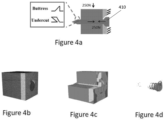
- FIG. 4a illustrates the initial conditions, prior to loading, of the three-dimensional finite element analysis (FEA) model constructed utilising mechanical simulation software, used to simulate the stress applied to bone tissue adjacent to an orthopaedic implant such as the bone implant device 410.
- FEA finite element analysis
- FIG. 4c An example of the finite element analysis (FEA) simulation results showing the stress applied to the bone material adjacent to the bone screw is shown in Figure 4c ; and the stress within the bone screw is shown for example in Figure 4d .
- FEA finite element analysis
- Figure 5a shows the analysis results of the FEA model shown and described in reference to Figure 4a and Figure 4b , showing the Von Mises stresses induced in the bone material adjacent the bone screw with typical buttress thread, as shown in figure 3b .
- Figure 5b illustrates the conditions following load of the model of the bone screw model with undercut thread as shown in Figure 4a and Figure 4b . Similar to the result shown in Figure 5a , being so urged by the load, the region of the simulated bone tissue, adjacent to the side of the implant is compressed against an adjacent portion of the modelled thread portion and central shaft.
- the stress concentration of the simulated bone tissue portions is only of a maximum of magnitude of 6.5MPa, which is much lower than that of the results as shown in Figure 5a .
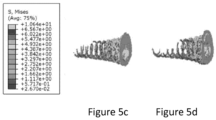
- Figure 5c illustrates the Von Mises stresses induced in the bone screw with buttress thread of Figure 3b
- Figure 5d shows the Von Mises stresses induced in the bone screw with undercut thread shown of Figure 3d
- the bone screw with undercut thread demonstrates a more even distribution of stress over the entire screw body than that of the buttress thread, and thus avoiding stress concentration at a specific point on the screw which may eventually lead to the local damage of the bone screws and even breakage thereof.
- Figure 6a is a bar chart showing the comparison of the maximum Von Mises stresses induced in bone material adjacent the two bone screws shown of Figure 3b and Figure 3d . It is shown that with the use of the undercut thread of the present invention, the maximum Von Mises stress induced in the bone material adjacent to the bone screw is only around 6.5 MPa, which is around 38% lower than that induced by the typical buttress thread.
Landscapes
- Health & Medical Sciences (AREA)
- Orthopedic Medicine & Surgery (AREA)
- Life Sciences & Earth Sciences (AREA)
- Surgery (AREA)
- Neurology (AREA)
- Heart & Thoracic Surgery (AREA)
- Engineering & Computer Science (AREA)
- Biomedical Technology (AREA)
- Nuclear Medicine, Radiotherapy & Molecular Imaging (AREA)
- Medical Informatics (AREA)
- Molecular Biology (AREA)
- Animal Behavior & Ethology (AREA)
- General Health & Medical Sciences (AREA)
- Public Health (AREA)
- Veterinary Medicine (AREA)
- Prostheses (AREA)
- Surgical Instruments (AREA)
Claims (14)
- Implantatvorrichtung (100d) zum Eingriff mit einem Knochen einer Person, wobei die Implantatvorrichtung ein distales Ende (102d), ein proximales Ende (104d), einen zentralen Schaft (106d), der sich dazwischen erstreckt, und eine Längsmittelachse (108d) umfasst;
wobei die Implantatvorrichtung ferner einen schraubenförmigen Gewindeabschnitt (110d), der sich in Umfangsrichtung um den zentralen Schaft (106d) erstreckt und sich in einer Richtung vom distalen Ende (102d) der Implantatvorrichtung und zum proximalen Ende (104d) davon hin erstreckt, und einen Fuß (112d) an der Basis des schraubenförmigen Gewindeabschnitts (110d) neben dem zentralen Schaft (106d) der Implantatvorrichtung beinhaltet, wobei der schraubenförmige Gewindeabschnitt (110d) im Querschnitt Folgendes beinhaltet:eine Vorderkante (114d) und eine Hinterkante (116d), die sich beide zumindest radial nach außen von dem zentralen Schaft (106d) erstrecken und den Gewindeabschnitt (110d) dazwischen definieren, wobei der Fuß (112d) des Gewindeabschnitts (110d) dazwischen in einer Richtung der Längsmittelachse (108d) der Implantatvorrichtung definiert ist; undeinen Scheitelabschnitt (118d), der zwischen der Vorderkante und der Hinterkante (116d) angeordnet ist, und wobei der Scheitelabschnitt (118d) einen radial nach außen gerichteten Abschnitt des Gewindeabschnitts (110d) bildet, und wobei der Scheitelabschnitt (118d) eine Eingriffsfläche zur Anlage und zum Eingriff mit Knochen einer Person bereitstellt, der radial an dem Gewindeabschnitt (110d) angeordnet ist;wobei die Vorderkante in eine Richtung zumindest zum distalen Ende (102d) der Implantatvorrichtung hin weist und wobei die Hinterkante (116d) zumindest in eine Richtung zum proximalen Ende (104d) der Implantatvorrichtung hin weist;wobei sich ein Abschnitt der Vorderkante in einer Richtung zum distalen Ende (102d) der Implantatvorrichtung hin weiter als der distalste Abschnitt des Fußes (112d) des Gewindeabschnitts (110d) erstreckt und wobei der Abstand in der Längsrichtung vom proximalsten Abschnitt des Fußes (112d) zum distalsten Abschnitt der Vorderkante größer als die Längslänge des Fußes (112d) ist, sodass der Abschnitt der Vorderkante eine Aussparung zwischen dem zentralen Schaft (106d) und der Vorderkante bildet; wobei der Abschnitt der Vorderkante, der die Aussparung zwischen dem zentralen Schaft (106d) und der Vorderkante definiert, für eine Anlage und einen Eingriff mit Knochengewebe einer Person, das innerhalb der Aussparung angeordnet ist, sorgt;wobei sich die Hinterkante (116d) in einer Richtung vom proximalsten Abschnitt des Fußes (112d) in einer radial nach außen gerichteten Richtung und zum distalen Ende (102d) hin erstreckt;dadurch gekennzeichnet, dass die Vorderkante (114d) des Gewindeabschnitts (110d) eine erste Facette (113d) und eine zweite Facette (111d) zur Anlage und zum Eingriff mit Knochengewebe einer Person beinhaltet,wobei die zweite Facette (111d) eine im Wesentlichen ebene Oberfläche aufweist und zwischen dem Fuß (112d) des Gewindeabschnitts (110d) und der ersten Facette (113d) angeordnet ist und sich radial nach außen von dem Schaft im Wesentlichen senkrecht zu der Längsmittelachse (108d) der Implantatvorrichtung zur ersten Facette (113d) hin erstreckt; unddie erste Facette (113d) eine im Wesentlichen ebene Oberfläche aufweist und sich im Wesentlichen radial nach außen von der zweiten Facette (111d) erstreckt und sich zu dem Scheitelabschnitt (118d) hin erstreckt. - Implantatvorrichtung (100d) nach Anspruch 1, wobei der Scheitelabschnitt (118d) Folgendes aufweist:eine Oberfläche, die im Wesentlichen eben und parallel zur Längsmittelachse (108d) der Implantatvorrichtung ist, die die Eingriffsfläche bereitstellt; odereine nach außen gebogene Außenfläche, die die Eingriffsfläche bereitstellt; undwobei der Scheitelabschnitt (118d) zumindest einen Abschnitt der Hinterkante (116d) bildet.
- Implantatvorrichtung (100d) nach einem der vorhergehenden Ansprüche, wobei
die durch die Vorderkante (114d) gebildete Aussparung so bemessen und geformt ist, dass sie, bei Eingriff mit radial angeordnetem Knochen neben dem Gewindeabschnitt (110d), für eine Verteilung von Spannung sorgt, die in dem Knochen neben der Vorderkante induziert wird, und für eine Verringerung der Spannungskonzentration in dem Knochen neben der Vorderkante sorgt. - Implantatvorrichtung (100d) nach einem der vorhergehenden Ansprüche, wobei:i) die Eingriffsfläche des Scheitelabschnitts (118d), bei Eingriff mit radial angeordneten Knochen neben dem Gewindeabschnitt (110d), für eine Verteilung von Spannung sorgt, die in dem Knochen neben dem Scheitelabschnitt (118d) entlang der Eingriffsfläche induziert wird, und die Eingriffsfläche für eine Verringerung der Spannungskonzentration in Knochen neben dem Scheitelabschnitt (118d) sorgt; und/oderii) der Scheitelabschnitt (118d) eine größere Längslänge als die des Fußes (112d) in der Richtung der Längsmittelachse (108d) der Implantatvorrichtung aufweist.
- Implantatvorrichtung (100d) nach einem der vorhergehenden Ansprüche,
wobei ein Neigungswinkel in einem Bereich von 95 Grad und 150 Grad zwischen der ebenen Oberfläche und der Längsmittelachse (108d) aufgespannt ist; optional wobei der Neigungswinkel etwa 120 Grad zwischen der ebenen Oberfläche und der Längsmittelachse (108d) aufgespannt ist. - Implantatvorrichtung (100d) nach einem der Ansprüche 1 bis 4, wobei ein Neigungswinkel in einem Bereich von 100 Grad und 130 Grad zwischen der ebenen Oberfläche und der Längsmittelachse (108d) aufgespannt ist; optional wobei der Neigungswinkel etwa 120 Grad zwischen der ebenen Oberfläche und der Längsmittelachse (108d) aufgespannt ist.
- Implantatvorrichtung (100d) nach den vorhergehenden Ansprüchen, wobei die Hinterkante (116d) des Gewindeabschnitts (110d) eine dritte Facette zur Anlage und zum Eingriff mit Knochengewebe einer Person beinhaltet, wobei die dritte Facette im Wesentlichen eben ist und sich von der proximalen Seite des Fußes (112d) am zentralen Schaft (106d) erstreckt und sich zum Scheitelabschnitt (118d) hin mit einer Neigung zum zentralen Schaft (106d) erstreckt.
- Implantatvorrichtung (100d) nach einem der vorhergehenden Ansprüche, wobei die Eingriffsfläche des Scheitelabschnitts (118d) zumindest teilweise durch eine oder mehrere der Folgenden bereitgestellt wird: die Vorderkante (114d) und die Hinterkante (116d).
- Implantatvorrichtung (100d) nach einem der vorhergehenden Ansprüche, wobei die Aussparung so bemessen und geformt ist, dass, beim gegeneinander Drücken der Implantatvorrichtung und angrenzendem Knochen, in dem die Vorrichtung eingebettet ist, auf einer ersten Seite der Implantatvorrichtung, zumindest ein Abschnitt der Vorderkante (114d) des Gewindeabschnitts (110d) gegen Knochen gedrückt wird, der innerhalb der Aussparungen auf der gegenüberliegenden Seite der Implantatvorrichtung angeordnet ist.
- Implantatvorrichtung (100d) nach einem der vorhergehenden Ansprüche, wobei der Gewindeabschnitt (110d) Folgendes aufweist:i) eine konstante Querschnittsfläche und -geometrie oder eine variierende Querschnittsfläche und -geometrie; und/oderii) eine konstante Gewindesteigung oder eine variierende Gewindesteigung.
- Implantatvorrichtung (100d) nach einem der vorhergehenden Ansprüche, wobei:i) die Implantatvorrichtung aus einem Metall- oder Metalllegierungsmaterial gebildet ist;
optional, wobei das Metall- oder Metalllegierungsmaterial aus der Gruppe ausgewählt ist, die Edelstahl, Titan, Titanlegierung, Kobalt-Chrom-Legierung oder dergleichen beinhaltet; und/oderii) die Implantatvorrichtung aus einem Polymermaterial oder einem Material auf Polymerbasis gebildet ist;
optional wobei das Polymermaterial oder Material auf Polymerbasis Polyetheretherketon (PEEK) ist. - Implantatvorrichtung (100d) nach einem der vorhergehenden Ansprüche, wobei die Implantatvorrichtung eine Knochenschraube ist;
optional wobei die Implantatvorrichtung eine orthopädische Feststellschraube, eine Pedikelschraubenvorrichtung, ein Femurkopfeingriffselement einer dynamischen Hüftschraube; ein Knochennahtanker; oder eine orthopädische Implantatprothesenvorrichtung ist. - Kit, umfassend eine oder mehrere Implantatvorrichtungen (100d) nach einem der Ansprüche 1 bis 12;optional wobei die eine oder mehreren Implantatvorrichtungen eine Knochenschraube sind;ferner optional wobei das Kit ferner eine oder mehrere Frakturfixierungsvorrichtungen umfasst.
- System zum Fixieren eines ersten Knochenabschnitts relativ zu einem zweiten Knochenabschnitt, wobei das System zwei oder mehr Implantatvorrichtungen (100d) nach einem der Ansprüche 1 bis 12 und ein Brückenglied aufweist, wobei eine erste Implantatvorrichtung mit dem ersten Knochenabschnitt in Eingriff bringbar ist und eine zweite Implantatvorrichtung mit dem zweiten Knochenabschnitt in Eingriff bringbar ist, wobei die distalen Enden (102d) der Implantatvorrichtungen mit den Knochenabschnitten in Eingriff bringbar sind und die proximalen Enden (104d) mit dem Brückenglied in Eingriff bringbar sind;optional wobei die eine oder mehreren Implantatvorrichtungen Pedikelschrauben sind und das Brückenglied ein Stab ist und das System ein Wirbelsäulenfusionssystem ist;ferner optional wobei das Brückenglied ein Stab ist, der einstellbar ist, um eine einstellbare Bewegung des ersten Knochenabschnitts und des zweiten Knochenabschnitts relativ zueinander bereitzustellen.
Applications Claiming Priority (2)
| Application Number | Priority Date | Filing Date | Title |
|---|---|---|---|
| US201962845455P | 2019-05-09 | 2019-05-09 | |
| PCT/CN2020/089350 WO2020224657A1 (en) | 2019-05-09 | 2020-05-09 | A novel thread design for bone screw |
Publications (4)
| Publication Number | Publication Date |
|---|---|
| EP3965675A1 EP3965675A1 (de) | 2022-03-16 |
| EP3965675A4 EP3965675A4 (de) | 2023-01-04 |
| EP3965675B1 true EP3965675B1 (de) | 2025-07-09 |
| EP3965675C0 EP3965675C0 (de) | 2025-07-09 |
Family
ID=73051418
Family Applications (1)
| Application Number | Title | Priority Date | Filing Date |
|---|---|---|---|
| EP20802395.2A Active EP3965675B1 (de) | 2019-05-09 | 2020-05-09 | Neues gewindedesign für knochenschraube |
Country Status (5)
| Country | Link |
|---|---|
| US (1) | US11596459B2 (de) |
| EP (1) | EP3965675B1 (de) |
| JP (1) | JP7383307B2 (de) |
| CN (1) | CN113873958B (de) |
| WO (1) | WO2020224657A1 (de) |
Families Citing this family (8)
| Publication number | Priority date | Publication date | Assignee | Title |
|---|---|---|---|---|
| EP4247281A1 (de) * | 2020-11-19 | 2023-09-27 | RTG Scientific, LLC | Befestigungsvorrichtungen, systeme und verfahren |
| US12121271B2 (en) | 2021-02-09 | 2024-10-22 | Rtg Scientific, Llc | Femoral fixation devices, systems, and methods |
| US12121276B2 (en) | 2020-11-19 | 2024-10-22 | Rtg Scientific, Llc | Fastening devices, systems, and methods |
| US20220249131A1 (en) | 2021-02-09 | 2022-08-11 | Rtg Scientific, Llc | Fastening devices, systems, and methods |
| AU2022326436A1 (en) | 2021-08-10 | 2024-02-15 | Rtg Scientific, Llc | Bone fixation devices, systems, methods, and instruments |
| US20240285322A1 (en) * | 2023-02-28 | 2024-08-29 | Globus Medical, Inc. | Orthopedic bone fasteners |
| AU2024338697A1 (en) * | 2023-09-08 | 2026-04-23 | Wesley ALSUP | Variable angled loading threads |
| US20250318910A1 (en) | 2024-04-10 | 2025-10-16 | Florian Freiwald | Dental implant with improved thread design |
Family Cites Families (31)
| Publication number | Priority date | Publication date | Assignee | Title |
|---|---|---|---|---|
| CH642838A5 (de) * | 1979-11-21 | 1984-05-15 | Osteo Ag | Kieferimplantat. |
| US4600224A (en) * | 1983-12-23 | 1986-07-15 | Interlock Technologies Corporation | Tubular connection having a chevron wedge thread |
| DE8620697U1 (de) * | 1986-07-31 | 1986-10-09 | orthoplant Endoprothetik GmbH, 2800 Bremen | Knochenschraube |
| DE59908122D1 (de) * | 1998-07-30 | 2004-01-29 | Franz Sutter | Implantat zum halten und/oder bilden eines zahnersatzes oder eines künstlichen fingergelenks |
| US6254146B1 (en) * | 1999-04-23 | 2001-07-03 | John Gandy Corporation | Thread form with multifacited flanks |
| DE19960287C1 (de) * | 1999-12-14 | 2001-07-26 | Ejot Verbindungstech Gmbh & Co | Selbstfurchende Schraube |
| US6572315B1 (en) * | 2000-01-06 | 2003-06-03 | Gary Jack Reed | Threaded fastener having a thread crest greater than its thread root |
| AR019513A1 (es) * | 2000-03-21 | 2002-02-27 | Levisman Ricardo | IMPLANTE DE FIJACIoN. |
| US6726689B2 (en) * | 2002-09-06 | 2004-04-27 | Roger P. Jackson | Helical interlocking mating guide and advancement structure |
| US6402515B1 (en) * | 2001-01-10 | 2002-06-11 | Sulzer Dental Inc. | Dental implant with variable profile thread |
| CN1604758A (zh) * | 2001-10-15 | 2005-04-06 | 加里J·里德 | 矫形外科稳定器械和方法 |
| US6976711B2 (en) * | 2002-04-19 | 2005-12-20 | Hydril Company Lp | Threaded connection especially for radially plastically expandable conduit |
| US20060009773A1 (en) * | 2002-09-06 | 2006-01-12 | Jackson Roger P | Helical interlocking mating guide and advancement structure |
| US20060106384A1 (en) | 2004-11-12 | 2006-05-18 | Reber Erik W | Intramedullary nail assembly |
| US8535357B2 (en) | 2004-12-09 | 2013-09-17 | Biomet Sports Medicine, Llc | Continuous phase compositions for ACL repair |
| CN200998298Y (zh) * | 2006-08-29 | 2008-01-02 | 许凯婷 | 脊椎固定骨钉的弹性结合杆 |
| US8602781B2 (en) * | 2007-05-16 | 2013-12-10 | Gary J. Reed | Dental implant with interlocking and centering threads |
| US20100036498A1 (en) * | 2008-04-03 | 2010-02-11 | Mcdevitt Dennis | Fusion cage with reverse thread profile (rtp) |
| KR20110073452A (ko) | 2008-08-15 | 2011-06-29 | 키네틱 스파인 테크놀로지스 인크. | 뼈 고정나사 |
| JP2010057743A (ja) | 2008-09-04 | 2010-03-18 | Shimane Univ | 骨部位用ネジ |
| PL2337512T3 (pl) | 2008-09-12 | 2012-09-28 | Synthes Gmbh | System usztywniający do stabilizacji i kierowania wzrostem kręgosłupa |
| US8267436B2 (en) * | 2009-07-08 | 2012-09-18 | Gandy Technologies Corporation | Arrow-shaped thread form for tubular connections |
| US8636808B2 (en) * | 2011-01-21 | 2014-01-28 | Trilliant Surgical, Ltd. | Spherical subtalar implant |
| CA2855695C (en) * | 2011-11-18 | 2021-06-01 | DePuy Synthes Products, LLC | Femoral neck fracture implant |
| CN103126758A (zh) * | 2011-11-25 | 2013-06-05 | 苏州艾迪尔医疗器械有限公司 | 负牙侧角螺钉 |
| ES2611883T3 (es) * | 2012-05-29 | 2017-05-11 | A.B. Dental Devices Ltd. | Un implante dental dentado |
| US9387021B2 (en) * | 2012-08-20 | 2016-07-12 | Ebi, Llc | Implant with semi-enclosed screws |
| CN104095677B (zh) * | 2014-07-15 | 2016-11-16 | 东南大学 | 高强度组合式自降解膨胀骨钉 |
| BR102014031426B1 (pt) * | 2014-12-15 | 2018-07-24 | Jjgc Ind E Comercio De Materiais Dentarios S/A | implante |
| CN204484286U (zh) * | 2015-01-16 | 2015-07-22 | 上海凯利泰医疗科技股份有限公司 | 一种用于椎弓根螺钉中的螺纹 |
| US10136929B2 (en) * | 2015-07-13 | 2018-11-27 | IntraFuse, LLC | Flexible bone implant |
-
2020
- 2020-05-09 CN CN202080034675.1A patent/CN113873958B/zh active Active
- 2020-05-09 WO PCT/CN2020/089350 patent/WO2020224657A1/en not_active Ceased
- 2020-05-09 EP EP20802395.2A patent/EP3965675B1/de active Active
- 2020-05-09 US US17/606,987 patent/US11596459B2/en active Active
- 2020-05-09 JP JP2021566162A patent/JP7383307B2/ja active Active
Also Published As
| Publication number | Publication date |
|---|---|
| CN113873958B (zh) | 2024-05-28 |
| US11596459B2 (en) | 2023-03-07 |
| WO2020224657A1 (en) | 2020-11-12 |
| CN113873958A (zh) | 2021-12-31 |
| JP7383307B2 (ja) | 2023-11-20 |
| JP2022524233A (ja) | 2022-04-28 |
| EP3965675A4 (de) | 2023-01-04 |
| EP3965675C0 (de) | 2025-07-09 |
| EP3965675A1 (de) | 2022-03-16 |
| US20220160410A1 (en) | 2022-05-26 |
Similar Documents
| Publication | Publication Date | Title |
|---|---|---|
| EP3965675B1 (de) | Neues gewindedesign für knochenschraube | |
| US20210259842A1 (en) | Bone implant device | |
| US11638601B2 (en) | Bone compression systems | |
| US9072561B2 (en) | Spinal facet fixation device | |
| Epari et al. | Biphasic plating improves the mechanical performance of locked plating for distal femur fractures | |
| EP2967894B1 (de) | Hammerzehenimplantat mit verbesserten greifflächen | |
| CN101208051B (zh) | 骨接合植入物及使用和制造方法 | |
| US20020082603A1 (en) | Method and device utilizing tapered screw shanks for spinal stabilization | |
| JP7817260B2 (ja) | 締結装置、システム、および方法 | |
| EP0359816A1 (de) | In breite und dicke spitzzulaufende rekonstruktions- und frakturplatte mit asymmetrischer lockanordnung | |
| US10898249B2 (en) | Self-compressing screws for generating and applying compression within a body | |
| JP2024519903A (ja) | 骨固定デバイス | |
| Izzawati et al. | Stress analysis of implant-bone fixation at different fracture angle | |
| Griffiths et al. | Better axial stiffness of a bicortical screw construct compared to a cable construct for comminuted Vancouver B1 proximal femoral fractures | |
| HK40060331A (en) | A novel thread design for bone screw | |
| HK40060331B (zh) | 骨螺钉的新型螺纹设计 | |
| JP5924565B2 (ja) | インプラント | |
| Thakur | Locking Plates–Concepts and Applications | |
| CN207970136U (zh) | 骨移植物 | |
| Schultz | An Experimental and Computational Mechanical Analysis of Bone Anchors and Substrate Interface | |
| Pitz | Compression-aided stability of orthopaedic devices | |
| CN105726111A (zh) | 一种具有广泛适应性和个体化特征的接骨板 |
Legal Events
| Date | Code | Title | Description |
|---|---|---|---|
| STAA | Information on the status of an ep patent application or granted ep patent |
Free format text: STATUS: THE INTERNATIONAL PUBLICATION HAS BEEN MADE |
|
| PUAI | Public reference made under article 153(3) epc to a published international application that has entered the european phase |
Free format text: ORIGINAL CODE: 0009012 |
|
| STAA | Information on the status of an ep patent application or granted ep patent |
Free format text: STATUS: REQUEST FOR EXAMINATION WAS MADE |
|
| 17P | Request for examination filed |
Effective date: 20211109 |
|
| AK | Designated contracting states |
Kind code of ref document: A1 Designated state(s): AL AT BE BG CH CY CZ DE DK EE ES FI FR GB GR HR HU IE IS IT LI LT LU LV MC MK MT NL NO PL PT RO RS SE SI SK SM TR |
|
| DAV | Request for validation of the european patent (deleted) | ||
| DAX | Request for extension of the european patent (deleted) | ||
| A4 | Supplementary search report drawn up and despatched |
Effective date: 20221207 |
|
| RIC1 | Information provided on ipc code assigned before grant |
Ipc: A61B 17/86 20060101AFI20221201BHEP |
|
| GRAP | Despatch of communication of intention to grant a patent |
Free format text: ORIGINAL CODE: EPIDOSNIGR1 |
|
| STAA | Information on the status of an ep patent application or granted ep patent |
Free format text: STATUS: GRANT OF PATENT IS INTENDED |
|
| INTG | Intention to grant announced |
Effective date: 20250211 |
|
| GRAS | Grant fee paid |
Free format text: ORIGINAL CODE: EPIDOSNIGR3 |
|
| GRAA | (expected) grant |
Free format text: ORIGINAL CODE: 0009210 |
|
| STAA | Information on the status of an ep patent application or granted ep patent |
Free format text: STATUS: THE PATENT HAS BEEN GRANTED |
|
| AK | Designated contracting states |
Kind code of ref document: B1 Designated state(s): AL AT BE BG CH CY CZ DE DK EE ES FI FR GB GR HR HU IE IS IT LI LT LU LV MC MK MT NL NO PL PT RO RS SE SI SK SM TR |
|
| REG | Reference to a national code |
Ref country code: GB Ref legal event code: FG4D |
|
| REG | Reference to a national code |
Ref country code: CH Ref legal event code: EP |
|
| REG | Reference to a national code |
Ref country code: IE Ref legal event code: FG4D |
|
| REG | Reference to a national code |
Ref country code: DE Ref legal event code: R096 Ref document number: 602020054275 Country of ref document: DE |
|
| U01 | Request for unitary effect filed |
Effective date: 20250717 |
|
| RAP4 | Party data changed (patent owner data changed or rights of a patent transferred) |
Owner name: THE UNIVERSITY OF HONG KONG |
|
| U07 | Unitary effect registered |
Designated state(s): AT BE BG DE DK EE FI FR IT LT LU LV MT NL PT RO SE SI Effective date: 20250730 |
|
| PG25 | Lapsed in a contracting state [announced via postgrant information from national office to epo] |
Ref country code: IS Free format text: LAPSE BECAUSE OF FAILURE TO SUBMIT A TRANSLATION OF THE DESCRIPTION OR TO PAY THE FEE WITHIN THE PRESCRIBED TIME-LIMIT Effective date: 20251109 |
|
| PG25 | Lapsed in a contracting state [announced via postgrant information from national office to epo] |
Ref country code: NO Free format text: LAPSE BECAUSE OF FAILURE TO SUBMIT A TRANSLATION OF THE DESCRIPTION OR TO PAY THE FEE WITHIN THE PRESCRIBED TIME-LIMIT Effective date: 20251009 |
|
| PG25 | Lapsed in a contracting state [announced via postgrant information from national office to epo] |
Ref country code: HR Free format text: LAPSE BECAUSE OF FAILURE TO SUBMIT A TRANSLATION OF THE DESCRIPTION OR TO PAY THE FEE WITHIN THE PRESCRIBED TIME-LIMIT Effective date: 20250709 |
|
| PG25 | Lapsed in a contracting state [announced via postgrant information from national office to epo] |
Ref country code: GR Free format text: LAPSE BECAUSE OF FAILURE TO SUBMIT A TRANSLATION OF THE DESCRIPTION OR TO PAY THE FEE WITHIN THE PRESCRIBED TIME-LIMIT Effective date: 20251010 |
|
| PG25 | Lapsed in a contracting state [announced via postgrant information from national office to epo] |
Ref country code: PL Free format text: LAPSE BECAUSE OF FAILURE TO SUBMIT A TRANSLATION OF THE DESCRIPTION OR TO PAY THE FEE WITHIN THE PRESCRIBED TIME-LIMIT Effective date: 20250709 |
|
| PG25 | Lapsed in a contracting state [announced via postgrant information from national office to epo] |
Ref country code: RS Free format text: LAPSE BECAUSE OF FAILURE TO SUBMIT A TRANSLATION OF THE DESCRIPTION OR TO PAY THE FEE WITHIN THE PRESCRIBED TIME-LIMIT Effective date: 20251009 |
|
| PG25 | Lapsed in a contracting state [announced via postgrant information from national office to epo] |
Ref country code: ES Free format text: LAPSE BECAUSE OF FAILURE TO SUBMIT A TRANSLATION OF THE DESCRIPTION OR TO PAY THE FEE WITHIN THE PRESCRIBED TIME-LIMIT Effective date: 20250709 |
|
| PG25 | Lapsed in a contracting state [announced via postgrant information from national office to epo] |
Ref country code: SM Free format text: LAPSE BECAUSE OF FAILURE TO SUBMIT A TRANSLATION OF THE DESCRIPTION OR TO PAY THE FEE WITHIN THE PRESCRIBED TIME-LIMIT Effective date: 20250709 |
|
| PG25 | Lapsed in a contracting state [announced via postgrant information from national office to epo] |
Ref country code: CZ Free format text: LAPSE BECAUSE OF FAILURE TO SUBMIT A TRANSLATION OF THE DESCRIPTION OR TO PAY THE FEE WITHIN THE PRESCRIBED TIME-LIMIT Effective date: 20250709 |
|
| PG25 | Lapsed in a contracting state [announced via postgrant information from national office to epo] |
Ref country code: SK Free format text: LAPSE BECAUSE OF FAILURE TO SUBMIT A TRANSLATION OF THE DESCRIPTION OR TO PAY THE FEE WITHIN THE PRESCRIBED TIME-LIMIT Effective date: 20250709 |