EP3967395A2 - Perowskit-metalloxid-katalysator mit substituiertem metallion zur reduktion der kohlenstoffabscheidung, herstellungsverfahren dafür und verfahren zur methanreformierungsreaktion unter verwendung davon - Google Patents
Perowskit-metalloxid-katalysator mit substituiertem metallion zur reduktion der kohlenstoffabscheidung, herstellungsverfahren dafür und verfahren zur methanreformierungsreaktion unter verwendung davon Download PDFInfo
- Publication number
- EP3967395A2 EP3967395A2 EP21195970.5A EP21195970A EP3967395A2 EP 3967395 A2 EP3967395 A2 EP 3967395A2 EP 21195970 A EP21195970 A EP 21195970A EP 3967395 A2 EP3967395 A2 EP 3967395A2
- Authority
- EP
- European Patent Office
- Prior art keywords
- reaction
- catalyst
- methane
- substituted
- perovskite
- Prior art date
- Legal status (The legal status is an assumption and is not a legal conclusion. Google has not performed a legal analysis and makes no representation as to the accuracy of the status listed.)
- Granted
Links
Images





Classifications
-
- B—PERFORMING OPERATIONS; TRANSPORTING
- B01—PHYSICAL OR CHEMICAL PROCESSES OR APPARATUS IN GENERAL
- B01J—CHEMICAL OR PHYSICAL PROCESSES, e.g. CATALYSIS OR COLLOID CHEMISTRY; THEIR RELEVANT APPARATUS
- B01J21/00—Catalysts comprising the elements, oxides, or hydroxides of magnesium, boron, aluminium, carbon, silicon, titanium, zirconium, or hafnium
- B01J21/06—Silicon, titanium, zirconium or hafnium; Oxides or hydroxides thereof
-
- B—PERFORMING OPERATIONS; TRANSPORTING
- B01—PHYSICAL OR CHEMICAL PROCESSES OR APPARATUS IN GENERAL
- B01J—CHEMICAL OR PHYSICAL PROCESSES, e.g. CATALYSIS OR COLLOID CHEMISTRY; THEIR RELEVANT APPARATUS
- B01J21/00—Catalysts comprising the elements, oxides, or hydroxides of magnesium, boron, aluminium, carbon, silicon, titanium, zirconium, or hafnium
- B01J21/06—Silicon, titanium, zirconium or hafnium; Oxides or hydroxides thereof
- B01J21/063—Titanium; Oxides or hydroxides thereof
-
- B—PERFORMING OPERATIONS; TRANSPORTING
- B01—PHYSICAL OR CHEMICAL PROCESSES OR APPARATUS IN GENERAL
- B01J—CHEMICAL OR PHYSICAL PROCESSES, e.g. CATALYSIS OR COLLOID CHEMISTRY; THEIR RELEVANT APPARATUS
- B01J21/00—Catalysts comprising the elements, oxides, or hydroxides of magnesium, boron, aluminium, carbon, silicon, titanium, zirconium, or hafnium
- B01J21/10—Magnesium; Oxides or hydroxides thereof
-
- B—PERFORMING OPERATIONS; TRANSPORTING
- B01—PHYSICAL OR CHEMICAL PROCESSES OR APPARATUS IN GENERAL
- B01J—CHEMICAL OR PHYSICAL PROCESSES, e.g. CATALYSIS OR COLLOID CHEMISTRY; THEIR RELEVANT APPARATUS
- B01J23/00—Catalysts comprising metals or metal oxides or hydroxides, not provided for in group B01J21/00
-
- B—PERFORMING OPERATIONS; TRANSPORTING
- B01—PHYSICAL OR CHEMICAL PROCESSES OR APPARATUS IN GENERAL
- B01J—CHEMICAL OR PHYSICAL PROCESSES, e.g. CATALYSIS OR COLLOID CHEMISTRY; THEIR RELEVANT APPARATUS
- B01J23/00—Catalysts comprising metals or metal oxides or hydroxides, not provided for in group B01J21/00
- B01J23/002—Mixed oxides other than spinels, e.g. perovskite
-
- B—PERFORMING OPERATIONS; TRANSPORTING
- B01—PHYSICAL OR CHEMICAL PROCESSES OR APPARATUS IN GENERAL
- B01J—CHEMICAL OR PHYSICAL PROCESSES, e.g. CATALYSIS OR COLLOID CHEMISTRY; THEIR RELEVANT APPARATUS
- B01J23/00—Catalysts comprising metals or metal oxides or hydroxides, not provided for in group B01J21/00
- B01J23/02—Catalysts comprising metals or metal oxides or hydroxides, not provided for in group B01J21/00 of the alkali- or alkaline earth metals or beryllium
-
- B—PERFORMING OPERATIONS; TRANSPORTING
- B01—PHYSICAL OR CHEMICAL PROCESSES OR APPARATUS IN GENERAL
- B01J—CHEMICAL OR PHYSICAL PROCESSES, e.g. CATALYSIS OR COLLOID CHEMISTRY; THEIR RELEVANT APPARATUS
- B01J23/00—Catalysts comprising metals or metal oxides or hydroxides, not provided for in group B01J21/00
- B01J23/70—Catalysts comprising metals or metal oxides or hydroxides, not provided for in group B01J21/00 of the iron group metals or copper
- B01J23/76—Catalysts comprising metals or metal oxides or hydroxides, not provided for in group B01J21/00 of the iron group metals or copper combined with metals, oxides or hydroxides provided for in groups B01J23/02 - B01J23/36
- B01J23/78—Catalysts comprising metals or metal oxides or hydroxides, not provided for in group B01J21/00 of the iron group metals or copper combined with metals, oxides or hydroxides provided for in groups B01J23/02 - B01J23/36 with alkali- or alkaline earth metals
-
- B—PERFORMING OPERATIONS; TRANSPORTING
- B01—PHYSICAL OR CHEMICAL PROCESSES OR APPARATUS IN GENERAL
- B01J—CHEMICAL OR PHYSICAL PROCESSES, e.g. CATALYSIS OR COLLOID CHEMISTRY; THEIR RELEVANT APPARATUS
- B01J35/00—Catalysts, in general, characterised by their form or physical properties
- B01J35/70—Catalysts, in general, characterised by their form or physical properties characterised by their crystalline properties, e.g. semi-crystalline
- B01J35/733—Perovskite-type
-
- B—PERFORMING OPERATIONS; TRANSPORTING
- B01—PHYSICAL OR CHEMICAL PROCESSES OR APPARATUS IN GENERAL
- B01J—CHEMICAL OR PHYSICAL PROCESSES, e.g. CATALYSIS OR COLLOID CHEMISTRY; THEIR RELEVANT APPARATUS
- B01J37/00—Processes, in general, for preparing catalysts; Processes, in general, for activation of catalysts
-
- B—PERFORMING OPERATIONS; TRANSPORTING
- B01—PHYSICAL OR CHEMICAL PROCESSES OR APPARATUS IN GENERAL
- B01J—CHEMICAL OR PHYSICAL PROCESSES, e.g. CATALYSIS OR COLLOID CHEMISTRY; THEIR RELEVANT APPARATUS
- B01J37/00—Processes, in general, for preparing catalysts; Processes, in general, for activation of catalysts
- B01J37/0009—Use of binding agents; Moulding; Pressing; Powdering; Granulating; Addition of materials ameliorating the mechanical properties of the product catalyst
- B01J37/0018—Addition of a binding agent or of material, later completely removed among others as result of heat treatment, leaching or washing,(e.g. forming of pores; protective layer, desintegrating by heat)
-
- B—PERFORMING OPERATIONS; TRANSPORTING
- B01—PHYSICAL OR CHEMICAL PROCESSES OR APPARATUS IN GENERAL
- B01J—CHEMICAL OR PHYSICAL PROCESSES, e.g. CATALYSIS OR COLLOID CHEMISTRY; THEIR RELEVANT APPARATUS
- B01J37/00—Processes, in general, for preparing catalysts; Processes, in general, for activation of catalysts
- B01J37/02—Impregnation, coating or precipitation
- B01J37/03—Precipitation; Co-precipitation
- B01J37/031—Precipitation
-
- B—PERFORMING OPERATIONS; TRANSPORTING
- B01—PHYSICAL OR CHEMICAL PROCESSES OR APPARATUS IN GENERAL
- B01J—CHEMICAL OR PHYSICAL PROCESSES, e.g. CATALYSIS OR COLLOID CHEMISTRY; THEIR RELEVANT APPARATUS
- B01J37/00—Processes, in general, for preparing catalysts; Processes, in general, for activation of catalysts
- B01J37/04—Mixing
-
- B—PERFORMING OPERATIONS; TRANSPORTING
- B01—PHYSICAL OR CHEMICAL PROCESSES OR APPARATUS IN GENERAL
- B01J—CHEMICAL OR PHYSICAL PROCESSES, e.g. CATALYSIS OR COLLOID CHEMISTRY; THEIR RELEVANT APPARATUS
- B01J37/00—Processes, in general, for preparing catalysts; Processes, in general, for activation of catalysts
- B01J37/08—Heat treatment
- B01J37/082—Decomposition and pyrolysis
- B01J37/088—Decomposition of a metal salt
-
- B—PERFORMING OPERATIONS; TRANSPORTING
- B01—PHYSICAL OR CHEMICAL PROCESSES OR APPARATUS IN GENERAL
- B01J—CHEMICAL OR PHYSICAL PROCESSES, e.g. CATALYSIS OR COLLOID CHEMISTRY; THEIR RELEVANT APPARATUS
- B01J37/00—Processes, in general, for preparing catalysts; Processes, in general, for activation of catalysts
- B01J37/16—Reducing
- B01J37/18—Reducing with gases containing free hydrogen
-
- C—CHEMISTRY; METALLURGY
- C01—INORGANIC CHEMISTRY
- C01B—NON-METALLIC ELEMENTS; COMPOUNDS THEREOF; METALLOIDS OR COMPOUNDS THEREOF NOT COVERED BY SUBCLASS C01C
- C01B3/00—Hydrogen; Gaseous mixtures containing hydrogen; Separation of hydrogen from mixtures containing it; Purification of hydrogen; Reversible storage of hydrogen
- C01B3/02—Production of hydrogen; Production of gaseous mixtures containing hydrogen
- C01B3/32—Production of hydrogen; Production of gaseous mixtures containing hydrogen by reaction of gaseous or liquid organic compounds with gasifying agents, e.g. water, carbon dioxide or air
- C01B3/34—Production of hydrogen; Production of gaseous mixtures containing hydrogen by reaction of gaseous or liquid organic compounds with gasifying agents, e.g. water, carbon dioxide or air by reaction of hydrocarbons with gasifying agents
- C01B3/38—Production of hydrogen; Production of gaseous mixtures containing hydrogen by reaction of gaseous or liquid organic compounds with gasifying agents, e.g. water, carbon dioxide or air by reaction of hydrocarbons with gasifying agents using catalysts
- C01B3/40—Production of hydrogen; Production of gaseous mixtures containing hydrogen by reaction of gaseous or liquid organic compounds with gasifying agents, e.g. water, carbon dioxide or air by reaction of hydrocarbons with gasifying agents using catalysts characterised by the catalyst
-
- B—PERFORMING OPERATIONS; TRANSPORTING
- B01—PHYSICAL OR CHEMICAL PROCESSES OR APPARATUS IN GENERAL
- B01J—CHEMICAL OR PHYSICAL PROCESSES, e.g. CATALYSIS OR COLLOID CHEMISTRY; THEIR RELEVANT APPARATUS
- B01J2235/00—Indexing scheme associated with group B01J35/00, related to the analysis techniques used to determine the catalysts form or properties
- B01J2235/15—X-ray diffraction
-
- C—CHEMISTRY; METALLURGY
- C01—INORGANIC CHEMISTRY
- C01B—NON-METALLIC ELEMENTS; COMPOUNDS THEREOF; METALLOIDS OR COMPOUNDS THEREOF NOT COVERED BY SUBCLASS C01C
- C01B2203/00—Integrated processes for the production of hydrogen or synthesis gas
- C01B2203/02—Processes for making hydrogen or synthesis gas
- C01B2203/0205—Processes for making hydrogen or synthesis gas containing a reforming step
- C01B2203/0227—Processes for making hydrogen or synthesis gas containing a reforming step containing a catalytic reforming step
- C01B2203/0233—Processes for making hydrogen or synthesis gas containing a reforming step containing a catalytic reforming step the reforming step being a steam reforming step
-
- C—CHEMISTRY; METALLURGY
- C01—INORGANIC CHEMISTRY
- C01B—NON-METALLIC ELEMENTS; COMPOUNDS THEREOF; METALLOIDS OR COMPOUNDS THEREOF NOT COVERED BY SUBCLASS C01C
- C01B2203/00—Integrated processes for the production of hydrogen or synthesis gas
- C01B2203/02—Processes for making hydrogen or synthesis gas
- C01B2203/0205—Processes for making hydrogen or synthesis gas containing a reforming step
- C01B2203/0227—Processes for making hydrogen or synthesis gas containing a reforming step containing a catalytic reforming step
- C01B2203/0238—Processes for making hydrogen or synthesis gas containing a reforming step containing a catalytic reforming step the reforming step being a carbon dioxide reforming step
-
- C—CHEMISTRY; METALLURGY
- C01—INORGANIC CHEMISTRY
- C01B—NON-METALLIC ELEMENTS; COMPOUNDS THEREOF; METALLOIDS OR COMPOUNDS THEREOF NOT COVERED BY SUBCLASS C01C
- C01B2203/00—Integrated processes for the production of hydrogen or synthesis gas
- C01B2203/02—Processes for making hydrogen or synthesis gas
- C01B2203/025—Processes for making hydrogen or synthesis gas containing a partial oxidation step
- C01B2203/0261—Processes for making hydrogen or synthesis gas containing a partial oxidation step containing a catalytic partial oxidation step [CPO]
-
- C—CHEMISTRY; METALLURGY
- C01—INORGANIC CHEMISTRY
- C01B—NON-METALLIC ELEMENTS; COMPOUNDS THEREOF; METALLOIDS OR COMPOUNDS THEREOF NOT COVERED BY SUBCLASS C01C
- C01B2203/00—Integrated processes for the production of hydrogen or synthesis gas
- C01B2203/10—Catalysts for performing the hydrogen forming reactions
- C01B2203/1041—Composition of the catalyst
- C01B2203/1047—Group VIII metal catalysts
- C01B2203/1052—Nickel or cobalt catalysts
- C01B2203/1058—Nickel catalysts
-
- C—CHEMISTRY; METALLURGY
- C01—INORGANIC CHEMISTRY
- C01B—NON-METALLIC ELEMENTS; COMPOUNDS THEREOF; METALLOIDS OR COMPOUNDS THEREOF NOT COVERED BY SUBCLASS C01C
- C01B2203/00—Integrated processes for the production of hydrogen or synthesis gas
- C01B2203/12—Feeding the process for making hydrogen or synthesis gas
- C01B2203/1205—Composition of the feed
- C01B2203/1211—Organic compounds or organic mixtures used in the process for making hydrogen or synthesis gas
- C01B2203/1235—Hydrocarbons
- C01B2203/1241—Natural gas or methane
Definitions
- the present invention relates to a perovskite metal oxide catalyst substituted with nickel, cobalt and iron ions for reducing carbon deposition, a method for producing the same, and a process for performing a methane reforming reaction using this catalyst.
- a novel type of catalyst is produced in which Ni in ionic form is substituted at a portion of the Ti site (B-site) of the multicomponent metal oxide SrTiO 3 having a perovskite (ABO 3 ) structure.
- methane reforming reactions e.g., steam-methane reforming (SMR), dry reforming of methane (DRM), catalytic partial oxidation of methane (CPOM), etc.
- SMR steam-methane reforming
- DRM dry reforming of methane
- CPOM catalytic partial oxidation of methane
- Methane reforming reaction refers to a reaction that produces a synthetic gas (syngas) composed of hydrogen (H 2 ) and carbon monoxide (CO) by reacting methane (CH 4 ) with steam (H 2 O), carbon dioxide (CO 2 ), or oxygen (O 2 ).
- syngas a synthetic gas
- CH 4 methane
- CO carbon monoxide
- O 2 oxygen
- high-purity hydrogen can be produced through an additional water-gas shift reaction
- various hydrocarbons can be produced using a (Fischer-Tropsch, hereinafter referred to as 'F-T') process
- alcohols such as methanol, ethanol, butanol, etc.
- a suitable catalyst such as Cu-ZnO-Al 2 O 3 . That is, various chemical products can be produced using syngas as a raw material.
- Methane reforming reaction capable of producing this syngas can be largely classified into three types as follows.
- the first type is a steam methane reforming (SMR) reaction as follows. CH 4 + H 2 O ⁇ CO + 3H 2 (1)
- the above reaction is a typical methane reforming reaction for producing syngas, is performed using nickel-loaded alumina as a catalyst, and has already been commercialized. Since it is a typical endothermic reaction, external heat needs to be efficiently supplied so that the reaction is continuously maintained.
- the second type of reforming reaction may be a dry reforming of methane (DRM) reaction, which uses CO 2 instead of water as an oxidizing agent, unlike the SMR reaction.
- DRM dry reforming of methane
- the DRM reaction is an endothermic reaction, like the SMR reaction, and the enthalpy of the DRM reaction is slightly greater than the enthalpy of the SMR reaction.
- carbon deposition occurs very quickly, leading to rapid deactivation of the catalyst. Since this reaction is similar to the SMR reaction, it has received a lot of attention, but it has not yet been commercialized because there is no suitable catalyst.
- the third type of reforming reaction may be a catalytic partial oxidation of methane (CPOM) reaction.
- CPOM catalytic partial oxidation of methane
- CPOM reaction is an exothermic reaction, unlike the SMR and DRM reactions described above, process considerations for effectively supplying external heat compared to the endothermic reactions need not to be taken into account.
- the CPOM reaction shows high methane conversion and syngas selectivity even at very high space velocity. That is, the CPOM reaction has advantages in terms of thermodynamics and kinetics.
- Catalysts currently being studied for application to the DRM reaction are nickel-based catalysts or precious metal-based catalysts used in the conventional SMR reaction. Carbon deposition on the nickel-based catalysts has been suppressed using various additives or special supports, but the carbon deposition has not yet been completely overcome.
- the CPOM reaction has advantages in terms of thermodynamics and kinetics as described above, the CPOM reaction is still difficult to commercialize. This is because catalysts that are used in the CPOM reaction are mainly based on expensive precious metals as active materials, which cause an increased price burden.
- catalysts in particular, in combined reforming reactions which are a combination of the DRM or DRM reaction and the SMR reaction, catalysts, in which metallic Ni is loaded on a Ce 2 O 3 support and small amounts of precious metals such as Pt and Rh are additionally loaded, show activity.
- the catalytic active site in the SMR or DRM reaction is understood to be metallic Ni, and based on this fact, catalysts have been designed.
- Some of perovskite metal oxides are used as a kind of catalyst precursor.
- LaNiO 3 has a typical perovskite structure of ABO 3 .
- LaNiO 3 is reduced to activate the catalyst, it is changed to a form in which the metallic Ni is loaded on the La 2 O 3 support.
- the metal oxide having the perovskite structure is used as a precursor for catalyst production, but the structure of the final reaction catalyst is not the metal oxide having the perovskite structure.
- the purpose of using such a perovskite precursor is because the metallic Ni having a very small size is uniformly distributed on the La 2 O 3 support.
- the present invention intends to solve the above-described problems of the SMR, DRM and CPOM reactions which are methane reforming reactions that produce hydrogen or syngas using methane, and to provide a catalyst in which a perovskite metal oxide is substituted with nickel, cobalt or iron ions to reduce carbon deposition, a method for producing the same, and a method for performing a methane reforming reaction using the same.
- One embodiment of the present invention may include a perovskite metal oxide catalyst substituted with metal ions for reducing carbon deposition, specifically a multicomponent metal oxide catalyst in which nickel, iron or cobalt in ionic form is substituted in the lattice structure of the catalyst and which has a perovskite lattice structure.
- the multicomponent metal oxide having the perovskite structure is preferably MgTiO 3 , CaTiO 3 , BaTiO 3 , or SrTiO 3 , most preferably SrTiO 3 .
- the nickel in ionic form is preferably substituted at the Ti site (B-site) of MgTiO 3 , CaTiO 3 , BaTiO 3 or SrTiO 3 , which is a multicomponent metal oxide having a perovskite (ABO 3 ) structure.
- B-site Ti site
- Co, Fe or like is substituted, like Ni, an appropriate reaction is possible.
- the above-described catalyst may be represented by following formula (1), more specifically the following formula (2) :
- Another embodiment of the present invention may include a method for producing a multicomponent metal oxide catalyst having a perovskite lattice structure, the method including: a step of mixing and stirring any one or more first metal precursors, selected form the group consisting of a strontium precursor, a magnesium precursor, a calcium precursor and a barium precursor, citric acid, and ethylene glycol at a molar ratio of 0.1: 0.4: 0.9 in distilled water in a temperature range of 50 to 90°C, thereby preparing a first mixture solution; a step of mixing and stirring a titanium precursor and a second metal precursor in anhydrous ethanol in a temperature range of 50 to 90°C, thereby preparing a second mixture solution; a reaction step of mixing the first mixture solution and the second mixture solution, followed by stirring in a temperature range of 50 to 90°C for about 24 hours; a step of removing the solvent through a drying step after the reaction step; a first calcination step of calcining a solid-state material,
- the first metal precursors are preferably the strontium precursor, the magnesium precursor, the calcium precursor, and the barium precursor, more specifically strontium nitrate, magnesium nitrate, calcium nitrate, and barium nitrate.
- the titanium precursor that is used in the present invention may be titanium(IV) isopropoxide, and the second metal precursor is more preferably nickel(II) nitrate hexahydrate, Cobalt nitrate hexahydrate or iron nitrate nonahydrate.
- the first calcination may be performed under the calcination conditions of temperature rising time of 1 hour and 10 minute and highest temperature-keeping time of 5 hours
- the second calcination may be performed under the calcination conditions of temperature rising time of 4 hours and highest temperature-keeping time of 5 hours.
- Still another embodiment of the present invention may include a methane reforming process including performing a methane reforming reaction using the multicomponent metal oxide catalyst described above or the multicomponent metal oxide catalyst produced by the production method described above, wherein the methane reforming reaction may be any one of a steam methane reforming (SMR) reaction, a dry reforming of methane (DRM) reaction, and a catalytic partial oxidation of methane (CPOM) reaction.
- SMR steam methane reforming
- DRM dry reforming of methane
- CPOM catalytic partial oxidation of methane
- the nickel-impregnated perovskite metal oxide catalyst with reduced carbon deposition according to the present invention has a useful advantage when used in a methane reforming reaction (the SMR, DRM or CPOM reaction, etc.).
- the SMR reaction In the case of the SMR reaction, excess steam is used to prevent carbon deposition on the catalyst, and for this reason, a lot of energy is consumed for steam production and increases the operating cost.
- the multicomponent metal oxide having a perovskite (ABO 3 ) structure according to the present invention is used as a catalyst, particularly when a catalyst, in which a portion of Ti 4+ constituting the B-site in the lattice structure of SrTiO 3 (hereinafter referred to as 'STO') is substituted with Ni 2+ , is used (for example, 3%, i.e., SrTi 0.97 Ni 0.03 O 3- ⁇ ), the SMR reaction may be stably performed without carbon deposition even when the steam/carbon ratio during the reaction is reduced to 0.5. That is, the SMR reaction which is an endothermic reaction may be stably maintained without having to use excess steam during the reaction, and thus the energy efficiency can be effectively increased.
- the DRM reaction has a problem in that catalyst deactivation occurs very faster than that in the SMR reaction, it is expected that the operating cost of the DRM reaction will be 20% cheaper than the operating cost of the SMR reaction.
- the multicomponent metal oxide having a perovskite (ABO 3 ) structure according to the present invention is used as a catalyst, particularly when a catalyst, in which a portion of Ti 4+ constituting the B-site in the lattice structure of SrTiO 3 (hereinafter referred to as 'STO') is substituted with Ni 2+ , is used (for example, 3%, i.e., SrTi 0.97 Ni 0.03 O 3- ⁇ ), no carbon deposition occurs, and thus DRM reaction can be stably maintained, like the SMR reaction, and commercialization of the DRM reaction is possible.
- 'STO' a catalyst, in which a portion of Ti 4+ constituting the B-site in the lattice structure of SrTiO 3 (hereinafter referred to as 'STO') is substituted with Ni 2+ , is used (for example, 3%, i.e., SrTi 0.97 Ni 0.03 O 3- ⁇ ), no carbon deposition occurs, and
- this DRM reaction also has the effect of reducing greenhouse gases because it can chemically produce useful syngas using CH 4 or CO 2 gas, which is a representative gas that causes greenhouse gases, as a reactant.
- the decrease in catalytic performance by carbon deposition does not generally occur, because the reactants contain oxygen.
- precious metal or metallic nickel is used as catalytic active sites, and hence when the CPOM reaction is performed at a high temperature of 900°C or above for a long time, a problem arises in that agglomeration of the catalytic active sites occurs, and thus the selectivity of the catalyst for syngas decreases and the temperature of the CPOM reactor increases rapidly.
- the multicomponent metal oxide catalyst having a perovskite (ABO 3 ) structure according to the present invention is a material that is synthesized mainly at a high temperature of 900 to 1,200°C, the catalyst has an advantage in that it is very stable at high temperatures, allowing the CPOM reaction to be stably maintained for a long time.
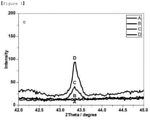
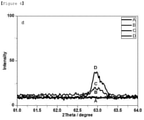
- FIGS. 1 to 4 show the results of observing the X-ray diffraction patterns of the catalysts according to the present invention as a function of the diffraction angle ( FIG. 1 : STO 3 , FIG. 2 : ST 0.97 N 0.03 O 3- ⁇ , FIG. 3 : ST 0.95 N 0.05 O 3- ⁇ , and FIG. 4 : ST 0.93 N 0.07 O 3- ⁇ ).
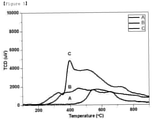
- FIG. 5 shows temperature programed reduction curves of the catalysts according to the present invention.
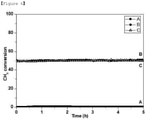
- FIG. 6 shows the results of observing time-dependent changes in CH 4 conversion when the SMR reaction was performed using the catalysts according to the present invention.
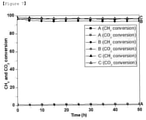
- FIG. 7 shows the results of observing time-dependent changes in CH 4 and CO 2 conversion when the DRM reaction was performed using the catalysts produced in the present invention.
- FIG. 8 shows the results of performing thermogravimetric analysis to analyze the amount of carbon deposition after recovering various catalysts (10 wt% Ni/alumina (sample E), 10 wt% Ni/0.5 wt% Ru/5 wt% Mg/alumina (sample F), Experimental Example 1 (sample B), and Experimental Example 2 (sample C)) used in the DRM reaction.
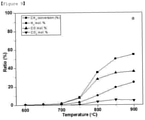
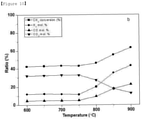
- FIGS. 9 to 12 show the results of measuring changes in CH 4 conversion ( FIG. 9 ) and the yields of H 2 ( FIG. 10 ), CO ( FIG. 11 ) and CO 2 ( FIG. 12 ) depending on the reaction temperature when the CPOM reaction was performed using the catalysts produced in the present invention.
- Catalysts used in conventional methane reforming reactions such as SMR, DRM and CPOM reactions, use metallic nickel or precious metals as catalytic active sites, but such precious metals have a price or scarcity problem. For this reason, in the present invention, nickel is used as a catalyst.
- the present invention intends to provide a catalyst having a new form and structure, a method for producing the same, and a process for reforming methane using the same.
- a multicomponent metal oxide having a perovskite (ABO 3 ) structure was used as a catalyst.
- a catalyst was produced in which only a portion of the perovskite lattice structure was substituted with nickel in ionic form (Ni 2+ ), not in metallic form (Ni 0 ). That is, the structure of the catalyst was designed such that nickel ions (Ni 2+ ) substituted at the B-site of the multicomponent metal oxide having the perovskite structure would serve as active sites, and the multicomponent metal oxide SrTiO 3 (STO 3 ) having a typical perovskite structure was used.
- MgTiO 3 , CaTiO 3 and BaTiO 3 may also be used in the same manner, because they have a perovskite structure, like SrTiO 3 (STO 3 ).
- Ni 2+ ions in the catalyst according to the present invention are not typical B-site cations bonding to six oxygen ions, but are kept in a state of having a coordination number lower than six, and Ni 2+ ions are kept in a state of having a coordination number lower than six without being saturated, and thus the catalyst exhibits catalytic activity.
- Ni 2+ , Co 2+ , Fe 2+ , Co 3+ , Fe 3+ or the like may also be substituted in the same manner and used as catalytic active sites.
- thermogravimetric analysis TGA
- Step 1) 0.1 mol of strontium nitrate (99.0%, Sigma Aldrich) was completely dissolved in 200 mL of distilled water under stirring at a temperature of 70°C, and then 0.4 ml of citric acid (99%, Sigma Aldrich) and 0.9 mol of ethylene glycol (99%) were added thereto and completely dissolved, thereby preparing a first mixture solution.
- strontium nitrate 99.0%, Sigma Aldrich
- Step 3 The first mixture solution was added slowly to and mixed with the second mixture solution, and then stirred for about 24 hours while the temperature was kept at about 70°C.
- Step 4) Thereafter, the solvent was completely removed by drying at 100°C for 24 hours, thereby obtaining solid-state particles.
- Step 5 The obtained solid-state particles were subjected to first calcination at a temperature of 350°C (a temperature rising time of 1 hour and 10 minutes and a keeping time of 5 hours) under an oxygen atmosphere.
- Step 6 After the first calcination, the solid-state particles were subjected to second calcination at a temperature of 900°C (a temperature rising time of 1 hour and 10 minutes and a keeping time of 5 hours) under an oxygen atmosphere, thereby producing a SrTi 1.00 to 0.93 Ni 0.00 to 0.07 O 3- ⁇ catalyst.
- strontium titanium oxide (SrTiO 3 , STO 3 ) corresponding to the Comparative Example 2 was produced without using nickel(II) nitrate hexahydrate (97%) in step 2 of Example 1 above, and then it was confirmed by x-ray diffraction analysis that the strontium titanium oxide had a typical perovskite structure (ABO 3 ), like sample A.
- metal oxides having a perovskite structure were produced as Experimental Examples 1 to 3 by substituting a portion of titanium with nickel while changing the amount of nickel(II) nitrate hexahydrate (97%) in step 2 of Example 1.
- Ni was substituted at the Ti site of the perovskite lattice structure and NiO was also formed independently.
- Example 1 As shown in FIG. 5 , for the Comparative Example and Experimental Examples 1 and 2 produced in Example 1 above, the degree of temperature-dependent reduction of each sample was analyzed by TPR (temperature programmed reduction).
- Specific SMR reaction conditions are as follows.
- the degree of carbon deposition on each of the catalysts was measured by thermogravimetric analysis (TGA), and the change in the weight of each catalyst was measured while rising the temperature from 50°C to 900°C at a rate of 10°C/min under an air atmosphere.
- TGA thermogravimetric analysis
- Sample C substituted with 5 mol% Ni was also stable in the SMR reaction, but it was confirmed by the TGA experiment that there was some carbon deposition on sample C (see FIG. 3 and Table 2).
- Sample C showed a mass loss of about 3% through the TGA experiment, and this is believed to be because carbon deposition occurred due to the NiO located outside the structure. From these experimental results, it can be seen that Ni substituting for a portion of Ti in the perovskite lattice structure acts as an active site for the SMR reaction. In the case of sample C having NiO formed thereon, there was carbon deposition, but in the case of sample B in which NiO was not formed independently and all Ni 2+ were located in the lattice structure, no carbon deposition occurred. From this, it can be expected that if a catalyst in which all Ni 2+ are located in the lattice structure is produced, deactivation of the catalyst by carbon deposition can be fundamentally solved because carbon deposition on the catalyst does not occur.
- each of the catalysts showed a tendency similar to that in the SMR reaction described above.
- Sample A substituted with no Ni did not show any activity for the DRM reaction, but the samples (samples B and C) substituted with 3% Ni and 5%, respectively, showed relatively catalytic activities, and the initial activities thereof were stably maintained for about 50 hours.
- the CPOM reaction was performed under a total of four conditions.
- (a) represents a blank (catalyst-free condition; FIG. 9 )
- (b) represents STO 3 (catalyst substituted with no Ni, Comparative Example, sample A, FIG. 10 )
- (c) represents sample B (non-reduced Experimental Example 1, FIG. 11 ) which was not subjected to the ST 0.97 N 0.03 O 3- ⁇ reduction process
- (d) represents sample B (Experimental Example 1 subjected to the reduction process at 600°C (a temperature rising time of 2 hr and a keeping time of 2 hr, FIG. 12 ) subjected to the ST 0.97 N 0.03 O 3- ⁇ reduction process.
- the SrTiO 3 catalyst (Comparative Example; sample A) substituted with no Ni had no effect on the reaction, but in the CPOM reaction, the catalyst showed certain reactivity in the temperature of 600 to 750°C (see FIG. 10 ). At this time, a lot of CO 2 was produced, and this is believed to be because the combustion reaction was predominant. In addition, it is considered that the reason that the H 2 /CO ratio was slightly higher than 2 is because the SMR reaction and a low proportion of the CPOM reaction did take place. Then, in the temperature range above 800°C, as the temperature increased, the proportion of CO 2 decreased and the proportions of H 2 and CO increased. These results can be attributed to the proportion of the combustion reaction decreased and the proportion of the CPOM reaction increased.
- Example B The results of the reaction performed using Experimental Example 1 (sample B), which showed the most stable behavior in the SMR reaction and DRM reaction as described above, are shown in FIG. 11 .
- high reaction activity appeared from low temperatures.
- sample B showed a tendency to produce a lot of H 2 and CO even at low temperatures.
- the H 2 /CO ratio was much higher than 2 and approached 3. This is believed to be because the SMR reaction with H 2 O produced by Ni substituted in the catalyst was predominant and the CPOM reaction acted as an additional reaction. However, as the temperature increased, the H 2 /CO ratio approached to 2. This is because the production of H 2 O decreased as the proportion of the combustion reaction decreased, and the activity of the CPOM became higher as the temperature increased.
- FIG. 12 shows the results of performing the CORM reaction using the same catalyst used in FIG. 6c after subjecting the same catalyst to an additional reduction process at 600°C for 2 hours under a hydrogen atmosphere.
- the activity of the catalyst was improved compared to that of the catalyst not subjected to the hydrogen reduction process.
- the catalyst showed a very high conversion rate of about 97% even at a high space velocity (SV) of 20,000 mLg -1 h -1 .
- SV space velocity
- Ni substituted at the Ti site (B-site) of SrTiO 3 having a perovskite structure can act as an active site for various methane reforming reactions (SMR, DRM and CPOM reactions).
- the catalysts produced in the present invention have resistance to carbon deposition. Accordingly, it is expected that these catalysts can stably maintain their activity for a long time, can reduce the operating cost of the SMR reaction, can reduce the operating cost of the DRM reaction, and can make it possible to commercialize the DRM reaction.
- the catalysts produced in the present invention exhibited high activity for the CPOM reaction and also had excellent high-temperature stability. Accordingly, it is expected that these catalysts can maintain the CPOM reaction for a long time, making it possible to commercialize the CPOM reaction.
- the present invention solves the prior art problems of SMR, DRM and CPOM reactions which are methane reforming reactions that produce hydrogen or syngas using methane, and provides a catalyst in which a perovskite metal oxide is substituted with nickel, cobalt or iron ions so that carbon deposition thereon can be reduced, a method for producing the same, and a method for performing a methane reforming reaction using this catalyst. Therefore, the present invention is industrially applicable.
Landscapes
- Chemical & Material Sciences (AREA)
- Chemical Kinetics & Catalysis (AREA)
- Engineering & Computer Science (AREA)
- Organic Chemistry (AREA)
- Materials Engineering (AREA)
- Combustion & Propulsion (AREA)
- Health & Medical Sciences (AREA)
- General Health & Medical Sciences (AREA)
- Inorganic Chemistry (AREA)
- Thermal Sciences (AREA)
- Physics & Mathematics (AREA)
- Catalysts (AREA)
- Hydrogen, Water And Hydrids (AREA)
Applications Claiming Priority (3)
| Application Number | Priority Date | Filing Date | Title |
|---|---|---|---|
| KR1020170119442A KR101994152B1 (ko) | 2017-09-18 | 2017-09-18 | 탄소 침적의 감소를 위해, 금속이온이 치환된 페로브스카이트 금속산화물 촉매 및 이의 제조 방법, 그리고 이를 이용한 메탄 개질 반응 방법 |
| EP17924929.7A EP3685916A4 (de) | 2017-09-18 | 2017-11-06 | Perowskit-metalloxid-katalysator mit substituiertem metallion zur reduktion der kohlenstoffabscheidung, herstellungsverfahren dafür und verfahren zur methanreformierungsreaktion unter verwendung davon |
| PCT/KR2017/012452 WO2019054557A1 (ko) | 2017-09-18 | 2017-11-06 | 탄소 침적의 감소를 위해, 금속이온이 치환된 페로브스카이트 금속산화물 촉매 및 이의 제조 방법, 그리고 이를 이용한 메탄 개질 반응 방법 |
Related Parent Applications (1)
| Application Number | Title | Priority Date | Filing Date |
|---|---|---|---|
| EP17924929.7A Division EP3685916A4 (de) | 2017-09-18 | 2017-11-06 | Perowskit-metalloxid-katalysator mit substituiertem metallion zur reduktion der kohlenstoffabscheidung, herstellungsverfahren dafür und verfahren zur methanreformierungsreaktion unter verwendung davon |
Publications (3)
| Publication Number | Publication Date |
|---|---|
| EP3967395A2 true EP3967395A2 (de) | 2022-03-16 |
| EP3967395A3 EP3967395A3 (de) | 2022-06-08 |
| EP3967395B1 EP3967395B1 (de) | 2025-02-19 |
Family
ID=64561487
Family Applications (2)
| Application Number | Title | Priority Date | Filing Date |
|---|---|---|---|
| EP21195970.5A Active EP3967395B1 (de) | 2017-09-18 | 2017-11-06 | Herstellungsverfahren eines perowskit-metalloxid-katalysator mit substituiertem metallion |
| EP17924929.7A Pending EP3685916A4 (de) | 2017-09-18 | 2017-11-06 | Perowskit-metalloxid-katalysator mit substituiertem metallion zur reduktion der kohlenstoffabscheidung, herstellungsverfahren dafür und verfahren zur methanreformierungsreaktion unter verwendung davon |
Family Applications After (1)
| Application Number | Title | Priority Date | Filing Date |
|---|---|---|---|
| EP17924929.7A Pending EP3685916A4 (de) | 2017-09-18 | 2017-11-06 | Perowskit-metalloxid-katalysator mit substituiertem metallion zur reduktion der kohlenstoffabscheidung, herstellungsverfahren dafür und verfahren zur methanreformierungsreaktion unter verwendung davon |
Country Status (4)
| Country | Link |
|---|---|
| US (2) | US11918981B2 (de) |
| EP (2) | EP3967395B1 (de) |
| KR (1) | KR101994152B1 (de) |
| WO (1) | WO2019054557A1 (de) |
Cited By (1)
| Publication number | Priority date | Publication date | Assignee | Title |
|---|---|---|---|---|
| CN115646504A (zh) * | 2022-09-18 | 2023-01-31 | 武汉大学 | 一种NiCo/PrBaMn2O5+δ析出型催化剂及其制备方法和应用 |
Families Citing this family (15)
| Publication number | Priority date | Publication date | Assignee | Title |
|---|---|---|---|---|
| CN111229250B (zh) * | 2018-11-29 | 2023-07-04 | 中国科学院大连化学物理研究所 | 一种乙醇重整催化剂及其制备和应用 |
| US11639290B2 (en) * | 2020-06-04 | 2023-05-02 | Saudi Arabian Oil Company | Dry reforming of methane with carbon dioxide at elevated pressure |
| CN112076755B (zh) * | 2020-10-19 | 2023-02-28 | 宁夏大学 | 一种co2加氢催化剂的制备方法及应用 |
| CN113209999B (zh) * | 2021-04-19 | 2022-04-15 | 中国科学院大连化学物理研究所 | 一种用于甲烷干气重整反应的催化剂及其制备方法 |
| CN115779913B (zh) * | 2021-09-10 | 2024-03-26 | 中国石油化工股份有限公司 | 葡萄糖制乙二醇的催化剂及其制备方法和应用 |
| CN113856696B (zh) * | 2021-09-14 | 2023-10-27 | 鞍钢集团北京研究院有限公司 | 一种镍基甲烷二氧化碳重整制氢催化剂的制备方法 |
| CN116635145A (zh) | 2021-10-21 | 2023-08-22 | 株式会社Lg化学 | 用于甲烷重整的催化剂及生产其的方法 |
| CN114029061B (zh) * | 2021-11-22 | 2023-10-20 | 北京化工大学 | 一种双金属高效催化剂、制备方法以及甲烷-二氧化碳共转化制备乙醇/乙醛的方法 |
| CN113967476B (zh) * | 2021-11-22 | 2024-03-26 | 北京化工大学 | 一种钙钛矿负载钴高效催化剂、制备方法以及甲烷部分氧化制备甲醇的方法 |
| CN114272928B (zh) * | 2022-01-05 | 2023-03-14 | 成都理工大学 | 用于乙酸自热重整制氢的镁钛类钙钛矿型镍基催化剂 |
| CN115133042B (zh) * | 2022-07-05 | 2025-07-18 | 山东科技大学 | 一种高活性抗积碳固体氧化物燃料电池阳极催化剂 |
| CN115779895B (zh) * | 2022-11-08 | 2024-04-30 | 清华大学 | 一种钙钛矿型催化剂及其制备方法和应用 |
| CN116273052B (zh) * | 2023-03-21 | 2025-01-17 | 福州大学 | 一种过渡金属负载的钙钛矿型催化剂的制备及其应用 |
| CN116374953A (zh) * | 2023-04-04 | 2023-07-04 | 上海天阳钢管有限公司 | 一种氢燃料的制备方法 |
| US12454464B1 (en) | 2025-05-16 | 2025-10-28 | Imam Mohammad Ibn Saud Islamic University | Calcium titanate/magnesium titanate/carbon-based nanocomposite |
Family Cites Families (10)
| Publication number | Priority date | Publication date | Assignee | Title |
|---|---|---|---|---|
| US3330697A (en) * | 1963-08-26 | 1967-07-11 | Sprague Electric Co | Method of preparing lead and alkaline earth titanates and niobates and coating method using the same to form a capacitor |
| JP4875410B2 (ja) * | 2006-06-13 | 2012-02-15 | トヨタ自動車株式会社 | 微粒子担持カーボン粒子およびその製造方法ならびに燃料電池用電極 |
| KR101072837B1 (ko) * | 2009-02-27 | 2011-10-14 | 한국과학기술원 | 모노리스 형태의 페로브스카이트 촉매의 제조방법 및 그 방법에 의해 제조된 페로브스카이트 촉매 |
| JP5126560B2 (ja) * | 2009-09-02 | 2013-01-23 | 株式会社村田製作所 | 炭化水素系ガス改質触媒、その製造方法および、合成ガスの製造方法 |
| SG182122A1 (en) * | 2010-12-23 | 2012-07-30 | Agency Science Tech & Res | A perovskite-type strontium titanate |
| KR101447681B1 (ko) | 2012-11-28 | 2014-10-07 | 한국과학기술연구원 | 혼합개질 반응용 페롭스카이트 구조의 담지촉매 |
| CN103933991B (zh) * | 2014-04-27 | 2016-10-26 | 东北石油大学 | 用于生产可调控合成气的钙钛矿型复合氧化物催化剂 |
| KR101579776B1 (ko) * | 2014-05-20 | 2015-12-23 | 한국과학기술연구원 | 페로브스카이트형 니켈계 촉매의 제조방법 |
| US10106727B2 (en) * | 2014-09-17 | 2018-10-23 | National Technology & Engineering Solutions Of Sandia, Llc | Proppant compositions and methods of use |
| KR101807128B1 (ko) * | 2015-07-06 | 2017-12-07 | 현대자동차 주식회사 | 페로브스카이트 촉매의 제조 방법 |
-
2017
- 2017-09-18 KR KR1020170119442A patent/KR101994152B1/ko active Active
- 2017-11-06 WO PCT/KR2017/012452 patent/WO2019054557A1/ko not_active Ceased
- 2017-11-06 EP EP21195970.5A patent/EP3967395B1/de active Active
- 2017-11-06 US US16/648,190 patent/US11918981B2/en active Active
- 2017-11-06 EP EP17924929.7A patent/EP3685916A4/de active Pending
-
2024
- 2024-01-11 US US18/410,777 patent/US20240139718A1/en active Pending
Cited By (2)
| Publication number | Priority date | Publication date | Assignee | Title |
|---|---|---|---|---|
| CN115646504A (zh) * | 2022-09-18 | 2023-01-31 | 武汉大学 | 一种NiCo/PrBaMn2O5+δ析出型催化剂及其制备方法和应用 |
| CN115646504B (zh) * | 2022-09-18 | 2023-11-21 | 武汉大学 | 一种NiCo/PrBaMn2O5+δ析出型催化剂及其制备方法和应用 |
Also Published As
| Publication number | Publication date |
|---|---|
| KR20180127145A (ko) | 2018-11-28 |
| US20200269217A1 (en) | 2020-08-27 |
| KR101994152B1 (ko) | 2019-06-28 |
| US11918981B2 (en) | 2024-03-05 |
| WO2019054557A1 (ko) | 2019-03-21 |
| EP3967395A3 (de) | 2022-06-08 |
| EP3967395B1 (de) | 2025-02-19 |
| EP3685916A1 (de) | 2020-07-29 |
| US20240139718A1 (en) | 2024-05-02 |
| EP3685916A4 (de) | 2021-06-02 |
Similar Documents
| Publication | Publication Date | Title |
|---|---|---|
| US20240139718A1 (en) | Perovskite metal oxide catalyst, in which metal ion is substituted, for reducing carbon deposition, preparation method therefor, and methane reforming reaction method using same | |
| CN102112227B (zh) | 用于从天然气和二氧化碳制备合成气的催化剂及其制备方法 | |
| EP2924002B1 (de) | Verfahren zum betrieb eines hts-reaktors bei niedrigem o/c-molverhältnis | |
| JP5592250B2 (ja) | 二酸化炭素の合成ガスへの接触水素化 | |
| Ghani et al. | Autothermal reforming process for efficient hydrogen production from crude glycerol using nickel supported catalyst: Parametric and statistical analyses | |
| KR102644506B1 (ko) | 고니켈 함유 탄화수소 개질반응용 페로브스카이트 금속산화물 촉매 및 이의 제조방법 | |
| Bussi et al. | Ethanol steam reforming over NiLaZr and NiCuLaZr mixed metal oxide catalysts | |
| KR100892033B1 (ko) | 고표면적 스핀넬 구조의 나노크기 결정을 가지는yMgO(1-y)Al₂O₃에 나노크기로 담지된 니켈계개질촉매 및 이를 이용한 수증기-이산화탄소 복합개질에의한 천연가스로부터 합성가스의 제조방법 | |
| Sohrabi et al. | Synthesis, characterization, and catalytic activity of Ni/CeMnO2 catalysts promoted by copper, cobalt, potassium and iron for ethanol steam reforming | |
| KR102092736B1 (ko) | 탄소 침적을 감소시킬 수 있는, 금속이온이 치환된 페로브스카이트 금속산화물 촉매의 제조 방법 및 이를 이용한 메탄 개질 반응 방법 | |
| Khajonvittayakul et al. | Tar steam reforming for synthesis gas production over Ni-based on ceria/zirconia and La0. 3Sr0. 7Co0. 7Fe0. 3O3 in a packed-bed reactor | |
| Viparelli et al. | Catalyst based on BaZrO3 with different elements incorporated in the structure: II. BaZr (1− x) RhxO3 systems for the production of syngas by partial oxidation of methane | |
| JP2014217793A (ja) | 合成ガス製造用触媒、該触媒の再生方法、及び合成ガスの製造方法 | |
| AU2012258290B2 (en) | Nickel based catalysts for hydrocarbon reforming | |
| KR20250097287A (ko) | 페로브스카이트 촉매, 그 제조방법 및 그 응용 | |
| KR101400889B1 (ko) | 탄화수소 개질촉매 및 이의 제조방법 | |
| KR101570943B1 (ko) | 이중 세공구조의 알루미나 지지체에 담지된 혼합 개질반응용 페롭스카이트 촉매 및 이의 제조방법 | |
| JP3914409B2 (ja) | 改質用触媒およびこれを用いる合成ガス製造方法 | |
| JP6089894B2 (ja) | 合成ガス製造用触媒及び合成ガスの製造方法 | |
| JPH10194703A (ja) | 合成ガスの製造用触媒及び合成ガスの製造方法 | |
| WO2024211330A1 (en) | Heterogeneous catalyst composition and methods thereof | |
| CN119951512A (zh) | 镍基固溶体催化剂及其制备方法和应用 | |
| AU2009266113B2 (en) | Process for operating HTS reactor | |
| PL244205B1 (pl) | Katalizator niklowo-wanadowy do waloryzacji dwutlenku węgla, sposób otrzymywania katalizatora niklowo-wanadowego i zastosowanie katalizatora niklowo-wanadowego w procesach waloryzacji dwutlenku węgla | |
| ARORA et al. | Effect of Promoters on Performance of Ni/γ-Al2O3 Catalyst in Dry Reforming of Methane |
Legal Events
| Date | Code | Title | Description |
|---|---|---|---|
| PUAI | Public reference made under article 153(3) epc to a published international application that has entered the european phase |
Free format text: ORIGINAL CODE: 0009012 |
|
| STAA | Information on the status of an ep patent application or granted ep patent |
Free format text: STATUS: THE APPLICATION HAS BEEN PUBLISHED |
|
| AC | Divisional application: reference to earlier application |
Ref document number: 3685916 Country of ref document: EP Kind code of ref document: P |
|
| AK | Designated contracting states |
Kind code of ref document: A2 Designated state(s): AL AT BE BG CH CY CZ DE DK EE ES FI FR GB GR HR HU IE IS IT LI LT LU LV MC MK MT NL NO PL PT RO RS SE SI SK SM TR |
|
| PUAL | Search report despatched |
Free format text: ORIGINAL CODE: 0009013 |
|
| AK | Designated contracting states |
Kind code of ref document: A3 Designated state(s): AL AT BE BG CH CY CZ DE DK EE ES FI FR GB GR HR HU IE IS IT LI LT LU LV MC MK MT NL NO PL PT RO RS SE SI SK SM TR |
|
| RIC1 | Information provided on ipc code assigned before grant |
Ipc: B01J 37/18 20060101ALI20220504BHEP Ipc: B01J 37/08 20060101ALI20220504BHEP Ipc: B01J 37/03 20060101ALI20220504BHEP Ipc: B01J 35/00 20060101ALI20220504BHEP Ipc: B01J 23/78 20060101ALI20220504BHEP Ipc: C01B 3/40 20060101ALI20220504BHEP Ipc: B01J 37/00 20060101ALI20220504BHEP Ipc: B01J 21/06 20060101ALI20220504BHEP Ipc: B01J 23/02 20060101ALI20220504BHEP Ipc: B01J 21/10 20060101ALI20220504BHEP Ipc: B01J 23/00 20060101AFI20220504BHEP |
|
| STAA | Information on the status of an ep patent application or granted ep patent |
Free format text: STATUS: REQUEST FOR EXAMINATION WAS MADE |
|
| 17P | Request for examination filed |
Effective date: 20221121 |
|
| RBV | Designated contracting states (corrected) |
Designated state(s): AL AT BE BG CH CY CZ DE DK EE ES FI FR GB GR HR HU IE IS IT LI LT LU LV MC MK MT NL NO PL PT RO RS SE SI SK SM TR |
|
| GRAP | Despatch of communication of intention to grant a patent |
Free format text: ORIGINAL CODE: EPIDOSNIGR1 |
|
| STAA | Information on the status of an ep patent application or granted ep patent |
Free format text: STATUS: GRANT OF PATENT IS INTENDED |
|
| INTG | Intention to grant announced |
Effective date: 20241128 |
|
| GRAS | Grant fee paid |
Free format text: ORIGINAL CODE: EPIDOSNIGR3 |
|
| GRAA | (expected) grant |
Free format text: ORIGINAL CODE: 0009210 |
|
| STAA | Information on the status of an ep patent application or granted ep patent |
Free format text: STATUS: THE PATENT HAS BEEN GRANTED |
|
| P01 | Opt-out of the competence of the unified patent court (upc) registered |
Free format text: CASE NUMBER: APP_65610/2024 Effective date: 20241212 |
|
| AC | Divisional application: reference to earlier application |
Ref document number: 3685916 Country of ref document: EP Kind code of ref document: P |
|
| AK | Designated contracting states |
Kind code of ref document: B1 Designated state(s): AL AT BE BG CH CY CZ DE DK EE ES FI FR GB GR HR HU IE IS IT LI LT LU LV MC MK MT NL NO PL PT RO RS SE SI SK SM TR |
|
| REG | Reference to a national code |
Ref country code: GB Ref legal event code: FG4D |
|
| REG | Reference to a national code |
Ref country code: CH Ref legal event code: EP |
|
| REG | Reference to a national code |
Ref country code: DE Ref legal event code: R096 Ref document number: 602017087961 Country of ref document: DE |
|
| REG | Reference to a national code |
Ref country code: IE Ref legal event code: FG4D |
|
| REG | Reference to a national code |
Ref country code: NL Ref legal event code: MP Effective date: 20250219 |
|
| PG25 | Lapsed in a contracting state [announced via postgrant information from national office to epo] |
Ref country code: RS Free format text: LAPSE BECAUSE OF FAILURE TO SUBMIT A TRANSLATION OF THE DESCRIPTION OR TO PAY THE FEE WITHIN THE PRESCRIBED TIME-LIMIT Effective date: 20250519 |
|
| PG25 | Lapsed in a contracting state [announced via postgrant information from national office to epo] |
Ref country code: FI Free format text: LAPSE BECAUSE OF FAILURE TO SUBMIT A TRANSLATION OF THE DESCRIPTION OR TO PAY THE FEE WITHIN THE PRESCRIBED TIME-LIMIT Effective date: 20250219 |
|
| PG25 | Lapsed in a contracting state [announced via postgrant information from national office to epo] |
Ref country code: PL Free format text: LAPSE BECAUSE OF FAILURE TO SUBMIT A TRANSLATION OF THE DESCRIPTION OR TO PAY THE FEE WITHIN THE PRESCRIBED TIME-LIMIT Effective date: 20250219 |
|
| PG25 | Lapsed in a contracting state [announced via postgrant information from national office to epo] |
Ref country code: ES Free format text: LAPSE BECAUSE OF FAILURE TO SUBMIT A TRANSLATION OF THE DESCRIPTION OR TO PAY THE FEE WITHIN THE PRESCRIBED TIME-LIMIT Effective date: 20250219 |
|
| REG | Reference to a national code |
Ref country code: LT Ref legal event code: MG9D |
|
| PG25 | Lapsed in a contracting state [announced via postgrant information from national office to epo] |
Ref country code: NO Free format text: LAPSE BECAUSE OF FAILURE TO SUBMIT A TRANSLATION OF THE DESCRIPTION OR TO PAY THE FEE WITHIN THE PRESCRIBED TIME-LIMIT Effective date: 20250519 Ref country code: IS Free format text: LAPSE BECAUSE OF FAILURE TO SUBMIT A TRANSLATION OF THE DESCRIPTION OR TO PAY THE FEE WITHIN THE PRESCRIBED TIME-LIMIT Effective date: 20250619 |
|
| PG25 | Lapsed in a contracting state [announced via postgrant information from national office to epo] |
Ref country code: NL Free format text: LAPSE BECAUSE OF FAILURE TO SUBMIT A TRANSLATION OF THE DESCRIPTION OR TO PAY THE FEE WITHIN THE PRESCRIBED TIME-LIMIT Effective date: 20250219 |
|
| PG25 | Lapsed in a contracting state [announced via postgrant information from national office to epo] |
Ref country code: HR Free format text: LAPSE BECAUSE OF FAILURE TO SUBMIT A TRANSLATION OF THE DESCRIPTION OR TO PAY THE FEE WITHIN THE PRESCRIBED TIME-LIMIT Effective date: 20250219 |
|
| PG25 | Lapsed in a contracting state [announced via postgrant information from national office to epo] |
Ref country code: LV Free format text: LAPSE BECAUSE OF FAILURE TO SUBMIT A TRANSLATION OF THE DESCRIPTION OR TO PAY THE FEE WITHIN THE PRESCRIBED TIME-LIMIT Effective date: 20250219 Ref country code: PT Free format text: LAPSE BECAUSE OF FAILURE TO SUBMIT A TRANSLATION OF THE DESCRIPTION OR TO PAY THE FEE WITHIN THE PRESCRIBED TIME-LIMIT Effective date: 20250620 |
|
| PG25 | Lapsed in a contracting state [announced via postgrant information from national office to epo] |
Ref country code: GR Free format text: LAPSE BECAUSE OF FAILURE TO SUBMIT A TRANSLATION OF THE DESCRIPTION OR TO PAY THE FEE WITHIN THE PRESCRIBED TIME-LIMIT Effective date: 20250520 Ref country code: BG Free format text: LAPSE BECAUSE OF FAILURE TO SUBMIT A TRANSLATION OF THE DESCRIPTION OR TO PAY THE FEE WITHIN THE PRESCRIBED TIME-LIMIT Effective date: 20250219 |
|
| REG | Reference to a national code |
Ref country code: AT Ref legal event code: MK05 Ref document number: 1767800 Country of ref document: AT Kind code of ref document: T Effective date: 20250219 |
|
| PG25 | Lapsed in a contracting state [announced via postgrant information from national office to epo] |
Ref country code: SE Free format text: LAPSE BECAUSE OF FAILURE TO SUBMIT A TRANSLATION OF THE DESCRIPTION OR TO PAY THE FEE WITHIN THE PRESCRIBED TIME-LIMIT Effective date: 20250219 |
|
| PG25 | Lapsed in a contracting state [announced via postgrant information from national office to epo] |
Ref country code: SM Free format text: LAPSE BECAUSE OF FAILURE TO SUBMIT A TRANSLATION OF THE DESCRIPTION OR TO PAY THE FEE WITHIN THE PRESCRIBED TIME-LIMIT Effective date: 20250219 |
|
| PG25 | Lapsed in a contracting state [announced via postgrant information from national office to epo] |
Ref country code: DK Free format text: LAPSE BECAUSE OF FAILURE TO SUBMIT A TRANSLATION OF THE DESCRIPTION OR TO PAY THE FEE WITHIN THE PRESCRIBED TIME-LIMIT Effective date: 20250219 |
|
| PG25 | Lapsed in a contracting state [announced via postgrant information from national office to epo] |
Ref country code: IT Free format text: LAPSE BECAUSE OF FAILURE TO SUBMIT A TRANSLATION OF THE DESCRIPTION OR TO PAY THE FEE WITHIN THE PRESCRIBED TIME-LIMIT Effective date: 20250219 |
|
| PG25 | Lapsed in a contracting state [announced via postgrant information from national office to epo] |
Ref country code: AT Free format text: LAPSE BECAUSE OF FAILURE TO SUBMIT A TRANSLATION OF THE DESCRIPTION OR TO PAY THE FEE WITHIN THE PRESCRIBED TIME-LIMIT Effective date: 20250219 |
|
| PG25 | Lapsed in a contracting state [announced via postgrant information from national office to epo] |
Ref country code: CZ Free format text: LAPSE BECAUSE OF FAILURE TO SUBMIT A TRANSLATION OF THE DESCRIPTION OR TO PAY THE FEE WITHIN THE PRESCRIBED TIME-LIMIT Effective date: 20250219 Ref country code: EE Free format text: LAPSE BECAUSE OF FAILURE TO SUBMIT A TRANSLATION OF THE DESCRIPTION OR TO PAY THE FEE WITHIN THE PRESCRIBED TIME-LIMIT Effective date: 20250219 |
|
| PG25 | Lapsed in a contracting state [announced via postgrant information from national office to epo] |
Ref country code: RO Free format text: LAPSE BECAUSE OF FAILURE TO SUBMIT A TRANSLATION OF THE DESCRIPTION OR TO PAY THE FEE WITHIN THE PRESCRIBED TIME-LIMIT Effective date: 20250219 |
|
| PG25 | Lapsed in a contracting state [announced via postgrant information from national office to epo] |
Ref country code: SK Free format text: LAPSE BECAUSE OF FAILURE TO SUBMIT A TRANSLATION OF THE DESCRIPTION OR TO PAY THE FEE WITHIN THE PRESCRIBED TIME-LIMIT Effective date: 20250219 |
|
| REG | Reference to a national code |
Ref country code: DE Ref legal event code: R097 Ref document number: 602017087961 Country of ref document: DE |
|
| PLBE | No opposition filed within time limit |
Free format text: ORIGINAL CODE: 0009261 |
|
| STAA | Information on the status of an ep patent application or granted ep patent |
Free format text: STATUS: NO OPPOSITION FILED WITHIN TIME LIMIT |
|
| PGFP | Annual fee paid to national office [announced via postgrant information from national office to epo] |
Ref country code: DE Payment date: 20251127 Year of fee payment: 9 |
|
| PGFP | Annual fee paid to national office [announced via postgrant information from national office to epo] |
Ref country code: GB Payment date: 20251125 Year of fee payment: 9 |
|
| PGFP | Annual fee paid to national office [announced via postgrant information from national office to epo] |
Ref country code: FR Payment date: 20251128 Year of fee payment: 9 |
|
| 26N | No opposition filed |
Effective date: 20251120 |