EP3968149A1 - Génération des règles de commande à partir d'un régulateur schématisé - Google Patents
Génération des règles de commande à partir d'un régulateur schématisé Download PDFInfo
- Publication number
- EP3968149A1 EP3968149A1 EP20195834.5A EP20195834A EP3968149A1 EP 3968149 A1 EP3968149 A1 EP 3968149A1 EP 20195834 A EP20195834 A EP 20195834A EP 3968149 A1 EP3968149 A1 EP 3968149A1
- Authority
- EP
- European Patent Office
- Prior art keywords
- rules
- semantic
- control
- platform
- semantic representation
- Prior art date
- Legal status (The legal status is an assumption and is not a legal conclusion. Google has not performed a legal analysis and makes no representation as to the accuracy of the status listed.)
- Granted
Links
Images



Classifications
-
- G—PHYSICS
- G06—COMPUTING OR CALCULATING; COUNTING
- G06F—ELECTRIC DIGITAL DATA PROCESSING
- G06F8/00—Arrangements for software engineering
- G06F8/40—Transformation of program code
- G06F8/41—Compilation
-
- G—PHYSICS
- G06—COMPUTING OR CALCULATING; COUNTING
- G06F—ELECTRIC DIGITAL DATA PROCESSING
- G06F40/00—Handling natural language data
- G06F40/30—Semantic analysis
-
- G—PHYSICS
- G06—COMPUTING OR CALCULATING; COUNTING
- G06F—ELECTRIC DIGITAL DATA PROCESSING
- G06F16/00—Information retrieval; Database structures therefor; File system structures therefor
- G06F16/30—Information retrieval; Database structures therefor; File system structures therefor of unstructured textual data
- G06F16/31—Indexing; Data structures therefor; Storage structures
- G06F16/316—Indexing structures
- G06F16/322—Trees
-
- G—PHYSICS
- G06—COMPUTING OR CALCULATING; COUNTING
- G06F—ELECTRIC DIGITAL DATA PROCESSING
- G06F40/00—Handling natural language data
- G06F40/20—Natural language analysis
- G06F40/205—Parsing
- G06F40/211—Syntactic parsing, e.g. based on context-free grammar [CFG] or unification grammars
-
- G—PHYSICS
- G06—COMPUTING OR CALCULATING; COUNTING
- G06F—ELECTRIC DIGITAL DATA PROCESSING
- G06F40/00—Handling natural language data
- G06F40/40—Processing or translation of natural language
- G06F40/58—Use of machine translation, e.g. for multi-lingual retrieval, for server-side translation for client devices or for real-time translation
Definitions
- the present invention relates to methods, apparatus and systems for generating control rules.
- the control regulations can be generated fully automatically from a textual formulation of a set of rules and can put a platform in a target state defined in the set of rules.
- platforms work or function for example individual devices, machines, devices, network-based systems or controllable and/or regulatable systems, is typically specified via sets of rules, which are often summarized in schematized rule texts. These are provided so that the working and functioning of the platform is documented and a larger group of people can understand the working and functioning.
- the rule texts often have to be read by a technician, interpreted and converted into control and/or regulation programs, which are then used to control the platform. These processes are error-prone, so that complex quality assurance measures typically have to be taken.
- a method for generating control rules includes providing a document that has at least one piece of information that formulates a set of rules, structuring the at least one piece of information to generate a large number of syntactic blocks, constructing terms and symbols the plurality of syntactic blocks to generate a semantic representation, checking the semantic representation and generating at least one control rule based on the checked semantic representation, wherein the at least one control rule corresponds to the set of rules formulated by the at least one statement.
- the method may be a computer-implemented method, or a method executable on a computer, apparatus, or computing device, which may include at least one processor or processing unit that executes instructions according to method steps of embodiments of the present invention.
- the at least one indication may be an indication which may be schematic but may be in the form of text. This can preferably have a readable form in a natural language, which can thus be easily read and understood by humans. Accordingly, the document and/or the at least one piece of information can have a schematized rule text that formulates the set of rules.
- the at least one piece of information can be structured based on a formal language in order to generate the plurality of syntactic blocks which in turn are used to construct the terms and symbols. Accordingly, the construction can take place on the basis of the formal language.
- the semantic representation can correspond to a logical-semantic overall representation, which clearly shows both the semantics of the set of rules and its logical connections. Accordingly, the present invention includes a transformation of schematized rule texts based on a formal language into an unambiguous logical-semantic overall representation.
- the semantic representation of the set of rules can be checked for consistency and feasibility.
- the checking can include further semantic-logical and/or have temporary and/or structural properties.
- the checking can be a basis for the subsequent generation of the at least one control rule. Accordingly, this can only be generated if the check led to a positive or permissible result.
- a verifiable overall representation can advantageously be generated fully automatically from a legible but structured specification of a set of rules, so that it can be ensured that the subsequently generated control rules result in error-free, consistent and intended control of a target platform specified by the set of rules.
- the target platform is preferably a technical system, a mechanical system (IoT), a cloud system, a client system, a SaaS system, a web interface and the like and/or control and/or regulation programs executed on the target platform.
- symbolic logic In symbolic logic, six logical relationships (logical connectives) of statements are formulated. Accordingly, the symbolic logic can be superior to a "normal" logic.
- the logical statements can be consistent or contain contradictions.
- the contradiction is expressed in general by the fact that two logical statements on the same subject cannot be true and false at the same time.
- the provability of logical statements can have limits.
- NLP Natural Language Processing
- a statement may come from a specific section of text used during the analysis.
- an entire chain can be generated from a source in the text, e.g. one of the at least one statement, to a derived statement, e.g. a term of the semantic representation.
- semantics A meaning or intention contained in a text is referred to by the term semantics.
- An abstract data-technical representation of this text meaning aims to make an equivalent, ie equivalent form of the content accessible to the computer for further processing. This is preferably represented by the semantic representation.
- dialectics Variations of natural language (e.g. across geographic areas) are called dialectics. Several dialects can mix or differ more from each other. Preferably, alternative language definitions resulting from the exchange of punctuation marks, symbols, and syntax can be viewed as dialects of the formal language.
- Actuators or actuators can represent signals for controlling machines or an active intervention in existing processes.
- the signals can include both electro-/magnetic signals and a change in physical variables.
- actors or actuators for example in the area of the "Internet of Things" (Internet of Things, IoT) command transmissions, for example in the form of HTTP requests or any protocol-based requirements, or a software-technical triggering of events, for example in the form of XML -Messages or otherwise structured messages in an enterprise service bus or micro-service architecture, also referred to as actors or actuators.
- IoT Internet of Things
- the focus is placed on the general command transmission for controlling such software or hardware state changes.
- a control can mean a directed influencing of a behavior of a technical system.
- a regulation can mean a directed influencing of a behavior of the technical system based on current parameters, property and characteristics of a technical system. Accordingly, when generating control rules, embodiments of the present invention may reside in a systematic of a scheduler, such as a digital scheduler, which may be able to, either directly or based on one or more of, among other things, system states, properties, characteristics and/or sensor information and the set of rules to trigger actuators of the target platform or a technical system.
- a set of rules is complete when the statements it contains specify a fact without gaps in the definition. Such gaps can be, for example, missing statements about subsystems that are named without clarifying rules being assigned to them. Missing statements can mean that the feasibility of the entire work cannot be verified. Checking the semantic representation can provide information about the completeness of the set of rules.
- a set of rules is satisfiable, i.e. consistent, if it is free of contradictions, ie if there is at least one solution such that all statements it contains can be regarded as true. Since the statements of the set of rules formulate options or ranges of values or may contain constraints, a set of rules can have more than one solution. Contradictions in the statements can relate to parts (e.g. individual versions or subtrees of the logical hierarchy) of the complete set of rules. Correspondingly, control regulations can also be generated for one or more parts of the set of rules, which can be fulfilled.
- the ability to fulfill the remaining degrees of freedom may be restricted. There is no satisfiability if there is no combination of the remaining choices such that all statements of the rule set remain true.
- Checking the semantic representation can provide information about whether the set of rules can be fulfilled for one or more instances.
- Embodiments of the invention can differentiate themselves from a purely procedural control.
- Procedural and object-oriented computer languages use the "divide and conquer" principle to set processes, relationships, etc. in individual process steps in order to execute them one after the other and depending on if-then decisions.
- Control loops can be represented in this way and broken down into manageable parts. It is often not possible to prove that such algorithms achieve their goals and their effectiveness as an overall set of rules.
- the set of rules defined in embodiments of the invention can describe a target situation, but does not necessarily require an order of program execution, but can describe relationships on a purely logical level, which can optionally be in a chronological order. Rule-based control can completely do without if-then structures.
- Embodiments of the present invention may differ from purely logical programming languages.
- Logical programming languages e.g. Lisp or Prolog
- the use of the languages is reserved for experts, who have to formulate the effect of the logical investigation (e.g. inference) themselves in a logical programming language.
- Embodiments of the present invention can preferably go beyond symbolic logic in two respects: in a choice of "n to m from k options" in OR statements and/or an integration of temporal orders, in any combination.
- Embodiments of the present invention can encapsulate inferences internally and make the consequence of the determined results available in the form of control rules or open options.
- use can be limited to defined purposes, but it can be directly applicable to a control task in the area of a platform or system to be controlled without in-depth knowledge of the platform or system.
- the method according to the invention thus advantageously closes the gap between the theoretical level of the logical programming languages and the actual control of a technical installation.
- Embodiments of the present invention can differ from pure expert systems. Expert systems usually consist of two components: a knowledge base and a set of methods to draw additional conclusions from the knowledge. This so called At the same time, inference is based on fuzzy conclusions. Heuristics are often used where a complete investigation of the solution space would be too time-consuming. A solution is determined that is sufficiently good, but it is not known whether this solution actually represents the optimum. Embodiments of the present invention may be differentiated. Embodiments of the present invention also represent knowledge in formal language. However, a fuzzy (e.g. fuzzylogical) representation is avoided and instead the concrete interpretation of the formal language is laid down in a comprehensible logical-semantic rule. The solutions are calculated completely in the implemented system and there are no heuristics. Inference is not used in the invention to obtain new knowledge. Conclusions are made solely within the system of rules defined in the formal language.
- Embodiments of the present invention may differ from hybrid control systems.
- Event control is technically implemented at points where states of systems are processed in an "if-then" scheme.
- the advantage of being able to react independently to certain states allows a quick reaction, for example in human-machine interfaces. In such systems, restrictions are often made from the context via constraints in order to simplify interaction with the user and to reduce queries/checks.
- Embodiments of the present invention are not a dialog system that is in direct interaction with the user and depicts natural written or spoken language without any limitation.
- the invention is always tied to a specific context through the respective definition of the mapping of language symbols on the formal language level. Within this context, the set of rules is processed unambiguously, in which vagueness within the language symbols is formalized, but is not left to free interpretation.
- Embodiments of the present invention can differ from pure machine learning or the concept of artificial intelligence.
- Artificial intelligence is understood to mean systems whose complex abilities are similar to those of humans in some aspects. The aim is to approach human performance (control of autonomous vehicles) or to surpass it (e.g. in Go or chess). These systems work, for example, with deep learning methods, in which the intermediate representations cannot be interpreted logically, but obviously achieve a good result heuristically effectively.
- Embodiments of the present invention outperform humans at the level of logical consequence deduction and complex proposition testing. Nevertheless, this happens "only" on the basis of mathematical propositional logic, which itself is not considered part of the invention.
- the invention does not have to be a system that falls within the field of artificial intelligence, since all statements remain mathematically unambiguous and logically answerable. Embodiments of the present invention react to inputs (rules and instantiation) deterministically, not heuristically or statistically.
- Embodiments of the present invention can differentiate themselves from pure controllers.
- Technical controllers implement a control loop with direct coupling of inputs and outputs.
- Systems theory describes a large number of different models. Depending on the regulator / controller, the specifications are followed to a greater or lesser extent so that, for example, oscillations in a technical system are damped, which could otherwise lead to instabilities due to time latencies.
- Models and methods e.g. from cybernetics, examine how natural systems correspond exactly to one of the theoretical models and how these could be reproduced technically (black box approach).
- Embodiments of the present invention may be used as an implemented rule-based system for controlling a plant.
- control signal refers to the target states defined in the rules and it is expected that, for example, the window will then be controlled by a classic controller or actuator.
- the invention only instructs this actuator (e.g. through HTTP post commands) to open a window, without the window opening itself being controlled during execution.
- the implemented system only derives the logically necessary or feasible next step from the set of rules and forwards this to the executing actors via suitable control commands.
- Embodiments of the present invention can differentiate themselves from pure metalanguages.
- Metalanguages describe program concepts in an abstract way.
- UML Unified Modeling Language
- the formal language formulated in embodiments of the present invention expresses the semantic and logical content of a set of rules and the terms/symbols contained there are divided into levels and related to one another.
- the invention goes beyond the definition of the necessary formal language in that the consequences arising from the set of rules and an instantiation are used for regulation.
- Embodiments of the present invention may differ from pure speech translation.
- Language translations transfer meaning of text from one natural language (e.g. German) to another (e.g. English). Because the meaning contained is contextual by the speaker's domain, but otherwise any words and expressions, the full meaning-preserving translation of texts is a challenge for computational linguistics.
- Embodiments of the present invention need not be able to encode any contained semantics of a text. Rather, only those parts of a text are interpreted by the system that correspond to a previously agreed syntax and contain the intended logical expressions of the formal language. Recognized expressions are transferred to the semantic representation. From there, the encoded intention can be transferred to other languages defined by a given syntax. The meaning of the rules is fully retained.
- Embodiments of the present invention may differ from pure language understanding.
- the central task of processing natural language to achieve a language understanding is the resolution of the syntactic ambiguities occurring in natural language and the understanding of the semantic relationships across multiple sentences.
- the aim is to recognize the contained pragmatics (intention of the linguistic utterance) and to derive conclusions or actions from it.
- the goal of embodiments of the present invention need not be to generate an understanding of natural language or purely natural language texts.
- Embodiments of the present invention may require the use of a formal language that is easily understood due to its proximity to the natural language of humans.
- the aim can be to formulate logical connections clearly, but not to appear abstract like a programming language.
- the formal language is adapted to the natural language context of the user's domain using the configurable grammar and characters.
- the at least one piece of information has a textual formulation of the set of rules.
- the textual formulation can be a natural language text.
- the textual formulation in the statement can be coded in any way in the document and stored accordingly in the document, so that the document can be read by a computing device and made available as text, for example via a user interface.
- the at least one control rule is a target system-dependent control rule.
- the at least one control rule can be defined via an instance of a target system or a platform in such a way that a desired target state can be reached when the at least one control rule is executed on the target system or platform.
- the method also includes converting the at least one control specification into a large number of platform-specific commands for controlling a target platform.
- the at least one control rule can be implemented in platform-specific commands according to a mapping.
- a control rule can be implemented in one or more platform-specific commands.
- the plurality of platform-specific commands includes a plurality of actors that place the target platform in a target state.
- the actuators can specifically influence states, properties and/or parameters of the target platform and query inputs relating to the target platform or states, properties and/or parameters of the target platform.
- the plurality of actors includes one or more of an actor for setting at least one parameter of the target platform, an actor for reading out at least one parameter of a current system state of the target platform, and an actor for querying a choice.
- the actor for setting at least one parameter of the target platform or the target system can be a command which, when executed by the target platform or the target system, sets the parameter in the target platform or in the target system.
- This actor can also be referred to as a set actor.
- the actor for reading out at least one parameter of a current system state of the target platform or the target system can be a command which, when executed by the target platform or the target system, reads a value of the parameter in the target platform or in the target system and makes it available.
- the actor for requesting a choice of at least one parameter of the target platform or system may be a command that, when executed by the target platform or system or any computing device, requests a decision related to a parameter in the target platform or system.
- a value of the parameter can be provided in a range and the command can query a specific value (Get actor).
- the multiplicity of actuators can also have an actuator with which the target system can be supplied with control commands.
- This Actor can also be referred to as a state actor. If several commands induced by actuators from the multiplicity of actuators are classified as equivalent in their mutual priority, for example by linearization rules, then a user-based decision can finally be included via the actuator for querying a choice.
- This actor can also be referred to as a NeedDecision actor. In the case of a fully automatic control, such a state can preferably be avoided as long as the target system can be kept in a well-defined state.
- the conversion includes queuing the plurality of platform-specific commands according to at least one linearization rule.
- the linearization rule can define a sequence of commands to achieve a desired target state. This can be defined by mapping the control rules to the commands for a target platform or system.
- checking the semantic representation includes automatically checking the set of rules for at least one of completeness, consistency, and application to an individual case. The check can lead to a statement as to whether the set of rules is complete or consistent. Furthermore, the examination can be carried out with regard to one or more instances. In addition, a target state for the target platform or the target system can be defined and, if necessary, further specified by values of the instance.
- the semantic representation has at least one semantic tree, the semantic tree having a large number of terms and symbols.
- the at least one semantic tree preferably has a multiplicity of elements, one or more of the multiplicity of elements having at least one reference to a further element of the multiplicity of elements.
- the semantic tree can advantageously encode relationships to one another according to references or hash tables and in this way increase the speed with regard to access to the referenced components of the semantic representation.
- the at least one reference is implemented by hashed lists and access indices.
- examining the semantic representation includes a recursive semantic tree analysis of the at least one semantic tree, wherein the recursive starts semantic tree analysis with terms representing roots of the at least one semantic tree.
- the semantic representation has at least one instantiation, wherein the at least one instantiation has one or more values for symbols of the semantic representation.
- the instantiation or instance may define a state, target state, or desired state of the target platform or system.
- the at least one control regulation can be geared to achieving the state when commands are executed by the target platform or the target system.
- the semantic representation can have multiple instantiations.
- instance-dependent control rules can be generated.
- the instance-dependent control regulations can depend on one another in a chronological sequence, so that initially a first state is created by means of the control regulations and then one or more further states.
- the method also includes transferring the semantic representation into a formal text corresponding to the at least one item of information in the document.
- sets of rules defined in one language and/or one dialect can be transferred to another language and/or dialect.
- the method can be achieved with regard to language-independent control of a target platform or a target system.
- easily understandable descriptions of the operation, the process and/or the functionality, optionally also for one or more instantiations, for the target platform or the target system can be formulated fully automatically.
- a device for generating control specifications is also specified, the device being set up to carry out a method according to one or more embodiments of the present invention.
- the device can access a document that has at least one piece of information that formulates a set of rules.
- the facility may parse the at least one statement to generate a plurality of syntactic blocks.
- the facility can construct terms and symbols from the syntactic blocks to generate a semantic representation.
- the semantic representation can be checked by the device.
- the device can at least one control rule based on the examined semantic representation generate, wherein the at least one control rule corresponds to the set of rules formulated by the at least one statement.
- the device can be a device with a processor or a processing unit.
- the device may further include a memory that may store instructions that, when executed, enable the processor or processing unit to perform the method according to embodiments of the present invention.
- the device can be set up to carry out a method according to any embodiment of the present invention in any combination.
- a system according to the invention which has a controllable and/or adjustable platform, which can be put into a system state by means of at least one control rule, at least one storage medium or data carrier that stores at least one piece of information that defines a set of rules for the platform formulated, and at least one device which is set up to generate at least one control regulation for the platform from the set of rules formulated by the at least one specification, wherein the at least one device is set up to carry out a method according to one or more embodiments of the present invention.
- the at least one control rule puts the platform in a target state specified in the set of rules formulated by the at least one statement.
- Embodiments of the method can have any components of the device or the system in any combination. Furthermore, embodiments of the device or of the system can have functional components which can have method steps of the method according to embodiments of the present invention in any combination.
- FIG. 12 shows a flow diagram of a method for generating control rules according to an embodiment of the present invention.
- the method causes generation of control rules for a platform.
- a set of rules 10 with at least one piece of information which at least partially formulates the set of rules 10, the piece of information is broken down in step 20 in order to generate a large number of syntactic blocks.
- terms and symbols are constructed from the syntactic blocks to generate a semantic representation of the rule set 10.
- the semantic representation is checked in step 40. This can include an instantiation of the set of rules 10 for one or more instances, which can be specified in the set of rules 10 itself or which can result from states of the platform.
- at least one control rule is generated based on the tested semantic representation.
- the control regulations correspond to the set of rules 10 formulated by the at least one statement.
- the at least one control rule can optionally be converted into a large number of platform-specific commands for controlling a target platform.
- the control rule can have a command obtained from the set of rules 10 for controlling the target platform.
- the platform is preferably a technical system, a mechanical system, a system in the field of the Internet of Things (IoT), a cloud system, a client system and/or at least one control and/or regulation program running on such a platform.
- the platform can be a technical system of any size.
- the platform can be an industrial plant or an IoT device.
- the control policies can also configure any target system, for example to configure a campus management system or a process plant control system. Other systems are conceivable and also included in the invention.
- the method shown means that a readable and understandable text (source text) can be used to define the set of rules 10, with the text being automatically converted into the semantic representation in order to create the control rules for a target platform.
- source text a readable and understandable text
- This enables a particularly intuitive use and definition of the control of target systems, which can be checked and fully automatically converted into target platform-dependent commands at the same time.
- Embodiments of the invention can thus relate to a transformation of a formal but natural-language text based on a defined formal language definition into a semantic representation with logical statements, from which control or regulation of complex plants or other systems can be realized in the technical implementation by a computer program, for example can.
- One advantage of controlling or regulating systems based on the uniform semantic representation is that consistency can be checked.
- the defined set of rules 10 ensures both before and during the control or regulation that error states are avoided and that the path to a defined target state of the systems always remains deterministic.
- An embodiment can bundle a mapping of a natural-language-acting, symbolic logic, which allows an automatic and unambiguous evaluation of rule sets, with an execution of the logical conclusions from the rules.
- the formulation of fuzziness can be allowed in a controlled manner so that clear boundaries are defined and the calculability of the problem is maintained.
- the formal language on which the source text is based can combine temporal dependencies and logical connections in such a way that deduction, rule conformity and applicability to individual cases remain manageable.
- the formulation of statements can be left as close as possible to a technical domain and linguistic designations of a user. This enables different users to formulate logical sets of rules in relation to technical target systems and platforms in a simple and readable manner.
- embodiments of the present invention can control or regulate real plants or other complex (computer) systems on the basis of the semantic representation, which reflects the set of rules 10 .
- FIG 12 illustrates a schematic representation of a method for generating control rules according to an embodiment of the present invention.
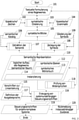
- figure 2 shows a schematic overall sequence of a conversion for the generation of control rules from a set of rules 101.
- the set of rules 101 can be formulated as text, with a corresponding textual formulation of the set of rules 101 via syntactic blocks 105 in a semantic representation 110 incl can be used to control software and/or hardware systems.
- the conversion can have transformation steps of the syntactic structure 103, an extraction of a semantic 107, a breakdown into symbols 108 and a resulting generation of the target system-dependent control specifications 116.
- the starting point for generating the semantic representation 110 can be the textual formulation of the set of rules 101 in a formal text, with configured dialectic rules from signs 102 and grammar 104 being taken into account.
- the formal text can have both defined logical and temporal statements for the set of rules 101 and value assignments from one or more instances for symbolic levels and commands required for control, for example actuator commands.
- an instance can be a representation of a specific situation for the set of rules 101 . For example, sensor values of a system landscape to be considered or values of an entity of a software system can be mapped as a system state.
- the characters 102 and the grammar 104 as part of a syntactical structure 103 are converted into syntactic blocks 105 for unambiguous interpretation of the formal text.
- text passages that are not relevant for the rule mapping, but which can contain additional explanations that are important for humans can be extracted, as can the logical statements and their hierarchical structure.
- the defined (and permissible) logical and temporal statements as well as a version structure of the set of rules 101 are converted into a semantic tree 111, preferably into referencing terms and versions, cf figure 5 for a preferred embodiment.
- the freely definable symbols/expressions in the formal texts can be broken down 108 using a structure of the symbols 109 and mapped as symbolic levels 112 with recognized symbol spellings as a symbolic dictionary 113 in the symbol structure.
- this additional value information of a symbol can be stored for deriving necessary control sequences of a rule evaluation.
- This type of structure allows the generated semantic representation 110 to be transferred back into a formal text. Since a different dialectic can be used during this reverse transformation, the formal text then generated can correspond to an expected dialectic of the respective user, whereby the set of rules 101 can be provided or displayed in a specific domain of the user.
- step 118 logical contradictions in the set of rules 101 can be recognized even before an instantiation. Among other things, these effectively prevent the systems from malfunctioning before the set of rules 101 is used. Since the check 118 can take place continuously, the user can already be informed of logical errors during the formulation of the set of rules 101 .
- An instantiation 114 can set both current states and a target state of the set of rules 101 to be achieved for any rules. Rules that must be fulfilled to achieve the target state and the rules pending a decision (e.g. set of open OR combinations) can be determined and the actors identified as missing can be generated 116. In a next step, the actors can be included in a linear process be transformed. For this purpose, chronological sequences as well as affiliations to versions and a position in a rule hierarchy according to a current configuration of linearization rules 115 can be taken into account. The actuators and corresponding actuator commands defined in an output language 117 can thus be translated into the control specifications 119 .
- a definition of the output language 117 can have HTTP posts, for example, which the actors of other software and/or hardware systems can trigger directly via web services.
- the definition may include other commands and other syntactic constructs suitable for defining the output language 117.
- a smart home system can be controlled in the same way as an orchestration of cloud services from complex parallel computer systems.
- instantiations 114 are transferred to the semantic representation 110 on the basis of control rules 119 (e.g. get actuators relating to e.g. sensor values), feedback from instance-dependent states 120 can update the semantic representation 110 of the instance 114 . This can be done continuously, ie at any time, at selected intervals or intervals, or can be triggered, for example when a status queried by the control specification 119 changes.
- control rules 119 e.g. get actuators relating to e.g. sensor values
- feedback from instance-dependent states 120 can update the semantic representation 110 of the instance 114 . This can be done continuously, ie at any time, at selected intervals or intervals, or can be triggered, for example when a status queried by the control specification 119 changes.
- figure 3 shows a schematic flowchart of a method for syntactically structuring textual formulations of a set of rules, which can be used in embodiments of the present invention.
- figure 3 10 illustrates technical steps for translating a formal text in a recursive parser 201, for example the formal text for defining the set of rules 101 figure 2 or Rule 10 figure 1 , in syntactically structured blocks, which the syntactical blocks 105 from figure 2 can match.
- the components can be affected accordingly figure 1 or 2 Reference can be made, this being understood as an example.
- the recursive parser 201 can, among other things, assume the dialectic characters 102 and syntax definitions from the dialectic grammar 104 of the language to be analyzed and/or the set of rules 101 as a configuration.
- Analysis and transformation of semantic expressions and mathematical expressions in the recursive parser 201 can be technically implemented as a configurable recursively executed finite state machine.
- Status transitions between all states 203 to 215 can represent the syntax definition as a dialectic grammar 104 of a source language.
- a status transition can in each case be defined by a next fully recognized character string or its alternatives from the dialectical characters 102, for example according to the table below.
- the area before a character found can be processed by an action block, preferably comprising storage of a text source and corresponding semantic meanings, and the area after the last character found can be continued linearly or with recursion in the subsequent status.
- a recursion level can therefore correspond to a nesting depth of terms or mathematical expressions.
- SymTokenAndOpen [ Opening the members of a logical "AND" connected set of statements SymTokenAndClose ] Closing the members of a logical "And” connected set of statements SymTokenOrOpen ⁇ Beginning of the list of members of a logical "or” connected set of statements SymTokenOrClose ⁇ End of the list of members of a logical "or” connected set of statements SymToken version # Delimitation of a version definition before the character from the following rule statement SymTokenTimeBefore « Separator between a symbol that should be before another symbol, or end of the list of symbols after chronological statements.
- SymTokenFunctionClose Completion of a sequence of argument values for a function.
- SymTokenEoS Rule completion sign.
- Subsequent text passages are implicit comments as long as no rule-compliant statements are made.
- SymTokenCommentEnd */ Characters at the end of a multi-line comment which may contain any characters and was explicitly opened with the comment start.
- SymTokenEOL ⁇ n Character that marks the end of the line and thus delimits the one-line comment.
- the recursive parser 201 can return to a previous state when a partial text to be analyzed has ended and no further character for a state transition has been recognized. In the case of bracket hierarchies or interspersed comments, this can lead to multiple viewing of the same text section with different interpretations of the current status.
- the starting point of the recursive parser 201 for semantic expressions can be the implicit comment 203 since actual rules can be surrounded by arbitrary text.
- semantic expressions and terms 204, or terms 205, temporal statements 206, and groups 207 can be nested in almost any way.
- An exception can be a nesting of temporal statements, since these should preferably not be contained in neutral groups.
- Remaining sections of text within the semantic expressions are always symbols, which are stored as such in the syntactic blocks 105 without decomposition 108 .
- Semantic rule statements themselves can potentially be encapsulated once via statement 208 as recommendations or test statements.
- test statements and recommendations can be a definition 209 as a starting point for mathematical expressions 202 from one regulatory context to the other semantic context.
- Gradations of binding forces of mathematical operators in terms can be designed in several status levels from a list of values 210 to mathematical addition including subtraction 211 and multiplication including division 212 to function brackets 214 .
- Function names themselves cannot yet be distinguished from symbols 215 at this level, since only a later analysis step can be responsible here. Skipping further function hierarchies in step 213 can enable a grouping of related sentence structures if they are interrupted by insertions, similar to a subordinate clause.
- the syntactic blocks 105 can be generated as an annotation of the formal text of the set of rules 101 .
- These preferably document the original source of the text section read and associate the respective text section with the meaning extracted by the dialectical signs 102 and syntax.
- individual characters of the respectively configured dialect can be assigned to the semantic meaning in the sense of the formal language.
- a configuration of the recursive parser 201 for individual state transitions can be given as follows: Current initial state Transition state when finding the symbol set of symbols Action for text before the found symbol State transition in case of recursion in the actions before the symbol Action for text after the found symbol State transition in case of recursion in the actions after the symbol Associated term type for generated syntax block
- Section Implicit - Comment Section definition SymToken Equal Action-Cont Action-Recurse Section definition ⁇ ⁇ Term-Define Section Implicit - Comment SectionGroup SymToken Group Action-Cont, Action-Recurse SectionGroup ⁇ ⁇ term group
- MathMul Section SkipFuncDef SymToken Function Open Action UpdCurrPos, Action Recurse Section SkipFunc Def ⁇ ⁇ Term Type Undef Section definition Section definition SymTokenEoS Action reparse section value Action cont, action return Section success Term Value Section Value Section Value SymToken element Action reparse Section MathAdd Action Cont section value Term
- FIG. 12 is a schematic flow diagram of a method for converting syntactic blocks into a semantic representation, applicable in embodiments of the present invention.
- the method can begin in step 301 with a linear method (dashed arrows) for all syntactic blocks 105 uniformly with a consolidation of the information contained.
- recursion levels can have gaps, especially when parsing mathematical terms, these gaps can be reduced by allowing logically adjacent blocks to be at most one level below their direct neighbors.
- a corresponding consolidation takes place in step 302.
- the parser does not distinguish whether the following symbolic values have been used as dynamic groups by interval designations. Therefore, this information can be subsequently determined on the basis of the existing overall view of the syntax blocks and the group type can be changed to dynamic groups, which are identified in step 303.
- the corresponding syntactic blocks are combined in step 305 in such a way that the comments for a symbol can be processed separately from the actual symbol name.
- embedded comments are recognized and corresponding clusters of the syntactic blocks 105 and comments are newly formed.
- the content of the syntactic blocks 105 can be clearly differentiated into content and/or comments, without these continuing to overlap.
- the contents can be extracted in step 306.
- the comments can be extracted.
- This intermediate form of summarized sections of the formal text can then serve as a starting point for terms or symbolic extraction or an identification of function names, which are processed in the transformation step 308 .
- the terms, symbols and functions can be formed in a recursive process (solid arrows) using the types annotated in the syntactic blocks 105 during parsing in the parser 201, which can also be referred to as term types.
- Step 107 off figure 4 can step 107 from here figure 2 correspond.
- a version specification can first be extracted as an interval value in step 311, provided the term has such a specification.
- interval specification can be read in step 312 and stored with the term.
- all data can be assembled in a new Term object and the corresponding term type can be set according to the parsed information of the syntactic block 105 in step 313, as described below with respect to FIG figure 5 and a particularly preferred embodiment is shown.
- Sub-terms can also be formed from predefined mathematical functions, which can have any mathematical functions, for example one or more of min, max, count and others, and which can be identified in step 314 .
- the Term object is created in step 313. After the recursion, the resulting term objects can be inserted into a term tree that may already exist 310.
- step 108 symbolic identifiers can be derived and stored from syntactic blocks 105 that are not assigned to any term type (undefined).
- Step 108 off figure 4 can step 108 from here figure 2 correspond.
- step 315 various components can be separated from one another.
- step 316 a determined symbolic name with no spaces as an uncased representation may be stored as "compressed" and by levels.
- Datums can be extracted in step 317 and a corresponding type of datum can be separated from the planes and added to the symbol as well. In the case of values associated with instances, these can be stored in step 318 in a storage structure associated with a corresponding instance name so that all values of the instance are directly accessible.
- output language definition 117 figure 2 these values can be stored in a manner similar to instances.
- the specification of the value for which an actuator is to be activated can be stored as an interval, so that the output can take place equally for a defined value range 319.
- the result of the processing according to figure 4 can turn into a semantic representation, for example the semantic representation 110 figure 2 be entered.
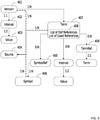
- FIG 12 shows a schematic representation of a data structure for implementing a semantic representation applicable in embodiments of the present invention.
- figure 5 shows a technical structure for storing a semantic representation, for example the semantic representation figure 1 or the semantic representation 110 from figure 2 .
- a semantic representation for example the semantic representation figure 1 or the semantic representation 110 from figure 2 .
- the structure according to figure 5 may affect the components figure 1 or 2 Reference can be made, this being understood as an example.
- Logical statements can be mapped by three structures, having a version 401, a symbol 406 and a term 407. Their source in the sense of referencing the location in the set of rules 101 or 10 can be mapped by a source structure 404. Logical statements can also be viewed as statements. Each statement can be a graph without closed paths, for example as an out-tree or a tree represent, where a term 407 can represent a root of the statement.
- the version 401 specified in a statement can refer to a version interval 402, which can have one or two values 403.
- the version 401 or a version object can also refer to all terms 407 and thereby formed graphs or trees with logical statements that correspond to the version interval 402.
- the term 407 or a corresponding term object can represent a statement in an abstract manner, which can have symbolic identifiers 405 and other implicit statements 409 as well as values or can refer to them. Since their order can be important for the processing, the references can be stored divided into defining (List of Def References) and used references (List of Used References) 408. Preferably, all values used in the terms (e.g. for mathematical functions) can be stored in be stored in the form of intervals 402 with their value or values of any type.
- a check for consistency with a value range defined elsewhere can be made possible, cf figure 7 .
- An additional reference to the source on which the objects are based can enable direct tracing back between the error or later control command and the causal rule, which leads to a significant increase in transparency. Recognized implicit comments can also be stored on the respective statement or directly on the symbolic identifier.
- the data structures used in the conversion are shown in the following table, which shows an overview of elementary structure contents as an example.
- UID Unique ID of the term for referencing MyType Semantic type (And, Or etc.) Value[] list of intervals ListofTermRefs[] List of references to hierarchically dependent terms ListofSymbolRefs[] List of references of defining and used symbols MySource[] Reference list to the source information of the term MyRootTerm Reference to the term root of the overall statement MyVersion Reference to the stated version of the overall statement ListofDefRefs [] Sorted list of references to Value, TermRef, SymbolRef of the defining references ListofU sedRefs [] Sorted list of references to Value, TermRef, SymbolRef of the references used symbol Surname Unique semantic name of the symbol level (adjusted for upper/lower case variants, case distinctions, etc.) ListOfOtherNames[] List of alternative spellings used ListOfDefTerms[] List of references to terms that contain the symbol as a defining symbol MySources [] Reference list to the source information in
- An implementation of concrete instances can use the same methods for organizing and extracting and decomposing the symbolic identifiers 405 into individual symbols 406 as well as instance and reference information.
- Corresponding instance rules with assigned instance values can be managed under a symbolic name in a hash table. Additional information (e.g. the time at which the instance value was transmitted) can be recorded, since a status update of the instance should be triggered taking into account the rules for linearization, cf. also block 116 in figure 2 and step 501 in figure 6 .
- a special feature of the data modeling according to figure 5 lies in the redundant form of administration of the semantic representation.
- all main structures can refer to each other via hashed lists.
- the knowledge is managed both hierarchically along the meaning of the rules of the set of rules 101 and in a direct linear database-like form, so that an effective, parallel and efficient evaluation and storage can take place.
- the data structure shown forms an efficient basis for rule checks, checks of instantiations and a derivation of the resulting control regulations, as is the case, for example, in figure 2 is shown.
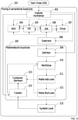
- figure 6 shows a schematic flowchart of a method for generating target-system-dependent control rules, which can be used in embodiments of the present invention.
- figure 6 illustrates how target system-dependent control rules, e.g. the control rules 119 figure 2 , can be formed.
- the set of rules 10 or 101 that can be defined by the semantic representation 110 can have a significantly larger range of functions than other frequently used means of describing control algorithms (eg truth tables, logic plans, relay circuits).
- the scope of logical statements, taking into account versions, extended OR sets and temporal statements, can enable the formulation of complex and at the same time manageable sets of rules.
- one or more target states can be defined from an overall set of rules in the form of the semantic representation 110 by instantiation, in order ultimately to derive control regulations from them.
- a basis for generating control rules can be a hierarchical set of rules check of the respective instantiation in step 502, which takes into account the achievement of target states.
- Resulting test results are structured in step 503, after which test results due to an action to be carried out one of the different Actors are assigned or can be added to a linearization in the case of dependency statements. If symbolic identifiers have to assume exactly one value in order to achieve the target state, the states can be brought about by executing set actuators 505 . If choices from extended OR conditions cannot be fully resolved to achieve the goal, an embodiment of the present invention requires further decisions before the goal state can be reached. In this case, NeedDecision actuators 506 are involved.
- temporal dependencies of the set of rules and system-specific specifications of the linearization for the formation of serial and/or parallel actuator sequences can be taken into account. This can be done according to the rules for linearization 115 figure 2 respectively. If a state is reached explicitly or through a semantic necessity, a state actor 510 can generate the appropriate control rules.
- get actuators 504 can be generated for all queryable statuses in order to have system statuses redetermined in the target systems and to have them flow into the instance statuses as instance-dependent feedback from the target system in order to take the further steps and corresponding Update control regulations to achieve the target state.
- the generated actuator commands 504, 505, 506, 510 can be placed in a unique sequence in step 507 according to the linearization rules. This can correspond to a chain of command for a controlled system.
- the sequence of actuator commands 504, 505, 506, 510 formed for symbol levels can be converted into target-system-specific instructions in step 508, which can be understood as the definition of an output language, cf. block 117 in figure 2 , where symbols for triggering the actuators can be stored.
- control can take place using the corresponding converted actuator commands in the target systems.
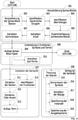
- figure 7 Figure 12 is a schematic representation of a recursive semantic tree analysis applicable in embodiments of the present invention.
- figure 7 Figure 10 illustrates how an embodiment of the present invention may perform the analysis to identify inconsistencies, inconsistencies, and potential optimizations in a rule base, such as rule base 101 figure 2 to find.
- the same flow structure can also be used to perform calculations defined by the rule set.
- the decisions already made implicitly can become rules are extracted or the open options for a future manifestation of a specific instance are derived.
- figure 7 The procedure shown can be found on the in figure 2 Set up the method shown as an example, for example in method step 118. However, this is by no means mandatory. figure 7 can be based on components figure 2 To refer to.
- One embodiment of the present invention evaluates the semantic representation in a plurality of phases that build on one another and, in particular, considers semantic trees which are mapped in the semantic representation, for example the semantic tree 111 figure 2 .
- the evaluation follows the same scheme of the semantic recursive tree analysis 118, which is also called backtracking in the literature.
- the general process for detecting first-order errors 601, second-order errors 607 and the calculation of results 615 can therefore be identical. Functions that are used equally in all areas are in the figure 7 therefore drawn across the entire width of the diagram, e.g. steps 605 and 606. In some process steps, e.g. 603, these basic functionalities can be supplemented or replaced by specific additional tests or processes, e.g. in step 610.
- a semantic representation for example the semantic representation 110 from FIG. 2, can have errors of different orders, which can be combined into two classes solely because of their similarity in processing. Errors can only occur at all because logical expressions may satisfy grammar (syntax and punctuation) but otherwise be meaningless or contradictory.
- a selection of the relevant symbols 604 resolves the group formation provided in the semantic representation.
- Logical statements (And, Or and temporal relation) do not refer to a defined group symbol, but to all members of the group equally.
- An OR selection of the group A of symbols B, C, D should just be equivalent to the selection from B, C, D and not include the group A as a symbol. The latter would correspond to an AND connection of the symbols mentioned under the name A, the one group is not doing right now. Since groups (and also dynamic groups) can again directly have groups, the determination of relevant symbols is to be carried out recursively.
- a recursion from the root to the leaves in the semantic tree must be carried out if sub-terms are present or rules further specify the symbols used.
- the recursion options are first determined 605. According to versioning of rules, corresponding recursions can be provided and executed 606 multiple times for different version intervals. In the case of errors of the first order, the errors determined are structured collected but no further calculation performed on the terms. This changes in the other versions of the recursive semantic tree analysis 118.
- the mathematical satisfiability of the partial terms 612 can be implemented such that terms are evaluated without assuming the state of the "non-critical" symbols. If a condition of a tested hypothesis cannot be fulfilled, although no assumption is made about the remaining symbols, the corresponding sub-term is considered impossible.
- impossible and possible options can be offset according to the logical rules and aggregated via the semantic tree down to the root (or partial evaluation).
- the recursive evaluation of the semantic tree for instances in step 614 uses the same process structures, but instead of the pure satisfiability of statements, the values of the sub-terms can be calculated using the mathematical formulas and instantiated values 615.
- Sub-terms that in the calculation recursion have a concrete value of an instance based on the rules are included in a list of the necessary consequences for this instance in order to derive corresponding control rules and corresponding commands from them, cf. also step 502 in figure 6 .
- Open selection options for a future form of a specific instance remain as a restriction of the options originally defined in the rules and thus allow more effective further processing of the instance (reduction of combinatorics) and corresponding communication of the remaining decision options to the user or another system, cf. on this step 506 in figure 6 .
- An embodiment can relate to an implementation of a logic-based control of other plants and systems (including other computer systems) with interleaved versions, which allow a definition of target states and full transparency between generated system logic and the source information of all logical statements and instance values.
- a number of basis terms from AND and/or OR statements can be greatly reduced by the concept of the n out of m of the k options of a flexible OR operator and thus made accessible to regulation.
- a statement from one line can potentially require thousands of statements in a basic logic, which practically cannot be processed as combinatorics.
- control can be made accessible by using only those symbols of the semantic representations for the concrete examination of a regulation that are dependent on the logical rules currently being considered and all other symbols are only considered quantitatively.
- a combination of all language elements in a consistent control logic a) can be determined without executing error states, b) remaining options can be determined for any instance hypotheses, and/or c) effectively the technically unworkable (memory space) or producible (time length) full combination tree be reduced to relevant partial statements.
- dialectic language flexibility can take place on the level of punctuation marks, the syntax of rules as well as in the output of control regulations and corresponding commands, which allows a natural-looking text as a set of rules to be understood equally and unambiguously by man and machine.
- An implementation can preferably use all language elements in a consistent, technically usable control logic in order to a) determine logical error states before a set of rules for controlling plants or systems is used, b) for any instance hypotheses, which correspond to a specific compilation of selected states of the can correspond to the facilities and systems relevant in the set of rules, to determine the remaining options, and/or c) to be able to generate a combination tree that can be processed technically and reduced to the relevant partial statements and to enable time-based system control.
- an implementation can enable users to create a logical set of rules without having to carry out a concrete implementation in a procedural, object-oriented or logical programming language, since the use of the dialects enables a natural-looking text both at the level of punctuation marks and the syntax of rules.
- the present invention is not limited to a specific embodiment of the Figures 1 to 7 methods, devices and systems shown is limited.
- other schemas for textual rules and other control rules or commands can be used.
- the sets of rules can be transformed into the respective control regulations according to modifications of the implementation methods presented.
- the present invention is not limited to a specific syntax or semantics of the set of rules, the semantic representation or the target system-dependent control regulations.
- the features disclosed in the above description, the claims and the figures can be important both individually and in any combination for the implementation of the invention in its various embodiments.
Landscapes
- Engineering & Computer Science (AREA)
- Theoretical Computer Science (AREA)
- General Engineering & Computer Science (AREA)
- Physics & Mathematics (AREA)
- General Physics & Mathematics (AREA)
- Computational Linguistics (AREA)
- General Health & Medical Sciences (AREA)
- Health & Medical Sciences (AREA)
- Audiology, Speech & Language Pathology (AREA)
- Artificial Intelligence (AREA)
- Software Systems (AREA)
- Data Mining & Analysis (AREA)
- Databases & Information Systems (AREA)
- Machine Translation (AREA)
- Devices For Executing Special Programs (AREA)
Priority Applications (2)
| Application Number | Priority Date | Filing Date | Title |
|---|---|---|---|
| EP20195834.5A EP3968149B1 (fr) | 2020-09-11 | 2020-09-11 | Génération des règles de commande à partir d'un régulateur schématisé |
| US17/470,668 US12223277B2 (en) | 2020-09-11 | 2021-09-09 | Generating control commands from schematized rule sets |
Applications Claiming Priority (1)
| Application Number | Priority Date | Filing Date | Title |
|---|---|---|---|
| EP20195834.5A EP3968149B1 (fr) | 2020-09-11 | 2020-09-11 | Génération des règles de commande à partir d'un régulateur schématisé |
Publications (3)
| Publication Number | Publication Date |
|---|---|
| EP3968149A1 true EP3968149A1 (fr) | 2022-03-16 |
| EP3968149C0 EP3968149C0 (fr) | 2025-12-24 |
| EP3968149B1 EP3968149B1 (fr) | 2025-12-24 |
Family
ID=72474157
Family Applications (1)
| Application Number | Title | Priority Date | Filing Date |
|---|---|---|---|
| EP20195834.5A Active EP3968149B1 (fr) | 2020-09-11 | 2020-09-11 | Génération des règles de commande à partir d'un régulateur schématisé |
Country Status (2)
| Country | Link |
|---|---|
| US (1) | US12223277B2 (fr) |
| EP (1) | EP3968149B1 (fr) |
Cited By (2)
| Publication number | Priority date | Publication date | Assignee | Title |
|---|---|---|---|---|
| CN116506291A (zh) * | 2023-06-28 | 2023-07-28 | 章和技术(广州)有限公司 | 一种电力系统网络设备配置内容解析方法及装置 |
| CN117608548A (zh) * | 2023-10-30 | 2024-02-27 | 北京领航智联物联网科技有限公司 | 一种物联网设备驱动指令自动生成方法及系统 |
Families Citing this family (5)
| Publication number | Priority date | Publication date | Assignee | Title |
|---|---|---|---|---|
| US12443166B2 (en) * | 2020-02-24 | 2025-10-14 | Schlumberger Technology Corporation | Multi-domain planning controller for drilling operations |
| US12547478B1 (en) * | 2020-12-11 | 2026-02-10 | Amazon Technologies, Inc. | Rule processing for cross-account event association |
| US12242857B1 (en) * | 2022-08-05 | 2025-03-04 | Marvell Asia Pte Ltd | System and method for generating multiple platform-dependent instruction sets from single hardware specification |
| CN115794121B (zh) * | 2023-01-18 | 2023-05-26 | 中国科学技术信息研究所 | 差阶逻辑表达式的编译方法、装置、电子设备和存储介质 |
| CN118778949B (zh) * | 2024-05-27 | 2025-09-09 | 华南农业大学 | 一种基于Flink的复杂事件规则描述方法及编译系统 |
Citations (1)
| Publication number | Priority date | Publication date | Assignee | Title |
|---|---|---|---|---|
| US20080126080A1 (en) * | 2001-01-08 | 2008-05-29 | Ariba, Inc. | Creation of structured data from plain text |
Family Cites Families (3)
| Publication number | Priority date | Publication date | Assignee | Title |
|---|---|---|---|---|
| US10795902B1 (en) * | 2016-04-12 | 2020-10-06 | Tableau Software, Inc. | Applying natural language pragmatics in a data visualization user interface |
| US11100144B2 (en) * | 2017-06-15 | 2021-08-24 | Oracle International Corporation | Data loss prevention system for cloud security based on document discourse analysis |
| US10762301B1 (en) * | 2018-09-04 | 2020-09-01 | Michael Dudley Johnson | Methods and systems for generating linguistic rules |
-
2020
- 2020-09-11 EP EP20195834.5A patent/EP3968149B1/fr active Active
-
2021
- 2021-09-09 US US17/470,668 patent/US12223277B2/en active Active
Patent Citations (1)
| Publication number | Priority date | Publication date | Assignee | Title |
|---|---|---|---|---|
| US20080126080A1 (en) * | 2001-01-08 | 2008-05-29 | Ariba, Inc. | Creation of structured data from plain text |
Cited By (3)
| Publication number | Priority date | Publication date | Assignee | Title |
|---|---|---|---|---|
| CN116506291A (zh) * | 2023-06-28 | 2023-07-28 | 章和技术(广州)有限公司 | 一种电力系统网络设备配置内容解析方法及装置 |
| CN116506291B (zh) * | 2023-06-28 | 2023-09-05 | 章和技术(广州)有限公司 | 一种电力系统网络设备配置内容解析方法及装置 |
| CN117608548A (zh) * | 2023-10-30 | 2024-02-27 | 北京领航智联物联网科技有限公司 | 一种物联网设备驱动指令自动生成方法及系统 |
Also Published As
| Publication number | Publication date |
|---|---|
| US20220083740A1 (en) | 2022-03-17 |
| EP3968149C0 (fr) | 2025-12-24 |
| EP3968149B1 (fr) | 2025-12-24 |
| US12223277B2 (en) | 2025-02-11 |
Similar Documents
| Publication | Publication Date | Title |
|---|---|---|
| EP3968149B1 (fr) | Génération des règles de commande à partir d'un régulateur schématisé | |
| DE69130766T2 (de) | Intelligentes hilfssystem | |
| DE112020003767T5 (de) | Erzeugen eines ausführbaren verfahrens aus einer textbeschreibung, die in einer natürlichen sprache geschrieben ist | |
| DE102006050112A1 (de) | Verfahren zur Erstellung einer Anforderungsbeschreibung für ein eingebettetes System | |
| DE102012207437B3 (de) | Verfahren zum Betrieb einer speicherprogrammierbaren Steuerung | |
| DE102015121509A1 (de) | Methodik und Vorrichtung zur Konsistenzprüfung durch Vergleich von Ontologiemodellen | |
| EP3047341B1 (fr) | Système de création informatisée de règles de surveillance et/ou de diagnostic d'une installation technique | |
| WO2010112264A1 (fr) | Dispositif et procédé de réalisation d'un modèle de processus | |
| DE102019124215A1 (de) | Verfahren zum Ändern von Modellen für die Erzeugung von Quellcode | |
| WO2017186469A1 (fr) | Système à commande vocale | |
| DE102024210716A1 (de) | Computergestütztes Verfahren zum Generieren für einen Fachbereich spezifischer Trainingsdaten für ein großes Sprachmodell | |
| DE102021116315A1 (de) | Verfahren zum Zusammenführen von Architekturinformationen | |
| DE102010033861A1 (de) | Auf einer formellen Analyse basierte Entwicklung von Anforderungsspezifikationen | |
| DE102020102862A1 (de) | Computerimplementiertes Verfahren und Vorrichtung zum Bereitstellen von auf Funktionalität verifizierten grafischen Programmanweisungen | |
| DE102019008598A1 (de) | Identifikation und Visualisierung von Assoziationen zwischen Code, der von einem Modell generiert ist, und Quellen, welche die Codegeneration beeinflussen | |
| DE102025108822A1 (de) | Umgestalten von eingabezeichenfolgen | |
| DE68905848T2 (de) | Speicherprogrammierbare steuerung mit strukturierter programmiersprache. | |
| DE102010047954A1 (de) | Formelle offline-Verifikation ausführbarer Modelle | |
| DE102010047957A1 (de) | Formelle online-Verifikation ausführbarer Modelle | |
| EP0519096B1 (fr) | Système diagnostique basé sur la connaissance avec un élément graphique pour l'acquisition des règles | |
| EP3907574A1 (fr) | Procédé de génération d'une explication d'une décision prise d'un système de commande de fabrication | |
| DE10033812A1 (de) | Verfahren zum Erzeugen von Informationsmodellen | |
| EP4530921A1 (fr) | Procédé et système d'utilisation d'intelligence artificielle avec un modèle de langage pour l'analyse sémantique d'informations textuelles d'un agencement d'automatisation industriel | |
| DE202015103261U1 (de) | Computerimplementiertes System zum Vergleichen von mindestens zwei Dateien visueller Programmiersprachen | |
| EP1533940A1 (fr) | Fonction d'une transformation d'un système TMN |
Legal Events
| Date | Code | Title | Description |
|---|---|---|---|
| PUAI | Public reference made under article 153(3) epc to a published international application that has entered the european phase |
Free format text: ORIGINAL CODE: 0009012 |
|
| STAA | Information on the status of an ep patent application or granted ep patent |
Free format text: STATUS: THE APPLICATION HAS BEEN PUBLISHED |
|
| AK | Designated contracting states |
Kind code of ref document: A1 Designated state(s): AL AT BE BG CH CY CZ DE DK EE ES FI FR GB GR HR HU IE IS IT LI LT LU LV MC MK MT NL NO PL PT RO RS SE SI SK SM TR |
|
| RBV | Designated contracting states (corrected) |
Designated state(s): AL AT BE BG CH CY CZ DE DK EE ES FI FR GB GR HR HU IE IS IT LI LT LU LV MC MK MT NL NO PL PT RO RS SE SI SK SM TR |
|
| STAA | Information on the status of an ep patent application or granted ep patent |
Free format text: STATUS: REQUEST FOR EXAMINATION WAS MADE |
|
| 17P | Request for examination filed |
Effective date: 20220915 |
|
| STAA | Information on the status of an ep patent application or granted ep patent |
Free format text: STATUS: EXAMINATION IS IN PROGRESS |
|
| 17Q | First examination report despatched |
Effective date: 20240723 |
|
| GRAP | Despatch of communication of intention to grant a patent |
Free format text: ORIGINAL CODE: EPIDOSNIGR1 |
|
| STAA | Information on the status of an ep patent application or granted ep patent |
Free format text: STATUS: GRANT OF PATENT IS INTENDED |
|
| RIC1 | Information provided on ipc code assigned before grant |
Ipc: G06F 8/41 20180101AFI20250630BHEP Ipc: G06F 40/30 20200101ALI20250630BHEP |
|
| INTG | Intention to grant announced |
Effective date: 20250714 |
|
| GRAS | Grant fee paid |
Free format text: ORIGINAL CODE: EPIDOSNIGR3 |
|
| GRAA | (expected) grant |
Free format text: ORIGINAL CODE: 0009210 |
|
| STAA | Information on the status of an ep patent application or granted ep patent |
Free format text: STATUS: THE PATENT HAS BEEN GRANTED |
|
| AK | Designated contracting states |
Kind code of ref document: B1 Designated state(s): AL AT BE BG CH CY CZ DE DK EE ES FI FR GB GR HR HU IE IS IT LI LT LU LV MC MK MT NL NO PL PT RO RS SE SI SK SM TR |
|
| REG | Reference to a national code |
Ref country code: CH Ref legal event code: F10 Free format text: ST27 STATUS EVENT CODE: U-0-0-F10-F00 (AS PROVIDED BY THE NATIONAL OFFICE) Effective date: 20251224 Ref country code: GB Ref legal event code: FG4D Free format text: NOT ENGLISH |
|
| REG | Reference to a national code |
Ref country code: DE Ref legal event code: R096 Ref document number: 502020012424 Country of ref document: DE |
|
| REG | Reference to a national code |
Ref country code: CH Ref legal event code: R17 Free format text: ST27 STATUS EVENT CODE: U-0-0-R10-R17 (AS PROVIDED BY THE NATIONAL OFFICE) Effective date: 20260304 |
|
| U01 | Request for unitary effect filed |
Effective date: 20260123 |
|
| U07 | Unitary effect registered |
Designated state(s): AT BE BG DE DK EE FI FR IT LT LU LV MT NL PT RO SE SI Effective date: 20260129 |
|
| PG25 | Lapsed in a contracting state [announced via postgrant information from national office to epo] |
Ref country code: NO Free format text: LAPSE BECAUSE OF FAILURE TO SUBMIT A TRANSLATION OF THE DESCRIPTION OR TO PAY THE FEE WITHIN THE PRESCRIBED TIME-LIMIT Effective date: 20260324 |
|
| PG25 | Lapsed in a contracting state [announced via postgrant information from national office to epo] |
Ref country code: HR Free format text: LAPSE BECAUSE OF FAILURE TO SUBMIT A TRANSLATION OF THE DESCRIPTION OR TO PAY THE FEE WITHIN THE PRESCRIBED TIME-LIMIT Effective date: 20251224 |
|
| PG25 | Lapsed in a contracting state [announced via postgrant information from national office to epo] |
Ref country code: RS Free format text: LAPSE BECAUSE OF FAILURE TO SUBMIT A TRANSLATION OF THE DESCRIPTION OR TO PAY THE FEE WITHIN THE PRESCRIBED TIME-LIMIT Effective date: 20260324 |