EP3974972A1 - Appareil de communication, système de communication et procédé de fonctionnement d'un appareil de communication - Google Patents
Appareil de communication, système de communication et procédé de fonctionnement d'un appareil de communication Download PDFInfo
- Publication number
- EP3974972A1 EP3974972A1 EP20198170.1A EP20198170A EP3974972A1 EP 3974972 A1 EP3974972 A1 EP 3974972A1 EP 20198170 A EP20198170 A EP 20198170A EP 3974972 A1 EP3974972 A1 EP 3974972A1
- Authority
- EP
- European Patent Office
- Prior art keywords
- communication device
- switch
- communication
- designed
- flow control
- Prior art date
- Legal status (The legal status is an assumption and is not a legal conclusion. Google has not performed a legal analysis and makes no representation as to the accuracy of the status listed.)
- Withdrawn
Links
- 238000004891 communication Methods 0.000 title claims abstract description 132
- 238000000034 method Methods 0.000 title claims description 15
- 230000008878 coupling Effects 0.000 claims abstract description 21
- 238000010168 coupling process Methods 0.000 claims abstract description 21
- 238000005859 coupling reaction Methods 0.000 claims abstract description 21
- 230000005540 biological transmission Effects 0.000 claims abstract description 16
- 230000006870 function Effects 0.000 claims description 22
- 238000003860 storage Methods 0.000 claims description 7
- 238000012217 deletion Methods 0.000 claims description 6
- 230000037430 deletion Effects 0.000 claims description 6
- 238000007726 management method Methods 0.000 claims description 6
- 238000012806 monitoring device Methods 0.000 claims description 6
- 238000012545 processing Methods 0.000 claims description 6
- 238000012986 modification Methods 0.000 claims description 4
- 230000004048 modification Effects 0.000 claims description 4
- 230000008859 change Effects 0.000 claims description 3
- 238000013468 resource allocation Methods 0.000 claims description 3
- 230000008569 process Effects 0.000 description 5
- 238000012544 monitoring process Methods 0.000 description 4
- 238000012423 maintenance Methods 0.000 description 3
- 238000002955 isolation Methods 0.000 description 2
- 238000013475 authorization Methods 0.000 description 1
- 230000006399 behavior Effects 0.000 description 1
- 230000001419 dependent effect Effects 0.000 description 1
- 238000011161 development Methods 0.000 description 1
- 230000018109 developmental process Effects 0.000 description 1
- 238000004519 manufacturing process Methods 0.000 description 1
- 238000005259 measurement Methods 0.000 description 1
- 230000006855 networking Effects 0.000 description 1
- 238000004801 process automation Methods 0.000 description 1
- 238000004088 simulation Methods 0.000 description 1
- 238000012546 transfer Methods 0.000 description 1
- 230000007704 transition Effects 0.000 description 1
Images

Classifications
-
- H—ELECTRICITY
- H04—ELECTRIC COMMUNICATION TECHNIQUE
- H04L—TRANSMISSION OF DIGITAL INFORMATION, e.g. TELEGRAPHIC COMMUNICATION
- H04L12/00—Data switching networks
- H04L12/28—Data switching networks characterised by path configuration, e.g. LAN [Local Area Networks] or WAN [Wide Area Networks]
- H04L12/40—Bus networks
- H04L12/40169—Flexible bus arrangements
- H04L12/40176—Flexible bus arrangements involving redundancy
-
- H—ELECTRICITY
- H04—ELECTRIC COMMUNICATION TECHNIQUE
- H04L—TRANSMISSION OF DIGITAL INFORMATION, e.g. TELEGRAPHIC COMMUNICATION
- H04L49/00—Packet switching elements
- H04L49/70—Virtual switches
-
- H—ELECTRICITY
- H04—ELECTRIC COMMUNICATION TECHNIQUE
- H04L—TRANSMISSION OF DIGITAL INFORMATION, e.g. TELEGRAPHIC COMMUNICATION
- H04L65/00—Network arrangements, protocols or services for supporting real-time applications in data packet communication
- H04L65/1066—Session management
- H04L65/1069—Session establishment or de-establishment
-
- H—ELECTRICITY
- H04—ELECTRIC COMMUNICATION TECHNIQUE
- H04L—TRANSMISSION OF DIGITAL INFORMATION, e.g. TELEGRAPHIC COMMUNICATION
- H04L65/00—Network arrangements, protocols or services for supporting real-time applications in data packet communication
- H04L65/60—Network streaming of media packets
- H04L65/61—Network streaming of media packets for supporting one-way streaming services, e.g. Internet radio
- H04L65/611—Network streaming of media packets for supporting one-way streaming services, e.g. Internet radio for multicast or broadcast
-
- H—ELECTRICITY
- H04—ELECTRIC COMMUNICATION TECHNIQUE
- H04L—TRANSMISSION OF DIGITAL INFORMATION, e.g. TELEGRAPHIC COMMUNICATION
- H04L12/00—Data switching networks
- H04L12/28—Data switching networks characterised by path configuration, e.g. LAN [Local Area Networks] or WAN [Wide Area Networks]
- H04L12/40—Bus networks
- H04L2012/4026—Bus for use in automation systems
-
- H—ELECTRICITY
- H04—ELECTRIC COMMUNICATION TECHNIQUE
- H04L—TRANSMISSION OF DIGITAL INFORMATION, e.g. TELEGRAPHIC COMMUNICATION
- H04L65/00—Network arrangements, protocols or services for supporting real-time applications in data packet communication
- H04L65/10—Architectures or entities
- H04L65/1046—Call controllers; Call servers
Definitions
- the present invention relates to a communication device, in particular a switch or a bridge, for coupling several further communication devices, a communication system comprising the communication device, in particular a communication system for transmitting time-critical data, and a method for operating the communication device.
- Industrial automation systems usually include a large number of automation devices that are networked with one another via an industrial communication network and are used in the context of manufacturing or process automation to control or regulate systems, machines or devices. Due to time-critical framework conditions in industrial automation systems, real-time communication protocols such as PROFINET, PROFIBUS, Real-Time Ethernet or Time-Sensitive Networking (TSN) are predominantly used for communication between automation devices. In particular, control services or applications can be automated and distributed to currently available servers or virtual machines of an industrial automation system depending on the workload.
- real-time communication protocols such as PROFINET, PROFIBUS, Real-Time Ethernet or Time-Sensitive Networking (TSN) are predominantly used for communication between automation devices.
- TSN Time-Sensitive Networking
- control services or applications can be automated and distributed to currently available servers or virtual machines of an industrial automation system depending on the workload.
- Interruptions in communication links between computer units in an industrial automation system or automation devices can lead to an unwanted or unnecessary repetition of a transmission of a service request.
- messages that are not or not fully transmitted can, for example, indicate a transition or Preventing an industrial automation system from remaining in a safe operating state.
- EP 3270560 B1 describes a method for setting up secure communication connections to an industrial automation system, in which a connection management device provides access control information for setting up an encrypted communication connection between a first communication device of a requesting user and a selected second communication device for these communication devices if the authorization check result is positive.
- the connection management device is formed by a server instance running on a firewall system. Data packets transmitted via an encrypted communication connection between the first communication device of the requesting user and the selected second communication device are decrypted by the firewall system for a check based on specified security rules and, if the check is successful, encrypted and forwarded to the first communication device of the requesting user or to the selected second communication device.
- communication devices to be simulated in terms of their behavior are each functionally subdivided into a communication control plane known as a control plane and a data transmission plane known as a data plane.
- Simulation system components which are formed by software containers that can be executed in a sequence control environment, are provided for the functions of the communication devices assigned to the control plane.
- Network infrastructure devices are modeled on the data plane by resources provided by the network infrastructure devices.
- the software containers assigned to the communication devices are executed selectively in the sequence control environment according to a predefined topology and are coupled to one another there.
- the earlier European patent application with the application file number 20193690.3 relates to a method for providing time-critical services, to which at least one server component is assigned in each case, which is formed by a sequence control component that can be loaded into a sequence control environment and executed there.
- a functional unit for processing a communication protocol stack is made available for each of the server components, which is connected to a functional unit for processing a communication protocol stack, which is assigned to the flow control environment.
- the services each include a directory service component for determining services provided by means of the flow control environment.
- the directory service components are connected to one another via a separate communication interface.
- An aggregator component formed by means of a further sequence control component is connected to the separate communication interface connected, which makes information about the services provided by the server components available outside of the flow control environment.
- Virtual machines can communicate with other virtual machines using software-implemented virtual switches.
- Virtual switches can usually access network adapters of a respective host system.
- virtual switches support increased automation of network management tasks.
- the present invention is based on the object of specifying a communication device that is easy to maintain and flexible to use, which enables a reliable and high-performance coupling of several physical communication devices, and to create a suitable system and method for its operation, in particular taking into account real-time requirements on the part of the to be coupled communication devices.
- this object is achieved by a communication device having the features specified in claim 1, by a communication system having the features specified in claim 13 and by a method having the features specified in claim 14.
- Advantageous developments are specified in the dependent claims.
- one of the and receiving units and the controller functional unit assigned to the coupling element are provided for processing a communication protocol stack.
- the communication device is preferably designed as a switch or bridge.
- the coupling element is a backplane switch.
- the controller functional unit is advantageously a controller for the backplane switch.
- the controller functional unit is designed to implement functions according to Simple Network Management Protocol (SNMP), Media Redundancy Protocol (MRP), High-availability Seamless Redundancy Protocol (HSR), Link-local Registration Protocol (LRP), Resource Allocation Protocol (RAP ) or designed and set up to provide VLAN functions.
- SNMP Simple Network Management Protocol
- MRP Media Redundancy Protocol
- HSR High-availability Seamless Redundancy Protocol
- LRP Link-local Registration Protocol
- RAP Resource Allocation Protocol
- the communication device includes a processor for processing program code and a program code memory as well as a sequence control environment formed by means of the processor and the memory. Sequence control components can be loaded into this sequence control environment for execution there.
- the sequence control environment has an interface for accessing the coupling element and the transmitting and receiving units.
- a predetermined sequence control component is provided for coupling a number of physical or virtual communication devices. This predetermined flow control component is designed and set up to exclusively allocate selected transmission and reception units via the flow control environment and to link them to one another, switched separately by the controller functional unit for forwarding datagrams. Virtual communication devices coupled to the predetermined scheduler component can in particular be formed by further sequence control components.
- the predetermined scheduler component is designed and set up to implement a virtual switch.
- the virtual switch can be designed and set up to control the forwarding of datagrams between communication devices that are connected to at least one physical switch.
- selected connections of the communication device or real switches can be configured as ring ports according to the Media Redundancy Protocol or High-availability Seamless Redundancy Protocol by means of the virtual switch.
- the virtual switch can perform the functions of an MRP redundancy manager or HSR duplicate filter functions.
- the present invention enables virtual switches to be used and operated within real switches. This achieves improved utilization of network resources.
- local overloads of communication devices can be avoided or compensated for by simply and quickly relocating communication control functions to a virtual switch within the same or another real switch.
- Such a relocation of communication control functions allows network components to be completely or partially shut down, for example, as part of maintenance tasks, without this leading to restricted communication for connected communication devices or subscribers.
- redundancy functions can be made available selectively within a real switch using a virtual switch.
- the virtual switch implemented using the specified flow control component is set up and configured to set up a link between the communication device and a physical switch, in particular in a maintenance scenario or in the event of topology changes, and to transfer data traffic from selected ports of the physical switch to the virtual switch Switch to mirror exclusively allocated transactions of the communication device.
- the virtual switch can be set up and designed to send a status signal to the physical switch after the data traffic has been successfully mirrored, by means of which a functional controller unit of the physical switch can be switched off. This ensures a reliable relocation of communication control functions through coordinated operation of all communication devices involved.
- the flow control components are or comprise software containers that are each designed and set up to run isolated from other software containers or container groups within the flow control environment on a host operating system that is installed in the communication device.
- the scheduling environment may include a Docker Engine or a Snap Core running on the communication device.
- the software containers each use a kernel of the host operating system of the communication device together with other software containers running on the communication device.
- Memory dumps for the software containers can, for example, be retrieved from a storage and provision system that can be read or written by a large number of users.
- the sequence control components can advantageously each be migrated from the communication device to another, essentially similar communication device or to a server device for execution there or can be executed simultaneously on other communication devices or on server devices.
- selected sequence control components are designed and set up to provide services or functions of an industrial automation system.
- the services can each include a plurality of similar or identical flow control components which are each designed and set up to be provided by different communication devices or server devices.
- automation functions can also be provided redundantly or with high availability by the communication device.
- the communication system comprises at least one communication device corresponding to the previous statements and at least one other, essentially similar communication device or at least one server device.
- a monitoring device assigned to the at least one communication device or the at least one server device is provided.
- the monitoring device is designed and set up to detect the creation, deletion or change of flow control components of the at least one communication device or the at least one server device and to record the flow control components with their respective execution status to register.
- the creation, deletion or modification of the sequence control components each includes an allocation or release of resources in the respective communication device or in the respective server device.
- the method according to the invention is intended for operating a communication device in accordance with the above statements, with the communication device being designed as a switch or bridge.
- a virtual switch is implemented using a predetermined flow control component of the communication device.
- the virtual switch controls the forwarding of datagrams between communication devices that are connected to at least one physical switch.
- the virtual switch preferably assumes control of the forwarding by the virtual switch establishing a link between the communication device and the physical switch and mirroring data traffic from selected connections of the physical switch to connections of the communication device exclusively allocated by the virtual switch.
- the virtual switch advantageously sends a status signal to the physical switch, as a result of which a controller functional unit of the physical switch is switched off.
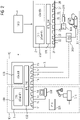
- Switch 1 shown is configured as an Ethernet switch in the present exemplary embodiment and is used to couple a number of other communication devices.
- the following explanations apply in an analogous manner to a communication device configured as a bridge for coupling a plurality of further communication devices.
- automation devices with communication modules such as programmable logic controllers 301, 303, 304, operating and monitoring stations 302, I/O controllers and I/O modules can be connected to the switch 1 (see FIG figure 2 ).
- the switch 1 and the communication or automation devices 301-304 connected to the switch 1 are preferably designed as components of a time-sensitive network, in particular according to IEEE 802.1Q, IEEE 802.1AB, IEEE 802.1AS, IEEE 802.1BA or IEEE 802.1 cb
- Programmable controllers 301, 303, 304 each typically include a communication module, a central processing unit and at least one input/output unit.
- the input/output units are used to exchange control and measured variables between the programmable logic controller 301, 303, 304 and a machine or device 311, 331, 341 controlled by the programmable logic controller 301, 303, 304 Determination of suitable control variables from recorded measured variables provided.
- the above components of the programmable logic controllers 301, 303, 304 are connected to one another, for example, via a backplane bus system.
- I/O modules can also be provided for exchanging control and measured variables with connected machines or devices.
- I/O modules can be controlled in particular by means of an I/O controller per automation cell.
- I/O modules can also be controlled by a remote programmable logic controller.
- An operating and monitoring station 302 is used to visualize process data or measurement and control variables that are processed or recorded by programmable logic controllers, I/O controllers, I/O modules or sensors.
- an operator control and monitoring station 302 is used to display values of a control loop and to change control parameters.
- Operating and monitoring stations 302 comprise at least a graphical user interface, an input device, a processor unit and a communication module.
- the switch includes a number of ports 11-18 for communication or automation devices, a number of transmission and reception units 111-118 assigned to the ports 11-18, a backplane switch 120 for the switched linking of the transmission and reception units 111-118 and a buffer memory for datagrams to be forwarded via the backplane switch 120.
- the transmission and reception units 111-118 are implemented by means of PHY and MAC circuits.
- the switch 1 includes a controller 130 assigned to the transmitting and receiving units 111-118 and the backplane switch, which is implemented in software in the present exemplary embodiment.
- the controller 130 is used to process a communication protocol stack and in particular implements functions according to Simple Network Management Protocol (SNMP), Media Redundancy Protocol (MRP), High-availability Seamless Redundancy Protocol (HSR), Link-local Registration Protocol (LRP), Resource Allocation Protocol or to provide VLAN functions.
- SNMP Simple Network Management Protocol
- MRP Media Redundancy Protocol
- HSR High-availability Seamless Redundancy Protocol
- LRP Link-local Registration Protocol
- Resource Allocation Protocol or to provide VLAN functions.
- the switch 1 includes a processor 101 for processing program code, a main memory 102 into which the program code can be loaded, and a storage unit 103, in particular a hard disk, a flash or SSD memory, for non-volatile storage of the program codes.
- a host operating system 131 is installed in the switch 1, on which a sequence control environment 132, for example a Docker engine, for software containers 133, 134 is executed by means of the processor 102, the main memory 102 and the storage unit 103 for non-volatile storage.
- the flow control environment 132 uses drivers of the host operating system 131 to access the backplane switch 120 and the sending and receiving units 111-118 and provides appropriate interfaces for the software containers 133, 134 that are in the flow control environment 132 for execution there are loadable.
- the software containers 133, 134 are each configured to run within the sequence control environment 132, isolated from other software containers or container groups or pods.
- the software containers 133, 134 each use a kernel of the host operating system 1131 of the switch 1 together with other software containers running on the switch 1.
- Isolation of the software containers 133, 134 or isolation of selected operating system means from one another can be implemented in particular by means of control groups and namespacing.
- Process groups can be defined by means of control groups in order to make available resources available for selected restrict groups.
- Individual processes or control groups can be isolated or hidden from other processes or control groups via namespaces.
- Memory images for software containers can be retrieved, for example, from a storage and provision system that can be read or written by a large number of users.
- the switch 1 includes a predetermined software container 133 for coupling multiple physical or virtual communication devices.
- the virtual communication devices are formed, for example, by additional software containers on the switch 1, another switch 2 of the same type, or by software containers or virtual machines on a server device.
- the default software container 133 is designed and set up to implement a virtual switch.
- the virtual switch 133 is intended to exclusively allocate selected transmission and reception units of the switch 1 via the flow control environment 132 and to link them to one another, switched separately by the controller 130 for forwarding datagrams.
- the virtual switch 133 can thus assume control of the forwarding of datagrams between communication devices 301-304 which are connected to at least one physical switch 1, 2.
- the virtual switch 133 can be used, for example, as part of maintenance work or topology changes to shift the control of forwarding functions from switch 2.
- the switch 2 is essentially the same as the switch 1 and also includes several ports 21-28, a backplane switch 220 and a controller 230 for the backplane switch 220.
- the switch 2 can also include a virtual switch.
- the virtual switch 133 integrated in the physical switch 1 takes over the control of forwarding functions from the switch 2, in that the virtual switch 133 establishes a link via an existing transmission path 3 between the two switches 1, 2 and data traffic from selected ports 21-24 of the switch 2 mirrored to ports 14-18 of switch 1 exclusively allocated by virtual switch 133.
- the virtual switch 133 sends a status signal to the switch 2, by which the controller 230 of the switch 2 is switched off with respect to the selected ports 21-24.
- the switch 1 thus has two logically separate port groups 10, 20 with communication devices 301-302, 303-304 assigned to these port groups, which are controlled on the one hand by the controller 130 of the switch 1 and on the other hand by the virtual switch 133.
- selected software containers 134 on the switch 1 are intended to provide services or functions of an industrial automation system.
- the services can each include a number of similar or identical software containers or pods, which are provided by different switches 1, 2 or server devices.
- a provision of several services or control applications of the same type on different switches 1, 2 or server devices can be controlled simultaneously by a monitoring device 4, for example using Kubernetes daemon sets, which is administratively assigned in particular to the switches 1, 2.
- the monitoring device is configured to detect creation, deletion or modification of software containers or pods on switches 1, 2 or on server devices and the software containers or pods with their respective execution status to register.
- the creation, deletion or modification of the sequence control components each includes an allocation or release of resources in the respective switch 1, 2 or in the respective server device.
- the software containers 133, 134 in particular the virtual switch 133, can each be migrated from switch 1 to another, essentially similar switch 2 or to a server device for execution there or to other switches or server facilities are running at the same time.
Landscapes
- Engineering & Computer Science (AREA)
- Multimedia (AREA)
- Computer Networks & Wireless Communication (AREA)
- Signal Processing (AREA)
- Business, Economics & Management (AREA)
- General Business, Economics & Management (AREA)
- Data Exchanges In Wide-Area Networks (AREA)
Priority Applications (1)
| Application Number | Priority Date | Filing Date | Title |
|---|---|---|---|
| EP20198170.1A EP3974972A1 (fr) | 2020-09-24 | 2020-09-24 | Appareil de communication, système de communication et procédé de fonctionnement d'un appareil de communication |
Applications Claiming Priority (1)
| Application Number | Priority Date | Filing Date | Title |
|---|---|---|---|
| EP20198170.1A EP3974972A1 (fr) | 2020-09-24 | 2020-09-24 | Appareil de communication, système de communication et procédé de fonctionnement d'un appareil de communication |
Publications (1)
| Publication Number | Publication Date |
|---|---|
| EP3974972A1 true EP3974972A1 (fr) | 2022-03-30 |
Family
ID=72659036
Family Applications (1)
| Application Number | Title | Priority Date | Filing Date |
|---|---|---|---|
| EP20198170.1A Withdrawn EP3974972A1 (fr) | 2020-09-24 | 2020-09-24 | Appareil de communication, système de communication et procédé de fonctionnement d'un appareil de communication |
Country Status (1)
| Country | Link |
|---|---|
| EP (1) | EP3974972A1 (fr) |
Citations (5)
| Publication number | Priority date | Publication date | Assignee | Title |
|---|---|---|---|---|
| US20180123954A1 (en) * | 2016-10-27 | 2018-05-03 | Nicira, Inc. | Virtualization Port Layer Including Physical Switch Port and Logical Switch Port |
| US20180357086A1 (en) * | 2017-06-13 | 2018-12-13 | Intel Corporation | Container virtual switching |
| US20200067763A1 (en) * | 2018-08-24 | 2020-02-27 | Cisco Technology, Inc. | Configuring container attribute data on network switches to enable networking functionality |
| EP3270560B1 (fr) | 2016-07-12 | 2020-03-25 | Siemens Aktiengesellschaft | Procede d'etablissement de liaisons de communication securisees avec un systeme d'automatisation industriel et systeme pare-feu |
| EP3618384B1 (fr) | 2018-08-31 | 2020-08-26 | Siemens Aktiengesellschaft | Procédé de simulation d'un traitement des requêtes de réservation pour flux de données multidiffusion dans des réseaux de communication et un système de simulation |
-
2020
- 2020-09-24 EP EP20198170.1A patent/EP3974972A1/fr not_active Withdrawn
Patent Citations (5)
| Publication number | Priority date | Publication date | Assignee | Title |
|---|---|---|---|---|
| EP3270560B1 (fr) | 2016-07-12 | 2020-03-25 | Siemens Aktiengesellschaft | Procede d'etablissement de liaisons de communication securisees avec un systeme d'automatisation industriel et systeme pare-feu |
| US20180123954A1 (en) * | 2016-10-27 | 2018-05-03 | Nicira, Inc. | Virtualization Port Layer Including Physical Switch Port and Logical Switch Port |
| US20180357086A1 (en) * | 2017-06-13 | 2018-12-13 | Intel Corporation | Container virtual switching |
| US20200067763A1 (en) * | 2018-08-24 | 2020-02-27 | Cisco Technology, Inc. | Configuring container attribute data on network switches to enable networking functionality |
| EP3618384B1 (fr) | 2018-08-31 | 2020-08-26 | Siemens Aktiengesellschaft | Procédé de simulation d'un traitement des requêtes de réservation pour flux de données multidiffusion dans des réseaux de communication et un système de simulation |
Similar Documents
| Publication | Publication Date | Title |
|---|---|---|
| EP4176545B1 (fr) | Procédé et système de fourniture des prestations à durée critique | |
| DE69429944T2 (de) | Kommunikation von lokalen Netzwerk basierten Anwendungen in einem Vermittlungsnetz | |
| DE102004052270B4 (de) | Verarbeitungsvorrichtungs-Managementsystem | |
| EP3975502B1 (fr) | Procédé et système de fourniture des services temporellement critiques au moyen d'un environnement de commande de déroulement | |
| EP3547618B1 (fr) | Procédé d'établissement d'une connexion de communication redondante et unité de commande sécurisée | |
| EP3618384B1 (fr) | Procédé de simulation d'un traitement des requêtes de réservation pour flux de données multidiffusion dans des réseaux de communication et un système de simulation | |
| EP2838220A1 (fr) | Procédé de transmission redondante de messages dans un réseau de communication industriel et appareil de communication | |
| EP3753205B1 (fr) | Transmission de données dans des réseaux de données sensibles au temps | |
| EP3843332A1 (fr) | Procédé de surveillance du trafic de données dans un réseau de communication et système de contrôle d'accès | |
| WO2023126127A1 (fr) | Procédé et système permettant de fournir des applications de commande prioritaires | |
| WO2020249345A1 (fr) | Procédé de fourniture d'applications de contrôle et dispositif de contrôle de la configuration | |
| EP3715983B1 (fr) | Procédé de fourniture des applications de commande à l'aide d'un réseau de communication destiné à la transmission des données temporellement critiques et dispositif de coordination | |
| WO2024002597A1 (fr) | Procédé pour la transmission sécurisée de données à temps critique au sein d'un système de communication, système de communication et adaptateur pour terminal | |
| DE102013211406A1 (de) | Kommunikationsgerät zur Verbindung eines Feldgeräts eines industriellen Automatisierungssystems mit einer ausfallgesicherten Steuerungseinheit und industrielles Automatisierungssystem | |
| EP4356596B1 (fr) | Procédé et système de fourniture des services temporellement critiques au moyen d'un environnement de commande de déroulement | |
| EP4204909B1 (fr) | Dispositif périphérique, procédé et logiciel pour fournir des fonctions de redondance sur un dispositif périphérique | |
| EP3974972A1 (fr) | Appareil de communication, système de communication et procédé de fonctionnement d'un appareil de communication | |
| EP1430634A2 (fr) | Messages de remplacement pour detecter et eviter des erreurs lors de la transmission de donnees critiques en temps reel | |
| EP4007212A1 (fr) | Procédé de surveillance et/ou de commande des appareils de communication fournissant des applications de commande et appareil de communication | |
| WO2024068303A1 (fr) | Procédé et système de transmission de données critiques dans le temps dans un réseau de communication | |
| EP3975488A1 (fr) | Procédé et appareil de communication destinés à la transmission de données temporellement critiques | |
| EP3873034B1 (fr) | Procédé et système de détection d'un trafic de données dans un réseau de communication | |
| EP3716519A1 (fr) | Procédé de transmission des données dépendantes du temps dans un réseau de communication et appareil de communication | |
| EP4135290A1 (fr) | Procédé de transmission des données pour le diagnostic de réseau entre les sous-réseaux connectés indirectement et appareil de communication de couplage | |
| EP3896918A1 (fr) | Procédé de fonctionnement d'un système de communication permettant de transmettre des données critiques dans le temps, dispositif de commande de domaines et dispositif de commande de communication |
Legal Events
| Date | Code | Title | Description |
|---|---|---|---|
| PUAI | Public reference made under article 153(3) epc to a published international application that has entered the european phase |
Free format text: ORIGINAL CODE: 0009012 |
|
| STAA | Information on the status of an ep patent application or granted ep patent |
Free format text: STATUS: THE APPLICATION HAS BEEN PUBLISHED |
|
| AK | Designated contracting states |
Kind code of ref document: A1 Designated state(s): AL AT BE BG CH CY CZ DE DK EE ES FI FR GB GR HR HU IE IS IT LI LT LU LV MC MK MT NL NO PL PT RO RS SE SI SK SM TR |
|
| STAA | Information on the status of an ep patent application or granted ep patent |
Free format text: STATUS: THE APPLICATION IS DEEMED TO BE WITHDRAWN |
|
| 18D | Application deemed to be withdrawn |
Effective date: 20221001 |