EP3979586A1 - Procédé pour réaliser un processus biologique - Google Patents
Procédé pour réaliser un processus biologique Download PDFInfo
- Publication number
- EP3979586A1 EP3979586A1 EP20199398.7A EP20199398A EP3979586A1 EP 3979586 A1 EP3979586 A1 EP 3979586A1 EP 20199398 A EP20199398 A EP 20199398A EP 3979586 A1 EP3979586 A1 EP 3979586A1
- Authority
- EP
- European Patent Office
- Prior art keywords
- data
- bioprocess
- routine
- unit
- control unit
- Prior art date
- Legal status (The legal status is an assumption and is not a legal conclusion. Google has not performed a legal analysis and makes no representation as to the accuracy of the status listed.)
- Pending
Links
Images


Classifications
-
- H—ELECTRICITY
- H04—ELECTRIC COMMUNICATION TECHNIQUE
- H04L—TRANSMISSION OF DIGITAL INFORMATION, e.g. TELEGRAPHIC COMMUNICATION
- H04L63/00—Network architectures or network communication protocols for network security
- H04L63/12—Applying verification of the received information
- H04L63/126—Applying verification of the received information the source of the received data
-
- G—PHYSICS
- G05—CONTROLLING; REGULATING
- G05B—CONTROL OR REGULATING SYSTEMS IN GENERAL; FUNCTIONAL ELEMENTS OF SUCH SYSTEMS; MONITORING OR TESTING ARRANGEMENTS FOR SUCH SYSTEMS OR ELEMENTS
- G05B19/00—Program-control systems
- G05B19/02—Program-control systems electric
- G05B19/04—Program control other than numerical control, i.e. in sequence controllers or logic controllers
- G05B19/042—Program control other than numerical control, i.e. in sequence controllers or logic controllers using digital processors
-
- G—PHYSICS
- G06—COMPUTING OR CALCULATING; COUNTING
- G06F—ELECTRIC DIGITAL DATA PROCESSING
- G06F21/00—Security arrangements for protecting computers, components thereof, programs or data against unauthorised activity
- G06F21/60—Protecting data
- G06F21/64—Protecting data integrity, e.g. using checksums, certificates or signatures
-
- H—ELECTRICITY
- H04—ELECTRIC COMMUNICATION TECHNIQUE
- H04L—TRANSMISSION OF DIGITAL INFORMATION, e.g. TELEGRAPHIC COMMUNICATION
- H04L9/00—Cryptographic mechanisms or cryptographic arrangements for secret or secure communications; Network security protocols
- H04L9/32—Cryptographic mechanisms or cryptographic arrangements for secret or secure communications; Network security protocols including means for verifying the identity or authority of a user of the system or for message authentication, e.g. authorization, entity authentication, data integrity or data verification, non-repudiation, key authentication or verification of credentials
- H04L9/3236—Cryptographic mechanisms or cryptographic arrangements for secret or secure communications; Network security protocols including means for verifying the identity or authority of a user of the system or for message authentication, e.g. authorization, entity authentication, data integrity or data verification, non-repudiation, key authentication or verification of credentials using cryptographic hash functions
-
- H—ELECTRICITY
- H04—ELECTRIC COMMUNICATION TECHNIQUE
- H04L—TRANSMISSION OF DIGITAL INFORMATION, e.g. TELEGRAPHIC COMMUNICATION
- H04L9/00—Cryptographic mechanisms or cryptographic arrangements for secret or secure communications; Network security protocols
- H04L9/32—Cryptographic mechanisms or cryptographic arrangements for secret or secure communications; Network security protocols including means for verifying the identity or authority of a user of the system or for message authentication, e.g. authorization, entity authentication, data integrity or data verification, non-repudiation, key authentication or verification of credentials
- H04L9/3236—Cryptographic mechanisms or cryptographic arrangements for secret or secure communications; Network security protocols including means for verifying the identity or authority of a user of the system or for message authentication, e.g. authorization, entity authentication, data integrity or data verification, non-repudiation, key authentication or verification of credentials using cryptographic hash functions
- H04L9/3239—Cryptographic mechanisms or cryptographic arrangements for secret or secure communications; Network security protocols including means for verifying the identity or authority of a user of the system or for message authentication, e.g. authorization, entity authentication, data integrity or data verification, non-repudiation, key authentication or verification of credentials using cryptographic hash functions involving non-keyed hash functions, e.g. modification detection codes [MDCs], MD5, SHA or RIPEMD
-
- H—ELECTRICITY
- H04—ELECTRIC COMMUNICATION TECHNIQUE
- H04L—TRANSMISSION OF DIGITAL INFORMATION, e.g. TELEGRAPHIC COMMUNICATION
- H04L9/00—Cryptographic mechanisms or cryptographic arrangements for secret or secure communications; Network security protocols
- H04L9/32—Cryptographic mechanisms or cryptographic arrangements for secret or secure communications; Network security protocols including means for verifying the identity or authority of a user of the system or for message authentication, e.g. authorization, entity authentication, data integrity or data verification, non-repudiation, key authentication or verification of credentials
- H04L9/3247—Cryptographic mechanisms or cryptographic arrangements for secret or secure communications; Network security protocols including means for verifying the identity or authority of a user of the system or for message authentication, e.g. authorization, entity authentication, data integrity or data verification, non-repudiation, key authentication or verification of credentials involving digital signatures
-
- H—ELECTRICITY
- H04—ELECTRIC COMMUNICATION TECHNIQUE
- H04L—TRANSMISSION OF DIGITAL INFORMATION, e.g. TELEGRAPHIC COMMUNICATION
- H04L9/00—Cryptographic mechanisms or cryptographic arrangements for secret or secure communications; Network security protocols
- H04L9/50—Cryptographic mechanisms or cryptographic arrangements for secret or secure communications; Network security protocols using hash chains, e.g. blockchains or hash trees
-
- G—PHYSICS
- G05—CONTROLLING; REGULATING
- G05B—CONTROL OR REGULATING SYSTEMS IN GENERAL; FUNCTIONAL ELEMENTS OF SUCH SYSTEMS; MONITORING OR TESTING ARRANGEMENTS FOR SUCH SYSTEMS OR ELEMENTS
- G05B2219/00—Program-control systems
- G05B2219/20—Pc systems
- G05B2219/24—Pc safety
- G05B2219/24167—Encryption, password, user access privileges
-
- G—PHYSICS
- G05—CONTROLLING; REGULATING
- G05B—CONTROL OR REGULATING SYSTEMS IN GENERAL; FUNCTIONAL ELEMENTS OF SUCH SYSTEMS; MONITORING OR TESTING ARRANGEMENTS FOR SUCH SYSTEMS OR ELEMENTS
- G05B2219/00—Program-control systems
- G05B2219/20—Pc systems
- G05B2219/25—Pc structure of the system
- G05B2219/25205—Encrypt communication
-
- H—ELECTRICITY
- H04—ELECTRIC COMMUNICATION TECHNIQUE
- H04L—TRANSMISSION OF DIGITAL INFORMATION, e.g. TELEGRAPHIC COMMUNICATION
- H04L63/00—Network architectures or network communication protocols for network security
- H04L63/12—Applying verification of the received information
- H04L63/123—Applying verification of the received information received data contents, e.g. message integrity
-
- H—ELECTRICITY
- H04—ELECTRIC COMMUNICATION TECHNIQUE
- H04L—TRANSMISSION OF DIGITAL INFORMATION, e.g. TELEGRAPHIC COMMUNICATION
- H04L67/00—Network arrangements or protocols for supporting network services or applications
- H04L67/01—Protocols
- H04L67/12—Protocols specially adapted for proprietary or special-purpose networking environments, e.g. medical networks, sensor networks, networks in vehicles or remote metering networks
-
- H—ELECTRICITY
- H04—ELECTRIC COMMUNICATION TECHNIQUE
- H04L—TRANSMISSION OF DIGITAL INFORMATION, e.g. TELEGRAPHIC COMMUNICATION
- H04L67/00—Network arrangements or protocols for supporting network services or applications
- H04L67/01—Protocols
- H04L67/12—Protocols specially adapted for proprietary or special-purpose networking environments, e.g. medical networks, sensor networks, networks in vehicles or remote metering networks
- H04L67/125—Protocols specially adapted for proprietary or special-purpose networking environments, e.g. medical networks, sensor networks, networks in vehicles or remote metering networks involving control of end-device applications over a network
Definitions
- the present invention relates to a method for conducting a bioprocess with a digital control unit according to the general part of claim 1, a digital control unit of a bioprocess arrangement for controlling a bioprocess according to claim 19, a control system with a digital control unit according to claim 20, a data processing system according to claim 21, a computer program product according to claim 22 and a computer readable storage media according to claim 23.
- bioprocess presently represents biotechnological and biopharmaceutical processes, which are involved in the manufacturing of desired therapeutic bioproducts such as biologics, vaccines, components for cell or gene therapy, or of non-therapeutic bioproducts such as pigments, biofuels or nutritional supplements.
- desired therapeutic bioproducts such as biologics, vaccines, components for cell or gene therapy, or of non-therapeutic bioproducts such as pigments, biofuels or nutritional supplements.
- bioproducts can either be manufactured by living cells, or the cell itself might be the bioproduct, or the bioproduct can be the result of a cell free manufacturing based on cell components that are of either natural or non-natural origin.
- the "bioprocess arrangement” comprises at least one device or the combination of two or more devices involved in the bioprocess, such as a bioreactor, a digital control unit (DCU), a filtration device, chromatography equipment, a centrifuge, a freeze dryer and analytical devices, which might be either single-use or multi-use equipment.
- a bioreactor such as a bioreactor, a digital control unit (DCU), a filtration device, chromatography equipment, a centrifuge, a freeze dryer and analytical devices, which might be either single-use or multi-use equipment.
- DCU digital control unit
- the digital control unit in question comes into play.
- An example for such a digital control unit which is the starting point for the invention, is shown in DE 102 37 082 A1 .
- the known digital control unit comprises all electronic components to control the bioprocess, to receive sensor data and to communicate with the user via a user interface. This allows to execute a bioprocess control routine, in which bioprocess data are being generated in order to document the real life execution of the desired bioprocess.
- bioprocess data are particularly important, for example, if a new pharmaceutical product is subject of a compliance procedure before its introduction into the market.
- Such compliance procedures often require proof, that the respective process in the bioprocess laboratory is in accordance with predefined rules. For instance during clinical trials this is of particular importance due to quality control standards and regulatory measures in clinical research, which are required by the respective national drug agency, such as the FDA, for the approval process of new drugs.
- this does not only concern the experimental phase, in which the documentation of process steps and sensor data is predominantly relevant, but also the manufacturing phase, in which the documentation of process quality plays an important role according to GMP standards.
- GMP or good manufacturing practice, are the practices required to conform to the guidelines recommended by agencies such as the FDA that control the authorization and licensing of the manufacture and sale of pharmaceutical products. These guidelines define the minima! manufacturing requirements that must be fulfilled in order to assure that the respective product is high in quality for their intended use.
- the accordance with GMP standards is overseen by regulatory agencies all over the world.
- the integrity of the bioprocess data is necessary. This means that it has to be ensured that the bioprocess data have not been manipulated, be it willingly or unwillingly.
- control presently includes any action that attributes to influencing the respective target, here the bioprocess, in a reproducible manner, which generally includes sending out data to the target and retrieving and storing data from the target.
- the digital control unit comprises a local data storage and a local processor unit, which presently are to be considered the core components for digital data processing.
- the digital control unit further comprises a bioprocess interface for sending and receiving bioprocess control data, which bioprocess interface comprises an actuator interface for sending actuator data to at least one actuator for influencing the bioprocess and a sensor interface for receiving sensor data related to the bioprocess from at least one sensor.
- a stirrer or a valve could be such actuators, while the associated, respective actuator data could be the stirring frequency in rounds per minute (rpm), or the fluid flow in milliliter per minute (mL/min), respectively.
- Exemplary sensors could be the biomass sensor, pH sensor or oxygen sensor, reflecting the respective data.
- the digital control unit also generates bioprocess data, which serve to describe the bioprocess as will be explained. These bioprocess data are the basis for the documentation, which is needed for above noted compliance procedures.
- the digital control unit comprises a user interface for displaying to a user at least part of the bioprocess data and for receiving user control command data.
- the user interface provides one possibility for the user to influence the bioprocess during both, the experimental development phase as well as the manufacturing phase.
- exemplary parameters that are set by the user are stirring speed, temperature, pH, oxygen saturation and the like.
- the digital control unit is configured to execute a bioprocess control routine via the local processor unit to control the bioprocess.
- the digital control unit receives the sensor data from the sensor.
- the digital control unit generates the actuator data based on the user control command data and/or the sensor data and controls the actuator by sending the actuator data to the actuator thereby influencing the bioprocess.
- This control may be based on a simple logic operation between the user control command data and/or the sensor data to derive the actuator data. It may also be based on a control loop, that derives actuator data in order to reach a certain target value.
- the digital control unit may provide a coordination function for the whole bioprocess on the one hand, and may also be only an execution tool to execute requests from at least one other control unit on the other hand.
- the digital control unit also generates the bioprocess data from the actuator data and/or the sensor data and/or the user control command data.
- the overall concept underlying the invention is now to execute the signing routine by an external signing unit and, however, to have this signing routine initiated by the local processor unit of the digital control unit.
- the digital control unit is responsible for performance of the above noted signing routine. This means, that the probability of the data stream being compromised between the digital control unit and the external signing unit is lowered once more.
- private key data are stored in an external signing unit, which is the basis for the execution of a data safety routine.
- the local processor unit initiates this data safety routine, such that the control of the whole data safety routine stays within the local processor unit.
- the local processor unit initiates a documentation routine to be executed by the local processor unit itself or by an external documentation unit.
- the expression "to be executed” in this context means that the above noted initiation is performed such that the respective routine, here the documentation routine, is being executed by the respective external unit, here the documentation unit.
- a request may be transmitted from the initiating unit, here the local processor unit, to the executing unit, here the documentation unit, via a data connection.
- documentation data are generated from the bioprocess data by the local processor unit or the external documentation unit. These documentation data are subject to signature to be explained in the following.
- a signing routine is initiated by the local processor unit in the data safety routine, which signing routine is to be executed by an external signing unit.
- a cryptographic private key is extracted from the private key data by the external signing unit.
- the documentation data are then digitally signed with the cryptographic private key by generating a digital signature.
- a digital signature of the documentation data is performed based on asymmetric cryptography, which as such is well known from the state of the art.
- the above noted extraction of the cryptographic private key from the private key data is particularly simple, if the private key data include the cryptographic key or are even identical to the cryptographic private key. However, the extraction may be more complex. For example, the cryptographic private key may be derived from the private key data based on an unpredictable random number.
- the proposed solution may be realized with a wide range of existing digital control units without even adding any additional hardware. This is not only a cost advantage, but also facilitates the introduction of the proposed solution into existing laboratories.
- the external documentation unit and/or the external signing unit may be provided by any unit outside the digital control unit, in particular by a laboratory control system or a cloud service.
- the external documentation unit and the external signing unit are provided by one single external unit, preferably by one and the same data processor of this single external unit.
- the bioprocess data are grouped into data blocks, which data blocks are then processed in a step of hashing.
- the data blocks are being hashed in form of a tree structure such as a Merkle tree structure.
- the signing of these documentation data which may include the complete hash tree structure or which may also include only the hash root, in any case require only little data processing as noted above.
- Claims 6 to 11 are directed to preferred variants regarding the data stream of the bioprocess data.
- the documentation routine and preferably also the signing routine are being initiated during control of the bioprocess in the bioprocess control routine. This is advantageous in particular in view of the signing routine, as after executing the signing routine, no unnoticed amendment of the bioprocess data is possible.
- Claims 8 to 10 are directed to more than one signing routine being initiated within the bioprocess.
- subsequent bioprocess data sets that are assigned to subsequent signing routines, are linked to each other one way or another, in order to ensure that no data between two subsequent bioprocess data sets are being missed.
- the external signing unit adds time stamps to the documentation data.
- time information in the external signing unit provides the necessary reference.
- the sensor data and/or the user control command data are protected from external manipulation, after receipt by the digital control unit.
- the local data storage is protected accordingly as well. For this, preferably, it is provided that via the user interface and also via any other interface, these data may not be amended.
- bioprocess data there are various preferred embodiments possible for the generation of the bioprocess data. Besides simply sequentially arranging the respective sensor data, actuator data and user control command data, it is well possible to generate a link information regarding a logical relation between at least part of these data and to generate the bioprocess data also based on this link information.
- This link information may, for example, be the logical relation between controlling an actuator and the expected change in sensor data (claims 13 and 14).
- Claims 15 to 17 are directed to preferred structural setups regarding the digital control unit.
- the digital control unit in question provides process-oriented control structures such as a control loop (claim 15) and that even the hardware of the digital control unit is directly linked to the bioprocess (claim 16).
- the intermediate link between the digital control unit and the sensor and/or actuator is made explicit with the preferred, direct data-wise connection between the bioprocess interface to the sensor and/or the actuator (claim 17).
- the expression "direct” means, that no data processing is taking place between the sensor and/or actuator and the bioprocess interface.
- the digital signature generated based on the documentation data may be stored in the local data storage of the digital control unit. It may also be stored in any other data storage, that is connected to the digital control unit via a data transmission interface. Both possibilities are subject to claim 18 to clarify, that after executing the signing routine, unnoticed manipulation of the bioprocess data is not possible as noted above, such that the location of storage of the digital signature does not play any role.
- the proposed digital control unit is claimed as such, which is configured to perform the above noted, proposed method for conducting a bioprocess. Reference may be made to all explanations given with regard to the proposed method.
- Another teaching according to claim 21 is directed to the data processing system for the realization of the proposed method, in particular for the realization of the respective routines.
- this data processing system comprises at least the local data storage and the local processor unit of the digital control unit. All explanations given with regard to the proposed digital control unit are again fully applicable to the proposed data processing system.
- a computer program product for the proposed data processing system is claimed as such.
- the computer program product is configured to realize the proposed method, in particular, to realize the above noted routines. Again, all explanations given for the proposed method are fully applicable to the proposed computer program product.
- the proposed bioprocess arrangement shall be able to be claimed as such.
- the proposed bioprocess arrangement preferably includes a bioreactor and all components and/or devices performing the corresponding upstream- and downstream processing phases.
- the upstream processing phase of a bioprocess generally consists of all actions and workflows from the development, optimization, screening and selection of a strain or cell line to its cultivation and the manufacturing of the desired bioproduct by the cell or cell components.
- This cultivation can be performed in various scales (microliter scale to several thousands of liters scale) using different reactor setups and geometries (rocking motion, stirred tank, bubble column, fixed bed, etc.) by applying different modes of operation (batch, fed-batch, continuous, in particular perfusion, or combinations thereof).
- the cultivation is usually monitored, analyzed and controlled based on different sensor technologies (soft, electrochemical, biochemical, optical, etc.; offline, online, inline, atline).
- the cultivation broth is separated from the desired bioproduct (e. g. monoclonal antibodies, polyketides, enzymes, vaccines).
- the downstream processing phase of a bioprocess generally includes various techniques and methods for recovery, purification, analysis and characterization of the desired bioproduct. It involves methods, such as cell disruption, sedimentation, centrifugation, precipitation, crystallization, extraction, filtration, adjustment of pH and conductivity of liquids, enzymatic or chemical modification, dilution, buffer exchange, evaporation, adsorption and chromatography. Analysis and characterization steps may be included to ensure the purified bioproduct is compliant to critical quality attributes (e.g. glycosylation patterns of antibodies, concentration of endotoxins).
- a final formulation step which involves buffer exchange, drying, freeze-drying or crystallization, might be performed to bring the purified bioproduct in a suitable state for storage and distribution before it is filled and packaged.
- Another preferred variant includes an arrangement performing an upstream process, which is continuously connected to a downstream arrangement.
- the proposed digital control unit 1 of a bioprocess arrangement 2 serves for controlling a bioprocess such as a cultivation process of microorganisms or mammalian cells using a bioreactor 3 and components for the corresponding upstream and downstream process (not displayed).
- the digital control unit 1 comprises a local data storage 4 and a local processor unit 5 for data processing. Both units 4, 5, namely the local data storage 4 and the local processor unit 5, are realized as electronic components. It may be pointed out, that the local processor unit 5 preferably comprises only one data processor, which performs all functions of the digital control unit 1. However, it may be provided, that the local processor unit 5 comprises more than one data processor, that interact with each other in order to perform all functions of the digital control unit 1.
- the digital control unit 1 comprises a bioprocess interface 6 for sending and receiving bioprocess control data.
- the bioprocess interface 6 comprises an actuator interface 7 for sending actuator data 8 to at least one actuator 9, 10 for influencing the bioprocess.
- the actuator 9, 10 is to be understood as any component, that may be controlled to be actuated, in order to influence the bioprocess.
- the actuator 9 is a stirrer comprising an impeller 9a within the bioreactor 3, while the actuator 10 is preferably a valve for introducing fluid, preferably nutrient solution, into the bioreactor 3.
- Other possible actuators are pumps, liquid handling units, heating and/or cooling systems, or the like.
- the bioprocess arrangement 2 may comprise any number of actuators 9, 10 that each may be controlled by the actuator data 8.
- the bioprocess arrangement is not limited to upstream devices.
- the bioprocess interface 6 also comprises a sensor interface 11 for receiving sensor data 12 related to the bioprocess from at least one sensor 13, 14, 15.
- sensor 13, 14, 15 may be any sensor relevant to describe the bioprocess such as the biomass sensor, pH sensor or oxygen sensor, or the like.
- the function of these sensors may well be provided by soft sensors, that are also called “virtual sensors”.
- Soft sensors derive sensor values from other sensing sources based on a data model. Depending on the application, there are various possibilities to realize the necessary data processing hardware assigned to the respective soft sensor.
- a sensor 13, 14, 15 in the above noted sense may be provided with its own sensor interface 11, that allows its connection to the bioprocess interface 6, preferably its sensor interface 11, for the transfer of sensor data 12.
- the sensor 13, 14, 15 may be connected to the sensor interface 11 of the bioprocess interface 6 for example via an electric, an optic, a pneumatic or a hydraulic connection. In the preferred embodiment shown in Fig. 1 and only as an example, an electric connection is indicated.
- the bioprocess arrangement 2 may comprise any number of sensors 13, 14, 15, which each provide sensor data 12 to the digital control unit 1.
- the digital control unit 1 generates bioprocess data 16, that serve to describe the bioprocess and that will be described in the following.
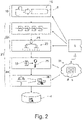
- the bioprocess data 16, just after their generation, are adding up to a continuous data stream S shown in Fig. 2 .
- the digital control unit 1 also comprises a user interface 17 for displaying to a user at least part of the bioprocess data 16 and for receiving the user control command data 18.
- These user control command data 18 may be a command to start and terminate the bioprocess and/or to set certain control parameters such as the stirring speed of the impeller 9a, which the actuator 9 is assigned to.
- the digital control unit 1 is configured to execute a bioprocess control routine 19 via the local processor unit 5 to control the bioprocess. This is indicated in Fig. 2 as well.
- the digital control unit 1 receives the sensor data 12 from the respective sensor 13, 14, 15.
- the digital control unit 1 also generates the actuator data 8 based on the user control command data 18 and/or the sensor data 12 and controls the actuator 9, 10 by sending the actuator data 8 to the actuator 9, 10 thereby influencing the bioprocess. From the actuator data 8 and/or the sensor data 12 and/or the user control command data 18, in the bioprocess control routine 19, the digital control unit 1 generates the bioprocess data 16.
- the bioprocess control routine 19 is preferably based on a control software running on the local processor unit 5, which may be structured as a sequence program, which may include rules to control the actuator 9, 10, control loops or the like.
- data integrity with respect to the bioprocess data 16 is ensured by applying asymmetric cryptography, which is being controlled by the digital control unit 1 and which is being executed by an external signing unit s.
- asymmetric cryptography which is being controlled by the digital control unit 1 and which is being executed by an external signing unit s.
- private key data 20 are stored in the external signing unit s.
- the digital control unit 1 is configured to initiate a data safety routine 21 via the local processor unit 5.
- the data safety routine 21 is relying on a safety software, which is run on the local processor unit 5 as well.
- the safety routine 21 includes a documentation routine 22.
- the digital control unit 1 is configured to initiate the documentation routine 22 by the local processor unit 5 within the data safety routine 21, which documentation routine 22 is executed by the local processor unit 5 or an external documentation unit d.
- documentation data 23 are generated from the bioprocess data 16 by the local processor unit 5 or an external documentation unit d, which documentation data 23 are subject to digital signing.
- the data safety routine 21 includes a signing routine 24.
- the digital control unit 1 is configured to initiate the signing routine 24 to be executed by the external signing unit s in the data safety routine 21 and that in the signing routine 24, a cryptographic private key 25 is extracted from the private key data 20 by the external signing unit s.
- the documentation data 23 are then signed with the cryptographic private key 25 by generating a digital signature 26.
- the data connection between the digital control unit 1 on the one hand and the external documentation unit d and/or the external signing unit s on the other hand is realized using a message authentication code (MAC).
- MAC message authentication code
- This not only encrypts the relevant data, but also ensures data integrity.
- the latter may be realized by separately signing the relevant data by the digital control unit 1 with a cryptographic private key stored in the local data storage 4, before transmitting these data to the external signing unit s.
- the documentation routine 22 comprises a step of grouping the bioprocess data 16 into data blocks d i and a step of hashing the data blocks d i generating hashes h i of the data blocks d i , wherein the documentation data 23 are generated from the hashes h i of the data blocks d i .
- the documentation routine 22 comprises a step of hashing the hashes h i of the data blocks d i in form of a tree structure applying a standard hash function.
- the resulting hash tree H is shown in Fig. 3a ).
- this tree structure is a Merkle tree structure.
- the data blocks d i are hashed in form of a tree structure into a hash root h0, wherein the documentation data 23 are generated from the hash root h0.
- the documentation data 23 are identical to the hash root h0.
- hashing various algorithms may be applied.
- the hash algorithms “SHA-1”, “SHA-2”, “BLAKE2” may be applied.
- an elliptic curve digital signature algorithm in particular the signature algorithm "ECDSA”, may be applied.
- the digital control unit 1 may execute the documentation routine 22 during control of the bioprocess in the bioprocess control routine 19. This may also be done by the external signing unit s as noted above.
- the signing routine 24 is executed more than once during the single bioprocess.
- the digital control unit 1 continuously receives the sensor data 12 from the sensor 13, 14, 15 in the bioprocess control routine 19 and continuously sends actuator data 8 to the actuator 9, 10 thereby influencing the bioprocess.
- the term "continuously” here generally means, that the respective actions, here the reception of sensor data 12 and the sending of actuator data 8, are being ongoingly and systematically, preferably periodically, repeated.
- the step of grouping the bioprocess data 16 into data blocks d i and/or the step of hashing the data blocks d i is/are preferably initiated with the start of the bioprocess.
- the signing routine 24 is executed a first time and at least a further time during the single bioprocess, wherein a subsequent signing routine 24, which is based on a subsequent bioprocess data step, is being executed subsequently to a previous signing routine 24, which is based on a previous bioprocess dataset.
- the respective previous bioprocess dataset and the respective subsequent bioprocess dataset are overlapping each other, such that it is ensured that all data of the bioprocess data 16 are being included into the signing routine 24.
- the digital control unit 1 or the external documentation unit d adds an identifier of the respective previous bioprocess dataset to the respective subsequent bioprocess dataset.
- the digital control unit 1 or the external signing unit s adds time stamps to the documentation data 23.
- This time stamp accordingly relates to the time of executing the signing routine 24.
- the bioprocess data 16 may include a time stamp for each bioprocess data item defining its creation.
- control measures may, for example, be a specific design of the control software and/or the safety software, such that access to the respective data is not possible via the user interface 17. Mechanical measures in this sense are to design the digital control unit 1 altogether in a mechanically robust fashion.
- the digital control unit 1 generates the bioprocess data 16 based on the sensor data 12 and/or the actuator data 8 and/or the user control command data 18. According to the easiest approach, these data are sequentially arranged based on specific rules, that define, which of these data are to be assigned to the documentation data 23.
- each data item of the bioprocess data 16 comprises at least the above noted, individual time stamp, a data item name and a data item value.
- the generation of the bioprocess data 16 is done continuously, preferably periodically with a period defined with relation to time or data volume.
- the step of grouping the bioprocess data 16 into data blocks d i during the documentation routine 22 is preferably done continuously as well.
- the hashing of the data blocks d i during the documentation routine 22 is preferably performed continuously. This continuous generation of bioprocess data 16, grouping into data blocks d i and hashing is advantageous, as the time frame, in which manipulation of data is still possible, is narrowed to a minimum.
- bioprocess data 16 As a result of the above, it is to be expected, that for an individual time stamp, a whole number of bioprocess data items exist, which have to be arranged in the bioprocess data 16.
- the data items of the bioprocess data 16 of the same individual time stamp are arranged in the bioprocess data 16 according to a predefined, total order function, for example a predefined sorting function.
- the digital control unit 1 or the external documentation unit d generates a link information regarding the logical relation between at least part of the sensor data 12 and/or the actuator data 8 and/or the user control command data 18 to each other and generates the bioprocess data 16 also based on the link information.
- the digital control unit 1 controls the bioprocess by communicating with the actuator 9, 10 and the sensor 13, 14, 15.
- the digital control unit 1 is configured to execute a feedback routine for realizing a control loop as noted above thereby influencing the bioprocess.
- Such control loop may serve to keep certain sensor data 12 stable by controlling the actuator 9, 10 accordingly.
- the digital control unit 1 has a casing 27, which should be robust as also noted above in order to prevent manipulation.
- the digital control unit 1 is a mobile unit that can be moved with the local processor unit 5 and the local data storage 4 through a laboratory.
- the local processor unit 5 and the local data storage 4 are connected via, here and preferably electrical, cables and/or short range wireless communication to the sensor 13, 14, 15 and/or the actuator 9, 10.
- the user interface 17 may well comprise a user display and a user input device, in particular a touch screen, each of which are located in or on the casing 27 of the digital control unit 1.
- the bioprocess interface 6 comprises a direct, electrical data-wise connection to the sensor 13, 14, 15 and/or the actuator 9, 10. This further reduces opportunities to manipulate data within the connection.
- direct refers to the definition of the expression "direct”.
- the digital signature 26 generated by signing the documentation data 23 is stored in the local data storage 4.
- the digital control unit 1 may comprise a data transmission interface 28, wherein the digital control unit 1 transmits the digital signature 26 and/or the documentation data 23 and/or the bioprocess data 16 or parts of the respective data to an external data storage 29, which generally may be a process control system, which itself may well be another digital control unit.
- the external data storage 29 is a so called “multifermenter" control system (MFCS), which comprises a local processor unit and a local data storage itself.
- the MFCS also provides a centralized process management system, dispatching requests to the digital control unit 1, which, however, does not play a role for this particular invention.
- the external documentation unit d and/or the external signing unit s is provided by a laboratory process control system 30 or a cloud service instance 31. Both alternatives are displayed in Fig. 1 , while in Fig. 2 , only the alternative of the documentation unit d and/or the signing unit s being provided by a cloud service instance 31 is displayed. This shows the high degree of flexibility in view of realizing the signing routine.
- bioprocess data that have been generated in a biotechnological environment during the bioprocess
- a sender may be the operator of the biotechnological environment, in which the respective bioprocess has been executed.
- the recipient may be a governmental organisation applying a compliance procedure to the bioprocess in question.
- the recipient of the bioprocess data 16 is able to verify the integrity of these bioprocess data 16.
- the public key which corresponds to the cryptographic private key 25, has also to be made available to the recipient.
- the public key may be provided by the sender of the bioprocess data 16 directly to the recipient or using a trusted key infrastructure (TKI).
- TKI trusted key infrastructure
- the recipient may decrypt the digital signature 26 to receive the documentation data 23, which may be the hash root h0 or the complete hash tree H shown in Fig. 3a ).
- the respective hash function to the received bioprocess data 16 leads to a hash tree, which is called the "verification hash tree V" in the following and which is shown in Fig. 3b ).
- the bioprocess data d 4 has been manipulated, which leads to the hashes h4', h34', h1234' and h0' being different from the hashes of the original hashes h4, h34, h1234 and h0. If the documentation data 23 are only based on the hash root h0, the recipient knows, that at least some data block d i is corrupted. If the documentation data 23 are only based on the complete hash tree H, the recipient may even derive by comparing the hash tree H to the verification hash tree V that data block d 4 is corrupted.
- the digital control unit 1 is claimed as such, which is configured to perform the proposed method. All explanations given before are fully applicable to this teaching.
- a control system with a proposed digital control unit 1 and an external documentation unit d and/or an external signing unit s is proposed as such. Again, reference is made to all explanations given before.
- independent teachings are directed to the data processing system for the realization of the above noted method, preferably comprising the local data storage 4 and the local processor unit 5, to a computer program product for the data processing system and to a computer readable storage media, on which the computer program product is stored.
Landscapes
- Engineering & Computer Science (AREA)
- Computer Security & Cryptography (AREA)
- Computer Networks & Wireless Communication (AREA)
- Signal Processing (AREA)
- Computing Systems (AREA)
- Computer Hardware Design (AREA)
- General Engineering & Computer Science (AREA)
- General Physics & Mathematics (AREA)
- Physics & Mathematics (AREA)
- Automation & Control Theory (AREA)
- Health & Medical Sciences (AREA)
- General Health & Medical Sciences (AREA)
- Theoretical Computer Science (AREA)
- Medical Informatics (AREA)
- Bioethics (AREA)
- Software Systems (AREA)
- Stored Programmes (AREA)
- Management, Administration, Business Operations System, And Electronic Commerce (AREA)
Priority Applications (4)
| Application Number | Priority Date | Filing Date | Title |
|---|---|---|---|
| EP20199398.7A EP3979586A1 (fr) | 2020-09-30 | 2020-09-30 | Procédé pour réaliser un processus biologique |
| CN202180067150.2A CN116267020A (zh) | 2020-09-30 | 2021-09-16 | 用于实施生物过程的方法 |
| PCT/EP2021/075495 WO2022069244A1 (fr) | 2020-09-30 | 2021-09-16 | Procédé pour réaliser un processus biologique |
| US18/029,280 US12445456B2 (en) | 2020-09-30 | 2021-09-16 | Method for conducting a bioprocess |
Applications Claiming Priority (1)
| Application Number | Priority Date | Filing Date | Title |
|---|---|---|---|
| EP20199398.7A EP3979586A1 (fr) | 2020-09-30 | 2020-09-30 | Procédé pour réaliser un processus biologique |
Publications (1)
| Publication Number | Publication Date |
|---|---|
| EP3979586A1 true EP3979586A1 (fr) | 2022-04-06 |
Family
ID=72709183
Family Applications (1)
| Application Number | Title | Priority Date | Filing Date |
|---|---|---|---|
| EP20199398.7A Pending EP3979586A1 (fr) | 2020-09-30 | 2020-09-30 | Procédé pour réaliser un processus biologique |
Country Status (4)
| Country | Link |
|---|---|
| US (1) | US12445456B2 (fr) |
| EP (1) | EP3979586A1 (fr) |
| CN (1) | CN116267020A (fr) |
| WO (1) | WO2022069244A1 (fr) |
Families Citing this family (1)
| Publication number | Priority date | Publication date | Assignee | Title |
|---|---|---|---|---|
| EP3979586A1 (fr) | 2020-09-30 | 2022-04-06 | Sartorius Stedim Biotech GmbH | Procédé pour réaliser un processus biologique |
Citations (5)
| Publication number | Priority date | Publication date | Assignee | Title |
|---|---|---|---|---|
| DE10237082A1 (de) | 2002-08-09 | 2004-02-19 | Sartorius Ag | Verfahren und Vorrichtung zur biotechnologischen Herstellung von Wertstoffen |
| US20040039706A1 (en) * | 2002-06-19 | 2004-02-26 | Skowron John M. | System and method for digitally authenticating facility management reports |
| EP2565832A2 (fr) * | 2011-08-31 | 2013-03-06 | Q-Tag AG | Procédés et dispositifs permettant de surveiller l'intégrité d'un article pendant le transport de l'article |
| US8719576B2 (en) | 2003-12-22 | 2014-05-06 | Guardtime IP Holdings, Ltd | Document verification with distributed calendar infrastructure |
| CN110675150A (zh) * | 2019-09-24 | 2020-01-10 | 支付宝(杭州)信息技术有限公司 | 基于联盟链的合规管理监督方法和装置 |
Family Cites Families (16)
| Publication number | Priority date | Publication date | Assignee | Title |
|---|---|---|---|---|
| AU2002248604A1 (en) * | 2001-03-09 | 2002-09-24 | Pascal Brandys | System and method of user and data verification |
| US9050379B2 (en) * | 2007-05-08 | 2015-06-09 | Finesse Solutions, Inc. | Bioprocess data management |
| US8452969B2 (en) * | 2009-09-16 | 2013-05-28 | GM Global Technology Operations LLC | Flexible broadcast authentication in resource-constrained systems: providing a tradeoff between communication and computational overheads |
| DE102011085518A1 (de) * | 2011-10-31 | 2013-05-02 | Siemens Aktiengesellschaft | Intelligentes Prozessinstrument |
| KR102216877B1 (ko) * | 2014-02-19 | 2021-02-18 | 삼성전자 주식회사 | 전자장치에서 생체 정보를 이용한 인증 방법 및 장치 |
| EP3140779A4 (fr) * | 2014-05-09 | 2017-11-29 | Google LLC | Systèmes et procédés pour l'utilisation de signaux oculaires avec des communications mobiles sécurisées |
| US10061910B2 (en) * | 2015-06-09 | 2018-08-28 | Intel Corporation | Secure biometric data capture, processing and management for selectively prohibiting access to a data storage component from an application execution environment |
| KR102470570B1 (ko) * | 2015-07-14 | 2022-11-24 | 삼성전자주식회사 | 결제 시스템, 전자 장치 및 전자 장치의 결제 방법 |
| CN105975839B (zh) * | 2016-06-12 | 2019-07-05 | 北京集创北方科技股份有限公司 | 一种生物特征识别装置和方法以及生物特征模板注册方法 |
| CN105975837B (zh) * | 2016-06-12 | 2019-04-30 | 北京集创北方科技股份有限公司 | 计算设备、生物特征识别方法和模板注册方法 |
| EP3287396B1 (fr) * | 2016-08-25 | 2023-12-06 | Körber Supply Chain Logistics GmbH | Systeme d'alimentation a segments |
| KR102734807B1 (ko) * | 2016-10-14 | 2024-11-27 | 삼성전자주식회사 | 전자 장치들 간 연결 방법 및 장치 |
| EP3536002B1 (fr) * | 2016-11-08 | 2020-11-18 | Aware, Inc. | Authentification d'identité biométrique décentralisée |
| WO2018197273A1 (fr) * | 2017-04-28 | 2018-11-01 | Ge Healthcare Bio-Sciences Ab | Procédé et système de création de flux de travaux de bioprocédé reconfigurables |
| US12198138B1 (en) * | 2020-05-21 | 2025-01-14 | Wells Fargo Bank, N.A. | Distributed ledger technology utilizing cardless payments |
| EP3979586A1 (fr) | 2020-09-30 | 2022-04-06 | Sartorius Stedim Biotech GmbH | Procédé pour réaliser un processus biologique |
-
2020
- 2020-09-30 EP EP20199398.7A patent/EP3979586A1/fr active Pending
-
2021
- 2021-09-16 WO PCT/EP2021/075495 patent/WO2022069244A1/fr not_active Ceased
- 2021-09-16 CN CN202180067150.2A patent/CN116267020A/zh active Pending
- 2021-09-16 US US18/029,280 patent/US12445456B2/en active Active
Patent Citations (5)
| Publication number | Priority date | Publication date | Assignee | Title |
|---|---|---|---|---|
| US20040039706A1 (en) * | 2002-06-19 | 2004-02-26 | Skowron John M. | System and method for digitally authenticating facility management reports |
| DE10237082A1 (de) | 2002-08-09 | 2004-02-19 | Sartorius Ag | Verfahren und Vorrichtung zur biotechnologischen Herstellung von Wertstoffen |
| US8719576B2 (en) | 2003-12-22 | 2014-05-06 | Guardtime IP Holdings, Ltd | Document verification with distributed calendar infrastructure |
| EP2565832A2 (fr) * | 2011-08-31 | 2013-03-06 | Q-Tag AG | Procédés et dispositifs permettant de surveiller l'intégrité d'un article pendant le transport de l'article |
| CN110675150A (zh) * | 2019-09-24 | 2020-01-10 | 支付宝(杭州)信息技术有限公司 | 基于联盟链的合规管理监督方法和装置 |
Non-Patent Citations (1)
| Title |
|---|
| ANONYMOUS: "Your Guide to Upstream Processing Solutions From Research to Production", 1 September 2016 (2016-09-01), XP055443113, Retrieved from the Internet <URL:https://www.connect-upstream.com/fileadmin/media/pdf/Cata_Upstream_S--1526-e.pdf> [retrieved on 20180122] * |
Also Published As
| Publication number | Publication date |
|---|---|
| US20230370475A1 (en) | 2023-11-16 |
| CN116267020A (zh) | 2023-06-20 |
| US12445456B2 (en) | 2025-10-14 |
| WO2022069244A1 (fr) | 2022-04-07 |
Similar Documents
| Publication | Publication Date | Title |
|---|---|---|
| Yin et al. | M2M security technology of CPS based on blockchains | |
| US12438729B2 (en) | Digital control unit of a bioprocess arrangement | |
| Kitney et al. | Build a sustainable vaccines industry with synthetic biology | |
| EP3430391A1 (fr) | Développement automatisé de bioprocessus | |
| Lakhan et al. | Dynamic application partitioning and task-scheduling secure schemes for biosensor healthcare workload in mobile edge cloud | |
| US12445456B2 (en) | Method for conducting a bioprocess | |
| Junaid | Artificial intelligence driven innovations in biochemistry: A review of emerging research frontiers | |
| Wang et al. | Dynamically reconfigurable encryption and decryption system design for the internet of things information security | |
| US12432072B2 (en) | Method for conducting a bioprocess | |
| US20240312585A1 (en) | Automatic task optimization methods in production and research facilities | |
| WO2016125259A1 (fr) | Dispositif de génération de commande d'action, procédé de génération de commande d'action, programme informatique et système de traitement | |
| Chopda et al. | Bridging the gap between PAT concepts and implementation: An integrated software platform for fermentation | |
| Chuang et al. | Develop real-time robot control architecture using robot operating system and ethercat | |
| Ma et al. | Integrating engineering, automation, and intelligence to catalyze the biomedical translation of organoids | |
| Whitford | Bioprocess intensification: technologies and goals | |
| Gao et al. | The data privacy protection method for hyperledger fabric based on trustzone | |
| Lakhan et al. | Potent blockchain-enabled socket RPC internet of healthcare things (IoHT) framework for medical enterprises | |
| Liu et al. | Throughput optimization for blockchain system with dynamic sharding | |
| You et al. | Evolution of industrial robots from the perspective of the metaverse: Integration of virtual and physical realities and human–robot collaboration | |
| Agmon et al. | A multi-scale approach to modeling E. coli chemotaxis | |
| Seo et al. | Advancements and challenges in next-generation mRNA vaccine manufacturing systems | |
| CN115083535B (zh) | 生物制药车间组态数字孪生构建方法及系统 | |
| Kim et al. | A Coordination Layer for Time Synchronization in Level-4 Multi-vECU Simulation | |
| WO2017096308A1 (fr) | Systèmes et procédés d'analyse de données afin de former des tables de données structurées | |
| CN114282877A (zh) | 支持生物技术实验室的用户的方法 |
Legal Events
| Date | Code | Title | Description |
|---|---|---|---|
| PUAI | Public reference made under article 153(3) epc to a published international application that has entered the european phase |
Free format text: ORIGINAL CODE: 0009012 |
|
| STAA | Information on the status of an ep patent application or granted ep patent |
Free format text: STATUS: THE APPLICATION HAS BEEN PUBLISHED |
|
| AK | Designated contracting states |
Kind code of ref document: A1 Designated state(s): AL AT BE BG CH CY CZ DE DK EE ES FI FR GB GR HR HU IE IS IT LI LT LU LV MC MK MT NL NO PL PT RO RS SE SI SK SM TR |
|
| STAA | Information on the status of an ep patent application or granted ep patent |
Free format text: STATUS: REQUEST FOR EXAMINATION WAS MADE |
|
| 17P | Request for examination filed |
Effective date: 20220928 |
|
| RBV | Designated contracting states (corrected) |
Designated state(s): AL AT BE BG CH CY CZ DE DK EE ES FI FR GB GR HR HU IE IS IT LI LT LU LV MC MK MT NL NO PL PT RO RS SE SI SK SM TR |
|
| STAA | Information on the status of an ep patent application or granted ep patent |
Free format text: STATUS: EXAMINATION IS IN PROGRESS |
|
| 17Q | First examination report despatched |
Effective date: 20231017 |
|
| RAP3 | Party data changed (applicant data changed or rights of an application transferred) |
Owner name: SARTORIUS STEDIM BIOTECH GMBH |