EP3287396B1 - Systeme d'alimentation a segments - Google Patents
Systeme d'alimentation a segments Download PDFInfo
- Publication number
- EP3287396B1 EP3287396B1 EP16185726.3A EP16185726A EP3287396B1 EP 3287396 B1 EP3287396 B1 EP 3287396B1 EP 16185726 A EP16185726 A EP 16185726A EP 3287396 B1 EP3287396 B1 EP 3287396B1
- Authority
- EP
- European Patent Office
- Prior art keywords
- conveying means
- piece goods
- conveying
- segment
- conveyor
- Prior art date
- Legal status (The legal status is an assumption and is not a legal conclusion. Google has not performed a legal analysis and makes no representation as to the accuracy of the status listed.)
- Active
Links
Images


Classifications
-
- B—PERFORMING OPERATIONS; TRANSPORTING
- B65—CONVEYING; PACKING; STORING; HANDLING THIN OR FILAMENTARY MATERIAL
- B65G—TRANSPORT OR STORAGE DEVICES, e.g. CONVEYORS FOR LOADING OR TIPPING, SHOP CONVEYOR SYSTEMS OR PNEUMATIC TUBE CONVEYORS
- B65G37/00—Combinations of mechanical conveyors of the same kind, or of different kinds, of interest apart from their application in particular machines or use in particular manufacturing processes
-
- B—PERFORMING OPERATIONS; TRANSPORTING
- B65—CONVEYING; PACKING; STORING; HANDLING THIN OR FILAMENTARY MATERIAL
- B65G—TRANSPORT OR STORAGE DEVICES, e.g. CONVEYORS FOR LOADING OR TIPPING, SHOP CONVEYOR SYSTEMS OR PNEUMATIC TUBE CONVEYORS
- B65G43/00—Control devices, e.g. for safety, warning or fault-correcting
- B65G43/10—Sequence control of conveyors operating in combination
-
- G—PHYSICS
- G05—CONTROLLING; REGULATING
- G05B—CONTROL OR REGULATING SYSTEMS IN GENERAL; FUNCTIONAL ELEMENTS OF SUCH SYSTEMS; MONITORING OR TESTING ARRANGEMENTS FOR SUCH SYSTEMS OR ELEMENTS
- G05B13/00—Adaptive control systems, i.e. systems automatically adjusting themselves to have a performance which is optimum according to some preassigned criterion
- G05B13/02—Adaptive control systems, i.e. systems automatically adjusting themselves to have a performance which is optimum according to some preassigned criterion electric
- G05B13/0265—Adaptive control systems, i.e. systems automatically adjusting themselves to have a performance which is optimum according to some preassigned criterion electric the criterion being a learning criterion
-
- B—PERFORMING OPERATIONS; TRANSPORTING
- B07—SEPARATING SOLIDS FROM SOLIDS; SORTING
- B07C—POSTAL SORTING; SORTING INDIVIDUAL ARTICLES, OR BULK MATERIAL FIT TO BE SORTED PIECE-MEAL, e.g. BY PICKING
- B07C1/00—Measures preceding sorting according to destination
- B07C1/02—Forming articles into a stream; Arranging articles in a stream, e.g. spacing, orientating
- B07C1/04—Forming a stream from a bulk; Controlling the stream, e.g. spacing the articles
-
- B—PERFORMING OPERATIONS; TRANSPORTING
- B07—SEPARATING SOLIDS FROM SOLIDS; SORTING
- B07C—POSTAL SORTING; SORTING INDIVIDUAL ARTICLES, OR BULK MATERIAL FIT TO BE SORTED PIECE-MEAL, e.g. BY PICKING
- B07C1/00—Measures preceding sorting according to destination
- B07C1/02—Forming articles into a stream; Arranging articles in a stream, e.g. spacing, orientating
- B07C1/06—Orientating; Aligning ; Aligning to one edge
-
- B—PERFORMING OPERATIONS; TRANSPORTING
- B65—CONVEYING; PACKING; STORING; HANDLING THIN OR FILAMENTARY MATERIAL
- B65G—TRANSPORT OR STORAGE DEVICES, e.g. CONVEYORS FOR LOADING OR TIPPING, SHOP CONVEYOR SYSTEMS OR PNEUMATIC TUBE CONVEYORS
- B65G15/00—Conveyors having endless load-conveying surfaces, i.e. belts and like continuous members, to which tractive effort is transmitted by means other than endless driving elements of similar configuration
- B65G15/22—Conveyors having endless load-conveying surfaces, i.e. belts and like continuous members, to which tractive effort is transmitted by means other than endless driving elements of similar configuration comprising a series of co-operating units
-
- B—PERFORMING OPERATIONS; TRANSPORTING
- B65—CONVEYING; PACKING; STORING; HANDLING THIN OR FILAMENTARY MATERIAL
- B65G—TRANSPORT OR STORAGE DEVICES, e.g. CONVEYORS FOR LOADING OR TIPPING, SHOP CONVEYOR SYSTEMS OR PNEUMATIC TUBE CONVEYORS
- B65G43/00—Control devices, e.g. for safety, warning or fault-correcting
- B65G43/08—Control devices operated by article or material being fed, conveyed or discharged
-
- B—PERFORMING OPERATIONS; TRANSPORTING
- B65—CONVEYING; PACKING; STORING; HANDLING THIN OR FILAMENTARY MATERIAL
- B65G—TRANSPORT OR STORAGE DEVICES, e.g. CONVEYORS FOR LOADING OR TIPPING, SHOP CONVEYOR SYSTEMS OR PNEUMATIC TUBE CONVEYORS
- B65G47/00—Article or material-handling devices associated with conveyors; Methods employing such devices
- B65G47/22—Devices influencing the relative position or the attitude of articles during transit by conveyors
- B65G47/24—Devices influencing the relative position or the attitude of articles during transit by conveyors orientating the articles
- B65G47/244—Devices influencing the relative position or the attitude of articles during transit by conveyors orientating the articles by turning them about an axis substantially perpendicular to the conveying plane
- B65G47/2445—Devices influencing the relative position or the attitude of articles during transit by conveyors orientating the articles by turning them about an axis substantially perpendicular to the conveying plane by means of at least two co-operating endless conveying elements
-
- B—PERFORMING OPERATIONS; TRANSPORTING
- B65—CONVEYING; PACKING; STORING; HANDLING THIN OR FILAMENTARY MATERIAL
- B65G—TRANSPORT OR STORAGE DEVICES, e.g. CONVEYORS FOR LOADING OR TIPPING, SHOP CONVEYOR SYSTEMS OR PNEUMATIC TUBE CONVEYORS
- B65G47/00—Article or material-handling devices associated with conveyors; Methods employing such devices
- B65G47/22—Devices influencing the relative position or the attitude of articles during transit by conveyors
- B65G47/26—Devices influencing the relative position or the attitude of articles during transit by conveyors arranging the articles, e.g. varying spacing between individual articles
- B65G47/30—Devices influencing the relative position or the attitude of articles during transit by conveyors arranging the articles, e.g. varying spacing between individual articles during transit by a series of conveyors
- B65G47/31—Devices influencing the relative position or the attitude of articles during transit by conveyors arranging the articles, e.g. varying spacing between individual articles during transit by a series of conveyors by varying the relative speeds of the conveyors forming the series
-
- G—PHYSICS
- G05—CONTROLLING; REGULATING
- G05B—CONTROL OR REGULATING SYSTEMS IN GENERAL; FUNCTIONAL ELEMENTS OF SUCH SYSTEMS; MONITORING OR TESTING ARRANGEMENTS FOR SUCH SYSTEMS OR ELEMENTS
- G05B19/00—Program-control systems
- G05B19/02—Program-control systems electric
- G05B19/418—Total factory control, i.e. centrally controlling a plurality of machines, e.g. direct or distributed numerical control [DNC], flexible manufacturing systems [FMS], integrated manufacturing systems [IMS] or computer integrated manufacturing [CIM]
- G05B19/4189—Total factory control, i.e. centrally controlling a plurality of machines, e.g. direct or distributed numerical control [DNC], flexible manufacturing systems [FMS], integrated manufacturing systems [IMS] or computer integrated manufacturing [CIM] characterised by the transport system
-
- B—PERFORMING OPERATIONS; TRANSPORTING
- B65—CONVEYING; PACKING; STORING; HANDLING THIN OR FILAMENTARY MATERIAL
- B65G—TRANSPORT OR STORAGE DEVICES, e.g. CONVEYORS FOR LOADING OR TIPPING, SHOP CONVEYOR SYSTEMS OR PNEUMATIC TUBE CONVEYORS
- B65G2201/00—Indexing codes relating to handling devices, e.g. conveyors, characterised by the type of product or load being conveyed or handled
- B65G2201/02—Articles
- B65G2201/0285—Postal items, e.g. letters, parcels
-
- B—PERFORMING OPERATIONS; TRANSPORTING
- B65—CONVEYING; PACKING; STORING; HANDLING THIN OR FILAMENTARY MATERIAL
- B65G—TRANSPORT OR STORAGE DEVICES, e.g. CONVEYORS FOR LOADING OR TIPPING, SHOP CONVEYOR SYSTEMS OR PNEUMATIC TUBE CONVEYORS
- B65G2203/00—Indexing code relating to control or detection of the articles or the load carriers during conveying
- B65G2203/02—Control or detection
- B65G2203/0208—Control or detection relating to the transported articles
- B65G2203/0225—Orientation of the article
-
- B—PERFORMING OPERATIONS; TRANSPORTING
- B65—CONVEYING; PACKING; STORING; HANDLING THIN OR FILAMENTARY MATERIAL
- B65G—TRANSPORT OR STORAGE DEVICES, e.g. CONVEYORS FOR LOADING OR TIPPING, SHOP CONVEYOR SYSTEMS OR PNEUMATIC TUBE CONVEYORS
- B65G2203/00—Indexing code relating to control or detection of the articles or the load carriers during conveying
- B65G2203/02—Control or detection
- B65G2203/0208—Control or detection relating to the transported articles
- B65G2203/0233—Position of the article
-
- B—PERFORMING OPERATIONS; TRANSPORTING
- B65—CONVEYING; PACKING; STORING; HANDLING THIN OR FILAMENTARY MATERIAL
- B65G—TRANSPORT OR STORAGE DEVICES, e.g. CONVEYORS FOR LOADING OR TIPPING, SHOP CONVEYOR SYSTEMS OR PNEUMATIC TUBE CONVEYORS
- B65G2203/00—Indexing code relating to control or detection of the articles or the load carriers during conveying
- B65G2203/04—Detection means
- B65G2203/042—Sensors
- B65G2203/044—Optical
-
- Y—GENERAL TAGGING OF NEW TECHNOLOGICAL DEVELOPMENTS; GENERAL TAGGING OF CROSS-SECTIONAL TECHNOLOGIES SPANNING OVER SEVERAL SECTIONS OF THE IPC; TECHNICAL SUBJECTS COVERED BY FORMER USPC CROSS-REFERENCE ART COLLECTIONS [XRACs] AND DIGESTS
- Y02—TECHNOLOGIES OR APPLICATIONS FOR MITIGATION OR ADAPTATION AGAINST CLIMATE CHANGE
- Y02P—CLIMATE CHANGE MITIGATION TECHNOLOGIES IN THE PRODUCTION OR PROCESSING OF GOODS
- Y02P90/00—Enabling technologies with a potential contribution to greenhouse gas [GHG] emissions mitigation
- Y02P90/02—Total factory control, e.g. smart factories, flexible manufacturing systems [FMS] or integrated manufacturing systems [IMS]
Definitions
- the present invention relates to the technical field of a conveyor system for piece goods.
- Piece goods are transported on a conveyor system along a conveyor route, with manipulation of the piece goods transported along a main transport direction, for example separation and/or rotation, taking place without the use of further devices such as baffles or the like, in that the piece goods are transported via more than one conveyor .
- Singulators are used to separate piece goods in the postal and logistical sectors, which can also partially align the piece goods.
- WO2004/039706 describes a singulator with conveyor belts arranged one behind the other and parallel to one another as conveying means, which transport piece goods along a main conveying direction.
- the conveying means arranged transversely to the main conveying direction and parallel to one another form segments and by controlling the conveying means of a segment differently, the piece goods are separated and/or rotated.
- WO 2006/002156 A1 discloses a conveyor system for transporting piece goods according to the preamble of claim 1 and a method for transporting piece goods according to the preamble of claim 6.
- the present invention is based on the object of transporting piece goods, especially smaller pieces of goods, on a conveyor system and thereby manipulating them efficiently during their transport. This object is achieved by a conveyor system for transporting piece goods according to claim 1 and by a method for transporting piece goods according to claim 6.
- a conveyor system for transporting piece goods, in particular mail items, along a main conveying direction comprising a control unit and a conveying path.
- the conveyor line includes segments that are arranged one behind the other along the main conveying direction.
- the segments comprise conveying means arranged essentially parallel to one another, for example conveyor belts, which are designed to transport the piece goods along the main conveying direction.
- the funding can be driven individually and controlled individually by the control unit.
- the conveying means of neighboring segments are arranged offset from one another transversely to the main conveying direction.
- a segment includes one or more conveyors that are designed to transport the piece goods along the main conveying direction.
- a funding from a previous segment leads to two or more funding from a subsequent segment.
- a segment includes two or more conveyors
- two piece goods transferred in parallel at the same level in a previous segment can be transferred to different conveyors in the following segment. This means that these piece goods can be transported at different speeds by the different conveying means and can therefore be separated. But even if only one item is transferred, but it rests on two different conveyors on the following segment, the alignment can be changed by different speeds of control.
- the segments are arranged offset from one another transversely to the main conveying direction by arranging the conveying means of adjacent segments offset from one another.
- a funding means of a preceding segment flows into two or more funding means of a subsequent segment.
- one or more segments can include similar conveying means.
- the same type of funding can also be controlled in the same way; construction and maintenance require the same expertise for all funding means. This reduces the complexity of the conveyor system.
- the conveyor system can comprise at least one sensor, which is designed to detect the position and/or orientation of the piece goods and the control unit can be adapted to control the conveying means in response to the detected position and/or orientation of the piece goods.
- the conveying means can be controlled particularly efficiently, individually adapted to the respective position and/or orientation of the piece goods on the conveyor system, which can therefore manipulate the piece goods particularly efficiently.
- an initial standard orientation of the piece goods is not necessary.
- control unit can be adapted to rotate and/or separate a piece of goods by controlling the conveying speed of the conveying means, in particular those conveying means on which the piece of goods lies and/or the directly adjacent conveying means.
- a calculation of the rotation and/or separation to be achieved can be carried out with a computing capacity that is adapted to the complexity of the control unit, since all funding can be included in the calculation, but does not have to be.
- a segment comprises one or more conveyors that are designed to transport the piece goods along the main conveying direction.
- the segments arranged one behind the other can be designed very flexibly with regard to the width and arrangement of their conveying means.
- the subsequent segment is arranged offset from the preceding segment by the conveying means of the subsequent one Segments are arranged offset from one another to the funding of the previous segment.
- an offset can be achieved in a particularly simple manner even with funding of different widths.
- a funding means of the preceding segment flows into two or more funding means of the following segment.
- one or more piece goods of the preceding segment initially resting on one conveyor of the preceding segment can be transferred to two or more conveyors of the subsequent segment solely by moving in the main conveying direction and can be further transported individually by individually controlling these conveyors and thus separated and/or rotated . If the conveying means of the preceding and subsequent segments are arranged in a line, the one or more piece goods would also have to be moved transversely to the main conveying direction, which would require more complex conveying means and also a more complicated control.
- the conveying means of adjacent segments can be arranged in such a way that a piece of goods is transferred from one conveying means of the preceding segment to two conveying means of the following segment.
- this arrangement enables a particularly simple separation of two piece goods arranged in parallel on the conveyor of the previous segment after transfer.
- detection can be carried out of the position and/or orientation of the piece goods on the conveyor system and control of the conveying means in response to the detected position and/or orientation of the piece goods.
- rotating and/or separating the piece goods can be done by controlling the conveying speed of the conveying means, in particular those conveying means on which the piece goods rest and/or the directly adjacent conveying means.
- the less funding used for checking the less complex and clearer the calculation and implementation of the procedure.
- the transfer from a previous segment to a subsequent segment involves two or more conveying means. If the piece goods are so small that they rest centrally on only one conveyor of the preceding segment, this ensures that they are transferred to one or more conveyors of the following segment.
- the piece goods are no longer centered on the conveyor of the following segment and can now be manipulated; when transferred to two or more conveyors of the subsequent segment, the piece of goods that are now resting on more than one conveyor can pass through Individually driving these two or more subsidies can be manipulated.
- Figure 1 shows a conveyor system 2 corresponding to the state of the art, which transports piece goods 4 along a main conveying direction 6 on a conveyor line 8 resting on conveyors 12.
- the conveying means 12 are arranged parallel to the main conveying direction 6 in segments 10 arranged one behind the other along the main conveying direction 6, aligned and along a line.
- Such a conveyor system 2 is optimized for transporting and manipulating piece goods 4 of a size that corresponds to the support surface of a conveyor 12.
- a typical area of application for such a conveyor system 2 is singulators in the postal and logistical areas.
- the piece goods 4, here postal items, are transferred from one segment 10 to the following segment 10 for transport.
- Large general cargo 4 lie on one or more conveyors 12 at the same time and can therefore be separated and/or rotated during their transport when the conveyors 12 are individually controlled by a control unit 14 (not shown here), for example by the conveyors 12 on which the piece goods 4 in question rest at a higher conveying speed 16 can be operated as the neighboring funding means 12.
- a control unit 14 not shown here
- the conveyors 12 on which the piece goods 4 in question rest at a higher conveying speed 16 can be operated as the neighboring funding means 12.
- two smaller piece goods 4 ' marked with crosses in the drawing, lie together on a conveyor 12.
- the design of the conveyor system 2 with conveying means 12 arranged in a line along the main conveying direction 6 does not enable the two smaller piece goods 4 'to be individually influenced only by controlling the conveying means 12, since these piece goods 4' are always transferred from a conveyor 12 of a preceding segment 10 to one Funding means 12 of a subsequent segment 10 are transferred together.
- the conveying means 12 transport the piece goods 4 along the main conveying direction 6.
- the two smaller piece goods 4 ' cannot be transferred to two or more different conveying means 12 only by transporting them along the main conveying direction 6.
- Figure 2 shows a conveyor system 2 with segments 10a - 10g arranged alternately offset transversely to the main conveying direction 6 according to the invention.
- the arrangement of the piece goods 4 corresponds to that of Figure 1 and the two smaller pieces of goods 4 'also lie together on the first segment 10a on only one conveyor 12, so that with the Figure 1 shown conveyor system 2, no separation of the smaller piece goods 4 'could take place.
- Due to the offset arrangement of the conveying means 12 of the adjacent segments 10a, 10b the two smaller piece goods 4 ', which are initially completely together lie on a conveyor 12 and are transferred to two different, individually drivable and controllable conveyors 12 of the following segment 10b by sole transport along the main conveying direction. All conveying means 12 are connected to a control unit 14, so that the two smaller piece goods 4 'can be separated by different conveying speeds of the two different conveying means 12 of the following segment 10b.
- a segment 10 extends over almost the entire width of the conveyor line 8.
- the segments 10a - 10g shown in this conveyor system 2 are, according to the invention, arranged regularly and alternately offset.
- the conveying means 12 are designed as conveyor belts, which offer the advantage of a relatively large and flat support surface, are also technically easy to implement and are therefore common conveying means 12, but other configurations, for example transport rollers, transport balls or the like, are also possible.
- a simultaneous use of differently designed funding means 12 - in a segment 10 or in adjacent segments - is also conceivable depending on the area of application.
- the segments (10) are arranged offset from one another in a regularly alternating manner transversely to the main conveying direction (6), in that the conveying means 12 of adjacent segments 10a, 10b are offset from one another.
- the conveyor system 2 shown includes segments 10a - 10g with conveyor belts as similar conveying means 12, each of which has the same width but a different length.
- one or more segments 10 with one or more funding means 12 of different widths can be used, so that one funding means 12 of a preceding segment 10 flows into three or more funding means 12 of a subsequent segment 10. Due to the offset arrangement, some or all of the funding means 12 of different segments 10 are not arranged in a line.
- a piece of goods 4 initially resting solely on a conveyor 12 of a segment 10 will thus rest on two or more conveyors 12 of a segment 10 following in the main conveying direction 6 during transport on the conveyor system 2 along the main conveying direction 6.
- a similar design of the funding means 12 is usually associated with less complexity in the technical implementation, with the similar design of the funding means 12 describing in particular the type of funding means 12, a different width and/or length of the funding means 12 and a different number of funding means 12 Different segment 10 is also included in the term similar funding 12.
- FIG 3 shows, according to a preferred embodiment of the invention, a separation process of two piece goods 4a, 4b, which are initially together, as in Figure 2 roughly parallel aligned with the main conveying direction 6 and resting on a common conveying means 12.
- the entire separation process is shown at different times t (piece goods 4a, 4b), t '(piece goods 4a', 4b') and t "(piece goods 4a", 4b").
- the funding 12a2 of the first segment 10a flows into the two funding means 12b2, 12b3 of the second, subsequent segment 10b, so that the two piece goods 4a, 4b are transferred approximately simultaneously to the segment 10b and the two subsequent conveyors 12b2, 12b3 by transport on the conveyor 12a of the segment 10a along the main conveying direction 6.
- piece goods 4b rest only on the conveyor 12b2, and piece goods 4a rest only on the conveyor 12b3.
- the conveying means 12b2 is now conveyed at the conveying speed 16b along the main transport direction 6, whereby it is either accelerated or transported at a constant transfer speed.
- the general cargo 4a is delayed on the conveyor 12b3 - either by stopping the conveyor 12b3 or operating it at a lower conveying speed 16a.
- the general cargo 4b' is clearly ahead of the general cargo 4a'.
- Both piece goods 4a', 4b' are now transferred to the conveyor 12c2, with the piece goods 4b" already leaving the conveyor 12c2 again when the piece goods 4a" are first taken over.
- the piece goods 4a'', 4b" are then transferred to the following segment 10d with the same, but preferably different, conveying speeds 16a'', 16b" for even better separation - again with a time delay to different conveying means 12d2, 12d3, which can also be controlled individually are.
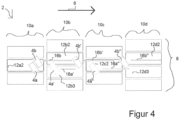
- Figure 4 shows, according to a preferred embodiment of the invention, a separation process of two piece goods 4a, 4b at different times t, t ⁇ and t", which initially together with their focus on only one conveyor 12a2 of the conveyor system 2 of Figure 3 lie on.
- the piece goods 4a, 4b are aligned obliquely to the main conveying direction 6, but since their center of gravity rests mainly on one conveyor 12, separation can be carried out analogously to that in Figure 3 take place.
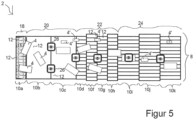
- FIG. 5 shows a schematic representation of a conveyor system 2 according to the invention, which forms a separation and alignment device.
- the conveyor system 2 is subdivided into segments along the main conveying direction 6 that essentially carry out different tasks.
- the piece goods 4, 4 ' are manipulated on a widening device 18 with the aim of widening the piece goods distribution as much as possible by transporting the piece goods 4, 4' along and additionally with a movement component orthogonal to the main conveying direction 6.
- This is then carried out on a transfer conveyor 20 only a transport along the main conveying direction 6.
- the transfer conveyor 20 comprises two segments 10b, 10c, each of which only includes a single conveyor 12 spanning the entire width of the conveyor route 8.
- the alignment section 22 is essentially used to manipulate the alignment of the piece goods 4, 4 'by means of different conveying speeds 16 of the conveying means 12; for this purpose, the segments 10d - 10h are relatively short and arranged offset from one another transversely to the main conveying direction 6.
- the distance correction section 24 is essentially designed to achieve the largest possible distance between the piece goods 4, 4 'along the main conveying direction 6; for this purpose, the conveying means 12 of the distance correction section 24 are designed to be longer than those of the alignment section 22.
- Piece goods 4, 4' of different sizes are transported on the conveyor system 2, with the smaller piece goods 4' being so small that two or more piece goods 4' can rest essentially together on just one conveyor 12.
- the conveyor system 2 comprises several sensors 26 arranged above and along the conveyor path and designed as optical detectors Figure 5 Sensors 26 connected to the control unit 24, not shown, detect the position and orientation of the piece goods 4, 4 ⁇ .
- the control unit 14 controls the conveying means 12 in response to the detected position and/or orientation of the piece goods 4.
- the control unit 14 automatically calculates an optimal control of the funding means 12 using an algorithm.
- the algorithm can, but does not have to, be capable of learning, preferably capable of learning iteratively. In order to use as little computing capacity as possible, the algorithm uses its Calculation of the control of the conveying means 12, in particular those conveying means 12 on which the piece goods 4, 4 'to be separated are currently resting and the directly adjacent conveying means 12.
- the control unit 14 is adapted in this way to rotate and/or a piece of goods 4, 4 'by controlling the conveying speed 16 of the conveying means 12, in particular those conveying means 12 on which the piece of goods 4 rests, and/or the directly adjacent conveying means 12 to isolate.
Landscapes
- Engineering & Computer Science (AREA)
- Mechanical Engineering (AREA)
- Physics & Mathematics (AREA)
- Artificial Intelligence (AREA)
- Automation & Control Theory (AREA)
- General Physics & Mathematics (AREA)
- Computer Vision & Pattern Recognition (AREA)
- Software Systems (AREA)
- Medical Informatics (AREA)
- Evolutionary Computation (AREA)
- Health & Medical Sciences (AREA)
- General Engineering & Computer Science (AREA)
- Manufacturing & Machinery (AREA)
- Quality & Reliability (AREA)
- Attitude Control For Articles On Conveyors (AREA)
- Branching, Merging, And Special Transfer Between Conveyors (AREA)
Claims (10)
- Système de convoyage (2) pour transporter des articles de détail (4), en particulier des envois postaux, le long d'une direction de convoyage principale (6), comprenant une unité de commande (14) et une voie de convoyage (8),
dans lequel- la voie de convoyage (8) comprend plus de deux segments (10) qui sont disposés les uns derrière les autres le long de la direction de convoyage principale (6) ;- les segments (10) comprennent des moyens de convoyage (12) disposés sensiblement parallèlement les uns aux autres, qui sont conçus pour transporter les articles (4) le long de la direction de convoyage principale (6) ;- les moyens de convoyage (12) peuvent être entraînés individuellement et pilotés individuellement par l'unité de commande (14) ;- un moyen de convoyage (12) d'un segment précédent (10) débouche dans deux ou plusieurs moyens de convoyage (12) d'un segment suivant (10) ;- un segment respectif (10) s'étend pratiquement sur toute la largeur de la voie de convoyage (8),caractérisé en ce que
les segments (10) sont disposés régulièrement en alternance en étant décalés les uns par rapport aux autres transversalement à la direction de convoyage principale (6), du fait que les moyens de convoyage (12) de segments adjacents (10) sont décalés les uns par rapport aux autres. - Système de convoyage (2) selon la revendication 1,
caractérisé en ce que
les moyens de convoyage sont réalisés sous forme de bandes transporteuses. - Système de convoyage (2) selon l'une des revendications 1 ou 2,
caractérisé en ce que
un ou plusieurs segments (10) comprennent des moyens de convoyage (12) de même type. - Système de convoyage (2) selon l'une des revendications 1 à 3,
caractérisé en ce quele système de convoyage (2) comprend au moins un capteur (26) qui est conçu pour détecter la position et/ou l'orientation des articles (4), eten ce que l'unité de commande (14) est adaptée pour piloter les moyens de convoyage (12) en réponse à la position et/ou à l'orientation détectée des articles (4). - Système de convoyage (2) selon l'une des revendications 1 à 4,
caractérisé en ce que
l'unité de commande (14) est adaptée pour faire tourner et/ou individualiser un article (4) en contrôlant la vitesse de convoyage (16) des moyens de convoyage (12), en particulier la vitesse des moyens de convoyage (12) sur lesquels repose l'article (4) et/ou la vitesse des moyens de convoyage (12) directement adjacents. - Procédé pour transporter des articles de détail, en particulier des envois postaux, sur une voie de convoyage (8) d'un système de convoyage (2), dans lequel- la voie de convoyage (8) comprend plus de deux segments (10) qui sont disposés les uns derrière les autres le long d'une direction de convoyage principale (6) ;- les segments (10) comprennent des moyens de convoyage (12) disposés sensiblement parallèlement les uns aux autres, qui sont conçus pour transporter les articles (4) le long de la direction de convoyage principale (6) ;- les moyens de convoyage (12) peuvent être entraînés individuellement et pilotés individuellement ;- un moyen de convoyage (12) du segment précédent (10) débouche dans deux ou plusieurs moyens de convoyage (12) du segment suivant (10),comprenant les étapes consistant à :a) transporter un article (4) sur un segment précédent (10a) à l'aide des moyens de convoyage (12) ;b) transférer un article (4) le long de la direction de convoyage principale (6) d'un segment précédent (10a) à un segment suivant (10b) décalé par rapport audit segment précédent (10a), le segment suivant (10) étant décalé par rapport au segment précédent (10) du fait que les moyens de convoyage (12) du segment suivant (10) sont décalés par rapport aux moyens de convoyage (12) du segment précédent (10), un segment (10) respectif s'étendant pratiquement sur toute la largeur de la voie de convoyage (8) ; etc) transporter l'article (4) sur le segment suivant à l'aide des moyens de convoyage (12) ;caractérisé en ce queles segments (10) sont disposés régulièrement en alternance en étant décalés les uns par rapport aux autres transversalement à la direction de convoyage principale (6), du fait que les moyens de convoyage (12) de segments adjacents (10) sont décalés les uns par rapport aux autres.
- Procédé selon la revendication 6,
caractérisé en ce que
les moyens de convoyage (12) sont réalisés sous forme de bandes transporteuses. - Procédé selon l'une des revendications 6 ou 7,
caractérisé en ce que
les moyens de convoyage (12) de segments adjacents (10) sont disposés de telle sorte qu'un article (4) est transféré d'un moyen de convoyage (12) du segment précédent (10) à deux moyens de convoyage (12) du segment suivant (10). - Procédé selon l'une des revendications 6 à 8,
caractérisé par
la détection de la position et/ou de l'orientation des articles (4) sur le système de convoyage (2), et par le pilotage des moyens de convoyage (12) en réponse à la position et/ou à l'orientation détectée des articles. - Procédé selon l'une des revendications 6 à 9,
caractérisé par
la rotation et/ou l'individualisation des articles (4) par contrôle de la vitesse de convoyage (16) des moyens de convoyage (12), en particulier la vitesse des moyens de convoyage (12) sur lesquels reposent les articles (4), et/ou la vitesse des moyens de convoyage (12) directement adjacents.
Priority Applications (3)
| Application Number | Priority Date | Filing Date | Title |
|---|---|---|---|
| EP16185726.3A EP3287396B1 (fr) | 2016-08-25 | 2016-08-25 | Systeme d'alimentation a segments |
| CN201710743988.4A CN107777275B (zh) | 2016-08-25 | 2017-08-25 | 传送系统和用于在传送系统的传送道上运输件货的方法 |
| US15/686,395 US10858199B2 (en) | 2016-08-25 | 2017-08-25 | Conveying system with segments and method for transporting individual items |
Applications Claiming Priority (1)
| Application Number | Priority Date | Filing Date | Title |
|---|---|---|---|
| EP16185726.3A EP3287396B1 (fr) | 2016-08-25 | 2016-08-25 | Systeme d'alimentation a segments |
Publications (2)
| Publication Number | Publication Date |
|---|---|
| EP3287396A1 EP3287396A1 (fr) | 2018-02-28 |
| EP3287396B1 true EP3287396B1 (fr) | 2023-12-06 |
Family
ID=56801438
Family Applications (1)
| Application Number | Title | Priority Date | Filing Date |
|---|---|---|---|
| EP16185726.3A Active EP3287396B1 (fr) | 2016-08-25 | 2016-08-25 | Systeme d'alimentation a segments |
Country Status (3)
| Country | Link |
|---|---|
| US (1) | US10858199B2 (fr) |
| EP (1) | EP3287396B1 (fr) |
| CN (1) | CN107777275B (fr) |
Cited By (1)
| Publication number | Priority date | Publication date | Assignee | Title |
|---|---|---|---|---|
| US20220397887A1 (en) * | 2019-11-20 | 2022-12-15 | Siemens Aktiengesellschaft | Method for computer-implemented configuration of a controlled drive application of a logistics system |
Families Citing this family (16)
| Publication number | Priority date | Publication date | Assignee | Title |
|---|---|---|---|---|
| DE102017120730A1 (de) * | 2017-09-08 | 2019-03-14 | Khs Gmbh | Vorrichtung und Verfahren zur Ausrichtung von Gebinden |
| EP4119472A1 (fr) * | 2018-11-16 | 2023-01-18 | Intelligrated Headquarters, LLC | Déchargeur de carton pour la récupération après bourrage |
| CN109879025B (zh) * | 2019-03-05 | 2024-03-15 | 威海新北洋技术服务有限公司 | 并排物体分离方法及装置 |
| WO2020190255A1 (fr) * | 2019-03-15 | 2020-09-24 | Siemens Logistics Llc | Systèmes et procédés de séparation de colis |
| SE543415C2 (en) * | 2019-05-27 | 2021-01-12 | Itab Shop Products Ab | A conveyor system for a checkout counter |
| US10988319B2 (en) | 2019-08-01 | 2021-04-27 | Intelligrated Headquarters, Llc | Multi-belt conveyor system with removable cartridges |
| US10934101B1 (en) * | 2019-08-14 | 2021-03-02 | Intelligrated Headquarters, Llc | Systems, methods, and apparatuses, for singulating items in a material handling environment |
| US10815069B1 (en) * | 2019-08-19 | 2020-10-27 | Siemens Logistics Llc | Parcel singulation systems and methods |
| CN110756441B (zh) * | 2019-10-18 | 2024-07-19 | 湖南大用智能科技有限公司 | 槟榔分拣系统及其多通道差速传送设备 |
| US10625952B1 (en) * | 2019-10-18 | 2020-04-21 | Grey Orange Pte. Ltd. | Induction station for conveying packages in storage facility |
| EP3979586A1 (fr) * | 2020-09-30 | 2022-04-06 | Sartorius Stedim Biotech GmbH | Procédé pour réaliser un processus biologique |
| ES2966145T3 (es) * | 2021-03-01 | 2024-04-18 | Koerber Supply Chain Logistics Gmbh | Procedimiento implementado por ordenador, dispositivo para el procesamiento de datos y sistema informático para controlar un equipo de regulación de un sistema de transporte |
| DE102022116484A1 (de) | 2022-07-01 | 2024-01-04 | Deutsche Post Ag | Vorrichtung zum Ausrichten von Objekten |
| DE102022116479A1 (de) | 2022-07-01 | 2024-01-04 | Deutsche Post Ag | Vorrichtung zum Ausrichten von Objekten |
| DE102022116482A1 (de) | 2022-07-01 | 2024-01-04 | Deutsche Post Ag | Vorrichtung zum Befördern von Objekten |
| DE102022116481A1 (de) | 2022-07-01 | 2024-01-04 | Deutsche Post Ag | Vorrichtung zum Ausrichten von Objekten |
Citations (1)
| Publication number | Priority date | Publication date | Assignee | Title |
|---|---|---|---|---|
| US20160200525A1 (en) * | 2013-08-26 | 2016-07-14 | Bobst Mex Sa | Method and device for conveying flat objects |
Family Cites Families (7)
| Publication number | Priority date | Publication date | Assignee | Title |
|---|---|---|---|---|
| EP1556297B1 (fr) | 2002-10-29 | 2008-04-23 | Siemens Aktiengesellschaft | Systeme de bande transporteuse permettant de manipuler des articles distribues |
| EP1758803A1 (fr) * | 2004-06-21 | 2007-03-07 | Siemens Corporate Research, Inc. | Separateur d'article a bon espacement et a vitesse elevee |
| EP1666386B1 (fr) * | 2004-12-03 | 2009-01-14 | Bobst S.A. | Méthode d'orientation d'éléments en plaque et dispoitif pour la mise en oeuvre de cette méthode |
| DE102006060303B4 (de) * | 2006-12-20 | 2008-09-11 | Klaus Edelmann | Sorter |
| US8127915B2 (en) * | 2009-12-21 | 2012-03-06 | Martin's Famous Pastry Shoppe, Inc. | System and method for separating a cluster of interconnected food products |
| DE102010015584A1 (de) * | 2010-04-19 | 2011-10-20 | SSI Schäfer Noell GmbH Lager- und Systemtechnik | Matrixförderer zur Verwendung als Sorter oder Palettiervorrichtung |
| US10040640B2 (en) * | 2016-05-04 | 2018-08-07 | Intelligrated Headquarters, Llc | Side-by-side reducer conveyor |
-
2016
- 2016-08-25 EP EP16185726.3A patent/EP3287396B1/fr active Active
-
2017
- 2017-08-25 US US15/686,395 patent/US10858199B2/en active Active
- 2017-08-25 CN CN201710743988.4A patent/CN107777275B/zh active Active
Patent Citations (1)
| Publication number | Priority date | Publication date | Assignee | Title |
|---|---|---|---|---|
| US20160200525A1 (en) * | 2013-08-26 | 2016-07-14 | Bobst Mex Sa | Method and device for conveying flat objects |
Cited By (1)
| Publication number | Priority date | Publication date | Assignee | Title |
|---|---|---|---|---|
| US20220397887A1 (en) * | 2019-11-20 | 2022-12-15 | Siemens Aktiengesellschaft | Method for computer-implemented configuration of a controlled drive application of a logistics system |
Also Published As
| Publication number | Publication date |
|---|---|
| CN107777275A (zh) | 2018-03-09 |
| US20180057271A1 (en) | 2018-03-01 |
| US10858199B2 (en) | 2020-12-08 |
| EP3287396A1 (fr) | 2018-02-28 |
| CN107777275B (zh) | 2021-04-13 |
Similar Documents
| Publication | Publication Date | Title |
|---|---|---|
| EP3287396B1 (fr) | Systeme d'alimentation a segments | |
| EP2704968B1 (fr) | Dispositif de transfert d'objets | |
| EP3678964B1 (fr) | Dispositif et procédé d'orientation de lots de produits | |
| EP3248913B1 (fr) | Convoyeur de singularisation et procédé de transport destinés à séparer une marchandise de détail le long d'au moins une bande de transport | |
| EP3689483B1 (fr) | Dispositif de tri des marchandises générales | |
| EP3115322A1 (fr) | Procede et dispositif destines a la depalettisation de pneus | |
| EP3357839A1 (fr) | Procédé et système de transport destinés à manipuler un flux de produits initial | |
| EP3786089A1 (fr) | Dispositif et procédé de transport et de tri des marchandises de détail | |
| EP3659719B1 (fr) | Dispositif de tri pour marchandises de détail à une pluralité de postes cibles | |
| EP2743193B1 (fr) | Procédé et dispositif de pliage d'un tranche ou d'une portion d'un produit alimentaire découpé | |
| EP1419018A1 (fr) | Dispositif pour trier des envois par categories d'epaisseurs | |
| EP3368452B1 (fr) | Station d'orientation permettant d'orienter un article à transporter transporté dans un système de transport | |
| EP2818254B1 (fr) | Dispositif de séparation d'objets | |
| EP3196154A1 (fr) | Systeme d'alimentation pour marchandises comprenant un dispositif d'alignement | |
| DE102022123092A1 (de) | Verfahren zum Vereinzeln von Vorformlingen sowie Vereinzelungsvorrichtungen | |
| DE102022126949A1 (de) | Vorrichtung zur Förderung und Vereinzelung von Werkstücken | |
| EP3904250B1 (fr) | Dispositif et procédé d'alimentation de produits plans à une unité de traitement | |
| DE102010035126A1 (de) | Verfahren und Vorrichtung zum kontrollierten Übergeben eines Stückguts von einem Zuführförderer auf einen Förderer | |
| EP2945891B1 (fr) | Installation de transport | |
| EP3284705A1 (fr) | Dispositif et procede de transmission controlee de marchandises au detail a l'aide d'un moyen d'orientation | |
| DE102018210473B4 (de) | Kompaktvereinzeler | |
| WO2003028908A1 (fr) | Dispositif de tri d'envois plats par differentes classes d'epaisseur | |
| EP3178759B1 (fr) | Système de convoyeur à rouleaux | |
| DE102015212949B4 (de) | Güterumwerfer | |
| EP3187438B1 (fr) | Transporteur pour marchandises au detail et procede de reparation d'une panne d'un transporteur |
Legal Events
| Date | Code | Title | Description |
|---|---|---|---|
| PUAI | Public reference made under article 153(3) epc to a published international application that has entered the european phase |
Free format text: ORIGINAL CODE: 0009012 |
|
| STAA | Information on the status of an ep patent application or granted ep patent |
Free format text: STATUS: THE APPLICATION HAS BEEN PUBLISHED |
|
| AK | Designated contracting states |
Kind code of ref document: A1 Designated state(s): AL AT BE BG CH CY CZ DE DK EE ES FI FR GB GR HR HU IE IS IT LI LT LU LV MC MK MT NL NO PL PT RO RS SE SI SK SM TR |
|
| AX | Request for extension of the european patent |
Extension state: BA ME |
|
| STAA | Information on the status of an ep patent application or granted ep patent |
Free format text: STATUS: REQUEST FOR EXAMINATION WAS MADE |
|
| 17P | Request for examination filed |
Effective date: 20180806 |
|
| RBV | Designated contracting states (corrected) |
Designated state(s): AL AT BE BG CH CY CZ DE DK EE ES FI FR GB GR HR HU IE IS IT LI LT LU LV MC MK MT NL NO PL PT RO RS SE SI SK SM TR |
|
| STAA | Information on the status of an ep patent application or granted ep patent |
Free format text: STATUS: EXAMINATION IS IN PROGRESS |
|
| 17Q | First examination report despatched |
Effective date: 20200514 |
|
| RAP1 | Party data changed (applicant data changed or rights of an application transferred) |
Owner name: KOERBER SUPPLY CHAIN LOGISTICS GMBH |
|
| GRAP | Despatch of communication of intention to grant a patent |
Free format text: ORIGINAL CODE: EPIDOSNIGR1 |
|
| STAA | Information on the status of an ep patent application or granted ep patent |
Free format text: STATUS: GRANT OF PATENT IS INTENDED |
|
| INTG | Intention to grant announced |
Effective date: 20230328 |
|
| GRAS | Grant fee paid |
Free format text: ORIGINAL CODE: EPIDOSNIGR3 |
|
| P01 | Opt-out of the competence of the unified patent court (upc) registered |
Effective date: 20230523 |
|
| GRAA | (expected) grant |
Free format text: ORIGINAL CODE: 0009210 |
|
| STAA | Information on the status of an ep patent application or granted ep patent |
Free format text: STATUS: THE PATENT HAS BEEN GRANTED |
|
| AK | Designated contracting states |
Kind code of ref document: B1 Designated state(s): AL AT BE BG CH CY CZ DE DK EE ES FI FR GB GR HR HU IE IS IT LI LT LU LV MC MK MT NL NO PL PT RO RS SE SI SK SM TR |
|
| REG | Reference to a national code |
Ref country code: GB Ref legal event code: FG4D Free format text: NOT ENGLISH |
|
| REG | Reference to a national code |
Ref country code: CH Ref legal event code: EP |
|
| REG | Reference to a national code |
Ref country code: DE Ref legal event code: R096 Ref document number: 502016016254 Country of ref document: DE |
|
| REG | Reference to a national code |
Ref country code: IE Ref legal event code: FG4D Free format text: LANGUAGE OF EP DOCUMENT: GERMAN |
|
| REG | Reference to a national code |
Ref country code: NL Ref legal event code: FP |
|
| REG | Reference to a national code |
Ref country code: LT Ref legal event code: MG9D |
|
| PG25 | Lapsed in a contracting state [announced via postgrant information from national office to epo] |
Ref country code: GR Free format text: LAPSE BECAUSE OF FAILURE TO SUBMIT A TRANSLATION OF THE DESCRIPTION OR TO PAY THE FEE WITHIN THE PRESCRIBED TIME-LIMIT Effective date: 20240307 |
|
| PG25 | Lapsed in a contracting state [announced via postgrant information from national office to epo] |
Ref country code: LT Free format text: LAPSE BECAUSE OF FAILURE TO SUBMIT A TRANSLATION OF THE DESCRIPTION OR TO PAY THE FEE WITHIN THE PRESCRIBED TIME-LIMIT Effective date: 20231206 |
|
| PG25 | Lapsed in a contracting state [announced via postgrant information from national office to epo] |
Ref country code: ES Free format text: LAPSE BECAUSE OF FAILURE TO SUBMIT A TRANSLATION OF THE DESCRIPTION OR TO PAY THE FEE WITHIN THE PRESCRIBED TIME-LIMIT Effective date: 20231206 |
|
| PG25 | Lapsed in a contracting state [announced via postgrant information from national office to epo] |
Ref country code: LT Free format text: LAPSE BECAUSE OF FAILURE TO SUBMIT A TRANSLATION OF THE DESCRIPTION OR TO PAY THE FEE WITHIN THE PRESCRIBED TIME-LIMIT Effective date: 20231206 Ref country code: GR Free format text: LAPSE BECAUSE OF FAILURE TO SUBMIT A TRANSLATION OF THE DESCRIPTION OR TO PAY THE FEE WITHIN THE PRESCRIBED TIME-LIMIT Effective date: 20240307 Ref country code: ES Free format text: LAPSE BECAUSE OF FAILURE TO SUBMIT A TRANSLATION OF THE DESCRIPTION OR TO PAY THE FEE WITHIN THE PRESCRIBED TIME-LIMIT Effective date: 20231206 Ref country code: BG Free format text: LAPSE BECAUSE OF FAILURE TO SUBMIT A TRANSLATION OF THE DESCRIPTION OR TO PAY THE FEE WITHIN THE PRESCRIBED TIME-LIMIT Effective date: 20240306 |
|
| PG25 | Lapsed in a contracting state [announced via postgrant information from national office to epo] |
Ref country code: SE Free format text: LAPSE BECAUSE OF FAILURE TO SUBMIT A TRANSLATION OF THE DESCRIPTION OR TO PAY THE FEE WITHIN THE PRESCRIBED TIME-LIMIT Effective date: 20231206 Ref country code: RS Free format text: LAPSE BECAUSE OF FAILURE TO SUBMIT A TRANSLATION OF THE DESCRIPTION OR TO PAY THE FEE WITHIN THE PRESCRIBED TIME-LIMIT Effective date: 20231206 Ref country code: NO Free format text: LAPSE BECAUSE OF FAILURE TO SUBMIT A TRANSLATION OF THE DESCRIPTION OR TO PAY THE FEE WITHIN THE PRESCRIBED TIME-LIMIT Effective date: 20240306 Ref country code: LV Free format text: LAPSE BECAUSE OF FAILURE TO SUBMIT A TRANSLATION OF THE DESCRIPTION OR TO PAY THE FEE WITHIN THE PRESCRIBED TIME-LIMIT Effective date: 20231206 Ref country code: HR Free format text: LAPSE BECAUSE OF FAILURE TO SUBMIT A TRANSLATION OF THE DESCRIPTION OR TO PAY THE FEE WITHIN THE PRESCRIBED TIME-LIMIT Effective date: 20231206 |
|
| PG25 | Lapsed in a contracting state [announced via postgrant information from national office to epo] |
Ref country code: IS Free format text: LAPSE BECAUSE OF FAILURE TO SUBMIT A TRANSLATION OF THE DESCRIPTION OR TO PAY THE FEE WITHIN THE PRESCRIBED TIME-LIMIT Effective date: 20240406 |
|
| PG25 | Lapsed in a contracting state [announced via postgrant information from national office to epo] |
Ref country code: CZ Free format text: LAPSE BECAUSE OF FAILURE TO SUBMIT A TRANSLATION OF THE DESCRIPTION OR TO PAY THE FEE WITHIN THE PRESCRIBED TIME-LIMIT Effective date: 20231206 |
|
| PG25 | Lapsed in a contracting state [announced via postgrant information from national office to epo] |
Ref country code: SK Free format text: LAPSE BECAUSE OF FAILURE TO SUBMIT A TRANSLATION OF THE DESCRIPTION OR TO PAY THE FEE WITHIN THE PRESCRIBED TIME-LIMIT Effective date: 20231206 |
|
| PG25 | Lapsed in a contracting state [announced via postgrant information from national office to epo] |
Ref country code: SM Free format text: LAPSE BECAUSE OF FAILURE TO SUBMIT A TRANSLATION OF THE DESCRIPTION OR TO PAY THE FEE WITHIN THE PRESCRIBED TIME-LIMIT Effective date: 20231206 Ref country code: SK Free format text: LAPSE BECAUSE OF FAILURE TO SUBMIT A TRANSLATION OF THE DESCRIPTION OR TO PAY THE FEE WITHIN THE PRESCRIBED TIME-LIMIT Effective date: 20231206 Ref country code: RO Free format text: LAPSE BECAUSE OF FAILURE TO SUBMIT A TRANSLATION OF THE DESCRIPTION OR TO PAY THE FEE WITHIN THE PRESCRIBED TIME-LIMIT Effective date: 20231206 Ref country code: IS Free format text: LAPSE BECAUSE OF FAILURE TO SUBMIT A TRANSLATION OF THE DESCRIPTION OR TO PAY THE FEE WITHIN THE PRESCRIBED TIME-LIMIT Effective date: 20240406 Ref country code: EE Free format text: LAPSE BECAUSE OF FAILURE TO SUBMIT A TRANSLATION OF THE DESCRIPTION OR TO PAY THE FEE WITHIN THE PRESCRIBED TIME-LIMIT Effective date: 20231206 Ref country code: CZ Free format text: LAPSE BECAUSE OF FAILURE TO SUBMIT A TRANSLATION OF THE DESCRIPTION OR TO PAY THE FEE WITHIN THE PRESCRIBED TIME-LIMIT Effective date: 20231206 |
|
| PG25 | Lapsed in a contracting state [announced via postgrant information from national office to epo] |
Ref country code: PT Free format text: LAPSE BECAUSE OF FAILURE TO SUBMIT A TRANSLATION OF THE DESCRIPTION OR TO PAY THE FEE WITHIN THE PRESCRIBED TIME-LIMIT Effective date: 20240408 Ref country code: PL Free format text: LAPSE BECAUSE OF FAILURE TO SUBMIT A TRANSLATION OF THE DESCRIPTION OR TO PAY THE FEE WITHIN THE PRESCRIBED TIME-LIMIT Effective date: 20231206 |
|
| PG25 | Lapsed in a contracting state [announced via postgrant information from national office to epo] |
Ref country code: PT Free format text: LAPSE BECAUSE OF FAILURE TO SUBMIT A TRANSLATION OF THE DESCRIPTION OR TO PAY THE FEE WITHIN THE PRESCRIBED TIME-LIMIT Effective date: 20240408 Ref country code: PL Free format text: LAPSE BECAUSE OF FAILURE TO SUBMIT A TRANSLATION OF THE DESCRIPTION OR TO PAY THE FEE WITHIN THE PRESCRIBED TIME-LIMIT Effective date: 20231206 |
|
| REG | Reference to a national code |
Ref country code: DE Ref legal event code: R097 Ref document number: 502016016254 Country of ref document: DE |
|
| PGFP | Annual fee paid to national office [announced via postgrant information from national office to epo] |
Ref country code: NL Payment date: 20240821 Year of fee payment: 9 |
|
| PGFP | Annual fee paid to national office [announced via postgrant information from national office to epo] |
Ref country code: DE Payment date: 20240619 Year of fee payment: 9 |
|
| PG25 | Lapsed in a contracting state [announced via postgrant information from national office to epo] |
Ref country code: DK Free format text: LAPSE BECAUSE OF FAILURE TO SUBMIT A TRANSLATION OF THE DESCRIPTION OR TO PAY THE FEE WITHIN THE PRESCRIBED TIME-LIMIT Effective date: 20231206 |
|
| PLBE | No opposition filed within time limit |
Free format text: ORIGINAL CODE: 0009261 |
|
| STAA | Information on the status of an ep patent application or granted ep patent |
Free format text: STATUS: NO OPPOSITION FILED WITHIN TIME LIMIT |
|
| PGFP | Annual fee paid to national office [announced via postgrant information from national office to epo] |
Ref country code: FR Payment date: 20240821 Year of fee payment: 9 |
|
| PG25 | Lapsed in a contracting state [announced via postgrant information from national office to epo] |
Ref country code: SI Free format text: LAPSE BECAUSE OF FAILURE TO SUBMIT A TRANSLATION OF THE DESCRIPTION OR TO PAY THE FEE WITHIN THE PRESCRIBED TIME-LIMIT Effective date: 20231206 |
|
| PG25 | Lapsed in a contracting state [announced via postgrant information from national office to epo] |
Ref country code: SI Free format text: LAPSE BECAUSE OF FAILURE TO SUBMIT A TRANSLATION OF THE DESCRIPTION OR TO PAY THE FEE WITHIN THE PRESCRIBED TIME-LIMIT Effective date: 20231206 Ref country code: DK Free format text: LAPSE BECAUSE OF FAILURE TO SUBMIT A TRANSLATION OF THE DESCRIPTION OR TO PAY THE FEE WITHIN THE PRESCRIBED TIME-LIMIT Effective date: 20231206 |
|
| PGFP | Annual fee paid to national office [announced via postgrant information from national office to epo] |
Ref country code: IT Payment date: 20240830 Year of fee payment: 9 |
|
| 26N | No opposition filed |
Effective date: 20240909 |
|
| REG | Reference to a national code |
Ref country code: CH Ref legal event code: PL |
|
| PG25 | Lapsed in a contracting state [announced via postgrant information from national office to epo] |
Ref country code: LU Free format text: LAPSE BECAUSE OF NON-PAYMENT OF DUE FEES Effective date: 20240825 |
|
| GBPC | Gb: european patent ceased through non-payment of renewal fee |
Effective date: 20240825 |
|
| PG25 | Lapsed in a contracting state [announced via postgrant information from national office to epo] |
Ref country code: CH Free format text: LAPSE BECAUSE OF NON-PAYMENT OF DUE FEES Effective date: 20240831 Ref country code: MC Free format text: LAPSE BECAUSE OF FAILURE TO SUBMIT A TRANSLATION OF THE DESCRIPTION OR TO PAY THE FEE WITHIN THE PRESCRIBED TIME-LIMIT Effective date: 20231206 |
|
| REG | Reference to a national code |
Ref country code: BE Ref legal event code: MM Effective date: 20240831 |
|
| PG25 | Lapsed in a contracting state [announced via postgrant information from national office to epo] |
Ref country code: GB Free format text: LAPSE BECAUSE OF NON-PAYMENT OF DUE FEES Effective date: 20240825 |
|
| PG25 | Lapsed in a contracting state [announced via postgrant information from national office to epo] |
Ref country code: BE Free format text: LAPSE BECAUSE OF NON-PAYMENT OF DUE FEES Effective date: 20240831 |
|
| PG25 | Lapsed in a contracting state [announced via postgrant information from national office to epo] |
Ref country code: IE Free format text: LAPSE BECAUSE OF NON-PAYMENT OF DUE FEES Effective date: 20240825 |
|
| PG25 | Lapsed in a contracting state [announced via postgrant information from national office to epo] |
Ref country code: FI Free format text: LAPSE BECAUSE OF FAILURE TO SUBMIT A TRANSLATION OF THE DESCRIPTION OR TO PAY THE FEE WITHIN THE PRESCRIBED TIME-LIMIT Effective date: 20231207 |
|
| REG | Reference to a national code |
Ref country code: AT Ref legal event code: MM01 Ref document number: 1638219 Country of ref document: AT Kind code of ref document: T Effective date: 20240825 |
|
| PG25 | Lapsed in a contracting state [announced via postgrant information from national office to epo] |
Ref country code: AT Free format text: LAPSE BECAUSE OF NON-PAYMENT OF DUE FEES Effective date: 20240825 |
|
| PG25 | Lapsed in a contracting state [announced via postgrant information from national office to epo] |
Ref country code: CY Free format text: LAPSE BECAUSE OF FAILURE TO SUBMIT A TRANSLATION OF THE DESCRIPTION OR TO PAY THE FEE WITHIN THE PRESCRIBED TIME-LIMIT; INVALID AB INITIO Effective date: 20160825 |
|
| REG | Reference to a national code |
Ref country code: DE Ref legal event code: R119 Ref document number: 502016016254 Country of ref document: DE |
|
| PG25 | Lapsed in a contracting state [announced via postgrant information from national office to epo] |
Ref country code: HU Free format text: LAPSE BECAUSE OF FAILURE TO SUBMIT A TRANSLATION OF THE DESCRIPTION OR TO PAY THE FEE WITHIN THE PRESCRIBED TIME-LIMIT; INVALID AB INITIO Effective date: 20160825 |
|
| REG | Reference to a national code |
Ref country code: NL Ref legal event code: MM Effective date: 20250901 |