EP3990295B1 - Bande de roulement réduisant le bruit - Google Patents
Bande de roulement réduisant le bruit Download PDFInfo
- Publication number
- EP3990295B1 EP3990295B1 EP20736797.0A EP20736797A EP3990295B1 EP 3990295 B1 EP3990295 B1 EP 3990295B1 EP 20736797 A EP20736797 A EP 20736797A EP 3990295 B1 EP3990295 B1 EP 3990295B1
- Authority
- EP
- European Patent Office
- Prior art keywords
- tread
- rubber layer
- shoulder
- center
- rubber composition
- Prior art date
- Legal status (The legal status is an assumption and is not a legal conclusion. Google has not performed a legal analysis and makes no representation as to the accuracy of the status listed.)
- Active
Links
Images
Classifications
-
- B—PERFORMING OPERATIONS; TRANSPORTING
- B60—VEHICLES IN GENERAL
- B60C—VEHICLE TYRES; TYRE INFLATION; TYRE CHANGING; CONNECTING VALVES TO INFLATABLE ELASTIC BODIES IN GENERAL; DEVICES OR ARRANGEMENTS RELATED TO TYRES
- B60C19/00—Tyre parts or constructions not otherwise provided for
- B60C19/002—Noise damping elements provided in the tyre structure or attached thereto, e.g. in the tyre interior
-
- B—PERFORMING OPERATIONS; TRANSPORTING
- B60—VEHICLES IN GENERAL
- B60C—VEHICLE TYRES; TYRE INFLATION; TYRE CHANGING; CONNECTING VALVES TO INFLATABLE ELASTIC BODIES IN GENERAL; DEVICES OR ARRANGEMENTS RELATED TO TYRES
- B60C11/00—Tyre tread bands; Tread patterns; Anti-skid inserts
- B60C11/0041—Tyre tread bands; Tread patterns; Anti-skid inserts comprising different tread rubber layers
- B60C11/005—Tyre tread bands; Tread patterns; Anti-skid inserts comprising different tread rubber layers with cap and base layers
- B60C11/0075—Tyre tread bands; Tread patterns; Anti-skid inserts comprising different tread rubber layers with cap and base layers with different base rubber layers in the axial direction
-
- B—PERFORMING OPERATIONS; TRANSPORTING
- B60—VEHICLES IN GENERAL
- B60C—VEHICLE TYRES; TYRE INFLATION; TYRE CHANGING; CONNECTING VALVES TO INFLATABLE ELASTIC BODIES IN GENERAL; DEVICES OR ARRANGEMENTS RELATED TO TYRES
- B60C11/00—Tyre tread bands; Tread patterns; Anti-skid inserts
- B60C11/24—Wear-indicating arrangements
-
- B—PERFORMING OPERATIONS; TRANSPORTING
- B60—VEHICLES IN GENERAL
- B60C—VEHICLE TYRES; TYRE INFLATION; TYRE CHANGING; CONNECTING VALVES TO INFLATABLE ELASTIC BODIES IN GENERAL; DEVICES OR ARRANGEMENTS RELATED TO TYRES
- B60C11/00—Tyre tread bands; Tread patterns; Anti-skid inserts
- B60C11/0008—Tyre tread bands; Tread patterns; Anti-skid inserts characterised by the tread rubber
- B60C2011/0016—Physical properties or dimensions
- B60C2011/0025—Modulus or tan delta
Definitions
- the present invention relates to a tread for a tire, in particular to a tread for a tire provides improvement on noise performance.
- the noise from the tires includes various components, that is a component from external noise and a component from internal noise.
- the internal noise includes a vibration due to excitation of a tread portion during rolling, the vibration is transmitted to a wheel rim, an axis, a suspension and a body of the vehicle then heard in an interior of the vehicle as noise.
- EP0827845 A1 discloses a tire having a reduced rigidity rubber component interposed between a tread layer and a belt reinforcement, the reduced rigidity rubber component having a hardness and a geometry such that the maximum longitudinal and lateral contact stresses on the tread layer are reduced relative to a tire without such reduced rigidity rubber component.
- WO2012119844 A1 discloses a pneumatic vehicle tire having a tread which is comprised in the radial direction of two layers consisting of different rubber compounds, a tread cap and a tread base, and the tread base viewed in the axial direction has at least directed radially outward, a central segment and two lateral segments, the two lateral segments consist of a rubber compound that has a lower dynamic elastic modulus E' at 55 °C and a lower hysteresis than the central segment of the tread base for a lower rolling resistance without worsening the handling behavior.
- JP2000198319 A discloses a pneumatic tire having a tread portion in a two-layered structure of a cap tread layer and an under tread layer, the under tread layer is constituted by a center region and a shoulder region extended continuously from the center region to an outer, the regions comprising rubber composition different from each other, the center region is arranged with a rubber layer where JIS-A hardness is from 65 to 80, the shoulder region is arranged with a rubber layer where JIS-A hardness is from 50 to 70.
- JP2009286317 A discloses a tire having two layers tread, a base rubber and a cap rubber, the base rubber is divided into a center base rubber segment located at the widthwise center and shoulder base rubber segments located on both sides outside the center base rubber segment in the width direction, a dynamic modulus of the elasticity (E') of the center base rubber segment is 8.0 to 18.0 at 30°C, the dynamic modulus of the elasticity (E') of the shoulder base rubber segments is 3.0 to 7.0 at 30°C.
- WO2014005929 A1 discloses a tire with a radial carcass reinforcement, having a crown reinforcement, itself capped radially by a tread connected to two beads by two sidewalls, the tread having at least two layers of blended elastomeric compounds that are radially superposed and have a voids ratio that is lower in the central part than at the axially outer parts.
- a first layer of blended elastomeric compounds of the tread is made up of a first blended elastomeric compound forming a part extending at least into the region of the equatorial plane and of at least two axially outer parts formed of a second blended elastomeric compound, the first blended elastomeric compound having a macro dispersion Z-value higher than 65 and a maximum tan(6) value, denoted tan( ⁇ )max, lower than 0.150, and the second blended elastomeric compound having a maximum tan(6) value, denoted tan( ⁇ )max, lower than 0.130.
- EP2522530 A1 discloses a tire having a rubber tread comprised of cap/base construction where the tread outer cap rubber layer contains the running surface of the tread and the tread base rubber layer underlies the tread cap layer wherein the base layer provides a transition zone between the tread cap layer and the remainder of the tire carcass and is not intended to be ground-contacting.
- the tread base rubber layer is comprised of three distinct zones, namely a circumferential annular central rubber zone positioned between two lateral annular rubber zones. The rubber tread cap layer and zoned rubber tread base layer are co-extruded together to form an integral tread rubber composite.
- a "radial direction/orientation” is a direction/orientation perpendicular to axis of rotation of the tire. This direction/orientation corresponds to thickness orientation of the tread.
- An "axial direction/orientation” is a direction/orientation parallel to axis of rotation of the tire.
- a "circumferential direction/orientation” is a direction/orientation which is tangential to any circle centered on axis of rotation. This direction/orientation is perpendicular to both the axial direction/orientation and the radial direction/orientation.
- a "tire” means all types of elastic tire whether or not subjected to an internal pressure.
- a "tread" of a tire means a quantity of rubber material bounded by lateral surfaces and by two main surfaces one of which is intended to come into contact with ground when the tire is rolling.
- a “groove” is a space between two rubber faces/sidewalls which do not contact between themselves under usual rolling condition connected by another rubber face/ bottom.
- a groove has a width and a depth.
- a “contact patch” is a footprint of a tire mounted onto its standard rim as identified in tire standards such as ETRTO, JATMA or TRA, and inflated at its nominal pressure and under its nominal load.
- a “width TW” of a contact face is a maximum contact width of the contact patch along with an axis of rotation of the tire.
- a “shear storage modulus G'" is a shear storage modulus measured at 23°C, 10Hz and 10% of strain.
- the present invention provides a tread for a tire having a contact face of a width TW intended to come into contact with ground during rolling, the tread being provided with at least one groove of a depth D provided with a wear indicating mean and extending generally in circumferential orientation and opening to the contact face, the tread comprising a center region and a pair of shoulder regions being positioned on two axial sides of the center region, the pair of shoulder regions each comprising a shoulder rubber layer of a thickness ts made of a shoulder rubber composition different from a rubber composition constituting the tread, a shear storage modulus G' of the rubber composition constituting the tread measured at 23°C, 10Hz and 10% of strain being different from a shear storage modulus G' of the shoulder rubber composition constituting the shoulder rubber layer measured at 23°C, 10Hz and 10% of strain, the shear storage modulus G' of the shoulder rubber composition constituting the shoulder rubber layer measured at 23°C, 10Hz and 10% of strain is less than or equal to 1.0 MPa.
- This arrangement provides an improvement on noise performance while maintaining reasonable level on handling performance.
- the shoulder rubber layer can effectively reduce excitation of the tread during rolling. Therefore it is possible to improve noise performance.
- the shoulder rubber layer can effectively reduce excitation of the tread during rolling.
- This shear storage modulus G' of the shoulder rubber composition constituting the shoulder rubber layer measured at 23°C, 10Hz and 10% of strain is preferably from 0.1 to 1.0 MPa, more preferable from 0.1 to 0.7 MPa.
- the shoulder rubber layer is comprised in the pair of shoulder regions and not the center region, degradation on handling performance is limited as the center region has a dominant impact on handling performance due to longer contact length compared to shoulder regions. Therefore it is possible to maintain reasonable level on handling performance.
- the shoulder rubber layer is invisible on the contact face when the tread being brand new.
- the shoulder rubber layer is provided radially below a level of 50% of the depth D of the at least one groove.
- the center region comprises a center rubber layer of a thickness tf made of a center rubber composition different from both the shoulder rubber composition and the rubber composition constituting the tread, and a shear storage modulus G' of the center rubber composition constituting the center rubber layer measured at 23°C, 10Hz and 10% of strain is higher than the shear storage modulus G' of the rubber composition constituting the tread measured at 23°C, 10Hz and 10% of strain.
- the center rubber layer is positioned radially inward of the center region.
- the thickness tf of the center rubber layer is thinner than the thickness ts of the shoulder rubber layer.
- the thickness tf of the center rubber layer is thicker than the thickness ts of the shoulder rubber layer, there is a risk that reduction of tread excitation by the shoulder rubber layer becomes insufficient due to relatively smaller volume of the shoulder rubber layer compare with the center rubber layer, thus improvement on noise performance becomes insufficient.
- the thickness tf of the center rubber layer thinner than the thickness ts of the shoulder rubber layer, it is possible to improve both noise and handling performance simultaneously and efficiently.
- the center rubber layer is provided radially below a level of the wear indicating mean.
- center rubber layer is provided radially above the level of the wear indicating mean, there is a risk that improvement on handling performance becomes insufficient, as too much volume of the center rubber layer may make flattening of the tire difficult which leads contact patch length shorter resulting generating less lateral force.
- center rubber layer provided radially below the level of the wear indicating mean it is possible to improve handling performance.
- the shear storage modulus G' of the center rubber composition constituting the center rubber layer measured at 23°C, 10Hz and 10% of strain is from 2 to 10 times of the shear storage modulus G' of the rubber composition constituting the tread measured at 23°C, 10Hz and 10% of strain.
- shear storage modulus G' of the center rubber composition constituting the center rubber layer measured at 23°C, 10Hz and 10% of strain is less than 2 times of the shear storage modulus G' of the rubber composition constituting the tread, there is a risk that improvement on handling performance becomes insufficient due to relatively insufficient modulus of the center rubber composition. If the shear storage modulus G' of the center rubber composition constituting the center rubber layer measured at 23°C, 10Hz and 10% of strain is more than 10 times of the shear storage modulus G' of the rubber composition constituting the tread, there is a risk that improvement on handling performance becomes insufficient either as too hard center rubber composition may make flattening of the tire difficult which leads contact patch length shorter resulting generating less lateral force.
- the shear storage modulus G' of the center rubber composition constituting the center rubber layer measured at 23°C, 10Hz and 10% of strain from 2 to 10 times of the shear storage modulus G' of the rubber composition constituting the tread, it is possible to improve handling performance.
- the shear storage modulus G' of the rubber composition constituting the tread other than the center rubber layer or the shoulder rubber layer measured at 23°C, 10Hz and 10% of strain is less than or equal to 6.0 MPa.
- the shear storage modulus G' of the rubber composition constituting the tread other than the center rubber layer or the shoulder rubber layer is more than 6.0 MPa, there is a risk that improvement on noise performance becomes insufficient, as the tread itself becomes too hard even provided with the shoulder rubber layer.
- the shear storage modulus G' of the rubber composition constituting the tread other than the center rubber layer or the shoulder rubber layer measured at 23°C, 10Hz and 10% of strain less than or equal to 6.0 MPa, it is possible to improve noise performance while improving or at least maintaining reasonable level on handling performance.
- the shear storage modulus G' of the rubber composition constituting the tread other than the center rubber layer or the shoulder rubber layer is preferably less than or equal to 4.0 MPa, more preferably less than or equal to 3.0 MPa.
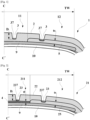
- a tread 1 for a tire according to a first embodiment of the present invention will be described referring to Fig. 1 .
- Fig. 1 is a schematic cross sectional view of a tread according to a first embodiment of the present invention.
- the tread 1 shown in the figure 1 is a half of a portion of the tread divided with respect to a center line C-C' extending in radial orientation.
- the tread 1 is a tread for a tire having dimension 235/45R18 and comprises a contact face 2 of a width TW intended to come into contact with the ground during rolling, and at least one groove 3 of a depth D provided with a wear indicating mean 37 and extending generally in circumferential orientation and opening to the contact face 2.
- the tread 1 comprising a center region 11 containing the center line C-C' and a pair of shoulder regions 12 being positioned on two axial sides of the center region 11.
- the tread 1 is equally divided into 3 regions, one center region 11 and two shoulder regions 12 with the width TW.
- a carcass 10 (or a casing), a main body of the tire which may or may not be provided with an inner liner for inhibiting loss or air pressure, and a ply 9 (or a belt), one or more rubber-coated layers of metallic or textile or other material in a form of cable or wire or strings, are provided radially inward of the tread 1.
- the pair of shoulder regions 12 each comprising a shoulder rubber layer 5 of a thickness ts made of a shoulder rubber composition different from a rubber composition constituting the tread 1.
- the thickness ts of the shoulder rubber layer 5 should be understood as a mean thickness of the shoulder rubber layer 5 measured perpendicular to the carcass 10 except under the groove 3 and until axially outermost of the ply 9.
- the shoulder rubber layer 5 is invisible on the contact face 2 when the tread 1 being brand new, and the shoulder rubber layer 5 is provided radially below a level of 50% of the depth D of the at least one groove 3.
- a shear storage modulus G' of the shoulder rubber composition constituting the shoulder rubber layer 5 measured at 23°C, 10Hz and 10% of strain is less than or equal to 1.0 MPa.
- the shoulder rubber layer can effectively reduce excitation of the tread 1 during rolling. Therefore it is possible to improve noise performance.
- the shoulder rubber layer 5 can effectively reduce excitation of the tread 1 during rolling.
- This shear storage modulus G' of the shoulder rubber composition constituting the shoulder rubber layer 5 measured at 23°C, 10Hz and 10% of strain is preferably from 0.2 to 1.0 MPa, more preferable from 0.2 to 0.7 MPa.
- the shoulder rubber layer 5 is comprised in the pair of shoulder regions 12 and not the center region 11, degradation on handling performance is limited as the center region 11 has a dominant impact on handling performance due to longer contact length compared to shoulder regions 12. Therefore it is possible to maintain reasonable level on handling performance.
- the shoulder rubber layer 5 is invisible on the contact face 2 when the tread 1 being brand new, it is possible to exhibit a good initial performance not only noise and handling but also other performances, as a contact patch is occupied by the rubber composition constituting the tread 1 which is designed to realize balanced performance.
- the shoulder rubber layer 5 is provided radially below a level of 50% of the depth D of the at least one groove 3, it is possible to keep the good initial performance not only noise and handling but also other performances longer, as the contact patch is continue occupied by the rubber composition constituting the tread 1 which is designed to realize balanced performance at least until middle of wear life.
- the center region 11 and the pair of shoulder regions 12 may be provided unevenly or asymmetrically with the width TW of the tread 1, and the pair of shoulder regions 12 may have different width from one another.
- the width of one shoulder region 12 is preferably less than or equal to one third of the width TW of the tread 1, more preferably from 10 to 25% of the width TW of the tread 1. If the width of one shoulder region 12 is more than one third of the width TW of the tread 1, there is a risk that degradation on handling performance due to shoulder rubber layer 5 becomes unacceptable. If the width of one shoulder region 12 is less than 10% of the width TW of the tread 1, there is a risk that reduction of tread excitation becomes insufficient results insufficient improvement on noise performance.
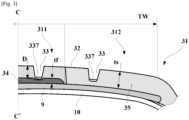
- FIG. 2 is a schematic cross sectional view of a tread according to a second embodiment of the present invention.
- the construction of this second embodiment is similar to that of the first embodiment other than the arrangement shown in Fig. 2 , thus description will be made referring to Fig. 2 .
- a tread 21 comprises a contact face 22 of a width TW, and at least one groove 23 of a depth D provided with a wear indicating mean 237.
- the tread 21 comprising a center region 211 containing the center line C-C' and a pair of shoulder regions 212 being positioned on two axial sides of the center region 211.
- the center region 211 comprises a center rubber layer 4 of a thickness tf made of a center rubber composition different from both the shoulder rubber composition and the rubber composition constituting the tread 21, and a shear storage modulus G' of the center rubber composition constituting the center rubber layer 4 measured at 23°C, 10Hz and 10% of strain is higher than the shear storage modulus G' of the rubber composition constituting the tread 21.
- the shoulder region 212 comprises a shoulder rubber layer 25 of a thickness ts made of a shoulder rubber composition different from the rubber composition constituting the tread 21.
- the center rubber layer 4 is positioned radially inward of the center region 211 and as to be sandwiched by the two shoulder rubber layers 25.
- the thickness tf of the center rubber layer 4 is thinner than the thickness ts of the shoulder rubber layer 25.
- the thickness ts of the shoulder rubber layer 25 should be understood as a mean thickness of the shoulder rubber layer 25 measured perpendicular to a carcass 10 except under the groove 23 and until axially outermost of a ply 9.
- the thickness tf of the center rubber layer 4 should be understood as a mean thickness of the center rubber layer 4 measured perpendicular to the carcass 10 except under the groove 23 and until axially outermost of the center region 211.
- the center rubber layer 4 is provided radially below a level of a wear indicating mean 237 provided with the groove 23.
- a shear storage modulus G' of the center rubber composition constituting the center rubber layer 4 measured at 23°C, 10Hz and 10% of strain is from 2 to 10 times of the shear storage modulus G' of the rubber composition constituting the tread 21.
- the shear storage modulus G' of the rubber composition constituting the tread 21 other than the center rubber layer 4 or the shoulder rubber layer 25 measured at 23°C, 10Hz and 10% of strain is less than or equal to 6.0 MPa.
- the center region 211 comprises a center rubber layer 4 of the thickness tf made of the center rubber composition different from both the shoulder rubber composition and the rubber composition constituting the tread 21, and the shear storage modulus G' of the center rubber composition constituting the center rubber layer 4 measured at 23°C, 10Hz and 10% of strain is higher than the shear storage modulus G' of the rubber composition constituting the tread 21, it is possible to improve handling performance, as the center rubber layer 4 made of the center rubber composition having higher shear storage modulus G' than the shear storage modulus G' of the rubber composition constituting the tread 21 deforms less and the tread 21 in the center region 211 other than the center rubber layer 4 need to deform more at a given slip angle thus generates stronger lateral force.
- center rubber layer 4 Since the center rubber layer 4 is positioned radially inward of the center region 211, it is possible to improve handling performance efficiently, as the center rubber layer 4 which has high shear storage modulus is placed closer to a component (the ply 9) of the tire generating dominantly lateral force.
- the thickness tf of the center rubber layer 4 is thinner than the thickness ts of the shoulder rubber layer 25, it is possible to improve both noise and handling performances simultaneously and efficiently, as thicker shoulder rubber layer thickness ensures reduction of tread excitation, and thinner center rubber layer thickness ensures generation of higher lateral force.
- the thickness tf of the center rubber layer 4 is thicker than the thickness ts of the shoulder rubber layer 25, there is a risk that reduction of tread excitation by the shoulder rubber layer 25 becomes insufficient due to relatively smaller volume of the shoulder rubber layer 25 compare with the center rubber layer 4, thus improvement on noise performance becomes insufficient.
- center rubber layer 4 is provided radially below a level of the wear indicating mean 237, it is possible to improve handling performance.
- center rubber layer 4 is provided radially above the level of the wear indicating mean 237, there is a risk that improvement on handling performance becomes insufficient, as too much volume of the center rubber layer 4 may make flattening of the tire difficult which leads contact patch length shorter resulting generating less lateral force.
- center rubber layer 4 provided radially below the level of the wear indicating mean 237, it is possible to improve handling performance.
- shear storage modulus G' of the center rubber composition constituting the center rubber layer 4 measured at 23°C, 10Hz and 10% of strain is from 2 to 10 times of the shear storage modulus G' of the rubber composition constituting the tread 21, it is possible to improve handling performance.
- shear storage modulus G' of the center rubber composition constituting the center rubber layer 4 measured at 23°C, 10Hz and 10% of strain is less than 2 times of the shear storage modulus G' of the rubber composition constituting the tread 21, there is a risk that improvement on handling performance becomes insufficient due to relatively insufficient modulus of the center rubber composition. If the shear storage modulus G' of the center rubber composition constituting the center rubber layer 4 measured at 23°C, 10Hz and 10% of strain is more than 10 times of the shear storage modulus G' of the rubber composition constituting the tread 21, there is a risk that improvement on handling performance becomes insufficient either as too hard center rubber composition may make flattening of the tire difficult which leads contact patch length shorter resulting generating less lateral force.
- the shear storage modulus G' of the center rubber composition constituting the center rubber layer 4 measured at 23°C, 10Hz and 10% of strain from 2 to 10 times of the shear storage modulus G' of the rubber composition constituting the tread 21, it is possible to improve handling performance.
- the shear storage modulus G' of the rubber composition constituting the tread 21 other than the center rubber layer 4 or the shoulder rubber layer 25 measured at 23°C, 10Hz and 10% of strain is less than or equal to 6.0 MPa, it is possible to improve noise performance while improving or at least maintaining reasonable level on handling performance.
- the shear storage modulus G' of the rubber composition constituting the tread 21 other than the center rubber layer 4 or the shoulder rubber layer 25 is more than 6.0 MPa, there is a risk that improvement on noise performance becomes insufficient, as the tread 21 itself becomes too hard even provided with the shoulder rubber layer 25.
- the shear storage modulus G' of the rubber composition constituting the tread 21 other than the center rubber layer 4 or the shoulder rubber layer 25 measured at 23°C, 10Hz and 10% of strain less than or equal to 6.0 MPa, it is possible to improve noise performance while improving or at least maintaining reasonable level on handling performance.
- the shear storage modulus G' of the rubber composition constituting the tread 21 other than the center rubber layer 4 or the shoulder rubber layer 25 is preferably less than or equal to 4.0 MPa, more preferably less than or equal to 3.0 MPa.
- the center rubber layer 4 and the shoulder rubber layer 25 may or may not be contact each other.
- the Example 1 was a tire provided with a tread as described in the above first embodiment; a width of one shoulder region was 25% of a width of the tread TW, a shear storage modulus G' of a shoulder rubber composition was 0.3 MPa, a shear storage modulus G' of a rubber composition constituting the tread other than a shoulder rubber layer was 2.7 MPa.
- the Example 2 was a tire provided with a tread as described in the above second embodiment; a width of one shoulder region was also 25% of a width of the tread TW, a shear storage modulus G' of a shoulder rubber composition was 0.3 MPa, a shear storage modulus G' of a center rubber composition was 12.2 MPa, a shear storage modulus G' of the tread other than a shoulder rubber layer or a center rubber layer was 2.7 MPa.
- the Reference was a tire provided with a tread without shoulder rubber layer nor center rubber layer.
- the Comparative Example was a tire provided with a tread similar to the Example 1; a shear storage modulus G' of a shoulder rubber composition was 1.5 MPa
- Unused test tires were mounted onto all four wheels of a 2,500 cc rear-wheel drive vehicle. On a straight path weathered asphalt, the vehicle was driven at a constant speed of 80 kph. An interior noise was measured using a microphone positioned at a passenger's ear close to window. An A-weighted sound pressure level between 0 and 500 Hz was calculated.
- results are shown in table 1.
- results are represented by difference in dB(A) against Reference, lower the value indicates better the performance.
- a cornering power of unused test tires mounted onto a standard rim and inflated to nominal internal pressure was measured using a flat belt tire tester.
- a load of 460kg was applied while tires driven at a constant speed of 80 kph, lateral force at a slip angle ⁇ 1° was measured, and the lateral forces measured at +1° and at -1° in absolute value were averaged.
- Example 1 Comparative Example Reference G' of shoulder rubber composition (MPa) 0.3 0.3 1.5 - G' of center rubber composition (MPa) - 12.2 - - Noise performance (dBA) -0.9 -0.8 -0.1 0.0 Handling performance (index) 93 102 98 100
Landscapes
- Engineering & Computer Science (AREA)
- Mechanical Engineering (AREA)
- Tires In General (AREA)
Claims (10)
- Bande de roulement (1) pour un pneu ayant une face de contact (2) d'une largeur (TW) destinée à venir en contact avec le sol pendant le roulement, la bande de roulement (1) étant pourvue d'au moins une rainure (3) d'une profondeur (D) pourvue d'un moyen d'indication d'usure (37) et s'étendant généralement dans une orientation circonférentielle et s'ouvrant vers la face de contact (2), la bande de roulement (1) comprenant une région centrale (11) et une paire de régions d'épaulement (12) positionnées sur deux côtés axiaux de la région centrale (11),les régions de la paire de régions d'épaulement (12) comprenant chacune une couche de caoutchouc d'épaulement (5) d'une épaisseur (ts) constituée d'une composition de caoutchouc d'épaulement différente d'une composition de caoutchouc constituant la bande de roulement (1), un module de conservation en cisaillement G' de la composition de caoutchouc constituant la bande de roulement (1) mesuré à 23 °C, 10 Hz et 10 % de déformation étant différent d'un module de conservation en cisaillement G' de la composition de caoutchouc d'épaulement constituant la couche de caoutchouc d'épaulement (5) mesuré à 23 °C, 10 Hz et 10 % de déformation,la bande de roulement étant caractérisée en ce que le module de conservation en cisaillement G' de la composition de caoutchouc d'épaulement constituant la couche de caoutchouc d'épaulement (5) mesuré à 23 °C, 10 Hz et 10 % de déformation est inférieur ou égal à 1,0 MPa.
- Bande de roulement (1) selon la revendication 1, dans laquelle la couche de caoutchouc d'épaulement (5) est invisible sur la face de contact (2) quand la bande de roulement (1) est toute neuve.
- Bande de roulement (1) selon la revendication 2, dans laquelle la couche de caoutchouc d'épaulement (5) est disposée radialement en dessous d'un niveau de 50 % de la profondeur (D) de l'au moins une rainure (3).
- Bande de roulement (1) selon l'une quelconque des revendications 1 à 3, dans laquelle la région centrale (11) comprend une couche de caoutchouc centrale (4) d'une épaisseur (tf) constituée d'une composition de caoutchouc centrale différente à la fois de la composition de caoutchouc d'épaulement et de la composition de caoutchouc constituant la bande de roulement, et dans laquelle un module de conservation en cisaillement G' de la composition de caoutchouc centrale constituant la couche de caoutchouc centrale (4) mesuré à 23 °C, 10 Hz et 10 % de déformation est supérieur au module de conservation en cisaillement G' de la composition de caoutchouc constituant la bande de roulement (1) mesuré à 23 °C, 10 Hz et 10 % de déformation.
- Bande de roulement (1) selon la revendication 4, dans laquelle la couche de caoutchouc centrale est positionnée radialement à l'intérieur de la région centrale (11).
- Bande de roulement (1) selon la revendication 4 ou la revendication 5, dans laquelle l'épaisseur (tf) de la couche de caoutchouc centrale (4) est plus mince que l'épaisseur ts de la couche de caoutchouc d'épaulement (5) .
- Bande de roulement (1) selon l'une quelconque des revendications 4 à 6, dans laquelle la couche de caoutchouc centrale (4) est disposée radialement en dessous d'un niveau du moyen d'indication d'usure (37).
- Bande de roulement (1) selon l'une quelconque des revendications 4 à 7, dans laquelle le module de conservation en cisaillement G' de la composition de caoutchouc centrale constituant la couche de caoutchouc centrale (4) mesuré à 23 °C, 10 Hz et 10 % de déformation représente de 2 à 10 fois le module de conservation en cisaillement G' de la composition de caoutchouc constituant la bande de roulement (1) mesuré à 23 °C, 10 Hz et 10 % de déformation.
- Bande de roulement (1) selon l'une quelconque des revendications 4 à 8, dans laquelle le module de conservation en cisaillement G' de la composition de caoutchouc constituant la bande de roulement (1) à part la couche de caoutchouc centrale (4) ou la couche de caoutchouc d'épaulement (5) mesuré à 23 °C, 10 Hz et 10 % de déformation est inférieur ou égal à 6,0 MPa.
- Pneu ayant une bande de roulement selon l'une quelconque des revendications 1 à 9.
Applications Claiming Priority (2)
| Application Number | Priority Date | Filing Date | Title |
|---|---|---|---|
| JP2019025292 | 2019-06-26 | ||
| PCT/JP2020/025174 WO2020262596A1 (fr) | 2019-06-26 | 2020-06-26 | Bande de roulement réduisant le bruit |
Publications (2)
| Publication Number | Publication Date |
|---|---|
| EP3990295A1 EP3990295A1 (fr) | 2022-05-04 |
| EP3990295B1 true EP3990295B1 (fr) | 2023-10-04 |
Family
ID=67262968
Family Applications (1)
| Application Number | Title | Priority Date | Filing Date |
|---|---|---|---|
| EP20736797.0A Active EP3990295B1 (fr) | 2019-06-26 | 2020-06-26 | Bande de roulement réduisant le bruit |
Country Status (4)
| Country | Link |
|---|---|
| US (1) | US20220355626A1 (fr) |
| EP (1) | EP3990295B1 (fr) |
| CN (1) | CN114025971B (fr) |
| WO (1) | WO2020262596A1 (fr) |
Families Citing this family (3)
| Publication number | Priority date | Publication date | Assignee | Title |
|---|---|---|---|---|
| US11912067B2 (en) * | 2019-12-20 | 2024-02-27 | The Goodyear Tire & Rubber Company | Rubber composition and a tire |
| DE102022205196A1 (de) * | 2022-05-24 | 2023-11-30 | Continental Reifen Deutschland Gmbh | Fahrzeugluftreifen und Verfahren zur Herstellung eines Fahrzeugluftreifens |
| USD1110248S1 (en) * | 2024-04-30 | 2026-01-27 | Shandong Linglong Tyre Co., Ltd. | Tire |
Family Cites Families (23)
| Publication number | Priority date | Publication date | Assignee | Title |
|---|---|---|---|---|
| US6403710B1 (en) * | 1994-08-29 | 2002-06-11 | The Dow Chemical Company | Block copolymer compositions containing substantially inert thermoelastic extenders |
| DE69722109T2 (de) | 1996-09-03 | 2004-02-19 | Michelin Recherche Et Technique S.A. | Reifen mit einer Lauffläche aus zwei verschiedenen Gummizusammensetzungen zur Steuerung der Abnutzung |
| JP3573636B2 (ja) * | 1998-12-28 | 2004-10-06 | 横浜ゴム株式会社 | 自動車用空気入りタイヤ及びその製造方法 |
| JP4328371B2 (ja) * | 2007-07-24 | 2009-09-09 | 株式会社ブリヂストン | 自動二輪車用空気入りタイヤ |
| FR2926037B1 (fr) * | 2008-01-09 | 2009-12-18 | Michelin Soc Tech | Dispositif pour bande de roulement. |
| JP5057522B2 (ja) | 2008-05-30 | 2012-10-24 | 株式会社ブリヂストン | タイヤ |
| BR112013009040B1 (pt) * | 2010-10-21 | 2021-01-12 | Pirelli Tyre S.P.A. | pneu para rodas de veículos, e, banda de rodagem de pneu |
| JP5463264B2 (ja) * | 2010-11-15 | 2014-04-09 | 東洋ゴム工業株式会社 | 空気入りタイヤ |
| DE102011001133A1 (de) | 2011-03-07 | 2012-09-13 | Continental Reifen Deutschland Gmbh | Fahrzeugluftreifen |
| US9487050B2 (en) | 2011-05-09 | 2016-11-08 | The Goodyear Tire & Rubber Company | Tire with tread having base layer comprised of diverse zoned rubber compositions |
| JP5736239B2 (ja) * | 2011-05-31 | 2015-06-17 | 株式会社ブリヂストン | タイヤ |
| FR2992897B1 (fr) | 2012-07-05 | 2014-08-15 | Michelin & Cie | Pneumatique comportant une bande de roulement constituee de plusieurs melanges elastomeriques |
| FR2992894B1 (fr) * | 2012-07-05 | 2014-08-15 | Michelin & Cie | Pneumatique comportant une bande de roulement constituee de plusieurs melanges elastomeriques |
| EP3201010A4 (fr) * | 2012-12-31 | 2018-05-09 | Compagnie Générale des Etablissements Michelin | Bande de roulement avec des caoutchoucs incompatibles |
| CN106364261B (zh) * | 2015-07-23 | 2019-11-15 | 住友橡胶工业株式会社 | 充气轮胎 |
| JP6941415B2 (ja) * | 2015-10-06 | 2021-09-29 | 横浜ゴム株式会社 | 空気入りタイヤ |
| WO2017074410A1 (fr) * | 2015-10-30 | 2017-05-04 | Compagnie Generale Des Etablissements Michelin | Bande de roulement de pneu avec lamelles en forme de perle et zones de rigidité variable |
| US11358414B2 (en) * | 2016-07-26 | 2022-06-14 | Compagnie Generale Des Etablissements Michelin | Tire with a tread sub-layer containing multiple materials |
| FR3057208A1 (fr) * | 2016-10-07 | 2018-04-13 | Compagnie Generale Des Etablissements Michelin | Bande de roulement de pneumatique pour vehicule lourd de type genie civil |
| WO2018221630A1 (fr) * | 2017-05-31 | 2018-12-06 | Compagnie Generale Des Etablissements Michelin | Pneu comprenant une bande de roulement |
| AU2018290810C1 (en) * | 2017-06-26 | 2024-09-12 | Evolved By Nature, Inc. | Silk-hyaluronic acid based tissue fillers and methods of using the same |
| FR3068916A1 (fr) * | 2017-07-17 | 2019-01-18 | Compagnie Generale Des Etablissements Michelin | Pneumatique a sous-couche de bande de roulement affleurante en fond de sillon et elements de renforcement en caoutchouc de haut module integres a la bande de roulement |
| IT201700084726A1 (it) * | 2017-07-25 | 2019-01-25 | Prometeon Tyre Group S R L | Pneumatico per ruote di veicoli |
-
2020
- 2020-06-26 EP EP20736797.0A patent/EP3990295B1/fr active Active
- 2020-06-26 WO PCT/JP2020/025174 patent/WO2020262596A1/fr not_active Ceased
- 2020-06-26 CN CN202080046481.3A patent/CN114025971B/zh active Active
- 2020-06-26 US US17/621,589 patent/US20220355626A1/en not_active Abandoned
Also Published As
| Publication number | Publication date |
|---|---|
| EP3990295A1 (fr) | 2022-05-04 |
| WO2020262596A1 (fr) | 2020-12-30 |
| CN114025971B (zh) | 2023-09-15 |
| US20220355626A1 (en) | 2022-11-10 |
| CN114025971A (zh) | 2022-02-08 |
Similar Documents
| Publication | Publication Date | Title |
|---|---|---|
| EP2628612B1 (fr) | Pneu | |
| EP3318424B1 (fr) | Pneumatique | |
| EP2962874B1 (fr) | Pneumatique à carcasse radiale de véhicule de tourisme | |
| EP3482976B1 (fr) | Pneu pour fonctionnement intensif | |
| EP3990295B1 (fr) | Bande de roulement réduisant le bruit | |
| EP2196329B1 (fr) | Pneumatique | |
| EP4116112A1 (fr) | Pneu poids lourd | |
| EP1199192B1 (fr) | Bandage pneumatique | |
| EP4434774B1 (fr) | Pneumatique | |
| EP4081412B1 (fr) | Bande de roulement réduisant le bruit | |
| EP4070968B1 (fr) | Pneumatique de motocyclette | |
| EP3251876B1 (fr) | Pneumatique | |
| EP4081409B1 (fr) | Pneu pour performances relatives au bruit améliorées | |
| JP2007076594A (ja) | 空気入りタイヤ | |
| WO2022137414A1 (fr) | Pneu pour performances relatives au bruit améliorées | |
| EP4321351B1 (fr) | Pneumatique | |
| EP3873752B1 (fr) | Pneu ayant des évidements dans une zone de talon | |
| EP4578668A1 (fr) | Pneumatique | |
| JP2007069665A (ja) | 空気入りタイヤ | |
| EP4722004A1 (fr) | Pneumatique | |
| EP3944967A1 (fr) | Pneumatique de motocyclette | |
| EP3868574A1 (fr) | Pneu à carcasse diagonale pour véhicule à deux roues | |
| JP2024061417A (ja) | 空気入りタイヤ | |
| JP2003072314A (ja) | 空気入りタイヤ | |
| CN104271364B (zh) | 重负载用轮胎 |
Legal Events
| Date | Code | Title | Description |
|---|---|---|---|
| STAA | Information on the status of an ep patent application or granted ep patent |
Free format text: STATUS: UNKNOWN |
|
| STAA | Information on the status of an ep patent application or granted ep patent |
Free format text: STATUS: THE INTERNATIONAL PUBLICATION HAS BEEN MADE |
|
| PUAI | Public reference made under article 153(3) epc to a published international application that has entered the european phase |
Free format text: ORIGINAL CODE: 0009012 |
|
| STAA | Information on the status of an ep patent application or granted ep patent |
Free format text: STATUS: REQUEST FOR EXAMINATION WAS MADE |
|
| 17P | Request for examination filed |
Effective date: 20211217 |
|
| AK | Designated contracting states |
Kind code of ref document: A1 Designated state(s): AL AT BE BG CH CY CZ DE DK EE ES FI FR GB GR HR HU IE IS IT LI LT LU LV MC MK MT NL NO PL PT RO RS SE SI SK SM TR |
|
| DAV | Request for validation of the european patent (deleted) | ||
| DAX | Request for extension of the european patent (deleted) | ||
| GRAP | Despatch of communication of intention to grant a patent |
Free format text: ORIGINAL CODE: EPIDOSNIGR1 |
|
| STAA | Information on the status of an ep patent application or granted ep patent |
Free format text: STATUS: GRANT OF PATENT IS INTENDED |
|
| RIC1 | Information provided on ipc code assigned before grant |
Ipc: B60C 11/24 20060101ALI20230425BHEP Ipc: B60C 11/00 20060101AFI20230425BHEP |
|
| INTG | Intention to grant announced |
Effective date: 20230525 |
|
| GRAS | Grant fee paid |
Free format text: ORIGINAL CODE: EPIDOSNIGR3 |
|
| GRAA | (expected) grant |
Free format text: ORIGINAL CODE: 0009210 |
|
| STAA | Information on the status of an ep patent application or granted ep patent |
Free format text: STATUS: THE PATENT HAS BEEN GRANTED |
|
| AK | Designated contracting states |
Kind code of ref document: B1 Designated state(s): AL AT BE BG CH CY CZ DE DK EE ES FI FR GB GR HR HU IE IS IT LI LT LU LV MC MK MT NL NO PL PT RO RS SE SI SK SM TR |
|
| REG | Reference to a national code |
Ref country code: GB Ref legal event code: FG4D |
|
| REG | Reference to a national code |
Ref country code: CH Ref legal event code: EP |
|
| REG | Reference to a national code |
Ref country code: IE Ref legal event code: FG4D |
|
| REG | Reference to a national code |
Ref country code: DE Ref legal event code: R096 Ref document number: 602020018649 Country of ref document: DE |
|
| REG | Reference to a national code |
Ref country code: LT Ref legal event code: MG9D |
|
| REG | Reference to a national code |
Ref country code: NL Ref legal event code: MP Effective date: 20231004 |
|
| REG | Reference to a national code |
Ref country code: AT Ref legal event code: MK05 Ref document number: 1617394 Country of ref document: AT Kind code of ref document: T Effective date: 20231004 |
|
| PG25 | Lapsed in a contracting state [announced via postgrant information from national office to epo] |
Ref country code: NL Free format text: LAPSE BECAUSE OF FAILURE TO SUBMIT A TRANSLATION OF THE DESCRIPTION OR TO PAY THE FEE WITHIN THE PRESCRIBED TIME-LIMIT Effective date: 20231004 |
|
| PG25 | Lapsed in a contracting state [announced via postgrant information from national office to epo] |
Ref country code: GR Free format text: LAPSE BECAUSE OF FAILURE TO SUBMIT A TRANSLATION OF THE DESCRIPTION OR TO PAY THE FEE WITHIN THE PRESCRIBED TIME-LIMIT Effective date: 20240105 |
|
| PG25 | Lapsed in a contracting state [announced via postgrant information from national office to epo] |
Ref country code: IS Free format text: LAPSE BECAUSE OF FAILURE TO SUBMIT A TRANSLATION OF THE DESCRIPTION OR TO PAY THE FEE WITHIN THE PRESCRIBED TIME-LIMIT Effective date: 20240204 |
|
| PG25 | Lapsed in a contracting state [announced via postgrant information from national office to epo] |
Ref country code: LT Free format text: LAPSE BECAUSE OF FAILURE TO SUBMIT A TRANSLATION OF THE DESCRIPTION OR TO PAY THE FEE WITHIN THE PRESCRIBED TIME-LIMIT Effective date: 20231004 |
|
| PG25 | Lapsed in a contracting state [announced via postgrant information from national office to epo] |
Ref country code: AT Free format text: LAPSE BECAUSE OF FAILURE TO SUBMIT A TRANSLATION OF THE DESCRIPTION OR TO PAY THE FEE WITHIN THE PRESCRIBED TIME-LIMIT Effective date: 20231004 |
|
| PG25 | Lapsed in a contracting state [announced via postgrant information from national office to epo] |
Ref country code: ES Free format text: LAPSE BECAUSE OF FAILURE TO SUBMIT A TRANSLATION OF THE DESCRIPTION OR TO PAY THE FEE WITHIN THE PRESCRIBED TIME-LIMIT Effective date: 20231004 |
|
| PG25 | Lapsed in a contracting state [announced via postgrant information from national office to epo] |
Ref country code: LT Free format text: LAPSE BECAUSE OF FAILURE TO SUBMIT A TRANSLATION OF THE DESCRIPTION OR TO PAY THE FEE WITHIN THE PRESCRIBED TIME-LIMIT Effective date: 20231004 Ref country code: IS Free format text: LAPSE BECAUSE OF FAILURE TO SUBMIT A TRANSLATION OF THE DESCRIPTION OR TO PAY THE FEE WITHIN THE PRESCRIBED TIME-LIMIT Effective date: 20240204 Ref country code: GR Free format text: LAPSE BECAUSE OF FAILURE TO SUBMIT A TRANSLATION OF THE DESCRIPTION OR TO PAY THE FEE WITHIN THE PRESCRIBED TIME-LIMIT Effective date: 20240105 Ref country code: ES Free format text: LAPSE BECAUSE OF FAILURE TO SUBMIT A TRANSLATION OF THE DESCRIPTION OR TO PAY THE FEE WITHIN THE PRESCRIBED TIME-LIMIT Effective date: 20231004 Ref country code: BG Free format text: LAPSE BECAUSE OF FAILURE TO SUBMIT A TRANSLATION OF THE DESCRIPTION OR TO PAY THE FEE WITHIN THE PRESCRIBED TIME-LIMIT Effective date: 20240104 Ref country code: AT Free format text: LAPSE BECAUSE OF FAILURE TO SUBMIT A TRANSLATION OF THE DESCRIPTION OR TO PAY THE FEE WITHIN THE PRESCRIBED TIME-LIMIT Effective date: 20231004 Ref country code: PT Free format text: LAPSE BECAUSE OF FAILURE TO SUBMIT A TRANSLATION OF THE DESCRIPTION OR TO PAY THE FEE WITHIN THE PRESCRIBED TIME-LIMIT Effective date: 20240205 |
|
| PG25 | Lapsed in a contracting state [announced via postgrant information from national office to epo] |
Ref country code: SE Free format text: LAPSE BECAUSE OF FAILURE TO SUBMIT A TRANSLATION OF THE DESCRIPTION OR TO PAY THE FEE WITHIN THE PRESCRIBED TIME-LIMIT Effective date: 20231004 Ref country code: RS Free format text: LAPSE BECAUSE OF FAILURE TO SUBMIT A TRANSLATION OF THE DESCRIPTION OR TO PAY THE FEE WITHIN THE PRESCRIBED TIME-LIMIT Effective date: 20231004 Ref country code: PL Free format text: LAPSE BECAUSE OF FAILURE TO SUBMIT A TRANSLATION OF THE DESCRIPTION OR TO PAY THE FEE WITHIN THE PRESCRIBED TIME-LIMIT Effective date: 20231004 Ref country code: NO Free format text: LAPSE BECAUSE OF FAILURE TO SUBMIT A TRANSLATION OF THE DESCRIPTION OR TO PAY THE FEE WITHIN THE PRESCRIBED TIME-LIMIT Effective date: 20240104 Ref country code: LV Free format text: LAPSE BECAUSE OF FAILURE TO SUBMIT A TRANSLATION OF THE DESCRIPTION OR TO PAY THE FEE WITHIN THE PRESCRIBED TIME-LIMIT Effective date: 20231004 Ref country code: HR Free format text: LAPSE BECAUSE OF FAILURE TO SUBMIT A TRANSLATION OF THE DESCRIPTION OR TO PAY THE FEE WITHIN THE PRESCRIBED TIME-LIMIT Effective date: 20231004 |
|
| REG | Reference to a national code |
Ref country code: DE Ref legal event code: R097 Ref document number: 602020018649 Country of ref document: DE |
|
| PG25 | Lapsed in a contracting state [announced via postgrant information from national office to epo] |
Ref country code: DK Free format text: LAPSE BECAUSE OF FAILURE TO SUBMIT A TRANSLATION OF THE DESCRIPTION OR TO PAY THE FEE WITHIN THE PRESCRIBED TIME-LIMIT Effective date: 20231004 |
|
| PG25 | Lapsed in a contracting state [announced via postgrant information from national office to epo] |
Ref country code: CZ Free format text: LAPSE BECAUSE OF FAILURE TO SUBMIT A TRANSLATION OF THE DESCRIPTION OR TO PAY THE FEE WITHIN THE PRESCRIBED TIME-LIMIT Effective date: 20231004 |
|
| PG25 | Lapsed in a contracting state [announced via postgrant information from national office to epo] |
Ref country code: SK Free format text: LAPSE BECAUSE OF FAILURE TO SUBMIT A TRANSLATION OF THE DESCRIPTION OR TO PAY THE FEE WITHIN THE PRESCRIBED TIME-LIMIT Effective date: 20231004 |
|
| PG25 | Lapsed in a contracting state [announced via postgrant information from national office to epo] |
Ref country code: SM Free format text: LAPSE BECAUSE OF FAILURE TO SUBMIT A TRANSLATION OF THE DESCRIPTION OR TO PAY THE FEE WITHIN THE PRESCRIBED TIME-LIMIT Effective date: 20231004 Ref country code: SK Free format text: LAPSE BECAUSE OF FAILURE TO SUBMIT A TRANSLATION OF THE DESCRIPTION OR TO PAY THE FEE WITHIN THE PRESCRIBED TIME-LIMIT Effective date: 20231004 Ref country code: RO Free format text: LAPSE BECAUSE OF FAILURE TO SUBMIT A TRANSLATION OF THE DESCRIPTION OR TO PAY THE FEE WITHIN THE PRESCRIBED TIME-LIMIT Effective date: 20231004 Ref country code: IT Free format text: LAPSE BECAUSE OF FAILURE TO SUBMIT A TRANSLATION OF THE DESCRIPTION OR TO PAY THE FEE WITHIN THE PRESCRIBED TIME-LIMIT Effective date: 20231004 Ref country code: EE Free format text: LAPSE BECAUSE OF FAILURE TO SUBMIT A TRANSLATION OF THE DESCRIPTION OR TO PAY THE FEE WITHIN THE PRESCRIBED TIME-LIMIT Effective date: 20231004 Ref country code: DK Free format text: LAPSE BECAUSE OF FAILURE TO SUBMIT A TRANSLATION OF THE DESCRIPTION OR TO PAY THE FEE WITHIN THE PRESCRIBED TIME-LIMIT Effective date: 20231004 Ref country code: CZ Free format text: LAPSE BECAUSE OF FAILURE TO SUBMIT A TRANSLATION OF THE DESCRIPTION OR TO PAY THE FEE WITHIN THE PRESCRIBED TIME-LIMIT Effective date: 20231004 |
|
| PLBE | No opposition filed within time limit |
Free format text: ORIGINAL CODE: 0009261 |
|
| STAA | Information on the status of an ep patent application or granted ep patent |
Free format text: STATUS: NO OPPOSITION FILED WITHIN TIME LIMIT |
|
| 26N | No opposition filed |
Effective date: 20240705 |
|
| PG25 | Lapsed in a contracting state [announced via postgrant information from national office to epo] |
Ref country code: SI Free format text: LAPSE BECAUSE OF FAILURE TO SUBMIT A TRANSLATION OF THE DESCRIPTION OR TO PAY THE FEE WITHIN THE PRESCRIBED TIME-LIMIT Effective date: 20231004 |
|
| PG25 | Lapsed in a contracting state [announced via postgrant information from national office to epo] |
Ref country code: SI Free format text: LAPSE BECAUSE OF FAILURE TO SUBMIT A TRANSLATION OF THE DESCRIPTION OR TO PAY THE FEE WITHIN THE PRESCRIBED TIME-LIMIT Effective date: 20231004 |
|
| PG25 | Lapsed in a contracting state [announced via postgrant information from national office to epo] |
Ref country code: MC Free format text: LAPSE BECAUSE OF FAILURE TO SUBMIT A TRANSLATION OF THE DESCRIPTION OR TO PAY THE FEE WITHIN THE PRESCRIBED TIME-LIMIT Effective date: 20231004 |
|
| REG | Reference to a national code |
Ref country code: CH Ref legal event code: PL |
|
| PG25 | Lapsed in a contracting state [announced via postgrant information from national office to epo] |
Ref country code: LU Free format text: LAPSE BECAUSE OF NON-PAYMENT OF DUE FEES Effective date: 20240626 |
|
| GBPC | Gb: european patent ceased through non-payment of renewal fee |
Effective date: 20240626 |
|
| PG25 | Lapsed in a contracting state [announced via postgrant information from national office to epo] |
Ref country code: IE Free format text: LAPSE BECAUSE OF NON-PAYMENT OF DUE FEES Effective date: 20240626 |
|
| PG25 | Lapsed in a contracting state [announced via postgrant information from national office to epo] |
Ref country code: CH Free format text: LAPSE BECAUSE OF NON-PAYMENT OF DUE FEES Effective date: 20240630 Ref country code: BE Free format text: LAPSE BECAUSE OF NON-PAYMENT OF DUE FEES Effective date: 20240630 |
|
| PG25 | Lapsed in a contracting state [announced via postgrant information from national office to epo] |
Ref country code: GB Free format text: LAPSE BECAUSE OF NON-PAYMENT OF DUE FEES Effective date: 20240626 |
|
| REG | Reference to a national code |
Ref country code: BE Ref legal event code: MM Effective date: 20240630 |
|
| PGFP | Annual fee paid to national office [announced via postgrant information from national office to epo] |
Ref country code: DE Payment date: 20250618 Year of fee payment: 6 |
|
| PGFP | Annual fee paid to national office [announced via postgrant information from national office to epo] |
Ref country code: FR Payment date: 20250627 Year of fee payment: 6 |
|
| PG25 | Lapsed in a contracting state [announced via postgrant information from national office to epo] |
Ref country code: FI Free format text: LAPSE BECAUSE OF FAILURE TO SUBMIT A TRANSLATION OF THE DESCRIPTION OR TO PAY THE FEE WITHIN THE PRESCRIBED TIME-LIMIT Effective date: 20231004 |
|
| PG25 | Lapsed in a contracting state [announced via postgrant information from national office to epo] |
Ref country code: CY Free format text: LAPSE BECAUSE OF FAILURE TO SUBMIT A TRANSLATION OF THE DESCRIPTION OR TO PAY THE FEE WITHIN THE PRESCRIBED TIME-LIMIT; INVALID AB INITIO Effective date: 20200626 |
|
| PG25 | Lapsed in a contracting state [announced via postgrant information from national office to epo] |
Ref country code: HU Free format text: LAPSE BECAUSE OF FAILURE TO SUBMIT A TRANSLATION OF THE DESCRIPTION OR TO PAY THE FEE WITHIN THE PRESCRIBED TIME-LIMIT; INVALID AB INITIO Effective date: 20200626 |