EP3990397B1 - Procédé peu coûteux et efficaces sur le plan sanitaire créant deux zones de traitement différentes dans de grandes masses d'eau pour faciliter des activités récréatives à contact direct - Google Patents
Procédé peu coûteux et efficaces sur le plan sanitaire créant deux zones de traitement différentes dans de grandes masses d'eau pour faciliter des activités récréatives à contact direct Download PDFInfo
- Publication number
- EP3990397B1 EP3990397B1 EP20832912.8A EP20832912A EP3990397B1 EP 3990397 B1 EP3990397 B1 EP 3990397B1 EP 20832912 A EP20832912 A EP 20832912A EP 3990397 B1 EP3990397 B1 EP 3990397B1
- Authority
- EP
- European Patent Office
- Prior art keywords
- zone
- water
- dissipation
- sedimentation
- dissipation zone
- Prior art date
- Legal status (The legal status is an assumption and is not a legal conclusion. Google has not performed a legal analysis and makes no representation as to the accuracy of the status listed.)
- Active
Links
Images




Classifications
-
- C—CHEMISTRY; METALLURGY
- C02—TREATMENT OF WATER, WASTE WATER, SEWAGE, OR SLUDGE
- C02F—TREATMENT OF WATER, WASTE WATER, SEWAGE, OR SLUDGE
- C02F1/00—Treatment of water, waste water, or sewage
- C02F1/52—Treatment of water, waste water, or sewage by flocculation or precipitation of suspended impurities
-
- C—CHEMISTRY; METALLURGY
- C02—TREATMENT OF WATER, WASTE WATER, SEWAGE, OR SLUDGE
- C02F—TREATMENT OF WATER, WASTE WATER, SEWAGE, OR SLUDGE
- C02F1/00—Treatment of water, waste water, or sewage
- C02F1/001—Processes for the treatment of water whereby the filtration technique is of importance
- C02F1/004—Processes for the treatment of water whereby the filtration technique is of importance using large scale industrial sized filters
-
- C—CHEMISTRY; METALLURGY
- C02—TREATMENT OF WATER, WASTE WATER, SEWAGE, OR SLUDGE
- C02F—TREATMENT OF WATER, WASTE WATER, SEWAGE, OR SLUDGE
- C02F1/00—Treatment of water, waste water, or sewage
- C02F1/50—Treatment of water, waste water, or sewage by addition or application of a germicide or by oligodynamic treatment
-
- C—CHEMISTRY; METALLURGY
- C02—TREATMENT OF WATER, WASTE WATER, SEWAGE, OR SLUDGE
- C02F—TREATMENT OF WATER, WASTE WATER, SEWAGE, OR SLUDGE
- C02F1/00—Treatment of water, waste water, or sewage
- C02F1/52—Treatment of water, waste water, or sewage by flocculation or precipitation of suspended impurities
- C02F1/5236—Treatment of water, waste water, or sewage by flocculation or precipitation of suspended impurities using inorganic agents
-
- C—CHEMISTRY; METALLURGY
- C02—TREATMENT OF WATER, WASTE WATER, SEWAGE, OR SLUDGE
- C02F—TREATMENT OF WATER, WASTE WATER, SEWAGE, OR SLUDGE
- C02F1/00—Treatment of water, waste water, or sewage
- C02F1/52—Treatment of water, waste water, or sewage by flocculation or precipitation of suspended impurities
- C02F1/5236—Treatment of water, waste water, or sewage by flocculation or precipitation of suspended impurities using inorganic agents
- C02F1/5245—Treatment of water, waste water, or sewage by flocculation or precipitation of suspended impurities using inorganic agents using basic salts, e.g. of aluminium and iron
-
- C—CHEMISTRY; METALLURGY
- C02—TREATMENT OF WATER, WASTE WATER, SEWAGE, OR SLUDGE
- C02F—TREATMENT OF WATER, WASTE WATER, SEWAGE, OR SLUDGE
- C02F1/00—Treatment of water, waste water, or sewage
- C02F1/52—Treatment of water, waste water, or sewage by flocculation or precipitation of suspended impurities
- C02F1/54—Treatment of water, waste water, or sewage by flocculation or precipitation of suspended impurities using organic material
- C02F1/56—Macromolecular compounds
-
- C—CHEMISTRY; METALLURGY
- C02—TREATMENT OF WATER, WASTE WATER, SEWAGE, OR SLUDGE
- C02F—TREATMENT OF WATER, WASTE WATER, SEWAGE, OR SLUDGE
- C02F1/00—Treatment of water, waste water, or sewage
- C02F1/72—Treatment of water, waste water, or sewage by oxidation
- C02F1/76—Treatment of water, waste water, or sewage by oxidation with halogens or compounds of halogens
-
- C—CHEMISTRY; METALLURGY
- C02—TREATMENT OF WATER, WASTE WATER, SEWAGE, OR SLUDGE
- C02F—TREATMENT OF WATER, WASTE WATER, SEWAGE, OR SLUDGE
- C02F1/00—Treatment of water, waste water, or sewage
- C02F2001/007—Processes including a sedimentation step
-
- C—CHEMISTRY; METALLURGY
- C02—TREATMENT OF WATER, WASTE WATER, SEWAGE, OR SLUDGE
- C02F—TREATMENT OF WATER, WASTE WATER, SEWAGE, OR SLUDGE
- C02F2103/00—Nature of the water, waste water, sewage or sludge to be treated
- C02F2103/42—Nature of the water, waste water, sewage or sludge to be treated from bathing facilities, e.g. swimming pools
-
- C—CHEMISTRY; METALLURGY
- C02—TREATMENT OF WATER, WASTE WATER, SEWAGE, OR SLUDGE
- C02F—TREATMENT OF WATER, WASTE WATER, SEWAGE, OR SLUDGE
- C02F2303/00—Specific treatment goals
- C02F2303/04—Disinfection
Definitions
- the present invention relates generally to treating a large body of water in order to make the water suitable for recreational purposes; more specifically for treating the water using a low cost sanitary system and method to minimize the risk of growth of microorganisms such as bacteria, protozoa, amoebas, microalgae and parasites, amongst others, thus solving the inefficiencies of current methods and systems in an innovative manner and at low costs. More specifically, the invention relates to a low cost and sanitary efficient system and method that creates two different treatment zones in large water bodies to facilitate direct contact recreational activities.
- recreational water bodies such as swimming pools and larger water bodies like swimming lakes
- microorganisms such as bacteria, protozoa, amoebas, microalgae and parasites, amongst others, which can create risks for bathers that use such water bodies for swimming, bathing, and for other direct contact recreational uses.
- swimming pool technology has been the most used water treatment technology for small water bodies used for recreational swimming purposes.
- various health entities from around the world have adopted regulations concerning the water treatment in order to regulate minimum health standards for swimming pools.
- sand filters are capable of filtering out particles in the size range of down to 20-25 microns and cartridge filters are typically capable of removing particles in the size range down to 5-10 microns.
- Cryptosporidium oocysts are approximately 4-6 microns in size. This makes them very difficult to remove by conventional pool filtration with the commonly used filters being able to remove only about 25% of oocysts per passage through the filter.
- the disinfection and filtration systems are not prepared for removing such microorganisms.
- Traditional disinfection is not enough to inactivate or kill such microorganisms, and the filtration system is not suitable for removing them from the water in an appropriate timeframe that ensures that people will not become infected once the contamination takes place.
- swimming pools are prone to RWIs triggered by microorganisms such as bacteria, protozoa, amoebas, microalgae and parasites, amongst others present in the water which can have high resistance to conventional swimming pool water treatment methods, and therefore can potentially reach bathers either by swallowing the water, breathing the re-suspended microorganisms, or simply by having direct contact with the water.
- microorganisms such as bacteria, protozoa, amoebas, microalgae and parasites, amongst others present in the water which can have high resistance to conventional swimming pool water treatment methods, and therefore can potentially reach bathers either by swallowing the water, breathing the re-suspended microorganisms, or simply by having direct contact with the water.
- the CDC reported that RWIs cases caused by Cryptosporidium in the U.S. had tripled since 2004. However, this increase may have been influenced by more advanced detection methods, e.g., meaning that previous cases may have existed but went undetected. More recently, data collected during 2013-2014 from the CDC indicates that there were more than 71 outbreak cases from swimming pools reported in the U.S., resulting in more than 950 cases. From 2000-2014, more than 450 outbreaks have been reported, resulting in more than 27,000 cases, where more than half of such cases were due to Cryptosporidium.
- swimming pools are prone to RWIs caused by amoebas present in the water body.
- RWIs caused by amoebas present in the water body.
- a 2003 study performed in Santiago, Chile found that five out of eight public swimming pools had free living amoebas during the summer period, and that Naegleria Fowleri and Acanthoamoebas were present in 36.3% of the samples.
- one of said public swimming pools where no free living amoebas or microorganism were found had an extremely high chlorine concentration which made the surrounding air unbreathable and caused eye irritation (especially because it was an indoor pool with poor air circulation).
- such large water bodies are partially treated using methods that essentially consist of reduced applications of conventional swimming pool technologies.
- the disinfectant levels and filtration levels are typically much lower than required in conventional swimming pools.
- the water volume is partially filtered and/or with less periodicity.
- a representative case is the one at Disney's River County, where an 11-year-old boy died from Naegleria Fowleri, which he contracted while swimming in their artificial lagoon. Another case happened at North Carolina's National Whitewater Center, where an 18-year-old woman died about a week after contracting the amoeba while rafting at the center.
- the Naegleria Fowleri enters the organism through the nose, from where it travels to the central nervous system and generates an acute brain inflammation and eventually leading to a Primary Meningoencephalitis (PAM), a brain infection that leads to the destruction of brain tissue. For this reason it is sometimes referred to as the "brain eating amoeba". Meningoencephalitis has an incubation period of between two and eight days, and in almost all cases results in the death of the infected patient.
- PAM Primary Meningoencephalitis
- Acanthoamoebas enter the human body through the eyes or skin cuts, travelling to the central nervous system and with an incubation period of only a few days. In the latter case, most of cases end with a fatal outcome.
- amoebas and acanthoamoebas are particularly dangerous where they are present in water bodies having strong currents or a constant water movement that generates a resuspension of sediments accumulated on the bottom surface of the water bodies.
- the resuspension increases the chances for the bacteria to reach the nose and eyes of bathers.
- CT Concentration of disinfectant mg L ⁇ Contact Time min
- CT values allow for the inactivation of different microorganisms, parasites, and protozoa, based on the type of disinfectant used, the temperature and pH of the water, and the level of inactivation required.
- Table 1 illustrates CT values for the inactivation of microorganisms.
- Inactivation is measured as 1 log, 2 log, 3 log or 4 log, as illustrated in the following Table 2: TABLE 2 1 log 90% Inactivation 2 log 99% Inactivation 3 log 99.9% Inactivation 4 log 99.99% Inactivation
- the present invention provides a method for treating a large body of water in order to make the water suitable for recreational purposes, as presented in claim 1.
- a Method according to the principles of the invention provide a low cost sanitary method that minimizes the risks of contamination of microorganisms such as bacteria, protozoa, amoebas, microalgae and parasites, among others.
- microorganisms such as bacteria, protozoa, amoebas, microalgae and parasites, among others.
- Such system and method may be employed in swimming lakes and man-made large water bodies, among others.
- the principles of the invention include designating two different treatment zones in the large body of water.
- the two zones have different configurations and treatment methods.
- the first zone is a sedimentation zone. This zone is used mainly to provide treatment and settling of microorganisms and/or contaminants to inactivate and/or remove them from the water body.
- the second zone is a dissipation zone. This zone is where the main direct contact recreational water activities are intended to occur.
- a water flow is established that along with the natural currents produced by winds and/or water temperature differences, allow generating a water dissipation pattern of the volume of water within the dissipation zone 2 into the sedimentation zone 1.
- continuous disinfection of the water volume in the dissipation zone is provided.
- a low cost and sanitary efficient method for providing large water bodies for direct contact recreational purposes of at least 3,000 m 2 , the method comprising: designating a sedimentation zone 1 and a dissipation zone 2 in the large water body, applying a disinfection method based on a CT index and applying an efficient amount of a flocculant composition into the sedimentation zone 1 that aids in the settling of different microorganisms and/or contaminants that are present in the sedimentation zone 1, and minimally disturb the water volume within the sedimentation zone, whereby disturbance to the sedimentation process is minimized; maintaining a permanent chlorine residual in the dissipation zone 2 water volume by adding an efficient amount of a chlorine disinfectant into the dissipation zone 2 so that at least a 0.5 mg/L free chlorine level is maintained in the water volume contained within the dissipation zone 2; injecting water to the dissipation zone by means of one or more inlet nozzles that along with the natural current
- the sedimentation zone 1 and the dissipation zone 2 are not separated by a physical barrier and the ratio between the water volume within the dissipation zone and the water volume within the sedimentation zone is from 1:2 to 1:40.
- the method further comprises designing the sedimentation zone so that, as a daily average, no more than 20% of the total number of bathers utilizing the large water body are present in the sedimentation zone 1, and wherein the sedimentation zone 1 is intended mainly for secondary non-direct recreational contact purposes; further comprising designing the dissipation zone for direct contact purposes such as swimming; and/or further comprising designing the dissipation zone so that as a daily average, 80% or more of the swimmers utilizing the large water body are present in the dissipation zone 2.
- a system for establishing a large water body suitable for direct contact recreational purposes the large water body of the type covering at least 3,000 m 2 , and having a periphery 12 and a bottom, comprising: a sedimentation zone 1 located within a portion of the large water body 3 and along a portion of the periphery 12; a system for dosing chemicals 19 within the sedimentation zone arranged and configured to apply: i) disinfectant agents in the water volume within the sedimentation zone to achieve a CT index of at least 42 every 72 hours, where C is defined as the concentration and T is defined as the minimum contact time, and ii) flocculant agents into the sedimentation zone that aid in the settling process of the different microorganisms, parasites, and protozoa that are present in the water body and inactivated by
- the present invention relates to a low cost and sanitary efficient method for providing large water bodies with two different treatment zones for direct contact recreational purposes.
- the low cost and sanitary efficient method of the present invention addresses the technical inefficiencies of conventional swimming pool technologies in maintaining safe and sanitary conditions in water bodies by combining the technical features of a dissipation zone 2 for direct contact recreational purposes, which has a particular and efficient water dissipation pattern as well as a minimum permanent concentration of a chlorine disinfectant, together with a sedimentation zone 1 that is intended mainly for secondary non-direct recreational contact purposes, which is not physically separated from the dissipation zone 2 and is configured to inactivate, flocculate and eliminate dangerous microorganisms previously dissipated from the dissipation zone 2.
- the combined disinfection methods, efficient diffusion patterns and sedimentation capacity of the water bodies according to the present invention create unprecedented safer environments for water recreational purposes that have not been described nor applied before and that solve the inefficiencies of conventional swimming pool technologies and those of partially treated large water bodies, allowing thus the creation of recreational water bodies that minimize the risk of infections caused by microorganisms (e.g., such as bacteria, protozoa, amoebas, microalgae and parasites, among others), thus solving the inefficiencies of current methods and systems in an innovative manner and at low costs.
- microorganisms e.g., such as bacteria, protozoa, amoebas, microalgae and parasites, among others
- direct contact recreational activities involve repeated or continuous direct contact of bathers with the water, involving a significant risk of ingestion of water, such as swimming, water skiing, diving, surfing and wading by children.
- secondary contact or non-contact recreational uses do not involve the direct contact of bathers with water and therefore do not involve a significant risk of water ingestion, such as fishing, or boating activities.
- the method of the present invention allows inactivating and/or removing contaminants and/or microorganisms from large water bodies, where such microorganisms can come from the air, water sources, external contamination, or more likely from bathers that access the water body who are carrying such contaminants.
- the present invention relates to a low cost and sanitary efficient method for providing large water bodies suitable for direct contact recreational purposes, wherein the method is defined, inter alia, by:
- the present disclosure also describes a system for establishing a large water body 3 suitable for direct contact recreational purposes, wherein the system comprises:
- the large water bodies with which the principles of the present invention may be practiced can be natural or artificial water bodies and can have a surface area of at least 3,000 m 2 , more preferably at least 8,000 m 2 and even more preferably at least 12,000 m 2 and most preferably at least 24,000 m 2 .
- a first sedimentation zone 1 and a second dissipation zone 2 both having different configurations, disinfection methods, cleaning requirements, and dissipation conditions.
- Both zones are located within the same large water body 3, and are not separated by a physical barrier, as the dissipation zone 2 is open into the sedimentation zone 1. Both zones may be delimited by the use of a delimitation means or device 4. Therefore, in an embodiment of the invention, a delimitation means 4 separates the sedimentation zone 1 and the dissipation zone 2.
- the means of delimitation 4 according to the invention may be selected from the group comprising a visual delimitation, overhead flags, a series of buoys, a flotation line, a delimitation line, a slope change, different depths and combinations thereof, among others.
- the approximate location of the means of delimitation can be established by other means such as in a brochure, designations by signage or rules, a handbook, a user guideline and by written and/or verbal instructions, among others.
- the ratio between the volume contained within the dissipation zone 2 and the volume contained within the sedimentation zone 1 is preferably 1:2, more preferably 1:10, even more preferably 1:30 and most preferably 1:40.
- the sedimentation zone 1 is configured to provide treatment and settling of contaminants and/or microorganisms such as bacteria, protozoa, amoebas, microalgae and parasites, amongst others in order to inactivate and remove them from the water body 3.
- contaminants and/or microorganisms such as bacteria, protozoa, amoebas, microalgae and parasites, amongst others in order to inactivate and remove them from the water body 3.
- the sedimentation zone 1 includes specific features that allow an efficient sedimentation of the suspended contaminants and microorganisms and avoiding their resuspension, including: (a) it has a defined depth, (b) it is designed to have a limited density of bathers, (c) it includes a disinfection treatment based on a CT index, (d) it includes the application of flocculants to aid in the settling of microorganisms and/or contaminants, and (e) it has a defined surface that ensures maintaining a calm water body to minimize water flows and water circulation that may interfere with the settling process.
- the above features are described in detail below:
- the dissipation zone 2 is the zone that is designated to have a high density of bathers, where at least 80% and more preferably at least 90% of the total number of bathers within the large water body 3 is present in the dissipation zone 2 with a maximum density of 1 bather per 2 m2, preferably a maximum density of 1 bather per 4 m 2 , more preferably a maximum density of 1 bather per 6 m 2 and most preferably a maximum density of 1 bather per 8 m 2 .
- Such 80% and 90% are calculated as a daily average, taking in account the total number of bathers that enter the water body 3, and where at least 80% and more preferably 90% of such bathers are located in the dissipation zone 2.
- the low cost and sanitary efficient method of the present invention addresses the technical inefficiencies of conventional swimming pool technologies in maintaining safe and sanitary conditions in large water bodies by combining the technical features of a dissipation zone 2 for direct contact recreational purposes, having a particular and efficient water dissipation pattern as well as a minimum permanent amount of a disinfectant, which in the event of a contamination event can safely and timely inactivate and dissipate dangerous microorganisms to a sedimentation zone 1 that is intended mainly for secondary non-direct recreational contact purposes, wherein said sedimentation zone 1 is not physically separated from the dissipation zone 2 and which is configured to inactivate microorganisms by means of a CT disinfection method, as well as to flocculate and eliminate them in an efficient, safe manner at low costs.
- a dissipation zone 2 having a permanent minimum concentration of a disinfectant and a particular and efficient dissipation pattern as well as a sedimentation zone 1 that combines the application of a CT disinfection method with the application of flocculant agents that allow a proper inactivation and elimination of contaminants and/or microorganisms to maintain a sanitary and safe zone for recreational water purposes.
- the combined disinfection methods, efficient diffusion pattern and sedimentation capacity of the water bodies according to the present invention create unprecedented safe environments for water recreational purposes that have not been described nor applied before and that solve the inefficiencies of conventional swimming pool technologies and those of partly treated large water bodies, allowing thus the creation of recreational water bodies that minimize the risk of infections caused by microorganisms such as bacteria, protozoa, amoebas, microalgae and parasites, amongst others, solving thus the inefficiencies of current methods and systems in an innovative manner and at low costs.
- the dissipation zone 2 is configured to create an efficient diffusion pattern of the volume within the dissipation zone 2 due to the combined effect of the one or more inlet nozzles 26 that inject a water flow into such zone along with the natural influence of water currents produced by winds and/or the horizontal and vertical water temperature differences of the water body, which creates a water flow and efficient diffusion pattern within the dissipation zone 2 that forces such water volume to leave the dissipation zone 2 and cross over to the sedimentation zone 1.
- the water body may be subject to stronger winds that can influence the dissipation pattern within the dissipation zone.
- the circulation created by the one or more inlet nozzles within the dissipation zone can be adjusted as necessary to maintain a suitable dissipation pattern. For instance, where winds positively influence the dissipation pattern within the dissipation zone, the water flow from the one or more inlet nozzles can be minimized or suppressed entirely if the dissipation pattern created by the winds is sufficient to generate the necessary dissipation of water volume from the dissipation zone to the sedimentation zone.
- the water flow from the one or more inlet nozzles can be adjusted to generate the necessary dissipation of water volume from the dissipation zone to the sedimentation zone
- a contamination event when a contamination event takes place, for example, contamination brought in by new bathers with infectious microorganisms or by other means, said contamination can be dissipated from the dissipation zone 2 into the sedimentation zone 1 for its inactivation and/or removal.
- a contamination event is referred to as any event where organic or inorganic substances that pose a risk to the health of the bathers or microorganisms are brought to the water body.
- the efficient dissipation pattern of the present invention is different than conventional swimming pools, where any contamination brought in by new infected bathers or by an infection event may remain in the same confined water volume for hours or even longer before it is removed or properly inactivated, causing a potential risk for other bathers.
- certain microorganisms are highly resistant to conventional filtration and disinfection methods of swimming pools, and therefore can survive many hours or even days within the pool water volume before they are removed.
- the use of conventional filtration systems may be used as an additional treatment to the water body. Such use may be due to local regulatory requirements, or decisions by the owner/developer.
- the use of a conventional filtration system of the water body is compatible with the method and system of the present invention, however, water flows in the sedimentation zone should allow for proper sedimentation of particles.
- Such use of a conventional filtration system as an additional treatment to the water body may involve higher construction and operation costs and therefore may be implemented in water bodies having a volume of preferably up to 50.000 m3.
- the permanent chlorine level in the dissipation zone 2 can be achieved by the use of chlorine tablets, by applying diluted chlorine through the one or more inlet nozzles 26 located in the dissipation zone 2, or by manually adding chlorine to such zone in an effective amount to maintain at least a 0.5 mg/L free chlorine level.
- the water injected to the dissipation zone 2 through the one or more inlet nozzles 26 is treated with ultraviolet light (UV).
- UV ultraviolet light
- the water body comprises a plurality of separate dissipation zones 2, preferably located along the periphery 12 of the water body 3 and open to the sedimentation zone 1, wherein the dissipation zones 2 are used for swimming, bathing, and other direct contact recreational purposes, whereas the sedimentation zone 1 has an aesthetic purpose and is intended mainly for secondary non-direct recreational contact purposes.
- the dissipation zone 2 requires a periodic cleaning of the bottom surface in order to maintain the bottom surface of such zones free of particles that may generate an aesthetic, safety, or sanitary impact in the water. Also, such zone must be periodically cleaned in order to prevent any resuspension of settled microorganisms.
- the bottom surface of the dissipation zone 2 is cleaned at least once per every 72-hours period. However, other time periods may be employed.
- the sedimentation zone 1 is limited to an even lower density of bathers of less than 10% of the total bathers present in the large water body 3. In other preferred embodiments, the sedimentation zone 1 does not allow the presence of bathers for direct contact recreational purposes and is configured to allow only the practice of aquatic sports with secondary contact purposes.
- the ratio between the volume contained within the dissipation zone 2 and the volume contained within the sedimentation zone 1 is preferably 1:2, more preferably 1:10, even more preferably 1:30 and most preferably 1:40, wherein such relation is calculated as the sum of all water volumes contained within the dissipation zones 2, divided by the sedimentation zone 1 water volume.
- the water from the sedimentation zone 1 and that has already been treated can be extracted from the sedimentation zone 1 and sent to the dissipation zone 2.
- Such water can be partially or completely mixed with make-up water.
- the present invention also eliminates particles and contaminants that are be susceptible to flocculation.
- the flocculant agents can be selected from the group comprising organic and inorganic flocculants.
- the flocculant agents are selected from inorganic flocculants comprising synthetic polymers, quaternary ammonium cationic polymers, polycationic polymers, aluminum salts, calcium oxide, calcium hydroxide and mixtures thereof.
- the flocculants added to the sedimentation zone 1 are selected from the group comprising a cationic or anionic polymeric flocculant and mixtures thereof and are preferably added to the sedimentation zone 1 at least once every 7 days at a rate of 0.03 g to 3.0 g per m3 of water volume of the sedimentation zone 1.
- Fig. 5 a functional block diagram illustrating the various components which may be utilized in connection with an embodiment of the present invention is shown.
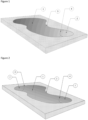
- the large water body is shown at designation 3. It will be appreciated that while the shape of the water body in Fig. 5 is shown with four-sided shape, the shape is for illustration only. Other embodiment shapes are illustrated in Figs. 1-3 .
- the sedimentation zone 1 and dissipation zone 2 are shown as designated portions of the large water body 3.
- the boundary for the delimitation means 4, which is not a physical barrier, is shown at the meeting point or intersection of the sedimentation zone 1 and dissipation zone 2.
- the periphery 12 extends about the edge of the large water body 3.
- Input water to pump 25 is provided from the dissipation zone 2, treated water from the sedimentation zone 1, and any required or desired make-up water from block 27.
- the amount of water from the various locations may be adjusted based on establishing the appropriate current/flow within the large water body 3, and evaporation, among other factors.
- the pump 25 provides water to the one or more inlet nozzles 26, which together with the natural influence of water currents produced by winds and/or the horizontal and vertical water temperature differences of the water body, establish the current or flow (indicated by the plurality of arrows 14) from the dissipation zone 2 to the sedimentation zone 1.
- the system for dosing chemicals 29 provides chemicals to the pump 25 and optionally provides chemicals directly to the dissipation zone 2.
- the system for dosing chemicals 19 comprising one or more inlet nozzles provides the necessary chemicals to the sedimentation zone 1.
- the system for dosing chemicals 19 provides the necessary disinfectant for the desired CT cycle and the flocculant composition.
- the system for dosing chemicals 19 comprising one or more inlet nozzles may be extended for additional lengths or positions along the periphery 12 for treatment based on the size of the large water body 3. Treated water can also be drawn from the sedimentation zone 1 through a pump 30 to the pump 25 or to the system for dosing chemicals 19.
- FIG. 6 a schematic cross section of a portion of the dissipation zone 2 is illustrated.
- the periphery 12 is shown as the demarcation between the shore or edge 15 and the water within the large water body 3.
- the downward slope from the periphery 12 to the bottom surface is preferably at an angle ⁇ that results in a slope of up to 15%. This provides an entrance into the water 16 from the shore 15 that is safe and generally comfortable for bathers entering the water.
- the Contamination Reduction Index is an index calculated based on a standardized protocol developed in the present disclosure to represent the safety and sanitary conditions of a water body treated according to the method of the invention.
- the Contamination Reduction Index is an Index that determines the time in minutes needed to dissipate a sample of an aqueous solution out of a defined water zone.
- the Contamination Reduction Index indicates the time in minutes counted as from the moment that a sample of a tinted solution is added to a particular point within a dissipation zone 2 until the tinted solution is dissipated and is not visually detectable in said dissipation zone 2.
- the Contamination Reduction Index (CRI) fairly represents the time that it will require for an aqueous contaminant brought in by a bather or by other means into a dissipation zone 2 to be dissipated out of that dissipation zone 2 into the sedimentation zone 1.
- the CRI is therefore a suitable and objective standard to assess the ability of said water zone to dissipate a contaminant in a short timeframe into the sedimentation zone 1, wherein said contaminant can be subsequently inactivated, flocculated and removed out of the sedimentation zone 1, maintaining thus safe and sanitary conditions in case of a contamination event.
- the CRI which counts the time as from the moment that the sample of a specific tinted solution is added into the dissipation zone 2 until the same is not visually detectable in said dissipation zone 2, depends on several of factors.
- the CRI of the dissipation zone 2 is influenced mainly by: the presence of an open connection to a sedimentation zone 1, the disposition of one or more inlet nozzles that inject a water flow into the dissipation zone 2 and the natural influence of water currents produced by winds and/or the horizontal and vertical water temperature differences of the water body.
- the dissipation zone 2 is configured to allow a Contamination Reduction Index (CRI) of up to 30 minutes, more preferably of up to 25 minutes, more preferably of up to 20 minutes and even more preferably of up to 15 minutes and even more preferably of up to 10 minutes.
- CRI Contamination Reduction Index
- the CRI can be determined in several ways, either from qualitative and/or quantitative data and analysis.
- the information regarding the time required to complete the dissipation of a sample of a tinted solution can be obtained qualitatively by visual inspection, methods based on experience, or estimate projections. In other embodiment, the information regarding the time required to complete the dissipation of a sample of a tinted solution can be obtained from one or more manual or automatic monitoring devices.
- the standardized protocol to determine the Contamination Reduction Index (CRI) comprises assessing the time required for a water zone (a dissipation zone 2) of 144 m3 to dissipate 7L of a tinted aqueous solution comprising 30 g/L of carmine (natural red 4) and 77 g/L of NaCl out of said water zone until the tinted solution is not visually detectable in said water zone. While the test is being conducted, and in order to ensure the visual detection of the tinted solution in the dissipation zone 2, the water zone should be free of chemical agents that may reduce the detection of colorant, such as chlorine and other disinfectant agents. Once the test is finalized, chemical agents should be reestablished according to the specifications of the dissipation zone 2.
- the Contamination Reduction Index provides therefore an objective projection of the efficient water dissipation patterns of the dissipation zone 2 according to the present invention, which combined with a permanent minimum disinfectant concentration as well as with an open connection to a sedimentation zone 1 that is configured to inactivate, flocculate and eliminate dangerous microorganisms, amongst other factors, allows providing safe and sanitary conditions for large water bodies for direct contact recreational purposes.
- the combined disinfection methods, efficient diffusion pattern and sedimentation capacity of the water bodies according to the present invention create unprecedented safe environments for water recreational purposes that have not been described nor applied before and that solve the inefficiencies of conventional swimming pool technologies and those of partly treated large water bodies, allowing thus the creation of recreational water bodies that minimize the risk of infections caused by microorganisms such as bacteria, protozoa, amoebas, microalgae and parasites, amongst others, solving thus the inefficiencies of current methods and systems in an innovative manner and at low costs.
- the method of the present invention also allows to reduce costs compared to conventional swimming pools systems and methods, where for example a 2 hectare conventional swimming pool would require a yearly operation cost of up to US$ 1.9MM considering chemical use and electricity use, whereas the method of the present invention would bring a yearly operation cost to less than US$ 140,000 (considering chemicals and energy costs as well) up to a 90% of reduction in annual maintenance costs.
- the method of the present invention allows minimizing the risk of contamination from microorganisms that current technologies are not capable of treating.
- current swimming pool technologies or partial treatment technologies for man-made water bodies have not been able to efficiently provide a high sanitary effect and have not been able to inactivate and/or remove microorganisms that cause recreational water illnesses or other infections that could even lead to fatal outcomes.
- the method from the present invention in addition to having low capital and operation costs, allows inactivating and/or removing microorganisms from recreational water bodies in an innovative manner, generating a new concept of water sanitation at low costs.
- the sedimentation zone 1 is designed to efficiently settle the microorganisms contained within such sedimentation zone 1 water volume, and where the dissipation zone 2 allows maintaining safe and sanitary conditions for high density of bathers at low costs.
- Fig. 7 there is provided an overview of the steps designated at 700 in an embodiment in accordance with the principles of the invention. In addition, the steps illustrated in Fig. 7 do not require that the steps be performed in the order shown.
- a sedimentation zone 1 and dissipation zone 2 are designated within the same large water body 3.
- the two zones are not separated by a physical barrier and the ratio between the volume of water contained within the dissipation zone 2 and the volume contained within the sedimentation zone 1 is from 1:2 to 1:40.
- the sedimentation zone 1 also has an aesthetic purpose and is used mainly for the practice of aquatic sports with secondary contact purposes. It is therefore designed to have a density of bathers lower than the dissipation zone 2, wherein as a daily average no more than 20% of the total number of bathers within the large water body 3 is present in the sedimentation zone 1.
- the dissipation zone 2 is used for direct contact purposes, such as swimming and bathing. It is designed to have a high density of bathers, wherein as a daily average, at least 80% of the total number of bathers within the large water body 3 is present in the dissipation zone 2 with a maximum density of 1 bather per 2 m2.
- a disinfection method based on a CT index is applied to the sedimentation zone 1 water volume.
- the CT index requires that the sedimentation zone 1 is treated by adding disinfectant agents to achieve a specific concentration "C” of the disinfectant during a minimum contact time of "T” in the complete water volume of the sedimentation zone 1.
- the disinfection method is performed such that the disinfectant agents are applied to the water volume contained in the sedimentation zone 1 to achieve a CT index of at least 42 every 72 hours.
- an efficient amount of a flocculant composition is applied into the sedimentation zone 1.
- the flocculant aids in the settling of different microorganisms and/or contaminants that are present in the sedimentation zone 1.
- the water flows and water circulation within the sedimentation zone 1 are preferably maintained at a to allow a proper sedimentation.
- a permanent chlorine residual is maintained in the dissipation zone 2 water volume by adding an efficient amount of chlorine so that a level of at least a 0.5 mg/L free chlorine level is maintained in the water volume contained within the dissipation zone 2.
- water is injected to the dissipation zone by means of one or more inlet nozzles thatalong with the natural currents produced by winds and/or water temperature differences -- allow generating a water dissipation pattern of the volume of water within the dissipation zone 2 into the sedimentation zone 1.
- the dissipation zone 2 is configured to allow a Contamination Reduction Index (CRI) of up to 30 minutes.
- CRI Contamination Reduction Index
- Figure 3 shows a water body 3 having a sedimentation zone 1 and a dissipation zone 2 according to the present invention, wherein the dissipation zone 2 comprises a nozzle system and has a residual chlorine concentration of approximately 0.5 mg/L.
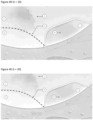
- Figure 2 shows the estimated location of the delimitation means 4, depicted as a dotted line, which is not a physical barrier and also depicts an adjacent (but completely independent) swimming pool (7) having conventional swimming pool technology, i.e., not having separate dissipation 2 and sedimentation 1 zones according to the present invention.
- Figure 4A also shows that an equivalent amount of a second red-tinted solution (6) was added into a spot inside the adjacent swimming pool (7).
- the water nozzles of the dissipation zone 2 were activated while the standard recirculation systems of the swimming pool (7) were operated according to its standard operating parameters.
- the dissipation zone 2 along with the natural influence of water currents produced by winds and/or the temperature differences in the water body, is able to safely and efficiently dissipate said contamination that might comprise dangerous microorganisms into a sedimentation zone 1 for its subsequent inactivation, flocculation and removal in a short time frame, thus minimizing the risk of bathers becoming infected by dangerous microorganisms.
- a contamination event for example, an aqueous fecal contamination or other type of contamination
- the dissipation zone 2 along with the natural influence of water currents produced by winds and/or the temperature differences in the water body, is able to safely and efficiently dissipate said contamination that might comprise dangerous microorganisms into a sedimentation zone 1 for its subsequent inactivation, flocculation and removal in a short time frame, thus minimizing the risk of bathers becoming infected by dangerous microorganisms.
- the dissipation zone 2 is configured to have a residual free chlorine concentration of at least 0.5 mg/L, said dissipation zone 2 can withstand a massive use of bathers without compromising the sanitary quality of such zone due to the fact that in the event of a contamination, the microorganisms can be dissipated in a more efficient and safe way compared to conventional swimming pools maintaining at the same time safe and sanitary conditions in the dissipation zone 2 which is the zone that is used for direct contact recreational purposes.
- the method according to the present invention was applied to the artificial lake.
- the artificial lake was designated to include two different zones: one zone for direct contact recreational purposes designated as the dissipation zone 2 and a second zone for secondary contact recreational purposes, namely, such as for aesthetic purposes and for the practice of watersports designated as the sedimentation zone 1.
- the volume rate between the dissipation zone and the sedimentation zone was designed to be approximately 1:6 and the sedimentation zone 1 comprised a depth of 2 meters at its deepest point, which allowed an efficient settling of the microorganisms.
- the combined disinfection methods, efficient diffusion pattern and sedimentation capacity of the water bodies according to the present invention create unprecedented safe environments for water recreational purposes that have not been described nor applied before and that solve the inefficiencies of conventional swimming pool technologies and those of partly treated large water bodies, allowing thus the creation of recreational water bodies that minimize the risk of infections caused by microorganisms such as bacteria, protozoa, amoebas, microalgae and parasites, amongst others, solving thus the inefficiencies of current methods and systems in an innovative manner and at low costs.
Landscapes
- Chemical & Material Sciences (AREA)
- Organic Chemistry (AREA)
- Environmental & Geological Engineering (AREA)
- Water Supply & Treatment (AREA)
- Hydrology & Water Resources (AREA)
- Life Sciences & Earth Sciences (AREA)
- Engineering & Computer Science (AREA)
- Inorganic Chemistry (AREA)
- Separation Of Suspended Particles By Flocculating Agents (AREA)
- Treatment Of Water By Oxidation Or Reduction (AREA)
- Physical Water Treatments (AREA)
- Treatment Of Biological Wastes In General (AREA)
- Aeration Devices For Treatment Of Activated Polluted Sludge (AREA)
- Agricultural Chemicals And Associated Chemicals (AREA)
- Heat Treatment Of Water, Waste Water Or Sewage (AREA)
Claims (32)
- Procédé d'aménagement de grands plans d'eau convenant à des fins récréatives par contact direct, le grand plan d'eau ayant une surface d'au moins 3000 m2, le procédé consistant à- désigner une zone de sédimentation (1) et une zone de dissipation (2) dans le grand plan d'eau, toutes deux ayant des configurations et des méthodes de traitement différentes, dans lesquelles:- la zone de sédimentation (1) et la zone de dissipation (2) sont situées dans la même grand plan d'eau (3) et ne sont pas séparées par une barrière physique, le rapport entre le volume d'eau contenu dans la zone de dissipation (2) et le volume contenu dans la zone de sédimentation (1) étant compris entre 1:2 et 1:40;- la zone de sédimentation (1) a un but esthétique et est utilisée principalement pour des activités récréatives sans contact, telles que la pêche ou les activités nautiques, qui n'impliquent pas le contact direct des baigneurs avec l'eau et ne comportent donc pas de risque significatif d'ingestion d'eau, dans laquelle la zone de sédimentation est conçue pour avoir une densité de baigneurs inférieure à la zone de dissipation (2), dans laquelle, en moyenne journalière, pas plus de 20 % du nombre total de baigneurs dans le grand plan d'eau (3) n'est présent dans la zone de sédimentation (1);- la zone de dissipation (2) est utilisée pour des activités récréatives de contact direct, telles que la natation, le ski nautique, la plongée, le surf et le pataugeage, qui impliquent un contact direct répété ou continu des baigneurs avec l'eau, avec un risque important d'ingestion d'eau, et est conçue pour avoir une forte densité de baigneurs, dans laquelle, en moyenne journalière, au moins 80 % du nombre total de baigneurs dans le grand plan d'eau (3) est présent dans la zone de dissipation (2), avec une densité maximale de 1 baigneur par 2 m2;- appliquer un procédé de désinfection basée sur un indice CT dans le volume d'eau de la zone de sédimentation (1), dans laquelle l'indice CT exige que la zone de sédimentation (1) soit traitée en ajoutant des agents désinfectants pour atteindre une concentration spécifique "C" du désinfectant pendant un temps de contact minimum "T" dans le volume d'eau de la zone de sédimentation (1), et dans laquelle la méthode de désinfection est exécutée de telle sorte que les agents désinfectants sont appliqués au volume d'eau contenu dans la zone de sédimentation (1) pour atteindre un indice CT d'au moins 42 mg*min/L toutes les 72 heures;- en appliquant une quantité efficace d'une composition floculante dans la zone de sédimentation (1) qui aide à la décantation des différents micro-organismes et/ou contaminants présents dans la zone de sédimentation (1), et dans laquelle les flux d'eau et la circulation de l'eau dans la zone de sédimentation (1) sont maintenus pour permettre une sédimentation adéquate;- maintenir un résidu de chlore permanent dans le volume d'eau de la zone de dissipation (2) en ajoutant une quantité efficace de chlore de manière à maintenir un niveau de chlore libre d'au moins 0,5 mg/L dans le volume d'eau contenu dans la zone de dissipation (2);- injecter de l'eau dans la zone de dissipation (2) au moyen d'une ou plusieurs buses d'entrée 26 qui, avec les courants naturels produits par les vents et/ou les différences de température de l'eau, ont la capacité de générer un modèle de dissipation du volume d'eau dans la zone de dissipation (2) dans la zone de sédimentation (1), etdans laquelle la zone de dissipation (2) est agencée et configurée pour permettre un indice de réduction de la contamination (CRI), le CRI étant déterminé sur la base d'un protocole normalisé qui comprend l'évaluation du temps nécessaire à une zone d'eau de 144 mètres cubes pour dissiper 7 litres d'une solution teintée comprenant 30 g/L de carmin et 77 g/L de NaCl hors de la zone d'eau de telle sorte que la solution teintée ne soit pas visuellement détectable dans ladite zone d'eau, qui tient compte des connexions ouvertes avec la zone de sédimentation (1), du débit d'eau injecté par les buses d'entrée et des courants d'eau naturels produits par les vents et/ou les différences de température à l'intérieur de la masse d'eau, la zone de dissipation (2) étant aménagée et configurée pour maintenir un CRI allant jusqu'à 30 minutes.
- Procédé selon la revendication 1, dans lequel la zone de sédimentation (1) et la zone de dissipation (2) sont délimitées par des moyens de délimitation (4).
- Procédé selon la revendication 2, dans lequel le moyen de délimitation (4) est choisi dans le groupe comprenant: une délimitation visuelle, une ligne de flottaison, une ligne de délimitation, des drapeaux aériens, des bouées, un changement de pente, une profondeur différente et des combinaisons de ceux-ci.
- Procédé selon la revendication 2, dans lequel le moyen de délimitation (4) est établi au moyen d'une brochure, de désignations par signalisation ou de règles, d'un manuel, d'un guide d'utilisation et d'instructions écrites et/ou verbales, entre autres.
- Procédé selon la revendication 1, dans lequel la profondeur de la zone de sédimentation (1) est d'au moins 1,8 mètre à son point le plus profond, ce qui permet d'établir une profondeur efficace pour la décantation des micro-organismes et des contaminants et de minimiser les perturbations causées par les baigneurs.
- Procédé selon la revendication 1, dans lequel la zone de sédimentation (1) a une surface d'au moins 1500 m2, de préférence d'au moins 6000 m2 et de préférence encore d'au moins 10000 m2.
- Procédé selon la revendication 1, dans lequel la composition floculante comprend un ou plusieurs agents floculants choisis dans le groupe comprenant les polymères synthétiques, les polymères cationiques à ammonium quaternaire, les polymères polycationiques, les sels d'aluminium, l'oxyde de calcium, l'hydroxyde de calcium et leurs mélanges.
- Procédé selon la revendication 7, dans lequel les agents floculants sont choisis dans le groupe comprenant un floculant polymère cationique ou anionique et leurs mélanges.
- Procédé selon la revendication 1, dans lequel la composition floculante est ajoutée à la zone de sédimentation (1) au moins une fois tous les 7 jours à un taux de 0,03 g à 3,0 g par m3 de volume d'eau de la zone de sédimentation (1).
- Procédé selon la revendication 1, dans lequel un nettoyage périodique de la surface du fond de la zone de sédimentation (1) est effectué, de sorte que la zone de sédimentation (1) aura un aspect plus naturel, comme les lacs et les lagunes naturels, et qu'un nettoyage quotidien ne sera pas nécessaire.
- Procédé selon la revendication 10, dans lequel la surface inférieure de la zone de sédimentation (1) est nettoyée au moins une fois tous les 7 jours.
- Procédé selon la revendication 1, dans lequel la zone de sédimentation (1) est conçue pour décourager les baigneurs de pénétrer dans la zone de sédimentation (1), ce qui permet de minimiser les activités récréatives avec contact direct et d'encourager la pratique des sports aquatiques avec des activités récréatives sans contact.
- Procédé selon la revendication 1, dans lequel la zone de dissipation (2) est conçue de manière à avoir une profondeur allant jusqu'à 1,4 mètre à son point le plus profond.
- Procédé selon la revendication 1, dans lequel la zone de dissipation (2) est conçue de manière à avoir une profondeur allant jusqu'à 1,6 mètre à son point le plus profond.
- Procédé selon la revendication 1, dans lequel la zone de dissipation (2) est conçue de manière à avoir une profondeur allant jusqu'à 1,8 mètre à son point le plus profond.
- Procédé selon la revendication 1, dans lequel la zone de dissipation (2) comprend une pente descendante de la périphérie (12) à la surface du fond à un angle α qui résulte en une pente allant jusqu'à 15 % pour obtenir une entrée sûre dans le grand plan d'eau (3).
- Procédé selon la revendication 1, dans lequel la zone de dissipation (2) est désignée de telle sorte qu'en moyenne journalière, au moins 90% du nombre total de baigneurs dans le grand plan d'eau (3) est présent dans la zone de dissipation (2).
- Procédé selon la revendication 1, dans lequel la zone de dissipation (2) est conçue pour avoir une densité maximale de baigneurs de 1 baigneur par 2 m2.
- Procédé selon la revendication 1, dans lequel la zone de dissipation (2) est conçue pour avoir une densité maximale de baigneurs de 1 baigneur par 6 m2.
- Procédé selon la revendication 1, dans lequel la zone de dissipation (2) est conçue pour avoir une densité maximale de baigneurs de 1 baigneur par 8 m2.
- Procédé selon la revendication 1, dans lequel l'eau fournie à la zone de dissipation (2) par une ou plusieurs buses d'entrée (26) est traitée avec de la lumière ultraviolette (UV).
- Procédé selon la revendication 1, dans lequel l'emplacement, la conception et la configuration d'une ou plusieurs buses d'entrée (26) peuvent varier pour obtenir différents types de modèles de renouvellement de l'eau dans la zone de dissipation (2).
- Procédé selon la revendication 1, dans lequel la zone de dissipation (2) est disposée et configurée pour permettre un indice de réduction de la contamination (CRI) allant jusqu'à 25 minutes.
- Procédé selon la revendication 1, dans lequel la zone de dissipation (2) est disposée et configurée pour permettre un indice de réduction de la contamination (CRI) allant jusqu'à 20 minutes.
- Procédé selon la revendication 1, dans lequel la zone de dissipation (2) est disposée et configurée pour permettre un indice de réduction de la contamination (CRI) allant jusqu'à 15 minutes.
- Procédé selon la revendication 1, comprenant en outre l'application d'un nettoyage périodique d'une surface de fond de la zone de dissipation (2) afin de maintenir la surface de fond de cette zone de dissipation (2) exempte de particules pouvant générer un impact esthétique, sécuritaire ou sanitaire dans l'eau.
- Procédé selon la revendication 26, dans lequel la surface inférieure de la zone de dissipation (2) est nettoyée au moins une fois par période de 72 heures.
- Procédé selon la revendication 1, dans lequel le chlore résiduel permanent est maintenu dans la zone de dissipation (2) par l'ajout de pastilles de chlore, par l'application de chlore dilué à travers une ou plusieurs buses d'entrée (26) situées dans la zone de dissipation (2), ou par l'ajout manuel de chlore dans cette zone.
- Procédé selon la revendication 1, dans lequel le grand plan d'eau (3) comprend plusieurs zones de dissipation (2) séparées, de préférence situées à la périphérie (12) du grand plan d'eau ()3.
- Procédé selon la revendication 1, dans lequel le grand plan d'eau (3) a un volume allant jusqu'à 50000 m3 et comprend un système de filtration centralisé qui peut filtrer la totalité du volume d'eau du plan d'eau.
- Procédé selon la revendication 1, dans lequel le résidu désinfectant permanent dans la zone de dissipation (2) est maintenu par l'ajout d'agents désinfectants choisis dans le groupe comprenant le chlore, le brome, l'ozone, ses dérivés et leurs mélanges.
- Procédé selon la revendication 1, comprenant en outre l'ajout d'une quantité efficace d'un désinfectant chloré dans la zone de sédimentation pour maintenir un niveau permanent de chlore libre dans la zone de sédimentation, de préférence d'au moins 0,5 mg/L.
Priority Applications (4)
| Application Number | Priority Date | Filing Date | Title |
|---|---|---|---|
| SI202030606T SI3990397T1 (sl) | 2019-06-28 | 2020-05-28 | Cenovno ugoden in sanitarno učinkovit postopek, ki ustvarja dve različni coni zdravljenja v velikih vodnih telesih za olajšanje rekreacijskih dejavnosti z neposrednim kontaktom |
| HRP20250490TT HRP20250490T1 (hr) | 2019-06-28 | 2020-05-28 | Jeftin i sanitarno učinkovit postupak koji stvara dvije različite zone obrade u velikim vodenim površinama kako bi se olakšale rekreacijske aktivnosti s izravnim kontaktom |
| EP24163393.2A EP4371947A3 (fr) | 2019-06-28 | 2020-05-28 | Système et procédé économique et hygiénique efficace créant deux zones de traitement différentes dans de grands plans d'eau |
| RS20250387A RS66752B1 (sr) | 2019-06-28 | 2020-05-28 | Jeftin i sanitarno efikasan postupak kojim se dobijaju dve različite zone tretiranja u velikim vodenim masama kako bi se omogućile rekreativne aktivnosti sa neposrednim kontaktom |
Applications Claiming Priority (2)
| Application Number | Priority Date | Filing Date | Title |
|---|---|---|---|
| US16/456,762 US11453603B2 (en) | 2019-06-28 | 2019-06-28 | Low cost and sanitary efficient method that creates two different treatment zones in large water bodies to facilitate direct contact recreational activities |
| PCT/US2020/034909 WO2020263488A1 (fr) | 2019-06-28 | 2020-05-28 | Système et procédé peu coûteux et efficaces sur le plan sanitaire créant deux zones de traitement différentes dans de grandes masses d'eau pour faciliter des activités récréatives à contact direct |
Related Child Applications (2)
| Application Number | Title | Priority Date | Filing Date |
|---|---|---|---|
| EP24163393.2A Division-Into EP4371947A3 (fr) | 2019-06-28 | 2020-05-28 | Système et procédé économique et hygiénique efficace créant deux zones de traitement différentes dans de grands plans d'eau |
| EP24163393.2A Division EP4371947A3 (fr) | 2019-06-28 | 2020-05-28 | Système et procédé économique et hygiénique efficace créant deux zones de traitement différentes dans de grands plans d'eau |
Publications (3)
| Publication Number | Publication Date |
|---|---|
| EP3990397A1 EP3990397A1 (fr) | 2022-05-04 |
| EP3990397A4 EP3990397A4 (fr) | 2023-06-21 |
| EP3990397B1 true EP3990397B1 (fr) | 2025-01-29 |
Family
ID=74043450
Family Applications (2)
| Application Number | Title | Priority Date | Filing Date |
|---|---|---|---|
| EP24163393.2A Pending EP4371947A3 (fr) | 2019-06-28 | 2020-05-28 | Système et procédé économique et hygiénique efficace créant deux zones de traitement différentes dans de grands plans d'eau |
| EP20832912.8A Active EP3990397B1 (fr) | 2019-06-28 | 2020-05-28 | Procédé peu coûteux et efficaces sur le plan sanitaire créant deux zones de traitement différentes dans de grandes masses d'eau pour faciliter des activités récréatives à contact direct |
Family Applications Before (1)
| Application Number | Title | Priority Date | Filing Date |
|---|---|---|---|
| EP24163393.2A Pending EP4371947A3 (fr) | 2019-06-28 | 2020-05-28 | Système et procédé économique et hygiénique efficace créant deux zones de traitement différentes dans de grands plans d'eau |
Country Status (39)
| Country | Link |
|---|---|
| US (5) | US11453603B2 (fr) |
| EP (2) | EP4371947A3 (fr) |
| JP (1) | JP7494223B2 (fr) |
| KR (1) | KR20220023969A (fr) |
| CN (1) | CN114072361B (fr) |
| AR (1) | AR119292A1 (fr) |
| AU (1) | AU2020304520B2 (fr) |
| BR (1) | BR112021023572A2 (fr) |
| CA (1) | CA3145106A1 (fr) |
| CL (1) | CL2021003009A1 (fr) |
| CO (1) | CO2021015563A2 (fr) |
| CR (1) | CR20210619A (fr) |
| CU (2) | CU20240010A7 (fr) |
| DK (1) | DK3990397T3 (fr) |
| DO (1) | DOP2021000257A (fr) |
| EC (1) | ECSP21087147A (fr) |
| ES (1) | ES3027764T3 (fr) |
| FI (1) | FI3990397T3 (fr) |
| GE (1) | GEAP202316278A (fr) |
| HR (1) | HRP20250490T1 (fr) |
| HU (1) | HUE070976T2 (fr) |
| IL (2) | IL289388B2 (fr) |
| JO (2) | JOP20210325B1 (fr) |
| LT (1) | LT3990397T (fr) |
| MA (2) | MA60465B1 (fr) |
| MX (2) | MX2021015099A (fr) |
| PE (1) | PE20220668A1 (fr) |
| PH (1) | PH12021553097A1 (fr) |
| PL (1) | PL3990397T3 (fr) |
| PT (1) | PT3990397T (fr) |
| PY (1) | PY2030104A (fr) |
| RS (1) | RS66752B1 (fr) |
| SG (1) | SG11202113346QA (fr) |
| SI (1) | SI3990397T1 (fr) |
| TW (2) | TWI876932B (fr) |
| UA (1) | UA130406C2 (fr) |
| UY (1) | UY38746A (fr) |
| WO (1) | WO2020263488A1 (fr) |
| ZA (1) | ZA202201253B (fr) |
Families Citing this family (4)
| Publication number | Priority date | Publication date | Assignee | Title |
|---|---|---|---|---|
| US11453603B2 (en) | 2019-06-28 | 2022-09-27 | Crystal Lagoons Technologies, Inc. | Low cost and sanitary efficient method that creates two different treatment zones in large water bodies to facilitate direct contact recreational activities |
| UY39586A (es) * | 2020-12-31 | 2022-07-29 | Crystal Lagoons Tech Inc | Sistema de calefacción localizada para grandes cuerpos de agua con un sistema de confinamiento parcial |
| UY40591A (es) * | 2023-02-02 | 2024-08-30 | Crystal Lagoons Tech Inc | Método para crear zonas sanitarias geométricas de agua dulce dentro de grandes cuerpos de agua |
| US12516534B1 (en) * | 2024-11-14 | 2026-01-06 | Crystal Lagoons Technologies, Inc. | Sustainable heat transfer system that includes a digital processing facility and a recreational man-made swimming lagoon that provides cooling to such facility, the system being configured for contributing to environmental sustainability and community benefits |
Family Cites Families (197)
| Publication number | Priority date | Publication date | Assignee | Title |
|---|---|---|---|---|
| US2923954A (en) | 1960-02-09 | babcock | ||
| US2071520A (en) | 1935-06-21 | 1937-02-23 | Harrison Joseph Duke | Sports lagoon and ocean terminal |
| US2141811A (en) | 1937-03-20 | 1938-12-27 | Roy B Everson | Swimming pool cleaner |
| US2314767A (en) | 1942-03-18 | 1943-03-23 | Burrell Technical Supply Compa | Adjustable rubber valve |
| US2646889A (en) | 1950-02-15 | 1953-07-28 | Dulak August | Swimming pool cleaning device |
| US3132773A (en) | 1962-12-17 | 1964-05-12 | Quentin L Hampton | Sludge removing apparatus for a settling tank |
| US3317925A (en) | 1963-05-15 | 1967-05-09 | Robert M Vance | Swimming pool construction |
| US3247053A (en) | 1964-03-02 | 1966-04-19 | Commercial Solvents Corp | Inhibiting the growth of algae in water with nu-(2-aminoalkyl) alkylamine |
| US3266631A (en) | 1964-03-16 | 1966-08-16 | Alvin A Snaper | Apparatus for separating a fluid mixture by acoustic energy |
| US3361150A (en) | 1965-01-06 | 1968-01-02 | Universal Interloc Inc | Water conditioning control system |
| US3419916A (en) | 1966-10-03 | 1969-01-07 | Martin M. Schankler | Liner type pool construction |
| GB1171664A (en) | 1967-02-21 | 1969-11-26 | Dorr Oliver Inc | Treatment of polluted streams in place |
| US3406416A (en) | 1967-05-05 | 1968-10-22 | Rainbow Plastics | Wheel for swimming pool vacuum cleaner head |
| US3412862A (en) | 1967-09-07 | 1968-11-26 | Merle P. Chaplin | Method and apparatus for cleaning areas overlain by a water body |
| US3540274A (en) | 1968-02-26 | 1970-11-17 | Medallion Pool Corp | Pool liner |
| US3660957A (en) | 1968-12-10 | 1972-05-09 | Martin M Schankler | Prefabricated swimming pool construction |
| US3641594A (en) | 1969-12-18 | 1972-02-15 | Leisign Engineering Co Inc | Gutter and water supply system for swimming pools |
| US3695434A (en) | 1970-08-28 | 1972-10-03 | George R Whitten Jr | Purification |
| US3748810A (en) | 1971-03-24 | 1973-07-31 | Mattingly Inc | Method of swimming pool manufacture |
| DE2141460A1 (de) | 1971-08-19 | 1973-02-22 | Dynamit Nobel Ag | Verfahren zum auskleiden von schwimmbecken |
| US3788982A (en) | 1972-01-18 | 1974-01-29 | F Zsoldos | Color control of water that is recirculated |
| US3844760A (en) | 1972-02-29 | 1974-10-29 | Monsanto Co | Composition for and method of treating water |
| HU165521B (fr) | 1972-07-03 | 1974-09-28 | ||
| US4119535A (en) | 1973-04-16 | 1978-10-10 | White Eugene B | Method of sanitizing a volume of water in conjunction with chlorine |
| DE2505846A1 (de) | 1974-02-15 | 1975-08-21 | Vmw Ranshofen Berndorf Ag | Verkleidung aus profilierten bahnen, insbesondere blechen fuer raeumlich gekruemmte flaechen |
| US4176058A (en) | 1974-10-24 | 1979-11-27 | Grobler Jacobus J | Method means for de-silting water |
| US3950809A (en) | 1974-11-08 | 1976-04-20 | Rudolf Emil Schatzmann | Combination sweeper and vacuum cleaner for swimming pools |
| US4880547A (en) | 1975-06-30 | 1989-11-14 | Kenji Etani | Methods for water treatment |
| US4519914A (en) | 1975-06-30 | 1985-05-28 | Kenji Etani | Method for treating swimming pool water |
| US4090266A (en) | 1975-12-19 | 1978-05-23 | Price John W | Swimming pool construction |
| GB1494005A (en) | 1976-04-30 | 1977-12-07 | Intchim Ltd | Swimming pools |
| US4100641A (en) | 1976-06-24 | 1978-07-18 | Pansini Andrew L | Swimming pool cleaners |
| US4129904A (en) | 1977-11-14 | 1978-12-19 | Pansini Andrew L | Swimming pool cleaner |
| IL55402A0 (en) | 1978-08-21 | 1978-10-31 | Melamed A | Method and means for cooling of heat generating industrial operations |
| CH638272A5 (de) | 1978-12-27 | 1983-09-15 | Sommer Schenk Ag | Geraet zur unterwasserreinigung. |
| US4263759A (en) | 1979-03-15 | 1981-04-28 | Bradley Enterprises, Inc. | Swimming pool construction and method of making the same |
| US4227361A (en) | 1979-03-16 | 1980-10-14 | Bradley Enterprises, Inc. | Method of constructing a swimming pool |
| US4254525A (en) | 1979-07-12 | 1981-03-10 | Aladdin Equipment Company | Submerged surface vacuum cleaner |
| DE3069242D1 (en) | 1979-12-03 | 1984-10-25 | Durack M J | Liquid retaining structures |
| US4306967A (en) | 1980-04-14 | 1981-12-22 | Trautwein Bill B | Cooling tower basin water treating apparatus |
| US4338697A (en) | 1980-08-14 | 1982-07-13 | Caleb Broadwater | Simplified pool cleaning apparatus |
| US4343696A (en) | 1981-02-03 | 1982-08-10 | Hung Pai Yen | System for removing sludge from dam reservoir |
| US4402101A (en) | 1981-08-07 | 1983-09-06 | Zyl Robert M Van | Power pool cleaner |
| JPS5912287A (ja) | 1982-07-12 | 1984-01-21 | Hitachi Ltd | 復水器冷却水除貝装置 |
| US4464215A (en) | 1982-07-28 | 1984-08-07 | W. R. Grace & Co. | Process of applying a unitary construction barrier |
| IT1206485B (it) | 1983-04-06 | 1989-04-27 | Mario Scheichenbauer | Metodo per la costruzione di piscine realizzate con casseri aperdere. |
| JPS59222294A (ja) | 1983-05-30 | 1984-12-13 | Nippon Kankyo Seibi:Kk | 接触材による湖沼水及び河川水の浄化法 |
| US4652378A (en) | 1984-08-15 | 1987-03-24 | Solmat Systems, Ltd. | Method of and apparatus for reduction of turbidity in a body of fluid |
| US4581075A (en) | 1985-03-15 | 1986-04-08 | Maxi-Sweep, Inc. | Self-propelled water borne pool cleaner |
| US4640784A (en) | 1985-07-29 | 1987-02-03 | Cant Investments Pty. Limited | Method and apparatus for cleaning swimming pools |
| US4692956A (en) | 1985-12-31 | 1987-09-15 | Kassis Amin I | Pool vacuum |
| US4752740A (en) | 1986-05-19 | 1988-06-21 | Steininger Jacques M | Electronic water chemistry analysis device with linear bargraph readouts |
| US5028321A (en) | 1986-07-23 | 1991-07-02 | Damon K. Stone | Method and apparatus for water circulation, cleaning, and filtration in a swimming pool |
| US5107872A (en) | 1986-08-15 | 1992-04-28 | Meincke Jonathan E | Cleaning system for swimming pools and the like |
| ES2001429A6 (es) | 1986-09-18 | 1988-05-16 | Crystalclear Co S A | Metodo para el tratamiento de masas de agua |
| US4768532A (en) | 1987-01-23 | 1988-09-06 | Jandy Industries | Underwater pool cleaner |
| US4767511A (en) | 1987-03-18 | 1988-08-30 | Aragon Pedro J | Chlorination and pH control system |
| US4863365A (en) | 1987-07-27 | 1989-09-05 | Pipe Liners, Inc. | Method and apparatus for deforming reformable tubular pipe liners |
| US4948296A (en) | 1987-12-18 | 1990-08-14 | Huntina Pty. Ltd. | Swimming pool construction |
| US4835810A (en) | 1988-01-06 | 1989-06-06 | Rainbow Lifegard Products, Inc. | Wheeled pool vacuum head with vacuum enhancing seal |
| US4849024A (en) | 1988-01-07 | 1989-07-18 | Liberty Pool Products S.A. | Pool cleaner |
| US4776053A (en) | 1988-02-01 | 1988-10-11 | Kiraly J George | Swimming pool vacuum cleaner hydrofoil |
| US4952398A (en) | 1988-03-17 | 1990-08-28 | Jean Tapin | Biocidal composition with copper algicide |
| IT1217945B (it) | 1988-06-28 | 1990-03-30 | Egatechnics Srl | Pulitore automatico semovente per piscine |
| ZA885179B (en) | 1988-07-18 | 1989-04-26 | Graham Mervyn Elliott | Swimming pool skimmer |
| DE3844374A1 (de) | 1988-12-30 | 1990-07-05 | Wahnbachtalsperrenverband | Verfahren zum entfernen von bewegungsaktiven mikroorganismen aus wasser |
| US4931187A (en) | 1989-02-07 | 1990-06-05 | Klenzoid, Inc. | Cooling tower system |
| CA2056379C (fr) | 1989-06-16 | 2001-01-09 | Thomas C. Kuechler | Compositions biocides pour circuits a eau de recirculation et methodes connexes |
| GB2243151A (en) | 1990-04-20 | 1991-10-23 | Lu Wen Pin | Device for aerating and dispersing chemicals in lakes etc. |
| US5039427A (en) | 1990-06-19 | 1991-08-13 | General Chemical Corporation | Method of treating lake water with aluminum hydroxide sulfate |
| FR2665209A1 (fr) | 1990-07-25 | 1992-01-31 | Chandler Michael | Dispositif de balai hydraulique pour bassin de piscine et analogue. |
| JPH076180B2 (ja) | 1990-09-03 | 1995-01-30 | 鹿島建設株式会社 | 干満差を利用した海水域浄化施設 |
| US5293659A (en) | 1990-09-21 | 1994-03-15 | Rief Dieter J | Automatic swimming pool cleaner |
| US5106229A (en) | 1990-10-09 | 1992-04-21 | Blackwell William A | In ground, rigid pools/structures; located in expansive clay soil |
| FR2668527B1 (fr) | 1990-10-29 | 1992-12-31 | Negri Jean Daniel | Structure de bassin aquatique, et procede pour sa realisation. |
| DK0483470T3 (da) | 1990-10-31 | 1996-09-23 | 3S Systemtechn Ag | Selvkørende rengøringsapparat, især til svømmebassiner |
| US5174231A (en) | 1990-12-17 | 1992-12-29 | American Colloid Company | Water-barrier of water-swellable clay sandwiched between interconnected layers of flexible fabric needled together using a lubricant |
| US5108514A (en) | 1991-02-08 | 1992-04-28 | Kisner Kim T | In-situ method for cleaning swimming pools without draining the water |
| JPH0576254A (ja) * | 1991-05-07 | 1993-03-30 | Mitsui Constr Co Ltd | 海水浄化方法 |
| US5143623A (en) | 1991-06-17 | 1992-09-01 | Kroll Brian L | Nutrient and particle removal: method and apparatus for treatment of existing lakes, ponds and water bodies |
| JP3026643B2 (ja) | 1991-07-16 | 2000-03-27 | 三洋電機株式会社 | 給排気装置 |
| FR2685374B1 (fr) | 1991-12-24 | 1994-03-25 | Pierre Nicoloff | Robot aspirateur autonome pour piscines. |
| US5268092A (en) | 1992-02-03 | 1993-12-07 | H.E.R.C., Inc. | Two water control system using oxidation reduction potential sensing |
| JPH05220466A (ja) | 1992-02-13 | 1993-08-31 | Hideaki Sakai | 自動添加撹拌方法および自動添加撹拌装置およびその 自動添加撹拌装置の使用方法および自動添加撹拌装置 による池湖水或は河川の水の浄化方法および自動添加 撹拌装置による池湖水或は河川の水の浄化装置 |
| JPH05261395A (ja) | 1992-03-17 | 1993-10-12 | Hitachi Kiden Kogyo Ltd | 水域の浄化装置 |
| US5422014A (en) | 1993-03-18 | 1995-06-06 | Allen; Ross R. | Automatic chemical monitor and control system |
| US5337434A (en) | 1993-04-12 | 1994-08-16 | Aqua Products, Inc. | Directional control means for robotic swimming pool cleaners |
| US5398361A (en) | 1994-03-21 | 1995-03-21 | Cason; Kurt N. | Vacuum cleaner for submerged non-parallel surfaces |
| IL109394A (en) | 1994-04-22 | 1997-03-18 | Maytronics Ltd | Swimming pool cleaning, navigational control system and method |
| JPH07310311A (ja) | 1994-05-17 | 1995-11-28 | Shimizu Corp | 人工ラグーン |
| US5454129A (en) | 1994-09-01 | 1995-10-03 | Kell; Richard T. | Self-powered pool vacuum with remote controlled capabilities |
| US5616239A (en) | 1995-03-10 | 1997-04-01 | Wendell; Kenneth | Swimming pool control system having central processing unit and remote communication |
| DE19515428C2 (de) | 1995-04-26 | 1997-03-13 | L V H T Lehr Und Versuchsgesel | Verfahren zur Aufbereitung von verschiedenen Betriebswässern in Freizeitbädern |
| FR2740493B1 (fr) | 1995-10-27 | 1998-01-09 | Armater | Structure de bassin ou de piscine sans paroi verticale |
| US5782480A (en) | 1995-12-20 | 1998-07-21 | Phillips; Reuben | Wheeled amphibious vehicle |
| JP3026643U (ja) | 1996-01-08 | 1996-07-16 | アサヒビール株式会社 | 水底の沈殿物除去装置 |
| EP1695770A1 (fr) | 1996-06-26 | 2006-08-30 | Melvyn L. Henkin | Système automatique de nettoyage d'une piscine à pression positive |
| US5802631A (en) | 1996-07-01 | 1998-09-08 | Friedman; Jerome | Pool liner installation method and apparatus |
| US6657546B2 (en) | 1996-10-04 | 2003-12-02 | Pablo F. Navarro | Integrated water treatment control system with probe failure detection |
| JPH10169226A (ja) | 1996-12-11 | 1998-06-23 | Nippon Filcon Co Ltd | プール水循環▲ろ▼過方法および循環▲ろ▼過式プール |
| FR2760483A3 (fr) | 1997-03-10 | 1998-09-11 | Philippe Billaud | Appareil electronique destine a la gestion automatique de la filtration en fonction des parametres temperature, temps de filtration |
| DE19814705A1 (de) | 1997-04-02 | 1998-10-08 | Hellebrekers Install Tech Bv | Verfahren und Vorrichtung zur Aufbereitung von Wasser, insbesondere von Schwimmbadwasser |
| US5842243A (en) | 1997-04-24 | 1998-12-01 | Aqua Products Inc. | Manually propelled pool cleaner |
| AU7492898A (en) | 1997-05-15 | 1998-12-08 | Orange County Water District | Method and system for cleaning a water basin floor |
| KR200162956Y1 (ko) | 1997-06-11 | 1999-12-15 | 강동석 | 오폐수 처리장치 |
| FR2766945B1 (fr) | 1997-07-29 | 1999-10-29 | Leroux Gilles Sa | Machine de personnalisation a haute cadence |
| JP3267904B2 (ja) | 1997-08-20 | 2002-03-25 | 株式会社マリン技研 | 水域浄化装置 |
| DE29716994U1 (de) | 1997-09-23 | 1997-11-13 | Teichform GmbH, 73037 Göppingen | Künstlicher Gartenteich |
| US6846452B2 (en) | 1998-07-17 | 2005-01-25 | Ashland Inc. | Scale inhibitor for an aqueous system |
| IL125592A (en) | 1998-07-30 | 2004-06-01 | Argad Eyal Water Treat Technol | Water treatment |
| FR2785898B1 (fr) | 1998-11-17 | 2000-12-22 | Jacques Giroguy | Procede et installation d'assainissement des eaux de bassins telles que les eaux de piscines |
| US6317901B1 (en) | 1998-11-30 | 2001-11-20 | Noel Leon Corpuel | Fresh or salt water pool |
| CN1256250A (zh) | 1998-12-09 | 2000-06-14 | 中国科学院生态环境研究中心 | 无机高分子絮凝剂的微絮凝-深床直接过滤净水处理工艺 |
| DE19860568B4 (de) | 1998-12-22 | 2005-08-04 | Menschel, Claudia, Dr.rer.nat. | Verfahren und Anlage zur Sanierung von Oberflächengewässern |
| US6149819A (en) | 1999-03-02 | 2000-11-21 | United States Filter Corporation | Air and water purification using continuous breakpoint halogenation and peroxygenation |
| US6409926B1 (en) | 1999-03-02 | 2002-06-25 | United States Filter Corporation | Air and water purification using continuous breakpoint halogenation and peroxygenation |
| US6419840B1 (en) | 1999-03-30 | 2002-07-16 | Jonathan E Meincke | Cleaning system for swimming pools and the like |
| US6539573B1 (en) | 1999-04-05 | 2003-04-01 | Michael A. Caccavella | JetNet |
| US6231268B1 (en) | 1999-04-19 | 2001-05-15 | Limnetics Corporation | Apparatus and method for treatment of large water bodies by directed circulation |
| US6303038B1 (en) | 1999-06-01 | 2001-10-16 | Albemarle Corporation | Solid mixtures of dialkylhydantoins and bromide ion sources for water sanitization |
| JP2001003586A (ja) | 1999-06-23 | 2001-01-09 | N Tec Kk | 昇降床を備えたプールの藻発生防止装置 |
| JP2001009452A (ja) | 1999-06-30 | 2001-01-16 | Nkk Corp | 遊泳プールのプール水処理設備および処理方法 |
| US6277288B1 (en) | 1999-07-12 | 2001-08-21 | Joseph Gargas | Combined ozonation and electrolytic chlorination water purification method |
| TW482186U (en) | 1999-11-23 | 2002-04-01 | Sheng-Yi Liu | Breeded-cycle water treat equipment |
| US6280639B1 (en) | 2000-06-20 | 2001-08-28 | Pedro G. Ortiz | Method and apparatus for automatic cleaning of a swimming pool |
| US20030228195A1 (en) | 2000-08-21 | 2003-12-11 | Masaru Mizutani | Pool using deep-sea water and its surrounding facilities |
| JP4463405B2 (ja) | 2000-09-20 | 2010-05-19 | 東亜ディーケーケー株式会社 | 酸化還元電流測定装置のセンサ及び酸化還元電流測定装置 |
| FR2818681B1 (fr) | 2000-12-21 | 2003-04-04 | Zodiac Pool Care Europe | Cassette laterale de transmission pour appareil roulant automoteur nettoyeur de surface immergee |
| JP4427202B2 (ja) | 2001-03-27 | 2010-03-03 | 有限会社アトラス | プール水浄化処理方法 |
| CA2349048C (fr) * | 2001-05-14 | 2012-12-04 | Philippe Girault | Procede de traitement d'eau potable |
| ATE452260T1 (de) | 2001-07-03 | 2010-01-15 | Pentair Pool Products Inc | Untergestell für ein automatisches schwimmbeckenreinigungsgerät |
| FI116305B (fi) | 2001-07-27 | 2005-10-31 | Antti Happonen | Menetelmä ja laitteisto vesienergian hyödyntämiseksi |
| GB0118749D0 (en) | 2001-08-01 | 2001-09-26 | Procter & Gamble | Water treatment compositions |
| US6644030B2 (en) | 2001-09-10 | 2003-11-11 | Usgen New England, Inc. | Cooling systems and methods of cooling |
| JP4183415B2 (ja) | 2001-12-27 | 2008-11-19 | 和重 田沼 | 水の複合的浄化装置 |
| JP2003200173A (ja) | 2002-01-09 | 2003-07-15 | Tadashi Inoue | 無機系抗菌剤を含有したクーリングタワー等の貯水槽の浄水材および浄水方法 |
| EP1357088B1 (fr) | 2002-04-25 | 2007-07-11 | Astral Pool Espana, S.A. | Dispositif pour le traitement d'eau de piscine |
| US7189314B1 (en) | 2002-09-06 | 2007-03-13 | Sensicore, Inc. | Method and apparatus for quantitative analysis |
| US7094353B2 (en) | 2002-11-04 | 2006-08-22 | Arch Chemicals, Inc. | Method of water treatment |
| FR2847286A1 (fr) | 2002-11-14 | 2004-05-21 | Marie Jeanne George | Profil de dallage de piscine |
| JP2006510487A (ja) | 2002-11-25 | 2006-03-30 | シーツ,リチャード,ジー | 動物性廃棄液の処理 |
| JP4188125B2 (ja) | 2003-03-05 | 2008-11-26 | Tdk株式会社 | 磁気記録媒体の製造方法及び製造装置 |
| US7022223B2 (en) | 2003-05-13 | 2006-04-04 | Tesomas Holdings Llc | Methods and systems for removing floating solid waste from the surface of a watercourse |
| AU2003902540A0 (en) | 2003-05-23 | 2003-06-05 | Watertech Services International Pty Ltd | A swimming pool cleaning and sanitising system |
| US6896799B2 (en) | 2003-06-16 | 2005-05-24 | Garabet Nemer Ohanian | Fish aquarium |
| US20050009192A1 (en) | 2003-07-11 | 2005-01-13 | Page Daniel V. | Remote monitoring system for water |
| DE10334521A1 (de) | 2003-07-29 | 2005-02-24 | P & W Invest Vermögensverwaltungsgesellschaft mbH | Flockungsmittel, Verfahren zu dessen Herstellung und dessen Verwendung |
| US20050207939A1 (en) | 2003-12-05 | 2005-09-22 | Christopher Roussi | Water-quality assessment system |
| US20060169322A1 (en) | 2003-12-12 | 2006-08-03 | Torkelson John E | Concealed automatic pool vacuum systems |
| WO2005058043A1 (fr) | 2003-12-16 | 2005-06-30 | Moore David J | Composition et procede de nettoyage de bassins |
| CA2459261C (fr) | 2004-03-02 | 2008-10-14 | Robert M. Palmer | Appareillage et procede de concentration des particules solides de boues |
| JP4729263B2 (ja) | 2004-04-02 | 2011-07-20 | イーエス・テクノロジー株式会社 | 水質の管理方法 |
| US20070181498A1 (en) | 2004-05-10 | 2007-08-09 | Povl Kaas | Method and a system for purifying water from a basin, in particular a swimming pool |
| JP3964415B2 (ja) | 2004-09-01 | 2007-08-22 | ▲隆▼ 桝井 | 水質改善方法 |
| US7329356B2 (en) * | 2004-12-21 | 2008-02-12 | Aquagems Laboratories, Llc | Flocculating agent for clarifying the water of man-made static water bodies |
| EP1853523B1 (fr) | 2004-12-30 | 2012-07-18 | Dewatering Filtration Technology Services Pty Ltd | Procede pour le traitement de l'eau souterraine et des eaux usees |
| ITPD20050028A1 (it) | 2005-02-08 | 2006-08-09 | Vittorio Pareti | Macchina pulitrice per piscine |
| WO2006110928A1 (fr) | 2005-04-14 | 2006-10-19 | Man Fui Tak | Systeme de nettoyage de piscine |
| US7832959B1 (en) | 2005-04-18 | 2010-11-16 | Bean Stuyvesant, L.L.C. | Method of restoration of a highly saline lake |
| ITPD20050261A1 (it) | 2005-09-09 | 2007-03-10 | Alessandro Milani | Procedimento per la realizzazione di piscine interrate, fontane e laghetti artificiali in genere |
| US7754073B2 (en) | 2005-11-22 | 2010-07-13 | Ultra Aquatic Technology Pty Ltd | Method and apparatus for collecting and/or removing sludge |
| US20070181510A1 (en) | 2006-02-03 | 2007-08-09 | Harvey Michael S | Algaecidal compositions for water treatment and method of use thereof |
| CN103253759B (zh) | 2006-04-10 | 2014-09-17 | 美多拉环保公司 | 用于池塘、湖泊、市政水池以及其它水体的水循环系统 |
| CN100546919C (zh) * | 2006-06-07 | 2009-10-07 | 上海舜禹环保工程成套技术有限公司 | 景观水处理工艺 |
| US7437248B2 (en) | 2006-07-03 | 2008-10-14 | Zakaria Sihalla | Water quality sampling system |
| FR2908420A1 (fr) | 2006-11-09 | 2008-05-16 | Rhodia Recherches & Tech | Composition silicone monocomposante sans etain reticulable en elastomere |
| AR060106A1 (es) | 2006-11-21 | 2008-05-28 | Crystal Lagoons Corp Llc | Proceso de obtencion de grandes cuerpos de agua mayores a 15.000 m3 para uso recreacionales con caracteristicas de coloracion, transparencia y limpieza similares a las piscinas o mares tropicales a bajo costo |
| JP5220466B2 (ja) | 2007-05-24 | 2013-06-26 | 湧永製薬株式会社 | Hla抗体解析装置及びその方法並びにプログラム |
| US8721898B2 (en) | 2007-08-02 | 2014-05-13 | Ecosphere Technologies, Inc. | Reactor tank |
| WO2009032455A1 (fr) | 2007-08-02 | 2009-03-12 | Ecosphere Technologies, Inc. | Traitement des eaux amélioré dans le recyclage de fluides résiduaires et traitement à rendement accru des eaux potables |
| US20090087549A1 (en) | 2007-09-27 | 2009-04-02 | Motorola, Inc. | Selective coating of fuel cell electrocatalyst |
| WO2009114206A2 (fr) | 2008-03-14 | 2009-09-17 | Franklin Bailey Green | Procédé d’élimination d’algues d’eau eutrophique |
| CL2008003900A1 (es) | 2008-12-24 | 2009-03-13 | Crystal Lagoons Curacao Bv | Proceso de filtracion del agua de un estanque, sin filtrar la totalidad del agua, que comprende a) emitir ondas ultrasonicas en el estanque; b) adicionar un floculante, c) succionar los floculos con un aparato aspirador hacia una linea recolectora de efluente; d) filtrar dicho efluente y retornar el caudal filtrado al estanque. |
| US8153010B2 (en) | 2009-01-12 | 2012-04-10 | American Air Liquide, Inc. | Method to inhibit scale formation in cooling circuits using carbon dioxide |
| JP2010169226A (ja) | 2009-01-26 | 2010-08-05 | Toyota Motor Corp | キャリア |
| JP5208061B2 (ja) | 2009-06-29 | 2013-06-12 | 株式会社日立製作所 | 凝集剤注入制御システム |
| US8312768B2 (en) | 2009-07-10 | 2012-11-20 | Centro De Investigaciones Submarinas S.L. | Autonomous and remote-controlled multi-parametric buoy for multi-depth water sampling, monitoring, data collection, transmission, and analysis |
| CN101717143B (zh) * | 2009-11-24 | 2012-02-01 | 河海大学 | 一种絮凝剂自动加药控制方法 |
| US8211296B2 (en) | 2010-04-09 | 2012-07-03 | Nch Ecoservices, Llc | Portable water treatment system and apparatus |
| DE102010019510B4 (de) | 2010-05-06 | 2018-03-29 | Brain Brandenburg Innovation Gmbh | Verfahren zum Einbringen chemischer Zusätze in Gewässer |
| US20120024769A1 (en) | 2010-06-17 | 2012-02-02 | Algaeventure Systems, Inc. | Method for collecting matter with a matter collection unit |
| US8518269B2 (en) * | 2011-03-30 | 2013-08-27 | Crystal Lagoons (Curacao) B.V. | Method and system for treating water used for industrial purposes |
| US8465651B2 (en) | 2011-03-30 | 2013-06-18 | Crystal Lagoons (Curacao) B.V. | Sustainable method and system for treating water bodies affected by bacteria and microalgae at low cost |
| US8454838B2 (en) | 2011-03-30 | 2013-06-04 | Crystal Lagoons (Curacao) B.V. | Method and system for the sustainable cooling of industrial processes |
| DE102012212600A1 (de) | 2012-07-18 | 2014-01-23 | Harsco Infrastructure Services Gmbh | Arretiervorrichtung mit Anschlag für Ankerstab und Verfahren |
| CN103880128B (zh) * | 2012-12-19 | 2016-08-17 | 水晶池(库拉索)有限公司 | 用于大型水体的局部化消毒系统 |
| AU2012385928B2 (en) | 2012-12-19 | 2018-03-08 | Crystal Lagoons (Curacao) B.V. | Localized disinfection system for large water bodies |
| US9470008B2 (en) * | 2013-12-12 | 2016-10-18 | Crystal Lagoons (Curacao) B.V. | System and method for maintaining water quality in large water bodies |
| CN104176861B (zh) * | 2014-08-18 | 2016-03-30 | 中国海洋石油总公司 | 一种海上平台生活污水处理方法 |
| KR102708552B1 (ko) | 2014-09-19 | 2024-09-24 | 가부시키가이샤 한도오따이 에네루기 켄큐쇼 | 이차 전지 |
| JP6204532B2 (ja) | 2016-05-12 | 2017-09-27 | クリスタル ラグーンズ (キュラソー) ベースローテン フェンノートシャップ | 大きな水域のための局所的消毒システム |
| US10597313B2 (en) | 2017-02-16 | 2020-03-24 | Saudi Arabian Oil Company | Chlorination-assisted coagulation processes for water purification |
| CN108585283B (zh) * | 2018-05-18 | 2020-12-01 | 厦门大学 | 羟基自由基杀灭水华微藻与矿化有机污染物处理系统及其方法 |
| JP2020019452A (ja) | 2018-08-03 | 2020-02-06 | トヨタ自動車株式会社 | 電動車両 |
| JP7310311B2 (ja) | 2019-05-29 | 2023-07-19 | セイコーエプソン株式会社 | 記録装置 |
| US11453603B2 (en) | 2019-06-28 | 2022-09-27 | Crystal Lagoons Technologies, Inc. | Low cost and sanitary efficient method that creates two different treatment zones in large water bodies to facilitate direct contact recreational activities |
| JP2020013586A (ja) | 2019-08-13 | 2020-01-23 | 株式会社ニコン | 撮像装置 |
-
2019
- 2019-06-28 US US16/456,762 patent/US11453603B2/en active Active
-
2020
- 2020-05-28 FI FIEP20832912.8T patent/FI3990397T3/fi active
- 2020-05-28 CU CU2024000010A patent/CU20240010A7/es unknown
- 2020-05-28 ES ES20832912T patent/ES3027764T3/es active Active
- 2020-05-28 PH PH1/2021/553097A patent/PH12021553097A1/en unknown
- 2020-05-28 LT LTEPPCT/US2020/034909T patent/LT3990397T/lt unknown
- 2020-05-28 CA CA3145106A patent/CA3145106A1/fr active Pending
- 2020-05-28 EP EP24163393.2A patent/EP4371947A3/fr active Pending
- 2020-05-28 IL IL289388A patent/IL289388B2/en unknown
- 2020-05-28 JP JP2021574994A patent/JP7494223B2/ja active Active
- 2020-05-28 KR KR1020217040115A patent/KR20220023969A/ko active Pending
- 2020-05-28 AU AU2020304520A patent/AU2020304520B2/en active Active
- 2020-05-28 IL IL310415A patent/IL310415B2/en unknown
- 2020-05-28 EP EP20832912.8A patent/EP3990397B1/fr active Active
- 2020-05-28 DK DK20832912.8T patent/DK3990397T3/da active
- 2020-05-28 CR CR20210619A patent/CR20210619A/es unknown
- 2020-05-28 SI SI202030606T patent/SI3990397T1/sl unknown
- 2020-05-28 MX MX2021015099A patent/MX2021015099A/es unknown
- 2020-05-28 RS RS20250387A patent/RS66752B1/sr unknown
- 2020-05-28 MA MA60465A patent/MA60465B1/fr unknown
- 2020-05-28 PE PE2021001998A patent/PE20220668A1/es unknown
- 2020-05-28 WO PCT/US2020/034909 patent/WO2020263488A1/fr not_active Ceased
- 2020-05-28 PL PL20832912.8T patent/PL3990397T3/pl unknown
- 2020-05-28 HU HUE20832912A patent/HUE070976T2/hu unknown
- 2020-05-28 PT PT208329128T patent/PT3990397T/pt unknown
- 2020-05-28 MA MA54893A patent/MA54893B1/fr unknown
- 2020-05-28 UA UAA202107071A patent/UA130406C2/uk unknown
- 2020-05-28 GE GEAP202316278A patent/GEAP202316278A/en unknown
- 2020-05-28 SG SG11202113346QA patent/SG11202113346QA/en unknown
- 2020-05-28 CN CN202080047789.XA patent/CN114072361B/zh active Active
- 2020-05-28 HR HRP20250490TT patent/HRP20250490T1/hr unknown
- 2020-05-28 BR BR112021023572A patent/BR112021023572A2/pt active IP Right Grant
- 2020-06-09 UY UY0001038746A patent/UY38746A/es active IP Right Grant
- 2020-06-22 TW TW113109970A patent/TWI876932B/zh active
- 2020-06-22 TW TW109121106A patent/TWI884154B/zh active
- 2020-06-26 PY PY202002030104A patent/PY2030104A/es unknown
- 2020-06-26 AR ARP200101820A patent/AR119292A1/es active IP Right Grant
- 2020-12-30 CU CU2021000100A patent/CU24725B1/es unknown
-
2021
- 2021-02-16 US US17/176,665 patent/US11649180B2/en active Active
- 2021-11-15 CL CL2021003009A patent/CL2021003009A1/es unknown
- 2021-11-19 CO CONC2021/0015563A patent/CO2021015563A2/es unknown
- 2021-12-07 MX MX2024005049A patent/MX2024005049A/es unknown
- 2021-12-08 EC ECSENADI202187147A patent/ECSP21087147A/es unknown
- 2021-12-09 JO JOJO/P/2021/0325A patent/JOP20210325B1/ar active
- 2021-12-10 DO DO2021000257A patent/DOP2021000257A/es unknown
-
2022
- 2022-01-26 ZA ZA2022/01253A patent/ZA202201253B/en unknown
- 2022-09-19 US US17/933,381 patent/US12006236B2/en active Active
-
2024
- 2024-05-01 US US18/652,516 patent/US12371352B2/en active Active
-
2025
- 2025-02-09 JO JOJO/P/2025/0035A patent/JOP20250035A1/ar unknown
- 2025-05-16 US US19/210,815 patent/US20250276921A1/en active Pending
Also Published As
Similar Documents
| Publication | Publication Date | Title |
|---|---|---|
| US12371352B2 (en) | Low cost and sanitary efficient method that creates two different treatment zones in large water bodies to facilitate direct contact recreational activities | |
| Lu et al. | Review of swimming-associated Cryptosporidiosis and Cryptosporidium oocysts removals from swimming pools | |
| OA21292A (en) | Low cost and sanitary efficient system and method that creates two different treatment zones in large water bodies to facilitate direct contact recreational activities. | |
| HK40068987A (en) | Low cost and sanitary efficient system and method that creates two different treatment zones in large water bodies to facilitate direct contact recreational activities | |
| EA044683B1 (ru) | Способ для обеспечения крупного водоема, подходящего для рекреационной деятельности с прямым контактом, и система для создания крупного водоема, подходящего для упрощения рекреационной деятельности с прямым контактом | |
| HK40068987B (zh) | 在大型水体中形成两个不同的处理区域以促进直接接触娱乐活动的低成本且卫生有效的系统和方法 | |
| Craun et al. | Waterborne outbreaks in the United States, 1971‐2000 | |
| CN209507848U (zh) | 一种带有光催化模块的游泳池水处理系统 | |
| CN109502844A (zh) | 一种带有光催化模块的游泳池水处理系统 | |
| Dadswell | Other Health‐Related Issues: Recreational and Hydrotherapy Pools | |
| He et al. | On use of new disinfection method to inactivate Cryptosporidium parvum oocysts suspended in water | |
| NZ784349B2 (en) | Low cost and sanitary efficient system and method that creates two different treatment zones in large water bodies to facilitate direct contact recreational activities | |
| Hafer | A Field Evaluation of the Bi–Polar Oxygen Sanitation System/Mineral Purification System | |
| SOUTHAUSTRALIANHEALTH | HYDROTHERAPY POOLS | |
| Lauria et al. | Can Old Technology Be the Best Solution? |
Legal Events
| Date | Code | Title | Description |
|---|---|---|---|
| REG | Reference to a national code |
Ref country code: HR Ref legal event code: TUEP Ref document number: P20250490T Country of ref document: HR |
|
| STAA | Information on the status of an ep patent application or granted ep patent |
Free format text: STATUS: THE INTERNATIONAL PUBLICATION HAS BEEN MADE |
|
| PUAI | Public reference made under article 153(3) epc to a published international application that has entered the european phase |
Free format text: ORIGINAL CODE: 0009012 |
|
| STAA | Information on the status of an ep patent application or granted ep patent |
Free format text: STATUS: REQUEST FOR EXAMINATION WAS MADE |
|
| 17P | Request for examination filed |
Effective date: 20211117 |
|
| AK | Designated contracting states |
Kind code of ref document: A1 Designated state(s): AL AT BE BG CH CY CZ DE DK EE ES FI FR GB GR HR HU IE IS IT LI LT LU LV MC MK MT NL NO PL PT RO RS SE SI SK SM TR |
|
| DAV | Request for validation of the european patent (deleted) | ||
| DAX | Request for extension of the european patent (deleted) | ||
| 111Z | Information provided on other rights and legal means of execution |
Free format text: AL AT BE BG CH CY CZ DE DK EE ES FI FR GB GR HR HU IE IS IT LT LU LV MC MK MT NL NO PL PT RO RS SE SI SK SM TR Effective date: 20230206 |
|
| REG | Reference to a national code |
Ref country code: DE Ref legal event code: R079 Free format text: PREVIOUS MAIN CLASS: C02F0001320000 Ipc: C02F0001520000 Ref document number: 602020045587 Country of ref document: DE |
|
| A4 | Supplementary search report drawn up and despatched |
Effective date: 20230524 |
|
| RIC1 | Information provided on ipc code assigned before grant |
Ipc: C02F 103/42 20060101ALN20230517BHEP Ipc: C02F 1/56 20060101ALN20230517BHEP Ipc: C02F 1/76 20060101ALI20230517BHEP Ipc: C02F 1/52 20060101AFI20230517BHEP |
|
| STAA | Information on the status of an ep patent application or granted ep patent |
Free format text: STATUS: EXAMINATION IS IN PROGRESS |
|
| 17Q | First examination report despatched |
Effective date: 20240506 |
|
| RIC1 | Information provided on ipc code assigned before grant |
Ipc: C02F 103/42 20060101ALN20240724BHEP Ipc: C02F 1/56 20060101ALN20240724BHEP Ipc: C02F 1/76 20060101ALI20240724BHEP Ipc: C02F 1/52 20060101AFI20240724BHEP |
|
| GRAP | Despatch of communication of intention to grant a patent |
Free format text: ORIGINAL CODE: EPIDOSNIGR1 |
|
| STAA | Information on the status of an ep patent application or granted ep patent |
Free format text: STATUS: GRANT OF PATENT IS INTENDED |
|
| RIC1 | Information provided on ipc code assigned before grant |
Ipc: C02F 103/42 20060101ALN20240820BHEP Ipc: C02F 1/56 20060101ALN20240820BHEP Ipc: C02F 1/76 20060101ALI20240820BHEP Ipc: C02F 1/52 20060101AFI20240820BHEP |
|
| INTG | Intention to grant announced |
Effective date: 20240906 |
|
| GRAS | Grant fee paid |
Free format text: ORIGINAL CODE: EPIDOSNIGR3 |
|
| GRAA | (expected) grant |
Free format text: ORIGINAL CODE: 0009210 |
|
| STAA | Information on the status of an ep patent application or granted ep patent |
Free format text: STATUS: THE PATENT HAS BEEN GRANTED |
|
| AK | Designated contracting states |
Kind code of ref document: B1 Designated state(s): AL AT BE BG CH CY CZ DE DK EE ES FI FR GB GR HR HU IE IS IT LI LT LU LV MC MK MT NL NO PL PT RO RS SE SI SK SM TR |
|
| REG | Reference to a national code |
Ref country code: GB Ref legal event code: FG4D |
|
| REG | Reference to a national code |
Ref country code: CH Ref legal event code: EP |
|
| REG | Reference to a national code |
Ref country code: DE Ref legal event code: R096 Ref document number: 602020045587 Country of ref document: DE |
|
| REG | Reference to a national code |
Ref country code: IE Ref legal event code: FG4D |
|
| P01 | Opt-out of the competence of the unified patent court (upc) registered |
Free format text: CASE NUMBER: APP_8472/2025 Effective date: 20250219 |
|
| REG | Reference to a national code |
Ref country code: PT Ref legal event code: SC4A Ref document number: 3990397 Country of ref document: PT Date of ref document: 20250417 Kind code of ref document: T Free format text: AVAILABILITY OF NATIONAL TRANSLATION Effective date: 20250411 |
|
| REG | Reference to a national code |
Ref country code: FI Ref legal event code: FGE |
|
| REG | Reference to a national code |
Ref country code: DK Ref legal event code: T3 Effective date: 20250428 |
|
| REG | Reference to a national code |
Ref country code: NL Ref legal event code: FP |
|
| REG | Reference to a national code |
Ref country code: SE Ref legal event code: TRGR |
|
| REG | Reference to a national code |
Ref country code: ES Ref legal event code: FG2A Ref document number: 3027764 Country of ref document: ES Kind code of ref document: T3 Effective date: 20250617 |
|
| REG | Reference to a national code |
Ref country code: HR Ref legal event code: T1PR Ref document number: P20250490 Country of ref document: HR |
|
| PGFP | Annual fee paid to national office [announced via postgrant information from national office to epo] |
Ref country code: FI Payment date: 20250612 Year of fee payment: 6 |
|
| PGFP | Annual fee paid to national office [announced via postgrant information from national office to epo] |
Ref country code: PL Payment date: 20250623 Year of fee payment: 6 |
|
| PGFP | Annual fee paid to national office [announced via postgrant information from national office to epo] |
Ref country code: ES Payment date: 20250616 Year of fee payment: 6 Ref country code: DK Payment date: 20250616 Year of fee payment: 6 |
|
| PGFP | Annual fee paid to national office [announced via postgrant information from national office to epo] |
Ref country code: LT Payment date: 20250612 Year of fee payment: 6 |
|
| PGFP | Annual fee paid to national office [announced via postgrant information from national office to epo] |
Ref country code: IS Payment date: 20250618 Year of fee payment: 6 Ref country code: RS Payment date: 20250616 Year of fee payment: 6 Ref country code: NO Payment date: 20250617 Year of fee payment: 6 |
|
| PGFP | Annual fee paid to national office [announced via postgrant information from national office to epo] |
Ref country code: LU Payment date: 20250612 Year of fee payment: 6 Ref country code: AL Payment date: 20250618 Year of fee payment: 6 Ref country code: NL Payment date: 20250618 Year of fee payment: 6 Ref country code: BE Payment date: 20250617 Year of fee payment: 6 |
|
| REG | Reference to a national code |
Ref country code: SK Ref legal event code: T3 Ref document number: E 46438 Country of ref document: SK |
|
| PGFP | Annual fee paid to national office [announced via postgrant information from national office to epo] |
Ref country code: PT Payment date: 20250617 Year of fee payment: 6 Ref country code: LV Payment date: 20250617 Year of fee payment: 6 |
|
| PGFP | Annual fee paid to national office [announced via postgrant information from national office to epo] |
Ref country code: EE Payment date: 20250618 Year of fee payment: 6 Ref country code: HU Payment date: 20250619 Year of fee payment: 6 Ref country code: FR Payment date: 20250613 Year of fee payment: 6 |
|
| PGFP | Annual fee paid to national office [announced via postgrant information from national office to epo] |
Ref country code: MT Payment date: 20250618 Year of fee payment: 6 Ref country code: BG Payment date: 20250613 Year of fee payment: 6 Ref country code: GR Payment date: 20250616 Year of fee payment: 6 |
|
| PGFP | Annual fee paid to national office [announced via postgrant information from national office to epo] |
Ref country code: CH Payment date: 20250620 Year of fee payment: 6 |
|
| PGFP | Annual fee paid to national office [announced via postgrant information from national office to epo] |
Ref country code: RO Payment date: 20250626 Year of fee payment: 6 Ref country code: AT Payment date: 20250616 Year of fee payment: 6 |
|
| PGFP | Annual fee paid to national office [announced via postgrant information from national office to epo] |
Ref country code: TR Payment date: 20250613 Year of fee payment: 6 Ref country code: SK Payment date: 20250624 Year of fee payment: 6 |
|
| PGFP | Annual fee paid to national office [announced via postgrant information from national office to epo] |
Ref country code: CZ Payment date: 20250613 Year of fee payment: 6 |
|
| REG | Reference to a national code |
Ref country code: HU Ref legal event code: AG4A Ref document number: E070976 Country of ref document: HU |
|
| PGFP | Annual fee paid to national office [announced via postgrant information from national office to epo] |
Ref country code: IE Payment date: 20250618 Year of fee payment: 6 |
|
| PGFP | Annual fee paid to national office [announced via postgrant information from national office to epo] |
Ref country code: SI Payment date: 20250616 Year of fee payment: 6 Ref country code: SE Payment date: 20250618 Year of fee payment: 6 |
|
| REG | Reference to a national code |
Ref country code: EE Ref legal event code: FG4A Ref document number: E025052 Country of ref document: EE Effective date: 20250414 |
|
| REG | Reference to a national code |
Ref country code: GR Ref legal event code: EP Ref document number: 20250400873 Country of ref document: GR Effective date: 20250613 |
|
| PG25 | Lapsed in a contracting state [announced via postgrant information from national office to epo] |
Ref country code: SM Free format text: LAPSE BECAUSE OF FAILURE TO SUBMIT A TRANSLATION OF THE DESCRIPTION OR TO PAY THE FEE WITHIN THE PRESCRIBED TIME-LIMIT Effective date: 20250129 |
|
| PGFP | Annual fee paid to national office [announced via postgrant information from national office to epo] |
Ref country code: DE Payment date: 20250722 Year of fee payment: 6 |
|
| PGFP | Annual fee paid to national office [announced via postgrant information from national office to epo] |
Ref country code: IT Payment date: 20250731 Year of fee payment: 6 |
|
| REG | Reference to a national code |
Ref country code: DE Ref legal event code: R097 Ref document number: 602020045587 Country of ref document: DE |
|
| PLBE | No opposition filed within time limit |
Free format text: ORIGINAL CODE: 0009261 |
|
| STAA | Information on the status of an ep patent application or granted ep patent |
Free format text: STATUS: NO OPPOSITION FILED WITHIN TIME LIMIT |
|
| REG | Reference to a national code |
Ref country code: HR Ref legal event code: ODRP Ref document number: P20250490 Country of ref document: HR Payment date: 20251120 Year of fee payment: 6 |
|
| 26N | No opposition filed |
Effective date: 20251030 |
|
| PGFP | Annual fee paid to national office [announced via postgrant information from national office to epo] |
Ref country code: HR Payment date: 20251120 Year of fee payment: 6 |
|
| PGFP | Annual fee paid to national office [announced via postgrant information from national office to epo] |
Ref country code: CY Payment date: 20250623 Year of fee payment: 6 |
|
| PGFP | Annual fee paid to national office [announced via postgrant information from national office to epo] |
Ref country code: GB Payment date: 20260324 Year of fee payment: 7 |
|
| PGFP | Annual fee paid to national office [announced via postgrant information from national office to epo] |
Ref country code: MC Payment date: 20260327 Year of fee payment: 7 |