EP3991603A1 - Procédé de fabrication d'une coque de siège monobloc à partir d'une natte composite fibreuse destinée à être utilisée dans un siège, ainsi que siège - Google Patents
Procédé de fabrication d'une coque de siège monobloc à partir d'une natte composite fibreuse destinée à être utilisée dans un siège, ainsi que siège Download PDFInfo
- Publication number
- EP3991603A1 EP3991603A1 EP21190142.6A EP21190142A EP3991603A1 EP 3991603 A1 EP3991603 A1 EP 3991603A1 EP 21190142 A EP21190142 A EP 21190142A EP 3991603 A1 EP3991603 A1 EP 3991603A1
- Authority
- EP
- European Patent Office
- Prior art keywords
- fiber composite
- composite mat
- seat shell
- seat
- molded part
- Prior art date
- Legal status (The legal status is an assumption and is not a legal conclusion. Google has not performed a legal analysis and makes no representation as to the accuracy of the status listed.)
- Granted
Links
Images

Classifications
-
- A—HUMAN NECESSITIES
- A47—FURNITURE; DOMESTIC ARTICLES OR APPLIANCES; COFFEE MILLS; SPICE MILLS; SUCTION CLEANERS IN GENERAL
- A47C—CHAIRS; SOFAS; BEDS
- A47C3/00—Chairs characterised by structural features; Chairs or stools with rotatable or vertically-adjustable seats
- A47C3/12—Chairs characterised by structural features; Chairs or stools with rotatable or vertically-adjustable seats with shell-shaped seat and back-rest unit, e.g. having arm-rests
-
- A—HUMAN NECESSITIES
- A47—FURNITURE; DOMESTIC ARTICLES OR APPLIANCES; COFFEE MILLS; SPICE MILLS; SUCTION CLEANERS IN GENERAL
- A47C—CHAIRS; SOFAS; BEDS
- A47C5/00—Chairs of special materials
-
- B—PERFORMING OPERATIONS; TRANSPORTING
- B29—WORKING OF PLASTICS; WORKING OF SUBSTANCES IN A PLASTIC STATE IN GENERAL
- B29C—SHAPING OR JOINING OF PLASTICS; SHAPING OF MATERIAL IN A PLASTIC STATE, NOT OTHERWISE PROVIDED FOR; AFTER-TREATMENT OF THE SHAPED PRODUCTS, e.g. REPAIRING
- B29C70/00—Shaping composites, i.e. plastics material comprising reinforcements, fillers or preformed parts, e.g. inserts
- B29C70/04—Shaping composites, i.e. plastics material comprising reinforcements, fillers or preformed parts, e.g. inserts comprising reinforcements only, e.g. self-reinforcing plastics
- B29C70/28—Shaping operations therefor
- B29C70/40—Shaping or impregnating by compression not applied
- B29C70/42—Shaping or impregnating by compression not applied for producing articles of definite length, i.e. discrete articles
Definitions
- the present invention relates to a method for producing a one-piece seat shell from a fiber composite mat for use in seating furniture.
- the present invention also relates to a piece of seating furniture with such a seat shell.
- polyesters such as polyethylene terephthalate (PET) or polylactide (PLA) or the like.
- the pamphlet describes DE 30 07 343 A1 a process for the production of molded parts from fiber fleece, in which fibers are used which, at least on the shell side, have fusible material with a binding effect.
- Fleece sections are compression molded under the influence of temperature. The heat treatment leads to that the binding process and the forming process take place simultaneously.
- the pamphlet EP 3 241 462 B1 describes a furniture and/or room-dividing structural element with at least one surface element on the room side, which is designed entirely or partially as a predominantly smooth-surfaced molded fleece made of plastic.
- the object of the present invention is to produce seating furniture with a flexible surface design in the simplest possible way.
- this object is achieved by a method having the features of patent claim 1 and a piece of seating furniture having the features of patent claim 12 .
- An idea underlying the present invention is to manufacture the supporting shell of a seat entirely from a single fiber mat by completely forming a molded part in a single working stroke of a mold, i.e. in only one manufacturing step. A contour cut for the molded part is punched out of the fiber composite mat and pressed into shape at the same time. Among other things, curves and edges are also formed in the same process step.
- a one-piece fiber mat with a plastic component that is brought into a deformable and/or flowable state by means of heat treatment serves as the material basis for the molded part.
- the fiber composite mat Before the actual pressing process, the fiber composite mat can be cut to size.
- the material can then be heated both before the actual pressing process, for example by means of a stream of hot air in an oven, and during it, for example by heating the mold.
- the interplay of the heated plastic portion and the pressurization of the pressing process initiates a crosslinking, deformation and/or compression process within the fiber composite structure, in which the melted plastic material is distributed between the fibers and they bond together. After cooling and the resulting hardening of the plastic, a hardened molded fiber composite part remains back in the desired form.
- seat shells with practically any curvature can be produced in a simple manner and with a high throughput rate.
- Excess material can be removed or cut off in post-processing steps, eg with a water cutting system. If desired or necessary, edges can be cleanly deburred and brushed in order to obtain the desired fleece feel.
- the fiber composite mat can have a non-woven fabric and/or a felt fabric.
- a non-woven fabric is a structure made of fibers of any length that have been combined and connected to one another in some way to form a fibrous layer.
- non-woven fabrics are easily bendable and have a comparatively small thickness compared to their length and width.
- Their main structural elements are fibers, which can consist of a wide variety of materials.
- Nonwovens represent a group of materials with a wide variety of properties that can be specifically adapted to a wide range of application requirements due to the large number of usable raw materials and production variants.
- a felt fabric is originally a fiber material made from a natural product, in particular new wool from sheep.
- felts made of man-made fibers (plastic) and plant fibers (e.g. coconut or cotton).
- Felted fabrics are sometimes differentiated from nonwovens based on the fiber materials used. Another frequent distinction is made in the fact that felts not only have a superficial, but also an extensive and even internal consolidation of the fiber material. In principle, a distinction can therefore be made on the basis of the density and/or the solidification mechanism. However, more recent standards for the definition of nonwovens no longer provide for an explicit separation from felts.
- the fiber composite mat can include PET-based fibers.
- PET Polyethylene terephthalate
- polyester is a thermoplastic produced by polycondensation from the polyester family, i.e. a crystal-clear plastic that can be spun into synthetic fibers by melting in the absence of air (melt spinning process). Since polyester is 100% recyclable, it is possible to produce fleece furniture from recycled material and to return it to the recycling cycle at the end of its life cycle.
- the fiber composite mat can comprise bicomponent fibers.
- the bicomponent fibers can have a polyester core surrounded by a polymer sheath with a melting temperature below the deformation temperature.
- a bicomponent fiber In contrast to a pure PET fibre, a bicomponent fiber only has a polyester core.
- PET has, for example, a melting point between about 200°C to 300°C.
- the fiber sheath enclosing the core can now have a polymer with a significantly lower melting point, for example a low-melting polymer which melts at below 150° C., for example 130° C. or less.
- a fiber composite mat made of such fibers only the sheath of the fibers can be melted and serve as a crosslinking basis for the formation of the molded part.
- the fiber cores on the other hand, can at least largely retain their solid structure and serve as a stiffening base material for the molded part.
- the pressure used during pressing determines the thickness and compression of the molded part.
- the low-melting part of the bi-component fibers fuses or welds with the polyester part of the fibers.
- the stronger the cross-linking of the fibers the lower the fleece feel of the resulting surface. At the same time, however, this has a higher stability.
- the degree of crosslinking also depends on the specific pressing process. With greater compression, greater crosslinking is achieved since the melted material is distributed more strongly.
- a fiber composite mat used can have different fiber types, eg a first fiber type made of pure PET fibers and a second fiber type made of a low-melting plastic or with a proportion of such a material.
- a fiber composite mat can have a plastic component that is not in fiber form, but surrounds or penetrates the fibers of the mat, for example as binding material or matrix material.
- This binding plastic part can, for example, already have been melted and crosslinked with the fibers of the mat in a previous production step.
- a stiffening structure for stiffening the seat shell and/or a mounting structure for mounting the seat shell on the piece of seating furniture can be formed in the molded part during the working stroke.
- one or more stiffening areas can be produced in the molded part by suitable compression and deformation of the fiber composite mat.
- a regular structure of stiffening ribs or the like can be incorporated into the molded part, in which areas of higher density of the fibrous material follow areas of lower density at regular intervals.
- higher density standalone structures can be incorporated into particularly stressed or stressed areas of the seat pan.
- certain areas of the molded part can be suitably shaped and reinforced or compressed in order to provide, for example, connection areas for the assembly of components on the seat shell and/or for the attachment of the seat shell to a piece of seating furniture.
- an assembly structure can be formed as an edge-side fold in the molded part.
- the envelope serves to increase the rigidity of the molded part.
- the seat shell on the cover can be placed, for example, on a strut or edge of a seat frame and mounted on it in this way.
- a positive or non-positive fit can be created by a suitable design of the envelope.
- the envelope can to a certain extent clasp the strut or edge of the seat frame with a pressing force.
- the fold creates a rounded edge for the seat shell, creating a pleasant feel and an aesthetically pleasing finish to the seat shell.
- supplementary fastening means can also be used in addition.
- the method can also include joining an assembly element to the molded part for assembly of the seat shell to the piece of seating furniture.
- one or more assembly elements can be molded onto or attached to the molded part.
- Such mounting elements include, for example, holders, clamps, connecting elements, eg angle elements, etc.
- such individual parts can be connected to the molded part in a detachable or non-detachable manner.
- Particularly suitable joining methods for fiber materials or nonwovens include gluing and welding, both of which belong to the material joining methods.
- a welding technique in addition to the classic thermal welding, i.e. the direct action of pressure and Temperature, especially ultrasonic welding into consideration. In such welding methods, the plastic material or at least one plastic component of the molded part can be melted and connected to a corresponding component of the mounting element in a materially bonded manner.
- the mounting element can be made of the same material as the fiber composite mat.
- the seat shell can thus be formed in its entirety, including the mounting or connecting elements, from the same nonwoven or felt material.
- the mounting element can be punched together with the molded part in the working stroke of the mold from the same fiber composite mat and pressed into shape.
- a single fiber composite mat is used as the starting material for the seat shell, including assembly elements.
- the individual components can be contour-punched from different areas of the fiber composite mat.
- the molding tool punches a contour cut for the components into the fiber composite mat.
- the components can then be cut out of the fiber composite mat along the outlined contours in a separate process step. Nevertheless, the components can already receive their final form or shape during the pressing process. In principle, however, it is also possible to retrofit the mounting elements and/or the molded part to be edited additionally before they are joined together.
- the mounting element can be joined to the molded part in a materially bonded manner after the pressing by ultrasonic welding.
- Ultrasonic welding is particularly suitable for thermoplastics such as PET.
- a high-frequency alternating current is generated with the help of a generator and transmitted to an ultrasonic transducer, the so-called converter, which uses the piezoelectric or magnetostrictive effect to generate mechanical ultrasonic vibrations.
- These vibrations are transmitted via an amplitude transformation piece to a sonotrode, which establishes the connection between the ultrasonic generator and the workpiece and adapts the ultrasonic vibration to the processing task.
- Sonotrodes are usually made of aluminium, titanium or steel, their geometry depends on the frequency provided by the generator used and on the processing task.
- the mounting element can be formed as an angle element.
- such an angle element can simply be punched out of the fiber composite mat as a rectangular area and already provided with a central fold during the pressing process. Then one of the two arms of the angle element can be welded and/or glued to the shaped part. The other arm can then be mounted on a piece of seating furniture, e.g.
- an insert part can be pressed with the fiber composite mat in the working stroke.
- the insert can serve, for example, as a reinforcement and/or as a mounting structure for the seat shell.
- a plastic component can be pressed into the liquefied or at least soft plastic material of the fiber composite mat. After cooling and hardening, a material connection between the two components can remain.
- a plastic component can be pressed with the fleece material in order to reinforce it in certain areas.
- a retainer, clip, connector, or the like may be fixedly connected to the molded part.
- the insert part can have a multiplicity of fastening hooks on a fastening surface on which the insert part is pressed with the fiber composite mat.
- the fastening hooks can in this case penetrate into the soft plastic material of the molded part, so that the insert part is permanently connected to the seat shell after it has hardened.
- the fastening hooks can act on the fibers of the fiber composite mat and get caught with them.
- the seat shell can have a mounting element which is designed as an angle element and fixes the seat shell to a first strut of the seat frame.
- an edge-side fold can be formed as a mounting structure in the seat shell, via which the seat shell is fixed to a second strut of the seat frame.
- the seat shell can have an insert part which is pressed into the cover of the seat shell to reinforce and/or attach the seat shell to the piece of seating furniture.
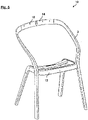
- figure 1 shows a schematic perspective view of a one-piece seat shell 1 of a piece of seating furniture 10 obliquely from the front according to an embodiment of the invention.
- the seat shell 1 is also in 2 and 4 shown in different views.
- figure 5 shows an associated seat frame 3 of the chair 10, to which the seat shell 1 can be attached.
- the seat shell 1 is pressed into shape from a single fiber composite mat 2 made of nonwoven fabric in a single production step.
- the seat frame 3, can be made of plastic or another material in a conventional manner.
- the frame 3 can consist of one piece and be made of a polyamide with a glass fiber additive.
- the associated method M for manufacturing the seat shell 1 from nonwoven fabric is shown schematically as a flowchart in 3 to see.
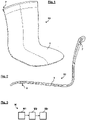
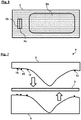
- An exemplary fiber composite mat 2, as used in method M, is in 6 to see. 7 finally shows a molding tool 4 as it can be used for the method M.
- the method M comprises M1 heating the fiber composite mat 2 to a forming temperature and M2 pressing the heated fiber composite mat 2 in a single working stroke of the molding tool 4 to form a flat molded part which is curved in accordance with the shape of the seat shell 1 .
- the heating step can be carried out before the pressing process, for example by placing the fiber composite mat 2 in a drawer oven and heating it to or above the forming temperature.
- the fiber composite mat 2 can already have been cut to size beforehand.
- the oven can be brought to a temperature of 180°C, which at a melting temperature of the plastic of 130°C leaves one or more minutes for the pressing and forming process before the temperature drops below the melting temperature again and the component hardens and thus no further is deformable.
- the heating can cause the fleece material to shrink in volume by a few percent, which must be taken into account when shaping.
- the shaping process in the mold 4 can then take several minutes.
- the molded part can then be removed.
- the fiber composite mat 2 is a one-piece fiber fleece mat, ie a flexible textile fabric made of tangled and irregularly intertwined, ie disordered, fibers. This can in particular be a felt mat.
- both simple fibers made of PET and bi-component fibers are used as fibers. each having a polyester core surrounded by a low-melting polymer sheath.
- Fibers with different plastic compositions can be used as well as fibers made from animal (e.g. wool), vegetable (e.g. coconut, hemp etc.) or other materials (glass, carbon etc.).
- the fibers used in each case can be embedded in a plastic or another matrix material and/or bound by it.
- the bicomponent fibers comprise a plastic component on the sheath side, which has a melting temperature below the deformation temperature, e.g. 130°C.
- this plastic component is softened or liquefied, making it flowable.
- the core of the bicomponent fibers and the simple PET fibers can remain in their solid state if the forming temperature is selected appropriately. Due to the contact pressure in the mold, the molten plastic is distributed in the fiber structure of the fiber composite mat 2 , which ultimately leads to more or less strong crosslinking within the fiber composite mat 2 .
- the low-melting part of the bi-component fiber merges with the simple PET fibers.
- the molding tool 4 For the shaping of the fiber material, the molding tool 4 comprises a press, which has a (convex) matrix 5 and a (concave) patrix 6 complementary thereto, which together form a negative mold of the desired end shape (see. 7 ).
- the molded part is contour-punched by the molding tool 4 in one working stroke from the fiber composite mat 2 and is simultaneously pressed into shape.
- the matrix 5 and the patrix 6 have different web-like elevations or bulges.
- Such structures can also be used to create indentations, folds and similar functional aspects in the structure of the molded part.
- contour webs 15 are drawn in, which specify several punched areas 2a, 2b in the fiber composite mat 2 (cf. 6 ).
- the molded part for the seat shell 1 is formed from the first punched area 2a.
- a mounting element 8 for the seat shell 1 is formed from the second punched area 2b, which is connected to the molded part in a separate process step (see below). If this does not already happen during the pressing process, both punched areas 2a, 2b can be cut out directly after the pressing process using a suitable method, with excess material of the fiber composite mat 2 being removed.
- a stiffening structure 7 for stiffening the seat shell 1 and/or a mounting structure 7 for mounting the seat shell 1 on the piece of seating furniture 10 can also be formed in the molded part.
- an example of this is an envelope formed as a structure 7 on the edge in the molded part.
- the area of the seat shell 1 with the cover serves as a backrest and is attached to the cover on a back brace 14 of the seat frame 3 .
- an insert part 9 made of plastic has also been pressed into the cover with the molded part during the working stroke (cf. 4 ).
- the insert part 9 has a multiplicity of fastening hooks 11 on a fastening surface 12 on which the insert part 9 is pressed with the fiber composite mat 2 .
- the insert part 9 and the assembly structure 7 as well as the seat frame 3 can have corresponding assembly openings 18 or assembly means, via which the seat shell 1 can be assembled with the seat frame 3 .
- the method M under M3 also includes joining an assembly element 8 to the molded part for assembly of the seat shell 1 to the seating furniture 10.
- the assembly element 8 is designed here as an angle element (cf. also Figures 2 and 3 ).
- the mounting element 8 has been integrally joined to the molded part on a mounting surface.
- the mounting element 8 has been welded in place, for example, by means of ultrasonic welding via a sonotrode. Examples are in 4 several spot welds 17 drawn.
- the mounting element 8 is made from the same material as the fiber composite mat 2 .
- the mounting element 8 is punched together with the molded part in the working stroke of the molding tool 4 from the same fiber composite mat 2 and pressed into shape.
- a second punching area 2b is provided in the fiber composite mat 2, from which the mounting element 8 is punched out.
- a fold bar 16 of the mold 4 creates a fold in the mounting element 8 and thus divides it into two right-angled fastening areas for the angle element.
- the seat shell 1 can be fixed to the seat frame 3 via the mounting element 8, e.g. to a horizontal cross brace 13 of the seat frame 3. Since the mounting element 8 is attached below the seat shell 1 and is therefore outside the field of view of an observer, joining methods such as ultrasonic welding can be used, which leave visible joints (welds).
- a seat shell 1 for a piece of seating furniture 10 is made from a single fiber mat 2 made from a fleece and/or felt material as a molded fleece.
- Mounting elements 8 are advantageously also punched out of this fiber mat 2 in the course of the same production step and are then connected to the seat shell 1 in a materially bonded manner.
- stiffening structures and/or assembly structures can be molded directly into the fiber structure of the seat shell 1 .
- Insert parts 9 made of plastic can complement the seat shell 1 structurally and functionally.
Landscapes
- Chemical & Material Sciences (AREA)
- Engineering & Computer Science (AREA)
- Composite Materials (AREA)
- Mechanical Engineering (AREA)
- Nonwoven Fabrics (AREA)
Applications Claiming Priority (1)
| Application Number | Priority Date | Filing Date | Title |
|---|---|---|---|
| DE102020213545.2A DE102020213545A1 (de) | 2020-10-28 | 2020-10-28 | Verfahren zur Herstellung einer einstückigen Sitzschale aus einer Faserverbundmatte zur Verwendung in einem Sitzmöbel sowie Sitzmöbel |
Publications (2)
| Publication Number | Publication Date |
|---|---|
| EP3991603A1 true EP3991603A1 (fr) | 2022-05-04 |
| EP3991603B1 EP3991603B1 (fr) | 2023-04-05 |
Family
ID=77249759
Family Applications (1)
| Application Number | Title | Priority Date | Filing Date |
|---|---|---|---|
| EP21190142.6A Active EP3991603B1 (fr) | 2020-10-28 | 2021-08-06 | Procédé de fabrication d'une coque de siège monobloc à partir d'une natte composite fibreuse destinée à être utilisée dans un siège |
Country Status (3)
| Country | Link |
|---|---|
| EP (1) | EP3991603B1 (fr) |
| DE (1) | DE102020213545A1 (fr) |
| PL (1) | PL3991603T3 (fr) |
Cited By (1)
| Publication number | Priority date | Publication date | Assignee | Title |
|---|---|---|---|---|
| CN116852749A (zh) * | 2023-06-02 | 2023-10-10 | 苏州竹新复合材料科技有限公司 | 一种陆空两栖载人机座椅快速成型方法及其座椅 |
Citations (6)
| Publication number | Priority date | Publication date | Assignee | Title |
|---|---|---|---|---|
| US2831534A (en) * | 1955-02-03 | 1958-04-22 | Thaden Molding Corp | Chair construction |
| DE1654292A1 (de) * | 1967-12-19 | 1971-02-18 | Kusch Co Sitzmoebel | Schaumstoffgepolstertes Sitzmoebelstueck |
| DE3007343A1 (de) | 1980-02-27 | 1981-09-10 | Johann Borgers Gmbh & Co Kg, 4290 Bocholt | Verfahren zur herstellung von formteilen aus faservlies |
| CA2843059A1 (fr) * | 2013-02-19 | 2014-08-19 | Composite Designs EU GmbH | Ensemble de siege de passager pour aeronef leger |
| EP3241462B1 (fr) | 2016-05-03 | 2018-04-18 | CEKA GmbH Co. KG | Element de structure de mobilier et/ou de division d'espace |
| CN109249662A (zh) * | 2017-07-14 | 2019-01-22 | 小智研发股份有限公司 | 复合层压制品及其制备方法 |
-
2020
- 2020-10-28 DE DE102020213545.2A patent/DE102020213545A1/de active Pending
-
2021
- 2021-08-06 PL PL21190142.6T patent/PL3991603T3/pl unknown
- 2021-08-06 EP EP21190142.6A patent/EP3991603B1/fr active Active
Patent Citations (6)
| Publication number | Priority date | Publication date | Assignee | Title |
|---|---|---|---|---|
| US2831534A (en) * | 1955-02-03 | 1958-04-22 | Thaden Molding Corp | Chair construction |
| DE1654292A1 (de) * | 1967-12-19 | 1971-02-18 | Kusch Co Sitzmoebel | Schaumstoffgepolstertes Sitzmoebelstueck |
| DE3007343A1 (de) | 1980-02-27 | 1981-09-10 | Johann Borgers Gmbh & Co Kg, 4290 Bocholt | Verfahren zur herstellung von formteilen aus faservlies |
| CA2843059A1 (fr) * | 2013-02-19 | 2014-08-19 | Composite Designs EU GmbH | Ensemble de siege de passager pour aeronef leger |
| EP3241462B1 (fr) | 2016-05-03 | 2018-04-18 | CEKA GmbH Co. KG | Element de structure de mobilier et/ou de division d'espace |
| CN109249662A (zh) * | 2017-07-14 | 2019-01-22 | 小智研发股份有限公司 | 复合层压制品及其制备方法 |
Cited By (1)
| Publication number | Priority date | Publication date | Assignee | Title |
|---|---|---|---|---|
| CN116852749A (zh) * | 2023-06-02 | 2023-10-10 | 苏州竹新复合材料科技有限公司 | 一种陆空两栖载人机座椅快速成型方法及其座椅 |
Also Published As
| Publication number | Publication date |
|---|---|
| PL3991603T3 (pl) | 2023-08-07 |
| DE102020213545A1 (de) | 2022-04-28 |
| EP3991603B1 (fr) | 2023-04-05 |
Similar Documents
| Publication | Publication Date | Title |
|---|---|---|
| EP0584445B1 (fr) | Pièce de garniture intérieure pour véhicules | |
| EP2933136B1 (fr) | Élément de rembourrage et procédé de fabrication d'un élément de rembourrage | |
| EP1567385B1 (fr) | Tableau de bord et procede de realisation | |
| EP1903135B1 (fr) | Matière composite multicouche et procédé de fabrication d'une matière composite multicouche | |
| EP3991603B1 (fr) | Procédé de fabrication d'une coque de siège monobloc à partir d'une natte composite fibreuse destinée à être utilisée dans un siège | |
| DE102020108728A1 (de) | Innenverkleidung für ein Kraftfahrzeug, die einen Dachhimmel und einen Versteifungsrahmen aufweist, und Verfahren zu ihrer Herstellung | |
| DE19744682A1 (de) | Innenverkleidung und Verfahren zu deren Herstellung | |
| WO2014079855A1 (fr) | Pièce hybride composite renforcée par des fibres, et procédé de fabrication d'une pièce hybride composite renforcée par des fibres | |
| DE102004009244B4 (de) | Kunststoffformteil mit einer Dekorschicht, seine Herstellung und Verwendung | |
| EP3101165B1 (fr) | Procede de fabrication d'un materiau de revetement d'habitacle de vehicule automobile | |
| DE102014107881A1 (de) | Faserverstärktes Verbundelement und Verfahren zu dessen Herstellung | |
| EP4000463B1 (fr) | Procédé de fabrication d'un diviseur d'espace à partir de mats composites fibreux, système de diviseur d'espace, ainsi que table | |
| EP3991954A2 (fr) | Procédé de fabrication d'une structure composite fibreuse monobloc à partir d'au moins une natte fibreuse composite, ainsi que structure composite fibreuse | |
| DE102004014423B4 (de) | Verfahren zur Herstellung eines Verkleidungsteils | |
| DE102016217189A1 (de) | Ausstattungsteil und Verfahren zur Herstellung eines Ausstattungsteiles | |
| EP2842727B1 (fr) | Procédé de fabrication d'un composant composite renforcé de fibres | |
| EP3218181A1 (fr) | Matériau composite textile de contrecollage contenant un composant non tissé et un composant mousse | |
| WO1989005366A1 (fr) | Procede de fabrication de nattes fibreuses stockables et maniables | |
| DE602004011798T2 (de) | Struktur zur Befestigung einer faserigen Matte | |
| EP3122543B1 (fr) | Pièce en matériau composite renforcé par des fibres et son procédé de fabrication | |
| EP3398761A1 (fr) | Procédé d'augmentation de la rigidité de pièces moulées en tissu non-tissé au moyen de la fabrication additive | |
| AT412700B (de) | Verfahren zur herstellung eines mehrlagigen bandartigen formteiles | |
| DE102021128072A1 (de) | Sitzstützelement und entsprechendes Herstellungsverfahren | |
| DE102004063634B4 (de) | Verfahren zur Herstellung eines Kunststoffformteils | |
| DE10036169C2 (de) | Verfahren zur Aufbereitung eines Faserverbundhalbzeugs, Faserverbundhalbzeug und daraus hergestellte Crashstruktur |
Legal Events
| Date | Code | Title | Description |
|---|---|---|---|
| PUAI | Public reference made under article 153(3) epc to a published international application that has entered the european phase |
Free format text: ORIGINAL CODE: 0009012 |
|
| STAA | Information on the status of an ep patent application or granted ep patent |
Free format text: STATUS: THE APPLICATION HAS BEEN PUBLISHED |
|
| AK | Designated contracting states |
Kind code of ref document: A1 Designated state(s): AL AT BE BG CH CY CZ DE DK EE ES FI FR GB GR HR HU IE IS IT LI LT LU LV MC MK MT NL NO PL PT RO RS SE SI SK SM TR |
|
| STAA | Information on the status of an ep patent application or granted ep patent |
Free format text: STATUS: REQUEST FOR EXAMINATION WAS MADE |
|
| 17P | Request for examination filed |
Effective date: 20220906 |
|
| RBV | Designated contracting states (corrected) |
Designated state(s): AL AT BE BG CH CY CZ DE DK EE ES FI FR GB GR HR HU IE IS IT LI LT LU LV MC MK MT NL NO PL PT RO RS SE SI SK SM TR |
|
| GRAP | Despatch of communication of intention to grant a patent |
Free format text: ORIGINAL CODE: EPIDOSNIGR1 |
|
| STAA | Information on the status of an ep patent application or granted ep patent |
Free format text: STATUS: GRANT OF PATENT IS INTENDED |
|
| RIC1 | Information provided on ipc code assigned before grant |
Ipc: D02G 3/04 20060101ALI20221129BHEP Ipc: B29C 70/42 20060101ALI20221129BHEP Ipc: A47C 5/00 20060101ALI20221129BHEP Ipc: A47C 3/12 20060101AFI20221129BHEP |
|
| INTG | Intention to grant announced |
Effective date: 20221214 |
|
| GRAS | Grant fee paid |
Free format text: ORIGINAL CODE: EPIDOSNIGR3 |
|
| GRAA | (expected) grant |
Free format text: ORIGINAL CODE: 0009210 |
|
| STAA | Information on the status of an ep patent application or granted ep patent |
Free format text: STATUS: THE PATENT HAS BEEN GRANTED |
|
| AK | Designated contracting states |
Kind code of ref document: B1 Designated state(s): AL AT BE BG CH CY CZ DE DK EE ES FI FR GB GR HR HU IE IS IT LI LT LU LV MC MK MT NL NO PL PT RO RS SE SI SK SM TR |
|
| REG | Reference to a national code |
Ref country code: GB Ref legal event code: FG4D Free format text: NOT ENGLISH |
|
| REG | Reference to a national code |
Ref country code: DE Ref legal event code: R096 Ref document number: 502021000546 Country of ref document: DE |
|
| REG | Reference to a national code |
Ref country code: CH Ref legal event code: EP |
|
| REG | Reference to a national code |
Ref country code: AT Ref legal event code: REF Ref document number: 1557616 Country of ref document: AT Kind code of ref document: T Effective date: 20230415 |
|
| REG | Reference to a national code |
Ref country code: IE Ref legal event code: FG4D Free format text: LANGUAGE OF EP DOCUMENT: GERMAN |
|
| P01 | Opt-out of the competence of the unified patent court (upc) registered |
Effective date: 20230526 |
|
| REG | Reference to a national code |
Ref country code: LT Ref legal event code: MG9D |
|
| REG | Reference to a national code |
Ref country code: NL Ref legal event code: MP Effective date: 20230405 |
|
| PG25 | Lapsed in a contracting state [announced via postgrant information from national office to epo] |
Ref country code: NL Free format text: LAPSE BECAUSE OF FAILURE TO SUBMIT A TRANSLATION OF THE DESCRIPTION OR TO PAY THE FEE WITHIN THE PRESCRIBED TIME-LIMIT Effective date: 20230405 |
|
| PG25 | Lapsed in a contracting state [announced via postgrant information from national office to epo] |
Ref country code: SE Free format text: LAPSE BECAUSE OF FAILURE TO SUBMIT A TRANSLATION OF THE DESCRIPTION OR TO PAY THE FEE WITHIN THE PRESCRIBED TIME-LIMIT Effective date: 20230405 Ref country code: PT Free format text: LAPSE BECAUSE OF FAILURE TO SUBMIT A TRANSLATION OF THE DESCRIPTION OR TO PAY THE FEE WITHIN THE PRESCRIBED TIME-LIMIT Effective date: 20230807 Ref country code: NO Free format text: LAPSE BECAUSE OF FAILURE TO SUBMIT A TRANSLATION OF THE DESCRIPTION OR TO PAY THE FEE WITHIN THE PRESCRIBED TIME-LIMIT Effective date: 20230705 Ref country code: ES Free format text: LAPSE BECAUSE OF FAILURE TO SUBMIT A TRANSLATION OF THE DESCRIPTION OR TO PAY THE FEE WITHIN THE PRESCRIBED TIME-LIMIT Effective date: 20230405 |
|
| PG25 | Lapsed in a contracting state [announced via postgrant information from national office to epo] |
Ref country code: RS Free format text: LAPSE BECAUSE OF FAILURE TO SUBMIT A TRANSLATION OF THE DESCRIPTION OR TO PAY THE FEE WITHIN THE PRESCRIBED TIME-LIMIT Effective date: 20230405 Ref country code: LV Free format text: LAPSE BECAUSE OF FAILURE TO SUBMIT A TRANSLATION OF THE DESCRIPTION OR TO PAY THE FEE WITHIN THE PRESCRIBED TIME-LIMIT Effective date: 20230405 Ref country code: LT Free format text: LAPSE BECAUSE OF FAILURE TO SUBMIT A TRANSLATION OF THE DESCRIPTION OR TO PAY THE FEE WITHIN THE PRESCRIBED TIME-LIMIT Effective date: 20230405 Ref country code: IS Free format text: LAPSE BECAUSE OF FAILURE TO SUBMIT A TRANSLATION OF THE DESCRIPTION OR TO PAY THE FEE WITHIN THE PRESCRIBED TIME-LIMIT Effective date: 20230805 Ref country code: HR Free format text: LAPSE BECAUSE OF FAILURE TO SUBMIT A TRANSLATION OF THE DESCRIPTION OR TO PAY THE FEE WITHIN THE PRESCRIBED TIME-LIMIT Effective date: 20230405 Ref country code: GR Free format text: LAPSE BECAUSE OF FAILURE TO SUBMIT A TRANSLATION OF THE DESCRIPTION OR TO PAY THE FEE WITHIN THE PRESCRIBED TIME-LIMIT Effective date: 20230706 Ref country code: AL Free format text: LAPSE BECAUSE OF FAILURE TO SUBMIT A TRANSLATION OF THE DESCRIPTION OR TO PAY THE FEE WITHIN THE PRESCRIBED TIME-LIMIT Effective date: 20230405 |
|
| PG25 | Lapsed in a contracting state [announced via postgrant information from national office to epo] |
Ref country code: FI Free format text: LAPSE BECAUSE OF FAILURE TO SUBMIT A TRANSLATION OF THE DESCRIPTION OR TO PAY THE FEE WITHIN THE PRESCRIBED TIME-LIMIT Effective date: 20230405 |
|
| REG | Reference to a national code |
Ref country code: DE Ref legal event code: R097 Ref document number: 502021000546 Country of ref document: DE |
|
| PG25 | Lapsed in a contracting state [announced via postgrant information from national office to epo] |
Ref country code: SK Free format text: LAPSE BECAUSE OF FAILURE TO SUBMIT A TRANSLATION OF THE DESCRIPTION OR TO PAY THE FEE WITHIN THE PRESCRIBED TIME-LIMIT Effective date: 20230405 |
|
| PG25 | Lapsed in a contracting state [announced via postgrant information from national office to epo] |
Ref country code: SM Free format text: LAPSE BECAUSE OF FAILURE TO SUBMIT A TRANSLATION OF THE DESCRIPTION OR TO PAY THE FEE WITHIN THE PRESCRIBED TIME-LIMIT Effective date: 20230405 Ref country code: SK Free format text: LAPSE BECAUSE OF FAILURE TO SUBMIT A TRANSLATION OF THE DESCRIPTION OR TO PAY THE FEE WITHIN THE PRESCRIBED TIME-LIMIT Effective date: 20230405 Ref country code: RO Free format text: LAPSE BECAUSE OF FAILURE TO SUBMIT A TRANSLATION OF THE DESCRIPTION OR TO PAY THE FEE WITHIN THE PRESCRIBED TIME-LIMIT Effective date: 20230405 Ref country code: EE Free format text: LAPSE BECAUSE OF FAILURE TO SUBMIT A TRANSLATION OF THE DESCRIPTION OR TO PAY THE FEE WITHIN THE PRESCRIBED TIME-LIMIT Effective date: 20230405 Ref country code: DK Free format text: LAPSE BECAUSE OF FAILURE TO SUBMIT A TRANSLATION OF THE DESCRIPTION OR TO PAY THE FEE WITHIN THE PRESCRIBED TIME-LIMIT Effective date: 20230405 Ref country code: CZ Free format text: LAPSE BECAUSE OF FAILURE TO SUBMIT A TRANSLATION OF THE DESCRIPTION OR TO PAY THE FEE WITHIN THE PRESCRIBED TIME-LIMIT Effective date: 20230405 |
|
| PLBE | No opposition filed within time limit |
Free format text: ORIGINAL CODE: 0009261 |
|
| STAA | Information on the status of an ep patent application or granted ep patent |
Free format text: STATUS: NO OPPOSITION FILED WITHIN TIME LIMIT |
|
| PG25 | Lapsed in a contracting state [announced via postgrant information from national office to epo] |
Ref country code: MC Free format text: LAPSE BECAUSE OF FAILURE TO SUBMIT A TRANSLATION OF THE DESCRIPTION OR TO PAY THE FEE WITHIN THE PRESCRIBED TIME-LIMIT Effective date: 20230405 |
|
| 26N | No opposition filed |
Effective date: 20240108 |
|
| PG25 | Lapsed in a contracting state [announced via postgrant information from national office to epo] |
Ref country code: MC Free format text: LAPSE BECAUSE OF FAILURE TO SUBMIT A TRANSLATION OF THE DESCRIPTION OR TO PAY THE FEE WITHIN THE PRESCRIBED TIME-LIMIT Effective date: 20230405 |
|
| PG25 | Lapsed in a contracting state [announced via postgrant information from national office to epo] |
Ref country code: LU Free format text: LAPSE BECAUSE OF NON-PAYMENT OF DUE FEES Effective date: 20230806 |
|
| PG25 | Lapsed in a contracting state [announced via postgrant information from national office to epo] |
Ref country code: LU Free format text: LAPSE BECAUSE OF NON-PAYMENT OF DUE FEES Effective date: 20230806 |
|
| PG25 | Lapsed in a contracting state [announced via postgrant information from national office to epo] |
Ref country code: SI Free format text: LAPSE BECAUSE OF FAILURE TO SUBMIT A TRANSLATION OF THE DESCRIPTION OR TO PAY THE FEE WITHIN THE PRESCRIBED TIME-LIMIT Effective date: 20230405 |
|
| REG | Reference to a national code |
Ref country code: BE Ref legal event code: MM Effective date: 20230831 |
|
| REG | Reference to a national code |
Ref country code: IE Ref legal event code: MM4A |
|
| PG25 | Lapsed in a contracting state [announced via postgrant information from national office to epo] |
Ref country code: SI Free format text: LAPSE BECAUSE OF FAILURE TO SUBMIT A TRANSLATION OF THE DESCRIPTION OR TO PAY THE FEE WITHIN THE PRESCRIBED TIME-LIMIT Effective date: 20230405 |
|
| PG25 | Lapsed in a contracting state [announced via postgrant information from national office to epo] |
Ref country code: IE Free format text: LAPSE BECAUSE OF NON-PAYMENT OF DUE FEES Effective date: 20230806 |
|
| PG25 | Lapsed in a contracting state [announced via postgrant information from national office to epo] |
Ref country code: IE Free format text: LAPSE BECAUSE OF NON-PAYMENT OF DUE FEES Effective date: 20230806 |
|
| PG25 | Lapsed in a contracting state [announced via postgrant information from national office to epo] |
Ref country code: BE Free format text: LAPSE BECAUSE OF NON-PAYMENT OF DUE FEES Effective date: 20230831 |
|
| PG25 | Lapsed in a contracting state [announced via postgrant information from national office to epo] |
Ref country code: BG Free format text: LAPSE BECAUSE OF FAILURE TO SUBMIT A TRANSLATION OF THE DESCRIPTION OR TO PAY THE FEE WITHIN THE PRESCRIBED TIME-LIMIT Effective date: 20230405 |
|
| PG25 | Lapsed in a contracting state [announced via postgrant information from national office to epo] |
Ref country code: BG Free format text: LAPSE BECAUSE OF FAILURE TO SUBMIT A TRANSLATION OF THE DESCRIPTION OR TO PAY THE FEE WITHIN THE PRESCRIBED TIME-LIMIT Effective date: 20230405 |
|
| REG | Reference to a national code |
Ref country code: CH Ref legal event code: PL |
|
| PG25 | Lapsed in a contracting state [announced via postgrant information from national office to epo] |
Ref country code: CH Free format text: LAPSE BECAUSE OF NON-PAYMENT OF DUE FEES Effective date: 20240831 |
|
| PG25 | Lapsed in a contracting state [announced via postgrant information from national office to epo] |
Ref country code: CY Free format text: LAPSE BECAUSE OF FAILURE TO SUBMIT A TRANSLATION OF THE DESCRIPTION OR TO PAY THE FEE WITHIN THE PRESCRIBED TIME-LIMIT; INVALID AB INITIO Effective date: 20210806 |
|
| PG25 | Lapsed in a contracting state [announced via postgrant information from national office to epo] |
Ref country code: HU Free format text: LAPSE BECAUSE OF FAILURE TO SUBMIT A TRANSLATION OF THE DESCRIPTION OR TO PAY THE FEE WITHIN THE PRESCRIBED TIME-LIMIT; INVALID AB INITIO Effective date: 20210806 |
|
| PGFP | Annual fee paid to national office [announced via postgrant information from national office to epo] |
Ref country code: DE Payment date: 20250829 Year of fee payment: 5 |
|
| PGFP | Annual fee paid to national office [announced via postgrant information from national office to epo] |
Ref country code: PL Payment date: 20250724 Year of fee payment: 5 Ref country code: IT Payment date: 20250825 Year of fee payment: 5 |
|
| PGFP | Annual fee paid to national office [announced via postgrant information from national office to epo] |
Ref country code: GB Payment date: 20250820 Year of fee payment: 5 |
|
| PGFP | Annual fee paid to national office [announced via postgrant information from national office to epo] |
Ref country code: AT Payment date: 20251020 Year of fee payment: 5 Ref country code: FR Payment date: 20250828 Year of fee payment: 5 |
|
| PG25 | Lapsed in a contracting state [announced via postgrant information from national office to epo] |
Ref country code: TR Free format text: LAPSE BECAUSE OF FAILURE TO SUBMIT A TRANSLATION OF THE DESCRIPTION OR TO PAY THE FEE WITHIN THE PRESCRIBED TIME-LIMIT Effective date: 20230405 |