EP4000778B1 - Kubischer bornitridsinterpressling und verfahren zur herstellung davon - Google Patents
Kubischer bornitridsinterpressling und verfahren zur herstellung davon Download PDFInfo
- Publication number
- EP4000778B1 EP4000778B1 EP20841032.4A EP20841032A EP4000778B1 EP 4000778 B1 EP4000778 B1 EP 4000778B1 EP 20841032 A EP20841032 A EP 20841032A EP 4000778 B1 EP4000778 B1 EP 4000778B1
- Authority
- EP
- European Patent Office
- Prior art keywords
- cbn
- powder
- boron nitride
- cubic boron
- sintered material
- Prior art date
- Legal status (The legal status is an assumption and is not a legal conclusion. Google has not performed a legal analysis and makes no representation as to the accuracy of the status listed.)
- Active
Links
Images




Classifications
-
- B—PERFORMING OPERATIONS; TRANSPORTING
- B23—MACHINE TOOLS; METAL-WORKING NOT OTHERWISE PROVIDED FOR
- B23B—TURNING; BORING
- B23B27/00—Tools for turning or boring machines; Tools of a similar kind in general; Accessories therefor
- B23B27/14—Cutting tools of which the bits or tips or cutting inserts are of special material
-
- C—CHEMISTRY; METALLURGY
- C04—CEMENTS; CONCRETE; ARTIFICIAL STONE; CERAMICS; REFRACTORIES
- C04B—LIME, MAGNESIA; SLAG; CEMENTS; COMPOSITIONS THEREOF, e.g. MORTARS, CONCRETE OR LIKE BUILDING MATERIALS; ARTIFICIAL STONE; CERAMICS; REFRACTORIES; TREATMENT OF NATURAL STONE
- C04B35/00—Shaped ceramic products characterised by their composition; Ceramics compositions; Processing powders of inorganic compounds preparatory to the manufacturing of ceramic products
- C04B35/515—Shaped ceramic products characterised by their composition; Ceramics compositions; Processing powders of inorganic compounds preparatory to the manufacturing of ceramic products based on non-oxide ceramics
- C04B35/58—Shaped ceramic products characterised by their composition; Ceramics compositions; Processing powders of inorganic compounds preparatory to the manufacturing of ceramic products based on non-oxide ceramics based on borides, nitrides, i.e. nitrides, oxynitrides, carbonitrides or oxycarbonitrides or silicides
- C04B35/583—Shaped ceramic products characterised by their composition; Ceramics compositions; Processing powders of inorganic compounds preparatory to the manufacturing of ceramic products based on non-oxide ceramics based on borides, nitrides, i.e. nitrides, oxynitrides, carbonitrides or oxycarbonitrides or silicides based on boron nitride
- C04B35/5831—Shaped ceramic products characterised by their composition; Ceramics compositions; Processing powders of inorganic compounds preparatory to the manufacturing of ceramic products based on non-oxide ceramics based on borides, nitrides, i.e. nitrides, oxynitrides, carbonitrides or oxycarbonitrides or silicides based on boron nitride based on cubic boron nitrides or Wurtzitic boron nitrides, including crystal structure transformation of powder
-
- C—CHEMISTRY; METALLURGY
- C04—CEMENTS; CONCRETE; ARTIFICIAL STONE; CERAMICS; REFRACTORIES
- C04B—LIME, MAGNESIA; SLAG; CEMENTS; COMPOSITIONS THEREOF, e.g. MORTARS, CONCRETE OR LIKE BUILDING MATERIALS; ARTIFICIAL STONE; CERAMICS; REFRACTORIES; TREATMENT OF NATURAL STONE
- C04B35/00—Shaped ceramic products characterised by their composition; Ceramics compositions; Processing powders of inorganic compounds preparatory to the manufacturing of ceramic products
- C04B35/622—Forming processes; Processing powders of inorganic compounds preparatory to the manufacturing of ceramic products
-
- C—CHEMISTRY; METALLURGY
- C04—CEMENTS; CONCRETE; ARTIFICIAL STONE; CERAMICS; REFRACTORIES
- C04B—LIME, MAGNESIA; SLAG; CEMENTS; COMPOSITIONS THEREOF, e.g. MORTARS, CONCRETE OR LIKE BUILDING MATERIALS; ARTIFICIAL STONE; CERAMICS; REFRACTORIES; TREATMENT OF NATURAL STONE
- C04B35/00—Shaped ceramic products characterised by their composition; Ceramics compositions; Processing powders of inorganic compounds preparatory to the manufacturing of ceramic products
- C04B35/622—Forming processes; Processing powders of inorganic compounds preparatory to the manufacturing of ceramic products
- C04B35/626—Preparing or treating the powders individually or as batches ; preparing or treating macroscopic reinforcing agents for ceramic products, e.g. fibres; mechanical aspects section B
- C04B35/62605—Treating the starting powders individually or as mixtures
-
- C—CHEMISTRY; METALLURGY
- C04—CEMENTS; CONCRETE; ARTIFICIAL STONE; CERAMICS; REFRACTORIES
- C04B—LIME, MAGNESIA; SLAG; CEMENTS; COMPOSITIONS THEREOF, e.g. MORTARS, CONCRETE OR LIKE BUILDING MATERIALS; ARTIFICIAL STONE; CERAMICS; REFRACTORIES; TREATMENT OF NATURAL STONE
- C04B35/00—Shaped ceramic products characterised by their composition; Ceramics compositions; Processing powders of inorganic compounds preparatory to the manufacturing of ceramic products
- C04B35/622—Forming processes; Processing powders of inorganic compounds preparatory to the manufacturing of ceramic products
- C04B35/626—Preparing or treating the powders individually or as batches ; preparing or treating macroscopic reinforcing agents for ceramic products, e.g. fibres; mechanical aspects section B
- C04B35/62605—Treating the starting powders individually or as mixtures
- C04B35/6261—Milling
- C04B35/62615—High energy or reactive ball milling
-
- C—CHEMISTRY; METALLURGY
- C04—CEMENTS; CONCRETE; ARTIFICIAL STONE; CERAMICS; REFRACTORIES
- C04B—LIME, MAGNESIA; SLAG; CEMENTS; COMPOSITIONS THEREOF, e.g. MORTARS, CONCRETE OR LIKE BUILDING MATERIALS; ARTIFICIAL STONE; CERAMICS; REFRACTORIES; TREATMENT OF NATURAL STONE
- C04B35/00—Shaped ceramic products characterised by their composition; Ceramics compositions; Processing powders of inorganic compounds preparatory to the manufacturing of ceramic products
- C04B35/622—Forming processes; Processing powders of inorganic compounds preparatory to the manufacturing of ceramic products
- C04B35/626—Preparing or treating the powders individually or as batches ; preparing or treating macroscopic reinforcing agents for ceramic products, e.g. fibres; mechanical aspects section B
- C04B35/62605—Treating the starting powders individually or as mixtures
- C04B35/62625—Wet mixtures
- C04B35/6264—Mixing media, e.g. organic solvents
-
- C—CHEMISTRY; METALLURGY
- C04—CEMENTS; CONCRETE; ARTIFICIAL STONE; CERAMICS; REFRACTORIES
- C04B—LIME, MAGNESIA; SLAG; CEMENTS; COMPOSITIONS THEREOF, e.g. MORTARS, CONCRETE OR LIKE BUILDING MATERIALS; ARTIFICIAL STONE; CERAMICS; REFRACTORIES; TREATMENT OF NATURAL STONE
- C04B35/00—Shaped ceramic products characterised by their composition; Ceramics compositions; Processing powders of inorganic compounds preparatory to the manufacturing of ceramic products
- C04B35/622—Forming processes; Processing powders of inorganic compounds preparatory to the manufacturing of ceramic products
- C04B35/626—Preparing or treating the powders individually or as batches ; preparing or treating macroscopic reinforcing agents for ceramic products, e.g. fibres; mechanical aspects section B
- C04B35/62605—Treating the starting powders individually or as mixtures
- C04B35/62645—Thermal treatment of powders or mixtures thereof other than sintering
- C04B35/62665—Flame, plasma or melting treatment
-
- C—CHEMISTRY; METALLURGY
- C04—CEMENTS; CONCRETE; ARTIFICIAL STONE; CERAMICS; REFRACTORIES
- C04B—LIME, MAGNESIA; SLAG; CEMENTS; COMPOSITIONS THEREOF, e.g. MORTARS, CONCRETE OR LIKE BUILDING MATERIALS; ARTIFICIAL STONE; CERAMICS; REFRACTORIES; TREATMENT OF NATURAL STONE
- C04B35/00—Shaped ceramic products characterised by their composition; Ceramics compositions; Processing powders of inorganic compounds preparatory to the manufacturing of ceramic products
- C04B35/622—Forming processes; Processing powders of inorganic compounds preparatory to the manufacturing of ceramic products
- C04B35/626—Preparing or treating the powders individually or as batches ; preparing or treating macroscopic reinforcing agents for ceramic products, e.g. fibres; mechanical aspects section B
- C04B35/628—Coating the powders or the macroscopic reinforcing agents
-
- C—CHEMISTRY; METALLURGY
- C04—CEMENTS; CONCRETE; ARTIFICIAL STONE; CERAMICS; REFRACTORIES
- C04B—LIME, MAGNESIA; SLAG; CEMENTS; COMPOSITIONS THEREOF, e.g. MORTARS, CONCRETE OR LIKE BUILDING MATERIALS; ARTIFICIAL STONE; CERAMICS; REFRACTORIES; TREATMENT OF NATURAL STONE
- C04B35/00—Shaped ceramic products characterised by their composition; Ceramics compositions; Processing powders of inorganic compounds preparatory to the manufacturing of ceramic products
- C04B35/622—Forming processes; Processing powders of inorganic compounds preparatory to the manufacturing of ceramic products
- C04B35/626—Preparing or treating the powders individually or as batches ; preparing or treating macroscopic reinforcing agents for ceramic products, e.g. fibres; mechanical aspects section B
- C04B35/628—Coating the powders or the macroscopic reinforcing agents
- C04B35/62802—Powder coating materials
-
- C—CHEMISTRY; METALLURGY
- C04—CEMENTS; CONCRETE; ARTIFICIAL STONE; CERAMICS; REFRACTORIES
- C04B—LIME, MAGNESIA; SLAG; CEMENTS; COMPOSITIONS THEREOF, e.g. MORTARS, CONCRETE OR LIKE BUILDING MATERIALS; ARTIFICIAL STONE; CERAMICS; REFRACTORIES; TREATMENT OF NATURAL STONE
- C04B35/00—Shaped ceramic products characterised by their composition; Ceramics compositions; Processing powders of inorganic compounds preparatory to the manufacturing of ceramic products
- C04B35/622—Forming processes; Processing powders of inorganic compounds preparatory to the manufacturing of ceramic products
- C04B35/626—Preparing or treating the powders individually or as batches ; preparing or treating macroscopic reinforcing agents for ceramic products, e.g. fibres; mechanical aspects section B
- C04B35/628—Coating the powders or the macroscopic reinforcing agents
- C04B35/62884—Coating the powders or the macroscopic reinforcing agents by gas phase techniques
-
- C—CHEMISTRY; METALLURGY
- C04—CEMENTS; CONCRETE; ARTIFICIAL STONE; CERAMICS; REFRACTORIES
- C04B—LIME, MAGNESIA; SLAG; CEMENTS; COMPOSITIONS THEREOF, e.g. MORTARS, CONCRETE OR LIKE BUILDING MATERIALS; ARTIFICIAL STONE; CERAMICS; REFRACTORIES; TREATMENT OF NATURAL STONE
- C04B35/00—Shaped ceramic products characterised by their composition; Ceramics compositions; Processing powders of inorganic compounds preparatory to the manufacturing of ceramic products
- C04B35/622—Forming processes; Processing powders of inorganic compounds preparatory to the manufacturing of ceramic products
- C04B35/626—Preparing or treating the powders individually or as batches ; preparing or treating macroscopic reinforcing agents for ceramic products, e.g. fibres; mechanical aspects section B
- C04B35/628—Coating the powders or the macroscopic reinforcing agents
- C04B35/62889—Coating the powders or the macroscopic reinforcing agents with a discontinuous coating layer
-
- C—CHEMISTRY; METALLURGY
- C04—CEMENTS; CONCRETE; ARTIFICIAL STONE; CERAMICS; REFRACTORIES
- C04B—LIME, MAGNESIA; SLAG; CEMENTS; COMPOSITIONS THEREOF, e.g. MORTARS, CONCRETE OR LIKE BUILDING MATERIALS; ARTIFICIAL STONE; CERAMICS; REFRACTORIES; TREATMENT OF NATURAL STONE
- C04B35/00—Shaped ceramic products characterised by their composition; Ceramics compositions; Processing powders of inorganic compounds preparatory to the manufacturing of ceramic products
- C04B35/622—Forming processes; Processing powders of inorganic compounds preparatory to the manufacturing of ceramic products
- C04B35/626—Preparing or treating the powders individually or as batches ; preparing or treating macroscopic reinforcing agents for ceramic products, e.g. fibres; mechanical aspects section B
- C04B35/63—Preparing or treating the powders individually or as batches ; preparing or treating macroscopic reinforcing agents for ceramic products, e.g. fibres; mechanical aspects section B using additives specially adapted for forming the products, e.g.. binder binders
- C04B35/6303—Inorganic additives
-
- C—CHEMISTRY; METALLURGY
- C04—CEMENTS; CONCRETE; ARTIFICIAL STONE; CERAMICS; REFRACTORIES
- C04B—LIME, MAGNESIA; SLAG; CEMENTS; COMPOSITIONS THEREOF, e.g. MORTARS, CONCRETE OR LIKE BUILDING MATERIALS; ARTIFICIAL STONE; CERAMICS; REFRACTORIES; TREATMENT OF NATURAL STONE
- C04B35/00—Shaped ceramic products characterised by their composition; Ceramics compositions; Processing powders of inorganic compounds preparatory to the manufacturing of ceramic products
- C04B35/622—Forming processes; Processing powders of inorganic compounds preparatory to the manufacturing of ceramic products
- C04B35/626—Preparing or treating the powders individually or as batches ; preparing or treating macroscopic reinforcing agents for ceramic products, e.g. fibres; mechanical aspects section B
- C04B35/63—Preparing or treating the powders individually or as batches ; preparing or treating macroscopic reinforcing agents for ceramic products, e.g. fibres; mechanical aspects section B using additives specially adapted for forming the products, e.g.. binder binders
- C04B35/638—Removal thereof
-
- C—CHEMISTRY; METALLURGY
- C04—CEMENTS; CONCRETE; ARTIFICIAL STONE; CERAMICS; REFRACTORIES
- C04B—LIME, MAGNESIA; SLAG; CEMENTS; COMPOSITIONS THEREOF, e.g. MORTARS, CONCRETE OR LIKE BUILDING MATERIALS; ARTIFICIAL STONE; CERAMICS; REFRACTORIES; TREATMENT OF NATURAL STONE
- C04B35/00—Shaped ceramic products characterised by their composition; Ceramics compositions; Processing powders of inorganic compounds preparatory to the manufacturing of ceramic products
- C04B35/622—Forming processes; Processing powders of inorganic compounds preparatory to the manufacturing of ceramic products
- C04B35/64—Burning or sintering processes
- C04B35/645—Pressure sintering
-
- B—PERFORMING OPERATIONS; TRANSPORTING
- B22—CASTING; POWDER METALLURGY
- B22F—WORKING METALLIC POWDER; MANUFACTURE OF ARTICLES FROM METALLIC POWDER; MAKING METALLIC POWDER; APPARATUS OR DEVICES SPECIALLY ADAPTED FOR METALLIC POWDER
- B22F5/00—Manufacture of workpieces or articles from metallic powder characterised by the special shape of the product
- B22F2005/001—Cutting tools, earth boring or grinding tool other than table ware
-
- C—CHEMISTRY; METALLURGY
- C04—CEMENTS; CONCRETE; ARTIFICIAL STONE; CERAMICS; REFRACTORIES
- C04B—LIME, MAGNESIA; SLAG; CEMENTS; COMPOSITIONS THEREOF, e.g. MORTARS, CONCRETE OR LIKE BUILDING MATERIALS; ARTIFICIAL STONE; CERAMICS; REFRACTORIES; TREATMENT OF NATURAL STONE
- C04B2235/00—Aspects relating to ceramic starting mixtures or sintered ceramic products
- C04B2235/02—Composition of constituents of the starting material or of secondary phases of the final product
- C04B2235/30—Constituents and secondary phases not being of a fibrous nature
- C04B2235/32—Metal oxides, mixed metal oxides, or oxide-forming salts thereof, e.g. carbonates, nitrates, (oxy)hydroxides, chlorides
- C04B2235/3217—Aluminum oxide or oxide forming salts thereof, e.g. bauxite, alpha-alumina
-
- C—CHEMISTRY; METALLURGY
- C04—CEMENTS; CONCRETE; ARTIFICIAL STONE; CERAMICS; REFRACTORIES
- C04B—LIME, MAGNESIA; SLAG; CEMENTS; COMPOSITIONS THEREOF, e.g. MORTARS, CONCRETE OR LIKE BUILDING MATERIALS; ARTIFICIAL STONE; CERAMICS; REFRACTORIES; TREATMENT OF NATURAL STONE
- C04B2235/00—Aspects relating to ceramic starting mixtures or sintered ceramic products
- C04B2235/02—Composition of constituents of the starting material or of secondary phases of the final product
- C04B2235/30—Constituents and secondary phases not being of a fibrous nature
- C04B2235/32—Metal oxides, mixed metal oxides, or oxide-forming salts thereof, e.g. carbonates, nitrates, (oxy)hydroxides, chlorides
- C04B2235/3231—Refractory metal oxides, their mixed metal oxides, or oxide-forming salts thereof
- C04B2235/3232—Titanium oxides or titanates, e.g. rutile or anatase
-
- C—CHEMISTRY; METALLURGY
- C04—CEMENTS; CONCRETE; ARTIFICIAL STONE; CERAMICS; REFRACTORIES
- C04B—LIME, MAGNESIA; SLAG; CEMENTS; COMPOSITIONS THEREOF, e.g. MORTARS, CONCRETE OR LIKE BUILDING MATERIALS; ARTIFICIAL STONE; CERAMICS; REFRACTORIES; TREATMENT OF NATURAL STONE
- C04B2235/00—Aspects relating to ceramic starting mixtures or sintered ceramic products
- C04B2235/02—Composition of constituents of the starting material or of secondary phases of the final product
- C04B2235/30—Constituents and secondary phases not being of a fibrous nature
- C04B2235/32—Metal oxides, mixed metal oxides, or oxide-forming salts thereof, e.g. carbonates, nitrates, (oxy)hydroxides, chlorides
- C04B2235/3231—Refractory metal oxides, their mixed metal oxides, or oxide-forming salts thereof
- C04B2235/3239—Vanadium oxides, vanadates or oxide forming salts thereof, e.g. magnesium vanadate
-
- C—CHEMISTRY; METALLURGY
- C04—CEMENTS; CONCRETE; ARTIFICIAL STONE; CERAMICS; REFRACTORIES
- C04B—LIME, MAGNESIA; SLAG; CEMENTS; COMPOSITIONS THEREOF, e.g. MORTARS, CONCRETE OR LIKE BUILDING MATERIALS; ARTIFICIAL STONE; CERAMICS; REFRACTORIES; TREATMENT OF NATURAL STONE
- C04B2235/00—Aspects relating to ceramic starting mixtures or sintered ceramic products
- C04B2235/02—Composition of constituents of the starting material or of secondary phases of the final product
- C04B2235/30—Constituents and secondary phases not being of a fibrous nature
- C04B2235/32—Metal oxides, mixed metal oxides, or oxide-forming salts thereof, e.g. carbonates, nitrates, (oxy)hydroxides, chlorides
- C04B2235/3231—Refractory metal oxides, their mixed metal oxides, or oxide-forming salts thereof
- C04B2235/3241—Chromium oxides, chromates, or oxide-forming salts thereof
-
- C—CHEMISTRY; METALLURGY
- C04—CEMENTS; CONCRETE; ARTIFICIAL STONE; CERAMICS; REFRACTORIES
- C04B—LIME, MAGNESIA; SLAG; CEMENTS; COMPOSITIONS THEREOF, e.g. MORTARS, CONCRETE OR LIKE BUILDING MATERIALS; ARTIFICIAL STONE; CERAMICS; REFRACTORIES; TREATMENT OF NATURAL STONE
- C04B2235/00—Aspects relating to ceramic starting mixtures or sintered ceramic products
- C04B2235/02—Composition of constituents of the starting material or of secondary phases of the final product
- C04B2235/30—Constituents and secondary phases not being of a fibrous nature
- C04B2235/32—Metal oxides, mixed metal oxides, or oxide-forming salts thereof, e.g. carbonates, nitrates, (oxy)hydroxides, chlorides
- C04B2235/3231—Refractory metal oxides, their mixed metal oxides, or oxide-forming salts thereof
- C04B2235/3244—Zirconium oxides, zirconates, hafnium oxides, hafnates, or oxide-forming salts thereof
-
- C—CHEMISTRY; METALLURGY
- C04—CEMENTS; CONCRETE; ARTIFICIAL STONE; CERAMICS; REFRACTORIES
- C04B—LIME, MAGNESIA; SLAG; CEMENTS; COMPOSITIONS THEREOF, e.g. MORTARS, CONCRETE OR LIKE BUILDING MATERIALS; ARTIFICIAL STONE; CERAMICS; REFRACTORIES; TREATMENT OF NATURAL STONE
- C04B2235/00—Aspects relating to ceramic starting mixtures or sintered ceramic products
- C04B2235/02—Composition of constituents of the starting material or of secondary phases of the final product
- C04B2235/30—Constituents and secondary phases not being of a fibrous nature
- C04B2235/32—Metal oxides, mixed metal oxides, or oxide-forming salts thereof, e.g. carbonates, nitrates, (oxy)hydroxides, chlorides
- C04B2235/3231—Refractory metal oxides, their mixed metal oxides, or oxide-forming salts thereof
- C04B2235/3251—Niobium oxides, niobates, tantalum oxides, tantalates, or oxide-forming salts thereof
-
- C—CHEMISTRY; METALLURGY
- C04—CEMENTS; CONCRETE; ARTIFICIAL STONE; CERAMICS; REFRACTORIES
- C04B—LIME, MAGNESIA; SLAG; CEMENTS; COMPOSITIONS THEREOF, e.g. MORTARS, CONCRETE OR LIKE BUILDING MATERIALS; ARTIFICIAL STONE; CERAMICS; REFRACTORIES; TREATMENT OF NATURAL STONE
- C04B2235/00—Aspects relating to ceramic starting mixtures or sintered ceramic products
- C04B2235/02—Composition of constituents of the starting material or of secondary phases of the final product
- C04B2235/30—Constituents and secondary phases not being of a fibrous nature
- C04B2235/32—Metal oxides, mixed metal oxides, or oxide-forming salts thereof, e.g. carbonates, nitrates, (oxy)hydroxides, chlorides
- C04B2235/3231—Refractory metal oxides, their mixed metal oxides, or oxide-forming salts thereof
- C04B2235/3256—Molybdenum oxides, molybdates or oxide forming salts thereof, e.g. cadmium molybdate
-
- C—CHEMISTRY; METALLURGY
- C04—CEMENTS; CONCRETE; ARTIFICIAL STONE; CERAMICS; REFRACTORIES
- C04B—LIME, MAGNESIA; SLAG; CEMENTS; COMPOSITIONS THEREOF, e.g. MORTARS, CONCRETE OR LIKE BUILDING MATERIALS; ARTIFICIAL STONE; CERAMICS; REFRACTORIES; TREATMENT OF NATURAL STONE
- C04B2235/00—Aspects relating to ceramic starting mixtures or sintered ceramic products
- C04B2235/02—Composition of constituents of the starting material or of secondary phases of the final product
- C04B2235/30—Constituents and secondary phases not being of a fibrous nature
- C04B2235/32—Metal oxides, mixed metal oxides, or oxide-forming salts thereof, e.g. carbonates, nitrates, (oxy)hydroxides, chlorides
- C04B2235/3231—Refractory metal oxides, their mixed metal oxides, or oxide-forming salts thereof
- C04B2235/3258—Tungsten oxides, tungstates, or oxide-forming salts thereof
-
- C—CHEMISTRY; METALLURGY
- C04—CEMENTS; CONCRETE; ARTIFICIAL STONE; CERAMICS; REFRACTORIES
- C04B—LIME, MAGNESIA; SLAG; CEMENTS; COMPOSITIONS THEREOF, e.g. MORTARS, CONCRETE OR LIKE BUILDING MATERIALS; ARTIFICIAL STONE; CERAMICS; REFRACTORIES; TREATMENT OF NATURAL STONE
- C04B2235/00—Aspects relating to ceramic starting mixtures or sintered ceramic products
- C04B2235/02—Composition of constituents of the starting material or of secondary phases of the final product
- C04B2235/30—Constituents and secondary phases not being of a fibrous nature
- C04B2235/38—Non-oxide ceramic constituents or additives
- C04B2235/3804—Borides
-
- C—CHEMISTRY; METALLURGY
- C04—CEMENTS; CONCRETE; ARTIFICIAL STONE; CERAMICS; REFRACTORIES
- C04B—LIME, MAGNESIA; SLAG; CEMENTS; COMPOSITIONS THEREOF, e.g. MORTARS, CONCRETE OR LIKE BUILDING MATERIALS; ARTIFICIAL STONE; CERAMICS; REFRACTORIES; TREATMENT OF NATURAL STONE
- C04B2235/00—Aspects relating to ceramic starting mixtures or sintered ceramic products
- C04B2235/02—Composition of constituents of the starting material or of secondary phases of the final product
- C04B2235/30—Constituents and secondary phases not being of a fibrous nature
- C04B2235/38—Non-oxide ceramic constituents or additives
- C04B2235/3804—Borides
- C04B2235/3813—Refractory metal borides
-
- C—CHEMISTRY; METALLURGY
- C04—CEMENTS; CONCRETE; ARTIFICIAL STONE; CERAMICS; REFRACTORIES
- C04B—LIME, MAGNESIA; SLAG; CEMENTS; COMPOSITIONS THEREOF, e.g. MORTARS, CONCRETE OR LIKE BUILDING MATERIALS; ARTIFICIAL STONE; CERAMICS; REFRACTORIES; TREATMENT OF NATURAL STONE
- C04B2235/00—Aspects relating to ceramic starting mixtures or sintered ceramic products
- C04B2235/02—Composition of constituents of the starting material or of secondary phases of the final product
- C04B2235/30—Constituents and secondary phases not being of a fibrous nature
- C04B2235/38—Non-oxide ceramic constituents or additives
- C04B2235/3817—Carbides
-
- C—CHEMISTRY; METALLURGY
- C04—CEMENTS; CONCRETE; ARTIFICIAL STONE; CERAMICS; REFRACTORIES
- C04B—LIME, MAGNESIA; SLAG; CEMENTS; COMPOSITIONS THEREOF, e.g. MORTARS, CONCRETE OR LIKE BUILDING MATERIALS; ARTIFICIAL STONE; CERAMICS; REFRACTORIES; TREATMENT OF NATURAL STONE
- C04B2235/00—Aspects relating to ceramic starting mixtures or sintered ceramic products
- C04B2235/02—Composition of constituents of the starting material or of secondary phases of the final product
- C04B2235/30—Constituents and secondary phases not being of a fibrous nature
- C04B2235/38—Non-oxide ceramic constituents or additives
- C04B2235/3817—Carbides
- C04B2235/3839—Refractory metal carbides
-
- C—CHEMISTRY; METALLURGY
- C04—CEMENTS; CONCRETE; ARTIFICIAL STONE; CERAMICS; REFRACTORIES
- C04B—LIME, MAGNESIA; SLAG; CEMENTS; COMPOSITIONS THEREOF, e.g. MORTARS, CONCRETE OR LIKE BUILDING MATERIALS; ARTIFICIAL STONE; CERAMICS; REFRACTORIES; TREATMENT OF NATURAL STONE
- C04B2235/00—Aspects relating to ceramic starting mixtures or sintered ceramic products
- C04B2235/02—Composition of constituents of the starting material or of secondary phases of the final product
- C04B2235/30—Constituents and secondary phases not being of a fibrous nature
- C04B2235/38—Non-oxide ceramic constituents or additives
- C04B2235/3817—Carbides
- C04B2235/3839—Refractory metal carbides
- C04B2235/3843—Titanium carbides
-
- C—CHEMISTRY; METALLURGY
- C04—CEMENTS; CONCRETE; ARTIFICIAL STONE; CERAMICS; REFRACTORIES
- C04B—LIME, MAGNESIA; SLAG; CEMENTS; COMPOSITIONS THEREOF, e.g. MORTARS, CONCRETE OR LIKE BUILDING MATERIALS; ARTIFICIAL STONE; CERAMICS; REFRACTORIES; TREATMENT OF NATURAL STONE
- C04B2235/00—Aspects relating to ceramic starting mixtures or sintered ceramic products
- C04B2235/02—Composition of constituents of the starting material or of secondary phases of the final product
- C04B2235/30—Constituents and secondary phases not being of a fibrous nature
- C04B2235/38—Non-oxide ceramic constituents or additives
- C04B2235/3817—Carbides
- C04B2235/3839—Refractory metal carbides
- C04B2235/3847—Tungsten carbides
-
- C—CHEMISTRY; METALLURGY
- C04—CEMENTS; CONCRETE; ARTIFICIAL STONE; CERAMICS; REFRACTORIES
- C04B—LIME, MAGNESIA; SLAG; CEMENTS; COMPOSITIONS THEREOF, e.g. MORTARS, CONCRETE OR LIKE BUILDING MATERIALS; ARTIFICIAL STONE; CERAMICS; REFRACTORIES; TREATMENT OF NATURAL STONE
- C04B2235/00—Aspects relating to ceramic starting mixtures or sintered ceramic products
- C04B2235/02—Composition of constituents of the starting material or of secondary phases of the final product
- C04B2235/30—Constituents and secondary phases not being of a fibrous nature
- C04B2235/38—Non-oxide ceramic constituents or additives
- C04B2235/3852—Nitrides, e.g. oxynitrides, carbonitrides, oxycarbonitrides, lithium nitride, magnesium nitride
- C04B2235/3856—Carbonitrides, e.g. titanium carbonitride, zirconium carbonitride
-
- C—CHEMISTRY; METALLURGY
- C04—CEMENTS; CONCRETE; ARTIFICIAL STONE; CERAMICS; REFRACTORIES
- C04B—LIME, MAGNESIA; SLAG; CEMENTS; COMPOSITIONS THEREOF, e.g. MORTARS, CONCRETE OR LIKE BUILDING MATERIALS; ARTIFICIAL STONE; CERAMICS; REFRACTORIES; TREATMENT OF NATURAL STONE
- C04B2235/00—Aspects relating to ceramic starting mixtures or sintered ceramic products
- C04B2235/02—Composition of constituents of the starting material or of secondary phases of the final product
- C04B2235/30—Constituents and secondary phases not being of a fibrous nature
- C04B2235/38—Non-oxide ceramic constituents or additives
- C04B2235/3852—Nitrides, e.g. oxynitrides, carbonitrides, oxycarbonitrides, lithium nitride, magnesium nitride
- C04B2235/386—Boron nitrides
-
- C—CHEMISTRY; METALLURGY
- C04—CEMENTS; CONCRETE; ARTIFICIAL STONE; CERAMICS; REFRACTORIES
- C04B—LIME, MAGNESIA; SLAG; CEMENTS; COMPOSITIONS THEREOF, e.g. MORTARS, CONCRETE OR LIKE BUILDING MATERIALS; ARTIFICIAL STONE; CERAMICS; REFRACTORIES; TREATMENT OF NATURAL STONE
- C04B2235/00—Aspects relating to ceramic starting mixtures or sintered ceramic products
- C04B2235/02—Composition of constituents of the starting material or of secondary phases of the final product
- C04B2235/30—Constituents and secondary phases not being of a fibrous nature
- C04B2235/38—Non-oxide ceramic constituents or additives
- C04B2235/3852—Nitrides, e.g. oxynitrides, carbonitrides, oxycarbonitrides, lithium nitride, magnesium nitride
- C04B2235/3865—Aluminium nitrides
-
- C—CHEMISTRY; METALLURGY
- C04—CEMENTS; CONCRETE; ARTIFICIAL STONE; CERAMICS; REFRACTORIES
- C04B—LIME, MAGNESIA; SLAG; CEMENTS; COMPOSITIONS THEREOF, e.g. MORTARS, CONCRETE OR LIKE BUILDING MATERIALS; ARTIFICIAL STONE; CERAMICS; REFRACTORIES; TREATMENT OF NATURAL STONE
- C04B2235/00—Aspects relating to ceramic starting mixtures or sintered ceramic products
- C04B2235/02—Composition of constituents of the starting material or of secondary phases of the final product
- C04B2235/30—Constituents and secondary phases not being of a fibrous nature
- C04B2235/38—Non-oxide ceramic constituents or additives
- C04B2235/3852—Nitrides, e.g. oxynitrides, carbonitrides, oxycarbonitrides, lithium nitride, magnesium nitride
- C04B2235/3886—Refractory metal nitrides, e.g. vanadium nitride, tungsten nitride
-
- C—CHEMISTRY; METALLURGY
- C04—CEMENTS; CONCRETE; ARTIFICIAL STONE; CERAMICS; REFRACTORIES
- C04B—LIME, MAGNESIA; SLAG; CEMENTS; COMPOSITIONS THEREOF, e.g. MORTARS, CONCRETE OR LIKE BUILDING MATERIALS; ARTIFICIAL STONE; CERAMICS; REFRACTORIES; TREATMENT OF NATURAL STONE
- C04B2235/00—Aspects relating to ceramic starting mixtures or sintered ceramic products
- C04B2235/02—Composition of constituents of the starting material or of secondary phases of the final product
- C04B2235/30—Constituents and secondary phases not being of a fibrous nature
- C04B2235/48—Organic compounds becoming part of a ceramic after heat treatment, e.g. carbonising phenol resins
-
- C—CHEMISTRY; METALLURGY
- C04—CEMENTS; CONCRETE; ARTIFICIAL STONE; CERAMICS; REFRACTORIES
- C04B—LIME, MAGNESIA; SLAG; CEMENTS; COMPOSITIONS THEREOF, e.g. MORTARS, CONCRETE OR LIKE BUILDING MATERIALS; ARTIFICIAL STONE; CERAMICS; REFRACTORIES; TREATMENT OF NATURAL STONE
- C04B2235/00—Aspects relating to ceramic starting mixtures or sintered ceramic products
- C04B2235/02—Composition of constituents of the starting material or of secondary phases of the final product
- C04B2235/50—Constituents or additives of the starting mixture chosen for their shape or used because of their shape or their physical appearance
- C04B2235/54—Particle size related information
- C04B2235/5418—Particle size related information expressed by the size of the particles or aggregates thereof
- C04B2235/5436—Particle size related information expressed by the size of the particles or aggregates thereof micrometer sized, i.e. from 1 to 100 micron
-
- C—CHEMISTRY; METALLURGY
- C04—CEMENTS; CONCRETE; ARTIFICIAL STONE; CERAMICS; REFRACTORIES
- C04B—LIME, MAGNESIA; SLAG; CEMENTS; COMPOSITIONS THEREOF, e.g. MORTARS, CONCRETE OR LIKE BUILDING MATERIALS; ARTIFICIAL STONE; CERAMICS; REFRACTORIES; TREATMENT OF NATURAL STONE
- C04B2235/00—Aspects relating to ceramic starting mixtures or sintered ceramic products
- C04B2235/02—Composition of constituents of the starting material or of secondary phases of the final product
- C04B2235/50—Constituents or additives of the starting mixture chosen for their shape or used because of their shape or their physical appearance
- C04B2235/54—Particle size related information
- C04B2235/5418—Particle size related information expressed by the size of the particles or aggregates thereof
- C04B2235/5445—Particle size related information expressed by the size of the particles or aggregates thereof submicron sized, i.e. from 0,1 to 1 micron
-
- C—CHEMISTRY; METALLURGY
- C04—CEMENTS; CONCRETE; ARTIFICIAL STONE; CERAMICS; REFRACTORIES
- C04B—LIME, MAGNESIA; SLAG; CEMENTS; COMPOSITIONS THEREOF, e.g. MORTARS, CONCRETE OR LIKE BUILDING MATERIALS; ARTIFICIAL STONE; CERAMICS; REFRACTORIES; TREATMENT OF NATURAL STONE
- C04B2235/00—Aspects relating to ceramic starting mixtures or sintered ceramic products
- C04B2235/60—Aspects relating to the preparation, properties or mechanical treatment of green bodies or pre-forms
- C04B2235/602—Making the green bodies or pre-forms by moulding
-
- C—CHEMISTRY; METALLURGY
- C04—CEMENTS; CONCRETE; ARTIFICIAL STONE; CERAMICS; REFRACTORIES
- C04B—LIME, MAGNESIA; SLAG; CEMENTS; COMPOSITIONS THEREOF, e.g. MORTARS, CONCRETE OR LIKE BUILDING MATERIALS; ARTIFICIAL STONE; CERAMICS; REFRACTORIES; TREATMENT OF NATURAL STONE
- C04B2235/00—Aspects relating to ceramic starting mixtures or sintered ceramic products
- C04B2235/65—Aspects relating to heat treatments of ceramic bodies such as green ceramics or pre-sintered ceramics, e.g. burning, sintering or melting processes
- C04B2235/656—Aspects relating to heat treatments of ceramic bodies such as green ceramics or pre-sintered ceramics, e.g. burning, sintering or melting processes characterised by specific heating conditions during heat treatment
-
- C—CHEMISTRY; METALLURGY
- C04—CEMENTS; CONCRETE; ARTIFICIAL STONE; CERAMICS; REFRACTORIES
- C04B—LIME, MAGNESIA; SLAG; CEMENTS; COMPOSITIONS THEREOF, e.g. MORTARS, CONCRETE OR LIKE BUILDING MATERIALS; ARTIFICIAL STONE; CERAMICS; REFRACTORIES; TREATMENT OF NATURAL STONE
- C04B2235/00—Aspects relating to ceramic starting mixtures or sintered ceramic products
- C04B2235/65—Aspects relating to heat treatments of ceramic bodies such as green ceramics or pre-sintered ceramics, e.g. burning, sintering or melting processes
- C04B2235/656—Aspects relating to heat treatments of ceramic bodies such as green ceramics or pre-sintered ceramics, e.g. burning, sintering or melting processes characterised by specific heating conditions during heat treatment
- C04B2235/6567—Treatment time
-
- C—CHEMISTRY; METALLURGY
- C04—CEMENTS; CONCRETE; ARTIFICIAL STONE; CERAMICS; REFRACTORIES
- C04B—LIME, MAGNESIA; SLAG; CEMENTS; COMPOSITIONS THEREOF, e.g. MORTARS, CONCRETE OR LIKE BUILDING MATERIALS; ARTIFICIAL STONE; CERAMICS; REFRACTORIES; TREATMENT OF NATURAL STONE
- C04B2235/00—Aspects relating to ceramic starting mixtures or sintered ceramic products
- C04B2235/65—Aspects relating to heat treatments of ceramic bodies such as green ceramics or pre-sintered ceramics, e.g. burning, sintering or melting processes
- C04B2235/658—Atmosphere during thermal treatment
- C04B2235/6581—Total pressure below 1 atmosphere, e.g. vacuum
-
- C—CHEMISTRY; METALLURGY
- C04—CEMENTS; CONCRETE; ARTIFICIAL STONE; CERAMICS; REFRACTORIES
- C04B—LIME, MAGNESIA; SLAG; CEMENTS; COMPOSITIONS THEREOF, e.g. MORTARS, CONCRETE OR LIKE BUILDING MATERIALS; ARTIFICIAL STONE; CERAMICS; REFRACTORIES; TREATMENT OF NATURAL STONE
- C04B2235/00—Aspects relating to ceramic starting mixtures or sintered ceramic products
- C04B2235/70—Aspects relating to sintered or melt-casted ceramic products
- C04B2235/74—Physical characteristics
- C04B2235/75—Products with a concentration gradient
-
- C—CHEMISTRY; METALLURGY
- C04—CEMENTS; CONCRETE; ARTIFICIAL STONE; CERAMICS; REFRACTORIES
- C04B—LIME, MAGNESIA; SLAG; CEMENTS; COMPOSITIONS THEREOF, e.g. MORTARS, CONCRETE OR LIKE BUILDING MATERIALS; ARTIFICIAL STONE; CERAMICS; REFRACTORIES; TREATMENT OF NATURAL STONE
- C04B2235/00—Aspects relating to ceramic starting mixtures or sintered ceramic products
- C04B2235/70—Aspects relating to sintered or melt-casted ceramic products
- C04B2235/80—Phases present in the sintered or melt-cast ceramic products other than the main phase
- C04B2235/85—Intergranular or grain boundary phases
-
- C—CHEMISTRY; METALLURGY
- C22—METALLURGY; FERROUS OR NON-FERROUS ALLOYS; TREATMENT OF ALLOYS OR NON-FERROUS METALS
- C22C—ALLOYS
- C22C26/00—Alloys containing diamond or cubic or wurtzitic boron nitride, fullerenes or carbon nanotubes
- C22C2026/003—Cubic boron nitrides only
Definitions
- the present disclosure relates to a cubic boron nitride sintered material and a method of producing the cubic boron nitride sintered material.
- a cubic boron nitride sintered material (hereinafter, also referred to as “cBN sintered material”) is a high-hardness material used for cutting tools and the like.
- the cBN sintered material is normally constituted of cubic boron nitride grains (hereinafter, also referred to as "cBN grains”) and a binder phase. Depending on a content ratio of the cBN grains, characteristics of the cBN sintered material tend to differ.
- cBN sintered materials are applied to cutting tools in accordance with the material of a workpiece, required precision in processing, or the like.
- a cubic boron nitride sintered material (hereinafter, also referred to as a "low-cBN sintered material”) having a low content ratio of cubic boron nitride (hereinafter, also referred to as "cBN”) can be suitably used for cutting of a hardened steel or the like.
- Japanese Patent Laying-Open No. 11-268956 discloses a cutting insert composed of a cubic boron nitride-based ultra-high pressure sintered material having a composition including 30 to 70 area% of cubic boron nitride in a structure observation with an electron microscope.
- US 2014/315015 discloses a method of producing a cubic boron nitride sintered material.
- a cubic boron nitride sintered material according to the present disclosure is a cubic boron nitride sintered material including: more than or equal to 20 volume% and less than 80 volume% of cubic boron nitride grains; and more than 20 volume% and less than or equal to 80 volume% of a binder phase, wherein
- a method of producing a cubic boron nitride sintered material according to the present disclosure is a method of producing the above-described cubic boron nitride sintered material, the method including:
- the cubic boron nitride sintered material according to the present disclosure can attain a long life of a tool when used as a tool material.
- a binder powder including at least one selected from a group consisting of a compound composed of at least one element selected from a group consisting of a group 4 element, a group 5 element, a group 6 element in a periodic table, and aluminum, and at least one element selected from a group consisting of nitrogen, carbon, boron, and oxygen, and a solid solution originated from the compound.
- a binder powder including at least one selected from a group consisting of a compound composed of at least one element selected from a group consisting of a group 4 element, a group 5 element, a group 6 element in a periodic table, and aluminum, and at least one element selected from a group consisting of nitrogen, carbon, boron, and oxygen, and a solid solution originated from the compound.
- the present inventors considered that the amount and distribution of carbon at the interface between the cBN grain and the binder phase are important to significantly increase the binding strength between the cBN grain and the binder phase and avoid deterioration of the characteristics of the cBN sintered material by the carbon existing at the interface between the cBN grain and the binder phase. Based on the above findings and considerations, the present inventors completed the present disclosure as a result of diligent study.
- the expression "A to B” represents a range of lower to upper limits (i.e., more than or equal to A and less than or equal to B).
- the unit of A is the same as the unit of B.
- a metallic element and a nonmetallic element does not necessarily need to constitute a stoichiometric composition.
- the metallic element include titanium (Ti), aluminum (Al), silicon (Si), tantalum (Ta), or chromium (Cr).
- the nonmetallic element include nitrogen (N), oxygen (O), and carbon (C).
- a cubic boron nitride sintered material is a cubic boron nitride sintered material including: more than or equal to 20 volume% and less than 80 volume% of cubic boron nitride grains; and more than 20 volume% and less than or equal to 80 volume% of a binder phase, wherein the binder phase includes at least one selected from a group consisting of a compound composed of at least one element selected from a group consisting of a group 4 element, a group 5 element, a group 6 element in a periodic table, and aluminum, and at least one element selected from a group consisting of nitrogen, carbon, boron, and oxygen, and a solid solution originated from the compound, and when a carbon content is measured from a cubic boron nitride grain into the binder phase in a direction perpendicular to an interface between the cubic boron nitride grain and the binder phase using TEM-EDX, a first region having a carbon content larger than an average value of
- the cubic boron nitride sintered material according to the present disclosure includes: more than or equal to 20 volume% and less than 80 volume% of the cubic boron nitride grains; and more than 20 volume% and less than or equal to 80 volume% of the binder phase. That is, the cubic boron nitride sintered material according to the present disclosure is a so-called low-cBN sintered material. It should be noted that the cBN sintered material can include an inevitable impurity resulting from a source material, a manufacturing condition, or the like. In the cubic boron nitride sintered material according to the present disclosure, the total of the content ratio of the cBN grains, the content ratio of the binder phase, and the content ratio of the inevitable impurity is 100 volume%.
- the lower limit of the total of the content ratio of the cBN grains and the content ratio of the binder phase can be more than or equal to 95 volume%, can be more than or equal to 96 volume%, can be more than or equal to 97 volume%, can be more than or equal to 98 volume%, or can be more than or equal to 99 volume%.
- the upper limit of the total of the content ratio of the cBN grains and the content ratio of the binder phase can be less than or equal to 100 volume%, or can be less than 100 volume%.
- the total of the content ratio of the cBN grains and the content ratio of the binder phase can be more than or equal to 95 volume% and less than or equal to 100 volume%, can be more than or equal to 96 volume% and less than or equal to 100 volume%, can be more than or equal to 97 volume% and less than or equal to 100 volume%, can be more than or equal to 98 volume% and less than or equal to 100 volume%, can be more than or equal to 99 volume% and less than or equal to 100 volume%, can be more than or equal to 95 volume% and less than 100 volume%, can be more than or equal to 96 volume% and less than 100 volume%, can be more than or equal to 97 volume% and less than 100 volume%, can be more than or equal to 98 volume% and less than 100 volume%, or can be more than or equal to 99 volume% and less than 100 volume%.
- the content ratio (volume%) of the cBN grains and the content ratio (volume%) of the binder phase in the cBN sintered material can be checked by performing structure observation, elemental analysis, and the like onto the cBN sintered material using an energy dispersive X-ray analysis device (EDX) (Octane Elect EDS system) accompanied with a scanning electron microscope (SEM) ("JSM-7800F” (trade name) provided by JEOL).
- EDX energy dispersive X-ray analysis device
- SEM scanning electron microscope
- a method of measuring the content ratio (volume%) of the cBN grains is as follows. First, the cBN sintered material is cut at an arbitrary location to produce a specimen including a cross section of the cBN sintered material. For the formation of the cross section, a focused ion beam device, a cross section polisher device, or the like can be used. Next, the cross section is observed by the SEM at a magnification of 5000x to obtain a reflected electron image. In the reflected electron image, a black region represents a region in which the cBN grains exist and a gray or white region represents a region in which the binder phase exists.
- the reflected electron image is subjected to binarization processing using image analysis software ("WinROOF" provided by Mitani Corporation).
- WinROOF image analysis software
- the area ratio of pixels originated from dark fields (pixels originated from the cBN grains) in the area of the measurement visual field is calculated.
- the calculated area ratio is regarded as volume%, thereby finding the content ratio (volume%) of the cBN grains.
- the area ratio of pixels originated from bright fields (pixels originated from the binder phase) in the area of the measurement visual field is calculated, thereby finding the content ratio (volume%) of the binder phase.
- Fig. 1 shows an exemplary reflected electron image obtained by observing the cBN sintered material using a SEM.
- the reflected electron image is loaded into image processing software.
- the loaded image is shown in Fig. 2 .
- an arbitrary line Q1 is drawn in the loaded image.
- a concentration is measured along line Q1 in the cross sectional view, and a GRAY value is read.
- a graph (hereinafter, also referred to as a "concentration cross section graph”) is prepared with the X coordinate representing line Q1 and the Y coordinate representing the GRAY value.
- Fig. 3 shows the reflected electron image of the cBN sintered material and the concentration cross section graph of the reflected electron image (the upper image corresponds to the reflected electron image and the lower graph corresponds to the concentration cross section graph).
- the width of the reflected electron image coincides with the width (23.27 ⁇ m) of the X coordinate of the concentration cross section graph.
- a distance from the left end portion of line Q1 to a specific position on line Q1 in the reflected electron image is represented by a value of the X coordinate in the concentration cross section graph.
- a black region in which cBN grains exist is arbitrarily selected at three locations.
- the black region corresponds to, for example, portions indicated by ellipses each denoted by a reference character "c" in the reflected electron image of Fig. 4 .
- the GRAY values of the black region at the three locations are read from the concentration cross section graph.
- the GRAY value of the black region at each of the three locations is the average value of the GRAY values of portions at a corresponding one of the three locations surrounded by the ellipses denoted by reference character "c" in the concentration cross section graph of Fig. 4 .
- the average value of the GRAY values at each of the three locations is calculated. This average value is defined as "cBN GRAY value" (hereinafter, also referred to as "G cbn ").
- a region in which the binder phase indicated by a gray color exists is arbitrarily selected at three locations.
- the binder phase corresponds to, for example, portions indicated by ellipses denoted by a reference character "d" in the reflected electron image of Fig. 4 .
- the GRAY values of the binder phase at the three locations are read from the concentration cross section graph.
- the GRAY value of the binder phase at each of the three locations is the average value of the GRAY values of portions at a corresponding one of the three locations surrounded by the ellipses denoted by reference character "d" in the concentration cross section graph of Fig. 4 .
- the average value of the GRAY values at each of the three locations is calculated. This average value is defined as "binder phase GRAY value" (hereinafter, also referred to as "G binder ").
- a GRAY value indicated by (G cbn + G binder )/2 is defined as the GRAY value of the interface between the black region (cBN grain) and the binder phase.
- GRAY value G cbn of the black region (cBN grain) is indicated by a line G cbn
- GRAY value G binder of the binder phase is indicated by a line G binder
- the GRAY value indicated by (G cbn + G binder )/2 is indicated by a line G1.
- the values of the X coordinate and the Y coordinate at the interface between the black region (cBN grain) and the binder phase can be read.
- the interface can be arbitrarily defined. For example, in a reflected electron image at the upper part of Fig. 5 , a portion surrounded by an ellipse denoted by a reference character "e" is shown as an exemplary portion including the interface. In the reflected electron image of Fig. 5 , the interface between the black region (cBN grain) and the binder phase is, for example, the portion indicated by the ellipse denoted by reference character "e".
- the interface which corresponds to the ellipse denoted by the reference character "e"
- the interface which corresponds to the ellipse denoted by the reference character "e"
- the reference character "e" between the black region (cBN grain) and the binder phase is a portion indicated by an arrow e.
- the tip of arrow e indicates the position of an intersection point between the concentration cross section graph of the GRAY value and line G1 indicating the GRAY value (G cbn + G binder )/2.
- the values of the X coordinate of arrow e and the Y coordinate of the tip of arrow e correspond to the values of the X coordinate and the Y coordinate at the interface between the black region (cBN grain) and the binder phase.
- the binarization processing is performed using, as threshold values, the values of the X coordinate and the Y coordinate at the interface between the black region (cBN grain) and the binder phase.
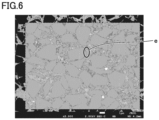
- Fig. 6 shows an image having been through the binarization processing.
- a region surrounded by a dotted line is a region having been through the binarization processing.
- the image having been through the binarization processing may include not only bright fields and dark fields but also white regions (portions whiter than the bright fields) corresponding to the regions white in the image yet to be through the binarization processing.
- Fig. 6 the area ratio of pixels originated from the dark fields (pixels originated from the cBN grains) in the area of the measurement visual field is calculated.
- the calculated area ratio is regarded as volume%, thereby finding the content ratio (volume%) of the cBN grains.
- the area ratio of pixels originated from the bright fields (pixels originated from the binder phase) in the area of the measurement visual field is calculated, thereby finding the content ratio (volume%) of the binder phase.
- the content ratio of the cBN grains in the cBN sintered material is preferably more than or equal to 35 volume% and less than 75 volume%, and is more preferably more than or equal to 50 volume% and less than or equal to 75 volume%.
- the content ratio of the binder phase in the cBN sintered material is preferably more than 25 volume% and less than or equal to 65 volume%, and is more preferably more than or equal to 25 volume% and less than or equal to 50 volume%.
- the cBN grains have high hardness, high strength, and high toughness, and serve as a base of the cBN sintered material.
- D 50 (average grain size) of the cBN grains is not particularly limited, and can be 0.1 to 10.0 ⁇ m, for example. Normally, as D 50 is smaller, the hardness of the cBN sintered material tends to be higher, and as variation in the grain sizes is smaller, the characteristics of the cBN sintered material tend to be more uniform.
- D 50 of the cBN grains is preferably, for example, 0.5 to 4.0 ⁇ m.
- D 50 of the cBN grains is determined as follows. First, a specimen including a cross section of the cBN sintered material is formed in the same manner as in the above-described method of finding the content ratio of the cBN grains, and a reflected electron image is obtained. Next, the equivalent circle diameter of each dark field (corresponding to the cBN grain) in the reflected electron image is calculated using image analysis software. It is preferable to calculate the equivalent circle diameters of 100 or more cBN grains by performing observation in five or more visual fields.
- D 50 represents a grain size corresponding to a cumulative area of 50% in the cumulative distribution. It should be noted that the equivalent circle diameter refers to the diameter of a circle having the same area as the area of the measured cBN grain.
- the binder phase serves to allow the cBN grains, each of which is a material difficult to be sintered, to be sintered at industrial levels of pressure and temperature. Moreover, reactivity of the binder phase with respect to iron is lower than that of cBN. Hence, in cutting of a high-hardness hardened steel, the binder phase additionally works to suppress chemical wear and thermal wear. Moreover, when the cBN sintered material contains the binder phase, wear resistance in high-efficient processing of a high-hardness hardened steel is improved.
- the binder phase includes at least one selected from a group consisting of a compound (hereinafter, also referred to as "binder phase compound”) composed of at least one element selected from a group consisting of a group 4 element, a group 5 element, a group 6 element in a periodic table, and aluminum, and at least one element selected from a group consisting of nitrogen, carbon, boron, and oxygen, and a solid solution originated from the compound.
- binder phase compound a compound
- the group 4 element in the periodic table includes titanium (Ti), zirconium (Zr), and hafnium (Hf), for example.
- the group 5 element includes vanadium (V), niobium (Nb), and tantalum (Ta), for example.
- the group 6 element includes chromium (Cr), molybdenum (Mo), and tungsten (W), for example.
- first metal element each of the elements included in the group 4 element, the group 5 element, and the group 6 element will be also referred to as "first metal element”.
- Examples of the compound (nitride) including the first metal element(s) and nitrogen include titanium nitride (TiN), zirconium nitride (ZrN), hafnium nitride (HfN), vanadium nitride (VN), niobium nitride (NbN), tantalum nitride (TaN), chromium nitride (Cr 2 N), molybdenum nitride (MoN), tungsten nitride (WN), titanium zirconium nitride (TiZrN), titanium hafnium nitride (TiHfN), titanium vanadium nitride (TiVN), titanium niobium nitride (TiNbN), titanium tantalum nitride (TiTaN), titanium chromium nitride (TiCrN), titanium molybdenum nitride (T
- Examples of the compound (carbide) including the first metal element(s) and carbon include titanium carbide (TiC), zirconium carbide (ZrC), hafnium carbide (HfC), vanadium carbide (VC), niobium carbide (NbC), tantalum carbide (TaC), chromium carbide (Cr 3 C 2 ), molybdenum carbide (MoC), and tungsten carbide (WC).
- Examples of the compound (boride) including the first metal element(s) and boron include titanium boride (TiB 2 ), zirconium boride (ZrB 2 ), hafnium boride (HfB 2 ), vanadium boride (VB 2 ), niobium boride (NbB 2 ), tantalum boride (TaB 2 ), chromium boride (CrB), molybdenum boride (MoB), and tungsten boride (WB).
- Examples of the compound (oxide) including the first metal element(s) and oxygen include titanium oxide (TiO 2 ), zirconium oxide (ZrO 2 ), hafnium oxide (HfO 2 ), vanadium oxide (V 2 O 5 ), niobium oxide (Nb 2 O 5 ), tantalum oxide (Ta 2 O 5 ), chromium oxide (Cr 2 O 3 ), molybdenum oxide (MoO 3 ), and tungsten oxide (WO 3 ).
- Examples of the compound (carbonitride) including the first metal element(s), carbon, and nitrogen include titanium carbonitride (TiCN), zirconium carbonitride (ZrCN), and hafnium carbonitride (HfCN).
- Examples of the compound (oxynitride) composed of the first metal element(s), oxygen, and nitrogen include titanium oxynitride (TiON), zirconium oxynitride (ZrON), hafnium oxynitride (HfON), vanadium oxynitride (VON), niobium oxynitride (NbON), tantalum oxynitride (TaON), chromium oxynitride (CrON), molybdenum oxynitride (MoON), and tungsten oxynitride (WON).
- binder phase compound including aluminum examples include aluminum nitride (AlN), titanium aluminum nitride (TiAlN, Ti 2 AlN, or Ti 3 AlN), aluminum boride (AlB 2 ), and aluminum oxide (Al 2 O 3 ).
- the solid solution originated from the binder phase compound refers to a state in which two or more of the compounds illustrated above are dissolved in the crystal structures of the compounds, and refers to an interstitial solid solution or a substitutional solid solution.
- One of the binder phase compounds may be solely used or two or more of the binder phase compounds may be used in combination.
- the binder phase may include other component(s) in addition to the binder phase compound(s).
- element(s) of the other component(s) include nickel (Ni), iron (Fe), manganese (Mn) and rhenium (Re).
- composition of the binder phase included in the cBN sintered material can be specified by, for example, XRD (X-ray Diffraction) and EDX (Energy dispersive X-ray spectrometry).
- a feature of the cBN sintered material according to the present disclosure lies in that the following conditions (1) to (3) are satisfied when a carbon content is measured from a cBN grain into the binder phase in a direction perpendicular to the interface between the cBN grain and the binder phase using TEM-EDX (Energy Dispersion X-ray Spectroscopy (EDX) accompanied with Transmission Electron Microscope (TEM)).
- TEM-EDX Energy Dispersion X-ray Spectroscopy (EDX) accompanied with Transmission Electron Microscope (TEM)
- TEM-EDX An analysis with the TEM-EDX is performed as follows. First, a sample is obtained from the cBN sintered material, and an argon ion slicer is used to slice the sample to form a cut piece having a thickness of 30 to 100 nm. Then, the cut piece is observed at 50000x using TEM (transmission electron microscope; "JEM-2100F/Cs" (trade name) provided by JEOL), thereby obtaining a first image.
- TEM transmission electron microscope
- the interface between the cBN grain and the binder phase is arbitrarily selected. It should be noted that in the first image, the cBN grain is observed as a black region, the binder phase is observed as a white or gray region, and the interface is observed as a white or gray region.
- the selected interface is positioned to pass through the vicinity of the center of the image, and observation is performed at an observation magnification changed to 2000000x, thereby obtaining a second image.
- the interface exists to extend from one end of the image to the other one end of the image opposite to the foregoing one end, via the vicinity of the center of the image.
- the carbon content is measured in the direction perpendicular to the interface in the second image.
- a specific measurement method is as follows.
- an extension direction in which the interface extends (extension direction in which the region having a high carbon concentration extends) is confirmed, and then an element line analysis is performed in the direction perpendicular to the extension direction.
- the direction perpendicular to the extension direction of the interface refers to a direction along a straight line intersecting a tangent of the extension direction at an angle of 90° ⁇ 5°.
- a beam diameter on that occasion is less than or equal to 0.3 nm, and a scanning interval is 0.1 to 0.7 nm.
- the average value of the carbon content of the binder phase and the length of the first region having a carbon content larger than the average value are calculated in accordance with the result of the element line analysis.
- the carbon in the carbon content of the binder phase includes: carbon included in the binder phase compound; and free carbon not included in the binder phase compound.
- Fig. 7 is a diagram schematically showing an exemplary second image.
- a cubic boron nitride grain 1 and a binder phase 2 are adjacent to each other to form an interface 3.
- the element line analysis is performed along a direction perpendicular to the extension direction of interface 3 (direction along the straight line intersecting the tangent of the extension direction at an angle of 90° ⁇ 5°) (direction indicated by an arrow A in Fig. 7 ).
- the direction perpendicular to the extension direction of the interface is a direction that is perpendicular to the interface (boundary line) between the cBN grain and the binder phase in the cross section of the sample and that is parallel to the cross section.
- Fig. 8 is an exemplary graph showing the result of the element line analysis.
- the horizontal axis (X axis) represents a distance (nm) from the interface
- the vertical axis (Y axis) represents a carbon content (atomic%).
- the value of the horizontal axis (X axis) is indicated with "-" (minus) the absolute value thereof corresponds to the distance from the interface.
- a distance from intersection point B in Fig. 7 toward the cBN grain 1 side along the direction (arrow A) of the element line analysis is indicated as a positive numerical value of the horizontal axis (X axis) in the graph in Fig. 8 .
- a distance from intersection point B in Fig. 7 toward the binder phase 2 side along the direction (arrow A) of the element line analysis is indicated as a negative numerical value of the horizontal axis (X axis) in the graph in Fig. 8 .
- the average value of the carbon content of the binder phase refers to the average value of the carbon content of the binder phase in a region between a line L1 and a line L2 in the cross section of the cBN sintered material, line L1 being an imaginary line located at a distance of 20 nm from the interface between the cBN grain and the binder phase toward the binder phase side, line L2 being an imaginary line located at a distance of 30 nm from the interface between the cBN grain and the binder phase toward the binder phase side.
- the average value of the carbon content of the binder phase is a value calculated from the graph indicating the result of the element line analysis.
- the average value of the carbon content of the binder phase is the average value of the carbon content in a range of -20 nm to -30 nm on the horizontal axis (X axis) (a range indicated by a; a range in which the distance from the interface is more than or equal to 20 nm and less than or equal to 30 nm).
- a region (range indicated by b) having a carbon content larger than the average value calculated above corresponds to the first region having a carbon content larger than the average value of the carbon content of the binder phase.
- the cubic boron nitride sintered material satisfies the above-described condition (1) (the first region having a carbon content larger than the average value of the carbon content of the binder phase exists).
- the cubic boron nitride sintered material satisfies the above-described condition (3) (the length of the first region is more than or equal to 0.1 nm and less than or equal to 10 nm).
- the cBN sintered material is regarded as the cBN sintered material according to the present disclosure.
- Fig. 9 shows an exemplary second image.
- a black region corresponds to the cBN grain
- a white region corresponds to the binder phase
- a white or gray region corresponds to the interface.
- the width of the white or gray region (substantially the upward/downward direction in Fig. 9 ) considered to correspond to the interface is more than 10 nm in the second image, reversion is made to the first image to select another interface again. This is due to the following reason: when the width of the white or gray region is more than 10 nm, it is difficult to say that the white or gray region corresponds to the "interface between the cBN grain and the binder phase".
- Fig. 10 shows a result of performing an element mapping analysis with EDX onto the second image shown in Fig. 9 , and shows a distribution state of carbon.
- a position at which carbon exists exhibits a light color. Therefore, in Fig. 10 , a region exhibiting a dark color is a region in which no carbon exists (or a very small amount of carbon exists). As the region has a lighter color, a larger amount of carbon exists therein.
- the region in which carbon exists includes the interface and exists along the interface.
- a solid line shown in the image shown in Fig. 10 represents a result of performing the element line analysis in the direction (direction from the lower left side to the upper right side in Fig. 10 ) perpendicular to the extension direction (direction from the upper left side to the lower right side in Fig. 10 ) of the carbon-containing region.
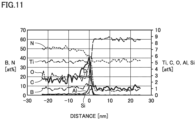
- Fig. 11 shows this in the form of a graph.
- the horizontal axis represents a distance (nm) for which the element line analysis has been performed
- the vertical axis represents the values of carbon content, boron content, nitrogen content, titanium content, oxygen content, aluminum content, and silicon content (atomic%) in spots as calculated from the result of the element line analysis.
- a peak of the carbon content is observed in the region including the interface.
- the portion at which the peak is observed corresponds to the "first region", and length D of the peak corresponds to the "length of the first region”.
- the cBN sintered material according to the present disclosure When the cBN sintered material according to the present disclosure is used as a tool material, a long life of the tool can be attained. This is presumably due to the following reason: in the cBN sintered material according to the present disclosure, the amount and distribution of carbon existing at the interface between the cBN grain and the binder phase are appropriately adjusted, thereby increasing binding strength between the cBN grain and the binder phase.
- the length of the first region is less than 0.1 nm in the cBN sintered material, a long life of the tool cannot be attained. This is presumably due to the following reason.
- the amount of carbon existing on the surface of the cBN particle before sintering is too small, the length of the first region in the cBN sintered material becomes less than 0.1 nm. In this case, the carbon does not sufficiently exhibit the effect of removing oxygen that decreases the binding strength during sintering, thus resulting in insufficient binding strength between the cBN grain and the binder phase.
- the length of the first region is preferably more than or equal to 0.1 nm and less than or equal to 5 nm. In this case, when the cBN sintered material is used as a tool material, a longer life of the tool can be attained.
- a difference between the maximum value of the carbon content of the first region and the average value of the carbon content of the binder phase is preferably more than or equal to 0.3 atomic% and less than or equal to 5 atomic%.
- the maximum value of the carbon content of the first region and the average value of the carbon content of the binder phase are values calculated from the graph indicating the result of the element line analysis on the cBN sintered material.
- the difference between the maximum value of the carbon content of the first region and the average value of the carbon content of the binder phase is more preferably more than or equal to 1.0 atomic% and less than or equal to 4.0 atomic%, and is further preferably more than or equal to 2.0 atomic% and less than or equal to 3.0 atomic%.
- the maximum value of the carbon content in the first region is preferably more than or equal to 0.1 atomic% and less than or equal to 10 atomic%, and is more preferably more than or equal to 5.0 atomic% and less than or equal to 10 atomic%. Thus, a longer life of the cBN sintered material can be attained.
- the average value of the carbon content of the binder phase is preferably more than or equal to 0.1 atomic% and less than or equal to 10 atomic%, and is more preferably more than or equal to 1.0 atomic% and less than or equal to 5.0 atomic%. Thus, a longer life of the cBN sintered material can be attained.
- the method of producing the cBN sintered material according to the present disclosure is a method of producing the cBN sintered material described in the first embodiment, and includes: a step (hereinafter, also referred to as "forming step") of forming an organic-substance-attached cubic boron nitride powder (hereinafter, also referred to as "organic-substance-attached cBN powder") by attaching an organic substance to a cubic boron nitride powder (hereinafter, also referred to as "cBN powder”); a step (hereinafter, also referred to as "preparing step”) of preparing a powder mixture by mixing the organic-substance-attached cubic boron nitride powder and a binder powder; and a step (hereinafter, also referred to as "sintering step”) of obtaining the cubic boron nitride sintered material by sintering the powder mixture.
- a step hereinafter, also referred to as "forming step” of
- the powder mixture includes more than or equal to 20 volume% and less than 80 volume% of the organic-substance-attached cubic boron nitride powder and more than 20 volume% and less than or equal to 80 volume% of the binder powder.
- the binder powder includes at least one element selected from a group consisting of a group 4 element, a group 5 element, a group 6 element in a periodic table, and aluminum, and at least one element selected from a group consisting of nitrogen, carbon, boron, and oxygen.
- This step is a step of forming the organic-substance-attached cBN powder by attaching the organic substance to the cBN powder.
- the cBN powder is source material powder for the cBN grains included in the cBN sintered material.
- the cBN powder is not particularly limited and known cBN powder can be used.
- D 50 (average particle size) of the cBN powder is not particularly limited, and can be 0.1 to 12.0 ⁇ m, for example.
- Examples of the method of attaching the organic substance to the cBN powder include: a method employing supercritical water; a method of performing plasma treatment; and the like.
- the method employing supercritical water will be described.
- a step of introducing the cBN powder and the organic substance into supercritical water is performed.
- the organic-substance-attached cubic boron nitride powder can be formed.
- the supercritical water refers to water in a supercritical state or a subcritical state.
- Examples of the method of introducing the cBN powder and the organic substance into the supercritical water include: a method of introducing the cBN powder into supercritical water having the organic substance dissolved therein. Accordingly, the cBN powder is brought into contact with the supercritical water, thereby cleaning the surfaces of the particles of the cBN powder. Further, the cBN powder including the particles having the cleaned surfaces and the organic substance are brought into contact with each other, with the result that the organic substance is attached on the cleaned surfaces.
- the organic substance to be used is preferably an amine or a hydrocarbon compound having a carbon number of more than or equal to 5.
- hexylamine, hexanenitrile, paraffin and hexane are more preferable.
- Hexylamine is further preferable. The present inventors have confirmed that when each of these organic substances is used, falling of the cBN grains is dramatically reduced in the cBN sintered material.
- a step of attaching the organic substance to the cubic boron nitride powder by plasma treatment is performed.
- An exemplary method is as follows: in a plasma generation apparatus, the cBN powder is exposed to an atmosphere of first gas including carbon and is then exposed to an atmosphere of second gas including ammonia.
- first gas CF 4 , CH 4 , C 2 H 2 or the like can be used.
- second gas NH 3 , a mixed gas of N 2 and H 2 , or the like can be used.
- the cBN powder since the cBN powder is exposed to the atmosphere of the first gas, the surfaces of the particles of the cBN powder are etched to form the cleaned surfaces, and carbon is attached to the cleaned surfaces. Then, the cBN powder having the carbon attached thereon is exposed to the atmosphere of the second gas, with the result that the carbon is terminated by ammonia. As a result, the organic substance including carbon and nitrogen is attached on the cleaned surfaces.
- the organic-substance-attached cBN powder can be formed by one of the method employing supercritical water and the method of performing plasma treatment. In this step, it is preferable to use the method employing supercritical water. This is due to the following reason: the organic substance to be attached onto the cBN powder can be readily made uniform and therefore the organic-substance-attached cBN powder can be also readily made uniform.
- the average particle size of the cBN powder is not particularly limited.
- the average particle size of the cBN powder is preferably 0.1 to 10 ⁇ m, and is more preferably 0.5 to 5.0 ⁇ m.
- examples of the organic substance to be attached include an amine and the like.
- a preferable amount of the organic substance to be attached to the cBN powder is changed depending on the particle size of the cBN powder.
- hexylamine when used as the organic substance, it is preferable to use 0.1 to 3000 ppm of hexylamine on a mass basis for a cBN powder having an average particle size of 1 to 10 ⁇ m. Further, for a cBN powder having an average particle size of 0.1 to 1 ⁇ m, it is preferable to use 0.1 to 1000 ppm of hexylamine on a mass basis. In each of such cases, a desired cBN sintered material tends to be efficiently produced.
- the amount of the organic substance attached on the organic-substance-attached cBN powder can be measured by, for example, gas chromatography mass spectroscopy.
- This step is a step of preparing the powder mixture by mixing the organic-substance-attached cBN powder and the binder powder.
- the organic-substance-attached cBN powder is the organic-substance-attached cBN powder obtained by the above-described forming step
- the binder powder is a source material for the binder phase of the cBN sintered material.
- the binder powder can be prepared as follows. First, there is prepared a compound (hereinafter, also referred to as "binder compound") including at least one element selected from the group consisting of the group 4 element, the group 5 element, the group 6 element in the periodic table, and aluminum, and at least one element selected from the group consisting of nitrogen, carbon, boron and oxygen.
- a compound hereinafter, also referred to as "binder compound”
- One of the binder compounds may be solely used or two or more of the binder compounds may be used in combination.
- the binder compound(s) are pulverized by a wet ball mill, a wet bead mill, or the like, thereby preparing the binder powder.
- the mixing ratio of the organic-substance-attached cBN powder and the binder powder is adjusted such that the ratio of the organic-substance-attached cBN powder in the powder mixture is more than or equal to 20 volume% and less than 80 volume% and the ratio of the binder powder is more than 20 volume% and less than or equal to 80 volume%.
- the mixing ratio of the organic-substance-attached cBN powder and the binder powder in the powder mixture is substantially the same as the ratio of the cBN grains and the binder phase in the cBN sintered material obtained by sintering the powder mixture. This is because the volume of the organic substance in the organic-substance-attached cBN powder is much smaller than that of the cBN powder. Therefore, by controlling the mixing ratio of the organic-substance-attached cBN powder and the binder powder in the powder mixture, the ratio of the cBN grains and the binder phase in the cBN sintered material can be adjusted to fall within a desired range.
- the method of mixing the organic-substance-attached cBN powder and the binder powder is not particularly limited; however, in order to efficiently and uniformly mix the powders, ball mill mixing, bead mill mixing, planetary mill mixing, jet mill mixing, or the like can be used. Each of the mixing methods may be performed in a wet manner or dry manner.
- the organic-substance-attached cBN powder and the binder powder are preferably mixed by wet ball mill mixing employing ethanol, acetone or the like as a solvent. After the mixing, the solvent is removed by natural drying. Thereafter, an impurity such as moisture adsorbed on the surfaces is volatilized by heat treatment to clean the surfaces. On this occasion, the organic substance attached on the cBN powder is decomposed by the heat treatment, but carbon remains uniformly on the surfaces to attain surface modification. Thus, the powder mixture is prepared.
- the binder powder may include other component(s) in addition to the above-described binder compound(s).
- elements of the other component(s) include nickel (Ni), iron (Fe), manganese (Mn), rhenium (Re), and the like.
- This step is a step of obtaining the cBN sintered material by sintering the powder mixture.
- the powder mixture is sintered under a high-temperature and high-pressure condition, thereby producing the cBN sintered material.
- the powder mixture is introduced into a container and is vacuum-sealed.
- the vacuum-sealed powder mixture is sintered using an ultra-high temperature and high pressure apparatus.
- Sintering conditions are not particularly limited, but are preferably 5.5 to 8 GPa, more than or equal to 1500°C and less than 2000°C, and 5 to 120 minutes. In particular, in view of balance between cost and sinterability, 6 to 7 GPa, 1600 to 1900°C, and 5 to 60 minutes are preferable.
- the organic substance attached on the organic-substance-attached cBN powder is decomposed by the first step, and remains as carbon on the surfaces of the particles of the cBN powder.
- carbon originated from the organic substance remains on the surfaces of the particles of the cBN powder.
- the carbon remains on the surfaces of the particles of the organic-substance-attached cBN powder. Therefore, on the surfaces of the particles of the organic-substance-attached cBN powder to be subjected to the second step, carbon does not exist in an imbalanced manner and exists substantially uniformly.
- the method of producing the cBN sintered material in the present disclosure there can be produced a cBN sintered material that can attain a long life of a tool when the cBN sintered material is used as a tool material.
- carbon substantially uniformly existing on the surfaces of the particles of the organic-substance-attached cBN powder exhibits a catalyst function to promote generation of neck growth at the interface between the cBN grain and the binder phase, thereby obtaining the cBN sintered material in which binding strength is excellent at the interface between the cBN grain and the binder phase.
- the method of producing the cBN sintered material in the present disclosure there can be produced a low-cBN sintered material that attains a long life with falling of cBN grains being suppressed.
- the cubic boron nitride sintered material according to the present disclosure can be used as a tool material.
- the tool can include the cBN sintered material as a substrate. Further, the tool may have a coating film on a surface of the cBN sintered material serving as the substrate.
- the shape and purpose of use of the tool are not particularly limited. Examples of thereof include a drill, an end mill, an indexable cutting insert for drill, an indexable cutting insert for end mill, an indexable cutting insert for milling, an indexable cutting insert for turning, a metal saw, a gear cutting tool, a reamer, a tap, an insert for crankshaft pin milling, and the like.
- the tool according to the present embodiment is not limited to a tool entirely composed of the cBN sintered material, and includes a tool having a portion (particularly, a cutting edge portion or the like) composed of the cBN sintered material.
- the cutting tool according to the present embodiment also includes a tool in which a base body (supporting body) composed of a cemented carbide or the like has a cutting edge portion composed of the cBN sintered material.
- the cutting edge portion is literally regarded as a tool.
- the cBN sintered material constitutes only a portion of the tool, the cBN sintered material is referred to as a tool.
- the tool according to the present embodiment includes the above-described cBN sintered material, a long life of the tool can be attained.
- organic-substance-attached cBN powder was formed. Specifically, first, supercritical water was formed using a supercritical water synthesis apparatus ("Momicho mini" provided by ITEC) under the following conditions.
- a hexylamine source solution was continuously introduced into the apparatus to attain a hexylamine concentration of 5 weight% in the supercritical water, and a cBN powder having an average particle size of 2 ⁇ m was continuously introduced into the apparatus to attain an amount of the cBN powder of 10 weight% in the supercritical water.
- the rate of introduction of hexylamine on this occasion was set to 2 ml/min.
- the cBN powder and the organic substance (hexylamine) were introduced into the supercritical water.
- the temperature and pressure in the apparatus was returned to normal temperature and normal pressure, and then a whole of the obtained slurry was collected.
- the slurry was centrifuged (at 10000 rpm for 5 minutes) to separate an excess of hexylamine not attached on the cBN powder.
- the concentrated slurry after the separation was dried to collect about 20 g of powder having been through the supercritical water treatment (i.e., the organic-substance-attached cBN powder).
- organic-substance-attached cBN powder was formed.
- the formed organic-substance-attached cBN powder was subjected to gas chromatography mass spectroscopy, thus confirming that 20.0 ppm of hexylamine existed (was attached) with respect to the cBN powder on the mass basis.
- the binder powder was prepared in the following procedure. Titanium (Ti) powder, aluminum (Al) powder, and titanium carbide (TiC) powder were mixed at 37 : 22 : 41 (weight%) and were subjected to heat treatment of 1500°C for 30 minutes in a vacuum atmosphere to obtain a binder compound substantially having a Ti 2 AlC composition. The binder compound was pulverized to attain an average particle size of 0.5 ⁇ m by the ball mill method, thereby forming a first binder powder. Further, titanium carbonitride (TiCN) powder was prepared as a second binder powder. The second binder powder and the first binder powder were mixed at a weight ratio of 1 : 3 to obtain the binder powder.
- TiC titanium carbide
- the obtained powder mixture was sintered to produce a cBN sintered material.
- the powder mixture was introduced into a container composed of Ta, the container was vacuum-sealed, and sintering was performed at 6.5 GPa and 1700°C for 15 minutes using a belt-type ultra-high-pressure high-temperature generation apparatus.
- the cBN sintered material was produced.
- a cBN sintered material was produced in the same manner as in Specimen 1 except that plasma treatment was employed in the forming step instead of the method employing supercritical water.
- the forming step is performed in the following manner: cBN powder was set in a chamber of a plasma modification apparatus (low-pressure plasma apparatus FEMTO provided by Dienner) and CF 4 gas was introduced to perform treatment for 30 minutes under conditions of a degree of vacuum of 30 Pa, an electric power of 1500 W, and a frequency of 13.56 MHz. Then, NH 3 gas was introduced to perform treatment for 30 minutes. Thus, an organic-substance-attached cBN powder having carbon and nitrogen introduced therein was formed.
- a plasma modification apparatus low-pressure plasma apparatus FEMTO provided by Dienner
- a cBN sintered material was produced in the same manner as in Specimen 9 except that the time of the treatment after introducing the CF 4 gas was changed to 60 minutes in the forming step.
- a cBN sintered material was produced in the same manner as in Specimen 9 except that the time of the treatment after introducing the NH 3 gas was changed to 15 minutes in the forming step.
- compositions of the binder phases of the cBN sintered materials of Specimens 1 to 17 was measured using XRD (X-ray diffraction measurement) and ICP.
- XRD X-ray diffraction measurement
- ICP ICP
- the length of the first region (hereinafter, also referred to as "the length of the first region")
- the maximum value of the carbon content of the first region and the average value of the carbon content of the binder phase were measured by element mapping analysis and element line analysis using TEM-EDX. Specific measurement methods have been described in the first embodiment, and therefore will not be described repeatedly. It should be noted that the thickness of each sample was 50 nm, a beam diameter in the EDX was 0.2 nm, and a scanning interval was 0.6 nm.
- the length of the first region, the maximum value of the carbon content of the first region, and the average value of the carbon content of the binder phase were measured for each of six arbitrarily extracted regions.
- a cutting tool (substrate shape: CNGA120408; cutting edge process: T01215) was produced using the cBN sintered material of each of Specimens 1 to 17. A cutting test was performed using this cutting tool under the following cutting conditions.
- the cutting edge was observed per cutting distance of 0.2 km so as to measure an amount of chipping.
- the amount of chipping was measured as a reduced width from the position of the ridgeline of the cutting edge before the cutting.
- the reduced width results from wear.
- a cutting distance at a point of time at which the amount of chipping became more than or equal to 0.02 mm was measured. It should be noted that a longer cutting distance indicates a longer life of the cutting tool. Results are shown in the column "Cutting Distance (km)" in Table 1. [Table 1] Specimen No.
- Each of the methods of producing the cBN sintered materials of Specimens 1 to 12 corresponds to an example of the present disclosure.
- Each of the cBN sintered materials of Specimens 1 to 12 corresponds to an example of the present disclosure.
- the cutting distance and the tool life were long.
- the content ratio of the organic-substance-attached cBN powder in the powder mixture was less than 20 volume%, and the method of producing the cBN sintered material of Specimen 13 corresponds to a comparative example.
- the content ratio of the cBN grains of the cBN sintered material of Specimen 13 is less than 20 volume%, and the cBN sintered material of Specimen 13 corresponds to a comparative example.
- the cutting distance and the tool life were short.
- the content ratio of the organic-substance-attached cBN powder in the powder mixture was more than or equal to 80 volume%, and the method of producing the cBN sintered material of Specimen 14 corresponds to a comparative example.
- the content ratio of the cBN grains of the cBN sintered material of Specimen 14 is more than or equal to 80 volume% and the cBN sintered material of Specimen 14 corresponds to a comparative example.
- the cutting distance and the tool life were short.
- the method of producing the cBN sintered material of Specimen 15 does not use the organic-substance-attached cBN powder and corresponds to a comparative example.
- the cBN sintered material of Specimen 15 no first region was confirmed and the cBN sintered material of Specimen 15 corresponds to a comparative example.
- the cutting distance and the tool life were short.
- the length of the first region is less than 0.1 nm and the cBN sintered material of Specimen 16 corresponds to a comparative example.
- the cutting distance and the tool life were short.
- the length of the first region was more than 10 nm and the cBN sintered material of Specimen 17 corresponds to a comparative example.
- the cutting distance and the tool life were short.
Landscapes
- Chemical & Material Sciences (AREA)
- Engineering & Computer Science (AREA)
- Ceramic Engineering (AREA)
- Manufacturing & Machinery (AREA)
- Structural Engineering (AREA)
- Materials Engineering (AREA)
- Organic Chemistry (AREA)
- Inorganic Chemistry (AREA)
- Crystallography & Structural Chemistry (AREA)
- Physics & Mathematics (AREA)
- Plasma & Fusion (AREA)
- Thermal Sciences (AREA)
- Mechanical Engineering (AREA)
- Cutting Tools, Boring Holders, And Turrets (AREA)
- Ceramic Products (AREA)
Claims (7)
- Gesintertes Material aus kubischem Bornitrid, mit: größer oder gleich 20 Volumen-% und weniger als 80 Volumen-% kubischer Bornitridkörner; und größer als 20 Volumen-% und kleiner oder gleich 80 Volumen-% einer Bindemittelphase, wobeidie Bindemittelphase mindestens ein Bestandteil enthält, das ausgewählt ist aus einer Gruppe bestehend aus einer Verbindung, die zusammengesetzt ist aus mindestens einem Element, das ausgewählt ist aus einer Gruppe bestehend aus einem Element der Gruppe 4, einem Element der Gruppe 5, einem Element der Gruppe 6 des Periodensystems und Aluminium, und aus mindestens einem Element, das ausgewählt ist aus einer Gruppe bestehend aus Stickstoff, Kohlenstoff, Bor und Sauerstoff, und aus einer festen Lösung, die aus der Verbindung stammt, undwenn ein Kohlenstoffgehalt von einem kubischen Bornitridkorn in die Bindemittelphase in einer Richtung senkrecht zu einer Grenzfläche zwischen dem kubischen Bornitridkorn und der Bindemittelphase unter Verwendung von TEM-EDX bei Anwendung des in der Beschreibung beschriebenen Verfahrens gemessen wird, ein erstes Gebiet mit einem Kohlenstoffgehalt, der größer ist als ein Durchschnittswert eines Kohlenstoffgehalts der Bindemittelphase, vorhanden ist, die Grenzfläche in dem ersten Gebiet vorhanden ist und eine Länge des ersten Gebiets größer oder gleich 0,1 nm und kleiner oder gleich 10 nm ist.
- Gesintertes Material aus kubischem Bornitrid gemäß Anspruch 1, wobei das Mengenverhältnis der kubischen Bornitridkörner größer oder gleich 35 Volumen% und kleiner als 75 Volumen% beträgt.
- Gesintertes Material aus kubischem Bornitrid gemäß Anspruch 1 oder 2, wobei die Länge des ersten Gebiets größer oder gleich 0,1 nm und kleiner oder gleich 5 nm beträgt.
- Gesintertes Material aus kubischem Bornitrid gemäß einem der Ansprüche 1 bis 3, wobei eine Differenz zwischen einem Maximalwert des Kohlenstoffgehalts des ersten Gebiets und dem Durchschnittswert des Kohlenstoffgehalts der Bindemittelphase größer oder gleich 0,3 Atom-% und kleiner oder gleich 5 Atom-% beträgt.
- Verfahren zur Herstellung des gesinterten Materials aus kubischem Bornitrid, das in einem der Ansprüche 1 bis 4 definiert ist, wobei das Verfahren umfasst:Bilden eines Pulvers aus kubischem Bornitrid mit angehefteter organischer Substanz durch Anheften einer organischen Substanz an ein Pulver aus kubischem Bornitrid;Herstellen einer Pulvermischung durch Mischen des Pulvers aus kubischem Bornitrid mit angehefteter organischer Substanz und eines Bindemittelpulvers; undErhalten des gesinterten Materials aus kubischem Bornitrid durch Sintern der Pulvermischung, wobeidie Pulvermischung größer oder gleich 20 Volumen-% und weniger als 80 Volumen-% des Pulvers aus kubischem Bornitrid mit angehefteter organischer Substanz und mehr als 20 Volumen-% und kleiner oder gleich 80 Volumen-% des Bindemittelpulvers enthält unddas Bindemittelpulver mindestens ein Element, das ausgewählt wird aus einer Gruppe bestehend aus einem Element der Gruppe 4, einem Element der Gruppe 5, einem Element der Gruppe 6 im Periodensystem und Aluminium, und mindestens ein Element, das ausgewählt wird aus einer Gruppe bestehend aus Stickstoff, Kohlenstoff, Bor und Sauerstoff, enthält.
- Verfahren zur Herstellung des gesinterten Materials aus kubischem Bornitrid gemäß Anspruch 5, wobei das Bilden des Pulvers aus kubischem Bornitrid mit angehefteter organischer Substanz das Einbringen des Pulvers aus kubischem Bornitrid und der organischen Substanz in überkritisches Wasser umfasst.
- Verfahren zur Herstellung des gesinterten Materials aus kubischem Bornitrid gemäß Anspruch 5, wobei das Formen des Pulvers aus kubischem Bornitrid mit angehefteter organischer Substanz Anheften der organischen Substanz an das Pulver aus kubischem Bornitrid durch Plasmabehandlung umfasst.
Applications Claiming Priority (2)
| Application Number | Priority Date | Filing Date | Title |
|---|---|---|---|
| JP2019133024 | 2019-07-18 | ||
| PCT/JP2020/027900 WO2021010473A1 (ja) | 2019-07-18 | 2020-07-17 | 立方晶窒化硼素焼結体、及び、その製造方法 |
Publications (3)
| Publication Number | Publication Date |
|---|---|
| EP4000778A1 EP4000778A1 (de) | 2022-05-25 |
| EP4000778A4 EP4000778A4 (de) | 2022-09-21 |
| EP4000778B1 true EP4000778B1 (de) | 2025-02-12 |
Family
ID=74209921
Family Applications (1)
| Application Number | Title | Priority Date | Filing Date |
|---|---|---|---|
| EP20841032.4A Active EP4000778B1 (de) | 2019-07-18 | 2020-07-17 | Kubischer bornitridsinterpressling und verfahren zur herstellung davon |
Country Status (6)
| Country | Link |
|---|---|
| US (1) | US11629101B2 (de) |
| EP (1) | EP4000778B1 (de) |
| JP (1) | JP7019093B2 (de) |
| KR (1) | KR102735931B1 (de) |
| CN (1) | CN114096502B (de) |
| WO (1) | WO2021010473A1 (de) |
Families Citing this family (4)
| Publication number | Priority date | Publication date | Assignee | Title |
|---|---|---|---|---|
| KR102735932B1 (ko) * | 2019-07-18 | 2024-11-28 | 스미토모덴키고교가부시키가이샤 | 입방정 질화붕소 소결체 |
| EP4000778B1 (de) | 2019-07-18 | 2025-02-12 | Sumitomo Electric Industries, Ltd. | Kubischer bornitridsinterpressling und verfahren zur herstellung davon |
| JP7064207B1 (ja) * | 2021-03-30 | 2022-05-10 | 国立大学法人東北大学 | 有機修飾窒化ホウ素粒子、及びその連続製造方法 |
| KR20240067022A (ko) | 2022-11-08 | 2024-05-16 | 리켄 비타민 가부시키가이샤 | 유성 화장료용 계면활성제 |
Family Cites Families (23)
| Publication number | Priority date | Publication date | Assignee | Title |
|---|---|---|---|---|
| JPS61141672A (ja) * | 1984-12-14 | 1986-06-28 | 三菱マテリアル株式会社 | 切削工具用立方晶窒化硼素基焼結体の製造法 |
| US5639285A (en) * | 1995-05-15 | 1997-06-17 | Smith International, Inc. | Polycrystallline cubic boron nitride cutting tool |
| JPH10114575A (ja) * | 1996-10-04 | 1998-05-06 | Sumitomo Electric Ind Ltd | 工具用高硬度焼結体 |
| JPH11268956A (ja) * | 1998-03-24 | 1999-10-05 | Mitsubishi Materials Corp | 耐チッピング性のすぐれた立方晶窒化ほう素基超高圧焼結材料製切削チップ |
| JP2005132654A (ja) * | 2003-10-29 | 2005-05-26 | Sumitomo Electric Ind Ltd | セラミックス複合材料及びその製造方法 |
| KR100955455B1 (ko) | 2004-10-28 | 2010-04-29 | 쿄세라 코포레이션 | 입방정 질화붕소 소결체 및 이를 이용한 절삭 공구 |
| JP2006169080A (ja) | 2004-12-20 | 2006-06-29 | Sumitomo Electric Ind Ltd | 立方晶窒化硼素多結晶体の製造方法 |
| JP4558042B2 (ja) | 2005-04-14 | 2010-10-06 | 住友電工ハードメタル株式会社 | cBN焼結体、及びそれを用いた切削工具 |
| WO2007010670A1 (ja) * | 2005-07-15 | 2007-01-25 | Sumitomo Electric Hardmetal Corp. | 複合焼結体 |
| JP4811853B2 (ja) | 2005-09-06 | 2011-11-09 | 独立行政法人物質・材料研究機構 | 高純度立方晶窒化ホウ素焼結体の製造法 |
| EP1950189B1 (de) | 2005-11-18 | 2016-08-17 | Sumitomo Electric Hardmetal Corp. | Sinterkörper aus kubischem bornitrid für hochqualitative oberflächeneigenschaftsbearbeitung, schneidwerkzeug aus sinterkörper aus kubischem bornitrid und verfahren zur schneidearbeit damit |
| US8999023B2 (en) | 2006-06-12 | 2015-04-07 | Sumitomo Electric Hardmetal Corp. | Composite sintered body |
| WO2013069657A1 (ja) | 2011-11-07 | 2013-05-16 | 株式会社タンガロイ | 立方晶窒化硼素焼結体 |
| JP5895690B2 (ja) * | 2012-05-08 | 2016-03-30 | 信越化学工業株式会社 | 有機修飾無機充填材の製造方法及び有機修飾無機充填材、並びに熱伝導性シリコーン組成物 |
| JP6082650B2 (ja) | 2013-04-26 | 2017-02-15 | 株式会社タンガロイ | 立方晶窒化硼素焼結体および被覆立方晶窒化硼素焼結体 |
| JP5879664B2 (ja) * | 2013-12-26 | 2016-03-08 | 住友電工ハードメタル株式会社 | 切削工具 |
| JP6650106B2 (ja) | 2014-11-27 | 2020-02-19 | 三菱マテリアル株式会社 | 立方晶窒化ほう素基焼結体および立方晶窒化ほう素基焼結体製切削工具 |
| JP6881200B2 (ja) | 2017-09-29 | 2021-06-02 | 三菱マテリアル株式会社 | 掘削チップ、掘削工具、および掘削チップの製造方法 |
| MX2019010713A (es) * | 2017-10-30 | 2019-12-02 | Sumitomo Electric Industries | Material sinterizado y herramienta de corte que incluye el mismo. |
| JP2019133024A (ja) | 2018-01-31 | 2019-08-08 | トヨタ自動車株式会社 | 情報処理装置 |
| JP6744519B1 (ja) | 2018-09-19 | 2020-08-19 | 住友電気工業株式会社 | 立方晶窒化硼素焼結体、それを含む切削工具、および立方晶窒化硼素焼結体の製造方法 |
| EP3854897B1 (de) | 2018-09-19 | 2026-03-04 | Sumitomo Electric Industries, Ltd. | Verfahren zur herstellung eines sinterkörpers aus kubischem bornitrid, sinterkörper aus kubischem bornitrid und schneidwerkzeug damit |
| EP4000778B1 (de) | 2019-07-18 | 2025-02-12 | Sumitomo Electric Industries, Ltd. | Kubischer bornitridsinterpressling und verfahren zur herstellung davon |
-
2020
- 2020-07-17 EP EP20841032.4A patent/EP4000778B1/de active Active
- 2020-07-17 CN CN202080051152.8A patent/CN114096502B/zh active Active
- 2020-07-17 WO PCT/JP2020/027900 patent/WO2021010473A1/ja not_active Ceased
- 2020-07-17 JP JP2021503616A patent/JP7019093B2/ja active Active
- 2020-07-17 KR KR1020227001395A patent/KR102735931B1/ko active Active
- 2020-07-17 US US17/625,749 patent/US11629101B2/en active Active
Also Published As
| Publication number | Publication date |
|---|---|
| EP4000778A4 (de) | 2022-09-21 |
| KR102735931B1 (ko) | 2024-11-28 |
| WO2021010473A1 (ja) | 2021-01-21 |
| US11629101B2 (en) | 2023-04-18 |
| KR20220035124A (ko) | 2022-03-21 |
| JP7019093B2 (ja) | 2022-02-14 |
| EP4000778A1 (de) | 2022-05-25 |
| CN114096502A (zh) | 2022-02-25 |
| US20220204411A1 (en) | 2022-06-30 |
| CN114096502B (zh) | 2023-03-21 |
| JPWO2021010473A1 (ja) | 2021-09-13 |
Similar Documents
| Publication | Publication Date | Title |
|---|---|---|
| EP3578534B1 (de) | Gesintertes material und schneidewerkzeug damit | |
| US11629101B2 (en) | Cubic boron nitride sintered material and method of producing same | |
| EP3854898B1 (de) | Kubischer sinterkörper aus bornitrid und schneidwerkzeug damit | |
| EP4000776B1 (de) | Kubischer sinterpressling aus bornitrid und schneidwerkzeug | |
| EP3854897B1 (de) | Verfahren zur herstellung eines sinterkörpers aus kubischem bornitrid, sinterkörper aus kubischem bornitrid und schneidwerkzeug damit | |
| CN116056822B (zh) | 立方晶氮化硼烧结体以及包含该立方晶氮化硼烧结体的切削工具 | |
| EP4000779B1 (de) | Sintermaterial aus kubischem bornitrid | |
| EP4001241B1 (de) | Gesinterter körper aus kubischem bornitrid | |
| EP4001242B1 (de) | Gesinterter körper aus kubischem bornitrid | |
| EP4082994A1 (de) | Kubischer bornitridsinterkörper und verfahren zur herstellung desselben | |
| EP4424655A1 (de) | Sinterkörper aus kubischem bornitrid | |
| EP4410760A1 (de) | Sinterkörper aus kubischem bornitrid | |
| CN116056823A (zh) | 立方晶氮化硼烧结体以及包含该立方晶氮化硼烧结体的切削工具 | |
| EP4707260A1 (de) | Würfelförmiger gesinterter bornitrid-presskörper und werkzeug | |
| EP4585711A1 (de) | Superharte legierung und schneidwerkzeug |
Legal Events
| Date | Code | Title | Description |
|---|---|---|---|
| STAA | Information on the status of an ep patent application or granted ep patent |
Free format text: STATUS: THE INTERNATIONAL PUBLICATION HAS BEEN MADE |
|
| PUAI | Public reference made under article 153(3) epc to a published international application that has entered the european phase |
Free format text: ORIGINAL CODE: 0009012 |
|
| STAA | Information on the status of an ep patent application or granted ep patent |
Free format text: STATUS: REQUEST FOR EXAMINATION WAS MADE |
|
| 17P | Request for examination filed |
Effective date: 20220111 |
|
| AK | Designated contracting states |
Kind code of ref document: A1 Designated state(s): AL AT BE BG CH CY CZ DE DK EE ES FI FR GB GR HR HU IE IS IT LI LT LU LV MC MK MT NL NO PL PT RO RS SE SI SK SM TR |
|
| A4 | Supplementary search report drawn up and despatched |
Effective date: 20220823 |
|
| RIC1 | Information provided on ipc code assigned before grant |
Ipc: C22C 29/02 20060101ALI20220817BHEP Ipc: C22C 26/00 20060101ALI20220817BHEP Ipc: C04B 35/645 20060101ALI20220817BHEP Ipc: C04B 35/628 20060101ALI20220817BHEP Ipc: C22C 1/05 20060101ALI20220817BHEP Ipc: C04B 35/5831 20060101ALI20220817BHEP Ipc: B23B 27/14 20060101ALI20220817BHEP Ipc: C22C 29/16 20060101AFI20220817BHEP |
|
| DAV | Request for validation of the european patent (deleted) | ||
| DAX | Request for extension of the european patent (deleted) | ||
| REG | Reference to a national code |
Ref country code: DE Ref legal event code: R079 Free format text: PREVIOUS MAIN CLASS: B23B0027140000 Ipc: C22C0029160000 Ref document number: 602020046062 Country of ref document: DE |
|
| RIC1 | Information provided on ipc code assigned before grant |
Ipc: C22C 29/02 20060101ALI20240705BHEP Ipc: C22C 26/00 20060101ALI20240705BHEP Ipc: C04B 35/645 20060101ALI20240705BHEP Ipc: C04B 35/628 20060101ALI20240705BHEP Ipc: C22C 1/05 20060101ALI20240705BHEP Ipc: C04B 35/5831 20060101ALI20240705BHEP Ipc: B23B 27/14 20060101ALI20240705BHEP Ipc: C22C 29/16 20060101AFI20240705BHEP |
|
| GRAP | Despatch of communication of intention to grant a patent |
Free format text: ORIGINAL CODE: EPIDOSNIGR1 |
|
| STAA | Information on the status of an ep patent application or granted ep patent |
Free format text: STATUS: GRANT OF PATENT IS INTENDED |
|
| INTG | Intention to grant announced |
Effective date: 20240906 |
|
| GRAS | Grant fee paid |
Free format text: ORIGINAL CODE: EPIDOSNIGR3 |
|
| GRAA | (expected) grant |
Free format text: ORIGINAL CODE: 0009210 |
|
| STAA | Information on the status of an ep patent application or granted ep patent |
Free format text: STATUS: THE PATENT HAS BEEN GRANTED |
|
| AK | Designated contracting states |
Kind code of ref document: B1 Designated state(s): AL AT BE BG CH CY CZ DE DK EE ES FI FR GB GR HR HU IE IS IT LI LT LU LV MC MK MT NL NO PL PT RO RS SE SI SK SM TR |
|
| P01 | Opt-out of the competence of the unified patent court (upc) registered |
Free format text: CASE NUMBER: APP_385/2025 Effective date: 20250106 |
|
| REG | Reference to a national code |
Ref country code: GB Ref legal event code: FG4D |
|
| REG | Reference to a national code |
Ref country code: CH Ref legal event code: EP |
|
| REG | Reference to a national code |
Ref country code: DE Ref legal event code: R096 Ref document number: 602020046062 Country of ref document: DE |
|
| REG | Reference to a national code |
Ref country code: IE Ref legal event code: FG4D |
|
| REG | Reference to a national code |
Ref country code: SE Ref legal event code: TRGR |
|
| REG | Reference to a national code |
Ref country code: NL Ref legal event code: MP Effective date: 20250212 |
|
| PG25 | Lapsed in a contracting state [announced via postgrant information from national office to epo] |
Ref country code: RS Free format text: LAPSE BECAUSE OF FAILURE TO SUBMIT A TRANSLATION OF THE DESCRIPTION OR TO PAY THE FEE WITHIN THE PRESCRIBED TIME-LIMIT Effective date: 20250512 |
|
| PG25 | Lapsed in a contracting state [announced via postgrant information from national office to epo] |
Ref country code: FI Free format text: LAPSE BECAUSE OF FAILURE TO SUBMIT A TRANSLATION OF THE DESCRIPTION OR TO PAY THE FEE WITHIN THE PRESCRIBED TIME-LIMIT Effective date: 20250212 |
|
| PG25 | Lapsed in a contracting state [announced via postgrant information from national office to epo] |
Ref country code: PL Free format text: LAPSE BECAUSE OF FAILURE TO SUBMIT A TRANSLATION OF THE DESCRIPTION OR TO PAY THE FEE WITHIN THE PRESCRIBED TIME-LIMIT Effective date: 20250212 |
|
| PG25 | Lapsed in a contracting state [announced via postgrant information from national office to epo] |
Ref country code: ES Free format text: LAPSE BECAUSE OF FAILURE TO SUBMIT A TRANSLATION OF THE DESCRIPTION OR TO PAY THE FEE WITHIN THE PRESCRIBED TIME-LIMIT Effective date: 20250212 |
|
| REG | Reference to a national code |
Ref country code: LT Ref legal event code: MG9D |
|
| PG25 | Lapsed in a contracting state [announced via postgrant information from national office to epo] |
Ref country code: IS Free format text: LAPSE BECAUSE OF FAILURE TO SUBMIT A TRANSLATION OF THE DESCRIPTION OR TO PAY THE FEE WITHIN THE PRESCRIBED TIME-LIMIT Effective date: 20250612 Ref country code: NO Free format text: LAPSE BECAUSE OF FAILURE TO SUBMIT A TRANSLATION OF THE DESCRIPTION OR TO PAY THE FEE WITHIN THE PRESCRIBED TIME-LIMIT Effective date: 20250512 |
|
| PG25 | Lapsed in a contracting state [announced via postgrant information from national office to epo] |
Ref country code: NL Free format text: LAPSE BECAUSE OF FAILURE TO SUBMIT A TRANSLATION OF THE DESCRIPTION OR TO PAY THE FEE WITHIN THE PRESCRIBED TIME-LIMIT Effective date: 20250212 |
|
| PG25 | Lapsed in a contracting state [announced via postgrant information from national office to epo] |
Ref country code: HR Free format text: LAPSE BECAUSE OF FAILURE TO SUBMIT A TRANSLATION OF THE DESCRIPTION OR TO PAY THE FEE WITHIN THE PRESCRIBED TIME-LIMIT Effective date: 20250212 |
|
| PG25 | Lapsed in a contracting state [announced via postgrant information from national office to epo] |
Ref country code: PT Free format text: LAPSE BECAUSE OF FAILURE TO SUBMIT A TRANSLATION OF THE DESCRIPTION OR TO PAY THE FEE WITHIN THE PRESCRIBED TIME-LIMIT Effective date: 20250612 Ref country code: LV Free format text: LAPSE BECAUSE OF FAILURE TO SUBMIT A TRANSLATION OF THE DESCRIPTION OR TO PAY THE FEE WITHIN THE PRESCRIBED TIME-LIMIT Effective date: 20250212 |
|
| PG25 | Lapsed in a contracting state [announced via postgrant information from national office to epo] |
Ref country code: BG Free format text: LAPSE BECAUSE OF FAILURE TO SUBMIT A TRANSLATION OF THE DESCRIPTION OR TO PAY THE FEE WITHIN THE PRESCRIBED TIME-LIMIT Effective date: 20250212 Ref country code: GR Free format text: LAPSE BECAUSE OF FAILURE TO SUBMIT A TRANSLATION OF THE DESCRIPTION OR TO PAY THE FEE WITHIN THE PRESCRIBED TIME-LIMIT Effective date: 20250513 |
|
| PGFP | Annual fee paid to national office [announced via postgrant information from national office to epo] |
Ref country code: IE Payment date: 20250610 Year of fee payment: 6 |
|
| PGFP | Annual fee paid to national office [announced via postgrant information from national office to epo] |
Ref country code: SE Payment date: 20250528 Year of fee payment: 6 |
|
| REG | Reference to a national code |
Ref country code: AT Ref legal event code: MK05 Ref document number: 1766113 Country of ref document: AT Kind code of ref document: T Effective date: 20250212 |
|
| PG25 | Lapsed in a contracting state [announced via postgrant information from national office to epo] |
Ref country code: SM Free format text: LAPSE BECAUSE OF FAILURE TO SUBMIT A TRANSLATION OF THE DESCRIPTION OR TO PAY THE FEE WITHIN THE PRESCRIBED TIME-LIMIT Effective date: 20250212 |
|
| PG25 | Lapsed in a contracting state [announced via postgrant information from national office to epo] |
Ref country code: DK Free format text: LAPSE BECAUSE OF FAILURE TO SUBMIT A TRANSLATION OF THE DESCRIPTION OR TO PAY THE FEE WITHIN THE PRESCRIBED TIME-LIMIT Effective date: 20250212 |
|
| PGFP | Annual fee paid to national office [announced via postgrant information from national office to epo] |
Ref country code: DE Payment date: 20250528 Year of fee payment: 6 |
|
| PG25 | Lapsed in a contracting state [announced via postgrant information from national office to epo] |
Ref country code: IT Free format text: LAPSE BECAUSE OF FAILURE TO SUBMIT A TRANSLATION OF THE DESCRIPTION OR TO PAY THE FEE WITHIN THE PRESCRIBED TIME-LIMIT Effective date: 20250212 |
|
| PG25 | Lapsed in a contracting state [announced via postgrant information from national office to epo] |
Ref country code: AT Free format text: LAPSE BECAUSE OF FAILURE TO SUBMIT A TRANSLATION OF THE DESCRIPTION OR TO PAY THE FEE WITHIN THE PRESCRIBED TIME-LIMIT Effective date: 20250212 |
|
| PG25 | Lapsed in a contracting state [announced via postgrant information from national office to epo] |
Ref country code: EE Free format text: LAPSE BECAUSE OF FAILURE TO SUBMIT A TRANSLATION OF THE DESCRIPTION OR TO PAY THE FEE WITHIN THE PRESCRIBED TIME-LIMIT Effective date: 20250212 Ref country code: CZ Free format text: LAPSE BECAUSE OF FAILURE TO SUBMIT A TRANSLATION OF THE DESCRIPTION OR TO PAY THE FEE WITHIN THE PRESCRIBED TIME-LIMIT Effective date: 20250212 |
|
| PG25 | Lapsed in a contracting state [announced via postgrant information from national office to epo] |
Ref country code: RO Free format text: LAPSE BECAUSE OF FAILURE TO SUBMIT A TRANSLATION OF THE DESCRIPTION OR TO PAY THE FEE WITHIN THE PRESCRIBED TIME-LIMIT Effective date: 20250212 |
|
| PG25 | Lapsed in a contracting state [announced via postgrant information from national office to epo] |
Ref country code: SK Free format text: LAPSE BECAUSE OF FAILURE TO SUBMIT A TRANSLATION OF THE DESCRIPTION OR TO PAY THE FEE WITHIN THE PRESCRIBED TIME-LIMIT Effective date: 20250212 |
|
| REG | Reference to a national code |
Ref country code: DE Ref legal event code: R097 Ref document number: 602020046062 Country of ref document: DE |
|
| PLBE | No opposition filed within time limit |
Free format text: ORIGINAL CODE: 0009261 |
|
| STAA | Information on the status of an ep patent application or granted ep patent |
Free format text: STATUS: NO OPPOSITION FILED WITHIN TIME LIMIT |
|
| REG | Reference to a national code |
Ref country code: CH Ref legal event code: L10 Free format text: ST27 STATUS EVENT CODE: U-0-0-L10-L00 (AS PROVIDED BY THE NATIONAL OFFICE) Effective date: 20251224 |
|
| 26N | No opposition filed |
Effective date: 20251113 |
|
| REG | Reference to a national code |
Ref country code: CH Ref legal event code: H13 Free format text: ST27 STATUS EVENT CODE: U-0-0-H10-H13 (AS PROVIDED BY THE NATIONAL OFFICE) Effective date: 20260224 |
|
| PG25 | Lapsed in a contracting state [announced via postgrant information from national office to epo] |
Ref country code: LU Free format text: LAPSE BECAUSE OF NON-PAYMENT OF DUE FEES Effective date: 20250717 |
|
| GBPC | Gb: european patent ceased through non-payment of renewal fee |
Effective date: 20250717 |
|
| REG | Reference to a national code |
Ref country code: BE Ref legal event code: MM Effective date: 20250731 |
|
| PG25 | Lapsed in a contracting state [announced via postgrant information from national office to epo] |
Ref country code: GB Free format text: LAPSE BECAUSE OF NON-PAYMENT OF DUE FEES Effective date: 20250717 |
|
| PG25 | Lapsed in a contracting state [announced via postgrant information from national office to epo] |
Ref country code: BE Free format text: LAPSE BECAUSE OF NON-PAYMENT OF DUE FEES Effective date: 20250731 |
|
| PG25 | Lapsed in a contracting state [announced via postgrant information from national office to epo] |
Ref country code: FR Free format text: LAPSE BECAUSE OF NON-PAYMENT OF DUE FEES Effective date: 20250731 |
|
| PG25 | Lapsed in a contracting state [announced via postgrant information from national office to epo] |
Ref country code: CH Free format text: LAPSE BECAUSE OF NON-PAYMENT OF DUE FEES Effective date: 20250731 |