EP4001185A1 - Système de transport des récipients de transport et procédé de fonctionnement optimisé d'un système de transport des récipients de transport - Google Patents
Système de transport des récipients de transport et procédé de fonctionnement optimisé d'un système de transport des récipients de transport Download PDFInfo
- Publication number
- EP4001185A1 EP4001185A1 EP20208783.9A EP20208783A EP4001185A1 EP 4001185 A1 EP4001185 A1 EP 4001185A1 EP 20208783 A EP20208783 A EP 20208783A EP 4001185 A1 EP4001185 A1 EP 4001185A1
- Authority
- EP
- European Patent Office
- Prior art keywords
- class
- length
- width
- transport container
- transport
- Prior art date
- Legal status (The legal status is an assumption and is not a legal conclusion. Google has not performed a legal analysis and makes no representation as to the accuracy of the status listed.)
- Withdrawn
Links
Images

Classifications
-
- B—PERFORMING OPERATIONS; TRANSPORTING
- B65—CONVEYING; PACKING; STORING; HANDLING THIN OR FILAMENTARY MATERIAL
- B65G—TRANSPORT OR STORAGE DEVICES, e.g. CONVEYORS FOR LOADING OR TIPPING, SHOP CONVEYOR SYSTEMS OR PNEUMATIC TUBE CONVEYORS
- B65G43/00—Control devices, e.g. for safety, warning or fault-correcting
- B65G43/08—Control devices operated by article or material being fed, conveyed or discharged
-
- B—PERFORMING OPERATIONS; TRANSPORTING
- B64—AIRCRAFT; AVIATION; COSMONAUTICS
- B64F—GROUND OR AIRCRAFT-CARRIER-DECK INSTALLATIONS SPECIALLY ADAPTED FOR USE IN CONNECTION WITH AIRCRAFT; DESIGNING, MANUFACTURING, ASSEMBLING, CLEANING, MAINTAINING OR REPAIRING AIRCRAFT, NOT OTHERWISE PROVIDED FOR; HANDLING, TRANSPORTING, TESTING OR INSPECTING AIRCRAFT COMPONENTS, NOT OTHERWISE PROVIDED FOR
- B64F1/00—Ground or aircraft-carrier-deck installations
- B64F1/36—Other airport installations
- B64F1/368—Arrangements or installations for routing, distributing or loading baggage
-
- B—PERFORMING OPERATIONS; TRANSPORTING
- B07—SEPARATING SOLIDS FROM SOLIDS; SORTING
- B07C—POSTAL SORTING; SORTING INDIVIDUAL ARTICLES, OR BULK MATERIAL FIT TO BE SORTED PIECE-MEAL, e.g. BY PICKING
- B07C3/00—Sorting according to destination
- B07C3/02—Apparatus characterised by the means used for distribution
- B07C3/08—Apparatus characterised by the means used for distribution using arrangements of conveyors
-
- B—PERFORMING OPERATIONS; TRANSPORTING
- B07—SEPARATING SOLIDS FROM SOLIDS; SORTING
- B07C—POSTAL SORTING; SORTING INDIVIDUAL ARTICLES, OR BULK MATERIAL FIT TO BE SORTED PIECE-MEAL, e.g. BY PICKING
- B07C5/00—Sorting according to a characteristic or feature of the articles or material being sorted, e.g. by control effected by devices which detect or measure such characteristic or feature; Sorting by manually actuated devices, e.g. switches
- B07C5/04—Sorting according to size
-
- B—PERFORMING OPERATIONS; TRANSPORTING
- B65—CONVEYING; PACKING; STORING; HANDLING THIN OR FILAMENTARY MATERIAL
- B65G—TRANSPORT OR STORAGE DEVICES, e.g. CONVEYORS FOR LOADING OR TIPPING, SHOP CONVEYOR SYSTEMS OR PNEUMATIC TUBE CONVEYORS
- B65G2201/00—Indexing codes relating to handling devices, e.g. conveyors, characterised by the type of product or load being conveyed or handled
- B65G2201/02—Articles
- B65G2201/0264—Luggage
-
- B—PERFORMING OPERATIONS; TRANSPORTING
- B65—CONVEYING; PACKING; STORING; HANDLING THIN OR FILAMENTARY MATERIAL
- B65G—TRANSPORT OR STORAGE DEVICES, e.g. CONVEYORS FOR LOADING OR TIPPING, SHOP CONVEYOR SYSTEMS OR PNEUMATIC TUBE CONVEYORS
- B65G47/00—Article or material-handling devices associated with conveyors; Methods employing such devices
- B65G47/52—Devices for transferring articles or materials between conveyors i.e. discharging or feeding devices
- B65G47/53—Devices for transferring articles or materials between conveyors i.e. discharging or feeding devices between conveyors which cross one another
- B65G47/54—Devices for transferring articles or materials between conveyors i.e. discharging or feeding devices between conveyors which cross one another at least one of which is a roller-way
-
- B—PERFORMING OPERATIONS; TRANSPORTING
- B65—CONVEYING; PACKING; STORING; HANDLING THIN OR FILAMENTARY MATERIAL
- B65G—TRANSPORT OR STORAGE DEVICES, e.g. CONVEYORS FOR LOADING OR TIPPING, SHOP CONVEYOR SYSTEMS OR PNEUMATIC TUBE CONVEYORS
- B65G47/00—Article or material-handling devices associated with conveyors; Methods employing such devices
- B65G47/52—Devices for transferring articles or materials between conveyors i.e. discharging or feeding devices
- B65G47/56—Devices for transferring articles or materials between conveyors i.e. discharging or feeding devices to or from inclined or vertical conveyor sections
- B65G47/57—Devices for transferring articles or materials between conveyors i.e. discharging or feeding devices to or from inclined or vertical conveyor sections for articles
Definitions
- the present invention relates to the technical field of conveyor systems for piece goods, in particular conveyor systems in which the piece goods are transported in transport containers and even more specifically airport baggage conveyor systems.
- the transport containers are loaded with the luggage during or after check-in, usually from above or from the side.
- the size of the transport containers is chosen depending on the requirements of the airport in such a way that the majority of all baggage items fit into the selected transport containers. Baggage that exceeds the maximum transport container size is treated as bulky baggage. Bulky baggage is sorted out manually at baggage check-in and handled in special bulky baggage transport containers. These bulky luggage transport containers can also be transported and handled on some - not all - conveyor systems, but are loaded at different points and brought into the conveyor system and discharged than the transport containers for normal luggage.
- the choice of tote size used in a baggage handling system depends on a customer's requirements. These requirements vary from region to region.
- the transport container size is determined on the basis of the dimension of the largest piece of luggage to be conveyed (check-in luggage, no bulky luggage), the transport containers are oversized for some of the transported goods and thus at least a partial "empty transport" takes place. A lot of empty space is stacked in luggage storage.
- the object of the present invention is therefore to provide an improved baggage handling system. This problem is solved by a method and a conveyor system with the features of the main claims. Advantageous configurations of the invention result from the dependent claims.
- the transport containers are preferably passive and are transported directly or indirectly by the active conveyor sections, so that the transport containers are inexpensive and do not have to have their own or associated driving units each comprising active conveyors such as AGVs.
- the conveyor system can also be designed to transport further transport containers filled with piece goods (for example transport containers for bulky luggage), it being possible for these transport containers to be introduced into the conveyor system at a different point, but this does not have to be the case.
- piece goods for example transport containers for bulky luggage
- the method is preferably provided for normal baggage as piece goods, it can also be used for bulky baggage or for a mixture of normal and bulky baggage.
- the incorporation of the piece goods provided for the process can be done at the same or at different incorporation points, it is crucial that at the Entry point no triage of the general cargo provided for the process is necessary.
- At least two classes of transport containers are provided, each of which is designed to accommodate at least one item of appropriate size, and the items are automatically assigned to one of the at least two classes depending on their recorded dimensions.
- the method can be used for piece goods in one
- the solution according to the invention is distinguished by the non-manual assignment of the piece goods to a class of transport containers depending on the recorded dimensions of the piece goods.
- the space utilization of the transport containers is improved; larger first-class transport containers only have to be used for large piece goods.
- General cargo assigned to a first-class or second-class transport container can also be referred to as first-class or second-class general cargo; the same applies to other classes of transport containers.
- the majority of general cargo has smaller dimensions and smaller transport containers (second class) are dimensioned sufficiently large for these smaller general cargo (second class).
- second class it is of course possible to load general cargo (second class) whose dimensions also fit into a smaller transport container (second class) into a first class transport container.
- second class general cargo
- second-class general cargo into one transport container with the same sorting destination, into one transport container second class for very small general cargo or in a first class transport container.
- the invention is used in the field of airport baggage handling systems, but can also be used for other logistics systems such as parcel sorting systems.
- the sorting destination can be a specific flight, an early baggage store for early check-in.
- the range of transport container classes can be expanded at will, but for optimization reasons the number of transport container classes must be kept low, since return transport and provision with a separate, individual supply of the transport containers of different classes must also take place.
- first-class or second-class transport container The general cargo assigned to a first-class or second-class transport container is referred to as first-class or second-class general cargo, so that first-class general cargo is at least one dimension larger than second-class general cargo.
- second-class general cargo can still be loaded into a first-class transport container.
- the size of the smaller transport container determines the maximum permissible dimensions of a (smaller) second class general cargo. As soon as general cargo is too large to fit in a second-class transport container, it is classed as a First-class general cargo and assigned to a first-class transport container.
- the relevant, characteristic external dimensions of the piece goods are recorded as dimensions.
- the length dimension is decisive for the allocation of the general cargo.
- the background system according to the invention can be integrated in airport baggage handling systems in a Supervisory Control and Data Acquisition (SCADA) system, which monitors and controls technical processes in airport baggage handling systems.
- SCADA Supervisory Control and Data Acquisition
- one or more of the method steps can be carried out automatically.
- the method steps can take place: Provision of a passive load handling device dimensioned for receiving at least two transport containers each loaded with at least one unit load and loading of the load handling device with these at least two transport containers, with these at least two transport containers resting entirely or at least partially on the passive load handling device be transported to the active conveyor line or lines.
- the load-carrying means is loaded before carrying out method step f).
- the transport containers lying on the passive load handling device are thus transported indirectly lying on the conveyor line. It is possible to operate the method in such a way that all or only some of the transport containers are transported lying on the passive load handling device. Others that are not resting on the load handling device Transport containers can be transported lying directly on the conveyor line.
- the passive load handling device can be designed in many different ways, for example as a pallet.
- the passive load-carrying means can be a first-class transport container.
- first-class transport container only smaller transport containers (second or higher class) are transported indirectly lying on the conveyor lines and the first class transport containers are transported directly lying on the conveyor lines.
- the method requires fewer different elements, large first-class transport containers can be used both to accommodate first-class general cargo and to accommodate smaller second-class (and higher)-class transport containers filled with general cargo.
- the at least one dimension of the piece good can be detected using one or more optical sensors, for example cameras, light barriers and/or light sensors, with the optical sensor or sensors being positioned above and/or along and/or transversely to a direction of movement of the piece good are arranged.
- the loading and/or unloading of the transport container with the piece goods can take place from above and/or from the side.
- the first-class transport container can have a first length and a first width and the second-class transport container can have a second length and a second width, the first length being greater than or equal to the first width and the second length being greater than or equal to can be the second width.
- the transport containers are thus rectangular or square.
- the first Length can be greater than or equal to the second length and the first width can be greater than or equal to the second width.
- a second-class shipping container fits into a first-class shipping container.
- the first width is essentially at least a multiple of the second width and/or the first length is essentially at least a multiple of the second length. This allows for optimal use of space.
- the wording essentially at least a multiple means that the lengths and/or widths of the transport containers are dimensioned to match one another in such a way that two or more transport containers with any necessary gaps fill the length or width of a first-class transport container.
- transport containers of a further, third class can also be provided and the method according to the invention according to one of claims 1 to 4 carried out using the third class transport container, the third class transport container being smaller than the first class transport container and having smaller or different dimensions than the second-class shipping container and the method steps according to the invention can be carried out using the third-class shipping container, as well as the first and second-class shipping containers.
- the dimensions of the third class transport container can also advantageously be selected and adapted to the dimensions of the first and second class transport containers.
- the third-class transport container can have a third width and a third length, with the third width being smaller than or equal to the second width and the third length being smaller or equal to the second length.
- the first width can essentially be at least a multiple of the third width and/or the first length can essentially be at least a multiple of the third length. The same can apply to the length and width ratios of second and third class transport containers.
- the passive load-carrying means can be provided with first holding means and the transport container with second holding means, and the first holding means can be designed to interact, in particular to interact in a form-fitting manner, with the second holding means, in that the interacting first and second holding means cause a movement of the on the passive Limit the load handling device to the transport container.
- a transport container can be loaded depending on its class at a loading point of a corresponding class, with the loading points of different classes not matching.
- the loading of a transport container can take place independently of its class at a common loading point, with the associated transport container being fed to the common loading point beforehand.
- the conveying paths of the transport containers of different classes do not match before they are loaded at their loading point, which also includes only a partial mismatch.
- separate stores for the first and second class transport containers can be arranged near the loading point, so that the transport containers can be made available quickly at the loading point.
- a common loading point should be understood to mean a class-independent loading point at which first- and second-class transport containers can be loaded equally. So can the loading of the transport containers first and second class can be carried out with only one loading device, however, a transport container assigned to the piece goods of the right class must be provided selectively at the right time at the common loading point.
- the dimensions of the first-class and/or second-class transport containers can be determined as a function of a spectrum of piece goods transported on the conveyor system.
- the transport container loaded with the piece goods can be temporarily stored in an intermediate store comprised by the conveyor system, preferably before the (final) sorting destination is reached.
- the intermediate store acts as an early baggage store.
- the piece goods assigned to a specific destination a specific aircraft, a specific delivery vehicle
- the buffer store can be designed for stacking the transport containers, and in a particularly advantageous embodiment, the dimensions of the first and second class transport containers can be matched to one another such that transport containers of different classes can be stacked on top of one another.
- first-class and second-class transport containers can be adapted to one another, so that, for example, two second-class transport containers can be stacked on top of a first-class transport container. But it is also possible that the first and second class transport containers only differ in height or that the transport containers of different classes cannot be stacked on top of each other. It is also possible to separate the transport containers from one to be taken from passive load handling equipment. However, it is also possible for all of the transport containers resting on a load-carrying means to be taken up in the intermediate store together.
- a conveyor system for piece goods of variable size in transport containers comprising means for carrying out the method according to the invention.
- the conveyor system has the same advantages, as far as transferable, which are listed with regard to the method presented.
- the conveyor system can include at least one insertion point for introducing piece goods, regardless of their dimensions, into the conveyor system.
- the conveyor system can include transport containers of a first and a second class designed to accommodate one item each, with the first class transport containers being larger than the second class transport containers.
- the conveyor system can have active conveyor sections for transporting first-class and second-class transport containers, with the transport containers being transportable on the same active conveyor sections of the conveyor system.
- the conveyor system can include a detection unit for the automated detection of at least one dimension, preferably a length, of an item and a background system for the automated assignment of the item to a first or second class transport container depending on the recorded dimension of the item by a background system included in the conveyor system.
- a loading point for the automated loading of the assigned transport container with the piece goods and the active conveyor sections can be configured for transporting the transport container loaded with the piece goods to a sorting destination assigned to the piece goods.
- the conveyor system can also include passive load-bearing devices dimensioned to accommodate at least two transport containers each loaded with at least one unit load, wherein the passive load-bearing devices can be transported lying on the active conveyor sections, wherein the passive load-bearing devices can be a first-class transport container.
- the conveyor system can also include at least one loading point for loading the transport container with piece goods, the conveyor system having its own loading point for each class of transport container, the loading points of different classes not matching, or the at least one loading point having a common loading point for each transport container class is.
- the conveyor system can also comprise transport containers of a further, third class.
- the dimensions of the transport containers of different classes can be matched to one another in the conveyor system according to the invention, analogously to the method.
- the conveyor system can have a common loading point which is designed for loading first-class and second-class transport containers.
- the loading of the first and second class transport containers requires only one loading device, although a transport container assigned to the general cargo and of the right class must be made available selectively at the right time at the common loading point.
- the conveyor system can have a first loading point for loading a first-class transport container and a second loading point for loading a second-class transport container, the first and second loading points not corresponding to one another.
- piece goods must be transported to the first or second loading point, which requires two loading devices if they are not positioned close together.
- the loading device can be optimized specifically for loading the first or second class transport containers.
- the conveyor system can have a first and a second feed path for a separate feed of first-class and second-class transport containers to their loading points.
- the conveyor system can have one or more optical sensors, for example cameras, light barriers and/or light sensors, with the optical sensor or sensors being arranged above and/or along and/or transversely to a direction of movement of the piece goods, with the or the optical sensors are designed to determine the dimensions of a piece of goods before loading the transport container.
- optical sensors for example cameras, light barriers and/or light sensors, with the optical sensor or sensors being arranged above and/or along and/or transversely to a direction of movement of the piece goods, with the or the optical sensors are designed to determine the dimensions of a piece of goods before loading the transport container.
- the passive load-carrying means with first holding means and the Transport container can be provided with second holding means and the first holding means can be designed to interact, in particular for form-fitting interaction, with the second holding means, in that the interacting first and second holding means restrict movement of the transport container resting on the passive load-carrying means.
- figure 1 shows, according to one embodiment of the invention, a conveyor system 2 according to the invention with a common loading point 14ab for first and second class transport containers 4a, 4b in a top view ( Figure 1a ) and in side view ( Figure 1b).
- figure 2 14 shows, according to a further embodiment, a conveyor system 2 according to the invention with two separate loading points 14a, 14b: a first loading point 14a for first-class transport containers 4a and a second loading point 14b for second-class transport containers 4b.
- the item of luggage 6 is first brought into the conveyor system 2 (at a check-in counter, baggage drop-off, unloading of an aircraft, etc.) and then on a conveyor section 10 along a conveying direction 12 in a detection area of at least a sensor 8 transported.
- the sensor 8 detects at least one, preferably all, external dimensions of the item of luggage 6 and transmits these to a background system 16.
- the background system 16 assigns the piece goods to a larger first-class transport container 4a or a smaller second-class transport container 4b based on the recorded dimensions.
- the item of luggage 6 is then transported to the loading point 14ab, 14a, 14b.
- the piece goods are only divided into different classes after they have been introduced into the conveyor system at the same entry point.
- the transport containers 4a, 4b are made available for loading and the transport containers 4a, 4b assigned to a unit load 6 are loaded.
- the sensors 8 In order to determine all external dimensions (length, width, height), it is necessary to arrange the sensors 8 above and/or along and/or transversely to a direction of movement 12 of the items of luggage 6 .
- the sensor 8 can also be a simple light barrier and the length of the item of luggage 6 in the transport direction 12 can then be calculated using the darkening time and the transport speed.
- each piece of cargo 6 is transported to the common loading point 14ab—regardless of the assignment of piece goods 6 to transport containers 4a, 4b.
- a first-class transport container 4a is transported on a first conveying path 12a toward the common loading point 14ab, and a second-class transport container 4b is conveyed on a second conveying path 12b toward the common loading point 14ab.
- the size of the (larger) first class transport container 4a determines the maximum permissible dimensions of a smaller second class general cargo 6b.
- each piece of cargo 6 is transported to its loading point 14a, 14b (the assigned class of transport containers 4a, 4b corresponds to the loading point class 14a, 14b).
- a first-class transport container 4a is transported on a first conveying path 12a toward the first loading point 14ab, and a second-class transport container 4b is conveyed on a second conveying path 12b toward the second loading point 14b.
- the transport routes of general cargo 6 first and second class share, loading the First and second class transport containers 4a, 4b take place at their own loading points 14a, 14b and only after loading are the transport routes 12a, 12b of the loaded transport containers 14 brought together again (not shown here).
- Figure 1b shows a loading of the transport containers 4a, 4b at the common loading point 14ab from above - the receiving conveyor section 10', on which the transport containers 4a, 4b are transported, is below the delivering conveyor belt 10.
- Loading can be carried out with a robot-like separate loading device, configured in the type of a gripping robot, or also simply by arranging the transport containers 4a, 4b laterally and below the upper conveying section 10, so that an item 6 simply falls into the transport container 6.
- Loading from the side with the conveyor sections 10, 10' at the same height is not shown separately, but is of course possible, just like other types of loading.
- the transport containers 4 can be transported to their loading point 14ab, 14a, 14b on lower conveyor belts 10'.
- the luggage spectrum at a passenger airport typically shows a similar distribution of length and width dimensions.
- the maximum length of a piece of luggage is decisive as to whether the piece of luggage still fits into a smaller second (or third, fourth%) class transport container or can only be accommodated in a first class transport container.
- Typically only a very small proportion is very long and also only a very small proportion is very short.
- the dimensions of the transport containers 4 at airports for normal luggage 6 have been selected in such a way that they can hold almost all normal luggage 6 .
- Larger transport containers are only used for bulky luggage, although there is a separate bulky luggage counter so that the bulky luggage is not brought into the conveyor system 2 at the same place as the normal luggage 6 . Since bulky luggage often has to be handled with care (bicycles, other sports equipment, prams, ...), these transport containers are loaded manually or at least with manual support.
- the dimensions of the first and/or second class transport containers 4a, 4b are chosen to accommodate IATA standard luggage sizes.
- the transport containers 4a, 4b are designed to be stackable and can thus be stored stacked one on top of the other in a space-saving manner in an intermediate store (eg an early baggage store).
- an intermediate store eg an early baggage store.
- the choice of the dimensions and the choice of the number of transport containers of different classes 4a, 4b, 4c, first and second class transport containers 4a, 4b depends on the typical range of luggage at an airport: if most passengers are traveling with large pieces of luggage 6, more will be First class transport containers 4a provided and/or the dimensions of the first and second class transport containers 4a, 4b are adjusted accordingly.
- a large part of the luggage 6 should fit in the second-class transport container 4b.
- a second-class transport container 4b has much smaller dimensions than a first-class transport container 4a. In this way, much less "empty air" is stacked in early baggage stores and the capacity of the early baggage stores can be greatly increased.
- a capacity increase of 20-40% is already realistic with only two classes of transport containers 4a, 4b.
- the distribution between the transport container classes 4a, 4b and the exact dimensions can be determined individually by the airport as the end customer. More than two classes of transport containers 4a, 4b, 4c can also be used for an even better use of space, but this also increases the logistical complexity. All process steps are partially or completely automated.
- the conveyor sections 10 are active conveyor sections, so that the transport containers resting directly or indirectly on them do not have to have their own drive unit.
- a passive load handling device 18 is provided.
- the transport containers 4a, 4b are placed on the load-carrying means 18 and, resting on this, are transported along the conveyor sections 10 of the conveyor system 2 to their sorting destinations.
- a load handling device 18 bundles the transport containers 4a, 4b, so that the method saves even more space and the capacity of the conveyor system 2 is thus increased.
- transport containers 4a, 4b transported one behind the other and transported individually require a distance.
- third-class transport containers 4c that are smaller or have different dimensions than second-class transport containers 4a are provided.
- the method according to the invention is carried out using the first, second and third class transport containers 4a, 4b, 4c.
- the transport containers 4a, 4b, 4c are dimensioned to match one another in such a way that the space on the passive load handling device 18 is used as efficiently as possible.
- the transport containers 4a, 4b, 4c each have lengths L1, L2, L3 and smaller or equal widths B1, B2, B3.
- the first width B1 is essentially at least a multiple of the second width B2 and/or the first length L1 is essentially at least a multiple of the second length L2.
- the third width B3 is preferably smaller than or equal to the second width B2 and the third length L3 is smaller than or equal to the second length L2.
- the first width B1 is essentially at least a multiple of the third width B3 and/or the first length L1 is essentially at least a multiple of the third length L3.
- the load-carrying means 18 are provided with first holding means and the transport containers 4a, 4b, 4c are provided with second holding means.
- the first holding means are designed to interact, in particular to interact positively, with the second holding means in that the interacting first and second holding means limit a movement of the transport container 4a, 4b, 4c resting on the passive load handling means.
- the passive load handling device 18 can be a first-class transport container 4a.
- this first-class transport container 4a can accommodate another first-class transport container 4a or just further second-class and/or third-class transport containers 4b, 4c.
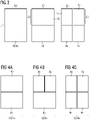
- FIG 3 shows, according to one embodiment, first, second and third class transport containers 4a, 4b, 4c.
- the first-class transport container 4a can also be a passive load handling device 18 .
- the lengths L1, L2, L3 and widths B1, B2, B3 of the transport containers 4a, 4b, 4c are matched to one another in such a way that two second-class transport containers 4b and four third-class transport containers 4c take the place of a first-class transport container 4a.
- figure 4 shows embodiments of the arrangement of transport containers 4b, 4c on a load handling device 18 with mutually adapted dimensioned transport containers 4a, 4b, 4c and load handling device 18.
- Two transport containers second Class 4b on a lifting device 18 Figure 4a .
- Two transport containers of third class 4c and one transport container of second class 4b on a load handling device 18 ( Figure 4c ).
- And four third-class transport containers 4c on a load handling device 18 Figure 4c ).
Landscapes
- Engineering & Computer Science (AREA)
- Mechanical Engineering (AREA)
- Aviation & Aerospace Engineering (AREA)
- Warehouses Or Storage Devices (AREA)
- Branching, Merging, And Special Transfer Between Conveyors (AREA)
Priority Applications (5)
| Application Number | Priority Date | Filing Date | Title |
|---|---|---|---|
| EP20208783.9A EP4001185A1 (fr) | 2020-11-20 | 2020-11-20 | Système de transport des récipients de transport et procédé de fonctionnement optimisé d'un système de transport des récipients de transport |
| US18/253,643 US12296982B2 (en) | 2020-11-20 | 2021-10-25 | Transport container conveyor system and method for the optimized operation of a transport container conveyor system |
| EP21805849.3A EP4247738A1 (fr) | 2020-11-20 | 2021-10-25 | Système de transport de conteneurs de transport et procédé pour le fonctionnement optimisé d'un système de transport de conteneurs de transport |
| PCT/EP2021/079458 WO2022106155A1 (fr) | 2020-11-20 | 2021-10-25 | Système de transport de conteneurs de transport et procédé pour le fonctionnement optimisé d'un système de transport de conteneurs de transport |
| CN202180077923.5A CN117042891B (zh) | 2020-11-20 | 2021-10-25 | 优化地运行输送系统的方法和输送系统 |
Applications Claiming Priority (1)
| Application Number | Priority Date | Filing Date | Title |
|---|---|---|---|
| EP20208783.9A EP4001185A1 (fr) | 2020-11-20 | 2020-11-20 | Système de transport des récipients de transport et procédé de fonctionnement optimisé d'un système de transport des récipients de transport |
Publications (1)
| Publication Number | Publication Date |
|---|---|
| EP4001185A1 true EP4001185A1 (fr) | 2022-05-25 |
Family
ID=73543037
Family Applications (2)
| Application Number | Title | Priority Date | Filing Date |
|---|---|---|---|
| EP20208783.9A Withdrawn EP4001185A1 (fr) | 2020-11-20 | 2020-11-20 | Système de transport des récipients de transport et procédé de fonctionnement optimisé d'un système de transport des récipients de transport |
| EP21805849.3A Pending EP4247738A1 (fr) | 2020-11-20 | 2021-10-25 | Système de transport de conteneurs de transport et procédé pour le fonctionnement optimisé d'un système de transport de conteneurs de transport |
Family Applications After (1)
| Application Number | Title | Priority Date | Filing Date |
|---|---|---|---|
| EP21805849.3A Pending EP4247738A1 (fr) | 2020-11-20 | 2021-10-25 | Système de transport de conteneurs de transport et procédé pour le fonctionnement optimisé d'un système de transport de conteneurs de transport |
Country Status (4)
| Country | Link |
|---|---|
| US (1) | US12296982B2 (fr) |
| EP (2) | EP4001185A1 (fr) |
| CN (1) | CN117042891B (fr) |
| WO (1) | WO2022106155A1 (fr) |
Families Citing this family (2)
| Publication number | Priority date | Publication date | Assignee | Title |
|---|---|---|---|---|
| CN115367237B (zh) * | 2022-10-24 | 2023-03-21 | 成都工业职业技术学院 | 一种物流配送用货物码垛打包装置 |
| US12377557B2 (en) | 2023-01-14 | 2025-08-05 | Sarcos Corp. | Robotic article handling end effector with capture device having a compliant material |
Citations (3)
| Publication number | Priority date | Publication date | Assignee | Title |
|---|---|---|---|---|
| EP1645340A1 (fr) * | 2004-10-06 | 2006-04-12 | Krones AG | Dispositifs et méthode pour trier ou convoyer des articles |
| DE102007025553A1 (de) * | 2007-05-31 | 2008-12-04 | Siemens Ag | Steuervorrichtung, Sortieranlage sowie Sortierverfahren für Güter |
| EP3028774A1 (fr) * | 2014-12-03 | 2016-06-08 | MULTIVAC Sepp Haggenmüller SE & Co. KG | Installation d'emballage avec une machine d'emballage par emboutissage |
Family Cites Families (13)
| Publication number | Priority date | Publication date | Assignee | Title |
|---|---|---|---|---|
| NL98148C (fr) * | 1946-08-03 | |||
| DE1431426A1 (de) * | 1964-01-16 | 1969-02-06 | Jean Immarigeon | Verbesserungen an Waehlfoerdervorrichtungen |
| US5226547A (en) * | 1991-04-19 | 1993-07-13 | Tritek Technologies, Inc. | Mail transport assembly for mail sorting system |
| US20030221935A1 (en) * | 1998-12-01 | 2003-12-04 | Crisplant A/S | Conveyor/sorter system, a loading conveyor and a control system for such conveyors |
| US7753191B2 (en) * | 2005-09-13 | 2010-07-13 | Crisplant A/S | System and method for automated handling of baggage objects |
| US20110139582A1 (en) * | 2009-12-15 | 2011-06-16 | Xerox Corporation | System and method for transporting variable-sized media |
| KR101282354B1 (ko) * | 2011-06-29 | 2013-07-04 | (주) 네오포스 | 배송물 구분 시스템, 그 시스템의 제어를 위한 상황 인지 방법 및 그 방법을 구현한 프로그램을 저장하는 컴퓨터로 판독 가능한 기록매체 |
| US9415248B2 (en) * | 2012-04-05 | 2016-08-16 | The Boeing Company | Fire extinguishment container |
| CN103736665B (zh) * | 2013-08-07 | 2015-11-18 | 上海邮政科学研究院 | 一种用于信件缓存分离的入信角调整机构 |
| CA2922683A1 (fr) * | 2013-08-28 | 2015-03-05 | Odds, Llc | Systeme et procede pour emballer des produits alimentaires |
| CN109420620B (zh) * | 2017-09-05 | 2020-07-24 | 上海同程物流发展有限公司 | 一种分拣收集装置以及应用该装置的物流分拣线 |
| ES2950708T3 (es) * | 2020-10-27 | 2023-10-13 | Siemens Logistics Gmbh | Sistema de transporte de equipajes y método para llenar un carrusel de recogida de equipaje de un sistema de transporte de equipajes con piezas de equipaje |
| EP4108604A1 (fr) * | 2021-06-24 | 2022-12-28 | Siemens Aktiengesellschaft | Chargement des récipients de transport d'une installation de transport, en particulier d'une installation de transport des bagages d'aéroport à taille variable des articles individuels |
-
2020
- 2020-11-20 EP EP20208783.9A patent/EP4001185A1/fr not_active Withdrawn
-
2021
- 2021-10-25 US US18/253,643 patent/US12296982B2/en active Active
- 2021-10-25 CN CN202180077923.5A patent/CN117042891B/zh active Active
- 2021-10-25 WO PCT/EP2021/079458 patent/WO2022106155A1/fr not_active Ceased
- 2021-10-25 EP EP21805849.3A patent/EP4247738A1/fr active Pending
Patent Citations (3)
| Publication number | Priority date | Publication date | Assignee | Title |
|---|---|---|---|---|
| EP1645340A1 (fr) * | 2004-10-06 | 2006-04-12 | Krones AG | Dispositifs et méthode pour trier ou convoyer des articles |
| DE102007025553A1 (de) * | 2007-05-31 | 2008-12-04 | Siemens Ag | Steuervorrichtung, Sortieranlage sowie Sortierverfahren für Güter |
| EP3028774A1 (fr) * | 2014-12-03 | 2016-06-08 | MULTIVAC Sepp Haggenmüller SE & Co. KG | Installation d'emballage avec une machine d'emballage par emboutissage |
Also Published As
| Publication number | Publication date |
|---|---|
| CN117042891B (zh) | 2025-11-11 |
| EP4247738A1 (fr) | 2023-09-27 |
| US12296982B2 (en) | 2025-05-13 |
| CN117042891A (zh) | 2023-11-10 |
| WO2022106155A1 (fr) | 2022-05-27 |
| US20240010356A1 (en) | 2024-01-11 |
Similar Documents
| Publication | Publication Date | Title |
|---|---|---|
| EP3228496B1 (fr) | Véhicule de distribution et procédé de livraison d'envois dans différents endroits suivant un itinéraire de distribution | |
| EP3584197B1 (fr) | Système de stockage | |
| DE19927251C2 (de) | Vorrichtung zum Handhaben von Stückgütern | |
| EP2297005B2 (fr) | Système de stockage et procédé pour le faire fonctionner | |
| DE102008036564B4 (de) | Skalierbarer Versandpuffer mit integrierter Sortierfunktion und Verfahren dazu | |
| EP1905705B1 (fr) | Zone de chargement d'une zone aéroportuaire | |
| EP3623061B1 (fr) | Installation de tri et procédé de tri d'objets | |
| EP1646570A2 (fr) | Poste de preparation de commandes et procede correspondant | |
| AT516404A4 (de) | Regallager mit einem Kreisverkehr auf einer geschlossenen Führungsbahn | |
| EP4552756A1 (fr) | Procédé de redistribution de paquets dans une station de tri | |
| EP4115994B2 (fr) | Agencements de tri destiné au tri des objets, ainsi que procédé correspondant | |
| DE102010020146A1 (de) | Stückgutbehandlungsanlage | |
| EP4247738A1 (fr) | Système de transport de conteneurs de transport et procédé pour le fonctionnement optimisé d'un système de transport de conteneurs de transport | |
| EP3613681A1 (fr) | Trieur de surface sur au moins deux plans | |
| EP2452900B1 (fr) | Station de chargement de chariots-cages, système de commissionnement avec une telle station et procédés correspondants | |
| EP3375739B1 (fr) | Dispositif de manipulation de marchandises en vrac | |
| DE102009017343A1 (de) | Sortierförderer innerhalb einer Förderanlage zum automatisierten Transport von Stückgütern | |
| DE102013210212A1 (de) | Catering-System und -verfahren | |
| DE102022113319B4 (de) | System und Verfahren zum Umschlagen und/oder Sortieren von Stückgütern in Abtragebereiche | |
| EP3712093A1 (fr) | Chargement et déchargement automatiques des voitures de transport | |
| EP4194109A1 (fr) | Installation et procédé de tri pour marchandises en détail pourvu de dispositif terminal cylindrique | |
| DE102023134278A1 (de) | Verfahren zum umverteilen von packstücken in einer sortierstation | |
| EP4461672A1 (fr) | Installation de transport comprenant un système de stockage et un point d'extrémité et procédé de stockage de porteurs de charge dans une installation de transport | |
| EP4628408A1 (fr) | Chargement de conteneurs avec des marchandises de détail | |
| EP4509445A1 (fr) | Procédé de chargement de colis individuels dans un volume de chargement doté d'un stockage intermédiaire |
Legal Events
| Date | Code | Title | Description |
|---|---|---|---|
| PUAI | Public reference made under article 153(3) epc to a published international application that has entered the european phase |
Free format text: ORIGINAL CODE: 0009012 |
|
| STAA | Information on the status of an ep patent application or granted ep patent |
Free format text: STATUS: THE APPLICATION HAS BEEN PUBLISHED |
|
| AK | Designated contracting states |
Kind code of ref document: A1 Designated state(s): AL AT BE BG CH CY CZ DE DK EE ES FI FR GB GR HR HU IE IS IT LI LT LU LV MC MK MT NL NO PL PT RO RS SE SI SK SM TR |
|
| STAA | Information on the status of an ep patent application or granted ep patent |
Free format text: STATUS: THE APPLICATION IS DEEMED TO BE WITHDRAWN |
|
| 18D | Application deemed to be withdrawn |
Effective date: 20221126 |