EP4001333A1 - Préparation destinée à la fabrication de matières adhésives à réactivité latente - Google Patents
Préparation destinée à la fabrication de matières adhésives à réactivité latente Download PDFInfo
- Publication number
- EP4001333A1 EP4001333A1 EP21206873.8A EP21206873A EP4001333A1 EP 4001333 A1 EP4001333 A1 EP 4001333A1 EP 21206873 A EP21206873 A EP 21206873A EP 4001333 A1 EP4001333 A1 EP 4001333A1
- Authority
- EP
- European Patent Office
- Prior art keywords
- 10bar
- sides
- adhesive
- initial
- component
- Prior art date
- Legal status (The legal status is an assumption and is not a legal conclusion. Google has not performed a legal analysis and makes no representation as to the accuracy of the status listed.)
- Granted
Links
Images
Classifications
-
- C—CHEMISTRY; METALLURGY
- C08—ORGANIC MACROMOLECULAR COMPOUNDS; THEIR PREPARATION OR CHEMICAL WORKING-UP; COMPOSITIONS BASED THEREON
- C08G—MACROMOLECULAR COMPOUNDS OBTAINED OTHERWISE THAN BY REACTIONS ONLY INVOLVING UNSATURATED CARBON-TO-CARBON BONDS
- C08G18/00—Polymeric products of isocyanates or isothiocyanates
- C08G18/06—Polymeric products of isocyanates or isothiocyanates with compounds having active hydrogen
- C08G18/70—Polymeric products of isocyanates or isothiocyanates with compounds having active hydrogen characterised by the isocyanates or isothiocyanates used
- C08G18/72—Polyisocyanates or polyisothiocyanates
- C08G18/80—Masked polyisocyanates
- C08G18/8003—Masked polyisocyanates masked with compounds having at least two groups containing active hydrogen
- C08G18/8048—Masked polyisocyanates masked with compounds having at least two groups containing active hydrogen with compounds of C08G18/34
-
- C—CHEMISTRY; METALLURGY
- C09—DYES; PAINTS; POLISHES; NATURAL RESINS; ADHESIVES; COMPOSITIONS NOT OTHERWISE PROVIDED FOR; APPLICATIONS OF MATERIALS NOT OTHERWISE PROVIDED FOR
- C09J—ADHESIVES; NON-MECHANICAL ASPECTS OF ADHESIVE PROCESSES IN GENERAL; ADHESIVE PROCESSES NOT PROVIDED FOR ELSEWHERE; USE OF MATERIALS AS ADHESIVES
- C09J175/00—Adhesives based on polyureas or polyurethanes; Adhesives based on derivatives of such polymers
- C09J175/04—Polyurethanes
-
- C—CHEMISTRY; METALLURGY
- C08—ORGANIC MACROMOLECULAR COMPOUNDS; THEIR PREPARATION OR CHEMICAL WORKING-UP; COMPOSITIONS BASED THEREON
- C08G—MACROMOLECULAR COMPOUNDS OBTAINED OTHERWISE THAN BY REACTIONS ONLY INVOLVING UNSATURATED CARBON-TO-CARBON BONDS
- C08G18/00—Polymeric products of isocyanates or isothiocyanates
- C08G18/06—Polymeric products of isocyanates or isothiocyanates with compounds having active hydrogen
- C08G18/08—Processes
- C08G18/0838—Manufacture of polymers in the presence of non-reactive compounds
- C08G18/0842—Manufacture of polymers in the presence of non-reactive compounds in the presence of liquid diluents
- C08G18/0847—Manufacture of polymers in the presence of non-reactive compounds in the presence of liquid diluents in the presence of solvents for the polymers
- C08G18/0852—Manufacture of polymers in the presence of non-reactive compounds in the presence of liquid diluents in the presence of solvents for the polymers the solvents being organic
-
- C—CHEMISTRY; METALLURGY
- C08—ORGANIC MACROMOLECULAR COMPOUNDS; THEIR PREPARATION OR CHEMICAL WORKING-UP; COMPOSITIONS BASED THEREON
- C08G—MACROMOLECULAR COMPOUNDS OBTAINED OTHERWISE THAN BY REACTIONS ONLY INVOLVING UNSATURATED CARBON-TO-CARBON BONDS
- C08G18/00—Polymeric products of isocyanates or isothiocyanates
- C08G18/06—Polymeric products of isocyanates or isothiocyanates with compounds having active hydrogen
- C08G18/08—Processes
- C08G18/10—Prepolymer processes involving reaction of isocyanates or isothiocyanates with compounds having active hydrogen in a first reaction step
-
- C—CHEMISTRY; METALLURGY
- C08—ORGANIC MACROMOLECULAR COMPOUNDS; THEIR PREPARATION OR CHEMICAL WORKING-UP; COMPOSITIONS BASED THEREON
- C08G—MACROMOLECULAR COMPOUNDS OBTAINED OTHERWISE THAN BY REACTIONS ONLY INVOLVING UNSATURATED CARBON-TO-CARBON BONDS
- C08G18/00—Polymeric products of isocyanates or isothiocyanates
- C08G18/06—Polymeric products of isocyanates or isothiocyanates with compounds having active hydrogen
- C08G18/28—Polymeric products of isocyanates or isothiocyanates with compounds having active hydrogen characterised by the compounds used containing active hydrogen
- C08G18/30—Low-molecular-weight compounds
- C08G18/34—Carboxylic acids; Esters thereof with monohydroxyl compounds
- C08G18/341—Dicarboxylic acids, esters of polycarboxylic acids containing two carboxylic acid groups
-
- C—CHEMISTRY; METALLURGY
- C08—ORGANIC MACROMOLECULAR COMPOUNDS; THEIR PREPARATION OR CHEMICAL WORKING-UP; COMPOSITIONS BASED THEREON
- C08G—MACROMOLECULAR COMPOUNDS OBTAINED OTHERWISE THAN BY REACTIONS ONLY INVOLVING UNSATURATED CARBON-TO-CARBON BONDS
- C08G18/00—Polymeric products of isocyanates or isothiocyanates
- C08G18/06—Polymeric products of isocyanates or isothiocyanates with compounds having active hydrogen
- C08G18/70—Polymeric products of isocyanates or isothiocyanates with compounds having active hydrogen characterised by the isocyanates or isothiocyanates used
- C08G18/72—Polyisocyanates or polyisothiocyanates
- C08G18/77—Polyisocyanates or polyisothiocyanates having heteroatoms in addition to the isocyanate or isothiocyanate nitrogen and oxygen or sulfur
- C08G18/78—Nitrogen
- C08G18/79—Nitrogen characterised by the polyisocyanates used, these having groups formed by oligomerisation of isocyanates or isothiocyanates
- C08G18/797—Nitrogen characterised by the polyisocyanates used, these having groups formed by oligomerisation of isocyanates or isothiocyanates containing carbodiimide and/or uretone-imine groups
-
- C—CHEMISTRY; METALLURGY
- C09—DYES; PAINTS; POLISHES; NATURAL RESINS; ADHESIVES; COMPOSITIONS NOT OTHERWISE PROVIDED FOR; APPLICATIONS OF MATERIALS NOT OTHERWISE PROVIDED FOR
- C09J—ADHESIVES; NON-MECHANICAL ASPECTS OF ADHESIVE PROCESSES IN GENERAL; ADHESIVE PROCESSES NOT PROVIDED FOR ELSEWHERE; USE OF MATERIALS AS ADHESIVES
- C09J5/00—Adhesive processes in general; Adhesive processes not provided for elsewhere, e.g. relating to primers
- C09J5/06—Adhesive processes in general; Adhesive processes not provided for elsewhere, e.g. relating to primers involving heating of the applied adhesive
-
- C—CHEMISTRY; METALLURGY
- C09—DYES; PAINTS; POLISHES; NATURAL RESINS; ADHESIVES; COMPOSITIONS NOT OTHERWISE PROVIDED FOR; APPLICATIONS OF MATERIALS NOT OTHERWISE PROVIDED FOR
- C09J—ADHESIVES; NON-MECHANICAL ASPECTS OF ADHESIVE PROCESSES IN GENERAL; ADHESIVE PROCESSES NOT PROVIDED FOR ELSEWHERE; USE OF MATERIALS AS ADHESIVES
- C09J7/00—Adhesives in the form of films or foils
- C09J7/10—Adhesives in the form of films or foils without carriers
-
- C—CHEMISTRY; METALLURGY
- C09—DYES; PAINTS; POLISHES; NATURAL RESINS; ADHESIVES; COMPOSITIONS NOT OTHERWISE PROVIDED FOR; APPLICATIONS OF MATERIALS NOT OTHERWISE PROVIDED FOR
- C09J—ADHESIVES; NON-MECHANICAL ASPECTS OF ADHESIVE PROCESSES IN GENERAL; ADHESIVE PROCESSES NOT PROVIDED FOR ELSEWHERE; USE OF MATERIALS AS ADHESIVES
- C09J7/00—Adhesives in the form of films or foils
- C09J7/30—Adhesives in the form of films or foils characterised by the adhesive composition
-
- C—CHEMISTRY; METALLURGY
- C09—DYES; PAINTS; POLISHES; NATURAL RESINS; ADHESIVES; COMPOSITIONS NOT OTHERWISE PROVIDED FOR; APPLICATIONS OF MATERIALS NOT OTHERWISE PROVIDED FOR
- C09J—ADHESIVES; NON-MECHANICAL ASPECTS OF ADHESIVE PROCESSES IN GENERAL; ADHESIVE PROCESSES NOT PROVIDED FOR ELSEWHERE; USE OF MATERIALS AS ADHESIVES
- C09J2203/00—Applications of adhesives in processes or use of adhesives in the form of films or foils
- C09J2203/326—Applications of adhesives in processes or use of adhesives in the form of films or foils for bonding electronic components such as wafers, chips or semiconductors
-
- C—CHEMISTRY; METALLURGY
- C09—DYES; PAINTS; POLISHES; NATURAL RESINS; ADHESIVES; COMPOSITIONS NOT OTHERWISE PROVIDED FOR; APPLICATIONS OF MATERIALS NOT OTHERWISE PROVIDED FOR
- C09J—ADHESIVES; NON-MECHANICAL ASPECTS OF ADHESIVE PROCESSES IN GENERAL; ADHESIVE PROCESSES NOT PROVIDED FOR ELSEWHERE; USE OF MATERIALS AS ADHESIVES
- C09J2463/00—Presence of epoxy resin
-
- C—CHEMISTRY; METALLURGY
- C09—DYES; PAINTS; POLISHES; NATURAL RESINS; ADHESIVES; COMPOSITIONS NOT OTHERWISE PROVIDED FOR; APPLICATIONS OF MATERIALS NOT OTHERWISE PROVIDED FOR
- C09J—ADHESIVES; NON-MECHANICAL ASPECTS OF ADHESIVE PROCESSES IN GENERAL; ADHESIVE PROCESSES NOT PROVIDED FOR ELSEWHERE; USE OF MATERIALS AS ADHESIVES
- C09J2475/00—Presence of polyurethane
Definitions
- the invention relates to a preparation for producing an adhesive, in particular a latently reactive adhesive, from at least one isocyanate-reactive polymer and at least one isocyanate-containing compound, a corresponding adhesive, and adhesive films based on such an adhesive.
- LCD liquid crystals
- OLED organic light-emitting diodes
- Such protection is also required for non-electronic visual display systems, such as mechanical displays such as clocks or level indicators on storage vessels.
- Glass is often used as a protective window because it offers advantages over plastic due to its feel. Glass is also inert to organic solvents and, due to its great hardness, also scratch-resistant, which gives it a high-quality impression. Panes of glass are also used when it comes to fulfilling optical functions such as refraction, concentration, weakening or amplification of light. When installing such lenses in the holder or the device body, the requirements are similar to those for the windows described above.
- anodized aluminum is becoming increasingly important as a decorative material for electronic devices.
- So-called anodized or anodized aluminum i.e. aluminum processed using the anodizing process, is aluminum on the surface of which an oxidic protective layer has been formed by anodic oxidation of the aluminum.
- the protective layer is not deposited on the workpiece, but rather an oxide or hydroxide is formed by converting the top metal layer. This therefore has a particularly good connection to the aluminum.
- a 5 to 25 ⁇ m thick layer is formed, which protects deeper layers from corrosion as long as there are no gaps in this layer, for example due to mechanical damage.
- the low thermal load capacity of approx. 80 °C applies, above which the anodized layer begins to crack, posing a challenge to processing.
- thermally sensitive bonding is the bonding of leather products in textiles and/or for decorative purposes, for example in motor vehicles and/or for covers of seating furniture and/or vehicle seats to harden, which also places high demands on the corresponding manufacturing processes.
- the bonding of various, possibly at least partially thermally sensitive substrates in electronic devices is nowadays mainly carried out by means of double-sided self-adhesive tapes, liquid adhesives, low-melting thermoplastics or latently reactive adhesive films that can be activated at low temperatures aqueous dispersions and particulate, blocked and/or surface-deactivated crosslinker systems.
- Double-sided self-adhesive tapes are very easy to apply, but they have limits, for example, in terms of the maximum bond strength that can be achieved, especially with bond areas that are becoming ever smaller.
- Liquid adhesives achieve excellent bond strengths with so-called structural or semi-structural bond strengths, but have clear disadvantages in application, for example due to the formation of drops or streaks, and the substrates to be bonded must be fixed while the liquid adhesive is curing.
- the highest bonding strengths in this segment are offered by the so-called 2-component liquid adhesives, which, in addition to the disadvantages listed above, also clog the application and/or mixing tools due to rapid curing reactions and also have to be homogeneously mixed before use.
- Low-melting thermoplastics offer the advantage of easy application by hot lamination or hot pressing and achieve very good bond strengths in the so-called semi-structural or structural area under normal ambient temperature conditions. Due to the permanent meltability of these systems, however, they soften above the softening point and lose significant bond strength, which can lead to problems in use, particularly when they are used for thermally sensitive substrates.
- Latently reactive adhesive films based on aqueous dispersions and particulate, blocked and/or surface-deactivated crosslinker systems offer a good compromise between simple application analogous to thermoplastics and high performance in terms of bond strength in the so-called semi-structural or structural area.
- these systems also have significantly improved performance, even at higher application temperatures, such as those that can occur, for example, due to waste heat from electronic components or exposure to the sun.
- these systems due to the production/synthesis process and/or the necessary emulsifiers and/or stabilizers and/or surfactants, these systems have intrinsic disadvantages under humid or warm and humid ambient conditions and/or in contact with polar solvents and/or chemicals (e.g. water, alcohols, (poly)ethylene glycols, etc.), in particular on hydrophilic and/or polar substrates where moisture penetrates or migrates into the interfaces between the adhesive film and the substrate or into the adhesive film itself.
- polar solvents and/or chemicals e.g. water, alcohols, (poly)ethylene glycols, etc.
- bar or “bar width” should be understood to mean the design of a double-sided adhesive material. Instead of full-surface gluing, often only frame gluing is required.
- the adhesive system is used as a ready-made section, which can have a segment (“web”) with a small width (“web width”). This can involve web widths in at least one section of the bonded area of at most 2 mm, at most 1 mm, at most 0.8 mm or even around 0.5 mm or even less.
- thermosensitive substrates are also to be bonded to one another, there is a need to offer heat-activatable films that can be processed even at very low temperatures (T at most 90° C. or even no more than 80° C. or less). Examples of particularly heat-sensitive substrates that do not require processing temperatures significantly above 80 °C tolerate are anodized (anodized) aluminum, various (possibly transparent) plastics and / or textiles, some surface-modified components and leather.
- the person skilled in the art is therefore interested in suitable and constantly improving adhesive systems for double-sided adhesive films for bonding, for example, such cover glasses or lenses, structural and/or decorative parts with holders and/or housings and/or with one another, various textiles and/or leather.
- the profile of requirements for adhesive systems for these applications includes high ejection strength (i.e. the bond strength of the component in its holder, so-called “push-out strength”) and often simultaneously high impact strength, even at low temperatures, so that individual components do not get stuck at the glue joint if they fall break apart
- bond strength adhesive systems with a layer of a latently reactive adhesive film appear to be very well suited. Examples of latently reactive adhesive films can be found in Habenicht (G.
- Adhesive products with at least one layer of a latently reactive adhesive film which contains a thermoplastic component that contains functional groups that can react with isocyanate, and an isocyanate-containing component that is dispersed in particulate form in the thermoplastic component, are advantageous for high bond strengths at low bonding temperatures present and possibly blocked (see e.g. BB Müller, W. Rath, Formulation of adhesives and sealants, 2nd ed., 2009, Vincentz Network, Hanover, pp. 141-144 as technological illustrative material), microencapsulated (see e.g. U.S. 4,483,744 and J.-M. Pernot, B. Pouyet, H. Brun, S.
- the WO 99/29755 describes reactive polyurethane adhesive systems based on aqueous polyurethane dispersions.
- Polyisocyanate particles which are deactivated on their surface, are dispersed in the matrix of a thermoplastic polyurethane which still carries functional groups for a reaction with isocyanates.
- the thermoplastic polyurethane melts.
- the deactivated particle surface dissolves and the isocyanate groups can react with the functional groups of the thermoplastic polyurethane.
- the formulations can contain, inter alia, silanes.
- silanes in the function of an adhesion promoter in this way has the disadvantage that silanes can hydrolyze and condense in an aqueous medium, so that their interfacial activity can be reduced.
- their mode of action can be impaired by possible other components of the dispersion, such as stabilizers and measures to adjust a pH value that is important for the stability of the dispersion.
- a latently reactive adhesive from a solution in an organic solvent with an excellent pot life and coatability of at least 1 day, preferably at least 2 days, more preferably at least 3 days, or a latently reactive adhesive film based on such an adhesive, or a composite of two or more substrates ,
- at least one on the side to be bonded has inorganic (hydrophilic) character and / or is thermally sensitive
- a latent reactive Adhesive film are bonded, especially for use in optical, electronic and / or precision engineering devices and / or thermally sensitive substrates, with a thermal capacity of 80 ° C, maximum 90 ° C, such as anodized aluminum, leather, synthetic leather and / or thermal sensitive plastic substrates and/or textiles are not described.
- U.S. 6,797,764 B2 describes aqueous adhesive formulations based on polyurethane. These can contain adhesion promoters such as silanes. In addition to plastics, stainless steel, aluminum, copper, iron, cold-rolled steel and phosphatized steel are given as examples of materials to be bonded.
- the adhesives are not latently reactive.
- WO 00/34403 A1 describes aqueous polyurethane-based adhesive formulations for bonding rubber items.
- the rubber items can be pre-treated with a primer.
- the disclosure teaches that the hydrolysis resistance of polyester groups can be improved by adding epoxides. Chemical degradation products of the primer are given as the cause of undesired hydrolysis.
- the adhesives are not latently reactive.
- WO 2013/127697 A1 relates to the bonding of anodized aluminum to a plastic using a polyurethane-based latent reactive adhesive film.
- Plastic materials can be surface-modified and carry inorganic layers.
- DE 102018206632 A1 relates to a latently reactive adhesive film made from a solution in an organic solvent.
- WO 9325599 A1 relates to hot-melt adhesives made from meltable polymers or polymer mixtures, which change to the liquid state at temperatures above 40° C., especially above 55° C., and which carry isocyanate-reactive functional groups, such as hydroxyl or amino groups, with pulverulent, solid, surface-deactivated isocyanates at least two isocyanate groups, or a suspension or dispersion of pulverulent, solid, di- or polyisocyanates, which have been surface-treated with a deactivating agent, in a non-volatile carrier liquid, are inhomogeneously mixed in an approximately stoichiometric ratio at a temperature of at least 40° C, so that the resulting mixture of substances has sub-areas in which the ratio of polymer to solid isocyanate and deactivating agent is different, i.e.
- bond strengths for bonded substrates are determined and compared in terms of their strength before and after damp/warm storage.
- An excessive drop in bond strength under these conditions, especially below the level of self-adhesives/self-adhesive tapes (PSAs) is undesirable.
- the bond strength of inorganic (hydrophilic) surfaces with a polyurethane-based, latently reactive adhesive film is influenced by exposure to a warm, humid climate.
- modern entertainment electronics and/or communications electronics and/or data processing devices and/or household electronics and in particular mobile devices require a broad resistance to chemical influences, after which the bond strength does not drop too much, in particular not below the level bonding with a PSA ( ⁇ 1 MPa in the push-out test).
- Examples of such chemicals are mixtures of Named ethanol and water for polar chemicals and oleic acid for non-polar and/or surfactant-like chemicals.
- Components (i) and (ii) are constituents of the adhesive obtainable from the preparation, while component (x) serves primarily as a processing aid for the preparation of the invention (precursor of the adhesive).
- thermoplastic, preferably (semi) crystalline, polymer component is formed from one or more polymers with functional groups that can react with isocyanate, and that the crosslinker component is formed from one or more isocyanate-containing, particulate compounds, and that the solvent component is formed from one or more organic solvents.
- the properties of “the at least one” representative of the respective component are mentioned below is spoken, the properties described apply in particular to all representatives of the respective component if there are several of them.
- a latent-reactive adhesive in particular in film form, made from an organically dissolved polymer and which has particularly advantageous adhesive properties can be offered in a new way for the person skilled in the art, which was not expected.
- the preparations for the production of (particularly latently reactive) adhesives and latently reactive adhesive films obtainable therefrom contain a thermoplastic component which has a melting point, T(melting point), and contains functional groups which can react with isocyanate, and an isocyanate containing component that is particulate, in particular finely divided particulate (preferably with a particle size distribution with d 50 ⁇ 50 microns, in particular ⁇ 15 microns) is present.
- the polymer component and the isocyanate component are not dispersed in an aqueous medium, but rather the polymer is present dissolved in an organic solvent, and the isocyanate compound is finely divided and dispersed in this solvent.
- the composition thus contains a polymer component (component (i)) formed from at least one polymer containing functional groups which can react with isocyanate (hereinafter also referred to as isocyanate-reactive polymer).
- This polymer component represents the polymeric basis for the adhesive mass which can be produced from the composition.
- the polymeric component (i) is present in organic solution.
- compounds that are functionalized with OH and/or NH 2 groups and/or urethane groups are used as polymer components.
- the at least one isocyanate-reactive polymer is an at least partially crystalline polymer, ie a semi-crystalline or crystalline polymer.
- (Semi)crystalline substances can be determined using Differential Scanning Calorimetry (DSC) according to DIN 53765:1994-03. Glass transition temperatures occur in amorphous substances and melting temperatures in (purely) crystalline substances. Glass transition temperatures are recognizable as steps and melting temperatures as peaks in the thermogram. Semi-crystalline materials can have glass transition temperatures in addition to melting temperatures. In the case of (semi)crystalline substances, at least one melting temperature can be identified, while this does not occur in the case of amorphous substances.
- the at least one isocyanate-reactive polymer is a polyurethane polymer, and even more preferably in connection with the advantageous embodiment mentioned above, a crystalline or semi-crystalline polyurethane polymer, for example polyurethane ester.
- thermoplastic polyurethane preferably has a softening point and/or decrystallization point of less than 90°C, preferably less than 80°C, even more preferably less than 70°C.
- a hydroxyl-terminated, largely linear, thermoplastic, highly crystallizing polyurethane elastomer is used as the isocyanate-reactive polymer.
- Such a polymer is commercially available from Covestrotechnik AG under the name Desmomelt 530®.
- less strongly crystallizing and/or branched and/or polyfunctional polymers can also be advantageous if, for example, with regard to even better chemical resistance and/or bond strength and/or hardness, if a higher crosslinking density is advantageous.
- the preparation according to the invention also contains a crosslinking component for the polymers to be crosslinked, which is formed from at least one isocyanate-containing particulate component (component (ii)).
- the isocyanate compounds can be used in a surface-deactivated or non-surface-deactivated manner. This represents an advantage over the prior art, which absolutely requires surface-deactivated isocyanate compounds for latently reactive adhesives.
- the preparation represents at least a two-phase system, namely the polymer solution and the particulate isocyanate-containing component, the curing reaction does not start significantly in this state. Even after the preparation has been spread out on a temporary or permanent carrier and dried, i.e.
- toluene diisocyanate compounds are used in whole or in part as the isocyanate-containing component, such as TDI dimers (obtainable, for example, as Dispercoll BL XP 2514® (aqueous dispersion of a reactive isocyanate based on TDI dimer; present preferably usable after removal of the water) or as Dancure 999 ® (1,3-bis(3-isocyanato-4-methylphenyl)-1,3-diazetidine-2,4-dione; solid)), and/or isophorone Diisocyanates (IPDI).
- TDI dimers obtainable, for example, as Dispercoll BL XP 2514® (aqueous dispersion of a reactive isocyanate based on TDI dimer; present preferably usable after removal of the water
- Dancure 999 ® 1,3-bis(3-isocyanato-4-methylphenyl)-1,3-diazetidine
- the formulation consists only of a polymer according to the invention and an isocyanate-containing compound according to the invention in a solvent according to the invention.
- the ratio between the polymer according to the invention and the isocyanate-containing compound according to the invention is selected in such a way that the resultant, latently reactive film has the property profile according to the invention and which may be desired.
- the person skilled in the art uses the minimum amount of isocyanate-containing compound according to the invention that is stoichiometrically necessary to crosslink the isocyanate-reactive groups of the polymer according to the invention.
- the person skilled in the art also advantageously uses more than this necessary amount of isocyanate-containing compound according to the invention, in particular to avoid unintended reactions of the isocyanate-containing compound according to the invention, for example with residual moisture in the solvent used according to the invention and/or moisture input via atmospheric humidity, for example during storage and/or transport and / or application of the latently reactive adhesive film according to the invention or if, for example, further isocyanate-reactive components are added to the formulation according to the invention.
- the melt viscosity of the polymer according to the invention and/or the melt viscosity of the latently reactive adhesive film according to the invention are high, so that there is insufficient solubility and/or migration capability in the required application time is guaranteed.
- the temperature-time relationship can be positively influenced by increasing the content of the isocyanate-containing compound according to the invention. In this case, unreacted portions of the isocyanate-containing compound according to the invention would remain in the adhesive film after crosslinking.
- isocyanate-containing compound according to the invention it can also be advantageous to use less than the stoichiometrically necessary amount of isocyanate-containing compound according to the invention, for example if it is necessary the polymer used according to the invention is a branched and/or polyisocyanate-reactive polymer, in order to avoid excessive crosslinking density, possibly accompanied by embrittlement, or to achieve a (e.g. viscoelastic) property profile required for the application of the latently reactive adhesive film according to the invention .
- a e.g. viscoelastic property profile required for the application of the latently reactive adhesive film according to the invention .
- 1 percent by weight to 25 percent by weight, particularly advantageously 2 percent by weight to 15 percent by weight, very particularly advantageously 4 percent by weight to 10 percent by weight, of the components of the formulation are selected from isocyanate-containing compounds according to the invention.
- the solvent used according to the invention is not taken into account in this calculation, this is only to be understood as a processing aid in order to mix the components of the formulation according to the invention homogeneously and to set a viscosity that allows coating the formulation according to the invention in the desired coating process to obtain the latently reactive according to the invention Allow adhesive film in the desired layer thickness.
- an organic solvent or a mixture of mutually compatible organic solvents in which the polymer component is essentially soluble and the crosslinking component is essentially insoluble can be used as the solvent component (x).
- the customary organic solvents can be chosen, and the solubility or non-solubility of the components mentioned herein can be found out easily by a person skilled in the art through specialist knowledge. Examples of solvents that can be used are acetone and 2-butanone, without wishing to be limited to these by naming them.
- the preparation according to the invention can optionally also comprise an adhesion promoter component (iii).
- an adhesion promoter component iii
- This is formed in particular from at least one organofunctional silane compound, for example of the general formula R—SiX 3 , where R denotes an organically functionalized radical and X denotes a hydrolyzable group.
- R denotes an organically functionalized radical
- X denotes a hydrolyzable group.
- the organic group of the silane can be used to bond to the adhesive; for example through a newly formed covalent bond.
- the organically functionalized radical R frequently represents a relatively long part of the molecule (spacer, frequently comprising an alkyl chain) which generally has a functional group and the function of which is to bond to the substrate surface and/or to components of the adhesive.
- Typical functional groups are vinyl, methacrylic acid, glycidyl, epoxy, epoxide, amino, urea or thiol groups.
- hydrolyzable groups X for example, alkoxy groups, and more rarely also halogen groups, are used.
- epoxy- or epoxide-terminated silanes, compounds based on an epoxy or epoxide silane, and/or alkylphosphonic acids can be used advantageously.
- silane compounds that can be used alone or together as the adhesion promoter component are aminopropyltrimethoxysilane, 3-glycidyloxypropyltrimethoxysilane (commercially available under the name Glymo ® ) and ⁇ -(3,4-epoxycyclohexyl)ethyltriethoxysilane (commercially available under the name CoatOSil 1770 ® ).
- silane-containing adhesion promoters are sensitive to hydrolysis
- the proportion of an adhesion promoter according to the invention is advantageously 0.5 percent by weight to 6 percent by weight, particularly advantageously 1 percent by weight to 4 percent by weight, very particularly advantageously 1.5 percent by weight to 3 percent by weight of the formulation according to the invention without solvent.
- a preferred embodiment of the invention is given by the fact that the composition of the preparation by the components (i), (ii) and (x) is final, so apart from the components (i), (ii) and (x) no other components or additives are present.
- a further preferred embodiment of the invention also has component (iii) in addition to components (i), (ii) and (x), but is otherwise final, ie has no further components or additives apart from these four components.
- the advantageous composition can be limited to the above three components (i), (ii) and (x), but in an advantageous further development it can also contain one or more organofunctional silane compounds as adhesion promoter component (iii), such as glycidyloxypropyltrimethoxysilane and/or ⁇ - (3,4-epoxycyclohexyl)ethyltriethoxysilane.
- adhesion promoter component (iii) such as glycidyloxypropyltrimethoxysilane and/or ⁇ - (3,4-epoxycyclohexyl)ethyltriethoxysilane.
- the advantageous composition can be limited to the above four components (i), (ii), (iii) and (x), but in an advantageous further development one or more components (iv) from the group of epoxides and/or epoxy Compounds containing mono-, di-, tri- or polyfunctional epoxides and/or epoxy compounds.
- These include, for example, compounds that are liquid / viscous at 23 °C, such as N,N,N',N'-tetrakis(2,3-epoxypropyl)-m-xylene-a,a'-diamine and/or 7-oxabicyclo-[ 4.1.0]hept-3-ylmethyl 7-oxabicyclo[4.1.0]heptane-3-carboxylate and/or compounds with a melting/softening point above 23 °C (so-called epoxy/epoxy resins) such as Epiclon N-673.
- compounds that are liquid / viscous at 23 °C such as N,N,N',N'-tetrakis(2,3-epoxypropyl)-m-xylene-a,a'-diamine and/or 7-oxabicyclo-[ 4.1.0]hept-3-ylmethyl 7-oxabicyclo[4.1.0]heptane-3-carboxylate and/or compounds with
- compositions can be limited to these components, but also advantageously contain further additives and/or components (v), see below, for example adhesive resins in particular.
- thickeners e.g. thermally and/or electrically conductive
- fillers e.g. thermally and/or electrically conductive
- organic and/or inorganic (color) pigments e.g. organic and/or inorganic fillers
- foaming agents e.g. microballoons
- catalysts e.g. microballoons
- antioxidants e.g. Light stabilizers and other polymers to set special adhesive properties.
- Special adhesive properties can be set, for example, by mixing in amorphous polymers (e.g. polyetherurethanes or polyacrylates) and/or by mixing in adhesive resins.
- Adhesive resins can optionally be used for the present invention in order to adjust the tacky properties of the adhesive film according to the invention or to make it tacky in the first place.
- adhesive resins such as those used for adhesives, are often used, differ from reactive components, the latter are often also called reactive resins.
- an “adhesive resin” is understood to mean an oligomeric or polymeric resin which causes or increases and/or influences the adhesion (the tack, the inherent tackiness) of the adhesive compared to the adhesive which does not contain any adhesive resin but is otherwise identical.
- adhesive resins contain no reactive groups apart from double bonds (in the case of unsaturated resins), since their properties should not change over the lifetime of the adhesive.
- adhesive resins in contrast to the reactive component(s) (reactive resins), are oligomeric or polymeric compounds that do not participate or do not significantly participate in curing reactions.
- resins based on terpene phenol or rosin such as partially or fully hydrogenated resins based on rosin and rosin derivatives, can be used as adhesive resins.
- suitable adhesive resins are hydrogenated polymers of dicyclopentadiene, partially, selectively or completely hydrogenated hydrocarbon resins based on C5, C5/C9 or C9 monomer streams, polyterpene resins based on ⁇ -pinene and/or ⁇ -pinene and/or ⁇ -limonene and/or ⁇ 3-carene, hydrogenated polymers of preferably pure C8 and C9 aromatics.
- the aforementioned adhesive resins can be used either alone or in a mixture.
- rosin resins include, for example, natural rosin, polymerized rosin, partially hydrogenated rosin, fully hydrogenated rosin, esterified products of these rosins (such as glycerol esters, pentaerythritol esters, ethylene glycol esters and methyl esters) and rosin derivatives (such as disproportionation rosins, fumaric acid-modified rosins and lime modified rosin).
- natural rosin such as glycerol esters, pentaerythritol esters, ethylene glycol esters and methyl esters
- rosin derivatives such as disproportionation rosins, fumaric acid-modified rosins and lime modified rosin.
- Adhesive resins based on acrylates and methacrylates can also be used according to the invention.
- the latent reactivity offers the advantage that this adhesive, in particular adhesive films, can be stored, transported and further processed (for example to form stamped parts) under normal conditions before they are then used at the bond site and cured.
- the resistances mentioned are characterized in particular by the fact that the correspondingly stored films or adhesives or adhesive products exposed to the corresponding influences also lead to bonds whose properties after bonding, in particular their bond strengths, are very good.
- the latently reactive adhesives or latently reactive adhesive films produced therefrom particularly preferably exhibit outstanding resistance to moist heat on polar substrates (in particular anodized aluminum); advantageously corresponding to values in the pushout test of at least 1 MPa after storage for 72 h at 60 °C and 95% relative humidity and/or after storage for 72 h at 85 °C and 85% relative humidity, particularly advantageously also a very Good chemical resistance, corresponding to values in the push-out test of at least 1 MPa after storage for 72 h at 60 °C in oleic acid and/or after storage for 72 h at 60 °C in EtOH/H 2 O (75% by volume / 25% by volume, particularly advantageously also of at least 1 MPa or more after storage for 72 h at 60 °C in chemicals / mixtures from, for example, the group of household chemicals / mixtures (e.g.
- human secretions e.g. sweat, sebum, urine, feces, blood, tissue fluids, saliva, other body fluids and/or secretions.
- a value in the push-out test of at least 1 MPa after storage for 72 hours in vapors of the aforementioned chemicals/mixtures or chemicals/mixtures of the aforementioned groups can be further advantageous .
- the solvent in particular is largely removed until only a small residual solvent content, preferably not more than 2 percent by weight, particularly preferably not more than 1 percent by weight, very particularly preferably not more than 0.5 percent by weight, remains in the preparation.
- This can be done in particular by heating, although the temperature of the adhesive should be below the activation temperature of the curing reaction.
- the solvent can be removed, for example, in a drying oven and/or a drying tunnel and/or another technical solution that ensures that the drying temperature (of the formulation and/or the adhesive film) remains below the activation temperature of the latently reactive adhesive film or only is exceeded for so long that the latently reactive adhesive film still has the property profile according to the invention after drying.
- the solvent is removed after the preparation has been coated onto a temporary or onto a permanent carrier.
- Permanent backings remain in the tape upon application, while temporary backings are removed for bonding. They are mainly used to protect and/or transport the adhesive tape and/or for improved dimensional stability and/or processability.
- drying processes are demanding due to the narrow temperature window available—as mentioned, the drying temperature should be well below the activation temperature of the curing reaction.
- drying processes are adequately described in the prior art. They can be applied accordingly here.
- the latently reactive adhesives and adhesive films obtainable from the preparation according to the invention are preferably non-tacky at room temperature in order to ensure good (re)positionability, as is the case for other heat-activatable adhesives
- Adhesive mass and adhesive film systems is already established in manufacturing processes. Alternatively, however, they can also be designed to be pressure-sensitively adhesive before the curing reaction.
- Tack is the property of a substance at room temperature (defined here as 23 °C) to enter into a permanent bond with a substrate even under relatively light pressure. Substances that have this property are referred to as pressure-sensitive adhesives.
- Pressure-sensitive adhesives have been known for a long time. Pressure-sensitive adhesives are usually permanently inherently tacky at room temperature, i.e.
- pressure-sensitive adhesives have a certain viscosity and tackiness, so that they wet the surface of the respective substrate even with little pressure.
- the ability of a pressure-sensitive adhesive to adhere to materials and to transfer forces is based on the adhesion and cohesion of the pressure-sensitive adhesive.
- Pressure-sensitive adhesives can be viewed as extremely high-viscosity liquids with an elastic portion. Pressure-sensitive adhesives therefore have special, characteristic viscoelastic properties that lead to permanent inherent tack and adhesiveness.
- Reactive adhesives which, like the present adhesive, are subsequently reactively cured can initially be present as pressure-sensitive adhesive at room temperature. As a result of the curing, they generally lose their pressure-sensitive adhesive properties as a result of the extensive crosslinking and associated increase in cohesion, so that the cured adhesive compositions then generally no longer have any pressure-sensitive adhesive properties at room temperature.
- the invention further relates to adhesive products comprising at least one layer of the adhesive of the invention.
- At least one layer of a latently reactive adhesive film is used in the product according to the invention, in particular with a layer thickness of between at least 5 ⁇ m and at most 1000 ⁇ m, preferably between at least 10 ⁇ m and at most 500 ⁇ m, particularly preferably between 25 ⁇ m and 250 ⁇ m.
- the products according to the invention are double-sided adhesive products.
- such products containing at least one latently reactive adhesive film are used in a single-layer form, applied to a (temporary) carrier material which can be removed again.
- Temporary backing materials suitable for the adhesive of the invention are known to those skilled in the art. Examples of suitable temporary backing material are all release films and release papers that are suitable for the adhesive of the invention and are known from the prior art and have a are equipped with a release layer and/or do not intrinsically form excessively high bond strengths with the adhesive of the invention. Siliconized papers suitable for the adhesive of the invention are preferred. Two layers of a removable backing material can also be used so that the top and bottom of the adhesive film are covered even if the product is not rolled up.
- Products containing at least one latently reactive adhesive film can also contain a further carrier material which remains in the product even after bonding (permanent carrier).
- a further carrier material which remains in the product even after bonding (permanent carrier).
- Foils and papers, but also non-crimp fabrics, woven fabrics and knitted fabrics are also suitable for this purpose.
- the surfaces of these carrier materials can each be chemically (primer, plasma) and/or physically (corona, flame, plasma) pretreated independently of one another in such a way that particularly good anchoring of the latent-reactive adhesive film on the carrier material can be achieved. Fleeces are preferred.
- One layer of permanent backing reduces any tendency of the adhesive film to be squeezed out of the bond line in the molten state under compression conditions (see DE 10 2009 006 935 A1 ).
- fabrics made of individual fibers are used as carrier fleece.
- All fleeces defined according to the DIN EN 29092 standard can be used.
- the fleece consists of loosely folded fibers that are not yet connected to each other. The strength results from the fiber's own adhesion.
- the fibers are randomly distributed.
- the fleeces can be differentiated according to the fiber materials.
- Fiber materials can be mineral fibers such as glass, mineral wool or basalt, animal fibers such as silk or wool, vegetable fibers such as cotton, cellulose, chemical fibers such as polyamide, polypropylene, polyphenylene sulfide, polyacrylonitrile, polyimide, polytetrafluoroethylene, aramid or polyester, or mixtures of the aforementioned substances can be used.
- the fibers can be strengthened mechanically by needling or water jets, chemically by adding binders or thermally by softening in a suitable stream of gas, between heated rollers or in a stream of steam.
- nonwovens based on cellulose are used.
- the basis weight of the fleece is preferably between 4 and 100 g/m 2 , particularly preferably between 10 and 70 g/m 2 .
- Such nonwovens are commercially available, for example available from Glatfelter.
- the thickness of these fleeces is preferably between 20 and 100 ⁇ m, most preferably between 30 and 60 ⁇ m.
- Adhesive products with a permanent carrier can have latently reactive adhesive film layers of different thicknesses and/or preferably latently reactive adhesive film layers of different types on the top and bottom. If different latent-reactive adhesive film layers are used, then both advantageously meet the requirements for the latent-reactive adhesive films, as set out above. There is also the possibility that in such systems one of the adhesive layers is not latently reactive but, for example, is thermoplastic, heat-activatable and/or adhesive.
- Products containing at least one latently reactive adhesive film can also be used in two-layer or multi-layer form and without a permanent carrier. At least the top and bottom layers are a layer of latent reactive adhesive film, which may differ in terms of thickness and/or type. If different latently reactive adhesive film layers are used, then both advantageously meet the requirements for the reactive latent adhesive films, as set out above.
- Multilayer adhesive products containing a permanent backing can have thicknesses of from 10 ⁇ m to 2000 ⁇ m, preferably from 25 ⁇ m to 500 ⁇ m, particularly preferably from 75 ⁇ m to 300 ⁇ m.
- Products with foamed layers and/or permanent carriers and/or adhesives can also have significantly greater thicknesses, such can be used, for example, to bridge and/or seal gaps between components and/or substrates and/or mechanical (e.g. protective and/or or damping) properties to implement.
- Products containing at least one latently reactive adhesive film can also be adhesive on one side, which means that a carrier remains permanently on one side of the product. All carriers already described can be used as permanent carriers. Permanent carriers can also be used to advantage, which provide another function of the product, such as electrical or thermal conductivity, scratch resistance, puncture resistance, abrasion resistance, radiation protection, optical properties, etc. These The list does not claim to be complete and is not to be understood as limiting.
- the product can be made up in web form as roll goods, as sheet goods or as a diecut and/or die-cut.
- the latent-reactive adhesive films are preferably non-tacky at room temperature, since the material can be made up (e.g. punched) without a temporary carrier and made available for further processing and/or repositioned in the processing process if necessary.
- a pressure-sensitive adhesive configuration is also conceivable and can be particularly advantageous if, for example, the adhesive of the invention or the adhesive film of the invention is to be fixed to a component and/or substrate during processing without a hot lamination step (intermediate product) and joining with other components and/or Substrates and curing of the adhesives of the invention or of the adhesive film of the invention should only take place at a later point in time.
- the reaction between the polymer component and the isocyanate-containing component starts and the curing reaction takes place. It is assumed--without wanting to be limited by this assumption in the general inventive idea--that the melting of crystallite structures leads to an amorphous polymer form in which the isocyanate component is ultimately soluble.
- a heating press is used to introduce the heat.
- the stamp of the heating press is made of aluminum, brass or bronze, for example, and its shape is usually adapted to the contours of the metal part or the dimensions of the die-cut.
- molded parts are usually used that are adapted to the contours of the components to be bonded, which prevents slipping.
- (Semi)structural bonds can be achieved by means of the adhesives obtainable according to the invention, in particular adhesive films.
- (Semi-)structural bonding refers in particular to a bonding where a possible point of fracture when the adhesive bond is loaded does not necessarily have to be in the adhesive layer or in the carrier material with the adhesive layer/layers between the components to be bonded, but with the same one likely to occur anywhere else on the items bonded by the structural adhesive.
- the durability of the bond can be as high as the durability of the bonded materials and can even exceed it.
- the person skilled in the art speaks of semi-structural bonds when the bond strength is above that of the bond produced with a non-latently reactive pressure-sensitive adhesive (PSA).
- PSA non-latently reactive pressure-sensitive adhesive
- the adhesive of the invention for example as part of a multilayer adhesive film or as a single-layer adhesive film--can be used in particular wherever the demands on the bond quality--for example in terms of bond strengths or durability--are high. This is the case, for example, in the field of electronic devices or in automobile construction, but also in many other areas.
- the adhesive composition is very suitable for bonding difficult substrates, small bonding areas—for example in the case of small-area bonding in the field of consumer electronics—and/or different substrates to be bonded, to name just a few.
- an exemplary use according to the invention relates to the bonding of anodised aluminum such as E6EV1 to a plastic.
- the plastic parts are preferably based on plastics that can be processed by injection molding.
- This group includes, for example, ABS, PC, ABS/PC blends, PMMA, polyamides, glass fiber reinforced polyamides, polyvinyl chloride, polyvinylene fluoride, cellulose acetate, cycloolefin copolymers, liquid crystal polymers (LCP), polylactide, polyetherketones, polyetherimide, polyethersulfone, polymethacrylmethylimide, polymethylpentene, polyphenyl ether, polyphenylene sulfide, polyphthalamide, polyurethanes, polyvinyl acetate, Styrene, acrylonitrile copolymers, polyacrylates or polymethacrylates, polyoxymethylene, acrylic esters, styrene-acrylonitrile copolymers, polyethylene, polyst
- the components can take any form required to manufacture a component or package for consumer electronic items. In the simplest form they are planar. However, 3-dimensional components are also quite common. The components can take on a wide variety of functions, such as housing, viewing window or stiffening element.
- the plastics used are very preferably polycarbonate, PMMA or ABS.
- the plastic parts can be painted or otherwise coated. Paints that are used for surface functionalization / modification of plastics are z. B. anti-reflective coatings, anti-fingerprint coatings, anti-scratch coatings or decorative printing (so-called. Backprints). Furthermore, plastics can also be equipped with (inorganic) layers, e.g. B. conductive layers. Indium tin oxide in particular should be mentioned here as the conductive layer. Some of these paints and coatings are thermally sensitive and therefore require the use of adhesive products that can be processed at low temperatures.
- the adhesive products with at least one layer of a latently reactive adhesive film are usually further processed into diecuts. These are produced, for example, by a laser cutting process, by flat bed stamping or by rotary stamping.
- the die-cut usually has the same dimensions as the anodized aluminum part, but can also be slightly smaller to allow for easy squeezing during the bonding process.
- the diecut of the adhesive product with at least one layer of a latent-reactive adhesive film without a temporary carrier is positioned manually, e.g. using tweezers, on the anodized aluminum part or between the components to be joined.
- the diecut of the adhesive product is treated with at least one layer of a latent reactive adhesive film after positioning on the anodized aluminum with a heat source, whereby the adhesion of the diecut to anodized aluminum increased.
- a heat source In the simplest case, an IR radiator, an iron, a heating plate or a heating press can be used as the heat source.
- the diecut is also equipped with a temporary carrier material in order to prevent the adhesive film from adhering to the tool or the heat source.
- the anodized aluminum part is placed on the die-cut of the adhesive product with at least one layer of a latently reactive adhesive film. Placement is on the open side.
- the temporary carrier material is still on the back.
- a heat source introduces heat through the anodized aluminum into the adhesive product with at least one layer of a latent-reactive adhesive film. This makes the adhesive product tacky, i.e. tacky, and adheres more strongly to the anodized aluminum than to the temporary carrier. It is heated through the anodized aluminum, but also through the adhesive product or both sides would be possible.
- thermally sensitive adhesive bonds is the bonding of leather products in textiles and/or for decorative purposes, for example in motor vehicles and/or for covers for seating furniture and/or vehicle seats and/or consumer electronics components and/or preferably thermally sensitive textiles themselves.
- the invention relates to the method for adhering two substrate surfaces to one another by means of an adhesive film, as presented above and/or in claim 11, on a substrate surface.
- the method is basically characterized in that the adhesive film is placed between the two substrate surfaces by making contact with them and is then cured by supplying heat (embodiment 1).
- the invention relates to a method for gluing an adhesive film, as presented above and/or in claim 11, to at least one substrate surface (embodiment 2).
- the adhesive film has in particular a permanent carrier; wherein the adhesive film is further applied, in particular with the free side, to the corresponding substrate surface by contacting it and then being cured by supplying heat.
- the adhesive film is cured by means of heat supply under pressure (embodiments 1a and 2a, respectively).
- the curing time is shorter than or equal to 20 minutes, preferably shorter than or equal to 10 minutes, even more preferably shorter than or equal to 5 minutes or even shorter.
- a 10 percent by weight solution of oxalic acid dihydrate in deionized (DI) water is prepared (90 parts by weight DI water, 10 parts by weight oxalic acid dihydrate). 1 L of this oxalic acid solution is transferred to a standard laboratory 2 L beaker and 10 g DANCURE 999 is dispersed using a dispersing disc (diameter 4 cm) for 1 hour at 2000 rpm.
- DI deionized
- the surface-deactivated DANCURE 999 in this way is washed in a suitable manner known to those skilled in the art using deionized water until the pH is neutral and then dried in a vacuum drying cabinet at room temperature.
- dimerized TDI dimerized TDI from synthesis 1.
- Desmomelt 530 is dissolved in acetone in a suitable manner known to those skilled in the art. Good workability of the solution has been shown on a laboratory scale at a solids content (Desmomelt 530 content) of 20 percent by weight to 25 percent by weight.
- Desmomelt 530 is dissolved in 2-butanone in a suitable manner known to those skilled in the art. Good workability of the solution has been shown on a laboratory scale at a solids content (Desmomelt 530 content) of 20 percent by weight to 25 percent by weight.
- Examples 1 to 3 are processed from acetone solution, examples 4 to 52 from 2-butanone solution.
- the corresponding preliminary product is homogenized with the added solvent, the nekafin 0 is added and then dispersed for 10 minutes at 2000 rpm. All other components are then added, dispersed homogeneously for a further 10 minutes at 2000 rpm, the wide-necked screw-cap jar is then sealed and rolled homogeneously on a commercially available roller mixer for 24 h.
- the corresponding formulation is coated on a suitable release paper known to those skilled in the art to a dry film thickness of 100 ⁇ m and dried for 20 minutes at 40° C. in a commercial convection oven. Other layer thicknesses are to be indicated accordingly with the results. A part of the corresponding formulation is accordingly still stored on the roller mixer and coated again after a further 24 h and 48 h. If the formulations can no longer be coated homogeneously after three days, the pot life of the formulation in question must be shown separately with the results.
- the corresponding preliminary product is homogenized with the added solvent, the particulate isocyanate is added and then dispersed at 2000 rpm for 10 minutes. All other components are then added, dispersed homogeneously for a further 10 minutes at 2000 rpm, the wide-necked screw-cap jar is then sealed and rolled homogeneously on a commercially available roller mixer for 24 h.
- the corresponding formulation is coated on a suitable release paper known to those skilled in the art to a dry film thickness of 100 ⁇ m and dried for 20 minutes at 40° C. in a commercial convection oven. Other layer thicknesses are given accordingly with the results.
- a part of the corresponding formulation is accordingly still stored on the roller mixer and coated again after a further 24 h and 48 h. If the formulations can no longer be coated homogeneously after three days, the pot life of the corresponding formulation is shown separately with the results.
- the latently reactive adhesive films according to the invention are stored for 24 h at 23° C. and 50% relative humidity.
- a test specimen is produced from the three components mentioned above by pre-laminating the adhesive film according to the invention with the free surface onto the substrate (1) with a precise fit (at 70° C. for 15 s). Then the temporary support is removed and this composite is pre-laminated concentrically with the now exposed side of the adhesive product onto the substrate (2) (also at 70 °C for 15 s), i.e. in such a way that the circular recess of the substrate 2 is exactly in the middle over the circular first substrate 1 is arranged (bonding area thus 282 mm 2 ). It is ensured that the total time of exposure to temperature (70 °C) in the pre-lamination process does not exceed 30 s.
- test specimens are "initial" after storage for 24 h at 23° C. and 50% relative humidity or after defined storage, see column 5 of the table of results for storage; Measure the information there (time @ temperature @ humidity (rel. humidity) or medium) and subsequent storage for 24 h at 23 °C and 50 % relative humidity.
- the heat is supplied in accordance with column 4 of the table ("above” means heat supplied via substrate (1), “both sides” means heat supplied via substrate (1) and substrate (2)).
- a tensile testing machine is equipped with a cylindrical stamp (steel, diameter 7 mm) and the specimen is clamped over the substrate (2) in a holder of the tensile testing machine, so that the substrate (1) is only held by the bond and through sufficient pressure can be removed by loosening the bond.
- the sample is fixed in such a way that possible bending of the substrate (2) due to the application of force during the test is minimized.
- the cylindrical stamp is used to press through the hole in the substrate (2) vertically (i.e. parallel and opposite to the normal vector of the surface of the adhesive product) and centrically onto the exposed surface of the adhesive product at a constant speed of 10 mm/s.
- the tests are carried out in the standard test climate ( 23 °C at 50 % RH).
- the force recorded is that at which the bond fails and the substrate (1) is detached from the substrate (2) (dissolution of the adhesive bond, recognizable by a sudden drop in force).
- the force is given normalized to the bond area (N/mm 2 or MPa, see column 6 of the table of results). Due to the natural scattering of the individual results, due to the most frequently occurring adhesive failure (failure at the substrate-adhesive film interface, due to the often high bond strengths achieved, often associated with deformation and/or cold flow of the substrates (structural bond strength), the arithmetic mean of three individual tests is used The last column of the result table gives the respective standard deviation of the measured value.
- Example 16 The blend of a base adhesive based on 100% by weight of this base adhesive specified in the brackets is given in brackets; Details before and after the brackets relate to 100% by weight of a blend of this base adhesive with the stated additives.
- example 1 94.0% Desmomelt 530; 6.0% dimerized TDI from Synthesis 1 example 2 92.0% Desmomelt 530; 8.0% dimerized TDI from Synthesis 1
- Example 3 90.0% Desmomelt 530; 10.0% dimerized TDI from Synthesis 1 example 4 93.0% Desmomelt 530; 6.0% Dancure 999; 1.0% nekafin 0
- Example 5 91.0% Desmomelt 530; 8.0% Dancure 999; 1.0% nekafin 0
- Example 6 89.0% Desmomelt 530; 10.0% Dancure 999; 1.0% nekafin 0
- Example 7 86.0% Desmomelt 530; 10.
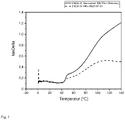
- Sample preparation 2 minutes at 50°C followed by heating or cooling to measurement temperature
- figure 1 excellently illustrates the latent crosslinking reaction of Example 15, versus the reference (Desmomelt 530 - film).
Landscapes
- Chemical & Material Sciences (AREA)
- Organic Chemistry (AREA)
- Health & Medical Sciences (AREA)
- Chemical Kinetics & Catalysis (AREA)
- Medicinal Chemistry (AREA)
- Polymers & Plastics (AREA)
- Engineering & Computer Science (AREA)
- Manufacturing & Machinery (AREA)
- Adhesives Or Adhesive Processes (AREA)
Priority Applications (1)
| Application Number | Priority Date | Filing Date | Title |
|---|---|---|---|
| EP25193012.9A EP4632029A3 (fr) | 2020-11-10 | 2021-11-08 | Préparation destinée à la fabrication de matières adhésives à réactivité latente |
Applications Claiming Priority (2)
| Application Number | Priority Date | Filing Date | Title |
|---|---|---|---|
| DE102020214095 | 2020-11-10 | ||
| DE102021200580.2A DE102021200580A1 (de) | 2020-11-10 | 2021-01-22 | Zubereitung zur Herstellung latentreaktiver Klebmassen |
Related Child Applications (3)
| Application Number | Title | Priority Date | Filing Date |
|---|---|---|---|
| EP25193012.9A Division EP4632029A3 (fr) | 2020-11-10 | 2021-11-08 | Préparation destinée à la fabrication de matières adhésives à réactivité latente |
| EP25193012.9A Previously-Filed-Application EP4632029A3 (fr) | 2020-11-10 | 2021-11-08 | Préparation destinée à la fabrication de matières adhésives à réactivité latente |
| EP25193012.9A Division-Into EP4632029A3 (fr) | 2020-11-10 | 2021-11-08 | Préparation destinée à la fabrication de matières adhésives à réactivité latente |
Publications (2)
| Publication Number | Publication Date |
|---|---|
| EP4001333A1 true EP4001333A1 (fr) | 2022-05-25 |
| EP4001333B1 EP4001333B1 (fr) | 2025-10-08 |
Family
ID=78536129
Family Applications (2)
| Application Number | Title | Priority Date | Filing Date |
|---|---|---|---|
| EP25193012.9A Pending EP4632029A3 (fr) | 2020-11-10 | 2021-11-08 | Préparation destinée à la fabrication de matières adhésives à réactivité latente |
| EP21206873.8A Active EP4001333B1 (fr) | 2020-11-10 | 2021-11-08 | Préparation destinée à la fabrication de matières adhésives à réactivité latente |
Family Applications Before (1)
| Application Number | Title | Priority Date | Filing Date |
|---|---|---|---|
| EP25193012.9A Pending EP4632029A3 (fr) | 2020-11-10 | 2021-11-08 | Préparation destinée à la fabrication de matières adhésives à réactivité latente |
Country Status (3)
| Country | Link |
|---|---|
| EP (2) | EP4632029A3 (fr) |
| KR (1) | KR102390345B1 (fr) |
| CN (2) | CN121203604A (fr) |
Cited By (3)
| Publication number | Priority date | Publication date | Assignee | Title |
|---|---|---|---|---|
| WO2024094579A1 (fr) | 2022-10-31 | 2024-05-10 | Tesa Se | Produit adhésif |
| WO2025241055A1 (fr) * | 2024-05-20 | 2025-11-27 | Henkel Ag & Co. Kgaa | Film adhésif pouvant être décollé par voie électrochimique |
| WO2026021846A1 (fr) * | 2024-07-26 | 2026-01-29 | Tesa Se | Composition d'apprêt pour produire une liaison adhésive |
Families Citing this family (1)
| Publication number | Priority date | Publication date | Assignee | Title |
|---|---|---|---|---|
| CN121752680A (zh) * | 2023-08-31 | 2026-03-27 | 汉高股份有限及两合公司 | 多层粘合剂膜、其制备方法和用途 |
Citations (12)
| Publication number | Priority date | Publication date | Assignee | Title |
|---|---|---|---|---|
| US4483744A (en) | 1979-03-14 | 1984-11-20 | The Plasmine Corporation | Sizing agents for cellulosic products |
| WO1993025599A1 (fr) | 1992-06-15 | 1993-12-23 | Abend Thomas P | Procede et melange de substances pour fabriquer des matieres fondues reactives |
| WO1999029755A1 (fr) | 1997-12-11 | 1999-06-17 | Thomas Abend | Procedes de production et utilisation de couches ou de poudres a reaction latente stables au stockage, a base de polyisocyanates solides desactives en surface et de polymeres de dispersion avec des groupes fonctionnels |
| WO2000034403A1 (fr) | 1998-12-08 | 2000-06-15 | H.B. Fuller Licensing & Financing, Inc. | Technique permettant de renforcer la resistance a l'hydrolyse d'adhesifs a dispersion de polyurethanne et ensembles liaisonnes produits avec ces adhesifs |
| EP1172390A1 (fr) * | 2000-07-15 | 2002-01-16 | Jowat Lobers & Frank Gmbh & Co. Kg | Dispersions d'isocyanates stables au stockage |
| US6797764B2 (en) | 2000-02-03 | 2004-09-28 | Olin Corporation | Water-based adhesive |
| DE102009006935A1 (de) | 2009-01-30 | 2010-08-05 | Tesa Se | Träger verstärkte hitzeaktivierbare Klebemassen |
| EP2236532A1 (fr) * | 2009-03-31 | 2010-10-06 | Bayer MaterialScience AG | Polyisocyanates hydrophiles à nanoparticules modifiées |
| DE102010013145A1 (de) | 2009-07-30 | 2011-02-03 | Lohmann Gmbh & Co. Kg | Latent reaktive, hitzeaktivierbare Klebmasse und damit hergestellte Klebemittel |
| WO2013127697A1 (fr) | 2012-03-01 | 2013-09-06 | Tesa Se | Utilisation d'un film adhésif à réactivité latente pour le collage de plastique sur de l'aluminium anodisé |
| DE102018206632A1 (de) | 2018-04-27 | 2019-10-31 | Tesa Se | Latent reaktiver Klebefilm |
| DE102018214254A1 (de) * | 2018-08-23 | 2020-02-27 | Tesa Se | Latentreaktives Klebeprodukt |
Family Cites Families (4)
| Publication number | Priority date | Publication date | Assignee | Title |
|---|---|---|---|---|
| DE10229519A1 (de) * | 2001-07-10 | 2003-01-30 | Henkel Kgaa | Reaktive Polyurethane mit einem geringen Gehalt an monomeren Diisocyanaten |
| ATE532806T1 (de) * | 2009-03-31 | 2011-11-15 | Sika Technology Ag | Heisshärtende oder hitzeaktivierbare zusammensetzung enthaltend ein oberflächendesaktiviertes polyisocyanat |
| DE102014222259A1 (de) * | 2014-10-31 | 2016-05-04 | Tesa Se | Verklebung zweier Substrate mittels latentreaktiver Klebefilme |
| EP3622352B1 (fr) * | 2017-05-09 | 2025-07-23 | Covestro Deutschland AG | Système constitué de deux couches de peintures sèches, transférables durcies aux uv pour la protection d'un hologramme dans un assemblage de feuilles photopolymère |
-
2021
- 2021-08-31 KR KR1020210115549A patent/KR102390345B1/ko active Active
- 2021-09-23 CN CN202511262973.7A patent/CN121203604A/zh active Pending
- 2021-09-23 CN CN202111118531.7A patent/CN114456760A/zh active Pending
- 2021-11-08 EP EP25193012.9A patent/EP4632029A3/fr active Pending
- 2021-11-08 EP EP21206873.8A patent/EP4001333B1/fr active Active
Patent Citations (13)
| Publication number | Priority date | Publication date | Assignee | Title |
|---|---|---|---|---|
| US4483744A (en) | 1979-03-14 | 1984-11-20 | The Plasmine Corporation | Sizing agents for cellulosic products |
| WO1993025599A1 (fr) | 1992-06-15 | 1993-12-23 | Abend Thomas P | Procede et melange de substances pour fabriquer des matieres fondues reactives |
| WO1999029755A1 (fr) | 1997-12-11 | 1999-06-17 | Thomas Abend | Procedes de production et utilisation de couches ou de poudres a reaction latente stables au stockage, a base de polyisocyanates solides desactives en surface et de polymeres de dispersion avec des groupes fonctionnels |
| WO2000034403A1 (fr) | 1998-12-08 | 2000-06-15 | H.B. Fuller Licensing & Financing, Inc. | Technique permettant de renforcer la resistance a l'hydrolyse d'adhesifs a dispersion de polyurethanne et ensembles liaisonnes produits avec ces adhesifs |
| US6797764B2 (en) | 2000-02-03 | 2004-09-28 | Olin Corporation | Water-based adhesive |
| EP1172390A1 (fr) * | 2000-07-15 | 2002-01-16 | Jowat Lobers & Frank Gmbh & Co. Kg | Dispersions d'isocyanates stables au stockage |
| DE102009006935A1 (de) | 2009-01-30 | 2010-08-05 | Tesa Se | Träger verstärkte hitzeaktivierbare Klebemassen |
| EP2236532A1 (fr) * | 2009-03-31 | 2010-10-06 | Bayer MaterialScience AG | Polyisocyanates hydrophiles à nanoparticules modifiées |
| DE102010013145A1 (de) | 2009-07-30 | 2011-02-03 | Lohmann Gmbh & Co. Kg | Latent reaktive, hitzeaktivierbare Klebmasse und damit hergestellte Klebemittel |
| WO2013127697A1 (fr) | 2012-03-01 | 2013-09-06 | Tesa Se | Utilisation d'un film adhésif à réactivité latente pour le collage de plastique sur de l'aluminium anodisé |
| EP2820098A1 (fr) * | 2012-03-01 | 2015-01-07 | Tesa SE | Utilisation d'un film adhésif à réactivité latente pour le collage de plastique sur de l'aluminium anodisé |
| DE102018206632A1 (de) | 2018-04-27 | 2019-10-31 | Tesa Se | Latent reaktiver Klebefilm |
| DE102018214254A1 (de) * | 2018-08-23 | 2020-02-27 | Tesa Se | Latentreaktives Klebeprodukt |
Non-Patent Citations (6)
Cited By (3)
| Publication number | Priority date | Publication date | Assignee | Title |
|---|---|---|---|---|
| WO2024094579A1 (fr) | 2022-10-31 | 2024-05-10 | Tesa Se | Produit adhésif |
| WO2025241055A1 (fr) * | 2024-05-20 | 2025-11-27 | Henkel Ag & Co. Kgaa | Film adhésif pouvant être décollé par voie électrochimique |
| WO2026021846A1 (fr) * | 2024-07-26 | 2026-01-29 | Tesa Se | Composition d'apprêt pour produire une liaison adhésive |
Also Published As
| Publication number | Publication date |
|---|---|
| EP4632029A2 (fr) | 2025-10-15 |
| KR102390345B1 (ko) | 2022-04-22 |
| CN114456760A (zh) | 2022-05-10 |
| CN121203604A (zh) | 2025-12-26 |
| EP4632029A3 (fr) | 2026-01-21 |
| EP4001333B1 (fr) | 2025-10-08 |
Similar Documents
| Publication | Publication Date | Title |
|---|---|---|
| EP4001333B1 (fr) | Préparation destinée à la fabrication de matières adhésives à réactivité latente | |
| DE102021200580A1 (de) | Zubereitung zur Herstellung latentreaktiver Klebmassen | |
| EP3212723B1 (fr) | Adhésion de deux substrats au moyen d' un film adhésif à réactivité latente | |
| EP2820098B1 (fr) | Utilisation d'un film adhésif à réactivité latente pour le collage de plastique sur de l'aluminium anodisé | |
| EP3137566B1 (fr) | Procédé pour réaliser un collage sur des surfaces sensibles aux perméats | |
| EP3137568B1 (fr) | Ruban adhésif détachable comprenant un adhésif liquide détachable dosable | |
| EP3394191B1 (fr) | Bande adhésive activable à la chaleur | |
| DE102007054046A1 (de) | Latentreaktive Klebstoffe für Identifikations-Dokumente | |
| DE102018218283A1 (de) | Verfahren zum Aufbringen von Stanzteilen auf Oberflächen sowie Testverfahren dafür | |
| DE102013217880A1 (de) | Latentreaktive Klebeprodukte mit verbesserter Stanzbarkeit und latentreaktive Klebfolienstanzlinge | |
| DE102006055093A1 (de) | Hitze-aktiviert verklebbares Flächenelement | |
| DE102022105185A1 (de) | Lösbares Laminat und Verfahren zum Lösen dauerhafter struktureller Verklebungen | |
| DE102017216070A1 (de) | Versiegelungsklebeband für Karosserien | |
| EP3231823B1 (fr) | Apprêt colorable | |
| EP3649205B1 (fr) | Ruban autoadhésif doté d'un support en pet résistant au fissurage | |
| EP3760686B1 (fr) | Adhésif à durcissement thermique et bande adhésive fabriquée à partir de celui-ci | |
| WO2019105911A1 (fr) | Film adhésif réactif latent comprenant un composant pouvant réduire la tension superficielle ou la tension interfaciale | |
| DE102023104755A1 (de) | Reaktivklebeband zum einfachen Lösen | |
| DE102024129175A1 (de) | Primerzusammensetzung zur Herstellung einer Klebeverbindung | |
| EP4506431A1 (fr) | Ruban adhésif, composite collé et procédé de libération électrique du composite collé | |
| WO2026021846A1 (fr) | Composition d'apprêt pour produire une liaison adhésive | |
| DE10162613A1 (de) | Elektrisch leitfähiges, permanent vollflächig haftklebriges, vorzugsweise trägerloses Klebeband bestehend aus einer vorzugsweise auf ein antiadhäsives Medium beschichteten Schicht eines Haftklebstoffs mit alkalisch reagierender Haftklebeoberfläche | |
| WO2019081387A1 (fr) | Rubans adhésifs à stabilité dimensionnelle | |
| DE202011001275U1 (de) | Hitzeaktivierbares strukturelles Haftklebeband mit Gewebeträger | |
| DE102016210536A1 (de) | Einfärbbarer Primer |
Legal Events
| Date | Code | Title | Description |
|---|---|---|---|
| PUAI | Public reference made under article 153(3) epc to a published international application that has entered the european phase |
Free format text: ORIGINAL CODE: 0009012 |
|
| STAA | Information on the status of an ep patent application or granted ep patent |
Free format text: STATUS: THE APPLICATION HAS BEEN PUBLISHED |
|
| AK | Designated contracting states |
Kind code of ref document: A1 Designated state(s): AL AT BE BG CH CY CZ DE DK EE ES FI FR GB GR HR HU IE IS IT LI LT LU LV MC MK MT NL NO PL PT RO RS SE SI SK SM TR |
|
| STAA | Information on the status of an ep patent application or granted ep patent |
Free format text: STATUS: REQUEST FOR EXAMINATION WAS MADE |
|
| 17P | Request for examination filed |
Effective date: 20221125 |
|
| RBV | Designated contracting states (corrected) |
Designated state(s): AL AT BE BG CH CY CZ DE DK EE ES FI FR GB GR HR HU IE IS IT LI LT LU LV MC MK MT NL NO PL PT RO RS SE SI SK SM TR |
|
| P01 | Opt-out of the competence of the unified patent court (upc) registered |
Effective date: 20230526 |
|
| STAA | Information on the status of an ep patent application or granted ep patent |
Free format text: STATUS: EXAMINATION IS IN PROGRESS |
|
| 17Q | First examination report despatched |
Effective date: 20240215 |
|
| REG | Reference to a national code |
Ref country code: DE Free format text: PREVIOUS MAIN CLASS: C08G0018100000 Ref country code: DE Ref legal event code: R079 Ref document number: 502021008913 Country of ref document: DE Free format text: PREVIOUS MAIN CLASS: C08G0018100000 Ipc: C09J0005060000 |
|
| GRAP | Despatch of communication of intention to grant a patent |
Free format text: ORIGINAL CODE: EPIDOSNIGR1 |
|
| STAA | Information on the status of an ep patent application or granted ep patent |
Free format text: STATUS: GRANT OF PATENT IS INTENDED |
|
| RIC1 | Information provided on ipc code assigned before grant |
Ipc: C09J 7/35 20180101ALI20250410BHEP Ipc: C08G 18/80 20060101ALI20250410BHEP Ipc: C08G 18/79 20060101ALI20250410BHEP Ipc: C08G 18/34 20060101ALI20250410BHEP Ipc: C08G 18/10 20060101ALI20250410BHEP Ipc: C09J 7/10 20180101ALI20250410BHEP Ipc: C09J 5/06 20060101AFI20250410BHEP |
|
| INTG | Intention to grant announced |
Effective date: 20250506 |
|
| GRAS | Grant fee paid |
Free format text: ORIGINAL CODE: EPIDOSNIGR3 |
|
| GRAA | (expected) grant |
Free format text: ORIGINAL CODE: 0009210 |
|
| STAA | Information on the status of an ep patent application or granted ep patent |
Free format text: STATUS: THE PATENT HAS BEEN GRANTED |
|
| AK | Designated contracting states |
Kind code of ref document: B1 Designated state(s): AL AT BE BG CH CY CZ DE DK EE ES FI FR GB GR HR HU IE IS IT LI LT LU LV MC MK MT NL NO PL PT RO RS SE SI SK SM TR |
|
| REG | Reference to a national code |
Ref country code: GB Ref legal event code: FG4D Free format text: NOT ENGLISH Ref country code: CH Ref legal event code: F10 Free format text: ST27 STATUS EVENT CODE: U-0-0-F10-F00 (AS PROVIDED BY THE NATIONAL OFFICE) Effective date: 20251008 |
|
| REG | Reference to a national code |
Ref country code: CH Ref legal event code: R17 Free format text: ST27 STATUS EVENT CODE: U-0-0-R10-R17 (AS PROVIDED BY THE NATIONAL OFFICE) Effective date: 20251010 |
|
| REG | Reference to a national code |
Ref country code: DE Ref legal event code: R096 Ref document number: 502021008913 Country of ref document: DE |
|
| REG | Reference to a national code |
Ref country code: IE Ref legal event code: FG4D Free format text: LANGUAGE OF EP DOCUMENT: GERMAN |
|
| REG | Reference to a national code |
Ref country code: CH Ref legal event code: U11 Free format text: ST27 STATUS EVENT CODE: U-0-0-U10-U11 (AS PROVIDED BY THE NATIONAL OFFICE) Effective date: 20251201 |
|
| PGFP | Annual fee paid to national office [announced via postgrant information from national office to epo] |
Ref country code: DE Payment date: 20251119 Year of fee payment: 5 |
|
| PGFP | Annual fee paid to national office [announced via postgrant information from national office to epo] |
Ref country code: AT Payment date: 20260113 Year of fee payment: 5 |
|
| PGFP | Annual fee paid to national office [announced via postgrant information from national office to epo] |
Ref country code: FR Payment date: 20251202 Year of fee payment: 5 |
|
| PGFP | Annual fee paid to national office [announced via postgrant information from national office to epo] |
Ref country code: CH Payment date: 20251201 Year of fee payment: 5 |
|
| REG | Reference to a national code |
Ref country code: NL Ref legal event code: MP Effective date: 20251008 |
|
| PG25 | Lapsed in a contracting state [announced via postgrant information from national office to epo] |
Ref country code: NL Free format text: LAPSE BECAUSE OF FAILURE TO SUBMIT A TRANSLATION OF THE DESCRIPTION OR TO PAY THE FEE WITHIN THE PRESCRIBED TIME-LIMIT Effective date: 20251008 |
|
| PG25 | Lapsed in a contracting state [announced via postgrant information from national office to epo] |
Ref country code: ES Free format text: LAPSE BECAUSE OF FAILURE TO SUBMIT A TRANSLATION OF THE DESCRIPTION OR TO PAY THE FEE WITHIN THE PRESCRIBED TIME-LIMIT Effective date: 20251008 |
|
| REG | Reference to a national code |
Ref country code: LT Ref legal event code: MG9D |
|
| PG25 | Lapsed in a contracting state [announced via postgrant information from national office to epo] |
Ref country code: NO Free format text: LAPSE BECAUSE OF FAILURE TO SUBMIT A TRANSLATION OF THE DESCRIPTION OR TO PAY THE FEE WITHIN THE PRESCRIBED TIME-LIMIT Effective date: 20260108 |
|
| PG25 | Lapsed in a contracting state [announced via postgrant information from national office to epo] |
Ref country code: HR Free format text: LAPSE BECAUSE OF FAILURE TO SUBMIT A TRANSLATION OF THE DESCRIPTION OR TO PAY THE FEE WITHIN THE PRESCRIBED TIME-LIMIT Effective date: 20251008 Ref country code: FI Free format text: LAPSE BECAUSE OF FAILURE TO SUBMIT A TRANSLATION OF THE DESCRIPTION OR TO PAY THE FEE WITHIN THE PRESCRIBED TIME-LIMIT Effective date: 20251008 |
|
| PG25 | Lapsed in a contracting state [announced via postgrant information from national office to epo] |
Ref country code: RS Free format text: LAPSE BECAUSE OF FAILURE TO SUBMIT A TRANSLATION OF THE DESCRIPTION OR TO PAY THE FEE WITHIN THE PRESCRIBED TIME-LIMIT Effective date: 20260108 |
|
| PG25 | Lapsed in a contracting state [announced via postgrant information from national office to epo] |
Ref country code: IS Free format text: LAPSE BECAUSE OF FAILURE TO SUBMIT A TRANSLATION OF THE DESCRIPTION OR TO PAY THE FEE WITHIN THE PRESCRIBED TIME-LIMIT Effective date: 20260208 |
|
| PG25 | Lapsed in a contracting state [announced via postgrant information from national office to epo] |
Ref country code: PT Free format text: LAPSE BECAUSE OF FAILURE TO SUBMIT A TRANSLATION OF THE DESCRIPTION OR TO PAY THE FEE WITHIN THE PRESCRIBED TIME-LIMIT Effective date: 20260209 |
|
| PG25 | Lapsed in a contracting state [announced via postgrant information from national office to epo] |
Ref country code: PL Free format text: LAPSE BECAUSE OF FAILURE TO SUBMIT A TRANSLATION OF THE DESCRIPTION OR TO PAY THE FEE WITHIN THE PRESCRIBED TIME-LIMIT Effective date: 20251008 |
|
| PG25 | Lapsed in a contracting state [announced via postgrant information from national office to epo] |
Ref country code: LV Free format text: LAPSE BECAUSE OF FAILURE TO SUBMIT A TRANSLATION OF THE DESCRIPTION OR TO PAY THE FEE WITHIN THE PRESCRIBED TIME-LIMIT Effective date: 20251008 |