EP4004245B1 - Procédé de récupération de lithium à partir de déchets de batteries au lithium-ion - Google Patents
Procédé de récupération de lithium à partir de déchets de batteries au lithium-ion Download PDFInfo
- Publication number
- EP4004245B1 EP4004245B1 EP20742783.2A EP20742783A EP4004245B1 EP 4004245 B1 EP4004245 B1 EP 4004245B1 EP 20742783 A EP20742783 A EP 20742783A EP 4004245 B1 EP4004245 B1 EP 4004245B1
- Authority
- EP
- European Patent Office
- Prior art keywords
- lithium
- solid
- transition metal
- particulate material
- viii
- Prior art date
- Legal status (The legal status is an assumption and is not a legal conclusion. Google has not performed a legal analysis and makes no representation as to the accuracy of the status listed.)
- Active
Links
Images


Classifications
-
- C—CHEMISTRY; METALLURGY
- C22—METALLURGY; FERROUS OR NON-FERROUS ALLOYS; TREATMENT OF ALLOYS OR NON-FERROUS METALS
- C22B—PRODUCTION AND REFINING OF METALS; PRETREATMENT OF RAW MATERIALS
- C22B1/00—Preliminary treatment of ores or scrap
- C22B1/005—Preliminary treatment of scrap
-
- C—CHEMISTRY; METALLURGY
- C22—METALLURGY; FERROUS OR NON-FERROUS ALLOYS; TREATMENT OF ALLOYS OR NON-FERROUS METALS
- C22B—PRODUCTION AND REFINING OF METALS; PRETREATMENT OF RAW MATERIALS
- C22B15/00—Obtaining copper
- C22B15/0063—Hydrometallurgy
- C22B15/0065—Leaching or slurrying
-
- C—CHEMISTRY; METALLURGY
- C22—METALLURGY; FERROUS OR NON-FERROUS ALLOYS; TREATMENT OF ALLOYS OR NON-FERROUS METALS
- C22B—PRODUCTION AND REFINING OF METALS; PRETREATMENT OF RAW MATERIALS
- C22B15/00—Obtaining copper
- C22B15/0063—Hydrometallurgy
- C22B15/0065—Leaching or slurrying
- C22B15/0067—Leaching or slurrying with acids or salts thereof
- C22B15/0071—Leaching or slurrying with acids or salts thereof containing sulfur
-
- C—CHEMISTRY; METALLURGY
- C22—METALLURGY; FERROUS OR NON-FERROUS ALLOYS; TREATMENT OF ALLOYS OR NON-FERROUS METALS
- C22B—PRODUCTION AND REFINING OF METALS; PRETREATMENT OF RAW MATERIALS
- C22B23/00—Obtaining nickel or cobalt
-
- C—CHEMISTRY; METALLURGY
- C22—METALLURGY; FERROUS OR NON-FERROUS ALLOYS; TREATMENT OF ALLOYS OR NON-FERROUS METALS
- C22B—PRODUCTION AND REFINING OF METALS; PRETREATMENT OF RAW MATERIALS
- C22B23/00—Obtaining nickel or cobalt
- C22B23/04—Obtaining nickel or cobalt by wet processes
- C22B23/0407—Leaching processes
-
- C—CHEMISTRY; METALLURGY
- C22—METALLURGY; FERROUS OR NON-FERROUS ALLOYS; TREATMENT OF ALLOYS OR NON-FERROUS METALS
- C22B—PRODUCTION AND REFINING OF METALS; PRETREATMENT OF RAW MATERIALS
- C22B23/00—Obtaining nickel or cobalt
- C22B23/04—Obtaining nickel or cobalt by wet processes
- C22B23/0407—Leaching processes
- C22B23/0415—Leaching processes with acids or salt solutions except ammonium salts solutions
- C22B23/043—Sulfurated acids or salts thereof
-
- C—CHEMISTRY; METALLURGY
- C22—METALLURGY; FERROUS OR NON-FERROUS ALLOYS; TREATMENT OF ALLOYS OR NON-FERROUS METALS
- C22B—PRODUCTION AND REFINING OF METALS; PRETREATMENT OF RAW MATERIALS
- C22B26/00—Obtaining alkali, alkaline earth metals or magnesium
- C22B26/10—Obtaining alkali metals
- C22B26/12—Obtaining lithium
-
- C—CHEMISTRY; METALLURGY
- C22—METALLURGY; FERROUS OR NON-FERROUS ALLOYS; TREATMENT OF ALLOYS OR NON-FERROUS METALS
- C22B—PRODUCTION AND REFINING OF METALS; PRETREATMENT OF RAW MATERIALS
- C22B3/00—Extraction of metal compounds from ores or concentrates by wet processes
- C22B3/04—Extraction of metal compounds from ores or concentrates by wet processes by leaching
- C22B3/12—Extraction of metal compounds from ores or concentrates by wet processes by leaching in inorganic alkaline solutions
-
- C—CHEMISTRY; METALLURGY
- C22—METALLURGY; FERROUS OR NON-FERROUS ALLOYS; TREATMENT OF ALLOYS OR NON-FERROUS METALS
- C22B—PRODUCTION AND REFINING OF METALS; PRETREATMENT OF RAW MATERIALS
- C22B3/00—Extraction of metal compounds from ores or concentrates by wet processes
- C22B3/04—Extraction of metal compounds from ores or concentrates by wet processes by leaching
- C22B3/16—Extraction of metal compounds from ores or concentrates by wet processes by leaching in organic solutions
-
- C—CHEMISTRY; METALLURGY
- C22—METALLURGY; FERROUS OR NON-FERROUS ALLOYS; TREATMENT OF ALLOYS OR NON-FERROUS METALS
- C22B—PRODUCTION AND REFINING OF METALS; PRETREATMENT OF RAW MATERIALS
- C22B47/00—Obtaining manganese
-
- C—CHEMISTRY; METALLURGY
- C22—METALLURGY; FERROUS OR NON-FERROUS ALLOYS; TREATMENT OF ALLOYS OR NON-FERROUS METALS
- C22B—PRODUCTION AND REFINING OF METALS; PRETREATMENT OF RAW MATERIALS
- C22B7/00—Working up raw materials other than ores, e.g. scrap, to produce non-ferrous metals and compounds thereof; Methods of a general interest or applied to the winning of more than two metals
- C22B7/006—Wet processes
- C22B7/007—Wet processes by acid leaching
-
- C—CHEMISTRY; METALLURGY
- C22—METALLURGY; FERROUS OR NON-FERROUS ALLOYS; TREATMENT OF ALLOYS OR NON-FERROUS METALS
- C22B—PRODUCTION AND REFINING OF METALS; PRETREATMENT OF RAW MATERIALS
- C22B7/00—Working up raw materials other than ores, e.g. scrap, to produce non-ferrous metals and compounds thereof; Methods of a general interest or applied to the winning of more than two metals
- C22B7/006—Wet processes
- C22B7/008—Wet processes by an alkaline or ammoniacal leaching
-
- H—ELECTRICITY
- H01—ELECTRIC ELEMENTS
- H01M—PROCESSES OR MEANS, e.g. BATTERIES, FOR THE DIRECT CONVERSION OF CHEMICAL ENERGY INTO ELECTRICAL ENERGY
- H01M10/00—Secondary cells; Manufacture thereof
- H01M10/05—Accumulators with non-aqueous electrolyte
- H01M10/052—Li-accumulators
- H01M10/0525—Rocking-chair batteries, i.e. batteries with lithium insertion or intercalation in both electrodes; Lithium-ion batteries
-
- H—ELECTRICITY
- H01—ELECTRIC ELEMENTS
- H01M—PROCESSES OR MEANS, e.g. BATTERIES, FOR THE DIRECT CONVERSION OF CHEMICAL ENERGY INTO ELECTRICAL ENERGY
- H01M10/00—Secondary cells; Manufacture thereof
- H01M10/54—Reclaiming serviceable parts of waste accumulators
-
- Y—GENERAL TAGGING OF NEW TECHNOLOGICAL DEVELOPMENTS; GENERAL TAGGING OF CROSS-SECTIONAL TECHNOLOGIES SPANNING OVER SEVERAL SECTIONS OF THE IPC; TECHNICAL SUBJECTS COVERED BY FORMER USPC CROSS-REFERENCE ART COLLECTIONS [XRACs] AND DIGESTS
- Y02—TECHNOLOGIES OR APPLICATIONS FOR MITIGATION OR ADAPTATION AGAINST CLIMATE CHANGE
- Y02W—CLIMATE CHANGE MITIGATION TECHNOLOGIES RELATED TO WASTEWATER TREATMENT OR WASTE MANAGEMENT
- Y02W30/00—Technologies for solid waste management
- Y02W30/50—Reuse, recycling or recovery technologies
- Y02W30/84—Recycling of batteries or fuel cells
Definitions
- the present invention is directed towards a process for the recovery of lithium and other metals from spent lithium ion batteries or production waste containing at least one of the transition metals nickel, manganese and cobalt; the process pertains specifically to the separation of lithium from undesired impurities, by extracting lithium as lithium hydroxide from a particulate material obtained from the lithium ion batteries, particularly the cell material thereof, typically after discharging, shredding and reducing at elevated temperature, and recovery of other metals such as nickel, manganese and/or cobalt from the residue after said extraction step in a smelting process.
- Such heat-treated black masses may be obtained from treating batteries in waste incineration ovens.
- the waste batteries or battery modules or battery cells are fed to the incineration oven where the battery feed is partially burned.
- the product of this treatment is cooled and mechanically treated using any kind of shredding or milling device suitable to separate a metallic fraction from the powdery black mass.
- These black masses are materials of low reactivity under normal conditions and can thus be transported easily.
- step (b) and (c) are performed in continuous mode, e,g. in a cascade of stirred vessels (step b) and/or in a cascade of stirred vessel plus centrifuge (step c).
- the polar solvent in present step (b) is an aqueous medium
- the ratio of the aqueous medium to material provided in step (a) is in the range of from 1 : 1 to 99 : 1, preferably 5 : 1 to 20 : 1 by weight.
- the particulate material provided in step (a) generally comprises material obtained from lithium containing transition metal oxide material such as lithium ion battery waste after carrying out the preliminary step (i) of heating under inert or reducing conditions to a temperature from the range 80 to 900° C, e.g. 200 to 850° C, especially 200 to 800° C.
- Preliminary step (i) is typically carried out directly after discharging the lithium ion batteries, dismantling and/or shredding as explained in more detail below. In some applications shredding and/or dismantling is carried out after preliminary step (i).
- the lithium ion batteries used, and thus the particulate material provided in step (a) typically contains carbon, e.g. in the form of graphite.
- exposure times define the total dwell time (synonymous with residence time) in the reactor or furnace, which has been heated to said elevated temperature; the temperature of the material should reach a temperature from the range given for at least a fraction of said dwell time.
- “contain” in relation to any substance generally means presence of such substance in an amount typically still detectable by x-ray powder diffraction, e.g. 1 % by weight or more, or means presence of such constituents in an amount typically detectable by ICP after a suitable digestion, e.g. 10 ppm by weight or more.
- the particulate material provided in present step (a) typically contains, with respect to the elements, about 1 to 10 % of lithium, about 3 to 30 % of the combined transition metal elements cobalt and/or nickel, and about 4 to 40 % of transition metal elements in total including any cobalt, nickel, manganese, copper and iron (all percentages by weight of dry particulate material provided in step (a)).
- step (a) the particulate material provided in step (a), as well as the material subjected to step (i), will alternatively be summarized as lithium containing transition metal oxide material.
- preliminary step (i) is preferably carried out as follows: (i) heating the lithium containing transition metal oxide material to a temperature from the range 200 to 900° C, or as indicated above, in the presence of H 2 .
- the lithium containing transition metal oxide material heated in step (i) stems from lithium ion batteries and may contain fluorine, typically in the range from 1% to 8% by weight, and/or phosphorous in the range from 0.2% to 2% by weight, relative to the weight of the lithium containing transition metal oxide material.
- Step (i) carried out with hydrogen includes heating the lithium containing transition metal oxide material to a temperature in the range of from 200 to 900° C, preferably 300 to 600° C, more preferably 350 to 500° C. Since strong heating, especially under oxidative conditions, but to a lesser extent also under reductive atmosphere, tends to increase formation of insoluble species (such as LiMnO 2 ), it is preferred to generally expose the lithium containing transition metal oxide material not to temperatures of 500° C or more. Consequently, it is preferred to keep the temperature in step (i) below 500° C; in one embodiment of the present process, step (i) is carried out using hydrogen and a temperature from the range 350 to 450° C, e.g. 380 to 450° C, especially 380 to 440° C.
- the atmosphere used to do the reduction contains 0.1% to 100% by volume of hydrogen, the rest being a non-oxidizing gas, preferably nitrogen, argon, steam, carbon monoxide, carbon dioxide or mixtures of at least two of these gases.
- Preferred non-oxidizing gases are nitrogen and steam and mixtures of nitrogen and steam.
- step (i) of present process is carried out mainly under hydrogen, for example under an atmosphere containing 35 to 100%, preferably 50 to 100%, by volume (normal conditions) of hydrogen, the rest, if present, being a non-oxidizing gas.
- the concentration of hydrogen in the reduction atmosphere and the reaction time are dependent on each other. Usually a low concentration of hydrogen requires longer reduction times and vice versa.
- step (i) is thus carried out by heating the lithium containing transition metal oxide material to a temperature in the range of from 350 to 450° C in the presence of more than 35 %, especially 50-100%, by volume of H 2 , and for a time period of 20 to 90 minutes.
- a particularly preferred process conducts step (i) using a temperature between 400 and 450° C, e.g.
- step (b) between 400 and 420° C, for up to 2.5 hours and 35 or more volume-% of hydrogen to recover Li in step (b) in an especially efficient way; applying too high temperatures may result in lower yields, longer duration does not lead to a negative effect but tends to lower the space time yield, while H 2 concentrations ⁇ 35 vol-% translate into short reaction times ⁇ 2.5 h and are therefore favored; an optimum space time yield is achievable using more than 80 vol.-% of hydrogen.
- the material is transferred from the oven to a cooling unit.
- the material is cooled down to temperatures preferably of 100° C and below.
- the cooling can be done at ambient conditions e.g. by storing the hot material in a chamber or vessel or in a rotating tube which may be the final non-heated or cooled part of a rotary kiln where the heat treatment is performed such that the heat can be conducted to the environment.
- the hot material can be cooled and conveyed by cooled conveying screws.
- a faster cooling can be obtained by introducing gases which after having passed the hot material bed may be fed to a heat exchanger.
- gases can be designed as fixed, moving or fluidized bed.
- the gases used are preferably inert gases like nitrogen, argon or carbon dioxide.
- reducing gases used for the reduction preferably during the beginning of the cooling period when the material is still at a temperature close to oven temperature.
- the gas composition may be changed to an inert gas at lower temperatures even oxygen containing gases like air or mixtures of air and inert gases may be employed.
- cooling under dry conditions in a gas atmosphere it is also possible to quench the hot material by a liquid.
- This can be done by spraying the cooling liquid to the hot material either in quantities that the liquid is evaporated and the material remains virtually dry (cooling by evaporation) or in bigger quantities that a slurry of the material is formed. Cooling by a liquid is especially preferred when the obtained cooled material or slurry can be employed directly in step (b) of this invention.
- the preferred quenching liquids are polar solvents that are sufficiently temperature stable most preferred is water.
- the liquid can be pumped to a heat exchanger and recycled back to the cooling vessel.
- preliminary step (i) is preferably carried out as follows: (i) heating the lithium containing transition metal oxide material to a temperature in the range of from 200 to 900° C in the presence of said carbonic material such as carbon; e.g. in the presence of graphite.
- the graphite contained in the black mass is used as reducing agent.
- the lithium containing transition metal oxide material heated in step (i) stems from lithium ion batteries and may contain typical impurities such as fluorine, as explained below in more detail.
- Step (i) carried out with carbonic material such as carbon as reducing agent includes heating the lithium containing transition metal oxide material to a temperature in the range of from 200 to 900° C, preferably 300 to 850° C, more preferably 500 to 850° C.
- the atmosphere used to effect the reduction contains either no oxygen, or up to 20% by volume of oxygen, the rest being a non-oxidizing gas, preferably nitrogen, argon, steam, carbon monoxide, carbon dioxide or mixtures of at least two of these gases.
- Preferred non-oxidizing gases are nitrogen and carbon monoxide and mixtures of nitrogen and carbon monoxide.
- step (i) of the present process is carried out under air or under diluted air, for example under an atmosphere containing 1 to 20%, preferably 1 to 10%, by volume (normal conditions) of oxygen, the rest, if present, being a non-oxidizing gas.
- reducing gases used for the reduction preferably during the beginning of the cooling period when the material is still at a temperature close to oven temperature.
- the gas composition may be changed to an inert gas at lower temperatures even oxygen containing gases like air or mixtures of air and inert gases may be employed.
- said lithium containing transition metal oxide material comprises battery scrap material, parts or materials from parts of a lithium ion battery, off-spec material including pure electrode material, or mixtures of such materials.
- said lithium containing transition metal oxide material preferably contains in the range of from 0.1 to 80% by weight of compounds other than nickel compounds such as nickel/cobalt components or nickel/cobalt/manganese or nickel/cobalt/aluminum compounds, if applicable, and in extreme cases the valuable material is a minority component.
- nickel compounds other than nickel compounds such as nickel/cobalt components or nickel/cobalt/manganese or nickel/cobalt/aluminum compounds, if applicable, and in extreme cases the valuable material is a minority component.
- examples of such components are carbon in electrically conductive form, hereinafter also referred to as conductive carbon, for example graphite, soot, and graphene.
- Examples of such embodiments are lithium containing transition metal oxide material containing one or two of the above additional components, or additional components (i), (ii) and (iii); (i), (ii) and (iv); (i), (ii) and (v); (i), (ii) and (vi); (i), (ii) and (viii); (i), (iii) and (iv); (i), (iii) and (v); (i), (iii) and (vi); (i), (iii) and (vii); (i), (iii) and (viii); (i), (iv) and (v); (i), (iv) and (vi); (i), (iv) and (vii); (i), (iv) and (vii); (i), (iv) and (viii); (i), (iv) and (viii); (i), (v) and (vii); (i), (v) and (vii); (i), (v) and (vii); (i), (v) and (
- Examples of layered nickel-cobalt-manganese oxides are compounds of the general formula Li 1+x (Ni a Co b Mn c M 1 d ) 1-x O 2 , with M 1 being selected from Mg, Ca, Ba, Al, Ti, Zr, Zn, Mo, V and Fe, the further variables being defined as follows: zero ⁇ x ⁇ 0.2 0.1 ⁇ a ⁇ 0.95 ,
- lithiated nickel-cobalt aluminum oxides are compounds of the general formula Li[Ni h Co i Al j ]O 2+r .
- Typical values for r, h, i and j are:
- Li( 1+x) [Ni 0.33 Co 0.33 Mn 0.33 ] (1-x) O 2 Li (1+x) [Ni 0.5 Co 0.2 Mn 0.3 ] (1-x) O 2 , Li (1-x) [Ni 0.6 CO 0.2 Mn 0.2 ] (1-x) O 2 , Li( 1-x) [Ni 0.7 Co 0.2 Mn 0.1 ] (1-x) O 2 , Li (1-x) [Ni 0.8 Co 0.1 Mn 0.1 ] (1-x) O 2 each with x as defined above, and Li[Ni 0.85 Co 0.13 Al 0.02 ]O 2 .
- Said lithium containing transition metal oxide material may have a regular shape but usually it has an irregular shape. It is preferred, though, to remove a light fraction such as housing parts from organic plastics and aluminum foil or copper foil as far as possible, for example in a forced stream of gas.
- the composition of the atmosphere is changed during step (i) this may be done for example in the case that volatile organic compounds are present in the feed that will be stripped off at an inert atmosphere before switching the atmosphere to a reducing one, e.g. hydrogen containing one.
- a reducing one e.g. hydrogen containing one.
- an oxidizing atmosphere in a temperature range between 20 to 300° C is employed in step (i) prior to the reduction with a hydrogen containing atmosphere.
- some impurity components namely organic components may be burned off, or the material is dried (especially employing temperatures up to 250° C as noted further above.
- Preferred oxidizing gases are oxygen or oxygen containing gases e.g. air.
- the material stemming from spent lithium ion battery cells, containing lithium, transition metal oxide and typically a fluorine and/or phosphorous compound, is preferably not subjected to oxidization above 300° C before carrying out the steps of the present process.
- the material provided in step (a) is ground prior to step (b) in order to de-agglomerate different solid particles from one another in cases that these are somehow agglomerated, for example by residual binder polymers.
- the grinding can be performed under dry or wet conditions.
- the grinding is done in an aqueous medium that is also employed in the consecutive step (b).
- step (b) the pressure may be released if applicable.
- a solution of a lithium salt is obtained as the liquid from step (c), typically an aqueous solution containing LiOH.
- the solid residue Prior to present step (c), the solid residue is contained in polar solvent, which may be an aqueous solution, forming a suspension.
- polar solvent which may be an aqueous solution, forming a suspension.
- the solid residue will be contained in the slurry of the second or last step, respectively.
- step (c) The solid residue obtained in step (c) is recovered by the solid-liquid separation step (c).
- This can be a filtration or centrifugation or a kind of sedimentation and decantation, optionally with subsequent washing steps applying the respective polar solvent used in step (b) as washing medium.
- the filtrate and washing liquids are usually combined prior to further work up targeting the respective lithium salts.
- flocculants may be added, for example polyacrylates.
- the solid residue obtained according to step (c) is characterized by a typical elemental composition which results from applying the preferred process conditions during step (b). Specifically, the solid residue is characterized by having a composition typical for battery scrap material (Li, graphite and at least one of Ni and Co; Mn may be present, too) but a significantly higher (Ni + Co + Mn) to Li weight ratio. Since battery scrap material, especially the cathode active material, is characterized by a (Ni + Co + Mn) : Li weight ratio between 5 and 12, the solid residue after step (c) is characterized by its lower Li content and therefore by a (Ni + Co + Mn) : Li weight ratio between 13 and 100000.
- battery scrap material especially the cathode active material
- step (b) is accompanied by a significantly increased calcium content, which is very low in the original particulate material provided in step (a) as mentioned above (0-0.5 wt.-%).
- the solid residue obtained according to a preferred variant of present step (c) is characterized by an elemental Ca weight content between 2 and 50 % (relative to the dry solid).
- step (c) This solid residue obtainable according to step (c) is a valuable source of materials useful for the production of new batteries; steps for the isolation of such materials are described hereinbelow.
- step (c) The solid residue obtained according to step (c) may subsequently be subjected to a step (d1), a solid-solid separation for the removal of Ni and/or Co if present.
- step (d1) nickel is recovered as a nickel containing solid.
- step (d1) of the present invention preferably comprises a wet solid-solid separation step.
- This solid-solid separation step serves to separate non-soluble components like carbon and polymers or insoluble inorganic components like metal particles or metal oxide particles from the metallic or metal oxide components of the lithium containing transition metal oxide material.
- a solid concentrate fraction is obtained typically containing the majority of the Ni and, if applicable, Co in enriched form.
- Such solid-solid separation step may be performed by mechanical, column or pneumatic, or hybrid flotations.
- collector compounds are added to the slurry which render the target components hydrophobic.
- Typical collector compounds for carbon and polymer particles are hydrocarbons or fatty alcohols which are introduced in amounts of 1 g to 50 kg/t of the solid residue obtained from step (c). It is also possible to perform the flotation in an inverse sense i.e. transforming the originally hydrophilic components into strongly hydrophobic components by special collector substances, e.g., fatty alcohol sulfates or esterquats. Preferred is the direct flotation employing hydrocarbon collectors for example mineral oils, kerosene or Diesel. In order to improve the selectivity of the flotation towards carbon and polymer particles suppressing agents can be added that reduce the amounts of entrained metallic and metal oxide components in the froth phase.
- Agents that can be used may be acids or bases for controlling the pH value in a range of from 3 to 9. It may also be ionic components that adsorb on the metallic or metal oxide surface e.g. sodium silicate or bipolar components like, for example, amino acids.
- carrier particles that form agglomerates with the hydrophobic target particles, e.g., polymer particles, carbonaceous particles, for example graphite or coal. By using magnetic carrier particles magnetic agglomerates may be formed that can be separated magnetically.
- the target components are paramagnetic, antiferro-, ferri- or ferromagnetic it is also possible to separate these components by a magnetic separation employing high intensity magnetic separators ("WHIMS”), medium intensity magnetic separators (“MIMS”) or low intensity magnetic separators (“LIMS”).
- HIMS high intensity magnetic separators
- MIMS medium intensity magnetic separators
- LIMS low intensity magnetic separators
- Other solid-solid separation techniques make use of the density difference of the solid constituents for example the density difference between graphite and metals or metal oxides. These techniques comprise float-sink methods employing fluids of densities intermediate to the densities of the solid components that will be separated. Another technique of this sort is the heavy media separation. Further separation techniques based on density differences are spirals and hydrocyclones.
- the solid-solid separation in step (d1) is a magnetic separation.
- the solid material obtained from step (c) is ground prior to step (d1) in order to liberate the different solid particles from one another in cases that these are somehow agglomerated for example by residual binder polymers.
- Such grinding is preferably performed in ball mills or stirred ball mills.
- step (d1) is a wet solid-solid separation employing an aqueous medium preferably water as fluid.
- the ratio of the fluid medium to solid material in such step (d1) is typically in the range of from 1 : 1 to 99 : 1, preferably 2 : 1 to 9 : 1 by weight.
- step (d1) From the wet solid-solid separation of step (d1), two slurries result: one containing the target transition metal containing solid material and one that contains the other components like carbonaceous materials and polymers and if applicable also some inorganic compounds.
- step (d1) two slurries result: one containing the target transition metal containing solid material and one that contains the other components like carbonaceous materials and polymers and if applicable also some inorganic compounds.
- suitable selection and, if necessary, combination of solid-solid separation steps at least 60% of the Ni and/or Co is obtained and concentrated in one fraction. Preferably at least 80 to 99% of the Ni and, if present, Co is separated.
- the liquid phase of the slurry fed to step (d1) still contains dissolved lithium.
- one or the other or both slurries obtained from the solid-solid separation in step (d1) are advantageously subjected to a solid-liquid separation in order to recover the lithium solution.
- the lithium solution then may be further treated in step (e).
- acidic or ammonia leaching may be applied.
- the transition metal material is treated with a leaching agent, which is preferably an acid selected from sulfuric acid, hydrochloric acid, nitric acid, methanesulfonic acid, oxalic acid and citric acid or a combination of at least two of the foregoing, for example a combination of nitric acid and hydrochloric acid.
- a leaching agent is an acid selected from sulfuric acid, hydrochloric acid, nitric acid, methanesulfonic acid, oxalic acid and citric acid or a combination of at least two of the foregoing, for example a combination of nitric acid and hydrochloric acid.
- the leaching agent is an acid selected from sulfuric acid, hydrochloric acid, nitric acid, methanesulfonic acid, oxalic acid and citric acid or a combination of at least two of the foregoing, for example a combination of nitric acid and hydrochloric acid.
- the leaching agent is an
- the leaching agent comprises an aqueous acid, such as an inorganic or organic aqueous acid.
- the leaching agent comprises a base, preferable ammonia or an amine.
- the leaching agent comprises a complex former, preferably a chelating agent.
- the leaching agent comprises an inorganic acid, an organic acid, a base or a chelating agent.
- the concentration of leaching agents may be varied in a wide range, for example of 0.1 to 98% by weight and preferably in a range between 10 and 80%.
- Preferred example of aqueous acids is aqueous sulfuric acid, for example with a concentration in the range of from 10 to 98% by weight.
- aqueous acid has a pH value in the range of from -1 to 2. The amount of acid is adjusted to maintain an excess of acid referring to the transition metal.
- the pH value of the resulting solution is in the range of from -0.5 to 2.5.
- a base as leaching agents are aqueous ammonia with a molar NH3 to metal (Ni, Co) ratio of 1:1 to 6:1, preferably 2:1 to 4:1, preferably also in the presence of carbonate or sulfate ions.
- Suitable chelating agents like EDTA or dimethylglyoxime are often applied in a molar ratio of 1:1 to 3:1.
- the leaching may be carried out in the presence of oxidizing agents.
- a preferred oxidizing agent is oxygen as pure gas or in mixtures with inert gases e.g. nitrogen or as air.
- Other oxidizing agents are oxidizing acids, e.g. nitric acid, or peroxides like hydrogen peroxide.
- step (d) can be performed by dissolving the solid Ni-concentrate obtained in step (c) or (d1) in an acid selected from sulfuric acid, hydrochloric acid, nitric acid, methane sulfonic acid, oxalic acid and citric acid.
- step (d) may be performed by treating the solid Ni-concentrate obtained in step (c) or (d1) with an aqueous solution of ammonium carbonate or ammonium bicarbonate.
- aqueous solution may contain additional ammonia.
- the Ni-concentrate obtained from step (c) or (d1) is treated in step (d) with an acid selected from sulfuric acid, hydrochloric acid, nitric acid, methanesulfonic acid, oxalic acid and citric acid or a combination of at least two of the foregoing, for example a combination of nitric acid and hydrochloric acid.
- an acid selected from sulfuric acid, hydrochloric acid, nitric acid, methanesulfonic acid, oxalic acid and citric acid or a combination of at least two of the foregoing, for example a combination of nitric acid and hydrochloric acid.
- concentration of acid may be varied in a wide range, for example of 0.1 to 99% by weight preferably in a range between 10 and 96%.
- the amount of acid is adjusted to maintain an excess of acid.
- the pH value of the resulting solution is in the range of from -0.5 to 2.
- aqueous acids is aqueous sulfuric acid, for example with a concentration in the range of from 10 to 98% by weight. Especially preferred is 10% to 80% aqueous sulfuric acid.
- step (d) is carried out in a vessel that is protected against strong acids, for example molybdenum and copper rich steel alloys, nickel-based alloys, duplex stainless steel or glass-lined or enamel or titanium coated steel.
- strong acids for example molybdenum and copper rich steel alloys, nickel-based alloys, duplex stainless steel or glass-lined or enamel or titanium coated steel.
- polymer liners and polymer vessels from acid-resistant polymers for example polyethylene such as HDPE and UHMPE, fluorinated polyethylene, perfluoroalkoxy alkanes (“PFA”), polytetrafluoroethylene (“PTFE”), PVDF and FEP.
- PFA perfluoroalkoxy alkanes
- PTFE polytetrafluoroethylene
- PVDF polytetrafluoropropylene
- the inventive process By performing the inventive process, it is possible to recover the transition metals such as nickel and, if applicable, cobalt and/or manganese from battery waste materials or scraps from battery, cell and cathode active material production, typically comprising cathode materials containing nickel and/or cobalt, in a form that they can be converted into cathode active materials very easily.
- the inventive process allows the recovery of transition metals such as nickel and, optionally, cobalt and/or manganese, that contain only tolerable traces of impurities such as copper, iron, and zinc, for example with less than 10 ppm of copper, preferably even less, for example 1 to 5 ppm.
- the precipitation of the transition metals after steps (f1), (f2) and (f3) is effected by hydrogen under elevated pressure.
- the pH-value of the solution is kept basic by addition of ammonia and/or ammonium carbonate.
- Ni, Co and Cu can be precipitated as metals.
- Certain catalysts known in the art may be added to improve this reaction.
- this Li-carbonate is dissolved again by further adding CO2 into solution, pref-erably under pressure, forming dissolved LiHCO3 (e6).
- Impurities which may be present can be separated using state-of-the-art purification techniques, e.g. solvent extraction, precipitation and/or ion exchange. After this optional purification, Li-carbonate can be obtained by raising the temperature of the solution which directly leads to Li-carbonate precipitation (e7). Pure Li-carbonate can be obtained by subsequent solid-liquid separation.
- Elemental analysis of fluorine and fluoride is performed in accordance with standardized methods: DIN EN 14582:2016-12 with regard to the sample preparation for the overall fluorine content determination (waste samples); the detection method is an ion selective electrode measurement.
- DIN 38405-D4-2:1985-07 water samples; digestion of inorganic solids with subsequent acid-supported distillation and fluoride determination using ion selective electrode).
- the composition of the black powder (PM) obtained is shown in Table 2.
- Tab. 2 Composition of reduced black powder (PM) F (ionic F thereof) 2.6 g [i.e. 0.14 mol]/100g (2.3 g [i.e. 0.12 mol]/100g) C (inorganic C thereof) 31.3 g/100g (1.2 g/100g) Ca 0.16 g [i.e. 0.004 mol]/100g Co 9.5 g/100g Cu 3.4 g/100g Li 3.6 g/100g Mn 5.8 g/100g Ni 4.8 g/100g P 0.36 g/100g
- Tab. 3 Results on particle size distribution measurement of reduced mass from waste lithium ion batteries after heat treatment. D10 [ ⁇ m] D50 [ ⁇ m] D80 [ ⁇ m] D90 [ ⁇ m] 3.46 17.36 33.86 48.92
- Example 2a Leaching with Ca(OH)2, addition of solids to liquid
- Example 2 is repeated except that 5 g of the black powder obtained as shown in Example 1, and the designated amount of solid Ca(OH)2, are added simultaneously to 200 g of water with stirring. Results are analogous to those reported in Table 4.
- a filtrate obtained from a process according to example 2 is further treated according to the above described step (e1) to yield solid LiOH as monohydrate: 1L of a filtrate containing 0.21 wt.-% lithium is concentrated by evaporation (40° C, 42 mbar)and finally dried applying 40° C and a constant flow of nitrogen for 24 h.
- Fig. 5 shows the obtained LiOH monohydrate with minor impurities of Li2CO3. The latter is due to contact with air during almost all process steps.
- elemental analysis reveals as main impurities (>200 ppm) F, Na, Ca, K and Cl and minor impurities ( ⁇ 200 ppm) of Al and Zn.
- Example 6 Providing a reduced mass from waste lithium ion batteries (step a)
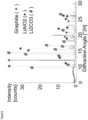
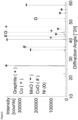
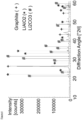
- the heat-treated particulate material is analyzed by means of X-ray powder diffraction (results analogous to those shown in Figs. 1-4 ), elemental analysis (Tab. 7) and particle size distribution (Tab. 8).
- the Li content is 3.0 wt.-%, which acts as reference for all further leaching examples (see below).
- Fluorine is represented as inorganic fluoride. Particle sizes are well below 1 mm; D50 is determined to be 17 ⁇ m.
- Example 7 Leaching with Ca(OH)2 (steps b and c)
- Example 8 Acidic leaching of obtained solid residue in Example 7 (step d)
- Example 10 Each of the solid residues obtained in example 4 after 24 of leaching (see Tab. 6) is treated with sulfuric acid (50%) followed by removal of undissolved residues. The solution obtained is combined with NaOH to precipitate all transition metal from the solution. The precipitate obtained is useful as a precursor for battery cathode active materials.
Landscapes
- Chemical & Material Sciences (AREA)
- Engineering & Computer Science (AREA)
- Materials Engineering (AREA)
- Manufacturing & Machinery (AREA)
- Mechanical Engineering (AREA)
- Metallurgy (AREA)
- Organic Chemistry (AREA)
- Environmental & Geological Engineering (AREA)
- Life Sciences & Earth Sciences (AREA)
- General Life Sciences & Earth Sciences (AREA)
- Geology (AREA)
- Geochemistry & Mineralogy (AREA)
- Inorganic Chemistry (AREA)
- Chemical Kinetics & Catalysis (AREA)
- Electrochemistry (AREA)
- General Chemical & Material Sciences (AREA)
- Manufacture And Refinement Of Metals (AREA)
- Secondary Cells (AREA)
- Battery Electrode And Active Subsutance (AREA)
Claims (15)
- Procédé de récupération d'un ou plusieurs métaux de transition et de lithium sous forme de sel de Li, généralement à partir d'un matériau comprenant des déchets de batteries lithium-ion ou de parties de celles-ci, lequel procédé comprend les étapes de(a) fourniture d'un matériau particulaire contenant un composé de métal de transition et/ou un métal de transition, le métal de transition étant choisi dans le groupe constitué par Ni et Co et au moins une fraction dudit Ni et/ou dudit Co étant dans un état d'oxydation inférieur à +2 ; lequel matériau particulaire contient en outre un sel de lithium ;(b) traitement du matériau fourni à l'étape (a) avec un hydroxyde alcalino-terreux et un solvant polaire, généralement un solvant protique ;(c) séparation du résidu solide contenant le métal de transition du liquide, éventuellement suivie de la soumission dudit résidu solide à une séparation solide-solide pour l'élimination du métal de transition tel que Ni ; et(d) traitement des solides contenant le métal de transition de manière à dissoudre au moins une partie du Ni et/ou du Co, généralement à l'aide d'un acide minéral ou d'une solution ammoniacale.
- Procédé selon la revendication 1, dans lequel le matériau particulaire fourni à l'étape (a) est obtenu à partir de batteries lithium-ion usagées, en particulier de leurs matériaux de pile, et/ou d'un matériau de rebut obtenu à partir de la production de batteries lithium-ion ou de matériaux actifs de cathode lithium-ion, et est fourni sous la forme d'une poudre sèche, d'une poudre humide ou d'une suspension de particules dans un liquide.
- Procédé selon la revendication 1 ou 2, dans lequel le matériau particulaire fourni à l'étape (a) comprend des particules ayant un diamètre moyen de particule D50 dans la plage de 1 µm à 2 mm lorsqu'il est détecté conformément à la norme ISO 13320 EN:2009-10.
- Procédé selon l'une quelconque des revendications précédentes, dans lequel le composé de métal de transition et/ou le métal de transition Ni et/ou Co à l'état d'oxydation inférieur à +2, contenus dans le matériau particulaire fourni à l'étape (a), comprennent Ni et/ou Co à l'état métallique, et dans lequel le composé de métal de transition et/ou le métal de transition contenus dans le matériau particulaire fourni à l'étape (a) sont de préférence présents en une quantité détectable par diffraction des rayons X sur poudre (rayonnement Cu-k-alpha-1).
- Procédé selon l'une quelconque des revendications précédentes, dans lequel le sel de lithium contenu dans le matériau particulaire fourni à l'étape (a) comprend un ou plusieurs sels parmi LiOH, LiF, Li2O, Li2CO3, LiHCO3, les aluminates de lithium, les sels de phosphate de lithium, les oxydes mixtes de Li et d'un ou plusieurs des éléments Ni, Co, Mn, Fe, Al, Cu.
- Procédé selon l'une quelconque des revendications précédentes, dans lequel l'étape (b) est effectuée en présence d'un hydroxyde alcalino-terreux et est de préférence effectuée pari) ajout de l'hydroxyde alcalino-terreux et/ou d'un oxyde alcalin, sous forme solide, ou d'un mélange comprenant l'hydroxyde alcalino-terreux sous forme de suspension ou de solution dans un solvant protique, généralement dans un liquide aqueux, et du matériau particulaire fourni à l'étape (a) simultanément au solvant polaire, qui est un solvant protique et de préférence un liquide aqueux tel que l'eau ;
ou parii) ajout du matériau particulaire fourni à l'étape (a) au solvant polaire, qui est un solvant protique et de préférence un liquide aqueux tel que l'eau, pour obtenir une suspension, suivi de l'ajout de l'hydroxyde alcalino-terreux et/ou d'un oxyde alcalin, sous forme solide, ou d'un mélange comprenant un hydroxyde alcalino-terreux sous forme de suspension ou de solution dans un solvant protique tel qu'un liquide aqueux ;
ou pariii) ajout de l'hydroxyde alcalino-terreux et/ou d'un oxyde alcalin, sous la forme d'un solide ou d'une suspension de solides dans un solvant polaire, à un liquide aqueux tel que l'eau pour obtenir un mélange comprenant l'hydroxyde alcalino-terreux, généralement sous forme de suspension ou de solution dans le liquide aqueux, et combinaison subséquente dudit mélange avec le matériau particulaire fourni à l'étape (a) ; ou pariv) ajout de l'hydroxyde alcalino-terreux et/ou d'un oxyde alcalin, sous forme solide, au matériau particulaire fourni à l'étape (a) pour obtenir un mélange de solides, suivi de l'ajout du solvant polaire, qui est un solvant protique et de préférence un liquide aqueux tel que l'eau ;
ou parv) ajout du matériau particulaire fourni à l'étape (a) au solvant polaire, qui est un solvant protique et de préférence un liquide aqueux tel que l'eau, pour obtenir une suspension, suivi d'une filtration pour obtenir un filtrat, et ajout subséquent de l'hydroxyde alcalino-terreux et/ou d'un oxyde alcalin, sous forme solide, ou d'un mélange comprenant un hydroxyde alcalino-terreux, généralement sous forme de suspension ou de solution dans le solvant polaire, de préférence un liquide aqueux, au filtrat. - Procédé selon l'une quelconque des revendications précédentes, dans lequel le solvant polaire de l'étape (b) contient de l'hydroxyde de calcium, qui est ajouté tel quel audit solvant polaire ou qui est formé in situ lors du contact d'oxyde de calcium avec le solvant polaire choisi parmi les solvants protiques tels que les liquides aqueux ou l'eau.
- Procédé selon l'une quelconque des revendications précédentes, dans lequel le matériau particulaire fourni à l'étape (a) comprend un matériau obtenu à partir de déchets de batteries lithium-ion après avoir effectué l'étape préliminaire (i) de chauffage dans des conditions inertes ou réductrices jusqu'à une température dans la plage de 80 à 900 °C, en particulier de 200 à 800 °C, généralement en présence de carbone et/ou d'un gaz réducteur choisi entre l'hydrogène et le monoxyde de carbone, laquelle étape préliminaire (i) est de préférence effectuée après décharge des batteries lithium-ion, démontage et/ou déchiquetage.
- Procédé selon l'une quelconque des revendications précédentes, dans lequel les solides contenant le métal de transition sont traités à l'étape (d) avec un acide minéral choisi parmi l'acide sulfurique, l'acide chlorhydrique, l'acide nitrique, l'acide méthanesulfonique, l'acide oxalique et l'acide citrique, ou une combinaison d'au moins deux des acides précédents, généralement en présence d'eau et éventuellement en présence en outre de peroxyde d'hydrogène.
- Procédé selon la revendication 9, où pendant l'étape préliminaire (i), la température de chauffage se situe dans la plage de 350 à 500 °C, en particulier de 350 à 450 °C, et l'étape (i) est conduite en présence de 35 % en volume ou plus d'hydrogène ; ou
où pendant l'étape préliminaire (i), la température de chauffage se situe dans la plage de 500 à 850 °C, en particulier de 600 à 800 °C, et l'étape (i) est conduite en présence de carbone dans une atmosphère contenant jusqu'à 20 % en volume d'oxygène. - Procédé selon l'une quelconque des revendications précédentes, dans lequel le matériau particulaire fourni à l'étape (a) est obtenu à partir de batteries lithium-ion après élimination mécanique du boîtier, du câblage ou des circuits et décharge, et dans lequel ledit matériau n'est pas exposé à des températures de 400 °C ou plus dans des conditions oxydantes avant d'être soumis à la présente étape (a).
- Procédé selon l'une quelconque des revendications précédentes, comprenant l'étape supplémentaire de soumission des solides obtenus à l'étape (c) à une séparation solide-solide, par exemple une séparation magnétique.
- Procédé selon l'une quelconque des revendications précédentes, dans lequel les solides traités à l'étape (d) contiennent en outre un ou plusieurs des éléments cuivre, fer et manganèse.
- Procédé selon l'une quelconque des revendications 1 à 11, comprenant l'étape supplémentaire de récupération de lithium sous forme d'hydroxyde de lithium par cristallisation à partir du liquide obtenu à l'étape (c) ou de récupération de lithium sous forme de carbonate de lithium après ajout de dioxyde de carbone au liquide obtenu à l'étape (c) et isolement du carbonate de lithium formé.
- Procédé selon l'une quelconque des revendications précédentes, dans lequel le métal de transition obtenu à l'étape (d) est soumis à une précipitation sous forme d'hydroxyde, éventuellement après élimination d'impuretés métalliques non souhaitées et/ou ajout de quantités manquantes de métaux sous forme de sels correspondants, et éventuellement suivie d'une calcination, pour parvenir à la composition métallique d'un matériau actif de cathode souhaité.
Applications Claiming Priority (4)
| Application Number | Priority Date | Filing Date | Title |
|---|---|---|---|
| EP19188696 | 2019-07-26 | ||
| EP20151674 | 2020-01-14 | ||
| EP20151754 | 2020-01-14 | ||
| PCT/EP2020/071035 WO2021018796A1 (fr) | 2019-07-26 | 2020-07-24 | Procédé de récupération de lithium et d'autres métaux à partir de batteries au lithium-ion usagées |
Publications (2)
| Publication Number | Publication Date |
|---|---|
| EP4004245A1 EP4004245A1 (fr) | 2022-06-01 |
| EP4004245B1 true EP4004245B1 (fr) | 2025-07-02 |
Family
ID=71670277
Family Applications (1)
| Application Number | Title | Priority Date | Filing Date |
|---|---|---|---|
| EP20742783.2A Active EP4004245B1 (fr) | 2019-07-26 | 2020-07-24 | Procédé de récupération de lithium à partir de déchets de batteries au lithium-ion |
Country Status (13)
| Country | Link |
|---|---|
| US (1) | US12312654B2 (fr) |
| EP (1) | EP4004245B1 (fr) |
| JP (1) | JP7645862B2 (fr) |
| CN (1) | CN114207162A (fr) |
| AU (1) | AU2020323677B2 (fr) |
| CA (1) | CA3144899A1 (fr) |
| ES (1) | ES3039923T3 (fr) |
| FI (1) | FI4004245T3 (fr) |
| HU (1) | HUE073085T2 (fr) |
| MX (1) | MX2022001041A (fr) |
| PL (1) | PL4004245T3 (fr) |
| TW (1) | TW202105823A (fr) |
| WO (1) | WO2021018796A1 (fr) |
Families Citing this family (39)
| Publication number | Priority date | Publication date | Assignee | Title |
|---|---|---|---|---|
| KR102680508B1 (ko) | 2020-08-24 | 2024-07-01 | 그린 라이온 피티이. 리미티드 | 리튬이온 배터리의 재활용에서의 불순물 제거 공정 |
| CN113106257B (zh) * | 2021-04-12 | 2022-11-29 | 广东佳纳能源科技有限公司 | 锂电池废料的回收利用方法及其应用 |
| CN113667825B (zh) | 2021-07-20 | 2022-11-15 | 广东邦普循环科技有限公司 | 镍铁湿法处理方法及其应用 |
| GB2609212A (en) * | 2021-07-22 | 2023-02-01 | Mexichem Fluor Sa De Cv | Process |
| KR20230052569A (ko) * | 2021-10-13 | 2023-04-20 | 에스케이이노베이션 주식회사 | 리튬 이차 전지로부터 리튬 전구체의 회수 방법 |
| EP4198151A1 (fr) * | 2021-12-16 | 2023-06-21 | Northvolt Revolt AB | Procédé de récupération de concentré de matériau actif de batterie |
| CN116802886A (zh) | 2022-01-17 | 2023-09-22 | 绿狮私人有限公司 | 用于回收利用磷酸铁锂电池的方法 |
| CN114381604B (zh) * | 2022-01-21 | 2024-04-02 | 上海第二工业大学 | 一种复合生物质粉末辅助分步机械活化回收锂离子电池正极废料的方法 |
| US20240417823A1 (en) * | 2022-02-03 | 2024-12-19 | Metastable Materials Private Limited | System and method for extraction of metal values from active material of lithium-ion batteries |
| AU2023223959B2 (en) * | 2022-02-23 | 2025-04-03 | Green Li-Ion Pte. Ltd | Processes and systems for purifying and recycling lithium-ion battery waste streams |
| CN114672651B (zh) * | 2022-03-10 | 2022-12-23 | 中南大学 | 一种利用槟榔渣回收废旧锂离子电池正极的方法 |
| CN114639889B (zh) * | 2022-03-29 | 2023-07-14 | 西安交通大学 | 一种超临界水原位修复废旧锂电池负极材料的方法 |
| TWI890995B (zh) | 2022-04-18 | 2025-07-21 | 新加坡商綠色鋰離子私人有限公司 | 用於自鋰離子電池組回收鋰之方法及系統 |
| US20250215524A1 (en) * | 2022-07-14 | 2025-07-03 | Jx Metals Circular Solutions Co., Ltd. | Method for recovering metals |
| CN115478177B (zh) * | 2022-08-30 | 2024-11-05 | 广东省科学院资源利用与稀土开发研究所 | 一种多金属钒页岩高效提取钒钼镍的方法 |
| KR20250142847A (ko) | 2022-09-16 | 2025-09-30 | 에이지알 리튬 인코포레이티드 | 폐 리튬 이온 배터리에서 블랙 매스를 추출하는 방법 및 시스템 |
| KR102729470B1 (ko) * | 2022-10-12 | 2024-11-13 | 포스코홀딩스 주식회사 | 리튬 함유 화합물을 포함하는 조성물 및 배터리 처리 방법 |
| KR102885576B1 (ko) * | 2022-10-12 | 2025-11-12 | 포스코홀딩스 주식회사 | 폐배터리 재활용 방법 |
| WO2024079236A1 (fr) | 2022-10-14 | 2024-04-18 | Basf Se | Séparation solide-solide de carbone émanant d'un sulfate alcalino-terreux difficilement soluble |
| EP4591389A1 (fr) * | 2022-10-31 | 2025-07-30 | AGR Lithium Inc. | Procédé et système de séparation de masse noire d'électrodes de batteries lithium-ion usagées |
| CN115652108B (zh) * | 2022-10-31 | 2024-04-12 | 安徽工业大学 | 一种低共熔溶剂溶解回收钴酸锂的方法 |
| CA3272621A1 (fr) | 2022-11-03 | 2024-05-10 | Basf Se | Matériau composite |
| KR20240116414A (ko) * | 2023-01-20 | 2024-07-29 | 주식회사 엘지에너지솔루션 | 전극 활물질 내 금속 이물의 검출 방법 |
| CN118603703B (zh) * | 2023-03-03 | 2026-03-06 | 宁德时代新能源科技股份有限公司 | 用于对正极活性材料中的金属单质异物颗粒的含量进行检测的方法 |
| CN120769924A (zh) * | 2023-03-10 | 2025-10-10 | 巴斯夫欧洲公司 | 用于纯化浸出溶液的方法 |
| JP7442891B1 (ja) * | 2023-05-15 | 2024-03-05 | メック株式会社 | リチウムイオン電池廃棄物の処理方法 |
| CN116751120B (zh) * | 2023-06-16 | 2025-07-29 | 惠州亿纬锂能股份有限公司 | 一种草酸锂及其制备方法与用途 |
| AU2023446718A1 (en) * | 2023-07-03 | 2025-02-06 | Gem Co., Ltd. | System for preparing new energy ni-co-mn raw material from laterite nickel ore |
| US12599915B2 (en) | 2023-08-17 | 2026-04-14 | Mag Ia, Inc. | Automatic magnetic impurity sample isolation |
| US12322771B2 (en) | 2023-08-23 | 2025-06-03 | Green Li-Ion Pte. Ltd. | Adaptable processes and systems for purifying co-precipitated or independent streams of manganese, nickel, and cobalt from lithium-ion battery waste streams |
| WO2025217619A1 (fr) * | 2024-04-12 | 2025-10-16 | Worcester Polytechnic Institute | Extraction sélective de lithium pour des matériaux de cathode |
| US20250372747A1 (en) * | 2024-05-28 | 2025-12-04 | Ace Green Recycling Inc. | Expanded surface area processing for lithium trapping |
| US20250372740A1 (en) * | 2024-05-28 | 2025-12-04 | Ace Green Recycling Inc. | Lithium-first battery recycling |
| EP4674993A1 (fr) * | 2024-07-05 | 2026-01-07 | Mecaware | Procédé d'extraction et de récupération sélectives d'éléments chimiques à partir d'un échantillon polymétallique |
| WO2026012618A1 (fr) * | 2024-07-12 | 2026-01-15 | Duesenfeld Gmbh | Procédé de traitement de composants d'un accumulateur contenant un matériau actif, et système de recyclage correspondant |
| US12480840B1 (en) | 2024-08-15 | 2025-11-25 | Mag Ia, Inc. | Automatic high precision battery material assessment system |
| CN119637840A (zh) * | 2024-11-11 | 2025-03-18 | 浙江大学 | 一种基于水基溶液的废旧钠离子电池硬碳材料回收再生方法及其应用 |
| CN119614877B (zh) * | 2025-02-14 | 2025-07-08 | 中南大学 | 一种从废旧钴酸锂电池正极材料中综合回收锂钴的方法 |
| CN121250127B (zh) * | 2025-12-04 | 2026-03-31 | 长春黄金研究院有限公司 | 从电子废弃物中富集单质金的方法 |
Family Cites Families (14)
| Publication number | Priority date | Publication date | Assignee | Title |
|---|---|---|---|---|
| EP1589121B1 (fr) | 2004-04-19 | 2008-12-31 | Umicore | Recyclage d'une pile |
| JP4492223B2 (ja) | 2004-06-21 | 2010-06-30 | トヨタ自動車株式会社 | リチウム電池処理方法 |
| JP2012112027A (ja) | 2010-11-25 | 2012-06-14 | Kangen Yoyu Gijutsu Kenkyusho:Kk | リチウム並びにコバルトやその他メタルの回収方法 |
| JP2012229481A (ja) * | 2011-04-27 | 2012-11-22 | Japan Metals & Chem Co Ltd | 使用済みリチウムイオン電池類の有価物の分別回収方法 |
| CN105377765B (zh) | 2013-05-08 | 2018-01-26 | 巴斯夫欧洲公司 | 球形颗粒、其制备及用途 |
| JP6352669B2 (ja) | 2014-04-11 | 2018-07-04 | Jx金属株式会社 | リチウムイオン電池廃棄物の処理方法 |
| WO2017091562A1 (fr) | 2015-11-24 | 2017-06-01 | Worcester Polytechnic Institute | Procédé et appareil permettant de recycler des batteries au lithium-ion |
| CN107017443B (zh) * | 2017-03-28 | 2019-04-09 | 北京科技大学 | 一种从废旧锂离子电池中综合回收有价金属的方法 |
| CN106848471B (zh) | 2017-04-18 | 2021-11-09 | 中科过程(北京)科技有限公司 | 一种废旧锂离子电池正极材料的混酸浸出及回收方法 |
| CA3083334A1 (fr) | 2017-12-19 | 2019-06-27 | Basf Se | Recyclage de batterie par traitement de la lixiviation avec du nickel metallique |
| CN108075203B (zh) * | 2017-12-28 | 2021-05-07 | 中南大学 | 一种废旧锂离子电池材料中有价金属组分回收的方法 |
| CN108220607A (zh) * | 2018-02-23 | 2018-06-29 | 中国科学院过程工程研究所 | 一种从含锂电极废料中回收锂的方法 |
| CN109088115B (zh) * | 2018-07-24 | 2020-07-17 | 广东光华科技股份有限公司 | 废旧锂离子电池正极材料循环利用制备三元正极材料方法 |
| TWI888394B (zh) * | 2019-07-26 | 2025-07-01 | 德商巴斯夫歐洲公司 | 自廢鋰離子電池中回收鋰和其他金屬之方法 |
-
2020
- 2020-07-23 TW TW109124962A patent/TW202105823A/zh unknown
- 2020-07-24 JP JP2022504525A patent/JP7645862B2/ja active Active
- 2020-07-24 HU HUE20742783A patent/HUE073085T2/hu unknown
- 2020-07-24 EP EP20742783.2A patent/EP4004245B1/fr active Active
- 2020-07-24 WO PCT/EP2020/071035 patent/WO2021018796A1/fr not_active Ceased
- 2020-07-24 AU AU2020323677A patent/AU2020323677B2/en not_active Expired - Fee Related
- 2020-07-24 ES ES20742783T patent/ES3039923T3/es active Active
- 2020-07-24 CA CA3144899A patent/CA3144899A1/fr active Pending
- 2020-07-24 CN CN202080053734.XA patent/CN114207162A/zh active Pending
- 2020-07-24 PL PL20742783.2T patent/PL4004245T3/pl unknown
- 2020-07-24 US US17/625,753 patent/US12312654B2/en active Active
- 2020-07-24 MX MX2022001041A patent/MX2022001041A/es unknown
- 2020-07-24 FI FIEP20742783.2T patent/FI4004245T3/fi active
Also Published As
| Publication number | Publication date |
|---|---|
| JP7645862B2 (ja) | 2025-03-14 |
| EP4004245A1 (fr) | 2022-06-01 |
| KR20220038442A (ko) | 2022-03-28 |
| PL4004245T3 (pl) | 2025-11-03 |
| TW202105823A (zh) | 2021-02-01 |
| US20220251681A1 (en) | 2022-08-11 |
| ES3039923T3 (en) | 2025-10-27 |
| CN114207162A (zh) | 2022-03-18 |
| CA3144899A1 (fr) | 2021-02-04 |
| AU2020323677A1 (en) | 2022-02-17 |
| MX2022001041A (es) | 2022-02-10 |
| JP2022542879A (ja) | 2022-10-07 |
| WO2021018796A1 (fr) | 2021-02-04 |
| AU2020323677B2 (en) | 2025-09-18 |
| HUE073085T2 (hu) | 2025-12-28 |
| FI4004245T3 (fi) | 2025-09-17 |
| US12312654B2 (en) | 2025-05-27 |
Similar Documents
| Publication | Publication Date | Title |
|---|---|---|
| EP4004245B1 (fr) | Procédé de récupération de lithium à partir de déchets de batteries au lithium-ion | |
| US12410493B2 (en) | Process for the recovery of lithium from waste lithium ion batteries | |
| EP4004244B1 (fr) | Procédé de récupération de lithium à partir de déchets de batteries au lithium-ion | |
| EP3821043B1 (fr) | Procédé de récupération de métal de transition | |
| US12152287B2 (en) | Process for the recovery of lithium and transition metal using heat | |
| KR102956721B1 (ko) | 폐기 리튬 이온 배터리로부터 리튬의 회수 방법 | |
| KR102956065B1 (ko) | 폐기 리튬 이온 배터리로부터 리튬 및 다른 금속의 회수 방법 | |
| KR102956064B1 (ko) | 폐기 리튬 이온 배터리로부터 리튬 및 다른 금속의 회수 방법 |
Legal Events
| Date | Code | Title | Description |
|---|---|---|---|
| STAA | Information on the status of an ep patent application or granted ep patent |
Free format text: STATUS: UNKNOWN |
|
| STAA | Information on the status of an ep patent application or granted ep patent |
Free format text: STATUS: THE INTERNATIONAL PUBLICATION HAS BEEN MADE |
|
| PUAI | Public reference made under article 153(3) epc to a published international application that has entered the european phase |
Free format text: ORIGINAL CODE: 0009012 |
|
| STAA | Information on the status of an ep patent application or granted ep patent |
Free format text: STATUS: REQUEST FOR EXAMINATION WAS MADE |
|
| 17P | Request for examination filed |
Effective date: 20220228 |
|
| AK | Designated contracting states |
Kind code of ref document: A1 Designated state(s): AL AT BE BG CH CY CZ DE DK EE ES FI FR GB GR HR HU IE IS IT LI LT LU LV MC MK MT NL NO PL PT RO RS SE SI SK SM TR |
|
| DAV | Request for validation of the european patent (deleted) | ||
| DAX | Request for extension of the european patent (deleted) | ||
| GRAP | Despatch of communication of intention to grant a patent |
Free format text: ORIGINAL CODE: EPIDOSNIGR1 |
|
| STAA | Information on the status of an ep patent application or granted ep patent |
Free format text: STATUS: GRANT OF PATENT IS INTENDED |
|
| INTG | Intention to grant announced |
Effective date: 20250205 |
|
| GRAS | Grant fee paid |
Free format text: ORIGINAL CODE: EPIDOSNIGR3 |
|
| GRAA | (expected) grant |
Free format text: ORIGINAL CODE: 0009210 |
|
| STAA | Information on the status of an ep patent application or granted ep patent |
Free format text: STATUS: THE PATENT HAS BEEN GRANTED |
|
| AK | Designated contracting states |
Kind code of ref document: B1 Designated state(s): AL AT BE BG CH CY CZ DE DK EE ES FI FR GB GR HR HU IE IS IT LI LT LU LV MC MK MT NL NO PL PT RO RS SE SI SK SM TR |
|
| REG | Reference to a national code |
Ref country code: GB Ref legal event code: FG4D |
|
| REG | Reference to a national code |
Ref country code: CH Ref legal event code: EP |
|
| REG | Reference to a national code |
Ref country code: DE Ref legal event code: R096 Ref document number: 602020053808 Country of ref document: DE |
|
| REG | Reference to a national code |
Ref country code: IE Ref legal event code: FG4D |
|
| REG | Reference to a national code |
Ref country code: FI Ref legal event code: FGE |
|
| REG | Reference to a national code |
Ref country code: SE Ref legal event code: TRGR |
|
| PGFP | Annual fee paid to national office [announced via postgrant information from national office to epo] |
Ref country code: FI Payment date: 20250724 Year of fee payment: 6 Ref country code: ES Payment date: 20250812 Year of fee payment: 6 |
|
| PGFP | Annual fee paid to national office [announced via postgrant information from national office to epo] |
Ref country code: DE Payment date: 20250728 Year of fee payment: 6 |
|
| PGFP | Annual fee paid to national office [announced via postgrant information from national office to epo] |
Ref country code: GB Payment date: 20250722 Year of fee payment: 6 |
|
| PGFP | Annual fee paid to national office [announced via postgrant information from national office to epo] |
Ref country code: FR Payment date: 20250725 Year of fee payment: 6 |
|
| PGFP | Annual fee paid to national office [announced via postgrant information from national office to epo] |
Ref country code: SE Payment date: 20250725 Year of fee payment: 6 |
|
| REG | Reference to a national code |
Ref country code: ES Ref legal event code: FG2A Ref document number: 3039923 Country of ref document: ES Kind code of ref document: T3 Effective date: 20251027 |
|
| REG | Reference to a national code |
Ref country code: NL Ref legal event code: MP Effective date: 20250702 |
|
| PGFP | Annual fee paid to national office [announced via postgrant information from national office to epo] |
Ref country code: HU Payment date: 20250722 Year of fee payment: 6 |
|
| PG25 | Lapsed in a contracting state [announced via postgrant information from national office to epo] |
Ref country code: PT Free format text: LAPSE BECAUSE OF FAILURE TO SUBMIT A TRANSLATION OF THE DESCRIPTION OR TO PAY THE FEE WITHIN THE PRESCRIBED TIME-LIMIT Effective date: 20251103 |
|
| PG25 | Lapsed in a contracting state [announced via postgrant information from national office to epo] |
Ref country code: NL Free format text: LAPSE BECAUSE OF FAILURE TO SUBMIT A TRANSLATION OF THE DESCRIPTION OR TO PAY THE FEE WITHIN THE PRESCRIBED TIME-LIMIT Effective date: 20250702 |
|
| REG | Reference to a national code |
Ref country code: AT Ref legal event code: MK05 Ref document number: 1809325 Country of ref document: AT Kind code of ref document: T Effective date: 20250702 |
|
| REG | Reference to a national code |
Ref country code: HU Ref legal event code: AG4A Ref document number: E073085 Country of ref document: HU |
|
| PG25 | Lapsed in a contracting state [announced via postgrant information from national office to epo] |
Ref country code: IS Free format text: LAPSE BECAUSE OF FAILURE TO SUBMIT A TRANSLATION OF THE DESCRIPTION OR TO PAY THE FEE WITHIN THE PRESCRIBED TIME-LIMIT Effective date: 20251102 |
|
| PG25 | Lapsed in a contracting state [announced via postgrant information from national office to epo] |
Ref country code: NO Free format text: LAPSE BECAUSE OF FAILURE TO SUBMIT A TRANSLATION OF THE DESCRIPTION OR TO PAY THE FEE WITHIN THE PRESCRIBED TIME-LIMIT Effective date: 20251002 |
|
| REG | Reference to a national code |
Ref country code: LT Ref legal event code: MG9D |
|
| PG25 | Lapsed in a contracting state [announced via postgrant information from national office to epo] |
Ref country code: AT Free format text: LAPSE BECAUSE OF FAILURE TO SUBMIT A TRANSLATION OF THE DESCRIPTION OR TO PAY THE FEE WITHIN THE PRESCRIBED TIME-LIMIT Effective date: 20250702 |
|
| PG25 | Lapsed in a contracting state [announced via postgrant information from national office to epo] |
Ref country code: HR Free format text: LAPSE BECAUSE OF FAILURE TO SUBMIT A TRANSLATION OF THE DESCRIPTION OR TO PAY THE FEE WITHIN THE PRESCRIBED TIME-LIMIT Effective date: 20250702 |
|
| PG25 | Lapsed in a contracting state [announced via postgrant information from national office to epo] |
Ref country code: GR Free format text: LAPSE BECAUSE OF FAILURE TO SUBMIT A TRANSLATION OF THE DESCRIPTION OR TO PAY THE FEE WITHIN THE PRESCRIBED TIME-LIMIT Effective date: 20251003 |
|
| PG25 | Lapsed in a contracting state [announced via postgrant information from national office to epo] |
Ref country code: CZ Free format text: LAPSE BECAUSE OF FAILURE TO SUBMIT A TRANSLATION OF THE DESCRIPTION OR TO PAY THE FEE WITHIN THE PRESCRIBED TIME-LIMIT Effective date: 20250702 |
|
| PG25 | Lapsed in a contracting state [announced via postgrant information from national office to epo] |
Ref country code: LV Free format text: LAPSE BECAUSE OF FAILURE TO SUBMIT A TRANSLATION OF THE DESCRIPTION OR TO PAY THE FEE WITHIN THE PRESCRIBED TIME-LIMIT Effective date: 20250702 |
|
| PG25 | Lapsed in a contracting state [announced via postgrant information from national office to epo] |
Ref country code: BG Free format text: LAPSE BECAUSE OF FAILURE TO SUBMIT A TRANSLATION OF THE DESCRIPTION OR TO PAY THE FEE WITHIN THE PRESCRIBED TIME-LIMIT Effective date: 20250702 |
|
| PGFP | Annual fee paid to national office [announced via postgrant information from national office to epo] |
Ref country code: PL Payment date: 20250812 Year of fee payment: 6 |
|
| PG25 | Lapsed in a contracting state [announced via postgrant information from national office to epo] |
Ref country code: RS Free format text: LAPSE BECAUSE OF FAILURE TO SUBMIT A TRANSLATION OF THE DESCRIPTION OR TO PAY THE FEE WITHIN THE PRESCRIBED TIME-LIMIT Effective date: 20251002 |
|
| REG | Reference to a national code |
Ref country code: CH Ref legal event code: H13 Free format text: ST27 STATUS EVENT CODE: U-0-0-H10-H13 (AS PROVIDED BY THE NATIONAL OFFICE) Effective date: 20260224 |
|
| PG25 | Lapsed in a contracting state [announced via postgrant information from national office to epo] |
Ref country code: RO Free format text: LAPSE BECAUSE OF FAILURE TO SUBMIT A TRANSLATION OF THE DESCRIPTION OR TO PAY THE FEE WITHIN THE PRESCRIBED TIME-LIMIT Effective date: 20250702 Ref country code: LU Free format text: LAPSE BECAUSE OF NON-PAYMENT OF DUE FEES Effective date: 20250724 |
|
| REG | Reference to a national code |
Ref country code: BE Ref legal event code: MM Effective date: 20250731 |
|
| PG25 | Lapsed in a contracting state [announced via postgrant information from national office to epo] |
Ref country code: SM Free format text: LAPSE BECAUSE OF FAILURE TO SUBMIT A TRANSLATION OF THE DESCRIPTION OR TO PAY THE FEE WITHIN THE PRESCRIBED TIME-LIMIT Effective date: 20250702 |
|
| PG25 | Lapsed in a contracting state [announced via postgrant information from national office to epo] |
Ref country code: DK Free format text: LAPSE BECAUSE OF FAILURE TO SUBMIT A TRANSLATION OF THE DESCRIPTION OR TO PAY THE FEE WITHIN THE PRESCRIBED TIME-LIMIT Effective date: 20250702 |
|
| PG25 | Lapsed in a contracting state [announced via postgrant information from national office to epo] |
Ref country code: BE Free format text: LAPSE BECAUSE OF NON-PAYMENT OF DUE FEES Effective date: 20250731 Ref country code: IT Free format text: LAPSE BECAUSE OF FAILURE TO SUBMIT A TRANSLATION OF THE DESCRIPTION OR TO PAY THE FEE WITHIN THE PRESCRIBED TIME-LIMIT Effective date: 20250702 |
|
| PG25 | Lapsed in a contracting state [announced via postgrant information from national office to epo] |
Ref country code: CH Free format text: LAPSE BECAUSE OF NON-PAYMENT OF DUE FEES Effective date: 20250731 |
|
| PG25 | Lapsed in a contracting state [announced via postgrant information from national office to epo] |
Ref country code: EE Free format text: LAPSE BECAUSE OF FAILURE TO SUBMIT A TRANSLATION OF THE DESCRIPTION OR TO PAY THE FEE WITHIN THE PRESCRIBED TIME-LIMIT Effective date: 20250702 Ref country code: SK Free format text: LAPSE BECAUSE OF FAILURE TO SUBMIT A TRANSLATION OF THE DESCRIPTION OR TO PAY THE FEE WITHIN THE PRESCRIBED TIME-LIMIT Effective date: 20250702 |