EP4004508B1 - Dispositif et procédé d'estimation de la température du contenu d'un récipient - Google Patents
Dispositif et procédé d'estimation de la température du contenu d'un récipient Download PDFInfo
- Publication number
- EP4004508B1 EP4004508B1 EP20743624.7A EP20743624A EP4004508B1 EP 4004508 B1 EP4004508 B1 EP 4004508B1 EP 20743624 A EP20743624 A EP 20743624A EP 4004508 B1 EP4004508 B1 EP 4004508B1
- Authority
- EP
- European Patent Office
- Prior art keywords
- temperature
- contents
- container
- data
- value
- Prior art date
- Legal status (The legal status is an assumption and is not a legal conclusion. Google has not performed a legal analysis and makes no representation as to the accuracy of the status listed.)
- Active
Links
Images


Classifications
-
- G—PHYSICS
- G01—MEASURING; TESTING
- G01K—MEASURING TEMPERATURE; MEASURING QUANTITY OF HEAT; THERMALLY-SENSITIVE ELEMENTS NOT OTHERWISE PROVIDED FOR
- G01K1/00—Details of thermometers not specially adapted for particular types of thermometer
- G01K1/14—Supports; Fastening devices; Arrangements for mounting thermometers in particular locations
- G01K1/143—Supports; Fastening devices; Arrangements for mounting thermometers in particular locations for measuring surface temperatures
-
- A—HUMAN NECESSITIES
- A47—FURNITURE; DOMESTIC ARTICLES OR APPLIANCES; COFFEE MILLS; SPICE MILLS; SUCTION CLEANERS IN GENERAL
- A47J—KITCHEN EQUIPMENT; COFFEE MILLS; SPICE MILLS; APPARATUS FOR MAKING BEVERAGES
- A47J36/00—Parts, details or accessories of cooking-vessels
- A47J36/32—Time-controlled igniting mechanisms or alarm devices
-
- A—HUMAN NECESSITIES
- A47—FURNITURE; DOMESTIC ARTICLES OR APPLIANCES; COFFEE MILLS; SPICE MILLS; SUCTION CLEANERS IN GENERAL
- A47J—KITCHEN EQUIPMENT; COFFEE MILLS; SPICE MILLS; APPARATUS FOR MAKING BEVERAGES
- A47J43/00—Implements for preparing or holding food, not provided for in other groups of this subclass
- A47J43/04—Machines for domestic use not covered elsewhere, e.g. for grinding, mixing, stirring, kneading, emulsifying, whipping or beating foodstuffs, e.g. power-driven
- A47J43/046—Machines for domestic use not covered elsewhere, e.g. for grinding, mixing, stirring, kneading, emulsifying, whipping or beating foodstuffs, e.g. power-driven with tools driven from the bottom side
-
- G—PHYSICS
- G01—MEASURING; TESTING
- G01J—MEASUREMENT OF INTENSITY, VELOCITY, SPECTRAL CONTENT, POLARISATION, PHASE OR PULSE CHARACTERISTICS OF INFRARED, VISIBLE OR ULTRAVIOLET LIGHT; COLORIMETRY; RADIATION PYROMETRY
- G01J5/00—Radiation pyrometry, e.g. infrared or optical thermometry
- G01J5/0003—Radiation pyrometry, e.g. infrared or optical thermometry for sensing the radiant heat transfer of samples, e.g. emittance meter
-
- G—PHYSICS
- G01—MEASURING; TESTING
- G01K—MEASURING TEMPERATURE; MEASURING QUANTITY OF HEAT; THERMALLY-SENSITIVE ELEMENTS NOT OTHERWISE PROVIDED FOR
- G01K7/00—Measuring temperature based on the use of electric or magnetic elements directly sensitive to heat ; Power supply therefor, e.g. using thermoelectric elements
- G01K7/42—Circuits effecting compensation of thermal inertia; Circuits for predicting the stationary value of a temperature
-
- G—PHYSICS
- G01—MEASURING; TESTING
- G01K—MEASURING TEMPERATURE; MEASURING QUANTITY OF HEAT; THERMALLY-SENSITIVE ELEMENTS NOT OTHERWISE PROVIDED FOR
- G01K2207/00—Application of thermometers in household appliances
- G01K2207/02—Application of thermometers in household appliances for measuring food temperature
- G01K2207/08—Application of thermometers in household appliances for measuring food temperature with food recipients having temperature sensing capability
Definitions
- the invention relates to a device and a corresponding method for determining an estimated value of the temperature of the contents of a container, in particular the contents of the container of a household appliance.
- a household appliance in particular a food processor, comprises a container in which a content, e.g. food, can be accommodated in order to process or process the content within the container.
- a content e.g. food
- the content can be tempered (in particular cooling or heating or warming up).
- it may be necessary to obtain an estimate of the temperature of the contents e.g. to set the temperature of the contents to a specific set point).
- EP 2 572 173 B1 describes a method for determining the temperature of the contents of a container during a warm-up process.
- US 6,462,316 B1 describes a method for determining the temperature of a cooking utensil, such as a pan.
- DE10 2016 113 494 A1 also discloses a method for estimating a temperature inside a container.
- the present document deals with the technical task of determining, in an efficient and precise manner, an estimate of the temperature of the contents of a container, in particular a food item in a container. Furthermore, the present document is concerned with precisely adjusting the temperature of the contents of a container.
- a device for determining an estimated value of the (content) temperature of the contents (in particular a (possibly liquid) food) of a container is described.
- the container and/or the device can be part of a household appliance.
- the determined estimated value of the content temperature can then be used to enable reliable and precise operation of the household appliance.
- the device comprises a container with a container wall that at least partially encloses the contents.
- the container can, for example, be made of a plastic and/or glass and/or a metal (e.g. stainless steel).
- the container wall can have a certain thickness or strength.
- the device comprises a temperature control unit which is set up to generate or withdraw thermal energy in order to control the temperature of the container from at least one side of the container.
- the temperature control unit may include a heating element to generate thermal energy and thereby heat the container.
- the temperature control unit can include a cooling element that is designed to extract thermal energy in order to cool the container.
- the temperature control unit can be arranged on the underside of the container.
- the device further includes a base temperature sensor configured to capture temperature data relating to the container.
- the basic temperature sensor can, for example, include a temperature-dependent electrical resistance.
- the base temperature sensor can be arranged such that the thermal energy generated or withdrawn by the temperature control unit influences the base temperature sensor.
- the temperature data (i.e. the sensor data) of the basic temperature sensor can be influenced by the operation of the temperature control unit.
- the basic temperature sensor can be arranged in the immediate vicinity of the temperature control unit (in particular on the underside of the container).
- the device comprises a computing unit which is set up to determine the estimated value of the content temperature of the contents of the container based on the temperature data and based on energy data in relation to the amount of energy of the thermal energy generated or withdrawn.
- the computing unit can be set up to determine the energy data based on control data for controlling the temperature control unit and, if necessary, on the basis of characteristic data in relation to the temperature control unit.
- the characteristic data can, for example, show the amount of energy generated or withdrawn for different operating states of the temperature control unit.
- the energy data can for example be the amount of energy within a specific time period (e.g. a time period between 1 second and 10 seconds).
- an estimated value for the content temperature of the contents of the container can be determined in a precise manner. This enables precise operation of a household appliance. In particular, operation of a household appliance can be made possible regardless of the filling quantity of the container of the household appliance. Furthermore, the automatic guidance through a recipe on a food processor can be improved.
- the computing unit is set up to determine a value of a base temperature indicated by the temperature data based on the temperature data.
- the value of the base temperature can possibly be determined based solely on the temperature data.
- the base temperature may correspond to the temperature actually detected by the temperature sensor.
- the determined value of the base temperature can then be adjusted depending on the energy data in order to determine the estimated value of the content temperature of the contents of the container.
- the computing unit is set up to multiply the amount of energy indicated by the energy data by a correction factor in order to determine a correction value for the base temperature.
- the determined value of the base temperature is then corrected with the correction value in order to determine the estimated value of the content temperature.
- the correction value can be subtracted from the determined value of the base temperature in order to determine the estimated value of the content temperature (particularly when the temperature control unit generates thermal energy).
- the correction value can be added to the determined value of the base temperature in order to determine the estimated value of the content temperature (particularly if the temperature control unit extracts thermal energy). In this way, the estimated value of the content temperature (which is given in degrees Celsius, for example) can be determined in a particularly precise manner.
- the correction factor depends on the determined value of the base temperature.
- the computing unit determines the correction factor valid for the current value of the base temperature (e.g. from a table stored in the device read out). By using a temperature-dependent correction factor, the accuracy of the estimated value can be further increased.
- the computing unit can be set up to determine content information relating to a property of the content in the container.
- the content information may, for example, indicate the type, viscosity and/or weight of the content.
- the correction factor can then be determined depending on the content information (e.g. read from a (possibly multi-dimensional) table). In this way, the accuracy of the estimated value of the content temperature can be further increased.
- the computing unit can thus be set up to determine weight data in relation to the weight of the contents of the container.
- the estimated value of the content temperature can then be determined in a particularly precise manner depending on the weight data.
- the device can include an additional temperature sensor, in particular an infrared (IR) sensor.
- the additional temperature sensor can, for example, be aimed at the container wall.
- the additional temperature sensor can be set up to record sensor data in relation to the (wall) temperature Tw of the container wall.
- the additional temperature sensor, in particular the IR sensor is preferably arranged outside the container (to ensure that the IR sensor is not contaminated by the contents of the container).
- the additional temperature sensor, in particular the IR sensor can be set up to record sensor data relating to the intensity of radiation in the infrared spectral range that emanates from the container wall.
- the additional temperature sensor in particular the IR sensor, can be set up to record sensor data relating to the emission of infrared radiation from the container wall.
- the additional temperature sensor can include a temperature-dependent measuring resistor.
- the computing unit can be set up to determine the estimated value of the content temperature based on the sensor data from the additional temperature sensor. In this way, the accuracy of the estimated value of the content temperature can be further increased.
- the computing unit can be set up to operate the temperature control unit depending on the determined estimated value of the content temperature, in particular in order to set an actual value of the content temperature to a target value. This allows precise operation of the device (particularly with regard to the temperature control of the contents of the device).
- the computing unit can be set up to determine a corresponding sequence of temperature data and energy data at a sequence of times and, based on this, a corresponding sequence of estimated values of the content temperature (e.g. periodically, for example with a frequency of 1 Hz or more).
- the content temperature of the contents of the container can therefore be monitored quasi-continuously (e.g. in order to set, in particular to regulate, the actual value of the content temperature to a specific target value).
- a household appliance in particular a food processor
- the household appliance includes the device described in this document, which is set up to determine an estimated value of the content temperature of the contents (e.g. a food item) of the container.
- the household appliance includes a control unit (e.g. combined with the computing unit of the device), which is set up to operate the household appliance depending on the determined estimated value of the content temperature.
- a household appliance in particular a household appliance, such as an oven, a food processor, a refrigerator, a washing machine, a dishwasher, and/or a dryer).
- a method for determining an estimated value of the content temperature of the contents of a container includes acquiring temperature data relating to the container using a base temperature sensor.
- the base temperature sensor is arranged in such a way that thermal energy generated or withdrawn by a temperature control unit for temperature control of the container influences the base temperature sensor.
- the method further includes determining energy data in relation to an amount of energy of the thermal energy generated or withdrawn.
- the method includes determining, on the basis of the temperature data, a value of a base temperature indicated by the temperature data, the subsequent determination of a correction factor dependent on the determined value of the base temperature, multiplying the amount of energy generated or indicated by the energy data extracted thermal energy with the correction factor to determine a correction value for the base temperature; and finally correcting the determined value of the base temperature with the correction value to determine the estimated value of the content temperature of the contents of the container.
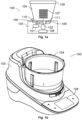
- FIG. 1a an exemplary food processor 100 (as an example of a household appliance).
- the food processor 100 shown includes a container 104, which is arranged on a base 103 of the food processor 100 and in which ingredients for a food product to be produced can be processed, for example by means of a tool or insert 107, which may be driven by a motor 102 becomes. Different tools 107 (eg a knife, a dough hook or a broom) can be mounted on the motor 102 if necessary.
- the food processor 100 can be set up to temper the container 104 by means of a temperature control unit 105, for example to cool or heat it.
- the food processor 100 can include one or more sensors 106, 111, which are set up to record sensor data in relation to the food processor 100 (in particular in relation to a state of the food processor 100) and/or in relation to the foodstuff to be produced.
- An exemplary sensor is a base temperature sensor 111 configured to collect temperature data related to the temperature of the container 104 and/or the food contained therein.
- the basic temperature sensor 111 can include a temperature-dependent measuring resistor.
- Another exemplary sensor 106 is a weight sensor or scale that is configured to collect weight data related to the weight of the container 104 and/or the food contained therein.
- the food processor 100 may include a user interface 108 that allows a user to make control inputs to the food processor 100 (e.g., via one or more buttons), and/or that allows the food processor 100 to provide feedback to a user of the food processor 100 (e.g. via a screen and/or via a display).
- the user interface 108 can be used to output information to a user regarding steps in a recipe for producing a specific food product.
- the food processor 100 includes a control unit 101, which can be set up to determine recipe data for a recipe for producing a specific food (e.g. read from a storage unit of the food processor 100 or downloaded from a database). Furthermore, the control unit 101 can be set up to operate the food processor 100 at least partially automatically depending on the recipe data in order to support the user in producing the specific food.
- a control unit 101 can be set up to determine recipe data for a recipe for producing a specific food (e.g. read from a storage unit of the food processor 100 or downloaded from a database).
- the control unit 101 can be set up to operate the food processor 100 at least partially automatically depending on the recipe data in order to support the user in producing the specific food.
- the food processor 100 may have a lid 109 for covering the container 104.
- the lid 109 can, if necessary, be locked by means of a locking device (not shown) in order to prevent access to the container 104 if necessary.
- Fig. 1b shows an exemplary food processor 100 in a perspective view.
- Fig. 1c shows the base 103 of an exemplary food processor 100 without container 104.
- the food processor 100 may include an infrared (IR) sensor 110 (also generally referred to as an auxiliary temperature sensor in this document) that is configured to capture sensor data related to the surface or side wall of the container 104.
- the IR sensor i.e. generally the additional temperature sensor
- the IR sensor 110 can be arranged within the base 103 of the food processor 100 and directed towards the location of the (removable) container 104.
- the IR sensor (i.e. generally the additional temperature sensor) 110 can be arranged at a certain height (e.g. 10mm or more, or 15mm or more) from the ground on the side of the container 104.
- the IR sensor i.e.
- the additional temperature sensor 110 is set up to detect the (electromagnetic) radiation emitted by a surface in the infrared range.
- the intensity of the radiation can be recorded. Based on the detected intensity of the radiation, the temperature of the surface or wall of the container 104 can be deduced.
- Fig. 2 shows a device 200, for example a section of the food processor 100, with the container 104 and the optional IR sensor 110 arranged outside the container 104.
- the IR sensor 110 is set up to receive sensor data 210 in relation to the temperature of the container 104 and/or of the contents 204 arranged in the container 104.
- the content 204 in the container 104 has a content temperature T I
- the wall of the container 104 has a wall temperature Tw
- the environment around the container 104 has an ambient temperature Tu.
- the sensor temperature Ts indicated by the sensor data 210 typically depends on the content temperature T I , the wall temperature Tw and/or the ambient temperature Tu.
- T target surface T raw sensor 4 ⁇ 1 ⁇ ⁇ ⁇ T ambient 4 ⁇ 4
- T target surface is the wall temperature Tw
- T raw sensor is the sensor temperature Ts
- T ambient the ambient temperature Tu
- ⁇ is the emissivity of the wall of the container 104.
- Fig. 2 also shows the base temperature sensor 111, which is arranged, for example, on the base 103 of the food processor 100 below the container 104.
- the base temperature sensor 110 may include a temperature-dependent ohmic resistance.
- the base temperature sensor 111 is configured to detect temperature data 211 (ie, sensor data) related to the temperature of the container 104.
- the temperature indicated by the temperature data 211 is referred to as the base temperature in this document.
- the base temperature sensor 110 can be arranged relatively close to the temperature control unit 105 of the food processor 100.
- the temperature data recorded by the basic temperature sensor 110 may possibly be influenced by the heating energy 215 emitted by the temperature control unit 105 (ie the thermal energy generated).
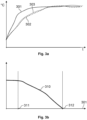
- Fig. 3a shows Fig. 3a the time course of the base temperature 301 indicated by the temperature data 211 as a function of the time t during a heating process of the contents 204 of the container 104.
- Fig. 3a the corresponding time course of the actual content temperature T I 302 of the content 204 of the container 104.
- the base temperature 301 deviates significantly from the actual content temperature 302, at least at times.
- the base temperature 301 is higher than the content temperature 302, which is due to the fact that the base temperature sensor 110 is influenced by the heating energy 215 during the heating process, which is used by the temperature control unit 105 to heat the container 104 and of the content 204 is generated.
- the control unit 101 can be set up to determine energy data in relation to the heating energy 215 generated or provided by the temperature control unit 105.
- the energy data can, for example, be based on the control signals for operating the Temperature control unit 105 can be determined. For example, based on the level at which the temperature control unit 105 is operated, it can be concluded which heating power and thus which (in a specific time interval) cumulative heating energy 225 is generated by the temperature control unit 105.
- control unit 101 can be set up to determine an estimated value for the content temperature 302 of the content 204 of the container 104 based on the temperature data 211 of the basic temperature sensor 111 and based on the energy data in relation to the generated heating energy 215.
- K is a correction factor that can be determined experimentally in advance.
- the correction factor can depend on the value of the base temperature 301.
- the correction factor 310 in particular in a temperature range between a first temperature 311 (eg 20 ° C) and a second temperature 312 (eg 90 ° C), can decrease (eg tend towards zero) as the base temperature 301 increases.
- the correction factor K can be determined based on a variety of measurements of the base temperature 301 and the actual content temperature 302 of the content 204 of the container 104.
- the correction factor K can be determined in such a way that a specific (statistical) distance measure between the estimated value of the content temperature determined (based on the correction factor) and the actual content temperature 302 is reduced, in particular minimized.
- the correction factor 310 may depend on the type of content 204 in the container 104. In particular, the correction factor 310 may depend on the viscosity of the content 204.
- the control unit 101 can be set up, the type and/or the viscosity to determine the content 204. For example, content information relating to the contents 204 of the container 104 can be captured by a user of the food processor 100 via the user interface 108 of the food processor 100. The correction factor 310 to be used for the respective type of content 204 can then be selected depending on the content information.
- the control unit 101 may be configured to determine weight data related to the weight of the content 204 (e.g. using the weight sensor 106).
- the correction factor 310 can then be determined depending on the weight data. In this way, the accuracy of the determined estimated value of the content temperature can be further increased.
- the estimated value of the content temperature can, if necessary, also be determined based on the sensor data 210 of the IR sensor 110 of the device 200. By additionally taking into account the sensor data 210 of the IR sensor, the accuracy of the determined estimated value of the content temperature can be further increased.
- the control unit 101 of the food processor 100 can be set up to operate the temperature control unit 105 depending on the determined estimated value of the content temperature.
- the actual value of the content temperature can be set (in particular regulated) to a specific target value depending on the determined estimated value of the content temperature. In this way, the quality of the operation of a food processor 100 and in particular the quality of a food produced with the food processor 100 can be increased.
- Fig. 4 shows a flowchart of an exemplary method 400 for determining an estimated value of the content temperature of the contents 204 of a container 104.
- the method 400 can be carried out, for example, by the control unit 101 of a household appliance 100.
- the method 400 includes the acquisition 401 of temperature data 211 in relation to the container 104 by means of a base temperature sensor 111.
- the base temperature sensor 111 is arranged such that thermal energy 215 generated or withdrawn by a temperature control unit 105 for temperature control of the container 104 is used
- Basic temperature sensor 111 influenced.
- the basic temperature control sensor 111 can be arranged directly next to the temperature control unit 105.
- the method 400 further includes determining 402 energy data in relation to the amount of energy of the generated or withdrawn thermal energy 215.
- the energy data results, for example, from control data for controlling the temperature control unit 105.
- the method 400 includes determining 403 the estimated value of the content temperature of the content 204 of the container 104 based on the temperature data 211 and based on the energy data. By taking the energy data into account, the estimated content temperature can be determined precisely. This enables precise operation of a household appliance 100.
Landscapes
- Physics & Mathematics (AREA)
- General Physics & Mathematics (AREA)
- Engineering & Computer Science (AREA)
- Food Science & Technology (AREA)
- Mechanical Engineering (AREA)
- Spectroscopy & Molecular Physics (AREA)
- Cookers (AREA)
Claims (12)
- Dispositif (200) pour déterminer une estimation de la température du contenu (204) d'un récipient (104), dans lequel le dispositif (200) comprend- le récipient (104) destiné à recueillir le contenu (204) ;- une unité de régulation de température (105) qui est configurée pour produire ou extraire de l'énergie thermique (215) afin de réguler la température du récipient (104) à partir d'au moins un côté du récipient (104) ;- un capteur de température de base (111) qui est configuré pour détecter des données de température (211) par rapport au récipient (104) et qui est disposé de telle sorte que l'énergie thermique (215) produite ou extraite par l'unité de régulation de température (105) influence le capteur de température de base (111) ; et- une unité de calcul (101) qui est configurée pour déterminer,caractérisé en ce que l'unité de calcul (101) est en outre configurée pour- sur la base des données de température (211), une valeur d'une température de base (301) indiquée par les données de température (211) ;- déterminer un facteur de correction (310) qui dépend de la valeur déterminée de la température de base (301) ;- multiplier la quantité d'énergie de l'énergie thermique (215) produite ou extraite indiquée par les données d'énergie par le facteur de correction (310) afin de déterminer une valeur de correction pour la température de base (301) ; et- corriger la valeur déterminée de la température de base (301) par la valeur de correction afin de déterminer la valeur estimée de la température du contenu (204) du récipient (104).
- Dispositif (200) selon la revendication 1, dans lequel l'unité de calcul (101) est configurée- pour soustraire la valeur de correction de la valeur déterminée de la température de base (301) afin de déterminer la valeur estimée de la température du contenu lorsque l'unité de régulation de température (105) produit de l'énergie thermique (215) ; et/ou- pour ajouter la valeur de correction à la valeur déterminée de la température de base (301) afin de déterminer la valeur estimée de la température du contenu lorsque l'unité de régulation de température (105) extrait de l'énergie thermique (215).
- Dispositif (200) selon l'une des revendications 1 et 2, dans lequel l'unité de calcul (101) est configurée pour- déterminer des informations de contenu concernant une propriété du contenu (204) ; dans lequel les informations de contenu indiquent un type, une viscosité et/ou un poids du contenu (204) ; et- déterminer le facteur de correction en fonction des informations de contenu.
- Dispositif (200) selon l'une des revendications précédentes, dans lequel l'unité de calcul (101) est configurée pour- déterminer des données de poids par rapport à un poids du contenu (204) du récipient (104) ; et- déterminer la valeur estimée de la température du contenu, également en fonction des données de poids.
- Dispositif (200) selon l'une des revendications précédentes, dans lequel l'unité de calcul (101) est configurée pour déterminer les données d'énergie sur la base de données de commande pour la commande de l'unité de régulation de température (105) et sur la base de données caractéristiques par rapport à l'unité de régulation de température (105).
- Dispositif (200) selon l'une des revendications précédentes, dans lequel- le dispositif (200) comprend un capteur de température supplémentaire, en particulier un capteur infrarouge (110), en abrégé IR, qui est dirigé vers une paroi du récipient (104) et qui est configuré pour détecter des données de capteur (210) par rapport à une température de paroi de la paroi du récipient ; et- l'unité de calcul (101) est configurée pour déterminer la valeur estimée de la température du contenu également sur la base des données de capteur (210) du capteur de température supplémentaire (110).
- Dispositif (200) selon la revendication 6, dans lequel le capteur de température supplémentaire est configuré pour détecter des données de capteur (210) par rapport à une intensité du rayonnement dans le domaine spectral infrarouge qui provient de la paroi du récipient.
- Dispositif (200) selon l'une des revendications précédentes, dans lequel l'unité de calcul (101) est configurée pour faire fonctionner l'unité de régulation de température (105) en fonction de la valeur estimée de la température du contenu qui a été déterminée, en particulier pour régler une valeur réelle de la température du contenu sur une valeur de consigne.
- Dispositif (200) selon l'une des revendications précédentes, dans lequel le capteur de température de base (111) comprend une résistance électrique dépendante de la température.
- Appareil électroménager (100) comprenant- le dispositif (200) selon l'une des revendications précédentes, qui est configuré pour déterminer une valeur estimée de la température du contenu (204) du récipient (104) ; et- une unité de calcul (101) qui est configurée pour faire fonctionner l'appareil électroménager (100) en fonction de la valeur estimée de la température du contenu (TI) qui a été déterminée.
- Appareil électroménager (100) selon la revendication 10, dans lequel l'appareil électroménager (100) est un robot de cuisine et le contenu (204) est un aliment transformé par le robot de cuisine.
- Procédé (400) pour déterminer une estimation de la température du contenu (204) d'un récipient (104), dans lequel le procédé (400) comprend- la détection (401) de données de température (211) par rapport au récipient (104) au moyen d'un capteur de température de base (111), dans lequel le capteur de température de base (111) est configuré de telle sorte que l'énergie thermique (215) produite ou extraite par une unité de régulation de température (105) afin de réguler la température du récipient (104) influence le capteur de température de base (111) ;- la détermination (402) de données d'énergie par rapport à une quantité d'énergie de l'énergie thermique (215) produite ou extraite ;- la détermination, sur la base des données de température (211), d'une valeur d'une température de base (301) indiquée par les données de température (211) ;caractérisé en ce que le procédé comprend en outre :- la détermination d'un facteur de correction (310) dépendant de la valeur déterminée de la température de base (301) ;- la multiplication de la quantité d'énergie de l'énergie thermique (215) produite ou extraite indiquée par les données d'énergie par le facteur de correction (310) afin de déterminer un facteur de correction pour la température de base (301) ; et- la correction de la valeur déterminée de la température de base (301) avec la valeur de correction pour déterminer la valeur estimée de la température du contenu (204) du récipient (104).
Applications Claiming Priority (2)
| Application Number | Priority Date | Filing Date | Title |
|---|---|---|---|
| DE102019211289.7A DE102019211289A1 (de) | 2019-07-30 | 2019-07-30 | Vorrichtung und Verfahren zur Ermittlung eines Schätzwertes der Temperatur des Inhalts eines Behälters |
| PCT/EP2020/069979 WO2021018589A1 (fr) | 2019-07-30 | 2020-07-15 | Dispositif et procédé d'estimation de la température du contenu d'un récipient |
Publications (3)
| Publication Number | Publication Date |
|---|---|
| EP4004508A1 EP4004508A1 (fr) | 2022-06-01 |
| EP4004508C0 EP4004508C0 (fr) | 2023-11-29 |
| EP4004508B1 true EP4004508B1 (fr) | 2023-11-29 |
Family
ID=71738111
Family Applications (1)
| Application Number | Title | Priority Date | Filing Date |
|---|---|---|---|
| EP20743624.7A Active EP4004508B1 (fr) | 2019-07-30 | 2020-07-15 | Dispositif et procédé d'estimation de la température du contenu d'un récipient |
Country Status (3)
| Country | Link |
|---|---|
| EP (1) | EP4004508B1 (fr) |
| DE (1) | DE102019211289A1 (fr) |
| WO (1) | WO2021018589A1 (fr) |
Citations (1)
| Publication number | Priority date | Publication date | Assignee | Title |
|---|---|---|---|---|
| EP2572173B1 (fr) * | 2010-05-20 | 2017-03-22 | Koninklijke Philips N.V. | Évaluation de la température |
Family Cites Families (3)
| Publication number | Priority date | Publication date | Assignee | Title |
|---|---|---|---|---|
| US6462316B1 (en) * | 2000-10-10 | 2002-10-08 | General Electric Company | Cooktop control and monitoring system including detecting properties of a utensil and its contents |
| DE102004033454A1 (de) * | 2004-07-07 | 2006-01-26 | E.G.O. Elektro-Gerätebau GmbH | Kochgerät mit Temperaturerfassung und Verfahren zur Temperaturerfassung an einem Kochgerät |
| DE102016113494A1 (de) * | 2016-07-21 | 2018-01-25 | Vorwerk & Co. Interholding Gmbh | Verfahren zur Schätzung einer zeitlich veränderbaren Messgröße eines Systems |
-
2019
- 2019-07-30 DE DE102019211289.7A patent/DE102019211289A1/de active Pending
-
2020
- 2020-07-15 EP EP20743624.7A patent/EP4004508B1/fr active Active
- 2020-07-15 WO PCT/EP2020/069979 patent/WO2021018589A1/fr not_active Ceased
Patent Citations (1)
| Publication number | Priority date | Publication date | Assignee | Title |
|---|---|---|---|---|
| EP2572173B1 (fr) * | 2010-05-20 | 2017-03-22 | Koninklijke Philips N.V. | Évaluation de la température |
Also Published As
| Publication number | Publication date |
|---|---|
| EP4004508A1 (fr) | 2022-06-01 |
| WO2021018589A1 (fr) | 2021-02-04 |
| EP4004508C0 (fr) | 2023-11-29 |
| DE102019211289A1 (de) | 2021-02-04 |
Similar Documents
| Publication | Publication Date | Title |
|---|---|---|
| EP2026632B1 (fr) | Procédé de détermination de la température de noyau d'un article de cuisson et appareil de cuisson destiné à l'exécution d'un tel procédé | |
| EP2063183B1 (fr) | Procédé de détermination de la température de noyau d'un article de cuisson | |
| EP1867926B1 (fr) | Appareil de cuisson doté d'une surveillance de l'état des produits de cuisson | |
| EP1022972B2 (fr) | Procede pour la conduite individuelle d'un rotissage et rotissoire correspondante | |
| EP2031306B1 (fr) | Procédé et appareil de cuisson | |
| EP1712844B1 (fr) | Procédé et dispositif de commande de la température d'un four de cuisson | |
| EP3482661B1 (fr) | Procédé de réglage d'une puissance de chauffage d'au moins un élément chauffant d'un appareil électroménager | |
| WO2009026887A4 (fr) | Procédé pour l'indication d'un temps de cuisson restant | |
| EP3705006B1 (fr) | Robot de cuisine avec dispositif de surveillance | |
| WO2022122478A2 (fr) | Procédé pour faire fonctionner un appareil de cuisson et appareil de cuisson | |
| EP4004508B1 (fr) | Dispositif et procédé d'estimation de la température du contenu d'un récipient | |
| DE102014103480B4 (de) | Gargerät und Verfahren zum Betreiben eines Gargerätes | |
| EP4088631A1 (fr) | Procédé permettant de faire fonctionner un élément chauffant | |
| DE102017214753A1 (de) | Haushalts-Gargerät | |
| EP2947436A1 (fr) | Procédé de détermination de la température en surface d'un produit de cuisson | |
| EP3771894B1 (fr) | Dispositif et procédé de détermination de la température du contenu d'un récipient | |
| DE102019107815B4 (de) | Verfahren zum Betreiben eines Gargeräts und Gargerät | |
| EP3771373B1 (fr) | Robot de cuisine et procédé d'amélioration de la sécurité d'un robot de cuisine | |
| EP0132666B1 (fr) | Procédé pour la stérilisation de conserves par réchauffement | |
| WO2021018586A1 (fr) | Robot culinaire et procédé de fonctionnement d'un robot culinaire | |
| EP4516167A1 (fr) | Dispositif et procédé de détermination de la température d'ébullition pour le fonctionnement d'un robot de cuisine | |
| EP3771374B1 (fr) | Robot de cuisine et procédé de fonctionnement d'un outil d'agitation d'un robot de cuisine | |
| DE102016102233A1 (de) | Gargerätsystem und Verfahren zum Betreiben | |
| DE102019107751A1 (de) | Verfahren zum Betreiben eines Gargerätes und Gargerät | |
| EP3524888B1 (fr) | Procédé de commande d'un appareil de cuisson ainsi qu'appareil de cuisson |
Legal Events
| Date | Code | Title | Description |
|---|---|---|---|
| STAA | Information on the status of an ep patent application or granted ep patent |
Free format text: STATUS: UNKNOWN |
|
| STAA | Information on the status of an ep patent application or granted ep patent |
Free format text: STATUS: THE INTERNATIONAL PUBLICATION HAS BEEN MADE |
|
| PUAI | Public reference made under article 153(3) epc to a published international application that has entered the european phase |
Free format text: ORIGINAL CODE: 0009012 |
|
| STAA | Information on the status of an ep patent application or granted ep patent |
Free format text: STATUS: REQUEST FOR EXAMINATION WAS MADE |
|
| 17P | Request for examination filed |
Effective date: 20220228 |
|
| AK | Designated contracting states |
Kind code of ref document: A1 Designated state(s): AL AT BE BG CH CY CZ DE DK EE ES FI FR GB GR HR HU IE IS IT LI LT LU LV MC MK MT NL NO PL PT RO RS SE SI SK SM TR |
|
| DAV | Request for validation of the european patent (deleted) | ||
| DAX | Request for extension of the european patent (deleted) | ||
| REG | Reference to a national code |
Free format text: PREVIOUS MAIN CLASS: G01K0001140000 Ref country code: DE Ref legal event code: R079 Ref document number: 502020006210 Country of ref document: DE Free format text: PREVIOUS MAIN CLASS: G01K0001140000 Ipc: G01K0001143000 |
|
| GRAP | Despatch of communication of intention to grant a patent |
Free format text: ORIGINAL CODE: EPIDOSNIGR1 |
|
| STAA | Information on the status of an ep patent application or granted ep patent |
Free format text: STATUS: GRANT OF PATENT IS INTENDED |
|
| RIC1 | Information provided on ipc code assigned before grant |
Ipc: G01J 5/00 20220101ALI20230619BHEP Ipc: A47J 43/046 20060101ALI20230619BHEP Ipc: G01K 7/42 20060101ALI20230619BHEP Ipc: A47J 36/32 20060101ALI20230619BHEP Ipc: G01K 1/143 20210101AFI20230619BHEP |
|
| INTG | Intention to grant announced |
Effective date: 20230713 |
|
| GRAS | Grant fee paid |
Free format text: ORIGINAL CODE: EPIDOSNIGR3 |
|
| GRAA | (expected) grant |
Free format text: ORIGINAL CODE: 0009210 |
|
| STAA | Information on the status of an ep patent application or granted ep patent |
Free format text: STATUS: THE PATENT HAS BEEN GRANTED |
|
| AK | Designated contracting states |
Kind code of ref document: B1 Designated state(s): AL AT BE BG CH CY CZ DE DK EE ES FI FR GB GR HR HU IE IS IT LI LT LU LV MC MK MT NL NO PL PT RO RS SE SI SK SM TR |
|
| REG | Reference to a national code |
Ref country code: GB Ref legal event code: FG4D Free format text: NOT ENGLISH |
|
| REG | Reference to a national code |
Ref country code: CH Ref legal event code: EP |
|
| REG | Reference to a national code |
Ref country code: DE Ref legal event code: R096 Ref document number: 502020006210 Country of ref document: DE |
|
| REG | Reference to a national code |
Ref country code: IE Ref legal event code: FG4D Free format text: LANGUAGE OF EP DOCUMENT: GERMAN |
|
| U01 | Request for unitary effect filed |
Effective date: 20231213 |
|
| U07 | Unitary effect registered |
Designated state(s): AT BE BG DE DK EE FI FR IT LT LU LV MT NL PT SE SI Effective date: 20231220 |
|
| PG25 | Lapsed in a contracting state [announced via postgrant information from national office to epo] |
Ref country code: GR Free format text: LAPSE BECAUSE OF FAILURE TO SUBMIT A TRANSLATION OF THE DESCRIPTION OR TO PAY THE FEE WITHIN THE PRESCRIBED TIME-LIMIT Effective date: 20240301 |
|
| PG25 | Lapsed in a contracting state [announced via postgrant information from national office to epo] |
Ref country code: IS Free format text: LAPSE BECAUSE OF FAILURE TO SUBMIT A TRANSLATION OF THE DESCRIPTION OR TO PAY THE FEE WITHIN THE PRESCRIBED TIME-LIMIT Effective date: 20240329 |
|
| PG25 | Lapsed in a contracting state [announced via postgrant information from national office to epo] |
Ref country code: ES Free format text: LAPSE BECAUSE OF FAILURE TO SUBMIT A TRANSLATION OF THE DESCRIPTION OR TO PAY THE FEE WITHIN THE PRESCRIBED TIME-LIMIT Effective date: 20231129 |
|
| PG25 | Lapsed in a contracting state [announced via postgrant information from national office to epo] |
Ref country code: IS Free format text: LAPSE BECAUSE OF FAILURE TO SUBMIT A TRANSLATION OF THE DESCRIPTION OR TO PAY THE FEE WITHIN THE PRESCRIBED TIME-LIMIT Effective date: 20240329 Ref country code: GR Free format text: LAPSE BECAUSE OF FAILURE TO SUBMIT A TRANSLATION OF THE DESCRIPTION OR TO PAY THE FEE WITHIN THE PRESCRIBED TIME-LIMIT Effective date: 20240301 Ref country code: ES Free format text: LAPSE BECAUSE OF FAILURE TO SUBMIT A TRANSLATION OF THE DESCRIPTION OR TO PAY THE FEE WITHIN THE PRESCRIBED TIME-LIMIT Effective date: 20231129 |
|
| PG25 | Lapsed in a contracting state [announced via postgrant information from national office to epo] |
Ref country code: RS Free format text: LAPSE BECAUSE OF FAILURE TO SUBMIT A TRANSLATION OF THE DESCRIPTION OR TO PAY THE FEE WITHIN THE PRESCRIBED TIME-LIMIT Effective date: 20231129 Ref country code: PL Free format text: LAPSE BECAUSE OF FAILURE TO SUBMIT A TRANSLATION OF THE DESCRIPTION OR TO PAY THE FEE WITHIN THE PRESCRIBED TIME-LIMIT Effective date: 20231129 Ref country code: NO Free format text: LAPSE BECAUSE OF FAILURE TO SUBMIT A TRANSLATION OF THE DESCRIPTION OR TO PAY THE FEE WITHIN THE PRESCRIBED TIME-LIMIT Effective date: 20240229 Ref country code: HR Free format text: LAPSE BECAUSE OF FAILURE TO SUBMIT A TRANSLATION OF THE DESCRIPTION OR TO PAY THE FEE WITHIN THE PRESCRIBED TIME-LIMIT Effective date: 20231129 |
|
| PG25 | Lapsed in a contracting state [announced via postgrant information from national office to epo] |
Ref country code: CZ Free format text: LAPSE BECAUSE OF FAILURE TO SUBMIT A TRANSLATION OF THE DESCRIPTION OR TO PAY THE FEE WITHIN THE PRESCRIBED TIME-LIMIT Effective date: 20231129 |
|
| PG25 | Lapsed in a contracting state [announced via postgrant information from national office to epo] |
Ref country code: SK Free format text: LAPSE BECAUSE OF FAILURE TO SUBMIT A TRANSLATION OF THE DESCRIPTION OR TO PAY THE FEE WITHIN THE PRESCRIBED TIME-LIMIT Effective date: 20231129 |
|
| PG25 | Lapsed in a contracting state [announced via postgrant information from national office to epo] |
Ref country code: SM Free format text: LAPSE BECAUSE OF FAILURE TO SUBMIT A TRANSLATION OF THE DESCRIPTION OR TO PAY THE FEE WITHIN THE PRESCRIBED TIME-LIMIT Effective date: 20231129 Ref country code: SK Free format text: LAPSE BECAUSE OF FAILURE TO SUBMIT A TRANSLATION OF THE DESCRIPTION OR TO PAY THE FEE WITHIN THE PRESCRIBED TIME-LIMIT Effective date: 20231129 Ref country code: RO Free format text: LAPSE BECAUSE OF FAILURE TO SUBMIT A TRANSLATION OF THE DESCRIPTION OR TO PAY THE FEE WITHIN THE PRESCRIBED TIME-LIMIT Effective date: 20231129 Ref country code: CZ Free format text: LAPSE BECAUSE OF FAILURE TO SUBMIT A TRANSLATION OF THE DESCRIPTION OR TO PAY THE FEE WITHIN THE PRESCRIBED TIME-LIMIT Effective date: 20231129 |
|
| REG | Reference to a national code |
Ref country code: DE Ref legal event code: R097 Ref document number: 502020006210 Country of ref document: DE |
|
| U20 | Renewal fee for the european patent with unitary effect paid |
Year of fee payment: 5 Effective date: 20240731 |
|
| PLBE | No opposition filed within time limit |
Free format text: ORIGINAL CODE: 0009261 |
|
| STAA | Information on the status of an ep patent application or granted ep patent |
Free format text: STATUS: NO OPPOSITION FILED WITHIN TIME LIMIT |
|
| 26N | No opposition filed |
Effective date: 20240830 |
|
| PG25 | Lapsed in a contracting state [announced via postgrant information from national office to epo] |
Ref country code: MC Free format text: LAPSE BECAUSE OF FAILURE TO SUBMIT A TRANSLATION OF THE DESCRIPTION OR TO PAY THE FEE WITHIN THE PRESCRIBED TIME-LIMIT Effective date: 20231129 |
|
| REG | Reference to a national code |
Ref country code: CH Ref legal event code: PL |
|
| GBPC | Gb: european patent ceased through non-payment of renewal fee |
Effective date: 20240715 |
|
| PG25 | Lapsed in a contracting state [announced via postgrant information from national office to epo] |
Ref country code: CH Free format text: LAPSE BECAUSE OF NON-PAYMENT OF DUE FEES Effective date: 20240731 |
|
| PG25 | Lapsed in a contracting state [announced via postgrant information from national office to epo] |
Ref country code: GB Free format text: LAPSE BECAUSE OF NON-PAYMENT OF DUE FEES Effective date: 20240715 |
|
| PG25 | Lapsed in a contracting state [announced via postgrant information from national office to epo] |
Ref country code: IE Free format text: LAPSE BECAUSE OF NON-PAYMENT OF DUE FEES Effective date: 20240715 |
|
| U20 | Renewal fee for the european patent with unitary effect paid |
Year of fee payment: 6 Effective date: 20250731 |
|
| PG25 | Lapsed in a contracting state [announced via postgrant information from national office to epo] |
Ref country code: CY Free format text: LAPSE BECAUSE OF FAILURE TO SUBMIT A TRANSLATION OF THE DESCRIPTION OR TO PAY THE FEE WITHIN THE PRESCRIBED TIME-LIMIT; INVALID AB INITIO Effective date: 20200715 |
|
| PG25 | Lapsed in a contracting state [announced via postgrant information from national office to epo] |
Ref country code: HU Free format text: LAPSE BECAUSE OF FAILURE TO SUBMIT A TRANSLATION OF THE DESCRIPTION OR TO PAY THE FEE WITHIN THE PRESCRIBED TIME-LIMIT; INVALID AB INITIO Effective date: 20200715 |