EP4004894B1 - System und verfahren zur verbesserten bestimmung der komplexität von luftsektoren - Google Patents
System und verfahren zur verbesserten bestimmung der komplexität von luftsektoren Download PDFInfo
- Publication number
- EP4004894B1 EP4004894B1 EP20737203.8A EP20737203A EP4004894B1 EP 4004894 B1 EP4004894 B1 EP 4004894B1 EP 20737203 A EP20737203 A EP 20737203A EP 4004894 B1 EP4004894 B1 EP 4004894B1
- Authority
- EP
- European Patent Office
- Prior art keywords
- atc
- situation
- complexity
- sector
- learning engine
- Prior art date
- Legal status (The legal status is an assumption and is not a legal conclusion. Google has not performed a legal analysis and makes no representation as to the accuracy of the status listed.)
- Active
Links
Images

Classifications
-
- G—PHYSICS
- G08—SIGNALLING
- G08G—TRAFFIC CONTROL SYSTEMS
- G08G5/00—Traffic control systems for aircraft
- G08G5/20—Arrangements for acquiring, generating, sharing or displaying traffic information
- G08G5/26—Transmission of traffic-related information between aircraft and ground stations
-
- G—PHYSICS
- G08—SIGNALLING
- G08G—TRAFFIC CONTROL SYSTEMS
- G08G5/00—Traffic control systems for aircraft
- G08G5/50—Navigation or guidance aids
- G08G5/56—Navigation or guidance aids for two or more aircraft
-
- G—PHYSICS
- G06—COMPUTING OR CALCULATING; COUNTING
- G06N—COMPUTING ARRANGEMENTS BASED ON SPECIFIC COMPUTATIONAL MODELS
- G06N20/00—Machine learning
-
- G—PHYSICS
- G06—COMPUTING OR CALCULATING; COUNTING
- G06N—COMPUTING ARRANGEMENTS BASED ON SPECIFIC COMPUTATIONAL MODELS
- G06N3/00—Computing arrangements based on biological models
- G06N3/02—Neural networks
- G06N3/04—Architecture, e.g. interconnection topology
- G06N3/045—Combinations of networks
-
- G—PHYSICS
- G06—COMPUTING OR CALCULATING; COUNTING
- G06N—COMPUTING ARRANGEMENTS BASED ON SPECIFIC COMPUTATIONAL MODELS
- G06N3/00—Computing arrangements based on biological models
- G06N3/02—Neural networks
- G06N3/08—Learning methods
-
- G—PHYSICS
- G06—COMPUTING OR CALCULATING; COUNTING
- G06N—COMPUTING ARRANGEMENTS BASED ON SPECIFIC COMPUTATIONAL MODELS
- G06N3/00—Computing arrangements based on biological models
- G06N3/02—Neural networks
- G06N3/08—Learning methods
- G06N3/09—Supervised learning
-
- G—PHYSICS
- G06—COMPUTING OR CALCULATING; COUNTING
- G06N—COMPUTING ARRANGEMENTS BASED ON SPECIFIC COMPUTATIONAL MODELS
- G06N3/00—Computing arrangements based on biological models
- G06N3/02—Neural networks
- G06N3/08—Learning methods
- G06N3/092—Reinforcement learning
-
- G—PHYSICS
- G06—COMPUTING OR CALCULATING; COUNTING
- G06Q—INFORMATION AND COMMUNICATION TECHNOLOGY [ICT] SPECIALLY ADAPTED FOR ADMINISTRATIVE, COMMERCIAL, FINANCIAL, MANAGERIAL OR SUPERVISORY PURPOSES; SYSTEMS OR METHODS SPECIALLY ADAPTED FOR ADMINISTRATIVE, COMMERCIAL, FINANCIAL, MANAGERIAL OR SUPERVISORY PURPOSES, NOT OTHERWISE PROVIDED FOR
- G06Q10/00—Administration; Management
- G06Q10/06—Resources, workflows, human or project management; Enterprise or organisation planning; Enterprise or organisation modelling
-
- G—PHYSICS
- G08—SIGNALLING
- G08G—TRAFFIC CONTROL SYSTEMS
- G08G5/00—Traffic control systems for aircraft
-
- G—PHYSICS
- G08—SIGNALLING
- G08G—TRAFFIC CONTROL SYSTEMS
- G08G5/00—Traffic control systems for aircraft
- G08G5/20—Arrangements for acquiring, generating, sharing or displaying traffic information
- G08G5/22—Arrangements for acquiring, generating, sharing or displaying traffic information located on the ground
-
- G—PHYSICS
- G08—SIGNALLING
- G08G—TRAFFIC CONTROL SYSTEMS
- G08G5/00—Traffic control systems for aircraft
- G08G5/50—Navigation or guidance aids
- G08G5/55—Navigation or guidance aids for a single aircraft
-
- G—PHYSICS
- G08—SIGNALLING
- G08G—TRAFFIC CONTROL SYSTEMS
- G08G5/00—Traffic control systems for aircraft
- G08G5/50—Navigation or guidance aids
- G08G5/59—Navigation or guidance aids in accordance with predefined flight zones, e.g. to avoid prohibited zones
-
- G—PHYSICS
- G08—SIGNALLING
- G08G—TRAFFIC CONTROL SYSTEMS
- G08G5/00—Traffic control systems for aircraft
- G08G5/70—Arrangements for monitoring traffic-related situations or conditions
- G08G5/72—Arrangements for monitoring traffic-related situations or conditions for monitoring traffic
- G08G5/727—Arrangements for monitoring traffic-related situations or conditions for monitoring traffic from a ground station
-
- G—PHYSICS
- G08—SIGNALLING
- G08G—TRAFFIC CONTROL SYSTEMS
- G08G5/00—Traffic control systems for aircraft
- G08G5/70—Arrangements for monitoring traffic-related situations or conditions
- G08G5/76—Arrangements for monitoring traffic-related situations or conditions for monitoring atmospheric conditions
Definitions
- the present invention relates to determining the complexity of processing air traffic control situations on sectors by operators, for example air traffic controllers.
- the present invention also relates to defining air sectors, and assigning these sectors to operators.
- Air traffic control systems aim to make flight operations safer, faster and more efficient. They prevent collisions between aircraft, or dangerous situations between an aircraft and its environment (weather, terrain, etc.). By synchronizing aircraft traffic as precisely as possible, they ensure safe air traffic, but also allow aircraft to respect scheduled flight times and adopt trajectories that are as fuel-efficient as possible.
- air traffic controllers receive a set of information relating to the airspace: position and predicted trajectories of aircraft, weather, etc. Controllers can also communicate, via written messages or oral communications, with aircraft pilots in order to retrieve additional information where appropriate, and give them instructions adapted to the situation, to guarantee the safety of air traffic, while ensuring the best possible quality of service to air transport users. For example, air traffic controllers can inform pilots of the appropriate time to land or take off from an airport, or on the contrary give them instructions to delay their approach if a runway is used by aircraft at the initially planned time. The quality of the work of air traffic controllers is therefore essential, to guarantee both the safety and the efficiency of air traffic.
- the work of air traffic controllers is organized by geographical sectors.
- the complexity of the work to be carried out on a sector varies depending on a number of factors, the most important of which is the complexity of the traffic: an air traffic controller will only be able to effectively handle a limited number of flights simultaneously.
- a variable number of controllers can be assigned to each sector, so that each controller only handles a situation whose complexity is sufficiently low (for example, comprising a limited number of flights, limited trajectory conflicts, if applicable in relation to environmental characteristics such as the weather for example) to carry out his work correctly.
- analytical functions have several disadvantages.
- Analytical functions calculated on CPU thus do not guarantee a fixed and low response time for the evaluation of the complexity of a sector. In the case of complex sectors, they do not do not guarantee a sufficiently low execution time to dynamically assign controllers according to the evolution of air traffic.
- Analytical functions also have the disadvantage of providing theoretical complexity, but which cannot take into account all the factors impacting ATC complexity.
- the objective metrics on which these analytical functions are based do not necessarily correspond to the complexity perceived by air traffic controllers.
- the invention relates to a method implemented by computer receiving as input a set of ATC situations each defined by a sector and a time period, and each associated with a set of input parameters comprising, for the sector and the time period: the trajectories of aircraft having crossed the sector; meteorological information; said method comprising, for each ATC situation: a step of forming a vector of input parameters comprising parameters of the set associated with the ATC situation; a step of executing an analytical calculation function of an ATC complexity index of the situation from the input parameters; said method comprising a step of training a supervised automatic learning engine taking as input associations, for each situation respectively, between its vector of input parameters and its ATC complexity index.
- the method includes, for at least one ATC situation, reinforcement learning from data representative of the workload felt by an air traffic controller in the situation.
- the method comprises, for at least one ATC situation, a step of calculating variations in the ATC complexity index from data representative of the workload felt by an air traffic controller in the situation, recorded for the sector and during the time period, and reinforcement learning of the supervised machine learning engine from the variations.
- the method comprises, for each ATC situation, a reinforcement learning step of the supervised learning engine, comprising: the presentation, to at least one air traffic controller, of an ATC situation, and of an ATC complexity index calculated by the supervised learning engine for this situation; the reception of a complexity index deviation entered by the at least one air traffic controller; the penalization of the learning according to this deviation.
- the method comprises a step of comparing predictions of grouping and ungrouping of sectors made from ATC complexity indices calculated by the machine learning engine and groupings and ungroupings of sectors made in said set of ATC situations by controllers.
- the method comprises validating the training of the supervised learning engine from said comparisons.
- the method comprises reinforcement learning of the supervised learning engine from said comparisons.
- the invention also discloses a system comprising: at least one computing unit capable of training a supervised machine learning engine; access to access to at least one information storage medium storing, for a set of ATC situations each defined by a sector and a time period, a set of parameters comprising, for the sector and the time period: the trajectories of aircraft having crossed the sector; meteorological information; the at least one computing unit being configured, for each ATC situation, for: forming an input parameter vector comprising parameters of the set associated with the ATC situation; executing an analytical calculation function of an ATC complexity index of the situation from the input parameters; the at least one calculation unit being configured to train a supervised machine learning engine taking as input associations, for each situation respectively, between its input parameter vector and its ATC complexity index.
- the invention also discloses a computer program product comprising computer code elements configured to execute a method according to one of the embodiments of the invention.
- the invention also discloses a computer-implemented method receiving as input, for a current ATC situation defined by a current sector and a time period, a set of parameters comprising, for the current sector: the trajectories of aircraft crossing the sector; meteorological information; said method comprising: a step of forming, for the current ATC situation, a vector of input parameters comprising parameters of the set; a step of executing a supervised learning engine to calculate, from the input vector, an ATC complexity index of the current situation, said engine having been trained by a method according to a method according to one of the embodiments of the invention.
- the invention also discloses a computer program product comprising computer code elements configured to execute a method according to one of the embodiments of the invention.
- the invention also discloses a system comprising: at least one computing unit capable of executing a supervised machine learning engine; at least one input port capable of receiving, for a current ATC situation defined by a current sector and a time period, a set of parameters comprising, for the current sector: the trajectories of aircraft crossing the sector; meteorological information; the at least one computing unit being configured to: form, for the current ATC situation, a vector of input parameters comprising parameters of the set; execute said supervised learning engine to calculate, from the input vector, a parameter index ATC complexity of the current situation, said engine having been driven by a method according to one of the embodiments of the invention.
- the at least one computing unit is configured to dynamically redefine the sectors of an airspace, based on the ATC complexity indices calculated by the supervised learning engine for the sectors.
- the at least one computing unit is configured to solve a constrained optimization problem, aiming at minimizing the total number of sectors on an airspace, while ensuring that the ATC complexity calculated by the supervised learning engine for each sector and time period is less than a predefined complexity.
- the machine learning engine is able to predict the complexity of a situation from its parameters.
- Such an engine has the advantage of requiring limited resources to predict the complexity of a given air situation.
- machine learning engines can thus predict the complexity of a situation in a limited time, regardless of the parameters associated with the situation, unlike analytical functions, whose computation time can vary significantly, and become very significant for particularly complex situations. This therefore ensures that it is possible to determine the complexity of a situation practically in real time.
- the invention allows dynamic allocation of sectors in a given airspace, in order to limit the number of sectors as much as possible, while ensuring that no sector exceeds a complexity threshold beyond which the sector could no longer be processed correctly by air traffic controllers.
- the invention allows ATC complexity indices to be calculated much more accurately than analytical functions.
- the invention allows learning of the complexity of ATC situations taking into account measures representative of the workload felt by the pilots, thus allowing better modeling of situations poorly taken into account by the analytical functions.
- the invention enables learning of the complexity of ATC situations very efficiently, requiring limited input from air traffic controllers.
- CPDLC Controller-Pilot Data Link Communications Controller-pilot communication data link A method of communication between controllers and pilots, defining a set of elementary messages that can be exchanged. These messages correspond to the procedures used for air traffic control.
- FIR Flight Information Region Flight Information Region volume in which a given control center ensures the smooth running of flights. In France, FIRs cover a flight space up to 19,500 feet. FL Flight Level Flight Level. In aeronautics, designates an altitude expressed in hundreds of feet above the 1013.25 hPa isobaric surface. GPS Global Positioning System Global Positioning System. Satellite positioning system.
- WMO World Meteorological Organization
- NAS Network Accessed Server Network Attached Storage Server A stand-alone file server connected to a network and whose data is accessed remotely.
- SIGMET SIGNIFICANT METeorological Information Significant Weather Information A type of message intended for aircraft in flight reporting very dangerous weather phenomena observed or forecast.
- UIR Upper Information Region Upper Information Region Flight Information Region covering, in France, the airspace located above 19,500 feet.
- VCS Voice Communication Systems Voice Communication Systems. Voice communication systems used in air traffic.
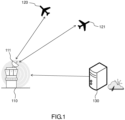
- FIG 1 represents an example of an air traffic control system, in which the invention can be implemented.
- the air traffic control system represented in figure 1 comprises a control tower 110, equipped with a radar 111 for locating aircraft 120, 121 flying in a given sector.
- the control tower 110 can communicate with the aircraft, for example via a radio link, in order to give information and instructions to the aircraft, but also to receive information and requests from the aircraft.
- the control tower can receive data from external providers, such as a weather server 130.
- an air traffic controller can provide indications and instructions to the pilots of the aircraft from a set of data comprising the planned trajectories of the aircraft in his sector, interactions with the pilots, and environmental data such as weather forecasts.
- the system of the figure 1 is given by way of non-limiting example only, and the invention can be implemented in many systems for air traffic control, such as ATC or ATFM systems.
- FIG. 2 represents a set of sectors in which the invention can be implemented.
- the FIRs cover the airspace up to 19,500 feet; beyond that, there is a UIR managed by the 5 control centers. These regions are in turn divided into control sectors, such as the sectors called Regional Control Centers (RCCs), or ACCs in English.
- RRCs Regional Control Centers
- Each of the sectors is permanently crossed by a certain number of aircraft.
- the complexity of processing air traffic in a sector varies depending on the number of aircraft in this sector, but also on other characteristics such as the weather or traffic density.
- the number of controllers assigned to a sector can be modulated according to the complexity of processing it.
- the shape and size of the sectors can also be adapted.
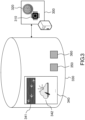
- FIG. 3 represents a calculation system allowing the training of a supervised automatic learning engine of the processing complexity of an ATC situation, in a set of implementation modes of the invention.
- the system 300 is a computing system. According to one set of embodiments of the invention, the system 300 may be a single computing device such as a computer, a server, or any other system capable of performing computer computations.
- the system 300 may also comprise a plurality of computing devices.
- the system 300 may be a server farm comprising multiple computing servers.
- the system 300 thus comprises at least one calculation unit 310 capable of driving a supervised machine learning engine 320.
- the at least one computing unit 310 may be any type of computing unit capable of performing computational calculations.
- the computing unit may be a processor configured with machine instructions, a microprocessor, an integrated circuit, a microcontroller, a programmable logic circuit, or any other computing unit capable of being programmed to perform computational operations.
- the supervised machine learning engine 320 may be any type of supervised machine learning engine.
- it may be an artificial neural network, a support vector machine, or a deep learning engine, such as a deep neural network, or a convolutional neural network.
- a supervised learning engine based on a neural network is particularly advantageous, since it allows, once trained, to execute in a bounded time. The execution of an artificial neural network, once trained, also requires a limited amount of computational resources.
- the system 300 comprises access to at least one information storage medium 330.
- the at least one information storage medium 330 may be of any type of storage capable of storing information: hard disk, CD, DVD, magnetic tape, a memory card, a USB key, a Flash memory, a RAM.
- the information storage medium may be integrated into the system 300.
- the system 300 is a computing device such as a server
- the information storage medium may be a hard disk of the device.
- the at least one storage medium may be a set of memories distributed across the different computing devices.
- the system 300 may also have access to the at least one information storage medium 330 via a connection.
- the at least one information storage medium may consist of at least one hard drive accessed remotely, for example via at least one NAS server, or via a cloud computing system.
- Aircraft trajectories 341 may be expressed in a variety of ways. For example, trajectories may be expressed as 4D trajectories, with waypoints defined by a latitude, longitude, and a FL and a time of passage. Trajectories may also include, for each waypoint, an associated heading. A trajectory may also be associated with an aircraft type and/or a callsign (denomination of a given aircraft).
- the weather information 342 may in particular include at least one of the following information: numerical information (temperatures, winds, pressures, etc.), for example via a GRIB file, descriptive text of the weather (for example, presence of a storm, thunderstorm, etc.), SIGMET messages. More generally, any type of data providing indications on the weather within the sector may be used.
- These parameters correspond to recordings of real situations that occurred in sectors at the time periods considered. They thus define, for an ATC situation defined by a given pair (sector, time period), the input parameters representative of the processing complexity of the sector. As indicated above, these parameters include at least the trajectories of aircraft that crossed the sector, and meteorological information for the sector and time period considered.
- the parameters may include, according to different embodiments of the invention, any type of parameters that may have an impact on the ATC complexity.
- the at least one information storage medium 330 also stores, for each ATC situation, data 350 representative of the workload felt by an air traffic controller and recorded for the corresponding sector and during the period of time. This interaction data is data recorded for the processing of the sector during the period of time.
- the at least one information storage medium 330 also stores the sector grouping and ungrouping decisions that have been made by the air traffic controllers, for at least some of the ATC situations 340.
- the at least one storage space 330 is capable of storing, for ATC situations that have occurred in the past, any type of data processed by an air traffic control system (ATC, ATFM, etc.) in past situations, and linked directly or indirectly to the complexity of processing. This recording is generally done automatically by the air traffic control systems. It is then sufficient to select the relevant information to store it.
- ATC air traffic control system
- ATFM ATFM
- the at least one computing unit 310 is configured to train the machine learning engine 320 to calculate a processing complexity index. of a sector in a given situation.
- the learning method implemented by the at least one calculation unit 310 is described in more detail with reference to the figure 4 below.
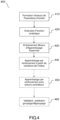
- FIG 4 represents a method of training a supervised machine learning engine of the processing complexity of an ATC situation, in a set of embodiments of the invention.
- Method 400 takes as input a set of ATC situations such as ATC 340 situations.
- Method 400 includes a subset of steps for associating, with each situation in a set, an input parameter vector and an Air Traffic Control complexity index. The steps of method 400 may be performed on all or some of the ATC situations.
- the method 400 comprises a step 410 of forming, from the set of parameters of an ATC situation 340, a vector of input parameters.
- This vector is formed from the set of parameters associated with a given ATC situation, such as the flight trajectories of aircraft crossing the sector, or the weather in the sector during the duration of the situation considered.
- This step makes it possible to formalize, for each ATC situation, the significant input parameters in the form of a vector that can be used as input to a machine learning engine.
- the method comprises a step 420 of executing an analytical calculation function of an ATC complexity index from the input parameters.
- An analytical computational function is a function that allows to evaluate an index of airspace complexity by means of operations and equations on the input parameters.
- a function will be able to evaluate parameters indicative of the complexity of processing a situation, such as the density of air traffic, the number of possible conflicts between trajectories of nearby aircraft, etc.
- the complexity index can be expressed in different ways. For example, it can be expressed as a scale, for example a number between 0.1 and 0.9.
- the complexity calculation function consists in performing a minute-by-minute sum of an indicator of occupancy/complexity of the situation. For example, this indicator can be initialized at 0.9; increased by 0.2 if the flight trend is not stable at a reference position, and further increased by 0.2 if the average flight speed is less than 300 knots. This thus allows to have a higher complexity indicator, if the aircraft fly fast and/or if their trajectories change a lot.
- This function is given by way of example only, and many other analytical functions, consisting in calculating a complexity indicator from operations and equations on the input parameters can be used.
- Steps 410 and 420 are repeated for each ATC situation.
- the method 400 comprises a step 420 of training a supervised machine learning engine such as the engine 320, said engine taking as input the associations, for each situation respectively, between the input parameter vector and the complexity index corresponding to each situation.
- the method then comprises a step 430 of training a supervised machine learning engine 320 taking as input associations, for each situation respectively, between its vector of input parameters and its complexity index ATC.
- the input parameter vector serves as the feature vector, and the computed complexity index as the label.
- the machine learning engine 320 can thus be trained to predict the results of the analytical function, for each situation.
- the machine learning engine 320 is capable of predicting the complexity of a situation from the parameters thereof. Such an engine has the advantage of requiring limited resources to predict the complexity of a given situation.
- the machine learning engines can thus predict the complexity of a situation in a bounded time, regardless of are the parameters associated with the situation, unlike analytical functions, whose calculation time can vary significantly, and become very important for particularly complex situations. This therefore ensures that it is possible to determine the complexity of a situation practically in real time.
- the method 400 comprises, for at least one ATC situation, reinforcement learning from data representative of the workload experienced by an air traffic controller in the situation.
- these interactions with the controllers can be both direct, through feedback from a controller on the calculated indices, and indirect, for example through measures representing the activity or workload of a controller recorded in real time in the ATC situation.
- the method 400 comprises, for at least one situation, a step 440 of refining the complexity indices from data 350 representative of the workload felt by an air traffic controller recorded for the sector and during the period of time, and of reinforcement learning of the supervised machine learning engine from the refined index.
- the refinement consists in refining the complexity indices to take into account the intensity of the interactions occurring during the processing of the sector by the air traffic controller during the time period and/or the workload felt by the controller.
- the data 350 are representative of the effective complexity of the processing, which can make it possible to improve the index calculated by the analytical functions, and thus improve the learning of the supervised learning engine 320.
- a variation of the complexity indices can be obtained from the 350 data: a positive or negative variation can be applied, if the calculated complexity index is not consistent with the 350 data for the situation. For example, if a low complexity index has been previously calculated, but the 350 data show a very large number of interactions between the controller and the aircraft during the corresponding period (for example, a very high number of CPDLC messages), a positive variation can be associated with the situation. Conversely, if a high complexity index has been previously calculated, but the 350 data show a low interaction between the controller and the air traffic control interface (low number of clicks, few mouse movements, etc.), a negative variation can be associated with the complexity index.
- reinforcement learning of the supervised learning engine 320 is applied, by iteratively retraining the supervised learning engine, with the objective of refining the learning to take into account the variations for each situation.
- the method 400 also comprises, for each situation, a step 450 of reinforcement learning of the supervised learning engine 320 based on feedback from at least one air traffic controller on the calculated ATC complexity index.
- This step consists, firstly, in presenting to an air traffic controller one of the training ATC situations, and the index calculated by the supervised learning engine 320.
- the presentation of the ATC situation can be carried out by a role-play, by simulating the situation for the controller.
- the controller can enter a perceived complexity gap.
- This gap represents the difference between the complexity perceived by the controller, and the complexity calculated by the engine 320.
- the complexity index is expressed on a scale ranging from 1 to 100
- the controller can enter a positive gap if it considers that the situation was in reality more complex than what was calculated by the supervised learning engine, and vice versa, the absolute value of the gap entered being all the more important as the controller estimates that the gap between calculated complexity and actual complexity is significant.
- this deviation is provided to the supervised learning engine 320 for reinforcement learning.
- This procedure can be performed for multiple situations, by multiple controllers.
- Reinforcement learning has the advantage of adapting learning very efficiently with a relatively small number of inputs.
- reinforcement learning with the processing of 200 situations by 5 controllers allows very efficient learning, the supervised learning engine 320 then being much more efficient than the analytical functions.
- This number of situations to be processed remains entirely reasonable, and in any case several orders of magnitude lower than the number of situations that would have been necessary for supervised learning exclusively based on the indices determined by the controllers, without having previously carried out steps 420 and 430.
- the learning engine 320 is capable of calculating a complexity index of a given ATC situation, from a data vector of the same type as those with which it was trained, including in particular weather information and aircraft trajectories over a sector for a given period of time.
- This adaptation of an airspace can be done in particular by grouping sectors, i.e. merging several sectors into one, or by ungrouping them, i.e. separating an air sector into several sub-sectors.
- Clustering and unclustering can be done in different ways. For example, if the complexity of two contiguous sectors becomes lower than a threshold predefined, they can be grouped into one. Conversely, if the complexity of an air sector becomes higher than a predefined threshold, it can be ungrouped into several.
- clustering can be performed using a bottom-up tree optimization algorithm: each leaf represents the smallest possible elementary sector, then contiguous sectors are iteratively grouped by 2 or 4 up to the root which corresponds to the largest possible sector, for example an entire FIR.
- the complexity is calculated from bottom to top for each elementary sector, then for each possible group of sectors. Sectors can then be grouped if one or more conditions are met: if the complexity of a group is smaller than the sum of the complexities of the elementary sectors that constitute it, if the complexity of a group is lower than a predefined threshold, etc.
- reinforcement learning can be performed, aiming to minimize the deviations between the sector grouping/ungrouping predictions made from the complexity calculations performed by the engine 320, and the decisions actually taken by the controllers.
- the steps of the method 400 are presented in the following order: steps 410, 420, 440, 450, 460 then 460.
- this order is given for information purposes only, and, according to certain embodiments of the invention, certain steps may not be performed, or may be performed in different orders.
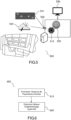
- FIG. 5 represents a system for calculating the complexity of processing an ATC situation using a supervised machine learning engine, in one embodiment of the invention.
- the system 500 may be, for example, an ATM, ATC or ATFM system, allowing air traffic controllers to monitor the air situation in a given sector.
- the system 500 is a computing system.
- the system 300 may be a single computing device such as a computer, a server, or any other system capable of performing computational calculations.
- the system 500 may also include a plurality of computing devices.
- the system 500 may be a server farm comprising multiple computing servers.
- the system 500 thus comprises at least one calculation unit 510 capable of executing a supervised automatic learning engine 320, similar to the supervised learning engine presented in figure 3 .
- the supervised machine learning engine 320 has been trained by a method such as method 400, and/or a system such as system 300.
- the at least one computing unit 310 may be any type of computing unit capable of performing computational calculations.
- the computing unit may be a processor configured with machine instructions, a microprocessor, an integrated circuit, a microcontroller, a programmable logic circuit, or any other computing unit capable of being programmed to perform computational operations.
- Input parameters can be received in different ways. For example, aircraft trajectories can be received by radio communication with the aircraft, by radar measurements, etc. Weather information can be received for example by measurements from a weather radar, by subscription to a weather service.
- the at least one port 530 may be of different types: internet connection, radio link, etc.
- the invention is not restricted to one type of input port, and those skilled in the art will be able to adapt the reception of the input parameters to the available input channels.
- the different input parameters may be received on a single port, or several ports, of the same type or of different types.
- the aircraft trajectories 541 may be received by radio link, and the weather information 542 by an internet connection.
- the at least one computing unit 510 is configured to form, for the current ATC situation, an input parameter vector comprising parameters of the set.
- the at least one calculation unit 510 is also configured to calculate, from the input vector, an ATC complexity index of the current situation.
- the 500 system is thus capable of calculating an ATC complexity index of the current situation, while benefiting from the advantages of training the supervised learning engine.
- the supervised learning engine 320 makes it possible to calculate ATC complexity indices with limited resource requirements, and a deterministic execution time. This makes it possible to take into account the evolution of the complexity of the sectors over time in a reactive manner.
- the system 500 can use it in different ways. For example, it can display it to at least one operator, for example an air traffic controller, via at least one screen 550. This allows the operator to verify that the number of air traffic controllers assigned to a given situation/sector is adequate depending on the complexity thereof. It can also raise an alert, either if the ATC complexity of a situation is too high compared to the number of controllers assigned to handle it, or it is too low, in which case too many air traffic controllers are mobilized for this situation.
- an air traffic controller for example an air traffic controller
- the at least one computing unit 510 is configured to dynamically redefine the shape and size of the sectors, in order to form as few sectors as possible, while ensuring that the ATC complexity of each sector is less than a predefined threshold.
- This complexity threshold can for example be a threshold above which the sector becomes too complex to be processed by air traffic controllers.
- the ATC complexity of a situation represented by a sector and a given period can be calculated by the supervised learning engine 320.
- the calculation time of the complexity of a sector by the supervised learning engine 320 is bounded and deterministic. This therefore makes it possible to solve a constrained optimization problem, recalculating at each iteration the complexity for each sector and time period. This thus allows a dynamic allocation of the air sectors. For example, airspace sectorization can be redefined in one-hour periods.
- FIG. 6 represents a method of calculating the processing complexity of an ATC situation using a supervised machine learning engine, in one embodiment of the invention.
- the method comprises a step 610 of forming, for the current ATC situation, a vector of input parameters comprising parameters of the set.
- the method then comprises a step 620 of executing a supervised learning engine 320 to calculate, from the input vector, an ATC complexity index of the current situation, said engine having been trained by the method 400.
Landscapes
- Engineering & Computer Science (AREA)
- Physics & Mathematics (AREA)
- General Physics & Mathematics (AREA)
- Theoretical Computer Science (AREA)
- Aviation & Aerospace Engineering (AREA)
- Software Systems (AREA)
- Evolutionary Computation (AREA)
- Data Mining & Analysis (AREA)
- Computing Systems (AREA)
- General Engineering & Computer Science (AREA)
- Mathematical Physics (AREA)
- Artificial Intelligence (AREA)
- Life Sciences & Earth Sciences (AREA)
- Computational Linguistics (AREA)
- Biophysics (AREA)
- General Health & Medical Sciences (AREA)
- Molecular Biology (AREA)
- Biomedical Technology (AREA)
- Health & Medical Sciences (AREA)
- Business, Economics & Management (AREA)
- Human Resources & Organizations (AREA)
- Strategic Management (AREA)
- Economics (AREA)
- Entrepreneurship & Innovation (AREA)
- Computer Vision & Pattern Recognition (AREA)
- Medical Informatics (AREA)
- Educational Administration (AREA)
- Game Theory and Decision Science (AREA)
- Development Economics (AREA)
- Marketing (AREA)
- Operations Research (AREA)
- Quality & Reliability (AREA)
- Tourism & Hospitality (AREA)
- General Business, Economics & Management (AREA)
- Traffic Control Systems (AREA)
- Radar, Positioning & Navigation (AREA)
- Remote Sensing (AREA)
- Atmospheric Sciences (AREA)
Claims (14)
- Computerimplementiertes Verfahren (400), das als Eingabe einen Satz von ATC-Situationen (340) empfängt, die jeweils durch einen Sektor und eine Zeitperiode definiert und jeweils mit einem Satz von Eingabeparametern assoziiert sind, die für den Sektor und die Zeitperiode Folgendes umfassen:- die Flugbahnen (341) von Luftfahrzeugen, die den Sektor durchquert haben;- meteorologische Informationen (342);wobei das Verfahren für jede ATC-Situation Folgendes umfasst:- einen Schritt (410) des Bildens eines Eingabeparametervektors, der Parameter des mit der ATC-Situation assoziierten Satzes umfasst;- einen Schritt (420) des Ausführens einer analytischen Funktion zum Berechnen eines ATC-Komplexitätsindex der Situation auf der Basis der Eingabeparameter;wobei das Verfahren einen Schritt (430) des Trainierens einer Engine (320) für überwachtes maschinelles Lernen umfasst, der als Eingabe für jede Situation jeweils Assoziationen zwischen seinem Eingangsparametervektor und seinem ATC-Komplexitätsindex hat.
- Verfahren nach Anspruch 1, das für mindestens eine ATC-Situation Enforcement-Learning (440, 450) auf der Basis von Daten umfasst, die für die von einem Fluglotsen in der Situation erfahrene Arbeitslast repräsentativ sind.
- Verfahren nach einem der Ansprüche 1 bis 2, das für mindestens eine ATC-Situation einen Schritt (440) des Berechnens von Variationen des ATC-Komplexitätsindex auf der Basis von Daten (350), die für die von einem Fluglotsen in der Situation erfahrene Arbeitslast repräsentativ sind und für den Sektor und während der Zeitperiode aufgezeichnet wurden, und von Reinforcement-Learning der Engine für überwachtes maschinelles Lernen auf der Basis der Variationen umfasst.
- Verfahren nach einem der Ansprüche 1 bis 3, das für jede ATC-Situation einen Schritt (450) des Reinforcement-Learning der Engine (320) für überwachtes Lernen umfasst, der Folgendes umfasst:- Präsentieren, mindestens einem Fluglotsen, einer ATC-Situation und eines ATC-Komplexitätsindex, der von der Engine (320) für überwachtes Learning für diese Situation berechnet wurde;- Empfangen einer Komplexitätsindex-Abweichung, die von dem mindestens einen Fluglotsen erfasst wird;- Pönalisieren des Lernens in Abhängigkeit von dieser Abweichung.
- Verfahren nach einem der Ansprüche 1 bis 4, das einen Schritt (460) des Vergleichens von Sektorgruppierungs- und -entgruppierungsvorhersagen, die auf der Basis von von der Machine-Learning-Engine berechneten ATC-Komplexitätsindizes vorgenommen wurden, und von in dem Satz von ATC-Situationen von Fluglotsen vorgenommenen Sektorgruppierungen und -entgruppierungen umfasst.
- Verfahren nach Anspruch 5, das das Validieren des Trainings der Engine für überwachtes Lernen auf der Basis der Vergleiche umfasst.
- Verfahren nach einem der Ansprüche 5 bis 6, das Reinforcement-Learning der Engine für überwachtes Lernen auf der Basis der Vergleiche umfasst.
- System (300), das Folgendes umfasst:- mindestens eine Recheneinheit (310), die eine Engine (320) für überwachtes maschinelles Lernen trainieren kann;- Zugang zu mindestens einem Informationsspeichermedium (330), das für einen Satz von jeweils durch einen Sektor und eine Zeitperiode definierten ATC-Situationen (340) einen Satz von Parametern speichert, der für den Sektor und die Zeitperiode Folgendes umfasst:- Flugbahnen (341) von Luftfahrzeugen, die den Sektor überquert haben;- meteorologische Informationen (342);wobei die mindestens eine Recheneinheit (310) für jede ATC-Situation konfiguriert ist zum:- Bilden (410) eines Eingabeparametervektors, der Parameter des mit der ATC-Situation assoziierten Satzes umfasst;- Ausführen (420) einer analytischen Funktion zur Berechnung eines ATC-Komplexitätsindex der Situation auf der Basis der Eingabeparameter;wobei die mindestens eine Recheneinheit zum Trainieren (430) einer Engine (320) für überwachtes maschinelles Lernen konfiguriert ist, die als Eingabe Assoziationen für jede Situation jeweils zwischen ihrem Eingabeparametervektor und ihrem ATC-Komplexitätsindex hat.
- Computerprogrammprodukt, das Programmcode-Befehle zur Ausführung der Schritte des Verfahrens nach einem der Ansprüche 1 bis 7 bei Ausführung des Programms auf einem Computer umfasst.
- Computerimplementiertes Verfahren (600), das für eine durch einen aktuellen Sektor und eine Zeitperiode definierte aktuelle ATC-Situation einen Satz von Parametern als Eingabe erhält, der für den aktuellen Sektor Folgendes umfasst:- Flugbahnen (541) von Luftfahrzeugen, die den Sektor durchqueren;- meteorologische Informationen (542);wobei das Verfahren (600) Folgendes umfasst:- einen Schritt (610) des Bildens, für die aktuelle ATC-Situation, eines Eingabeparametervektors, der Parameter des Satzes umfasst;- einen Schritt (620) des Ausführens einer Engine (320) für überwachtes Lernen, um auf der Basis des Eingabevektors einen ATC-Komplexitätsindex für die aktuelle Situation zu berechnen, wobei die Engine durch ein Verfahren nach einem der Ansprüche 1 bis 7 trainiert wurde.
- Computerprogrammprodukt, das Programmcode-Befehle zur Ausführung der Schritte des Verfahrens nach Anspruch 10 umfasst, wenn das Programm auf einem Computer ausgeführt wird.
- System (500), das Folgendes umfasst:- mindestens eine Recheneinheit (510), die zum Ausführen einer Engine (320) für überwachtes maschinelles Lernen geeignet ist;- mindestens einen Eingangsport (530), der für eine durch einen aktuellen Sektor und eine Zeitperiode definierte aktuelle ATC-Situation einen Satz von Parametern empfangen kann, der für den aktuellen Sektor Folgendes umfasst:wobei die mindestens eine Recheneinheit (310) konfiguriert ist zum:- Flugbahnen (541) von Luftfahrzeugen, die den Sektor durchqueren;- meterologische linformationen (542);- Bilden (610), für die aktuelle ATC-Situation, eines Eingabeparametervektors, der Parameter des Satzes umfasst;- Ausführen (620) der Engine (320) für überwachtes Lernen, um auf der Basis des Eingabevektors einen ATC-Komplexitätsindex für die aktuelle Situation zu berechnen, wobei die Engine durch ein Verfahren nach einem der Ansprüche 1 bis 7 trainiert wurde.
- System nach Anspruch 12, wobei die mindestens eine Recheneinheit (510) zum dynamischen Neudefinieren der Sektoren eines Luftraums auf der Basis der von der Engine (320) für überwachtes Lernen (320) für die Sektoren berechneten ATC-Komplexitätsindizes konfiguriert ist.
- System nach Anspruch 13, wobei die mindestens eine Recheneinheit (510) zum Lösen eines eingeschränkten Optimierungsproblems konfiguriert ist, das darauf abzielt, die Gesamtzahl von Sektoren in einem Luftraum zu minimieren, während sie stellt sicher, dass die von der Engine (320) für überwachtes Lernen (320) für jeden Sektor und jede Zeitperiode berechnete ATC-Komplexität unter einer vordefinierten Komplexität liegt.
Applications Claiming Priority (2)
| Application Number | Priority Date | Filing Date | Title |
|---|---|---|---|
| FR1908722A FR3099625A1 (fr) | 2019-07-31 | 2019-07-31 | Systeme et methode pour la determination amelioree de complexite de secteur aeriens |
| PCT/EP2020/069690 WO2021018556A1 (fr) | 2019-07-31 | 2020-07-13 | Système et méthode pour la détermination améliorée de complexité de secteurs aériens |
Publications (3)
| Publication Number | Publication Date |
|---|---|
| EP4004894A1 EP4004894A1 (de) | 2022-06-01 |
| EP4004894B1 true EP4004894B1 (de) | 2024-10-09 |
| EP4004894C0 EP4004894C0 (de) | 2024-10-09 |
Family
ID=69630341
Family Applications (1)
| Application Number | Title | Priority Date | Filing Date |
|---|---|---|---|
| EP20737203.8A Active EP4004894B1 (de) | 2019-07-31 | 2020-07-13 | System und verfahren zur verbesserten bestimmung der komplexität von luftsektoren |
Country Status (6)
| Country | Link |
|---|---|
| US (1) | US12542064B2 (de) |
| EP (1) | EP4004894B1 (de) |
| AU (1) | AU2020322283A1 (de) |
| FR (1) | FR3099625A1 (de) |
| HU (1) | HUE069863T2 (de) |
| WO (1) | WO2021018556A1 (de) |
Families Citing this family (4)
| Publication number | Priority date | Publication date | Assignee | Title |
|---|---|---|---|---|
| CN111598148B (zh) * | 2020-04-29 | 2022-09-16 | 中国电子科技集团公司第二十八研究所 | 一种基于历史容量相似特征的容量评估方法及设备 |
| FR3111465B1 (fr) | 2020-06-12 | 2023-06-02 | Thales Sa | Système et méthode pour une détection rapide et fiable de complexité de secteurs aériens |
| CN113592341B (zh) * | 2021-08-10 | 2024-07-02 | 南京航空航天大学 | 度量损失函数、扇区复杂度评估方法及系统 |
| CN114065407B (zh) * | 2022-01-18 | 2022-05-17 | 中国民航大学 | 一种基于机场风速多元感知的尾流间隔动态缩减方法 |
Family Cites Families (6)
| Publication number | Priority date | Publication date | Assignee | Title |
|---|---|---|---|---|
| WO2009052404A1 (en) * | 2007-10-17 | 2009-04-23 | Lockheed Martin Corporation | Hybrid heuristic national airspace flight path optimization |
| CN105225539B (zh) * | 2015-09-30 | 2017-12-05 | 中国民用航空总局第二研究所 | 基于主成分分析的扇区运行性能综合指数的方法及系统 |
| CN105206115B (zh) * | 2015-09-30 | 2017-11-17 | 中国民用航空总局第二研究所 | 一种基于主成分分析的空中交通管制扇区通行能力检测方法 |
| US10643480B2 (en) * | 2016-04-19 | 2020-05-05 | George Mason University | Method and apparatus for probabilistic alerting of aircraft unstabilized approaches using big data |
| CN107944472B (zh) * | 2017-11-03 | 2019-05-28 | 北京航空航天大学 | 一种基于迁移学习的空域运行态势计算方法 |
| US11410558B2 (en) * | 2019-05-21 | 2022-08-09 | International Business Machines Corporation | Traffic control with reinforcement learning |
-
2019
- 2019-07-31 FR FR1908722A patent/FR3099625A1/fr active Pending
-
2020
- 2020-07-13 EP EP20737203.8A patent/EP4004894B1/de active Active
- 2020-07-13 AU AU2020322283A patent/AU2020322283A1/en active Pending
- 2020-07-13 WO PCT/EP2020/069690 patent/WO2021018556A1/fr not_active Ceased
- 2020-07-13 US US17/631,486 patent/US12542064B2/en active Active
- 2020-07-13 HU HUE20737203A patent/HUE069863T2/hu unknown
Also Published As
| Publication number | Publication date |
|---|---|
| WO2021018556A1 (fr) | 2021-02-04 |
| EP4004894A1 (de) | 2022-06-01 |
| US20220270497A1 (en) | 2022-08-25 |
| FR3099625A1 (fr) | 2021-02-05 |
| US12542064B2 (en) | 2026-02-03 |
| AU2020322283A1 (en) | 2022-03-10 |
| HUE069863T2 (hu) | 2025-04-28 |
| EP4004894C0 (de) | 2024-10-09 |
Similar Documents
| Publication | Publication Date | Title |
|---|---|---|
| EP4004894B1 (de) | System und verfahren zur verbesserten bestimmung der komplexität von luftsektoren | |
| US20250232682A1 (en) | Unmanned Aerial Vehicle Authorization And Geofence Envelope Determination | |
| US10909859B1 (en) | Optimized deployment of remotely operated aerial vehicle resources from a fleet to satisfy requests for remotely operated aerial vehicle resources | |
| FR3055958A1 (fr) | Aide a la decision pour la revision d'un plan de vol | |
| FR3046225B1 (fr) | Affichage de donnees meteorologiques dans un aeronef | |
| US20190130769A1 (en) | Real-time identification and provision of preferred flight parameters | |
| US12555373B2 (en) | Automated hazard recognition using multiparameter analysis of aerial imagery | |
| US20150254738A1 (en) | Systems and methods for aerial imaging and analysis | |
| US11054280B2 (en) | Displaying weather-based flight information in vertical profile | |
| EP4086576B1 (de) | Optimiertes management des flugverkehrs von unbemannten luftfahrzeugen | |
| FR3010809A1 (fr) | Procede et dispositif de gestion automatique a bord d'un aeronef de messages audio de controle aerien. | |
| FR3038750A1 (fr) | Procede d'integration d'un nouveau service de navigation dans un systeme avionique embarque a architecture ouverte de type client-serveur, en particulier d'un service de manoeuvre fim | |
| US11585960B2 (en) | Effective agriculture and environment monitoring | |
| WO2021249712A1 (fr) | Système et méthode pour une détection rapide et fiable de complexité de secteurs aériens | |
| EP4165619A1 (de) | System und verfahren zur besseren bestimmung von wegparametern von flugzeugen | |
| Hernández et al. | Real-time estimated time of arrival prediction system using historical surveillance data | |
| FR3105545A1 (fr) | Dispositif et procede de proposition automatique de resolution de conflits aeriens | |
| EP4524806A1 (de) | Verfahren zur bestimmung des risikos eines landefehlers | |
| FR3161956A1 (fr) | Procédé et système d’aide à la replanification de trajectoire pour un véhicule mobile et programme d’ordinateur associé | |
| EP4068244A1 (de) | Hilfsverfahren zur steuerung von luftfahrzeugen | |
| EP4350667A1 (de) | Verfahren zur verwaltung von flugparametern von flugzeugen | |
| EP4068245A1 (de) | Hilfsvorrichtung zur steuerung von luftfahrzeugen | |
| CN121010165A (zh) | 一种低空空域资源配置方法、装置、存储介质及电子设备 |
Legal Events
| Date | Code | Title | Description |
|---|---|---|---|
| STAA | Information on the status of an ep patent application or granted ep patent |
Free format text: STATUS: UNKNOWN |
|
| STAA | Information on the status of an ep patent application or granted ep patent |
Free format text: STATUS: THE INTERNATIONAL PUBLICATION HAS BEEN MADE |
|
| PUAI | Public reference made under article 153(3) epc to a published international application that has entered the european phase |
Free format text: ORIGINAL CODE: 0009012 |
|
| STAA | Information on the status of an ep patent application or granted ep patent |
Free format text: STATUS: REQUEST FOR EXAMINATION WAS MADE |
|
| 17P | Request for examination filed |
Effective date: 20220125 |
|
| AK | Designated contracting states |
Kind code of ref document: A1 Designated state(s): AL AT BE BG CH CY CZ DE DK EE ES FI FR GB GR HR HU IE IS IT LI LT LU LV MC MK MT NL NO PL PT RO RS SE SI SK SM TR |
|
| DAV | Request for validation of the european patent (deleted) | ||
| DAX | Request for extension of the european patent (deleted) | ||
| RIC1 | Information provided on ipc code assigned before grant |
Ipc: G06N 3/08 20060101ALI20240325BHEP Ipc: G06N 3/045 20230101ALI20240325BHEP Ipc: G06N 3/00 20060101ALI20240325BHEP Ipc: G06Q 10/06 20120101ALI20240325BHEP Ipc: G08G 5/00 20060101AFI20240325BHEP |
|
| GRAP | Despatch of communication of intention to grant a patent |
Free format text: ORIGINAL CODE: EPIDOSNIGR1 |
|
| STAA | Information on the status of an ep patent application or granted ep patent |
Free format text: STATUS: GRANT OF PATENT IS INTENDED |
|
| INTG | Intention to grant announced |
Effective date: 20240515 |
|
| GRAS | Grant fee paid |
Free format text: ORIGINAL CODE: EPIDOSNIGR3 |
|
| GRAA | (expected) grant |
Free format text: ORIGINAL CODE: 0009210 |
|
| STAA | Information on the status of an ep patent application or granted ep patent |
Free format text: STATUS: THE PATENT HAS BEEN GRANTED |
|
| AK | Designated contracting states |
Kind code of ref document: B1 Designated state(s): AL AT BE BG CH CY CZ DE DK EE ES FI FR GB GR HR HU IE IS IT LI LT LU LV MC MK MT NL NO PL PT RO RS SE SI SK SM TR |
|
| RAP3 | Party data changed (applicant data changed or rights of an application transferred) |
Owner name: THALES |
|
| REG | Reference to a national code |
Ref country code: CH Ref legal event code: EP |
|
| REG | Reference to a national code |
Ref country code: DE Ref legal event code: R096 Ref document number: 602020039072 Country of ref document: DE |
|
| REG | Reference to a national code |
Ref country code: IE Ref legal event code: FG4D Free format text: LANGUAGE OF EP DOCUMENT: FRENCH |
|
| U01 | Request for unitary effect filed |
Effective date: 20241018 |
|
| U07 | Unitary effect registered |
Designated state(s): AT BE BG DE DK EE FI FR IT LT LU LV MT NL PT RO SE SI Effective date: 20241104 |
|
| PG25 | Lapsed in a contracting state [announced via postgrant information from national office to epo] |
Ref country code: IS Free format text: LAPSE BECAUSE OF FAILURE TO SUBMIT A TRANSLATION OF THE DESCRIPTION OR TO PAY THE FEE WITHIN THE PRESCRIBED TIME-LIMIT Effective date: 20250209 Ref country code: HR Free format text: LAPSE BECAUSE OF FAILURE TO SUBMIT A TRANSLATION OF THE DESCRIPTION OR TO PAY THE FEE WITHIN THE PRESCRIBED TIME-LIMIT Effective date: 20241009 |
|
| PG25 | Lapsed in a contracting state [announced via postgrant information from national office to epo] |
Ref country code: ES Free format text: LAPSE BECAUSE OF FAILURE TO SUBMIT A TRANSLATION OF THE DESCRIPTION OR TO PAY THE FEE WITHIN THE PRESCRIBED TIME-LIMIT Effective date: 20241009 |
|
| PG25 | Lapsed in a contracting state [announced via postgrant information from national office to epo] |
Ref country code: NO Free format text: LAPSE BECAUSE OF FAILURE TO SUBMIT A TRANSLATION OF THE DESCRIPTION OR TO PAY THE FEE WITHIN THE PRESCRIBED TIME-LIMIT Effective date: 20250109 |
|
| PG25 | Lapsed in a contracting state [announced via postgrant information from national office to epo] |
Ref country code: GR Free format text: LAPSE BECAUSE OF FAILURE TO SUBMIT A TRANSLATION OF THE DESCRIPTION OR TO PAY THE FEE WITHIN THE PRESCRIBED TIME-LIMIT Effective date: 20250110 |
|
| PG25 | Lapsed in a contracting state [announced via postgrant information from national office to epo] |
Ref country code: PL Free format text: LAPSE BECAUSE OF FAILURE TO SUBMIT A TRANSLATION OF THE DESCRIPTION OR TO PAY THE FEE WITHIN THE PRESCRIBED TIME-LIMIT Effective date: 20241009 |
|
| REG | Reference to a national code |
Ref country code: HU Ref legal event code: AG4A Ref document number: E069863 Country of ref document: HU |
|
| PG25 | Lapsed in a contracting state [announced via postgrant information from national office to epo] |
Ref country code: RS Free format text: LAPSE BECAUSE OF FAILURE TO SUBMIT A TRANSLATION OF THE DESCRIPTION OR TO PAY THE FEE WITHIN THE PRESCRIBED TIME-LIMIT Effective date: 20250109 |
|
| PG25 | Lapsed in a contracting state [announced via postgrant information from national office to epo] |
Ref country code: SM Free format text: LAPSE BECAUSE OF FAILURE TO SUBMIT A TRANSLATION OF THE DESCRIPTION OR TO PAY THE FEE WITHIN THE PRESCRIBED TIME-LIMIT Effective date: 20241009 |
|
| PG25 | Lapsed in a contracting state [announced via postgrant information from national office to epo] |
Ref country code: SK Free format text: LAPSE BECAUSE OF FAILURE TO SUBMIT A TRANSLATION OF THE DESCRIPTION OR TO PAY THE FEE WITHIN THE PRESCRIBED TIME-LIMIT Effective date: 20241009 |
|
| PGFP | Annual fee paid to national office [announced via postgrant information from national office to epo] |
Ref country code: CZ Payment date: 20250627 Year of fee payment: 6 |
|
| PGFP | Annual fee paid to national office [announced via postgrant information from national office to epo] |
Ref country code: IE Payment date: 20250624 Year of fee payment: 6 |
|
| U20 | Renewal fee for the european patent with unitary effect paid |
Year of fee payment: 6 Effective date: 20250621 |
|
| PGFP | Annual fee paid to national office [announced via postgrant information from national office to epo] |
Ref country code: HU Payment date: 20250711 Year of fee payment: 6 |
|
| PLBE | No opposition filed within time limit |
Free format text: ORIGINAL CODE: 0009261 |
|
| STAA | Information on the status of an ep patent application or granted ep patent |
Free format text: STATUS: NO OPPOSITION FILED WITHIN TIME LIMIT |
|
| 26N | No opposition filed |
Effective date: 20250710 |
|
| REG | Reference to a national code |
Ref country code: CH Ref legal event code: H13 Free format text: ST27 STATUS EVENT CODE: U-0-0-H10-H13 (AS PROVIDED BY THE NATIONAL OFFICE) Effective date: 20260224 |
|
| GBPC | Gb: european patent ceased through non-payment of renewal fee |
Effective date: 20250713 |
|
| PG25 | Lapsed in a contracting state [announced via postgrant information from national office to epo] |
Ref country code: GB Free format text: LAPSE BECAUSE OF NON-PAYMENT OF DUE FEES Effective date: 20250713 |
|
| PG25 | Lapsed in a contracting state [announced via postgrant information from national office to epo] |
Ref country code: CH Free format text: LAPSE BECAUSE OF NON-PAYMENT OF DUE FEES Effective date: 20250731 |