EP4005943B1 - Sac en plastique et utilisation d'un sac en plastique - Google Patents
Sac en plastique et utilisation d'un sac en plastique Download PDFInfo
- Publication number
- EP4005943B1 EP4005943B1 EP20210070.7A EP20210070A EP4005943B1 EP 4005943 B1 EP4005943 B1 EP 4005943B1 EP 20210070 A EP20210070 A EP 20210070A EP 4005943 B1 EP4005943 B1 EP 4005943B1
- Authority
- EP
- European Patent Office
- Prior art keywords
- side edge
- weld
- rear wall
- front wall
- spacing
- Prior art date
- Legal status (The legal status is an assumption and is not a legal conclusion. Google has not performed a legal analysis and makes no representation as to the accuracy of the status listed.)
- Active
Links
Images

Classifications
-
- A—HUMAN NECESSITIES
- A45—HAND OR TRAVELLING ARTICLES
- A45C—PURSES; LUGGAGE; HAND CARRIED BAGS
- A45C13/00—Details; Accessories
- A45C13/02—Interior fittings; Means, e.g. inserts, for holding and packing articles
-
- B—PERFORMING OPERATIONS; TRANSPORTING
- B65—CONVEYING; PACKING; STORING; HANDLING THIN OR FILAMENTARY MATERIAL
- B65D—CONTAINERS FOR STORAGE OR TRANSPORT OF ARTICLES OR MATERIALS, e.g. BAGS, BARRELS, BOTTLES, BOXES, CANS, CARTONS, CRATES, DRUMS, JARS, TANKS, HOPPERS, FORWARDING CONTAINERS; ACCESSORIES, CLOSURES, OR FITTINGS THEREFOR; PACKAGING ELEMENTS; PACKAGES
- B65D31/00—Bags or like containers made of paper and having structural provision for thickness of contents
- B65D31/12—Bags or like containers made of paper and having structural provision for thickness of contents with two or more compartments
-
- A—HUMAN NECESSITIES
- A45—HAND OR TRAVELLING ARTICLES
- A45C—PURSES; LUGGAGE; HAND CARRIED BAGS
- A45C3/00—Flexible luggage; Handbags
- A45C3/04—Shopping bags; Shopping nets
-
- B—PERFORMING OPERATIONS; TRANSPORTING
- B65—CONVEYING; PACKING; STORING; HANDLING THIN OR FILAMENTARY MATERIAL
- B65D—CONTAINERS FOR STORAGE OR TRANSPORT OF ARTICLES OR MATERIALS, e.g. BAGS, BARRELS, BOTTLES, BOXES, CANS, CARTONS, CRATES, DRUMS, JARS, TANKS, HOPPERS, FORWARDING CONTAINERS; ACCESSORIES, CLOSURES, OR FITTINGS THEREFOR; PACKAGING ELEMENTS; PACKAGES
- B65D33/00—Details of, or accessories for, sacks or bags
- B65D33/06—Handles
- B65D33/10—Handles formed of similar material to that used for the bag
-
- B—PERFORMING OPERATIONS; TRANSPORTING
- B65—CONVEYING; PACKING; STORING; HANDLING THIN OR FILAMENTARY MATERIAL
- B65D—CONTAINERS FOR STORAGE OR TRANSPORT OF ARTICLES OR MATERIALS, e.g. BAGS, BARRELS, BOTTLES, BOXES, CANS, CARTONS, CRATES, DRUMS, JARS, TANKS, HOPPERS, FORWARDING CONTAINERS; ACCESSORIES, CLOSURES, OR FITTINGS THEREFOR; PACKAGING ELEMENTS; PACKAGES
- B65D33/00—Details of, or accessories for, sacks or bags
- B65D33/06—Handles
- B65D33/12—String handles
-
- A—HUMAN NECESSITIES
- A45—HAND OR TRAVELLING ARTICLES
- A45C—PURSES; LUGGAGE; HAND CARRIED BAGS
- A45C13/00—Details; Accessories
- A45C13/02—Interior fittings; Means, e.g. inserts, for holding and packing articles
- A45C2013/026—Inserts
-
- Y—GENERAL TAGGING OF NEW TECHNOLOGICAL DEVELOPMENTS; GENERAL TAGGING OF CROSS-SECTIONAL TECHNOLOGIES SPANNING OVER SEVERAL SECTIONS OF THE IPC; TECHNICAL SUBJECTS COVERED BY FORMER USPC CROSS-REFERENCE ART COLLECTIONS [XRACs] AND DIGESTS
- Y02—TECHNOLOGIES OR APPLICATIONS FOR MITIGATION OR ADAPTATION AGAINST CLIMATE CHANGE
- Y02W—CLIMATE CHANGE MITIGATION TECHNOLOGIES RELATED TO WASTEWATER TREATMENT OR WASTE MANAGEMENT
- Y02W30/00—Technologies for solid waste management
- Y02W30/50—Reuse, recycling or recovery technologies
- Y02W30/80—Packaging reuse or recycling, e.g. of multilayer packaging
Definitions
- the present invention relates to a reusable plastic bag with inner pocket inserts for accommodating one or more beverage bottles and a reusable plastic bag according to the invention with inner pocket inserts and holding loops for accommodating one or more beverage bottles and the use of the reusable plastic bag according to the invention with inner pocket inserts for accommodating one or more beverage bottles.
- the EP 0 311 824 A2 discloses a fold-out carrier bag for bottles made of paper, delimited by a base and a casing, with the unfolding of the carrier bag creating an accommodation space with compartments.
- the DE 299 02 399 U1 shows a transport bag for bottles based on a traditional plastic bag with a divided interior for inserting the bottles.
- the U.S. 2015/246751 A1 shows a reusable bag comprising a front wall and an opposite back wall each having an outer surface, an inner surface, a first side edge, a second side edge, a bottom edge and a top edge, a first side wall and a second side wall each having an outer surface, an inner surface, a first side edge, a second side edge, a bottom edge and a top edge, the first side edge of the first side wall being connected to the second side edge of the back wall and the second side edge of the first side wall being connected to the first side edge of the front wall, the first side edge of the second side wall is connected to the second side edge of the front wall and the second side edge of the second side wall is connected to the first side edge of the rear wall.
- the bags of U.S. 2015/246751 A1 further comprise a bottom panel having an outer surface, an inner surface, a first edge connected to the lower edge of the front panel, a second edge connected to the lower edge of the first side panel, a third edge connected to the bottom edge of the back panel, and a fourth edge connected to the bottom edge of the second side panel, wherein the front wall, the back wall, the first side wall, the second side wall, the bottom wall are made of a nonwoven material. Also have the bags of U.S.
- 2015/246751 A1 a cavity formed by the bottom wall, the front wall, the back wall, the first side wall and the second side wall, the cavity having an open end near the top edges of the front wall, the back wall, the first side wall and the second side wall having.
- These bags are also provided with a first channel wall having a first edge connected to the inner surface of the first side wall and a second edge connected to the inner surface of the second side wall, the first channel wall being substantially perpendicular to the first side wall and a second channel wall having a first edge connected to the inner surface of the first side wall and a second edge connected to the inner surface of the second side wall, the second channel wall being substantially parallel to the first channel wall and wherein the first channel wall and the second channel wall form a channel in the cavity.
- the bags of U.S. 2015/246751 A1 also have a first partition having a first edge connected to the inner surface of the front wall and a second edge connected to the first channel wall, wherein the first divider, a portion of the first channel wall, a portion of the first side wall and part of the front wall forming a first compartment, and a second partition having a first edge connected to the inner surface of the rear wall and a second edge connected to the second channel wall, the second partition, a portion of the second channel wall, a portion of the first side wall and a portion form a second compartment on the back wall.
- a reusable bag is intended to provide compartments for reusable shopping bags as well as purchased goods.
- Another bag is from the US2010/270342A1 known.
- the special carrier bags or transport bags for bottles known from the prior art have the decisive disadvantage that the subdivision of the interior space is necessarily predetermined by the division into individual chambers for the beverage bottles.
- Such a carrier bag especially for bottles has a very limited area of use, a user would hardly take it with him for a spontaneous purchase, in particular of non-drink bottles.
- some prior art systems, especially those made of paper are not designed for multiple use.
- the present invention was therefore based on the object of providing a reusable plastic bag for holding one or more beverage bottles which does not have the disadvantages of the prior art carrier bags or transport bags and which is particularly suitable for the repeated, reliable transport of even heavy glass bottles without suffering damage to the material and which can also be easily and inexpensively mass-produced by machine.
- a plastic bag was found according to claim 1 with a bag base and an opposite bag opening, comprising a front wall and a rear wall, each with a first side edge and an opposite second side edge and an opening edge and a bottom edge, the front wall and the rear wall in the region of their first and second side edges and their bottom edges are connected to one another at least in sections, in particular by means of welding, to form opposite first and second bag edges and a bag bottom edge, the front wall and/or the rear wall having at least one plastic film layer on the inside, which is at a distance from or at a distance from the first side edge extends in the direction of or up to the opposite second side edge and from the bottom edge or at a distance from the bottom edge in the direction of or up to the edge of the opening, the plastic film layer of the front wall and/or the rear wall being spaced apart from one another by at least two, in particular three or four, welded or glued areas, in particular welded seams, which run essentially parallel and extend at a distance from the bottom edge in the direction of
- Pocket inner inserts each set up and designed to hold one or more beverage bottles, the front wall being designed in multiple layers and the plastic film layer being connected exclusively to the inner layer of the multi-layered front wall via the welded or adhesive areas and/or the rear wall being designed in multiple layers and wherein the plastic film layer is connected exclusively to the inner layer of the multi-layer rear wall via the welding or adhesive areas.
- the welding or adhesive areas represent or include spot or continuous welding or gluing of the front wall or rear wall with the associated plastic film layers, in particular continuous weld seams.
- This embodiment has the advantage that the layers of plastic film lie flat against the front or rear wall when the pocket inserts are not filled with a bottle or the like, and the interior of the pocket can be filled with food, for example, in the conventional manner without restriction.
- the plastic film bag according to the invention instead of the welded or adhesive areas, there are further plastic film layers in the form of side walls, which extend from the front or rear wall to the plastic film layer already described. In this way, larger pocket inserts for accommodating larger beverage bottles or beverage bottles with a larger capacity can be generated.
- a plastic bag according to the invention described above offers inner pocket inserts for accommodating one or more beverage bottles, so that they are held securely in place within the plastic bag and do not fall over, slip or collide, whereby the inner pocket inserts can also remain unused and the plastic bag according to the invention can thus be used for Transport of other things, such as groceries can be used. If the bag's inner inserts are not used, however, they are not in the form of chambers in the bag, as is the case in carrier bags especially for bottled drinks, but lie flat on the inside of the front wall and/or rear wall, so that they cannot be loaded with other things when the plastic bag is loaded disturb.
- the inner bag inserts are open towards the bottom of the bag.
- the pocket inserts snuggle up particularly well to the front wall and/or rear wall plastic bag according to the invention can be made even easier and cheaper due to the lack of an additional welded or glued seam.
- the front wall and the rear wall are along their first side edges via a first side wall connected and joined together along their second side edges by a second side wall.
- first side edges or only the second side edges are connected to one another via a side wall, but the embodiment with two side walls is preferred.
- the additional side walls allow a larger interior space to be generated in the plastic bag according to the invention, which in particular also enables the transport of large beverage bottles or beverage bottles with a larger capacity.
- the transport of additional goods, such as groceries, in the interior space between the beverage bottles in the pocket inner slots is also conceivable.
- such embodiments of the plastic bag according to the invention have also proven to be suitable in which the bag bottom has a bottom fold, with a first bottom fold section extending from the bottom fold to the front wall and with a second bottom fold section extends from the bottom fold to the rear wall.
- the embodiment described here is particularly suitable for being able to be put down during transport without the beverage bottles falling over or tipping over in the interior of the plastic bag according to the invention.
- a uniform weight distribution of the goods to be transported, in particular the beverage bottles, within the plastic bag is particularly well possible.
- the front wall or the rear wall in particular both the front wall and the rear wall, have a hem at least in sections on the inside or outside in the area of the opening edges.
- the hem, at least in sections is on the inside on the front or rear wall, in particular on both the front and rear walls.
- those embodiments of the plastic bag according to the invention have proven to be well suited in which the hem of the front wall or the hem of the rear wall, in particular both the hem of the front wall and the rear wall, each extend from the first side edge of the front or the Rear wall extends to the opposite second side edge of the front and rear walls.
- such embodiments are very expedient in which the hem of the front wall spaced from the edge of the opening along an extension of or spaced from the first side edge in the direction of or up to the second side edge with connected to the front wall, in particular welded or glued, in particular with a continuous longitudinal weld.
- the hem of the rear wall is also connected, in particular welded or glued, to the rear wall at a distance from its opening edge along an extension of or at a distance from the first side edge in the direction of or up to the second side edge, in particular with a continuous longitudinal weld.
- Configurations are also conceivable for both the seam of the front wall and the rear wall, in which both welding and gluing are present.
- a plastic bag according to the invention which has already been described and which also comprises at least one holding loop connected to the front wall or at least one to the rear wall, each with a first and a second connection region, preferably both one with the front wall and one with a strap attached to the back panel. It has proven to be particularly suitable if the straps connected to the front wall and to the rear wall are each welded or glued in their first and second connection areas in the area of the hem of the front or rear wall, or if they are both welded and glued.
- the described embodiment of the plastic bag according to the invention with the straps is easier to transport, but the straps attached in this way also show improved resilience and carrying strength compared to conventional carrier bags due to the reduced mechanical wear, especially when the plastic bag according to the invention is used multiple times.
- the strap connected to the front wall via its first and second connection areas and/or the strap with the rear wall has a first flexible tubular hollow body or a single-layer or multi-layer material strip that does not form a hollow body, in particular a strip of plastic material, which is connected at least in sections or essentially completely is covered by a second flexible tubular hollow body.
- the at least one plastic film layer is connected at least in sections to the first side edge and/or the second side edge, in particular by welding.
- a particularly robust and resilient plastic carrier bag is obtained in particular through the combination of the features described above, which form the reinforced seam, with the features of the holding loop.
- the front wall and the rear wall have, in particular triangular, cutouts at the transition from their bottom edges to the bag edges.
- Plastic bags according to the invention are particularly expedient in which the at least one plastic film layer extends in the direction from the bottom edge to the opening edge of the front wall, which corresponds to up to 80%, in particular 40 to 60%, of the extension of the front wall from the bottom edge to the opening edge.
- the at least one plastic film layer on the rear wall in the direction from the bottom edge to the opening edge of the rear wall has an extent that is 30 to 80%, in particular 40 to 60%, of the extent of the rear wall from the bottom edge to the opening edge.
- the bottom opening of the pocket insert is at a distance from the bottom of the pocket that is 5 to 30%, in particular 10 to 20%, of the extent of the front wall or the rear wall corresponds to the edge of the bottom to the edge of the opening.
- the at least one plastic film layer has an extension in the direction from the first to the second side edge of the front wall, that of the extension corresponds to the front wall from the first to the second side edge.
- the at least one plastic film layer of the rear wall extends in the direction from the first to the second side edge of the rear wall, which corresponds to the extension of the rear wall from the first to the second side edge.
- thermoplastics Preference is given to all embodiments of the plastic bag according to the invention in which the front wall or the rear wall or the at least one plastic film layer or optionally the side walls of the plastic bag or the bottom of the bag or the hem of the front and/or rear wall or the holding loops are essentially based on thermoplastics or are made from this. Particularly preferred are the configurations of the plastic bag according to the invention in which all of the components just listed or at least a large part of the components listed are based on or are made from thermoplastics. However, any combination with other textiles, such as natural fibers or man-made fibers, is also conceivable. However, preference is given to thermoplastics, preference being given to polyolefins, in particular polyethylene and/or polyester.
- plastic-based bags have the disadvantage that they are difficult to degrade in the environment.
- the plastic bags according to the invention therefore essentially consist of or comprise recyclable materials. It is advantageous if a uniform plastic material is used throughout in order to obtain a single-variety plastic for recycling.
- inner pocket compartments adjacent the side edges that are smaller than the adjoining inner pocket inner compartments. They can be used for the safe, local storage of small, especially long, objects, but unlike the wider inner pocket inserts, they can also remain unused in order to make it easier to fill the other inner pocket inserts, especially if the inner pocket inserts are on the inside of the front wall and on the inside of the rear wall to be filled with bottles at the same time.
- the distance from the welding or adhesive area, in particular in the form of a weld seam, which is arranged adjacent to the first side edge, to this first side edge is a maximum of 75%, in particular a maximum of 50%
- plastic bags according to the invention those are particularly preferred in which, in relation to the front wall, the spacing of at least two pairs, in particular of all pairs, in adjacent welding or adhesive areas, in particular in the form of weld seams, is essentially the same and/or in which in relation to the rear wall, the spacing of at least two pairs, in particular of all pairs, is essentially the same at mutually adjacent welding or adhesive areas.
- the distance from adjacent welded or bonded areas of a pair of such welded or bonded areas, in particular from all pairs of adjacent welded or bonded areas, is preferably in the range of 8 to 18 cm, particularly preferably in the range of 10 to 16 cm and especially in the range of 12.0 to 14.0 cm.
- plastic bags according to the invention are also obtained if the front wall is designed in two layers and/or, in particular, and that the rear wall is designed in two layers.
- those in which the plastic film layer on the front wall is connected exclusively to the inner layer of the multi-layer front wall via the welded areas in the form of weld seams are particularly preferred, it being possible to provide alternatively or additionally, in particular additionally, for the plastic film layer on the rear wall to be connected via the Welding areas in the form of welds is connected exclusively to the inner layer of the multi-layer rear wall.
- the plastic film layer of the front wall and/or, in particular, the plastic film layer of the rear wall preferably comprise low-density polyethylene and are in particular made of it educated. Furthermore, such plastic film layers of the front wall and/or, in particular and, the rear wall with an average, in particular absolute, thickness in the range from 30 to 80 ⁇ m, in particular in the range from 35 to 60 ⁇ m, are particularly preferred. Such plastic film layers regularly have sufficient elasticity and also allow larger objects, in particular bottles, to be inserted into the pocket inserts.
- the object on which the invention is based is also achieved by using the plastic bag according to the invention for transporting beverage bottles, in particular beverage bottles with a capacity of up to 2 liters of liquid.
- the plastic bag according to the invention with inner pocket inserts and the plastic bag according to the invention with inner pocket inserts and straps as well as the use of the plastic bag according to the invention is accompanied by the surprising finding that one or more beverage bottles can be transported safely without the individual beverage bottles slipping, tipping over or colliding comes inside the plastic bag. It is also possible to safely park the plastic bag during transport.
- the plastic bag can be easily and inexpensively mass-produced, with the material being reusable, durable and extremely resilient and tear-resistant.
- the plastic bag according to the invention is not only limited to the transport of beverage bottles: if other goods, such as groceries, are transported in the plastic bag according to the invention, the inner pocket inserts are not disturbing or even in the way, but nestle flat against the inside of the front - or the back wall of the plastic bag.
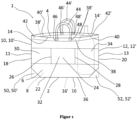
- FIG. 1 shows a schematic view of a plastic bag 1 according to the invention.
- This comprises a bag base 2 with a bag base fold 36 and an opposite bag opening 4 and a front wall 6 and a rear wall 8, each with a first side edge 10, 10 'and an opposite second side edge 12, 12' and an opening edge 14, 14' and a bottom edge 16, 16'.
- the front wall 6 and the rear wall 8 are joined in the region of their first 10, 10' and second side edges 12, 12' and their bottom edges 16, 16' by means of welding to form a first pocket edge 18 and a second pocket edge 20 and a Bag bottom edge 22 connected to each other.
- the front wall 6 has a plastic film layer 24 on the inside, which extends from the first side edge 10 in the direction of the second side edge 12 and spaced from the bottom edge 16 in the direction of the opening edge 14, with the plastic film layer 24 covering two welding or adhesive areas 26 , 28 which are connected in sections to the inside of the front wall 6 and form the pocket inserts 30, 32 and 34 which are open towards the bottom 2 of the pocket.
- the inclusion of a drinks bottle is shown as an example in the pocket insert 34 .
- the rear wall 8 is likewise equipped on the inside with a plastic film layer (not shown) in a corresponding manner.
- the embodiment of the plastic bag 1 according to the invention shown here also comprises a hem 38, 38' on the inside of the front 6 and rear wall 8, which is created by turning over continuation sections 42, 42' on the front 6 and rear wall 8, respectively .
- the seams 38, 38' are inboard to the front panel 6 and rear panel 8, respectively, via continuous longitudinal welds 40, 40' connected.
- the embodiment shown here of the plastic bag 1 according to the invention has straps 44, 44' on the front 6 and rear wall 8, which on the inside on the reinforced hem 38, 38' have a first connection area 46, 46' and a second connection area 48, 48'. are attached.
- the plastic bag 1 shown here has triangular recesses 50, 50', 52, 52' on the bottom 2 of the bag.
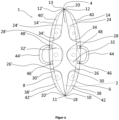
- FIG figure 2 shows a schematic top view of the embodiment of the inventive plastic bag 1 according to FIG figure 1 .
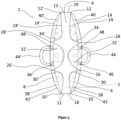
- the plastic film layers 24, 24' are connected on the inside to the front wall 6 or the rear wall 8 by welding or adhesive areas 26, 26', 28, 28', so that a total of six pocket inserts 30, 30', 32, 32', 34 and 34 'Be trained to hold six beverage bottles. If there are no bottles in the pocket inserts 30, 30', 32, 32', 34, the plastic film layers 24, 24' lie against the inside of the front wall 6 or the rear wall 8 and do not interfere with the conventional filling process of a plastic bag 1.
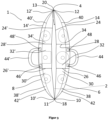
- FIG figure 3 shows a schematic plan view of a further embodiment of a plastic bag 1 according to the invention. This differs from the embodiment according to FIG figure 2 in that the welding or adhesive areas 26, 26', 28 and 28' are not designed as spot or continuous welds or adhesive bonds with the front 6 or rear wall 8, but as separate film partitions, which makes it possible to accommodate larger beverage bottles or of beverage bottles with a larger capacity.
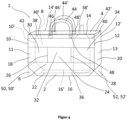
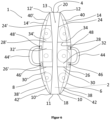
- FIG figure 4 shows a schematic view of an alternative embodiment of a plastic bag 1 according to the invention. This differs from the embodiment according to FIG figure 1 ) in that the first 10, 10' and second side edges 12, 12' of the front wall 6 and the rear wall 8 are connected to one another via a first side wall 11 and a second side wall 13, in particular welded to one another.
- the first pocket edge 18 and the second pocket edge 20 are accordingly formed over the middle line of the first 11 and second side wall 13 which runs from the pocket bottom 2 to the pocket opening 4 .
- FIG figure 5 shows a schematic top view of the embodiment of the plastic bag 1 according to the invention according to FIG figure 4 .
- the plastic film layers 24, 24' are connected to the front wall 6 or the rear wall 8 on the inside by welding or adhesive areas 26, 26', 28, 28' are connected, so that a total of six inner pocket inserts 30, 30', 32, 32', 34 and 34' are formed to hold six beverage bottles.
- FIG figure 6 shows a schematic plan view of a further embodiment of a plastic bag 1 according to the invention. This differs from the embodiment according to FIG figure 5 in that the welding or adhesive areas 26, 26', 28 and 28' are not designed as spot or continuous welds or adhesive bonds with the front 6 or rear wall 8, but as separate film partitions, which makes it possible to accommodate larger beverage bottles or of beverage bottles with a larger capacity.
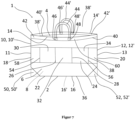
- FIG figure 7 shows a schematic view of a particularly preferred, alternative embodiment of a plastic bag 1 according to the invention.
- This differs from the embodiment according to FIG figure 1 in that there is a welding or adhesive area 54 in the form of a weld seam for fastening the plastic film layer 24 adjacent to the first side edge 10, which has a distance from this first side edge 10 that is smaller, preferably about half smaller, than the distance between the welding or bonding area 26 and the welding or bonding area 54 as well as between the welding or bonding area 26 and the welding or bonding area 28 and also between the welding or bonding area 28 and the welding or bonding area 56, each in Form of a weld present.
- the welding or adhesive area 56 in the form of a weld seam for attaching the plastic film layer 24, which is adjacent to the second side edge 12, has a distance from this second side edge 12 that is smaller, preferably about half smaller than the distance between the weld or bond area 26 and the weld or bond area 54 as well as between the weld or bond area 26 and the weld or bond area 28 and moreover as well as between the weld or bond area 28 and the weld or bond area 56, respectively in the form of a weld.
- the plastic film layer 24' of the rear wall 8 can be connected to the same on the inside in the same way as explained above for the front wall. This is included for the sake of clarity figure 7 not shown, but in figure 8 .
- FIG figure 8 shows a schematic top view of the embodiment of the inventive plastic bag 1 according to FIG figure 7 .
- the plastic film layers 24, 24' are connected on the inside to the front wall 6 or the rear wall 8 by welding or adhesive areas 26, 26', 28, 28' or 54, 54', 56, 56', each in particular in the form of weld seams, connected for a total of six larger pocket inserts 30, 30', 32, 32', 34 and 34' and four smaller pocket inserts 58, 58', 60, 60' are formed. Since the four smaller inner pocket inserts remain unused, there is still sufficient storage space for accommodating further products between the plastic film layers 24, 24', even when bottles are accommodated in the larger inner pocket inserts.
Landscapes
- Engineering & Computer Science (AREA)
- Mechanical Engineering (AREA)
- Bag Frames (AREA)
Claims (27)
- Sac en plastique (1) avec un fond de sac (2) et une ouverture de sac opposée (4), comprenantune paroi avant (6) et une paroi arrière (8), respectivement avec un premier bord latéral (10, 10') et un second bord latéral opposé (12, 12') ainsi qu'un bord d'ouverture (14,14') et un bord de fond (16, 16'),dans lequel la paroi avant (6) et la paroi arrière (8) sont, au niveau de leurs premiers (10, 10') et seconds (12, 12') bords latéraux et de leurs bords de fond (16, 16'), reliées l'une à l'autre au moins par sections, en particulier à l'aide d'une soudure, en formant des premiers (18) et seconds bords de sac (20) opposés ainsi d'un bord de fond de sac (22), dans lequel la paroi avant (6) et/ou la paroi arrière (8) présente(nt) du côté intérieur au moins une couche de feuilles en matière plastique (24, 24') qui s'étend depuis le premier bord latéral (10,10') ou à distance de celui-ci en direction du second bord opposé (12,12') ou jusqu'à celui-ci ainsi que depuis le bord de fond (16,16') ou à distance du bord de fond (16,16') en direction du bord d'ouverture (14, 14') ou jusqu'à celui-ci,dans lequel la couche de feuilles en matière plastique (24, 24') de la paroi avant (6) et/ou de la paroi arrière (8) est reliée au moins par sections au côté intérieur de la paroi avant (6) respectivement de la paroi arrière (8), par au moins deux, en particulier trois ou quatre, surfaces de soudure ou de colle (26, 26', 28, 28'), en particulier des cordons de soudure, qui s'étendent à chaque fois à distance les un(e)s des autres, en particulier sensiblement parallèlement, et qui s'étendent à distance du bord de fond (16, 16') en direction du bord d'ouverture (14, 14') ou jusqu'à celui-ci en formant des compartiments de sac (30, 32, 34) ouverts vers l'ouverture de sac (4), à chaque fois conçus et agencé pour y loger une ou plusieurs bouteilles pour boisson,caractérisé en ce quela paroi avant (6) est conçue avec plusieurs couches et en ce que la couche de feuilles en matière plastique (24) est reliée, par des surfaces de soudure ou de colle (54, 26 ; 26, 28 ; 28, 56), exclusivement à la couche intérieure de la paroi avant (6) à plusieurs couches et/ouen ce que la paroi arrière (8) est conçue avec plusieurs couches et en ce que la couche de feuilles en matière plastique (24') est reliée, par des surfaces de soudure ou de colle (54', 26' ; 26', 28' ; 28', 56'), exclusivement à la couche intérieure de la paroi arrière (8) à plusieurs couches.
- Sac en plastique (1) selon la revendication 1, caractérisé en ce que les compartiments de sac (30, 32, 34) sont ouverts vers le fond de sac (2).
- Sac en plastique (1) selon la revendication 1 ou 2, caractérisé en ce que la paroi avant (6) et la paroi arrière (8) sont reliées l'une à l'autre le long de leurs premiers bords latéraux (10,10') par une première paroi latérale (11) et/ou en ce que la paroi avant (6) et la paroi arrière (8) sont reliées l'une à l'autre le long de leurs seconds bords latéraux (12, 12') par une seconde paroi latérale (13).
- Sac en plastique (1) selon une des revendications précédentes, caractérisé en ce que le fond de sac (2) présente un pli de fond (36), dans lequel depuis le pli de fond (36) jusqu'à la paroi avant (6) s'étend une première section de pli de fond et dans lequel depuis le pli de fond (36) jusqu'à la paroi arrière (8) s'étend une seconde section de pli de fond.
- Sac en plastique (1) selon une des revendications précédentes, caractérisé en ce que la paroi avant (6) et/ou la paroi arrière (8), en particulier la paroi avant (6) et la paroi arrière (8), présentent au moins par sections un ourlet (38, 38') au niveau des bords d'ouverture (14, 14') du côté intérieur et/ou extérieur, en particulier du côté intérieur.
- Sac en plastique (1) selon la revendication 5, caractérisé en ce que l'ourlet (38) de la paroi avant (6) et/ou l'ourlet (38') de la paroi arrière (8) s'étend(ent) depuis le premier bord latéral (10,10') de la paroi avant (6) respectivement de la paroi arrière (8) jusqu'au second bord latéral opposé (12, 12') de la paroi avant (6) respectivement de la paroi arrière (8).
- Sac en plastique (1) selon la revendication 5 ou 6, caractérisé en ce que l'ourlet (38) de la paroi avant (6) est relié, en particulier soudé et/ou collé, en particulier avec une soudure longitudinale continue (40), à la paroi avant (6) à distance de son bord d'ouverture (14) le long d'une extension depuis le premier bord latéral (10) ou à distance de celui-ci en direction du second bord latéral (12) ou jusqu'à celui-ci et/ou en ce que l'ourlet (38') de la paroi arrière (8) est relié, en particulier soudé et/ou collé, en particulier avec une soudure longitudinale continue (40'), à la paroi arrière (8) à distance de son bord d'ouverture (14') le long d'une extension depuis le premier bord latéral bord latéral (10') ou à distance de celui-ci en direction du second bord latéral (12') ou jusqu'à celui-ci.
- Sac en plastique (1) selon une des revendications 5 à 7, caractérisé en ce que l'ourlet (38) de la paroi avant (6) est conçu avec deux respectivement plusieurs couches sous la forme d'une section de prolongement (42) de la paroi avant (6) à l'aide d'un rabat réalisé en une ou plusieurs fois et/ou en ce que l'ourlet (38') de la paroi arrière (8) est conçu avec deux respectivement plusieurs couches sous la forme d'une section de prolongement (42') de la paroi arrière (8) à l'aide d'un rabat réalisé en une ou plusieurs fois.
- Sac en plastique (1) selon une des revendications précédentes, comprenant en outre au moins une sangle (44) reliée à la paroi avant (6) et/ou au moins une sangle (44') reliée à la paroi arrière (8) avec respectivement une première (46, 46') et une seconde zone de liaison (48, 48'), en particulier dans lequel la sangle (44) reliée à la paroi avant (6) et la sangle (44') reliée à la paroi arrière (8) sont soudées et/ou collées à chaque fois dans leurs premières (46, 46') et secondes zones de liaison (48, 48') au niveau de l'ourlet (38, 38') de la paroi avant (6) et/ou arrière (8).
- Sac en plastique (1) selon la revendication 9, caractérisé en ce que la sangle (44) reliée à la paroi avant (6) par de ses premières (46) et secondes zones de liaison (48) et/ou la sangle (44') reliée à la paroi arrière (8) par ses premières (46') et secondes zones de liaison (48') présente(nt) au niveau de la première zone de liaison respective (46, 46') jusqu'à la seconde zone de liaison (48, 48') au moins par sections un premier corps creux en forme de tuyau flexible ou une bande de matériau avec une ou plusieurs couches et ne formant pas un corps creux, en particulier une bande de matériau en matière plastique, qui est recouvert(e) par sections ou sensiblement complètement par un second corps creux en forme de tuyau flexible.
- Sac en plastique (1) selon une des revendications précédentes, caractérisé en ce que l'au moins une couche de feuilles en matière plastique (24, 24') est reliée, au moins par sections, au premier bord latéral (10, 10') et/ou au second bord latéral (12, 12'), en particulier à l'aide d'une soudure.
- Sac en plastique (1) selon une des revendications précédentes, caractérisé en ce que la paroi avant (6) et la paroi arrière (8) présentent des évidements (50, 50', 52, 52'), en particulier triangulaires, à la jonction de leurs bords de fond (16,16') vers les bords de sac (18, 20).
- Sac en plastique (1) selon une des revendications précédentes, caractérisé en ce que l'au moins une couche de feuilles en matière plastique (24) présente en direction du bord de fond (16) vers le bord d'ouverture (14) de la paroi avant (6) une extension qui correspond à 30 à 80 %, en particulier 40 à 60 %, de l'extension de la paroi avant (6) depuis le bord de fond (16) vers le bord d'ouverture (14), et/ou en ce que l'au moins une couche de feuilles en matière plastique (24') présente en direction du bord de fond (16') vers le bord d'ouverture (14') de la paroi arrière (8) une extension qui correspond à 30 à 80 %, en particulier 40 à 60 %, de l'extension de la paroi arrière (8) depuis le bord de fond (16') vers le bord d'ouverture (14').
- Sac en plastique (1) selon une des revendications 2 bis 13, caractérisé en ce que l'ouverture du côté du fond des compartiments de sac (30, 32, 34) présente une distance jusqu'au fond de sac (2) qui correspond à 5 à 30 %, en particulier 10 à 20 %, de l'extension de la paroi avant (6) et/ou paroi arrière (8) depuis le bord de fond (16, 16') vers le bord d'ouverture (14, 14').
- Sac en plastique (1) selon une des revendications précédentes, caractérisé en ce que l'au moins une couche de feuilles en matière plastique (24) présente, en direction du premier (10) jusqu'au second bord latéral (12) de la paroi avant (6), une extension qui correspond à l'extension de la paroi avant (6) depuis le premier (10) jusqu'au second bord latéral (12), et/ou en ce que l'au moins une couche de feuilles en matière plastique (24') présente, en direction du premier (10') jusqu'au second bord latéral (12') de la paroi arrière (8), une extension qui correspond à l'extension de la paroi arrière (8) depuis le premier (10') jusqu'au second bord latéral (12').
- Sac en plastique (1) selon une des revendications précédentes, caractérisé en ce que la paroi avant (6) et/ou la paroi arrière (8) et/ou l'au moins une couche de feuilles en matière plastique (24, 24') et/ou le cas échéant les parois latérales (11, 13) du sac en plastique (1) et/ou le fond de sac (2) et/ou l'ourlet (38, 38') de la paroi avant (6) et/ou paroi arrière (8) et/ou les sangles (44, 44'), sont basées sensiblement sur des matières plastiques thermoplastiques, de préférence des polyoléfines, en particulier de préférence des polyéthylènes, en particulier des polyéthylènes basse densité, et/ou polyesters, ou fabriquées à partir de ceux-ci.
- Sac en plastique (1) selon une des revendications précédentes, caractérisé en ce que celui-ci est sensiblement composé à partir de matériau recyclable ou comprend celui-ci.
- Sac en plastique (1) selon une des revendications 1 à 8, caractérisé en ce que celui-ci est formé sensiblement d'un seul tenant.
- Sac en plastique (1) selon une des revendications précédentes, caractérisé en ce que la couche de feuilles en matière plastique (24) de la paroi avant (6) s'étend depuis le premier bord latéral (10) jusqu'au second bord latéral opposé (12),dans lequel la distance de la surface de soudure ou de colle (54), en particulier sous la forme d'un cordon de soudure, qui est disposé(e) de manière adjacente au premier bord latéral (10), jusqu'à ce premier bord latéral (10) est inférieure à la distance d'au moins une paire, en particulier de toutes les paires, de surfaces de soudure ou de colle adjacentes entre elles (54, 26 ; 26, 28 ; 28, 56) et/ou, en particulier et,dans lequel la distance de la surface de soudure ou de colle (56), en particulier sous la forme d'un cordon de soudure, qui est disposé(e) de manière adjacente au second bord latéral (12), jusqu'à ce second bord latéral (12) est inférieure à la distance d'au moins une paire, en particulier de toutes les paires, de surfaces de soudure ou de colle adjacentes entre elles (54, 26 ; 26, 28 ; 28, 56) et/ou, en particulier et, en ce quela couche de feuilles en matière plastique (24') de la paroi arrière (8) s'étend depuis le premier bord latéral (10') jusqu'au second bord latéral opposé (12'),dans lequel la distance de la surface de soudure ou de colle (54'), en particulier sous la forme d'un cordon de soudure, qui est disposé(e) de manière adjacente au premier bord latéral (10'), jusqu'à ce premier bord latéral (10') est inférieure à la distance d'au moins une paire, en particulier de toutes les paires, de surfaces de soudure ou de colle adjacentes entre elles (54', 26' ; 26', 28'; 28', 56') et/ou, en particulier et,dans lequel la distance de la surface de soudure ou de colle (56'), en particulier sous la forme d'un cordon de soudure, qui est disposé(e) de manière adjacente au second bord latéral (12'), jusqu'à ce second bord latéral (12') est inférieure à la distance d'au moins une paire, en particulier de toutes les paires, de surfaces de soudure ou de colle adjacentes entre elles (54', 26' ; 26', 28' ; 28', 56').
- Sac en plastique (1) selon une des revendications 1 à 18, caractérisé en ce que la couche de feuilles en matière plastique (24) de la paroi avant (6) s'étend depuis le premier bord latéral (10) ou à distance de celui-ci, en particulier à distance de celui-ci, en direction du second bord latéral opposé (12) mais pas jusqu'à celui-ci, dans lequel la distance de la surface de soudure ou de colle (54), en particulier sous la forme d'un cordon de soudure, qui est disposé(e) de manière adjacente au premier bord latéral (10), jusqu'à ce premier bord latéral (10) est inférieure à la distance d'au moins une paire, en particulier de toutes les paires, de surfaces de soudure ou de colle adjacentes entre elles (54, 26 ; 26, 28 ; 28, 56) et/ou, en particulier et,dans lequel la distance de la surface de soudure ou de colle (56), en particulier sous la forme d'un cordon de soudure, qui est disposé(e) de manière adjacente au second bord latéral (12), jusqu'à ce second bord latéral (12) est inférieure à la distance d'au moins une paire, en particulier de toutes les paires, de surfaces de soudure ou de colle adjacentes entre elles (54, 26 ; 26, 28 ; 28, 56)et/ou, en particulier et, en ce quela couche de feuilles en matière plastique (24') de la paroi arrière (8) s'étend à distance du premier bord latéral (10') en direction du second bord latéral opposé (12') mais pas jusqu'à celui-cidans lequel la distance de la surface de soudure ou de colle (54'), en particulier sous la forme d'un cordon de soudure, qui est disposé(e) de manière adjacente au premier bord latéral (10'), jusqu'à ce premier bord latéral (10') est inférieure à la distance d'au moins une paire, en particulier de toutes les paires, de surfaces de soudure ou de colle adjacentes entre elles (54', 26' ; 26', 28' ; 28', 56') et/ou, en particulier et,dans lequel la distance de la surface de soudure ou de colle (56'), en particulier sous la forme d'un cordon de soudure, qui est disposé(e) de manière adjacente au second bord latéral (12'), jusqu'à ce second bord latéral (12') est inférieure à la distance d'au moins une paire, en particulier de toutes les paires, de surfaces de soudure ou de colle adjacentes entre elles (54', 26' ; 26', 28' ; 28', 56').
- Sac en plastique (1) selon la revendication 19 ou 20, caractérisé en ce que, par rapport à la paroi avant (6), la distance de la surface de soudure ou de colle (54), en particulier sous la forme d'un cordon de soudure, qui est disposé(e) de manière adjacente au premier bord latéral (10), jusqu'à ce premier bord latéral (10) représente au maximum 75 %, en particulier au maximum 50 %, de la distance d'au moins une paire de surfaces de soudure ou de colle adjacentes entre elles (54, 26 ; 26, 28 ; 28, 56), en particulier de la distance de la paire respective de surfaces de soudure ou de colle adjacentes entre elles (54, 26 ; 26, 28 ; 28, 56) qui présente la plus petite distance les unes des autres parmi les paires de surfaces de soudure ou de colle adjacentes entre elles (54, 26 ; 26, 28 ; 28, 56),
et/ou, en particulier et, en ce que,
par rapport à la paroi avant (6), la distance de la surface de soudure ou de colle (56), en particulier sous la forme d'un cordon de soudure, qui est disposé(e) de manière adjacente au second bord latéral (12), jusqu'à ce second bord latéral (12) représente au maximum 75 %, en particulier au maximum 50 %, de la distance d'au moins une paire de surfaces de soudure ou de colle adjacentes entre elles (54, 26 ; 26, 28 ; 28, 56), en particulier de la distance de la paire respective de surfaces de soudure ou de colle adjacentes entre elles (54, 26 ; 26, 28 ; 28, 56), qui présente la plus petite distance les unes des autres parmi les paires de surfaces de soudure ou de colle adjacentes entre elles (54, 26 ; 26, 28 ; 28, 56). - Sac en plastique (1) selon une des revendications 19 à 21, caractérisé en ce que, par rapport à la paroi arrière (8), la distance de la surface de soudure ou de colle (54'), en particulier sous la forme d'un cordon de soudure, qui est disposé(e) de manière adjacente au premier bord latéral (10'), jusqu'à ce premier bord latéral (10') représente au maximum 75 %, en particulier au maximum 50 %, de la distance d'au moins une paire de surfaces de soudure ou de colle adjacentes entre elles (54', 26' ; 26', 28' ; 28', 56'), en particulier de la distance de la paire respective de surfaces de soudure ou de colle adjacentes entre elles (54', 26' ; 26', 28' ; 28', 56'), qui présente la plus petite distance les unes des autres parmi les paires de surfaces de soudure ou de colle adjacentes entre elles (54', 26' ; 26', 28' ; 28', 56')
et/ou, en particulier et, en ce que,
par rapport à la paroi arrière (8), la distance de la surface de soudure ou de colle (56'), en particulier sous la forme d'un cordon de soudure, qui est disposé(e) de manière adjacente au second bord latéral (12'), jusqu'à ce second bord latéral (12') représente au maximum 75 %, en particulier au maximum 50 %, de la distance d'au moins une paire de surfaces de soudure ou de colle adjacentes entre elles (54', 26' ; 26', 28'; 28', 56'), en particulier de la distance de la paire respective de surfaces de soudure ou de colle adjacentes entre elles (54', 26' ; 26', 28' ; 28', 56'), qui présente la plus petite distance les unes des autres parmi les paires de surfaces de soudure ou de colle adjacentes entre elles (54', 26' ; 26', 28' ; 28', 56'). - Sac en plastique (1) selon une des revendications précédentes, caractérisé en ce que, par rapport à la paroi avant (6), la distance d'au moins deux paires, en particulier de toutes les paires, de surfaces de soudure ou de colle adjacentes entre elles (54, 26 ; 26, 28 ; 28, 56), en particulier sous forme de cordons de soudure, coïncide coïncide sensiblement et/ou en ce que,
par rapport à la paroi arrière (8), la distance d'au moins deux paires, en particulier de toutes les paires, de surfaces de soudure ou de colle adjacentes entre elles (54', 26' ; 26', 28' ; 28', 56'), en particulier sous forme de cordons de soudure, coïncide sensiblement. - Sac en plastique (1) selon une des revendications précédentes, caractérisé en ce que la paroi avant (6) est conçue avec deux couches, et/ou, en particulier et, en ce que la paroi arrière (8) est conçue avec deux couches.
- Sac en plastique (1) selon la revendication 24, caractérisé en ce quela couche de feuilles en matière plastique (24) est, par des surfaces de soudure ou de colle (54, 26 ; 26, 28 ; 28, 56), sous forme de cordons de soudure reliée exclusivement à la couche intérieure de la paroi avant à plusieurs couches (6) et/ou, en particulier et, en ce quela couche de feuilles en matière plastique (24') est, par le des surfaces de soudure ou de colle (54', 26' ; 26', 28' ; 28', 56'), en particulier sous forme de cordons de soudure, reliée exclusivement à la couche intérieure de la paroi arrière (8) à plusieurs couches.
- Sac en plastique (1) selon une des revendications précédentes, caractérisé en ce que la couche de feuilles en matière plastique (24, 24') de la paroi avant (6) et/ou, en particulier et, de la paroi arrière (8), comprend du polyéthylène basse densité ou est formé à partir de celui-ci et/ou, en particulier et, en ce que
la couche de feuilles en matière plastique (24, 24') de la paroi avant (6) et/ou, en particulier et, de la paroi arrière (8), présente une épaisseur moyenne, en particulier absolue, comprise dans la plage de 30 à 80 µm, en particulier dans la plage de 35 à 60 µm. - Utilisation du sac en plastique (1) selon une des revendications précédentes pour le transport de bouteilles pour boisson, en particulier de bouteilles pour boisson avec une contenance allant jusqu'à 2 litres.
Priority Applications (8)
| Application Number | Priority Date | Filing Date | Title |
|---|---|---|---|
| RS20230976A RS64758B1 (sr) | 2020-11-26 | 2020-11-26 | Plastična torba i upotreba plastične torbe |
| HRP20231416TT HRP20231416T1 (hr) | 2020-11-26 | 2020-11-26 | Plastična vrećica i upotreba plastične vreće |
| HUE20210070A HUE064365T2 (hu) | 2020-11-26 | 2020-11-26 | Mûanyag táska és mûanyag táska alkalmazása |
| PL20210070.7T PL4005943T3 (pl) | 2020-11-26 | 2020-11-26 | Torba z tworzywa sztucznego i zastosowanie torby z tworzywa sztucznego |
| ES20210070T ES2964833T3 (es) | 2020-11-26 | 2020-11-26 | Bolsa de plástico y uso de una bolsa de plástico |
| EP20210070.7A EP4005943B1 (fr) | 2020-11-26 | 2020-11-26 | Sac en plastique et utilisation d'un sac en plastique |
| US17/396,482 US12048362B2 (en) | 2020-11-26 | 2021-08-06 | Plastic bag having internal bag inserts and plastic bag having internal bag inserts and holding straps |
| US18/752,288 US20240341432A1 (en) | 2020-11-26 | 2024-06-24 | Plastic bag having internal bag inserts and plastic bag having internal bag inserts and holding straps |
Applications Claiming Priority (1)
| Application Number | Priority Date | Filing Date | Title |
|---|---|---|---|
| EP20210070.7A EP4005943B1 (fr) | 2020-11-26 | 2020-11-26 | Sac en plastique et utilisation d'un sac en plastique |
Publications (3)
| Publication Number | Publication Date |
|---|---|
| EP4005943A1 EP4005943A1 (fr) | 2022-06-01 |
| EP4005943B1 true EP4005943B1 (fr) | 2023-08-09 |
| EP4005943C0 EP4005943C0 (fr) | 2023-08-09 |
Family
ID=73598767
Family Applications (1)
| Application Number | Title | Priority Date | Filing Date |
|---|---|---|---|
| EP20210070.7A Active EP4005943B1 (fr) | 2020-11-26 | 2020-11-26 | Sac en plastique et utilisation d'un sac en plastique |
Country Status (7)
| Country | Link |
|---|---|
| US (2) | US12048362B2 (fr) |
| EP (1) | EP4005943B1 (fr) |
| ES (1) | ES2964833T3 (fr) |
| HR (1) | HRP20231416T1 (fr) |
| HU (1) | HUE064365T2 (fr) |
| PL (1) | PL4005943T3 (fr) |
| RS (1) | RS64758B1 (fr) |
Families Citing this family (1)
| Publication number | Priority date | Publication date | Assignee | Title |
|---|---|---|---|---|
| USD1007326S1 (en) * | 2021-07-30 | 2023-12-12 | Flat System S.R.L. | Packaging bag |
Family Cites Families (26)
| Publication number | Priority date | Publication date | Assignee | Title |
|---|---|---|---|---|
| US2089297A (en) * | 1935-04-24 | 1937-08-10 | H R Weaver | Bottle spacer |
| US2473429A (en) * | 1945-06-20 | 1949-06-14 | Harry L Hinman | Bottle carrier |
| US2653750A (en) * | 1949-02-26 | 1953-09-29 | Oscar L Vines | Carrier for bottles and the like |
| US4696403A (en) * | 1986-09-16 | 1987-09-29 | Sonoco Products Company | Bottle bag |
| DE3734562A1 (de) | 1987-10-13 | 1989-04-27 | Kochsiek Maschinenbau Soltau G | Tragetasche aus papier |
| US4872766A (en) * | 1988-11-18 | 1989-10-10 | Sonoco Products Company | Two-compartment plastic bag |
| US5046860A (en) * | 1990-08-02 | 1991-09-10 | New Hero, Incorporated | Reusable shopping bag assembly |
| FR2743783B1 (fr) * | 1996-01-22 | 1998-02-20 | Bellehchili Djamal | Sac destine a recevoir des charges sensiblement rigides |
| USD397871S (en) * | 1996-12-27 | 1998-09-08 | Djamal Bellehchilli | Bag for bottles |
| CA2260588C (fr) * | 1999-02-02 | 2003-12-23 | William Shackleton | Conteneur souple avec cloisons internes |
| DE29902399U1 (de) | 1999-02-10 | 2000-07-20 | Eul, Werner, 53844 Troisdorf | Transportbeutel für Flaschen oder Flaschenbeutel |
| DE10324785A1 (de) * | 2003-05-31 | 2004-12-30 | Conteyor Multibag Systems N.V. | Verfahren zur Herstellung eines flexiblen Haltesystems |
| US20070175787A1 (en) * | 2004-01-09 | 2007-08-02 | Aaron Lown | Multi-Pack Tote Apparatus |
| USD529709S1 (en) * | 2005-01-08 | 2006-10-10 | Built, Ny, Inc. | Six pack tote apparatus |
| US8033727B2 (en) * | 2006-09-08 | 2011-10-11 | Gimex International S.A. | Transparent bag for carrying, displaying, chilling and serving a beverage in a beverage container |
| US20080083629A1 (en) * | 2006-10-04 | 2008-04-10 | Soucie James L | Tote bag for carrying a plurality of wine bottles |
| US20090173646A1 (en) * | 2007-11-27 | 2009-07-09 | Lilian Blomberg | Carrier - for Bottles and Such |
| US20100084443A1 (en) * | 2008-10-06 | 2010-04-08 | Sacs Of Life, Llc | Reusable shopping bag system |
| US20100270342A1 (en) * | 2009-04-22 | 2010-10-28 | Barthel Stacy L | Flexible bag including bottle carrier sections |
| US8281950B2 (en) * | 2010-01-21 | 2012-10-09 | Profound Products, Inc. | Versatile multi-compartment beverage container carrier |
| US8789702B1 (en) * | 2012-11-07 | 2014-07-29 | Chiaki Shingyouchi-Hall | Collapsible toiletry container assembly |
| US20150125096A1 (en) * | 2013-11-06 | 2015-05-07 | Leda Erin Mulholland | Collapsible and Selectively Compartmentalized Bag |
| US9604757B2 (en) * | 2014-02-28 | 2017-03-28 | My Smart Products, LLC | Reusable bag holder and system and method of using the same |
| US20150296939A1 (en) * | 2014-04-20 | 2015-10-22 | SWG Enterprises LLC | Compartmented bag for baby items |
| US20160135572A1 (en) * | 2014-11-17 | 2016-05-19 | Loren Reidar Ilvedson | Hands-Free Self-Balancing Insulated Beverage Holder |
| USD774747S1 (en) * | 2015-06-05 | 2016-12-27 | Hatchland Llc | Bottle tote |
-
2020
- 2020-11-26 EP EP20210070.7A patent/EP4005943B1/fr active Active
- 2020-11-26 PL PL20210070.7T patent/PL4005943T3/pl unknown
- 2020-11-26 ES ES20210070T patent/ES2964833T3/es active Active
- 2020-11-26 HR HRP20231416TT patent/HRP20231416T1/hr unknown
- 2020-11-26 HU HUE20210070A patent/HUE064365T2/hu unknown
- 2020-11-26 RS RS20230976A patent/RS64758B1/sr unknown
-
2021
- 2021-08-06 US US17/396,482 patent/US12048362B2/en active Active
-
2024
- 2024-06-24 US US18/752,288 patent/US20240341432A1/en active Pending
Also Published As
| Publication number | Publication date |
|---|---|
| US12048362B2 (en) | 2024-07-30 |
| PL4005943T3 (pl) | 2024-02-26 |
| US20220160091A1 (en) | 2022-05-26 |
| ES2964833T3 (es) | 2024-04-09 |
| RS64758B1 (sr) | 2023-11-30 |
| US20240341432A1 (en) | 2024-10-17 |
| EP4005943A1 (fr) | 2022-06-01 |
| EP4005943C0 (fr) | 2023-08-09 |
| HUE064365T2 (hu) | 2024-03-28 |
| HRP20231416T1 (hr) | 2024-03-01 |
Similar Documents
| Publication | Publication Date | Title |
|---|---|---|
| DE1943027U (de) | Aus einem schlauch aus thermoplastischer kunststoffolie hergestellte tasche. | |
| DE4301620A1 (de) | Fließmittelpackung mit Beutel | |
| DE3205340A1 (de) | Sack, insbesondere ventilsack, vorzugsweise aus kunststoffolie | |
| EP4005943A1 (fr) | Sac en plastique à compartiments et sac en plastique à compartiments et à poignées | |
| EP3450343B2 (fr) | Sac à poignée en matière plastique et boucle de retenue pour un sac à poignée en matière plastique | |
| DE2215227A1 (de) | Tragetasche oder tragbare Verpackung | |
| EP1888417B1 (fr) | Emballage de protection pour un objet | |
| DE10317537A1 (de) | Kraftfahrzeug mit einer auf einem Schienenweg verschiebbaren Ladeplatte | |
| DE102018214910B4 (de) | Haltestruktur | |
| EP3875387B9 (fr) | Sac à fond en film plastique et son utilisation ainsi que découpe pour un sac à fond en film plastique | |
| EP1666367B1 (fr) | Sac de transport | |
| EP3045405B1 (fr) | Sachet en matière plastique et poche en matière plastique, notamment pour la vente par correspondance en ligne | |
| DE4100055A1 (de) | Aufbewahrungs- und transportbehaeltnis, insbesondere fuer hygiene- und toilettenartikel oder dergleichen auf reisen | |
| DE202017103768U1 (de) | Versandtasche | |
| DE102017114022A1 (de) | Versandtasche | |
| DE7919536U1 (de) | Isoliertasche | |
| EP4570692A1 (fr) | Sac à porter en plastique | |
| EP1113967B1 (fr) | Tube, utilisation d'une poche en plastique et procede de production d'un tube | |
| DE202023103038U1 (de) | Kunststofftragetasche, insbesondere Kunststoffversandtasche | |
| DE102007011174A1 (de) | Schüttguttasche mit Aufnahmeelementen für Gabelspaplerzinken und Elemente dafür | |
| EP4534433A2 (fr) | Sac à porter en plastique | |
| EP1935799B1 (fr) | Poches à ourlets | |
| EP4570691A1 (fr) | Sac à porter en plastique | |
| DE102015101743A1 (de) | Faltbarer Flaschenträger aus Kunststoff | |
| EP4161310A1 (fr) | Valise à roulettes recyclable |
Legal Events
| Date | Code | Title | Description |
|---|---|---|---|
| REG | Reference to a national code |
Ref country code: HR Ref legal event code: TUEP Ref document number: P20231416T Country of ref document: HR |
|
| PUAI | Public reference made under article 153(3) epc to a published international application that has entered the european phase |
Free format text: ORIGINAL CODE: 0009012 |
|
| STAA | Information on the status of an ep patent application or granted ep patent |
Free format text: STATUS: REQUEST FOR EXAMINATION WAS MADE |
|
| 17P | Request for examination filed |
Effective date: 20211104 |
|
| AK | Designated contracting states |
Kind code of ref document: A1 Designated state(s): AL AT BE BG CH CY CZ DE DK EE ES FI FR GB GR HR HU IE IS IT LI LT LU LV MC MK MT NL NO PL PT RO RS SE SI SK SM TR |
|
| GRAP | Despatch of communication of intention to grant a patent |
Free format text: ORIGINAL CODE: EPIDOSNIGR1 |
|
| STAA | Information on the status of an ep patent application or granted ep patent |
Free format text: STATUS: GRANT OF PATENT IS INTENDED |
|
| INTG | Intention to grant announced |
Effective date: 20230425 |
|
| P01 | Opt-out of the competence of the unified patent court (upc) registered |
Effective date: 20230331 |
|
| GRAS | Grant fee paid |
Free format text: ORIGINAL CODE: EPIDOSNIGR3 |
|
| GRAA | (expected) grant |
Free format text: ORIGINAL CODE: 0009210 |
|
| STAA | Information on the status of an ep patent application or granted ep patent |
Free format text: STATUS: THE PATENT HAS BEEN GRANTED |
|
| AK | Designated contracting states |
Kind code of ref document: B1 Designated state(s): AL AT BE BG CH CY CZ DE DK EE ES FI FR GB GR HR HU IE IS IT LI LT LU LV MC MK MT NL NO PL PT RO RS SE SI SK SM TR |
|
| REG | Reference to a national code |
Ref country code: GB Ref legal event code: FG4D Free format text: NOT ENGLISH |
|
| REG | Reference to a national code |
Ref country code: CH Ref legal event code: EP |
|
| REG | Reference to a national code |
Ref country code: IE Ref legal event code: FG4D Free format text: LANGUAGE OF EP DOCUMENT: GERMAN |
|
| REG | Reference to a national code |
Ref country code: DE Ref legal event code: R096 Ref document number: 502020004610 Country of ref document: DE |
|
| U01 | Request for unitary effect filed |
Effective date: 20230901 |
|
| REG | Reference to a national code |
Ref country code: RO Ref legal event code: EPE |
|
| U07 | Unitary effect registered |
Designated state(s): AT BE BG DE DK EE FI FR IT LT LU LV MT NL PT SE SI Effective date: 20231010 |
|
| P04 | Withdrawal of opt-out of the competence of the unified patent court (upc) registered |
Effective date: 20231006 |
|
| REG | Reference to a national code |
Ref country code: NO Ref legal event code: T2 Effective date: 20230809 |
|
| U20 | Renewal fee for the european patent with unitary effect paid |
Year of fee payment: 4 Effective date: 20231116 |
|
| REG | Reference to a national code |
Ref country code: GR Ref legal event code: EP Ref document number: 20230402090 Country of ref document: GR Effective date: 20231211 |
|
| REG | Reference to a national code |
Ref country code: SK Ref legal event code: T3 Ref document number: E 42798 Country of ref document: SK |
|
| REG | Reference to a national code |
Ref country code: HR Ref legal event code: ODRP Ref document number: P20231416T Country of ref document: HR Payment date: 20231120 Year of fee payment: 4 |
|
| REG | Reference to a national code |
Ref country code: HR Ref legal event code: T1PR Ref document number: P20231416 Country of ref document: HR |
|
| REG | Reference to a national code |
Ref country code: HU Ref legal event code: AG4A Ref document number: E064365 Country of ref document: HU |
|
| REG | Reference to a national code |
Ref country code: ES Ref legal event code: FG2A Ref document number: 2964833 Country of ref document: ES Kind code of ref document: T3 Effective date: 20240409 |
|
| PG25 | Lapsed in a contracting state [announced via postgrant information from national office to epo] |
Ref country code: SM Free format text: LAPSE BECAUSE OF FAILURE TO SUBMIT A TRANSLATION OF THE DESCRIPTION OR TO PAY THE FEE WITHIN THE PRESCRIBED TIME-LIMIT Effective date: 20230809 |
|
| REG | Reference to a national code |
Ref country code: DE Ref legal event code: R097 Ref document number: 502020004610 Country of ref document: DE |
|
| PLBE | No opposition filed within time limit |
Free format text: ORIGINAL CODE: 0009261 |
|
| STAA | Information on the status of an ep patent application or granted ep patent |
Free format text: STATUS: NO OPPOSITION FILED WITHIN TIME LIMIT |
|
| 26N | No opposition filed |
Effective date: 20240513 |
|
| REG | Reference to a national code |
Ref country code: HR Ref legal event code: ODRP Ref document number: P20231416 Country of ref document: HR Payment date: 20241113 Year of fee payment: 5 |
|
| U20 | Renewal fee for the european patent with unitary effect paid |
Year of fee payment: 5 Effective date: 20241127 |
|
| P05 | Withdrawal of opt-out of the competence of the unified patent court (upc) changed |
Free format text: CASE NUMBER: APP_578754/2023 Effective date: 20231010 |
|
| PGFP | Annual fee paid to national office [announced via postgrant information from national office to epo] |
Ref country code: HU Payment date: 20241119 Year of fee payment: 5 |
|
| PGFP | Annual fee paid to national office [announced via postgrant information from national office to epo] |
Ref country code: MC Payment date: 20241126 Year of fee payment: 5 Ref country code: NO Payment date: 20241119 Year of fee payment: 5 |
|
| PGFP | Annual fee paid to national office [announced via postgrant information from national office to epo] |
Ref country code: PL Payment date: 20241031 Year of fee payment: 5 Ref country code: GR Payment date: 20241122 Year of fee payment: 5 |
|
| PGFP | Annual fee paid to national office [announced via postgrant information from national office to epo] |
Ref country code: GB Payment date: 20241126 Year of fee payment: 5 |
|
| PGFP | Annual fee paid to national office [announced via postgrant information from national office to epo] |
Ref country code: IS Payment date: 20241125 Year of fee payment: 5 |
|
| PGFP | Annual fee paid to national office [announced via postgrant information from national office to epo] |
Ref country code: CZ Payment date: 20241111 Year of fee payment: 5 Ref country code: HR Payment date: 20241113 Year of fee payment: 5 Ref country code: IE Payment date: 20241119 Year of fee payment: 5 |
|
| PGFP | Annual fee paid to national office [announced via postgrant information from national office to epo] |
Ref country code: RO Payment date: 20241114 Year of fee payment: 5 Ref country code: SK Payment date: 20241111 Year of fee payment: 5 |
|
| PGFP | Annual fee paid to national office [announced via postgrant information from national office to epo] |
Ref country code: ES Payment date: 20241218 Year of fee payment: 5 Ref country code: RS Payment date: 20241105 Year of fee payment: 5 |
|
| PGFP | Annual fee paid to national office [announced via postgrant information from national office to epo] |
Ref country code: CH Payment date: 20241201 Year of fee payment: 5 |
|
| PGFP | Annual fee paid to national office [announced via postgrant information from national office to epo] |
Ref country code: TR Payment date: 20241107 Year of fee payment: 5 |
|
| PGFP | Annual fee paid to national office [announced via postgrant information from national office to epo] |
Ref country code: CY Payment date: 20241125 Year of fee payment: 5 |
|
| PGFP | Annual fee paid to national office [announced via postgrant information from national office to epo] |
Ref country code: MK Payment date: 20241114 Year of fee payment: 5 |
|
| U20 | Renewal fee for the european patent with unitary effect paid |
Year of fee payment: 6 Effective date: 20251126 |
|
| REG | Reference to a national code |
Ref country code: HR Ref legal event code: PBON Ref document number: P20231416 Country of ref document: HR Effective date: 20251126 |
|
| REG | Reference to a national code |
Ref country code: CH Ref legal event code: H13 Free format text: ST27 STATUS EVENT CODE: U-0-0-H10-H13 (AS PROVIDED BY THE NATIONAL OFFICE) Effective date: 20260623 |
|
| PG25 | Lapsed in a contracting state [announced via postgrant information from national office to epo] |
Ref country code: MC Free format text: LAPSE BECAUSE OF NON-PAYMENT OF DUE FEES Effective date: 20251201 |
|
| REG | Reference to a national code |
Ref country code: SK Ref legal event code: MM4A Ref document number: E 42798 Country of ref document: SK Effective date: 20251126 |
|
| PG25 | Lapsed in a contracting state [announced via postgrant information from national office to epo] |
Ref country code: RS Free format text: LAPSE BECAUSE OF NON-PAYMENT OF DUE FEES Effective date: 20251126 |
|
| PG25 | Lapsed in a contracting state [announced via postgrant information from national office to epo] |
Ref country code: GR Free format text: LAPSE BECAUSE OF NON-PAYMENT OF DUE FEES Effective date: 20260608 |
|
| PG25 | Lapsed in a contracting state [announced via postgrant information from national office to epo] |
Ref country code: NO Free format text: LAPSE BECAUSE OF NON-PAYMENT OF DUE FEES Effective date: 20251130 |
|
| PG25 | Lapsed in a contracting state [announced via postgrant information from national office to epo] |
Ref country code: CH Free format text: LAPSE BECAUSE OF NON-PAYMENT OF DUE FEES Effective date: 20251130 Ref country code: RO Free format text: LAPSE BECAUSE OF NON-PAYMENT OF DUE FEES Effective date: 20251126 Ref country code: HU Free format text: LAPSE BECAUSE OF NON-PAYMENT OF DUE FEES Effective date: 20251127 |
|
| PG25 | Lapsed in a contracting state [announced via postgrant information from national office to epo] |
Ref country code: CY Free format text: LAPSE BECAUSE OF NON-PAYMENT OF DUE FEES Effective date: 20251127 |
|
| PG25 | Lapsed in a contracting state [announced via postgrant information from national office to epo] |
Ref country code: CZ Free format text: LAPSE BECAUSE OF NON-PAYMENT OF DUE FEES Effective date: 20251126 |
|
| PG25 | Lapsed in a contracting state [announced via postgrant information from national office to epo] |
Ref country code: SK Free format text: LAPSE BECAUSE OF NON-PAYMENT OF DUE FEES Effective date: 20251126 |
|
| PG25 | Lapsed in a contracting state [announced via postgrant information from national office to epo] |
Ref country code: IS Free format text: LAPSE BECAUSE OF NON-PAYMENT OF DUE FEES Effective date: 20260602 |