EP4006089A1 - Harzzusammensetzung - Google Patents
Harzzusammensetzung Download PDFInfo
- Publication number
- EP4006089A1 EP4006089A1 EP20854616.8A EP20854616A EP4006089A1 EP 4006089 A1 EP4006089 A1 EP 4006089A1 EP 20854616 A EP20854616 A EP 20854616A EP 4006089 A1 EP4006089 A1 EP 4006089A1
- Authority
- EP
- European Patent Office
- Prior art keywords
- filler
- less
- resin composition
- weight
- average particle
- Prior art date
- Legal status (The legal status is an assumption and is not a legal conclusion. Google has not performed a legal analysis and makes no representation as to the accuracy of the status listed.)
- Pending
Links
- 239000011342 resin composition Substances 0.000 title claims abstract description 150
- 239000000945 filler Substances 0.000 claims description 317
- 239000002245 particle Substances 0.000 claims description 162
- 229920005989 resin Polymers 0.000 claims description 91
- 239000011347 resin Substances 0.000 claims description 91
- 229920005862 polyol Polymers 0.000 claims description 48
- 150000003077 polyols Chemical group 0.000 claims description 41
- -1 isocyanate compound Chemical class 0.000 claims description 24
- 229920002803 thermoplastic polyurethane Polymers 0.000 claims description 13
- 239000012948 isocyanate Substances 0.000 claims description 11
- VTYYLEPIZMXCLO-UHFFFAOYSA-L Calcium carbonate Chemical compound [Ca+2].[O-]C([O-])=O VTYYLEPIZMXCLO-UHFFFAOYSA-L 0.000 claims description 8
- 239000004925 Acrylic resin Substances 0.000 claims description 5
- 229920000178 Acrylic resin Polymers 0.000 claims description 5
- 239000003822 epoxy resin Substances 0.000 claims description 5
- VTHJTEIRLNZDEV-UHFFFAOYSA-L magnesium dihydroxide Chemical compound [OH-].[OH-].[Mg+2] VTHJTEIRLNZDEV-UHFFFAOYSA-L 0.000 claims description 5
- 239000000347 magnesium hydroxide Substances 0.000 claims description 5
- 229910001862 magnesium hydroxide Inorganic materials 0.000 claims description 5
- 229920000647 polyepoxide Polymers 0.000 claims description 5
- 229910052581 Si3N4 Inorganic materials 0.000 claims description 4
- 229910000019 calcium carbonate Inorganic materials 0.000 claims description 4
- 239000000395 magnesium oxide Substances 0.000 claims description 4
- CPLXHLVBOLITMK-UHFFFAOYSA-N magnesium oxide Inorganic materials [Mg]=O CPLXHLVBOLITMK-UHFFFAOYSA-N 0.000 claims description 4
- AXZKOIWUVFPNLO-UHFFFAOYSA-N magnesium;oxygen(2-) Chemical compound [O-2].[Mg+2] AXZKOIWUVFPNLO-UHFFFAOYSA-N 0.000 claims description 4
- HQVNEWCFYHHQES-UHFFFAOYSA-N silicon nitride Chemical compound N12[Si]34N5[Si]62N3[Si]51N64 HQVNEWCFYHHQES-UHFFFAOYSA-N 0.000 claims description 4
- 229920002050 silicone resin Polymers 0.000 claims description 4
- OKTJSMMVPCPJKN-UHFFFAOYSA-N Carbon Chemical compound [C] OKTJSMMVPCPJKN-UHFFFAOYSA-N 0.000 claims description 3
- VYPSYNLAJGMNEJ-UHFFFAOYSA-N Silicium dioxide Chemical compound O=[Si]=O VYPSYNLAJGMNEJ-UHFFFAOYSA-N 0.000 claims description 3
- 229910021485 fumed silica Inorganic materials 0.000 claims description 3
- TWNQGVIAIRXVLR-UHFFFAOYSA-N oxo(oxoalumanyloxy)alumane Chemical compound O=[Al]O[Al]=O TWNQGVIAIRXVLR-UHFFFAOYSA-N 0.000 claims description 3
- 229920005672 polyolefin resin Polymers 0.000 claims description 3
- PIGFYZPCRLYGLF-UHFFFAOYSA-N Aluminum nitride Chemical compound [Al]#N PIGFYZPCRLYGLF-UHFFFAOYSA-N 0.000 claims description 2
- LTPBRCUWZOMYOC-UHFFFAOYSA-N Beryllium oxide Chemical compound O=[Be] LTPBRCUWZOMYOC-UHFFFAOYSA-N 0.000 claims description 2
- PZNSFCLAULLKQX-UHFFFAOYSA-N Boron nitride Chemical compound N#B PZNSFCLAULLKQX-UHFFFAOYSA-N 0.000 claims description 2
- MXRIRQGCELJRSN-UHFFFAOYSA-N O.O.O.[Al] Chemical compound O.O.O.[Al] MXRIRQGCELJRSN-UHFFFAOYSA-N 0.000 claims description 2
- XLOMVQKBTHCTTD-UHFFFAOYSA-N Zinc monoxide Chemical compound [Zn]=O XLOMVQKBTHCTTD-UHFFFAOYSA-N 0.000 claims description 2
- 229910001593 boehmite Inorganic materials 0.000 claims description 2
- 229910052799 carbon Inorganic materials 0.000 claims description 2
- 239000004927 clay Substances 0.000 claims description 2
- 229910052570 clay Inorganic materials 0.000 claims description 2
- FAHBNUUHRFUEAI-UHFFFAOYSA-M hydroxidooxidoaluminium Chemical compound O[Al]=O FAHBNUUHRFUEAI-UHFFFAOYSA-M 0.000 claims description 2
- HBMJWWWQQXIZIP-UHFFFAOYSA-N silicon carbide Chemical compound [Si+]#[C-] HBMJWWWQQXIZIP-UHFFFAOYSA-N 0.000 claims description 2
- 238000002347 injection Methods 0.000 abstract description 26
- 239000007924 injection Substances 0.000 abstract description 26
- 239000011231 conductive filler Substances 0.000 abstract description 19
- 230000001747 exhibiting effect Effects 0.000 abstract description 8
- 239000000203 mixture Substances 0.000 description 93
- 239000003795 chemical substances by application Substances 0.000 description 60
- PNEYBMLMFCGWSK-UHFFFAOYSA-N aluminium oxide Inorganic materials [O-2].[O-2].[O-2].[Al+3].[Al+3] PNEYBMLMFCGWSK-UHFFFAOYSA-N 0.000 description 59
- 239000000463 material Substances 0.000 description 34
- 239000012071 phase Substances 0.000 description 30
- 239000000853 adhesive Substances 0.000 description 25
- 230000001070 adhesive effect Effects 0.000 description 25
- 238000000034 method Methods 0.000 description 25
- 238000006243 chemical reaction Methods 0.000 description 18
- 230000003068 static effect Effects 0.000 description 17
- 230000000704 physical effect Effects 0.000 description 16
- 239000005056 polyisocyanate Substances 0.000 description 16
- 229920001228 polyisocyanate Polymers 0.000 description 16
- 230000008569 process Effects 0.000 description 15
- 238000009826 distribution Methods 0.000 description 14
- 230000017525 heat dissipation Effects 0.000 description 14
- 230000000052 comparative effect Effects 0.000 description 11
- 239000003063 flame retardant Substances 0.000 description 11
- RNFJDJUURJAICM-UHFFFAOYSA-N 2,2,4,4,6,6-hexaphenoxy-1,3,5-triaza-2$l^{5},4$l^{5},6$l^{5}-triphosphacyclohexa-1,3,5-triene Chemical compound N=1P(OC=2C=CC=CC=2)(OC=2C=CC=CC=2)=NP(OC=2C=CC=CC=2)(OC=2C=CC=CC=2)=NP=1(OC=1C=CC=CC=1)OC1=CC=CC=C1 RNFJDJUURJAICM-UHFFFAOYSA-N 0.000 description 10
- JOYRKODLDBILNP-UHFFFAOYSA-N Ethyl urethane Chemical compound CCOC(N)=O JOYRKODLDBILNP-UHFFFAOYSA-N 0.000 description 9
- 150000001732 carboxylic acid derivatives Chemical class 0.000 description 9
- 125000003178 carboxy group Chemical group [H]OC(*)=O 0.000 description 8
- 238000002156 mixing Methods 0.000 description 8
- 238000002411 thermogravimetry Methods 0.000 description 8
- 238000002441 X-ray diffraction Methods 0.000 description 7
- 125000002887 hydroxy group Chemical group [H]O* 0.000 description 7
- 238000004519 manufacturing process Methods 0.000 description 6
- 229910052782 aluminium Inorganic materials 0.000 description 5
- XAGFODPZIPBFFR-UHFFFAOYSA-N aluminium Chemical compound [Al] XAGFODPZIPBFFR-UHFFFAOYSA-N 0.000 description 5
- 238000004458 analytical method Methods 0.000 description 5
- 230000009477 glass transition Effects 0.000 description 5
- 238000009413 insulation Methods 0.000 description 5
- 238000002844 melting Methods 0.000 description 5
- 230000008018 melting Effects 0.000 description 5
- 239000007787 solid Substances 0.000 description 5
- OFOBLEOULBTSOW-UHFFFAOYSA-N Malonic acid Chemical compound OC(=O)CC(O)=O OFOBLEOULBTSOW-UHFFFAOYSA-N 0.000 description 4
- 150000001334 alicyclic compounds Chemical class 0.000 description 4
- 150000007824 aliphatic compounds Chemical class 0.000 description 4
- 125000004432 carbon atom Chemical group C* 0.000 description 4
- 239000003054 catalyst Substances 0.000 description 4
- 238000006482 condensation reaction Methods 0.000 description 4
- 230000007423 decrease Effects 0.000 description 4
- 238000000113 differential scanning calorimetry Methods 0.000 description 4
- 150000002513 isocyanates Chemical class 0.000 description 4
- 238000012360 testing method Methods 0.000 description 4
- LYCAIKOWRPUZTN-UHFFFAOYSA-N Ethylene glycol Chemical compound OCCO LYCAIKOWRPUZTN-UHFFFAOYSA-N 0.000 description 3
- 239000005057 Hexamethylene diisocyanate Substances 0.000 description 3
- PXHVJJICTQNCMI-UHFFFAOYSA-N Nickel Chemical compound [Ni] PXHVJJICTQNCMI-UHFFFAOYSA-N 0.000 description 3
- MUBZPKHOEPUJKR-UHFFFAOYSA-N Oxalic acid Chemical compound OC(=O)C(O)=O MUBZPKHOEPUJKR-UHFFFAOYSA-N 0.000 description 3
- DNIAPMSPPWPWGF-UHFFFAOYSA-N Propylene glycol Chemical compound CC(O)CO DNIAPMSPPWPWGF-UHFFFAOYSA-N 0.000 description 3
- 230000009471 action Effects 0.000 description 3
- 125000002947 alkylene group Chemical group 0.000 description 3
- WERYXYBDKMZEQL-UHFFFAOYSA-N butane-1,4-diol Chemical compound OCCCCO WERYXYBDKMZEQL-UHFFFAOYSA-N 0.000 description 3
- 230000015556 catabolic process Effects 0.000 description 3
- 229910010293 ceramic material Inorganic materials 0.000 description 3
- 239000002131 composite material Substances 0.000 description 3
- 150000001875 compounds Chemical class 0.000 description 3
- 230000001186 cumulative effect Effects 0.000 description 3
- 150000002009 diols Chemical class 0.000 description 3
- 230000000694 effects Effects 0.000 description 3
- 238000011068 loading method Methods 0.000 description 3
- 238000005259 measurement Methods 0.000 description 3
- 239000002904 solvent Substances 0.000 description 3
- 239000013008 thixotropic agent Substances 0.000 description 3
- 238000012546 transfer Methods 0.000 description 3
- PAPBSGBWRJIAAV-UHFFFAOYSA-N ε-Caprolactone Chemical compound O=C1CCCCCO1 PAPBSGBWRJIAAV-UHFFFAOYSA-N 0.000 description 3
- 229920002943 EPDM rubber Polymers 0.000 description 2
- LFQSCWFLJHTTHZ-UHFFFAOYSA-N Ethanol Chemical compound CCO LFQSCWFLJHTTHZ-UHFFFAOYSA-N 0.000 description 2
- VZCYOOQTPOCHFL-OWOJBTEDSA-N Fumaric acid Chemical compound OC(=O)\C=C\C(O)=O VZCYOOQTPOCHFL-OWOJBTEDSA-N 0.000 description 2
- PEDCQBHIVMGVHV-UHFFFAOYSA-N Glycerine Chemical compound OCC(O)CO PEDCQBHIVMGVHV-UHFFFAOYSA-N 0.000 description 2
- 239000004698 Polyethylene Substances 0.000 description 2
- KKEYFWRCBNTPAC-UHFFFAOYSA-N Terephthalic acid Chemical compound OC(=O)C1=CC=C(C(O)=O)C=C1 KKEYFWRCBNTPAC-UHFFFAOYSA-N 0.000 description 2
- ATJFFYVFTNAWJD-UHFFFAOYSA-N Tin Chemical compound [Sn] ATJFFYVFTNAWJD-UHFFFAOYSA-N 0.000 description 2
- XSTXAVWGXDQKEL-UHFFFAOYSA-N Trichloroethylene Chemical compound ClC=C(Cl)Cl XSTXAVWGXDQKEL-UHFFFAOYSA-N 0.000 description 2
- UKLDJPRMSDWDSL-UHFFFAOYSA-L [dibutyl(dodecanoyloxy)stannyl] dodecanoate Chemical compound CCCCCCCCCCCC(=O)O[Sn](CCCC)(CCCC)OC(=O)CCCCCCCCCCC UKLDJPRMSDWDSL-UHFFFAOYSA-L 0.000 description 2
- 230000001133 acceleration Effects 0.000 description 2
- 239000004840 adhesive resin Substances 0.000 description 2
- 229920006223 adhesive resin Polymers 0.000 description 2
- WNLRTRBMVRJNCN-UHFFFAOYSA-N adipic acid Chemical compound OC(=O)CCCCC(O)=O WNLRTRBMVRJNCN-UHFFFAOYSA-N 0.000 description 2
- 150000001491 aromatic compounds Chemical class 0.000 description 2
- 125000003118 aryl group Chemical group 0.000 description 2
- 239000012298 atmosphere Substances 0.000 description 2
- DQXBYHZEEUGOBF-UHFFFAOYSA-N but-3-enoic acid;ethene Chemical compound C=C.OC(=O)CC=C DQXBYHZEEUGOBF-UHFFFAOYSA-N 0.000 description 2
- 230000008859 change Effects 0.000 description 2
- 239000004020 conductor Substances 0.000 description 2
- 239000002826 coolant Substances 0.000 description 2
- 238000001816 cooling Methods 0.000 description 2
- 239000000498 cooling water Substances 0.000 description 2
- 239000007822 coupling agent Substances 0.000 description 2
- 239000013078 crystal Substances 0.000 description 2
- 239000012975 dibutyltin dilaurate Substances 0.000 description 2
- 239000003085 diluting agent Substances 0.000 description 2
- 238000007599 discharging Methods 0.000 description 2
- 239000002270 dispersing agent Substances 0.000 description 2
- 239000005038 ethylene vinyl acetate Substances 0.000 description 2
- 238000011156 evaluation Methods 0.000 description 2
- 238000007306 functionalization reaction Methods 0.000 description 2
- RRAMGCGOFNQTLD-UHFFFAOYSA-N hexamethylene diisocyanate Chemical compound O=C=NCCCCCCN=C=O RRAMGCGOFNQTLD-UHFFFAOYSA-N 0.000 description 2
- QQVIHTHCMHWDBS-UHFFFAOYSA-N isophthalic acid Chemical compound OC(=O)C1=CC=CC(C(O)=O)=C1 QQVIHTHCMHWDBS-UHFFFAOYSA-N 0.000 description 2
- 239000007788 liquid Substances 0.000 description 2
- BDJRBEYXGGNYIS-UHFFFAOYSA-N nonanedioic acid Chemical compound OC(=O)CCCCCCCC(O)=O BDJRBEYXGGNYIS-UHFFFAOYSA-N 0.000 description 2
- XNGIFLGASWRNHJ-UHFFFAOYSA-N phthalic acid Chemical compound OC(=O)C1=CC=CC=C1C(O)=O XNGIFLGASWRNHJ-UHFFFAOYSA-N 0.000 description 2
- WLJVNTCWHIRURA-UHFFFAOYSA-N pimelic acid Chemical compound OC(=O)CCCCCC(O)=O WLJVNTCWHIRURA-UHFFFAOYSA-N 0.000 description 2
- BASFCYQUMIYNBI-UHFFFAOYSA-N platinum Chemical compound [Pt] BASFCYQUMIYNBI-UHFFFAOYSA-N 0.000 description 2
- 229920001200 poly(ethylene-vinyl acetate) Polymers 0.000 description 2
- 229920000139 polyethylene terephthalate Polymers 0.000 description 2
- 239000005020 polyethylene terephthalate Substances 0.000 description 2
- 229920002635 polyurethane Polymers 0.000 description 2
- 239000004814 polyurethane Substances 0.000 description 2
- 229920000915 polyvinyl chloride Polymers 0.000 description 2
- 239000002243 precursor Substances 0.000 description 2
- 238000007789 sealing Methods 0.000 description 2
- CXMXRPHRNRROMY-UHFFFAOYSA-N sebacic acid Chemical compound OC(=O)CCCCCCCCC(O)=O CXMXRPHRNRROMY-UHFFFAOYSA-N 0.000 description 2
- TYFQFVWCELRYAO-UHFFFAOYSA-N suberic acid Chemical compound OC(=O)CCCCCCC(O)=O TYFQFVWCELRYAO-UHFFFAOYSA-N 0.000 description 2
- 239000012756 surface treatment agent Substances 0.000 description 2
- VZCYOOQTPOCHFL-UHFFFAOYSA-N trans-butenedioic acid Natural products OC(=O)C=CC(O)=O VZCYOOQTPOCHFL-UHFFFAOYSA-N 0.000 description 2
- ARCGXLSVLAOJQL-UHFFFAOYSA-N trimellitic acid Chemical compound OC(=O)C1=CC=C(C(O)=O)C(C(O)=O)=C1 ARCGXLSVLAOJQL-UHFFFAOYSA-N 0.000 description 2
- 150000004072 triols Chemical group 0.000 description 2
- XLYOFNOQVPJJNP-UHFFFAOYSA-N water Substances O XLYOFNOQVPJJNP-UHFFFAOYSA-N 0.000 description 2
- DNIAPMSPPWPWGF-VKHMYHEASA-N (+)-propylene glycol Chemical compound C[C@H](O)CO DNIAPMSPPWPWGF-VKHMYHEASA-N 0.000 description 1
- BJEPYKJPYRNKOW-REOHCLBHSA-N (S)-malic acid Chemical compound OC(=O)[C@@H](O)CC(O)=O BJEPYKJPYRNKOW-REOHCLBHSA-N 0.000 description 1
- ZTNJGMFHJYGMDR-UHFFFAOYSA-N 1,2-diisocyanatoethane Chemical compound O=C=NCCN=C=O ZTNJGMFHJYGMDR-UHFFFAOYSA-N 0.000 description 1
- ZGDSDWSIFQBAJS-UHFFFAOYSA-N 1,2-diisocyanatopropane Chemical compound O=C=NC(C)CN=C=O ZGDSDWSIFQBAJS-UHFFFAOYSA-N 0.000 description 1
- YPFDHNVEDLHUCE-UHFFFAOYSA-N 1,3-propanediol Substances OCCCO YPFDHNVEDLHUCE-UHFFFAOYSA-N 0.000 description 1
- OVBFMUAFNIIQAL-UHFFFAOYSA-N 1,4-diisocyanatobutane Chemical compound O=C=NCCCCN=C=O OVBFMUAFNIIQAL-UHFFFAOYSA-N 0.000 description 1
- CDMDQYCEEKCBGR-UHFFFAOYSA-N 1,4-diisocyanatocyclohexane Chemical compound O=C=NC1CCC(N=C=O)CC1 CDMDQYCEEKCBGR-UHFFFAOYSA-N 0.000 description 1
- VZXPHDGHQXLXJC-UHFFFAOYSA-N 1,6-diisocyanato-5,6-dimethylheptane Chemical compound O=C=NC(C)(C)C(C)CCCCN=C=O VZXPHDGHQXLXJC-UHFFFAOYSA-N 0.000 description 1
- ALVZNPYWJMLXKV-UHFFFAOYSA-N 1,9-Nonanediol Chemical compound OCCCCCCCCCO ALVZNPYWJMLXKV-UHFFFAOYSA-N 0.000 description 1
- RTBFRGCFXZNCOE-UHFFFAOYSA-N 1-methylsulfonylpiperidin-4-one Chemical compound CS(=O)(=O)N1CCC(=O)CC1 RTBFRGCFXZNCOE-UHFFFAOYSA-N 0.000 description 1
- BTUDGPVTCYNYLK-UHFFFAOYSA-N 2,2-dimethylglutaric acid Chemical compound OC(=O)C(C)(C)CCC(O)=O BTUDGPVTCYNYLK-UHFFFAOYSA-N 0.000 description 1
- GOHPTLYPQCTZSE-UHFFFAOYSA-N 2,2-dimethylsuccinic acid Chemical compound OC(=O)C(C)(C)CC(O)=O GOHPTLYPQCTZSE-UHFFFAOYSA-N 0.000 description 1
- JAHNSTQSQJOJLO-UHFFFAOYSA-N 2-(3-fluorophenyl)-1h-imidazole Chemical compound FC1=CC=CC(C=2NC=CN=2)=C1 JAHNSTQSQJOJLO-UHFFFAOYSA-N 0.000 description 1
- DUHQIGLHYXLKAE-UHFFFAOYSA-N 3,3-dimethylglutaric acid Chemical compound OC(=O)CC(C)(C)CC(O)=O DUHQIGLHYXLKAE-UHFFFAOYSA-N 0.000 description 1
- WZHHYIOUKQNLQM-UHFFFAOYSA-N 3,4,5,6-tetrachlorophthalic acid Chemical compound OC(=O)C1=C(Cl)C(Cl)=C(Cl)C(Cl)=C1C(O)=O WZHHYIOUKQNLQM-UHFFFAOYSA-N 0.000 description 1
- HHDUMDVQUCBCEY-UHFFFAOYSA-N 4-[10,15,20-tris(4-carboxyphenyl)-21,23-dihydroporphyrin-5-yl]benzoic acid Chemical compound OC(=O)c1ccc(cc1)-c1c2ccc(n2)c(-c2ccc(cc2)C(O)=O)c2ccc([nH]2)c(-c2ccc(cc2)C(O)=O)c2ccc(n2)c(-c2ccc(cc2)C(O)=O)c2ccc1[nH]2 HHDUMDVQUCBCEY-UHFFFAOYSA-N 0.000 description 1
- IJGRMHOSHXDMSA-UHFFFAOYSA-N Atomic nitrogen Chemical compound N#N IJGRMHOSHXDMSA-UHFFFAOYSA-N 0.000 description 1
- RYGMFSIKBFXOCR-UHFFFAOYSA-N Copper Chemical compound [Cu] RYGMFSIKBFXOCR-UHFFFAOYSA-N 0.000 description 1
- 238000005033 Fourier transform infrared spectroscopy Methods 0.000 description 1
- 239000005058 Isophorone diisocyanate Substances 0.000 description 1
- AZSVKORGCIOZHJ-UHFFFAOYSA-N N=C=O.N=C=O.O=C=NCC1(CN=C=O)CCCCC1 Chemical compound N=C=O.N=C=O.O=C=NCC1(CN=C=O)CCCCC1 AZSVKORGCIOZHJ-UHFFFAOYSA-N 0.000 description 1
- 229910019142 PO4 Inorganic materials 0.000 description 1
- ALQSHHUCVQOPAS-UHFFFAOYSA-N Pentane-1,5-diol Chemical compound OCCCCCO ALQSHHUCVQOPAS-UHFFFAOYSA-N 0.000 description 1
- 239000006087 Silane Coupling Agent Substances 0.000 description 1
- BQCADISMDOOEFD-UHFFFAOYSA-N Silver Chemical compound [Ag] BQCADISMDOOEFD-UHFFFAOYSA-N 0.000 description 1
- KDYFGRWQOYBRFD-UHFFFAOYSA-N Succinic acid Natural products OC(=O)CCC(O)=O KDYFGRWQOYBRFD-UHFFFAOYSA-N 0.000 description 1
- ZJCCRDAZUWHFQH-UHFFFAOYSA-N Trimethylolpropane Chemical compound CCC(CO)(CO)CO ZJCCRDAZUWHFQH-UHFFFAOYSA-N 0.000 description 1
- 239000007983 Tris buffer Substances 0.000 description 1
- LUSFFPXRDZKBMF-UHFFFAOYSA-N [3-(hydroxymethyl)cyclohexyl]methanol Chemical compound OCC1CCCC(CO)C1 LUSFFPXRDZKBMF-UHFFFAOYSA-N 0.000 description 1
- YIMQCDZDWXUDCA-UHFFFAOYSA-N [4-(hydroxymethyl)cyclohexyl]methanol Chemical compound OCC1CCC(CO)CC1 YIMQCDZDWXUDCA-UHFFFAOYSA-N 0.000 description 1
- KXBFLNPZHXDQLV-UHFFFAOYSA-N [cyclohexyl(diisocyanato)methyl]cyclohexane Chemical compound C1CCCCC1C(N=C=O)(N=C=O)C1CCCCC1 KXBFLNPZHXDQLV-UHFFFAOYSA-N 0.000 description 1
- 238000009825 accumulation Methods 0.000 description 1
- 239000001361 adipic acid Substances 0.000 description 1
- 235000011037 adipic acid Nutrition 0.000 description 1
- 230000002411 adverse Effects 0.000 description 1
- 238000004220 aggregation Methods 0.000 description 1
- 230000002776 aggregation Effects 0.000 description 1
- 125000002723 alicyclic group Chemical group 0.000 description 1
- 150000007933 aliphatic carboxylic acids Chemical class 0.000 description 1
- 125000001931 aliphatic group Chemical group 0.000 description 1
- BJEPYKJPYRNKOW-UHFFFAOYSA-N alpha-hydroxysuccinic acid Natural products OC(=O)C(O)CC(O)=O BJEPYKJPYRNKOW-UHFFFAOYSA-N 0.000 description 1
- JFCQEDHGNNZCLN-UHFFFAOYSA-N anhydrous glutaric acid Natural products OC(=O)CCCC(O)=O JFCQEDHGNNZCLN-UHFFFAOYSA-N 0.000 description 1
- 239000012752 auxiliary agent Substances 0.000 description 1
- 230000008901 benefit Effects 0.000 description 1
- WPYMKLBDIGXBTP-UHFFFAOYSA-N benzoic acid Chemical compound OC(=O)C1=CC=CC=C1 WPYMKLBDIGXBTP-UHFFFAOYSA-N 0.000 description 1
- BMRWNKZVCUKKSR-UHFFFAOYSA-N butane-1,2-diol Chemical compound CCC(O)CO BMRWNKZVCUKKSR-UHFFFAOYSA-N 0.000 description 1
- OWBTYPJTUOEWEK-UHFFFAOYSA-N butane-2,3-diol Chemical compound CC(O)C(C)O OWBTYPJTUOEWEK-UHFFFAOYSA-N 0.000 description 1
- KDYFGRWQOYBRFD-NUQCWPJISA-N butanedioic acid Chemical compound O[14C](=O)CC[14C](O)=O KDYFGRWQOYBRFD-NUQCWPJISA-N 0.000 description 1
- 239000003575 carbonaceous material Substances 0.000 description 1
- 239000000919 ceramic Substances 0.000 description 1
- 238000010276 construction Methods 0.000 description 1
- 229910052802 copper Inorganic materials 0.000 description 1
- 239000010949 copper Substances 0.000 description 1
- 229910052593 corundum Inorganic materials 0.000 description 1
- 238000002425 crystallisation Methods 0.000 description 1
- 230000008025 crystallization Effects 0.000 description 1
- IFDVQVHZEKPUSC-UHFFFAOYSA-N cyclohex-3-ene-1,2-dicarboxylic acid Chemical compound OC(=O)C1CCC=CC1C(O)=O IFDVQVHZEKPUSC-UHFFFAOYSA-N 0.000 description 1
- QSAWQNUELGIYBC-UHFFFAOYSA-N cyclohexane-1,2-dicarboxylic acid Chemical compound OC(=O)C1CCCCC1C(O)=O QSAWQNUELGIYBC-UHFFFAOYSA-N 0.000 description 1
- FOTKYAAJKYLFFN-UHFFFAOYSA-N decane-1,10-diol Chemical compound OCCCCCCCCCCO FOTKYAAJKYLFFN-UHFFFAOYSA-N 0.000 description 1
- 230000007547 defect Effects 0.000 description 1
- 238000010586 diagram Methods 0.000 description 1
- 235000014113 dietary fatty acids Nutrition 0.000 description 1
- 238000001035 drying Methods 0.000 description 1
- 229920001971 elastomer Polymers 0.000 description 1
- 238000010292 electrical insulation Methods 0.000 description 1
- 238000005516 engineering process Methods 0.000 description 1
- 239000000194 fatty acid Substances 0.000 description 1
- 229930195729 fatty acid Natural products 0.000 description 1
- 239000001530 fumaric acid Substances 0.000 description 1
- 238000007429 general method Methods 0.000 description 1
- 239000011521 glass Substances 0.000 description 1
- 235000011187 glycerol Nutrition 0.000 description 1
- PCHJSUWPFVWCPO-UHFFFAOYSA-N gold Chemical compound [Au] PCHJSUWPFVWCPO-UHFFFAOYSA-N 0.000 description 1
- 229910052737 gold Inorganic materials 0.000 description 1
- 239000010931 gold Substances 0.000 description 1
- 239000010439 graphite Substances 0.000 description 1
- 229910002804 graphite Inorganic materials 0.000 description 1
- 238000010438 heat treatment Methods 0.000 description 1
- XXMIOPMDWAUFGU-UHFFFAOYSA-N hexane-1,6-diol Chemical compound OCCCCCCO XXMIOPMDWAUFGU-UHFFFAOYSA-N 0.000 description 1
- 239000012796 inorganic flame retardant Substances 0.000 description 1
- 230000001788 irregular Effects 0.000 description 1
- NIMLQBUJDJZYEJ-UHFFFAOYSA-N isophorone diisocyanate Chemical compound CC1(C)CC(N=C=O)CC(C)(CN=C=O)C1 NIMLQBUJDJZYEJ-UHFFFAOYSA-N 0.000 description 1
- 230000014759 maintenance of location Effects 0.000 description 1
- VZCYOOQTPOCHFL-UPHRSURJSA-N maleic acid Chemical compound OC(=O)\C=C/C(O)=O VZCYOOQTPOCHFL-UPHRSURJSA-N 0.000 description 1
- 239000011976 maleic acid Substances 0.000 description 1
- 239000001630 malic acid Substances 0.000 description 1
- 235000011090 malic acid Nutrition 0.000 description 1
- ZQKXQUJXLSSJCH-UHFFFAOYSA-N melamine cyanurate Chemical compound NC1=NC(N)=NC(N)=N1.O=C1NC(=O)NC(=O)N1 ZQKXQUJXLSSJCH-UHFFFAOYSA-N 0.000 description 1
- 239000007769 metal material Substances 0.000 description 1
- AYLRODJJLADBOB-QMMMGPOBSA-N methyl (2s)-2,6-diisocyanatohexanoate Chemical compound COC(=O)[C@@H](N=C=O)CCCCN=C=O AYLRODJJLADBOB-QMMMGPOBSA-N 0.000 description 1
- LVHBHZANLOWSRM-UHFFFAOYSA-N methylenebutanedioic acid Natural products OC(=O)CC(=C)C(O)=O LVHBHZANLOWSRM-UHFFFAOYSA-N 0.000 description 1
- SLCVBVWXLSEKPL-UHFFFAOYSA-N neopentyl glycol Chemical compound OCC(C)(C)CO SLCVBVWXLSEKPL-UHFFFAOYSA-N 0.000 description 1
- 229910052759 nickel Inorganic materials 0.000 description 1
- 235000006408 oxalic acid Nutrition 0.000 description 1
- NBIIXXVUZAFLBC-UHFFFAOYSA-K phosphate Chemical compound [O-]P([O-])([O-])=O NBIIXXVUZAFLBC-UHFFFAOYSA-K 0.000 description 1
- 239000010452 phosphate Substances 0.000 description 1
- 229910052697 platinum Inorganic materials 0.000 description 1
- 229920000573 polyethylene Polymers 0.000 description 1
- 239000002861 polymer material Substances 0.000 description 1
- 238000006116 polymerization reaction Methods 0.000 description 1
- 229920001296 polysiloxane Polymers 0.000 description 1
- 229920000166 polytrimethylene carbonate Polymers 0.000 description 1
- 239000004800 polyvinyl chloride Substances 0.000 description 1
- 238000002360 preparation method Methods 0.000 description 1
- 239000002994 raw material Substances 0.000 description 1
- 230000035939 shock Effects 0.000 description 1
- 238000004904 shortening Methods 0.000 description 1
- 229910052709 silver Inorganic materials 0.000 description 1
- 239000004332 silver Substances 0.000 description 1
- 239000007790 solid phase Substances 0.000 description 1
- 239000000243 solution Substances 0.000 description 1
- 238000003860 storage Methods 0.000 description 1
- 238000004381 surface treatment Methods 0.000 description 1
- UFDHBDMSHIXOKF-UHFFFAOYSA-N tetrahydrophthalic acid Natural products OC(=O)C1=C(C(O)=O)CCCC1 UFDHBDMSHIXOKF-UHFFFAOYSA-N 0.000 description 1
- DQWPFSLDHJDLRL-UHFFFAOYSA-N triethyl phosphate Chemical compound CCOP(=O)(OCC)OCC DQWPFSLDHJDLRL-UHFFFAOYSA-N 0.000 description 1
- WFKWXMTUELFFGS-UHFFFAOYSA-N tungsten Chemical compound [W] WFKWXMTUELFFGS-UHFFFAOYSA-N 0.000 description 1
- 229910052721 tungsten Inorganic materials 0.000 description 1
- 239000010937 tungsten Substances 0.000 description 1
- 238000004148 unit process Methods 0.000 description 1
- 230000004580 weight loss Effects 0.000 description 1
- 229910001845 yogo sapphire Inorganic materials 0.000 description 1
Images

Classifications
-
- C—CHEMISTRY; METALLURGY
- C08—ORGANIC MACROMOLECULAR COMPOUNDS; THEIR PREPARATION OR CHEMICAL WORKING-UP; COMPOSITIONS BASED THEREON
- C08K—Use of inorganic or non-macromolecular organic substances as compounding ingredients
- C08K3/00—Use of inorganic substances as compounding ingredients
- C08K3/01—Use of inorganic substances as compounding ingredients characterized by their specific function
- C08K3/013—Fillers, pigments or reinforcing additives
-
- C—CHEMISTRY; METALLURGY
- C08—ORGANIC MACROMOLECULAR COMPOUNDS; THEIR PREPARATION OR CHEMICAL WORKING-UP; COMPOSITIONS BASED THEREON
- C08G—MACROMOLECULAR COMPOUNDS OBTAINED OTHERWISE THAN BY REACTIONS ONLY INVOLVING UNSATURATED CARBON-TO-CARBON BONDS
- C08G18/00—Polymeric products of isocyanates or isothiocyanates
- C08G18/06—Polymeric products of isocyanates or isothiocyanates with compounds having active hydrogen
- C08G18/28—Polymeric products of isocyanates or isothiocyanates with compounds having active hydrogen characterised by the compounds used containing active hydrogen
- C08G18/40—High-molecular-weight compounds
- C08G18/42—Polycondensates having carboxylic or carbonic ester groups in the main chain
-
- C—CHEMISTRY; METALLURGY
- C08—ORGANIC MACROMOLECULAR COMPOUNDS; THEIR PREPARATION OR CHEMICAL WORKING-UP; COMPOSITIONS BASED THEREON
- C08G—MACROMOLECULAR COMPOUNDS OBTAINED OTHERWISE THAN BY REACTIONS ONLY INVOLVING UNSATURATED CARBON-TO-CARBON BONDS
- C08G18/00—Polymeric products of isocyanates or isothiocyanates
- C08G18/06—Polymeric products of isocyanates or isothiocyanates with compounds having active hydrogen
- C08G18/28—Polymeric products of isocyanates or isothiocyanates with compounds having active hydrogen characterised by the compounds used containing active hydrogen
- C08G18/40—High-molecular-weight compounds
- C08G18/42—Polycondensates having carboxylic or carbonic ester groups in the main chain
- C08G18/4266—Polycondensates having carboxylic or carbonic ester groups in the main chain prepared from hydroxycarboxylic acids and/or lactones
- C08G18/4269—Lactones
- C08G18/4277—Caprolactone and/or substituted caprolactone
-
- C—CHEMISTRY; METALLURGY
- C08—ORGANIC MACROMOLECULAR COMPOUNDS; THEIR PREPARATION OR CHEMICAL WORKING-UP; COMPOSITIONS BASED THEREON
- C08G—MACROMOLECULAR COMPOUNDS OBTAINED OTHERWISE THAN BY REACTIONS ONLY INVOLVING UNSATURATED CARBON-TO-CARBON BONDS
- C08G18/00—Polymeric products of isocyanates or isothiocyanates
- C08G18/06—Polymeric products of isocyanates or isothiocyanates with compounds having active hydrogen
- C08G18/70—Polymeric products of isocyanates or isothiocyanates with compounds having active hydrogen characterised by the isocyanates or isothiocyanates used
- C08G18/72—Polyisocyanates or polyisothiocyanates
- C08G18/73—Polyisocyanates or polyisothiocyanates acyclic
-
- C—CHEMISTRY; METALLURGY
- C08—ORGANIC MACROMOLECULAR COMPOUNDS; THEIR PREPARATION OR CHEMICAL WORKING-UP; COMPOSITIONS BASED THEREON
- C08K—Use of inorganic or non-macromolecular organic substances as compounding ingredients
- C08K3/00—Use of inorganic substances as compounding ingredients
- C08K3/18—Oxygen-containing compounds, e.g. metal carbonyls
- C08K3/20—Oxides; Hydroxides
- C08K3/22—Oxides; Hydroxides of metals
-
- C—CHEMISTRY; METALLURGY
- C08—ORGANIC MACROMOLECULAR COMPOUNDS; THEIR PREPARATION OR CHEMICAL WORKING-UP; COMPOSITIONS BASED THEREON
- C08K—Use of inorganic or non-macromolecular organic substances as compounding ingredients
- C08K3/00—Use of inorganic substances as compounding ingredients
- C08K3/34—Silicon-containing compounds
- C08K3/36—Silica
-
- C—CHEMISTRY; METALLURGY
- C08—ORGANIC MACROMOLECULAR COMPOUNDS; THEIR PREPARATION OR CHEMICAL WORKING-UP; COMPOSITIONS BASED THEREON
- C08K—Use of inorganic or non-macromolecular organic substances as compounding ingredients
- C08K7/00—Use of ingredients characterised by shape
- C08K7/16—Solid spheres
- C08K7/18—Solid spheres inorganic
-
- H—ELECTRICITY
- H01—ELECTRIC ELEMENTS
- H01M—PROCESSES OR MEANS, e.g. BATTERIES, FOR THE DIRECT CONVERSION OF CHEMICAL ENERGY INTO ELECTRICAL ENERGY
- H01M10/00—Secondary cells; Manufacture thereof
- H01M10/60—Heating or cooling; Temperature control
- H01M10/61—Types of temperature control
- H01M10/613—Cooling or keeping cold
-
- H—ELECTRICITY
- H01—ELECTRIC ELEMENTS
- H01M—PROCESSES OR MEANS, e.g. BATTERIES, FOR THE DIRECT CONVERSION OF CHEMICAL ENERGY INTO ELECTRICAL ENERGY
- H01M10/00—Secondary cells; Manufacture thereof
- H01M10/60—Heating or cooling; Temperature control
- H01M10/64—Heating or cooling; Temperature control characterised by the shape of the cells
- H01M10/647—Prismatic or flat cells, e.g. pouch cells
-
- H—ELECTRICITY
- H01—ELECTRIC ELEMENTS
- H01M—PROCESSES OR MEANS, e.g. BATTERIES, FOR THE DIRECT CONVERSION OF CHEMICAL ENERGY INTO ELECTRICAL ENERGY
- H01M10/00—Secondary cells; Manufacture thereof
- H01M10/60—Heating or cooling; Temperature control
- H01M10/65—Means for temperature control structurally associated with the cells
- H01M10/653—Means for temperature control structurally associated with the cells characterised by electrically insulating or thermally conductive materials
-
- H—ELECTRICITY
- H01—ELECTRIC ELEMENTS
- H01M—PROCESSES OR MEANS, e.g. BATTERIES, FOR THE DIRECT CONVERSION OF CHEMICAL ENERGY INTO ELECTRICAL ENERGY
- H01M10/00—Secondary cells; Manufacture thereof
- H01M10/60—Heating or cooling; Temperature control
- H01M10/65—Means for temperature control structurally associated with the cells
- H01M10/655—Solid structures for heat exchange or heat conduction
-
- H—ELECTRICITY
- H01—ELECTRIC ELEMENTS
- H01M—PROCESSES OR MEANS, e.g. BATTERIES, FOR THE DIRECT CONVERSION OF CHEMICAL ENERGY INTO ELECTRICAL ENERGY
- H01M50/00—Constructional details or processes of manufacture of the non-active parts of electrochemical cells other than fuel cells, e.g. hybrid cells
- H01M50/20—Mountings; Secondary casings or frames; Racks, modules or packs; Suspension devices; Shock absorbers; Transport or carrying devices; Holders
- H01M50/204—Racks, modules or packs for multiple batteries or multiple cells
-
- H—ELECTRICITY
- H01—ELECTRIC ELEMENTS
- H01M—PROCESSES OR MEANS, e.g. BATTERIES, FOR THE DIRECT CONVERSION OF CHEMICAL ENERGY INTO ELECTRICAL ENERGY
- H01M50/00—Constructional details or processes of manufacture of the non-active parts of electrochemical cells other than fuel cells, e.g. hybrid cells
- H01M50/20—Mountings; Secondary casings or frames; Racks, modules or packs; Suspension devices; Shock absorbers; Transport or carrying devices; Holders
- H01M50/204—Racks, modules or packs for multiple batteries or multiple cells
- H01M50/207—Racks, modules or packs for multiple batteries or multiple cells characterised by their shape
- H01M50/211—Racks, modules or packs for multiple batteries or multiple cells characterised by their shape adapted for pouch cells
-
- H—ELECTRICITY
- H01—ELECTRIC ELEMENTS
- H01M—PROCESSES OR MEANS, e.g. BATTERIES, FOR THE DIRECT CONVERSION OF CHEMICAL ENERGY INTO ELECTRICAL ENERGY
- H01M50/00—Constructional details or processes of manufacture of the non-active parts of electrochemical cells other than fuel cells, e.g. hybrid cells
- H01M50/20—Mountings; Secondary casings or frames; Racks, modules or packs; Suspension devices; Shock absorbers; Transport or carrying devices; Holders
- H01M50/218—Mountings; Secondary casings or frames; Racks, modules or packs; Suspension devices; Shock absorbers; Transport or carrying devices; Holders characterised by the material
-
- H—ELECTRICITY
- H01—ELECTRIC ELEMENTS
- H01M—PROCESSES OR MEANS, e.g. BATTERIES, FOR THE DIRECT CONVERSION OF CHEMICAL ENERGY INTO ELECTRICAL ENERGY
- H01M50/00—Constructional details or processes of manufacture of the non-active parts of electrochemical cells other than fuel cells, e.g. hybrid cells
- H01M50/20—Mountings; Secondary casings or frames; Racks, modules or packs; Suspension devices; Shock absorbers; Transport or carrying devices; Holders
- H01M50/218—Mountings; Secondary casings or frames; Racks, modules or packs; Suspension devices; Shock absorbers; Transport or carrying devices; Holders characterised by the material
- H01M50/22—Mountings; Secondary casings or frames; Racks, modules or packs; Suspension devices; Shock absorbers; Transport or carrying devices; Holders characterised by the material of the casings or racks
- H01M50/227—Organic material
-
- H—ELECTRICITY
- H01—ELECTRIC ELEMENTS
- H01M—PROCESSES OR MEANS, e.g. BATTERIES, FOR THE DIRECT CONVERSION OF CHEMICAL ENERGY INTO ELECTRICAL ENERGY
- H01M50/00—Constructional details or processes of manufacture of the non-active parts of electrochemical cells other than fuel cells, e.g. hybrid cells
- H01M50/20—Mountings; Secondary casings or frames; Racks, modules or packs; Suspension devices; Shock absorbers; Transport or carrying devices; Holders
- H01M50/218—Mountings; Secondary casings or frames; Racks, modules or packs; Suspension devices; Shock absorbers; Transport or carrying devices; Holders characterised by the material
- H01M50/22—Mountings; Secondary casings or frames; Racks, modules or packs; Suspension devices; Shock absorbers; Transport or carrying devices; Holders characterised by the material of the casings or racks
- H01M50/231—Mountings; Secondary casings or frames; Racks, modules or packs; Suspension devices; Shock absorbers; Transport or carrying devices; Holders characterised by the material of the casings or racks having a layered structure
-
- H—ELECTRICITY
- H01—ELECTRIC ELEMENTS
- H01M—PROCESSES OR MEANS, e.g. BATTERIES, FOR THE DIRECT CONVERSION OF CHEMICAL ENERGY INTO ELECTRICAL ENERGY
- H01M50/00—Constructional details or processes of manufacture of the non-active parts of electrochemical cells other than fuel cells, e.g. hybrid cells
- H01M50/20—Mountings; Secondary casings or frames; Racks, modules or packs; Suspension devices; Shock absorbers; Transport or carrying devices; Holders
- H01M50/244—Secondary casings; Racks; Suspension devices; Carrying devices; Holders characterised by their mounting method
-
- H—ELECTRICITY
- H01—ELECTRIC ELEMENTS
- H01M—PROCESSES OR MEANS, e.g. BATTERIES, FOR THE DIRECT CONVERSION OF CHEMICAL ENERGY INTO ELECTRICAL ENERGY
- H01M50/00—Constructional details or processes of manufacture of the non-active parts of electrochemical cells other than fuel cells, e.g. hybrid cells
- H01M50/20—Mountings; Secondary casings or frames; Racks, modules or packs; Suspension devices; Shock absorbers; Transport or carrying devices; Holders
- H01M50/249—Mountings; Secondary casings or frames; Racks, modules or packs; Suspension devices; Shock absorbers; Transport or carrying devices; Holders specially adapted for aircraft or vehicles, e.g. cars or trains
-
- H—ELECTRICITY
- H01—ELECTRIC ELEMENTS
- H01M—PROCESSES OR MEANS, e.g. BATTERIES, FOR THE DIRECT CONVERSION OF CHEMICAL ENERGY INTO ELECTRICAL ENERGY
- H01M50/00—Constructional details or processes of manufacture of the non-active parts of electrochemical cells other than fuel cells, e.g. hybrid cells
- H01M50/20—Mountings; Secondary casings or frames; Racks, modules or packs; Suspension devices; Shock absorbers; Transport or carrying devices; Holders
- H01M50/258—Modular batteries; Casings provided with means for assembling
-
- C—CHEMISTRY; METALLURGY
- C08—ORGANIC MACROMOLECULAR COMPOUNDS; THEIR PREPARATION OR CHEMICAL WORKING-UP; COMPOSITIONS BASED THEREON
- C08K—Use of inorganic or non-macromolecular organic substances as compounding ingredients
- C08K3/00—Use of inorganic substances as compounding ingredients
- C08K3/18—Oxygen-containing compounds, e.g. metal carbonyls
- C08K3/20—Oxides; Hydroxides
- C08K3/22—Oxides; Hydroxides of metals
- C08K2003/2227—Oxides; Hydroxides of metals of aluminium
-
- C—CHEMISTRY; METALLURGY
- C08—ORGANIC MACROMOLECULAR COMPOUNDS; THEIR PREPARATION OR CHEMICAL WORKING-UP; COMPOSITIONS BASED THEREON
- C08K—Use of inorganic or non-macromolecular organic substances as compounding ingredients
- C08K2201/00—Specific properties of additives
- C08K2201/001—Conductive additives
-
- C—CHEMISTRY; METALLURGY
- C08—ORGANIC MACROMOLECULAR COMPOUNDS; THEIR PREPARATION OR CHEMICAL WORKING-UP; COMPOSITIONS BASED THEREON
- C08K—Use of inorganic or non-macromolecular organic substances as compounding ingredients
- C08K2201/00—Specific properties of additives
- C08K2201/002—Physical properties
- C08K2201/003—Additives being defined by their diameter
-
- C—CHEMISTRY; METALLURGY
- C08—ORGANIC MACROMOLECULAR COMPOUNDS; THEIR PREPARATION OR CHEMICAL WORKING-UP; COMPOSITIONS BASED THEREON
- C08K—Use of inorganic or non-macromolecular organic substances as compounding ingredients
- C08K2201/00—Specific properties of additives
- C08K2201/002—Physical properties
- C08K2201/005—Additives being defined by their particle size in general
-
- C—CHEMISTRY; METALLURGY
- C08—ORGANIC MACROMOLECULAR COMPOUNDS; THEIR PREPARATION OR CHEMICAL WORKING-UP; COMPOSITIONS BASED THEREON
- C08K—Use of inorganic or non-macromolecular organic substances as compounding ingredients
- C08K2201/00—Specific properties of additives
- C08K2201/014—Additives containing two or more different additives of the same subgroup in C08K
-
- C—CHEMISTRY; METALLURGY
- C08—ORGANIC MACROMOLECULAR COMPOUNDS; THEIR PREPARATION OR CHEMICAL WORKING-UP; COMPOSITIONS BASED THEREON
- C08K—Use of inorganic or non-macromolecular organic substances as compounding ingredients
- C08K2201/00—Specific properties of additives
- C08K2201/016—Additives defined by their aspect ratio
-
- H—ELECTRICITY
- H01—ELECTRIC ELEMENTS
- H01M—PROCESSES OR MEANS, e.g. BATTERIES, FOR THE DIRECT CONVERSION OF CHEMICAL ENERGY INTO ELECTRICAL ENERGY
- H01M10/00—Secondary cells; Manufacture thereof
- H01M10/60—Heating or cooling; Temperature control
- H01M10/62—Heating or cooling; Temperature control specially adapted for specific applications
- H01M10/625—Vehicles
-
- H—ELECTRICITY
- H01—ELECTRIC ELEMENTS
- H01M—PROCESSES OR MEANS, e.g. BATTERIES, FOR THE DIRECT CONVERSION OF CHEMICAL ENERGY INTO ELECTRICAL ENERGY
- H01M2220/00—Batteries for particular applications
- H01M2220/20—Batteries in motive systems, e.g. vehicle, ship, plane
-
- Y—GENERAL TAGGING OF NEW TECHNOLOGICAL DEVELOPMENTS; GENERAL TAGGING OF CROSS-SECTIONAL TECHNOLOGIES SPANNING OVER SEVERAL SECTIONS OF THE IPC; TECHNICAL SUBJECTS COVERED BY FORMER USPC CROSS-REFERENCE ART COLLECTIONS [XRACs] AND DIGESTS
- Y02—TECHNOLOGIES OR APPLICATIONS FOR MITIGATION OR ADAPTATION AGAINST CLIMATE CHANGE
- Y02E—REDUCTION OF GREENHOUSE GAS [GHG] EMISSIONS, RELATED TO ENERGY GENERATION, TRANSMISSION OR DISTRIBUTION
- Y02E60/00—Enabling technologies; Technologies with a potential or indirect contribution to GHG emissions mitigation
- Y02E60/10—Energy storage using batteries
Definitions
- the present application relates to a resin composition.
- the present application also relates to a battery module comprising a cured product of the resin composition; and a battery pack comprising the battery module.
- batteries applied to automobiles are required to be manufactured with a high-capacity while being smaller and lighter.
- the highly integrated electronic devices or electrical devices generate more heat during an operation process, and accordingly, a technology for controlling the generated heat becomes more important.
- a typical example of a heat dissipation material for heat control is a composite material in which a thermally conductive filler material such as a carbon material or a ceramic material is mixed with a polymer material.
- thermal conductivity of the composite material increases, heat can be effectively controlled, and as the ratio of the thermally conductive filler material generally increases, the thermal conductivity of the composite material increases.
- Patent Document 1 discloses the content of using a heat dissipation material (heat dissipation adhesive) to which a heat conductive filler is introduced in order to transfer the heat generated in a battery cell to a heat conductive battery module case.
- a heat dissipation material heat dissipation adhesive
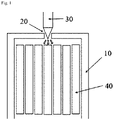
- an injection device (30) such as a nozzle is inserted into an injection hole (20) formed in a battery module case (10) in order to apply a heat dissipation material, and the heat dissipation material is injected inside the battery module case through the injection device (30).
- the heat dissipation material containing an excessive amount of thermally conductive filler is injected with a device having a relatively small diameter such as a nozzle, a large pressure is generated inside the device during the injection process, and a large load is applied to the device.
- the space into which the heat dissipation material is injected is relatively narrow, so that a pressure is also generated inside the case (10), which puts more load on the device.
- the heat dissipation material containing an excessive amount of thermally conductive filler is solidified inside the nozzle 30, which is equipment, by aggregation of fillers, or the like, during the injection process as described above, where such solidified components further narrow the passage through which the heat dissipation material passes and the load applied to the equipment becomes larger.
- Such a problem may occur in common not only in the manufacturing process of the battery module as in Patent Document 1, but also in the case of injecting a material containing an excessive amount of filler with the equipment such as the nozzle.
- Such a load applied to the equipment reduces the lifespan of the equipment, thereby causing product defects or an increase in cost through frequent replacement of the equipment.
- the content of the filler included in the material may be considered to reduce the content of the filler included in the material. If the content of the filler is reduced in the material, it is possible to reduce the load applied to the equipment in the process.
- the amount of the filler is reduced, the effect to be obtained through the introduction of the filler cannot be obtained.
- the content of the thermally conductive filler is reduced, the thermal conductivity of the heat dissipating material is lowered.
- Patent Document 1 Korean Laid-Open Patent Publication No. 2016-0105354
- the present application provides a resin composition comprising a thermally conductive filler.
- the present application aims to be capable of improving or minimizing a load applied to injection equipment when the resin composition has been injected by the equipment such as a nozzle, while comprising a thermally conductive filler to the extent that it is capable of exhibiting a desired thermal conductivity.
- the present application also relates to a battery module comprising the resin composition or a cured product thereof; a battery pack comprising the battery module; and an automobile comprising the battery module or battery pack.
- the relevant physical property is a physical property measured at room temperature, unless otherwise specified.
- room temperature is a natural temperature without heating or cooling, and is usually any temperature within a range of about 10°C to 30°C, or about 23°C or about 25°C or so. Unless otherwise specified in this specification, the unit of temperature is °C.
- normal pressure is a natural pressure without pressurizing or depressurizing, where usually about 1 atmosphere or so is referred to as normal pressure.
- the present application relates to a resin composition.
- the resin composition comprises a filler component.
- filler component means a component consisting of a filler, that is, a component comprising only the filler.
- the filler component may comprise two or more fillers having different average particle diameters. In one example, the filler component may comprise three or more fillers having different average particle diameters, or may be composed of three to six, three to five, three to four, or three fillers, having different average particle diameters. That is, in one example, the filler component may also comprise only three to six, three to five, three to four, or three fillers, having different average particle diameters.
- the filler component may exhibit at least two peaks in a volume curve of a particle size distribution measured using laser diffraction.
- the filler component may exhibit three or more peaks in the volume curve of the particle size distribution, or may exhibit three to six, three to five, three to four, or three peaks.
- the filler component exhibiting one, two, or four or more peaks is not included.
- the average particle diameter in the filler of the present application means a particle diameter at which the volume accumulation becomes 50% in the volume curve of the particle size distribution measured by laser diffraction, which may also be referred to as a median diameter. That is, in the present application, the particle size distribution is obtained on a volume basis through the laser diffraction, and the particle diameter at the point where the cumulative value becomes 50% in the cumulative curve with 100% of the total volume is set as the average particle diameter, and in another example, such an average particle diameter may be referred to as a median particle size or a D50 particle diameter.
- the two fillers having different average particle diameters may mean fillers having different particle diameters at the point where the cumulative value becomes 50% in the volume curve of the particle size distribution.
- the filler component of the resin composition of the present application may be a thermally conductive filler component.
- thermally conductive filler component means a filler component functioning so that the resin composition can be cured to exhibit a thermal conductivity to be described below.
- the resin composition of the present application may form a cured product exhibiting a high thermal conductivity even under a relatively low content of the filler component.
- the resin composition of the present application may provide a resin composition which can be cured to exhibit a high thermal conductivity while having a relatively low load value through adjustment of particle diameters and/or ratios of fillers included in the filler component.
- the definition of the load value will be described below.
- Such a resin composition can minimize or eliminate the load applied to the equipment even when injected through the equipment having a relatively small particle diameter, such as a nozzle, during the application process.
- the resin composition may be a resin composition used for a battery module or a battery pack, and specifically, may be a resin composition used to construct the battery module or battery pack in the same form as in Patent Document 1.
- the resin composition of the present application may be a composition which is used to fix battery cells in the battery module by being injected into the case of the battery module and contacting one or more battery cells present in the battery module.
- the resin composition of the present application may be, for example, an adhesive composition.
- the resin composition of the present application has a low load value as above, and exhibits a high thermal conductivity when cured, so that it is very suitable for the above applications.
- the resin composition comprises a resin component and a filler component, where the filler component comprises two or more fillers having different average particle diameters.
- the resin composition of the present application or the filler component included in the composition may satisfy the following general formula 1. 25 ⁇ D 50 A / D 50 C ⁇ 300
- D 50A is the maximum average particle diameter of the filler component
- Dsoc is the minimum average particle diameter of the filler component
- the maximum average particle diameter (D 50A ) of the filler component may mean the average particle diameter of the filler having the largest average particle diameter among fillers included in the filler component.
- the maximum average particle diameter (D 50A ) of the filler component may mean the particle diameter of the peak appearing at the largest particle diameter among the peaks appearing in the volume curve of the particle size distribution measured using laser diffraction for the filler component. can mean
- the minimum average particle diameter (Dsoc) of the filler component may mean the average particle diameter of the filler having the smallest average particle diameter among fillers included in the filler component.
- the minimum average particle diameter (Dsoc) of the filler component may mean the particle diameter of the peak appearing at the smallest particle diameter among the peaks appearing in the volume curve of the particle size distribution measured using laser diffraction for the filler component.
- the D 50A / D 50C value of General Formula 1 above may also be further adjusted in a range of 26 or more, 27 or more, 28 or more, 29 or more, 30 or more, 31 or more, 32 or more, 33 or more, 34 or more, 35 or more, 40 or more, 50 or more, 60 or more.
- the filler component comprises three or more fillers having different average particle diameters or exhibits the three or more peaks
- the filler component comprises only three fillers having different average particle diameters or exhibits only the three peaks
- the resin composition of the present application may exhibit a low load value.
- the resin composition may have a load value of less than 35 kgf.
- the load value is a numerical value quantifying how much load is applied to equipment having a narrow diameter such as a nozzle when a resin composition is injected by the relevant equipment.
- the resin composition is a two-component type comprising a main composition and a curing agent composition
- the load value is a value measured immediately after mixing the main composition and the curing agent composition.
- the load value may be measured by the method of the example item to be described below. That is, the load value may be measured through the force applied in the pushing process while pushing the resin composition using a device, such as a static mixer, capable of simulating the equipment having a narrow diameter such as the nozzle.
- a device such as a static mixer, capable of simulating the equipment having a narrow diameter such as the nozzle.
- the load value may be a maximum value of the force applied when the resin composition is pushed out at a constant velocity (1mm/s) so that the resin composition is passed through the inside of a static mixer (a stepped static mixer that a circular discharge part has a diameter of 2 mm and the number of elements is 16) (e.g., Sulzer, MBH-06-16T) and discharged to the discharge part of the mixer.
- a static mixer a stepped static mixer that a circular discharge part has a diameter of 2 mm and the number of elements is 16
- a general TA (Texture analyzer) equipment can be used.
- the load values can be measured in the same manner by connecting two cartridges to the front end of the static mixer, loading the main and curing agent compositions into the two cartridges, respectively, and then injecting them into the static mixer at a constant speed.
- the load value can be measured at the point where the force applied to the pressurizing means (TA equipment) becomes a maximum value, wherein the force starts to be measured from the time the resin composition is first discharged to the discharge part of the static mixer by the above method.
- the relevant force increases with time and then decreases again, or increases and then does not increase anymore, where the load value is the maximum value of the force before the decrease, or the maximum force that has not increased any more.
- the load value may further be controlled in the range of greater than about 12 kgf, greater than 13 kgf, greater than 14 kgf, greater than 15 kgf, greater than 16 kgf, greater than 17 kgf, greater than 18 kgf, greater than 19 kgf, or greater than about 20 kgf and/or in the range of less than about 34 kgf, less than 33 kgf, less than 32 kgf, less than 31 kgf, less than 30 kgf, less than 29 kgf, or less than about 28 kgf.
- the lower the load value the less the burden applied on the equipment is, but if the load value is too low, overflow may occur after injection of the resin composition or the storage stability of the resin composition may be deteriorated, so that it may be appropriate for the load value to be determined in the above-described range.
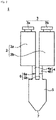
- the load value of the resin composition has been measured using a mixer (equipment) in which a cartridge and a mixer are combined, and Fig. 2 illustratively shows the equipment.
- the mixer (1) comprises two cartridges (2) and one mixer (5), where the cartridge may have a pressurizing means (3).
- the applied cartridge (2) is not particularly limited, where a known cartridge may be used as long as it can accommodate the main composition and the curing agent composition.
- the cartridge for accommodating the main composition or curing agent composition may be of a circle having a diameter of about 15mm to about 20mm
- first discharge parts (4a, 4b) for discharging the main composition or curing agent composition may be of a circle having a discharge part diameter of about 2mm to about 5mm
- its height may be about 80mm to about 300mm
- its total volume may be about 10ml to about 100ml.
- the cartridge (2a, 2b) may have a pressurizing means (3a, 3b).
- the pressurizing means (3a, 3b) is not particularly limited, and a known pressurizing means can be used.
- the pressurizing means may use a TA (Texture analyzer).
- the pressurizing means (3a, 3b) may pressurize the cartridges (2a, 2b) to discharge the main composition and the curing agent composition inside the cartridges through the mixer (5).
- the pressurizing speed of the pressurizing means (3a, 3b) may be about 0.01 to about 2mm/s.
- the pressurizing speed may be about 0.01 mm/s or more, 0.05 mm/s or more, or about 0.1 mm/s or more, and may be about 1.5 mm/s or less, about 1 mm/s or less, 0.8 mm/s or less, 0.6 mm /s or less, 0.4 mm/s or less, or about 0.2 mm/s or less, or may also be about 1 mm/s or less or so.
- a static mixer may be used as the mixer (5).
- the static mixer (5) has two receiving parts (6a, 6b) for receiving the main composition and the curing agent composition, respectively, from the two cartridges (2a, 2b), and one second discharge part (7) for discharging the resin composition mixed by the static mixer (5), where the sizes of the receiving parts (6a, 6b) may be each a circle with a diameter of about 2mm to about 5mm and the second discharge part (7) may be of a circle having a diameter of about 1mm to about 3mm, and the number of elements may be about 5 to about 20.
- the capacity of the mixer may have a capacity satisfying a range of General Formula 2 below. V ⁇ t 2 / td ⁇ Q
- V is the capacity of the static mixer
- t2 is the time for doubling the viscosity of the resin composition
- td is the dispensing process time
- Q is the injection amount per process unit time.
- the resin composition may have a thermal conductivity of 3.0 W/mK or more after curing, and may form, for example, a resin layer having the thermal conductivity.
- the resin layer may also have a thermal conductivity of about 50 W/mK or less, 45 W/mK or less, 40 W/mK or less, 35 W/mK or less, 30 W/mK or less, 25 W/mK or less, 20 W/mK or less, 15 W/mK or less, about 10 W/mK or less, 9 W/mK or less, 8 W/mK or less, 7 W/mK or less, 6 W/mK or less, 5 W/mK or less, or 4 W/mK or less or so.
- the thermal conductivity of the resin layer may be measured according to, for example, ASTM D5470 standard or ISO 22007-2 standard.
- the resin composition that is cured to exhibit a thermal conductivity of at least 3.0 W/mK or more is useful in various applications, and is particularly effective in dissipating heat generated inside the battery module to the outside.
- the filler component of the resin composition in the present application may comprise fillers having at least three different average particle diameters.
- Such a filler component may exhibit at least three peaks in the volume curve of the particle size distribution measured using the laser diffraction.
- an excessive amount of filler must be applied in general, and when the filler is applied in excess, handleability is lowered, as the viscosity of the resin composition increases significantly and overloading of injection equipment occurs.
- the viscosity of the resin composition may be maintained at an appropriate level, a low load value may be ensured to prevent overloading of the injection equipment, and the service life of the injection equipment may be improved, even if the filler is excessively applied to the resin composition.
- the filler component of the resin composition may comprise a first filler having an average particle diameter in a range of 60 ⁇ m to 200 ⁇ m, a second filler having an average particle diameter of more than 5 ⁇ m and 40 ⁇ m or less, and a third filler having an average particle diameter of 0.2 ⁇ m to 5 ⁇ m.
- the filler component may comprise the three fillers, or may comprise only the three fillers.
- the first filler may be a filler having the largest average particle diameter among the fillers included in the filler component
- the third filler may be a filler having the smallest average particle diameter among the fillers included in the filler component. Therefore, in this case, the average particle diameter of the first filler may be the maximum average particle diameter (D 50A ) of General Formula 1 above, and the average particle diameter of the third filler may be the minimum average particle diameter (Dsoc) of General Formula 1 above.
- the volume curve of the particle size distribution measured using the laser diffraction with respect to the filler component of the resin composition may exhibit a first peak appearing at a particle diameter within the range of 60 ⁇ m to 200 ⁇ m, a second peak appearing at a particle diameter within the range of more than 5 ⁇ m and 40 ⁇ m or less and a third peak appearing at a particle diameter within the range of 0.2 ⁇ m to 5 ⁇ m.
- the volume curve of the particle size distribution may comprise at least the three peaks, or may exhibit only the three peaks.
- the first peak may be a peak appearing at the largest particle diameter among the peaks shown by the volume curve
- the third peak may be a peak appearing at the lowest particle diameter among the peaks shown by the volume curve. Therefore, in this case, the particle diameter at which the first peak appears may be the maximum average particle diameter (D 50A ) of General Formula 1 above, and the particle diameter at which the third peak appears may be the minimum average particle diameter (Dsoc) of General Formula 1 above.
- the average particle diameter of the first filler or the particle diameter at which the first peak appears may be further adjusted in the range of 190 ⁇ m or less, 180 ⁇ m or less, 170 ⁇ m or less, 160 ⁇ m or less, 150 ⁇ m or less, 140 ⁇ m or less, 130 ⁇ m or less, 120 ⁇ m or less, 115 ⁇ m or less, 110 ⁇ m or less, 105 ⁇ m or less, 100 ⁇ m or less, 95 ⁇ m or less, 90 ⁇ m or less, 85 ⁇ m or less, 80 ⁇ m or less, or about 75 ⁇ m or less and/or in the range of 61 ⁇ m or more, 62 ⁇ m or more, 63 ⁇ m or more, 64 ⁇ m or more, 65 ⁇ m or more, 66 ⁇ m or more, 67 ⁇ m or more, 68 ⁇ m or more, 69 ⁇ m or more, or 70 ⁇ m or more.
- the average particle diameter of the first filler or the particle diameter at which the first peak appears is within the above range, it is advantageous to secure the desired high thermal conductivity (3.0 W/mK or more) and low load value.
- the average particle diameter of the second filler or the particle diameter at which the second peak appears may be further adjusted in the range of more than about 6 ⁇ m, more than 7 ⁇ m, more than 8 ⁇ m, more than 9 ⁇ m, more than 10 ⁇ m, more than 11 ⁇ m, more than 12 ⁇ m, more than 13 ⁇ m, more than about 14 ⁇ m, more than 15 ⁇ m, more than 16 ⁇ m, more than 17 ⁇ m, more than 18 ⁇ m, or more than 19 ⁇ m and/or in the range of 39 ⁇ m or less, 38 ⁇ m or less, 37 ⁇ m or less, 36 ⁇ m or less, 35 ⁇ m or less, 34 ⁇ m or less, 33 ⁇ m or less, 32 ⁇ m or less, 31 ⁇ m or less, 30 ⁇ m or less, 29 ⁇ m or less, 28 ⁇ m or less, about 27 ⁇ m or less, 26 ⁇ m or less, 25 ⁇ m or less, 24 ⁇ m or less, 23
- the average particle diameter of the third filler or the particle diameter at which the third peak appears may be further adjusted in the range of about 0.3 ⁇ m or more, 0.4 ⁇ m or more, or about 0.5 ⁇ m or more and/or in the range of about 5 ⁇ m or less, 4.5 ⁇ m or less, about 4 ⁇ m or less, about 3.5 ⁇ m or less, about 3 ⁇ m or less, about 2.5 ⁇ m or less, about 2 ⁇ m or less, about 1.5 ⁇ m or less, or about 1 ⁇ m or less.
- the ratio (D1/D2) of the average particle diameter (D1) of the first filler to the average particle diameter (D2) of the second filler may be in the range of about 3 to 20.
- the ratio (D1/D2) may be 3.1 or more, 3.2 or more, 3.3 or more, 3.4 or more, or 3.5 or more, or may also be 19 or less, 18 or less, 17 or less, 16 or less, 15 or less, 14 or less, 13 or less, 12 or less, 11 or less, 10 or less, 9 or less, 8 or less, 7 or less, 6 or less, 5 or less, or 4 or less or so.
- the second filler and the third filler having a size in the above range are included together with the first filler and their relationship satisfies General Formula 1 and the like, the high thermal conductivity and low load value can be satisfied effectively, while maintaining the viscosity of the resin composition at an appropriate level.
- the filler component may be present in a ratio of 91 parts by weight or less in 100 parts by weight of the total resin composition. In another example, the filler component may be present in a ratio of about 90.5 parts by weight or less, 90.0 parts by weight or less, 89.5 parts by weight or less, 89.0 parts by weight or less, 88.5 parts by weight or less, 88.0 parts by weight or less, 87.5 parts by weight or less, or about 87 parts by weight or less, or may be present in a ratio of about 70 parts by weight or more, about 75 parts by weight or more, about 80 parts by weight or more, about 85 parts by weight or more, or about 86 parts by weight or more, in 100 parts by weight of the resin composition.
- the ratio of the filler component in the resin composition may be 91 weight% or less. In another example, the ratio of the filler component in the resin composition may be about 90.5 weight% or less, 90.0 weight% or less, 89.5 weight% or less, 89.0 weight% or less, 88.5 weight% or less, 88.0 weight% or less, 87.5 weight% or less, or about 87 weight% or less, or may be about 70 weight% or more, about 75 weight% or more, about 80 weight% or more, about 85 weight% or more, or about 86 weight% or more.
- the ratio of the second filler may be about 35 parts by weight or more, about 40 parts by weight or more, about 45 parts by weight or more, about 50 parts by weight or more, about 55 parts by weight or more, about 60 parts by weight or more, about 65 parts by weight or more, about 70 parts by weight or more, or about 75 parts by weight or more, or may be about 115 parts by weight or less, about 110 parts by weight or less, about 105 parts by weight or less, about 100 parts by weight or less, about 95 parts by weight or less, about 90 parts by weight or less, about 85 parts by weight or less, about 80 parts by weight or less, or about 75 parts by weight or less or so; and in another example, the ratio of the third filler may be about 35 parts by weight or more, about 40 parts by weight or more, about 45
- the content of the filler component is too large, an overload may occur in the injection equipment for injecting the resin composition, thereby shortening the life of the injection equipment, and if the content is too small, the thermal conductivity realized by curing the resin composition may be lowered, but it is possible to secure an appropriate thermal conductivity and load value within the above range.
- the content of the first filler may be about 35 parts by weight to about 80 parts by weight relative to 100 parts by weight of the total filler component; the content of the second filler may be about 5 parts by weight to about 40 parts by weight relative to 100 parts by weight of the total filler; and the content of the third filler may be about 5 parts by weight to about 40 parts by weight relative to 100 parts by weight of the total filler.
- the filler component may comprise 30 weight% or more of a spherical filler.
- a spherical filler usually, if the shape of the filler is spherical, it is not advantageous to achieve a higher thermal conductivity. That is, in terms of thermal conductivity, it is advantageous to use a non-spherical shape as a filler.
- the filler when the filler is non-spherical, it is not advantageous in terms of the load value or the hardness of the solid matter, so that by comprising the spherical filler in an amount of a certain level or more in the filler component, advantageous effects can be exerted in terms of the load value and the hardness of the solid matter.
- the high thermal conductivity can be achieved even under the content of the spherical filler as above.
- the content of the spherical filler in the filler component may be 35 weight% or more, 40 weight% or more, 45 weight% or more, 50 weight% or more, 55 weight% or more, 60 weight% or more, 65 weight% or more, 70 weight% or more. or more, 75 weight% or more, 80 weight% or more, 85 weight% or more, 90 weight% or more, or 95 weight% or more.
- the content upper limit of the spherical filler in the filler component may be adjusted in the range of 95 weight% or less, 90 weight% or less, 85 weight% or less, 80 weight% or less, or 75 weight% or less in consideration of the thermal conductivity, load value and hardness characteristics of the solid matter.
- the non-spherical filler may be selected as the third filler.
- spherical filler is a filler having a sphericity of 0.9 or more.
- the sphericity of the spherical filler may be 0.95 or more. Therefore, a filler having a sphericity of less than 0.9 is a non-spherical filler.
- the sphericity of the filler may be defined as a ratio (S'/S) of a surface area (S) of a particle and a surface area (S') of a sphere having the same volume as that of the particle.
- S'/S a ratio of a surface area of a particle and a surface area of a sphere having the same volume as that of the particle.
- S'/S surface area of a particle
- S' surface area
- the circularity is indicated by a value ranging from 0 to 1, where a perfect circle has a value of 1, and the more irregular the shape of the particle, it has a value lower than 1.
- the filler component may comprise an alpha (a)-phase filler (e.g., alpha-phase alumina filler, etc.) in a ratio of 90 weight% or less based on 100 weight% of the total filler.
- an alpha (a)-phase filler e.g., alpha-phase alumina filler, etc.
- the ratio of the alpha phase included in the filler component may be within the above range.
- the filler component may comprise the alpha phase in a range of about 40 weight% or more, about 42 weight% or more, 44 weight% or more, 46 weight% or more, 48 weight% or more, 50 weight% or more, 52 weight% or more, or 54 weight% or more based on 100 weight% of the total filler, or may comprise it in an amount of 85 weight% or less, 80 weight% or less, 75 weight% or less, about 70 weight% or less, 65 weight% or less, or 60 weight% or less.
- a method of obtaining the ratio of the alpha (a)-phase in the filler component is not particularly limited. That is, after analyzing the crystal phases (e.g., alpha or beta gamma phase in the case of alumina) of the fillers in the filler component through conventional XRD analyses, the ratio of the alpha phase in the crystal phases may be confirmed.
- the crystal phases e.g., alpha or beta gamma phase in the case of alumina
- the filler component may be a thermally conductive filler component.
- thermally conductive filler is a filler component functioning so that the resin composition is cured to exhibit a thermal conductivity of about 3.0 W/mK or more.
- a filler component may comprise a filler made of a material having a thermal conductivity of about 1 W/mK or more, 5 W/mK or more, 10 W/mK or more, or about 15 W/mK or more.
- the thermal conductivity of the material may be about 400 W/mK or less, 350 W/mK or less, or about 300 W/mK or less.
- a material such as aluminum oxide (alumina: Al 2 O 3 ), aluminum nitride (AlN), boron nitride (BN), silicon nitride (Si 3 N 4 ), silicon carbide (SiC), beryllium oxide (BeO), A ceramic material such as zinc oxide (ZnO), magnesium oxide (MgO) or boehmite.
- a ceramic material such as aluminum oxide (alumina: Al 2 O 3 ), aluminum nitride (AlN), boron nitride (BN), silicon nitride (Si 3 N 4 ), silicon carbide (SiC), beryllium oxide (BeO), A ceramic material such as zinc oxide (ZnO), magnesium oxide (MgO) or boehmite.
- the filler component may comprise various fillers if necessary, in addition to the thermally conductive filler as above, and for example, a carbon filler such as graphite, or a filler such as fumed silica, clay, aluminum hydroxide (Al(OH) 3 ), magnesium hydroxide (Mg(OH) 2 ) or calcium carbonate (CaCO 3 ), and the like may be applied.
- a carbon filler such as graphite
- a filler such as fumed silica, clay, aluminum hydroxide (Al(OH) 3 ), magnesium hydroxide (Mg(OH) 2 ) or calcium carbonate (CaCO 3 ), and the like may be applied.
- the filler component may have a moisture content of about 1,000 ppm or less.
- the moisture content can be measured with a karl fishcer titrator (KR831) under conditions of 10% relative humidity and 5.0 or less drift.
- the moisture content may be an average moisture content with respect to the entire filler component used in the resin composition.
- a filler component satisfying the above conditions may be selectively used, or the moisture content of the filler may be adjusted to satisfy the moisture content range by a method of drying the filler component to be used in an oven at a temperature of about 200°C, and the like.
- the upper limit of the moisture content of the filler component may be about 800 ppm or less, 600 ppm or less, or about 400 ppm or less, and the lower limit thereof may be about 100 ppm or more, or about 200 ppm or more.
- the resin composition of the present application may be a room temperature curable composition.
- the room temperature curable composition means a composition in which the curing reaction of the resin composition starts at room temperature and proceeds at room temperature.
- the curing starts at room temperature immediately after the main resin and the curing agent are mixed at room temperature, and the curing proceeds in a state maintained at room temperature.
- the resin composition may be an adhesive composition.
- adhesive composition is a composition capable of forming an adhesive before or after curing.
- the kind of the resin component contained in such a resin composition is not particularly limited.
- resin component includes not only a component generally known as a resin, but also a component that can be converted into a resin through a curing reaction or a polymerization reaction.
- an adhesive resin or a precursor capable of forming an adhesive resin may be applied as the resin component.
- An example of such a resin component includes an acrylic resin, an epoxy resin, a urethane resin, an olefin resin, an EVA (ethylene vinyl acetate) resin or a silicone resin, and the like, or a precursor such as a polyol or an isocyanate compound, and the like, but is not limited thereto.
- the resin composition of the present application may be a one-component resin composition or a two-component resin composition.
- the two-component resin composition is separated into a main composition and a curing agent composition as is known, where these two separated compositions may be mixed and reacted to form a resin, and when the resin composition of the present application is a two-component type, the resin composition comprising the resin component and the filler component may refer to the main composition, the curing agent composition, a mixture thereof, or a state after mixing them and then performing the reaction.
- the resin composition is, for example, a two-component resin composition comprising a main composition and a curing agent composition
- the main composition may comprise a silicone resin, a polyol resin, an epoxy resin or an acrylic resin as the main resin
- the curing agent composition may comprise, as the curing agent, a known curing agent suitable for the main resin.
- a siloxane compound when the main resin is a silicone resin, a siloxane compound may be used as the curing agent; when the main resin is a polyol resin, an isocyanate compound may be used as the curing agent; when the main resin is an epoxy resin, an amine compound may be used as the curing agent, and when the main resin is an acrylic resin, an isocyanate compound may be used as the curing agent.
- the resin composition may be a urethane resin composition, and may be a two-component urethane resin composition.
- the term two-component urethane resin composition is a composition capable of forming a resin by formulating the main composition and the curing agent composition, where the polyurethane may be formed by the reaction of the main agent and the curing agent.
- the resin composition of the present application may refer to a main composition of a two-component urethane resin composition, a curing agent composition of a two-component urethane resin composition, or a mixture of the main and curing agent compositions, or a mixture in a state where a urethane resin is formed by a urethane reaction in the mixture.
- the main composition of the two-component urethane-based resin composition may comprise at least a polyol, and the curing agent composition may comprise an isocyanate compound such as polyisocyanate.
- the urethane resin formed by the reaction of the two-component urethane resin composition may comprise at least the polyol-derived unit and the polyisocyanate-derived unit.
- the polyol-derived unit may be a unit formed by the urethane reaction of the polyol with the polyisocyanate
- the polyisocyanate-derived unit may be a unit formed by the urethane reaction of the polyisocyanate with the polyol.
- the main resin and the curing agent may each exhibit a viscosity of about 10,000 cP or less.
- the main resin and the curing agent may each have a viscosity upper limit of about 8,000 cP or less, 6,000 cP or less, 4,000 cP or less, 2,000 cP or about 1,000 cP or less.
- the main resin and the curing agent may each have a viscosity upper limit of about 900 cP or less, 800 cP or less, 700 cP or less, 600 cP or less, 500 cP or less, or about 400 cP or less.
- the main resin and the curing agent may have a viscosity lower limit of about 50 cP or more, or about 100 cP or more. If the viscosity is too low, processability may be good, but as the molecular weight of the raw material is lowered, the possibility of volatilization may increase and the adhesive force may be deteriorated, where this disadvantage can be prevented by satisfying the lower limit range.
- the viscosity may be measured at room temperature using, for example, a Brookfield LV type viscometer. Specifically, it may be measured using a Brookfield LV type viscometer at about 25°C with a torque of about 90% and a shear rate of about 100rpm.
- the resin composition may be a two-component urethane resin composition.
- the two-component urethane resin composition may be cured by reacting a main resin comprising a polyol and the like with a curing agent comprising an isocyanate and the like at room temperature.
- the curing reaction may be assisted by a catalyst, for example.
- the two-part urethane-based composition may include all a state where the main resin (polyol) and the curing agent (isocyanate) are separated, mixed, or reacted.
- a tin-based catalyst for example, a tin-based catalyst may be used.
- a tin-based catalyst dibutyltin dilaurate (DBTDL) may be used.
- the two-component urethane-based composition may comprise a main composition comprising at least a polyol resin and a curing agent composition comprising at least an isocyanate, so that the cured product of the resin composition may comprise both the polyol-derived unit and the polyisocyanate-derived unit.
- the polyol-derived unit may be a unit formed by a urethane reaction of a polyol with a polyisocyanate
- the polyisocyanate-derived unit may be a unit formed by a urethane reaction of a polyisocyanate with a polyol.
- an ester polyol resin may be used as the polyol resin included in the main material.
- the ester polyol it is advantageous to satisfy the above-described General Formula 2, and it is also advantageous to satisfy physical properties, such as adhesive force, to be described below.
- the ester polyol may be an amorphous or sufficiently low crystalline polyol.
- the "amorphous” means a case where the crystallization temperature (Tc) and the melting temperature (Tm) are not observed in a DSC (differential scanning calorimetry) analysis to be described below.
- the DSC analysis can be performed at a rate of 10°C/minute within a range of -80°C to 60°C, and for example, a method can be performed, in which the temperature is raised from 25°C to 60°C at the above rate, and then the temperature is reduced to -80°C again and raised to 60°C again.
- the "sufficiently low crystalline” means a case where the melting point (Tm) observed in the DSC analysis is less than 15°C, which is about 10°C or lower, 5°C or lower, 0°C or lower, - 5°C or lower, -10°C or lower, or about -20°C or lower or so.
- the lower limit of the melting point is not particularly limited, but for example, the melting point may be about - 80°C or higher, -75°C or higher, or about -70°C or higher.
- the polyol is crystalline or has high (room temperature) crystallizability, such as not satisfying the melting point range, the viscosity difference depending on the temperature easily increases, so that it may be difficult to satisfy the above-described General Formula 2 or physical properties such as adhesive force to be described below.
- ester polyol for example, a carboxylic acid polyol or a caprolactone polyol may be used.
- the carboxylic acid polyol may be formed by reacting a component comprising a carboxylic acid and a polyol (e.g., a diol or a triol, etc.), and the caprolactone polyol may be formed by reacting a component comprising caprolactone and a polyol (e.g., a diol or a triol, etc.). At this time, the carboxylic acid may be a dicarboxylic acid.
- the polyol may be a polyol represented by the following formula 1 or 2.
- X is a carboxylic acid-derived unit
- Y is a polyol-derived unit.
- the polyol-derived unit may be, for example, a triol unit or a diol unit.
- n and m may be any number, and for example, n is a number in a range of 2 to 10, m is a number in a range of 1 to 10, and R 1 and R 2 are each independently an alkylene having 1 to 14 carbon atoms.
- carboxylic acid-derived unit may mean a moiety other than the carboxyl group in the carboxylic acid compound.
- polyol-derived unit may mean a moiety other than the hydroxyl group in the polyol compound structure.
- the carboxylic acid-derived unit may mean a moiety of the carboxylic acid structure which does not participate in the condensation reaction.
- the polyol-derived unit may mean a moiety of the polyol structure which does not participate in the condensation reaction.
- Y in Formula 2 also represents a moiety excluding the ester bond. That is, when the polyol and the caprolactone form an ester bond, the polyol-derived unit in Formula 2, Y may mean a moiety of the polyol structure which does not participate in the ester bond.
- the ester bonds are represented in Formulas 1 and 2, respectively.
- the polyol-derived unit of Y in Formulas above is a unit derived from a polyol having three or more hydroxyl groups such as a triol unit, a branched structure may be realized in the Y part in the formula structure.
- the kind of the carboxylic acid-derived unit of X is not particularly limited, but in order to secure desired physical properties, it may be a unit derived from one or more compounds selected from the group consisting of a fatty acid compound, an aromatic compound having two or more carboxyl groups, an alicyclic compound having two or more carboxyl groups and an aliphatic compound having two or more carboxyl groups.
- the aromatic compound having two or more carboxyl groups may be phthalic acid, isophthalic acid, terephthalic acid, trimellitic acid or tetrachlorophthalic acid.
- the alicyclic compound having two or more carboxyl groups may be tetrahydrophthalic acid or hexahydrophthalic acid.
- the aliphatic compound having two or more carboxyl groups may be oxalic acid, adipic acid, azelaic acid, sebacic acid, succinic acid, malic acid, glutaric acid, malonic acid, pimelic acid, suberic acid, 2,2-dimethylsuccinic acid, 3,3-dimethylglutaric acid, 2,2-dimethylglutaric acid, maleic acid, fumaric acid or itaconic acid.
- an aliphatic carboxylic acid-derived unit may be preferable to an aromatic carboxylic acid-derived unit.
- the kind of the polyol-derived unit of Y is not particularly limited, but in order to secure desired physical properties, it may be derived from one or more compounds selected from the group consisting of an alicyclic compound having two or more hydroxyl groups and an aliphatic compound having two or more hydroxyl groups.
- the alicyclic compound having two or more hydroxyl groups may be 1,3-cyclohexane dimethanol or 1,4-cyclohexane dimethanol.
- the aliphatic compound having two or more hydroxyl groups may be ethylene glycol, propylene glycol, 1,2-butylene glycol, 2,3-butylene glycol, 1,3-propanediol, 1,4-butanediol, 1,6-hexanediol, neopentyl glycol, 1,2-ethylhexyldiol, 1,5-pentanediol, 1,9-nonanediol, 1,10- decanediol, glycerin or trimethylol propane.
- n is any number, and the range may be selected in consideration of the desired physical properties of the resin composition or a resin layer, which is the cured product thereof.
- n may be about 2 to 10 or 2 to 5.
- m is any number, and the range may be selected in consideration of the desired physical properties of the resin composition or a resin layer, which is the cured product thereof.
- m is about 1 to 10 or 1 to 5.
- n and m in Formulas 1 and 2 are outside the above ranges, the crystallizability expression of the polyol becomes stronger, which may adversely affect the injection processability of the composition.
- R 1 and R 2 are each independently an alkylene having 1 to 14 carbon atoms.
- the number of carbon atoms can be selected in consideration of the desired physical properties of the resin composition or a resin layer which is the cured product thereof.
- the molecular weight of the polyol may be adjusted in consideration of the viscosity, durability or adhesion, and the like, as described below, which may be within a range of, for example, about 300 to about 2,000.
- the "molecular weight” may be a weight average molecular weight (Mw) measured using GPC (gel permeation chromatograph). If it is out of the above range, the reliability of the resin layer after curing may be poor and problems related to volatile components may occur.
- the kind of the isocyanate contained in the curing agent is not particularly limited, but in order to secure desired physical properties, a non-aromatic isocyanate compound containing no aromatic group can be used.
- a non-aromatic isocyanate compound containing no aromatic group can be used.
- the reaction rate may be too fast and the glass transition temperature of the cured product may be increased, so that it may be difficult to satisfy the above-described General Formula 2 or physical properties such as adhesive force to be described below.
- non-aromatic isocyanate compound for example, an aliphatic polyisocyanate such as hexamethylene diisocyanate, trimethylhexamethylene diisocyanate, lysine diisocyanate, norbornane diisocyanate methyl, ethylene diisocyanate, propylene diisocyanate or tetramethylene diisocyanate; an alicyclic polyisocyanate such as transcyclohexane-1,4-diisocyanate, isophorone diisocyanate, bis(isocyanatomethyl)cyclohexane diisocyanate or dicyclohexylmethane diisocyanate; or one or more carbodiimide-modified polyisocyanates or isocyanurate-modified polyisocyanates of the foregoing; and the like may be used. Also, a mixture of two or more of the above-listed compounds may be used.
- the resin component included in the two-component resin composition may have a glass transition temperature (Tg) of less than 0°C after curing.
- Tg glass transition temperature
- brittle characteristics can be secured in a relatively short time even at a low temperature where the battery module or the battery pack can be used, thereby ensuring impact resistance and vibration resistance characteristics.
- the tacky property of the cured product may be excessively high or the thermal stability may be lowered.
- the lower limit of the glass transition temperature of the two-component resin composition after curing may be about -70°C or more, -60°C or more, -50°C or more, -40°C or more, or about -30°C or more, and the upper limit thereof may be about -5°C or less, -10°C or less, -15°C or less, or about - 20°C or less.
- the expression “after curing” may be used in the same meaning as “real curing”.
- the real curing means a state that in order to manufacture a battery module, the resin composition injected into the module can be regarded as having been cured enough to function as an adhesive imparted with a function such as actual heat dissipation.
- the real curing can be confirmed from the fact that a conversion rate based on the NCO peak around 2250 cm -1 is 80% or more, which is determined by a FT-IR analysis on the basis of the curing at room temperature and 30 to 70% relative humidity for 24 hours.
- the ratio of the polyol resin component and the polyisocyanate component in the resin composition is not particularly limited, which may be appropriately adjusted to enable a urethane reaction between them.
- the resin composition of the present application may have a viscosity value of about 500,000 cP or less.
- the lower limit may be, for example, about 150,000 cP or more.
- the viscosity value of the resin composition may be about 450,000 cP or less, 400,000 cP or less, or about 350,000 cP or less, and may be about 160,000 cP or more, 180,000 cP or more, or about 200,000 cP or more.
- the viscosity of the resin composition when measured in a shear rate range of 0.01 to 10.0/s using a rheological property measuring device (ARES) within 1 minute at room temperature after the curing reaction is started by mixing the main composition and the curing agent composition, it may be a viscosity value measured at a point of 2.5/s.
- RATS rheological property measuring device
- the resin composition may further comprise a viscosity controlling agent, such as a thixotropic agent, a diluent, a dispersant, a surface treatment agent or a coupling agent, for adjusting viscosity, if necessary, for example, for raising or lowering viscosity or for controlling viscosity depending on shear force.
- a viscosity controlling agent such as a thixotropic agent, a diluent, a dispersant, a surface treatment agent or a coupling agent, for adjusting viscosity, if necessary, for example, for raising or lowering viscosity or for controlling viscosity depending on shear force.
- the thixotropic agent controls the viscosity of the resin composition depending on the shear force, whereby the process of manufacturing the battery module can be effectively performed.
- the usable thixotropic agent fumed silica and the like can be exemplified.
- the diluent or dispersant is usually used for lowering the viscosity of the resin composition, and any of various kinds known in the art can be used without limitation as long as it can exhibit the above action.
- the surface treatment agent is for surface treatment of the filler introduced into the resin layer, and any of various kinds known in the art can be used without limitation as long as it can exhibit the above action.
- the coupling agent may be used, for example, to improve the dispersibility of the thermally conductive filler such as alumina, and any of various kinds known in the art may be used without limitation as long as it can exhibit the above action.
- the resin composition may further comprise a flame retardant or a flame retardant auxiliary agent.
- a known flame retardant may be used without any particular limitation, and for example, a flame retardant in the form of a solid phase or a liquid flame retardant may be applied.
- the flame retardant includes, for example, organic flame retardants such as melamine cyanurate and inorganic flame retardants such as magnesium hydroxide.
- a liquid type flame retardant material TEP, triethyl phosphate, or TCPP, tris(1,3-chloro-2-propyl)phosphate, etc.
- a silane coupling agent capable of acting as a flame retardant synergist may also be added.
- the resin composition may comprise the above-described constitutions, and may be a solvent type composition, a water-based composition or a solventless type composition, but considering the convenience of the manufacturing process, the solventless type may be suitable.
- the resin composition of the present application may have physical properties suitable for the use to be described below.
- the resin composition may have a leakage current of less than about 1mA as measured at room temperature 60 minutes after the main composition and the curing agent composition initiate a curing reaction.
- the lower limit of the leakage current is not particularly limited, but considering the composition of the resin composition and the like, it may be about 0.01mA or more, 0.02mA or more, 0.03mA or more, or about 0.05mA or more.
- the leakage current was measured according to ISO 6469-3. When the range of the leakage current is satisfied, the resin layer formed after the resin composition is cured has excellent electrical insulation properties. Therefore, the performance of the battery module can be maintained and stability can be secured.
- Such a leakage current can also be controlled by adjusting the components of the resin composition, and for example, the leakage current can be controlled by applying an insulating filler in the resin composition.
- an insulating filler in the resin composition.
- the above-described ceramic filler among thermally conductive fillers is known as a component capable of securing insulation properties.
- the resin composition may have adhesive force (S1) of about 200 gf/lOmm or more of the resin composition measured at room temperature 24 hours after the main composition and the curing agent composition initiate the curing reaction. That is, it may mean adhesive force of the resin composition after curing.
- the adhesive force may be about 220 gf/lOmm or more, 250 gf/lOmm or more, 300 gf/lOmm or more, 350 gf/lOmm or more, 400 gf/lOmm or more, 420 gf/lOmm or more, 440 gf/lOmm or more, or about 460 gf/lOmm or more.
- the battery module can secure appropriate impact resistance and vibration resistance.
- the upper limit of the adhesive force is not particularly limited, which may be about 1,000 gf/lOmm or less, 900 gf/lOmm or less, 800 gf/lOmm or less or 700 gf/lOmm or less, 600 gf/lOmm or less, or about 500 gf/10 mm or less or so.
- the adhesive force is too high, there is a risk that the pouch portion to which the resin layer formed after the resin composition is cured is attached will tear.
- the adhesive force can be measured with respect to an aluminum pouch.
- an aluminum pouch used for manufacturing a battery cell is cut to a width of about 10 mm, a resin composition is loaded on a glass plate, and the cut aluminum pouch is loaded thereon so that the resin composition contacts the PET (poly (ethylene terephthalate) surface of the pouch, and then the adhesive force can be measured while the resin composition is cured at 25°C and 50% RH for 24 hours and the aluminum pouch is peeled off at a peeling angle of 180° and a peeling speed of 300 mm/min with a tensile tester (Texture analyzer).
- the adhesive force of the resin composition after curing can be maintained at a considerable level even under high-temperature/high-humidity.
- the % ratio [(S2/S1) ⁇ 100] of the adhesive force (S2) measured by the same method after a high-temperature/high-humidity acceleration test performed under predetermined conditions relative to the adhesive force (S1) measured at room temperature may be about 70% or more, or about 80% or more.
- the high-temperature/high-humidity acceleration test can be measured after storing the same specimen as the specimen used for measuring the room temperature adhesive force for 10 days under conditions of a temperature of 40°C to 100°C and humidity of 75% relative humidity (RH) or more.
- the resin composition can have excellent heat resistance after curing.
- the composition of the present application may have a 5% weight loss temperature of 120°C or higher at the time of a thermogravimetric analysis (TGA) measured for the cured product of only the resin components in a state of comprising no filler.
- the composition of the present application may have an 800°C balance of about 70 weight% or more at the time of a thermogravimetric analysis (TGA) measured for the cured product of the resin composition in a state of comprising the filler.
- the 800°C balance may be about 75 weight% or more, 80 weight% or more, 85 weight% or more, or about 90 weight% or more.
- the 800°C balance may be about 99 weight% or less.
- the thermogravimetric analysis (TGA) can be measured within a range of 25°C to 800°C at a temperature raising rate of 20°C/minute under a nitrogen (N 2 ) atmosphere of 60cm 3 /minute.
- the heat resistance characteristics related to the thermogravimetric analysis (TGA) can be secured by controlling the kind of the resin and/ or the filler or the content thereof.
- the present application also relates to a battery module.
- the module comprises a module case and a battery cell.
- the battery cell may be housed in the module case.
- One or more battery cells may be present in the module case, and a plurality of battery cells may be housed in the module case.
- the number of battery cells housed in the module case is adjusted depending on applications and the like, which is not particularly limited.
- the battery cells housed in the module case may be electrically connected to each other.
- the module case may comprise at least sidewalls and a bottom plate which form an internal space in which the battery cell can be housed. Also, the module case may further comprise a top plate for sealing the internal space.
- the sidewalls, the bottom plate, and the top plate are integrally formed with each other, or the sidewalls, the bottom plate, and/or the top plate as separated from each other are assembled, so that the module case can be formed.
- the shape and size of such a module case are not particularly limited and may be appropriately selected depending on applications, or the type and number of the battery cell housed in the internal space, and the like.
- top plate and bottom plate are terms having relative concepts used to distinguish them. That is, it does not mean that in the actual use state, the top plate necessarily exists at the upper portion and the bottom plate necessarily exists at the lower portion.
- Fig. 3 is a view showing an exemplary module case (10), which is an example of a box-shaped case (10) comprising one bottom plate (10a) and four sidewalls (10b).
- the module case (10) may further comprise a top plate (10c) sealing the internal space.
- Fig. 4 is a schematic view of the module case (10) of Fig. 3 , as observed from above, in which the battery cells (20) are housed.
- a hole may be formed in the bottom plate, the sidewalls, and/or the top plate of the module case.
- the hole may be an injection hole used for injecting a material for forming the resin layer, that is, the above-described resin composition.
- the shape, number and position of the hole can be adjusted in consideration of the injection efficiency of the material for forming the resin layer.
- the hole may be formed at least on the bottom plate and/or the top plate.
- An observation hole may be formed at the end of the top plate and the bottom plate, and the like where the injection hole is formed.
- an observation hole may be formed for observing whether the injected material is injected well to the end of the sidewalls, the bottom plate, or the top plate.
- the position, shape, size, and number of the observation hole are not particularly limited as long as they are formed so that it can be confirmed whether the injected material is properly injected.
- the module case may be a thermally conductive case.
- thermally conductive case means a case in which the thermal conductivity of the entire case is 10 W/mK or more, or at least a portion having the thermal conductivity as above is included.
- at least one of the sidewalls, the bottom plate and the top plate as described above may have the thermal conductivity described above.
- at least one of the sidewalls, the bottom plate, and the top plate may comprise a portion having the thermal conductivity.
- the battery module of the present application may comprise a first cured resin layer in contact with the top plate and the battery cell, and a second cured resin layer in contact with the bottom plate and the battery cell, where at least the second cured resin layer may be a thermally conductive resin layer. Accordingly, it can be said that at least the bottom plate may have thermal conductivity or may comprise a thermally conductive portion.
- the thermal conductivity of: the thermally conductive top plate, bottom plate, sidewalls; or the thermally conductive portion may be about 20 W/mK or more, 30 W/mK or more, 40 W/mK or more, 50 W/mK or more, 60 W/mK or more, 70 W/mK or more, 80 W/mK or more, 90 W/mK or more, 100 W/mK or more, 110 W/mK or more, 120 W/mK or more, 130 W/mK or more, 140 W/mK or more, 150 W/mK or more, 160 W/mK or more, 170 W/mK or more, 180 W/mK or more, 190 W/mK or more, or about 195 W/mK or more.
- the thermal conductivity may be about 1,000 W/mK or less, 900 W/mK or less, 800 W/mK or less, 700 W/mK or less, 600 W/mK or less, 500 W/mK or less, 400 W/mK or less, 300 W/mK or less, or about 250 W/mK or less, but is not limited thereto.
- the kind of materials exhibiting the thermal conductivity as above is not particularly limited, and for example, includes metal materials such as aluminum, gold, silver, tungsten, copper, nickel, or platinum.
- the module case may be comprised entirely of the thermally conductive material as above, or at least a part of the module case may be a portion comprised of the thermally conductive material. Accordingly, the module case may have the above-mentioned range of thermal conductivity, or comprise at least one portion having the aforementioned thermal conductivity.
- the portion having a thermal conductivity in the above range may be a portion in contact with the resin layer and/or the insulating layer.
- the portion having the thermal conductivity may be a portion in contact with a cooling medium such as cooling water.
- battery cell means a single unit secondary battery configured by including an electrode assembly and a casing.
- the type of the battery cell housed in the battery module case is not particularly limited, and a variety of known battery cells may be applied.
- the battery cell may be a pouch type.
- the battery module of the present application may further comprise a resin layer.
- the battery module of the present application may comprise a cured resin layer in which the filler-containing composition is cured.
- the cured resin layer may be formed from the resin composition as described above.
- the battery module may comprise, as the resin layer, a first cured resin layer in contact with the top plate and the battery cell, and a second cured resin layer in contact with the bottom plate and the battery cell.
- One or more of the first and second cured resin layers may comprise a cured product of the resin composition as described above, thereby having the predetermined adhesive force, cold resistance, heat resistance, and insulation properties as described above.
- the first and second cured resin layers are thermally conductive resin layers, and the thermal conductivity of the resin layer is about 3 W/mK or more, as described above.
- the bottom plate, the top plate and/or the sidewalls, and the like to which the resin layer is attached may be a portion having the above-described thermal conductivity of 10 W/mK or more.
- the module case portion representing the thermal conductivity may be a part in contact with a cooling medium, for example, cooling water or the like.
- the resin layer may be a flame retardant resin layer.
- flame retardant resin layer may mean a resin layer showing a V-0 rating in UL 94 V Test (vertical burning test). This can secure stability against fires and other accidents that may occur in the battery module.
- At least one of the sidewalls, the bottom plate and the top plate in contact with the resin layer may be the above-described thermally conductive sidewalls, bottom plate or top plate.
- the term contact may also mean a case where, for example, the top plate, the bottom plate and/or the sidewall; or the battery cell is in direct contact with the resin layer, or another element, for example, an insulating layer or the like exists therebetween.
- the resin layer in contact with the thermally conductive sidewalls, bottom plate or top plate may be in thermal contact with the target.
- the thermal contact may mean a state that the resin layer is in direct contact with the bottom plate or the like, or other elements, for example, an insulating layer or the like as described below, between the resin layer and the bottom plate or the like are present, but the other element does not interfere with heat transfer from the battery cell to the resin layer, and from the resin layer to the bottom plate or the like.
- the phrase “does not interfere with heat transfer” means the case that even when other elements (e.g., an insulating layer) exists between the resin layer and the bottom plate or the like, the total thermal conductivity of the other elements and the resin layer is about 1.5 W/mK or more, 2 W/mK or more, 2.5 W/mK or more, 3 W/mK or more, 3.5 W/mK or more, or about 4 W/mK or more, or the total thermal conductivity of the resin layer and the bottom plate or the like in contact therewith is included in the range even when the other elements are present.
- other elements e.g., an insulating layer
- the thermal conductivity of the thermal contact may be about 50 W/mK or less, 45 W/mK or less, 40 W/mK or less, 35 W/mK or less, 30 W/mK or less, 25 W/mK or less, 20 W/mK or less, 15 W/mK or less, 10 W/mK or less, 5 W/mK or less, 4.5 W/mK or less, or about 4.0 W/mK or less.
- This thermal contact can be achieved by controlling the thermal conductivity and/or the thickness of the other element when the other element is present.
- the thermally conductive resin layer may be in thermal contact with the bottom plate or the like and may also be in thermal contact with the battery cell.
- the battery module may further comprise an insulating layer between the module case and the battery cell or between the resin layer and the module case.
- an insulating layer By adding an insulating layer, it is possible to prevent problems such as an electrical short phenomenon or a fire due to a contact between the cell and the case by an impact that may occur during use.
- the insulating layer may be formed using an insulating sheet having high insulation and thermal conductivity, or may be formed by applying or injecting a material exhibiting insulating properties. For example, a process of forming an insulating layer may be performed before the injection of the resin composition. A so-called TIM (thermal interface material) or the like may be applied in forming the insulating layer.
- the insulating layer may be formed of an adhesive material, and for example, the insulating layer may also be formed using a resin layer having little or no filler such as thermally conductive fillers.
- a resin component which can be used for forming the insulating layer an acrylic resin, PVC (poly(vinyl chloride)), an olefin resin such as PE (polyethylene), an epoxy resin, silicone or a rubber component such as an EPDM (ethylene propylene diene monomer) rubber, and the like can be exemplified, without being limited thereto.
- the insulating layer may have an insulation breakdown voltage, as measured according to ASTM D149, of about 5 kV/mm or more, 10 kV/mm or more, 15 kV/mm or more, 20 kV/mm or more, 25 kV/mm or more, or about 30 kV/mm or more.
- the dielectric breakdown voltage of the insulating layer may be about 100 kV/mm or less, 90 kV/mm or less, 80 kV/mm or less, 70 kV/mm or less, or about 60 kV/mm or less.
- the thickness of the insulating layer can be set to an appropriate range in consideration of the insulating property and the thermal conductivity of the insulating layer, and the like, and for example, may be about 5 ⁇ m or more, 10 ⁇ m or more, 20 ⁇ m or more, 30 ⁇ m or more, 40 ⁇ m or more, 50 ⁇ m or more, 60 ⁇ m or more, 70 ⁇ m or more, 80 ⁇ m or more, or about 90 ⁇ m or more or so.
- the upper limit of the thickness is not particularly limited and may be, for example, about 1 mm or less, 200 ⁇ m or less, 190 ⁇ m or less, 180 ⁇ m or less, 170 ⁇ m or less, 160 ⁇ m or less, or about 150 ⁇ m or less.
- the present application also relates to a battery pack, for example, a battery pack comprising two or more battery modules as described above.
- the battery modules may be electrically connected to each other.
- a method of electrically connecting two or more battery modules to constitute a battery pack is not particularly limited, and all known methods can be applied thereto.
- the present application also relates to a device comprising the battery module or the battery pack.
- An example of the device may include an automobile such as an electric vehicle, but is not limited thereto, which may include all applications requiring a secondary battery as power.
- a method of constructing the automobile using the battery pack is not particularly limited, and a general method may be applied.
- the present application may provide a resin composition capable of improving or minimizing a load applied to injection equipment, such as a nozzle, when injected by the equipment, while including a thermally conductive filler capable of exhibiting a desired thermal conductivity.
- the thermal conductivity of the resin layer was measured by a hot-disk method according to ISO 22007-2 standard.
- the resin compositions which were mixtures of main compositions and curing agent compositions prepared in Examples and Comparative Examples, were each placed in a mold having a thickness of about 7 mm or so, and the thermal conductivity was measured in the through plane direction using the Hot Disk equipment.
- the Hot Disk equipment is an equipment that can check the thermal conductivity by measuring the temperature change (electrical resistance change) while the sensor with the nickel wire double spiral structure is heated, and the thermal conductivity was measured according to this standard.
- the load value (kgf) of the resin composition was measured using the equipment (1) in which two cartridges (2, 2a, 2b) and one static mixer (5) were connected as shown in Fig. 2 .
- a cartridge (Sulzer, AB050-01-10-01) including a material injection part of a circle with a diameter of 18 mm and a material discharge part (4, 4a, 4b) of a circle with a diameter of 3mm, and having a height of 100mm and an internal volume of 25 ml was used.
- a stepped type static mixer (Sulzer, MBH-06-16T) including a discharge part (7) of a circle with a diameter of 2 mm and having an element number of 16 was used.
- pressurizing means (3, 3a, 3b) (means for pushing the composition loaded in the cartridge) of the equipment of Fig. 2 , a TA (Texture analyzer) was used.
- the main and curing agent compositions loaded into the two cartridges (2a, 2b), respectively, were pressurized with a TA (Texture analyzer) (3a, 3b) at a constant speed of 1 mm/s, and injected into the static mixer (5), and from the time when the main and curing agent compositions injected into the mixer (5) were mixed in the mixer (5) and first discharged from the discharge part (7), the force applied to the pressurizing means was measured and simultaneously, the force of the maximum value at the point where the force become the maximum value was designated as the load value (Li).
- TA Transmission analyzer
- the force applied to the TA when the force applied to the TA is measured in the above manner, usually, the force continuously increases and then decreases, or it shows the tendency that the increased force no longer increases, where the load value is the maximum force before the decrease or the maximum force at the point that it no longer increases.
- the average particle diameter of the filler mentioned in this specification is the D50 particle diameter of the filler, which is a particle diameter measured by Marvern's MASTERSIZER3000 equipment in accordance with ISO-13320 standard. Upon the measurement, ethanol was used as a solvent. The incident laser is scattered by the fillers dispersed in the solvent, and the values of the intensity and directionality of the scattered laser vary depending on the size of the filler, which are analyzed using the Mie theory, whereby the D50 particle diameter can be obtained. Through the above analysis, the distribution can be obtained through conversion to the diameter of a sphere having the same volume as the dispersed fillers, and the particle diameter can be evaluated by obtaining the D50 value, which is the median value of the distribution.
- the sphericity of a filler which is a three-dimensional particle, is defined as the ratio (S'/S) of the surface area (S) of the particle and the surface area (S') of a sphere having the same volume as that of the particle, and for real particles, it is usually an average value of circularity.
- the circularity is the ratio of the boundary (P) of the image obtained from the two-dimensional image of the particle and the boundary of a circle having the same image and the same area (A), which is theoretically obtained by the following equation, and a value from 0 to 1, where for an ideal circle, the circularity is 1.
- Circularity 4 ⁇ A / P 2
- the sphericity is an average value of circularity measured by Marvern's particle shape analysis equipment (FPIA-3000).
- a resin composition was prepared in a two-component type using the following materials.
- the main resin was a caprolactone polyol represented by the following formula 2, wherein the number of repeating units (m in Formula 2) is at a level of about 1 to 3 or so, R 1 and R 2 are each alkylene having 4 carbon atoms, and as the polyol-derived unit (Y in Formula 3), a polyol containing a 1,4-butanediol unit was used.
- polyisocyanate (HDI, hexamethylene diisocyanate) was used as a curing agent.
- the ratio (D 50A /D 50C ) of the maximum average particle diameter (D 50A ) to the minimum average particle diameter (Dsoc) in the filler component is about 35.
- the filler component comprises about 55 weight% of the alpha phase.
- the alpha phase was obtained by performing the XRD analysis on the filler component.
- the main composition was prepared by uniformly mixing the main resin and the filler component with a planetary mixer.
- the curing agent composition was prepared by uniformly mixing the curing agent and the filler component with a planetary mixer.
- the main resin and the curing agent were used in an equivalent ratio of 1:1.
- the filler component in an amount such that about 86.7 parts by weight of the filler component was present in 100 parts by weight of the resin composition in which the main and curing agent compositions were mixed, was divided into two equal weights and blended into each of the main and curing agent compositions.
- Main and curing agent compositions were prepared in the same manner as in Example 1, except that as the filler component, a first alumina filler (spherical, sphericity of 0.95 or more) having an average particle diameter of about 120 ⁇ m, a second alumina filler (spherical, sphericity of 0.95 or more) having an average particle diameter of about 20 ⁇ m and a third alumina filler (non-spherical, sphericity less than 0.9) having an average particle diameter of about 1 ⁇ m were mixed in a weight ratio of 4:3:3 (first alumina filler: second alumina filler: third alumina filler) and used.
- first alumina filler spherical, sphericity of 0.95 or more
- second alumina filler spherical, sphericity of 0.95 or more
- a third alumina filler non-spherical, sphericity less than
- the ratio (D 50A /D 50C ) of the maximum average particle diameter (D 50A ) to the minimum average particle diameter (Dsoc) in the filler component was about 120, and when the total weight of the filler component was set to 100 weight%, the ratio of the alpha phase was about 55 weight%.
- the alpha phase was obtained by performing the XRD analysis on the filler component.
- Main and curing agent compositions were prepared in the same manner as in Example 1, except that as the filler component, a first alumina filler (spherical, sphericity of 0.95 or more) having an average particle diameter of about 75 ⁇ m, a second alumina filler (spherical, sphericity of 0.95 or more) having an average particle diameter of about 20 ⁇ m and a third alumina filler (non-spherical, sphericity less than 0.9) having an average particle diameter of about 0.5 ⁇ m were mixed in a weight ratio of 4:3:3 (first alumina filler: second alumina filler: third alumina filler) and used.
- first alumina filler spherical, sphericity of 0.95 or more
- second alumina filler spherical, sphericity of 0.95 or more
- a third alumina filler non-spherical, sphericity less than
- the ratio (D 50A /D 50C ) of the maximum average particle diameter (D 50A ) to the minimum average particle diameter (Dsoc) in the filler component is about 150.
- the alpha phase was present in a ratio of about 55 weight%. The alpha phase was obtained by performing the XRD analysis on the filler component.
- Main and curing agent compositions were prepared in the same manner as in Example 1, except that as the filler component, a first alumina filler (spherical, sphericity of 0.95 or more) having an average particle diameter of about 65 ⁇ m, a second alumina filler (spherical, sphericity of 0.95 or more) having an average particle diameter of about 20 ⁇ m and a third alumina filler (non-spherical, sphericity less than 0.9) having an average particle diameter of about 1 ⁇ m were mixed in a weight ratio of 4:3:3 (first alumina filler: second alumina filler: third alumina filler) and used.
- first alumina filler spherical, sphericity of 0.95 or more
- second alumina filler spherical, sphericity of 0.95 or more
- a third alumina filler non-spherical, sphericity less than
- the ratio (D 50A /D 50C ) of the maximum average particle diameter (D 50A ) to the minimum average particle diameter (Dsoc) in the filler component is about 65.
- the alpha phase was included in a ratio of about 55 weight%. The alpha phase was obtained by performing the XRD analysis on the filler component.
- Main and curing agent compositions were prepared in the same manner as in Example 1, except that as the filler component, a first alumina filler (spherical, sphericity of 0.95 or more) having an average particle diameter of about 120 ⁇ m, a second alumina filler (spherical, sphericity of 0.95 or more) having an average particle diameter of about 20 ⁇ m and a third alumina filler (non-spherical, sphericity less than 0.9) having an average particle diameter of about 0.5 ⁇ m were mixed in a weight ratio of 4:3:3 (first alumina filler: second alumina filler: third alumina filler) and used.
- first alumina filler spherical, sphericity of 0.95 or more
- second alumina filler spherical, sphericity of 0.95 or more
- a third alumina filler non-spherical, sphericity less than
- the ratio (D 50A /D 50C ) of the maximum average particle diameter (D 50A ) to the minimum average particle diameter (Dsoc) in the filler component is about 240.
- the alpha phase is present in the filler component in a ratio of about 55 weight%.
- the alpha phase was obtained by performing the XRD analysis on the filler component.
- Main and curing agent compositions were prepared in the same manner as in Example 1, except that as the filler component, a first alumina filler (spherical, sphericity of 0.95 or more) having an average particle diameter of about 70 ⁇ m, a second alumina filler (spherical, sphericity of 0.95 or more) having an average particle diameter of about 20 ⁇ m and a third alumina filler (non-spherical, sphericity less than 0.9) having an average particle diameter of about 2 ⁇ m were mixed in a weight ratio of 4:3:3 (first alumina filler: second alumina filler: third alumina filler) and used.
- first alumina filler spherical, sphericity of 0.95 or more
- second alumina filler spherical, sphericity of 0.95 or more
- a third alumina filler non-spherical, sphericity less than
- the ratio (D 50A /D 50C ) of the maximum average particle diameter (D 50A ) to the minimum average particle diameter (Dsoc) in the filler component is about 35.
- the ratio of the alpha phase is about 45 weight%.
- the alpha phase was obtained by performing the XRD analysis on the filler component.
- Main and curing agent compositions were prepared in the same manner as in Example 1, except that as the filler component, a first alumina filler (spherical, sphericity of 0.95 or more) having an average particle diameter of about 70 ⁇ m, a second alumina filler (spherical, sphericity of 0.95 or more) having an average particle diameter of about 20 ⁇ m and a third alumina filler (non-spherical, sphericity less than 0.9) having an average particle diameter of about 2 ⁇ m were mixed in a weight ratio of 4:3:3 (first alumina filler: second alumina filler: third alumina filler) and used.
- first alumina filler spherical, sphericity of 0.95 or more
- second alumina filler spherical, sphericity of 0.95 or more
- a third alumina filler non-spherical, sphericity less than
- the ratio (D 50A /D 50C ) of the maximum average particle diameter (D 50A ) to the minimum average particle diameter (Dsoc) in the filler component is about 35.
- the ratio of the alpha phase is about 65 weight%. The alpha phase was obtained by performing the XRD analysis on the filler component.
- Main and curing agent compositions were prepared in the same manner as in Example 1, except that as the filler component, a first alumina filler having an average particle diameter of about 40 ⁇ m, a second alumina filler having an average particle diameter of about 20 ⁇ m and a third alumina filler having an average particle diameter of about 2 ⁇ m were mixed in a weight ratio of 4:3:3 (first alumina filler: second alumina filler: third alumina filler) and used.
- the ratio (D 50A /D 50C ) of the maximum average particle diameter (D 50A ) to the minimum average particle diameter (Dsoc) in the filler component is about 20.
- the alpha phase is about 55 weight% based on 100 weight% of the total filler component.
- Main and curing agent compositions were prepared in the same manner as in Example 1, except that using the filler component of Comparative Example 2, the amount of the filler component was adjusted so that about 88.6 parts by weight was present in 100 parts by weight of the resin composition in which the main and curing agent compositions were mixed, and this filler component was divided into two equal weights and blended into each of the main and curing agent compositions.
- a first alumina filler (spherical, sphericity 0.9 or more) having an average particle diameter of about 70 ⁇ m
- a second alumina filler (spherical, sphericity 0.9 or more) having an average particle diameter of about 20 ⁇ m
- a third alumina filler (spherical, sphericity 0.9 or more) having an average particle diameter of about 2 ⁇ m were mixed in a weight ratio of 4:3:3 (first alumina filler: second alumina filler: third alumina filler) and used.
- the ratio (D 50A /D 50C ) of the maximum average particle diameter (D 50A ) to the minimum average particle diameter (Dsoc) in the filler component is about 35.
- the alpha phase was included in about 35 weight%.
Landscapes
- Chemical & Material Sciences (AREA)
- Chemical Kinetics & Catalysis (AREA)
- Electrochemistry (AREA)
- General Chemical & Material Sciences (AREA)
- Medicinal Chemistry (AREA)
- Organic Chemistry (AREA)
- Polymers & Plastics (AREA)
- Health & Medical Sciences (AREA)
- Engineering & Computer Science (AREA)
- Manufacturing & Machinery (AREA)
- Aviation & Aerospace Engineering (AREA)
- Compositions Of Macromolecular Compounds (AREA)
- Secondary Cells (AREA)
Applications Claiming Priority (2)
| Application Number | Priority Date | Filing Date | Title |
|---|---|---|---|
| KR20190100982 | 2019-08-19 | ||
| PCT/KR2020/011040 WO2021034102A1 (ko) | 2019-08-19 | 2020-08-19 | 수지 조성물 |
Publications (2)
| Publication Number | Publication Date |
|---|---|
| EP4006089A1 true EP4006089A1 (de) | 2022-06-01 |
| EP4006089A4 EP4006089A4 (de) | 2022-08-31 |
Family
ID=74660092
Family Applications (1)
| Application Number | Title | Priority Date | Filing Date |
|---|---|---|---|
| EP20854616.8A Pending EP4006089A4 (de) | 2019-08-19 | 2020-08-19 | Harzzusammensetzung |
Country Status (6)
| Country | Link |
|---|---|
| US (1) | US20220282067A1 (de) |
| EP (1) | EP4006089A4 (de) |
| JP (1) | JP7466951B2 (de) |
| KR (1) | KR102393127B1 (de) |
| CN (1) | CN114222791B (de) |
| WO (1) | WO2021034102A1 (de) |
Families Citing this family (12)
| Publication number | Priority date | Publication date | Assignee | Title |
|---|---|---|---|---|
| WO2021179276A1 (en) * | 2020-03-13 | 2021-09-16 | Ddp Specialty Electronic Materials Us, Llc | Thermal interface material comprising magnesium hydroxide |
| EP4289880A4 (de) * | 2021-09-30 | 2024-10-16 | LG Chem, Ltd. | Härtbare zusammensetzung |
| KR20240006889A (ko) * | 2022-07-07 | 2024-01-16 | 현대자동차주식회사 | 배터리 갭 필러 도포 장치 및 도포 방법 |
| TWI877815B (zh) * | 2022-11-01 | 2025-03-21 | 美商陶氏全球科技有限責任公司 | 具有填料之組合及降低的擠壓力的熱界面材料 |
| KR102851428B1 (ko) * | 2023-02-06 | 2025-08-28 | 주식회사 엘지화학 | 경화성 조성물 |
| KR20250026497A (ko) | 2023-08-17 | 2025-02-25 | 주식회사 엘지화학 | 수지 조성물 |
| KR20250026498A (ko) | 2023-08-17 | 2025-02-25 | 주식회사 엘지화학 | 경화성 조성물 |
| KR20250045648A (ko) | 2023-09-26 | 2025-04-02 | 주식회사 엘지화학 | 경화성 조성물 |
| GB2634229A (en) * | 2023-10-02 | 2025-04-09 | Mercedes Benz Group Ag | A battery module for a battery pack, a battery pack, and a method for producing said battery module |
| KR20250098747A (ko) | 2023-12-22 | 2025-07-01 | 주식회사 엘지화학 | 경화성 조성물 |
| KR20250098748A (ko) | 2023-12-22 | 2025-07-01 | 주식회사 엘지화학 | 경화성 조성물 |
| WO2026060352A1 (en) * | 2024-09-13 | 2026-03-19 | Henkel Ag & Co. Kgaa | Dispensable thermally conductive materials |
Family Cites Families (20)
| Publication number | Priority date | Publication date | Assignee | Title |
|---|---|---|---|---|
| JPS63251466A (ja) * | 1987-04-06 | 1988-10-18 | Shin Etsu Chem Co Ltd | 熱伝導性液状シリコ−ンゴム組成物 |
| DE102008049849A1 (de) * | 2008-10-01 | 2010-04-08 | Tesa Se | Wärmeleitungszusammensetzung |
| JP5615140B2 (ja) * | 2010-11-19 | 2014-10-29 | 日本合成化学工業株式会社 | ポリエステル系粘着剤組成物、およびポリエステル系粘着剤、ならびにそれを用いてなる粘着シート |
| KR101958506B1 (ko) * | 2011-11-02 | 2019-03-14 | 히타치가세이가부시끼가이샤 | 수지 조성물, 및 그것을 이용한 수지 시트, 프리프레그, 적층판, 금속 기판, 프린트 배선판 및 파워 반도체 장치 |
| JP2013189625A (ja) * | 2012-02-15 | 2013-09-26 | Nippon Steel & Sumikin Chemical Co Ltd | 高熱伝導性樹脂硬化物、高熱伝導性半硬化樹脂フィルム及び高熱伝導性樹脂組成物 |
| US9779853B2 (en) * | 2013-03-28 | 2017-10-03 | Panasonic Corporation | Insulating thermally conductive resin composition |
| JP5975182B2 (ja) * | 2013-10-24 | 2016-08-23 | Dic株式会社 | 樹脂組成物、樹脂成形体、放熱材料及び放熱部材、並びにこれらの製造方法 |
| KR101941117B1 (ko) * | 2015-02-27 | 2019-01-23 | 주식회사 엘지화학 | 배터리 모듈 |
| ES2914973T3 (es) * | 2015-03-05 | 2022-06-20 | Henkel Ag & Co Kgaa | Adhesivo termoconductor |
| KR102544343B1 (ko) * | 2015-05-22 | 2023-06-19 | 모멘티브 파포만스 마테리아루즈 쟈판 고도가이샤 | 열전도성 조성물 |
| CN107614620B (zh) * | 2015-05-25 | 2020-09-22 | 日立化成株式会社 | 树脂组合物、树脂片、预浸渍体、绝缘物、树脂片固化物和散热构件 |
| CN108495897B (zh) * | 2016-02-01 | 2021-09-14 | 阪东化学株式会社 | 热传导性树脂成型品 |
| HUE059556T2 (hu) * | 2016-05-16 | 2022-11-28 | Martinswerk Gmbh | Timföld termékek és alkalmazásaik olyan polimer kompoziciókban, amelyek nagy hõvezetési tényezõvel rendelkeznek |
| US20190264070A1 (en) * | 2016-10-31 | 2019-08-29 | Sumitomo Bakelite Co., Ltd. | Thermally conductive paste and electronic device |
| KR102166470B1 (ko) * | 2017-05-16 | 2020-10-16 | 주식회사 엘지화학 | 수지 조성물 |
| EP3663582B1 (de) * | 2017-08-22 | 2022-04-06 | LG Chem, Ltd. | Verfahren zur bestimmung der geeignetheit einer vorrichtung zur abgabe eines wärmeableitungsmaterials |
| JP6973875B2 (ja) * | 2017-08-22 | 2021-12-01 | エルジー・ケム・リミテッド | 放熱素材の混合方法 |
| KR102146540B1 (ko) * | 2017-09-15 | 2020-08-20 | 주식회사 엘지화학 | 배터리 모듈 |
| KR20200099567A (ko) * | 2017-12-20 | 2020-08-24 | 헨켈 아게 운트 코. 카게아아 | 기계적 특성의 우수한 조합을 갖는 열 전도성 폴리우레탄 접착제 |
| KR102017766B1 (ko) | 2018-02-05 | 2019-10-15 | 동국대학교 산학협력단 | 딥 러닝 기반의 차량 운전자 시선 추적 장치 및 방법 |
-
2020
- 2020-08-19 EP EP20854616.8A patent/EP4006089A4/de active Pending
- 2020-08-19 KR KR1020200104000A patent/KR102393127B1/ko active Active
- 2020-08-19 US US17/634,359 patent/US20220282067A1/en active Pending
- 2020-08-19 WO PCT/KR2020/011040 patent/WO2021034102A1/ko not_active Ceased
- 2020-08-19 JP JP2022510837A patent/JP7466951B2/ja active Active
- 2020-08-19 CN CN202080057735.1A patent/CN114222791B/zh active Active
Also Published As
| Publication number | Publication date |
|---|---|
| CN114222791A (zh) | 2022-03-22 |
| KR102393127B1 (ko) | 2022-05-02 |
| JP2022544819A (ja) | 2022-10-21 |
| CN114222791B (zh) | 2024-09-10 |
| JP7466951B2 (ja) | 2024-04-15 |
| EP4006089A4 (de) | 2022-08-31 |
| KR20210021927A (ko) | 2021-03-02 |
| WO2021034102A1 (ko) | 2021-02-25 |
| US20220282067A1 (en) | 2022-09-08 |
Similar Documents
| Publication | Publication Date | Title |
|---|---|---|
| EP4006089A1 (de) | Harzzusammensetzung | |
| EP4006090A1 (de) | Harzzusammensetzung | |
| EP3686230B1 (de) | Harzzusammensetzung | |
| EP3674339B1 (de) | Harzzusammensetzung | |
| US11909053B2 (en) | Resin composition and battery module comprising the same | |
| EP3670558B1 (de) | Harzzusammensetzung | |
| US12365797B2 (en) | Resin composition | |
| KR102851424B1 (ko) | 이액형 수지 조성물 및 이를 포함하는 배터리 모듈의 제조방법 | |
| KR102248922B1 (ko) | 수지 조성물 | |
| KR102113234B1 (ko) | 수지 조성물 및 이를 포함하는 배터리 모듈 | |
| KR102268268B1 (ko) | 수지 조성물 및 이를 포함하는 배터리 모듈 | |
| EP3670559B1 (de) | Harzzusammensetzung | |
| KR102146541B1 (ko) | 수지 조성물 | |
| KR20210071563A (ko) | 이액형 수지 조성물 |
Legal Events
| Date | Code | Title | Description |
|---|---|---|---|
| STAA | Information on the status of an ep patent application or granted ep patent |
Free format text: STATUS: THE INTERNATIONAL PUBLICATION HAS BEEN MADE |
|
| PUAI | Public reference made under article 153(3) epc to a published international application that has entered the european phase |
Free format text: ORIGINAL CODE: 0009012 |
|
| STAA | Information on the status of an ep patent application or granted ep patent |
Free format text: STATUS: REQUEST FOR EXAMINATION WAS MADE |
|
| 17P | Request for examination filed |
Effective date: 20220228 |
|
| AK | Designated contracting states |
Kind code of ref document: A1 Designated state(s): AL AT BE BG CH CY CZ DE DK EE ES FI FR GB GR HR HU IE IS IT LI LT LU LV MC MK MT NL NO PL PT RO RS SE SI SK SM TR |
|
| A4 | Supplementary search report drawn up and despatched |
Effective date: 20220802 |
|
| RIC1 | Information provided on ipc code assigned before grant |
Ipc: C08G 18/73 20060101ALI20220727BHEP Ipc: H01M 10/625 20140101ALI20220727BHEP Ipc: C08K 7/18 20060101ALI20220727BHEP Ipc: C08K 3/36 20060101ALI20220727BHEP Ipc: C08K 3/22 20060101ALI20220727BHEP Ipc: C08G 18/42 20060101ALI20220727BHEP Ipc: C08K 3/013 20180101AFI20220727BHEP |
|
| DAV | Request for validation of the european patent (deleted) | ||
| DAX | Request for extension of the european patent (deleted) | ||
| STAA | Information on the status of an ep patent application or granted ep patent |
Free format text: STATUS: EXAMINATION IS IN PROGRESS |
|
| 17Q | First examination report despatched |
Effective date: 20240729 |