EP4006112A1 - Mélanges, en particulier mélanges de caoutchouc, contenant une matière à base de carbone particulaire produite à partir de matières premières renouvelables et utilisation correspondante - Google Patents
Mélanges, en particulier mélanges de caoutchouc, contenant une matière à base de carbone particulaire produite à partir de matières premières renouvelables et utilisation correspondante Download PDFInfo
- Publication number
- EP4006112A1 EP4006112A1 EP22150185.1A EP22150185A EP4006112A1 EP 4006112 A1 EP4006112 A1 EP 4006112A1 EP 22150185 A EP22150185 A EP 22150185A EP 4006112 A1 EP4006112 A1 EP 4006112A1
- Authority
- EP
- European Patent Office
- Prior art keywords
- rubber
- renewable raw
- mass
- carbon material
- particulate carbon
- Prior art date
- Legal status (The legal status is an assumption and is not a legal conclusion. Google has not performed a legal analysis and makes no representation as to the accuracy of the status listed.)
- Pending
Links
Images


Classifications
-
- C—CHEMISTRY; METALLURGY
- C09—DYES; PAINTS; POLISHES; NATURAL RESINS; ADHESIVES; COMPOSITIONS NOT OTHERWISE PROVIDED FOR; APPLICATIONS OF MATERIALS NOT OTHERWISE PROVIDED FOR
- C09C—TREATMENT OF INORGANIC MATERIALS, OTHER THAN FIBROUS FILLERS, TO ENHANCE THEIR PIGMENTING OR FILLING PROPERTIES ; PREPARATION OF CARBON BLACK ; PREPARATION OF INORGANIC MATERIALS WHICH ARE NO SINGLE CHEMICAL COMPOUNDS AND WHICH ARE MAINLY USED AS PIGMENTS OR FILLERS
- C09C1/00—Treatment of specific inorganic materials other than fibrous fillers; Preparation of carbon black
- C09C1/44—Carbon
- C09C1/48—Carbon black
-
- C—CHEMISTRY; METALLURGY
- C08—ORGANIC MACROMOLECULAR COMPOUNDS; THEIR PREPARATION OR CHEMICAL WORKING-UP; COMPOSITIONS BASED THEREON
- C08L—COMPOSITIONS OF MACROMOLECULAR COMPOUNDS
- C08L21/00—Compositions of unspecified rubbers
-
- B—PERFORMING OPERATIONS; TRANSPORTING
- B60—VEHICLES IN GENERAL
- B60C—VEHICLE TYRES; TYRE INFLATION; TYRE CHANGING; CONNECTING VALVES TO INFLATABLE ELASTIC BODIES IN GENERAL; DEVICES OR ARRANGEMENTS RELATED TO TYRES
- B60C1/00—Tyres characterised by the chemical composition or the physical arrangement or mixture of the composition
- B60C1/0016—Compositions of the tread
-
- B—PERFORMING OPERATIONS; TRANSPORTING
- B60—VEHICLES IN GENERAL
- B60C—VEHICLE TYRES; TYRE INFLATION; TYRE CHANGING; CONNECTING VALVES TO INFLATABLE ELASTIC BODIES IN GENERAL; DEVICES OR ARRANGEMENTS RELATED TO TYRES
- B60C1/00—Tyres characterised by the chemical composition or the physical arrangement or mixture of the composition
- B60C1/0025—Compositions of the sidewalls
-
- B—PERFORMING OPERATIONS; TRANSPORTING
- B60—VEHICLES IN GENERAL
- B60C—VEHICLE TYRES; TYRE INFLATION; TYRE CHANGING; CONNECTING VALVES TO INFLATABLE ELASTIC BODIES IN GENERAL; DEVICES OR ARRANGEMENTS RELATED TO TYRES
- B60C5/00—Inflatable pneumatic tyres or inner tubes
-
- C—CHEMISTRY; METALLURGY
- C08—ORGANIC MACROMOLECULAR COMPOUNDS; THEIR PREPARATION OR CHEMICAL WORKING-UP; COMPOSITIONS BASED THEREON
- C08J—WORKING-UP; GENERAL PROCESSES OF COMPOUNDING; AFTER-TREATMENT NOT COVERED BY SUBCLASSES C08B, C08C, C08F, C08G or C08H
- C08J5/00—Manufacture of articles or shaped materials containing macromolecular substances
- C08J5/04—Reinforcing macromolecular compounds with loose or coherent fibrous material
- C08J5/0405—Reinforcing macromolecular compounds with loose or coherent fibrous material with inorganic fibres
- C08J5/042—Reinforcing macromolecular compounds with loose or coherent fibrous material with inorganic fibres with carbon fibres
-
- C—CHEMISTRY; METALLURGY
- C08—ORGANIC MACROMOLECULAR COMPOUNDS; THEIR PREPARATION OR CHEMICAL WORKING-UP; COMPOSITIONS BASED THEREON
- C08K—Use of inorganic or non-macromolecular organic substances as compounding ingredients
- C08K3/00—Use of inorganic substances as compounding ingredients
- C08K3/01—Use of inorganic substances as compounding ingredients characterized by their specific function
- C08K3/013—Fillers, pigments or reinforcing additives
-
- C—CHEMISTRY; METALLURGY
- C08—ORGANIC MACROMOLECULAR COMPOUNDS; THEIR PREPARATION OR CHEMICAL WORKING-UP; COMPOSITIONS BASED THEREON
- C08K—Use of inorganic or non-macromolecular organic substances as compounding ingredients
- C08K3/00—Use of inorganic substances as compounding ingredients
- C08K3/02—Elements
- C08K3/04—Carbon
-
- C—CHEMISTRY; METALLURGY
- C08—ORGANIC MACROMOLECULAR COMPOUNDS; THEIR PREPARATION OR CHEMICAL WORKING-UP; COMPOSITIONS BASED THEREON
- C08L—COMPOSITIONS OF MACROMOLECULAR COMPOUNDS
- C08L97/00—Compositions of lignin-containing materials
- C08L97/005—Lignin
-
- C—CHEMISTRY; METALLURGY
- C09—DYES; PAINTS; POLISHES; NATURAL RESINS; ADHESIVES; COMPOSITIONS NOT OTHERWISE PROVIDED FOR; APPLICATIONS OF MATERIALS NOT OTHERWISE PROVIDED FOR
- C09C—TREATMENT OF INORGANIC MATERIALS, OTHER THAN FIBROUS FILLERS, TO ENHANCE THEIR PIGMENTING OR FILLING PROPERTIES ; PREPARATION OF CARBON BLACK ; PREPARATION OF INORGANIC MATERIALS WHICH ARE NO SINGLE CHEMICAL COMPOUNDS AND WHICH ARE MAINLY USED AS PIGMENTS OR FILLERS
- C09C1/00—Treatment of specific inorganic materials other than fibrous fillers; Preparation of carbon black
- C09C1/44—Carbon
- C09C1/48—Carbon black
- C09C1/56—Treatment of carbon black ; Purification
-
- C—CHEMISTRY; METALLURGY
- C09—DYES; PAINTS; POLISHES; NATURAL RESINS; ADHESIVES; COMPOSITIONS NOT OTHERWISE PROVIDED FOR; APPLICATIONS OF MATERIALS NOT OTHERWISE PROVIDED FOR
- C09K—MATERIALS FOR MISCELLANEOUS APPLICATIONS, NOT PROVIDED FOR ELSEWHERE
- C09K23/00—Use of substances as emulsifying, wetting, dispersing, or foam-producing agents
- C09K23/002—Inorganic compounds
-
- C—CHEMISTRY; METALLURGY
- C10—PETROLEUM, GAS OR COKE INDUSTRIES; TECHNICAL GASES CONTAINING CARBON MONOXIDE; FUELS; LUBRICANTS; PEAT
- C10B—DESTRUCTIVE DISTILLATION OF CARBONACEOUS MATERIALS FOR PRODUCTION OF GAS, COKE, TAR, OR SIMILAR MATERIALS
- C10B53/00—Destructive distillation, specially adapted for particular solid raw materials or solid raw materials in special form
- C10B53/02—Destructive distillation, specially adapted for particular solid raw materials or solid raw materials in special form of cellulose-containing material
-
- C—CHEMISTRY; METALLURGY
- C01—INORGANIC CHEMISTRY
- C01P—INDEXING SCHEME RELATING TO STRUCTURAL AND PHYSICAL ASPECTS OF SOLID INORGANIC COMPOUNDS
- C01P2006/00—Physical properties of inorganic compounds
- C01P2006/12—Surface area
-
- C—CHEMISTRY; METALLURGY
- C01—INORGANIC CHEMISTRY
- C01P—INDEXING SCHEME RELATING TO STRUCTURAL AND PHYSICAL ASPECTS OF SOLID INORGANIC COMPOUNDS
- C01P2006/00—Physical properties of inorganic compounds
- C01P2006/19—Oil-absorption capacity, e.g. DBP values
-
- C—CHEMISTRY; METALLURGY
- C08—ORGANIC MACROMOLECULAR COMPOUNDS; THEIR PREPARATION OR CHEMICAL WORKING-UP; COMPOSITIONS BASED THEREON
- C08J—WORKING-UP; GENERAL PROCESSES OF COMPOUNDING; AFTER-TREATMENT NOT COVERED BY SUBCLASSES C08B, C08C, C08F, C08G or C08H
- C08J2400/00—Characterised by the use of unspecified polymers
- C08J2400/22—Thermoplastic resins
-
- C—CHEMISTRY; METALLURGY
- C08—ORGANIC MACROMOLECULAR COMPOUNDS; THEIR PREPARATION OR CHEMICAL WORKING-UP; COMPOSITIONS BASED THEREON
- C08J—WORKING-UP; GENERAL PROCESSES OF COMPOUNDING; AFTER-TREATMENT NOT COVERED BY SUBCLASSES C08B, C08C, C08F, C08G or C08H
- C08J2400/00—Characterised by the use of unspecified polymers
- C08J2400/24—Thermosetting resins
-
- C—CHEMISTRY; METALLURGY
- C08—ORGANIC MACROMOLECULAR COMPOUNDS; THEIR PREPARATION OR CHEMICAL WORKING-UP; COMPOSITIONS BASED THEREON
- C08J—WORKING-UP; GENERAL PROCESSES OF COMPOUNDING; AFTER-TREATMENT NOT COVERED BY SUBCLASSES C08B, C08C, C08F, C08G or C08H
- C08J2400/00—Characterised by the use of unspecified polymers
- C08J2400/26—Elastomers
-
- Y—GENERAL TAGGING OF NEW TECHNOLOGICAL DEVELOPMENTS; GENERAL TAGGING OF CROSS-SECTIONAL TECHNOLOGIES SPANNING OVER SEVERAL SECTIONS OF THE IPC; TECHNICAL SUBJECTS COVERED BY FORMER USPC CROSS-REFERENCE ART COLLECTIONS [XRACs] AND DIGESTS
- Y02—TECHNOLOGIES OR APPLICATIONS FOR MITIGATION OR ADAPTATION AGAINST CLIMATE CHANGE
- Y02E—REDUCTION OF GREENHOUSE GAS [GHG] EMISSIONS, RELATED TO ENERGY GENERATION, TRANSMISSION OR DISTRIBUTION
- Y02E50/00—Technologies for the production of fuel of non-fossil origin
- Y02E50/10—Biofuels, e.g. bio-diesel
Definitions
- the present invention relates to a particulate carbon material according to claim 1 and a method for its production according to claim 9 and the use of the material according to claim 19 in polymer blends.
- particulate carbon material There are many uses for particulate carbon material.
- One application is as a filler for polymers such as elastomers, thermoplastics or duroplastics.
- fillers are used in order to influence the technical rubber properties of the crosslinked rubber items, e.g. measured as tensile strength, hardness, rigidity or tear strength.
- the product properties such as rolling resistance, abrasion and wet skid behavior are adjusted in this way.
- the influencing of technical rubber properties by a filler is also referred to as reinforcement.
- Carbon black is most commonly produced by the pyrolysis of natural gas, petroleum fractions and/or coal-based oils, producing significant amounts of carbon dioxide depending on the quality of the carbon black.
- Precipitated silica is produced from water glass, with the production of water glass also producing large amounts of carbon dioxide.
- a particulate carbon material based on renewable raw materials that can be used as a filler, for example, is described below, which has surprisingly good properties when used as a filler in elastomers compared to the traditionally produced fillers carbon black and silica.
- a filler is a particulate solid that is added to an elastomer, thermoplastic, or thermoset.
- the technical rubber properties of a (e.g. through vulcanization) crosslinked rubber mixture are influenced to varying degrees by the addition of the filler, usually together with other additives, before crosslinking.
- a typical filler is silica.
- Silicic acid essentially means precipitated silica, which is mainly used in rubber articles. There is also pyrogenic silica.
- carbon black Another typical filler is carbon black. This always refers to carbon black, i.e. a technically targeted carbon black with defined properties. Soot is mainly produced via incomplete combustion or pyrolysis. Soot here does not mean by-products of combustion as in the case of diesel soot or smokestack soot.
- the reinforcing effect of carbon black and/or silica correlates strongly with the primary particle size of the filler.
- the primary particle size is directly related to the specific surface area.
- inactive carbon blacks carbon blacks with a low surface area
- semiactive carbon blacks carbon blacks with a medium surface area
- active carbon blacks activity here meaning the degree of reinforcing effect of the respective carbon blacks in the rubber.
- inactive carbon blacks have BET surface areas ⁇ 30 m 2 /g
- semi-active carbon blacks 30-70 m 2 /g active carbon blacks 90 to > 150 m 2 /g.
- the importance of the surface area as a guide variable is also made clear by the fact that the first digit of the ASTM carbon blacks reflects the particle size or surface area. When silica is the differentiation is less pronounced.
- Silicic acid with a clear reinforcing effect typically have BET surface areas >100 m 2 /g.
- filler means a product that achieves at least the performance of an inactive carbon black.
- a performance that is at least comparable to that of an inactive carbon black is also referred to below as a reinforcing effect.
- a typical inactive carbon black is N990.
- the particle surface consists of the outer and the inner surface.
- the associated measured variable is the specific surface area of the particulate material.
- the specific surface area can be measured as an outer surface using statistical thickness surface area, STSA for short, or as a total surface area consisting of the outer and inner surface using the Brunauer, Emmett and Teller nitrogen surface, or BET for short.
- the difference between the inner and outer surface essentially results from the porosity of the material.
- the inner surface also includes the area present in the pores.
- a coarse-grained material that has a comparatively small outer (ie STSA) surface area can nevertheless have a high overall (ie BET) surface area (consisting of outer and inner surface) if it is highly porous.
- the difference "BET surface area minus STSA surface area” is a measure of the porosity of finely divided materials, as it represents the surface area of the pores. The smaller the difference, the less porous the material. In the case of non-porous materials, the BET also describes the fineness well.
- the BET surface area and the STSA surface area are determined in accordance with the ASTM D 6556-14 standard. In the present invention, in contrast to this, the sample preparation/outgassing for the STSA and BET measurement takes place at 150°C.
- N 2 adsorption results in a larger surface area for microporous carbon blacks, since the nitrogen molecules can also penetrate into the pores. This effect can be avoided by using surface-active substances that are larger than the pores (CTAB method) or by determining the N2 adsorption at higher partial pressures (0.2 to 0.5) and further evaluation (STSA method).
- STSA method (Statistical Thickness Surface Area): The evaluation uses the same measurement data as the BET method, but the measurement is carried out at higher partial pressures (0.2 to 0.5).
- the STSA method is based on the so-called t-plot evaluation method according to de Boer, later modified by Magee. Here it is assumed that the adsorption takes place locally differently in different stack heights and then has a statistical thickness.
- the STSA surface area is also given in m 2 /g and is a measure of the "outer" surface area of a carbon black particle, but above all it is a measure of the rubber-active surface area.
- Soot and silica are made up of primary particles. These geometric units, which do not exist in isolation but are recognizable in pictorial representations, have grown together into aggregates, with the growing together taking place through strong chemical bonds. Aggregates can also be combined to form agglomerates, with the connection of several aggregates to form agglomerates taking place via weak forces. Agglomerates can be destroyed by dispersing. The degree of aggregate formation is described outdated by DBP absorption or more recently by oil absorption. More information can be found in ASTM D 2414. One also speaks of the oil absorption number with the abbreviation OAN for English oil absorption number. A high DBP or oil absorption value indicates a material with highly branched aggregates. In the case of soot in particular, the so-called structure has a direct influence on its reinforcing effect.
- the performance of carbon black or silica in rubber applications is usually determined by measuring rubber parameters.
- Technical rubber parameters describe certain properties of a rubber compound in the crosslinked, e.g. vulcanized state.
- rubber articles are to be understood as meaning the finished articles made of rubber after they have been crosslinked or vulcanized.
- these finished rubber articles are also referred to as rubber parts, molded bodies, articles made of elastomeric material or rubber products.
- the wide variety of rubber parts in the most varied of applications results in a large number of different sizes for describing rubber parts. Depending on the area of application, values of a variable that are stated as positive can also be evaluated as negative elsewhere.
- the primary rubber parameters are tensile strength (ASTM D 412, DIN 53504), tear strength (DIN 53455) and the stress values at 50%, 100%, 200% and 300% elongation (DIN 53504), hereinafter referred to as the so-called modulus 50%, modulus 100%, 200% modulus or 300% modulus referred to.
- the hardness (ASTM D 2240), for example, can also play a role. For these quantities, high but not too high values are considered positive.
- tan delta As the quotient of loss modulus E" and storage modulus E' of the elastomer material.
- the tan delta values are determined in the course of a dynamic mechanical analysis (temperature sweep).
- the dynamic mechanical analysis (DMA) is used in the case described here with prismatic Shaped pieces with the dimensions 2x10x35 mm for the temperature variation carried out on an Eplexor 150N Dynamic Mechanical Thermal Spectrometer.
- Untreated silica is a filler with polar functional groups that can interfere with crosslinking in sulfur crosslinked systems.
- the interference with sulfur crosslinking can be based, for example, on the adsorption of vulcanization aids on the polar functional groups of the filler surface.
- the different surface energies of polymer and filler can prevent good dispersion of the filler in the polymer and when the mixture is reheated (e.g. during Vulcanization) lead to an undesirable re-agglomeration of the already dispersed filler particles (so-called filler flocculation). This is the starting point for adding reagents to the silica.
- the polar groups of the silicic acid are reacted with suitable basic compounds, as a result of which these groups are deactivated or masked.
- the silica as such as a whole is activated in this way in its function as a reinforcing filler, ie the surface chemistry of the silica is linked to the surface chemistry of the surface chemistry by this activation or masking polymer adapted.
- Fritz Röthemeier, Franz Sommer, 3rd edition, Carl Hanser Verlag Kunststoff 2013 on pages 301 - 302 Compare: Fritz Röthemeier, Franz Sommer, 3rd edition, Carl Hanser Verlag Kunststoff 2013 on pages 301 - 302 .
- silica is usually used with coupling agents.
- Coupling reagents are bifunctional compounds that bind to the silicic acid on the one hand and to the rubber on the other hand and can thus create a connection between the silicic acid and the rubber. This is particularly important since silica and rubber are chemically incompatible with one another.
- a typical coupling agent is bis(triethoxypropylsilyl)tetrasulfide when using silica in rubber.
- adhesion promoters are used, which also ensure a connection between the polymer and another component, which can be another polymer or a filler.
- a coupling agent is also understood to mean an adhesion promoter.
- the particle size or particle size distribution is often also specified. This is mainly determined by laser diffraction or sieve analysis. As a rule, either the percentage of the number (Q0 distribution) or the volume (Q3 distribution) of particles of a certain geometric size relative to the total amount of particles is stated. The specification is usually in ⁇ m.
- the grain size records the size of the separated particle present under the specific conditions. It depends on the dispersing medium and the quality of the dispersion.
- the particle size does not differentiate between particles as a result of macroscopic caking, for example due to foreign substances, particles as a result of microscopic agglomeration with insufficient dispersing effort, or particles in the form of isolated aggregates or primary particles. It indicates the expansion of a body that is limited to the outside, even if it may consist of several connected parts consists. Using the material density (bulk density), the mass distribution can be calculated from the volume distribution.
- the morphology of fillers can be fibrous, platelet-like or spherical.
- the length-to-diameter ratio can be used as a distinguishing criterion.
- the expansions in different spatial directions are determined, for example, by means of electron microscopic measurements (TEM, REM).
- the aspect ratio the quotient of the largest and smallest dimensions, is also often spoken of. It can be specified both in the form x:y and in the form of the calculated quotient.
- a sphere would have an aspect ratio of 1, ellipsoidal structures from around 1.5 to 2 and fibre-like structures over 10.
- Raw materials of fossil origin are above all all substances derived from petroleum, such as distillates, distillation residues or petroleum components processed by cracking processes.
- Fossil raw materials also include all products that result from the distillation, coking or liquefaction of lignite, hard coal or anthracite.
- Natural gas is also a fossil raw material. What all fossil carbon sources have in common is that their 14 C content is below that of renewable raw materials, since they no longer participate in constant isotope exchange.
- renewable raw materials are all products that are derived from the direct use of plants or animals. If you think of the soot production process, these can primarily be vegetable oils or animal fats. In the broader sense and thus in the sense of this document, any biomass is included.
- Biomass is all organic matter that is accessible from the use of plants or animals or that occurs as waste from this use; including derived products and waste produced or separated from it. Without imposing any restrictions here, wood, straw, sugar, starch, vegetable oil, leaves, shells, bagasse, empty fruit stalks, fermentation residues, green waste or organic municipal waste can be named as typical forms of biomass. It is common for organic material to have a shorter length Regeneration time than peat has to be called biomass. In particular, this also includes waste from the industrial use of plants. For example, large quantities of wood are processed in the pulp industry, which produces lignin-containing waste such as black liquor. What all biomasses have in common is that their 14 C content is higher than that of fossil raw materials, since they take part in constant isotope exchange.
- Lignin is a naturally occurring polymer, which can be derived primarily from the building blocks coumaryl, coniferyl and sinapyl alcohol. Depending on the wood processing process, it accumulates in large quantities as KRAFT lignin, usually dissolved in black liquor, hydrolysis lignin or lignin sulfonate. Depending on the pH value in the respective manufacturing process, the hydrogen atoms in the hydroxyl groups typical of lignin can be partially replaced by metal cations. The lignin sulfonate is actually already a chemical derivative of lignin, as it has additional sulfonate groups introduced during processing.
- HTC is the abbreviation for hydrothermal carbonization. This involves the treatment of a substance in the aqueous phase under pressure and at elevated temperature. Due to the increased pressure, it is possible to carry out reactions in liquid water at which the temperature is well above 100°C, i.e. above the boiling point of water at normal pressure.
- fillers with a reinforcing effect are mainly used to improve the technical rubber properties of rubber articles.
- the two most widely used fillers for rubber applications are carbon black and silica. Soot is obtained almost exclusively from fossil raw materials. Since the product according to the invention is a particulate carbon material that can be used, for example, as a filler and is obtained from renewable raw materials, the classic carbon blacks obtained from fossil raw materials do not belong to the prior art.
- Silicic acid is a filler that is obtained from inorganic silicon compounds. For this reason, silicic acids are also not part of the prior art.
- the subject of research activities is the development of alternative fillers from renewable raw materials.
- the main goal of most of these development efforts is to reproduce the properties of carbon black as well as possible by refining renewable raw materials. This applies in particular to the Carbon percentage which is usually adjusted to more than 90%, but also the percentage of graphitic carbon.
- the materials produced in this way are therefore also called bio-based soot or bio-based carbon black.
- the parallel goal is to provide a filler made from renewable raw materials that can at least partially replace classic carbon blacks.
- WO 2010/043562 A1 it is known, for example, that carbon black can also be produced from renewable raw materials.
- the carbon black disclosed should above all have an improved modulus in rubber applications with a particularly narrow aggregate size distribution.
- the carbon blacks characterized are in the range of the classic carbon blacks N220 and N375.
- the soot described here is produced in the classic furnace process, in which natural gas is used in a pre-combustion chamber and fossil carbon is released.
- the soot obtained in this way has an S content of max. 2.5%, a content of volatile components according to DIN 53552 of max. 2.5% and thus an approximate C content of more than 95% carbon.
- a carbon product which is formed from porous carbon particles with a surface area of more than 500 m 2 /g and an average pore volume of less than 1 ml/g, which in turn consist of primary particles, such as aggregates, which have a particle size of have less than 250 nm.
- the carbon product is obtained from hydrothermal carbonization of bio-material that has more than 40% carbon on a dry matter basis. Lignin, tannin and betulin, hydrolysis lignin, products from the manufacture of paper, boards, bio-fuel or brewing products are mentioned as starting materials.
- the carbon content of the products described in the examples is between 77.31 and 86.44% carbon.
- the high carbonization of the material given in the examples means that other elements, such as oxygen and hydrogen in particular, have to be depleted. This inevitably leads to the disadvantage that the surface chemistry of the material is depleted, ie there are fewer functional groups on the surface. The lower surface groups have a negative effect on possible attachment mechanisms to the polymer.
- renewable raw materials such as lignin or lignin derivatives can be used directly in rubber mixtures, both with and without coupling agents, in order to influence the technical rubber properties in the crosslinked state.
- DE 10 2008 050 966 A1 a rubber mixture containing a lignin derivative, more specifically a lignin sulfonic acid derivative, up to alkali metal or alkaline earth metal salts of lignin sulfonic acid.
- the rubber mixture produced using this ligninsulfonic acid derivative can also contain carbon black or silica.
- the application also claims a tire made from the aforementioned rubber compound.
- the disadvantage is how the in DE 10 2008 050 966 A1
- the examples disclosed show that the lignin derivatives are always used alongside 40 phr of carbon black or 80 phr of silica/5 phr of carbon black.
- silica is used in this document for silicic acid. An improvement in the technical rubber parameters is therefore only achieved in combination with the classic fillers.
- silane as a coupling agent in renewable raw materials that are to be used as fillers are known.
- EP 2 223 928 A1 a functionalized lignin, where groups contained in the lignin react with functionalizing agents and these agents can be anhydrides, esters and silanes. Furthermore, a rubber mixture is disclosed, which contains functionalized lignin as a filler, possibly in a mixture with classic carbon black or silicic acid, and optionally a coupling agent for the functionalized lignin or for the silicic acid.
- HTC hydrothermal carbonization
- WO 2014/122163 A1 describes a method for the production of carbon-enriched biomass material, the biomass material obtained and its use.
- the lignocellulose material used is treated at elevated temperature, preferably at a maximum of 120-320° C., and partially oxidizing conditions, ie with the substoichiometric presence of oxygen, preferably in the range 0.15-0.45 mol/kg dry lignocellulose material, and after opening of the reactor, solid products are optionally separated from the reaction mixture.
- the feedstock has a moisture content between 10% and 70% and a size between 0.2 and 100 mm.
- the pressure applied is between 1 and 100 bar absolute.
- the reaction time given is 2-500 minutes.
- 0.1-1 kg of water or steam/kg of lignocellulose is used.
- the carbon concentration is increased by 8 - 25%.
- the material obtained has a maximum of 45-60% carbon, in addition to 5-8% hydrogen and 35-50% oxygen.
- the only use given is incineration, specifically in the ground state for dust firing.
- a method for obtaining carbonized lignin with a defined grain size distribution from a lignin-containing liquid is known, the lignin-containing liquid being subjected to hydrothermal carbonization, whereby the lignin is converted into a carbonized lignin, and the carbonized lignin from the carbonized lignin-containing liquid liquid is separated, the lignin-containing liquid is subjected to hydrothermal carbonization at temperatures in the range from about 150°C to about 280°C and the particle size distribution of the carbonized lignin by adjusting the H + ion concentration in the lignin-containing liquid before and/or during hydrothermal carbonization is stopped.
- the distribution of the grain size of the product obtained, ie the size of the agglomerates can be influenced.
- the object of the invention is to provide a particulate carbon material from renewable raw materials that can be used, for example, as a filler, which, for example, when used in rubber mixtures after crosslinking, shows comparable performance in terms of technical rubber parameters to a classic carbon black with a similar BET/STSA surface area.
- the object of the invention is to provide an efficient method with regard to the use of energy and auxiliary materials, by means of which the material according to the invention can be produced.
- the object is achieved by a particulate carbon material having the features of claim 1 and a method for its production having the features of claim 9.
- the renewable raw material used is preferably lignin-containing biomass and here in particular lignin-containing biomass with a Klason lignin content of more than 80% (the Klason method is used to determine the lignin content, in which the polysaccharides are separated by a two-stage acid hydrolysis and the remaining lignin residue is subsequently weighed as Klason lignin).
- Lignin is a by-product of woody biomass fractionation processes. During the fractionation processes, the lignin is typically either dissolved and then separated from the insoluble components of the woody biomass (e.g. KRAFT process) or the woody biomass is depolymerized in such a way that the lignin mainly remains as a solid (e.g.
- the lignin is either dissolved in a liquid containing lignin, for example black liquor, or as a solid, which is usually mechanically dewatered. If the lignin is dissolved in a liquid containing the lignin, the lignin can usually be precipitated from this, for example using acids or gases with an acidic effect, and obtained as a mechanically dehydrated solid (compare, for example, the LignoBoost process).
- the 14 C content which corresponds to that of renewable raw materials, distinguishes the present particulate carbon material, which can be used, for example, as a filler in elastomers, thermoplastics or duroplastics, from classic soot that is obtained on the basis of fossil raw materials.
- the particulate carbon material has a 14 C content of greater than 0.20 Bq/g carbon, particularly preferably greater than 0.23 Bq/g carbon, but preferably less than 0.45 Bq/g carbon in each case.
- the carbon content is more than 60% by mass and less than 80% by mass, preferably more than 65% by mass and less than 75% by mass, more preferably more than 68% by mass and less than 74% by mass, more preferably more than 70% by mass and less than 73% by mass (carbon content via elemental analysis according to DIN 51732; ash content according to DIN 51719 at 815° C.) distinguishes the present filler Particulate carbon material from renewable raw materials used directly as a filler, such as wood flour, etc., which typically have a lower carbon content.
- the carbon content based on the ash-free dry substance of more than 60% by mass and less than 80% by mass distinguishes the present particulate carbon material from products made from renewable raw materials, for example by fractionation, extraction, distillation or crystallization, such as sugar, starch, cellulose, etc., which typically have a lower Carbon content based on the ash-free dry substance of 40% by mass - 50% by mass.
- the present particulate carbon material differs in its preferred embodiment from lignin which was separated by means of a KRAFT process from biomass, which typically has a carbon content based on the ash-free dry matter of 65% by mass.
- the advantage of the present product's low carbon content compared to soot is that the surface functionality originating from the renewable raw materials is partially retained and can be used in the application, for example via coupling reagents.
- the STSA surface area of at least 5 m 2 /g and at most 200 m 2 /g, preferably between 8 m 2 /g and 100 m 2 /g further distinguishes the present particulate carbon material from non-porous lignin or non-porous particulate material which over the hydrothermal carbonization, which usually has BET surface areas of less than 2 m 2 /g, with the STSA surface areas - which are usually not measured - naturally being slightly lower.
- the present particulate carbon material differs from particulate materials from renewable raw materials that have a high specific BET surface area due to their high porosity, such as pyrolysis coals, coals that were obtained via partial oxidation, coals that were obtained via hydrothermal carbonization and activated carbons in that the particulate carbon material present is largely non-porous and very finely divided, as detected by the STSA surface.
- the STSA surface area has values between 10 m 2 / g and 80 m 2 / g, preferably between 12 m 2 / g and 70 m 2 / g, more preferably between 15 m 2 / g and 70 m 2 /g, particularly preferably between 20 m 2 /g and 70 m 2 /g.
- the BET surface area of the present particulate carbon material differs from the STSA surface area by only a maximum of 20%, preferably a maximum of 15%, more preferably a maximum of 10%.
- the pore volume of the particulate carbon material is advantageously ⁇ 0.1 cm 3 /g, more preferably ⁇ 0.01 cm 3 /g, particularly preferably ⁇ 0.005 cm 3 /g. This distinguishes the present particulate carbon material from finely divided porous materials such as ground biogenic powdered activated carbon, which in addition to a BET surface area of usually more than 500 m 2 /g can also have an STSA surface area of at most 10 m 2 /g.
- the advantage of the STSA surface area which is high compared to lignin and HTC carbon, is the high degree of fineness of the product, which enables a high degree of interaction between the product and, for example, polymers.
- the advantage of the almost non-existent porosity of the present product is that additives and cross-linking chemicals cannot lose their effectiveness by penetrating the pores, for example compared to the use of porous carbon materials.
- the average size of the primary particles of the particulate carbon material is advantageously limited to a value greater than 8 nm, preferably greater than 10 nm, more preferably greater than 15 nm.
- the primary particles of the particulate carbon material advantageously have a heterogeneous size distribution.
- the smaller particle fraction accordingly has a size of greater than 8 nm, preferably greater than 10 nm, more preferably greater than 15 nm up to a size of 250 nm.
- the larger particle fraction has sizes above 250 nm.
- primary particles have grown into aggregates, as a result of which the size of the primary particles differs from the size of the aggregates.
- the size of the primary particles is then preferably below 250 nm.
- the primary particles are smaller than aggregates, preferably by an average of at least a factor of 2, more preferably by an average of at least a factor of 4.
- primary particles can also be present individually in this preferred embodiment and can then theoretically be equated with aggregates. In this preferred embodiment, however, this is only rarely the case, preferably less than 25%, more preferably less than 20%, particularly preferably less than 15%. This applies in particular to primary particles with a size of more than 250 nm.
- the size of the primary particles and aggregates cannot be determined, or only to an insufficient extent, by measuring the grain size, for example using laser diffraction or sieve analysis, images taken with a scanning electron microscope, for example, can be used to determine these sizes.
- the oil absorption number (OAN) between 50 ml/100g and 150 ml/100g distinguishes the present particulate carbon materials from carbon materials pulverized, for example by grinding or steam explosion, which have lower OAN values due to the missing aggregates or those destroyed by the grinding process.
- the OAN value is between 65 ml/100g and 150 ml/100g, more preferably between 70 ml/100g and 130 ml/100g, more preferably between 75 ml/100g and 130 ml/100g , particularly preferably between 80 ml/100 g and 120 ml/100 g.
- the OAN absorption is determined according to the ASTM D 2414-00 standard.
- the advantage of the high oil absorption number compared to carbon products with a lower oil absorption number is the presence of aggregates, which have an advantageous effect on the interactions between the particulate carbon material present and, for example, polymers.
- the particulate carbon material present has a water content of less than 5% by mass, preferably less than 3% by mass, more preferably less than 2% by mass.
- the present low water content or the dry state of the carbon material enables its incorporation, e.g. as a filler in polymers, because the generation of vapor bubbles at high temperatures is avoided.
- increased moisture content of the carbon material interferes with the use of coupling reagents.
- a 15% suspension of the particulate carbon material in distilled water has an electrical conductivity of less than 5 mS/cm, preferably less than 3 mS/cm and more preferably less than 2 mS/cm.
- the electrical conductivity (determined as the conductance of the measuring probe of the device PCE-PHD1 at 20°C to 25°C) is used here as a measure of the ion content or the ion concentration, in particular of ions selected from the group containing Na + , Ca 2 + , SO 4 2- , CO 3 2 " , S 2- , HS - .
- the advantage of the low conductivity is the low proportion of water-soluble ions, which could also separate from the present product when used in polymers, for example.
- one embodiment of the particulate carbon material has a pH of >6, preferably >7, more preferably >8 in a 15% suspension in distilled water.
- the pH of a 15% suspension of the particulate carbon material in distilled water is preferably less than 10, more preferably less than 9.
- the advantage of the neutral or slightly basic pH of the present product is, for example, its good compatibility with the others components of the polymer mixture.
- the particulate carbon material present has a D/G signal ratio in the Raman spectrum between 0.20 and 0.90, preferably between 0.40 and 0.75, more preferably between 0.45 and 0.70 as a measure of the proportion of graphitic carbon.
- the area ratio D/G of the D band to the G band in the Raman spectrum can be used as a measure of the proportion of graphitic carbon in the material.
- the D-band (disorder band) is above 1300 cm-1 to about 1360 cm-1 and the G-band (graphite band) is about 1580-1590 cm-1.
- the integrals of the Raman spectrum over the D band and over the G band are calculated and then related.
- the advantage of the specified D/G ratio is that the material can be used like a classic carbon black in some applications - due to its proportion of graphitic carbon - and moreover - due to its proportion of amorphous carbon and the elements bound to it - others functionalities are available.
- the present particulate carbon material has low solubility in basic solution.
- Percent base resistance is determined by dividing the dry matter of the weighed residue by the dry matter of the weighed particulate carbon material and multiplying by 100. The percent solubility of the particulate carbon material is determined by subtracting the base resistance from 100.
- the particulate carbon material according to the invention differs from lignin in that its resistance to bases is significantly increased.
- This has the advantage that, for example, in the case of use as a filler in rubber products or plastic products, the present particulate carbon material is not easily washed out of the rubber product or plastic product upon contact with water.
- the particulate carbon material according to the invention advantageously has a surface chemistry comparable to silica.
- Surface chemistry means that the present carbon material has high OH group density.
- the oxygen content of the present ashless particulate carbon material is between 20% by mass and 30% by mass, preferably between 20% by mass and 25% by mass.
- the present particulate carbon material differs from soot, which is obtained from renewable raw materials, for example, by intensive carbonization (pyrolysis, oxidation, hydrothermal carbonization, etc.) in that the functional groups of the renewable raw materials used to produce the present particulate carbon material are not through the thermal treatment were largely separated, but continue to be available for connection to polymers or coupling reagents.
- the ash content of the particulate carbon material, based on the dry substance is preferably at least 1% by mass but less than 8% by mass, more preferably at least 2% by mass and less than 6% by mass, more preferably at least 3% by mass and less than 6% by mass, in particular at least 4% by mass and less than 6% by mass (ash content according to DIN 51719 at 815° C.).
- the D90 of the Q3 distribution of the grain size (as a measure of the size of the particles present separately under the specific conditions) is less than 30 ⁇ m, preferably less than 20 ⁇ m, more preferably less than 15 ⁇ m, more preferably less than 10 ⁇ m, in particular less than 5 ⁇ m.
- the D99 of the Q3 distribution of the grain size is less than 30 ⁇ m, preferably less than 20 ⁇ m, more preferably less than 15 ⁇ m, more preferably less than 10 ⁇ m, in particular less than 5 ⁇ m.
- the D99 of the Q3 distribution of the grain size is more than 1 ⁇ m, preferably more than 2 ⁇ m.
- the advantage of the maximum values of the Q3 distribution of the grain size given above is that the present particulate carbon material when used in polymers, for example, does not cause any defects due to the maximum size of the separated particles present, which, for example, lead to premature cracking or breaking of the polymer or to lead to surface defects during extrusion.
- the particle size distribution of the particulate carbon material is measured in a 10% suspension with distilled water by means of laser diffraction. Before and/or during the measurement of the grain size distribution, the sample to be measured is dispersed with ultrasound until a grain size distribution that is stable over several measurements is obtained.
- the STSA surface of the present particulate carbon material is preferably largely independent of its Q3 distribution of the grain size and characterizes the fineness of the primary particles.
- the present particulate carbon material which can be used as a filler among other things, differs from fillers according to the prior art, which are obtained, for example, by grinding renewable raw materials, in that the filler has a clear structure that is comparable to the structure of classic carbon blacks.
- the shape can be determined, for example, by REM images.
- the particulate carbon material that can be used as a filler preferably has a non-fibrous morphology, by which is meant that the aspect ratio is less than 10, preferably less than 5.
- this preferred embodiment of the present particulate carbon material has a similar potential for interactions between filler and polymer as a classical carbon black and enables this interaction potential is additionally supplemented via a mechanism similar to that of silicic acid, for example by coupling reagents.
- the particulate carbon material can be used, for example, as a filler or reinforcing filler.
- the particulate carbon material according to the invention can be used, for example, in rubber and rubber mixtures or plastic.
- polymer mixtures which are characterized in that they contain at least one polymer and at least one particulate carbon material according to the invention.
- Polymers can be thermoplastics, duroplastics or elastomers.
- polymers are for example in WO 2010/043562 A1 from page 10, line 20 to page 12, line 36, into which the particulate carbon material according to the invention can be introduced.
- Preferred polymers are selected from a list of the following plastics or rubbers: polyester, polyethylene, polypropylene, polyester carbonates, polyamides, polyimides, polyesteramides, polyetherimides, polyurethanes, polyvinyl alcohols, polyvinyl acetates, polyvinyl chlorides, polymethacrylates, polystyrenes, styrene-maleic anhydride, polycaprolactones, polybutylene terephthalates, polyepoxides ; cellulose products such as cellulose acetate or cellulose nitrate, vulcanized fiber, polylactic acid, polyhydroxyalkanoates, chitin, casein, gelatin; formaldehyde resins such as melamine-formaldehyde resin, urea-formaldehyde resin, mel
- Another subject of the invention are rubber mixtures, which are characterized in that they contain at least one rubber and at least one particulate carbon material according to the invention.
- the particulate carbon material can be used in amounts of 10% by mass to 150% by mass, preferably 20% by mass to 120% by mass, more preferably 40% by mass to 100% by mass, particularly preferably 50% by mass .-% to 80% by mass, based on the mass of the rubber used, are used.
- the rubber mixture preferably contains at least the particulate carbon material according to the invention and, in addition, naturally occurring mineral, silicate, calcareous or calcareous fillers.
- the rubber mixture preferably contains the particulate carbon material according to the invention and a coupling agent, preferably an organosilane.
- the organosilanes can be, for example, bis(trialkoxysilylalkyl) oligo- or polysulfide, for example bis(triethoxysilylpropyl) disulfide or bis(triethoxysilylpropyl) tetrasulfide, mercaptosilanes, aminosilanes, silanes with unsaturated hydrocarbon groups, for example vinylsilanes.
- silanes with large saturated hydrocarbon groups for example dodecyltriethoxysilane, can also act as coupling agents, although van der Waals forces rather than covalent bonds ensure a certain coupling to the polymer.
- the organosilane is preferably used in amounts of 2% by mass to 16% by mass, more preferably 4% by mass to 14% by mass, particularly preferably 6% by mass to 12% by mass, based on the mass of the particulate carbon material used.
- selected rubber-technical characteristics are preferably achieved in the crosslinked state of the rubber mixture, which are comparable to those when using a Semi-active carbon black or a silica can be achieved together with an organosilane.
- selected technical rubber characteristics are preferably not only achieved but also exceeded in the crosslinked state of the rubber mixture, which are achieved when using a carbon black with an STSA surface comparable to that of the particulate carbon material.
- the rubber mixture contains the particulate carbon material according to the invention and a reagent which masks the functional groups, preferably an organosilane, an amine or a glycol.
- the amine used can be, for example, triethanolamine, hexamethylenetetramine, di-o-tolylguanidine or diphenylguanidine.
- the glycol can be ethylene glycol, tetraethylene glycol or Polyethylene glycol are used.
- the organosilane can be a trialkoxysilylalkylsilane, for example triethoxymethylsilane, triethoxyethylsilane or triethoxypropylsilane.
- the reagents mentioned are not capable of being incorporated into the crosslinking via sulfur bridges. However, they react with the surface of the carbon material according to the invention, consuming the functional groups, so that they have less of an adverse effect on the sulfur crosslinking. Thus, the triethoxyalkylsilanes do not act like a coupling agent. In addition to avoiding disturbed sulfur crosslinking, such silanes act as compatibilizers, which adapt the surface energy of the filler particles to that of the polymer matrix, and thus lead to significantly improved dispersibility.
- carbon black in a rubber mixture can be substituted up to 100% by the particulate carbon material present and, despite this, in the crosslinked state a performance comparable to that of the carbon black can be achieved with regard to selected technical rubber characteristics.
- silica in a rubber mixture can preferably be substituted up to 100% by the present particulate carbon material and still achieve a comparable performance in the crosslinked state as with the silica with regard to selected rubber characteristics, with an organosilane preferably being used.
- Preferred rubber characteristics are the modulus 50% and modulus 200% determined in a tensile test. High values for the modulus 50% and modulus 200% are preferred.
- Another preferred characteristic rubber value is the loss factor tan delta (quotient of loss modulus E" and storage modulus E' of the elastomer material) at temperatures between 40°C, preferably 50°C, more preferably 60°C and 100°C determined in a dynamic mechanical analysis ( temperature sweep).
- This characteristic value is a common predictor value for rolling friction in the tire industry.
- Low values for the tan delta in the specified temperature range are preferred, more preferably the tan delta reduction is at least 10% compared to the carbon black reference, very particularly the tan delta reduction is preferably at least 15% compared to the carbon black reference.
- An additional preferred rubber-related characteristic value is the loss factor tan delta at 0° C.
- tan delta 0 °C high values are preferred, more preferably the tan delta increase is at least 10% over the carbon black reference.
- the rubber mixture also contains carbon blacks, preferably semi-active carbon blacks or active carbon blacks, in addition to the particulate carbon material.
- This rubber mixture preferably contains at least the particulate carbon material, at least one carbon black, preferably a semi-active carbon black or an active carbon black, and naturally occurring mineral, siliceous, calcareous or calcareous fillers.
- This rubber mixture preferably contains at least the particulate carbon material, at least one carbon black, preferably a semi-active carbon black or an active carbon black and naturally occurring mineral, silicate, calcareous or calcareous fillers and at least one organosilane.
- the advantage of the simultaneous use of the particulate carbon material together with a carbon black is that certain technical rubber characteristics of the vulcanized rubber compound can be improved.
- the rubber mixture preferably contains, in addition to the particulate carbon material according to the invention, also silicic acids, preferably precipitated and pyrogenic silicic acids, and can also contain naturally occurring, mineral, siliceous, calcareous or calcareous fillers and an organosilane.
- silicic acids preferably precipitated and pyrogenic silicic acids, and can also contain naturally occurring, mineral, siliceous, calcareous or calcareous fillers and an organosilane.
- synthetic rubbers are also suitable for the production of the rubber mixtures according to the invention.
- Preferred synthetic rubbers are, for example W. Hofmann, Rubber Technology, Genter Verlag, Stuttgart 1980 or in WO 2010/043562 from page 15, line 4 to page 15, line 24 described.
- Further preferred synthetic rubbers are also given in the following list: styrene-butadiene copolymers (SBR), polybutadiene (BR), polyisoprene, isobutylene-isoprene copolymers, ethylene-propylene-diene copolymers, acrylonitrile-butadiene copolymers (NBR), chloroprene, fluorine rubber or acrylic rubber and mixtures thereof.
- SBR styrene-butadiene copolymers
- BR polybutadiene
- NBR acrylonitrile-butadiene copolymers
- chloroprene fluorine rubber or acrylic rubber and mixtures thereof.
- the rubber mixtures according to the invention can contain other rubber auxiliaries, such as reaction accelerators, aging inhibitors, heat stabilizers, light stabilizers, ozone protection agents, processing aids, plasticizers, tackifiers, blowing agents, dyes, pigments, waxes, extenders, organic acids, retarders, metal oxides and activators such as diphenylguanidine, triethanolamine, polyethylene glycol , alkoxy-terminated polyethylene glycol or hexanetriol, which are well known in the rubber industry.
- other rubber auxiliaries such as reaction accelerators, aging inhibitors, heat stabilizers, light stabilizers, ozone protection agents, processing aids, plasticizers, tackifiers, blowing agents, dyes, pigments, waxes, extenders, organic acids, retarders, metal oxides and activators such as diphenylguanidine, triethanolamine, polyethylene glycol , alkoxy-terminated polyethylene glycol or hexanetriol, which are well known in the
- Sulfur, organic sulfur donors or free-radical generators can serve as crosslinking agents.
- the rubber mixtures according to the invention can also contain vulcanization accelerators.
- the blending of the rubbers with the particulate carbon material, optionally carbon blacks, optionally silicas, optionally rubber auxiliaries and optionally organosilanes can be carried out in customary mixing units, such as roll mills, internal mixers and mixing extruders.
- Such rubber mixtures are usually prepared in an internal mixer, with the rubbers, the particulate carbon material, any carbon blacks, any silica, any rubber auxiliaries and any organosilanes first being mixed in at from 100° C. to 170° C. in one or more successive thermomechanical mixing stages.
- the order in which the individual components are added and the time at which they are added can have a decisive effect on the mixture properties obtained.
- the rubber mixture thus obtained is then mixed with the crosslinking chemicals, usually in an internal mixer or on a rolling mill at 40-120° C., and processed into the so-called raw mixture for the subsequent process steps, such as shaping and vulcanization.
- the rubber mixtures according to the invention can be vulcanized at temperatures of from 80° C. to 200° C., preferably from 130° C. to 180° C., optionally under a pressure of from 10 to 200 bar.
- the rubber mixtures according to the invention are suitable for the production of rubber articles, i.e. articles made from the completely crosslinked or vulcanized elastomers, so-called shaped bodies, for example for the production of pneumatic tires, tire treads, tire sidewalls, cable jackets, hoses, drive belts, Conveyor belts, roller coverings, tyres, shoe soles, buffers, sealing rings, profiles and damping elements.
- rubber articles i.e. articles made from the completely crosslinked or vulcanized elastomers, so-called shaped bodies, for example for the production of pneumatic tires, tire treads, tire sidewalls, cable jackets, hoses, drive belts, Conveyor belts, roller coverings, tyres, shoe soles, buffers, sealing rings, profiles and damping elements.
- plastic mixtures which are characterized in that they contain at least one plastic and at least one particulate carbon according to the invention.
- plastic means a thermoplastic or duroplast.
- the particulate carbon material can be used in amounts of 10% by mass to 150% by mass, preferably 20% by mass to 120% by mass, more preferably 30% by mass to 100% by mass, based on the mass of the used plastic, are used.
- the plastic mixture preferably contains the particulate carbon material according to the invention and an adhesion promoter or a coupling agent.
- the adhesion promoter is preferably based on the use of maleic anhydride or other organic acids, preferably unsaturated carboxylic acids.
- maleic anhydride or other organic acids preferably unsaturated carboxylic acids.
- silanes preferably with particularly large hydrocarbon radicals, for example triethoxydodecylsilane, can also be used as adhesion promoters.
- the adhesion promoter is preferably used in amounts of 2% by mass to 16% by mass, more preferably 4% by mass to 14% by mass, particularly preferably 6% by mass to 12% by mass, based on the mass of the plastic used.
- Plastics can be, for example, polyethylene (PE), polypropylene (PP), polyvinyl acetate (PVA) or thermoplastic elastomers (TPE).
- PE polyethylene
- PP polypropylene
- PVA polyvinyl acetate
- TPE thermoplastic elastomers
- the plastic mixtures according to the invention are preferably used for the production of cables, pipes, fibers, foils, in particular agricultural foils, technical plastics and injection molded articles.
- the present particulate carbon material is produced in a method according to the invention which, in particular, enables the STSA surface area and the OAN value to be adjusted to the range specified above.
- the conductance of the liquid containing the renewable raw material is preferably used.
- the desired STSA surface area is also preferably set by increasing the temperature of the hydrothermal treatment and/or lengthening the residence time in the hydrothermal treatment when there is a desired increase in the STSA surface area.
- the temperature of the hydrothermal treatment is increased and/or the residence time in the hydrothermal treatment is increased if the yield of dry particulate carbon material is very low, preferably less than 10%, more preferably less than 20%, more preferably less than 30%, particularly preferably less than 40%, each based on the dry matter of the renewable raw material.
- the desired STSA surface area is also preferably set by lowering the temperature of the hydrothermal treatment and/or shortening the residence time in the hydrothermal treatment when the STSA surface area is reduced as desired.
- Temperature and dwell time do not only mean the maximum temperature that is maintained over a specific dwell time, but also the temperature-time profile that is run through in the second step. If no temperature-time profile is given below, the temperature means the maximum temperature that is maintained over a specific residence time. In the following, temperature and residence time are also jointly referred to as process conditions.
- the present method offers the advantage over the prior art that the formation of the desired finely divided particles is not already completed in the first step, but only during the hydrothermal treatment in the second step are brought about conditions which lead to the formation of the particulate carbon material with the corresponding STSA Lead surface and OAN value. Only through such a procedure is it possible to bring about particle formation and a reaction at the same time, which ultimately leads to a particulate carbon material, which, for example, also with regard to its carbon content or its Resistance to bases differs from the renewable raw material used.
- the advantage of the complete solution of the renewable raw material in the liquid containing the renewable raw material is that a solid - solid transition is suppressed and the solid that can be separated in the third step is formed completely from the solution, i.e. a transition from the solution to the solid takes place.
- the process is advantageously operated continuously, with the process conditions of the hydrothermal treatment being kept constant in the second step and the pH value and conductivity of the liquid containing the renewable raw material being continuously adjusted in the first step in order to reduce fluctuations in the quality of the renewable raw material compensate.
- This procedure has the advantage that the significantly more complex setting of the process conditions in the second step can be avoided.
- This procedure has the advantage that the conductance can be used to fine-tune the quality of the liquid containing the renewable raw material, since this can be measured much more easily and reliably than the pH value.
- the concentration of the organic dry matter of the renewable raw material in the liquid containing the renewable raw material, the pH value of the liquid containing the renewable raw material and/or the concentration of inorganic ions in the liquid containing the renewable raw material are advantageously adjusted in the first step.
- the concentration of the organic dry matter of the renewable raw material in the liquid containing the renewable raw material, the pH value of the liquid containing the renewable raw material and/or the concentration of inorganic ions in the liquid containing the renewable raw material are adjusted in the first step and At the second step.
- the concentration of the organic dry matter of the renewable raw material in the liquid containing the renewable raw material, the pH value of the liquid containing the renewable raw material and/or the concentration of inorganic ions in the liquid containing the renewable raw material are adjusted in the second step.
- the renewable raw material is advantageously completely dissolved in the liquid containing the renewable raw material in the first step and the formation of the desired finely divided particles is prevented during the hydrothermal treatment in the second step not only by the selected process conditions but also by an increase in the concentration of the organic dry matter of the renewable raw material in the liquid containing the renewable raw material, a reduction in the pH value of the liquid containing the renewable raw material or an increase in the concentration tration of inorganic ions in the liquid containing the renewable raw material.
- the advantage of such a method is that the conditions which lead to the formation of the desired finely divided particles can be brought about in a targeted manner in the second step, thereby increasing the stability of the method and possibly reducing the residence time in the second step.
- This procedure ensures that after the formation of the desired finely divided material is complete, no further solids, for example during the cooling phase at the end of the second step, or by increasing the concentration of the organic dry matter in the liquid containing the particulate carbon material, for example by evaporation in the third step is formed.
- the pressure corresponds at least to the saturated vapor pressure of the liquid containing the renewable raw material.
- the method of the present invention may further include washing after dehydration in the third step or pulverization after drying in the fourth step.
- the drying in the fourth step is preferably carried out at temperatures below the softening point of the particulate carbon material, preferably at temperatures below 150°C, more preferably at temperatures below 130°C.
- the D90 of the Q3 distribution of the grain size of the particulate carbon material after drying in the fourth step is adjusted by pulverization to a value of less than 30 ⁇ m, preferably less than 20 ⁇ m, more preferably less than 15 ⁇ m, particularly preferably less than 10 ⁇ m.
- the process manages in particular without the addition of a copolymerizable compound or a polymerization initiator and without fermentation of the biomass.
- a liquid containing the renewable raw material is provided.
- water (1) and lignin (2) are mixed and a lignin-containing liquid with a set content of organic dry matter (3) is prepared.
- the lignin is then completely dissolved in the lignin-containing liquid.
- the pH is adjusted to the desired value (7) by adding a base or an acid (6).
- the preparation of the solution is supported by intensive mixing at a suitable temperature (4) for a sufficient time (5).
- a certain concentration of inorganic ions which can be measured as conductivity (9), is adjusted by the added base or acid and by salts, which are additionally added (8) and/or also originate from the ash content of the lignin.
- composition and properties of the lignin-containing liquid thus prepared are given in Table 1, Table 1 example 1 2 3 4 5 6 7 8th 9 - ml kind kind 9 % °C H additive G - additive G mS/cm 1 10200 distilled water lignin 1 1800 14.1 80 2 NaOH 107.25 10.1 - 0.0 15.1 2 10200 distilled water lignin 1 1800 14.1 80 2 NaOH 128.40 10.3 - 0.0 17.5 3 10200 distilled water lignin 2 1800 14.2 80 2 NaOH 111.60 10.2 - 0.0 18.1 4 10200 distilled water lignin 2 1800 14.2 80 2 NaOH 111.60 10.2 - 0.0 20.1 6 3854 Tap water in Ludwigsfelde lignin 3 1092 14.8 80 2 NaOH 54.00 9.6 - 0.0 15.9 7 3,854 Tap water in Ludwigsfelde lignin 3 1092 14.8 80 2 NaOH 54.00 9.6 - 0.0 15.9 8th 3,854 Tap water in Ludwig
- the composition of the lignin used is given in Table 2.
- Table 2 lignin 1 lignin 2 lignin 3 C 62.8 64.0 67.2 H 4.8 5.2 5.5 O (calculated) 24.8 24.0 24.0 N 0.3 0.0 0.0 s 1.3 1.5 1.8 N / A 2.5 1.9 0.3 Ash (without Na) 3.6 4.1 1.2
- the liquid containing the renewable raw material is subjected to hydrothermal treatment and a solid is obtained in this way.
- the solution prepared in the first step is heated from a starting temperature (10) over a heating time (11) to a reaction temperature (12), which has a Reaction time (13) is maintained. This is followed by cooling over a cooling time (14) to a final temperature (15). As a result, a solid is obtained.
- the pH value (16) and the conductivity (17) of the liquid containing the solid change depending on the process conditions mentioned above.
- the raw particulate carbon material is dewatered and, if necessary, washed.
- the raw particulate carbon material is largely separated from the liquid containing it by a dewatering (18).
- the raw particulate carbon material is then washed with many times the mass of water and dewatered again (19).
- Table 4 The process conditions of the third step are summarized in Table 4.
- Table 4 example 18 19 - kind Type washing liquid Amount of washing liquid kg/kg dry particulate carbon material 1 Centrifuge: 6000 rpm 15 min resuspension / centrifuge; 6000 rpm / 15 min distilled water 3 2 Centrifuge; 6000 rpm /15 min resuspension / centrifuge; 6000 rpm 115 min distilled water 3 3 Centrifuge; 6000 rpm 115 min resuspension / centrifuge; 6000 rpm /15 min distilled water 3 4 Centrifuge; 6000 rpm /15 min resuspension / centrifuge; 6000 rpm 115 min distilled water 3 6 Centrifuge; 9000 rpm /15 min resuspension / centrifuge; 9000 rpm / 15 min Tap water Ludwiqsteide 2 7 Centrifuge: 9000 rpm 1 15 min resuspension / centrifuge; 9000 rpm 115 min Tap water in Ludwig
- the dewatered and optionally washed raw particulate carbon material is dried and optionally ground.
- the dehydrated raw carbon particulate material and remaining liquid are dried at an elevated temperature (20, see Table 5) to obtain the carbon particulate material.
- the particulate carbon material can be de-agglomerated (21, see Table 5).
- Table 5 example 20 21 - °C - 1 105 Jet mill with classifier wheel 2 105 Jet mill with classifier wheel 3 105 Jet mill with classifier wheel 4 105 Jet mill with classifier wheel 6 105 - 7 105 - 8th 105 - 9 105 - 10 105 - 11 105 -
- the carbon materials obtained according to Examples 1 and 2 are introduced into a rubber mixture as a filler and vulcanized with the aid of other additives.
- the composition of the rubber compound is shown in Table 7.
- SBR Solution SBR
- sSBR Styrene-maleic anhydride
- Buna VSL 4526-0 HM from Lanxess was used as the SBR. It is a copolymer of 26% by weight styrene in addition to butadiene. Its Mooney viscosity is 65 ME (ASTM D 1646). Zinc oxide, stearic acid and sulfur were from Fischer Scientific. 2-N-cyclohexyl Benzothiazole sulfenamide (CBS) was from Lanxess. 1,3-Diphenylguanidine (DPG) was used by Sigma-Aldrich Co. LLC, USA. The process oil TDAE (VIVATEC 500) was from Klaus Dahleke KG.
- the antioxidant 2,2,4-trimethyl-1,2-dihydroquinoline polymer TMQ was supplied by CHErbsloh, Krefeld. N-(1,3-dimethylbutyl)-N'-phenyl-P-phenylenediamine (6PPD) was obtained from abcr Gmbh & Co. KG, Düsseldorf. Bis(triethoxysilylpropyl)tetrasulfide, which is marketed by Evonik Industries under the name Si69® , was used as the coupling reagent.
- SBR was initially introduced in an internal mixer (Haake Rheomix 600P, ThermoFisher Scientific, Düsseldorf) at 145° C. and a filling factor of 0.7, corresponding to a volume of 56 cm 3 .
- the fillers were then added in two stages.
- the temperature in the internal mixer was maintained in a range between 140-165 ° C. for 10 minutes and mixed at a speed of 60 rpm for complete silanization.
- the antioxidants and vulcanization additives were added on a two-roll mill (Polymix-110L, Servitec Maschinen Service GmbH, Wustermark) at an initial temperature of 50° C. and a constant friction of 1:1.2.
- Rubber compounds Reference and A are crosslinked using a vulcanization process common to carbon black application.
- Rubber compounds B, C, and D are crosslinked using a vulcanization process common to the use of silica together with Si69.
- the samples were vulcanized in a TP1000 laboratory press (Fontijne Grotnes BV, Vlaardingen Netherlands) at 160° C. and a pressing force of 150 kN.
- the optimum vulcanization time t 90 was determined using a rubber process analyzer (Scarabaeus SIS-V50, Scarabaeus GmbH, Wetzlar).
- the mechanical characterization was carried out on DIN S2 specimens according to DIN 53504 with a Zwick/Roell-Z010 materials testing machine (Zwick GmbH & Co KG, Ulm) with an optical strain sensor at a crosshead speed of 200 mm/min at room temperature.
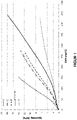
- the stress-strain curves in the tensile test as an example of the technical rubber properties of the rubber articles obtained from Examples AD in Table 7 are shown in the diagram in FIG figure 1 listed.
- examples B, C and D show comparable properties to the filler N660. So are the values for the modulus 50%, modulus 100% and modulus 200% of examples B and C at least as high as for the reference. Furthermore, it is shown that increasing the degree of filling from 40 phr (B) to 60 phr (D) of the particulate carbon material according to Example 2 with elongation in the lower range (up to 100%) leads to an increase in the stress values, i.e. the modulus 50% and the Modulus 100%, leads.
- the loss factor tan delta (quotient of loss modulus E" and storage modulus E' of the elastomer material) as a function of temperature, determined in a dynamic mechanical analysis (temperature sweep), is in figure 2 and Table 8.
- untreated lignin has already been used in rubber mixtures.
- the following comparative example shows the differential effect of untreated lignin and the carbon material of the present invention in a rubber compound.
- lignin 3 from Table 2 is introduced into a rubber mixture as a filler and vulcanized with the aid of other additives.
- the composition of the rubber mixture corresponds to the composition in Example 12 B, but instead of the particulate carbon material from Example 2, untreated lignin 3 is now used.
- the rubber compound for Example 13 is crosslinked using a conventional vulcanization process for the use of silica together with Si69.
- Example 14 to determine the 14 C content of the product from Example 2
- Example 2 For the purpose of determining the 14 C content, the material from Example 2 was sent to the Pozna ⁇ Radiocarbon Laboratory, Foundation of the A. Mickiewicz University, ul. Rubiez 46, 61-612 Pozna ⁇ given. The method used is described by the head of the laboratory, Tomasz Goslar, on the institute's website. The essential contents for lignin are summarized below.
- the content of 14 C in the carbon sample is measured with the "Compact Carbon AMS” spectrometer (manufacturer: National Electrostatics Corporation, USA), which is Article Goslar T., Czernik J., Goslar E., 2004, Nuclear Instruments and Methods B, 223-224, 5-11 is described.
- the measurement is based on the comparison of the intensities of 14 C, 13 C and 12 C ion beams measured for each sample and standard (modern standard: "oxalic acid II" and standard for 14 C-free carbon "background”).
- 30-33 samples of unknown age are measured alternately with 3-4 modern standard measurements and 1-2 background measurements. When dating organic samples, the background is represented by charcoal.
- the calibration of the 14 C age is performed with the OxCal ver. 4.2 (2014) program, the basics of which can be found in Bronk Ramsey C., 2001, Radiocarbon, 43, 355-363 , while the current version is described in Bronk Ramsey C., 2009, Radiocarbon, 51, 337-360 and Bronk Ramsey C. and Lee S., 2013, Radiocarbon, 55, 720-730 is described.
- the calibration will against the latest version of the 14 C calibration curve i.e. INTCAL13 ( Reimer PJ, et al. 2013, Radiocarbon, 55(4), 1869-1887 ) performed.
- the analysis gives the age of the carbon sample for archaeological purposes. However, the measurement result can also be given as a specific activity. In the present case of the material from Example 2, the analysis for the specific activity gave a value of 243.30 ⁇ 0.52 Bq/kgC or Bq/kg carbon.
- Example 15 for the production of rubber articles from SBR with the particulate carbon material from Example 2 in the presence of a functional group masking reagent:
- the carbon material obtained according to Example 2 is introduced as a filler into a rubber mixture and vulcanized with the aid of other additives.
- the composition of the rubber mixture and its processing corresponds to that in Example 12 B (Table 7), but the silane Si69 is replaced by triethoxymethylsilane in an equimolar amount, which corresponds to the use of 1.06 phr. Further processing is analogous to example 12.
- the triethoxymethylsilane is not capable of being incorporated into the crosslinking via sulfur bridges. However, it reacts with the surface of the carbon material according to the invention, consuming the functional groups.
- the functional groups that react with the silane are replaced by methyl groups on the outside, which, compared to the unmodified starting material, leads to compatibilization of the filler surface with the non-polar rubber matrix.
- the carbon material of the present invention treated with triethoxymethylsilane provides higher tensile strength in rubber than the carbon material used without the silane, but, as expected, lags behind the carbon material in combination with the Si69 coupling silane.
- the stress-strain curve in a tensile test as an example of the technical rubber properties of the rubber articles obtained in figure 4 shows that it can be useful in selected rubber systems and for selected applications to mask the functional groups.
- the carbon material obtained according to Example 2 is introduced as a filler into a mixture of NR and BR and vulcanized with the aid of other additives.
- a mixture (pre-mix) of NR and BR is first produced in an internal mixer (Haake Rheomix 600P, ThermoFisher Scientific, Düsseldorf) at a starting temperature of 120°C, which is then mixed with the respective filler and other components is transferred.
- B also in the internal mixer (starting temperature 35°C, speed 60 min -1 )
- a masterbatch is first produced from BR, the filler and silane, which is then further processed with NR and the remaining components (also in the internal mixer, Starting temperature 120°C, speed 60 min -1 ).
- the quantitative composition of both processing variants is identical.
- the stress-strain curve in a tensile test as an example of the technical rubber properties of the rubber articles obtained from Examples A and B are shown in the diagram in FIG figure 5 listed. These show that the carbon material according to the invention can be used for reinforcement in NR/BR mixtures. Furthermore, it can be seen that the order of processing has an influence on the performance of the filler in the articles made of the respective NR/BR rubber compound in the cured state. In this way, the modulus and tensile strength can be influenced.
- the carbon material obtained according to exemplary embodiment 4 is introduced into NBR as a filler and vulcanized with the aid of further additives but without a coupling agent.
- the composition of the rubber compound is shown in Table 9.
- Table 9 reference A B Perbunan 3945 100.0 100.0 100.0 ZnO 5.0 5.0 5.0 stearic acid 1.0 1.0 1.0 Mesamoll II 15.0 15.0 15.0 talc 80.0 80.0 80.0 N550 30.0 30.0 30.0 N990 80.0 40.0 Material from Example 4 40.0 80.0 Vulkanox 4010 3.0 3.0 3.0 sulfur 0.5 0.5 0.5 MBTS 1.0 1.0 1.0 1.0 TMTD 3.0 3.0 3.0
- the mixtures are produced on a Haake Rheomix 600 (tangential rotor geometry, 78 cm 3 ) with an initial temperature of 40° C. and a rotor speed of 100 min -1 .
- the optimal vulcanization time was determined using a Rubber Process Analyzer and the mixture was vulcanized at 160° C. for a minute value of (t 90 +1/mm layer thickness).
- the Shore A hardness was determined according to DIN 53505: 2000-08, the tensile test according to DIN 53504:2009-10 and storage for 72 hours at 70 °C in Lubrizol OS 206304 oil according to DIN ISO 1817:2008-08].
- Table 10 The values shown in Table 10 were determined. Table 10 example reference A B Hardness Shore A 83 84 85 Tensile Strength (MPa) 9.9 11.1 11.4 Elongation at break (%) 235 253 248 Modulus (MPa) 50% 4.7 5.3 5.6 100% 6.6 7.5 8.0 200% 9.7 10.8 11
- Table 11 Changes after storage in engine oil for 72h/70°C reference A B at weight % -2.6 -2.6 -2.7 at volume % -3.4 -3.3 -3.3 With the hardness +3 +3 +3 In the tensile strength % +6 +12 +11 In the elongation at break % -9 -6 -10
Landscapes
- Chemical & Material Sciences (AREA)
- Organic Chemistry (AREA)
- Health & Medical Sciences (AREA)
- Chemical Kinetics & Catalysis (AREA)
- Medicinal Chemistry (AREA)
- Polymers & Plastics (AREA)
- Engineering & Computer Science (AREA)
- Materials Engineering (AREA)
- Inorganic Chemistry (AREA)
- Mechanical Engineering (AREA)
- Oil, Petroleum & Natural Gas (AREA)
- Manufacturing & Machinery (AREA)
- Carbon And Carbon Compounds (AREA)
- Compositions Of Macromolecular Compounds (AREA)
- Processing Of Solid Wastes (AREA)
- Pigments, Carbon Blacks, Or Wood Stains (AREA)
- Medicinal Preparation (AREA)
Applications Claiming Priority (6)
| Application Number | Priority Date | Filing Date | Title |
|---|---|---|---|
| DE102015014956 | 2015-11-21 | ||
| DE102015015549 | 2015-11-29 | ||
| DE102015015550 | 2015-11-29 | ||
| DE102016201801.9A DE102016201801A1 (de) | 2015-11-21 | 2016-02-05 | Partikelförmiges Kohlenstoffmaterial herstellbar aus nachwachsenden Rohstoffen und Verfahren zu dessen Herstellung |
| EP16809654.3A EP3377585B1 (fr) | 2015-11-21 | 2016-11-18 | Matériau particulaire à base de carbone à partir de ressources renouvelables |
| PCT/EP2016/078176 WO2017085278A1 (fr) | 2015-11-21 | 2016-11-18 | Matériau particulaire à base de carbone pouvant être produit à partir de ressources renouvelables et son procédé de production |
Related Parent Applications (2)
| Application Number | Title | Priority Date | Filing Date |
|---|---|---|---|
| EP16809654.3A Division-Into EP3377585B1 (fr) | 2015-11-21 | 2016-11-18 | Matériau particulaire à base de carbone à partir de ressources renouvelables |
| EP16809654.3A Division EP3377585B1 (fr) | 2015-11-21 | 2016-11-18 | Matériau particulaire à base de carbone à partir de ressources renouvelables |
Publications (1)
| Publication Number | Publication Date |
|---|---|
| EP4006112A1 true EP4006112A1 (fr) | 2022-06-01 |
Family
ID=58693752
Family Applications (3)
| Application Number | Title | Priority Date | Filing Date |
|---|---|---|---|
| EP22150185.1A Pending EP4006112A1 (fr) | 2015-11-21 | 2016-11-18 | Mélanges, en particulier mélanges de caoutchouc, contenant une matière à base de carbone particulaire produite à partir de matières premières renouvelables et utilisation correspondante |
| EP16809654.3A Active EP3377585B1 (fr) | 2015-11-21 | 2016-11-18 | Matériau particulaire à base de carbone à partir de ressources renouvelables |
| EP20160400.6A Active EP3682965B1 (fr) | 2015-11-21 | 2016-11-18 | Procede de production de matiere carbonee particuliere a partir de matieres premieres renouvelables |
Family Applications After (2)
| Application Number | Title | Priority Date | Filing Date |
|---|---|---|---|
| EP16809654.3A Active EP3377585B1 (fr) | 2015-11-21 | 2016-11-18 | Matériau particulaire à base de carbone à partir de ressources renouvelables |
| EP20160400.6A Active EP3682965B1 (fr) | 2015-11-21 | 2016-11-18 | Procede de production de matiere carbonee particuliere a partir de matieres premieres renouvelables |
Country Status (21)
| Country | Link |
|---|---|
| US (6) | US11312864B2 (fr) |
| EP (3) | EP4006112A1 (fr) |
| JP (3) | JP6934867B2 (fr) |
| KR (2) | KR102745788B1 (fr) |
| CN (4) | CN121227084A (fr) |
| BR (2) | BR122020009058B1 (fr) |
| CA (2) | CA3190439A1 (fr) |
| DE (1) | DE102016201801A1 (fr) |
| DK (2) | DK3682965T3 (fr) |
| ES (2) | ES2949315T3 (fr) |
| FI (3) | FI13196Y1 (fr) |
| HR (2) | HRP20230719T1 (fr) |
| HU (2) | HUE062198T2 (fr) |
| LT (2) | LT3682965T (fr) |
| MY (1) | MY205470A (fr) |
| PL (2) | PL3377585T3 (fr) |
| PT (2) | PT3682965T (fr) |
| RU (2) | RU2729689C2 (fr) |
| SI (2) | SI3682965T1 (fr) |
| WO (1) | WO2017085278A1 (fr) |
| ZA (2) | ZA202003198B (fr) |
Families Citing this family (60)
| Publication number | Priority date | Publication date | Assignee | Title |
|---|---|---|---|---|
| US10370539B2 (en) | 2014-01-30 | 2019-08-06 | Monolith Materials, Inc. | System for high temperature chemical processing |
| US11939477B2 (en) | 2014-01-30 | 2024-03-26 | Monolith Materials, Inc. | High temperature heat integration method of making carbon black |
| WO2015116943A2 (fr) | 2014-01-31 | 2015-08-06 | Monolith Materials, Inc. | Conception de torche à plasma |
| CN107709608B (zh) | 2015-02-03 | 2019-09-17 | 巨石材料公司 | 再生冷却方法和设备 |
| KR102705340B1 (ko) | 2015-02-03 | 2024-09-09 | 모놀리스 머티어리얼스 인코포레이티드 | 카본 블랙 생성 시스템 |
| FI129778B (en) | 2015-06-26 | 2022-08-31 | Teknologian Tutkimuskeskus Vtt Oy | Procedure for activation and precipitation of lignin |
| CA3032246C (fr) | 2015-07-29 | 2023-12-12 | Monolith Materials, Inc. | Procede et appareil de conception d'alimentation electrique de torche a plasma a courant continu |
| CA2995081C (fr) | 2015-08-07 | 2023-10-03 | Monolith Materials, Inc. | Procede de fabrication de noir de carbone |
| EP3347306A4 (fr) | 2015-09-09 | 2019-04-17 | Monolith Materials, Inc. | Matériaux circulaires à base de graphène à faible nombre de couches |
| DE102016201801A1 (de) | 2015-11-21 | 2017-05-24 | Suncoal Industries Gmbh | Partikelförmiges Kohlenstoffmaterial herstellbar aus nachwachsenden Rohstoffen und Verfahren zu dessen Herstellung |
| US11492496B2 (en) | 2016-04-29 | 2022-11-08 | Monolith Materials, Inc. | Torch stinger method and apparatus |
| FI3243877T4 (fi) | 2016-05-09 | 2024-11-04 | Nokian Renkaat Oyj | Rengas, joka käsittää hydrotermisesti karbonoitua ligniiniä |
| CN106542531B (zh) * | 2016-11-23 | 2018-08-31 | 广东东燃热能科技有限公司 | 一种生物质资源综合利用的方法 |
| CN110603297A (zh) | 2017-03-08 | 2019-12-20 | 巨石材料公司 | 用热传递气体制备碳颗粒的系统和方法 |
| EP3612600A4 (fr) | 2017-04-20 | 2021-01-27 | Monolith Materials, Inc. | Systèmes et procédés particulaires |
| EP3676335A4 (fr) | 2017-08-28 | 2021-03-31 | Monolith Materials, Inc. | Systèmes particulaires et procédés |
| CN111278767A (zh) * | 2017-08-28 | 2020-06-12 | 巨石材料公司 | 用于颗粒生成的系统和方法 |
| FI3470457T4 (fi) * | 2017-10-10 | 2023-12-19 | Continental Reifen Deutschland Gmbh | Rikin avulla silloitettava kautsuseos, kautsuseoksen vulkanoitu kumi ja ajoneuvon rengas |
| CN109399604B (zh) * | 2018-11-16 | 2022-04-05 | 中南大学 | 一种利用恶臭假单胞菌自修饰制备的多孔碳材料及其制备方法和应用 |
| JP7132832B2 (ja) * | 2018-11-26 | 2022-09-07 | Toyo Tire株式会社 | ゴムウエットマスターバッチを含有するゴム組成物、およびその製造方法 |
| DE102018220946A1 (de) * | 2018-12-04 | 2020-06-04 | Suncoal Industries Gmbh | Partikelförmige Kohlenstoffmaterialien und Verfahren zu deren Auftrennung |
| EP3927881A2 (fr) * | 2019-02-21 | 2021-12-29 | SunCoal Industries GmbH | Procédé pour réduire l'odeur de matières carbonées particulaires |
| EP3997157A1 (fr) | 2019-07-10 | 2022-05-18 | SunCoal Industries GmbH | Procédé de fabrication d'une lignine stabilisée à haute surface spécifique |
| EP4073018A1 (fr) * | 2019-12-13 | 2022-10-19 | Carbonauten GmbH | Carbone utilisé comme charge pour matrice de support |
| WO2021223789A1 (fr) | 2020-05-05 | 2021-11-11 | Suncoal Industries Gmbh | Pigment noir biogène, procédé de production et utilisation associés |
| EP4230699A3 (fr) | 2020-07-10 | 2023-10-25 | SunCoal Industries GmbH | Procede de preparation de lignines stabilisees et de grande surface specifique |
| DE102021100142A1 (de) | 2021-01-07 | 2022-07-07 | Suncoal Industries Gmbh | Verfahren zur Herstellung eines vernetzten Lignins mit hoher spezifischer Oberfläche |
| MX2023000363A (es) * | 2020-07-10 | 2023-02-13 | Suncoal Ind Gmbh | Procedimiento para la produccion de una lignina reticulada con elevada superficie especifica, lignina reticulada y articulos industriales de goma o neumaticos que comprenden lignina reticulada. |
| US20240052530A1 (en) * | 2020-08-25 | 2024-02-15 | The Texas A&M University System | Lignin Fractionation and Fabrication for Quality Carbon Fiber |
| AU2021332007A1 (en) * | 2020-08-26 | 2023-03-30 | Suncoal Industries Gmbh | Modified fine particulate carbon materials and method for producing same |
| HUE062349T2 (hu) * | 2020-09-23 | 2023-10-28 | Suncoal Ind Gmbh | Kaucsuk kompozíció jármû gumiabroncsok belsõ béléséhez |
| AU2021358888A1 (en) * | 2020-10-05 | 2023-06-08 | Monolith Materials, Inc. | Systems and methods for processing |
| FI20215306A1 (fi) * | 2021-03-19 | 2022-09-20 | Nokian Renkaat Oyj | Kumipohjainen tuote, jossa on matala fluidin läpäisevyys |
| US20240368408A1 (en) * | 2021-05-05 | 2024-11-07 | Suncoal Industries Gmbh | Biogenic black pigment, method for the production thereof and use thereof |
| AU2022277800A1 (en) * | 2021-05-20 | 2023-12-07 | Suncoal Industries Gmbh | Organosilane-modified organic fillers and rubber compositions containing said fillers |
| MX2023013757A (es) | 2021-05-20 | 2023-12-04 | Suncoal Ind Gmbh | Cargas organicas de superficie modificada y composiciones de caucho que contienen las mismas. |
| ES3036060T3 (en) | 2021-08-23 | 2025-09-12 | Suncoal Ind Gmbh | Peroxide crosslinkable rubber compositions containing organic fillers |
| FI4408919T3 (fi) * | 2021-09-28 | 2026-01-09 | Suncoal Ind Gmbh | Rikillä ristisidottava kumikoostumus, joka sisältää orgaanisia täyteaineita ja organosilaania |
| JP2024539005A (ja) * | 2021-10-21 | 2024-10-28 | ユー ピー エム キュンメネ コーポレーション | 耐燃焼性熱可塑性組成物 |
| CA3235888A1 (fr) * | 2021-10-21 | 2023-04-27 | Upm-Kymmene Corporation | Composition thermoplastique pouvant etre recyclee et triee |
| AU2021469494A1 (en) * | 2021-10-21 | 2024-05-02 | Upm-Kymmene Corporation | A recyclable thermoplastic composition |
| JP2024175150A (ja) * | 2021-10-29 | 2024-12-18 | 三洋貿易株式会社 | カーボンブラック担持炭素質フィラー |
| WO2023074224A1 (fr) * | 2021-10-29 | 2023-05-04 | 三洋貿易株式会社 | Dispersion liquide de polyols à teneur en charge carbonée |
| CN116507658A (zh) * | 2021-10-29 | 2023-07-28 | 三洋贸易株式会社 | 含碳质填料的多元醇类分散液 |
| US12351717B2 (en) | 2021-12-20 | 2025-07-08 | The Goodyear Tire & Rubber Company | Tread rubber composition with majority renewable content |
| WO2023129170A1 (fr) * | 2021-12-31 | 2023-07-06 | Compagnie Generale Des Etablissements Michelin | Caoutchouc renforcé par du biocharbon amélioré |
| GB202203532D0 (en) * | 2022-03-14 | 2022-04-27 | Arq Ip Ltd | Elastomeric composite materials |
| JP2025510045A (ja) | 2022-03-22 | 2025-04-14 | サンコール・インダストリーズ・ゲーエムベーハー | 空気入り車両用タイヤのインナーライナー用ゴム組成物 |
| CN115055479B (zh) * | 2022-05-13 | 2022-12-20 | 中国城市建设研究院有限公司 | 一种装修垃圾处理装置及方法 |
| FR3137917B1 (fr) * | 2022-07-18 | 2025-05-30 | Upm Kymmene Corp | Composition élastomère et articles comprenant la composition |
| FI131677B1 (en) * | 2022-07-18 | 2025-09-09 | Upm Kymmene Corp | Elastomeric composition and products comprising the composition |
| CN115322543B (zh) * | 2022-08-10 | 2024-05-17 | 浙江旺林生物科技有限公司 | 一种聚乳酸/聚己内酯/植物炭黑复合材料及其制备方法 |
| CN120202123A (zh) * | 2022-11-18 | 2025-06-24 | 森科尔工业有限公司 | 具有硫醚键的有机填料 |
| WO2024160370A1 (fr) | 2023-02-01 | 2024-08-08 | Suncoal Industries Gmbh | Granulation à sec de matière carbonée particulaire et agglomérats ainsi produits |
| EP4438676A1 (fr) | 2023-03-29 | 2024-10-02 | SunCoal Industries GmbH | Composition de caoutchouc contenant des charges organiques et pouvant être réticulée au moyen de soufre |
| DE102023002671A1 (de) | 2023-06-26 | 2025-01-02 | Günter Etzrodt | Verfahren zur Herstellung von Pigment Schwarz aus nachhaltigen Rohstoffen ohne Kohlendioxid-Emissionen und dessen Verwendung |
| WO2025261600A1 (fr) | 2024-06-19 | 2025-12-26 | Upm-Kymmene Corporation | Composition de caoutchouc de chloroprène contenant une charge à base de lignine pour améliorer la résistance à l'inflammabilité |
| WO2025261599A1 (fr) | 2024-06-19 | 2025-12-26 | Upm-Kymmene Corporation | Composition de caoutchouc acrylique contenant une combinaison de charges constituée d'une charge à base de lignine et de noir de carbone |
| WO2026073541A1 (fr) | 2024-10-01 | 2026-04-09 | Upm-Kymmene Corporation | Charge à base de lignine contenant des compositions de caoutchouc pour améliorer la conductivité thermique et l'isolation électrique |
| CN120423536B (zh) * | 2025-07-08 | 2025-11-04 | 深圳市贝特瑞新能源技术研究院有限公司 | 用于催化剂载体的碳材料及其制备方法、催化剂和燃料电池 |
Citations (8)
| Publication number | Priority date | Publication date | Assignee | Title |
|---|---|---|---|---|
| US20050100502A1 (en) * | 2003-11-06 | 2005-05-12 | Kai Krauss | Carbon black |
| DE102008050966A1 (de) | 2007-10-12 | 2009-05-20 | Toyo Tire & Rubber Co., Ltd., Osaka-shi | Gummimischung für Luftreifen |
| WO2010043562A1 (fr) | 2008-10-16 | 2010-04-22 | Evonik Degussa Gmbh | Noir de carbone, procédés de production de noir de carbone et son utilisation |
| EP2223928A1 (fr) | 2009-02-10 | 2010-09-01 | The Goodyear Tire & Rubber Company | Lignine fonctionnalisée, caoutchouc contenant de la lignine fonctionnalisée et produits contenant une telle composition en caoutchouc |
| EP2671632A2 (fr) * | 2012-06-09 | 2013-12-11 | Leibniz-Institut für Oberflächenmodifizierung e.V. | Procédé de fabrication d'une dispersion homogène et très stable de nanoparticules de carbone dans des solvants et d'un granulat issu de celle-ci et son utilisation |
| WO2014096544A1 (fr) | 2012-12-19 | 2014-06-26 | Teknologian Tutkimuskeskus Vtt | Procédé de traitement hydrothermique de biomatériaux de masse molaire élevée |
| WO2014122163A1 (fr) | 2013-02-07 | 2014-08-14 | Arbaflame Technology As | Procédé de production d'une matière de biomasse enrichie en carbone |
| WO2015018944A1 (fr) * | 2013-08-09 | 2015-02-12 | Suncoal Industries Gmbh | Procédé permettant d'obtenir de la lignine à partir de liqueur noire et produits fabriqués par ledit procédé |
Family Cites Families (102)
| Publication number | Priority date | Publication date | Assignee | Title |
|---|---|---|---|---|
| CA700368A (en) | 1964-12-22 | Her Majesty The Queen In Right Of Canada, As Represented By The Ministerof National Research Council | Lignin-reinforced synthetic rubber | |
| CA818607A (en) | 1969-07-22 | R. Griffith Thomas | Method of producing lignin-reinforced rubber | |
| CA522715A (fr) | 1956-03-13 | W. Macgregor Donald | Caoutchouc renforce de lignine | |
| AT86234B (de) | 1917-10-09 | 1921-11-25 | Friedrich Dr Bergius | Verfahren zur Aufarbeitung von Extrakten vegetabilischer Produkte. |
| AT85234B (de) | 1919-10-27 | 1921-08-25 | Olof Frankman | Antrieb motorisch betriebener Maschinen zum Ernten von in Reihen gepflanzten Wurzelfrüchten. |
| US4477611A (en) | 1983-09-07 | 1984-10-16 | Uniroyal, Inc. | Reinforced rubber composition containing ground coal |
| US4598105A (en) | 1983-09-21 | 1986-07-01 | Amoco Corporation | Rubber composition and method |
| US5192361A (en) | 1992-01-27 | 1993-03-09 | Westvaco Corporation | Submicron lignin-based binders for water-based black ink formulations |
| US6172154B1 (en) | 1996-05-03 | 2001-01-09 | Cabot Corporation | Elastomers compositions with dual phase aggregates and pre-vulcanization modifier |
| DE19840663A1 (de) | 1998-09-05 | 2000-03-09 | Degussa | Ruß |
| US6391274B1 (en) * | 1998-09-05 | 2002-05-21 | Degussa Huls Aktiengesellschaft | Carbon black |
| EP1078959B1 (fr) * | 1999-08-27 | 2002-03-13 | Degussa AG | Noir de carbone, procédé pour sa préparation et son utilisation |
| DE10107228A1 (de) | 2001-02-16 | 2002-09-05 | Degussa | Ruß, Verfahren zu seiner Herstellung und seine Verwendung |
| US7019084B2 (en) * | 2002-12-11 | 2006-03-28 | The Goodyear Tire & Rubber Company | Tire with rubber composition |
| US6962181B2 (en) | 2003-02-17 | 2005-11-08 | The Goodyear Tire & Rubber Company | Pneumatic tire having built-in sealant layer and preparation thereof |
| DE10336575A1 (de) * | 2003-08-08 | 2005-03-10 | Degussa | Ruß |
| JP2005075856A (ja) | 2003-08-28 | 2005-03-24 | Sumitomo Rubber Ind Ltd | タイヤ用ゴム組成物 |
| US20070193669A1 (en) | 2003-10-31 | 2007-08-23 | Luca Giannini | High-performance tyre for vehicle wheels |
| DE102004019433A1 (de) | 2004-04-19 | 2005-11-10 | Basf Ag | Haftklebstoff für PVC-Folien |
| US7829057B2 (en) * | 2004-05-04 | 2010-11-09 | Cabot Corporation | Carbon black and multi-stage process for making same |
| US7847009B2 (en) * | 2004-05-13 | 2010-12-07 | Columbian Chemicals Company | Carbonaceous material with dissociated aggregate size and particle size distribution and improved dispersibility |
| JP2007039638A (ja) | 2005-03-23 | 2007-02-15 | Nissin Kogyo Co Ltd | 炭素繊維複合材料 |
| US7722713B2 (en) * | 2005-05-17 | 2010-05-25 | Cabot Corporation | Carbon blacks and polymers containing the same |
| US7781493B2 (en) | 2005-06-20 | 2010-08-24 | Dow Global Technologies Inc. | Protective coating for window glass |
| US7786183B2 (en) | 2005-06-20 | 2010-08-31 | Dow Global Technologies Inc. | Coated glass articles |
| US7064171B1 (en) | 2005-09-22 | 2006-06-20 | The Goodyear Tire & Rubber Company | Non-random styrene-butadiene rubber |
| EP1801825A1 (fr) | 2005-12-23 | 2007-06-27 | Abb Research Ltd. | Un film, un condensateur, un transformateur de tension et une méthode d'utilisation d'un condensateur |
| US7891391B2 (en) | 2006-09-08 | 2011-02-22 | The Goodyear Tire & Rubber Company | Tire with tread having an outer cap layer and underlying transition layer containing at least one of depolymerized rubber, pre-cured rubber and coal dust |
| US8034316B2 (en) * | 2006-11-07 | 2011-10-11 | Cabot Corporation | Carbon blacks having low PAH amounts and methods of making same |
| US20080128065A1 (en) * | 2006-11-30 | 2008-06-05 | Paul Harry Sandstrom | Pneumatic tire with oxygen barrier component comprised of a rubber composition containing a dispersion of oxygen-adsorbing activated carbon |
| DE102007056170A1 (de) | 2006-12-28 | 2008-11-06 | Dominik Peus | Semikontinuierliches Verfahren zur Herstellung von Brennstoff aus Biomasse |
| ES2710176T3 (es) | 2007-02-08 | 2019-04-23 | Grenol Ip Gmbh | Carbonización hidrotermal de biomasa |
| ITMI20070626A1 (it) | 2007-03-29 | 2008-09-30 | Polimeri Europa Spa | Mescola vulcanizzabile comprendente copolineri ramificati vinilarene-diene coniugato parzialmente idrogenati |
| FR2914634B1 (fr) * | 2007-04-06 | 2011-08-05 | Arkema France | Procede de fabrication de nanotubes de carbone a partir de matieres premieres renouvelables |
| EP2139953B1 (fr) * | 2007-04-24 | 2014-04-16 | Cabot Corporation | Noir de carbone à faible structure et procédé de fabrication de celui-ci |
| DE102007022840A1 (de) | 2007-05-11 | 2008-12-24 | Suncoal Industries Gmbh | Verfahren zur Kühlung und Vorwärmung einer Anlage zur hydrothermalen Carbonisierung von Biomasse |
| JP5062593B2 (ja) * | 2007-12-03 | 2012-10-31 | 独立行政法人産業技術総合研究所 | リグニンを原料とする炭素微粒子及びその製造方法 |
| RU2010146037A (ru) | 2008-04-17 | 2012-05-27 | Ссл Карбон Солюшнс Лтд. (Gb) | Способ преобразования биомассы в углеподобный материал с использованием процесса гидротермальной карбонизации |
| US20110073229A1 (en) | 2008-05-30 | 2011-03-31 | Claudina Veas | Lignin in tire components |
| EP2130893A3 (fr) | 2008-06-05 | 2012-05-09 | TerraNova Energy GmbH | Procédé de fabrication de charbon, notamment de boue de charbon |
| JP5442608B2 (ja) | 2008-06-18 | 2014-03-12 | 株式会社ブリヂストン | エラストマー組成物および該エラストマー組成物を用いたタイヤ |
| CA2729267A1 (fr) | 2008-06-23 | 2010-01-21 | Csl Carbon Solutions Ltd. | Procede de preparation d'un materiau hybride hydrothermal a partir d'une biomasse, et materiau hybride hydrothermal pouvant etre obtenu par le procede |
| US7671126B1 (en) | 2008-12-03 | 2010-03-02 | The Goodyear Tire & Rubber Company | Tire with tread |
| JP2012522629A (ja) * | 2009-04-01 | 2012-09-27 | サンコール・インダストリーズ・ゲゼルシャフト・ミト・ベシュレンクテル・ハフツング | 再生可能原料および有機残留物の水熱炭化方法 |
| JP5662424B2 (ja) * | 2009-05-14 | 2015-01-28 | ユニヴァーシティー オブ ノースダコタ | バイオマス油から高炭素含量生成物を生成するための方法 |
| JP5394143B2 (ja) | 2009-06-24 | 2014-01-22 | 東洋ゴム工業株式会社 | ゴム組成物及びゴム用補強剤、並びにそれらの製造方法 |
| NZ578113A (en) | 2009-07-01 | 2010-07-30 | Lignotech Developments Ltd | Processing of lignocellulosic and related materials |
| WO2011013161A1 (fr) | 2009-07-27 | 2011-02-03 | エス.エス.アロイ株式会社 | Procédé pour la production de noir de carbone de biomasse utilisant de la biomasse comme matière de départ et dispositif correspondant |
| US20130046064A1 (en) | 2009-08-27 | 2013-02-21 | Charles Herd | Use of surface-treated carbon blacks in an elastomer to reduce compound hysteresis and tire rolling resistance and improve wet traction |
| DE102009045060A1 (de) * | 2009-09-28 | 2011-03-31 | Evonik Degussa Gmbh | Ruß, ein Verfahren zu seiner Herstellung sowie seine Verwendung |
| EP2322474A1 (fr) | 2009-11-16 | 2011-05-18 | Evonik Degussa GmbH | Procédé de pyrolyse d'hydrates de carbone |
| JP5495208B2 (ja) * | 2010-02-05 | 2014-05-21 | 国立大学法人 宮崎大学 | リグニンを原料とする高比表面積活性炭、及びそれを含む低級アルコール用吸着剤 |
| WO2012000033A1 (fr) | 2010-07-01 | 2012-01-05 | Ignite Energy Resources Limited | Procédé de chauffage balistique |
| JP2012077133A (ja) * | 2010-09-30 | 2012-04-19 | Toyo Tire & Rubber Co Ltd | ゴム組成物および空気入りタイヤ |
| EP2457978A1 (fr) * | 2010-11-24 | 2012-05-30 | Evonik Degussa GmbH | Procédé de pyrolyse de biomasse en lignine, solide en carbone obtenu et son utilisation comme adsorbant ou amendement de sol |
| IT1406771B1 (it) | 2010-12-23 | 2014-03-07 | Sea Marconi Technologies Di Vander Tumiatti S A S | Impianto modulare per la conduzione di procedimenti di conversione di matrici carboniose |
| DE102011003002B4 (de) * | 2011-01-21 | 2022-09-08 | Evonik Carbon Black Gmbh | Verfahren zur Herstellung von Ruß |
| PL2484434T3 (pl) | 2011-02-05 | 2020-04-30 | Grenol Ip Gmbh | Ciągły reaktor hydrotermicznego uwęglania |
| DE102011001108B4 (de) | 2011-03-04 | 2015-03-12 | Ava-Co2 Schweiz Ag | Verfahren und Vorrichtung zur hydrothermalen Karbonisierung |
| CN102212219B (zh) | 2011-04-06 | 2013-05-08 | 江南大学 | 一种用作橡胶填料的稻壳基碳/硅复合物及其制备方法 |
| JP5740207B2 (ja) | 2011-05-23 | 2015-06-24 | 東洋ゴム工業株式会社 | タイヤトレッド用ゴム組成物及び空気入りタイヤ |
| ES2393464B1 (es) | 2011-06-09 | 2013-11-18 | Ingelia, S.L. | Procedimiento para la extracción de productos bioquímicos obtenidos a partir de un proceso de carbonización hidrotermal de biomasa. |
| DE102011113825A1 (de) | 2011-09-21 | 2013-03-21 | Grenol Ip Gmbh | Zumindest quasi kontinuierliche hydrothermale Karbonisierung von Biomasse |
| JP6007081B2 (ja) | 2011-12-20 | 2016-10-12 | 花王株式会社 | リグニン分解物の製造方法 |
| ITTO20120014A1 (it) | 2012-01-11 | 2013-07-12 | Chemtex Italia S R L | Composizione ad elevata area superficiale comprendente lignina |
| US9175150B2 (en) * | 2012-03-02 | 2015-11-03 | Cabot Corporation | Modified carbon blacks having low PAH amounts and elastomers containing the same |
| EP2819854B1 (fr) * | 2012-03-02 | 2020-04-15 | Cabot Corporation | Composites élastomères contenant des charges modifiées et élastomères fonctionnalisés |
| DE102012205642A1 (de) * | 2012-04-05 | 2013-10-10 | Evonik Industries Ag | Mercaptosilan-Ruß-Abmischung |
| JP2014001379A (ja) * | 2012-05-23 | 2014-01-09 | Asahi Carbon Co Ltd | カーボンブラックの製造方法、カーボンブラック、ゴム組成物、タイヤ |
| CN102701201B (zh) * | 2012-06-21 | 2015-11-18 | 山东大学 | 一种碱法造纸黑液木质素制备粉末活性炭的方法 |
| US20140162873A1 (en) * | 2012-07-11 | 2014-06-12 | South Dakota State University | Materials and methods for production of activated carbons |
| FR2993261B1 (fr) * | 2012-07-13 | 2019-06-21 | Cabot Corporation | Noir de carbone fortement structure |
| FR2993568B1 (fr) | 2012-07-17 | 2014-08-22 | Compagnie Ind De La Matiere Vegetale Cimv | Utilisation d'une lignine pour le renfort mecanique d'elastomeres, et elastomere ainsi renforce |
| FR2993895B1 (fr) | 2012-07-25 | 2014-08-08 | Michelin & Cie | Composition de caoutchouc comprenant une resine a base de lignine |
| WO2014027953A1 (fr) * | 2012-08-17 | 2014-02-20 | Su Holding Ab | Carbone magnétique actif |
| JP5745490B2 (ja) | 2012-10-25 | 2015-07-08 | 住友ゴム工業株式会社 | インナーライナー用ゴム組成物及び空気入りタイヤ |
| US20140227325A1 (en) * | 2013-02-13 | 2014-08-14 | Ut-Battelle, Llc | Lignin-derived porous carbon composition, methods of preparation, and use thereof |
| KR101440443B1 (ko) | 2013-02-15 | 2014-09-17 | 손근수 | 바이오 카본블랙의 초미세 분쇄 제조 방법 및 이를 이용하여 제조되는 바이오 카본블랙함유 고분자 복합재. |
| US20140251179A1 (en) * | 2013-03-05 | 2014-09-11 | Cabot Corporation | Aqueous pigment dispersions |
| DE102013217418A1 (de) | 2013-05-08 | 2014-11-13 | Siemens Aktiengesellschaft | Hydrothermale Behandlung von Abwasserschlamm und Schwarzlauge |
| FI20135842A7 (fi) * | 2013-08-19 | 2015-02-20 | Valmet Technologies Oy | Menetelmä ja järjestelmä ligniinin käsittelemiseksi |
| WO2015056757A1 (fr) | 2013-10-16 | 2015-04-23 | 住友ベークライト株式会社 | Composition de résine, composition de caoutchouc et matériau durci |
| CN104649246A (zh) * | 2013-11-18 | 2015-05-27 | 湖南师范大学 | 一种生物质碳微/纳米球的低温水热制备方法 |
| FR3015497B1 (fr) | 2013-12-23 | 2016-02-05 | Michelin & Cie | Composition de caoutchouc comprenant des fibres de cellulose |
| KR101582253B1 (ko) * | 2014-04-21 | 2016-01-04 | 한국타이어 주식회사 | 타이어 트레드용 고무 조성물 및 이를 이용하여 제조한 타이어 |
| CN103951858A (zh) | 2014-04-22 | 2014-07-30 | 华南理工大学 | 硅烷偶联剂改性羟甲基木质素填充的橡胶组合物及其制备方法 |
| FI126078B (fi) | 2014-07-04 | 2016-06-15 | Metsä Fibre Oy | Menetelmä mustalipeän sisältämän ligniinin hyödyntämiseksi |
| DE102014215627A1 (de) | 2014-08-07 | 2016-02-25 | Volkswagen Aktiengesellschaft | Verbundwerkstoff sowie Formteil aus diesem |
| DE102014215807B3 (de) * | 2014-08-08 | 2015-12-24 | Suncoal Industries Gmbh | Verfahren zur Gewinnung eines stabilisierten Lignins mit definierter Korngrößenverteilung aus einer Lignin beinhaltenden Flüssigkeit |
| JP6959861B2 (ja) * | 2014-08-29 | 2021-11-05 | オリオン エンジニアード カーボンズ ゲゼルシャフト ミット ベシュレンクテル ハフツング | カーボンブラックの空隙率(Porosity)を制御するプロセス |
| FI126818B (en) | 2015-02-06 | 2017-06-15 | Valmet Technologies Oy | A method for treating lignin-based material |
| US10072154B2 (en) * | 2015-02-26 | 2018-09-11 | Sid Richardson Carbon, Ltd. | Low hysteresis carbon black |
| FI129778B (en) | 2015-06-26 | 2022-08-31 | Teknologian Tutkimuskeskus Vtt Oy | Procedure for activation and precipitation of lignin |
| US20170058127A1 (en) * | 2015-08-24 | 2017-03-02 | Georgia Southern University Research and Service Foundation | Production of nanocellulose and carbon black from lignocellulosic biomass |
| CA2998637A1 (fr) * | 2015-09-16 | 2017-03-23 | Sweetwater Energy, Inc. | Charbon actif specialise derive de biomasse pretraitee |
| DE102016201801A1 (de) * | 2015-11-21 | 2017-05-24 | Suncoal Industries Gmbh | Partikelförmiges Kohlenstoffmaterial herstellbar aus nachwachsenden Rohstoffen und Verfahren zu dessen Herstellung |
| ITUB20159589A1 (it) | 2015-12-23 | 2017-06-23 | Pirelli | Pneumatico per ruote di veicoli |
| FI3243877T4 (fi) | 2016-05-09 | 2024-11-04 | Nokian Renkaat Oyj | Rengas, joka käsittää hydrotermisesti karbonoitua ligniiniä |
| CN106243427A (zh) | 2016-08-04 | 2016-12-21 | 安徽嘉木橡塑工业有限公司 | 一种轮胎专用橡胶材料及其制备方法 |
| WO2020040959A1 (fr) * | 2018-08-20 | 2020-02-27 | Cabot Corporation | Compositions contenant des additifs conducteurs, électrodes associées et batteries associées |
| EP4230699A3 (fr) * | 2020-07-10 | 2023-10-25 | SunCoal Industries GmbH | Procede de preparation de lignines stabilisees et de grande surface specifique |
| AU2021332007A1 (en) * | 2020-08-26 | 2023-03-30 | Suncoal Industries Gmbh | Modified fine particulate carbon materials and method for producing same |
-
2016
- 2016-02-05 DE DE102016201801.9A patent/DE102016201801A1/de active Pending
- 2016-11-18 CN CN202511337602.0A patent/CN121227084A/zh active Pending
- 2016-11-18 FI FIU20224002U patent/FI13196Y1/en active IP Right Grant
- 2016-11-18 HU HUE20160400A patent/HUE062198T2/hu unknown
- 2016-11-18 HR HRP20230719TT patent/HRP20230719T1/hr unknown
- 2016-11-18 BR BR122020009058-8A patent/BR122020009058B1/pt active IP Right Grant
- 2016-11-18 HR HRP20230672TT patent/HRP20230672T1/hr unknown
- 2016-11-18 SI SI201631720T patent/SI3682965T1/sl unknown
- 2016-11-18 BR BR112018008961-3A patent/BR112018008961B1/pt active IP Right Grant
- 2016-11-18 PT PT201604006T patent/PT3682965T/pt unknown
- 2016-11-18 CA CA3190439A patent/CA3190439A1/fr active Pending
- 2016-11-18 EP EP22150185.1A patent/EP4006112A1/fr active Pending
- 2016-11-18 US US15/777,906 patent/US11312864B2/en active Active
- 2016-11-18 CN CN202010354647.XA patent/CN111547699A/zh active Pending
- 2016-11-18 PL PL16809654.3T patent/PL3377585T3/pl unknown
- 2016-11-18 FI FIEP16809654.3T patent/FI3377585T3/en active
- 2016-11-18 JP JP2018526521A patent/JP6934867B2/ja active Active
- 2016-11-18 PL PL20160400.6T patent/PL3682965T3/pl unknown
- 2016-11-18 RU RU2018121627A patent/RU2729689C2/ru active
- 2016-11-18 CA CA3002724A patent/CA3002724C/fr active Active
- 2016-11-18 WO PCT/EP2016/078176 patent/WO2017085278A1/fr not_active Ceased
- 2016-11-18 ES ES16809654T patent/ES2949315T3/es active Active
- 2016-11-18 LT LTEP20160400.6T patent/LT3682965T/lt unknown
- 2016-11-18 CN CN201680068049.8A patent/CN108291098A/zh active Pending
- 2016-11-18 SI SI201631717T patent/SI3377585T1/sl unknown
- 2016-11-18 MY MYPI2018000712A patent/MY205470A/en unknown
- 2016-11-18 DK DK20160400.6T patent/DK3682965T3/da active
- 2016-11-18 LT LTEPPCT/EP2016/078176T patent/LT3377585T/lt unknown
- 2016-11-18 EP EP16809654.3A patent/EP3377585B1/fr active Active
- 2016-11-18 HU HUE16809654A patent/HUE062285T2/hu unknown
- 2016-11-18 FI FIEP20160400.6T patent/FI3682965T3/en active
- 2016-11-18 EP EP20160400.6A patent/EP3682965B1/fr active Active
- 2016-11-18 DK DK16809654.3T patent/DK3377585T3/da active
- 2016-11-18 ES ES20160400T patent/ES2949422T3/es active Active
- 2016-11-18 KR KR1020187017579A patent/KR102745788B1/ko active Active
- 2016-11-18 CN CN202210133009.4A patent/CN114395275A/zh active Pending
- 2016-11-18 RU RU2020115875A patent/RU2020115875A/ru unknown
- 2016-11-18 PT PT168096543T patent/PT3377585T/pt unknown
- 2016-11-18 KR KR1020247041924A patent/KR20250006320A/ko active Pending
-
2020
- 2020-04-13 US US16/847,523 patent/US11639444B2/en active Active
- 2020-05-20 JP JP2020088264A patent/JP7018986B2/ja active Active
- 2020-05-29 ZA ZA2020/03198A patent/ZA202003198B/en unknown
-
2021
- 2021-09-07 US US17/468,246 patent/US11306209B2/en active Active
- 2021-09-07 US US17/468,253 patent/US20210403723A1/en active Pending
-
2022
- 2022-01-26 US US17/585,004 patent/US12584021B2/en active Active
- 2022-02-01 JP JP2022014474A patent/JP7378513B2/ja active Active
- 2022-02-03 ZA ZA2022/01521A patent/ZA202201521B/en unknown
-
2024
- 2024-03-18 US US18/607,978 patent/US12545789B2/en active Active
Patent Citations (8)
| Publication number | Priority date | Publication date | Assignee | Title |
|---|---|---|---|---|
| US20050100502A1 (en) * | 2003-11-06 | 2005-05-12 | Kai Krauss | Carbon black |
| DE102008050966A1 (de) | 2007-10-12 | 2009-05-20 | Toyo Tire & Rubber Co., Ltd., Osaka-shi | Gummimischung für Luftreifen |
| WO2010043562A1 (fr) | 2008-10-16 | 2010-04-22 | Evonik Degussa Gmbh | Noir de carbone, procédés de production de noir de carbone et son utilisation |
| EP2223928A1 (fr) | 2009-02-10 | 2010-09-01 | The Goodyear Tire & Rubber Company | Lignine fonctionnalisée, caoutchouc contenant de la lignine fonctionnalisée et produits contenant une telle composition en caoutchouc |
| EP2671632A2 (fr) * | 2012-06-09 | 2013-12-11 | Leibniz-Institut für Oberflächenmodifizierung e.V. | Procédé de fabrication d'une dispersion homogène et très stable de nanoparticules de carbone dans des solvants et d'un granulat issu de celle-ci et son utilisation |
| WO2014096544A1 (fr) | 2012-12-19 | 2014-06-26 | Teknologian Tutkimuskeskus Vtt | Procédé de traitement hydrothermique de biomatériaux de masse molaire élevée |
| WO2014122163A1 (fr) | 2013-02-07 | 2014-08-14 | Arbaflame Technology As | Procédé de production d'une matière de biomasse enrichie en carbone |
| WO2015018944A1 (fr) * | 2013-08-09 | 2015-02-12 | Suncoal Industries Gmbh | Procédé permettant d'obtenir de la lignine à partir de liqueur noire et produits fabriqués par ledit procédé |
Non-Patent Citations (5)
| Title |
|---|
| ARTIKEL GOSLAR T.CZERNIK J.GOSLAR E., NUCLEAR INSTRUMENTS AND METHODS B, vol. 223-224, 2004, pages 5 - 11 |
| BROCK, RADIOCARBON, vol. 52, 2010, pages 102 - 112 |
| BRONK RAMSEY C., RADIOCARBON, vol. 51, 2009, pages 337 - 360 |
| BRONK RAMSEY C.LEE S., RADIOCARBON, vol. 55, no. 4, 2013, pages 1869 - 1887 |
| CZERNIK J.GOSLAR T., RADIOCARBON, vol. 43, 2001, pages 355 - 363 |
Also Published As
Similar Documents
| Publication | Publication Date | Title |
|---|---|---|
| EP3377585B1 (fr) | Matériau particulaire à base de carbone à partir de ressources renouvelables | |
| EP3470457B1 (fr) | Mélange de caoutchouc réticulable au soufre, vulcanisation de mélange de caoutchouc et pneumatique pour véhicule | |
| EP4204359B1 (fr) | Matières carbonées particulaires fines modifiées et leur procédé de production | |
| WO2020169809A2 (fr) | Procédé pour réduire l'odeur de matières carbonées particulaires | |
| EP4341342A1 (fr) | Charges organiques à surface modifiée et compositions de caoutchouc les contenant | |
| EP4408919B1 (fr) | Composition de caoutchouc pouvant être réticulée au soufre contenant des charges organiques et de l'organosilane | |
| EP4341104A1 (fr) | Charges organiques modifiées par un organosilane et compositions de caoutchouc les contenant |
Legal Events
| Date | Code | Title | Description |
|---|---|---|---|
| PUAI | Public reference made under article 153(3) epc to a published international application that has entered the european phase |
Free format text: ORIGINAL CODE: 0009012 |
|
| STAA | Information on the status of an ep patent application or granted ep patent |
Free format text: STATUS: THE APPLICATION HAS BEEN PUBLISHED |
|
| AC | Divisional application: reference to earlier application |
Ref document number: 3377585 Country of ref document: EP Kind code of ref document: P |
|
| AK | Designated contracting states |
Kind code of ref document: A1 Designated state(s): AL AT BE BG CH CY CZ DE DK EE ES FI FR GB GR HR HU IE IS IT LI LT LU LV MC MK MT NL NO PL PT RO RS SE SI SK SM TR |
|
| STAA | Information on the status of an ep patent application or granted ep patent |
Free format text: STATUS: REQUEST FOR EXAMINATION WAS MADE |
|
| 17P | Request for examination filed |
Effective date: 20221026 |
|
| RBV | Designated contracting states (corrected) |
Designated state(s): AL AT BE BG CH CY CZ DE DK EE ES FI FR GB GR HR HU IE IS IT LI LT LU LV MC MK MT NL NO PL PT RO RS SE SI SK SM TR |
|
| STAA | Information on the status of an ep patent application or granted ep patent |
Free format text: STATUS: EXAMINATION IS IN PROGRESS |
|
| 17Q | First examination report despatched |
Effective date: 20230307 |
|
| GRAP | Despatch of communication of intention to grant a patent |
Free format text: ORIGINAL CODE: EPIDOSNIGR1 |
|
| STAA | Information on the status of an ep patent application or granted ep patent |
Free format text: STATUS: GRANT OF PATENT IS INTENDED |
|
| INTG | Intention to grant announced |
Effective date: 20230719 |
|
| GRAJ | Information related to disapproval of communication of intention to grant by the applicant or resumption of examination proceedings by the epo deleted |
Free format text: ORIGINAL CODE: EPIDOSDIGR1 |
|
| STAA | Information on the status of an ep patent application or granted ep patent |
Free format text: STATUS: EXAMINATION IS IN PROGRESS |
|
| INTC | Intention to grant announced (deleted) |