EP4007286A1 - Verfahren zur steuerung einer kommunikation zwischen einem steuergerät und einem leseterminal - Google Patents
Verfahren zur steuerung einer kommunikation zwischen einem steuergerät und einem leseterminal Download PDFInfo
- Publication number
- EP4007286A1 EP4007286A1 EP21208844.7A EP21208844A EP4007286A1 EP 4007286 A1 EP4007286 A1 EP 4007286A1 EP 21208844 A EP21208844 A EP 21208844A EP 4007286 A1 EP4007286 A1 EP 4007286A1
- Authority
- EP
- European Patent Office
- Prior art keywords
- control device
- stb
- reading terminal
- tcd1
- session
- Prior art date
- Legal status (The legal status is an assumption and is not a legal conclusion. Google has not performed a legal analysis and makes no representation as to the accuracy of the status listed.)
- Pending
Links
Images

Classifications
-
- H—ELECTRICITY
- H04—ELECTRIC COMMUNICATION TECHNIQUE
- H04N—PICTORIAL COMMUNICATION, e.g. TELEVISION
- H04N21/00—Selective content distribution, e.g. interactive television or video on demand [VOD]
- H04N21/40—Client devices specifically adapted for the reception of or interaction with content, e.g. set-top-box [STB]; Operations thereof
- H04N21/41—Structure of client; Structure of client peripherals
- H04N21/4104—Peripherals receiving signals from specially adapted client devices
- H04N21/4126—The peripheral being portable, e.g. PDAs or mobile phones
- H04N21/41265—The peripheral being portable, e.g. PDAs or mobile phones having a remote control device for bidirectional communication between the remote control device and client device
-
- H—ELECTRICITY
- H04—ELECTRIC COMMUNICATION TECHNIQUE
- H04W—WIRELESS COMMUNICATION NETWORKS
- H04W76/00—Connection management
- H04W76/20—Manipulation of established connections
-
- G—PHYSICS
- G08—SIGNALLING
- G08C—TRANSMISSION SYSTEMS FOR MEASURED VALUES, CONTROL OR SIMILAR SIGNALS
- G08C17/00—Arrangements for transmitting signals characterised by the use of a wireless electrical link
- G08C17/02—Arrangements for transmitting signals characterised by the use of a wireless electrical link using a radio link
-
- G—PHYSICS
- G09—EDUCATION; CRYPTOGRAPHY; DISPLAY; ADVERTISING; SEALS
- G09G—ARRANGEMENTS OR CIRCUITS FOR CONTROL OF INDICATING DEVICES USING STATIC MEANS TO PRESENT VARIABLE INFORMATION
- G09G1/00—Control arrangements or circuits, of interest only in connection with cathode-ray tube indicators; General aspects or details, e.g. selection emphasis on particular characters, dashed line or dotted line generation; Preprocessing of data
- G09G1/005—Power supply circuits
-
- H—ELECTRICITY
- H04—ELECTRIC COMMUNICATION TECHNIQUE
- H04N—PICTORIAL COMMUNICATION, e.g. TELEVISION
- H04N21/00—Selective content distribution, e.g. interactive television or video on demand [VOD]
- H04N21/40—Client devices specifically adapted for the reception of or interaction with content, e.g. set-top-box [STB]; Operations thereof
- H04N21/41—Structure of client; Structure of client peripherals
- H04N21/422—Input-only peripherals, i.e. input devices connected to specially adapted client devices, e.g. global positioning system [GPS]
- H04N21/42204—User interfaces specially adapted for controlling a client device through a remote control device; Remote control devices therefor
-
- H—ELECTRICITY
- H04—ELECTRIC COMMUNICATION TECHNIQUE
- H04N—PICTORIAL COMMUNICATION, e.g. TELEVISION
- H04N21/00—Selective content distribution, e.g. interactive television or video on demand [VOD]
- H04N21/40—Client devices specifically adapted for the reception of or interaction with content, e.g. set-top-box [STB]; Operations thereof
- H04N21/43—Processing of content or additional data, e.g. demultiplexing additional data from a digital video stream; Elementary client operations, e.g. monitoring of home network or synchronising decoder's clock; Client middleware
- H04N21/436—Interfacing a local distribution network, e.g. communicating with another STB or one or more peripheral devices inside the home
- H04N21/4363—Adapting the video stream to a specific local network, e.g. a Bluetooth® network
- H04N21/43632—Adapting the video stream to a specific local network, e.g. a Bluetooth® network involving a wired protocol, e.g. IEEE 1394
- H04N21/43635—HDMI
-
- H—ELECTRICITY
- H04—ELECTRIC COMMUNICATION TECHNIQUE
- H04N—PICTORIAL COMMUNICATION, e.g. TELEVISION
- H04N21/00—Selective content distribution, e.g. interactive television or video on demand [VOD]
- H04N21/40—Client devices specifically adapted for the reception of or interaction with content, e.g. set-top-box [STB]; Operations thereof
- H04N21/43—Processing of content or additional data, e.g. demultiplexing additional data from a digital video stream; Elementary client operations, e.g. monitoring of home network or synchronising decoder's clock; Client middleware
- H04N21/443—OS processes, e.g. booting an STB, implementing a Java virtual machine in an STB or power management in an STB
- H04N21/4436—Power management, e.g. shutting down unused components of the receiver
-
- G—PHYSICS
- G08—SIGNALLING
- G08C—TRANSMISSION SYSTEMS FOR MEASURED VALUES, CONTROL OR SIMILAR SIGNALS
- G08C2201/00—Transmission systems of control signals via wireless link
- G08C2201/50—Receiving or transmitting feedback, e.g. replies, status updates, acknowledgements, from the controlled devices
- G08C2201/51—Remote controlling of devices based on replies, status thereof
-
- G—PHYSICS
- G09—EDUCATION; CRYPTOGRAPHY; DISPLAY; ADVERTISING; SEALS
- G09G—ARRANGEMENTS OR CIRCUITS FOR CONTROL OF INDICATING DEVICES USING STATIC MEANS TO PRESENT VARIABLE INFORMATION
- G09G2330/00—Aspects of power supply; Aspects of display protection and defect management
- G09G2330/02—Details of power systems and of start or stop of display operation
- G09G2330/021—Power management, e.g. power saving
-
- G—PHYSICS
- G09—EDUCATION; CRYPTOGRAPHY; DISPLAY; ADVERTISING; SEALS
- G09G—ARRANGEMENTS OR CIRCUITS FOR CONTROL OF INDICATING DEVICES USING STATIC MEANS TO PRESENT VARIABLE INFORMATION
- G09G2370/00—Aspects of data communication
- G09G2370/12—Use of DVI or HDMI protocol in interfaces along the display data pipeline
Definitions
- the invention relates to a method for managing communication between a control device and a reading terminal
- the reading device aims at a device capable of accessing multimedia content locally or via a communication network.
- the reading device is controlled by a control device.
- the control device refers to a device used to manipulate another device, remotely, by cable, by infrared, radio waves, etc. the manipulation is carried out through a set of commands available on the control device.
- the control device used below to illustrate the invention will be a remote control.
- a remote control can be a physical and/or software resource.
- a physical remote control is typically a box capable of controlling a device illustrated by means of a data receiver in the following description.
- a software remote control is for example a man-machine interface offered by means of a computer application; this type of interface is available for viewing content on a computer; indeed, more and more content (VOD, TVOD) can be played on a computer, tablet, or similar devices.
- Current remote controls are generally wireless and are powered electrically by an energy source such as batteries, batteries, etc.
- the communication protocols used today consume a lot of energy. Battery life is dramatically shortened. Premature battery wear is troublesome for three main reasons. A first reason is that the user must change the stacks often; This change requires a manual operation that is not desired by some people, especially the elderly. A second reason is ecological; used batteries increase exponentially. A third reason is the high cash cost of batteries.
- Bluetooth remote controls operate in connected mode.
- This connected mode requires maintaining an active Bluetooth session between the remote control and the equipment to be controlled, so as to transmit commands from the remote control to the equipment to be controlled at any time.
- a first reason is that the establishment of a new session leads to a consumption peak because it requires a lot of energy; repetitive peaks linked to disconnections/reconnections inevitably cause premature battery wear.
- a second reason is that the recovery time of a Bluetooth session is not instantaneous and requires a few hundred milliseconds which may be perceptible to the user. The user can thus, when the remote control is on standby, press a key and have the impression that it is not taken into account by the controlled equipment.
- the invention improves the situation.
- the state of the session between the reading terminal and the control device becomes dependent on the operating state of the rendering device.
- This dependence is judicious because the operating state of the playback device, which is controlled independently of the playback device, for example via a second control device, is often linked to an explicit action by the user who wishes, for example, to stop the restitution.
- the user explicitly presses a key of the second control device to stop the restitution of the content.
- the probability that the user turns on the playback device again, following the shutdown of the playback device, in a short period of time, is therefore extremely low; the invention therefore guarantees a sufficiently long period of time between the session break and a possible session reestablishment.
- the invention avoids repetitive session cuts and re-establishments which consume a great deal of energy and which require a waiting period which is often perceptible to the user.
- the solution is therefore very advantageous in terms of energy saving and user experience.
- the session is re-established even before the user issues a command to the reading terminal via the first control device. Thanks to the invention, the time for reestablishing the Bluetooth session is no longer perceptible to the user, the reestablishment having already started, or even ended, even before a command is issued by the first control device to destination of the playback device.
- the step of obtaining data representative of a modification of the operating state of the playback device includes a step of receiving commands from the second remote control and detecting commands having the effect of changing the operating state of the reading device.
- the detection of a request to modify the operating state of the playback device here aims at an intention to change the operating state of the playback device, the command from the second device not having, at this stage, yet been executed by the rendering device.
- This mode has the advantage of detecting a change in operating state of the rendering device even before the rendering device executes the command transmitted by the second remote control and the rendering device actually changes operating state.
- the modification consists in cutting the communication session between the reading terminal and the first control device.
- This first mode targets a modification which has the effect of cutting off the session for example as soon as the playback device is switched off or enters a standby state.
- the modification of the operating state is a transition from a state in which the restitution device is capable of restoring a content
- the modification consists in establishing the session.
- This third mode is aimed at establishing a session as soon as the rendering device is switched on.
- a reestablishment of the session comprises a transmission of a wake-up command to the control device.
- the invention relates to an entity for managing communication between a control device, called the first control device, and a reading terminal able to communicate together via a first communication link, the controller being capable of communicating with the reading terminal when a communication session is active on the first communication link, the reading terminal being connected via a second communication link to a rendering device having several operating states and capable of render content according to its operating state, characterized in that it comprises
- the invention relates to a computer program capable of being implemented in a management entity as defined above, said program comprising code instructions which, when the program is executed, performs the step defined in the process defined above.
- the invention relates to a recording medium readable by a data processor on which is recorded a program comprising program code instructions for the execution of the steps of the method defined above.
- the data carrier can be any entity or device capable of storing the program.
- the medium may comprise a storage means, such as a ROM, for example a CD ROM or a microelectronic circuit ROM, or even a magnetic recording means, or a hard disk.
- the information medium can be a transmissible medium such as an electrical or optical signal, which can be conveyed via an electrical or optical cable, by radio or by other means.
- the program according to the invention can in particular be downloaded from an Internet-type network.
- the information carrier may be an integrated circuit in which the program is incorporated, the circuit being adapted to execute or to be used in the execution of the method in question.
- the figure 1 represents a system SYS comprises a control device, for example a remote control TCD1, referred to as the first remote control in the following, able to control a reading terminal STB.
- a control device for example a remote control TCD1, referred to as the first remote control in the following, able to control a reading terminal STB.
- the first remote control TCD1 conventionally includes a processor, a storage module for storing data and at least one command element such as command keys (also called key codes) for example located on one side of the remote control.
- the control modules and elements, as well as the processor, are powered by an electrical energy source such as a cell or a battery.
- the installed modules and control elements are interconnected via a bus.
- a bus has the function of ensuring the transfer of digital data between the various circuits of a computer.
- the bus in question includes a data bus and a control bus.
- the reading terminal STB is connected to a TV rendering device capable of rendering content.
- the rendering device is a TV set, but could very well be a simple screen, a speaker, etc.
- the rendering device has several operating states. These operating states can be controlled from a control device, for example a remote control TCD2, referred to as the second remote control in the following.
- a control device for example a remote control TCD2, referred to as the second remote control in the following.
- control devices can either be integrated into the device with which they are associated or located remotely in the case of a remote control.
- the second control device TCD2 is similar to the first remote control TCD1.
- This second remote control TCD2 communicates with the TV restitution device via a second communication link RES2.
- the content can be stored in a memory of the reading terminal STB or on a data medium such as a DVD inserted in the reading terminal.
- the content can also be stored in a remote device connected to the reading terminal STB for example via an Internet network.
- the reading terminal STB accesses the requested content via the Internet network, for example via a home gateway (not shown in the figures).
- the GTW gateway is typically a Livebox ® type domestic gateway.
- connection between the STB decoder and the TV set is arbitrary; for example the connection between the decoder and the television is an HDMI cable an ETHERNET cable or any other equivalent cable.
- connection between the STB decoder and the gateway is also arbitrary, for example an Ethernet link or a Wi-Fi network.
- the content is multimedia content stored remotely on a service platform which, for example, delivers multimedia content such as television channels, television on demand (VOD) films, etc.
- a service platform which, for example, delivers multimedia content such as television channels, television on demand (VOD) films, etc.
- the first remote control TCD1 is capable of controlling the decoder STB directly without an intermediary.
- the first remote control TCD1 communicates with the decoder STB via a first communication link RES1 of the short-range type such as for example a Bluetooth, ZigBee, Wi-Fi, etc. connection.
- the first remote control TCD1 and the decoder STB are equipped with respective communication modules.
- a session can be in progress or interrupted; we will speak of an active or inactive session in the following, respectively.
- a communication is only possible between the decoder STB and the first remote control TCD1 when a communication session is active.
- sending a command from the first remote control TCD1 to the decoder STB requires that a session be active (established) between the first remote control TCD1 and the decoder STB.
- a communication session is inactive when the first remote control TCD1 and/or the decoder STB goes(s) into a standby state or is (are) switched off. Let us recall that a standby state can for example follow a period of inactivity of the user.
- Such a decoder STB is suitable for implementing the method for managing communication between the decoder STB and the first remote control TCD1.
- the STB decoder comprises physical and/or software resources, namely memories associated with a processor CPU.
- the memories can be of the ROM (Read Only Memory) or RAM (Random Access Memory) type or else Flash.
- the STB decoder further comprises a processing circuit for implementing the method for managing a communication between the STB decoder and the first remote control TCD1 according to different embodiments of the invention, the processing circuit comprising a CPU processor controlled by a management entity ENT, in our example a computer program, stored in a ROM MEM, the entity MNG being able to implement the management method.
- a management entity ENT in our example a computer program, stored in a ROM MEM, the entity MNG being able to implement the management method.
- the code instructions of the computer program PGM are for example loaded into a RAM memory, referenced MR, before being executed by the processor CPU.
- the communication interfaces COM1, COM2, as well as the management entity MNG, are controlled by the processor PRO of the processing circuit.
- the TV reproduction device can have several operating states. Depending on its state, the TV reproduction device may or may not restore multimedia content. For example, if the TV rendering device is inactive (off or on standby), the latter cannot render content as it is; conversely, if it is active, the TV rendering device can render.
- the invention proposes to detect a modification of the operating state of the restitution device, and to modify the state of the session between the first remote control TCD1 and the decoder STB according to the detected operating state of the restitution device. TV.
- the picture 3 illustrates a first embodiment of the method of the invention.
- the steps are as follows: During a first step ET11, the user commands via the second remote control TCD2 to switch off the TV reproduction device.
- the TV restitution device receives the command and executes the command.
- the TV restitution device transmits to the decoder STB data referenced OFF representative of the new operating state of the TV restitution device.
- the transmission of this data can be carried out by means of the HDMI CEC protocol (Anglo-Saxon acronym for Consumer Electronics Control) known to those skilled in the art.
- the decoder STB receives the data OFF from the TV restitution device.
- the decoder STB following reception, cuts off the session in progress.
- the break can be preceded by a message from the decoder STB intended for the first remote control TCD1 informing the first remote control of the break in the session.
- the first TCD1 remote control can be put on standby.
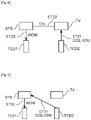
- the figure 4 illustrates a second embodiment of the method of the invention.
- the steps are as follows: During a first step ET21, the user commands via the second remote control TCD2 to power up the TV reproduction device.
- the TV rendering device receives the command and executes the command.
- the TV reproduction device is powered up.
- the TV playback device transmits to the decoder STB a datum referenced ON representative of the new operating state of the TV playback device.
- the transmission of this data can once again be carried out by means of the HDMI CEC protocol (Anglo-Saxon acronym for Consumer Electronics Control) known to those skilled in the art.
- the decoder STB receives the data ON coming from the TV restitution device.
- the decoder STB following reception of the datum ON, transmits a message to the first remote control TCD1 to modify its operating state.
- the first remote control TCD1 then passes from the standby state to a normal operating state.
- a communication session is activated between the decoder STB and the first remote control TCD1.
- the message making it possible to wake up the first remote control TCD1 is for example the message “Wake On Bluetooth” known to those skilled in the art.
- the TV playback device is controlled via the TCD2 remote control.
- the step for obtaining data representative of a modification of the operating state of the playback device includes a step ET31 for receiving commands CDE(ON) from the second remote control TCD2.
- the management module MNG intercepts the commands transmitted by the second remote control CD2 which are intended for the TV restitution device.
- the device reading device STB then detects, among the intercepted commands, the commands resulting in a change of state of the reading device.
- the management module MNG performs step ET15 or ET25 depending on the current operating state of the TV playback device.
- the decoder STB following reception, transmits during a second step ET32 (step ET25), a message to the first remote control TCD1 to modify its operating state.
- the first remote control TCD1 then passes from the standby state to a normal operating state. Following this passage, a communication session is activated between the decoder STB and the first remote control TCD1.
- module can correspond either to a software component or to a hardware component or a set of hardware and software components, a software component itself corresponding to one or more programs or computer sub-programs or more generally to any element of a program capable of implementing a function or a set of functions as described for the modules concerned.
- a hardware component corresponds to any element of a hardware (or hardware) assembly capable of implementing a function or a set of functions for the module concerned (integrated circuit, smart card, memory card, etc. .).
Landscapes
- Engineering & Computer Science (AREA)
- Signal Processing (AREA)
- Multimedia (AREA)
- Computer Networks & Wireless Communication (AREA)
- Physics & Mathematics (AREA)
- General Physics & Mathematics (AREA)
- General Engineering & Computer Science (AREA)
- Software Systems (AREA)
- Human Computer Interaction (AREA)
- Radar, Positioning & Navigation (AREA)
- Remote Sensing (AREA)
- Computer Hardware Design (AREA)
- Theoretical Computer Science (AREA)
- Selective Calling Equipment (AREA)
- Two-Way Televisions, Distribution Of Moving Picture Or The Like (AREA)
Applications Claiming Priority (1)
| Application Number | Priority Date | Filing Date | Title |
|---|---|---|---|
| FR2012118A FR3116624A1 (fr) | 2020-11-25 | 2020-11-25 | Procédé de gestion d’une communication entre un dispositif de commande et un terminal de lecture. |
Publications (1)
| Publication Number | Publication Date |
|---|---|
| EP4007286A1 true EP4007286A1 (de) | 2022-06-01 |
Family
ID=74668989
Family Applications (1)
| Application Number | Title | Priority Date | Filing Date |
|---|---|---|---|
| EP21208844.7A Pending EP4007286A1 (de) | 2020-11-25 | 2021-11-17 | Verfahren zur steuerung einer kommunikation zwischen einem steuergerät und einem leseterminal |
Country Status (3)
| Country | Link |
|---|---|
| US (1) | US12402192B2 (de) |
| EP (1) | EP4007286A1 (de) |
| FR (1) | FR3116624A1 (de) |
Families Citing this family (1)
| Publication number | Priority date | Publication date | Assignee | Title |
|---|---|---|---|---|
| KR20230033287A (ko) * | 2021-09-01 | 2023-03-08 | 삼성전자주식회사 | 디스플레이 장치 및 그 제어 방법 |
Citations (3)
| Publication number | Priority date | Publication date | Assignee | Title |
|---|---|---|---|---|
| US20090249086A1 (en) * | 2008-03-27 | 2009-10-01 | Echostar Technologies L.L.C. | Systems and methods for controlling the power state of remote control electronics |
| JP2012161038A (ja) * | 2011-02-02 | 2012-08-23 | Buffalo Inc | 映像伝送システム、送信側無線通信装置、及び受信側無線通信装置 |
| US9998786B2 (en) * | 2016-08-29 | 2018-06-12 | Nanning Fugui Precision Industrial Co., Ltd. | Set-top box and method for reducing power consumption of a remote control |
Family Cites Families (10)
| Publication number | Priority date | Publication date | Assignee | Title |
|---|---|---|---|---|
| US7319992B2 (en) * | 2000-09-25 | 2008-01-15 | The Mission Corporation | Method and apparatus for delivering a virtual reality environment |
| US20150135206A1 (en) * | 2002-05-10 | 2015-05-14 | Convergent Media Solutions Llc | Method and apparatus for browsing using alternative linkbases |
| US8887209B2 (en) * | 2003-09-05 | 2014-11-11 | Echostar Technologies L.L.C. | Pairing a remote control and a television |
| US8077263B2 (en) * | 2006-10-23 | 2011-12-13 | Sony Corporation | Decoding multiple remote control code sets |
| US8316393B2 (en) * | 2008-10-01 | 2012-11-20 | At&T Intellectual Property I, L.P. | System and method for a communication exchange with an avatar in a media communication system |
| US8905927B2 (en) * | 2010-11-30 | 2014-12-09 | Universal Electronics Inc. | System and method for non-intrusive health monitoring in the home |
| US8528012B2 (en) * | 2011-09-06 | 2013-09-03 | Motorola Mobility Llc | Interactive remote control system and method |
| US9392320B1 (en) * | 2014-04-25 | 2016-07-12 | Amazon Technologies, Inc. | Adaptive battery life enhancer |
| JP6763352B2 (ja) * | 2017-07-05 | 2020-09-30 | Smk株式会社 | 機器制御装置、プログラム及びリモートコントロールシステム |
| KR20200132238A (ko) * | 2019-05-16 | 2020-11-25 | 삼성전자주식회사 | 전자 장치 및 그 제어 방법 |
-
2020
- 2020-11-25 FR FR2012118A patent/FR3116624A1/fr active Pending
-
2021
- 2021-11-17 EP EP21208844.7A patent/EP4007286A1/de active Pending
- 2021-11-18 US US17/529,879 patent/US12402192B2/en active Active
Patent Citations (3)
| Publication number | Priority date | Publication date | Assignee | Title |
|---|---|---|---|---|
| US20090249086A1 (en) * | 2008-03-27 | 2009-10-01 | Echostar Technologies L.L.C. | Systems and methods for controlling the power state of remote control electronics |
| JP2012161038A (ja) * | 2011-02-02 | 2012-08-23 | Buffalo Inc | 映像伝送システム、送信側無線通信装置、及び受信側無線通信装置 |
| US9998786B2 (en) * | 2016-08-29 | 2018-06-12 | Nanning Fugui Precision Industrial Co., Ltd. | Set-top box and method for reducing power consumption of a remote control |
Non-Patent Citations (1)
| Title |
|---|
| LTD HITACHI: "High-Definition Multimedia Interface Specification Version 1.3a", 10 November 2006 (2006-11-10), XP055113810, Retrieved from the Internet <URL:http://www.microprocessor.org/HDMISpecification13a.pdf> * |
Also Published As
| Publication number | Publication date |
|---|---|
| FR3116624A1 (fr) | 2022-05-27 |
| US12402192B2 (en) | 2025-08-26 |
| US20220167455A1 (en) | 2022-05-26 |
Similar Documents
| Publication | Publication Date | Title |
|---|---|---|
| EP3926929B1 (de) | Verfahren zum verwalten des lesens von digitalen inhalten in einem multimedia-lesegerät, das mit einem wiedergabegerät verbunden ist | |
| FR3116624A1 (fr) | Procédé de gestion d’une communication entre un dispositif de commande et un terminal de lecture. | |
| EP3516851B1 (de) | Verfahren zum austausch von nachrichten und zur verwaltung von nachrichten, endgerät und nachrichtenserver | |
| WO2012052693A2 (fr) | Traitement de donnees pour le transfert ou la replication d'un flux media | |
| EP4106277A1 (de) | Verfahren zum aktivieren einer kommunikationsschnittstelle eines gateways für wohngebäude in einem lokalen kommunikationsnetz, entsprechende ausrüstung und entsprechendes computerprogramm | |
| EP2122978A2 (de) | Kommunikationsverfahren und -vorrichtung | |
| FR3086478A1 (fr) | Gestion du fonctionnement d'une telecommande lors de la reception d'un appel telephonique. | |
| FR3120468A1 (fr) | Procédé de gestion de la configuration d’une télécommande. | |
| FR3116172A1 (fr) | Procédé de gestion de l’accès à un contenu numérique | |
| FR3086477A1 (fr) | Gestion de l'alimentation electrique d'une telecommande. | |
| WO2008046827A1 (fr) | Procédé de gestion de mémoire dans un terminal client, signal, programme d'ordinateur et terminal correspondants | |
| EP3881498B1 (de) | Verfahren zur verwaltung der nachrichtenübertragungsfrequenz auf einer kommunikationsverbindung | |
| EP2679003B1 (de) | Verfahren und vorrichtung zur abhängiger verwaltung eines elektronischen gerätes | |
| EP4391521A1 (de) | Verwaltung der standby-steuerung eines medienstream-player-endgeräts | |
| EP4402769A1 (de) | Verfahren zur verwaltung der elektrischen versorgung von geräten | |
| EP1460554B1 (de) | System um den Ruhe-/Aufwachungszustand eines multiplexierten Datenübertragungsnetzwerks zu steuern | |
| FR3013873A1 (fr) | Procede de communication de donnees, dispositif de paiement electronique, systeme, produit programme d'ordinateur et medium correspondants. | |
| FR3117716A1 (fr) | Procédé de gestion de la restitution d’un contenu par un dispositif de restitution. | |
| FR3082043A1 (fr) | Gestion de l'alimentation electrique d'une telecommande. | |
| EP4109905A1 (de) | Steuerung des adaptiven progressiven downloads von digitalen inhalten im bildschirmschonermodus | |
| FR2919777A1 (fr) | Ensemble formant passerelle de liaison entre deux reseaux de telecommunication | |
| FR3094596A1 (fr) | Procédé de contrôle de la consommation énergétique d’un équipement pilotable au moyen d’une télécommande | |
| EP2854415B1 (de) | Dynamisches Übertragungsverfahren von Informationsdaten über ein Audio- und/oder Videoprogramm | |
| FR3134940A1 (fr) | Gestion de la restitution d’un contenu multimédia | |
| FR3126080A1 (fr) | Procédé et dispositif de commutation de la réception de services de diffusion d’un dispositif de diffusion radiophonique |
Legal Events
| Date | Code | Title | Description |
|---|---|---|---|
| PUAI | Public reference made under article 153(3) epc to a published international application that has entered the european phase |
Free format text: ORIGINAL CODE: 0009012 |
|
| STAA | Information on the status of an ep patent application or granted ep patent |
Free format text: STATUS: THE APPLICATION HAS BEEN PUBLISHED |
|
| AK | Designated contracting states |
Kind code of ref document: A1 Designated state(s): AL AT BE BG CH CY CZ DE DK EE ES FI FR GB GR HR HU IE IS IT LI LT LU LV MC MK MT NL NO PL PT RO RS SE SI SK SM TR |
|
| STAA | Information on the status of an ep patent application or granted ep patent |
Free format text: STATUS: REQUEST FOR EXAMINATION WAS MADE |
|
| 17P | Request for examination filed |
Effective date: 20221104 |
|
| RBV | Designated contracting states (corrected) |
Designated state(s): AL AT BE BG CH CY CZ DE DK EE ES FI FR GB GR HR HU IE IS IT LI LT LU LV MC MK MT NL NO PL PT RO RS SE SI SK SM TR |
|
| STAA | Information on the status of an ep patent application or granted ep patent |
Free format text: STATUS: EXAMINATION IS IN PROGRESS |
|
| 17Q | First examination report despatched |
Effective date: 20240416 |