EP4009747A1 - Dispositif plasma - Google Patents
Dispositif plasma Download PDFInfo
- Publication number
- EP4009747A1 EP4009747A1 EP21206439.8A EP21206439A EP4009747A1 EP 4009747 A1 EP4009747 A1 EP 4009747A1 EP 21206439 A EP21206439 A EP 21206439A EP 4009747 A1 EP4009747 A1 EP 4009747A1
- Authority
- EP
- European Patent Office
- Prior art keywords
- plasma
- plasma device
- contact element
- plateau
- housing
- Prior art date
- Legal status (The legal status is an assumption and is not a legal conclusion. Google has not performed a legal analysis and makes no representation as to the accuracy of the status listed.)
- Granted
Links
Images


Classifications
-
- H—ELECTRICITY
- H05—ELECTRIC TECHNIQUES NOT OTHERWISE PROVIDED FOR
- H05H—PLASMA TECHNIQUE; PRODUCTION OF ACCELERATED ELECTRICALLY-CHARGED PARTICLES OR OF NEUTRONS; PRODUCTION OR ACCELERATION OF NEUTRAL MOLECULAR OR ATOMIC BEAMS
- H05H1/00—Generating plasma; Handling plasma
- H05H1/24—Generating plasma
- H05H1/2406—Generating plasma using dielectric barrier discharges, i.e. with a dielectric interposed between the electrodes
-
- D—TEXTILES; PAPER
- D06—TREATMENT OF TEXTILES OR THE LIKE; LAUNDERING; FLEXIBLE MATERIALS NOT OTHERWISE PROVIDED FOR
- D06M—TREATMENT, NOT PROVIDED FOR ELSEWHERE IN CLASS D06, OF FIBRES, THREADS, YARNS, FABRICS, FEATHERS OR FIBROUS GOODS MADE FROM SUCH MATERIALS
- D06M10/00—Physical treatment of fibres, threads, yarns, fabrics or fibrous goods made from such materials, e.g. by ultrasonic waves, corona discharge, irradiation, electric currents or magnetic fields; Physical treatment combined with treatment with chemical compounds or elements
- D06M10/02—Sonic or ultrasonic waves; Corona discharge
- D06M10/025—Corona discharge or low temperature plasma
-
- H—ELECTRICITY
- H05—ELECTRIC TECHNIQUES NOT OTHERWISE PROVIDED FOR
- H05H—PLASMA TECHNIQUE; PRODUCTION OF ACCELERATED ELECTRICALLY-CHARGED PARTICLES OR OF NEUTRONS; PRODUCTION OR ACCELERATION OF NEUTRAL MOLECULAR OR ATOMIC BEAMS
- H05H1/00—Generating plasma; Handling plasma
- H05H1/24—Generating plasma
-
- H—ELECTRICITY
- H05—ELECTRIC TECHNIQUES NOT OTHERWISE PROVIDED FOR
- H05H—PLASMA TECHNIQUE; PRODUCTION OF ACCELERATED ELECTRICALLY-CHARGED PARTICLES OR OF NEUTRONS; PRODUCTION OR ACCELERATION OF NEUTRAL MOLECULAR OR ATOMIC BEAMS
- H05H2245/00—Applications of plasma devices
- H05H2245/30—Medical applications
- H05H2245/36—Sterilisation of objects, liquids, volumes or surfaces
Definitions
- the present invention relates to a plasma device for treating surfaces, in particular textiles, according to the preamble of claim 1.
- the plasma device for inactivating preferably odor-relevant molecules and thus for refreshing surfaces, for example in textiles, is known.
- the plasma device has a housing and an associated plasma source and at least one spacer, which ensures that a predefined distance is maintained between the plasma source and a surface to be treated, at which molecules attached to the surface to be treated pass through Electrons of the plasma can be inactivated.
- a portable sterilization and disinfection device comprising: a housing, a power storage device arranged in the housing, and a transformer connected to the power storage device.
- a high-voltage discharge device is connected to the transformer and configured to generate ozone and negative ions by high-voltage discharge under the boosting voltage output from the transformer.
- plasma devices are used for this purpose, for example, by means of which bacteria, germs, viruses, spores, fungi and odor molecules in particular can be inactivated.
- the disadvantage of the plasma device known from the prior art is that it only inactivates odor molecules, for example, or destroys cell walls of bacteria, microbes, etc., but no further cleaning of the surface takes place.
- the present invention is therefore concerned with the problem of specifying an improved or at least an alternative embodiment for a plasma device of the generic type, by means of which a simple and at the same time improved cleaning of the surfaces to be treated is made possible.
- the present invention is based on the general idea of attaching an additional cleaning device to a plasma device known per se, by means of which particularly fluff and hair can be picked up and a surface to be treated can thereby be better cleaned.
- the plasma device according to the invention has a particularly elongated housing in which a plasma source is arranged. Running in the longitudinal direction of the housing is also a plateau surface with an electrode, preferably also running in the longitudinal direction, via which the plasma can be or is applied to the surface to be treated. The electrode can be surrounded by a ceramic substrate. The plasma is created directly on the surface of the plateau by igniting the electrode. In the transverse direction next to the electrode or the plasma source, i.e.
- At least one contact element which during operation of the plasma device interacts mechanically with the surface to be treated, is provided according to the invention for the mechanical pretreatment of the surface .
- the contact element can have a higher coefficient of friction on textiles than the plateau surface and acts in a similar way to a lint roller or thread lifter and allows lint or hair to be collected before the surface to be treated is impinged with plasma, resulting in a significant improved and at the same time simple surface treatment, for example cleaning, is made possible.
- non-thermal plasma which is also referred to as cold plasma
- Bacteria, spores, viruses, etc. can also be killed with such a plasma without a high temperature being necessary for this purpose.
- the plasma is generated by applying electrical energy to a gas or gas mixture, as a result of which atoms of the gas are ionized, ie electrons are removed from an atomic shell, leaving a positively charged atom.
- a gas consisting of a sufficiently high proportion of free ions and electrons is referred to as plasma.
- the ions and electrons move as free charge carriers.
- a cold plasma which can also be referred to as low-pressure plasma
- reactive particles are formed, such as different oxygen and nitrogen species, which have a sufficiently long service life to damage organic compounds.
- reactive particles such as different oxygen and nitrogen species, which have a sufficiently long service life to damage organic compounds.
- These include atomic oxygen, superoxide radicals, ozone, hydroxyl radicals, nitrogen monoxide and nitrogen dioxide, which not only have a destructive effect on a wide variety of odor molecules, but also on cell components such as cell walls, and are therefore able to inactivate odors and cell walls of bacteria , germs, viruses, fungi or comparable microorganisms, since these, if they are directly exposed to the plasma, become negatively charged due to the bombardment with the electrons present in the plasma.
- the plasma device according to the invention can thus be the odor-inactivating or cell wall-destroying effects of the plasma with the mechanical effects of the side of the electrode or the Combine plasma source arranged contact elements and thereby achieve a significantly improved treatment / cleaning of the surfaces to be treated.
- the contact elements which are equipped in particular with the higher coefficient of friction, enable a textile to be treated to be tightened, which means that wrinkles can be smoothed out, for example, and the cleaning by the plasma can be additionally supported.
- the contact elements are preferably arranged on both sides of the plasma source, so that a cleaning process combined with picking up hair or fluff can take place both in a forward and in a backward movement.
- the contact elements By absorbing lint or hair, the contact elements also prevent lint or hair from penetrating into the plasma device, which can cause a deterioration in the cleaning effect of the plasma source in the long term. In addition, the contact elements can also protect a movement mechanism of the plasma source or the plateau surface from contamination and thus keep it functional in the long term.
- the contact element has a surface area with a coefficient of friction that can be changed in the transverse direction of the plateau surface.
- the coefficient of friction can increase away from the electrode, so that it also increases with increasing distance from the plateau surface.
- a distance between the plateau area and the surface to be treated is preferably 0 mm in order to avoid excessive ozone development.
- Ozone is a molecule (O 3 ) made up of three oxygen atoms (O).
- O oxygen atom
- direct contact with the textile surface must be ensured.
- a low ozone concentration is also desirable because of ozone-induced respiratory irritation and discoloration. Due to the changing coefficient of friction on the surface areas and in particular Reliable tightening of the surfaces to be treated can also be achieved by an increase in the coefficient of friction as the distance from the electrode or the plasma source increases, as a result of which the cleaning effect can be improved.
- the contact elements are arranged on curved side surfaces of the housing adjacent to the plateau surface and serve as wrinkle smoothers.
- the increased coefficient of friction can be achieved, for example, by an appropriate coating, for example a coating made of rubber and/or silicone, but also by attaching bristles.
- the position of the contact elements on the curved side faces can increase the effect of smoothing the textile to be treated.
- the contact elements with an increased coefficient of friction can also extend further over the curved side surfaces on which the plasma device is usually gripped, thereby enabling reliable gripping.
- the handling and guidance of the plasma device during the treatment process can also be simplified as a result.
- the contact elements lie between the plateau surface and a curved side surface, so that the side surface on which the plasma device is usually gripped with thumb and finger remains free. This makes it possible to limit the contact elements, which means that on the one hand the smoothing or lint and/or hair-picking effect is obtained, but the coating of other surfaces can be avoided, which brings cost advantages.
- At least one contact element is expediently designed as a thread lifter.
- a thread lifter By means of such a thread lifter, not only can the surface to be treated be tightened, but it is also possible to pick up lint and/or hair, similar to a comb, which achieves an additional cleaning effect and in particular also prevents such lint or hair from penetrating into a Interior of the housing and thus an impairment, for example, an adjustment mechanism of the plasma source or the plateau surface can be avoided.
- Thread lifters of this type can, for example, have raising elements, for example bristles that are inclined pointing the way from the plateau area.
- Such thread lifters can also have straightening elements made of rubber, for example made of silicone, which can for example only be designed as knobs or the like, but at the same time allow fluff or hair to be collected and smoothed out.
- the contact elements with the thread lifter are expediently arranged on a console, which is in particular formed in one piece with the housing, between the respective plateau surface and an associated curved side surface.
- a console which is wedge-shaped in cross section, allows the arrangement of the contact elements with the increased coefficient of friction almost flush with the surface of the plateau area.
- Such consoles also offer the possibility of providing corresponding recesses into which, for example, a contact element designed as a thread lifter or as a material strip with an increased coefficient of friction can be inserted. This in turn also enables the contact elements with an increased coefficient of friction to be replaced, for example in the event of corresponding wear. Due to the one-piece design of the console with the housing, these can be produced together with the housing as a cost-effective plastic injection molded part in a single step.
- a UV light source is provided in addition to the plasma source, via which UV light can be applied to the surface to be treated.
- a UV source it is possible to destroy DNA from microbes and thereby have an antibacterial or antimicrobial effect.
- Such a UV source for emitting UV light can be activated simultaneously with the plasma source or in addition to or as an alternative to it, for example via a corresponding switch on the housing of the plasma device.
- the plateau surface is expediently spring-loaded and protrudes beyond the housing of the plasma device when it is not in use.
- Spring loading of the plateau surface or even the plasma source arranged in the housing makes it possible to guide the plateau surface close to the surface during the cleaning process, which in particular can prevent excessive ozone production by the plasma source.
- the spring-loaded plateau surface causes also shielding the generated plasma from atmospheric oxygen, so that although sufficient oxygen is available for ozone production, the aforementioned excessive ozone production with the associated disadvantages does not take place.
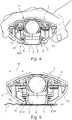
- a plasma device 1 for treating, in particular for refreshing, surfaces 2, such as textiles 3, an elongated housing 4.
- surfaces 2 such as textiles 3, an elongated housing 4.
- these textiles 3 can also have artificial fibers such as nylon.
- surfaces or objects made of ceramic, plastic, feathers, leather, glass, wood or metal should also be able to be subsumed under the term "surface 2".
- a plasma source 5 is arranged in the elongate housing 4 and is capable of generating plasma, preferably non-thermal plasma, which is also referred to as cold plasma, in a targeted manner for eliminating odors and certain hydrocarbons.
- solid, liquid or gaseous, plasma is referred to as the fourth state of aggregation.
- a sufficient amount of energy is supplied to a gas or gas mixture, for example in the form of electrical energy, some of the gas atoms are ionized, i. H. Electrons are removed from the atomic shell and move around as free particles, leaving a positively charged atom.
- a gas consists of a sufficiently high proportion of free ions and electrons, the state of aggregation is referred to as plasma. So, plasma is matter whose constituents are partially charged components, ions and electrons that move as free charge carriers.
- the causes of the antibacterial effect of a plasma lie in heat, dehydration, shear stress, UV radiation, free radicals and charges.
- low-pressure plasmas which are also called cold plasmas
- the heat plays a subordinate role, since these plasmas are operated at room temperature.
- reactive particles are formed, such as various oxygen or nitrogen species, which have a sufficiently long lifetime to damage organic compounds in the event of indirect exposure.
- These particles include including atomic oxygen, superoxide radicals, ozone, hydroxyl radicals, nitrogen monoxide and nitrogen dioxide. These particles show a destructive effect on a wide variety of odor components as well as cell components.
- odor components which usually consist of carbon compounds, as well as the cell walls of bacteria, germs, viruses, fungi or other comparable microorganisms are directly exposed to the plasma, they become negatively charged due to the bombardment with the electrons present in the plasma. Due to the electrostatic repulsion, this leads to mechanical stresses that can even exceed the tensile strength and destroy the odor molecule or the cell wall. However, not only mechanical tension due to the charge can destroy the cell walls, but also the disturbance of the charge balance of the odor molecules or the cell wall through various other electrostatic interactions and electrolysis, e.g. B. by changing the permeability of the cell walls. A mechanism for inactivating microorganisms also results from the very high-energy ions.
- the plasma can be generated by means of a high frequency. Low-pressure plasmas are therefore particularly well suited for inactivating odors on textile fabrics or on household surfaces or the like in order to achieve odor activation.
- the housing 4 has a plateau surface 6 with at least one electrode 7, which also runs in the longitudinal direction 9 and is in particular slightly raised, via which the plasma can be applied or generated to the surface 2 to be treated.
- a cleaning effect of the surface 2 in the transverse direction 17 next to the electrode 7 or the plasma source 5, i.e. in the direction of movement before or before and after the plasma source 5, at least one during operation of the plasma device 1 is mechanically connected to the Surface 2 to be treated is provided with a contact element 8 that interacts with it, which enables mechanical cleaning of the surface 2 to be treated, in particular due to a higher coefficient of friction on textiles 3 than on the plateau surface 6.
- each plasma device 1 is usually provided with two contact elements 8 with an increased coefficient of friction on textiles 3, so that the plasma device 1 can be moved back and forth in the operating state transversely to the longitudinal direction 9 and mechanical pre-cleaning takes place with each movement.
- hair or fluff can be picked up by the contact elements 8 or the surface 2 to be treated can be smoothed out before it is exposed to plasma by the plasma source 5 .
- the contact elements 8 can therefore also serve as smoothing elements 11 .
- Such a contact element 8 can be designed, for example, in the form of individual nubs on the surface, with such nubs being arranged in different rows, distances, heights and made of different materials, so that different effects or friction values can occur.
- the contact element 8 can also have a friction-increasing varnish or coating, so that a textile 3 rubs against it and results in adhesion, as a result of which the textile 3 can be tightened.
- a contact element 8 designed as a smoothing element 11 has an arrow shape in the direction of movement, as a result of which the textile 3 can also be stretched in a further direction.
- the contact element 8 can also be designed as a thread lifter 10, as is the case in the embodiments of the plasma device 1 according to the invention according to FIGS 2 , 4 and 5 is shown.
- the contact elements 8 are designed as smoothing elements 11 with a friction-increasing coating, as is the case in the embodiments according to FIGS 3 and 6 and 7.
- thin elastic elements for example bristles
- bristles can be provided, similar to a rake or a comb are aligned to this.
- bristles or tines can also be referred to as erecting elements 12 .
- the raising elements 12 can be designed in different rows, sometimes at different heights or offset from one another.
- the contact elements 8, in particular the thread lifters 10 or the smoothing elements 11, can thereby use the electrode 7 project beyond 9 in the longitudinal direction.
- such a smoothing element 11 can also have a wiping function, so that the surface 2 is wiped over a wide area.
- the contact elements 8 have a coefficient of friction that is variable transversely to the longitudinal direction 9 of the plateau surface 6, in particular that the coefficient of friction increases away from the electrode 7, i.e. with increasing distance from the electrode 7 increases.
- the textile 3 can be tightened, resulting in particular in a surface 2 running parallel to the plateau surface 6, which can be optimally cleaned via the plasma.
- the contact elements 8 are arranged on curved side surfaces 13 adjacent to the plateau surface 6 .
- they mainly serve as wrinkle smoothers or smoothing elements 11.
- fingers may grip the contact elements 8 when using the plasma device 1, whereby reliable handling is possible due to the higher coefficient of friction there.
- the contact elements 8 lie between the plateau surface 6 and the side surfaces 13, as is the case in the embodiment according to FIGS 2 and 4 and 5 is the case.
- the contact elements 8 are designed as thread lifters 10 .
- the plasma device 1 according to the invention can also have a UV light source, via which UV light can be applied to the surface 2 to be treated. An antibacterial or antimicrobial effect can also be achieved via UV radiation.
- the plateau surface 6 or the plasma source 5 can also be spring-loaded and in a non-use state (cf. 4 ) on the housing 4 and also on the contact elements 8, such as the thread lifter 10, protrude. If this plasma device 1 is placed on the surface 2 to be treated, the plasma source 5 or the plateau surface 6 is pressed into the housing 4, whereby a comparatively tight contact of the plateau surface 6 with the surface 2 to be treated and thus an optimized cleaning result is achieved can become.
- the contact elements 8 with the thread lifter 10 can correspond to the 2 as well as 4 and 5 on a bracket 14 embodied in particular in one piece with the housing 4 between the plateau surface 6 and the curved side surface 13 .
- the bracket 14 can also have a recess 15 in which the thread lifter 10 is embedded, it also being theoretically conceivable that the thread lifter 10 and thus also the contact element 8 can be exchanged if this is worn out, for example.
- the plasma source 5 can be activated via a switch 16, so that the plasma device 1 can theoretically also be used exclusively as a lint brush.
- the plasma source 5 is supplied with energy via a battery or an accumulator.
- the textile 3 can be given the opportunity to relax and thus be fed to the plasma source 5 without any creases. It is also conceivable for the thread lifter 10 or the individual bristles of the contact elements 8 to be arrow-shaped in the transverse direction 17 away from the plasma source 5, as a result of which the textile 3 can be expanded and smoothed to a certain extent, similar to an iron.
- the contact elements 8 With the contact elements 8 according to the invention, a mechanical pre-cleaning of the surface 2 to be treated can be achieved, whereupon an after-treatment by means of the plasma source 5 or UV light takes place.
- the textile 3 can be tightened by the contact elements 8, as a result of which creases are avoided and direct contact between the plateau surface 6 and the surface 2 to be treated can be achieved.
- less ozone is produced and at the same time it is ensured that the entire surface 2 is covered with the plateau area 6 and charged with plasma.
- Through the contact elements 8 can also undesired penetration of hair, threads or fluff between the plasma source 5 and the housing 4 into the interior of the housing 4 of the plasma device 1 can be prevented, whereby a long functionality can be guaranteed.
Landscapes
- Engineering & Computer Science (AREA)
- Physics & Mathematics (AREA)
- Plasma & Fusion (AREA)
- Spectroscopy & Molecular Physics (AREA)
- Textile Engineering (AREA)
- Chemical Or Physical Treatment Of Fibers (AREA)
- Treatment Of Fiber Materials (AREA)
- Cleaning In General (AREA)
Applications Claiming Priority (1)
| Application Number | Priority Date | Filing Date | Title |
|---|---|---|---|
| DE102020215114.8A DE102020215114A1 (de) | 2020-12-01 | 2020-12-01 | Plasma-Vorrichtung |
Publications (2)
| Publication Number | Publication Date |
|---|---|
| EP4009747A1 true EP4009747A1 (fr) | 2022-06-08 |
| EP4009747B1 EP4009747B1 (fr) | 2025-10-08 |
Family
ID=78528706
Family Applications (1)
| Application Number | Title | Priority Date | Filing Date |
|---|---|---|---|
| EP21206439.8A Active EP4009747B1 (fr) | 2020-12-01 | 2021-11-04 | Dispositif plasma |
Country Status (2)
| Country | Link |
|---|---|
| EP (1) | EP4009747B1 (fr) |
| DE (1) | DE102020215114A1 (fr) |
Citations (9)
| Publication number | Priority date | Publication date | Assignee | Title |
|---|---|---|---|---|
| US6513269B2 (en) | 2000-07-28 | 2003-02-04 | Matsushita Electric Industrial Co., Ltd. | Steam sprayer |
| JP2010022703A (ja) * | 2008-07-23 | 2010-02-04 | Sharp Corp | アイロン |
| DE102008063053A1 (de) * | 2008-12-23 | 2010-07-01 | Melitta Haushaltsprodukte Gmbh & Co. Kg | Reinigungsaufsatz für Staubsauger |
| DE102011100751A1 (de) | 2011-05-05 | 2012-11-08 | Max Planck-Gesellschaft zur Förderung der Wissenschaften e.V. | Verfahren zur Inaktivierung vorzugsweise geruchsrelevanter Moleküle und Vorrichtung zu dessen Durchführung |
| CN205814739U (zh) | 2016-05-20 | 2016-12-21 | 金科伟业(中国)有限公司 | 一种便携式灭菌消毒机 |
| WO2017162505A1 (fr) * | 2016-03-22 | 2017-09-28 | Koninklijke Philips N.V. | Dispositif à plasma froid pour traiter la peau |
| US20180214586A1 (en) * | 2015-07-28 | 2018-08-02 | EP Technologies LLC | Scrubbing device for cleaning, sanitizing or disinfecting |
| CN108771767A (zh) | 2018-08-24 | 2018-11-09 | 深圳市浪尖开物科技有限公司 | 衣柜净化器 |
| DE102018213143A1 (de) * | 2018-08-06 | 2020-02-06 | Hyve Innovation Design Gmbh | Aktivierungsvorrichtung und Aktivierungsverfahren einer Plasmaquelle zur Oberflächenbehandlung |
Family Cites Families (4)
| Publication number | Priority date | Publication date | Assignee | Title |
|---|---|---|---|---|
| DE102004005641A1 (de) | 2004-02-04 | 2005-09-01 | Miele & Cie. Kg | Düse für ein Bodenpflegegerät |
| DE102011010355A1 (de) | 2011-02-04 | 2012-08-09 | Max-Plank-Gesellschaft zur Förderung der Wissenschaften e.v. | Bodenreinigungsgerät mit einem Plasmaapplikator |
| DE102015111401B3 (de) | 2015-07-14 | 2016-09-01 | Cinogy Gmbh | Behandlungsgerät zur Behandlung mit einem dielektrisch behinderten Plasma |
| DE102018126489A1 (de) | 2018-10-24 | 2020-04-30 | Cinogy Gmbh | Plasma-Behandlungsgerät mit Bürstenkopf |
-
2020
- 2020-12-01 DE DE102020215114.8A patent/DE102020215114A1/de active Pending
-
2021
- 2021-11-04 EP EP21206439.8A patent/EP4009747B1/fr active Active
Patent Citations (9)
| Publication number | Priority date | Publication date | Assignee | Title |
|---|---|---|---|---|
| US6513269B2 (en) | 2000-07-28 | 2003-02-04 | Matsushita Electric Industrial Co., Ltd. | Steam sprayer |
| JP2010022703A (ja) * | 2008-07-23 | 2010-02-04 | Sharp Corp | アイロン |
| DE102008063053A1 (de) * | 2008-12-23 | 2010-07-01 | Melitta Haushaltsprodukte Gmbh & Co. Kg | Reinigungsaufsatz für Staubsauger |
| DE102011100751A1 (de) | 2011-05-05 | 2012-11-08 | Max Planck-Gesellschaft zur Förderung der Wissenschaften e.V. | Verfahren zur Inaktivierung vorzugsweise geruchsrelevanter Moleküle und Vorrichtung zu dessen Durchführung |
| US20180214586A1 (en) * | 2015-07-28 | 2018-08-02 | EP Technologies LLC | Scrubbing device for cleaning, sanitizing or disinfecting |
| WO2017162505A1 (fr) * | 2016-03-22 | 2017-09-28 | Koninklijke Philips N.V. | Dispositif à plasma froid pour traiter la peau |
| CN205814739U (zh) | 2016-05-20 | 2016-12-21 | 金科伟业(中国)有限公司 | 一种便携式灭菌消毒机 |
| DE102018213143A1 (de) * | 2018-08-06 | 2020-02-06 | Hyve Innovation Design Gmbh | Aktivierungsvorrichtung und Aktivierungsverfahren einer Plasmaquelle zur Oberflächenbehandlung |
| CN108771767A (zh) | 2018-08-24 | 2018-11-09 | 深圳市浪尖开物科技有限公司 | 衣柜净化器 |
Also Published As
| Publication number | Publication date |
|---|---|
| EP4009747B1 (fr) | 2025-10-08 |
| DE102020215114A1 (de) | 2022-06-02 |
Similar Documents
| Publication | Publication Date | Title |
|---|---|---|
| EP2704655B1 (fr) | Procédé d'inactivation de molécules et dispositif permettant la mise en oeuvre dudit procédé | |
| EP2704654B1 (fr) | Dispositif de traitement der surfaces au plasma | |
| DE69417697T2 (de) | Vorrichtung zur Behandlung von Haaren mit Dampf | |
| EP2323600B1 (fr) | Pansement rapide | |
| DE3615670A1 (de) | Verfahren und vorrichtung zur behandlung von gasen mittels entladung | |
| TW200601968A (en) | Composition for the impregnation of fibers, fabrics and nettings imparting a protective activity against pests | |
| DE10260156A1 (de) | Wäschetrockner und Verwendung eines Ultraschallzerstäubers | |
| DE102011100751A1 (de) | Verfahren zur Inaktivierung vorzugsweise geruchsrelevanter Moleküle und Vorrichtung zu dessen Durchführung | |
| EP4062715B1 (fr) | Dispositif à plasma | |
| EP4009747B1 (fr) | Dispositif plasma | |
| DE3032752C2 (de) | Verfahren zur desinfizierenden Chemisch-Reinigung | |
| EP1214102B1 (fr) | Dispositif de nettoyage et de desinfection de surfaces | |
| DE102019110814A1 (de) | Vorrichtung zum Behandeln von Textilien mit einem physikalischen Plasma | |
| EP4255511B1 (fr) | Dispositif à plasma | |
| DE202008018415U1 (de) | Textiler Überzug für ein Dampferzeugungsgerät | |
| EP4126078A1 (fr) | Dispositif de désinfection d'objets ou de matières solides, de préférence des éléments d'équipement de protection et utilisation dudit dispositif | |
| EP4009750B1 (fr) | Dispositif plasma | |
| KR100337536B1 (ko) | 활성탄소섬유 복합 부직포의 제조방법 | |
| DE102020215106A1 (de) | Plasma-Vorrichtung | |
| DE4122010C1 (fr) | ||
| EP3991623A1 (fr) | Dispositif de nettoyage | |
| EP3960925A1 (fr) | Élément fonctionnel pour un générateur de vapeur portable | |
| KR20200093128A (ko) | 콜드 플라즈마를 활용한 소취 섬유제조 기술 | |
| DE102020215103A1 (de) | Verfahren zum Ansteuern einer Plasmaquelle eines handführbaren Geräts und handführbares Gerät | |
| DE102020215105A1 (de) | Gerät zur Behandlung eines Gegenstands mit Plasma |
Legal Events
| Date | Code | Title | Description |
|---|---|---|---|
| PUAI | Public reference made under article 153(3) epc to a published international application that has entered the european phase |
Free format text: ORIGINAL CODE: 0009012 |
|
| STAA | Information on the status of an ep patent application or granted ep patent |
Free format text: STATUS: THE APPLICATION HAS BEEN PUBLISHED |
|
| AK | Designated contracting states |
Kind code of ref document: A1 Designated state(s): AL AT BE BG CH CY CZ DE DK EE ES FI FR GB GR HR HU IE IS IT LI LT LU LV MC MK MT NL NO PL PT RO RS SE SI SK SM TR |
|
| STAA | Information on the status of an ep patent application or granted ep patent |
Free format text: STATUS: REQUEST FOR EXAMINATION WAS MADE |
|
| 17P | Request for examination filed |
Effective date: 20221208 |
|
| RBV | Designated contracting states (corrected) |
Designated state(s): AL AT BE BG CH CY CZ DE DK EE ES FI FR GB GR HR HU IE IS IT LI LT LU LV MC MK MT NL NO PL PT RO RS SE SI SK SM TR |
|
| GRAP | Despatch of communication of intention to grant a patent |
Free format text: ORIGINAL CODE: EPIDOSNIGR1 |
|
| STAA | Information on the status of an ep patent application or granted ep patent |
Free format text: STATUS: GRANT OF PATENT IS INTENDED |
|
| RIC1 | Information provided on ipc code assigned before grant |
Ipc: H05H 1/24 20060101AFI20250114BHEP |
|
| INTG | Intention to grant announced |
Effective date: 20250129 |
|
| GRAJ | Information related to disapproval of communication of intention to grant by the applicant or resumption of examination proceedings by the epo deleted |
Free format text: ORIGINAL CODE: EPIDOSDIGR1 |
|
| STAA | Information on the status of an ep patent application or granted ep patent |
Free format text: STATUS: REQUEST FOR EXAMINATION WAS MADE |
|
| GRAP | Despatch of communication of intention to grant a patent |
Free format text: ORIGINAL CODE: EPIDOSNIGR1 |
|
| STAA | Information on the status of an ep patent application or granted ep patent |
Free format text: STATUS: GRANT OF PATENT IS INTENDED |
|
| INTG | Intention to grant announced |
Effective date: 20250516 |
|
| GRAS | Grant fee paid |
Free format text: ORIGINAL CODE: EPIDOSNIGR3 |
|
| GRAA | (expected) grant |
Free format text: ORIGINAL CODE: 0009210 |
|
| STAA | Information on the status of an ep patent application or granted ep patent |
Free format text: STATUS: THE PATENT HAS BEEN GRANTED |
|
| AK | Designated contracting states |
Kind code of ref document: B1 Designated state(s): AL AT BE BG CH CY CZ DE DK EE ES FI FR GB GR HR HU IE IS IT LI LT LU LV MC MK MT NL NO PL PT RO RS SE SI SK SM TR |
|
| REG | Reference to a national code |
Ref country code: GB Ref legal event code: FG4D Free format text: NOT ENGLISH Ref country code: CH Ref legal event code: F10 Free format text: ST27 STATUS EVENT CODE: U-0-0-F10-F00 (AS PROVIDED BY THE NATIONAL OFFICE) Effective date: 20251008 |
|
| REG | Reference to a national code |
Ref country code: DE Ref legal event code: R096 Ref document number: 502021008912 Country of ref document: DE |
|
| REG | Reference to a national code |
Ref country code: IE Ref legal event code: FG4D Free format text: LANGUAGE OF EP DOCUMENT: GERMAN |
|
| PGFP | Annual fee paid to national office [announced via postgrant information from national office to epo] |
Ref country code: DE Payment date: 20251130 Year of fee payment: 5 |
|
| PGFP | Annual fee paid to national office [announced via postgrant information from national office to epo] |
Ref country code: GB Payment date: 20251127 Year of fee payment: 5 |
|
| PGFP | Annual fee paid to national office [announced via postgrant information from national office to epo] |
Ref country code: AT Payment date: 20260113 Year of fee payment: 5 |
|
| PGFP | Annual fee paid to national office [announced via postgrant information from national office to epo] |
Ref country code: FR Payment date: 20251201 Year of fee payment: 5 |
|
| REG | Reference to a national code |
Ref country code: NL Ref legal event code: MP Effective date: 20251008 |
|
| PG25 | Lapsed in a contracting state [announced via postgrant information from national office to epo] |
Ref country code: NL Free format text: LAPSE BECAUSE OF FAILURE TO SUBMIT A TRANSLATION OF THE DESCRIPTION OR TO PAY THE FEE WITHIN THE PRESCRIBED TIME-LIMIT Effective date: 20251008 |
|
| PG25 | Lapsed in a contracting state [announced via postgrant information from national office to epo] |
Ref country code: ES Free format text: LAPSE BECAUSE OF FAILURE TO SUBMIT A TRANSLATION OF THE DESCRIPTION OR TO PAY THE FEE WITHIN THE PRESCRIBED TIME-LIMIT Effective date: 20251008 |
|
| REG | Reference to a national code |
Ref country code: LT Ref legal event code: MG9D |
|
| PG25 | Lapsed in a contracting state [announced via postgrant information from national office to epo] |
Ref country code: NO Free format text: LAPSE BECAUSE OF FAILURE TO SUBMIT A TRANSLATION OF THE DESCRIPTION OR TO PAY THE FEE WITHIN THE PRESCRIBED TIME-LIMIT Effective date: 20260108 |
|
| PG25 | Lapsed in a contracting state [announced via postgrant information from national office to epo] |
Ref country code: HR Free format text: LAPSE BECAUSE OF FAILURE TO SUBMIT A TRANSLATION OF THE DESCRIPTION OR TO PAY THE FEE WITHIN THE PRESCRIBED TIME-LIMIT Effective date: 20251008 Ref country code: FI Free format text: LAPSE BECAUSE OF FAILURE TO SUBMIT A TRANSLATION OF THE DESCRIPTION OR TO PAY THE FEE WITHIN THE PRESCRIBED TIME-LIMIT Effective date: 20251008 |
|
| PG25 | Lapsed in a contracting state [announced via postgrant information from national office to epo] |
Ref country code: RS Free format text: LAPSE BECAUSE OF FAILURE TO SUBMIT A TRANSLATION OF THE DESCRIPTION OR TO PAY THE FEE WITHIN THE PRESCRIBED TIME-LIMIT Effective date: 20260108 |
|
| PG25 | Lapsed in a contracting state [announced via postgrant information from national office to epo] |
Ref country code: IS Free format text: LAPSE BECAUSE OF FAILURE TO SUBMIT A TRANSLATION OF THE DESCRIPTION OR TO PAY THE FEE WITHIN THE PRESCRIBED TIME-LIMIT Effective date: 20260208 |
|
| PG25 | Lapsed in a contracting state [announced via postgrant information from national office to epo] |
Ref country code: PT Free format text: LAPSE BECAUSE OF FAILURE TO SUBMIT A TRANSLATION OF THE DESCRIPTION OR TO PAY THE FEE WITHIN THE PRESCRIBED TIME-LIMIT Effective date: 20260209 |
|
| PG25 | Lapsed in a contracting state [announced via postgrant information from national office to epo] |
Ref country code: PL Free format text: LAPSE BECAUSE OF FAILURE TO SUBMIT A TRANSLATION OF THE DESCRIPTION OR TO PAY THE FEE WITHIN THE PRESCRIBED TIME-LIMIT Effective date: 20251008 |
|
| PG25 | Lapsed in a contracting state [announced via postgrant information from national office to epo] |
Ref country code: LV Free format text: LAPSE BECAUSE OF FAILURE TO SUBMIT A TRANSLATION OF THE DESCRIPTION OR TO PAY THE FEE WITHIN THE PRESCRIBED TIME-LIMIT Effective date: 20251008 |