EP4012403B1 - Procédé d'analyse de pyrroloquinoline quinone - Google Patents
Procédé d'analyse de pyrroloquinoline quinone Download PDFInfo
- Publication number
- EP4012403B1 EP4012403B1 EP20773943.4A EP20773943A EP4012403B1 EP 4012403 B1 EP4012403 B1 EP 4012403B1 EP 20773943 A EP20773943 A EP 20773943A EP 4012403 B1 EP4012403 B1 EP 4012403B1
- Authority
- EP
- European Patent Office
- Prior art keywords
- pyrroloquinoline quinone
- pqq
- analysis
- reduced
- oxidized
- Prior art date
- Legal status (The legal status is an assumption and is not a legal conclusion. Google has not performed a legal analysis and makes no representation as to the accuracy of the status listed.)
- Active
Links
Images






Classifications
-
- G—PHYSICS
- G01—MEASURING; TESTING
- G01N—INVESTIGATING OR ANALYSING MATERIALS BY DETERMINING THEIR CHEMICAL OR PHYSICAL PROPERTIES
- G01N30/00—Investigating or analysing materials by separation into components using adsorption, absorption or similar phenomena or using ion-exchange, e.g. chromatography or field flow fractionation
- G01N30/02—Column chromatography
- G01N30/88—Integrated analysis systems specially adapted therefor, not covered by a single one of the groups G01N30/04 - G01N30/86
-
- G—PHYSICS
- G01—MEASURING; TESTING
- G01N—INVESTIGATING OR ANALYSING MATERIALS BY DETERMINING THEIR CHEMICAL OR PHYSICAL PROPERTIES
- G01N30/00—Investigating or analysing materials by separation into components using adsorption, absorption or similar phenomena or using ion-exchange, e.g. chromatography or field flow fractionation
- G01N30/02—Column chromatography
- G01N30/04—Preparation or injection of sample to be analysed
- G01N30/06—Preparation
-
- A—HUMAN NECESSITIES
- A23—FOODS OR FOODSTUFFS; TREATMENT THEREOF, NOT COVERED BY OTHER CLASSES
- A23L—FOODS, FOODSTUFFS OR NON-ALCOHOLIC BEVERAGES, NOT OTHERWISE PROVIDED FOR; PREPARATION OR TREATMENT THEREOF
- A23L2/00—Non-alcoholic beverages; Dry compositions or concentrates therefor; Preparation or treatment thereof
- A23L2/52—Adding ingredients
- A23L2/68—Acidifying substances
-
- A—HUMAN NECESSITIES
- A23—FOODS OR FOODSTUFFS; TREATMENT THEREOF, NOT COVERED BY OTHER CLASSES
- A23V—INDEXING SCHEME RELATING TO FOODS, FOODSTUFFS OR NON-ALCOHOLIC BEVERAGES AND LACTIC OR PROPIONIC ACID BACTERIA USED IN FOODSTUFFS OR FOOD PREPARATION
- A23V2002/00—Food compositions, function of food ingredients or processes for food or foodstuffs
-
- G—PHYSICS
- G01—MEASURING; TESTING
- G01N—INVESTIGATING OR ANALYSING MATERIALS BY DETERMINING THEIR CHEMICAL OR PHYSICAL PROPERTIES
- G01N30/00—Investigating or analysing materials by separation into components using adsorption, absorption or similar phenomena or using ion-exchange, e.g. chromatography or field flow fractionation
- G01N30/02—Column chromatography
- G01N2030/022—Column chromatography characterised by the kind of separation mechanism
- G01N2030/027—Liquid chromatography
-
- G—PHYSICS
- G01—MEASURING; TESTING
- G01N—INVESTIGATING OR ANALYSING MATERIALS BY DETERMINING THEIR CHEMICAL OR PHYSICAL PROPERTIES
- G01N30/00—Investigating or analysing materials by separation into components using adsorption, absorption or similar phenomena or using ion-exchange, e.g. chromatography or field flow fractionation
- G01N30/02—Column chromatography
- G01N30/04—Preparation or injection of sample to be analysed
- G01N30/06—Preparation
- G01N2030/067—Preparation by reaction, e.g. derivatising the sample
-
- G—PHYSICS
- G01—MEASURING; TESTING
- G01N—INVESTIGATING OR ANALYSING MATERIALS BY DETERMINING THEIR CHEMICAL OR PHYSICAL PROPERTIES
- G01N30/00—Investigating or analysing materials by separation into components using adsorption, absorption or similar phenomena or using ion-exchange, e.g. chromatography or field flow fractionation
- G01N30/02—Column chromatography
- G01N30/88—Integrated analysis systems specially adapted therefor, not covered by a single one of the groups G01N30/04 - G01N30/86
- G01N2030/8809—Integrated analysis systems specially adapted therefor, not covered by a single one of the groups G01N30/04 - G01N30/86 analysis specially adapted for the sample
- G01N2030/884—Integrated analysis systems specially adapted therefor, not covered by a single one of the groups G01N30/04 - G01N30/86 analysis specially adapted for the sample organic compounds
Definitions
- the present invention relates to the quantitative analysis method of oxidized and reduced pyrroloquinoline quinone or a salt thereof.
- Pyrroloquinoline quinone (hereinafter occasionally called merely "PQQ") is a substance in which a pyrrole ring is condensed with a quinoline ring to make an o-quinone structure. This substance may be called oxidized PQQ. This quinone structure is easily reduced to form reduced pyrroloquinoline quinone. Reduced PQQ changes into oxidized PQQ by oxidation with air. It is known that the oxidation and reduction are thus conducted between oxidized pyrroloquinoline quinone and reduced pyrroloquinoline quinone easily. It is known that these oxidized PQQ and reduced PQQ have different UV spectra (Non Patent Literature 1).
- PQQ is considered to have many important physiological activities such as the effect of promoting the proliferation of cells, an anti-cataract effect, the effect of preventing and treating liver disease, the effect of promoting the healing of wounds, an antiallergic effect, the effect of inhibiting reverse transcriptase, the effect of inhibiting glyoxylase I, and an anticancer effect.
- Industrial importance of utilizing PQQ is increasing.
- a pyrroloquinoline quinone disodium salt is actually used as a food (Patent Literature 1).
- the calculation of the accurate measurement data of PQQ in foods has been required in the system of foods with functional claims using functionality.
- PQQ is provided as a mixture with various substances.
- PQQ reacts with many food components easily, and is easily interfered with at the time of analysis.
- the analysis is the analysis of the content contained in a capsule or a tablet in milligram order.
- the analysis method for oxidized PQQ has heretofore been used in the case of the analysis method of PQQ.
- High performance liquid chromatography HPLC is a method for analyzing nonvolatile substances, and analysis with high sensitivity has been also developed.
- HPLC high performance liquid chromatography
- no analysis method suitable for the quantification of oxidized PQQ and reduced PQQ has been reported.
- the separation of oxidized PQQ and reduced PQQ has not been reported in detail.
- Non Patent Literature 1 reports a method for suppressing this interference at the time of analysis.
- This method is a method for conducting a step of removing ascorbic acid by air oxidation before measurement and then conducting HPLC analysis for suppressing interference due to ascorbic acid.
- the method is a method for removing ascorbic acid which is a reducing agent and detecting all as the oxidized type since the oxidized type and the reduced type of pyrroloquinoline quinone cannot be separated under this analysis condition.
- reducing agents represented by ascorbic acid are blended in various foods.
- a large amount of reducing agents is blended especially in beverages in consideration also of a role as acidulants.
- reduced pyrroloquinoline quinone has a problem with the stability under measurement conditions such as oxidation with air (including dissolved oxygen contained in liquid). Therefore, a method for quantifying reduced pyrroloquinoline quinone accurately has not been established.
- reduced pyrroloquinoline quinone can be stabilized under measurement conditions, and its amount can be quantified
- reduced PQQ and oxidized PQQ can be separated in a method using HPLC, and a method for enabling accurate quantification of the oxidized type and the reduced type can be established.
- a new method for converting all into the reduced type for measurement can be established to find the total amount oxidized and reduced pyrroloquinoline quinone contained in a specimen.
- the present invention has been completed in view of the above-mentioned problem, and an object of the present invention is to provide a high performance liquid chromatography method which enables quantitative analysis with the stability of reduced pyrroloquinoline quinone under measurement conditions maintained.
- PQQ contained in the measurement object can be quantified rapidly and easily without being influenced by the coexisting components.
- the present inventors have examined earnestly to solve the above-mentioned problem, consequently found that the above-mentioned problem can be solved using a reversed phase column as a stationary phase and using predetermined eluent as a mobile phase, and completed the present invention.
- the present invention is as follows.
- a high performance liquid chromatography method which enables quantitative analysis with the stability of reduced pyrroloquinoline quinone under measurement conditions maintained can be provided.
- a high performance liquid chromatography analysis method of the present embodiment comprises a sample preparation step of preparing a sample for HPLC containing reduced pyrroloquinoline quinone or a salt thereof from a specimen and oxidized pyrroloquinoline quinone, and a separation step of separating the reduced pyrroloquinoline quinone or a salt thereof contained in the sample for HPLC from the specimen using interaction between a stationary phase and a mobile phase by a high performance liquid chromatography method using a reversed phase column as the stationary phase and using an eluent comprising 0.050 to 1.5% by mass of phosphoric acid and/or hydrochloric acid and 20 to 50% by volume of methanol and/or acetonitrile as the mobile phase.
- the separation step the reduced pyrroloquinoline quinone and the oxidized pyrroloquinoline quinone comprised in the sample for high performance liquid chromatography are separated.
- Reduced pyrroloquinoline quinone is generally subjected to air oxidation easily.
- the oxidation of reduced pyrroloquinoline quinone proceeds during analysis, accurate analysis results cannot be obtained.
- the conversion of reduced pyrroloquinoline quinone into the oxidized type during analysis can meanwhile be suppressed, and analysis can be performed with the stability of reduced pyrroloquinoline quinone maintained.
- the ability to separate reduced pyrroloquinoline quinone and oxidized pyrroloquinoline quinone is improved using the above-mentioned predetermined mobile phase, and both can also be separated and quantified separately.
- the sample preparation step is a step of preparing a sample for HPLC containing reduced pyrroloquinoline quinone or a salt thereof from a specimen and oxidized pyrroloquinoline quinone.
- a pretreatment step, , a liquid separation step, and a centrifugation step mentioned below may be performed before the sample preparation step, if needed.
- PQQ Pyrroloquinoline quinone which is an analyte in the analysis method of the present embodiment will be shown below.
- PQQ includes oxidized PQQ represented by the following formula (1) and reduced PQQ represented by the following formula (2).
- the pyrroloquinoline quinone When a substance is displayed as pyrroloquinoline quinone, the pyrroloquinoline quinone usually indicates oxidized PQQ.
- a pyrroloquinoline quinone disodium salt n hydrate is sold as foods, and this is also included in analyte.
- the state can vary, from a state in which oxidized PQQ is in a relatively large amount to a state in which reduced PQQ is in a relatively large amount, depending on the environment.
- reduced PQQ exists in a relatively large amount in a solution because reduction proceeds easily, whereas oxidized PQQ exists in a relatively large amount in an oxidation environment.
- the total amount of oxidized PQQ and reduced PQQ can be quantified with respect to this point.
- the salt of the above-mentioned pyrroloquinoline quinone which is an analyte is not particularly limited, examples thereof include salts with metals such as alkali metals and alkaline-earth metals; and salts with nonmetals such as ammonium cations.
- the disodium salt which is a type of alkali metal salt, is frequently used as foods, and is important as the analyte.
- the specimen (measurement object) containing pyrroloquinoline quinone is not particularly limited, examples thereof include foods (including beverages), medicaments, and quasi drugs.
- the foods include foods in general and foods with health claims (for example, foods for specified health uses, foods with functional claims, and foods with nutrient function claims).
- examples of a more specific specimen include drugs and supplements for oral administration such as capsules, tablets, powders, and granules; beverages; jellies; gummi candies; and other foods such as retort foods.
- the specimen can be cosmetics, detergents, other external preparations, and the like, which are not food or drink, besides the above, and can be general products containing PQQ.
- the pretreatment step depending on the shape of the measurement object may be conducted.
- the measurement object can be suitably treated so that the sample is easily mixed, for example, by cutting a capsule if the measurement object is the capsule, pulverizing a tablet if the measurement object is the tablet, or the like.
- a reduction treatment step represents an embodiment not according to the present invention.
- the reduction treatment step of adding a reducing agent to the specimen may be performed before the sample preparation step.
- all the oxidized pyrroloquinoline quinone contained in the specimen is preferably converted into reduced pyrroloquinoline quinone in this case. This enables quantification of the total amount of the reduced pyrroloquinoline quinone and oxidized pyrroloquinoline quinone contained in the specimen by one analysis.
- a component which reacts with oxidized PQQ before or after the sample preparation step, or during the step to form an unspecified analog may be contained in the specimen.
- Such a component can cause the interference of the analysis.
- an amino group-containing substance tends to cause such interference easily. More specific examples thereof include essential amino acids, theanine, ornithine, and protein-containing substances.
- an operation not according to the present invention for converting PQQ into the reduced type can be performed.
- a reduction treatment step of converting oxidized PQQ in the specimen into reduced PQQ may be performed by adding a reducing agent to the specimen.
- Reduced PQQ which is the main measurement object in the analysis method of the present embodiment is excellent in stability unlike oxidized PQQ in that reduced PQQ does not react with optional components such as amino acids. Quantitative analysis can be performed thereby without being interfered with by the optional components coexisting in the sample for HPLC.
- Reduced PQQ is different from oxidized PQQ in the elution time in the liquid chromatography, and the peaks in a chromatogram are easily separated.
- the reducing agent is not particularly limited, examples thereof include conventionally known substances such as ascorbic acid.
- the generation of reduced PQQ can proceed efficiently and preferentially using the reducing agent, and the influence of the above-mentioned interfering substances can be excluded.
- the mode of ascorbic acid added as a reducing agent is not particularly limited, may be an aqueous solution or powdered. When the ascorbic acid is used in the form of an aqueous solution, water or a buffer solution may be used as a solvent.
- the method for adding the reducing agent to the specimen is not particularly limited, examples thereof include a method in which pyrroloquinoline quinone or a salt thereof and ascorbic acid coexist in an aqueous solution such as water or a buffer solution.
- the temperature and the time of reaction which generates reduced PQQ by the method can be adjusted depending on the PQQ concentration or the interfering substance concentration and are not particularly limited.
- the reaction temperature is preferably 0 to 120°C, more preferably 10 to 90°C, and further preferably 20 to 80°C.
- the reaction time is preferably 5 minutes to 2 days, more preferably 10 minutes to 24 hours, and further preferably 10 minutes to 10 hours.
- the pH of the aqueous solution is preferably 1 to 3, and more preferably 1.5 to 2.5.
- the amount of the reducing agent used is preferably largely excessive based on pyrroloquinoline quinone. More specifically, the amount of the reducing agent used is preferably 100 to 1000000 parts by mass, more preferably 500 to 500000 parts by mass, and further preferably 1000 to 100000 parts by mass based on 1 part by mass of pyrroloquinoline quinone.
- a compound which may interfere with the analysis by inhibiting the extraction of PQQ in the sample preparation step can also be contained in the specimen.
- examples thereof include fat-soluble components. More specific examples of the fat-soluble components include fats/oils such as edible fat/oil, non-edible fat/oil, animal fat/oil, and vegetable fat/oil; lipoic acid; docosahexaenoic acid (DHA); eicosapentaenoic acid (EPA); lipids such as lecithin; fat-soluble vitamins such as vitamin E and derivatives thereof; glycerylphosphorylcholine; and magnesium stearate. Among these, fats/oils have a high interfering effect, and prevent quantification easily.
- an operation for removing this can be performed.
- the liquid separation step of further mixing an organic solvent incompatible with water, dissolving the fat-soluble components in the measurement object in the organic solvent, and then removing the organic solvent to prepare a sample for HPLC from which the fat-soluble components in the measurement object is removed may be performed.
- the quantification accuracy of PQQ (the oxidized type or the reduced type) tends to be further improved by performing the liquid separation operation, extracting the fat-soluble component into the organic layer, and extracting PQQ (the oxidized type or the reduced type) into the aqueous layer.
- the organic solvent which can be used in the liquid separation treatment is not particularly limited, examples thereof include ethyl acetate, chloroform, methylene chloride, cyclohexane, toluene, hexane, dimethylformamide, dimethyl sulfoxide, and acetone.
- ethyl acetate, chloroform, and methylene chloride are preferable, and ethyl acetate, which has high biodegradability, is more preferable from the viewpoint that water-solubility is low.
- the liquid separation operation can be omitted.
- the quantification accuracy of PQQ tends to be further improved by performing the liquid separation operation.
- Examples of other substances which inhibit the extraction of PQQ in the sample preparation step include powder components.
- the powder components are not particularly limited, examples thereof include inorganic powder such as silica and organic powder such as rice flour.
- an operation for removing these can be performed.
- a centrifugation operation may be performed (centrifugation step). The centrifugation operation may be used to separate the aqueous layer and the organic layer in the process of the liquid separation operation.
- a diluent may be added to the sample for HPLC to adjust the concentrations of PQQ or other components to concentrations suitable for HPLC measurement.
- the diluent is not particularly limited, examples thereof include organic solvents such as methanol and acetonitrile which are mixed with water, and water. A mixed solvent thereof may be used as the diluent.
- the diluent when the diluent contains water, the diluent is preferably acidic. Reduced PQQ can be maintained more stable thereby.
- HPLC eluent may be used as the diluent.
- the difference between the composition of the sample to be introduced into HPLC and the composition of HPLC eluent decreases thereby. Therefore, shock peaks, disorders of peak shapes and the fluctuation of the elution time can be deterred.
- the sample for HPLC obtained as mentioned above can contain reduced PQQ or the salt thereof, oxidized PQQ, and other components contained in the measurement object.
- the separation step is a step of separating reduced pyrroloquinoline quinone or a salt thereof contained in the sample for HPLC from the specimen using interaction between a stationary phase and a mobile phase by a high performance liquid chromatography method using a reversed phase column as the stationary phase and using an eluent comprising 0.050 to 1.5% by mass of phosphoric acid and/or hydrochloric acid and 20 to 50% by volume of methanol and/or acetonitrile as the mobile phase.
- Reduced PQQ and oxidized PQQ contained in the sample for HPLC can be quantified separately thereby.
- the total amount of reduced PQQ and oxidized PQQ contained in the specimen can be quantified.
- the quantification method is not particularly limited, examples thereof include the standard addition method, the internal standard method, and the absolute calibration method.
- the quantification method may be adopted in view of the required accuracy and correction.
- a standard addition method which can be used in the present embodiment is the same as the usual method.
- Examples thereof include a method in which the chromatogram of the sample for HPLC is obtained using a detector which can detect oxidized PQQ or reduced PQQ, and the salt thereof, and imidazopyrroloquinoline and a salt thereof contained in the sample for HPLC are quantified from a calibration curve beforehand produced based on the area of the peak.
- the calibration curve is produced, standard solutions having known concentrations are beforehand prepared, the standard solutions are added to the sample for HPLC, and a sample group is prepared for producing the calibration curve.
- LC Liquid chromatography
- HPLC high performance liquid chromatography
- An HPLC device comprises a separation column and a pump which feeds a separation solution to the separation column.
- the HPLC device may comprises other constituents such as an autosampler, a heater, and a detector for detecting separated components. Examples of the detector include a UV detector, a fluorescence detector, and a mass spectroscope.
- a reversed phase column is used as a separation column which is a stationary phase.
- the reversed phase column include a column filled with an octadecylsilylated silica gel packing material (octadecylsilyl (ODS) column), a column filled with silica gel into which octyl groups are introduced (C8 column), a column filled with silica gel into which ethyl groups are introduced (C2 column), and columns in which ion-exchange resins are blended with these types of silica gel, especially the ODS column is preferable.
- ODS octadecylsilyl
- the particle size of the packing material is preferably 5.0 ⁇ m or less and more preferably 1.7 to 5.0 ⁇ m. When the particle size of the packing material is in the above-mentioned range, the separation ability tends to be further improved.
- Eluent used as a mobile phase contains 0.050 to 1.5% by mass of phosphoric acid and/or hydrochloric acid and 20 to 50% by volume of methanol and/or acetonitrile. The use of such an eluent enables measurement of reduced PQQ in a stable state and also separation of oxidized PQQ and reduced PQQ.
- the eluent contains either or both of phosphoric acid and hydrochloric acid.
- concentration of phosphoric acid or hydrochloric acid means the concentration of phosphoric acid or hydrochloric acid when the eluent contains either phosphoric acid or hydrochloric acid and the total amount of phosphoric acid and hydrochloric acid when the eluent contains both phosphoric acid and hydrochloric acid.
- concentration of phosphoric acid and/or hydrochloric acid is 0.050 to 1.5% by mass, preferably 0.085 to 1.5% by mass, more preferably 0.1 to 1.5% by mass, and further preferably 0.2 to 1% by mass.
- the separation ability is improved, reduced PQQ can be measured in a stable state, and oxidized PQQ and reduced PQQ can also be separated.
- other acid components may be added.
- the eluent contains either or both of methanol and acetonitrile.
- "20 to 50% by volume of methanol and/or acetonitrile” means the concentration of methanol or acetonitrile when the eluent contains either methanol or acetonitrile and the total amount of methanol and acetonitrile when the eluent contains both methanol and acetonitrile.
- the content of methanol and/or acetonitrile is 20 to 50% by volume, preferably 25 to 45% by volume and more preferably 27.5 to 42.5% by volume.
- the content of methanol and/or acetonitrile be 30 to 50% by volume, 30 to 45% by volume, or 30 to 42.5% by volume.
- the separation ability is improved, reduced PQQ can be measured in a stable state, and oxidized PQQ and reduced PQQ can also be separated.
- other organic solvents may be added.
- the pH of the eluent is preferably 2.8 or less, more preferably 2.3 or less, and further preferably 2.1 or less.
- the separation ability is improved, reduced PQQ can be measured in a stable state, and oxidized PQQ and reduced PQQ can also be separated.
- the elution method is not particularly limited, examples thereof include an isocratic elution method in which the composition of the mobile phase (eluent) is not changed during liquid feeding and a gradient elution method in which the composition of the mobile phase (eluent) is changed during liquid feeding.
- the elution method can be suitably selected depending on separation ability.
- the analysis method of the present embodiment has the advantage and characteristic that oxidized PQQ and reduced PQQ can be detected.
- Eluent used in Example 1 was obtained by mixing water and methanol at a volume ratio 73:27 and adding phosphoric acid to the mixed liquid so that the content of phosphoric acid was 0.34% by mass.
- Analysis Sample 1 An aqueous pyrroloquinoline quinone disodium salt solution (40 mg/L) and an aqueous ascorbic acid solution (2 g/L) were mixed to prepare Analysis Sample 1. Analysis operation was performed under the above-mentioned HPLC analysis conditions within 120 minutes after the preparation of Analysis Sample 1. Figure 1 shows its chromatogram.
- Analysis operation was separately performed under the above-mentioned HPLC analysis conditions using, as samples, an aqueous ascorbic acid solution alone and an aqueous pyrroloquinoline quinone disodium salt solution alone fully exposed to air and converted into the oxidized type to obtain respective chromatograms.
- the chromatogram when the aqueous ascorbic acid solution alone is a sample showed that the elution time of ascorbic acid was 1.1 minutes.
- the chromatogram when the aqueous pyrroloquinoline quinone disodium salt solution alone fully exposed to air is a sample showed that the elution time of the oxidized pyrroloquinoline quinone disodium salt was 10.2 minutes.
- the peaks corresponding to the elution times of ascorbic acid and the oxidized pyrroloquinoline quinone disodium salt were specified in the chromatogram obtained using Analysis Sample 1, and a peak other than the elution times of ascorbic, acid and the oxidized pyrroloquinoline quinone disodium salt was identified as a peak derived from the reduced pyrroloquinoline quinone disodium salt.
- the elution time of the reduced pyrroloquinoline quinone disodium salt was 17.4 minutes.
- the absorption in the UV-VIS at the elution times was measured by photodiode array analysis in addition to analysis with the above-mentioned detector UV.
- Figure 2 shows the absorption spectrum in the UV-VIS at an elution time of 10.2 minutes
- Figure 3 shows the absorption spectrum in the UV-VIS at an elution time of 17.4 minutes.
- Analysis Sample 1 was prepared in the same way as mentioned above. Analysis operation was performed under the above-mentioned HPLC analysis conditions within 120 minutes after the preparation of Analysis Sample 1 to obtain a chromatogram. Analysis operation was separately performed under the above-mentioned HPLC analysis conditions using, as samples, an aqueous ascorbic acid solution alone and an aqueous pyrroloquinoline quinone disodium salt solution alone fully exposed to air to obtain respective chromatograms.
- Table 1 shows the analysis conditions of Examples 2 to 7 and Comparative Example 2 and the elution times of ascorbic acid, the oxidized pyrroloquinoline quinone disodium salt, and the reduced pyrroloquinoline quinone disodium salt.
- aqueous solution containing the oxidized pyrroloquinoline quinone disodium salt (100 mg/L or 500 mg/L) and pretreatment liquid listed in Table 2 were mixed, the mixture was left to stand at 50°C for 1 hour (pretreatment step) to prepare each analysis sample. Analysis was performed under the following HPLC analysis conditions using the each obtained analysis sample. The deposition of reduced PQQ was confirmed 24 hours or more after, followed by analysis.
- An aqueous solution containing a pyrroloquinoline quinone disodium salt at 20 mg/L, an aqueous solution containing a pyrroloquinoline quinone disodium salt at 40 mg/L, and an aqueous solution containing a pyrroloquinoline quinone disodium salt at 80 mg/L were provided.
- An aqueous 10% by mass ascorbic acid solution was mixed as pretreatment liquid with these aqueous solutions separately, and the mixtures were left to stand at normal temperature (23°C) for 1 hour to prepare three analysis samples. Then, analysis was performed under the following HPLC analysis conditions.
- the peak area of the reduced pyrroloquinoline quinone disodium salt which appeared at an elution time of 4.0 was calculated based on the obtained chromatogram as to each of three analysis samples.
- the peak area of the reduced pyrroloquinoline quinone disodium salt which appeared at an elution time of 4.0 was calculated with both a chromatogram obtained by absorption at a wavelength of 259 nm and a chromatogram obtained by absorption at a wavelength of 320 nm using the detector UV.
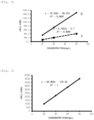
- Figure 4 shows the relationship between the peak area and the concentration of the pyrroloquinoline quinone disodium salt in the analysis sample with the axis of ordinates showing the peak area based on the chromatogram obtained by absorption at a wavelength of 259 nm and the axis of abscissas showing the concentration of the pyrroloquinoline quinone disodium salt used in the preparation of the analysis sample.
- Figure 4 similarly shows the relationship between the peak area and the concentration of the pyrroloquinoline quinone disodium salt in the analysis sample in the chromatogram obtained by absorption at a wavelength of 320 nm.
- the straight line A is a straight line showing the relationship between the peak area based on the chromatogram obtained by absorption at a wavelength of 259 nm and the concentration of the pyrroloquinoline quinone disodium salt in the analysis sample.
- the straight line B is a straight line showing the relationship between the peak area based on the chromatogram obtained by absorption at a wavelength of 320 nm and the concentration of the pyrroloquinoline quinone disodium salt in the analysis sample.
- the peak area of the reduced pyrroloquinoline quinone disodium salt which appeared at an elution time of 9.7 was calculated based on the obtained chromatogram as to each of four analysis samples. In this case, the peak area of the reduced pyrroloquinoline quinone disodium salt which appeared at an elution time of 9.7 was calculated with the chromatogram obtained by absorption at a wavelength of 320 nm.
- Figure 5 shows the relationship between the peak area and the concentration of the pyrroloquinoline quinone disodium salt in the analysis sample with the axis of ordinates showing the peak area based on the chromatogram obtained by absorption at a wavelength of 320 nm and the axis of abscissas showing the concentration of the pyrroloquinoline quinone disodium salt used in the preparation of the analysis sample.
- the straight line is a straight line showing the relationship between the peak area based on the chromatogram obtained by absorption at a wavelength of 320 nm and the concentration of the pyrroloquinoline quinone disodium salt in the analysis sample.
- Figure 6 shows the consequently obtained chromatogram.
- the concentration of the pyrroloquinoline quinone contained in the analysis sample was calculated at 21.8 mg/L.
- concentration of pyrroloquinoline quinone contained in the analysis sample was calculated from the peak area using the calibration curve produced in Quantitative Test 2, the concentration was estimated at 21.6 mg/L.
- the ratio of the concentration of pyrroloquinoline quinone calculated by the calibration curve to the concentration of pyrroloquinoline quinone actually contained in the analysis sample (recovery rate) was 99%. This analysis result showed that a result excellent in quantitativeness was obtained.
- aqueous pyrroloquinoline quinone disodium salt solution 40 mg/L
- an aqueous solution containing 2% by mass ascorbic acid and 2% by mass ⁇ -cyclodextrin were mixed at 1:1 as pretreatment to prepare an analysis sample. Analysis operation was performed under the above-mentioned HPLC analysis conditions within 60 minutes after the preparation of the analysis sample.
- Figure 8 shows the chromatogram of the aqueous PQQ solution (40 mg/L) before pretreatment. The peak of PQQ was detected at 6.4 minutes.
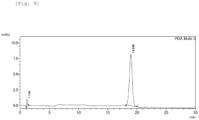
- Figure 9 shows the result of the pretreated aqueous PQQ solution. Ascorbic acid in the pretreatment liquid exhibited a peak at 1.2 minutes, and the peak of reduced PQQ (20 mg/L) was detected at 18.9 minutes.
Landscapes
- Chemical & Material Sciences (AREA)
- Health & Medical Sciences (AREA)
- Life Sciences & Earth Sciences (AREA)
- Immunology (AREA)
- Analytical Chemistry (AREA)
- Biochemistry (AREA)
- General Health & Medical Sciences (AREA)
- General Physics & Mathematics (AREA)
- Physics & Mathematics (AREA)
- Pathology (AREA)
- Nutrition Science (AREA)
- Engineering & Computer Science (AREA)
- Food Science & Technology (AREA)
- Polymers & Plastics (AREA)
- Nitrogen Condensed Heterocyclic Rings (AREA)
- Investigating Or Analysing Biological Materials (AREA)
Claims (3)
- Procédé d'analyse chromatographique liquide à haute performance, comprenant :une étape de préparation d'échantillon consistant à préparer un échantillon pour chromatographie liquide à haute performance comprenant de la pyrroloquinoline quinone réduite ou un sel de celle-ci provenant d'une éprouvette ; etune étape de séparation consistant à séparer la pyrroloquinoline quinone réduite ou un sel de celle-ci compris dans l'échantillon pour chromatographie liquide à haute performance de l'éprouvette en utilisant une interaction entre une phase stationnaire et une phase mobile par un procédé de chromatographie liquide à haute performance utilisant une colonne à phase inversée en tant que phase stationnaire et utilisant un éluant comprenant 0,050 à 1,5 % en masse d'acide phosphorique et/ou d'acide chlorhydrique et 20 à 50 % en volume de méthanol et/ou d'acétonitrile en tant que phase mobile ;dans lequel lorsque l'échantillon pour chromatographie liquide à haute performance comprend en outre de la pyrroloquinoline quinone oxydée,dans l'étape de séparation, la pyrroloquinoline quinone réduite et la pyrroloquinoline quinone oxydée comprises l'échantillon pour chromatographie liquide à haute performance sont séparées.
- Procédé d'analyse chromatographique liquide à haute performance selon la revendication 1,
dans lequel le pH de l'éluant est de 2,8 ou moins. - Procédé d'analyse chromatographique liquide à haute performance selon la revendication 1 ou 2,
dans lequel l'éprouvette est une boisson.
Applications Claiming Priority (2)
| Application Number | Priority Date | Filing Date | Title |
|---|---|---|---|
| JP2019053588 | 2019-03-20 | ||
| PCT/JP2020/012247 WO2020189753A1 (fr) | 2019-03-20 | 2020-03-19 | Procédé d'analyse de pyrroloquinoline quinone |
Publications (4)
| Publication Number | Publication Date |
|---|---|
| EP4012403A1 EP4012403A1 (fr) | 2022-06-15 |
| EP4012403A4 EP4012403A4 (fr) | 2022-10-26 |
| EP4012403B1 true EP4012403B1 (fr) | 2024-12-18 |
| EP4012403C0 EP4012403C0 (fr) | 2024-12-18 |
Family
ID=72520234
Family Applications (1)
| Application Number | Title | Priority Date | Filing Date |
|---|---|---|---|
| EP20773943.4A Active EP4012403B1 (fr) | 2019-03-20 | 2020-03-19 | Procédé d'analyse de pyrroloquinoline quinone |
Country Status (4)
| Country | Link |
|---|---|
| US (1) | US12566159B2 (fr) |
| EP (1) | EP4012403B1 (fr) |
| JP (1) | JP7450860B2 (fr) |
| WO (1) | WO2020189753A1 (fr) |
Families Citing this family (2)
| Publication number | Priority date | Publication date | Assignee | Title |
|---|---|---|---|---|
| CN112500407B (zh) * | 2020-12-25 | 2022-03-11 | 西安蓝晓科技新材料股份有限公司 | 一种吡咯并喹啉醌二钠盐的纯化方法 |
| CN117471005B (zh) * | 2023-10-26 | 2024-04-16 | 山东省食品药品检验研究院 | 一种乳饮料中吡咯喹啉醌二钠盐的检测方法 |
Family Cites Families (7)
| Publication number | Priority date | Publication date | Assignee | Title |
|---|---|---|---|---|
| US9163014B2 (en) | 2009-07-16 | 2015-10-20 | Mitsubishi Gas Chemical Company, Inc. | Crystals of pyrroloquinolinequinone sodium salts |
| EP2537848B1 (fr) * | 2010-02-16 | 2015-04-08 | Mitsubishi Gas Chemical Company, Inc. | Procédé de production de pyrroloquinoléine quinone réduite |
| JP5979376B2 (ja) * | 2010-11-26 | 2016-08-24 | 三菱瓦斯化学株式会社 | 溶解性の高いピロロキノリンキノン塩及びその製造方法 |
| JP6609261B2 (ja) * | 2014-09-22 | 2019-11-20 | 国立大学法人名古屋大学 | 新規な寿命延長剤、該寿命延長剤を用いた寿命延長方法、新規なデュアルオキシダーゼ活性化剤、デュアルオキシダーゼの活性化方法、寿命延長剤の製造、及びデュアルオキシダーゼ活性化剤の製造 |
| CN105334301B (zh) * | 2015-11-27 | 2017-03-22 | 潍坊盛瑜药业有限公司 | 一种吡咯并喹啉醌pqq二钠盐杂质的分离纯化方法 |
| JP6760753B2 (ja) * | 2016-04-01 | 2020-09-23 | 株式会社Lsiメディエンス | ピロロキノリンキノンの分析方法 |
| EP3739334B1 (fr) * | 2018-01-12 | 2022-07-27 | Mitsubishi Gas Chemical Company, Inc. | Procede d'analyse quantitative de pyrroloquinoline quinone ou d'un sel de celle-ci |
-
2020
- 2020-03-19 EP EP20773943.4A patent/EP4012403B1/fr active Active
- 2020-03-19 WO PCT/JP2020/012247 patent/WO2020189753A1/fr not_active Ceased
- 2020-03-19 US US17/440,048 patent/US12566159B2/en active Active
- 2020-03-19 JP JP2021507414A patent/JP7450860B2/ja active Active
Also Published As
| Publication number | Publication date |
|---|---|
| JPWO2020189753A1 (fr) | 2020-09-24 |
| EP4012403C0 (fr) | 2024-12-18 |
| EP4012403A1 (fr) | 2022-06-15 |
| WO2020189753A1 (fr) | 2020-09-24 |
| US20220146465A1 (en) | 2022-05-12 |
| JP7450860B2 (ja) | 2024-03-18 |
| EP4012403A4 (fr) | 2022-10-26 |
| US12566159B2 (en) | 2026-03-03 |
Similar Documents
| Publication | Publication Date | Title |
|---|---|---|
| EP3739334B1 (fr) | Procede d'analyse quantitative de pyrroloquinoline quinone ou d'un sel de celle-ci | |
| Pellati et al. | Chromatographic and electrophoretic methods for the analysis of phenetylamine alkaloids in Citrus aurantium | |
| Vidović et al. | Simultaneous determination of some water-soluble vitamins and preservatives in multivitamin syrup by validated stability-indicating high-performance liquid chromatography method | |
| Wabaidur et al. | A rapid method for the simultaneous determination of l-ascorbic acid and acetylsalicylic acid in aspirin C effervescent tablet by ultra performance liquid chromatography–tandem mass spectrometry | |
| Chen et al. | Measurement of caffeine and its three primary metabolites in human plasma by HPLC‐ESI‐MS/MS and clinical application | |
| JP4659407B2 (ja) | オリゴメリックプロアントシアニジン(opc)の分析方法 | |
| Li et al. | Non-linear pharmacokinetics of piperine and its herb-drug interactions with docetaxel in Sprague-Dawley rats | |
| Maher et al. | UPLC–ESI–MS/MS study of the effect of green tea extract on the oral bioavailability of erlotinib and lapatinib in rats: Potential risk of pharmacokinetic interaction | |
| Al-Shehri et al. | Development and validation of an UHPLC-MS/MS method for simultaneous determination of palbociclib, letrozole and its metabolite carbinol in rat plasma and pharmacokinetic study application | |
| Herrera-Herrera et al. | Determination of quinolone residues in infant and young children powdered milk combining solid-phase extraction and ultra-performance liquid chromatography–tandem mass spectrometry | |
| Sparidans et al. | Liquid chromatography-tandem mass spectrometric assay for the light sensitive tyrosine kinase inhibitor axitinib in human plasma | |
| EP4012403A1 (fr) | Procédé d'analyse de pyrroloquinoline quinone | |
| Kobayashi et al. | Enantiomeric determination of α-lipoic acid in urine by LC/MS/MS | |
| Sintara et al. | Quantification of cranberry proanthocyanidins by normal‐phase high‐performance liquid chromatography using relative response factors | |
| JP2017187321A (ja) | ピロロキノリンキノンの分析方法 | |
| Lang et al. | Raw coffee based dietary supplements contain carboxyatractyligenin derivatives inhibiting mitochondrial adenine-nucleotide-translocase | |
| Li et al. | Analysis of CoQ10 in rat serum by ultra-performance liquid chromatography mass spectrometry after oral administration | |
| Ferrari et al. | High precision and selectivity for quantitation of enrofloxacin and ciprofloxacin in five chicken tissues using solid phase extraction and ESI LC-MS/MS for application in monitoring residues | |
| Xu et al. | Methenamine in dairy products by isotope dilution gas chromatography coupled with triple quadrupole mass spectrometry: Method validation and occurrence | |
| EP4053549A1 (fr) | Procédé de détermination de la structure d'une substance dans un échantillon multicomposant | |
| JP2018146313A (ja) | ナルフラフィン塩酸塩含有軟カプセル剤の溶出試験方法 | |
| Liu et al. | Isotopic internal standard correction for the determination of diludine residue in animal-derived matrix samples using enhanced matrix removal-lipid clean-up combined with ultra-performance liquid chromatography-tandem mass spectrometry | |
| Rakuša et al. | Quantification of reduced and oxidized coenzyme Q10 in supplements and medicines by HPLC-UV | |
| Canavesi et al. | Development and validation of a stability-indicating LC–UV method for the determination of pantethine and its degradation product based on a forced degradation study | |
| CN114062555A (zh) | 一种膳食补充剂类产品中nmn含量的测定方法 |
Legal Events
| Date | Code | Title | Description |
|---|---|---|---|
| STAA | Information on the status of an ep patent application or granted ep patent |
Free format text: STATUS: THE INTERNATIONAL PUBLICATION HAS BEEN MADE |
|
| PUAI | Public reference made under article 153(3) epc to a published international application that has entered the european phase |
Free format text: ORIGINAL CODE: 0009012 |
|
| STAA | Information on the status of an ep patent application or granted ep patent |
Free format text: STATUS: REQUEST FOR EXAMINATION WAS MADE |
|
| 17P | Request for examination filed |
Effective date: 20210909 |
|
| AK | Designated contracting states |
Kind code of ref document: A1 Designated state(s): AL AT BE BG CH CY CZ DE DK EE ES FI FR GB GR HR HU IE IS IT LI LT LU LV MC MK MT NL NO PL PT RO RS SE SI SK SM TR |
|
| DAV | Request for validation of the european patent (deleted) | ||
| DAX | Request for extension of the european patent (deleted) | ||
| A4 | Supplementary search report drawn up and despatched |
Effective date: 20220928 |
|
| RIC1 | Information provided on ipc code assigned before grant |
Ipc: G01N 30/88 20060101ALI20220922BHEP Ipc: G01N 30/26 20060101ALI20220922BHEP Ipc: G01N 30/06 20060101AFI20220922BHEP |
|
| GRAP | Despatch of communication of intention to grant a patent |
Free format text: ORIGINAL CODE: EPIDOSNIGR1 |
|
| STAA | Information on the status of an ep patent application or granted ep patent |
Free format text: STATUS: GRANT OF PATENT IS INTENDED |
|
| INTG | Intention to grant announced |
Effective date: 20240823 |
|
| GRAS | Grant fee paid |
Free format text: ORIGINAL CODE: EPIDOSNIGR3 |
|
| GRAA | (expected) grant |
Free format text: ORIGINAL CODE: 0009210 |
|
| STAA | Information on the status of an ep patent application or granted ep patent |
Free format text: STATUS: THE PATENT HAS BEEN GRANTED |
|
| AK | Designated contracting states |
Kind code of ref document: B1 Designated state(s): AL AT BE BG CH CY CZ DE DK EE ES FI FR GB GR HR HU IE IS IT LI LT LU LV MC MK MT NL NO PL PT RO RS SE SI SK SM TR |
|
| REG | Reference to a national code |
Ref country code: CH Ref legal event code: EP |
|
| REG | Reference to a national code |
Ref country code: DE Ref legal event code: R096 Ref document number: 602020043398 Country of ref document: DE |
|
| REG | Reference to a national code |
Ref country code: IE Ref legal event code: FG4D |
|
| U01 | Request for unitary effect filed |
Effective date: 20241219 |
|
| U07 | Unitary effect registered |
Designated state(s): AT BE BG DE DK EE FI FR IT LT LU LV MT NL PT RO SE SI Effective date: 20250110 |
|
| U20 | Renewal fee for the european patent with unitary effect paid |
Year of fee payment: 6 Effective date: 20250205 |
|
| PG25 | Lapsed in a contracting state [announced via postgrant information from national office to epo] |
Ref country code: HR Free format text: LAPSE BECAUSE OF FAILURE TO SUBMIT A TRANSLATION OF THE DESCRIPTION OR TO PAY THE FEE WITHIN THE PRESCRIBED TIME-LIMIT Effective date: 20241218 |
|
| PG25 | Lapsed in a contracting state [announced via postgrant information from national office to epo] |
Ref country code: NO Free format text: LAPSE BECAUSE OF FAILURE TO SUBMIT A TRANSLATION OF THE DESCRIPTION OR TO PAY THE FEE WITHIN THE PRESCRIBED TIME-LIMIT Effective date: 20250318 |
|
| PG25 | Lapsed in a contracting state [announced via postgrant information from national office to epo] |
Ref country code: GR Free format text: LAPSE BECAUSE OF FAILURE TO SUBMIT A TRANSLATION OF THE DESCRIPTION OR TO PAY THE FEE WITHIN THE PRESCRIBED TIME-LIMIT Effective date: 20250319 |
|
| PG25 | Lapsed in a contracting state [announced via postgrant information from national office to epo] |
Ref country code: RS Free format text: LAPSE BECAUSE OF FAILURE TO SUBMIT A TRANSLATION OF THE DESCRIPTION OR TO PAY THE FEE WITHIN THE PRESCRIBED TIME-LIMIT Effective date: 20250318 |
|
| PG25 | Lapsed in a contracting state [announced via postgrant information from national office to epo] |
Ref country code: SM Free format text: LAPSE BECAUSE OF FAILURE TO SUBMIT A TRANSLATION OF THE DESCRIPTION OR TO PAY THE FEE WITHIN THE PRESCRIBED TIME-LIMIT Effective date: 20241218 |
|
| PG25 | Lapsed in a contracting state [announced via postgrant information from national office to epo] |
Ref country code: PL Free format text: LAPSE BECAUSE OF FAILURE TO SUBMIT A TRANSLATION OF THE DESCRIPTION OR TO PAY THE FEE WITHIN THE PRESCRIBED TIME-LIMIT Effective date: 20241218 |
|
| PG25 | Lapsed in a contracting state [announced via postgrant information from national office to epo] |
Ref country code: ES Free format text: LAPSE BECAUSE OF FAILURE TO SUBMIT A TRANSLATION OF THE DESCRIPTION OR TO PAY THE FEE WITHIN THE PRESCRIBED TIME-LIMIT Effective date: 20241218 |
|
| PG25 | Lapsed in a contracting state [announced via postgrant information from national office to epo] |
Ref country code: IS Free format text: LAPSE BECAUSE OF FAILURE TO SUBMIT A TRANSLATION OF THE DESCRIPTION OR TO PAY THE FEE WITHIN THE PRESCRIBED TIME-LIMIT Effective date: 20250418 |
|
| PG25 | Lapsed in a contracting state [announced via postgrant information from national office to epo] |
Ref country code: SK Free format text: LAPSE BECAUSE OF FAILURE TO SUBMIT A TRANSLATION OF THE DESCRIPTION OR TO PAY THE FEE WITHIN THE PRESCRIBED TIME-LIMIT Effective date: 20241218 |
|
| PG25 | Lapsed in a contracting state [announced via postgrant information from national office to epo] |
Ref country code: CZ Free format text: LAPSE BECAUSE OF FAILURE TO SUBMIT A TRANSLATION OF THE DESCRIPTION OR TO PAY THE FEE WITHIN THE PRESCRIBED TIME-LIMIT Effective date: 20241218 |
|
| PG25 | Lapsed in a contracting state [announced via postgrant information from national office to epo] |
Ref country code: MC Free format text: LAPSE BECAUSE OF FAILURE TO SUBMIT A TRANSLATION OF THE DESCRIPTION OR TO PAY THE FEE WITHIN THE PRESCRIBED TIME-LIMIT Effective date: 20241218 |
|
| REG | Reference to a national code |
Ref country code: CH Ref legal event code: H13 Free format text: ST27 STATUS EVENT CODE: U-0-0-H10-H13 (AS PROVIDED BY THE NATIONAL OFFICE) Effective date: 20251023 |
|
| PLBE | No opposition filed within time limit |
Free format text: ORIGINAL CODE: 0009261 |
|
| STAA | Information on the status of an ep patent application or granted ep patent |
Free format text: STATUS: NO OPPOSITION FILED WITHIN TIME LIMIT |
|
| 26N | No opposition filed |
Effective date: 20250919 |
|
| GBPC | Gb: european patent ceased through non-payment of renewal fee |
Effective date: 20250319 |
|
| PG25 | Lapsed in a contracting state [announced via postgrant information from national office to epo] |
Ref country code: GB Free format text: LAPSE BECAUSE OF NON-PAYMENT OF DUE FEES Effective date: 20250319 |
|
| PG25 | Lapsed in a contracting state [announced via postgrant information from national office to epo] |
Ref country code: CH Free format text: LAPSE BECAUSE OF NON-PAYMENT OF DUE FEES Effective date: 20250331 |
|
| PG25 | Lapsed in a contracting state [announced via postgrant information from national office to epo] |
Ref country code: IE Free format text: LAPSE BECAUSE OF NON-PAYMENT OF DUE FEES Effective date: 20250319 |
|
| U20 | Renewal fee for the european patent with unitary effect paid |
Year of fee payment: 7 Effective date: 20260209 |