EP4014776A1 - Procédé de production d'une série de pantalons - Google Patents
Procédé de production d'une série de pantalons Download PDFInfo
- Publication number
- EP4014776A1 EP4014776A1 EP20215865.5A EP20215865A EP4014776A1 EP 4014776 A1 EP4014776 A1 EP 4014776A1 EP 20215865 A EP20215865 A EP 20215865A EP 4014776 A1 EP4014776 A1 EP 4014776A1
- Authority
- EP
- European Patent Office
- Prior art keywords
- sizes
- trousers
- size
- fabric
- standard
- Prior art date
- Legal status (The legal status is an assumption and is not a legal conclusion. Google has not performed a legal analysis and makes no representation as to the accuracy of the status listed.)
- Withdrawn
Links
Images




Classifications
-
- A—HUMAN NECESSITIES
- A41—WEARING APPAREL
- A41H—APPLIANCES OR METHODS FOR MAKING CLOTHES, e.g. FOR DRESS-MAKING OR FOR TAILORING, NOT OTHERWISE PROVIDED FOR
- A41H3/00—Patterns for cutting-out; Methods of drafting or marking-out such patterns, e.g. on the cloth
-
- A—HUMAN NECESSITIES
- A41—WEARING APPAREL
- A41D—OUTERWEAR; PROTECTIVE GARMENTS; ACCESSORIES
- A41D1/00—Garments
- A41D1/06—Trousers
-
- A—HUMAN NECESSITIES
- A41—WEARING APPAREL
- A41D—OUTERWEAR; PROTECTIVE GARMENTS; ACCESSORIES
- A41D31/00—Materials specially adapted for outerwear
- A41D31/04—Materials specially adapted for outerwear characterised by special function or use
- A41D31/18—Elastic
Definitions
- the present invention relates to a method for producing a series of trousers.
- the method according to the invention reduces waste related to textile production.
- a person who has acquired a garment may change size in such a manner that the garment no longer fits, before the garment is worn out. This could, e.g., be the case in case of weight loss or weight gain, or due to children growing. In such cases the garment will most likely also be discarded, and thereby destroyed, even though the garment is not worn out.
- the invention provides a method for producing a series of trousers, the method comprising the steps of:
- the invention provides a method for producing a series of trousers.
- the term 'series of trousers' should be interpreted to mean a style or design, in the form of a pair of trousers, which is produced in a number of different sizes.
- a fabric is initially provided.
- the fabric has a fabric stretch of at least 85, as measured in accordance with Active Standard ASTM D3107.
- Active Standard ASTM D3107 This is a standard test which is used for determining the stretch, growth and recovery properties that garments made with the tested fabric may be expected to exhibit during use.
- the test is particularly suitable for fabrics woven in whole or in part from stretch yarns, and which exhibit high stretch and good recovery properties from low tension. Further information regarding the Active Standard ASTM D3107 can be found at: https://www.astm.org/Standards/D3107.htm.
- the provided fabric has a high fabric stretch, and may advantageously be a fabric which is woven in whole or in part from stretch yarns.
- the fabric is cut in accordance with the patterns, thereby obtaining a plurality of trouser cuttings, and trousers in various sizes are manufactured from the trouser cuttings, thereby producing the series of trousers.
- the series of trousers manufactured in this manner covers a high number of standard sizes with a number of sizes which is at most 1/3 of the number of standard sizes covered. This is partly possible due to the high fabric stretch of the applied fabric, which allows the trousers to stretch and recover, thereby matching several sizes.
- each of the sizes covers at least three standard sizes, the surplus of produced items required in order to meet customer demands can be reduced, because a given size will meet the demand of customers which would normally require at least three different sizes.
- the very small and very large normal sizes are covered by sizes which also cover more intermediate sizes, which are in higher demand. This significantly reduces the need for destroying unsold items, thereby reducing waste of textile products and improving sustainability.
- the trousers will most likely still fit, because the size covers at least three standard sizes. This increases the likelihood that the owner will wear and use the trousers until they are worn out, rather than discarding them because they no longer fit. This also significantly reduces waste of textile products and improves sustainability.
- the method according to the invention is particularly relevant with respect to garments for children and maternity clothes, but it is also relevant for ordinary garments for adults.
- the fabric may have a fabric stretch, as measured in accordance with Active Standard ASTM D3107, within the interval 85 to 95, such as within the interval 87 to 93, such as within the interval 90 to 92, such as approximately 91.
- the fabric stretch may be approximately 91.2 ⁇ 4%.
- the step of providing patterns for a plurality of sizes may comprise providing patterns for at most six adult sizes.
- a high number of standard adult sizes are covered by at most six adult sizes of the kind provided by the invention.
- the patterns define six adult sizes, and each of these adult sizes covers at least three standard sizes, then at least eighteen standard sizes will be covered by only six sizes. This significantly reduces the waste of textile products.
- the step of providing patterns for a plurality of sizes of trousers may comprise providing patterns, where each size covers at least three European standard sizes.
- the standard sizes covered by the inventive sizes are European standard sizes, such as European standard adult sizes.
- the standard sizes could be US standard sizes, UK standard sizes, standard children sizes, or any other suitable kind of standard sizes.
- the plurality of sizes may in combination cover sizes of at least European standard size 34 to European standard size 56.
- a size I may cover European standard sizes 34, 36 and 38.
- a size II may cover European standard sizes 40, 42 and 44.
- a size III may cover European standard sizes 46, 48 and 50.
- a size IIII may cover European standard sizes 52, 54 and 56.
- European standard size 56 is covered by a size, i.e. size IIII, which also covers sizes 52 and 54. Accordingly, a supply of 'size 56' can also be offered without risking that a high number of trousers needs to be destroyed.
- the fabric may be a denim fabric.
- Denim fabric is known to be durable, and it is therefore suitable for producing trousers.
- the fabric may be of any other suitable kind which meets the requirements with regard to fabric stretch.
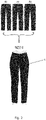
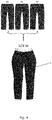
- Figs. 1-4 illustrate four sizes of a series of trousers 1 manufactured in accordance with a method according to an embodiment of the invention.
- Fig. 1 illustrates size I
- Fig. 2 illustrates size II
- Fig. 3 illustrates size III
- Fig. 4 illustrates size IIII. It can be seen from Figs. 1-4 that each of the sizes I-IIII covers three European standard sizes.
- size I covers European standard sizes 34, 36 and 38
- size II covers European standard sizes 40, 42 and 44
- size III covers European standard sizes 46, 48 and 50
- size IIII covers European standard sizes 52, 54 and 56.
- Figs. 5-8 illustrate patterns 2 for four sizes of a series of trousers manufactured in accordance with a method according to an embodiment of the invention.
- the patterns 2 illustrated in Figs. 5-8 could, e.g., be applied for manufacturing the trousers 1 illustrated in Figs. 1-4 .
- Fig. 5 illustrates a pattern 2 for a size I which covers European standard sizes 34, 36 and 38.
- the solid line 3 represents the inventive size I pattern.
- Dashed line 4 represents European standard size 34 for a similar prior art style.
- dotted line 5 represents European standard size 36 for the prior art style
- dashed line 6 represents European standard size 38 for the prior art style.
- the inventive trousers can stretch in such a manner that the three shown European standard sizes 4, 5, 6 are covered by the inventive pattern 3.
- Figs. 6-8 illustrate similar patterns 2 for sizes II, III and IIII according to the invention.
- the solid line 7 represents the inventive size II pattern, which covers European standard sizes 40, 42 and 44 for a similar prior art style.
- Dashed line 8 represents European standard size 40 for the similar prior art style
- dotted line 9 represents European standard size 42 for the prior art style
- dashed-dotted line 10 represents European standard size 44 for the prior art style.
- the solid line 11 represents the inventive size III pattern, which covers European standard sizes 46, 48 and 50 for a similar prior art style.
- Dashed-dotted line 12 represents European standard size 46 for the similar prior art style
- dotted line 13 represents European standard size 48 for the prior art style
- dashed-dotted line 14 represents European standard size 50 for the prior art style.
- the solid line 15 represents the inventive size IIII pattern, which covers European standard sizes 52, 54 and 56 for a similar prior art style.
- Dotted line 16 represents European standard size 52 for the similar prior art style
- dashed line 17 represents European standard size 54 for the prior art style
- dashed line 18 represents European standard size 56 for the prior art style.
Landscapes
- Engineering & Computer Science (AREA)
- Textile Engineering (AREA)
- Details Of Garments (AREA)
Priority Applications (1)
| Application Number | Priority Date | Filing Date | Title |
|---|---|---|---|
| EP20215865.5A EP4014776A1 (fr) | 2020-12-21 | 2020-12-21 | Procédé de production d'une série de pantalons |
Applications Claiming Priority (1)
| Application Number | Priority Date | Filing Date | Title |
|---|---|---|---|
| EP20215865.5A EP4014776A1 (fr) | 2020-12-21 | 2020-12-21 | Procédé de production d'une série de pantalons |
Publications (1)
| Publication Number | Publication Date |
|---|---|
| EP4014776A1 true EP4014776A1 (fr) | 2022-06-22 |
Family
ID=73856047
Family Applications (1)
| Application Number | Title | Priority Date | Filing Date |
|---|---|---|---|
| EP20215865.5A Withdrawn EP4014776A1 (fr) | 2020-12-21 | 2020-12-21 | Procédé de production d'une série de pantalons |
Country Status (1)
| Country | Link |
|---|---|
| EP (1) | EP4014776A1 (fr) |
Citations (3)
| Publication number | Priority date | Publication date | Assignee | Title |
|---|---|---|---|---|
| US4995514A (en) * | 1986-08-19 | 1991-02-26 | Horst Forschner | Method and measurement system for the production of garment kits |
| EP3009020A1 (fr) * | 2014-10-17 | 2016-04-20 | COFEMEL - Sociedade de Vestuário S.A. | Article d'habillement et son procédé de production |
| WO2020136280A1 (fr) * | 2018-12-28 | 2020-07-02 | Sanko Tekstil Isletmeleri San. Ve Tic. A.S. | Vêtements extensibles et leur procédé de fabrication |
-
2020
- 2020-12-21 EP EP20215865.5A patent/EP4014776A1/fr not_active Withdrawn
Patent Citations (3)
| Publication number | Priority date | Publication date | Assignee | Title |
|---|---|---|---|---|
| US4995514A (en) * | 1986-08-19 | 1991-02-26 | Horst Forschner | Method and measurement system for the production of garment kits |
| EP3009020A1 (fr) * | 2014-10-17 | 2016-04-20 | COFEMEL - Sociedade de Vestuário S.A. | Article d'habillement et son procédé de production |
| WO2020136280A1 (fr) * | 2018-12-28 | 2020-07-02 | Sanko Tekstil Isletmeleri San. Ve Tic. A.S. | Vêtements extensibles et leur procédé de fabrication |
Similar Documents
| Publication | Publication Date | Title |
|---|---|---|
| FI112588B (fi) | Mittatilaus- ja valmistusjärjestelmässä käytettävä sovitusvaate sekä laite mittatilauskaavojen aikaansaamiseksi sovitusvaatteita hyväksikäyttäen mittatilausvaatteen valmistamista varten | |
| EP2338363A1 (fr) | Bande antidérapante et produit textile | |
| US12252818B2 (en) | Woven fabric, method for producing same, and fiber product containing said woven fabric | |
| US6071578A (en) | Tubular fabric and method of making the same | |
| EP3330419A1 (fr) | Tissu tricoté circulaire brossé | |
| CN106757656A (zh) | 如针织物那样的机织物及其制造方法 | |
| EP4014776A1 (fr) | Procédé de production d'une série de pantalons | |
| US20130086726A1 (en) | Clothing components and articles of clothing including fabric woven with a multi-layered region and a single-layered region, and methods of making such woven fabrics | |
| US20020166348A1 (en) | Warp knit having an excellent touch, and a process of preparing the same | |
| WO2016013995A1 (fr) | Tissu denim à surteinture plat | |
| CN104736751A (zh) | 具有单厚度保持边缘的坯件与管状针织制品及制造该制品的方法 | |
| JP7079110B2 (ja) | シングル丸編地 | |
| CN108425172A (zh) | 一种高密度织物 | |
| Tsai et al. | The influence of woven stretch fabric properties on garment design and pattern construction | |
| CN212247362U (zh) | 袜子 | |
| EP2740372B1 (fr) | Procédé de fabrication d'un complet | |
| JP2020186481A (ja) | 織物を備える物品、織物、織物の製造方法及び衣服の製造方法 | |
| Davis | Hosiery manufacture | |
| KR101905047B1 (ko) | 경편에 적합한 천연복합 사이로-컴팩트 방적사, 이의 제조방법 및 이를 이용한 경편물 | |
| US6698252B1 (en) | Snag-resistant matte-effect warp-knitted textile fabric for activewear apparel | |
| JP2009144254A (ja) | 織物および織物裏地 | |
| WO2002024995A1 (fr) | Tricot a maille jetee ayant un excellent toucher et procede de production de ce dernier | |
| Manonmani et al. | Suitability of compact yarn for manufacturing of eco-friendly processed weft knitted fabrics | |
| JP2002242046A (ja) | 透過性伸縮織物 | |
| JP2025132063A (ja) | 人工皮革およびその製造方法ならびに衣料、雑貨 |
Legal Events
| Date | Code | Title | Description |
|---|---|---|---|
| PUAI | Public reference made under article 153(3) epc to a published international application that has entered the european phase |
Free format text: ORIGINAL CODE: 0009012 |
|
| STAA | Information on the status of an ep patent application or granted ep patent |
Free format text: STATUS: THE APPLICATION HAS BEEN PUBLISHED |
|
| AK | Designated contracting states |
Kind code of ref document: A1 Designated state(s): AL AT BE BG CH CY CZ DE DK EE ES FI FR GB GR HR HU IE IS IT LI LT LU LV MC MK MT NL NO PL PT RO RS SE SI SK SM TR |
|
| STAA | Information on the status of an ep patent application or granted ep patent |
Free format text: STATUS: THE APPLICATION IS DEEMED TO BE WITHDRAWN |
|
| 18D | Application deemed to be withdrawn |
Effective date: 20221223 |