EP4015594B1 - Ruban adhésif - Google Patents
Ruban adhésif Download PDFInfo
- Publication number
- EP4015594B1 EP4015594B1 EP20852539.4A EP20852539A EP4015594B1 EP 4015594 B1 EP4015594 B1 EP 4015594B1 EP 20852539 A EP20852539 A EP 20852539A EP 4015594 B1 EP4015594 B1 EP 4015594B1
- Authority
- EP
- European Patent Office
- Prior art keywords
- adhesive tape
- mass
- temperature
- glass transition
- parts
- Prior art date
- Legal status (The legal status is an assumption and is not a legal conclusion. Google has not performed a legal analysis and makes no representation as to the accuracy of the status listed.)
- Active
Links
Images
Classifications
-
- C—CHEMISTRY; METALLURGY
- C09—DYES; PAINTS; POLISHES; NATURAL RESINS; ADHESIVES; COMPOSITIONS NOT OTHERWISE PROVIDED FOR; APPLICATIONS OF MATERIALS NOT OTHERWISE PROVIDED FOR
- C09J—ADHESIVES; NON-MECHANICAL ASPECTS OF ADHESIVE PROCESSES IN GENERAL; ADHESIVE PROCESSES NOT PROVIDED FOR ELSEWHERE; USE OF MATERIALS AS ADHESIVES
- C09J7/00—Adhesives in the form of films or foils
- C09J7/20—Adhesives in the form of films or foils characterised by their carriers
- C09J7/22—Plastics; Metallised plastics
- C09J7/24—Plastics; Metallised plastics based on macromolecular compounds obtained by reactions involving only carbon-to-carbon unsaturated bonds
- C09J7/245—Vinyl resins, e.g. polyvinyl chloride [PVC]
-
- C—CHEMISTRY; METALLURGY
- C09—DYES; PAINTS; POLISHES; NATURAL RESINS; ADHESIVES; COMPOSITIONS NOT OTHERWISE PROVIDED FOR; APPLICATIONS OF MATERIALS NOT OTHERWISE PROVIDED FOR
- C09J—ADHESIVES; NON-MECHANICAL ASPECTS OF ADHESIVE PROCESSES IN GENERAL; ADHESIVE PROCESSES NOT PROVIDED FOR ELSEWHERE; USE OF MATERIALS AS ADHESIVES
- C09J7/00—Adhesives in the form of films or foils
- C09J7/20—Adhesives in the form of films or foils characterised by their carriers
- C09J7/21—Paper; Textile fabrics
-
- C—CHEMISTRY; METALLURGY
- C09—DYES; PAINTS; POLISHES; NATURAL RESINS; ADHESIVES; COMPOSITIONS NOT OTHERWISE PROVIDED FOR; APPLICATIONS OF MATERIALS NOT OTHERWISE PROVIDED FOR
- C09J—ADHESIVES; NON-MECHANICAL ASPECTS OF ADHESIVE PROCESSES IN GENERAL; ADHESIVE PROCESSES NOT PROVIDED FOR ELSEWHERE; USE OF MATERIALS AS ADHESIVES
- C09J109/00—Adhesives based on homopolymers or copolymers of conjugated diene hydrocarbons
- C09J109/02—Copolymers with acrylonitrile
-
- C—CHEMISTRY; METALLURGY
- C08—ORGANIC MACROMOLECULAR COMPOUNDS; THEIR PREPARATION OR CHEMICAL WORKING-UP; COMPOSITIONS BASED THEREON
- C08J—WORKING-UP; GENERAL PROCESSES OF COMPOUNDING; AFTER-TREATMENT NOT COVERED BY SUBCLASSES C08B, C08C, C08F, C08G or C08H
- C08J5/00—Manufacture of articles or shaped materials containing macromolecular substances
- C08J5/18—Manufacture of films or sheets
-
- C—CHEMISTRY; METALLURGY
- C09—DYES; PAINTS; POLISHES; NATURAL RESINS; ADHESIVES; COMPOSITIONS NOT OTHERWISE PROVIDED FOR; APPLICATIONS OF MATERIALS NOT OTHERWISE PROVIDED FOR
- C09J—ADHESIVES; NON-MECHANICAL ASPECTS OF ADHESIVE PROCESSES IN GENERAL; ADHESIVE PROCESSES NOT PROVIDED FOR ELSEWHERE; USE OF MATERIALS AS ADHESIVES
- C09J109/00—Adhesives based on homopolymers or copolymers of conjugated diene hydrocarbons
- C09J109/06—Copolymers with styrene
-
- C—CHEMISTRY; METALLURGY
- C09—DYES; PAINTS; POLISHES; NATURAL RESINS; ADHESIVES; COMPOSITIONS NOT OTHERWISE PROVIDED FOR; APPLICATIONS OF MATERIALS NOT OTHERWISE PROVIDED FOR
- C09J—ADHESIVES; NON-MECHANICAL ASPECTS OF ADHESIVE PROCESSES IN GENERAL; ADHESIVE PROCESSES NOT PROVIDED FOR ELSEWHERE; USE OF MATERIALS AS ADHESIVES
- C09J11/00—Features of adhesives not provided for in group C09J9/00, e.g. additives
- C09J11/02—Non-macromolecular additives
- C09J11/04—Non-macromolecular additives inorganic
-
- C—CHEMISTRY; METALLURGY
- C09—DYES; PAINTS; POLISHES; NATURAL RESINS; ADHESIVES; COMPOSITIONS NOT OTHERWISE PROVIDED FOR; APPLICATIONS OF MATERIALS NOT OTHERWISE PROVIDED FOR
- C09J—ADHESIVES; NON-MECHANICAL ASPECTS OF ADHESIVE PROCESSES IN GENERAL; ADHESIVE PROCESSES NOT PROVIDED FOR ELSEWHERE; USE OF MATERIALS AS ADHESIVES
- C09J11/00—Features of adhesives not provided for in group C09J9/00, e.g. additives
- C09J11/02—Non-macromolecular additives
- C09J11/06—Non-macromolecular additives organic
-
- C—CHEMISTRY; METALLURGY
- C09—DYES; PAINTS; POLISHES; NATURAL RESINS; ADHESIVES; COMPOSITIONS NOT OTHERWISE PROVIDED FOR; APPLICATIONS OF MATERIALS NOT OTHERWISE PROVIDED FOR
- C09J—ADHESIVES; NON-MECHANICAL ASPECTS OF ADHESIVE PROCESSES IN GENERAL; ADHESIVE PROCESSES NOT PROVIDED FOR ELSEWHERE; USE OF MATERIALS AS ADHESIVES
- C09J115/00—Adhesives based on rubber derivatives
- C09J115/005—Hydrogenated nitrile rubber
-
- C—CHEMISTRY; METALLURGY
- C09—DYES; PAINTS; POLISHES; NATURAL RESINS; ADHESIVES; COMPOSITIONS NOT OTHERWISE PROVIDED FOR; APPLICATIONS OF MATERIALS NOT OTHERWISE PROVIDED FOR
- C09J—ADHESIVES; NON-MECHANICAL ASPECTS OF ADHESIVE PROCESSES IN GENERAL; ADHESIVE PROCESSES NOT PROVIDED FOR ELSEWHERE; USE OF MATERIALS AS ADHESIVES
- C09J7/00—Adhesives in the form of films or foils
- C09J7/10—Adhesives in the form of films or foils without carriers
-
- C—CHEMISTRY; METALLURGY
- C08—ORGANIC MACROMOLECULAR COMPOUNDS; THEIR PREPARATION OR CHEMICAL WORKING-UP; COMPOSITIONS BASED THEREON
- C08J—WORKING-UP; GENERAL PROCESSES OF COMPOUNDING; AFTER-TREATMENT NOT COVERED BY SUBCLASSES C08B, C08C, C08F, C08G or C08H
- C08J2327/00—Characterised by the use of homopolymers or copolymers of compounds having one or more unsaturated aliphatic radicals, each having only one carbon-to-carbon double bond, and at least one being terminated by a halogen; Derivatives of such polymers
- C08J2327/02—Characterised by the use of homopolymers or copolymers of compounds having one or more unsaturated aliphatic radicals, each having only one carbon-to-carbon double bond, and at least one being terminated by a halogen; Derivatives of such polymers not modified by chemical after-treatment
- C08J2327/04—Characterised by the use of homopolymers or copolymers of compounds having one or more unsaturated aliphatic radicals, each having only one carbon-to-carbon double bond, and at least one being terminated by a halogen; Derivatives of such polymers not modified by chemical after-treatment containing chlorine atoms
- C08J2327/06—Homopolymers or copolymers of vinyl chloride
-
- C—CHEMISTRY; METALLURGY
- C08—ORGANIC MACROMOLECULAR COMPOUNDS; THEIR PREPARATION OR CHEMICAL WORKING-UP; COMPOSITIONS BASED THEREON
- C08J—WORKING-UP; GENERAL PROCESSES OF COMPOUNDING; AFTER-TREATMENT NOT COVERED BY SUBCLASSES C08B, C08C, C08F, C08G or C08H
- C08J2327/00—Characterised by the use of homopolymers or copolymers of compounds having one or more unsaturated aliphatic radicals, each having only one carbon-to-carbon double bond, and at least one being terminated by a halogen; Derivatives of such polymers
- C08J2327/02—Characterised by the use of homopolymers or copolymers of compounds having one or more unsaturated aliphatic radicals, each having only one carbon-to-carbon double bond, and at least one being terminated by a halogen; Derivatives of such polymers not modified by chemical after-treatment
- C08J2327/04—Characterised by the use of homopolymers or copolymers of compounds having one or more unsaturated aliphatic radicals, each having only one carbon-to-carbon double bond, and at least one being terminated by a halogen; Derivatives of such polymers not modified by chemical after-treatment containing chlorine atoms
- C08J2327/08—Homopolymers or copolymers of vinylidene chloride
-
- C—CHEMISTRY; METALLURGY
- C08—ORGANIC MACROMOLECULAR COMPOUNDS; THEIR PREPARATION OR CHEMICAL WORKING-UP; COMPOSITIONS BASED THEREON
- C08J—WORKING-UP; GENERAL PROCESSES OF COMPOUNDING; AFTER-TREATMENT NOT COVERED BY SUBCLASSES C08B, C08C, C08F, C08G or C08H
- C08J2409/00—Characterised by the use of homopolymers or copolymers of conjugated diene hydrocarbons
- C08J2409/02—Copolymers with acrylonitrile
-
- C—CHEMISTRY; METALLURGY
- C08—ORGANIC MACROMOLECULAR COMPOUNDS; THEIR PREPARATION OR CHEMICAL WORKING-UP; COMPOSITIONS BASED THEREON
- C08J—WORKING-UP; GENERAL PROCESSES OF COMPOUNDING; AFTER-TREATMENT NOT COVERED BY SUBCLASSES C08B, C08C, C08F, C08G or C08H
- C08J2411/00—Characterised by the use of homopolymers or copolymers of chloroprene
-
- C—CHEMISTRY; METALLURGY
- C08—ORGANIC MACROMOLECULAR COMPOUNDS; THEIR PREPARATION OR CHEMICAL WORKING-UP; COMPOSITIONS BASED THEREON
- C08J—WORKING-UP; GENERAL PROCESSES OF COMPOUNDING; AFTER-TREATMENT NOT COVERED BY SUBCLASSES C08B, C08C, C08F, C08G or C08H
- C08J2411/00—Characterised by the use of homopolymers or copolymers of chloroprene
- C08J2411/02—Latex
-
- C—CHEMISTRY; METALLURGY
- C08—ORGANIC MACROMOLECULAR COMPOUNDS; THEIR PREPARATION OR CHEMICAL WORKING-UP; COMPOSITIONS BASED THEREON
- C08J—WORKING-UP; GENERAL PROCESSES OF COMPOUNDING; AFTER-TREATMENT NOT COVERED BY SUBCLASSES C08B, C08C, C08F, C08G or C08H
- C08J2415/00—Characterised by the use of rubber derivatives
-
- C—CHEMISTRY; METALLURGY
- C08—ORGANIC MACROMOLECULAR COMPOUNDS; THEIR PREPARATION OR CHEMICAL WORKING-UP; COMPOSITIONS BASED THEREON
- C08K—Use of inorganic or non-macromolecular organic substances as compounding ingredients
- C08K3/00—Use of inorganic substances as compounding ingredients
- C08K3/18—Oxygen-containing compounds, e.g. metal carbonyls
- C08K3/24—Acids; Salts thereof
- C08K3/26—Carbonates; Bicarbonates
- C08K2003/265—Calcium, strontium or barium carbonate
-
- C—CHEMISTRY; METALLURGY
- C08—ORGANIC MACROMOLECULAR COMPOUNDS; THEIR PREPARATION OR CHEMICAL WORKING-UP; COMPOSITIONS BASED THEREON
- C08K—Use of inorganic or non-macromolecular organic substances as compounding ingredients
- C08K3/00—Use of inorganic substances as compounding ingredients
- C08K3/34—Silicon-containing compounds
- C08K3/36—Silica
-
- C—CHEMISTRY; METALLURGY
- C08—ORGANIC MACROMOLECULAR COMPOUNDS; THEIR PREPARATION OR CHEMICAL WORKING-UP; COMPOSITIONS BASED THEREON
- C08K—Use of inorganic or non-macromolecular organic substances as compounding ingredients
- C08K5/00—Use of organic ingredients
- C08K5/0008—Organic ingredients according to more than one of the "one dot" groups of C08K5/01 - C08K5/59
- C08K5/0016—Plasticisers
-
- C—CHEMISTRY; METALLURGY
- C08—ORGANIC MACROMOLECULAR COMPOUNDS; THEIR PREPARATION OR CHEMICAL WORKING-UP; COMPOSITIONS BASED THEREON
- C08K—Use of inorganic or non-macromolecular organic substances as compounding ingredients
- C08K5/00—Use of organic ingredients
- C08K5/04—Oxygen-containing compounds
- C08K5/10—Esters; Ether-esters
- C08K5/11—Esters; Ether-esters of acyclic polycarboxylic acids
-
- C—CHEMISTRY; METALLURGY
- C08—ORGANIC MACROMOLECULAR COMPOUNDS; THEIR PREPARATION OR CHEMICAL WORKING-UP; COMPOSITIONS BASED THEREON
- C08K—Use of inorganic or non-macromolecular organic substances as compounding ingredients
- C08K5/00—Use of organic ingredients
- C08K5/04—Oxygen-containing compounds
- C08K5/10—Esters; Ether-esters
- C08K5/12—Esters; Ether-esters of cyclic polycarboxylic acids
-
- C—CHEMISTRY; METALLURGY
- C08—ORGANIC MACROMOLECULAR COMPOUNDS; THEIR PREPARATION OR CHEMICAL WORKING-UP; COMPOSITIONS BASED THEREON
- C08L—COMPOSITIONS OF MACROMOLECULAR COMPOUNDS
- C08L27/00—Compositions of homopolymers or copolymers of compounds having one or more unsaturated aliphatic radicals, each having only one carbon-to-carbon double bond, and at least one being terminated by a halogen; Compositions of derivatives of such polymers
- C08L27/02—Compositions of homopolymers or copolymers of compounds having one or more unsaturated aliphatic radicals, each having only one carbon-to-carbon double bond, and at least one being terminated by a halogen; Compositions of derivatives of such polymers not modified by chemical after-treatment
- C08L27/04—Compositions of homopolymers or copolymers of compounds having one or more unsaturated aliphatic radicals, each having only one carbon-to-carbon double bond, and at least one being terminated by a halogen; Compositions of derivatives of such polymers not modified by chemical after-treatment containing chlorine atoms
- C08L27/06—Homopolymers or copolymers of vinyl chloride
-
- C—CHEMISTRY; METALLURGY
- C09—DYES; PAINTS; POLISHES; NATURAL RESINS; ADHESIVES; COMPOSITIONS NOT OTHERWISE PROVIDED FOR; APPLICATIONS OF MATERIALS NOT OTHERWISE PROVIDED FOR
- C09J—ADHESIVES; NON-MECHANICAL ASPECTS OF ADHESIVE PROCESSES IN GENERAL; ADHESIVE PROCESSES NOT PROVIDED FOR ELSEWHERE; USE OF MATERIALS AS ADHESIVES
- C09J2203/00—Applications of adhesives in processes or use of adhesives in the form of films or foils
- C09J2203/302—Applications of adhesives in processes or use of adhesives in the form of films or foils for bundling cables
-
- C—CHEMISTRY; METALLURGY
- C09—DYES; PAINTS; POLISHES; NATURAL RESINS; ADHESIVES; COMPOSITIONS NOT OTHERWISE PROVIDED FOR; APPLICATIONS OF MATERIALS NOT OTHERWISE PROVIDED FOR
- C09J—ADHESIVES; NON-MECHANICAL ASPECTS OF ADHESIVE PROCESSES IN GENERAL; ADHESIVE PROCESSES NOT PROVIDED FOR ELSEWHERE; USE OF MATERIALS AS ADHESIVES
- C09J2301/00—Additional features of adhesives in the form of films or foils
- C09J2301/10—Additional features of adhesives in the form of films or foils characterized by the structural features of the adhesive tape or sheet
- C09J2301/12—Additional features of adhesives in the form of films or foils characterized by the structural features of the adhesive tape or sheet by the arrangement of layers
- C09J2301/122—Additional features of adhesives in the form of films or foils characterized by the structural features of the adhesive tape or sheet by the arrangement of layers the adhesive layer being present only on one side of the carrier, e.g. single-sided adhesive tape
-
- C—CHEMISTRY; METALLURGY
- C09—DYES; PAINTS; POLISHES; NATURAL RESINS; ADHESIVES; COMPOSITIONS NOT OTHERWISE PROVIDED FOR; APPLICATIONS OF MATERIALS NOT OTHERWISE PROVIDED FOR
- C09J—ADHESIVES; NON-MECHANICAL ASPECTS OF ADHESIVE PROCESSES IN GENERAL; ADHESIVE PROCESSES NOT PROVIDED FOR ELSEWHERE; USE OF MATERIALS AS ADHESIVES
- C09J2301/00—Additional features of adhesives in the form of films or foils
- C09J2301/40—Additional features of adhesives in the form of films or foils characterized by the presence of essential components
- C09J2301/408—Additional features of adhesives in the form of films or foils characterized by the presence of essential components additives as essential feature of the adhesive layer
-
- C—CHEMISTRY; METALLURGY
- C09—DYES; PAINTS; POLISHES; NATURAL RESINS; ADHESIVES; COMPOSITIONS NOT OTHERWISE PROVIDED FOR; APPLICATIONS OF MATERIALS NOT OTHERWISE PROVIDED FOR
- C09J—ADHESIVES; NON-MECHANICAL ASPECTS OF ADHESIVE PROCESSES IN GENERAL; ADHESIVE PROCESSES NOT PROVIDED FOR ELSEWHERE; USE OF MATERIALS AS ADHESIVES
- C09J2301/00—Additional features of adhesives in the form of films or foils
- C09J2301/40—Additional features of adhesives in the form of films or foils characterized by the presence of essential components
- C09J2301/41—Additional features of adhesives in the form of films or foils characterized by the presence of essential components additives as essential feature of the carrier layer
-
- C—CHEMISTRY; METALLURGY
- C09—DYES; PAINTS; POLISHES; NATURAL RESINS; ADHESIVES; COMPOSITIONS NOT OTHERWISE PROVIDED FOR; APPLICATIONS OF MATERIALS NOT OTHERWISE PROVIDED FOR
- C09J—ADHESIVES; NON-MECHANICAL ASPECTS OF ADHESIVE PROCESSES IN GENERAL; ADHESIVE PROCESSES NOT PROVIDED FOR ELSEWHERE; USE OF MATERIALS AS ADHESIVES
- C09J2301/00—Additional features of adhesives in the form of films or foils
- C09J2301/40—Additional features of adhesives in the form of films or foils characterized by the presence of essential components
- C09J2301/414—Additional features of adhesives in the form of films or foils characterized by the presence of essential components presence of a copolymer
-
- C—CHEMISTRY; METALLURGY
- C09—DYES; PAINTS; POLISHES; NATURAL RESINS; ADHESIVES; COMPOSITIONS NOT OTHERWISE PROVIDED FOR; APPLICATIONS OF MATERIALS NOT OTHERWISE PROVIDED FOR
- C09J—ADHESIVES; NON-MECHANICAL ASPECTS OF ADHESIVE PROCESSES IN GENERAL; ADHESIVE PROCESSES NOT PROVIDED FOR ELSEWHERE; USE OF MATERIALS AS ADHESIVES
- C09J2409/00—Presence of diene rubber
-
- C—CHEMISTRY; METALLURGY
- C09—DYES; PAINTS; POLISHES; NATURAL RESINS; ADHESIVES; COMPOSITIONS NOT OTHERWISE PROVIDED FOR; APPLICATIONS OF MATERIALS NOT OTHERWISE PROVIDED FOR
- C09J—ADHESIVES; NON-MECHANICAL ASPECTS OF ADHESIVE PROCESSES IN GENERAL; ADHESIVE PROCESSES NOT PROVIDED FOR ELSEWHERE; USE OF MATERIALS AS ADHESIVES
- C09J2409/00—Presence of diene rubber
- C09J2409/006—Presence of diene rubber in the substrate
-
- C—CHEMISTRY; METALLURGY
- C09—DYES; PAINTS; POLISHES; NATURAL RESINS; ADHESIVES; COMPOSITIONS NOT OTHERWISE PROVIDED FOR; APPLICATIONS OF MATERIALS NOT OTHERWISE PROVIDED FOR
- C09J—ADHESIVES; NON-MECHANICAL ASPECTS OF ADHESIVE PROCESSES IN GENERAL; ADHESIVE PROCESSES NOT PROVIDED FOR ELSEWHERE; USE OF MATERIALS AS ADHESIVES
- C09J2411/00—Presence of chloroprene
- C09J2411/006—Presence of chloroprene in the substrate
-
- C—CHEMISTRY; METALLURGY
- C09—DYES; PAINTS; POLISHES; NATURAL RESINS; ADHESIVES; COMPOSITIONS NOT OTHERWISE PROVIDED FOR; APPLICATIONS OF MATERIALS NOT OTHERWISE PROVIDED FOR
- C09J—ADHESIVES; NON-MECHANICAL ASPECTS OF ADHESIVE PROCESSES IN GENERAL; ADHESIVE PROCESSES NOT PROVIDED FOR ELSEWHERE; USE OF MATERIALS AS ADHESIVES
- C09J2415/00—Presence of rubber derivatives
-
- C—CHEMISTRY; METALLURGY
- C09—DYES; PAINTS; POLISHES; NATURAL RESINS; ADHESIVES; COMPOSITIONS NOT OTHERWISE PROVIDED FOR; APPLICATIONS OF MATERIALS NOT OTHERWISE PROVIDED FOR
- C09J—ADHESIVES; NON-MECHANICAL ASPECTS OF ADHESIVE PROCESSES IN GENERAL; ADHESIVE PROCESSES NOT PROVIDED FOR ELSEWHERE; USE OF MATERIALS AS ADHESIVES
- C09J2415/00—Presence of rubber derivatives
- C09J2415/006—Presence of rubber derivatives in the substrate
-
- C—CHEMISTRY; METALLURGY
- C09—DYES; PAINTS; POLISHES; NATURAL RESINS; ADHESIVES; COMPOSITIONS NOT OTHERWISE PROVIDED FOR; APPLICATIONS OF MATERIALS NOT OTHERWISE PROVIDED FOR
- C09J—ADHESIVES; NON-MECHANICAL ASPECTS OF ADHESIVE PROCESSES IN GENERAL; ADHESIVE PROCESSES NOT PROVIDED FOR ELSEWHERE; USE OF MATERIALS AS ADHESIVES
- C09J2427/00—Presence of halogenated polymer
-
- C—CHEMISTRY; METALLURGY
- C09—DYES; PAINTS; POLISHES; NATURAL RESINS; ADHESIVES; COMPOSITIONS NOT OTHERWISE PROVIDED FOR; APPLICATIONS OF MATERIALS NOT OTHERWISE PROVIDED FOR
- C09J—ADHESIVES; NON-MECHANICAL ASPECTS OF ADHESIVE PROCESSES IN GENERAL; ADHESIVE PROCESSES NOT PROVIDED FOR ELSEWHERE; USE OF MATERIALS AS ADHESIVES
- C09J2427/00—Presence of halogenated polymer
- C09J2427/006—Presence of halogenated polymer in the substrate
Definitions
- the present invention relates to adhesive tape.
- binding tape is used to bind electrical wires in predetermined shapes.
- Substrates with excellent flexibility are often used in tape that binds electrical wires and the electrical wires bound thereby can be miniaturized while having excellent strength and bendability and can be installed in narrow, hidden locations within complicated electrical wiring.
- problems such as wear due to friction between electrical wires and friction sounds that can occur due to vibration when a device is driven.
- binding tape for the substrates of binding tape for electrical wires, etc., tapes that have a polyvinyl chloride resin as the substrate are often used, but in applications in which acoustic absorption is demanded, binding tape provided with a substrate layer comprising woven fabric, non-woven fabric, etc. is used with the objective of reducing percussive sounds or friction sounds involved with the abovementioned vibration.
- Patent Document 1 describes, as a binding tape having such acoustic absorption, an adhesive tape wherein a substrate layer comprising a non-woven fabric to which a binder has been added is provided to a web that has been strengthened mechanically or by wet-laying.
- substrates comprising a woven fabric or a non-woven fabric are constituted by yarn or fibers, so there are gaps on the order of several ⁇ m to several mm between fibers.
- Patent Document 2 presents an adhesive tape comprising a rubber substrate such as butyl rubber. Further, adhesive tape having a thick polyvinyl chloride resin as a substrate represented by Patent Documents 3 and 4 is used with the objective of protecting electrical wires from the sharp tips discussed above.
- EP 3 075 806 A1 relates to a pressure-sensitive adhesive (PSA) tape comprising a polyvinyl chloride (PVC) film.
- PVC film constituting the PSA tape comprises, as the plasticizer, a polyester-based plasticizer having a molecular weight of 1000 or greater and a carboxylic acid ester having a molecular weight of less than 1000.
- the PVC adhesive tape having such a constitution is likely to combine heat resistance and other properties (e.g. initial adhesive strength and low-temperature properties) at a high level.
- the weight WPLH of the polyester-based plasticizer having the molecular weight of 1000 or greater and the weight WPLL of the carboxylic acid ester having the molecular weight of less than 1000 satisfy the formula 1 ⁇ W PLH / W PLL ⁇ 7 .
- EP 3 279 283 A1 discloses a polyvinyl chloride (PVC) adhesive tape less susceptible to cracking at low temperatures even with thin PVC film.
- the pressure-sensitive adhesive (PSA) tape provided by the present invention comprises a PVC film and a PSA layer placed on at least one face of the PVC film.
- the PSA tape shows a tensile elongation at break of 80% or higher at -20° C.
- the present invention addresses the problem of providing an adhesive tape that can reduce percussive sounds or friction sounds, can prevent contamination of a covered article due to contamination by dirt or dust or permeation by water or oil, has durability against puncture or friction, and easily bends after binding a covered article.
- the present invention has the following aspects.
- an adhesive tape that can reduce percussive sounds or friction sounds, can prevent contamination of a covered article due to contamination by dirt or dust or permeation by water or oil, has durability against puncture or friction, and easily bends after binding a covered article can be provided.
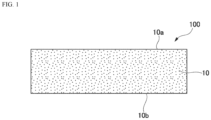
- Figure 1 is a cross-sectional view showing an adhesive tape according to Example 1 of the present invention.
- the adhesive tape of the present invention is an adhesive tape having a substrate comprising 100 parts by mass of a polyvinyl chloride, with the polyvinyl chloride including one or more of the group consisting of homopolymers of polyvinyl chloride, vinyl chloride-vinyl acetate copolymers, vinyl chloride-ethylene copolymers and vinyl chloride-propylene copolymers, and, with respect to the 100 parts by mass of the polyvinyl chloride, 10-100 parts by mass of an elastomer and 10-100 parts by mass of a plasticizer, characterized by the elastomer comprising an acrylonitrile monomer unit and at least one monomer unit selected from the group consisting of a chloroprene monomer unit, a butadiene monomer unit, and an isoprene monomer unit and the adhesive tape having an attenuation value of 2 dB or greater in a sound attenuation test.
- the polyvinyl chloride including one or more of the group consisting of homo
- Such an adhesive tape can reduce percussive sounds or friction sounds, can prevent contamination of a covered article due to contamination by dirt or dust or permeation by water or oil, has durability against puncture or friction, and furthermore, easily bends after binding a covered article.
- the attenuation value of the adhesive tape indicates a value determined by the acoustic absorption test described below.
- the test was performed with a method similar to that for "soundproof material" in Section 5.5.5 of LV312-1, the unified standard for German automobile makers, and the attenuation value was calculated. Specifically, a 350 mm ⁇ 190 mm aluminum plate with a plate thickness of 0.3 mm is bent into a semicircle with a diameter of 290 mm. Then, a steel rod with a diameter of 8 mm is dropped with a load of 0.16 N from a position 20 mm above the apex of the aluminum plate. At this time, the noise at impact is measured (units: dB) with a microphone installed 50 mm above the impact position. The noise when one layer of an adhesive tape sample (dimensions: 25 mm ⁇ 50 mm) is attached to the impact position of the steel rod is measured and the difference with respect to the noise measured with the steel rod alone is the attenuation value.
- the attenuation value for the adhesive tape of the present invention in the abovementioned acoustic absorption test is 2 dB or greater, preferably 3 dB or greater, and still more preferably 4 dB or greater.
- the higher the attenuation value in the acoustic absorption test the better percussive sounds and friction sounds due to engine vibrations, shaking during travel, etc. can be suppressed.
- Examples of methods to increase the attenuation value include, for instance, adjustments to the blend of the tape substrate (for example, increasing the ratios of the elastomer component and the plasticizer, adding a filler, etc.), increasing the thickness of the tape, etc.
- the substrate of the present invention comprises 100 parts by mass of polyvinyl chloride, with the polyvinyl chloride including one or more of the group consisting of homopolymers of polyvinyl chloride, vinyl chloride-vinyl acetate copolymers, vinyl chloride-ethylene copolymers and vinyl chloride-propylene copolymers, and, with respect to the 100 parts by mass of polyvinyl chloride, 10-100 parts by mass of an elastomer and 10-100 parts by mass of a plasticizer.
- the substrate of the present invention has adhesion in and of itself. Therefore, the adhesive tape of the present invention may lack an adhesive layer. That is, the adhesive tape may be constituted by the substrate alone. When the adhesive tape is constituted by the substrate alone, it is preferable that one surface of the substrate not have adhesive force. That is, one surface of the substrate may be roughened.
- the adhesive force when one surface of the substrate is superimposed on the other surface of the substrate is preferably 0.1-10 N/10 mm and more preferably 0.5-5 N/10 mm.
- the adhesive force indicates the 180° peeling adhesive force value measured with a method conforming to JIS Z 0237. If the adhesive force is within the abovementioned range, sufficient binding is readily obtained when used as, for example, binding tape.
- the substrate of the adhesive tape of the present invention must comprise polyvinyl chloride and a plasticizer and the ratio thereof is 10-100 parts by mass of the plasticizer, preferably 20-80 parts by mass of the plasticizer, and more preferably 30-70 parts by mass of the plasticizer with respect to 100 parts by mass of polyvinyl chloride. If the plasticizer is below the abovementioned lower limit, bendability falls and if the plasticizer exceeds the abovementioned upper limit, durability against puncture or friction falls.
- acoustic absorption in order to suppress the generation of sounds due to impacts or friction is required of the adhesive tape of the present invention.
- Elastomers are suitable as a component that does not impair the durability discussed above while meeting this requirement.
- the ratio thereof is 10-100 parts by mass of the elastomer, preferably 20-80 parts by mass of the elastomer, and more preferably 30-70 parts by mass of the elastomer with respect to 100 parts by mass of polyvinyl chloride. If the elastomer is below the abovementioned lower limit, acoustic absorption falls and if the elastomer exceeds the abovementioned upper limit, durability against puncture or friction falls.
- polyvinyl chloride examples include homopolymers of polyvinyl chloride, vinyl chloride-vinyl acetate copolymers, vinyl chloride-ethylene copolymers, vinyl chloride-propylene copolymers. These may be used individually or in a combination of two or more. Among these, homopolymers of polyvinyl chloride are preferred because they have excellent durability against puncture or friction, water resistance, and oil resistance and are generic and can be used at low prices.
- the degree of polymerization of polyvinyl chloride is not particularly limited so long as the effects of the present invention are present, but that with an average degree of polymerization of 500-4000 is preferred, that with an average degree of polymerization of 800-3000 is more preferred, and that with an average degree of polymerization of 1000-2000 is especially preferred from the viewpoint of obtaining favorable workability.
- phthalic acid esters for example, phthalic acid esters, isophthalic acid esters, terephthalic acid esters, adipic acid esters, trimellitic acid esters, polyesters thereof, phosphoric acid-based plasticizers, epoxy-based plasticizers, etc. can be used as the plasticizer.
- plasticizer examples include diisononyl phthalate (DINP), diheptyl phthalate (DHP), di-2-ethylhexyl phthalate (DEHP), di-n-octyl phthalate (n-DOP), diisodecyl phthalate (DIDP), di-2-ethylhexyl isophthalate (DOIP), di-2-ethylhexyl terephthalate (DOTP), benzyl butyl phthalate (BBP), tri-2-ethylhexyl trimellitate (TOTM), di-2-ethylhexyl adipate (DOA), tricresyl phosphate (TCP), benzyl octyl adipate (BOA), adipic acid-propylene glycol-based polyesters, adipic acid-butylene glycol-based polyesters, phthalic acid-propylene glycol-based polyesters, diphenyl
- phthalic acid diesters such as diisononyl phthalate (DINP), diheptyl phthalate (DHP), di-2-ethylhexyl phthalate (DEHP), di-n-octyl phthalate (n-DOP), and diisodecyl phthalate (DIDP), which have excellent plasticizing effects on polyvinyl chloride resins and minimal bleed-out, are preferred and among these, diesters of phthalic acid and an alcohol with 9 or 10 carbon atoms such as diisononyl phthalate (DINP) and diisodecyl phthalate (DIDP) are especially preferred. Diesters with an alcohol with 9 or more carbon atoms are preferred because they have smaller effects on the human body. If the diester is with an alcohol with 10 or fewer carbon atoms, more favorable plasticizing effects are readily obtained.
- DINP diisononyl phthalate
- DEHP di-2-ethylhexyl phthal
- An elastomer with high diffusion relative to the polyvinyl chloride discussed above, that does not readily impair durability against puncture or friction, and that contains an acrylonitrile monomer unit and at least one monomer unit selected from the group consisting of a chloroprene monomer unit, a butadiene monomer unit, and an isoprene monomer unit must be used as the elastomer.
- an elastomer consisting of an acrylonitrile monomer unit and at least one monomer unit selected from the group consisting of a chloroprene monomer unit, a butadiene monomer unit, and an isoprene monomer unit is more preferred.
- the elastomer examples include acrylonitrile-chloroprene rubber, acrylonitrile-butadiene rubber, hydrogenated acrylonitrile-butadiene rubber, carboxy-modified acrylonitrile-butadiene rubber, acrylonitrile-isoprene rubber, acrylonitrile-butadiene-isoprene rubber, etc. and among these, acrylonitrile-chloroprene rubber is preferred from the viewpoint of more excellent water resistance and oil resistance. Further, acrylonitrile-butadiene rubber is preferred from the viewpoint of excellent durability against puncture or friction.
- the ratio of the acrylonitrile monomer unit in the elastomer is preferably 5-45% by mass and more preferably 15-35% by mass with respect to the total amount of all monomer units of the elastomer. If the ratio of acrylonitrile in the elastomer is within the abovementioned range, compatibility with polyvinyl chloride is high and high wear durability is therefore readily obtained.
- the glass transition temperature of the elastomer is preferably -40°C to 0°C, more preferably -35°C to -5°C, and still more preferably -32°C to -8°C. If the glass transition temperature is equal to or greater than the abovementioned lower limit, durability against puncture or friction is not readily impaired. Further, if the glass transition temperature is equal to or lower than the abovementioned upper limit, bendability is not readily impaired.
- the glass transition temperature changes depending on the measurement method and measurement conditions.
- the glass transition temperature in the elastomer in the present embodiment is the inflection point of the change in heat capacity according to a differential scanning calorimetry (DSC) method when the temperature is changed from -100°C to 100°C at a rate of temperature increase of 10°C/minute under atmospheric pressure.
- the glass transition temperature as referred to here conforms to JIS K 7121 and can be calculated from intermediate glass transition temperature Tmg, extrapolated glass transition initiation temperature Tig, and extrapolated glass transition ending temperature Teg.
- Tmg is defined as the temperature at the intersection of a straight line equidistant in the direction of the vertical axis from straight lines extended from each baseline with the curved line of the stepwise change portion of the glass transition;
- Tig is defined as the temperature at the intersection between a straight line extending the low-temperature side baseline to the high-temperature side and a tangent line drawn at the point where the gradient of the curved line of the stepwise change portion of the glass transition is at its maximum;
- Teg is defined as the temperature at the intersection between a straight line extending the high-temperature baseline to the low-temperature side and a tangent line drawn at the point where the gradient of the curved line of the stepwise change portion of the glass transition is at its maximum.
- the glass transition temperature in the elastomer of the present embodiment is the value measured for Tmg directly under the conditions described in the differential scanning calorimetry (DSC) method discussed previously.
- the adhesive tape of the present invention may include an inorganic filler as an extender, a reinforcement, etc.
- the inorganic filler include, for instance, aluminum hydroxide, magnesium hydroxide, zirconium hydroxide, calcium hydroxide, potassium hydroxide, barium hydroxide, ammonium polyphosphate, a polyphosphoric acid amide, zirconium oxide, magnesium oxide, zinc oxide, titanium oxide, molybdenum oxide, guanidine phosphate, hydrotalcite, smectites, zinc borate, anhydrous zinc borate, zinc metaborate, barium metaborate, antimony oxide, antimony trioxide, antimony pentaoxide, red phosphorus, talc, kaolin, clay, alumina, silica, boehmite, bentonite, sodium silicate, calcium silicate, calcium sulfate, calcium carbonate, magnesium carbonate, carbon black, etc.
- inorganic fillers talc, kaolin, clay, silica, and carbon black, which are capable of further improving durability against puncture or friction, are preferred.
- Carbon black in which reinforcement effects with both polyvinyl chloride and the elastomer in particular are higher, is more preferred.
- the inorganic filler may be that obtained by pulverizing a natural product or may be that obtained by neutralizing and precipitating an aqueous solution or the like. Further, the inorganic filler may be that in which a functional group has been introduced with a surface treatment agent, etc.
- a surface treatment agent etc.
- a fatty acid, a rosin acid, a lignin acid, a quaternary ammonium salt, etc. can be used as the surface treatment agent.
- a modifier, a dispersing agent, a colorant, a stabilizer, an anti-aging agent, a light absorber, a lubricant, etc. may be added, as necessary, to the adhesive tape of the present invention so long as the effects of the present invention are not hindered.
- the modifier examples include, for instance, halogenated vinyl-based copolymers (vinyl chloride-vinyl acetate copolymers, vinyl chloride-ethylene copolymers, vinyl chloride-propylene copolymers, chlorinated polyethylene, and chlorinated polyvinyl chloride), elastomer components other than the elastomer (butadiene-styrene copolymers, methyl methacrylate-butadiene-styrene copolymers, methyl methacrylate-butyl acrylate copolymers, etc., ethylene-vinyl acetate copolymers, ether-based and ester-based polyurethanes, etc.), thermoplastic resins (polymethyl methacrylate, polymethyl acrylate, polyacrylonitrile, polyacrylonitrile-styrene copolymers), etc. These may be used individually or in a combination of two or more.
- the content of the inorganic filler, the modifier, and the other additives is not particularly limited and these may be blended within a range that does not inhibit the effects of the present invention.
- the additives can be blended at greater than 0 parts by mass and equal to or less than 50 parts by mass with respect to 100 parts by mass of polyvinyl chloride.
- the adhesive tape of the present invention may have an adhesive layer.
- the adhesive layer is preferably constituted by an adhesive.
- the adhesive is not particularly limited so long as the effects of the present invention are present and adhesives used in conventional binding tape can appropriately be used as such.
- acrylic adhesives, rubber-based adhesives, silicone-based adhesives, urethane-based adhesives, etc. can be used as the adhesive, specifically.
- the adhesive may contain any additive so long as the effects of the present invention are not inhibited.
- additives examples include, for instance, softening agents, tackifiers, surface lubricants, leveling agents, antioxidants, corrosion inhibitors, photostabilizers, ultraviolet light absorbers, thermal-resistance stabilizers, polymerization inhibitors, silane coupling agents, lubricants, inorganic or organic fillers, metal powders, pigments, etc. These may be used individually or in a combination of two or more.
- the thickness thereof is not particularly limited so long as the effects of the present invention are present and, for example, is preferably 5-100 ⁇ m and more preferably 10-50 ⁇ m.
- the adhesive layer may be constituted from a plurality of layers.
- the total thickness of the adhesive layer is preferably adjusted so as to be within the abovementioned range.
- Examples of the manufacturing method for the adhesive tape of the present invention include methods wherein raw materials including the polyvinyl chloride, elastomer, and plasticizer discussed above are mixed, melt-kneaded, and then formed into a film with a predetermined thickness, width, and length.
- the melt kneading method is not particularly limited so long as the effects of the present invention are present, for example, various mixers and kneaders provided with a heater such as a twin-screw extruder, continuous and batch kneaders, rolls, or a Banbury mixer can be used.
- a composition wherein the raw materials have been dispersed uniformly by the abovementioned method can be film-formed in a sheet-like shape by common methods such as, for example, a calendar method, a T-die method, and an inflation method and the film-formed sheet can be used as tape by putting the same in a wound rolled form.
- an annealing treatment is preferably performed for 1-6 hours at 100°C or greater, preferably at 100-130°C. This is preferred because the deformation rate explained below can be further reduced by performing such an annealing treatment.
- the thickness of the adhesive tape of the present invention is preferably 150-750 ⁇ m, more preferably 250-650 ⁇ m, and still more preferably 300-600 ⁇ m. Due to the thickness being equal to or greater than the abovementioned lower limit, an adhesive tape with more excellent acoustic absorption and various durability can readily be obtained. Further, due to the thickness being equal to or less than the abovementioned upper limit, bendability after binding is readily more favorable. Moreover, the width of the adhesive tape of the present invention is preferably 10-300 mm, more preferably 15-250 mm, and still more preferably 18-220 mm. The binding area per unit length of the tape increases the greater the tape width, so the greater the tape width, the more readily the binding strength becomes favorable and the shorter the tape width the more readily the bendability after binding becomes more favorable.
- the adhesive tape of the present invention is preferably wound in a rolled form with a uniform width from the standpoint of binding workability and it is still more preferable that this form be maintained even after changes in temperature and the passage of time.
- "Deformation" due to relaxation of residual strain occurs particularly in tape comprising an elastomer when left in an environment with a higher temperature than that at which the tape was film-formed or was wound into a rolled form. Accordingly, the lower the deformation rate the better.
- Examples of methods to reduce the deformation rate include adjustments to the blend of the tape substrate (for example, lowering the ratio of the elastomer component or the plasticizer, etc.), increasing the tape width, increasing the adhesive force between one surface of the tape and the other surface of the tape (the front surface and the rear surface of the tape), reducing the tension during winding, performing a heat treatment (annealing treatment) after winding, relaxing residual strain ahead of time, etc.
- the deformation rate can be calculated with the following formula with the tape roll width prior to being left as W1 and the tape roll width after being left as W2.
- Deformation Rate % W 2 ⁇ W 1 / W 1 ⁇ 100
- the deformation rate after having been left for 72 hours at 65°C is preferably 10% or lower and more preferably 5% or lower.
- the adhesive tape of the present invention does not require an adhesive layer, which serves as a source of deformation, so the deformation rate after having been left for 72 hours at 65°C can readily be made 10% or lower.
- the adhesive tape of the present invention can reduce percussive sounds or friction sounds, can prevent contamination of a covered article due to contamination by dirt or dust or permeation by water or oil, has durability against puncture or friction, and easily bends after binding a covered article. Therefore, the adhesive tape can be suitably used in fields where these capabilities are demanded, for example, electrical wiring in drive portions of electric motor devices, electrical portions of vehicles, etc. Further, the adhesive tape can also be suitably used in devices in which low noise, in particular, is related to product quality, such as home appliances, office supplies, and acoustic equipment. Naturally, the adhesive tape of the present invention is not limited to the abovementioned uses.
- the polymerization terminator phenothiazine was added to terminate polymerization at the point in time at the polymerization rate became 56% with respect to the total amount of the chloroprene monomer and the acrylonitrile monomer. Then, an acrylonitrile-chloroprene copolymer latex was obtained by removing the unreacted monomers in the reaction solution under reduced pressure. The obtained acrylonitrile-chloroprene copolymer latex was adjusted to pH 7.0 and demulsified by being frozen and coagulated on a metal plate that had been cooled to -20°C. A solid acrylonitrile-chloroprene rubber was obtained by washing the obtained sheet with water and drying for 15 minutes at 130°C.
- the glass transition temperature of the abovementioned acrylonitrile-chloroprene rubber was -21°C.
- the polymerization rate of the copolymer latex was calculated from the dry weight of the airdried copolymer latex. Specifically, the polymerization rate was calculated according to general formula (I) below.
- the solid component concentration refers to the concentration (% by mass) of solid components excluding the solvent (water) and volatile components such as volatile chemicals and raw materials after heating 2 g of the sampled copolymer latex at 130°C.
- the total amount loaded is the total amount of raw materials, reagents, and solvent (water) loaded in the polymerization tank from the initiation of polymerization to a given time.
- the evaporation residue refers to the mass of the chemicals among the chemicals and raw materials that were loaded from the initiation of polymerization to a given time that did not volatilize under the condition of 130°C and remain as solid components with the polymer.
- the amount of monomers loaded is the total amount of the monomers initially added to the polymerization tank and the monomers added separately from the initiation of polymerization to a given time.
- Polymerization Rate % Total Amount Loaded g ⁇ Solid Component Concentration % by mass / 100 ⁇ Evaporation Residue g / Amount of Monomers Loaded g ⁇ 100
- Figure 1 is a cross-sectional view showing an adhesive tape 100 according to Example 1 of the present invention.
- the surface roughness (Ra) of a surface 10a which is one surface of a substrate 10 in the adhesive tape 100 of Example 1, is 1 ⁇ m. Further, the other surface 10b of the substrate 10 has adhesion.
- the attenuation value of the obtained adhesive tape sample is evaluated according to the following evaluation method.
- the attenuation value was calculated by performing a test with a method similar to that for "soundproof material" in Section 5.5.5 of LV312-1, the unified standard for German automobile makers. Specifically, a 350 mm ⁇ 190 mm aluminum plate with a plate thickness of 0.3 mm was bent into a semicircle with a diameter of 290 mm. Next, in an environment with a temperature of 23 ⁇ 2°C and humidity of 50 ⁇ 10%, a steel rod with a diameter of 8 mm was dropped with a load of 0.16 N from a position 20 mm above the apex of the aluminum plate and at that time, the noise at impact was measured (units: dB) with a microphone installed 50 mm above the impact position.
- the adhesive force of the obtained adhesive tape is the 180° peeling adhesive force between the one surface and the other surface as measured based on JIS Z 0237. That is, in Figure 1 , the surface 10b of another adhesive tape 100 was attached to the surface 10a of an adhesive tape 100 and the 180° peeling adhesive force was measured. The results are shown in Table 1.
- Binding was evaluated in the following manner.
- the evaluation sample was heated for 1 minute in an oven with a 100°C atmosphere, the sample was removed from the oven and left for 30 minutes in an evaluation testing chamber with the temperature set to 23 ⁇ 2°C and the humidity to 50 ⁇ 5% RH. Then one end of the adhesive tape of the evaluation sample was gripped with one hand and the group of electrical wires was pulled with the other hand and the condition of the group of electrical wires was evaluated according to the following evaluation criteria. "C" or above is considered passing.
- the bendability of the adhesive tape after binding a bundle of electrical wires was evaluated according to the following method. Further, evaluating in accordance with the following evaluation criteria, "C" or above is considered passing.
- a bundle of electrical wires was bound with the same method as for the binding evaluation discussed above.
- the diameter of the smallest cylinder around which the bundle could be wound following the cylinder (without breaking) was measured.
- a bundle of electrical wires was bound with the same method as for the binding evaluation.
- the bundle of electrical wires was wound once around a side surface of a stainless steel cylinder with a diameter of 50 mm and then affixed with the adhesive tape. Then, in an environment with a temperature of 23 ⁇ 2°C and humidity of 50 ⁇ 10%, a steel sphere with a diameter of 10 mm was dropped onto the bundle of electrical wires on the side surface of the cylinder from a height of 25 cm, generating a percussive sound.
- the sound pressure was measured (units: ⁇ Pa) with a microphone installed 50 mm above the position at which the sound was generated.
- a bundle of electrical wires was bound with the same method as for the binding evaluation discussed above.
- a 10 mm ⁇ corrugated tube manufactured by Panduit Corp.
- the corrugated tube was moved back and forth at a speed of 50 ⁇ 10 mm/second in the lengthwise direction, generating friction sounds.
- the sound pressure was measured (units: ⁇ Pa) with a microphone installed 20 mm above the position at which the sound was generated.
- the puncture durability of the adhesive tape was evaluated according to the following method. Further, evaluating in accordance with the following evaluation criteria, "C" or above is considered passing.
- the adhesive tape sample was fixed on a stage in which a 20 mm diameter hole had been made and, in an environment with a temperature of 23 ⁇ 2°C and humidity of 50 ⁇ 10%, a needle with a diameter of 1 mm and R 0.5 mm punctured the center of the hole at a speed of 50 mm/minute.
- the maximum load (N) until the needle penetrated the sample was measured at this time.
- the wear durability of the adhesive tape was evaluated according to the following method. Further, evaluating in accordance with the following evaluation criteria, "C" or above is considered passing.
- the adhesive tape sample was wound once around a cylinder with a diameter of 10 mm and the sample surface was then worn with sandpaper having a grain size of 180 ⁇ m from above at a speed of 150 mm/second. The wear distance (mm) until a hole was made in the sample was measured at this time.
- the water resistance of the adhesive tape was evaluated according to the following method. Further, evaluating in accordance with the following evaluation criteria, "C" or above is considered passing.
- the oil resistance of the adhesive tape was evaluated according to the following method. Further, evaluating in accordance with the following evaluation criteria, "C" or above is considered passing.
- Adhesive tapes were created with methods similar to that of Example 1 other than changing the elastomer composition, the blending composition of the adhesive tape, the thickness, the width, and the surface roughness Ra as shown in Tables 1-3.
- the thicknesses and widths of the obtained adhesive tapes are shown in Tables 1-3.
- the evaluations were carried out for each adhesive tape with the same methods as in Example 1 and the results are shown in Tables 1-3. It is noted that Example 21 does not fall under the scope of the present invention.
- Polyvinyl Chloride 1 Product name "TH-1000", manufactured by Taiyo Vinyl Corporation.
- Polyvinyl Chloride 2 Product name "TH-1300", manufactured by Taiyo Vinyl Corporation.
- Ethylene-polyvinyl chloride copolymer Product name "TE-1050", manufactured by Taiyo Vinyl Corporation.
- Acrylonitrile-butadiene rubber Product name "Nipol ® 1043", manufactured by ZEON CORPORATION, glass transition temperature: -37°C.
- Hydrogenated acrylonitrile-butadiene rubber Product name "Zetpol ® 2010", manufactured by ZEON CORPORATION, glass transition temperature: -24°C.
- Acrylonitrile-butadiene-isoprene rubber Product name "Nipol ® DN1201", manufactured by ZEON CORPORATION, glass transition temperature: -26°C.
- Styrene-butadiene rubber Product name "Nipol ® 1502", manufactured by ZEON CORPORATION, glass transition temperature: -51°C.
- Chloroprene rubber Product name "DENKA CHLOROPRENE M-40", manufactured by Denka Company Limited, glass transition temperature: -38°C.
- Diisodecyl phthalate Product name "DIDP”, manufactured by J-PLUS Co., Ltd.
- Di(2-ethylhexyl) adipate Product name "DOA”, manufactured by J-PLUS Co., Ltd.
- Tri(2-ethylhexyl) trimellitate Product name "TOTM”, manufactured by J-PLUS Co., Ltd.
- Carbon Black 1 Product name "SEAST ® 3", manufactured by Tokai Carbon Co., Ltd.
- Carbon Black 2 Product name "Diablack ® H", manufactured by Mitsubishi Chemical Corporation.
- the adhesive tapes of Examples 1-20 and 22-26 which satisfy the features of the present application, were excellent in all the physical properties of percussive sound and friction sound suppressive effects, puncture durability, wear durability, bendability, binding, and water and oil resistance.
- Example 21 does not fall under the scope of the present invention.
- the adhesive tapes of Comparative Examples 1-7 which do not satisfy the features of the present invention, were not capable of meeting all of the abovementioned physical properties.
- the adhesive tape of the present invention can reduce percussive sounds or friction sounds, can prevent contamination of a covered article due to permeation by water or oil, has durability against puncture or friction, and easily bends after binding a covered article.
Landscapes
- Chemical & Material Sciences (AREA)
- Organic Chemistry (AREA)
- Chemical Kinetics & Catalysis (AREA)
- Engineering & Computer Science (AREA)
- Manufacturing & Machinery (AREA)
- Materials Engineering (AREA)
- Health & Medical Sciences (AREA)
- Medicinal Chemistry (AREA)
- Polymers & Plastics (AREA)
- Inorganic Chemistry (AREA)
- Adhesive Tapes (AREA)
- Adhesives Or Adhesive Processes (AREA)
Claims (6)
- Un ruban adhésif ayant un substrat comprenant 100 parties en masse d'un chlorure de polyvinyle, le chlorure de polyvinyle incluant un ou plusieurs éléments du groupe constitué d'homopolymères de chlorure de polyvinyle, de copolymères de chlorure de vinyle-acétate de vinyle, de copolymères de chlorure de vinyle-éthylène et de copolymères de chlorure de vinyle-propylène, et, par rapport aux 100 parties en masse du chlorure de polyvinyle, de 10 à 100 parties en masse d'un élastomère et de 10 à 100 parties en masse d'un plastifiant, dans lequell'élastomère comprend une unité de monomère acrylonitrile et au moins une unité de monomère sélectionnée dans le groupe constitué d'une unité de monomère chloroprène, d'une unité de monomère butadiène, et d'une unité de monomère isoprène,le ruban adhésif ayant une valeur d'atténuation de 2 dB ou plus dans un test d'absorption acoustique, le test étant réalisé par- pliage d'une plaque d'aluminium de 350 mm × 190 mm d'une épaisseur de plaque de 0,3 mm en un demi-cercle d'un diamètre de 290 mm,- le fait de faire tomber une tige d'acier d'un diamètre de 8 mm avec une charge de 0,16 N depuis une position à 20 mm au-dessus du sommet de la plaque d'aluminium,- mesure du bruit à l'impact en dB en tant qu'unités grâce à un microphone installé à 50 mm au-dessus de la position d'impact, le bruit, lorsqu'une couche d'un échantillon de ruban adhésif d'une dimension de 25 mm × 50 mm est attachée à la position d'impact de la tige d'acier, étant mesuré et la différence par rapport au bruit mesuré avec la tige d'acier seule étant définie comme la valeur d'atténuation, etl'épaisseur du substrat allant de 150 à 750 µm.
- Le ruban adhésif selon la revendication 1, dans lequel la température de transition vitreuse de l'élastomère va de -40 °C à 0 °C, la température de transition vitreuse étant le point d'inflexion de la modification de la capacité thermique selon un procédé de calorimétrie différentielle à balayage lorsque la température est modifiée de -100 °C à 100 °C à une vitesse d'augmentation de température de 10 °C/minute sous pression atmosphérique, dans lequel la température de transition vitreuse est conforme à la norme industrielle japonaise (JIS) K 7121 et peut être calculée à partir de la température de transition vitreuse intermédiaire, de la température de départ de transition vitreuse extrapolée et de la température de fin de transition vitreuse extrapolée- la température de transition vitreuse intermédiaire étant définie comme la température à l'intersection d'une ligne droite équidistante dans la direction de l'axe vertical de lignes droites étendues depuis chaque ligne de base avec la ligne courbe de la portion de modification par étapes de la transition vitreuse,- la température de départ de transition vitreuse extrapolée étant définie comme la température à l'intersection entre une ligne droite s'étendant de la ligne de base de côté de température basse au côté de température élevée et une ligne tangente tirée au point où le gradient de la ligne courbe de la portion de modification par étapes de la transition vitreuse est à son maximum ; et- la température de fin de transition vitreuse extrapolée étant définie comme la température à l'intersection entre une ligne droite s'étendant de la ligne de base de température élevée au côté de température basse et une ligne tangente tirée au point où le gradient de la ligne courbe de la portion de modification par étapes de la transition vitreuse est à son maximum,dans lequel la température de transition vitreuse est la valeur mesurée pour la température de transition vitreuse intermédiaire directement dans les conditions décrites dans le procédé de calorimétrie différentielle à balayage.
- Le ruban adhésif selon la revendication 1 ou la revendication 2, dans lequel le plastifiant est un diester d'acide phtalique et d'un alcool présentant 9 ou 10 atomes de carbone.
- Le ruban adhésif selon n'importe laquelle des revendications 1 à 3, dans lequel la force d'adhérence lorsqu'une surface du substrat est superposée sur une autre surface du substrat va de 0,5 à 5 N/10 mm, la force d'adhérence étant la force d'adhérence au pelage à 180° entre cette une surface et l'autre surface telle que mesurée sur la base de la norme industrielle japonaise (JIS) Z 0237.
- Le ruban adhésif selon n'importe laquelle des revendications 1 à 4, dans lequel le substrat comprend de 1 à 50 parties en masse de noir de carbone par rapport aux 100 parties en masse du chlorure de polyvinyle.
- Le ruban adhésif selon n'importe laquelle des revendications 1 à 5, dans lequel la largeur de ruban du ruban adhésif va de 10 à 300 mm, et le taux de déformation après avoir été enroulé en une forme roulée et laissé pendant 72 heures à 65 °C est de 10 % ou moins, dans lequel le taux de déformation du ruban adhésif est calculé grâce à la formule suivante

Applications Claiming Priority (2)
| Application Number | Priority Date | Filing Date | Title |
|---|---|---|---|
| JP2019149013 | 2019-08-15 | ||
| PCT/JP2020/030569 WO2021029403A1 (fr) | 2019-08-15 | 2020-08-11 | Ruban adhésif |
Publications (3)
| Publication Number | Publication Date |
|---|---|
| EP4015594A1 EP4015594A1 (fr) | 2022-06-22 |
| EP4015594A4 EP4015594A4 (fr) | 2022-09-21 |
| EP4015594B1 true EP4015594B1 (fr) | 2023-12-20 |
Family
ID=74570280
Family Applications (1)
| Application Number | Title | Priority Date | Filing Date |
|---|---|---|---|
| EP20852539.4A Active EP4015594B1 (fr) | 2019-08-15 | 2020-08-11 | Ruban adhésif |
Country Status (6)
| Country | Link |
|---|---|
| US (1) | US20220396717A1 (fr) |
| EP (1) | EP4015594B1 (fr) |
| JP (1) | JP7499772B2 (fr) |
| CN (1) | CN114072478B (fr) |
| TW (1) | TWI862662B (fr) |
| WO (1) | WO2021029403A1 (fr) |
Families Citing this family (6)
| Publication number | Priority date | Publication date | Assignee | Title |
|---|---|---|---|---|
| JP7643963B2 (ja) * | 2021-07-16 | 2025-03-11 | デンカ株式会社 | コンクリート保護用水系コーティング剤及びコンクリート保護膜の形成方法 |
| WO2023234125A1 (fr) * | 2022-05-30 | 2023-12-07 | デンカ株式会社 | Ruban protecteur de liaison |
| WO2023234124A1 (fr) * | 2022-05-30 | 2023-12-07 | デンカ株式会社 | Ruban protecteur de liaison |
| WO2025037590A1 (fr) * | 2023-08-14 | 2025-02-20 | デンカ株式会社 | Ruban adhésif, et faisceau de câbles |
| WO2025037592A1 (fr) * | 2023-08-14 | 2025-02-20 | デンカ株式会社 | Ruban adhésif, et faisceau de câbles |
| WO2025037591A1 (fr) * | 2023-08-14 | 2025-02-20 | デンカ株式会社 | Ruban adhésif, et faisceau de câbles |
Family Cites Families (40)
| Publication number | Priority date | Publication date | Assignee | Title |
|---|---|---|---|---|
| US3129816A (en) * | 1963-10-31 | 1964-04-21 | Minnesota Mining & Mfg | Pressure-sensitive adhesive tape with plasticized polyvinyl chloride backing |
| US3617380A (en) * | 1968-04-16 | 1971-11-02 | Ricoh Kk | Polyvinyl chloride supports for use as the base of magnetic recording materials |
| US4652475A (en) * | 1985-11-08 | 1987-03-24 | The Gates Rubber Company | Compound adhesive formulation and composite hose made with the same |
| JPS62158734A (ja) * | 1986-01-07 | 1987-07-14 | Denki Kagaku Kogyo Kk | 導電性樹脂シ−ト |
| JPH0790697B2 (ja) * | 1988-07-12 | 1995-10-04 | 日産自動車株式会社 | ウエザーストリップ |
| US4988768A (en) * | 1988-12-27 | 1991-01-29 | Ppg Industries, Inc. | Polyvinyl chloride plastisol based curable composition |
| US5274043A (en) * | 1991-05-09 | 1993-12-28 | The B. F. Goodrich Company | Chlorinated PVC blends |
| US5709956A (en) * | 1994-07-25 | 1998-01-20 | Denki Kagaku Kogyo Kabushiki Kaisha | Co-extruded multilayer laminate |
| JP3036405B2 (ja) * | 1995-06-14 | 2000-04-24 | 三菱化学エムケーブイ株式会社 | 塩化ビニル系樹脂組成物 |
| JP3549662B2 (ja) * | 1996-03-25 | 2004-08-04 | ミネソタ マイニング アンド マニュファクチャリング カンパニー | 粘着テープおよびその製造方法 |
| US6043318A (en) * | 1996-09-27 | 2000-03-28 | Hardiman; Christopher John | Nitrile rubber/polyvinyl chloride blends |
| JPH117856A (ja) | 1997-06-16 | 1999-01-12 | Sumitomo Wiring Syst Ltd | ワイヤハーネスへの保護材の外装構造 |
| DE10039982A1 (de) | 2000-08-16 | 2002-03-07 | Tesa Ag | Klebebänder mit textilem Träger für die Ummantelung von langgestrecktem Gut, wie insbesondere Kabelsätzen |
| DE10060474A1 (de) * | 2000-12-06 | 2002-06-13 | Bayer Ag | Verfahren zur Herstellung von Mischungen aus Polyvinylchlorid und Polymerisaten auf Basis von konjugierten Dienen und Acrylnitril |
| JP2006152192A (ja) | 2004-12-01 | 2006-06-15 | Sliontec Corp | ブチルゴム粘着剤及びそれを用いた粘着テープまたはシート |
| CA2627299C (fr) * | 2005-10-27 | 2011-12-20 | Exxonmobil Chemical Patents Inc. | Construction comprenant une couche de liaison |
| CN102027087B (zh) | 2008-05-14 | 2014-02-26 | 电气化学工业株式会社 | 粘合膜 |
| CN101497768B (zh) * | 2009-03-04 | 2011-08-31 | 三友(天津)高分子技术有限公司 | 汽车用消音胶片 |
| WO2011021626A1 (fr) * | 2009-08-21 | 2011-02-24 | 電気化学工業株式会社 | Procédé de fabrication d'un latex de polychloroprène, latex de polychloroprène et adhésif mettant en oeuvre celui-ci |
| JP5784982B2 (ja) * | 2011-05-25 | 2015-09-24 | 矢崎エナジーシステム株式会社 | 電線被覆用塩化ビニル樹脂組成物およびそれを用いた電線 |
| JP6506955B2 (ja) * | 2014-03-11 | 2019-04-24 | 日東電工株式会社 | 粘着テープ |
| US20160289506A1 (en) * | 2015-04-01 | 2016-10-06 | Nitto Denko Corporation | Pressure-sensitive adhesive tape |
| WO2016158412A1 (fr) * | 2015-04-01 | 2016-10-06 | 日東電工株式会社 | Rouleau de ruban adhésif |
| JP6633306B2 (ja) * | 2015-04-01 | 2020-01-22 | 日東電工株式会社 | 粘着テープ |
| CN118344818A (zh) * | 2015-04-01 | 2024-07-16 | 日东电工株式会社 | 粘合带 |
| CN108307637A (zh) * | 2015-04-01 | 2018-07-20 | 日东电工株式会社 | 粘合带 |
| EP3075805B1 (fr) * | 2015-04-01 | 2019-01-30 | Nitto Denko Corporation | Bande adhésive sensible à la pression |
| US9758659B2 (en) * | 2015-08-20 | 2017-09-12 | Tak Kwong Kwan | Self-sinking and air permeable plastic material |
| EP3533851B1 (fr) * | 2016-10-26 | 2024-07-03 | Riken Technos Corporation | Film adhésif |
| EP3597715A4 (fr) * | 2017-03-15 | 2020-04-15 | Denka Company Limited | Feuille adhésive, matériau de protection et faisceau électrique |
| MY196426A (en) * | 2017-09-08 | 2023-04-10 | Denka Company Ltd | Substrate for Pressure-Sensitive Adhesive Tape, Pressure-Sensitive Adhesive Tape, and Production Method Therefor |
| KR102511194B1 (ko) * | 2017-10-05 | 2023-03-16 | 덴카 주식회사 | 점착성 시트, 보호재 및 와이어 하니스 |
| US10166863B1 (en) * | 2018-04-04 | 2019-01-01 | Ford Motor Company Brasil Ltda | Biodiesel resistant PVC/NBR rubber composition |
| CN108586990A (zh) * | 2018-05-15 | 2018-09-28 | 佛山市高明威仕达塑料有限公司 | 一种abs改性pvc片材及其生产工艺 |
| US11920061B2 (en) * | 2018-10-01 | 2024-03-05 | Denka Company Limited | Adhesive sheet |
| ES2926815T3 (es) * | 2018-11-08 | 2022-10-28 | Denka Company Ltd | Composición de copolímero de cloropreno/nitrilo insaturado y objeto moldeado vulcanizado |
| US20220356381A1 (en) * | 2019-08-15 | 2022-11-10 | Denka Company Limited | Adhesive tape |
| US20220325141A1 (en) * | 2019-09-19 | 2022-10-13 | Denka Company Limited | Binding tape |
| US20240309197A1 (en) * | 2021-03-30 | 2024-09-19 | Denka Company Limited | Method for manufacturing chloroprene-based polymer composition, chloroprene-based polymer composition, dip-molded body and method for manufacturing dip-molded body |
| KR20240033013A (ko) * | 2021-07-09 | 2024-03-12 | 덴카 주식회사 | 점착 테이프 |
-
2020
- 2020-08-11 JP JP2021539295A patent/JP7499772B2/ja active Active
- 2020-08-11 WO PCT/JP2020/030569 patent/WO2021029403A1/fr not_active Ceased
- 2020-08-11 CN CN202080048541.5A patent/CN114072478B/zh active Active
- 2020-08-11 EP EP20852539.4A patent/EP4015594B1/fr active Active
- 2020-08-11 US US17/623,502 patent/US20220396717A1/en not_active Abandoned
- 2020-08-14 TW TW109127672A patent/TWI862662B/zh active
Non-Patent Citations (1)
| Title |
|---|
| "POLYVINYLCHLORIDE//POLYVINYLAMINE", ROMPP CHEMIE LEXIKON, XX, XX, no. 1, 1 January 1995 (1995-01-01), pages 3579 - 3581, XP002907558 * |
Also Published As
| Publication number | Publication date |
|---|---|
| EP4015594A4 (fr) | 2022-09-21 |
| TWI862662B (zh) | 2024-11-21 |
| CN114072478B (zh) | 2023-07-25 |
| JPWO2021029403A1 (fr) | 2021-02-18 |
| CN114072478A (zh) | 2022-02-18 |
| EP4015594A1 (fr) | 2022-06-22 |
| WO2021029403A1 (fr) | 2021-02-18 |
| TW202113014A (zh) | 2021-04-01 |
| JP7499772B2 (ja) | 2024-06-14 |
| US20220396717A1 (en) | 2022-12-15 |
Similar Documents
| Publication | Publication Date | Title |
|---|---|---|
| EP4015594A1 (fr) | Ruban adhésif | |
| CN111183197B (zh) | 粘着性片材、保护材料及线束 | |
| JP7075936B2 (ja) | 粘着テープ用基材、粘着テープ及びその製造方法 | |
| TWI914440B (zh) | 黏著帶及其用途 | |
| JP7849165B2 (ja) | 粘着テープおよびその利用 | |
| CN118344818A (zh) | 粘合带 | |
| JP7489538B2 (ja) | 粘着テープ | |
| JP4444602B2 (ja) | 複合成形体 | |
| JP4652349B2 (ja) | 複合成形体 | |
| EP4036031B1 (fr) | Bande adhésive | |
| WO2018003805A1 (fr) | Composition de résine thermoplastique pour revêtement de fil électrique, et fil électrique mettant en œuvre celle-ci | |
| WO2025037593A1 (fr) | Ruban adhésif et faisceau de câbles | |
| WO2025037590A1 (fr) | Ruban adhésif, et faisceau de câbles | |
| WO2025037592A1 (fr) | Ruban adhésif, et faisceau de câbles | |
| EP4656697A1 (fr) | Ruban adhésif sensible à la pression et son procédé de production | |
| JP2005263845A (ja) | 結束用テープ | |
| WO2025037591A1 (fr) | Ruban adhésif, et faisceau de câbles | |
| JPWO2025037593A5 (fr) | ||
| JP2006290958A (ja) | 帯電防止性アクリル系樹脂組成物およびフィルム、シート | |
| JP5019432B2 (ja) | 帯電防止性アクリル系樹脂組成物およびフィルム、シート | |
| TW202547953A (zh) | 黏著帶、及線束 | |
| EP3406667A1 (fr) | Composition de caoutchouc, et tuyau |
Legal Events
| Date | Code | Title | Description |
|---|---|---|---|
| STAA | Information on the status of an ep patent application or granted ep patent |
Free format text: STATUS: THE INTERNATIONAL PUBLICATION HAS BEEN MADE |
|
| PUAI | Public reference made under article 153(3) epc to a published international application that has entered the european phase |
Free format text: ORIGINAL CODE: 0009012 |
|
| STAA | Information on the status of an ep patent application or granted ep patent |
Free format text: STATUS: REQUEST FOR EXAMINATION WAS MADE |
|
| 17P | Request for examination filed |
Effective date: 20211216 |
|
| AK | Designated contracting states |
Kind code of ref document: A1 Designated state(s): AL AT BE BG CH CY CZ DE DK EE ES FI FR GB GR HR HU IE IS IT LI LT LU LV MC MK MT NL NO PL PT RO RS SE SI SK SM TR |
|
| REG | Reference to a national code |
Ref country code: DE Ref legal event code: R079 Free format text: PREVIOUS MAIN CLASS: C09J0109020000 Ipc: C09J0007240000 Ref country code: DE Ref legal event code: R079 Ref document number: 602020023206 Country of ref document: DE Free format text: PREVIOUS MAIN CLASS: C09J0109020000 Ipc: C09J0007240000 |
|
| A4 | Supplementary search report drawn up and despatched |
Effective date: 20220823 |
|
| RIC1 | Information provided on ipc code assigned before grant |
Ipc: C08J 5/18 20060101ALI20220817BHEP Ipc: C09J 127/06 20060101ALI20220817BHEP Ipc: C09J 109/02 20060101ALI20220817BHEP Ipc: C09J 7/10 20180101ALI20220817BHEP Ipc: C09J 7/24 20180101AFI20220817BHEP |
|
| DAV | Request for validation of the european patent (deleted) | ||
| DAX | Request for extension of the european patent (deleted) | ||
| STAA | Information on the status of an ep patent application or granted ep patent |
Free format text: STATUS: EXAMINATION IS IN PROGRESS |
|
| 17Q | First examination report despatched |
Effective date: 20230425 |
|
| GRAP | Despatch of communication of intention to grant a patent |
Free format text: ORIGINAL CODE: EPIDOSNIGR1 |
|
| STAA | Information on the status of an ep patent application or granted ep patent |
Free format text: STATUS: GRANT OF PATENT IS INTENDED |
|
| RIC1 | Information provided on ipc code assigned before grant |
Ipc: C09J 115/00 20060101ALI20230712BHEP Ipc: C09J 109/06 20060101ALI20230712BHEP Ipc: C09J 109/02 20060101ALI20230712BHEP Ipc: C08J 5/18 20060101ALI20230712BHEP Ipc: C09J 7/10 20180101ALI20230712BHEP Ipc: C09J 7/24 20180101AFI20230712BHEP |
|
| INTG | Intention to grant announced |
Effective date: 20230811 |
|
| GRAS | Grant fee paid |
Free format text: ORIGINAL CODE: EPIDOSNIGR3 |
|
| GRAA | (expected) grant |
Free format text: ORIGINAL CODE: 0009210 |
|
| STAA | Information on the status of an ep patent application or granted ep patent |
Free format text: STATUS: THE PATENT HAS BEEN GRANTED |
|
| AK | Designated contracting states |
Kind code of ref document: B1 Designated state(s): AL AT BE BG CH CY CZ DE DK EE ES FI FR GB GR HR HU IE IS IT LI LT LU LV MC MK MT NL NO PL PT RO RS SE SI SK SM TR |
|
| P01 | Opt-out of the competence of the unified patent court (upc) registered |
Effective date: 20231113 |
|
| REG | Reference to a national code |
Ref country code: GB Ref legal event code: FG4D |
|
| REG | Reference to a national code |
Ref country code: CH Ref legal event code: EP |
|
| REG | Reference to a national code |
Ref country code: DE Ref legal event code: R096 Ref document number: 602020023206 Country of ref document: DE |
|
| REG | Reference to a national code |
Ref country code: IE Ref legal event code: FG4D |
|
| PG25 | Lapsed in a contracting state [announced via postgrant information from national office to epo] |
Ref country code: GR Free format text: LAPSE BECAUSE OF FAILURE TO SUBMIT A TRANSLATION OF THE DESCRIPTION OR TO PAY THE FEE WITHIN THE PRESCRIBED TIME-LIMIT Effective date: 20240321 |
|
| REG | Reference to a national code |
Ref country code: LT Ref legal event code: MG9D |
|
| PG25 | Lapsed in a contracting state [announced via postgrant information from national office to epo] |
Ref country code: LT Free format text: LAPSE BECAUSE OF FAILURE TO SUBMIT A TRANSLATION OF THE DESCRIPTION OR TO PAY THE FEE WITHIN THE PRESCRIBED TIME-LIMIT Effective date: 20231220 |
|
| REG | Reference to a national code |
Ref country code: NL Ref legal event code: MP Effective date: 20231220 |
|
| PG25 | Lapsed in a contracting state [announced via postgrant information from national office to epo] |
Ref country code: ES Free format text: LAPSE BECAUSE OF FAILURE TO SUBMIT A TRANSLATION OF THE DESCRIPTION OR TO PAY THE FEE WITHIN THE PRESCRIBED TIME-LIMIT Effective date: 20231220 |
|
| PG25 | Lapsed in a contracting state [announced via postgrant information from national office to epo] |
Ref country code: LT Free format text: LAPSE BECAUSE OF FAILURE TO SUBMIT A TRANSLATION OF THE DESCRIPTION OR TO PAY THE FEE WITHIN THE PRESCRIBED TIME-LIMIT Effective date: 20231220 Ref country code: GR Free format text: LAPSE BECAUSE OF FAILURE TO SUBMIT A TRANSLATION OF THE DESCRIPTION OR TO PAY THE FEE WITHIN THE PRESCRIBED TIME-LIMIT Effective date: 20240321 Ref country code: FI Free format text: LAPSE BECAUSE OF FAILURE TO SUBMIT A TRANSLATION OF THE DESCRIPTION OR TO PAY THE FEE WITHIN THE PRESCRIBED TIME-LIMIT Effective date: 20231220 Ref country code: ES Free format text: LAPSE BECAUSE OF FAILURE TO SUBMIT A TRANSLATION OF THE DESCRIPTION OR TO PAY THE FEE WITHIN THE PRESCRIBED TIME-LIMIT Effective date: 20231220 Ref country code: BG Free format text: LAPSE BECAUSE OF FAILURE TO SUBMIT A TRANSLATION OF THE DESCRIPTION OR TO PAY THE FEE WITHIN THE PRESCRIBED TIME-LIMIT Effective date: 20240320 |
|
| REG | Reference to a national code |
Ref country code: AT Ref legal event code: MK05 Ref document number: 1642443 Country of ref document: AT Kind code of ref document: T Effective date: 20231220 |
|
| PG25 | Lapsed in a contracting state [announced via postgrant information from national office to epo] |
Ref country code: NL Free format text: LAPSE BECAUSE OF FAILURE TO SUBMIT A TRANSLATION OF THE DESCRIPTION OR TO PAY THE FEE WITHIN THE PRESCRIBED TIME-LIMIT Effective date: 20231220 |
|
| PG25 | Lapsed in a contracting state [announced via postgrant information from national office to epo] |
Ref country code: SE Free format text: LAPSE BECAUSE OF FAILURE TO SUBMIT A TRANSLATION OF THE DESCRIPTION OR TO PAY THE FEE WITHIN THE PRESCRIBED TIME-LIMIT Effective date: 20231220 Ref country code: RS Free format text: LAPSE BECAUSE OF FAILURE TO SUBMIT A TRANSLATION OF THE DESCRIPTION OR TO PAY THE FEE WITHIN THE PRESCRIBED TIME-LIMIT Effective date: 20231220 Ref country code: NO Free format text: LAPSE BECAUSE OF FAILURE TO SUBMIT A TRANSLATION OF THE DESCRIPTION OR TO PAY THE FEE WITHIN THE PRESCRIBED TIME-LIMIT Effective date: 20240320 Ref country code: NL Free format text: LAPSE BECAUSE OF FAILURE TO SUBMIT A TRANSLATION OF THE DESCRIPTION OR TO PAY THE FEE WITHIN THE PRESCRIBED TIME-LIMIT Effective date: 20231220 Ref country code: LV Free format text: LAPSE BECAUSE OF FAILURE TO SUBMIT A TRANSLATION OF THE DESCRIPTION OR TO PAY THE FEE WITHIN THE PRESCRIBED TIME-LIMIT Effective date: 20231220 Ref country code: HR Free format text: LAPSE BECAUSE OF FAILURE TO SUBMIT A TRANSLATION OF THE DESCRIPTION OR TO PAY THE FEE WITHIN THE PRESCRIBED TIME-LIMIT Effective date: 20231220 |
|
| PG25 | Lapsed in a contracting state [announced via postgrant information from national office to epo] |
Ref country code: IS Free format text: LAPSE BECAUSE OF FAILURE TO SUBMIT A TRANSLATION OF THE DESCRIPTION OR TO PAY THE FEE WITHIN THE PRESCRIBED TIME-LIMIT Effective date: 20240420 |
|
| PG25 | Lapsed in a contracting state [announced via postgrant information from national office to epo] |
Ref country code: CZ Free format text: LAPSE BECAUSE OF FAILURE TO SUBMIT A TRANSLATION OF THE DESCRIPTION OR TO PAY THE FEE WITHIN THE PRESCRIBED TIME-LIMIT Effective date: 20231220 Ref country code: AT Free format text: LAPSE BECAUSE OF FAILURE TO SUBMIT A TRANSLATION OF THE DESCRIPTION OR TO PAY THE FEE WITHIN THE PRESCRIBED TIME-LIMIT Effective date: 20231220 |
|
| PG25 | Lapsed in a contracting state [announced via postgrant information from national office to epo] |
Ref country code: SK Free format text: LAPSE BECAUSE OF FAILURE TO SUBMIT A TRANSLATION OF THE DESCRIPTION OR TO PAY THE FEE WITHIN THE PRESCRIBED TIME-LIMIT Effective date: 20231220 |
|
| PG25 | Lapsed in a contracting state [announced via postgrant information from national office to epo] |
Ref country code: SM Free format text: LAPSE BECAUSE OF FAILURE TO SUBMIT A TRANSLATION OF THE DESCRIPTION OR TO PAY THE FEE WITHIN THE PRESCRIBED TIME-LIMIT Effective date: 20231220 Ref country code: SK Free format text: LAPSE BECAUSE OF FAILURE TO SUBMIT A TRANSLATION OF THE DESCRIPTION OR TO PAY THE FEE WITHIN THE PRESCRIBED TIME-LIMIT Effective date: 20231220 Ref country code: RO Free format text: LAPSE BECAUSE OF FAILURE TO SUBMIT A TRANSLATION OF THE DESCRIPTION OR TO PAY THE FEE WITHIN THE PRESCRIBED TIME-LIMIT Effective date: 20231220 Ref country code: IT Free format text: LAPSE BECAUSE OF FAILURE TO SUBMIT A TRANSLATION OF THE DESCRIPTION OR TO PAY THE FEE WITHIN THE PRESCRIBED TIME-LIMIT Effective date: 20231220 Ref country code: IS Free format text: LAPSE BECAUSE OF FAILURE TO SUBMIT A TRANSLATION OF THE DESCRIPTION OR TO PAY THE FEE WITHIN THE PRESCRIBED TIME-LIMIT Effective date: 20240420 Ref country code: EE Free format text: LAPSE BECAUSE OF FAILURE TO SUBMIT A TRANSLATION OF THE DESCRIPTION OR TO PAY THE FEE WITHIN THE PRESCRIBED TIME-LIMIT Effective date: 20231220 Ref country code: CZ Free format text: LAPSE BECAUSE OF FAILURE TO SUBMIT A TRANSLATION OF THE DESCRIPTION OR TO PAY THE FEE WITHIN THE PRESCRIBED TIME-LIMIT Effective date: 20231220 Ref country code: AT Free format text: LAPSE BECAUSE OF FAILURE TO SUBMIT A TRANSLATION OF THE DESCRIPTION OR TO PAY THE FEE WITHIN THE PRESCRIBED TIME-LIMIT Effective date: 20231220 |
|
| PG25 | Lapsed in a contracting state [announced via postgrant information from national office to epo] |
Ref country code: PL Free format text: LAPSE BECAUSE OF FAILURE TO SUBMIT A TRANSLATION OF THE DESCRIPTION OR TO PAY THE FEE WITHIN THE PRESCRIBED TIME-LIMIT Effective date: 20231220 Ref country code: PT Free format text: LAPSE BECAUSE OF FAILURE TO SUBMIT A TRANSLATION OF THE DESCRIPTION OR TO PAY THE FEE WITHIN THE PRESCRIBED TIME-LIMIT Effective date: 20240422 |
|
| PG25 | Lapsed in a contracting state [announced via postgrant information from national office to epo] |
Ref country code: PT Free format text: LAPSE BECAUSE OF FAILURE TO SUBMIT A TRANSLATION OF THE DESCRIPTION OR TO PAY THE FEE WITHIN THE PRESCRIBED TIME-LIMIT Effective date: 20240422 Ref country code: PL Free format text: LAPSE BECAUSE OF FAILURE TO SUBMIT A TRANSLATION OF THE DESCRIPTION OR TO PAY THE FEE WITHIN THE PRESCRIBED TIME-LIMIT Effective date: 20231220 |
|
| REG | Reference to a national code |
Ref country code: DE Ref legal event code: R097 Ref document number: 602020023206 Country of ref document: DE |
|
| PGFP | Annual fee paid to national office [announced via postgrant information from national office to epo] |
Ref country code: DE Payment date: 20240702 Year of fee payment: 5 |
|
| PG25 | Lapsed in a contracting state [announced via postgrant information from national office to epo] |
Ref country code: DK Free format text: LAPSE BECAUSE OF FAILURE TO SUBMIT A TRANSLATION OF THE DESCRIPTION OR TO PAY THE FEE WITHIN THE PRESCRIBED TIME-LIMIT Effective date: 20231220 |
|
| PLBE | No opposition filed within time limit |
Free format text: ORIGINAL CODE: 0009261 |
|
| STAA | Information on the status of an ep patent application or granted ep patent |
Free format text: STATUS: NO OPPOSITION FILED WITHIN TIME LIMIT |
|
| PG25 | Lapsed in a contracting state [announced via postgrant information from national office to epo] |
Ref country code: SI Free format text: LAPSE BECAUSE OF FAILURE TO SUBMIT A TRANSLATION OF THE DESCRIPTION OR TO PAY THE FEE WITHIN THE PRESCRIBED TIME-LIMIT Effective date: 20231220 |
|
| PG25 | Lapsed in a contracting state [announced via postgrant information from national office to epo] |
Ref country code: SI Free format text: LAPSE BECAUSE OF FAILURE TO SUBMIT A TRANSLATION OF THE DESCRIPTION OR TO PAY THE FEE WITHIN THE PRESCRIBED TIME-LIMIT Effective date: 20231220 Ref country code: DK Free format text: LAPSE BECAUSE OF FAILURE TO SUBMIT A TRANSLATION OF THE DESCRIPTION OR TO PAY THE FEE WITHIN THE PRESCRIBED TIME-LIMIT Effective date: 20231220 |
|
| 26N | No opposition filed |
Effective date: 20240923 |
|
| REG | Reference to a national code |
Ref country code: CH Ref legal event code: PL |
|
| PG25 | Lapsed in a contracting state [announced via postgrant information from national office to epo] |
Ref country code: LU Free format text: LAPSE BECAUSE OF NON-PAYMENT OF DUE FEES Effective date: 20240811 |
|
| GBPC | Gb: european patent ceased through non-payment of renewal fee |
Effective date: 20240811 |
|
| PG25 | Lapsed in a contracting state [announced via postgrant information from national office to epo] |
Ref country code: MC Free format text: LAPSE BECAUSE OF FAILURE TO SUBMIT A TRANSLATION OF THE DESCRIPTION OR TO PAY THE FEE WITHIN THE PRESCRIBED TIME-LIMIT Effective date: 20231220 Ref country code: CH Free format text: LAPSE BECAUSE OF NON-PAYMENT OF DUE FEES Effective date: 20240831 |
|
| REG | Reference to a national code |
Ref country code: BE Ref legal event code: MM Effective date: 20240831 |
|
| PG25 | Lapsed in a contracting state [announced via postgrant information from national office to epo] |
Ref country code: GB Free format text: LAPSE BECAUSE OF NON-PAYMENT OF DUE FEES Effective date: 20240811 |
|
| PG25 | Lapsed in a contracting state [announced via postgrant information from national office to epo] |
Ref country code: BE Free format text: LAPSE BECAUSE OF NON-PAYMENT OF DUE FEES Effective date: 20240831 |
|
| PG25 | Lapsed in a contracting state [announced via postgrant information from national office to epo] |
Ref country code: FR Free format text: LAPSE BECAUSE OF NON-PAYMENT OF DUE FEES Effective date: 20240831 |
|
| PG25 | Lapsed in a contracting state [announced via postgrant information from national office to epo] |
Ref country code: IE Free format text: LAPSE BECAUSE OF NON-PAYMENT OF DUE FEES Effective date: 20240811 |
|
| PG25 | Lapsed in a contracting state [announced via postgrant information from national office to epo] |
Ref country code: CY Free format text: LAPSE BECAUSE OF FAILURE TO SUBMIT A TRANSLATION OF THE DESCRIPTION OR TO PAY THE FEE WITHIN THE PRESCRIBED TIME-LIMIT; INVALID AB INITIO Effective date: 20200811 |
|
| REG | Reference to a national code |
Ref country code: DE Ref legal event code: R119 Ref document number: 602020023206 Country of ref document: DE |
|
| PG25 | Lapsed in a contracting state [announced via postgrant information from national office to epo] |
Ref country code: HU Free format text: LAPSE BECAUSE OF FAILURE TO SUBMIT A TRANSLATION OF THE DESCRIPTION OR TO PAY THE FEE WITHIN THE PRESCRIBED TIME-LIMIT; INVALID AB INITIO Effective date: 20200811 |