EP4015636B1 - Oligonucléotide de triphosphate 5' avec extrémité franche et utilisations associées - Google Patents
Oligonucléotide de triphosphate 5' avec extrémité franche et utilisations associées Download PDFInfo
- Publication number
- EP4015636B1 EP4015636B1 EP21209636.6A EP21209636A EP4015636B1 EP 4015636 B1 EP4015636 B1 EP 4015636B1 EP 21209636 A EP21209636 A EP 21209636A EP 4015636 B1 EP4015636 B1 EP 4015636B1
- Authority
- EP
- European Patent Office
- Prior art keywords
- oligonucleotide
- ifn
- triphosphate
- rna
- stranded
- Prior art date
- Legal status (The legal status is an assumption and is not a legal conclusion. Google has not performed a legal analysis and makes no representation as to the accuracy of the status listed.)
- Active
Links
Images




Classifications
-
- C—CHEMISTRY; METALLURGY
- C12—BIOCHEMISTRY; BEER; SPIRITS; WINE; VINEGAR; MICROBIOLOGY; ENZYMOLOGY; MUTATION OR GENETIC ENGINEERING
- C12N—MICROORGANISMS OR ENZYMES; COMPOSITIONS THEREOF; PROPAGATING, PRESERVING, OR MAINTAINING MICROORGANISMS; MUTATION OR GENETIC ENGINEERING; CULTURE MEDIA
- C12N15/00—Mutation or genetic engineering; DNA or RNA concerning genetic engineering, vectors, e.g. plasmids, or their isolation, preparation or purification; Use of hosts therefor
- C12N15/09—Recombinant DNA-technology
- C12N15/11—DNA or RNA fragments; Modified forms thereof; Non-coding nucleic acids having a biological activity
- C12N15/117—Nucleic acids having immunomodulatory properties, e.g. containing CpG-motifs
-
- C—CHEMISTRY; METALLURGY
- C12—BIOCHEMISTRY; BEER; SPIRITS; WINE; VINEGAR; MICROBIOLOGY; ENZYMOLOGY; MUTATION OR GENETIC ENGINEERING
- C12N—MICROORGANISMS OR ENZYMES; COMPOSITIONS THEREOF; PROPAGATING, PRESERVING, OR MAINTAINING MICROORGANISMS; MUTATION OR GENETIC ENGINEERING; CULTURE MEDIA
- C12N2310/00—Structure or type of the nucleic acid
- C12N2310/10—Type of nucleic acid
- C12N2310/14—Type of nucleic acid interfering nucleic acids [NA]
-
- C—CHEMISTRY; METALLURGY
- C12—BIOCHEMISTRY; BEER; SPIRITS; WINE; VINEGAR; MICROBIOLOGY; ENZYMOLOGY; MUTATION OR GENETIC ENGINEERING
- C12N—MICROORGANISMS OR ENZYMES; COMPOSITIONS THEREOF; PROPAGATING, PRESERVING, OR MAINTAINING MICROORGANISMS; MUTATION OR GENETIC ENGINEERING; CULTURE MEDIA
- C12N2310/00—Structure or type of the nucleic acid
- C12N2310/10—Type of nucleic acid
- C12N2310/17—Immunomodulatory nucleic acids
-
- C—CHEMISTRY; METALLURGY
- C12—BIOCHEMISTRY; BEER; SPIRITS; WINE; VINEGAR; MICROBIOLOGY; ENZYMOLOGY; MUTATION OR GENETIC ENGINEERING
- C12N—MICROORGANISMS OR ENZYMES; COMPOSITIONS THEREOF; PROPAGATING, PRESERVING, OR MAINTAINING MICROORGANISMS; MUTATION OR GENETIC ENGINEERING; CULTURE MEDIA
- C12N2310/00—Structure or type of the nucleic acid
- C12N2310/30—Chemical structure
- C12N2310/31—Chemical structure of the backbone
- C12N2310/315—Phosphorothioates
-
- C—CHEMISTRY; METALLURGY
- C12—BIOCHEMISTRY; BEER; SPIRITS; WINE; VINEGAR; MICROBIOLOGY; ENZYMOLOGY; MUTATION OR GENETIC ENGINEERING
- C12N—MICROORGANISMS OR ENZYMES; COMPOSITIONS THEREOF; PROPAGATING, PRESERVING, OR MAINTAINING MICROORGANISMS; MUTATION OR GENETIC ENGINEERING; CULTURE MEDIA
- C12N2310/00—Structure or type of the nucleic acid
- C12N2310/50—Physical structure
- C12N2310/53—Physical structure partially self-complementary or closed
Definitions
- the present invention relates to the field of immunotherapy and drug discovery.
- the present invention provides a oligonucleotide which is capable of activating RIG-I and inducing an antiviral IFN response in cells expressing RIG-I.
- the present invention further provides the use of said oligonucleotide for inducing an anti-viral IFN response in vitro and in vivo.
- the present invention additionally provides the use of said oligonucleotide for preventing and/or treating diseases or conditions such as infections, tumors/cancers, and immune disorders, as further defined in the claims.
- Interferon (IFN) response is a major component of the anti-viral response and comprises the production of type I IFNs, IFN- ⁇ and IFN- ⁇ .
- An anti-viral response also comprises the production of various other cytokines, such as IL-12, which promote innate and adaptive immunity 1 .
- immune cells are equipped with a set of pattern recognition receptors (PRR) which act at the frontline of the recognition process and which can be grouped into two major classes: the Toll-like receptors and the RNA helicases.
- PRR pattern recognition receptors
- TLR Toll-like receptor
- RNA helicases such as RIG-I, MDA-5 and LGP-2, have been implicated in the detection of viral RNA 10,11 .
- the RNA helicases are cytosolic and are expressed in a wide spectrum of cell types, including immune cells and non-immune cells, such as fibroblasts and epithelial cells 12 . Therefore, not only immune cells, but also non-immune cells which express one or more of the RNA helicase(s), are capable of detecting and responding to viral RNA.
- Both the TLR and the RNA helicase systems co-operate to optimally detect viral RNA.
- RNA-derived RNA Given the abundance of host RNA present in the cytoplasm, it is an intricate task to specifically and reliably detect virus-derived RNA. Maximal sensitivity together with a high degree of specificity for "non-self” are required. Two major mechanisms appear to be in place in vertebrate cells to distinguish “non-self” from “self” nucleic acids via a protein receptor-based recognition system: (1) the detection of a pathogen-specific compartmentalization, and (2) the detection of a pathogen-specific molecular signature or motif.
- Endosomal RNA is recognized by the TLRs as "non-self" 4 .
- host RNA can acquire the ability to stimulate an IFN response via the activation of TLRs under certain pathological situations 13 .
- RNA transcripts have been proposed to stimulate an IFN response via TLR3 2 , RIG-I 11 and MDA-5 14 .
- the present inventors recently identified the 5' triphosphate moiety of viral RNA transcripts as the ligand for RIG-I 15, 19 .
- exonucleolytic degradation of double-stranded RNA by an activity in Xenopus laevis germinal vesicles occurs 31 .
- nascent nuclear endogenous host RNA transcripts initially also contain a 5' triphosphate
- several nuclear post-transcriptional modifications, including 5' capping, endonucleolytic cleavage, and base and backbone modifications, of the nascent RNA transcripts lead to mature cytoplasmic RNAs which are ignored by RIG-I.
- blunt-ended short dsRNA without any 5' phosphate group 16 or with 5' monophosphate 24 has also been postulated to stimulate RIG-I.
- a clearly defined molecular signature has not yet been reported for the ssRNA-sensing TLRs, TLR7 and TLR8.
- nucleotide composition of the RNA on top of endosomal localization, may represent basis for discriminating between "self' and "non-self' by the TLRs 3-5, 10, 11, 17, 18 .
- RNA molecules which are capable of activating RIG-I and inducing an anti-viral, in particular, an IFN, response in cells expressing RIG-I. It is a further object of the present invention to use said RNA molecules for inducing an anti-viral, in particular, an IFN, response in vitro and in vivo. It is an ultimate object of the present invention to use said RNA molecules for preventing and/or treating diseases or conditions which would benefit from an anti-viral, in particular, an IFN, response, such as infections, tumors/cancers, and immune disorders.
- the present invention provides an essentially homogenous population of a chemically synthesized oligonucleotide, which is capable of activating RIG-I and inducing a type I IFN response, wherein said essentially homogenous population means that at least 85 % of the oligonucleotides have the same chemical identity, including the same nucleotide sequence, backbone, modifications, length, and end structures, wherein the oligonucleotide has two blunt ends, wherein the blunt ends are ends of a fully double-stranded section, and wherein the fully double-stranded section is at least 21 and at most 30 base pairs in length, and the double-stranded oligonucleotide has one blunt end bearing a 5' triphosphate attached to the most 5' ribonucleotide and a second blunt end which does not bear a 5' triphosphate, wherein the most 5' ribonucleotide with the triphosphate attached to is G, U or C, wherein the oligon
- the oligonucleotide comprises at least one inosine.
- the most 5' ribonucleotide with the triphosphate attached to is selected from G and U, preferably G.
- sequence of the first 4 ribonucleotides at the 5' end is selected from: AAGU, AAAG, AUGG, AUUA, AACG, AUGA, AGUU, AUUG, AACA, AGAA, AGCA, AACU, AUCG, AGGA, AUCA, AUGC, AGUA, AAGC, AACC, AGGU, AAAC, AUGU, ACUG, ACGA, ACAG, AAGG, ACAU, ACGC, AAAU, ACGG, AUUC, AGUG, ACAA, AUCC, AGUC, wherein the sequence is in the 5'->3' direction.
- the oligonucleotide is free of modifications selected pseudouridine, 2-thiouridine, 2'-Fluorine-dNTP, 2'-O-methylated NTP, in particular 2'-fluorine-dCTP, 2'-fluorine-dUTP, 2'-O-methylated CTP, 2'-O-methylated UTP.
- the oligonucleotide comprises at least one structural motif recognized by at least one of TLR3, TLR7, TLR8 and TLR9.
- the oligonucleotide has gene-silencing activity.
- the present invention provides a pharmaceutical composition comprising at least one oligonucleotide preparation of the present invention and a pharmaceutically acceptable carrier, as further defined in the claims.
- the pharmaceutical composition further comprises at least one agent selected from an immunostimulatory agent, an anti-viral agent, an anti-bacterial agent, an anti-tumor agent, retinoic acid, IFN- ⁇ , and IFN- ⁇ .
- the present invention further provides the use of at least one oligonucleotide preparation of the present invention for the preparation of a composition for inducing type I IFN production, as further defined in the claims.
- the present invention also provides the use of at least one oligonucleotide preparation of the present invention for the preparation of a composition for preventing and/or treating a disease or condition selected from an infection, a tumor, and an immune disorder, as further defined in the claims.
- the oligonucleotide preparation is used in combination with at least one agent selected from an immunostimulatory agent, an anti-viral agent, an anti-bacterial agent, an anti-tumor agent, retinoic acid, IFN- ⁇ , and IFN- ⁇ .
- the composition is prepared for administration in combination with at least one treatment selected from a prophylactic and/or a therapeutic treatment of an infection, a tumor, and an immune disorder.
- the present invention additionally provides an in vitro method for inducing type I IFN production in a cell, comprising the steps of:
- siRNAs small-interfering RNA
- siRNAs small-interfering RNA
- synthetic siRNAs which bear 5' OH
- dsRNA 25-nucleotide long with a 5' monophosphate was also a ligand for RIG-I 24 .
- ssRNA bearing 5' triphosphate was confirmed to be a ligand for RIG-I 24 .
- a blunt-ended dsRNA bearing a 5' monophosphate was more potent at inducing an IFN response than that having 3' overhangs 24 .
- 5' monophosphate in dsRNA was not required for interaction with the C-terminal domain of RIG-I whereas 5' triphosphate did interact with the C-terminal domain.
- shRNAs generated by in vitro transcription obliterated the ability of the 5' triphosphate-bearing RNA to induce IFN- ⁇ production via the RIG-I pathway 30 .
- shRNAs bearing two 5' G's, which had two G-U wobble base pairs at the end, i.e., a blunt end were completely inactive in inducing an IFN response.
- RNA molecules have been reported to be the ligand for RIG-I and different molecular signatures have been postulated to be recognized by RIG-I.
- the data in the prior art were inconsistent and at times conflicting with regard to the molecular signatures that were important for activating RIG-I. In other words, there was no consensus in the prior art with regard to the critical molecular signature(s) for RIG-I recognition and activation.
- RNA oligonucleotides bearing 5' triphosphate hereinafter, "3pRNA”; unpublished data from the present inventors
- 3pRNA double-stranded RNA oligonucleotides bearing 5' triphosphate
- PDCs appear to utilize TLR7 primarily
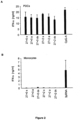
- monocytes appear to utilize RIG-I primarily (Example 1; Figure 1 ).
- PDC is the only cell type that produces a significant amount of IFN- ⁇ upon stimulation with an appropriate TLR ligand.
- other immune cells such as myeloid cells, produce cytokines other than IFN- ⁇ in response to stimulation by TLR ligands. Therefore, monocytes (without contaminating functional PDCs) are ideal for studying the mechanism of ligand recognition by and the activation of RIG-I, with IFN- ⁇ production as the readout.
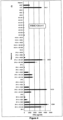
- the present inventors stimulated purified primary human monocytes with the same synthetic blunt-ended short dsRNA without any 5' phosphate as that used in Marques TJ et al. (2006) 16 , and found surprisingly that there was no IFN- ⁇ production (Example 2; Figure 2 , sample “27+0 ds”). Furthermore, the present inventors stimulated purified primary human monocytes with a synthetic blunt-ended short dsRNA bearing a 5' phosphate similar to that used in Takahasi et al. (2008) 24 , and found surprisingly that there was little or no IFN- ⁇ production (Example 3; Figure 6 , samples with "P-A" in the name). These findings contradict suggestions in the prior art that blunt-end was a molecular signature recognized by RIG-I and was capable of activating RIG-I in the absence of 5' triphosphate 16, 24 .
- both 5' triphosphate and blunt end are molecular signatures recognized by RIG-I.
- 5' triphosphate is the primary molecular signature recognized by RIG-I
- blunt end is a secondary one which is not capable of activating RIG-I on its own but is capable of augmenting RIG-I activation in the presence of 5' triphosphate.
- the fact that the activity-enhancing effect of the blunt end was only observed when the blunt end was the end that bore the 5' triphosphate suggests that 5' triphosphate and blunt end are recognized by functional domains or sub-domains of RIG-I which are adjacent to each other in the 3-dimensional structure.
- dsRNA oligonucleotides as short as 21 base pairs (bp) were capable of activating RIG-I and inducing significant IFN- ⁇ production when they bore 5' triphosphate and a blunt end, which is in contrast to the suggestion of Marques et al. (2006) that a length of 25bp was required for consistent RIG-I activation 16 .
- the present inventors found that the RIG-I-activating and IFN- ⁇ -inducing activity of a dsRNA bearing 5' triphosphate and blunt end depended on the identity of the 5' nucleotide bearing the 5' triphosphate. Whereas a dsRNA having a 5' adenosine (A) was more potent than one having a 5' guanosine (G) or one having a 5' uridine (U), they were all more potent than one having a 5' cytidine (C).
- dsRNA oligonucleotides are essentially homogenous populations, wherein the oligonucleotides in each population are chemically well-defined and have essentially the same length, sequence and end structures.
- dsRNA oligonucleotides obtained via in vitro transcription have variable lengths and end structures.
- the present inventors have thus identified synthetic dsRNA oligonucleotides bearing at least one 5' triphosphate and at least one blunt end at the same end as the 5' triphosphate, with a reference for A as the 5' triphoshpate-bearing nucleoside, as highly potent agents for activating RIG-I and inducing type I IFN production from RIG-I-expressing cells.
- RNA oligonucleotide bearing 5' triphosphate means "an RNA oligonucleotide bearing 5' triphosphate”
- triphosphate RNA oligonucleotide and "3pRNA oligonucleotide” are used interchangeably.
- the present invention provides an oligonucleotide preparation which comprises an essentially homogenous population of an oligonucleotide and which is capable of activating RIG-I and inducing an anti-viral response, in particular, a type I IFN response, more specifically, an IFN- ⁇ response, as further defined in the claims.
- the oligonucleotide has two blunt ends and comprises at least 1 ribonucleotide at the 5' end at the blunt end, wherein the blunt end bears a 5' triphosphate attached to the 5' ribonucleotide, wherein the 5' triphosphate is free of any cap structure, and wherein the blunt ends are ends of a fully double-stranded section which is at least 21 base pair (bp) in length and at most 30 bp in length, as defined in the claims. In other words, the blunt ends are the ends of the fully double-stranded section.
- oligonucleotide section is fully double-stranded when the two strands forming the section have the same length and the sequences of the two strands are 100% complementary to each other.
- two nucleotides are said to be complementary to each other if they can form a base pair, either a Waston-Crick base pair (A-U, G-C) or a wobble base pair (U-G, U-A, I-A, I-U, I-C).
- the double-stranded section is preferably at least 22, more preferably 23, even more preferably at least 24 bp in length.
- the double-stranded section is at most 30 bp in length.
- the oligonucleotide has preferably at least 2, 3, 4, 5, 6, more preferably at least 7, 8, 9, 10, 11, 12, even more preferably, at least 13, 14, 15, 16, 17, 18, most preferably, at least 19, 20, 21 ribonucleotides at the 5' end of the strand bearing the 5' triphosphate.
- the fully double-stranded section is composed solely of ribonucleotides.
- the oligonucleotide is an RNA oligonucleotide. In another embodiment, the oligonucleotide is an RNA-DNA hybrid.
- an essentially homogenous population it is meant that the oligonucleotides contained in the preparation have essentially the same chemical identity (or chemical composition), including the same nucleotide sequence, backbone, modifications, length, and end structures.
- the oligonucleotides contained in the preparation are chemically defined and are essentially identical to each other.
- at least 85%, preferably at least 90%, more preferably at least 95%, even more preferably at least 96%, 97%, 98%, most preferably at least 99% of the oligonucleotides in the preparation have the same chemical identity (or chemical composition), including the same nucleotide sequence, backbone, modifications, length, and end structures.
- the preparation is at least 85%, preferably at least 90%, more preferably at least 95%, even more preferably at least 96%, 97%, 98%, most preferably at least 99% pure.
- the purity and the chemical identity (or chemical composition) of an oligonucleotide preparation can be readily determined by a person skilled in the art using any appropriate methods, such as gel electrophoresis (in particular, denaturing gel electrophoresis), HPLC, mass spectrometry (e.g., MALDI-ToF MS), and sequencing.
- the oligonucleotide is a double-stranded oligonucleotide.
- the double-stranded oligonucleotide is one wherein one of the strands comprises at least 1, preferably at least 3, more preferably at least 6 ribonucleotide(s) at the 5' end, and has a triphosphate attached to the most 5' ribonucleotide, wherein the triphosphate is free of any cap structure and wherein the ends are blunt ends, as defined in the claims .
- the double-stranded oligonucleotide has one blunt end bearing the 5' triphosphate and a second blunt end which does not bear a 5' triphosphate.
- the double-stranded oligonucleotide has one 5' triphosphate.
- the double-stranded oligonucleotide is at least 21bp in length, wherein the length refers to the number of base pairs of the continuous section of the oligonucleotide that is fully double-stranded.
- continuous it is meant that the section of the oligonucleotide that is completely double-stranded and is not interrupted by any single-stranded structures.
- the double-stranded oligonucleotide is at least 22, more preferably at least 23, and most preferably at least 24 bp in length.
- the double-stranded oligonucleotide is at most 30bp in length.
- the double-stranded oligonucleotide is a homoduplex.
- homoduplex it is meant that the two strands forming the oligonucleotide have exactly the same length and sequence in the 5' to 3' orientation.
- a homoduplex can be formed when each strand forming the double-stranded oligonucleotide has a sequence that is 100% self-complementary, meaning that the sequence of the 5' half is 100% complementary to that of the 3' half.
- oligonucleotide preparation contains essentially a homogenous population of oligonucleotides having essentially the same chemical identity (or chemical composition), including the same nucleotide sequence, backbone, modifications, length, and end structures, as defined in the claims.
- the oligonucleotides can be purified by any standard methods in the art, such as capillary gel electrophoresis and HPLC. Synthetic oligonucleotides, double-stranded, obtained from most commercial sources contain 5' OH. These synthetic oligonucleotides can be modified at the 5' end to bear a 5' triphosphate by any appropriate methods known in the art. The preferred method for 5' triphosphate attachment is that developed by János Ludwig and Fritz Eckstein 27 .
- in vitro transcription can be employed, which is disclosed but not claimed.
- measures need to be taken to ensure that each intended in vitro transcribed single strand is indeed single-stranded.
- Aberrant transcripts may be generated in vitro using an RNA polymerase.
- an RNA transcript generated by an RNA polymerase in vitro may fold back onto itself and prime RNA-dependent RNA synthesis, leading to the generation of aberrant transcripts of undefined and/or nonuniform lengths and sequences. Therefore, in principle, any measure that would prevent RNA synthesis primed by the RNA transcript itself can be employed.
- a single stranded oligonucleotide is designed to have a sequence X 1 -X 2 -X 3 -...X m- 2 -X m-1 -X m , wherein m is the length of the oligonucleotide, wherein the sequence has no or minimal self complementarity, wherein X 1 , X 2 , X 3 , ..., X m are chosen from 1, 2 or 3 of the 4 conventional nucleotides A, U, C and G, wherein at least one of the nucleotides that are complementary to any of X m-2 , X m-1 , and X m , i.e., Y m-2 , Y m-1 , and Y m , is not among the 1, 2, or 3 nucleotides chosen for X 1 , X 2 , X 3 , ..., X m .
- An appropriate DNA template for generating such an ssRNA oligonucleotide can be generated using any appropriate methods known in the art.
- An in vitro transcription reaction is set up using the DNA template and a nucleotide mixture which does not contain the complementary nucleotide(s) which is(are) not comprised in X 1 -X 2 -X 3 -...X m-2 -X m-1 -X m . Any appropriate in vitro transcription conditions known in the art can be used. Due to the absence of the complementary nucleotide, no aberrant RNA-primed RNA synthesis can take place. As a result, a single-stranded population of X 1 -X 2 -X 3 -...-X m can be obtained.
- the resulting ssRNA preparation can be purified by any appropriate methods known in the art and an equal amount of two purified ssRNA preparations with complementary sequence can be annealed to obtain an essentially homogenous population of a double-stranded RNA oligonucleotide of desired sequence.
- the ssRNA oligonucleotide may be GACACACACACACACACACACACACACACACACACA (SEQ ID NO: 44) and the in vitro transcription may be carried out in the presence of ATP, CTP and GTP, i.e., in the absence of UTP, which is disclosed but not claimed.
- one strand can be prepared by chemical synthesis and the other by in vitro transcription.
- an in vitro transcribed ssRNA can be treated with a phosphatase, such as calf intestine phosphotase (CIP), to remove the 5' triphosphate.
- CIP calf intestine phosphotase
- Mismatch of one or two nucleotides may be tolerated in the double-stranded section of the oligonucleotide in that the IFN-inducing activity of the oligonucleotide is not significantly reduced.
- the mismatch is preferably at least 6bp, more preferably at least 12bp, even more preferably at least 18pb away from the blunt end bearing the 5' triphosphate.
- the double-stranded RNA oligonucleotide contains one or more GU wobble base pairs instead of GC or UA base pairing.
- the double-stranded oligonucleotide as defined in the claims comprises at least 1, 2, 3, 4, 5, preferably at least 6, 7, 8, 9, 10, more preferably at least 11, 12, 13, 14, 15, even more preferably at least 16, 17, 18, 19, 20 inosine (I).
- at least 1, 2, 3, 4, 5%, preferably at least 10, 15, 20, 25, 30%, more preferably at least 35, 40, 45, 50, 55, 60%, even more preferably at least 70, 80, or 90% of the adenosine (A) and/or guanosine (G) in the oligonucleotide is replaced with inosine (I).
- the 5' ribonucleotide bearing the at least one 5' triphosphate is preferably G, followed by U, followed by C, in the order of descending preference.
- sequence of the first 4 ribonucleotides at the 5' end of the double- or single-stranded oligonucleotide bearing the 5' triphosphate is selected from: AAGU (No. 1), AAAG (No. 2), AUGG (No. 3), AUUA (No. 4), AACG (No. 5), AUGA (No. 6), AGUU (No. 7), AUUG (No. 8), AACA (No. 9), AGAA (No. 10), AGCA (No. 11), AACU (No. 12), AUGG (No. 13), AGGA (No. 14), AUCA (No. 15), AUGC (No. 16), AGUA (No. 17), AAGC (No.
- the first nucleotide of the above-listed 5' 4-nucleotide sequences is a G, U or C, in the order of descending preference, instead of A.
- the double-stranded oligonucleotide contains one or more structural motif(s) or molecular signature(s) which is(are) recognized by the TLRs, in particular, TLR3, TLR7 and TLR8.
- the double-stranded oligonucleotide is at least 30bp in length and is recognized by TLR3 2 .
- the double-stranded oligonucleotide contains defined sequence motifs recognized by TLR7 3, 4, 5, 22, 29 .
- the double-stranded oligonucleotide can comprise at least one, preferably at least two, more preferably at least three, even more preferably at least four, even more preferably at least five, and most preferably at least six, of the 4-nucleotide (4mer) motifs selected from the group consisting of: GUUC (No. 101), GUCA (No. 102), GCUC (No. 103), GUUG (No. 104), GUUU (No. 105), GGUU (No. 106), GUGU (No. 107), GGUC (No. 108), GUCU (No.
- GUCC No. 110
- GCUU No. 111
- UUGU No. 112
- UGUC No. 113
- CUGU No. 114
- CGUC No. 115
- UGUU No. 116
- GUUA No. 117
- UGUA No. 118
- UUUC No. 119
- UGUG No. 120
- GGUA No. 121
- GUCG No. 122
- UUUG No. 123
- UGGU No. 124
- GUGG No. 125
- GUGC No. 126
- GUAC No. 127
- GUAU No. 128)
- UAGU No. 129
- GUAG No.
- the 4mer motifs are selected from the group consisting of Nos. 101-119, Nos. 101-118, Nos. 101-117, Nos. 101-116, more preferably, Nos. 101-115, Nos. 101-114, Nos. 101-113, Nos. 101-112, more preferably, Nos. 101-111, Nos. 110-110, Nos. 101-109, No. 101-108, Nos. 101-107, even more preferably, Nos. 101-106, Nos. 101-105, Nos. 101-104, Nos. 101-103, most preferably, Nos. 101-102 of the 4mer motifs.
- the oligonucleotide may comprise one or more copies of the same 4mer motif or one or more copies of one or more different 4mer motifs.
- the double-stranded oligonucleotide may contain one or more of the same or different structural motif(s) or molecular signature(s) recognized by TLR3, TLR7, TLR8 and TLR9 as described above.
- the double-stranded oligonucleotide as defined in the claims has gene-silencing activity.
- gene-silencing activity refers to the capability of the oligonucleotide to downregulate the expression of a gene, preferably via RNA interference (RNAi).
- RNAi RNA interference
- the oligonucleotide is an siRNA (small interfering RNA) or an shRNA (small hairpin RNA).
- siRNAs and shRNAs Given the coding sequence of a gene, a person skilled in the art can readily design siRNAs and shRNAs using publicly available algorithms such as that disclosed in Reynolds et al. 23 and design engines such as "BD-RNAi design” (Beckton Dickinson) and “Block-iT RNAi” (Invitrogen). Even though conventional siRNAs usually are 19bp in length and have two 2-nucleotide 3' overhangs (i.e., each single strand is 21 nucleotides in length), a person skilled in the art can readily modify the sequence of the siRNAs designed by the known algorithms or design engines and obtain double-stranded oligonucleotides which have the structural characteristics of those defined in the claims .
- a person skilled in the art can readily test the gene-silencing efficacy of the oligonucleotides using methods known in the art such as Northern blot analysis, quantitative or semi-quantitative RT-PCR, Western blot analysis, surface or intracellular FACS analysis.
- the siRNA is at least 21bp in length; the sense strand bears a 5' triphosphate; the end that bears the 5' triphosphate is a blunt end and the other end is a blunt end, as defined in the claims .
- the siRNA or shRNA is specific for a disease/disorder-associated gene.
- a disease/disorder-related gene refers to a gene that is expressed in a cell in a disease/disorder but not expressed in a normal cell or a gene that is expressed at a higher level in a cell in a disease/disorder than in a normal cell.
- the expression of the disease/disorder-associated gene causes or contributes to the establishment and/or progression of the disease/disorder.
- the disease/disorder is a tumor or a cancer and the disease/disorder-associated gene is an oncogene.
- oncogenes include wild-type and/or mutant Bcl-2, c-Myc, c-Ras, c-Met, Her2, EGFR, PDGFR, VEGFR, Edg4, Edg7, S1P, Raf, ERKWNT, Survivin, HGF, cdk2, cdk4, MITF, cyclin D1, GRO.
- the disease/disorder is a viral infection and the disease/disorder-associated gene is a gene which is or the product of which is required for host cell recognition, host cell entry, viral replication, viral partical assembly, and/or viral transmission.
- the disease/disorder-associated gene may be a viral gene or a host gene.
- An example of a viral gene is HbsAg of HBV.
- the double-stranded oligonucleotide may contain any naturally-occurring, synthetic, modified nucleotides, or a mixture thereof, as long as the synthetic and/or modified nucleotides do not compromise (i.e., reduce) the type I IFN-inducing activity of the oligonucleotide.
- the oligonucleotide does not contain any modification such as pseudouridine, 2-thiouridine, 2'-Fluorine-dNTP, 2'-O-methylated NTP, in particular 2'-fluorine-dCTP, 2'-fluorine-dUTP, 2'-O-methylated CTP, 2'-O-methylated UTP.
- the double-stranded oligonucleotide may contain any naturally-occurring, synthetic, modified internucleoside linkages, or a mixture thereof, as long as the linkages do not compromise the type I IFN-inducing activity of the oligonucleotide.
- the 5' triphosphate group of the double-stranded oligonucleotide may be modified as long as the modification does not compromise the type I IFN-inducing activity of the oligonucleotide.
- one or more of the oxygen (O) in the triphosphate group may be replaced with a sulfur (S); the triphosphate group may be modified with the addition of one or more phosphate group(s).
- the double-stranded oligonucleotide may be modified covalently or non-covalently to improve its chemical stability, resistance to nuclease degradation, ability to across cellular and/or subcellular membranes, target (organ, tissue, cell type, subcellular compartment)-specificity, pharmacokinetic properties, biodistribution, or any combinations thereof.
- phosphorothioate linkage(s) and/or pyrophosphate linkage(s) may be introduced to enhance the chemical stability and/or the nuclease resistance of an RNA oligonucleotide.
- the oligonucleotide may be covalently linked to one or more lipophilic group(s) or molecule(s), such as a lipid or a lipid-based molecule, preferably, a cholesterol or a derivative thereof.
- the lipophilic group or molecule is preferably not attached to the blunt end bearing the 5' triphosphate.
- the modification does not comprise the type I IFN-inducing activity of the oligonucleotide.
- a reduction in the type I IFN-inducing activity of the oligonucleotide caused by the modification is off-set by an increase in the stability and/or delivery and/or other properties as described above.
- the double-stranded oligonucleotide may bear any combination of any number of features described above, as further defined in the claims.
- a preferred double-stranded oligonucleotide is an RNA oligonucleotide having one blunt end with one 5' triphosphate attached to a 5' and a length of between 21 and 30bp, as further defined I the claims.
- a more preferred double-stranded oligonucleotide is an RNA oligonucleotide having two blunt ends bearing one 5' triphosphate attached to a 5' and a length of between 21 and 30bp.
- the present invention provides a pharmaceutical composition
- a pharmaceutical composition comprising at least one of the oligonucleotide preparation of the invention described above and a pharmaceutically acceptable carrier, as defined in the claims.
- oligonucleotide preparation(s) of the same or different oligonucleotide(s) can be used together.
- the pharmaceutical composition further comprises an agent which facilitates the delivery of the oligonucleotide into a cell, in particular, into the cytosol of the cell, as defined in the claims.
- the delivery agent is a complexation agent which forms a complex with the oligonucleotide and facilitates the delivery of the oligonucleotide into cells.
- Complexation agents are also referred to as "transfection agents" in the art. Any complexation agent which is compatible with the intended use of the pharmaceutical composition can be employed. Examples of complexation agents include polymers and biodegradable microspheres.
- the polymer is preferably a cationic polymer, more preferably a cationic lipid.
- Examples of a polymer include polyethylenimine (PEI) such as in vivo-jetPEI TM (PolyPlus) and collagen derivatives.
- biodegradable microspheres examples include liposomes, virosomes, stable-nucleic-acid-lipid particles (SNALPs), SICOMATRIX ® (CSL Limited), and poly (D,L-lactide-co-glycolide) copolymer (PLGA) microspheres.
- SNALPs stable-nucleic-acid-lipid particles
- SICOMATRIX ® CSL Limited
- PLGA poly (D,L-lactide-co-glycolide) copolymer
- the delivery agent is a virus, preferably a replication-deficient virus.
- the oligonucleotide to be delivered is contained in the viral capsule and the virus may be selected based on its target specificity.
- useful viruses include polymyxoviruses which target upper respiratory tract epithelia and other cells, hepatitis B virus which targets liver cells, influenza virus which targets epithelial cells and other cells, adenoviruses which targets a number of different cell types, papilloma viruses which targets epithelial and squamous cells, herpes virus which targets neurons, retroviruses such as HIV which targets CD4 + T cells, dendritic cells and other cells, modified Vaccinia Ankara which targets a variety of cells, and oncolytic viruses which target tumor cells.
- oncolytic viruses include naturally occurring wild-type Newcastle disease virus, attenuated strains of reovirus, vesicular stomatitis virus (VSV), and genetically engineered mutants of herpes simplex virus type 1 (HSV-1), adenovirus, poxvirus and measles virus.
- the oligonucleotide and/or the pharmaceutical composition can be delivered into cells via physical means such as electroporation, shock wave administration, ultrasound triggered transfection, and gene gun delivery with gold particles.
- the pharmaceutical composition may further comprise another agent such as an agent that stabilizes the oligonucleotide.
- a stabilizing agent include a protein that complexes with the oligonucleotide to form an iRNP, chelators such as EDTA, salts, and RNase inhibitors.
- the pharmaceutical composition further comprises one or more pharmaceutically active therapeutic agent(s), as defined in the claims.
- a pharmaceutically active agent include immunostimulatory agents, anti-viral agents, antibiotics, anti-fungal agents, anti-parasitic agents, anti-tumor agents, cytokines, chemokines, growth factors, anti-angiogenic factors, chemotherapeutic agents, antibodies and gene silencing agents.
- the pharmaceutically active agent is selected from the group consisting of an immunostimulatory agent, an anti-viral agent and an anti-tumor agent.
- the more than one pharmaceutically active agents may be of the same or different category.
- the pharmaceutical composition further compriese retinoid acid, IFN- ⁇ and/or IFN- ⁇ .
- Retinoid acid, IFN- ⁇ and/or IFN- ⁇ are capable of sensitizing cells for IFN- ⁇ production, possibly through the upregulation of RIG-I expression.
- the pharmaceutical composition may be formulated in any way that is compatible with its therapeutic application, including intended route of administration, delivery format and desired dosage.
- Optimal pharmaceutical compositions may be formulated by a skilled person according to common general knowledge in the art, such as that described in Remington's Pharmaceutical Sciences (18th Ed., Gennaro AR ed., Mack Publishing Company, 1990 ).
- the pharmaceutical composition may be formulated for instant release, controlled release, timed-release, sustained release, extended release, or continuous release.
- the pharmaceutical composition may be administered by any route known in the art, including, but not limited to, topical, enteral and parenteral routes, provided that it is compatible with the intended application.
- Topic administration includes, but is not limited to, epicutaneous, inhalational, intranasal, vaginal administration, enema, eye drops, and ear drops.
- Enteral administration includes, but is not limited to, oral, rectal administration and administration through feeding tubes.
- Parenteral administration includes, but is not limited to, intravenous, intraarterial, intramuscular, intracardiac, subcutaneous, intraosseous, intradermal, intrathecal, intraperitoneal, transdermal, transmucosal, and inhalational administration.
- the pharmaceutical composition is for local (e.g., mucosa, skin) applications, such as in the form of a spray (i.e., aerosol) preparation.
- a spray i.e., aerosol
- the pharmaceutical composition may be use for prophylactic and/or therapeutic purposes.
- a spray i.e., aerosol
- aerosol i.e., aerosol
- the optimal dosage, frequency, timing and route of administration can be readily determined by a person skilled in the art on the basis of factors such as the disease or condition to be treated, the severity of the disease or condition, the age, gender and physical status of the patient, and the presence or absence of previous treatment.
- the present application provides the in vitro use of the oligonucleotide preparation of the invention described above and further defined in the claims.
- the present application provides the use of at least one oligonucleotide preparation for inducing an anti-viral response, in particular, a type I IFN response, more specifically, an IFN- ⁇ response, in vitro, as defined in the claims.
- the present application also provides the use of at least one oligonucleotide preparation for inducing apoptosis of a tumor cell in vitro.
- the present invention provides an in vitro method for stimulating an anti-viral response, in particular, a type I IFN response, more specifically, an IFN- ⁇ response in a cell, as defined in the claims, comprising the steps of:
- the cells may express RIG-I endogenously and/or exogenously from an exogenous nucleic acid (RNA or DNA).
- the exogenous DNA may be a plasmid DNA, a viral vector, or a portion thereof.
- the exogenous DNA may be ingerated into the genome of the cell or may exisit extra-chromosomally.
- the cells include, but are not limited to, primary immune cells, primary non-immune cells, and cell lines.
- Immune cells include, but are not limited to, peripheral blood mononuclear cells (PBMC), plasmacytoid dendritric cells (PDC), myeloid dendritic cells (MDC), macrophages, monocytes, B cells, natural killer cells, granulocytes, CD4+ T cells, CD8+ T cells, and NKT cells.
- Non-immune cells include, but are not limited to, fibroblasts, endothelial cells, epithelial cells, and tumor cells. Cell lines may be derived from immune cells or non-immune cells.
- the present disclosure provides an in vitro method for inducing apoptosis of a tumor cell, comprising the steps of:
- the tumor cell may be a primary tumor cell freshly isolated from a vertebrate animal having a tumor or a tumor cell line.
- the present application provides the in vivo use of the oligonucleotide preparation of the invention as defined in the claims .
- the present invention provides at least one oligonucleotide preparation for inducing an anti-viral response, in particular, a type I IFN response, more specifically, an IFN- ⁇ response, in a vertebrate animal, in particular, a mammal, as further defined in the claims.
- the present application further provides at least one oligonucleotide preparation for inducing apoptosis of a tumor cell in a vertebrate animal, in particular, a mammal.
- the present application additionally provides at least one oligonucleotide preparation for preventing and/or treating a disease and/or disorder in a vertebrate animal, in particular, a mammal, in medical and/or veterinary practice, as further defined in the claims
- At least one oligonucleotide preparation can be used as a vaccine adjuvant.
- the present application provides the use of at least one oligonucleotide preparation for the preparation of a pharmaceutical composition for inducing an anti-viral response, in particular, a type I IFN response, more specifically, an IFN- ⁇ response, in a vertebrate animal, in particular, a mammal, as defined in the claims.
- the present application further provides the use of at least one oligonucleotide preparation for the preparation of a pharmaceutical composition for inducing apoptosis of a tumor cell in a vertebrate animal, in particular, a mammal.
- the present application additionally provides the use of at least one oligonucleotide preparation for the preparation of a pharmaceutical composition for preventing and/or treating a disease and/or disorder in a vertebrate animal, in particular, a mammal, in medical and/or veterinary practice, as defined in the claims.
- the diseases and/or disorders include infections, tumors/cancers, and immune disorders, as defined in the claims.
- Infections include, but are not limited to, viral infections, bacterial infections, anthrax, parasitic infections, fungal infections and prion infection.
- Viral infections include, but are not limited to, infections by hepatitis C, hepatitis B, influenza virus, herpes simplex virus (HSV), human immunodeficiency virus (HIV), respiratory syncytial virus (RSV), vesicular stomatitis virus(VSV), cytomegalovirus (CMV), poliovirus, encephalomyocarditis virus (EMCV), human papillomavirus (HPV) and smallpox virus.
- the infection is an upper respiratory tract infection caused by viruses and/or bacteria, in particular, flu, more specifically, bird flu.
- Bacterial infections include, but are not limited to, infections by streptococci , staphylococci , E. Coli , and pseudomonas.
- the bacterial infection is an intracellular bacterial infection which is an infection by an intracellular bacterium such as mycobacteria (tuberculosis), chlamydia, mycoplasma, listeria, and an facultative intracelluar bacterium such as staphylococcus aureus.
- Parasitic infections include, but are not limited to, worm infections, in particular, intestinal worm infection.
- the infection is a viral infection or an intracellular bacterial infection.
- the infection is a viral infection by hepatitis C, hepatitis B, influenza virus, RSV, HPV, HSV1, HSV2, and CMV.
- Tumors include both benign and malignant tumors (i.e., cancer).
- Cancers include, but are not limited to biliary tract cancer, brain cancer, breast cancer, cervical cancer, choriocarcinoma, colon cancer, endometrial cancer, esophageal cancer, gastric cancer, intraepithelial neoplasm, leukemia, lymphoma, liver cancer, lung cancer, melanoma, myelomas, neuroblastoma, oral cancer, ovarian cancer, pancreatic cancer, prostate cancer, rectal cancer, sarcoma, skin cancer, testicular cancer, thyroid cancer and renal cancer.
- the cancer is selected from hairy cell leukemia, chronic myelogenous leukemia, cutaneous T-cell leukemia, chronic myeloid leukemia, non-Hodgkin's lymphoma, multiple myeloma, follicular lymphoma, malignant melanoma, squamous cell carcinoma, renal cell carcinoma, prostate carcinoma, bladder cell carcinoma, breast carcinoma, ovarian carcinoma, non-small cell lung cancer, small cell lung cancer, hepatocellular carcinoma, basaliom, colon carcinoma, cervical dysplasia, and Kaposi's sarcoma (AIDS-related and non-AIDS related).
- hairy cell leukemia chronic myelogenous leukemia, cutaneous T-cell leukemia, chronic myeloid leukemia, non-Hodgkin's lymphoma, multiple myeloma, follicular lymphoma, malignant melanoma, squamous cell carcinoma, renal cell carcinoma, prostate carcinoma, bladder cell carcinoma, breast carcinoma, ova
- Immune disorders include, but are not limited to, allergies, autoimmune disorders, and immunodeficiencies.
- Autoimmune diseases include, but are not limited to, multiple sclerosis, diabetes mellitus, arthritis (including rheumatoid arthritis, juvenile rheumatoid arthritis, osteoarthritis, psoriatic arthritis), encephalomyelitis, myasthenia gravis, systemic lupus erythematosis, autoimmune thyroiditis, dermatisis (including atopic dermatitis and eczematous dermatitis), psoriasis, Siogren's Syndrome, Crohn's disease, aphthous ulcer, ulceris, conjunctivitis, keratoconjunctivitis, ulcerative colitis, asthma, allergic asthma, cutaneous lupus erythematosus, scleroderma, vaginitis, proctitis, drug eruptions, leprosy reversal reactions, erythema nodosum leprosum, allergic encephalomye
- Immunodeficiencies include, but are not limited to, spontaneous immunodeficiency, acquired immunodeficiency (including AIDS), drug-induced immunodeficiency or immunosuppression (such as that induced by immunosuppressants used in transplantation and chemotherapeutic agents used for treating cancer), and immunosuppression caused by chronic hemodialysis, trauma or surgical procedures.
- the immune disorder is multiple sclerosis.
- the oligonucleotide has gene silencing activity.
- the oligonucleotide thus has two functionalities, gene silencing and immune stimulating, combined in one molecule.
- the oligonucleotide has gene-silencing activity that is specific for a disease/disorder-associated gene, such as an oncogene or a gene required for viral infection and/or replication.
- the oligonucleotide is used in combination with one or more pharmaceutically active agents such as immunostimulatory agents, anti-viral agents, antibiotics, anti-fungal agents, anti-parasitic agents, anti-tumor agents, cytokines, chemokines, growth factors, anti-angiogenic factors, chemotherapeutic agents, antibodies and gene silencing agents.
- pharmaceutically active agent is selected from the group consisting of an immunostimulatory agent, an anti-viral agent and an anti-tumor agent.
- the more than one pharmaceutically active agents may be of the same or different category.
- the oligonucleotide is used in combination with an anti-viral vaccine, an anti-bacterial vaccine, and/or an anti-tumor vaccine, wherein the vaccine can be prophylactic and/or therapeutic.
- the oligonucleotide can serve as a vaccine adjuvant.
- the oligonucleotide is used in combination with retinoic acid and/or type I IFN (IFN- ⁇ and/or IFN- ⁇ ).
- Retinoid acid, IFN- ⁇ and/or IFN- ⁇ are capable of sensitizing cells for IFN- ⁇ production, possibly through the upregulation of RIG-I expression.
- the pharmaceutical composition is for use in combination with one or more prophylactic and/or therapeutic treatments of diseases and/or disorders such as infection, tumor, and immune disorders.
- the treatments may be pharmacological and/or physical (e.g., surgery, radiation).
- Vertebrate animals include, but are not limited to, fish, amphibians, birds, and mammals. Mammals include, but are not limited to, rats, mice, cats, dogs, horses, sheep, cattle, cows, pigs, rabbits, non-human primates, and humans. In a preferred embodiment, the mammal is human.
- the present invention is illustrated by the following Examples.
- the Examples are for illustration purposes only and are by no means to be construed to limit the scope of the invention.
- Human PBMC were prepared from whole blood donated by young healthy donors by Ficoll-Hypaque density gradient centrifugation (Biochrom, Berlin, Germany).
- PDC were isolated by MACS using the blood dendritic cell Ag (BCDA)-4 dendritic cell isolation kit from Miltenyi Biotec (Bergisch-Gladbach, Germany). Briefly, PDC were labelled with anti-BDCA-4 Ab coupled to colloidal paramagnetic microbeads and passed through a magnetic separation column twice (LS column, then MS column; Miltenyi Biotec). The purity of isolated PDC (lineage-negative, MHC-II-positive and CD123-positive cells) was above 95 %.
- MDC monocyte isolation kit II
- monocyte isolation kit II MDCs were purified from PBMC by immunomagnetic sorting with anti-CD1c beads (CD1c (BDCA-1)+ Dendritic Cell Isolation Kit, human, Miltenyi Biotec). Viability of all cells was above 95 %, as determined by trypan blue exclusion. Unless indicated otherwise, cells were cultured in 96-well plates for stimulation experiments.
- MDCs (0.5 ⁇ 10 6 /ml) were kept in RPMI 1640 containing 10% FCS, 1.5mM L-glutamine, 100 U/ml penicilin and 100 ⁇ g/ml streptomycin.
- PDCs (0.25 ⁇ 10 6 /ml) were cultured in the same medium supplemented with 10 ng/ml IL-3 (R&D Systems GmbH).
- Monocytes (0.5 ⁇ 10 6 /ml) were resuspended in RPMI medium with 2% AB serum (BioWhittaker, Heidelberg, Germany), 1.5mM L-glutamine, 100 U/ml penicilin and 100 ⁇ g/ml streptomycin. All compounds were tested for endotoxin contamination prior to use.
- TLR7-deficient mice were kindly provided by S. Akira 3 .
- Female C57BU6 mice were purchased from Harlan-Winkelmann (Borchen, Germany). Mice were 6-12 weeks of age at the onset of experiments. Animal studies were approved by the local regulatory agency (Regierung von Oberbayern, Kunststoff, Germany).
- RNA oligonucleotides were purchased from Eurogentec (Leiden, Belgium), MWG-BIOTECH AG (Ebersberg, Germany), biomers.net GmbH (Ulm, Germany), and optionally modified by Janos Ludwig (Rockefeller Univ., USA).
- In vitro transcribed RNAs were prepared using the Megashort Script Kit (Ambion, Huntingdon, UK) following the manufacture's instructions. In vitro transcription was carried out overnight at 37 °C. The DNA template was digested using DNase I (Ambion). RNAs were purified by phenol:chloroform extraction and alcohol precipitation.
- RNAs Excess salts and NTPs were removed by passing the RNAs through a Mini Quick Spin TM Oligo Column (Roche). Size and integrity of RNAs was checked via gel electrophoresis. CpG-ODN was purchased from Coley Pharmaceutical Group (Wellesley, USA) or Metabion (Martinsried, Germany).
- RNA oligonucleotides were transfected into cells using 0.5 ⁇ l of Lipofectamine 2000 (Invitrogen) in each well of a 96-well plate according to the manufacturer s protocol. CpG ODN was used at a final concentration of 3 ⁇ g/ml.
- the polycationic polypeptide poly-L-arginine (Sigma, P7762)
- 200ng nucleic acid diluted in PBS PAA Laboratories GmBH
- PBS PAA Laboratories GmBH
- cells were pre-treated with 1 or 2.5 ⁇ g/ml chloroquine (Sigma) for 30min prior to stimulation. 24h post-stimulation/transcription, tissue culture supernatants were collected and assayed for IFN- ⁇ production.
- Human IFN- ⁇ was assessed in cell culture supernatants harvested 24 hours after stimulation/transfection using the IFN- ⁇ module set (Bender MedSystems, Graz, Austria) according to manufacturer's recommendations.
- Murine IFN- ⁇ was measured according to the following protocol: monoclonal rat anti-mouse IFN- ⁇ (clone RMMA-1) was used as the capture Ab, polyclonal rabbit anti-mouse IFN- ⁇ serum was used for detection (both PBL Biomedical Laboratories), and HRP-conjugated donkey anti-rabbit IgG was used as the secondary reagent (Jackson ImmunoResearch Laboratories).
- Mouse rlFN- ⁇ (PBL Biomedical Laboratories) was used as the standard (IFN- ⁇ concentration in IU/ ml).
- RNA oligonucleotides bearing 5' triphosphate are recognized by different receptors in monocytes and PDCs. (Comparative example)
- RNA oligonucleotides bearing 5' triphosphate (3pRNA) were transfected into these cells in the presence and absence of chloroquine, a potent inhibitor of TLR7, TLR8 and TLR9-mediated nucleic aid recognition.
- Table 1 RNA and DNA oligonucleotide sequences.
- the ability of 3pRNA to induce IFN- ⁇ from PDCs depended on the presence of U in the sequence which is known to be a molecular signature recognized by TLR7.
- Example 2 IFN- ⁇ induction in monocytes strictly requires the presence of a 5' triphosphate.
- RNA oligonucleotides bearing 5' monophosphate were transfected into purified primary human monocytes. An in vitro transcribed RNA bearing 5' triphosphate was used as a positive control. The level of IFN- ⁇ secretion was determined 24 hours after transfection/stimulation. Table 2. RNA oligonucleotide sequences.
- RNA oligonucleotides tested were capable of inducing IFN- ⁇ production from PDCs which primarily use TLR7 for short dsRNA recognition (see Example 1).
- Example 3 Blunt end augments the immunostimulatory activity of synthetic double-stranded oligonucleotides bearing 5' triphosphate.
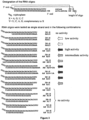
- RNA oligonucleotides are capable of inducing IFN- ⁇ production from PDCs via a TLR7-dependent pathway (see Example 1), in order to study RIG-I-dependent induction of IFN- ⁇ , RNA oligonucleotides ( Figure 3 & Table 3) were transfected into purified monocytes, PDC-depleted PBMCs (PBMC-PDC) or chloroquine-treated PBMCs (PBMC+Chl).
- RNA and DNA oligonucelotide sequences Name Sequence 5' end Type SEQ ID NO 3P-A A ACACACACACACACACACACUUU 3P RNA, syn 8 ivt3P-G G ACACACACACACACACUUU 3P RNA, ivt 9 3P-G G ACACACACACACACACUUU 3P RNA, syn 9 3P-C C ACACACACACACACACUUU 3P RNA, syn 10 3P-U U ACACACACACACACACACAC U U U 3P RNA, syn 11 HO-A A ACACACACACACACACACACUUU OH RNA, syn 8 P-A A ACACACACACACACACACACUUU P RNA, syn 8 AS A26 AAAGUGUGUGUGUGUGUGUGUGUGUGUGUGUGUGUGUGUGUGUGUGUGUGUGUGUGUGUGUGUGUGUGUGUGUGUGUGUGUGUGUGUGUGUGUGUGUGUGUGUGUGUGUGUGUGUGUGU
- a minimal length of 21 nucleotides was required for a double-stranded 3pRNA oligonucleotide to induce IFN- ⁇ from monocytes. Furthermore, the highest IFN- ⁇ -inducing activity was seen when the double-stranded 3pRNA oligonucleotide had a blunt end at the same end bearing the 5' triphosphate. The structure of the end not bearing a 5' triphosphate did not appear to affect the IFN- ⁇ -inducing activity of the oligonucleotide to any significant degree.
- dsRNA oligonucleotides with an A at the 5' end bearing the 5' triphosphate were more potent in inducing IFN- ⁇ than those with a G or U at the same position; dsRNA oligonucleotides with a C at the 5' end bearing the 5' triphosphate was the least potent. Similar results were obtained with PDC-depleted PBMCs and chloroquine-treated PBMCs ( Figure 4-6 , B & C).
- blunt end is a molecular signature recognized by RIG-I; it augments the potency of a synthetic double-stranded RNA oligonucleotide bearing 5' triphosphate at the same end in inducing IFN- ⁇ via the RIG-I pathway.
- Example 4 Single-stranded RNA transcripts can be generated by in vitro transcription.
Landscapes
- Health & Medical Sciences (AREA)
- Genetics & Genomics (AREA)
- Life Sciences & Earth Sciences (AREA)
- Engineering & Computer Science (AREA)
- Biomedical Technology (AREA)
- Bioinformatics & Cheminformatics (AREA)
- Wood Science & Technology (AREA)
- Organic Chemistry (AREA)
- Chemical & Material Sciences (AREA)
- Biotechnology (AREA)
- General Engineering & Computer Science (AREA)
- Zoology (AREA)
- Molecular Biology (AREA)
- Microbiology (AREA)
- Immunology (AREA)
- Plant Pathology (AREA)
- Biophysics (AREA)
- Biochemistry (AREA)
- General Health & Medical Sciences (AREA)
- Physics & Mathematics (AREA)
- Pharmaceuticals Containing Other Organic And Inorganic Compounds (AREA)
- Detergent Compositions (AREA)
- Emulsifying, Dispersing, Foam-Producing Or Wetting Agents (AREA)
- Saccharide Compounds (AREA)
Claims (13)
- Population essentiellement homogène d'un oligonucléotide synthétisé chimiquement, qui est apte à activer RIG-I et à induire une réponse IFN de type I,dans laquelle ladite population essentiellement homogène signifie qu'au moins 85 % des oligonucléotides ont la même identité chimique, y compris la même séquence nucléotidique, le même squelette, les mêmes modifications, longueur et structures d'extrémité,dans laquelle l'oligonucléotide a deux extrémités franches,dans laquelle les extrémités franches sont les extrémités d'une section entièrement double brin, et dans laquelle la section entièrement double brin a une longueur d'au moins 21 et d'au plus 30 paires de bases, etl'oligonucléotide double brin a une extrémité franche portant un triphosphate en 5' lié au ribonucléotide le plus en 5' et une seconde extrémité franche qui ne porte pas de triphosphate en 5',dans laquelle le ribonucléotide le plus en 5' avec le triphosphate lié est G, U ou C,dans laquelle l'oligonucléotide comprend au moins 1, de préférence au moins 3, plus préférablement au moins 6 ribonucléotide(s) à l'extrémité 5' au niveau de l'extrémité franche portant le triphosphate en 5', etdans laquelle l'oligonucléotide est dépourvu de modifications choisies dans le groupe constitué de la pseudouridine, la 2-thiouridine, un 2'fluor-dNTP et un NTP 2-O-méthylé, ou dans laquelle l'oligonucléotide contient des nucléotides modifiés qui ne compromettent pas l'activité d'induction de l'IFN de type I,dans laquelle le triphosphate en 5' est dépourvu de toute structure de coiffe.
- Population d'oligonucléotides selon la revendication 1, dans laquelle ladite population essentiellement homogène signifie qu'au moins 90 %, de préférence au moins 95 %, plus préférablement au moins 95 %, plus préférablement au moins 97 %, et de manière préférée entre toutes au moins 98 % des oligonucléotides ont la même identité chimique, y compris la même séquence nucléotidique, le même squelette, les mêmes modifications, longueur et structures d'extrémité.
- Population d'oligonucléotides selon l'une quelconque des revendications 1 ou 2, dans laquelle la section entièrement double brin a au moins une longueur de 22 paires de bases, plus préférablement une longueur de 23 paires de bases, et de manière préférée entre toutes une longueur de 24 paires de bases.
- Population d'oligonucléotides selon l'une quelconque des revendications 1 à 3, dans laquelle le ribonucléotide le plus en 5' auquel est lié le triphosphate est G.
- Population d'oligonucléotides selon l'une quelconque des revendications 1 à 4, dans laquelle la section entièrement double brin est composée uniquement de ribonucléotides.
- Population d'oligonucléotides selon l'une quelconque des revendications 1 à 5, dans laquelle la séquence des 3 premiers ribonucléotides suivant le ribonucléotide le plus en 5' portant le triphosphate en 5' est choisie parmi AGU, AAG, UGG, UUA, ACG, UGA, GUU, UUG, ACA, GAA, GCA, ACU, UCG, GGA, UCA, UGC, GUA, ACC, GGU, AAC, UGU, CUG, CGA, CAG, AGG, CAU, CGC, AAU, CGG, UUC, GUG, CAA, UCC, dans laquelle la séquence est dans le sens 5'->3'.
- Population d'oligonucléotides selon l'une quelconque des revendications 1 à 6, dans laquelle l'oligonucléotide comprend au moins une inosine.
- Population d'oligonucléotides selon l'une quelconque des revendications 1 à 7, dans laquelle l'oligonucléotide présente une activité de silençage génique.
- Composition pharmaceutique comprenant au moins une population d'oligonucléotides selon l'une quelconque des revendications 1 à 8, et un support pharmaceutiquement acceptable.
- Composition pharmaceutique selon la revendication 9, comprenant en outre au moins un agent choisi parmi un agent immunostimulant, un agent antiviral, un agent antibactérien, un agent anti-tumoral, l'acide rétinoïque, l'IFN-a et l'IFN-β.
- Composition pharmaceutique selon l'une quelconque des revendications 9 ou 10 pour une utilisation dans la prévention et/ou le traitement d'une maladie ou d'un état choisi parmi une infection, une tumeur et un trouble immunitaire.
- Composition pharmaceutique pour une utilisation selon la revendication 11, dans laquelle la composition pharmaceutique est destinée à être administrée en association avec au moins un traitement choisi parmi un traitement prophylactique et/ou thérapeutique d'une infection, d'une tumeur et d'un trouble immunitaire.
- Procédé in vitro d'induction de la production d'IFN de type I dans une cellule, comprenant les étapes de :(a) mélange d'au moins une population d'oligonucléotides selon l'une quelconque des revendications 1 à 8 avec un agent de complexation ; et(b) mise en contact d'une cellule avec le mélange de (a), dans laquelle la cellule exprime RIG-I.
Priority Applications (1)
| Application Number | Priority Date | Filing Date | Title |
|---|---|---|---|
| EP21209636.6A EP4015636B1 (fr) | 2008-05-21 | 2008-05-21 | Oligonucléotide de triphosphate 5' avec extrémité franche et utilisations associées |
Applications Claiming Priority (5)
| Application Number | Priority Date | Filing Date | Title |
|---|---|---|---|
| EP21209636.6A EP4015636B1 (fr) | 2008-05-21 | 2008-05-21 | Oligonucléotide de triphosphate 5' avec extrémité franche et utilisations associées |
| EP15190442.2A EP3045536B1 (fr) | 2008-05-21 | 2008-05-21 | Oligonucléotide de triphosphate 5 avec extrémité franche et utilisations associées |
| EP12004666.9A EP2518150B1 (fr) | 2008-05-21 | 2008-05-21 | Oligonucléotide de triphosphate 5 avec extrémité franche et utilisations associées |
| EP19174691.6A EP3581656B1 (fr) | 2008-05-21 | 2008-05-21 | Oligonucléotide de triphosphate 5' avec extrémité franche et utilisations associées |
| EP08009406A EP2123757B1 (fr) | 2008-05-21 | 2008-05-21 | Oligonucléotide à 5'-triphosphate présentant une extrémité franche et ses utilisations |
Related Parent Applications (4)
| Application Number | Title | Priority Date | Filing Date |
|---|---|---|---|
| EP12004666.9A Division EP2518150B1 (fr) | 2008-05-21 | 2008-05-21 | Oligonucléotide de triphosphate 5 avec extrémité franche et utilisations associées |
| EP08009406A Division EP2123757B1 (fr) | 2008-05-21 | 2008-05-21 | Oligonucléotide à 5'-triphosphate présentant une extrémité franche et ses utilisations |
| EP15190442.2A Division EP3045536B1 (fr) | 2008-05-21 | 2008-05-21 | Oligonucléotide de triphosphate 5 avec extrémité franche et utilisations associées |
| EP19174691.6A Division EP3581656B1 (fr) | 2008-05-21 | 2008-05-21 | Oligonucléotide de triphosphate 5' avec extrémité franche et utilisations associées |
Publications (2)
| Publication Number | Publication Date |
|---|---|
| EP4015636A1 EP4015636A1 (fr) | 2022-06-22 |
| EP4015636B1 true EP4015636B1 (fr) | 2024-11-20 |
Family
ID=39823273
Family Applications (5)
| Application Number | Title | Priority Date | Filing Date |
|---|---|---|---|
| EP21209636.6A Active EP4015636B1 (fr) | 2008-05-21 | 2008-05-21 | Oligonucléotide de triphosphate 5' avec extrémité franche et utilisations associées |
| EP15190442.2A Active EP3045536B1 (fr) | 2008-05-21 | 2008-05-21 | Oligonucléotide de triphosphate 5 avec extrémité franche et utilisations associées |
| EP08009406A Active EP2123757B1 (fr) | 2008-05-21 | 2008-05-21 | Oligonucléotide à 5'-triphosphate présentant une extrémité franche et ses utilisations |
| EP12004666.9A Revoked EP2518150B1 (fr) | 2008-05-21 | 2008-05-21 | Oligonucléotide de triphosphate 5 avec extrémité franche et utilisations associées |
| EP19174691.6A Active EP3581656B1 (fr) | 2008-05-21 | 2008-05-21 | Oligonucléotide de triphosphate 5' avec extrémité franche et utilisations associées |
Family Applications After (4)
| Application Number | Title | Priority Date | Filing Date |
|---|---|---|---|
| EP15190442.2A Active EP3045536B1 (fr) | 2008-05-21 | 2008-05-21 | Oligonucléotide de triphosphate 5 avec extrémité franche et utilisations associées |
| EP08009406A Active EP2123757B1 (fr) | 2008-05-21 | 2008-05-21 | Oligonucléotide à 5'-triphosphate présentant une extrémité franche et ses utilisations |
| EP12004666.9A Revoked EP2518150B1 (fr) | 2008-05-21 | 2008-05-21 | Oligonucléotide de triphosphate 5 avec extrémité franche et utilisations associées |
| EP19174691.6A Active EP3581656B1 (fr) | 2008-05-21 | 2008-05-21 | Oligonucléotide de triphosphate 5' avec extrémité franche et utilisations associées |
Country Status (9)
| Country | Link |
|---|---|
| EP (5) | EP4015636B1 (fr) |
| CY (1) | CY1117499T1 (fr) |
| DK (1) | DK2518150T3 (fr) |
| ES (1) | ES2553877T3 (fr) |
| HR (1) | HRP20151198T2 (fr) |
| HU (1) | HUE026153T2 (fr) |
| PL (1) | PL2518150T3 (fr) |
| PT (1) | PT2518150E (fr) |
| SI (1) | SI2518150T1 (fr) |
Families Citing this family (15)
| Publication number | Priority date | Publication date | Assignee | Title |
|---|---|---|---|---|
| SI2056845T1 (en) | 2006-08-08 | 2018-02-28 | Rheinische Friedrich-Wilhelms-Universitaet Bonn | STRUCTURE AND USE 5 'PHOSPHATE OF OLIGONUCLEOTES |
| EP2297323A1 (fr) | 2008-05-21 | 2011-03-23 | Hartmann, Gunther | Oligonucléotide à 5 -triphosphate présentant une extrémité franche et ses utilisations |
| EP2508530A1 (fr) | 2011-03-28 | 2012-10-10 | Rheinische Friedrich-Wilhelms-Universität Bonn | Purification d'oligonucléotides triphosphorylés au moyen d'étiquettes de capture |
| US20140286998A1 (en) * | 2011-10-31 | 2014-09-25 | Riboxx Gmbh | Double-Stranded RNA For Immunostimulation |
| WO2013097965A1 (fr) * | 2011-12-30 | 2013-07-04 | Riboxx Gmbh | Arn bicaténaire contenant un triphosphate pour l'immunostimulation |
| EP2880186B1 (fr) | 2012-08-03 | 2019-02-06 | University Of Washington Through Its Center For Commercialization | Compositions et procédés pour améliorer le séquençage de nanopores |
| EP2712870A1 (fr) | 2012-09-27 | 2014-04-02 | Rheinische Friedrich-Wilhelms-Universität Bonn | Nouveaux ligands de RIG-I et procédés pour les produire |
| KR101842679B1 (ko) * | 2015-10-15 | 2018-03-28 | 한국과학기술원 | Rna 올리고뉴클레오티드 및 이를 포함하는 면역 활성제 |
| EP3781687A4 (fr) | 2018-04-20 | 2022-02-09 | Merck Sharp & Dohme Corp. | Nouveaux agonistes de rig-i substitués : compositions et méthodes associées |
| JP7707161B2 (ja) * | 2019-10-23 | 2025-07-14 | チェックメイト ファーマシューティカルズ, インコーポレイテッド | 合成rig-i様受容体アゴニスト |
| EP3909612A1 (fr) | 2020-05-12 | 2021-11-17 | Life Science Inkubator Betriebs GmbH & Co. KG | Composition de nanoparticules |
| CN113481205B (zh) * | 2021-07-30 | 2023-11-03 | 杭州凡泰生物科技有限公司 | 一种hpv18类病毒颗粒的核酸适配体hpv1801及其应用 |
| WO2023043239A1 (fr) * | 2021-09-15 | 2023-03-23 | 올릭스 주식회사 | Arn double brin présentant un effet d'induction d'une réponse immunitaire innée, et utilisation associée |
| WO2025088117A1 (fr) | 2023-10-25 | 2025-05-01 | Rheinische Friedrich-Wilhelms-Universität Bonn | Construction d'acide ribonucléique pouvant induire une réponse immunitaire, ainsi que composition pharmaceutique et kit la contenant |
| WO2026047025A1 (fr) | 2024-08-27 | 2026-03-05 | Rheinische Friedrich-Wilhelms-Universität Bonn | Conjugué photocontrôlable, composition pharmaceutique et kit le comprenant, et leurs utilisations |
Family Cites Families (6)
| Publication number | Priority date | Publication date | Assignee | Title |
|---|---|---|---|---|
| CA2480775C (fr) | 2002-04-04 | 2016-05-31 | Coley Pharmaceutical Gmbh | Oligoribonucleotides immunostimulants contenant de la guanine et de l'uracile |
| US20060178334A1 (en) | 2005-02-04 | 2006-08-10 | City Of Hope | Double-stranded and single-stranded RNA molecules with 5 ' triphosphates and their use for inducing interferon |
| EP1764107A1 (fr) | 2005-09-14 | 2007-03-21 | Gunther Hartmann | Compositions comportant les oligonucléotides d'ARN immunostimulatoire et les méthodes pour produire lesdits oligonucléotides d'ARN |
| EP1924284A1 (fr) | 2005-09-14 | 2008-05-28 | Hartmann, Gunther | Compositions comprenant des oligonucleotides d'arn a activite d'immunostimulation et procedes de production associes |
| WO2007038788A2 (fr) * | 2005-09-29 | 2007-04-05 | The Cleveland Clinic Foundation | Petits arn interferents en tant que medicaments non specifiques |
| SI2056845T1 (en) | 2006-08-08 | 2018-02-28 | Rheinische Friedrich-Wilhelms-Universitaet Bonn | STRUCTURE AND USE 5 'PHOSPHATE OF OLIGONUCLEOTES |
-
2008
- 2008-05-21 EP EP21209636.6A patent/EP4015636B1/fr active Active
- 2008-05-21 EP EP15190442.2A patent/EP3045536B1/fr active Active
- 2008-05-21 EP EP08009406A patent/EP2123757B1/fr active Active
- 2008-05-21 HU HUE12004666A patent/HUE026153T2/en unknown
- 2008-05-21 DK DK12004666.9T patent/DK2518150T3/en active
- 2008-05-21 EP EP12004666.9A patent/EP2518150B1/fr not_active Revoked
- 2008-05-21 ES ES12004666.9T patent/ES2553877T3/es active Active
- 2008-05-21 SI SI200831535T patent/SI2518150T1/sl unknown
- 2008-05-21 PL PL12004666T patent/PL2518150T3/pl unknown
- 2008-05-21 PT PT120046669T patent/PT2518150E/pt unknown
- 2008-05-21 EP EP19174691.6A patent/EP3581656B1/fr active Active
-
2015
- 2015-11-09 HR HRP20151198TT patent/HRP20151198T2/hr unknown
- 2015-11-18 CY CY20151101040T patent/CY1117499T1/el unknown
Also Published As
| Publication number | Publication date |
|---|---|
| HUE026153T2 (en) | 2016-05-30 |
| EP3581656B1 (fr) | 2021-11-24 |
| EP3045536A1 (fr) | 2016-07-20 |
| EP4015636A1 (fr) | 2022-06-22 |
| PT2518150E (pt) | 2015-12-02 |
| EP2123757A1 (fr) | 2009-11-25 |
| ES2553877T3 (es) | 2015-12-14 |
| CY1117499T1 (el) | 2017-04-26 |
| EP2518150A3 (fr) | 2012-11-14 |
| HRP20151198T1 (xx) | 2015-12-04 |
| EP2518150B1 (fr) | 2015-10-21 |
| HRP20151198T2 (hr) | 2016-01-15 |
| PL2518150T3 (pl) | 2016-02-29 |
| EP3581656A1 (fr) | 2019-12-18 |
| EP3045536B1 (fr) | 2019-07-10 |
| SI2518150T1 (sl) | 2016-02-29 |
| EP2518150A2 (fr) | 2012-10-31 |
| EP2123757B1 (fr) | 2012-10-31 |
| DK2518150T3 (en) | 2015-12-07 |
Similar Documents
| Publication | Publication Date | Title |
|---|---|---|
| EP3581656B1 (fr) | Oligonucléotide de triphosphate 5' avec extrémité franche et utilisations associées | |
| US10196638B2 (en) | 5′ triphosphate oligonucleotide with blunt end and uses thereof | |
| EP2056845B1 (fr) | Structure et utilisation d'oligonucléotides 5'-phosphate | |
| EP2408918B1 (fr) | Ligand du tlr7 et ses utilisations | |
| EP3600342A1 (fr) | Procédé de conception de ligands rig-i | |
| HK1225755A1 (en) | 5'triphosphate oligonucleotides with blunt ends and uses thereof | |
| HK1225755B (en) | 5' triphosphate oligonucleotide with blunt end and uses thereof | |
| AU2011244863B2 (en) | Structure and use of 5' phosphate oligonucleotides | |
| JP2017006144A (ja) | 平滑末端を有する5’三リン酸オリゴヌクレオチドおよびその使用 |
Legal Events
| Date | Code | Title | Description |
|---|---|---|---|
| PUAI | Public reference made under article 153(3) epc to a published international application that has entered the european phase |
Free format text: ORIGINAL CODE: 0009012 |
|
| STAA | Information on the status of an ep patent application or granted ep patent |
Free format text: STATUS: THE APPLICATION HAS BEEN PUBLISHED |
|
| AC | Divisional application: reference to earlier application |
Ref document number: 2123757 Country of ref document: EP Kind code of ref document: P Ref document number: 2518150 Country of ref document: EP Kind code of ref document: P Ref document number: 3045536 Country of ref document: EP Kind code of ref document: P Ref document number: 3581656 Country of ref document: EP Kind code of ref document: P |
|
| AK | Designated contracting states |
Kind code of ref document: A1 Designated state(s): AT BE BG CH CY CZ DE DK EE ES FI FR GB GR HR HU IE IS IT LI LT LU LV MC MT NL NO PL PT RO SE SI SK TR |
|
| STAA | Information on the status of an ep patent application or granted ep patent |
Free format text: STATUS: REQUEST FOR EXAMINATION WAS MADE |
|
| 17P | Request for examination filed |
Effective date: 20221222 |
|
| RBV | Designated contracting states (corrected) |
Designated state(s): AT BE BG CH CY CZ DE DK EE ES FI FR GB GR HR HU IE IS IT LI LT LU LV MC MT NL NO PL PT RO SE SI SK TR |
|
| STAA | Information on the status of an ep patent application or granted ep patent |
Free format text: STATUS: EXAMINATION IS IN PROGRESS |
|
| 17Q | First examination report despatched |
Effective date: 20230822 |
|
| GRAP | Despatch of communication of intention to grant a patent |
Free format text: ORIGINAL CODE: EPIDOSNIGR1 |
|
| STAA | Information on the status of an ep patent application or granted ep patent |
Free format text: STATUS: GRANT OF PATENT IS INTENDED |
|
| INTG | Intention to grant announced |
Effective date: 20240627 |
|
| GRAS | Grant fee paid |
Free format text: ORIGINAL CODE: EPIDOSNIGR3 |
|
| GRAA | (expected) grant |
Free format text: ORIGINAL CODE: 0009210 |
|
| STAA | Information on the status of an ep patent application or granted ep patent |
Free format text: STATUS: THE PATENT HAS BEEN GRANTED |
|
| P01 | Opt-out of the competence of the unified patent court (upc) registered |
Free format text: CASE NUMBER: APP_55371/2024 Effective date: 20241009 |
|
| AC | Divisional application: reference to earlier application |
Ref document number: 2123757 Country of ref document: EP Kind code of ref document: P Ref document number: 2518150 Country of ref document: EP Kind code of ref document: P Ref document number: 3045536 Country of ref document: EP Kind code of ref document: P Ref document number: 3581656 Country of ref document: EP Kind code of ref document: P |
|
| AK | Designated contracting states |
Kind code of ref document: B1 Designated state(s): AT BE BG CH CY CZ DE DK EE ES FI FR GB GR HR HU IE IS IT LI LT LU LV MC MT NL NO PL PT RO SE SI SK TR |
|
| REG | Reference to a national code |
Ref country code: GB Ref legal event code: FG4D |
|
| REG | Reference to a national code |
Ref country code: DE Ref legal event code: R081 Ref document number: 602008065125 Country of ref document: DE Owner name: RHEINISCHE FRIEDRICH-WILHELMS-UNIVERSITAET BON, DE Free format text: FORMER OWNER: ANMELDERANGABEN UNKLAR / UNVOLLSTAENDIG, 80297 MUENCHEN, DE |
|
| REG | Reference to a national code |
Ref country code: CH Ref legal event code: EP |
|
| REG | Reference to a national code |
Ref country code: DE Ref legal event code: R096 Ref document number: 602008065125 Country of ref document: DE |
|
| REG | Reference to a national code |
Ref country code: IE Ref legal event code: FG4D |
|
| REG | Reference to a national code |
Ref country code: LT Ref legal event code: MG9D |
|
| REG | Reference to a national code |
Ref country code: NL Ref legal event code: MP Effective date: 20241120 |
|
| PG25 | Lapsed in a contracting state [announced via postgrant information from national office to epo] |
Ref country code: HR Free format text: LAPSE BECAUSE OF FAILURE TO SUBMIT A TRANSLATION OF THE DESCRIPTION OR TO PAY THE FEE WITHIN THE PRESCRIBED TIME-LIMIT Effective date: 20241120 Ref country code: IS Free format text: LAPSE BECAUSE OF FAILURE TO SUBMIT A TRANSLATION OF THE DESCRIPTION OR TO PAY THE FEE WITHIN THE PRESCRIBED TIME-LIMIT Effective date: 20250320 Ref country code: PT Free format text: LAPSE BECAUSE OF FAILURE TO SUBMIT A TRANSLATION OF THE DESCRIPTION OR TO PAY THE FEE WITHIN THE PRESCRIBED TIME-LIMIT Effective date: 20250320 |
|
| PG25 | Lapsed in a contracting state [announced via postgrant information from national office to epo] |
Ref country code: FI Free format text: LAPSE BECAUSE OF FAILURE TO SUBMIT A TRANSLATION OF THE DESCRIPTION OR TO PAY THE FEE WITHIN THE PRESCRIBED TIME-LIMIT Effective date: 20241120 Ref country code: NL Free format text: LAPSE BECAUSE OF FAILURE TO SUBMIT A TRANSLATION OF THE DESCRIPTION OR TO PAY THE FEE WITHIN THE PRESCRIBED TIME-LIMIT Effective date: 20241120 |
|
| REG | Reference to a national code |
Ref country code: AT Ref legal event code: MK05 Ref document number: 1743606 Country of ref document: AT Kind code of ref document: T Effective date: 20241120 |
|
| PG25 | Lapsed in a contracting state [announced via postgrant information from national office to epo] |
Ref country code: BG Free format text: LAPSE BECAUSE OF FAILURE TO SUBMIT A TRANSLATION OF THE DESCRIPTION OR TO PAY THE FEE WITHIN THE PRESCRIBED TIME-LIMIT Effective date: 20241120 |
|
| PG25 | Lapsed in a contracting state [announced via postgrant information from national office to epo] |
Ref country code: ES Free format text: LAPSE BECAUSE OF FAILURE TO SUBMIT A TRANSLATION OF THE DESCRIPTION OR TO PAY THE FEE WITHIN THE PRESCRIBED TIME-LIMIT Effective date: 20241120 |
|
| PG25 | Lapsed in a contracting state [announced via postgrant information from national office to epo] |
Ref country code: NO Free format text: LAPSE BECAUSE OF FAILURE TO SUBMIT A TRANSLATION OF THE DESCRIPTION OR TO PAY THE FEE WITHIN THE PRESCRIBED TIME-LIMIT Effective date: 20250220 |
|
| PG25 | Lapsed in a contracting state [announced via postgrant information from national office to epo] |
Ref country code: LV Free format text: LAPSE BECAUSE OF FAILURE TO SUBMIT A TRANSLATION OF THE DESCRIPTION OR TO PAY THE FEE WITHIN THE PRESCRIBED TIME-LIMIT Effective date: 20241120 Ref country code: GR Free format text: LAPSE BECAUSE OF FAILURE TO SUBMIT A TRANSLATION OF THE DESCRIPTION OR TO PAY THE FEE WITHIN THE PRESCRIBED TIME-LIMIT Effective date: 20250221 Ref country code: AT Free format text: LAPSE BECAUSE OF FAILURE TO SUBMIT A TRANSLATION OF THE DESCRIPTION OR TO PAY THE FEE WITHIN THE PRESCRIBED TIME-LIMIT Effective date: 20241120 |
|
| PG25 | Lapsed in a contracting state [announced via postgrant information from national office to epo] |
Ref country code: PL Free format text: LAPSE BECAUSE OF FAILURE TO SUBMIT A TRANSLATION OF THE DESCRIPTION OR TO PAY THE FEE WITHIN THE PRESCRIBED TIME-LIMIT Effective date: 20241120 |
|
| PGFP | Annual fee paid to national office [announced via postgrant information from national office to epo] |
Ref country code: DE Payment date: 20250519 Year of fee payment: 18 |
|
| PG25 | Lapsed in a contracting state [announced via postgrant information from national office to epo] |
Ref country code: DK Free format text: LAPSE BECAUSE OF FAILURE TO SUBMIT A TRANSLATION OF THE DESCRIPTION OR TO PAY THE FEE WITHIN THE PRESCRIBED TIME-LIMIT Effective date: 20241120 |
|
| PGFP | Annual fee paid to national office [announced via postgrant information from national office to epo] |
Ref country code: GB Payment date: 20250522 Year of fee payment: 18 |
|
| PG25 | Lapsed in a contracting state [announced via postgrant information from national office to epo] |
Ref country code: EE Free format text: LAPSE BECAUSE OF FAILURE TO SUBMIT A TRANSLATION OF THE DESCRIPTION OR TO PAY THE FEE WITHIN THE PRESCRIBED TIME-LIMIT Effective date: 20241120 |
|
| PGFP | Annual fee paid to national office [announced via postgrant information from national office to epo] |
Ref country code: FR Payment date: 20250526 Year of fee payment: 18 |
|
| PG25 | Lapsed in a contracting state [announced via postgrant information from national office to epo] |
Ref country code: RO Free format text: LAPSE BECAUSE OF FAILURE TO SUBMIT A TRANSLATION OF THE DESCRIPTION OR TO PAY THE FEE WITHIN THE PRESCRIBED TIME-LIMIT Effective date: 20241120 |
|
| PG25 | Lapsed in a contracting state [announced via postgrant information from national office to epo] |
Ref country code: SK Free format text: LAPSE BECAUSE OF FAILURE TO SUBMIT A TRANSLATION OF THE DESCRIPTION OR TO PAY THE FEE WITHIN THE PRESCRIBED TIME-LIMIT Effective date: 20241120 |
|
| PG25 | Lapsed in a contracting state [announced via postgrant information from national office to epo] |
Ref country code: CZ Free format text: LAPSE BECAUSE OF FAILURE TO SUBMIT A TRANSLATION OF THE DESCRIPTION OR TO PAY THE FEE WITHIN THE PRESCRIBED TIME-LIMIT Effective date: 20241120 |
|
| PG25 | Lapsed in a contracting state [announced via postgrant information from national office to epo] |
Ref country code: IT Free format text: LAPSE BECAUSE OF FAILURE TO SUBMIT A TRANSLATION OF THE DESCRIPTION OR TO PAY THE FEE WITHIN THE PRESCRIBED TIME-LIMIT Effective date: 20241120 |
|
| REG | Reference to a national code |
Ref country code: DE Ref legal event code: R097 Ref document number: 602008065125 Country of ref document: DE |
|
| PG25 | Lapsed in a contracting state [announced via postgrant information from national office to epo] |
Ref country code: SE Free format text: LAPSE BECAUSE OF FAILURE TO SUBMIT A TRANSLATION OF THE DESCRIPTION OR TO PAY THE FEE WITHIN THE PRESCRIBED TIME-LIMIT Effective date: 20241120 |
|
| PLBE | No opposition filed within time limit |
Free format text: ORIGINAL CODE: 0009261 |
|
| STAA | Information on the status of an ep patent application or granted ep patent |
Free format text: STATUS: NO OPPOSITION FILED WITHIN TIME LIMIT |
|
| 26N | No opposition filed |
Effective date: 20250821 |
|
| REG | Reference to a national code |
Ref country code: CH Ref legal event code: H13 Free format text: ST27 STATUS EVENT CODE: U-0-0-H10-H13 (AS PROVIDED BY THE NATIONAL OFFICE) Effective date: 20251223 |
|
| PG25 | Lapsed in a contracting state [announced via postgrant information from national office to epo] |
Ref country code: LU Free format text: LAPSE BECAUSE OF NON-PAYMENT OF DUE FEES Effective date: 20250521 |
|
| PG25 | Lapsed in a contracting state [announced via postgrant information from national office to epo] |
Ref country code: CH Free format text: LAPSE BECAUSE OF NON-PAYMENT OF DUE FEES Effective date: 20250531 |
|
| REG | Reference to a national code |
Ref country code: BE Ref legal event code: MM Effective date: 20250531 |
|
| PG25 | Lapsed in a contracting state [announced via postgrant information from national office to epo] |
Ref country code: MC Free format text: LAPSE BECAUSE OF FAILURE TO SUBMIT A TRANSLATION OF THE DESCRIPTION OR TO PAY THE FEE WITHIN THE PRESCRIBED TIME-LIMIT Effective date: 20241120 |
|
| PG25 | Lapsed in a contracting state [announced via postgrant information from national office to epo] |
Ref country code: IE Free format text: LAPSE BECAUSE OF NON-PAYMENT OF DUE FEES Effective date: 20250521 |
|
| PG25 | Lapsed in a contracting state [announced via postgrant information from national office to epo] |
Ref country code: BE Free format text: LAPSE BECAUSE OF NON-PAYMENT OF DUE FEES Effective date: 20250531 |