EP4018986A1 - Laminé adhésif perforé - Google Patents
Laminé adhésif perforé Download PDFInfo
- Publication number
- EP4018986A1 EP4018986A1 EP20217128.6A EP20217128A EP4018986A1 EP 4018986 A1 EP4018986 A1 EP 4018986A1 EP 20217128 A EP20217128 A EP 20217128A EP 4018986 A1 EP4018986 A1 EP 4018986A1
- Authority
- EP
- European Patent Office
- Prior art keywords
- layer
- perforated
- adhesive
- laminate according
- peel force
- Prior art date
- Legal status (The legal status is an assumption and is not a legal conclusion. Google has not performed a legal analysis and makes no representation as to the accuracy of the status listed.)
- Granted
Links
Images



Classifications
-
- A—HUMAN NECESSITIES
- A61—MEDICAL OR VETERINARY SCIENCE; HYGIENE
- A61F—FILTERS IMPLANTABLE INTO BLOOD VESSELS; PROSTHESES; DEVICES PROVIDING PATENCY TO, OR PREVENTING COLLAPSING OF, TUBULAR STRUCTURES OF THE BODY, e.g. STENTS; ORTHOPAEDIC, NURSING OR CONTRACEPTIVE DEVICES; FOMENTATION; TREATMENT OR PROTECTION OF EYES OR EARS; BANDAGES, DRESSINGS OR ABSORBENT PADS; FIRST-AID KITS
- A61F13/00—Bandages or dressings; Absorbent pads
- A61F13/02—Adhesive bandages or dressings
- A61F13/023—Adhesive bandages or dressings wound covering film layers without a fluid retention layer
- A61F13/0233—Adhesive bandages or dressings wound covering film layers without a fluid retention layer characterised by the oclusive layer skin contacting layer
-
- A—HUMAN NECESSITIES
- A61—MEDICAL OR VETERINARY SCIENCE; HYGIENE
- A61F—FILTERS IMPLANTABLE INTO BLOOD VESSELS; PROSTHESES; DEVICES PROVIDING PATENCY TO, OR PREVENTING COLLAPSING OF, TUBULAR STRUCTURES OF THE BODY, e.g. STENTS; ORTHOPAEDIC, NURSING OR CONTRACEPTIVE DEVICES; FOMENTATION; TREATMENT OR PROTECTION OF EYES OR EARS; BANDAGES, DRESSINGS OR ABSORBENT PADS; FIRST-AID KITS
- A61F13/00—Bandages or dressings; Absorbent pads
- A61F13/02—Adhesive bandages or dressings
- A61F13/023—Adhesive bandages or dressings wound covering film layers without a fluid retention layer
-
- A—HUMAN NECESSITIES
- A61—MEDICAL OR VETERINARY SCIENCE; HYGIENE
- A61F—FILTERS IMPLANTABLE INTO BLOOD VESSELS; PROSTHESES; DEVICES PROVIDING PATENCY TO, OR PREVENTING COLLAPSING OF, TUBULAR STRUCTURES OF THE BODY, e.g. STENTS; ORTHOPAEDIC, NURSING OR CONTRACEPTIVE DEVICES; FOMENTATION; TREATMENT OR PROTECTION OF EYES OR EARS; BANDAGES, DRESSINGS OR ABSORBENT PADS; FIRST-AID KITS
- A61F13/00—Bandages or dressings; Absorbent pads
- A61F13/02—Adhesive bandages or dressings
- A61F13/0246—Adhesive bandages or dressings characterised by the skin-adhering layer
-
- A—HUMAN NECESSITIES
- A61—MEDICAL OR VETERINARY SCIENCE; HYGIENE
- A61F—FILTERS IMPLANTABLE INTO BLOOD VESSELS; PROSTHESES; DEVICES PROVIDING PATENCY TO, OR PREVENTING COLLAPSING OF, TUBULAR STRUCTURES OF THE BODY, e.g. STENTS; ORTHOPAEDIC, NURSING OR CONTRACEPTIVE DEVICES; FOMENTATION; TREATMENT OR PROTECTION OF EYES OR EARS; BANDAGES, DRESSINGS OR ABSORBENT PADS; FIRST-AID KITS
- A61F13/00—Bandages or dressings; Absorbent pads
- A61F13/02—Adhesive bandages or dressings
- A61F13/0246—Adhesive bandages or dressings characterised by the skin-adhering layer
- A61F13/0253—Adhesive bandages or dressings characterised by the skin-adhering layer characterized by the adhesive material
Definitions
- the invention relates to new laminate showing excellent properties when being adhered to a surface such as the skin.
- the laminate can for example be used for the preparation of articles such as wound dressings which are used for promoting/supporting the process of the healing of a wound.
- a wound can be regarded as the separation of the contiguity of tissues of the skin, wherein this can be combined with loss of substance.
- the healing of wounds is based on the ability of the skin to regenerate tissue such as epithelial tissue, connective and supporting tissue.
- the regeneration of tissue is a complex occurrence of cell activities overlapping with each other, wherein said cell activities promote the healing process step by step.
- a suitable wound dressing may help to provide a favorable environment for said healing process.
- Such wound dressings have to be applied on a surface such as a wound or the skin surrounding said wound.
- a surface such as a wound or the skin surrounding said wound.
- the wound dressing adheres well to said surface to prevent an undesired slipping or even removal of the wound dressing.
- the properties of the layer facing the wound appear to be essential to ensure the above-indicated adherence properties of a wound dressing.
- perforated layers may have improved properties with regard to the specific adherence requirements of the layer facing the wound.
- US 2009/0093779 A1 describes a supple thermoplastic section of material comprising a first smooth surface; a second surface facing away from the first smooth surface and a plurality of three-dimensional perforations whose walls extend from the first smooth surface and end in an overhang with a free edge, thus making the second surface rough to touch.
- Said material seems to be improvable with regard to the peeling properties, such as the strength of the peel force and peeling condition, once peeling (removal) is desired.
- the structure should also ensure safe removal without negatively affecting the surface of the skin or wound to which it has been applied.
- the present invention has unexpectedly solved the above objectives by a new perforated adhesive laminate comprising a first layer comprising a medically acceptable adhesive and a substrate, wherein the laminate has perforation holes which opening has a specific area and wherein said perforation holes form a specific perforation pattern.
- the subject of the present invention is a perforated adhesive laminate comprising
- Another aspect of the invention is an assembly comprising the perforated adhesive laminate according to the present invention and a textile or a polymer-based film.
- the invention is directed to the use of the perforated adhesive laminate according to the present invention or the assembly according to the present invention as a wound contact layer and/or backing layer of a wound dressing.
- the present perforated adhesive laminate comprises (a) a first layer comprising a medically acceptable adhesive.
- An adhesive can be regarded as a substance which, when applied to one or both surfaces of two distinct subjects, binds them together and resists their separation.
- the adhesive comprised in the first layer is medically acceptable.
- a medically acceptable adhesive is an adhesive which substantially does not negatively affect the environment/surface of the body to which it may be applied. Thus, when for example applied over a wound, the medically acceptable adhesive does not release inadvertently or grow together with the wound tissue, since both can be detrimental to wound healing.
- the medically acceptable adhesive comprised in the first layer can be any medically acceptable adhesive known to the skilled person.
- medically acceptable adhesives are acrylate-based adhesives, epoxide-based adhesives, urethane-based adhesives and silicone-based adhesives. It is preferred that the medically acceptable adhesive comprised in the first layer is an acrylate-based adhesive or a silicone-based adhesive. More preferred, the medically acceptable adhesive comprised in the first layer is a silicon-based adhesive.
- the first layer has a thickness from 20 ⁇ m to 225 ⁇ m, more preferably from 30 ⁇ m to 215 ⁇ m, in particular from 40 ⁇ m to 200 ⁇ m.
- the first layer has a thickness of about 45 ⁇ m, about 50 ⁇ m, about 60 ⁇ m, about 70 ⁇ m, about 80 ⁇ m, about 90 ⁇ m, about 100 ⁇ m, about 110 ⁇ m, about 120 ⁇ m, about 130 ⁇ m, about 140 ⁇ m, about 150 ⁇ m, about 160 ⁇ m, about 170 ⁇ m, about 180 ⁇ m or about 190 ⁇ m.
- the first layer (a) comprises a medically acceptable silicone-based adhesive and has a thickness of 20 ⁇ m to 225 ⁇ m, more preferably from 40 ⁇ m to 200 ⁇ m.
- the first layer consists of a medically acceptable adhesive.
- the present perforated adhesive laminate comprises (b) a substrate.
- a substrate can be considered as a carrier comprising an inert material.
- Inert materials suitable for a substrate are known in the art.
- suitable inert materials are polymers, such as polyethylene-based materials, polypropylene-based materials, polyester-based materials, such as materials from polyethylene terephthalate (PET), polyamide-based materials, polyvinylchloride-based materials, polyacrylate-based materials, polymethacrylate-based materials, polyurethane-based materials, such as materials from polyester urethane or polyether urethane, silicone-based materials and mixtures thereof.
- the substrate comprises a polyurethane-based material.
- the substrate can have any form as long as the first layer can be coated on one side of the substrate.
- the substrate is a film.
- the substrate has a thickness of 5 ⁇ m to 50 ⁇ m, more preferably 10 ⁇ m to 40 ⁇ m, in particular 20 ⁇ m to 30 ⁇ m.
- the substrate has a thickness of about 21 ⁇ m, about 22 ⁇ m, about 23 ⁇ m, about 24 ⁇ m, about 25 ⁇ m, about 26 ⁇ m, about 27 ⁇ m, about 28 ⁇ m or about 29 ⁇ m, especially about 25 ⁇ m.
- the substrate comprises polyurethane-based material, preferably in form of a film and has a thickness of 5 ⁇ m to 50 ⁇ m, more preferably from 10 ⁇ m to 40 ⁇ m.
- First layer (a) is applied on substrate (b).
- the laminate is construed such that the first layer (a) is the wound contact layer.
- the first layer is arranged such that the side opposite to the side applied on the substrate is facing the wound.
- the laminate according to the present invention comprises (c) an optional second layer comprising a medically acceptable adhesive.
- an optional second layer comprising a medically acceptable adhesive.
- the medically acceptable adhesive comprised by optional second layer (c) can for example be acrylate-based adhesives, epoxide-based adhesives, urethane-based adhesives or silicone-based adhesives.
- the medically acceptable adhesive comprised by optional second layer (c) can preferably be the same adhesive as the medically acceptable adhesive comprised by first layer (a).
- the medically acceptable adhesive comprised by optional second layer (c) can be another adhesive as the medically acceptable adhesive comprised by first layer (a).
- the medically acceptable adhesive comprised in the optional second layer is an acrylate-based adhesive or a silicone-based adhesive. More preferred, the medically acceptable adhesive comprised in the optional second layer is an acrylate-based adhesive.
- the optional second layer consists of a medically acceptable adhesive.
- optional second layer (c) layer has a thickness of 5 ⁇ m to 100 ⁇ m, more preferably 10 ⁇ m to 70 ⁇ m, in particular 20 ⁇ m to 40 ⁇ m, especially about 30 ⁇ m.
- the optional second layer has a thickness of about 21 ⁇ m, about 22 ⁇ m, about 23 ⁇ m, about 24 ⁇ m, about 25 ⁇ m, about 26 ⁇ m, about 27 ⁇ m, about 28 ⁇ m, about 29 ⁇ m, about 30 ⁇ m, about 31 ⁇ m, about 32 ⁇ m, about 33 ⁇ m, about 34 ⁇ m, about 35 ⁇ m, about 36 ⁇ m, about 37 ⁇ m, about 38 ⁇ m or about 39 ⁇ m.
- optional second layer (c) comprises a medically acceptable acrylate-based adhesive and has a thickness of 5 ⁇ m to 100 ⁇ m, in particular 20 ⁇ m to 40 ⁇ m.
- optional second layer (c) is applied onto the opposite side of the substrate onto which the first layer is applied.
- optional second layer (c) is optionally applied onto the wound-remote side of substrate (b).
- the laminate according to the invention has perforation holes forming a perforation pattern such that the strength of the first layer's average peel force in machine-direction and the strength of the first layer's average peel force in cross-direction differ no more than 5 %, preferably no more than 4 %, in particular no more than3 %.
- a perforation hole can be considered as an opening going through the perforated laminate, i.e. completely through first layer (a) and substrate (b) as well as optional second layer (c).
- Perforation holes can be made by any device suitable for the perforation of a laminate such as nails, needles or a punch. Alternatively, perforation can be carried out by die cutting, kiss cutting and by ultrasonic cutting.
- the opening of a perforation hole can be any form.
- the form of the opening of a perforation hole can for example be rectangular, square, circular, elliptic, triangular, pentagonal, hexagonal, octagonal or diamond-shaped.
- the openings of the perforation holes are square, circular or elliptic, preferably circular.
- the openings of the perforation holes have a size of between 1.75 mm 2 and 12.5 mm 2 , preferably between 2.0 mm 2 and 8.5 mm 2 , in particular between 2.25 mm 2 and 5.0 mm 2 .
- the opening size of a perforation hole between 1.75 mm 2 and 12.5 mm 2 substantially corresponds to a diameter of the opening hole of about 1.5 mm to about 3.9 mm.
- the opening size of a perforation hole between 2.25 mm 2 and 5.0 mm 2 substantially corresponds to a diameter of the opening hole of about 1.7 mm to about 2.5 mm.
- the perforation holes in the laminate form a perforation pattern such that the strength of the first layer's average peel force in machine-direction and the strength of the first layer's average peel force in cross-direction differ no more than 5 %, and/or the amplitude between the maximum and minimum peaks of the peel force curve is no more than 25 %, preferably no more than 15 % of the average peel force.
- the laminate can be considered to have a machine direction and a cross direction.
- said laminate can get desired properties, such as advantageous shrink properties.
- the cross-direction is generally a direction being inclined by a certain angle from the machine direction. Said angle is usually 0° to 90°C.
- the strength of the average peel force in machine-direction and the average strength of the peel force in cross-direction and the amplitude between the maximum and minimum peaks of the peel force curve are determined as explained in the experimental section below.
- both the strength of the first layer's average peel force in machine-direction and the strength of the first layer's average peel force in cross-direction differ no more than 5 %
- both the strength of the first layer's average peel force in machine-direction and the strength of the first layer's average peel force in cross-direction are substantially the same and thus, the known peeling off from one direction or side of the laminate can preferably be prevented or at least significantly reduced.
- advantageous homogenous strengths of the average peel forces of the first layer in both directions of the whole laminate can be achieved. Similar considerations apply in case that the amplitude between the maximum and minimum peaks of the peel force curve is no more than 25 % of the average peel force.
- an advantageous homogenous peel force of the first layer and thus of the whole laminate can be achieved and peeling off the side of the laminate can be preferably prevented or at least significantly reduced.
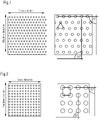
- a perforation pattern with perforation holes is known, wherein the perforation holes are arranged at equidistance from each other to form an equilateral triangle (angle 60°) aligned with machine direction and cross direction is known.
- Such a perforation pattern can be seen in Figure 1 . Due to the pattern, poor balance of the strengths of the average peel forces in machine direction and cross direction can be achieved. Further, the pattern leads to a disadvantageously high amplitude between the maximum and minimum peaks of the peel force curve.
- the perforation holes are arranged at equidistance from each other to form a square aligned to machine direction and cross direction.
- a perforation pattern can be seen in Figure 2 . Due to the pattern, a good balance of the strengths of the average peel forces in machine direction and cross direction can be achieved. Further, the pattern results in a high amplitude between the maximum and minimum peaks of the peel force curve.
- the perforation holes are arranged at equidistance from each other to form a square at a 45° angle from machine direction and cross direction.
- Such a perforation pattern can be seen in Figure 3 . Due to the pattern, a good balance of the strengths of the average peel forces in machine direction and cross direction can be achieved. Further, the pattern results in a high amplitude between the maximum and minimum peaks of the peel force curve.
- the perforation holes are arranged at equidistance from each other to form an equilateral triangle (angle 60°), wherein the aligned holes constitute an angle of between 10° and 20°, preferably between 12° and 18°, more preferably between 13° and 17°, in particular about 15° from machine direction and cross direction.
- a perforation pattern with 15° from the machine and cross direction can be seen in Figure 4 . Due to the pattern, a good balance of the strengths of the average peel forces in machine direction and cross direction can be achieved. Further, since there is no alternance between perforated rows and plain rows at the front of the peel direction, the pattern leads to an advantageously low amplitude between the maximum and minimum peaks of the peel force curve.
- the sum of the areas of the opening of the perforated holes is between 10 % and 50 %, preferably between 12 % and 45 %, more preferably between 15 % and 30 % of the total surface of the laminate.
- These areas can also be referred to as open (or opened) areas of the laminate due to the absence of any material in this area.
- the sum of the areas of the opening of the perforated holes is preferably about 15 %, about 16 %, about 17 %, about 18 %, about 19 %, about 20 %, about 21 %, about 22 %, about 23 %, about 24 %, about 25 %, about 26 %, about 27 %, about 28 %, about 29 % or about 30 %, more preferably about 25 %.
- the present laminate exhibits good adherence to a surface such as the skin.
- the invention relates to an assembly comprising the perforated adhesive laminate according to the invention and a textile or a polymer-based film.
- a textile can be referred to as a flexible material which can be prepared by weaving, knitting, crocheting, knotting, tatting, felting, bonding or braiding of yarns or threads and thereby creating an interlocking network of these yarns or threads.
- These yarns or threads in turn can be obtained by spinning raw fibres from either natural or synthetic sources into long and twisted lengths.
- textiles are woven fabrics, non-woven fabrics, knittings, nettings or braids, tulle or felt.
- the textile is a woven fabric or a non-woven fabric.
- a woven fabric is a fabric made by interlacing two or more threads at right angles to one another and can for example be obtained by weaving.
- Woven fabrics can be produced on a loom and made of many threads woven on a warp and a weft.
- a non-woven fabric is a fabric-like material which can be made from staple fibre (short) and long fibres (continuous long), bonded together by chemical, mechanical, heat or solvent treatment.
- the woven fabric or the non-woven fabric is based on natural or synthetic fibers.
- Natural fibres can be referred to as fibres having a natural origin such as plants, animals or minerals. Natural fibres generally can be used without having undergone a chemical transformation reaction. Examples are silk, cellulose, cotton and wool.
- Synthetic fibres can be referred to as fibres which have been either chemically synthesized or natural fibres which have been chemically transformed or modified.
- examples are viscose fibres or fibres made from polymers such as poly(meth)acrylate, polyamide, polyimide, polyamidimide, polyurethane, polyester such as polyethylene terephthalate and polybutylene terephthalate, polyether, polyacrylnitrile, polyalkylene such as polyethylene and polypropylene.
- the polymer-based film comprised by the assembly has a solubility in water of less than 10 mg/1, more preferably less than 1 mg/ml, in particular from 0,0001 to 1 mg/ml; determined with column elution according to EU-Guideline RL67-548-EWG, annex V, chapter A6.
- the polymer-based film can, for example, comprise polymers such as polyurethane, polyether urethane, polyester urethane, polyester, polypropylene, polyethylene, polyamide, polyvinylchloride, polyorganosiloxane (silicone), polyacrylate, polymethacrylate or mixtures therefrom, preferably polyurethane.
- the polymer-based film exhibits a water vapor permeability from at least 300 g/m 2 /24 hrs, in particular from at least 1000 g/m 2 /24 hrs and especially from at least 2000 g/m 2 /24 hrs to 5000 g/m 2 /24 hrs, determined according to DIN EN 13726, upright.
- the assembly comprises a laminate according to the invention and a textile or a polymer-based film, wherein the laminate is arranged such that the first layer of the laminate is the wound contact layer. It is further preferred that the laminate comprises a second layer comprising a medically acceptable adhesive.
- the textile or the polymer-based film, preferably a polymer-film, is arranged on said second layer comprised by the present laminate.
- the assembly comprises a laminate according to the invention, a textile or a polymer-based film and a layer comprising absorbent material.
- An absorbent material can be referred to as a material capable of receiving and subsequently retaining a liquid such as water or exudate.
- Absorbent materials are known in the art.
- the absorbent material is a superabsorbent material based on a copolymer of acrylic acid and acrylamide or a foam, preferably a foam based on polyurethane.
- the layer of the absorbent material such as a foam can preferably have a surface being smaller that the surface of the second layer comprised by the laminate.
- the layer of absorbent material is arranged on or adhered to the centre of the second layer comprised by the laminate, such that the four rims of the second layer are formed which are not covered by the layer of absorbent material and which have substantially of the same area size.
- the textile or a polymer-based film can be adhered to the medically acceptable adhesive of said rims of the second layer comprised by the laminate.
- the first layer of the present laminate can be used as wound contact layer, while the second layer comprised by the laminate enables the formation of an assembly optionally having further layers.
- the invention is related to a wound care product comprising the perforated adhesive laminate according to the invention and/or the assembly according the invention.
- the perforated adhesive laminate and/or the assembly are concerned, it applies substantially the same as described above.
- the wound care product is a wound dressing.
- the invention is directed to the use of the perforated adhesive laminate according to the invention as a wound contact layer or as a backing layer of a wound dressing. It is preferred that the first layer comprised by perforated adhesive laminate according to the invention is used as a wound contact layer of a wound dressing.
- the properties of the layer ensure an excellent adherence to the surface of the skin and enable a safe and easy removal without negatively affecting the surface of the skin or wound to which it has been applied.
- the perforated adhesive laminate according to the invention is used as a wound contact layer of an island-like wound dressing.
- the island-like wound dressing further preferably comprises a laminate having a second layer comprising a medically acceptable adhesive on which a layer of absorbent material is adhered.
- the surface of the layer comprising the absorbent material is preferably smaller than the surface of the second layer comprised by the laminate and preferably is arranged on or adhered to the centre of the second layer comprised by the laminate, such that the four rims of the second layer are formed.
- These rims which are not covered by the layer of absorbent material preferably have substantially the same area size.
- the textile or a polymer-based film can be adhered to the medically acceptable adhesive of said rims of the second layer comprised by the laminate.
- the first layer comprised by the present laminate can be used as the wound contact layer, while the second layer comprised by the laminate enables the formation of an assembly optionally having further layers.
- the perforated adhesive laminate according to the invention can be used as a backing layer of a wound dressing, in particular of a wound dressing having a pad, preferably a pad comprising an absorbent material, wherein the pad is directly into contact with the wound.
- the pad preferably the pad comprising an absorbent material
- the perforated adhesive laminate does not comprise a second layer comprising a medically acceptable adhesive.
- the substrate of the perforated adhesive laminate can be considered as the backing layer of a wound dressing.
- the assembly according to the invention can be used as a backing layer of a wound dressing, in particular a wound dressing having a pad, preferably a pad comprising an absorbent material, wherein the pad is directly in contact with the wound.
- the pad preferably the pad comprising an absorbent material
- the assembly comprises a laminate comprising layer (a), (b) and (c) as well as and a textile or a polymer-based film, wherein the textile or a polymer-based film is arranged on or adhered to (c) the second layer comprising a medically acceptable adhesive.
- the textile or the polymer-based film of the assembly can be considered as a backing layer of a wound dressing.
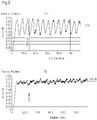
- the peel force on Bristol paper of a laminate having a pattern according to Figure 1 and a pattern according to Figure 4 has been determined and is shown in Figures 5 and 6 , wherein the peel force has been determined by a method based on FINAT n°1.
- the peel force is determined over a width of 25 mm.
- the characteristic values are shown Table 1 (lines with 0° MD, 0° CD correspond to a pattern according to Figure 1 ; lines with 15° MD, 15° CD correspond to a pattern according to Figure 4 ).
- Table 1 tilt peaks average [N] valleys average [N] peel force average [N] amplitude of peaks/valleys amplitude/ peel force [%] 0° MD 2.24 1.22 1.75 1.02 58 0° CD 1.78 1.52 1.64 0.26 16 15° MD 1.86 1.52 1.76 0.34 20 15° CD 1.85 1.52 1.73 0.33 20 MD machine direction CD: cross direction
- a perforation pattern according to Figure 4 (tilt 15°) has a strength of average peel force in machine-direction and a strength of average peel force in cross-direction which differ less than 2 %. Moreover, the amplitude between the maximum and minimum peaks of the peel force curve is 20 % of the average peel force.
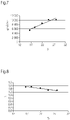
- Peel force and the moisture vapor transmission rate are apparent antinomic properties. Moisture vapor transmission rate rises with an increasing open area while the peel force decreases with an increasing open area (see Figures 7 and 8 ).
Landscapes
- Health & Medical Sciences (AREA)
- Life Sciences & Earth Sciences (AREA)
- Engineering & Computer Science (AREA)
- Biomedical Technology (AREA)
- Heart & Thoracic Surgery (AREA)
- Vascular Medicine (AREA)
- Animal Behavior & Ethology (AREA)
- General Health & Medical Sciences (AREA)
- Public Health (AREA)
- Veterinary Medicine (AREA)
- Dermatology (AREA)
- Laminated Bodies (AREA)
- Materials For Medical Uses (AREA)
Priority Applications (6)
| Application Number | Priority Date | Filing Date | Title |
|---|---|---|---|
| PL20217128.6T PL4018986T3 (pl) | 2020-12-23 | 2020-12-23 | Perforowany laminat ze środkiem adhezyjnym |
| EP20217128.6A EP4018986B1 (fr) | 2020-12-23 | 2020-12-23 | Laminé adhésif perforé |
| FIEP20217128.6T FI4018986T3 (fi) | 2020-12-23 | 2020-12-23 | Perforoitu liimalaminaatti |
| CN202180083483.4A CN116669671A (zh) | 2020-12-23 | 2021-12-22 | 穿孔的粘合层压板 |
| PCT/EP2021/087221 WO2022136512A1 (fr) | 2020-12-23 | 2021-12-22 | Stratifié adhésif perforé |
| US18/259,004 US20240041658A1 (en) | 2020-12-23 | 2021-12-22 | Perforated Adhesive Laminate |
Applications Claiming Priority (1)
| Application Number | Priority Date | Filing Date | Title |
|---|---|---|---|
| EP20217128.6A EP4018986B1 (fr) | 2020-12-23 | 2020-12-23 | Laminé adhésif perforé |
Publications (2)
| Publication Number | Publication Date |
|---|---|
| EP4018986A1 true EP4018986A1 (fr) | 2022-06-29 |
| EP4018986B1 EP4018986B1 (fr) | 2025-12-17 |
Family
ID=74105742
Family Applications (1)
| Application Number | Title | Priority Date | Filing Date |
|---|---|---|---|
| EP20217128.6A Active EP4018986B1 (fr) | 2020-12-23 | 2020-12-23 | Laminé adhésif perforé |
Country Status (6)
| Country | Link |
|---|---|
| US (1) | US20240041658A1 (fr) |
| EP (1) | EP4018986B1 (fr) |
| CN (1) | CN116669671A (fr) |
| FI (1) | FI4018986T3 (fr) |
| PL (1) | PL4018986T3 (fr) |
| WO (1) | WO2022136512A1 (fr) |
Cited By (1)
| Publication number | Priority date | Publication date | Assignee | Title |
|---|---|---|---|---|
| EP4497448A1 (fr) * | 2023-07-28 | 2025-01-29 | Advanced Silicone Coating | Couche comprenant un adhésif |
Families Citing this family (2)
| Publication number | Priority date | Publication date | Assignee | Title |
|---|---|---|---|---|
| USD1076109S1 (en) * | 2021-02-18 | 2025-05-20 | Seabas Enterprises Pty Ltd | Medical protective shield with surface pattern |
| GB202203623D0 (en) * | 2022-03-16 | 2022-04-27 | Convatec Ltd | Wound dressing |
Citations (5)
| Publication number | Priority date | Publication date | Assignee | Title |
|---|---|---|---|---|
| US20080319368A1 (en) * | 2004-06-30 | 2008-12-25 | Mads Lykke | Skin Plate Adhesive Product and Method for Its Manufacture |
| US20090093779A1 (en) | 2006-04-12 | 2009-04-09 | Birgit Riesinger | Primary Dressing |
| US20190134255A1 (en) * | 2016-04-11 | 2019-05-09 | Lohmann Corporation | Silicone free products with equivalent adhesion and silicone-like low trauma skin contact properties |
| US20200246192A1 (en) * | 2017-08-18 | 2020-08-06 | Medtrade Products Limited | Wound dressing |
| US20200323694A1 (en) * | 2019-04-09 | 2020-10-15 | Bio Med Sciences, Inc. | Layered apertured wound dressing, process of manufacture and useful articles thereof |
Family Cites Families (7)
| Publication number | Priority date | Publication date | Assignee | Title |
|---|---|---|---|---|
| US5018515A (en) * | 1987-12-14 | 1991-05-28 | The Kendall Company | See through absorbent dressing |
| JP2688062B2 (ja) * | 1988-06-20 | 1997-12-08 | 積水化学工業株式会社 | 医療用貼付部材 |
| JP4279014B2 (ja) * | 2003-03-13 | 2009-06-17 | 藤森工業株式会社 | ラミネートシートの製造方法 |
| JP2004284337A (ja) * | 2003-03-24 | 2004-10-14 | Toru Sueyoshi | 積層シートおよび積層体 |
| GB2455962A (en) * | 2007-12-24 | 2009-07-01 | Ethicon Inc | Reinforced adhesive backing sheet, for plaster |
| GB2497406A (en) * | 2011-11-29 | 2013-06-12 | Webtec Converting Llc | Dressing with a perforated binder layer |
| EP2995287A1 (fr) * | 2014-09-11 | 2016-03-16 | Mölnlycke Health Care AB | Pansement médical |
-
2020
- 2020-12-23 PL PL20217128.6T patent/PL4018986T3/pl unknown
- 2020-12-23 FI FIEP20217128.6T patent/FI4018986T3/fi not_active Application Discontinuation
- 2020-12-23 EP EP20217128.6A patent/EP4018986B1/fr active Active
-
2021
- 2021-12-22 WO PCT/EP2021/087221 patent/WO2022136512A1/fr not_active Ceased
- 2021-12-22 US US18/259,004 patent/US20240041658A1/en active Pending
- 2021-12-22 CN CN202180083483.4A patent/CN116669671A/zh active Pending
Patent Citations (5)
| Publication number | Priority date | Publication date | Assignee | Title |
|---|---|---|---|---|
| US20080319368A1 (en) * | 2004-06-30 | 2008-12-25 | Mads Lykke | Skin Plate Adhesive Product and Method for Its Manufacture |
| US20090093779A1 (en) | 2006-04-12 | 2009-04-09 | Birgit Riesinger | Primary Dressing |
| US20190134255A1 (en) * | 2016-04-11 | 2019-05-09 | Lohmann Corporation | Silicone free products with equivalent adhesion and silicone-like low trauma skin contact properties |
| US20200246192A1 (en) * | 2017-08-18 | 2020-08-06 | Medtrade Products Limited | Wound dressing |
| US20200323694A1 (en) * | 2019-04-09 | 2020-10-15 | Bio Med Sciences, Inc. | Layered apertured wound dressing, process of manufacture and useful articles thereof |
Cited By (2)
| Publication number | Priority date | Publication date | Assignee | Title |
|---|---|---|---|---|
| EP4497448A1 (fr) * | 2023-07-28 | 2025-01-29 | Advanced Silicone Coating | Couche comprenant un adhésif |
| WO2025026927A1 (fr) * | 2023-07-28 | 2025-02-06 | Advanced Silicone Coating | Couche comprenant un adhésif |
Also Published As
| Publication number | Publication date |
|---|---|
| CN116669671A (zh) | 2023-08-29 |
| EP4018986B1 (fr) | 2025-12-17 |
| FI4018986T3 (fi) | 2026-03-16 |
| US20240041658A1 (en) | 2024-02-08 |
| PL4018986T3 (pl) | 2026-04-27 |
| WO2022136512A1 (fr) | 2022-06-30 |
Similar Documents
| Publication | Publication Date | Title |
|---|---|---|
| JP4991301B2 (ja) | フックファスナー複合材料 | |
| EP4018986B1 (fr) | Laminé adhésif perforé | |
| EP3706813B1 (fr) | Pansement antimicrobien | |
| TW449551B (en) | Nonwoven sheets, adhesive articles, and methods for making the same | |
| CN101522972B (zh) | 伸缩性无纺布以及带材 | |
| WO1999060881A1 (fr) | Element de fixation et article absorbant comportant ledit element | |
| CN103974680B (zh) | 不粘附的伤口敷料及其相关方法 | |
| US20190390382A1 (en) | Moisture-absorbent composite nonwoven fabric and article thereof | |
| JP2001286549A (ja) | 医療用包帯材料 | |
| JP2010281003A (ja) | 化粧料含浸用皮膚被覆シート及びその製造方法、並びにこれを用いたフェイスマスク | |
| CN1452672A (zh) | 包含稳定化的长丝组合体的非织造织物结构体 | |
| CN103857414A (zh) | 创伤敷料及其相关方法 | |
| CN107109736A (zh) | 自粘性无纺布 | |
| TW201134669A (en) | Elastic fabric with adhesive | |
| WO2001036731A1 (fr) | Non-tisse comportant des fibres longues | |
| CN110974540B (zh) | 纤维片 | |
| US20030191423A1 (en) | Breathable non-perforated bandage | |
| JP5128336B2 (ja) | 伸縮性不織布及びその製造方法 | |
| AU2001275223A1 (en) | Breathable non-perforated bandage | |
| JPH0754314Y2 (ja) | 貼付用基材 | |
| JP2021094072A (ja) | 伸縮性繊維シート | |
| JP7775304B2 (ja) | 衛生材料用不織布、sapシート用基材、及びsapシート | |
| TW202348211A (zh) | 纖維薄片 | |
| JPH11200212A (ja) | 寝具用複合不織布 | |
| HK40021605B (en) | Fiber sheet |
Legal Events
| Date | Code | Title | Description |
|---|---|---|---|
| PUAI | Public reference made under article 153(3) epc to a published international application that has entered the european phase |
Free format text: ORIGINAL CODE: 0009012 |
|
| STAA | Information on the status of an ep patent application or granted ep patent |
Free format text: STATUS: THE APPLICATION HAS BEEN PUBLISHED |
|
| AK | Designated contracting states |
Kind code of ref document: A1 Designated state(s): AL AT BE BG CH CY CZ DE DK EE ES FI FR GB GR HR HU IE IS IT LI LT LU LV MC MK MT NL NO PL PT RO RS SE SI SK SM TR |
|
| STAA | Information on the status of an ep patent application or granted ep patent |
Free format text: STATUS: REQUEST FOR EXAMINATION WAS MADE |
|
| 17P | Request for examination filed |
Effective date: 20221209 |
|
| RBV | Designated contracting states (corrected) |
Designated state(s): AL AT BE BG CH CY CZ DE DK EE ES FI FR GB GR HR HU IE IS IT LI LT LU LV MC MK MT NL NO PL PT RO RS SE SI SK SM TR |
|
| STAA | Information on the status of an ep patent application or granted ep patent |
Free format text: STATUS: EXAMINATION IS IN PROGRESS |
|
| 17Q | First examination report despatched |
Effective date: 20240626 |
|
| REG | Reference to a national code |
Ref country code: DE Ref legal event code: R079 Free format text: PREVIOUS MAIN CLASS: A61F0013020000 Ipc: A61F0013024600 Ref country code: DE Ref legal event code: R079 Ref document number: 602020063954 Country of ref document: DE Free format text: PREVIOUS MAIN CLASS: A61F0013020000 Ipc: A61F0013024600 |
|
| GRAP | Despatch of communication of intention to grant a patent |
Free format text: ORIGINAL CODE: EPIDOSNIGR1 |
|
| STAA | Information on the status of an ep patent application or granted ep patent |
Free format text: STATUS: GRANT OF PATENT IS INTENDED |
|
| RIC1 | Information provided on ipc code assigned before grant |
Ipc: A61F 13/0246 20240101AFI20250623BHEP Ipc: A61F 13/02 20060101ALI20250623BHEP |
|
| INTG | Intention to grant announced |
Effective date: 20250710 |
|
| GRAS | Grant fee paid |
Free format text: ORIGINAL CODE: EPIDOSNIGR3 |
|
| GRAA | (expected) grant |
Free format text: ORIGINAL CODE: 0009210 |
|
| STAA | Information on the status of an ep patent application or granted ep patent |
Free format text: STATUS: THE PATENT HAS BEEN GRANTED |
|
| AK | Designated contracting states |
Kind code of ref document: B1 Designated state(s): AL AT BE BG CH CY CZ DE DK EE ES FI FR GB GR HR HU IE IS IT LI LT LU LV MC MK MT NL NO PL PT RO RS SE SI SK SM TR |
|
| REG | Reference to a national code |
Ref country code: CH Ref legal event code: F10 Free format text: ST27 STATUS EVENT CODE: U-0-0-F10-F00 (AS PROVIDED BY THE NATIONAL OFFICE) Effective date: 20251217 Ref country code: GB Ref legal event code: FG4D |
|
| REG | Reference to a national code |
Ref country code: DE Ref legal event code: R096 Ref document number: 602020063954 Country of ref document: DE |
|
| P01 | Opt-out of the competence of the unified patent court (upc) registered |
Free format text: CASE NUMBER: UPC_APP_0015805_4018986/2025 Effective date: 20251204 |
|
| REG | Reference to a national code |
Ref country code: FI Ref legal event code: FGE |
|
| PGFP | Annual fee paid to national office [announced via postgrant information from national office to epo] |
Ref country code: SE Payment date: 20260323 Year of fee payment: 6 |
|
| PGFP | Annual fee paid to national office [announced via postgrant information from national office to epo] |
Ref country code: GB Payment date: 20260227 Year of fee payment: 6 |
|
| PGFP | Annual fee paid to national office [announced via postgrant information from national office to epo] |
Ref country code: ES Payment date: 20260319 Year of fee payment: 6 |
|
| REG | Reference to a national code |
Ref country code: LT Ref legal event code: MG9D |
|
| PG25 | Lapsed in a contracting state [announced via postgrant information from national office to epo] |
Ref country code: NO Free format text: LAPSE BECAUSE OF FAILURE TO SUBMIT A TRANSLATION OF THE DESCRIPTION OR TO PAY THE FEE WITHIN THE PRESCRIBED TIME-LIMIT Effective date: 20260317 |
|
| PGFP | Annual fee paid to national office [announced via postgrant information from national office to epo] |
Ref country code: DE Payment date: 20260226 Year of fee payment: 6 |
|
| PG25 | Lapsed in a contracting state [announced via postgrant information from national office to epo] |
Ref country code: HR Free format text: LAPSE BECAUSE OF FAILURE TO SUBMIT A TRANSLATION OF THE DESCRIPTION OR TO PAY THE FEE WITHIN THE PRESCRIBED TIME-LIMIT Effective date: 20251217 |
|
| PGFP | Annual fee paid to national office [announced via postgrant information from national office to epo] |
Ref country code: FI Payment date: 20260311 Year of fee payment: 6 |
|
| PG25 | Lapsed in a contracting state [announced via postgrant information from national office to epo] |
Ref country code: RS Free format text: LAPSE BECAUSE OF FAILURE TO SUBMIT A TRANSLATION OF THE DESCRIPTION OR TO PAY THE FEE WITHIN THE PRESCRIBED TIME-LIMIT Effective date: 20260317 |
|
| PGFP | Annual fee paid to national office [announced via postgrant information from national office to epo] |
Ref country code: FR Payment date: 20260227 Year of fee payment: 6 |
|
| REG | Reference to a national code |
Ref country code: NL Ref legal event code: MP Effective date: 20251217 |
|
| PG25 | Lapsed in a contracting state [announced via postgrant information from national office to epo] |
Ref country code: LV Free format text: LAPSE BECAUSE OF FAILURE TO SUBMIT A TRANSLATION OF THE DESCRIPTION OR TO PAY THE FEE WITHIN THE PRESCRIBED TIME-LIMIT Effective date: 20251217 |