EP4019926A1 - System und verfahren zur gleichzeitigen erfassung von kontaktkraft und seitlicher belastung - Google Patents
System und verfahren zur gleichzeitigen erfassung von kontaktkraft und seitlicher belastung Download PDFInfo
- Publication number
- EP4019926A1 EP4019926A1 EP20000480.2A EP20000480A EP4019926A1 EP 4019926 A1 EP4019926 A1 EP 4019926A1 EP 20000480 A EP20000480 A EP 20000480A EP 4019926 A1 EP4019926 A1 EP 4019926A1
- Authority
- EP
- European Patent Office
- Prior art keywords
- layer
- electrodes
- subset
- sensor component
- along
- Prior art date
- Legal status (The legal status is an assumption and is not a legal conclusion. Google has not performed a legal analysis and makes no representation as to the accuracy of the status listed.)
- Withdrawn
Links
Images



Classifications
-
- G—PHYSICS
- G01—MEASURING; TESTING
- G01L—MEASURING FORCE, STRESS, TORQUE, WORK, MECHANICAL POWER, MECHANICAL EFFICIENCY, OR FLUID PRESSURE
- G01L1/00—Measuring force or stress, in general
- G01L1/20—Measuring force or stress, in general by measuring variations in ohmic resistance of solid materials or of electrically-conductive fluids; by making use of electrokinetic cells, i.e. liquid-containing cells wherein an electrical potential is produced or varied upon the application of stress
- G01L1/205—Measuring force or stress, in general by measuring variations in ohmic resistance of solid materials or of electrically-conductive fluids; by making use of electrokinetic cells, i.e. liquid-containing cells wherein an electrical potential is produced or varied upon the application of stress using distributed sensing elements
-
- B—PERFORMING OPERATIONS; TRANSPORTING
- B25—HAND TOOLS; PORTABLE POWER-DRIVEN TOOLS; MANIPULATORS
- B25J—MANIPULATORS; CHAMBERS PROVIDED WITH MANIPULATION DEVICES
- B25J13/00—Controls for manipulators
- B25J13/08—Controls for manipulators by means of sensing devices, e.g. viewing or touching devices
- B25J13/081—Touching devices, e.g. pressure-sensitive
- B25J13/084—Tactile sensors
-
- G—PHYSICS
- G01—MEASURING; TESTING
- G01L—MEASURING FORCE, STRESS, TORQUE, WORK, MECHANICAL POWER, MECHANICAL EFFICIENCY, OR FLUID PRESSURE
- G01L1/00—Measuring force or stress, in general
- G01L1/18—Measuring force or stress, in general using properties of piezo-resistive materials, i.e. materials of which the ohmic resistance varies according to changes in magnitude or direction of force applied to the material
-
- G—PHYSICS
- G01—MEASURING; TESTING
- G01L—MEASURING FORCE, STRESS, TORQUE, WORK, MECHANICAL POWER, MECHANICAL EFFICIENCY, OR FLUID PRESSURE
- G01L5/00—Apparatus for, or methods of, measuring force, work, mechanical power, or torque, specially adapted for specific purposes
- G01L5/16—Apparatus for, or methods of, measuring force, work, mechanical power, or torque, specially adapted for specific purposes for measuring several components of force
- G01L5/161—Apparatus for, or methods of, measuring force, work, mechanical power, or torque, specially adapted for specific purposes for measuring several components of force using variations in ohmic resistance
- G01L5/162—Apparatus for, or methods of, measuring force, work, mechanical power, or torque, specially adapted for specific purposes for measuring several components of force using variations in ohmic resistance of piezoresistors
-
- G—PHYSICS
- G01—MEASURING; TESTING
- G01L—MEASURING FORCE, STRESS, TORQUE, WORK, MECHANICAL POWER, MECHANICAL EFFICIENCY, OR FLUID PRESSURE
- G01L5/00—Apparatus for, or methods of, measuring force, work, mechanical power, or torque, specially adapted for specific purposes
- G01L5/22—Apparatus for, or methods of, measuring force, work, mechanical power, or torque, specially adapted for specific purposes for measuring the force applied to control members, e.g. control members of vehicles, triggers
- G01L5/226—Apparatus for, or methods of, measuring force, work, mechanical power, or torque, specially adapted for specific purposes for measuring the force applied to control members, e.g. control members of vehicles, triggers to manipulators, e.g. the force due to gripping
- G01L5/228—Apparatus for, or methods of, measuring force, work, mechanical power, or torque, specially adapted for specific purposes for measuring the force applied to control members, e.g. control members of vehicles, triggers to manipulators, e.g. the force due to gripping using tactile array force sensors
Definitions
- the invention relates to a tactile sensing system having a sensor component which comprises a plurality of layers stacked along a normal axis Z and a control unit electrically connected to the sensor component.
- the invention further relates to a method to operate a tactile sensing system.
- Such a tactile sensing system may be facilitated as a human-like electronic skin, which is an essential component of autonomous systems as the handling of physical contact becomes critical in many applications.
- tactile sensors have been developed for robotic hands and fingers, current autonomous systems still lack tactile sensors that can cover large and curved surfaces of robots.
- Robots need to have a good sense of touch in order to function in cluttered everyday environments, which are usually unstructured.
- Robotic systems require tactile sensors that are able to measure their intentional and unintentional contacts with humans, other robots, and inanimate objects, as well as the deformations of the robot's own body parts, such as flexion of a soft joint. Because external physical contact and internal deformations can occur at any location, these tactile sensors need to cover all exposed surfaces of a robot, not just the hands.
- the specifications required for a tactile sensor strongly depend on the part of the robot's body on which it will be mounted.
- the tactile sensors on a robot finger demand high spatial resolution and sensitivity to both normal and shear forces for object identification, grasping, and manipulation.
- the tactile sensors on a robot's arm surfaces need large-area coverage, mechanical compliance, manufacturability, sensitivity to external contacts, physical robustness, and reliability.
- Most existing tactile sensing approaches were designed for the fingertips and are thus poorly suited to the distinct goals of whole-body tactile sensing.
- the objective of this invention is to provide a tactile sensing system which overcomes the above-mentioned challenges.
- tactile sensing system having a sensor component which comprises a plurality of layers stacked along a normal axis Z and a detection unit electrically connected to the sensor component, wherein the sensor component comprises a first layer, designed as a piezoresistive layer or strain sensitive layer, a third layer, designed as a conductive layer or electrode layer which is electrically connected to the detection unit, and a second layer, designed as a spacing layer between the first layer and the third layer, wherein the first layer comprises a plurality of electrodes electrically connected to the detection unit, wherein at least one contact force along the normal axis Z on the sensor component is detectable by the detection unit due to a change of a current distribution between the first layer and the third layer, wherein at least one lateral strain on the sensor component is detectable by the detection unit due to a change of the resistance distribution change in the piezoresistive first layer.
- the sensor component comprises a first layer, designed as a piezoresistive layer or strain sensitive layer, a third layer, designed as a conductive layer
- the tactile sensing system is preferably a stack of layers.
- the layers are stacked along the normal axis Z and extend parallel to a first plane comprising a length axis X and width axis Y.
- the second layer is arranged along the normal axis Z above the first layer.
- the third layer is arranged along the normal axis Z above the second layer.
- the tactile sensing system may therefore detect at least one contact force along the normal axis Z and at least one lateral strain. It is understood that the at least one contact force may act entirely parallel to the normal axis Z or that the at least one contact force may have only a component acting along the normal axis Z.
- the at least one lateral strain may preferably be introduced by a lateral stretch force of the sensor component, the stretch force preferably acting along a stretch direction having at least a component along the length axis X and/or the width axis Y.
- the at least one lateral strain may preferably be introduced by a bending force, by which the sensor component, the stack of layers, and the first layer are bent out of the first plane.
- the detection unit applies a resistance reconstruction method, which allows a simultaneous detection of the at least one contact force along the normal axis Z on the sensor component and the at least one lateral strain on the sensor component.
- the first layer is a piezoresistive layer.
- a change in the electrical resistivity is caused due to an application of mechanical force/torque that induces lateral strain.
- the change in the resistivity may be detected by the detection unit.
- the sensor component comprises additional layers to the first, the second and the third layer. It is conceivable that there is at least one additional layer arranged along the normal axis Z above the third layer. It is also conceivable that there is at least one additional layer arranged along the normal axis Z underneath the first layer. Further, it is conceivable that there is at least one more layer arranged between the first and the second layer. Further, it is conceivable that there is at least one more layer arranged between the second and the third layer.
- the thickness of the sensor component is in the range between a few micrometers and a few centimeters.
- the layers consist preferably of flexible and/or soft materials.
- the entire sensor component is preferably flexible and/or soft.
- the first layer comprises a sublayer which has piezoresistive properties, wherein the sublayer comprises a conductive fabric and/or a conductive ink and/or carbon and/or carbon nanotubes and/or graphene and/or intrinsically conducting polymers (PEDOT, PSS, Polypyrrole, etc).
- the sublayer may also be a combination of at least two of said materials.
- the plurality of electrodes of the first layer is electrically connected to said sublayer.
- the conductivity of the sublayer is lower than the conductivity of the plurality of electrodes.
- the sublayer has therefore a high resistance in view of the plurality of electrodes.
- the sublayer consists of a high-resistance fabric or high-resistance textile.
- the high-resistance fabric layer is woven or knitted from at least one conductive yarn and comprises a predetermined textile structure.
- a change of the textile structure caused by the lateral strain causes a change in the resistance of the sublayer.
- said change of the resistance may be detected through the plurality of electrodes by the detection unit.
- the plurality of electrodes is arranged in a grid structure on the sublayer.
- the grid structure is formed according to a two-dimensional Bravais lattice. In a two-dimensional space, there are 5 Bravais lattices: oblique (monoclinic), rectangular (orthorhombic), centered rectangular (orthorhombic), hexagonal, and square (tetragonal). It is also conceivable that a different grid structure is applied.
- the third layer is made of conductive fabric or a conductive textile.
- the conductivity of the third layer is higher than the conductivity of the first layer or the conductivity of the sublayer of the first layer.
- the third layer may also be referred to as the electrode layer.
- the second layer is deformable along the normal axis Z.
- the at least one contact force along the normal axis Z causes at least one deformation.
- the at least one contact force along the normal axis Z acts on at least one contact area of the second layer.
- the at least one contact force is transmitted through the preferably flexible third layer and, if present, through further layers on top of the third layer.
- the at least one contact area is located on the surface of the second area, which extends parallel to the first plane.
- the shape of the at least one deformation depends on the shape of the at least one contact force, which essentially extends along the normal axis Z.
- At least one distance along the normal axis Z between the first layer and the third layer is decreased at least within the at least one contact area.
- said at least one deformation and/or the at least one decreased distance along the normal axis Z between the first layer and the third layer results in an increase of the conductivity between the first and the third layer, which is essentially restricted to the extent of the at least one contact area along a length axis X and a width axis Y.
- the second layer comprises piezoresistive characteristics with regard to the at least one contact force along the normal axis Z.
- a current flow between the first layer and the second layer is possible and/or is increased or noticeably increased.
- said current flows within the deformed contact area of the second layer.
- a tunneling current is established between the first layer and the third layer essentially within the contact area.
- the conductivity between the first layer and the third layer is very low in the state when no contact force along the normal axis Z is applied.
- the second layer is, in not deformed state, essentially insulating with regard to a current between the first layer and the third layer. Thus, there is essentially no current between the first and the second layer in case the second layer is not deformed
- the conductivity of the second layer is lower than the conductivity of the first layer in cases when the second layer is not deformed.
- the conductivity of the second layer is lower than the conductivity of the third layer.
- the second layer also does not allow a current within the second layer parallel to the first layer between a first subset of electrodes from the first layer and a second subset of electrodes of the first layer. The in-plane current of the first layer is therefore essentially restricted to the sublayer of the first layer.
- the second layer comprises a porous structure in particular a conductive foam and/or a piezoresistive material and/or a nanocomposite and/or a tunneling material.
- the second layer provides therefore piezoresistive characteristics due to an incident contact force along the normal axis Z.
- the second layer is a solid conductive foam, for instance an ESD (electrostatic discharge) material foam.
- ESD electrostatic discharge
- a conductive foam is an object formed by electrically insulating trapping pockets.
- the trapping pockets are formed in a conductive material.
- a mechanical force causes a deformation which increases the contact areas in the foam. By this the conductivity is increased.
- the spacer layer is deformed due to the at least one contact force. Due to this deformation a local distance between the first layer and the second layer is decreased. Such a decrease of the distance causes an increase in the tunneling probability between the first and the third layer and therefore a local tunneling current defined to the special position of the deformation.
- each member of the electrode group is electrically connected to a multiplexer unit of the detection unit.
- at least one first subset of the members of the electrode group may be connected to at least one current or voltage source.
- at least one second subset of the members of the electrode group may be electrically connected to a detection device.
- an adhesive is applied in preferably at sparse points.
- an adhesive is applied preferably at sparse points.
- the expression "at sparse points" should be understood that the area on which adhesive is applied is large enough to ensure a rigid connection between the layers and at the same time small enough to avoid introducing electrical isolation between the first layer and the second layer and the third layer and the second layer.
- an electronic skin for an autonomous system in particular a robot comprising the tactile sensing system according to at least one of the above-mentioned embodiments.
- the electronic skin may comprise the features or combinations of the features described above for the tactile sensor device. Further, the same advantages may apply for the electronic skin as described above for the tactile sensing system and vice versa.
- an autonomous system in particular a robot comprising the tactile sensing system according to at least one of the above-mentioned embodiments.
- the autonomous system may comprise the features or combinations of the features described above for the tactile sensing system and/or the electronic skin. Further, the same advantages may apply for the autonomous system as described above for the tactile sensor device, the electronic skin and vice versa
- the sensor component is used as an electronic skin of the autonomous system.
- the electronic skin may comprise the tactile sensing system alone, the sensor component alone, or the tactile sensing system and the sensor component together.
- Such an electronic skin can be designed at a large scale.
- the electronic skin is flexible and/or soft, such that it may be easily wrapped around the autonomous system or robot.
- the autonomous system comprises a component with an outer skin, wherein the outer skin comprises the sensor component and/or the tactile sensor device.
- the outer skin is wrapped around the component.
- a component may for instance be an arm. It is also conceivable that the sensor component is wrapped around the entire autonomous system, in particular the robot.
- the objective is also addressed by a method to operate a tactile sensing system according to at least one of the above-mentioned embodiments and to simultaneously detect at least one contact force along the normal axis Z and at least one lateral strain, comprising the following steps:
- the current in step b) is a constant current.
- the current in steps d) is a constant current.
- the current in step b) is not constant current.
- the current in step d) is not a constant current.
- step e a voltage change is measured depending on the change of the resistance in the first layer caused by at least one lateral strain.
- step f) the following step is performed: repeating the steps b) to e) for a preset number of iterations.
- a different first subset of electrodes, second subset of electrodes, third subset of electrodes and fourth subset of electrodes is chosen.
- different current injection patterns between the electrodes of the third subset of electrodes and/or between the third layer and the first subset of electrodes are implemented.
- an output of the force distribution is generated in form of a matrix of values.
- This matrix of values may be visualized in a two-dimensional plot, for instance as a false color image.
- the output may be displayed on a computing device which is connected to the detection unit or which is part of the detection unit.
- a resistance reconstruction is preferably used.
- the resistance reconstruction method estimates resistance distributions caused by either contact force along the normal axis Z or a lateral strain.
- the method preferably calculates the resistance distribution of a continuum medium when injected currents through the subsets of electrodes and corresponding measured voltages are known. This is an inverse problem, so finding a proper mapping function is important.
- the method comprises providing one first mapping function for contact sensing and another second mapping function for lateral strain sensing.
- the first mapping function is a linear mapping function.
- the second mapping function is linear mapping function. It is also conceivable that the first mapping function and/or the second mapping function are nonlinear mapping functions using either a physics model-based approach or a data-driven approach.
- the conductivity distribution ⁇ may be estimated from the voltage potentials measured from the electrodes.
- a linearized approximation is advantageously used to obtain the Jacobian matrix that maps conductivity changes to the voltage measurement changes from the electrodes.
- E is a vector of voltages measured from the electrodes.
- J is the Jacobian matrix calculated from the resistance matrix, and w is a noise vector.
- V R ⁇ ⁇ I
- R(a) is the resistance matrix, which is a function of the conductivity distribution.
- the voltage measurement change from another subset of electrodes is preferably determined as follows.
- ⁇ E ik M i T R ⁇ + ⁇ ⁇ R ⁇ P k
- Mi the i-th voltage measurement pattern
- P k the k-th current injection pattern. More details of this mathematical background are provided by D. S. Holder, Electrical impedance tomography: methods, history and applications. CRC Press, 2004.
- the simulation imposes the amount of current flows either from a current source or a voltage source.
- these steps are done only in the first calibration step of the tactile sensing system.
- the first mapping function may be stored in a storage unit of the detection unit.
- the electrical currents flow forming electrical potentials. If resistances of the model and injected current are known, the corresponding voltages at the distributed electrodes can be estimated. Thus, all the predefined contact locations x are advantageously simulated to estimate the corresponding voltages.
- dV current_perturbation ⁇ R x ⁇ x
- I const . ⁇ dx
- these voltages form a Jacobian matrix (J current _ perturbation ) that relates contact location x to voltage measurements.
- J current_perturbation ⁇ R x ⁇ x
- I const .
- the first mapping function which is generated in step i) is the inverse of this Jacobian matrix (J current_perturbation ).
- the second mapping function may be stored in a storage unit of the detection unit.
- the detection of a lateral strain comprises a current injection between electrodes of the first layer.
- the voltages measured from the distributed electrodes of the first layer vary.
- the corresponding voltages may be estimated by a resistance perturbation on predefined locations of the first layer.
- the resistances at the predefined locations (r) can be perturbed to estimate the corresponding voltages.
- all the predefined contact locations r are advantageously simulated to estimate the corresponding voltages.
- These voltages form a Jacobian matrix (J resistance_perturbation ) that relates resistance distribution change to voltage measurements.
- dV resistance_perturbation ⁇ R r ⁇ r
- I const .
- dr J resistance_perturbation ⁇ R x ⁇ x
- I const .
- the first mapping function which is generated in step i) is the inverse of this Jacobian matrix (J resistance_perturbation ).
- Figure 3 shows a tactile sensing system 1 having a sensor component 2 which comprises a plurality of layers 4, 5, 6 stacked along a normal axis Z and a detection unit 3 electrically connected to the sensor component 2, wherein the sensor component 2 comprises a first layer 4, designed as a piezoresistive layer, a third layer 6, designed as a conductive layer which is electrically connected to the detection unit 2, and a second layer 5, designed as a spacing layer between the first layer 4 and the third layer 6, wherein the first layer 4 comprises a plurality of electrodes electrically 7 connected to the detection unit 3, wherein at least one contact force 10 along the normal axis Z on the sensor component 2 is detectable by the detection unit 3 due to a change of a current distribution between the first layer 4 and the third layer 6, wherein at least one lateral strain 11 on the sensor component 2 is detectable by the detection unit 3 due to a change of the resistance distribution change in the piezoresistive first layer 4.
- the sensor component 2 comprises a first layer 4, designed as a piezoresistive layer,
- the sensor component 2 is a stack of layers comprising at least the first layer 4, the second layer 5 and the third layer 6. It is conceivable that the sensor component 2 comprises more layers made of certain materials which are arranged below and/or above and/or in between the first layer 4, the second layer 5 and the third layer 6.
- the sensor component 2 is therefore a laminate design composed of at least preferably exactly three layers.
- the layers are stacked along the normal axis Z.
- the layers extend parallel to a first plane P comprising a length axis X and width axis Y.
- the second layer 5 is arranged along the normal axis Z above the first layer 4 and along the normal axis Z below the third layer and is therefore also called the spacer layer.
- the thickness of the sensor component 2 is in the range between a few micrometers to a few centimeters.
- the thickness of the layers 4, 5, 6 of the sensor component 2 is in a range between a few micrometers to a few centimeters.
- the layers 4, 5, 6 of the sensor component 2 consist of flexible and/or soft materials. Therefore, the entire sensor component 2 may be soft and/or flexible and therefore may be wrapped easily around a component of an autonomous system like a robot or even wrapped around the entire autonomous system like a robot.
- the tactile sensing system may detect at least one contact force 10 along the normal axis Z and at least one lateral strain 11.
- the at least one contact force 10 acts on the surface of the third layer 6. Due to the flexibility and/or softness of the third layer the at least one contact force 10 acts on the surface of the second layer 5.
- the at least one contact force 10 would also act on the surfaces of the third 6 and second layer 5 if there would be more layers provided on top of the third layer 6.
- the direction of the at least one contact force 10 may be parallel to the normal axis Z. It is also conceivable that the at least one contact force 10 has only a direction component parallel to the normal axis Z.
- the at least one lateral strain 11 may be introduced by a lateral stretch-force of the sensor component.
- the at least one lateral strain 11 may also cause a compression in which the distance between two points is decreased.
- the at least one lateral strain 11 may be introduced by a bending force, by which the sensor component 2, the stack of layers, the first layer 4 is/are bent out of the first plane P. This is depicted in figure 6c .
- the first layer 4 comprises a sublayer 4a which has piezoresistive properties.
- the piezoresistive layer 4 is sensitive to lateral strain.
- the sublayer 8 comprises a conductive fabric and/or a conductive ink and/or carbon and/or carbon nanotubes and/or graphene and/or intrinsically conducting polymers (PEDOT, PSS, Polypyrrole, etc).
- the sublayer 8 may also be a combination of at least two of said materials. Further, the plurality of electrodes 7 of the first layer 4 is electrically connected to said sublayer 8.
- the sublayer 8 consists of a high-resistance fabric or high resistance textile, wherein the high resistance fabric layer is woven or knitted by at least one conductive yarn and comprises a predetermined textile structure.
- a change of the textile structure caused by the at least one lateral strain causes a change in the resistance of the sublayer 8.
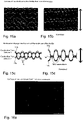
- Figure 15b shows in principle a section of the textile structure comprising a first group of conductive yarn 17a and a second group of conductive yarn 17b.
- the two groups of conductive yarn 17a, 17b may consist of the same material or of a different material.
- the two conductive yarns 17a, 17b are interwoven or knitted with each other.
- the high-resistance fabric is preferably woven or knitted such that the two groups of conductive yarn 17a, 17b alternate along the weaving or knitting direction, resulting in a plurality of contact points along the weaving or knitting direction.
- the at least one lateral strain 11 causes a stretch between the two groups of conductive yarn 17a, 17b. By this stretch the two groups of conductive yarn 17a, 17b have different contact points with each other as depicted in figure 15d .
- Such new connections result in a change namely a decrease of the resistance of the fabric. It is also conceivable to use other kinds of fabric with a different structure can behave differently. If the resistance change is not extreme, the same sensing mechanism may detect either resistance increase or decrease.
- Figures 15a and 15c depict a microscopic picture from the fabric in a non-stretched and a stretched state.
- the second layer 5 is deformable along the normal axis Z.
- the at least one contact force 10 along the normal axis Z acts on at least one contact area 9 of the second layer 5, through at least the third layer 6.
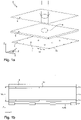
- the second layer 5 is deformed essentially within the at least one contact area 9, depicted in principle in figure 1a .
- the second layer may also be deformed gradually outside of the at least one contact area 9. The degree of deformation outside the at least one contact area depends on the material of the second layer 5. Due to said at least one deformation at least one distance 12 along the normal axis Z between the first layer 4 and the third layer 6 is decreased at least within the contact area 9.
- Said at least one deformation and/or the decrease of the at least one distance along the normal axis Z between the first layer 4 and the third layer 6 result in an increase of the conductivity between the first layer 4 and the third layer 6.
- the increase of the conductivity is essentially restricted to the extent of the at least one contact area 9 along a length axis X and a width axis Y.
- the conductivity of the second layer 5 should be low when there is no compressive pressure. If there is a compressive pressure, electrical conductivity of this layer 5 increases, connecting the first layer 4 and the third layer.
- the second layer 5 has piezoresistive characteristics with regard to the at least one contact force along the normal axis Z.
- This piezoresistive characteristic can be achieved by using piezoresistive materials (nanocomposites, tunneling material) and/or porous structures (e.g. a mesh structure, a thin sponge).
- said current flows within the deformed contact area 9 of the second layer 5.
- a tunneling current is established between the first layer 4 and the third layer 6 essentially within the contact area 9.
- the second layer comprises a porous structure in particular a conductive foam and/or a piezoresistive material and/or a nanocomposite and/or a tunneling material.
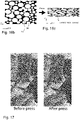
- the second layer is a solid conductive foam, as depicted in figures 16a , 16b, 16c .
- a conductive foam is an object formed by electrically insulating trapping pockets 19, as depicted in figures 16b and 16c .
- the trapping pockets 19 are formed in a conductive material 20.
- the conductive foam In a non-compressed state, the conductive foam has a preferably high resistance.
- the trapping pockets 19 are deformed, which results in an increase of the internal contact areas of the conductive material.
- the porous structure becomes a bulk conductive material. This results in a decrease of the resistance along the normal axis Z and an increase of the conductivity in the compressed area along the normal axis Z.
- Figure 16a depicts a microscopic image of the surface of the conductive foam.
- FIG 17 a measurement is depicted of a conductive foam with and without pressure. Resistance of the square laminate sample (30 mm x 30 mm x 5 mm) is initially 74.1 MOhm. The resistance drops to 2.4 MOhm when it is completely pressed. This value (2.4 MOhm) is therefore still larger than the resistance of the strain-sensitive first layer 4.
- the third layer 6 is made of conductive fabric or a conductive textile.
- the conductivity of the third layer 6 is higher than the conductivity of the first layer 4 or the conductivity of the sublayer 8 of the first layer 4.
- the third layer may also be called the electrode layer.
- the conductivity of said sublayer 8 is lower than the conductivity of the plurality of electrodes 7.
- the conductivity of the second layer 5 is lower than the conductivity of the first layer 4, in case when the second layer 5 is not deformed.
- the conductivity of the second layer 5 is lower than the conductivity of the third layer 6.
- the third layer 6 is a low-resistance fabric with a resistance R LOW
- the second layer 5 is a conductive foam with a resistance R foam
- the first layer is a high resistance fabric R High .
- the relation of the resistances is: R LOW ⁇ R High ⁇ R foam
- the second layer 5 does not allow a current within the second layer 5 parallel to the first layer 4 between a first subset of electrodes 7 from the first layer 4 and a second subset of electrodes 7 of the first layer 4.
- the in-plane current of the first layer 4 is therefore essentially restricted to the sublayer 8 of the first layer 4.
- the second layer does not allow an essential current circumventing the first layer 4.
- an adhesive 16 is applied, preferably preferably at sparse points.
- an adhesive 16 is applied preferably at sparse points.
- the expression "at sparse points" should be understood that the areas of the individual layers on which adhesive is applied is large enough to ensure a rigid connection between the layers and at the same time small enough to avoid introducing electrical isolation between the first layer and the second layer and the third layer and the second layer. It is conceivable that there is a plurality of sparse points with adhesive between the individual layers. The adhesive locations should be small enough to not interfere with the functionality of the sensor component 2 but large enough to ensure a tight enough connection between the individual layers.
- FIG. 1b an embodiment of a sensor component 2 is depicted.
- the second layer 5 needs to have high resistance compared to the first piezoresistive layer 4. When the laminate is pressed, the resistance of the second layer 5 should decrease.
- a candidate for a second layer is conductive foam.
- the strain-sensitive first layer 4 could for instance be a conductive fabric (Eeontex, Eenonyx, USA) that has 10 ⁇ 4 Ohm/Sq resistivity.
- the second layer could be a conductive foam (ESD foam, Wolfgang Warmbier, Germany) that has 10 ⁇ 10 - 10 ⁇ 12 Ohm/Sq resistivity.
- the top-electrode third layer 6 could be another conductive fabric (Technik-tex P130, Statex, Germany) that has 0.1 Ohm/Sq resistivity.
- the plurality of electrodes 7 of the first layer 4 and the third layer 6 forms an electrode group.
- Each member of the electrode group is electrically connected to a multiplexer unit 13 of the detection unit 3.
- the multiplexer unit 13 at least one first subset of the members of the electrode group may be connected to at least one current or voltage source 14.
- at least one second subset of the members of the electrode group may be electrically connected to a detection device 15. This is depicted in Fig 3 .
- the tactile sensing system 1 is operated with a method to simultaneously detect a contact force 10 along the normal axis Z and a lateral strain 11.
- the detection unit 3 applies a resistance reconstruction method, which allows a simultaneous detection of the contact force 10 along the normal axis Z on the sensor component 2 and the lateral strain 11 on the sensor component 2.
- the method to operate a tactile sensing system 1 and to simultaneously detect at least one contact force 10 along the normal axis Z and at least one lateral strain 11, comprising the following steps
- step f) the following step is performed: repeating the steps b) to e) for a preset number of iterations, wherein for each iteration a different first subset of electrodes, second subset of electrodes, third subset of electrodes and fourth subset of electrodes is chosen.
- the current in step b) is a constant current.
- the current in step b) is not constant current.
- the current in steps d) is a constant current.
- the current in step d) is not a constant current.
- the multiplexer unit 13 In order to establish the connections in steps b) and d) the multiplexer unit 13 is used. The measurement in step c) and e) is performed by the detection device 15. The detection device is also connected by the multiplexer unit with the according electrodes and/or third layer.
- Sensing of both surface normal contact and lateral strain is performed using resistance reconstruction.
- the resistance change of the conductive medium is estimated by injecting electrical currents and measuring voltages.
- Figure 4 shows an installation of the plurality of electrodes 7 and the third layer 4 which enables surface normal contact sensing.
- the third layer 6 is designed as a wide electrode layer. All the electrodes, including the distributed electrodes 7 of the first layer 4 the electrode layer in form of the third layer 6, are connected to the electronic circuits 21 for current injection and voltage measurement.
- the second layer is omitted for the sake of clarity.
- Figures 5a and 5b illustrate the working principle for detecting the at least one contact force 10 along the normal axis Z.
- Figures 5a and 5b are a sectional view along the line A-B in figure 4 .
- the current source 14 (+I, -I) is connected to a first subset (one or more than one electrodes) of the electrodes 7 of the first layer 4 and to the electrode layer in the form of the third layer 6.
- the current source 14 may also be replaced by a voltage source with a current monitoring resistor. If there is no contact force on the sensor component 2, an electrical current does not flow because the second layer 5 electrically separates the first layer 4 and the third layer 6.
- the second layer 5 electrically connects the first layer 4 and the third layer 6, since there is a local deformation 23 of the second layer 5.
- This connection makes the electrical current flow.
- the electrical current is depicted with the dotted line 22. Due to the electrical current electrical potentials (V 2 , V3, ...Vi) around the conductive medium are formed.
- the electrical potentials are measured by connecting the second subset of electrodes 7 and the third layer to the detection device.
- the electrical potentials are also measured by connecting the second subset of electrodes 7 and the third subset of electrodes 7.
- Figures 6a, 6b and 6c illustrate the working principle for detecting the lateral strain 11.
- Figures 6a, 6b and 6c are a sectional view along the line A-B in figure 4 .
- the current or voltage source 14 (+I, -I) is connected to the third subset electrodes of the piezoresistive first layer 4.
- the electrical potentials (V 2 , V 3 ,... V i ) measured from the fourth subset of electrodes 7 of the piezoresistive first layer 4 are mainly sensitive to the resistance change caused by lateral strains such as out-of-plane bending as depicted in figure 6b or lateral stretch as depicted in figure 6c .
- the first layer 4 and the third layer 6 are depicted, wherein the electronic circuits 21 connect the plurality of electrodes 7 and the third layer 6 with the multiplexer unit 13 of the detection unit 3.
- the multiplexer unit 13 may connect a subset of electrodes and/or the third layer with a current or voltage source 14 or more than one and/or a detection device which may comprise an analog digital converter ADC.
- the multiplexer unit 13 can be controlled by any means of controllers 24, such as microcontrollers, FPGAs (field programmable gate arrays), digital communications, etc.
- the first and second mapping functions are preferably based on a resistance reconstruction method to estimate resistance distributions caused by either surface normal contact or lateral strain.
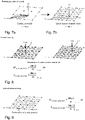
- the resistance reconstruction method calculates resistance distribution of a continuum medium when injected currents and corresponding voltages are known. Both mapping functions are computed by perturbing the forward operator that is modeled with an approximate resistance network model. Details of this resistance network model are shown in Figures 7a, 7b, 8 and 9.
- Figure 8 illustrates a linear mapping model for detecting the at least one contact force 10.
- the electrical currents flow forming electrical potentials. If the resistances of the model and the injected current are known, the corresponding voltages at the distributed electrodes 7 can be estimated. In the same way, all the predefined contact locations x are simulated to estimate the corresponding voltages. These voltages form a Jacobian matrix J current_perturbation that relates contact location x to voltage measurements. The first mapping function is then the inverse a Jacobian matrix J current_perturbation -1 .
- Figure 9 a linear mapping model for detecting the at least one lateral strain 11.
- currents are injected in between the distributed electrodes of a third subset of electrodes 7.
- the voltages measured from the distributed electrodes of the fourth subset of electrodes also vary.
- the resistances at the predefined locations r can be perturbed to estimate the corresponding voltages.
- These voltages form a Jacobian matrix J resistance_perturbation -1 that relates resistance distribution change to voltage measurements.
- Jacobian matrices are obtained from simulation, inverse matrices of the Jacobian matrix are computed to obtain the mapping functions. In this procedure, many inverse computation methods can be applied such as regularization.
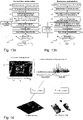
- FIG 13a a flowchart with regard to the first preferably linear mapping function is depicted.
- the first linear mapping function is generated by a simulation method comprising the following steps using a current flow perturbation:
- FIG 13b a flowchart with regard to the second preferably linear mapping function is depicted.
- the second preferably linear mapping function is generated by a simulation method comprising the following steps
- mapping functions are computed by perturbing the forward operator that is modeled with an approximate resistance network model.
- the simulation is fundamentally based on the modified nodal analysis. According to the above stated methods to perturb the parameters related to the contact sensing and lateral strain sensing are perturbed, so that the mapping function can be obtained. Depending on the perturbing parameter, two different mapping functions are obtained.
- the simulation begins with defining the sensor geometry and base resistivity value. It can be defined in two or three dimensions. The geometry of plurality of electrodes 7 is also defined. The resistivity of the electrode is set as well.
- the continuum model is discretized into mesh elements, which is a linear resistor network model.
- the current injection pattern is defined to always include the top-electrode in form of the third layer 6 and one of the bottom electrodes 7 of the first layer 4.
- the voltage measurement pattern is defined both from the top-electrode and the bottom electrodes 7 and only from the bottom electrodes 7 of the first layer 4.
- the sensor and electrode geometry is defined and discretized without including the top-electrode because this simulation model assumes that the electrical current doesn't flow from the bottom electrodes of the first layer 4 to the top-electrode in the form of the third layer 6. In reality, a small portion of the electrical current can flow, but this amount can be neglectable if the resistance of the spacing layer in the form of the second layer 5 is higher than that of the bottom strain-sensitive first layer 4.
- the current injection pattern and voltage measurement pattern are also selected only from the bottom electrodes 7 of the first layer.
- the resistances of the mesh elements corresponding to a specified location are changed. After that, the voltages are simulated and saved as a result of the specific perturbation. This perturbing location is changed to the other predefined location, and the process is repeated until all the predefined perturbing locations are simulated.
- the plurality of electrodes 7 are arranged in the first layer 4. Rearranging the electrode configuration directly affects the inverse computation. One can imagine that any perturbation made far from an electrode cannot influence that electrode's voltage measurement. There are various possibilities on the distribution of the electrodes 7 on the surface of the sublayer 8. According to one embodiment the electrodes 7 are arranged only along the edges 8a of the sublayer 8. This is depicted in figure 10a . According to a further embodiment the plurality of electrodes 7 is arranged in a grid structure on the sublayer 8. As depicted in figure 10b . Various grid structures are hereby conceivable. The grid structure is in the form of a two-dimensional Bravais lattice.
- FIG 10a shows a rather poor spatial resolution in the central sensing region because the central region is far from every one of the electrodes 7.
- Figure 11 shows the simulation results of the norm distinguishability in log scale for the boundary electrode model according to figure 10a and the distributed electrode model according to figure 10b .
- the distinguishability is defined by the amount of voltage change corresponding to the conductivity perturbation. The main difference occurs at the center region where the contact is far from the boundary 8a.
- Figure 12 shows the simulation results of two-point conductivity perturbation case. When the local conductivity at two points in the central region is perturbed, the inverse computation results in different outcomes that the boundary electrodes 7 model cannot distinguish the two different locations at the center. On the other hand, the distributed electrodes model adeptly discriminated the two local conductivity changes.
- FIG 14 gives an overview over the detection of two acting contact forces 10 and a lateral strain in form of a bending force.
- the contact forces and the lateral strain act simultaneously.
- detection unit 3 controls the current injection condition and collects voltage measurements for both the contact-sensing case and the strain-sensing case, sequentially.
- the voltage measurements consist of two parts (V contact , V strain ). These two voltage measurements are separately multiplied with the according mapping function.
- the voltage measurements relating to acting contact forces 10 are converted with the first mapping function in the form of an inverse Jacobian matrix J current_pertur-bation -1 .
- the voltage measurements relating to the acting lateral strain 11 are converted with the second mapping function in the form of an inverse Jacobian matrix J resistance_perturbation -1 .
- the corresponding outcomes are considered to be contact distribution and bending distribution.
- the tactile sensing system 1 may be comprised of an autonomous system 100, in particular a robot.
- the sensor component 2 may be used as an electronic skin 103 of the autonomous system 100.
- the electronic skin may comprise the tactile sensing system 1 and/or the sensor component 2 or consist of the tactile sensing system 1 and/or the sensor component 2.
- Such an electronic skin can be designed at a large scale.
- the electronic skin 103 is flexible and/or soft, such that it may be easily wrapped around the autonomous system 100, in particular a robot.
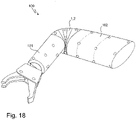
- Figure 18 shows a component 101 of the autonomous system 100 with an outer skin 102, wherein the outer skin 102 comprises the sensor component 2.
- the component 101 is in this case an arm of a robot. It is also conceivable that the sensor component is wrapped around the entire autonomous system, in particular a robot.
- this invention advantageously introduces a special piezoresistive laminate design, electrodes arrangement, current injection and voltage measurement strategy, and reconstruction process in order to estimate both surface normal contact sensing and lateral strain sensing simultaneously.
- this invention advantageously demonstrates an example of a tactile sensor that can measure contact pressure and out-of-plane bending itself.
Landscapes
- Physics & Mathematics (AREA)
- General Physics & Mathematics (AREA)
- Engineering & Computer Science (AREA)
- Human Computer Interaction (AREA)
- Robotics (AREA)
- Mechanical Engineering (AREA)
- Chemical & Material Sciences (AREA)
- Analytical Chemistry (AREA)
- Force Measurement Appropriate To Specific Purposes (AREA)
Priority Applications (6)
| Application Number | Priority Date | Filing Date | Title |
|---|---|---|---|
| EP20000480.2A EP4019926A1 (de) | 2020-12-22 | 2020-12-22 | System und verfahren zur gleichzeitigen erfassung von kontaktkraft und seitlicher belastung |
| US18/258,647 US20240044729A1 (en) | 2020-12-22 | 2021-12-15 | System and Method for Simultaneously Sensing Contact Force and Lateral Strain |
| PCT/EP2021/086037 WO2022136074A1 (en) | 2020-12-22 | 2021-12-15 | System and method for simultaneously sensing contact force and lateral strain |
| EP21839936.8A EP4267925A1 (de) | 2020-12-22 | 2021-12-15 | System und verfahren zur gleichzeitigen erfassung von kontaktkraft und seitlicher dehnung |
| CN202180086537.2A CN116761992A (zh) | 2020-12-22 | 2021-12-15 | 用于同时传感接触力和横向应变的系统和方法 |
| KR1020237025024A KR20230124048A (ko) | 2020-12-22 | 2021-12-15 | 접촉력과 측방향 변형을 동시에 감지하기 위한 시스템 및 방법 |
Applications Claiming Priority (1)
| Application Number | Priority Date | Filing Date | Title |
|---|---|---|---|
| EP20000480.2A EP4019926A1 (de) | 2020-12-22 | 2020-12-22 | System und verfahren zur gleichzeitigen erfassung von kontaktkraft und seitlicher belastung |
Publications (1)
| Publication Number | Publication Date |
|---|---|
| EP4019926A1 true EP4019926A1 (de) | 2022-06-29 |
Family
ID=73856679
Family Applications (2)
| Application Number | Title | Priority Date | Filing Date |
|---|---|---|---|
| EP20000480.2A Withdrawn EP4019926A1 (de) | 2020-12-22 | 2020-12-22 | System und verfahren zur gleichzeitigen erfassung von kontaktkraft und seitlicher belastung |
| EP21839936.8A Withdrawn EP4267925A1 (de) | 2020-12-22 | 2021-12-15 | System und verfahren zur gleichzeitigen erfassung von kontaktkraft und seitlicher dehnung |
Family Applications After (1)
| Application Number | Title | Priority Date | Filing Date |
|---|---|---|---|
| EP21839936.8A Withdrawn EP4267925A1 (de) | 2020-12-22 | 2021-12-15 | System und verfahren zur gleichzeitigen erfassung von kontaktkraft und seitlicher dehnung |
Country Status (5)
| Country | Link |
|---|---|
| US (1) | US20240044729A1 (de) |
| EP (2) | EP4019926A1 (de) |
| KR (1) | KR20230124048A (de) |
| CN (1) | CN116761992A (de) |
| WO (1) | WO2022136074A1 (de) |
Families Citing this family (1)
| Publication number | Priority date | Publication date | Assignee | Title |
|---|---|---|---|---|
| CN120493665B (zh) * | 2025-07-18 | 2025-10-17 | 华中科技大学 | 一种柔性压阻传感器的应变感知模型、建立及预测方法 |
Citations (2)
| Publication number | Priority date | Publication date | Assignee | Title |
|---|---|---|---|---|
| US20150331523A1 (en) * | 2014-05-15 | 2015-11-19 | Bebop Sensors, Inc. | Two-dimensional sensor arrays |
| US20190113410A1 (en) * | 2017-10-17 | 2019-04-18 | University Of Maryland, College Park | Two-dimensional center of pressure sensor systems, devices, and methods |
Family Cites Families (43)
| Publication number | Priority date | Publication date | Assignee | Title |
|---|---|---|---|---|
| US5060527A (en) * | 1990-02-14 | 1991-10-29 | Burgess Lester E | Tactile sensing transducer |
| US6225814B1 (en) * | 1999-04-13 | 2001-05-01 | Tekscan, Inc | Contact width sensors |
| GB0011829D0 (en) * | 2000-05-18 | 2000-07-05 | Lussey David | Flexible switching devices |
| US6543299B2 (en) * | 2001-06-26 | 2003-04-08 | Geoffrey L. Taylor | Pressure measurement sensor with piezoresistive thread lattice |
| GB0407366D0 (en) * | 2004-03-31 | 2004-05-05 | Koninkl Philips Electronics Nv | Textile form touch sensor |
| US7430925B2 (en) * | 2005-05-18 | 2008-10-07 | Pressure Profile Systems, Inc. | Hybrid tactile sensor |
| US8127623B2 (en) * | 2005-05-18 | 2012-03-06 | Pressure Profile Systems Inc. | Capacitive tactile tile sensor |
| US7439962B2 (en) * | 2005-06-01 | 2008-10-21 | Synaptics Incorporated | Touch pad with flexible substrate |
| US8161826B1 (en) * | 2009-03-05 | 2012-04-24 | Stryker Corporation | Elastically stretchable fabric force sensor arrays and methods of making |
| US7719007B2 (en) * | 2008-04-30 | 2010-05-18 | Milliken & Company | Flexible electroluminescent capacitive sensor |
| US7958789B2 (en) * | 2008-08-08 | 2011-06-14 | Tokai Rubber Industries, Ltd. | Capacitive sensor |
| US8893561B2 (en) * | 2009-05-06 | 2014-11-25 | Xsensor Technology Corporation | Dielectric textured elastomer in a pressure mapping system |
| US9281415B2 (en) * | 2010-09-10 | 2016-03-08 | The Board Of Trustees Of The Leland Stanford Junior University | Pressure sensing apparatuses and methods |
| JP2012122823A (ja) * | 2010-12-08 | 2012-06-28 | Seiko Epson Corp | 検出装置、電子機器、及びロボット |
| FR2970566B1 (fr) * | 2011-01-13 | 2013-11-15 | Francis Cannard | Dispositif de mesure de la pression a partir d'un objet souple, pliable et/ou extensible realise a partir de matiere textile comportant un dispositif de mesure |
| US9271665B2 (en) * | 2011-05-20 | 2016-03-01 | The Regents Of The University Of California | Fabric-based pressure sensor arrays and methods for data analysis |
| TW201310011A (zh) * | 2011-08-19 | 2013-03-01 | Ind Tech Res Inst | 力量感測器及力量感測器之阻值變化量的量測方法 |
| US9076419B2 (en) * | 2012-03-14 | 2015-07-07 | Bebop Sensors, Inc. | Multi-touch pad controller |
| US8904876B2 (en) * | 2012-09-29 | 2014-12-09 | Stryker Corporation | Flexible piezocapacitive and piezoresistive force and pressure sensors |
| US8997588B2 (en) * | 2012-09-29 | 2015-04-07 | Stryker Corporation | Force detecting mat with multiple sensor types |
| WO2014058806A1 (en) * | 2012-10-08 | 2014-04-17 | Stc.Unm | Improved pliable pressure-sensing fabric |
| TW201418683A (zh) * | 2012-11-13 | 2014-05-16 | Ind Tech Res Inst | 壓力量測結構 |
| US10260968B2 (en) * | 2013-03-15 | 2019-04-16 | Nano Composite Products, Inc. | Polymeric foam deformation gauge |
| AU2015370928A1 (en) * | 2014-12-23 | 2017-07-20 | Haydale Graphene Industries Plc | Piezoresistive device |
| KR102330585B1 (ko) * | 2015-03-23 | 2021-11-24 | 엘지디스플레이 주식회사 | 터치 스크린 장치와 그의 구동 방법, 및 이를 포함하는 휴대용 전자 기기 |
| US10067008B2 (en) * | 2015-04-22 | 2018-09-04 | Vorbeck Materials Corp. | Capacitive sensor |
| WO2017044617A1 (en) * | 2015-09-08 | 2017-03-16 | The Regents Of The University Of California | Tactile sensors and methods of fabricating tactile sensors |
| KR20170056450A (ko) * | 2015-11-13 | 2017-05-23 | 주식회사 모다이노칩 | 복합 소자 및 이를 구비하는 전자기기 |
| DE102016106074A1 (de) * | 2016-04-04 | 2017-10-05 | Pilz Gmbh & Co. Kg | Gewebe mit mehreren Gewebelagen |
| US10401241B2 (en) * | 2016-06-08 | 2019-09-03 | The University Of British Columbia | Surface sensor arrays using ionically conducting material |
| US10267690B2 (en) * | 2016-09-13 | 2019-04-23 | The Board Of Trustees Of The Leland Stanford Junior University | Capacitive force/torque sensor |
| WO2018084284A1 (ja) * | 2016-11-04 | 2018-05-11 | 国立大学法人弘前大学 | 分布測定センサ、分布測定センサシステム、分布測定プログラムおよび記録媒体 |
| DE102017100786B4 (de) * | 2017-01-17 | 2018-09-06 | Pilz Gmbh & Co. Kg | Taktiler Sensor mit Gehäuse |
| US11860048B2 (en) * | 2017-07-10 | 2024-01-02 | The Board Of Trustees Of The Leland Stanford Junior University | Capacitive and tactile sensors and related sensing methods |
| US10444094B1 (en) * | 2017-07-14 | 2019-10-15 | Flex Ltd. | Bladder system for force sensitive resistors (FSR) sensors |
| US11946821B2 (en) * | 2018-07-10 | 2024-04-02 | The Board Of Trustees Of The Leland Stanford Junior University | Capacitive and tactile sensors and related sensing methods |
| EP3660642B1 (de) * | 2018-11-28 | 2023-11-08 | Sanko Tekstil Isletmeleri San. Ve Tic. A.S. | Grossflächiges berührungsgewebe |
| JP7663516B2 (ja) * | 2019-06-10 | 2025-04-16 | ナショナル ユニバーシティー オブ シンガポール | 圧力センサ用の複合構造及び圧力センサ |
| GB201910563D0 (en) * | 2019-07-24 | 2019-09-04 | Hussein Zakareya Elmo | A compliant tri-axial force sensor and method of fabricating the same |
| US12492955B2 (en) * | 2019-10-24 | 2025-12-09 | The Board Of Trustees Of The Leland Stanford Junior University | Devices and methods involving sensing in response to an applied touch or other force |
| US11269440B1 (en) * | 2020-08-12 | 2022-03-08 | Universal Cement Corporation | Foldable force sensing device |
| US12056305B2 (en) * | 2022-01-05 | 2024-08-06 | Samsung Electronics Co., Ltd. | Pressure sensor, pressure sensor pixel array including pressure sensor, and electronic system including pressure sensor |
| US11561138B1 (en) * | 2022-06-28 | 2023-01-24 | RET Equipment Inc. | Resistive pressure sensor with improved structure design |
-
2020
- 2020-12-22 EP EP20000480.2A patent/EP4019926A1/de not_active Withdrawn
-
2021
- 2021-12-15 EP EP21839936.8A patent/EP4267925A1/de not_active Withdrawn
- 2021-12-15 CN CN202180086537.2A patent/CN116761992A/zh active Pending
- 2021-12-15 US US18/258,647 patent/US20240044729A1/en active Pending
- 2021-12-15 KR KR1020237025024A patent/KR20230124048A/ko not_active Withdrawn
- 2021-12-15 WO PCT/EP2021/086037 patent/WO2022136074A1/en not_active Ceased
Patent Citations (2)
| Publication number | Priority date | Publication date | Assignee | Title |
|---|---|---|---|---|
| US20150331523A1 (en) * | 2014-05-15 | 2015-11-19 | Bebop Sensors, Inc. | Two-dimensional sensor arrays |
| US20190113410A1 (en) * | 2017-10-17 | 2019-04-18 | University Of Maryland, College Park | Two-dimensional center of pressure sensor systems, devices, and methods |
Non-Patent Citations (1)
| Title |
|---|
| D. S. HOLDER: "Electrical impedance tomography: methods, history and applications", 2004, CRC PRESS |
Also Published As
| Publication number | Publication date |
|---|---|
| US20240044729A1 (en) | 2024-02-08 |
| KR20230124048A (ko) | 2023-08-24 |
| CN116761992A (zh) | 2023-09-15 |
| WO2022136074A1 (en) | 2022-06-30 |
| EP4267925A1 (de) | 2023-11-01 |
Similar Documents
| Publication | Publication Date | Title |
|---|---|---|
| Canavese et al. | Piezoresistive flexible composite for robotic tactile applications | |
| Zhu et al. | A soft robotic finger with self-powered triboelectric curvature sensor based on multi-material 3D printing | |
| KR102239466B1 (ko) | 유연촉각센서, 유연촉각센서 시스템 및 그 제조방법 | |
| US11860048B2 (en) | Capacitive and tactile sensors and related sensing methods | |
| US11300470B2 (en) | Flexible temperature-sensitive pressure sensor based on nanoparticle lattice array quantum conductance, and assembly method and application thereof | |
| US8132468B2 (en) | Flexural deformation sensing device and a user interface using the same | |
| Nakamoto et al. | Stretchable strain sensor with anisotropy and application for joint angle measurement | |
| CN107003190B (zh) | 高分辨率压力感测 | |
| Siegel et al. | An integrated tactile and thermal sensor | |
| Fonseca et al. | A flexible piezoresistive/self-capacitive hybrid force and proximity sensor to interface collaborative robots | |
| Dahiya et al. | Tactile sensing technologies | |
| Speeter | Flexible, piezoresitive touch sensing array | |
| Lee et al. | Piezoresistive textile layer and distributed electrode structure for soft whole-body tactile skin | |
| Lee et al. | Internal array electrodes improve the spatial resolution of soft tactile sensors based on electrical resistance tomography | |
| Lee et al. | Calibrating a soft ERT-based tactile sensor with a multiphysics model and sim-to-real transfer learning | |
| Wu et al. | New tactile sensor for position detection based on distributed planar electric field | |
| Zheng et al. | A large-area tactile sensor for distributed force sensing using highly sensitive piezoresistive sponge | |
| US20240044729A1 (en) | System and Method for Simultaneously Sensing Contact Force and Lateral Strain | |
| US20210025767A1 (en) | Manufacturing method for shear and normal force sensor | |
| Zapciu et al. | Additive manufacturing integration of thermoplastic conductive materials in intelligent robotic end effector systems | |
| White et al. | Distributed sensing in capacitive conductive composites | |
| KR102587301B1 (ko) | 3차원 구조 변환이 가능한 촉각 센서 및 이의 제조방법 | |
| Shaik et al. | Modelling and analysis of single node E-skin piezoresistive pressure sensor simulation results | |
| Khamis et al. | Design principles for building a soft, compliant, high spatial resolution tactile sensor array | |
| Gonzalez Rodriguez et al. | 3D printing of flexible sensing actuators |
Legal Events
| Date | Code | Title | Description |
|---|---|---|---|
| PUAI | Public reference made under article 153(3) epc to a published international application that has entered the european phase |
Free format text: ORIGINAL CODE: 0009012 |
|
| STAA | Information on the status of an ep patent application or granted ep patent |
Free format text: STATUS: THE APPLICATION HAS BEEN PUBLISHED |
|
| AK | Designated contracting states |
Kind code of ref document: A1 Designated state(s): AL AT BE BG CH CY CZ DE DK EE ES FI FR GB GR HR HU IE IS IT LI LT LU LV MC MK MT NL NO PL PT RO RS SE SI SK SM TR |
|
| STAA | Information on the status of an ep patent application or granted ep patent |
Free format text: STATUS: THE APPLICATION IS DEEMED TO BE WITHDRAWN |
|
| 18D | Application deemed to be withdrawn |
Effective date: 20230103 |