EP4020006A1 - Capteur de temps de vol indirect - Google Patents
Capteur de temps de vol indirect Download PDFInfo
- Publication number
- EP4020006A1 EP4020006A1 EP20306680.8A EP20306680A EP4020006A1 EP 4020006 A1 EP4020006 A1 EP 4020006A1 EP 20306680 A EP20306680 A EP 20306680A EP 4020006 A1 EP4020006 A1 EP 4020006A1
- Authority
- EP
- European Patent Office
- Prior art keywords
- matrix
- circuit
- pixels
- area
- lines
- Prior art date
- Legal status (The legal status is an assumption and is not a legal conclusion. Google has not performed a legal analysis and makes no representation as to the accuracy of the status listed.)
- Granted
Links
Images



Classifications
-
- G—PHYSICS
- G01—MEASURING; TESTING
- G01S—RADIO DIRECTION-FINDING; RADIO NAVIGATION; DETERMINING DISTANCE OR VELOCITY BY USE OF RADIO WAVES; LOCATING OR PRESENCE-DETECTING BY USE OF THE REFLECTION OR RERADIATION OF RADIO WAVES; ANALOGOUS ARRANGEMENTS USING OTHER WAVES
- G01S17/00—Systems using the reflection or reradiation of electromagnetic waves other than radio waves, e.g. lidar systems
- G01S17/02—Systems using the reflection of electromagnetic waves other than radio waves
- G01S17/06—Systems determining position data of a target
- G01S17/46—Indirect determination of position data
-
- G—PHYSICS
- G01—MEASURING; TESTING
- G01S—RADIO DIRECTION-FINDING; RADIO NAVIGATION; DETERMINING DISTANCE OR VELOCITY BY USE OF RADIO WAVES; LOCATING OR PRESENCE-DETECTING BY USE OF THE REFLECTION OR RERADIATION OF RADIO WAVES; ANALOGOUS ARRANGEMENTS USING OTHER WAVES
- G01S7/00—Details of systems according to groups G01S13/00, G01S15/00, G01S17/00
- G01S7/48—Details of systems according to groups G01S13/00, G01S15/00, G01S17/00 of systems according to group G01S17/00
- G01S7/481—Constructional features, e.g. arrangements of optical elements
- G01S7/4814—Constructional features, e.g. arrangements of optical elements of transmitters alone
- G01S7/4815—Constructional features, e.g. arrangements of optical elements of transmitters alone using multiple transmitters
-
- G—PHYSICS
- G01—MEASURING; TESTING
- G01S—RADIO DIRECTION-FINDING; RADIO NAVIGATION; DETERMINING DISTANCE OR VELOCITY BY USE OF RADIO WAVES; LOCATING OR PRESENCE-DETECTING BY USE OF THE REFLECTION OR RERADIATION OF RADIO WAVES; ANALOGOUS ARRANGEMENTS USING OTHER WAVES
- G01S17/00—Systems using the reflection or reradiation of electromagnetic waves other than radio waves, e.g. lidar systems
- G01S17/88—Lidar systems specially adapted for specific applications
- G01S17/89—Lidar systems specially adapted for specific applications for mapping or imaging
- G01S17/894—Three-dimensional [3D] imaging with simultaneous measurement of time-of-flight at a two-dimensional [2D] array of receiver pixels, e.g. time-of-flight cameras or flash lidar
-
- G—PHYSICS
- G01—MEASURING; TESTING
- G01S—RADIO DIRECTION-FINDING; RADIO NAVIGATION; DETERMINING DISTANCE OR VELOCITY BY USE OF RADIO WAVES; LOCATING OR PRESENCE-DETECTING BY USE OF THE REFLECTION OR RERADIATION OF RADIO WAVES; ANALOGOUS ARRANGEMENTS USING OTHER WAVES
- G01S17/00—Systems using the reflection or reradiation of electromagnetic waves other than radio waves, e.g. lidar systems
- G01S17/88—Lidar systems specially adapted for specific applications
- G01S17/89—Lidar systems specially adapted for specific applications for mapping or imaging
-
- G—PHYSICS
- G01—MEASURING; TESTING
- G01S—RADIO DIRECTION-FINDING; RADIO NAVIGATION; DETERMINING DISTANCE OR VELOCITY BY USE OF RADIO WAVES; LOCATING OR PRESENCE-DETECTING BY USE OF THE REFLECTION OR RERADIATION OF RADIO WAVES; ANALOGOUS ARRANGEMENTS USING OTHER WAVES
- G01S7/00—Details of systems according to groups G01S13/00, G01S15/00, G01S17/00
- G01S7/48—Details of systems according to groups G01S13/00, G01S15/00, G01S17/00 of systems according to group G01S17/00
- G01S7/481—Constructional features, e.g. arrangements of optical elements
- G01S7/4816—Constructional features, e.g. arrangements of optical elements of receivers alone
-
- G—PHYSICS
- G01—MEASURING; TESTING
- G01S—RADIO DIRECTION-FINDING; RADIO NAVIGATION; DETERMINING DISTANCE OR VELOCITY BY USE OF RADIO WAVES; LOCATING OR PRESENCE-DETECTING BY USE OF THE REFLECTION OR RERADIATION OF RADIO WAVES; ANALOGOUS ARRANGEMENTS USING OTHER WAVES
- G01S7/00—Details of systems according to groups G01S13/00, G01S15/00, G01S17/00
- G01S7/48—Details of systems according to groups G01S13/00, G01S15/00, G01S17/00 of systems according to group G01S17/00
- G01S7/483—Details of pulse systems
- G01S7/486—Receivers
- G01S7/4861—Circuits for detection, sampling, integration or read-out
- G01S7/4863—Detector arrays, e.g. charge-transfer gates
Definitions
- the present disclosure relates generally to image sensors, and more particularly to time of flight sensors.
- Image sensors of the time of flight type are known.
- indirect time of flight sensors are configurated to determine a dephasing between periodic light emitted by the sensor towards a scene to capture, and light received by pixels of the sensor, the received light corresponding to the light reflected by the scene when illuminated by the sensor. Based on the dephasing determined for each pixel of the sensor, a distance between this pixel and a conjugated point of the scene may be calculated, and a depth map of the scene may be generated.
- One embodiment addresses all or some of the drawbacks of known indirect time of flight sensors.
- the illumination device comprises an array of laser sources and an optical device configurated to direct light emitted by the array of laser sources towards the scene, and wherein:
- the first circuit is configured to control, by means of the second signals, a reading of all the pixels after each illumination of a first area, before an illumination of a next first area.
- the second circuit is configured, before each reading of all the pixels controlled by the first circuit, to control several successive illumination cycles each comprising a unique illumination of each first area, and to control an absence of light emission by the illumination device during said reading.
- the first circuit is configured to control, after each illumination of a first area, a reading of only the pixels of the second area corresponding to said first area.
- the second circuit is configured to control an absence of light emission by the illumination device when the first circuit control the reading of the pixels of a second area.
- the senor for each voltage level intended to be provided to at least one pixel of the first half of the matrix, and, simultaneously, to at least one pixel of the second half of the matrix, the sensor comprises a generator of said voltage level for the first half and a generator of said voltage level for the second half, the generators being electrically decoupled from each other.
- the senor comprises a first reading circuit coupled the second lines of the first half of the matrix, and a second reading circuit coupled to the second lines of the second half of the matrix, a reference voltage of the first reading circuit being electrically decoupled from a reference voltage of the second reading circuit.
- the first reading circuit is disposed along a first edge of the matrix, on the side of the first half
- the second reading circuit is disposed along a second edge of the matrix, on the side of the second half, the first and second edges being parallel.
- the senor comprises a control circuit for controlling the commutators such that the output of each commutator is coupled to the first input of said commutator during a reading of pixels of the first half of the matrix, and to the second input of said commutator during a reading of pixels of the second half of the matrix.
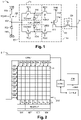
- Figure 1 illustrates an example of a circuit of a pixel 1 of an indirect time of flight sensor.
- Pixel 1 comprises a photoconversion region, or photosensitive region, PD, for example a photodiode, preferably a pinned photodiode.
- the photoconversion region PD has an electrode, for example its anode, which is connected to a node 100 configured to receive a reference voltage, for example the ground GND.
- the photoconversion region PD is configured such that charges are generated therein when light is received by the region PD.
- Pixel 1 further comprises two identical sets E1 and E2, delimited by dashed lines in Figure 1 .
- Each set E1, E2 is coupled to the region PD, and more particularly to the electrode 102 of the region PD which is not connected to the node 100.
- Each set E1, E2 of the pixel 1 comprises a charges storage region mem1, mem2 and a controllable charge transfer device TGmem1, TGmem2.
- Device TGmem1, respectively TGmem2, is connected between the region PD and the region mem1, respectively mem2.
- Device TGmem1, respectively TGmem2 is configured to transfer charges from the region PD to the region mem1, respectively mem2. More precisely, device TGmem1, respectively TGmem2, is configured to transfer charges from the region PD to the region mem1, respectively mem2, when its control signal TG1, respectively TG2, is active, for example at a high level, and to avoid any charge transfer between the region PD and the region mem1, respectively mem2, when this control signal is inactive, for example at a low level.
- Each device TGmem1, TGmem2 is, for example, a transfer gate.
- Region mem1, respectively mem2, is configured to store charges which are transferred therein by the transfer device TGmem1, respectively TGmem2, until these charges are transferred elsewhere in the pixel 1 during a reading phase.
- Each region mem1, mem2 is, for example, a pinned diode.
- Each pinned diode mem1, mem2 has an electrode, for example its anode, connected to the node 100, and another electrode 104, for example its cathode, coupled to the electrode 102 of the region PD by the corresponding transfer device TGmem1, TGmem2.
- Pixel 1 has an output 106. During a reading phase of the pixel 1, outputs signals of the pixel 1 are available on the output 106.
- Pixel 1 comprises a selection device 108, for example a MOS ("Metal Oxide Semiconductor") transistor.
- the device 108 is connected between the output 106 and a reading conductive line Vx.
- the selection device 108 is configured to selectively couple the output 106 of the pixel 1 to the line Vx. More precisely, during a reading phase of the pixel 1, for example when a control signal RD of the device 108 is active, for example at a high level, the device 108 couples the output 106 to line Vx, and outside of a reading phase of the pixel 1, for example when signal RD is inactive, for example at a low level, the device 108 isolates output 106 from line Vx.
- MOS Metal Oxide Semiconductor
- a line Vx is shared by all the pixels 1 which belong to the same column.
- all the pixels of the row to which belongs this pixel are selected by activating signal RD for this row of pixels.
- Pixel 1 comprises a controllable output circuit 110, delimited in dashed lines in Figure 1 .
- the circuit 108 is configured to selectively generate, on the output 106, an output signal indicative of the number of charges stored in the charge storage region mem1 of the pixel or an output signal indicative of the number of charges stored in the charge storage region mem2 of the pixel.
- the circuit 110 when a first signal RD1 is active, for example at a high level, the circuit 110 provides a signal, for example a voltage referenced to node 100, indicative of the number of charges stored in region mem1, and, when a second signal RD2 is active, for example at a high level, the circuit 110 provides a signal, for example a voltage referenced to node 100, indicative of the number of charges stored in region mem2.
- the circuit 100 comprises, for each set E1, E2, a controllable coupling device TGRD1, TGRD2, for example a transfer gate.
- Device TGRD1, respectively TGRD2 is connected to the set E1, respectively E2, and, more precisely, to region mem1, respectively mem2, for example to the electrode 104 of the region mem1, respectively mem2.
- the device TGRD1, respectively TGRD2 is configured to couple the region mem1, respectively mem2, to a node 111 when the signal RD1, respectively RD2, is active, and to insulate the region mem1, respectively mem2, from node 111 when the signal RD1, respectively RD2, is inactive.
- Circuit 110 further comprises a source follower MOS transistor 112 having its gate connected to node 111, its source connected to output 106 and its drain connected to a node 114 configurated to receive a supply voltage Vdd.
- the transistor AB is controlled by a signal TGAB.
- the transistor AB is configured, when off, to operate as an antiblooming device for the region PD, and, when on, to reset the region PD, that is to say to evacuate all the photo-generated charges accumulated in the region PD towards the node 118.
- a usual indirect time of flight sensor comprising a matrix of pixels 1 arranged in rows and columns
- all the transfer devices TGmem1 and TGmem2 of all the pixels 1 of the matrix are driven simultaneously to transfer charges photo-generated in the region PD of each pixel towards regions alternatively mem1 and mem2 of this pixel.
- the scene to capture is illuminated by the sensor in a flash manner, that is to say that each time the sensor emits light, the whole scene is illuminated.
- the light is, for example, emitted under the form of a burst of successive periodic pulses of light.
- all the pixels 1 of the matrix are read. More particularly, during the reading of all the pixels 1 of the matrix, the rows of pixels are selected the one after the other with the signals RD, and all the pixels 1 of a selected row are read simultaneously.
- the pixel comprises only two identical sets E1 and E2, in other examples not illustrated, the pixel may comprise more than two identical sets, for example four identical sets.
- the pixel 1 has only one output 106
- the pixel may comprise more than one output 106.
- the pixel may comprise one output 106 for each set E1, E2, the circuit 110 being then connected between the sets E1, E2 and the outputs 106.
- the selection device 108 is then configured to selectively couple the outputs 106 to at least one corresponding line Vx.
- the output 106 associated to the set E1 is selectively coupled to a first line Vx by the device 108
- the output 106 associated to the set E2 is selectively coupled to a second line Vx by the device 108.
- pixels known by those skilled in the art may be used in a matrix of pixels of an indirect time of flight sensor, and the pixel 1 of Figure 1 is only one example of these known pixels. Further, usual controls of these different pixels during an integration phase and during a reading phase are well known by those skilled in the art.
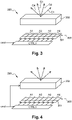
- Figure 2 illustrates an indirect time of flight sensor 2 according to one embodiment.
- the sensor 2 comprises a matrix 200 of pixels 1, only one pixel 1 being referenced on Figure 2 to avoid surcharging the drawing. Pixels 1 are arranged in rows (horizontally on Figure 2 ) and columns (vertically on Figure 2 ). In the example of Figure 2 , the matrix 200 comprises 8 rows and 8 columns, although, in practice, the matrix 200 may comprise hundreds of rows and hundreds of columns.
- the sensor 2 comprises a reading circuit READOUT.
- Circuit READOUT is configured to received output signals of the pixels of the matrix 200 which are coupled to the Vx lines when these pixels are selected.
- circuit READOUT is configured to received output signals of the pixels having their outputs 106 coupled to corresponding lines Vx thank to their selection devices 108 ( Figure 1 ).
- the Vx lines are arranged parallel to the columns of the matrix 200, or, said in other words, the Vx lines are vertical on Figure 2 .
- Each Vx line is coupled, preferably connected, to the circuit READOUT. In order to avoid surcharging the Figure 2 , only one Vx line is fully represented, in dashed lines, in this Figure.
- each Vx line is shared by several pixels, and, more particularly, by all the pixels of a corresponding column in the embodiment of Figure 2 .
- the reading circuit READOUT for example comprises a plurality of analog-to-digital converters (ADC), preferably one ADC for each Vx line.
- ADC analog-to-digital converters
- the sensor 2 comprises a control circuit CTRL1.
- the circuit CTRL1 is configured to control reading phases and integration phases for the pixels of the matrix 200.
- the sensor 2 comprises parallel conductive lines 204.
- Lines 204 are connected to circuit CTRL1.
- the circuit CTRL1 is configured to provide the control signals TG1 and TG2 ( Figure 1 ) to the lines 204.
- the lines 204 are parallel to the lines Vx.
- Each line 204 is for example shared by all the pixels of a corresponding column of the matrix.
- only one line 204 is fully represented, in dashed lines, in order to avoid surcharging the Figure.
- only one line 204 by column is represented in Figure 2 .
- each pixel receives control signals TG1 and TG2 ( Figure 1 ) via two corresponding lines 204, and each column is thus associated to a line 204 for transmitting signal TG1 to all the pixels of the column, and to another line 204 for transmitting signal TG2 to all these pixels.
- the sensor 2 further comprises parallel conductive lines 206. Lines 206 are connected to circuit CTRL1.
- the circuit CTRL1 is configured to provide the control signals RD to the lines 206.
- the lines 206 are perpendicular to the lines Vx.
- Each line 206 is for example shared by all the pixels of a corresponding row of the matrix.
- only one line 206 is fully represented in dashed lines in order to avoid surcharging the Figure.
- the other control signals provided to the pixels of the matrix 200 are preferably provided by the circuit CTRL1.
- the sensor 2 comprises other conductive lines (not shown) to provide other control signals and voltages to the pixels of the matrix 200.
- the sensor 2 comprises:
- the sensor 2 comprises an illumination device 205.
- the illumination device 205 is configured to illuminate a scene to capture.
- the sensor 2 further comprises a control circuit CTRL2 configured to control the device 205.
- the circuit CTRL2 provides a control signal cmd to the device 205.
- the signal cmd is, for example, a digital signal comprising several bits.
- the scene to capture is divided in a plurality of areas, and it is here proposed to successively illuminate each area of the scene, by illuminating only one area at a time, being understood that, in practice, parts of the scene which are adjacent to the illuminated area may also receive some light.
- the device 205 and its control circuit CTRL2 are configured to successively illuminate each area of the scene.
- the device 205 is configured to illuminate different areas of the scene to capture, the area which is illuminated by the device 205 being determined by the signal cmd.
- Control circuits CTRL1 and CTRL2 are synchronized, for example by means of a synchronization circuit SYNC which couples circuits CTRL1 and CTRL2. Said in other words, circuit SYNC receives and/or sends synchronization signals to and/or from circuits CTRL1 and CTRL2.
- the matrix 200 is divided in a plurality of areas, the total number of areas of the matrix being, preferably, equal to the total number of areas of the scene.
- the matrix 200 is divided in four areas M1, M2, M3 and M4.
- Each area M1, M2, M3, M4 comprises adjacent lines of pixels 1, these lines of pixels being parallel to the conductive lines 204.
- each area M1, M2, M3, M4 comprises two adjacent lines of pixels 1 which are parallel to the lines 204, or, said in other words, each area M1, M2, M3, M4 comprises two adjacent columns of pixels 1.
- the matrix 200 and the device 205 are disposed relative to each other such that each area M1, M2, M3, M4 of the matrix 200 corresponds to an area of the scene, taken among the areas the scene is divided in and which are successively illuminated. Said in other words, the matrix 200 and the device 205 are disposed relative to each other such that, each time an area of the scene, taken among the plurality of areas the scene is divided in, is illuminated by the device 205, the light reflected by this area of the scene is received by the pixels 1 of the corresponding area M1, M2, M3 or M4 of the matrix 200, being understood that, in practice, some other pixels of the matrix, which are disposed near this corresponding area M1, M2, M3 of M4, may also receive part of the light reflected by the scene.
- the implementation of this disposition of the matrix 200 and the device 205 relative to each other is in the abilities of those skilled in the art.
- the sensor 2 allows a scanned illumination of the scene to capture.
- all the light generated by the device 205 is directed towards this area of the scene.
- the signal-to-noise ratio of the light received by the sensor 2 is increased compared to that of the light received by these usual sensors.
- the light received by each area of scene carries less optical power than the light received by the only area of the scene which is illuminated by the sensor 2 during a scanned illumination.
- the circuit CTRL1 is further configured to provide different control signals TG1 and TG2 to the different areas M1, M2, M3 and M4 of the matrix 200. Said in other words, the circuit CTRL1 is configured to control the charge transfers independently in each area M1, M2, M3, M4 of the matrix 200, or, said differently, independently between the areas M1, M2, M3 and M4.
- circuit CTRL1 comprises a different sub-circuit (not shown on Figure 2 ) for each area M1, M2, M3, M4 of the matrix, each sub-circuit being configured to provide control signals for charge transfer in the pixels of the area M1, M2, M3 or M4 this sub-circuit is associated with.
- the circuit CTRL1 is configured to control an integration phase for the pixels of any one of the areas M1, M2, M3 and M4, while the circuit CTRL1 controls no integration phase for the pixels of the other areas. More particularly, when an area of the scene is illuminated by the device 205, and the light reflected by this area of the scene is received by the corresponding area M1, M2, M3 or M4 of the matrix 200, control signals TG1, TG2 are maintained, by circuit CTRL1, at the inactive state for the other areas of the matrix 200. The control signals TG1, TG2 are repeatedly commuted between active and inactive states only for the pixels 1 of the area M1, M2, M3 or M4 which is receiving light.
- control signals TG1, TG2 are repeatedly commuted between active and inactive states only for the pixels 1 of the area of the matrix 200 corresponding to the area of the scene which is illuminated, such that in each pixel of said area of the matrix 200, charges are alternatively transferred, from the region PD, to each storage regions mem1, mem2 of the pixel.
- each commutation of the signal TG1, respectively TG2 corresponds to a charge or a discharge of a capacitance, typically the gate capacitance of the charge transfer device TGmem1, respectively TGmem2.
- a power consumption of the sensor 2 is reduced compared to that of a usual indirect time of flight sensor, in which signals TG1, respectively TG2, commute simultaneously in all the pixels of the sensor.
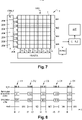
- Figure 3 illustrates, in a very schematic manner, the illumination device 205 according to one embodiment.
- the illumination device 205 comprises an array 300 of laser sources 301, only one laser source being referenced in Figure 3 in order to avoid surcharging the Figure.
- Each laser source 301 is, preferably, a VCSEL ("Vertical-Cavity Surface-Emitting Laser").
- the array 300 comprises 8X2 laser sources 301, although the number of light sources 301 of the array can be different in other examples.
- Device 205 further comprises an optical device 302, represented in the form of a block in Figure 3 .
- Optical device 302 is configurated to direct, or orientate, the light emitted by the array 300 of laser sources 301 towards the scene to capture.
- the array 300 is divided in a plurality of sets of laser sources.
- the array 300 is divided into four sets A1, A2, A3 and A4 of laser sources 301.
- the number of sets of the array 300 is equal to the number of areas of the scene, and to the number of areas M1, M2, M3, M4 of the matrix 200 ( Figure 2 ).
- Each set A1, A2, A3, A4 is configured to illuminate a corresponding area of the scene to capture.
- the laser sources 301 of the array can be each controlled independently from the other laser sources 301.
- the array 300 is controlled such that, when laser sources 301 of a given sets A1, A2, A3 or A4 of the array 300 is emitting light, the laser sources 301 of the other sets are emitting no light.
- the laser sources 301 which are emitting light and those which are emitting no light are determined by the signal cmd.
- the circuit CTRL2 ( Figure 2 ) is configured to control, with the signal cmd, an emission of light by sets A1, A2, A3 and A4 the one after the other. More precisely, the set A1, A2, A3 or A4 which emits light depends on the value of the signal cmd.
- the emitted light is directed towards a corresponding area of the scene to capture by the device 302, the illuminated area of the scene being different for each set A1, A2, A3, A4 of the array 300 of laser sources 301.
- the optical device 302 for example a lens or an objective, is configured to direct the light emitted by the laser sources 301 of the respective set A1, A2, A3 or A4 in a respective direction O1, O2, O3 or O4.
- set A1 (respectively A2, A3 or A4) emits light
- a first (respectively a second, a third or a fourth) area of the scene is illuminated and reflected light is received by the area M1 (respectively M2, M3 or M4) of the matrix 200 ( Figure 2 ).
- the device 205 comprises a control circuit CTRL3 configured to control the emission of light by each light source 301 of the array 300 based on signal cmd.
- CTRL3 configured to control the emission of light by each light source 301 of the array 300 based on signal cmd.
- a given power supply provided to the array 300 is shared, or split, between those of the light sources 301 which are emitting light.
- the optical power of the light received by an area of the scene is greater when only the light sources of the set A1, A2, A3 or A4 corresponding to this area are emitting light (scanned illumination), than when all the light sources 301 are emitting light simultaneously (flash illumination).
- Figure 4 illustrates the illumination device 205 according to one alternative embodiment.
- the device 205 of Figure 4 comprises, as the one of Figure 3 , the array 300 of laser sources 301, and the optical device 302.
- the array 300 is not divided in a plurality of sets of light independently controllable. For example, depending on the signal cmd, all the light sources 301 emit light, or do not emit any light.
- the device 205 comprises the control circuit CTRL3 configured to control the emission of light by all light sources 301 of the array 300 based on signal cmd.
- the optical device 302 is controllable. More precisely, the direction in which the light emitted by the array 300 is directed by the device 302 is controllable. Said in other words, the device 302 is configured to direct the emitted light differently depending on signal cmd.
- the control circuit CTRL2 ( Figure 2 ), which provides the control signal cmd to the device 205, is configured to provide, at each illumination of an area of the scene to capture, the control signal cmd which corresponds to a directing of the light, by the device 302, towards this area of the scene.
- the optical device 302 is configured to direct the light emitted by the array of laser sources 301 in four different directions O1, O2, O3 or O4, each corresponding to a different area of the scene.
- signal cmd is at a first (respectively a second, a third or a fourth) value
- a first (respectively a second, a third or a fourth) area of the scene is illuminated and reflected light is received by the area M1 (respectively M2, M3 or M4) of the matrix 200 ( Figure 2 ).
- the device 302 for example comprises mirror(s) and/or one or several lens, the orientation of which being controllable by the signal cmd.
- the optical device 302 comprises at least one controllable movable micro-mirror, or, in other words, a MEMs (Microelectromechanical systems) controllable movable micro-mirror.
- MEMs Microelectromechanical systems
- the implementation of the optical device 302 is in the abilities of those skilled in the art.
- a given power supply which is provided to the array 300 during an illumination phase is shared between all the light sources 301.
- all the light emitted by the array 300 is concentrated towards a given area of the scene by the optical device 302. This differs from a flash illumination for which the light emitted by the array 300 is directed, or spread, towards the whole scene to capture.
- a scanned illumination of the scene allows to improve the optical power of the light successively received by each area of the scene, compared to that of the light received simultaneously by all the areas of the scene during a flash illumination.
- inventions of Figure 3 and 4 may be combined. Further, the described embodiments of indirect time of flight sensors are not limited to the embodiments of the device 205 described in relation with Figures 3 and 4 . Those skilled in the art are capable of using other illumination devices which are controllable, such that the emitted light is directed only towards an area of the scene to capture, selected in a controllable manner among a plurality of areas of the scene.
- Figure 5 shows chronograms illustrating operation of the sensor of Figure 2 according to one embodiment. More specifically, in this example the scene to capture is divided in four area S1, S2, S3 and S4, and the Figure 5 shows, depending on time t, the light ("light") emitted by the illumination device 205 ( Figure 2 ), which area S1, S2, S3 or S4 receives the light ("illuminated area of the scene"), which corresponding area M1, M2, M3 or M4 of the matrix 200 ( Figure 2 ) receives the reflected light and has its pixels in an integration phase ("integrated area”), and which pixels of the matrix are read (“read”).
- the device 205 emits light under the form of a burst of periodic pulses of light.
- device 205 emits light with the direction O1, towards the area S1 of the scene.
- the light reflected by this area S1 is received by the corresponding area M1 of the matrix.
- An integration phase of the received light is done in the pixels of the area M1 only, by commutating the control signals TG1, TG2 of the charge transfer devices TGmem1, TGmem2 of these pixels between their active and inactive states, at a frequency upper than that of the emitted light.
- the circuit CTRL1 is configured to control, by means of signals RD, a reading of all the pixels of the matrix 200, by reading the rows of the matrix ones after the other.
- device 205 emits light with the direction O2, towards the area S2 of the scene.
- the light reflected by the area S2 is received by the corresponding area M2 of the matrix, and an integration phase is performed in the pixels of the area M2 only.
- device 205 emits light with the direction O3, towards the area S3 of the scene.
- the light reflected by the area S3 is received by the corresponding area M3 of the matrix, and an integration phase is performed in the area M3 only.
- device 205 emits light with the direction O4, towards the area S4 of the scene.
- the light reflected by the area S4 is received by the corresponding area A4 of the matrix, and an integration phase is performed in the area M4 only.
- the outputs signals of the pixels of the area M1 read after the illumination of the area M1 (between instants t1 and t2), the outputs signals of the pixels of the area M2 read after the illumination of the area M2 (between instants t3 and t4), the outputs signals of the pixels of the area M3 read after the illumination of the area M3 (between instants t5 and t6), and the outputs signals of the pixels of the area M4 read after the illumination of the area M4 (between instants t7 and t8) may be used to generate, or compute, an image, or depth map, of scene.
- a new scanned illumination of the scene begins, by illuminating, with the device 205, the area M1 of the scene.
- the device 205 when capturing a scene, during the successive illuminations of the areas of the scene, the device 205 is supplied with an average power supply having a given peak power, which is equal to an average power, having the same peak power, provided to an illumination device of a usual sensor during a flash illumination of the scene.
- the duration T of the illumination phase of each area of the scene during a scanned illumination is preferably equal to the duration of the flash illumination divided by the number of areas of the scene. This allows to further increase, the signal-to-noise ratio in the sensor 2 compared to a usual sensor, without modifying the power supply used to illuminate the scene to capture.
- Figure 6 shows chronograms illustrating operation of the sensor of Figure 2 according to one alternative embodiment.
- the scene to capture is divided in four area S1, S2, S3 and S4, and the Figure 6 shows, depending on time t, the light ("light") emitted by the illumination device 205, which area S1, S2, S3 or S4 receives the light ("illuminated area of the scene"), which corresponding area M1, M2, M3 or M4 of the matrix 200 receives the reflected light and has its pixels in an integration phase ("integrated area”), and which pixels of the matrix are read.
- the device 205 emits light under the form of a burst of periodic pulses of light.
- device 205 emits light with the direction O1, towards the area S1 of the scene.
- the light reflected by this area S1 is received by the corresponding area M1 of the matrix.
- An integration phase of the received light is done in the pixels of the area M1 only, by commutating the control signals TG1, TG2 of the charge transfer devices TGmem1, TGmem2 of these pixels between their active and inactive states, at a frequency upper than that of the emitted light.
- device 205 emits light with the direction O2, towards the area S2 of the scene.
- the light reflected by the area S2 is received by the corresponding area M2 of the matrix, and an integration phase is performed in the pixels of the area M2 only.
- device 205 emits light with the direction O3, towards the area S3 of the scene.
- the light reflected by the area S3 is received by the corresponding area M3 of the matrix, and an integration phase is performed in the pixels of the area M3 only.
- device 205 emits light with the direction O4, towards the area S4 of the scene.
- the light reflected by the area S4 is received by the corresponding area M3 of the matrix, and an integration phase is performed in the pixels of the area M4 only.
- a cycle of successive illuminations of the areas S1, S2, S3 and S4, in which each area S1, S2, S3, S4 is illuminated once may be then repeated several times before a reading of all the pixels of the matrix ("all matrix").
- the cycle of successive illuminations of the area S1, S2, S3 and S4 is performed four times, once between the instants t10 and t14, once between the instant t14 and an instant t15 posterior to instant t14, once between the instant t15 and an instant t16 posterior to instant t15, and once between the instant t16 and an instant t17 posterior to instant t16.
- the circuit CTRL1 controls, by means of signals RD, a reading of all the pixels of the matrix ("all matrix"), by reading the rows of the matrix ones after the other. No light is emitted during this reading phase.
- a depth map of the scene can be generated, or computed, based on the outputs signals of the pixels read during the reading phase.
- the circuit CTRL2 is configured to control several successive illumination cycles, each comprising a unique illumination of each area S1, S2, S3 and S4.
- the circuit CTRL1 is further configured to control an absence of emission of light by the illumination device 205 during the reading.
- the duration T1 of each illumination phase of each area S1, S2, S3 and S4 is equal to the duration T of the illumination phase of each area S1, S2, S3 and S4 described in relation with Figure 5 , divided by the number of times the illumination cycle of the areas S1, S2, S3 and S4 is repeated before a full reading of the matrix.
- the illumination duration T1 is equal to a quarter of the illumination duration T ( Figure 5 ).
- the power supply provided to device 205 for capturing the scene is the same in the operation mode of Figure 6 and in the operation mode of Figure 5 .
- the operation described in relation with Figure 6 allows to mitigate the temperature elevation in the array 300 of the device 205, compared to the operation described in relation with Figure 5 .
- the lines 204 for providing the control signals TG1, TG2 to the transfer devices TGmem1, TGmem2 of the pixels are parallel to the lines Vx.
- Other embodiments will be described below, in which lines 204 are perpendicular to the lines Vx.
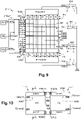
- Figure 7 illustrates an indirect time of flight sensor 2' according to a further embodiment, in which lines 204 are perpendicular to lines Vx.
- the sensor 2' comprises, as the sensor 2 ( Figure 2 ), the matrix 200 of pixels 1, the circuit READOUT, the lines Vx coupled to the circuit READOUT, the lines 206, and the illumination device 205 and its control circuit CTRL2, which will not be described again.
- the sensor 2' comprises a control circuit CTRL1'.
- the circuit CTRL1' is configured to control reading phases and integration phases for the pixels of the matrix 200.
- the circuit CTRL1' is configured to provide the control signals TG1 and TG2 ( Figure 1 ) to the lines 204.
- the circuit CTRL1' is further configured to provide the control signals RD to the lines 206.
- each line 204 which are each connected to circuit CTRL1', are perpendicular to the lines Vx.
- Each line 204 is shared by all the pixels of a corresponding row of the matrix.
- only one line 204 is fully represented in dashed lines, in order to avoid surcharging the Figure.
- only one line 204 by row is represented in Figure 7 .
- each pixel receives control signals TG1 and TG2 ( Figure 1 ) via two corresponding lines 204, and each row is thus associated to a line 204 for transmitting signal TG1 to all the pixels of the row, and to another line 204 for transmitting signal TG2 to all these pixels.
- the other control signal provided to the pixels of the matrix 200 are preferably provided by the circuit CTRL1'.
- the sensor 2' comprises other conductive lines (not shown) to provide other control signals and voltages to the pixels of the matrix 200.
- the sensor 2' comprises:
- Control circuits CTRL1' and CTRL2 are synchronized, for example by means of a synchronization circuit SYNC which couples circuits CTRL1' and CTRL2. Said in other words, circuit SYNC receives and/or sends synchronization signals to and/or from circuits CTRL1' and CTRL2.
- the matrix 200 of sensor 2' is divided in a plurality of areas, the total number of areas of the matrix being, preferably, equal to the total number of areas of the scene.
- the matrix 200 is divided in four areas M1, M2, M3 and M4.
- Each area M1, M2, M3, M4 comprises adjacent lines of pixels 1, these lines of pixels being parallel to the conductive lines 204.
- each area M1, M2, M3, M4 comprises two adjacent lines of pixels 1 which are parallel to the lines 204, or, said in other words, each area M1, M2, M3, M4 comprises two adjacent rows of pixels 1.
- the matrix 200 and the device 205 are disposed relative to each other such that each area M1, M2, M3, M4 of the matrix 200 corresponds to an area of the scene.
- the sensor 2' allows, as the sensor 2 of Figure 2 , a scanned illumination of the scene to capture. As a result, the signal-to-noise ratio of the light received by the sensor 2' is increased compared to that of the light received by the usual sensors.
- the circuit CTRL1' is configured to provide different control signals TG1 and TG2 to the different areas M1, M2, M3 and M4 of the matrix 200. Said in other words, the circuit CTRL1' is configured to control the charge transfers independently in each area M1, M2, M3, M4 of the matrix 200.
- circuit CTRL1' comprises a different sub-circuit (not shown on Figure 7 ) for each area M1, M2, M3, M4 of the matrix, each sub-circuit being configured to provide control signals for charge transfer in the pixels of the area M1, M2, M3 or M4 this sub-circuit is associated with.
- the circuit CTRL1' is configured to control an integration phase for the pixels of any one of the areas M1, M2, M3 and M4, while the circuit CTRL1' controls no integration phase for the pixels of the other areas. More particularly, when an area of the scene is illuminated by the device 205, and the light reflected by this area of the scene is received by the corresponding area M1, M2, M3 or M4 of the matrix 200, control signals TG1, TG2 are maintained, by circuit CTRL1', at the inactive state for the other areas of the matrix 200. The control signals TG1, TG2 are repeatedly commuted between active and inactive states only for the pixels 1 of the area M1, M2, M3 or M4 which is receiving light.
- control signals TG1, TG2 are repeatedly commuted between active and inactive states only for the pixels 1 of the area of the matrix 200 corresponding to the area of the scene which is illuminated, such that in each pixel of said area of the matrix 200, charges are alternatively transferred, from the region PD, to each storage regions mem1, mem2 of the pixel.
- a power consumption of the sensor 2' is reduced compared to that of a usual indirect time of flight sensor.
- An advantage of the sensor 2' compared to the sensor 2 is that the pixels of a given area M1, M2, M3 or M4 of the matrix 200 of sensor 2' may be read without performed a full reading of the matrix 200, by reading ones after the other only the rows of this area.
- Figure 8 shows chronograms illustrating operation of the sensor 2' of Figure 7 according to one embodiment. More specifically, in this example the scene to capture is divided in four area S1, S2, S3 and S4, and the Figure 8 shows, depending on time t, the light ("light") emitted by the illumination device 205 ( Figure 7 ), which area S1, S2, S3 or S4 receives the light ("illuminated area of the scene"), which corresponding area M1, M2, M3 or M4 of the matrix 200 ( Figure 7 ) receives the reflected light and has its pixels in an integration phase ("integrated area”), and which pixels of the matrix are read (“read”).
- the device 205 emits light under the form of a burst of periodic pulses of light.
- each illumination of an area S1, S2, S3 or S4 of the scene is followed by a reading of the pixels of only the area M1, M2, M3 or M4 of the matrix which corresponds to this area of the scene.
- the circuit CTRL1' is configured to control, after each illumination of an area S1, S2, S3 or S4, a reading of only the pixels of the area M1, M2, M3 or M4 corresponding to this area S1, S2, S3 or S4, before an illumination of a next area of the scene.
- the circuit CTRL2 is configured to control an absence of light emission by the device 205.
- the duration of the reading of the pixels of a given area of the matrix is reduced compared to that of the sensor 2, because it is not anymore needed to read the all the pixels of the matrix to read the pixels of a given area of the matrix.
- the senor 2' operates as described in relation with Figure 6 .
- the circuit CTRL2 is configured, before each reading of all the pixels, which is controlled by the circuit CTRL1', to control several successive illumination cycles each comprising a unique illumination of each area S1, S2, S3 and S4 of the scene.
- the circuit CTRL2 is further configured to control an absence of light emission by the illumination device 205 during the reading of the matrix.
- the pixels matrix is split into two insulated halves. Further, separated, or electrically decoupled, supply voltage, reference voltage, bias voltages and control signals are provided to each matrix half. It is then possible to read pixels of one half of the matrix while pixels of the other half are integrating, without generating noise.
- Different embodiments of indirect time of flight sensors implementing this strategy will be now described.
- Figure 9 illustrates an indirect time of flight sensor 2" according to a further embodiment.
- the sensor 2" is similar to the sensor 2' of Figure 7 , and only the difference between these two sensors will be described in detail.
- the illumination device 205 and its control circuit CTRL2 are not shown.
- the matrix 200 is split into two halves P1 and P2. More specifically, a limit between parts P1 and P2 of the matrix 200 is parallel to the lines 204.
- each column comprises a first portion, or half, belonging to part P1, and a second portion, or half, belonging to part P2 and being aligned with the first portion of the column.
- the parts P1 and P2 have a common edge, which corresponds to the limit between parts P1 and P2.
- the lines Vx which are parallel to the column of the matrix and perpendicular to lines 204, are interrupted at the limit between parts P1 and P2 of the matrix 200.
- the lines Vx of the part P1 of the matrix 200 and the lines Vx of the part P2 of the matrix end at the limit between parts P1 and P2 of the matrix 200.
- the lines Vx of part P1 of the matrix are insulated from the lines Vx of part P2 of the matrix, and the lines Vx of part P1, respectively P2, do not extend above or below the part P2, respectively P1.
- Figure 9 in order to not surcharging the Figure, only one line Vx of the part P1 is represented in dashed line, and only one corresponding line Vx of the part P2 is represented in dashed line.
- a line Vx of the part P2 corresponds to a line Vx of the part P1 when these two lines Vx belong to the same column of the matrix 200.
- a line Vx of the part P2 corresponds to a line Vx of the part P1 when the line Vx of the part P1 is selectively coupled to given outputs of the pixels of the part P1 disposed in this column, and the line Vx is selectively coupled to the corresponding outputs of the pixels of the part P2 disposed in this column.
- the part P1 of the matrix 200 is electrically decoupled from the part P2 of the matrix 200. More specifically, a semiconductor substrate to which the pixels 1 of the matrix 200 belong has a first part which comprises the part P1 of the matrix 200 and a second part which comprises the part P2 of the matrix 200. Said in other words, the first part of the substrate comprises the half P1 of the matrix and a second part of the substrate comprises the half P2 of the matrix.
- the first and second parts of the substrate are insulated from each other using insulation structures passing through the substrate, the insulation structures being preferably insulation structures provided between pixels to insulate the pixels from each other.
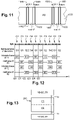
- Figure 10 shows a very schematic top view of two adjacent pixels 1 of the sensor of Figure 9 , according to an example.
- Figure 11 shows a very schematic cross section view along plan AA of Figure 10 .
- the two adjacent pixels 1 belong to the same column of the matrix, but to two different adjacent rows.
- the pixels 1 are disposed in and on a semiconductor substrate 1003.
- the two adjacent pixels are laterally delimited, or surrounded, by an insulation structure 1000, which is schematically represented by a simple line in Figure 10 .
- the insulation structure 1000 passes through the substrate 1003.
- the insulation structure 1000 is preferably a capacitive deep trench insulation (CDTI), that is to say a trench filled with a conductive material 1001, insulated from the semiconductor substrate 1003 by an insulative layer 1002.
- the conductive material is a metal, for example tungsten or aluminium, or a metal alloy. Indeed, the use of a metal or metal alloy allows to reduce the optical cross-talk.
- each pixel 1 is laterally delimited by a capacitive deep trench insulation 1005, for example a U-shaped insulation structure 1005 in the view of Figure 10 .
- the storage region mem1 and mem2 of each pixel 1 are defined, or delimited, by a portion of the structure 1000 and a portion of the structure 1005 which is opposite and parallel to this portion of the structure 1000. Said in other words, each storage region mem1, mem2 is laterally delimited, in a direction perpendicular to its length, by two parallel portions of the respective structures 1000 and 1005.
- each pixel 1 further comprises transfer devices TGmem1 and TGmem2, the coupling devices TGRD1 and TGRD2, the transistor 112 and the selection device 108, the transistors 112 and 108 being shared by the two adjacent pixels.
- the pixels of the matrix 200 can be arranged by groups of four pixels, the pixels of each group sharing the same transistors 112 and 108.
- each pixel of matrix 200 has its own transistors 112 and 108.
- the storage region mem1 and mem2 of each pixel may be delimited by CDTI which are not portion of the insulation structure 1000 which laterally delimitate the pixel.
- the insulation structure 1000 is of the CDTI type, in other example, this insulation structure may be a deep trench insulation (DTI), that is to say a trench filled with an insulating material, the DTI passing through the substrate.
- DTI deep trench insulation
- the set of all the pixels 1 of the part P1 of the matrix are surrounded by an insulation structure 1000, which delimits the first part of the substrate, and the set of all the pixels of the part P2 of the matrix are surrounded by another insulation structure 1000, which delimits the second part of the substrate.
- the reference voltage GND which is provided to the first part of the substrate and the reference voltage GND which is provided to the second part of the substrate are electrically decoupled from each other.
- the reference voltage GND provided to the first part of the substrate, or, in other words, to each pixel of the part P1 of the matrix is provided by a first bonding pad 900 of the sensor 2
- the other reference voltage GND provided to the second part of the substrate, or, in other words, to each pixel of the part P2 of the matrix is provided by a second bonding pad 902 of the sensor 2".
- Each bonding pad 900, 902 receives an off-chip reference voltage GND.
- Each bonding pad 900, 902 acts as a low-pass filter, as it is schematically represented in Figure 9 by a resistance R and an inductance L series-connected in each bonding pad.
- the insulation structures 1000 are CDTI.
- a bias voltage to structure 1000 delimiting the part P1 of the matrix 200, which is electrically decoupled from a bias voltage provided to structure 1000 delimiting the part P2 of the matrix 200.
- the bias voltage of the CDTI 1000 of the part P1 of the matrix 200 is provided by a voltage generator 904
- the bias voltage of the CDTI 1000 of the part P2 of the matrix 200 is provided by a voltage generator 906, which is electrically decoupled form the generator 904.
- the sensor 2" comprises a control circuit CTRL1".
- the circuit CTRL1" is configured to control reading phases and integration phases for the pixels of the matrix 200.
- the circuit CTRL1" is configured to provide the control signals TG1 and TG2 ( Figure 1 ) to the lines 204.
- the circuit CTRL1" is further configured to provide the control signals RD to the lines 206.
- the lines 204 which are each connected to circuit CTRL1" are parallel to the lines Vx.
- Each line 204 is shared by all the pixels of a corresponding row of the matrix.
- only one line 204 for each part P1, P2 of the matrix is fully represented in dashed lines, in order to avoid surcharging the Figure. Further, in order to avoid surcharging the Figure, only one line 204 by row is represented in Figure 9 .
- each pixel receives control signals TG1 and TG2 ( Figure 1 ) via two corresponding lines 204, and each row is thus associated to a line 204 for transmitting signal TG1 to all the pixels of the row, and to another line 204 for transmitting signal TG2 to all these pixels.
- the other control signal provided to the pixels of the matrix 200 are preferably provided by the circuit CTRL1".
- the sensor 2" comprises other conductive lines (not shown) to provide other control signals and voltages to the pixels of the matrix 200.
- the sensor 2" comprises:
- Control circuits CTRL1" and CTRL2 are synchronized, for example by means of a synchronization circuit SYNC (not shown in Figure 9 ), which couples circuits CTRL1" and CTRL2.
- the matrix 200 of sensor 2" is divided in a plurality of areas, the total number of areas of the matrix being, preferably, equal to the total number of areas of the scene.
- the matrix 200 is divided in four areas M1, M2, M3 and M4.
- Each area M1, M2, M3, M4 comprises adjacent lines of pixels 1, parallel to the conductive lines 204.
- each area M1, M2, M3, M4 comprises two adjacent lines of pixels 1 which are parallel to the lines 204, or, said in other words, each area M1, M2, M3, M4 comprises two adjacent rows of pixels 1.
- the matrix 200 and the device 205 are disposed relative to each other such that each area of the scene corresponds to an area M1, M2, M3, M4 of the matrix 200.
- areas M1 and M2 belong to part P1 of the matrix 200
- areas M3 and M4 belonging to part P2 of the matrix 200.
- the circuit CTRL1" is configured to provide different control signals TG1 and TG2 to the different areas M1, M2, M3 and M4 of the matrix 200, in a way similar to that described for the circuit CTRL1' ( Figure 7 ). Compared to the circuit CTRL1' of the sensor 2' of Figure 7 , the circuit CTRL1" is further configured to simultaneously control charge transfers in the pixels of an area of one of the halves P1 and P2 of the matrix 200, and a reading of the pixels of an area of the other one of the halves P1 and P2.
- the pixels of the area M1 or M2 of the part P1 are in a reading phase (respectively in an integration phase) controlled by the circuit CTRL1"
- the pixels of the area M3 or M4 of the part P1 are in an integration phase (respectively in a reading phase) controlled by the circuit CTRL1".
- the senor 2" comprises a voltage generator configured to provides this voltage level to the part P1 of the matrix, and a voltage generator configured to provides this voltage level to the other part P2 of matrix.
- a voltage generator configured to provides this voltage level to the part P1 of the matrix.
- the sensor 2" comprises a voltage generator 910 configured to provide the voltage level TGmemL to part P1 of the matrix 200, and a voltage generator 912 configured to provide the voltage level TGmemL to the part P2 of the matrix 200.
- the sensor 2" may comprise only one voltage generator 908 configured to provide the voltage level TGmemH, which is for example alternatively to the part P1 and to the part P2 of the matrix by the circuit CTRL1".
- the senor 2" comprises a first reading circuit READOUT1 coupled the lines Vx of the half P1 of the matrix 200, and a second reading circuit READOUT2 coupled to the lines Vx of the half P2 of the matrix 200.
- Circuit READOUT1, respectively READOUT2 is configured to received output signals of the pixels of the part P1, respectively P2, of matrix 200 which are coupled to the Vx lines of part P1, respectively P2, when these pixels are selected.
- Each reading circuit READOUT1 and READOUT2 for example comprises a plurality of analog-to-digital converters (ADC), preferably one ADC for each Vx line coupled to this reading circuit.
- ADC analog-to-digital converters
- the circuit READOUT1 receives a reference voltage, in this example the ground GND
- the circuit READOUT2 receives a reference voltage, in this example the ground GND.
- the reference voltage GND of the circuit READOUT1 is electrically decoupled from that of the circuit READOUT2.
- the reference voltage GND applied to the circuit READOUT1 is provided by a third bonding pad 912 of the sensor 2
- the other reference voltage GND applied to the circuit READOUT2 is provided by a fourth bonding pad 914 of the sensor 2”.
- Each bonding pad 912, 914 receives the off-chip reference voltage GND.
- Each bonding pad 912, 914 acts as a low-pass filter as schematically represented in Figure 9 by a resistance R and an inductance L series-connected in each bonding pad.
- Figure 12 shows chronograms illustrating operation of the sensor of Figure 9 according to one embodiment. More specifically, in this example the scene to capture is divided in four area S1, S2, S3 and S4, and the Figure 12 shows, depending on time t, the light ("light") emitted by the illumination device 205 of the sensor 2", which area S1, S2, S3 or S4 receives the light ("illuminated area of the scene"), which corresponding area M1, M2 of part P1 or M3, M4 of part P2 receives the reflected light and has its pixels integrating light ("integrated area of P1" and "integrated area of P2"), and which area M1, M2 of part P1 or M3, M4 of part P2 is read (“read area of P1" and "read area of P2").
- the device 205 emits light under the form of a burst of periodic pulses of light.
- device 205 emits light with the direction O1, towards the area S1 of the scene.
- the light reflected by this area S1 is received by the corresponding area M1 of part P1 of the matrix.
- An integration phase of the received light is done in the pixels of the area M1 only, thus only in part P1 of the matrix.
- device 205 emits light with the direction O3, towards the area S3 of the scene.
- the light reflected by this area S3 is received by the corresponding area M3 of part P2 of the matrix.
- An integration phase of the received light is done in the pixels of the area M3 only, thus only in part P2 of the matrix.
- the area M1 of the part P1 of the matrix is read. More specifically, the reading of the pixels of the area M1 is controlled by circuit CTRL1", and is done by reading the rows of pixels of the area M1 ones after the other.
- device 205 emits light with the direction O2, towards the area S2 of the scene.
- the light reflected by the area S2 is received by the corresponding area M2 of the matrix, and an integration phase is performed in the pixels of the area M2 only, thus only in part P1 of the matrix.
- the area M3 of the part P2 of the matrix 200 is read, similarly to the manner the area M1 was read between instants t21 and t22.
- device 205 emits light with the direction O4, towards the area S4 of the scene.
- the light reflected by the area S4 is received by the corresponding area M4 of the matrix, and an integration phase is performed in the pixels of the area M4 only, thus only in part P2 of the matrix.
- the area M2 of the part P1 of the matrix 200 is read, similarly to the manner the area M1 was read between instants t21 and t22.
- the area M4 of part P2 of the matrix 200 is read, similarly to the manner the area M1 was read between instants t21 and t22.
- a depth map of the scene may be computed. More specifically, the depth map is generated based on the output signals of the pixels of the area M1 read between the instants t21 and t22, of the area M2 read between the instants t22 and t23, of the area M3 read between the instants t23 and t24, and of the area M4 read between the instants t24 and t25.
- device 205 may emits light with the direction O1, towards the area S1 of the scene, such that the reflected light is integrated by the area M1 only. This allows to start a new acquisition of the scene to capture, similar to that described between the instants t20 and t25.
- a blanking time is provided after the instant t25, and before a new acquisition of the scene implemented as described between instants t20 and t25.
- Figure 13 illustrates, in a very schematic manner, an implementation of the sensor of Figure 9 , according to one embodiment.
- Figure 13 is a top view of the disposition of the circuit READOUT1 and READOUT2 relative to the matrix 200.
- circuit READOUT1 is disposed along a first edge of the matrix 200, on the side of the half P1 of the matrix, circuit READOUT2 being disposed along a second edge of the matrix, on the side of the half P2.
- the first and second edges are parallel. More specifically, the first and second edges are perpendicular to the lines Vx (not shown on Figure 13 ).
- This disposition of the circuits READOUT1 and READOUT2 relative to the matrix 200 is for example used when the circuits READOUT1 and READOUT2 belongs to the same semiconductor substrate than the matrix 200.
- Figure 14 illustrates, in a very schematic manner, an implementation of the sensor of Figure 9 , according to one alternative embodiment.
- Figure 14 is a perspective view of the disposition of the circuit READOUT1 and READOUT2 relative to the matrix 200.
- the matrix belongs to a first semiconductor substrate
- the circuits READOUT1 and READOUT2 belongs to a second semiconductor substrate.
- the first substrate is stacked over the second substrate.
- the lines Vx of the part P1 of the matrix 200 are coupled to the circuit READOUT1, for example thank to an interconnexion structure (not shown) which is sandwiched between the first and second substrates.
- the lines Vx of the part P2 of the matrix 200 are coupled to the circuit READOUT2, for example thank to same interconnexion structure.
- only one line Vx is represented in dashed line, in each part P1, P2 of the matrix 200.
- the circuit READOUT1 is disposed below the part P1 of the matrix 200, the circuit READOUT2 being disposed below the part P2 of the matrix.
- the second substrate further comprises digital circuits, for example in CMOS technology, for example a circuit for processing signals provided by the circuits READOUT1 and READOUT2 in order to generate a depth map of a scene.
- digital circuits for example in CMOS technology, for example a circuit for processing signals provided by the circuits READOUT1 and READOUT2 in order to generate a depth map of a scene.
- Figure 15 illustrates an alternative embodiment of the indirect time of flight sensor 2" of the Figure 9 . Only the differences between the sensor 2" of Figure 9 and the sensor 2" of Figure 15 are detailed. In figure 15 , the two parts P1 and P2 of the matrix 200 are spaced from each other to simplify the illustration of the sensor 2", although, in practice, these two parts P1 and P2 are adjacent to each other, the part P1 being disposed along the part P2, similarly to what has been described in relation with Figure 9 .
- a first semiconductor substrate comprises the matrix 200, and lies on a second semiconductor substrate.
- the two substrates are stacked one over the other.
- the sensor 2" further comprises commutators 1500, only one of the commutators 1500 being referenced in Figure 15 in order to avoid surcharging the Figure.
- the commutators 1500 belong to the second substrate.
- the commutators 1500 are disposed below the limit between the two parts P1 and P2 of the matrix 200.
- the sensor 2" comprises as much commutators 1500 as the half P1 of the matrix 200 comprises lines Vx.
- Each commutator 1500 comprises a first input 1501, a second input 1502, an output 1503 and is controlled by a signal Sel.
- Each commutator 1500 is configured to electrically couple its input 1501 to its output 1503 when signal Sel is in a first state, and to couple its input 1502 to its output 1503 when signal Sel is in a second state.
- each commutator 1500 has its input 1501 connected to a line Vx of the part P1 of the matrix 200, and its input 1502 connected to a corresponding line Vx of the part P2 of the matrix 200.
- a line Vx of the part P2 corresponds to a line Vx of the part P1 when these two lines belong to the same column of the matrix 200.
- a line Vx of the part P2 of the matrix 200 corresponds to a line Vx of the part P1 of the matrix 200, for example, when the line Vx of the part P1 is selectively coupled to given outputs of the pixels of the part P1 disposed in this column, and the line Vx of part P2 is selectively coupled to corresponding outputs of the pixels of the part P2 disposed in said column.
- the sensor 2" comprises only one reading circuit READOUT3.
- the circuit READOUT3 belongs to the same substrate as the commutators 1500.
- the lines Vx of the part P1 seems to pass through the circuit READOUT3, as represented by portions of the lines Vx in dashed lines, in practice this is not the case.
- a reference voltage GND applied to the circuit READOUT3 is provided by a bonding pad 1505 of the sensor 2", which receives the off-chip reference voltage GND and acts as a low-pass filter as schematically represented in Figure 15 by a resistance R and an inductance L series-connected in the bonding pad 1505.
- Each commutator 1500 has its outputs 1503 coupled, preferably connected, to the circuit READOUT3.
- the circuit READOUT3 for example comprises an ADC for each commutator 1500.
- a control circuit for example the circuit CTRL1
- the circuit for controlling the commutators in this example the circuit CTRL1" is configured to provide the signal Sel at its first state during a reading of pixels of the half P1 of the matrix, and at its second state during a reading of pixels of the half P2 of the matrix.
- each line Vx of part P1, respectively P2 is coupled by a corresponding commutator 1500 to the circuit READOUT3 which then receives output signals of theses pixels. Further, when reading pixels of the part P1, respectively P2, of the matrix 200, the circuit READOUT3 is insulated from the lines Vx of part P2, respectively P1, by the commutators 1500.
- the sensor 2" of Figure 15 is more compact as it comprises only one reading circuit.
- Figure 16 illustrates, in a very schematic manner, an implementation of the sensor 2" of Figure 15 according to one embodiment.
- Figure 16 is perspective view of the disposition of the circuit READOUT3 and the commutators 1500 relative to the matrix 200.
- the matrix 200 belongs to a first semiconductor substrate (not represented in Figure 16 ), and the commutators 1500 belong to a second semiconductor substrate (not represented in Figure 16 ), the first substrate being stacked over the second substrate.
- the lines Vx of the parts P1 and P2 of the matrix 200 are, for example, conductive lines of an interconnexion structure which is sandwiched between the first and second substrates, only one line Vx of the part P1 and one corresponding line Vx of the part P2 being represented in Figure 16 in order to avoid surcharging the Figure.
- the commutators 1500 are disposed below the limit between the parts P1 and P2 of matrix 200, or, said in other words, below the common edge of the parts P1 and P2 of the matrix 200.
- the circuit READOUT3 belongs to the same substrate as the commutators 1500.
- the circuit READOUT3 is preferably disposed below the matrix 200, for example below the part P2 of the matrix as represented in Figure 16 .
- the second substrate further comprises digital circuits, for example in CMOS technology, for example a circuit for processing signals provided by the circuit READOUT3 in order to generate a depth map of a scene.
- digital circuits for example in CMOS technology, for example a circuit for processing signals provided by the circuit READOUT3 in order to generate a depth map of a scene.
- Figure 17 illustrates another alternative embodiment of the sensor 2" of the Figure 9 . Only the differences between the sensor 2" of Figure 15 and the sensor 2" of Figure 17 are here detailed.
- the sensor 2" comprises two reading circuits READOUT4 and READOUT5 instead of the reading circuit READOUT3.
- the circuits READOUT4 and READOUT5 belong to the same substrate as the commutators 1500.
- the lines Vx of the part P1, respectively P2 seems to pass through the circuit READOUT4, respectively READOUT5, as represented by portions of the lines Vx in dashed lines, in practice this is not the case.
- a reference voltage GND applied to the circuit READOUT4 is provided by a bonding pad 1700 of the sensor 2
- a reference voltage GND applied to the circuit READOUT5 is provided by a bonding pad 1702 of the sensor 2".
- Each bonding pad 1700 and 1702 receives the off-chip reference voltage GND and acts as a low-pass filter, as schematically represented in Figure 17 by a resistance R and an inductance L series-connected in each bonding pad.
- each commutator 1500 has its input 1501 connected to a line Vx of the part P1 of the matrix and its input 1502 connected to a corresponding line Vx of the part P2 of the matrix.
- each commutator 1500 connected to lines Vx of an odd column of the matrix 200 has its output 1503 connected to the circuit READOUT4, whereas each commutator 1500 connected to lines Vx of an even column of the matrix 200 has its output 1503 connected to the circuit READOUT5.
- Each circuit READOUT4, REDAOUT5 for example comprises an ADC for each commutator 1500 coupled, preferably connected, to this circuit.
- a control circuit for example the circuit CTRL1
- CTRL1 is configured to control the commutators 1500 such that the output 1503 of each commutator is coupled to the first input 1501 of this commutator during a reading of pixels of the half P1 of the matrix, and to the second input 1502 of this commutator during a reading of pixels of the half P2 of the matrix.
- each line Vx of part P1, respectively P2 is coupled by a corresponding commutator 1500 to the circuit READOUT4 when this line Vx belongs to an odd column of the matrix 200 and to the circuit READOUT5 when this line Vx belongs to an even column of the matrix 200, such that each output signal of each of these pixels is received either by the circuit READOUT4 or the circuit READOUT 5.
- circuits READOUT4 and READOUT5 are insulated from the lines Vx of part P2, respectively P1, by the commutators 1500.
- the commutators 1500 are disposed below the limit between the parts P1 and P2 of the matrix 200.
- the circuit READOUT4 is disposed below one of the parts P1 and P2 of the matrix 200, the circuit READOUT5 being disposed below the other one of the parts P1 and P2.
- Figure 18 illustrates, in a very schematic manner, an implementation of the sensor 2" of Figure 17 according to one embodiment.
- Figure 18 is perspective view of the disposition of the circuits READOUT4 and READOUT5 and of the commutators 1500 relative to the matrix 200.
- the matrix 200 belongs to a first semiconductor substrate (not represented in Figure 18 ), and the commutators 1500 belong to a second semiconductor substrate (not represented in Figure 18 ), the first substrate being stacked over the second substrate.
- the lines Vx of the parts P1 and P2 of the matrix 200 are for example conductive lines of an interconnexion structure which is sandwiched between the first and second substrates, only one line Vx of the part P1 and one corresponding line Vx of the part P2 being represented in Figure 18 in order to avoid surcharging the Figure.
- the commutator 1500 are disposed below the limit between the parts P1 and P2 of matrix 200, or, said in other words, below the common edge of the parts P1 and P2 of the matrix 200.
- circuits READOUT4 and REDAOUT5 belong to the same substrate as the commutators 1500.
- the circuit READOUT4 is disposed below one of the parts P1 and P2 of the matrix 200, the circuit READOUT5 being disposed below the other one of the parts P1 and P2.
- the circuit READOUT4 is disposed below the part P1 of the matrix, the circuit READOUT5 being disposed below the part P2 of the matrix.
- the second substrate further comprises digital circuits, for example in CMOS technology, for example a circuit for processing signals provided by the circuits READOUT4 and READOUT5 in order to generate a depth map of a scene.
- digital circuits for example in CMOS technology, for example a circuit for processing signals provided by the circuits READOUT4 and READOUT5 in order to generate a depth map of a scene.
- the illumination device 205 is configured to direct the light towards each of the areas S1, S2, S3, S4 of the scene by illuminating only one area at a time, and the matrix 200 is divided in four corresponding areas M1, M2, M3 and M4, those skilled in the art are capable to implement embodiment wherein the scene is divided into more (or less) than four areas, the device 205 is configured to independently illuminate each of these areas of the scene, and the matrix 200 is divided in areas such that each area of the matrix corresponds to an area of the scene. Further, those skilled in the art are capable of implementing embodiments in which the pixels of the matrix 200 are different from pixel 1 described in relation with Figure 1 , and in more for a specific example in relation with Figures 10 and 11 .
Landscapes
- Engineering & Computer Science (AREA)
- Physics & Mathematics (AREA)
- Computer Networks & Wireless Communication (AREA)
- General Physics & Mathematics (AREA)
- Radar, Positioning & Navigation (AREA)
- Remote Sensing (AREA)
- Electromagnetism (AREA)
- Transforming Light Signals Into Electric Signals (AREA)
- Optical Radar Systems And Details Thereof (AREA)
Priority Applications (3)
| Application Number | Priority Date | Filing Date | Title |
|---|---|---|---|
| EP20306680.8A EP4020006B1 (fr) | 2020-12-23 | 2020-12-23 | Capteur de temps de vol indirect |
| US17/557,349 US20220196835A1 (en) | 2020-12-23 | 2021-12-21 | Indirect time of flight sensor |
| CN202111578548.0A CN114675294B (zh) | 2020-12-23 | 2021-12-22 | 间接飞行时间传感器 |
Applications Claiming Priority (1)
| Application Number | Priority Date | Filing Date | Title |
|---|---|---|---|
| EP20306680.8A EP4020006B1 (fr) | 2020-12-23 | 2020-12-23 | Capteur de temps de vol indirect |
Publications (2)
| Publication Number | Publication Date |
|---|---|
| EP4020006A1 true EP4020006A1 (fr) | 2022-06-29 |
| EP4020006B1 EP4020006B1 (fr) | 2025-07-02 |
Family
ID=74844647
Family Applications (1)
| Application Number | Title | Priority Date | Filing Date |
|---|---|---|---|
| EP20306680.8A Active EP4020006B1 (fr) | 2020-12-23 | 2020-12-23 | Capteur de temps de vol indirect |
Country Status (3)
| Country | Link |
|---|---|
| US (1) | US20220196835A1 (fr) |
| EP (1) | EP4020006B1 (fr) |
| CN (1) | CN114675294B (fr) |
Citations (2)
| Publication number | Priority date | Publication date | Assignee | Title |
|---|---|---|---|---|
| US20140055771A1 (en) * | 2012-02-15 | 2014-02-27 | Mesa Imaging Ag | Time of Flight Camera with Stripe Illumination |
| US20180156899A1 (en) * | 2015-08-04 | 2018-06-07 | Panasonic Intellectual Property Management Co., Ltd. | Method for driving solid-state imaging device |
Family Cites Families (6)
| Publication number | Priority date | Publication date | Assignee | Title |
|---|---|---|---|---|
| EP3333893B1 (fr) * | 2015-08-04 | 2020-02-19 | Panasonic Intellectual Property Management Co., Ltd. | Dispositif d'imagerie à semi-conducteurs |
| FR3046495B1 (fr) * | 2015-12-30 | 2018-02-16 | Stmicroelectronics (Crolles 2) Sas | Pixel de detection de temps de vol |
| FR3065320B1 (fr) * | 2017-04-18 | 2020-02-07 | Stmicroelectronics (Crolles 2) Sas | Pixel de detection de temps de vol |
| EP3864432A4 (fr) * | 2018-11-20 | 2022-06-29 | Sense Photonics, Inc. | Procédés et systèmes pour la fourniture de signaux stroboscopiques distribués spatialement |
| CN110024374B (zh) * | 2019-02-27 | 2021-08-10 | 深圳市汇顶科技股份有限公司 | 成像系统及成像系统的像素阵列和图像传感器 |
| US10914817B2 (en) * | 2019-03-29 | 2021-02-09 | Rockwell Automation Technologies, Inc. | Multipath interference error correction in a time of flight sensor |
-
2020
- 2020-12-23 EP EP20306680.8A patent/EP4020006B1/fr active Active
-
2021
- 2021-12-21 US US17/557,349 patent/US20220196835A1/en not_active Abandoned
- 2021-12-22 CN CN202111578548.0A patent/CN114675294B/zh active Active
Patent Citations (2)
| Publication number | Priority date | Publication date | Assignee | Title |
|---|---|---|---|---|
| US20140055771A1 (en) * | 2012-02-15 | 2014-02-27 | Mesa Imaging Ag | Time of Flight Camera with Stripe Illumination |
| US20180156899A1 (en) * | 2015-08-04 | 2018-06-07 | Panasonic Intellectual Property Management Co., Ltd. | Method for driving solid-state imaging device |
Also Published As
| Publication number | Publication date |
|---|---|
| CN114675294B (zh) | 2025-08-15 |
| CN114675294A (zh) | 2022-06-28 |
| EP4020006B1 (fr) | 2025-07-02 |
| US20220196835A1 (en) | 2022-06-23 |
Similar Documents
| Publication | Publication Date | Title |
|---|---|---|
| US11076119B2 (en) | Solid state imaging device, method of controlling solid state imaging device, and program for controlling solid state imaging device | |
| TWI903735B (zh) | 光檢測裝置 | |
| KR101933994B1 (ko) | 깊이 영상과 컬러 영상을 획득하는 픽셀 구조를 가진 이미지 센서 | |
| EP3258683A1 (fr) | Capteur d'image et procédé pour faire fonctionner un capteur d'image | |
| KR101031982B1 (ko) | 고상 촬상 디바이스 및 그 구동 방법 | |
| US4581539A (en) | Solid-state image sensor | |
| KR102785834B1 (ko) | 이미지 센싱 장치 | |
| CN113224087B (zh) | 图像感测装置 | |
| KR20160112775A (ko) | 이미지 센서 | |
| EP4020006B1 (fr) | Capteur de temps de vol indirect | |
| US10413162B2 (en) | Image sensor, endoscope, and endoscope system | |
| CN220230724U (zh) | 环境光传感器 | |
| US11722792B2 (en) | Image sensing device | |
| US12306039B2 (en) | Light sensor | |
| US6355949B1 (en) | Solid state imaging apparatus with horizontal charge transfer register which can transfer signal charge faster | |
| US20250160030A1 (en) | Image sensor | |
| US11227883B2 (en) | Image sensing device having a shared pixel structure including MOS transistors | |
| US20240340554A1 (en) | Imaging device | |
| JP2023124524A (ja) | 撮像装置およびその制御方法 | |
| JPH05191729A (ja) | Ccd型固体撮像素子と撮像装置 |
Legal Events
| Date | Code | Title | Description |
|---|---|---|---|
| PUAI | Public reference made under article 153(3) epc to a published international application that has entered the european phase |
Free format text: ORIGINAL CODE: 0009012 |
|
| STAA | Information on the status of an ep patent application or granted ep patent |
Free format text: STATUS: THE APPLICATION HAS BEEN PUBLISHED |
|
| AK | Designated contracting states |
Kind code of ref document: A1 Designated state(s): AL AT BE BG CH CY CZ DE DK EE ES FI FR GB GR HR HU IE IS IT LI LT LU LV MC MK MT NL NO PL PT RO RS SE SI SK SM TR |
|
| STAA | Information on the status of an ep patent application or granted ep patent |
Free format text: STATUS: REQUEST FOR EXAMINATION WAS MADE |
|
| 17P | Request for examination filed |
Effective date: 20221215 |
|
| RBV | Designated contracting states (corrected) |
Designated state(s): AL AT BE BG CH CY CZ DE DK EE ES FI FR GB GR HR HU IE IS IT LI LT LU LV MC MK MT NL NO PL PT RO RS SE SI SK SM TR |
|
| GRAP | Despatch of communication of intention to grant a patent |
Free format text: ORIGINAL CODE: EPIDOSNIGR1 |
|
| STAA | Information on the status of an ep patent application or granted ep patent |
Free format text: STATUS: GRANT OF PATENT IS INTENDED |
|
| RIC1 | Information provided on ipc code assigned before grant |
Ipc: G01S 17/894 20200101ALI20250305BHEP Ipc: G01S 7/4863 20200101ALI20250305BHEP Ipc: G01S 7/481 20060101AFI20250305BHEP |
|
| INTG | Intention to grant announced |
Effective date: 20250314 |
|
| GRAS | Grant fee paid |
Free format text: ORIGINAL CODE: EPIDOSNIGR3 |
|
| GRAA | (expected) grant |
Free format text: ORIGINAL CODE: 0009210 |
|
| STAA | Information on the status of an ep patent application or granted ep patent |
Free format text: STATUS: THE PATENT HAS BEEN GRANTED |
|
| AK | Designated contracting states |
Kind code of ref document: B1 Designated state(s): AL AT BE BG CH CY CZ DE DK EE ES FI FR GB GR HR HU IE IS IT LI LT LU LV MC MK MT NL NO PL PT RO RS SE SI SK SM TR |
|
| REG | Reference to a national code |
Ref country code: GB Ref legal event code: FG4D |
|
| REG | Reference to a national code |
Ref country code: CH Ref legal event code: EP |
|
| REG | Reference to a national code |
Ref country code: DE Ref legal event code: R096 Ref document number: 602020053727 Country of ref document: DE |
|
| REG | Reference to a national code |
Ref country code: IE Ref legal event code: FG4D |
|
| REG | Reference to a national code |
Ref country code: NL Ref legal event code: MP Effective date: 20250702 |
|
| PG25 | Lapsed in a contracting state [announced via postgrant information from national office to epo] |
Ref country code: PT Free format text: LAPSE BECAUSE OF FAILURE TO SUBMIT A TRANSLATION OF THE DESCRIPTION OR TO PAY THE FEE WITHIN THE PRESCRIBED TIME-LIMIT Effective date: 20251103 |
|
| PG25 | Lapsed in a contracting state [announced via postgrant information from national office to epo] |
Ref country code: NL Free format text: LAPSE BECAUSE OF FAILURE TO SUBMIT A TRANSLATION OF THE DESCRIPTION OR TO PAY THE FEE WITHIN THE PRESCRIBED TIME-LIMIT Effective date: 20250702 |
|
| REG | Reference to a national code |
Ref country code: AT Ref legal event code: MK05 Ref document number: 1809824 Country of ref document: AT Kind code of ref document: T Effective date: 20250702 |
|
| PG25 | Lapsed in a contracting state [announced via postgrant information from national office to epo] |
Ref country code: IS Free format text: LAPSE BECAUSE OF FAILURE TO SUBMIT A TRANSLATION OF THE DESCRIPTION OR TO PAY THE FEE WITHIN THE PRESCRIBED TIME-LIMIT Effective date: 20251102 |
|
| PGFP | Annual fee paid to national office [announced via postgrant information from national office to epo] |
Ref country code: DE Payment date: 20251126 Year of fee payment: 6 |
|
| PG25 | Lapsed in a contracting state [announced via postgrant information from national office to epo] |
Ref country code: NO Free format text: LAPSE BECAUSE OF FAILURE TO SUBMIT A TRANSLATION OF THE DESCRIPTION OR TO PAY THE FEE WITHIN THE PRESCRIBED TIME-LIMIT Effective date: 20251002 |
|
| REG | Reference to a national code |
Ref country code: LT Ref legal event code: MG9D |
|
| PG25 | Lapsed in a contracting state [announced via postgrant information from national office to epo] |
Ref country code: AT Free format text: LAPSE BECAUSE OF FAILURE TO SUBMIT A TRANSLATION OF THE DESCRIPTION OR TO PAY THE FEE WITHIN THE PRESCRIBED TIME-LIMIT Effective date: 20250702 |
|
| PG25 | Lapsed in a contracting state [announced via postgrant information from national office to epo] |
Ref country code: FI Free format text: LAPSE BECAUSE OF FAILURE TO SUBMIT A TRANSLATION OF THE DESCRIPTION OR TO PAY THE FEE WITHIN THE PRESCRIBED TIME-LIMIT Effective date: 20250702 |
|
| PG25 | Lapsed in a contracting state [announced via postgrant information from national office to epo] |
Ref country code: HR Free format text: LAPSE BECAUSE OF FAILURE TO SUBMIT A TRANSLATION OF THE DESCRIPTION OR TO PAY THE FEE WITHIN THE PRESCRIBED TIME-LIMIT Effective date: 20250702 |
|
| PG25 | Lapsed in a contracting state [announced via postgrant information from national office to epo] |
Ref country code: GR Free format text: LAPSE BECAUSE OF FAILURE TO SUBMIT A TRANSLATION OF THE DESCRIPTION OR TO PAY THE FEE WITHIN THE PRESCRIBED TIME-LIMIT Effective date: 20251003 |
|
| PG25 | Lapsed in a contracting state [announced via postgrant information from national office to epo] |
Ref country code: CZ Free format text: LAPSE BECAUSE OF FAILURE TO SUBMIT A TRANSLATION OF THE DESCRIPTION OR TO PAY THE FEE WITHIN THE PRESCRIBED TIME-LIMIT Effective date: 20250702 Ref country code: SE Free format text: LAPSE BECAUSE OF FAILURE TO SUBMIT A TRANSLATION OF THE DESCRIPTION OR TO PAY THE FEE WITHIN THE PRESCRIBED TIME-LIMIT Effective date: 20250702 |
|
| PG25 | Lapsed in a contracting state [announced via postgrant information from national office to epo] |
Ref country code: LV Free format text: LAPSE BECAUSE OF FAILURE TO SUBMIT A TRANSLATION OF THE DESCRIPTION OR TO PAY THE FEE WITHIN THE PRESCRIBED TIME-LIMIT Effective date: 20250702 |
|
| PG25 | Lapsed in a contracting state [announced via postgrant information from national office to epo] |
Ref country code: PL Free format text: LAPSE BECAUSE OF FAILURE TO SUBMIT A TRANSLATION OF THE DESCRIPTION OR TO PAY THE FEE WITHIN THE PRESCRIBED TIME-LIMIT Effective date: 20250702 Ref country code: BG Free format text: LAPSE BECAUSE OF FAILURE TO SUBMIT A TRANSLATION OF THE DESCRIPTION OR TO PAY THE FEE WITHIN THE PRESCRIBED TIME-LIMIT Effective date: 20250702 |
|
| PG25 | Lapsed in a contracting state [announced via postgrant information from national office to epo] |
Ref country code: RS Free format text: LAPSE BECAUSE OF FAILURE TO SUBMIT A TRANSLATION OF THE DESCRIPTION OR TO PAY THE FEE WITHIN THE PRESCRIBED TIME-LIMIT Effective date: 20251002 |
|
| PG25 | Lapsed in a contracting state [announced via postgrant information from national office to epo] |
Ref country code: ES Free format text: LAPSE BECAUSE OF FAILURE TO SUBMIT A TRANSLATION OF THE DESCRIPTION OR TO PAY THE FEE WITHIN THE PRESCRIBED TIME-LIMIT Effective date: 20250702 |
|
| PG25 | Lapsed in a contracting state [announced via postgrant information from national office to epo] |
Ref country code: RO Free format text: LAPSE BECAUSE OF FAILURE TO SUBMIT A TRANSLATION OF THE DESCRIPTION OR TO PAY THE FEE WITHIN THE PRESCRIBED TIME-LIMIT Effective date: 20250702 |
|
| PG25 | Lapsed in a contracting state [announced via postgrant information from national office to epo] |
Ref country code: SM Free format text: LAPSE BECAUSE OF FAILURE TO SUBMIT A TRANSLATION OF THE DESCRIPTION OR TO PAY THE FEE WITHIN THE PRESCRIBED TIME-LIMIT Effective date: 20250702 |
|
| PG25 | Lapsed in a contracting state [announced via postgrant information from national office to epo] |
Ref country code: DK Free format text: LAPSE BECAUSE OF FAILURE TO SUBMIT A TRANSLATION OF THE DESCRIPTION OR TO PAY THE FEE WITHIN THE PRESCRIBED TIME-LIMIT Effective date: 20250702 |
|
| PG25 | Lapsed in a contracting state [announced via postgrant information from national office to epo] |
Ref country code: IT Free format text: LAPSE BECAUSE OF FAILURE TO SUBMIT A TRANSLATION OF THE DESCRIPTION OR TO PAY THE FEE WITHIN THE PRESCRIBED TIME-LIMIT Effective date: 20250702 |
|
| PG25 | Lapsed in a contracting state [announced via postgrant information from national office to epo] |
Ref country code: EE Free format text: LAPSE BECAUSE OF FAILURE TO SUBMIT A TRANSLATION OF THE DESCRIPTION OR TO PAY THE FEE WITHIN THE PRESCRIBED TIME-LIMIT Effective date: 20250702 Ref country code: SK Free format text: LAPSE BECAUSE OF FAILURE TO SUBMIT A TRANSLATION OF THE DESCRIPTION OR TO PAY THE FEE WITHIN THE PRESCRIBED TIME-LIMIT Effective date: 20250702 |