EP4028253B1 - Procédé de production combinée pour un outil de moulage pour la vulcanisation par moulage d'un pneumatique de véhicule et pneumatique de véhicule - Google Patents
Procédé de production combinée pour un outil de moulage pour la vulcanisation par moulage d'un pneumatique de véhicule et pneumatique de véhicule Download PDFInfo
- Publication number
- EP4028253B1 EP4028253B1 EP20761791.1A EP20761791A EP4028253B1 EP 4028253 B1 EP4028253 B1 EP 4028253B1 EP 20761791 A EP20761791 A EP 20761791A EP 4028253 B1 EP4028253 B1 EP 4028253B1
- Authority
- EP
- European Patent Office
- Prior art keywords
- depressions
- depression
- moulding
- elongated
- vehicle tyre
- Prior art date
- Legal status (The legal status is an assumption and is not a legal conclusion. Google has not performed a legal analysis and makes no representation as to the accuracy of the status listed.)
- Active
Links
Images


Classifications
-
- B—PERFORMING OPERATIONS; TRANSPORTING
- B29—WORKING OF PLASTICS; WORKING OF SUBSTANCES IN A PLASTIC STATE IN GENERAL
- B29D—PRODUCING PARTICULAR ARTICLES FROM PLASTICS OR FROM SUBSTANCES IN A PLASTIC STATE
- B29D30/00—Producing pneumatic or solid tyres or parts thereof
- B29D30/06—Pneumatic tyres or parts thereof (e.g. produced by casting, moulding, compression moulding, injection moulding, centrifugal casting)
- B29D30/72—Side-walls
-
- B—PERFORMING OPERATIONS; TRANSPORTING
- B29—WORKING OF PLASTICS; WORKING OF SUBSTANCES IN A PLASTIC STATE IN GENERAL
- B29C—SHAPING OR JOINING OF PLASTICS; SHAPING OF MATERIAL IN A PLASTIC STATE, NOT OTHERWISE PROVIDED FOR; AFTER-TREATMENT OF THE SHAPED PRODUCTS, e.g. REPAIRING
- B29C33/00—Moulds or cores; Details thereof or accessories therefor
- B29C33/38—Moulds or cores; Details thereof or accessories therefor characterised by the material or the manufacturing process
- B29C33/3842—Manufacturing moulds, e.g. shaping the mould surface by machining
-
- B—PERFORMING OPERATIONS; TRANSPORTING
- B23—MACHINE TOOLS; METAL-WORKING NOT OTHERWISE PROVIDED FOR
- B23K—SOLDERING OR UNSOLDERING; WELDING; CLADDING OR PLATING BY SOLDERING OR WELDING; CUTTING BY APPLYING HEAT LOCALLY, e.g. FLAME CUTTING; WORKING BY LASER BEAM
- B23K26/00—Working by laser beam, e.g. welding, cutting or boring
- B23K26/36—Removing material
- B23K26/362—Laser etching
-
- B—PERFORMING OPERATIONS; TRANSPORTING
- B29—WORKING OF PLASTICS; WORKING OF SUBSTANCES IN A PLASTIC STATE IN GENERAL
- B29D—PRODUCING PARTICULAR ARTICLES FROM PLASTICS OR FROM SUBSTANCES IN A PLASTIC STATE
- B29D30/00—Producing pneumatic or solid tyres or parts thereof
- B29D30/06—Pneumatic tyres or parts thereof (e.g. produced by casting, moulding, compression moulding, injection moulding, centrifugal casting)
- B29D30/0601—Vulcanising tyres; Vulcanising presses for tyres
- B29D30/0606—Vulcanising moulds not integral with vulcanising presses
-
- B—PERFORMING OPERATIONS; TRANSPORTING
- B29—WORKING OF PLASTICS; WORKING OF SUBSTANCES IN A PLASTIC STATE IN GENERAL
- B29D—PRODUCING PARTICULAR ARTICLES FROM PLASTICS OR FROM SUBSTANCES IN A PLASTIC STATE
- B29D30/00—Producing pneumatic or solid tyres or parts thereof
- B29D30/06—Pneumatic tyres or parts thereof (e.g. produced by casting, moulding, compression moulding, injection moulding, centrifugal casting)
- B29D30/0601—Vulcanising tyres; Vulcanising presses for tyres
- B29D30/0606—Vulcanising moulds not integral with vulcanising presses
- B29D2030/0607—Constructional features of the moulds
- B29D2030/0612—Means for forming recesses or protrusions in the tyres, e.g. grooves or ribs, to create the tread or sidewalls patterns
-
- B—PERFORMING OPERATIONS; TRANSPORTING
- B29—WORKING OF PLASTICS; WORKING OF SUBSTANCES IN A PLASTIC STATE IN GENERAL
- B29D—PRODUCING PARTICULAR ARTICLES FROM PLASTICS OR FROM SUBSTANCES IN A PLASTIC STATE
- B29D30/00—Producing pneumatic or solid tyres or parts thereof
- B29D30/06—Pneumatic tyres or parts thereof (e.g. produced by casting, moulding, compression moulding, injection moulding, centrifugal casting)
- B29D30/0601—Vulcanising tyres; Vulcanising presses for tyres
- B29D30/0606—Vulcanising moulds not integral with vulcanising presses
- B29D2030/0607—Constructional features of the moulds
- B29D2030/0616—Surface structure of the mould, e.g. roughness, arrangement of slits, grooves or channels
-
- B—PERFORMING OPERATIONS; TRANSPORTING
- B29—WORKING OF PLASTICS; WORKING OF SUBSTANCES IN A PLASTIC STATE IN GENERAL
- B29D—PRODUCING PARTICULAR ARTICLES FROM PLASTICS OR FROM SUBSTANCES IN A PLASTIC STATE
- B29D30/00—Producing pneumatic or solid tyres or parts thereof
- B29D30/06—Pneumatic tyres or parts thereof (e.g. produced by casting, moulding, compression moulding, injection moulding, centrifugal casting)
- B29D30/72—Side-walls
- B29D2030/726—Decorating or marking the sidewalls before tyre vulcanization
Definitions
- the invention relates to a method for producing a molding tool of a vulcanization device for the formative vulcanization of a vehicle tire, wherein the molding tool has a negative contrast structure on a molding surface of the molding tool.
- the invention further relates to a vehicle tire produced by means of the molding tool.
- Such a negative contrast structure is usually shaped into the surface of the tire, in particular onto at least one of the side walls of the tire and/or the tread, during the vulcanization of the tire using the vulcanization mold.
- the surface of the tire thus has a positive contrast structure that is complementary to the negative contrast structure.
- Such positive contrast structures are known. They are used on the tire sidewall and/or on the tread, for example, to represent a marking.
- a marking can include an image, a character, a machine-readable code, a company name, a company logo, a marking, an area, etc.
- the positive contrast structure can represent the marking in whole or in part and/or surround it in whole or in part.
- a positive contrast structure creates a contrast to non-structured or differently structured surface areas. This can make markings, for example, more visible.
- the negative contrast structure is usually created using a chip-removing process on the mold surface of a molding tool.
- the disadvantage of negative contrast structures created in this way is that the resulting positive contrast structure usually either only has a limited contrast effect or is complex to produce the mold and later handle in tire production, e.g. with regard to cleaning and venting.
- the US 2012 0227879 A1 discloses providing a negative contrast structure of a mold for tires by laser engraving.
- laser engraving is complex.
- the US 2014 216 622 A1 discloses a method for producing a marking of a mold for tires, which is produced by a combination of mechanical processing and laser engraving.
- the object is therefore to provide a method for producing a mold having a negative contrast structure on its mold surface, which is improved with regard to the contrast effect of the positive contrast structure on the tire and the production of the mold.
- the method combines two different manufacturing processes to produce a negative contrast structure having first and second depressions.
- a vehicle tire that is produced by shaping vulcanization of a tire blank with a vulcanization device having such a mold has on its surface a positive contrast structure complementary to the negative contrast structure.
- the positive contrast structure has first elevations complementary to the first depressions of the negative contrast structure and second elevations complementary to the second depressions of the negative contrast structure.
- the first depressions are created using a conventional chip-removing process. This can be done, for example, by milling using a milling head. This makes it possible to create particularly efficient simple structures, such as elongated depressions that are aligned in one direction. These can be, for example, hatching ribs that are preferably aligned largely parallel to one another in a straight line.
- the structures that can be efficiently created using chip-removing processes are limited in their geometry, e.g. by the width and flank angle of the milling head, as well as in their orientation.
- the cross-section of an elongated first depression can be determined, for example, by the geometry of the milling head.
- the first depressions can be arranged touching one another or spaced apart from one another.
- the first surface structure can extend exactly over the surface or beyond it.
- second depressions are created by means of laser engraving.
- Laser engraving allows the geometry, in particular, for example, the choice of flank angles of elongated depressions, and/or the alignment, in particular a non-linear alignment, of the depressions, to be selected more flexibly.
- the second depressions can be arranged so as to touch one another or at a distance from one another.
- the second surface structure can extend exactly over the surface or beyond it.
- a laser beam generated by a laser is directed at a surface to be engraved.
- the engraving is carried out by means of the energy input onto the surface caused by the laser beam.
- the laser beam and the surface are usually moved relative to each other so that the laser beam is guided over the surface depending on the structure to be engraved.
- a device for The resulting engraved structure and the engraving time can be optimized by adjusting the speed of the relative movement and parameters of the laser beam, such as the intensity and/or focus of the laser beam.
- the laser can be continuous or pulsed.
- steps b) and c) allows for greater flexibility in the creation of the negative contrast structure and structures that achieve an improved contrast effect in the positive on the tire can be realized more easily.
- the production time can be shortened compared to producing a corresponding mold surface using only a chip-removing process or only laser engraving. This reduces the production effort while maintaining an advantageous contrast effect.
- a method for producing a mold having a negative contrast structure on its mold surface is provided, which is improved with regard to the contrast effect of the positive contrast structure on the tire and the production of the mold.
- the mold is made of steel, at least in the area of the mold surface.
- the mold surface can also have a coating.
- Steel can be processed using both a chip-removing process and laser engraving. At the same time, such a mold has proven to be very suitable for the mold-forming vulcanization of a large number of tires.
- Step b) can take place before or after step c).
- step b) takes place before step c).
- step b) all first depressions are produced in step b) and all second depressions are produced at a temporal and/or spatial distance in step c).
- the means for the chip removal process and for laser engraving can therefore be used spatially and/or temporally apart from one another and do not have to be combined with one another in one device.
- Step b) can take place before or after step c).
- step b) takes place before step c).
- the second depressions have a surface that has a greater, preferably a factor of 10 greater, particularly preferably a factor of 20 greater, roughness depth than a surface of the first depressions.
- Depressions produced by laser engraving, such as the second depressions generally have a greater roughness depth due to the manufacturing process than depressions produced by machining processes, such as the first depressions.
- the surface roughness depth can be determined according to DIN EN ISO 4287:1998.
- the surface roughness depth is the arithmetic mean of the individual surface roughness depths of consecutive individual measuring sections.
- the individual roughness depth is the maximum height difference within an individual measuring section.
- the second elevations of the complementary positive contrast structure on the tire can then have a correspondingly greater roughness depth than the first elevations. This enables different reflection properties of the first and second elevations.
- At least one first depression has an elongated shape, preferably in that at least one first depression has a length that is at least twice, particularly preferably at least four times, greater than the width of the at least one first depression.
- the at least one complementary first elevation of the positive contrast structure has a corresponding shape.
- Chip-removing processes are particularly suitable for the efficient creation of recesses with an elongated shape.
- the chip-removing tool can be guided over the mold tool in a preferably straight line while maintaining the same relative height to the original mold surface. It is particularly efficient if the first recess has a length that is at least 4 times greater than the width of the first recess.
- the width and length of a depression can be determined halfway up the depression.
- first depressions have such an elongated shape.
- First depressions of an elongated shape can be the negative forms of hatched ribs. Such hatched ribs enable a good contrast effect on the tire if they are easy to manufacture. It is expedient if several first depressions of an elongated shape are arranged largely parallel to one another.
- At least one second depression has an elongated shape, preferably that at least one second depression has a length that is at least 2 times, particularly preferably at least 4 times, greater than the width of the at least one second depression.
- the at least one complementary second elevation of the positive contrast structure has a corresponding shape.
- Laser engraving can also be used to efficiently create elongated depressions. It is useful if several, preferably all, second depressions have such an elongated shape. Second depressions of elongated shape can be the negative forms of hatching ribs. It is useful if several second depressions of elongated shape are arranged largely parallel to one another.
- first structure has a plurality of first elongated depressions and the second structure has a plurality of second elongated depressions and that the first depressions and the second depressions are arranged largely parallel to one another, preferably largely parallel to one another and alternating.
- the complementary positive contrast structure on the tire can be designed accordingly.
- first recess By combining the first recess with the second recess, the advantages of both structures and their manufacturing methods can be realized despite the simple structure.
- the first recess can be produced particularly efficiently and the second recess can be made with a small flank angle using laser engraving, for example.
- An advantageous embodiment is provided in that at least one first elongated recess and at least one second elongated recess are arranged crossing one another.
- Such cross structures can achieve a particularly good contrast effect while simultaneously supporting the positive contrast structure on the tire and allowing good venting during tire production. It may be that when the second depression of the two intersecting depressions is created, the material is not removed over the entire length of the depression, but is interrupted in the intersection area by the other depression of the two intersecting depressions that was previously created. The second depression created in this way can therefore have an interruption in the intersection area.
- At least one second recess has a length which is less than twice the height of the second recess.
- Such depressions are easier to create using laser engraving than using a machining process. It is useful if several or all of the second depressions are designed in this way.
- the complementary positive contrast structure on the tire features advantageous short second elevations.
- At least one second recess has a curvature or a kink in its elongated extension.
- Such recesses with non-linear extension can be produced more easily by laser engraving than by means of a machining process. It is expedient if several or all of the second recesses are designed in this way.
- the first depressions and the second depressions can each have opposing flanks that form an angle with each other.
- the flanks can each form the same angle with each other. However, they can also differ in this respect.
- At least one first depression has opposing flanks which enclose an angle of at least 50°, preferably from 55° to 65°, with one another, and in that at least one second depression has opposing flanks which enclose an angle of 4° to 30°, preferably from 10° to 20°, particularly preferably from 12° to 16°, with one another.
- opposing flanks can be made to enclose an angle of 4° to 30°, preferably 10° to 20°, particularly preferably 12° to 16°.
- the height of the at least one first depression and/or the height of the at least one second depression is a maximum of 0.8 mm, preferably a maximum of 0.6 mm, particularly preferably a maximum of 0.4 mm.
- Such a negative contrast structure can be efficiently produced using a machining process and laser engraving.
- the small dimensions enable an excellent contrast effect of the complementary positive contrast structure.
- the height can be measured relative to the unmachined mold surface of the surface area of the mold before step b).
- the invention also relates to a molding tool of a vulcanization mold for the molding vulcanization of a vehicle tire, manufactured according to the method described.
- the invention also relates to a vehicle tire produced by form-forming vulcanization of a green tire with a vulcanization device having a mold with a negative contrast structure on a surface region of a mold surface of the mold according to the method shown, wherein the vehicle tire has on its surface, in particular on at least one sidewall and/or the tread, the positive contrast structure complementary to the negative contrast structure.
- the positive contrast structure has an advantageous contrast effect while simultaneously reducing the production effort for the mold and tire.
- the positive contrast structure can, for example, represent a marking in whole or in part or surround it in whole or in part.
- the positive contrast structure has first elevations that are complementary to the first depressions of the negative contrast structure and second elevations that are complementary to the second depressions of the negative contrast structure.
- the geometry and arrangement as well as the surface quality of the first and second depressions produced on the mold surface thus determine the complementary geometry and arrangement as well as the surface quality of the first and second elevations of the positive contrast structure.
- the second elevations have a surface which is larger, preferably by a factor of 10 larger, particularly preferably by a factor 20 greater, roughness depth than a surface of the first elevations.
- the roughness depth can be determined according to DIN EN ISO 4287:1998. This allows a difference in the roughness depth of the first and second elevations caused by the different manufacturing processes to be achieved, whereby the contrast effect can be influenced in a targeted manner.
- the tire is a pneumatic vehicle tire. It can be a pneumatic vehicle tire for a bicycle, a passenger car, a van, an SUV, a light truck, a commercial vehicle, a motorcycle or a bus. It is particularly preferred that it is a pneumatic vehicle tire for a passenger car.
- Such pneumatic vehicle tires generally have a lower sidewall height than the other pneumatic vehicle tires mentioned. As a result, the space for attaching symbols such as text or images is generally limited. A high contrast effect is therefore particularly advantageous for good readability and/or recognition.
- the vehicle tire has a plurality of surfaces having the contrast structures, wherein the surfaces are arranged such that they represent a machine-readable code, preferably a two-dimensional code, particularly preferably a QR code.
- such an arrangement is ideally suited for displaying a machine-readable code, in particular for displaying the areas of the code that are usually dark.
- the areas of the code that are usually light can be formed by a largely unprocessed surface or, in comparison to the positive contrast structure, a smooth surface of the vehicle tire.
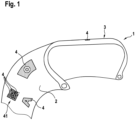
- the Figure 1 shows a pneumatic vehicle tire 1 with side walls 2 and a tread 3 and with at least one positive contrast structure 4 on at least one of the side walls 2 and/or the tread 3.
- the positive contrast structure 4 can in particular also be applied to groove flanks and/or groove bottoms of grooves running in the tread 3 or at the tread outlet, i.e. on the shoulder flanks running outside the ground contact area to the side walls, or on the outer surface of the tread, i.e. on the tread that comes into contact with the ground.
- the tire is produced by shaping vulcanization of a green tire with a vulcanization device having a mold 5 with a negative contrast structure 6 complementary to the positive contrast structure 4 on a surface region 7 of a mold surface of the mold 5.
- Such a positive contrast structure 4 is ideally suited for displaying a code 41, in particular a two-dimensional code such as a QR code.
- the areas of the code that are usually displayed dark can be designed to have the positive contrast structure 4.
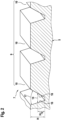
- the Figures 2 and 3 serve to illustrate the manufacture of a mold suitable for shaping vulcanization 5.
- step b) is carried out before step c).
- step c) can also be carried out first and then step b).
- the Figure 2 shows a section through the mold 5 with the surface area 7 after step b).
- the first surface structure 9 of first depressions 10 has already been produced by a chip-removing process such as milling.
- the first surface structure 9 extends at least over the surface area 7.
- a second surface structure 11 of second depressions 12 is produced by means of laser engraving.
- the second surface structure 11 extends at least over the surface region 7, whereby the first structure 9 and the second structure 11 together form the negative contrast structure 6 in the surface region 7.
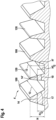
- the Figure 3 shows a section through the mold 5 with the surface area 7 after step c).
- the surface area 7 now also has the second depressions 12 of the second surface area produced by laser engraving. 11.
- the first surface structure 9 and the second surface structure 11 together form the negative contrast structure 6 in the surface area 7.
- the second depressions 12 have a surface 18 which has a greater, preferably a factor of 10 greater, particularly preferably a factor of 20 greater, roughness depth according to DIN EN ISO 4287:1998 than a surface 16 of the first depressions 10.
- all first depressions 10 are first created in step b) and all second depressions 12 are created spatially and/or temporally spaced therefrom in a subsequent step c).
- the means for the chip-removing process and for the laser engraving can thus be used spatially and/or temporally spaced from one another and do not have to be combined with one another in one apparatus.
- At least one first depression 10 can have an elongated shape.
- the at least one first depression 10 has a length 13 that is at least twice, particularly preferably at least four times, greater than the width 14 of the at least one first depression 10.
- all first depressions 10 have such an elongated shape.
- the width 14 and the length 13 of the first recess 10 can be determined at half the height H of the recess. In the illustration
- At least one second depression 12 can have an elongated shape.
- the at least one second depression 12 has a length 13 that is at least 2 times, particularly preferably at least 4 times, greater than the width 14' of the at least one second depression 12.
- all second depressions 12 have such an elongated shape.
- the width 14' and the length of the second recess 12 can be determined at half the height H' of the recess.
- step b) a plurality of first elongated depressions 10 were produced and in step c), a plurality of second elongated depressions 12 were produced.
- the first depressions 10 and the second depressions 12 are arranged largely parallel to one another, preferably largely parallel to one another and alternating.
- the depressions 10, 12 can be aligned largely in a straight line. Alternatively, however, at least a second depression 12 can have a curvature or a kink in its elongated extension.
- the first depressions 10 and the second depressions 12 can each have opposing flanks 16, 18 which enclose an angle 17, 19 with one another.
- the flanks 16, 18 can each enclose the same angle 17, 19 with one another. However, they can also differ in this respect.
- at least one first depression 10 can have opposing flanks 16 which enclose an angle 17 of at least 50°, preferably 55° to 65°
- at least one second depression 12 can have opposing flanks 18 which enclose an angle 19 of 4° to 30°, preferably 10° to 20°, particularly preferably 12° to 16°.
- the height H of the at least one first recess 10 and/or the height H ⁇ of the at least one second recess 12 can be a maximum of 0.8 mm, preferably a maximum of 0.6 mm, particularly preferably a maximum of 0.4 mm.
- the height H, H ⁇ may be measured relative to the unmachined mold surface of the surface area of the mold prior to step b).
- the Figure 4 shows a section through a vehicle tire 1 produced by shaping vulcanization of a tire blank with a vulcanization device comprising the mold 5 with a negative contrast structure 6 on a surface area 7 of a mold surface of the mold produced according to the in the Figures 2 and 3
- the vehicle tire 1 has on its surface 2,3 the positive contrast structure 4 complementary to the negative contrast structure 6.
- the positive contrast structure 4 shown can be located on at least one of the side walls 3 and/or the tread 3. It can be the one shown in the Figure 1 illustrated pneumatic vehicle tyre 1.
- the first depressions 10 of the negative contrast structure 6 correspond to complementary first elevations 100 of the positive contrast structure 4.
- the second depressions 12 of the negative contrast structure 6 correspond to complementary second elevations 120 of the positive contrast structure 4.
- the positive contrast structure 4 shown corresponds to a hatching with hatching ribs 100, 120.
- the dimensions of the elevations 100, 120 largely correspond to the dimensions of the complementary depressions 10, 12 of the complementary negative contrast structure 6 and are therefore designated with the same reference symbols H, H', 17, 19, 13, 14 as those of the corresponding negative contrast structure 6.
- the second elevations 120 can have a surface that has a greater, preferably a factor of 10 greater, particularly preferably a factor of 20 greater, roughness depth according to DIN EN ISO 4287:1998 than a surface of the first elevations 100.
- the Figure 5 shows a schematic plan view of another mold 5 produced by the method according to the invention.
- the negative contrast structure 6 differs from that shown in the Figure 3
- the negative contrast structure 6 shown is characterized at least in that at least a first elongated depression 10 and a second elongated depression 12 are arranged crossing one another.
- the second elongated depression 12 has a lower height H' than the first elongated depression 10.
- the material removal by means of laser engraving during the creation of the second elongated depression 12 was not carried out over the entire length 13 of the second elongated depression 12, but in the intersection area through the previously created first elongated recess 10 was interrupted.
- the second elongated recess 12 can thus have an interruption.
- the at least one second recess 12 can have a length 13 which is less than twice the height H' of the second recess 12. The length can be measured at half the height H' of the second recess.
Landscapes
- Engineering & Computer Science (AREA)
- Mechanical Engineering (AREA)
- Physics & Mathematics (AREA)
- Optics & Photonics (AREA)
- Plasma & Fusion (AREA)
- Manufacturing & Machinery (AREA)
- Moulds For Moulding Plastics Or The Like (AREA)
Claims (13)
- Procédé de fabrication d'un outil de moulage (5) d'un dispositif de vulcanisation destiné à la vulcanisation par moulage d'un pneu de véhicule (1), l'outil de moulage (5) présentant une structure de contraste négative (6) sur une surface de moulage de l'outil de moulage (5), le procédé comprenant au moins les étapes suivantes :a) mise à disposition de l'outil de moulage (5) présentant la surface de moulage pour l'estampage de moulage d'une surface (2, 3) d'un pneu de véhicule (1) au cours de la vulcanisation du pneu au moyen du dispositif de vulcanisation,b) génération d'une première structure de surface (9) de premières cavités (10) au moyen d'un procédé d'enlèvement de copeaux, la première structure de surface (9) s'étendant au moins sur une zone de surface (7) de la surface de moulage,c) génération d'une deuxième structure de surface (11) de deuxièmes cavités (12) au moyen d'une gravure au laser, la deuxième structure (11) s'étendant au moins sur la zone de surface (7) et la première structure de surface (9) et la deuxième structure de surface (11) formant ensemble la structure de contraste négative (6) dans la zone de surface (7),caractérisé en ce que
les deuxièmes cavités (12) possèdent une surface (18) qui présente une profondeur de rugosité supérieure à une surface (16) des premières cavités (10). - Procédé selon la revendication 1, caractérisé en ce que toutes les premières cavités (10) sont générées à l'étape b) et toutes les deuxièmes cavités (12) sont générées à l'étape c) de manière espacée dans le temps et/ou dans l'espace.
- Procédé selon au moins l'une des revendications précédentes, caractérisé en ce que les deuxièmes cavités (12) possèdent une surface (18) qui présente une profondeur de rugosité supérieure d'un facteur 10, de préférence d'un facteur 20, à une surface (16) des premières cavités (10).
- Procédé selon au moins l'une des revendications précédentes, caractérisé en ce qu'au moins une première cavité (10) présente une forme allongée, de préférence en ce qu'au moins une première cavité (10) présente une longueur (13) qui est au moins deux fois, de manière particulièrement préférée au moins quatre fois, supérieure à la largeur (14) de ladite au moins une première cavité (10).
- Procédé selon au moins l'une des revendications précédentes, caractérisé en ce qu'au moins une deuxième cavité (12) présente une forme allongée, de préférence en ce qu'au moins une deuxième cavité (12) présente une longueur qui est au moins 2 fois, de manière particulièrement préférée au moins 4 fois, supérieure à la largeur (14') de ladite au moins une deuxième cavité (12).
- Procédé selon au moins l'une des revendications précédentes, caractérisé en ce que la première structure (9) possède plusieurs premières cavités allongées (10) et la deuxième structure (11) plusieurs deuxièmes cavités allongées (12), et en ce que les premières cavités (10) et les deuxièmes cavités (12) sont ici disposées parallèlement les unes aux autres, de préférence parallèlement les unes aux autres et en alternance.
- Procédé selon au moins l'une des revendications précédentes, caractérisé en ce qu'au moins une première cavité allongée (10) et une deuxième cavité allongée (12) sont disposées de manière à se croiser mutuellement.
- Procédé selon au moins l'une des revendications précédentes, caractérisé en ce qu'au moins une deuxième cavité (12) présente une longueur (13) inférieure à deux fois la hauteur (H') de la deuxième cavité (12).
- Procédé selon au moins l'une des revendications précédentes, caractérisé en ce qu'au moins une deuxième cavité (12) présente une courbure ou un coude dans son extension longitudinale.
- Procédé selon au moins l'une des revendications précédentes, caractérisé en ce qu'au moins une première cavité (10) présente des flancs (16) opposés l'un à l'autre qui forment entre eux un angle (17) d'au moins 50°, de préférence de 55° à 65°, et en ce qu'au moins une deuxième cavité (12) présente des flancs (18) opposés l'un à l'autre qui forment entre eux un angle (19) de 4° à 30°, de préférence de 10° à 20°, plus préférentiellement de 12° à 16°.
- Procédé selon au moins l'une des revendications précédentes, caractérisé en ce que la hauteur (H) de l'au moins une première cavité (10) et/ou la hauteur (H') de l'au moins une deuxième cavité (12) est au maximum de 0,8 mm, de préférence au maximum de 0,6 mm, de manière particulièrement préférée au maximum de 0,4 mm.
- Pneu de véhicule (1) fabriqué par vulcanisation par moulage d'une ébauche de pneu avec un dispositif de vulcanisation qui possède un outil de moulage (5) ayant une structure de contraste négative (6) sur une zone de surface (7) d'une surface de moulage de l'outil de moulage fabriqué selon au moins l'une des revendications 1 à 11, le pneu de véhicule (1) présentant sur sa surface (2, 3), en particulier sur au moins une paroi latérale (2) et/ou la bande de roulement (3), la structure de contraste positive (4) complémentaire à la structure de contraste négative (6).
- Pneu de véhicule (1) selon la revendication 12, caractérisé en ce que le pneu de véhicule possède plusieurs surfaces présentant la structure de contraste positif (4), les surfaces étant disposées de telle sorte qu'elles représentent un code (41) lisible par machine, de préférence un code bidimensionnel (41), de manière particulièrement préférée un code QR (41).
Applications Claiming Priority (2)
| Application Number | Priority Date | Filing Date | Title |
|---|---|---|---|
| DE102019213874.8A DE102019213874A1 (de) | 2019-09-11 | 2019-09-11 | Kombiniertes Herstellungsverfahren für ein Formwerkzeug zur formgebenden Vulkanisation eines Fahrzeugreifens sowie Fahrzeugreifen |
| PCT/EP2020/073647 WO2021047897A1 (fr) | 2019-09-11 | 2020-08-24 | Procédé de production combinée pour un outil de moulage pour la vulcanisation par moulage d'un pneumatique de véhicule et pneumatique de véhicule |
Publications (2)
| Publication Number | Publication Date |
|---|---|
| EP4028253A1 EP4028253A1 (fr) | 2022-07-20 |
| EP4028253B1 true EP4028253B1 (fr) | 2024-07-24 |
Family
ID=72243105
Family Applications (1)
| Application Number | Title | Priority Date | Filing Date |
|---|---|---|---|
| EP20761791.1A Active EP4028253B1 (fr) | 2019-09-11 | 2020-08-24 | Procédé de production combinée pour un outil de moulage pour la vulcanisation par moulage d'un pneumatique de véhicule et pneumatique de véhicule |
Country Status (5)
| Country | Link |
|---|---|
| US (1) | US12479133B2 (fr) |
| EP (1) | EP4028253B1 (fr) |
| CN (1) | CN114390972B (fr) |
| DE (1) | DE102019213874A1 (fr) |
| WO (1) | WO2021047897A1 (fr) |
Family Cites Families (25)
| Publication number | Priority date | Publication date | Assignee | Title |
|---|---|---|---|---|
| JPS60236806A (ja) * | 1984-05-09 | 1985-11-25 | Yokohama Rubber Co Ltd:The | 空気入りタイヤ |
| JPH0813514B2 (ja) * | 1987-06-02 | 1996-02-14 | 横浜ゴム株式会社 | タイヤサイド部への紋様刻印方法 |
| DE3782655T2 (de) * | 1987-09-04 | 1993-03-25 | Sumitomo Rubber Ind | Valukanisierungsform fuer luftreifen. |
| JPH0939518A (ja) * | 1995-07-26 | 1997-02-10 | Bridgestone Corp | 多数のリッジよりなる装飾体を備えた空気入りタイヤ |
| US6253815B1 (en) * | 1998-08-14 | 2001-07-03 | Michelin Recherche Et Techniques S.A. | Design pattern for a tire |
| JP2008201384A (ja) * | 2007-02-22 | 2008-09-04 | Toyo Tire & Rubber Co Ltd | 空気入りタイヤ |
| EP2085201A1 (fr) * | 2008-01-30 | 2009-08-05 | Continental Aktiengesellschaft | Moule de vulcanisation de bandages de pneu et pneu fabriqué à l'aide de ce moule de vulcanisation de bandages de pneu |
| FR2950566B1 (fr) | 2009-09-28 | 2011-08-26 | Michelin Soc Tech | Motif de pneumatique a fort contraste et procede d'obtention |
| US8555327B2 (en) | 2011-03-28 | 2013-10-08 | Google Inc. | Broadcasting links to enhanced content |
| FR2973286B1 (fr) | 2011-03-31 | 2013-08-16 | Michelin Soc Tech | Motif de pneumatique a fort contraste |
| FR2976523B1 (fr) * | 2011-06-15 | 2014-07-25 | Michelin Soc Tech | Pneumatique comportant un motif a fort contraste et des nervures de protection du motif |
| JP5986374B2 (ja) * | 2011-12-28 | 2016-09-06 | 株式会社ブリヂストン | タイヤおよびタイヤ成形用金型 |
| FR2995254B1 (fr) | 2012-09-12 | 2015-07-17 | Michelin & Cie | Pneumatique comportant un motif a fort contraste comprenant une pluralite de cavites |
| FR3007324B1 (fr) | 2013-06-20 | 2015-07-17 | Michelin & Cie | Pneumatique comportant un marquage a fort contraste |
| FR3007325B1 (fr) | 2013-06-21 | 2016-02-12 | Michelin & Cie | Pneumatique comportant un marquage a fort contraste |
| FR3009521B1 (fr) | 2013-08-07 | 2015-08-14 | Michelin & Cie | Pneumatique comportant un element graphique particulier |
| DE102013223567A1 (de) | 2013-10-24 | 2015-04-30 | Continental Reifen Deutschland Gmbh | Produkt aufweisend einen optoelektronisch lesbaren Code |
| FR3020594B1 (fr) | 2014-04-30 | 2018-01-05 | Compagnie Generale Des Etablissements Michelin | Pneumatique comportant un symbole matriciel a fort contraste sur le flanc |
| FR3020593B1 (fr) | 2014-04-30 | 2016-12-23 | Michelin & Cie | Element de moule pour moule de pneumatique comportant un marquage |
| EP2977934B1 (fr) | 2014-07-21 | 2018-11-21 | 4JET Technologies GmbH | Codage numérique d'articles en caoutchouc |
| JP6584334B2 (ja) | 2016-01-28 | 2019-10-02 | 株式会社ブリヂストン | タイヤ |
| DE102016215732B4 (de) | 2016-08-23 | 2024-10-10 | Continental Reifen Deutschland Gmbh | Vulkanisierform für Fahrzeugreifen und Fahrzeugreifen als Solcher |
| DE102016219472A1 (de) | 2016-10-07 | 2018-04-12 | Continental Reifen Deutschland Gmbh | Verfahren zur Herstellung eines Fahrzeugreifens |
| EP3498496A1 (fr) * | 2017-12-18 | 2019-06-19 | Aeolus Tyre Co., Ltd. | Motif de bande de roulement de pneu spécial pour les positions de toutes les roues de véhicule de tourisme |
| DE102018204245A1 (de) | 2018-03-20 | 2019-09-26 | Continental Reifen Deutschland Gmbh | Fahrzeugluftreifen |
-
2019
- 2019-09-11 DE DE102019213874.8A patent/DE102019213874A1/de active Pending
-
2020
- 2020-08-24 US US17/753,677 patent/US12479133B2/en active Active
- 2020-08-24 CN CN202080063581.7A patent/CN114390972B/zh active Active
- 2020-08-24 EP EP20761791.1A patent/EP4028253B1/fr active Active
- 2020-08-24 WO PCT/EP2020/073647 patent/WO2021047897A1/fr not_active Ceased
Also Published As
| Publication number | Publication date |
|---|---|
| EP4028253A1 (fr) | 2022-07-20 |
| US12479133B2 (en) | 2025-11-25 |
| WO2021047897A1 (fr) | 2021-03-18 |
| CN114390972B (zh) | 2024-06-28 |
| DE102019213874A1 (de) | 2021-03-11 |
| CN114390972A (zh) | 2022-04-22 |
| US20220339824A1 (en) | 2022-10-27 |
Similar Documents
| Publication | Publication Date | Title |
|---|---|---|
| DE102011112148B4 (de) | Extruder und Verfahren zum Herstellen eines Extruders | |
| DE202013012423U1 (de) | Reifen mit einem Muster mit starkem Kontrast, welches eine Mehrzahl von Hohlräumen aufweist | |
| EP1063071A2 (fr) | Article en polymère avec une surface structurée, en particulier pneumatique, moule et fabrication du moule | |
| DE102019217511A1 (de) | Fahrzeugluftreifen aufweisend eine Kontraststruktur | |
| EP2809528B1 (fr) | Pneu de véhicule | |
| DE4422548C2 (de) | Aufbringen eines Zeichens in eine sichtbare Fläche eines Reifens | |
| EP4076831B1 (fr) | Impression 3d d'éléments de moule pour pneus | |
| EP2428307B1 (fr) | Procédé de production de structures de surface rugueuses | |
| DE102019207943A1 (de) | Fahrzeugluftreifen aufweisend eine Schraffurfläche | |
| EP4028253B1 (fr) | Procédé de production combinée pour un outil de moulage pour la vulcanisation par moulage d'un pneumatique de véhicule et pneumatique de véhicule | |
| EP4178813B1 (fr) | Pneus de véhicule ayant une structure de surface de contraste | |
| EP3077186B1 (fr) | Moule de vulcanisation pour pneumatiques toutes saisons et d'hiver pour véhicule automobile et procédé de fabrication du moule de vulcanisation | |
| EP3808549B1 (fr) | Pneus de véhicule comprenant une surface structurée contrastée et procédé de fabrication d'un outil de moulage | |
| EP3808576B1 (fr) | Pneus de véhicule comportant une surface hachurée et un procédé de fabrication d'un outil de moulage | |
| EP3638518B1 (fr) | Pneumatique de véhicule | |
| DE102019217662A1 (de) | Verfahren zur Herstellung eines Kraftfahrzeug-Kunststoffbauteils mit mindestens einem partiell an dem Kraftfahrzeug-Kunststoffbauteil ausgebildeten Transmissionsbereich | |
| EP4103394B1 (fr) | Procédé de fabrication d'un segment de moule d'un moule de vulcanisation, segment de moule et moule de vulcanisation | |
| DE102018010142A1 (de) | Verfahren zum Herstellen eines Kunststoff-Formteils mit integralen Haltekomponenten | |
| DE102020207473A1 (de) | Verfahren zur Herstellung einer Formsegmentkomponente, Formsegmentkomponente, Vulkanisationsform und Fahrzeugluftreifen | |
| EP4255740B1 (fr) | Pneumatique de véhicule comprenant une surface hachurée, moule de vulcanisation et procédé de production | |
| DE202011102315U1 (de) | Form zum Herstellen eines Dekorteils, Verfahren zur Herstellung einer Form sowie Dekorteil | |
| EP3838629B1 (fr) | Pneumatiques de véhicule comportant une structure de surface à contraste pourvue de nervures | |
| DE102019213765A1 (de) | Fahrzeugreifen aufweisend einen Markierungsbereich | |
| EP3868567B1 (fr) | Procédé de production d'une surface décorative | |
| EP4699795A1 (fr) | Élément d'insertion pour la fabrication d'un profil de bande de roulement d'un pneu de véhicule, et pneu de véhicule fabriqué avec l'élément d'insertion |
Legal Events
| Date | Code | Title | Description |
|---|---|---|---|
| STAA | Information on the status of an ep patent application or granted ep patent |
Free format text: STATUS: UNKNOWN |
|
| STAA | Information on the status of an ep patent application or granted ep patent |
Free format text: STATUS: THE INTERNATIONAL PUBLICATION HAS BEEN MADE |
|
| PUAI | Public reference made under article 153(3) epc to a published international application that has entered the european phase |
Free format text: ORIGINAL CODE: 0009012 |
|
| STAA | Information on the status of an ep patent application or granted ep patent |
Free format text: STATUS: REQUEST FOR EXAMINATION WAS MADE |
|
| 17P | Request for examination filed |
Effective date: 20220411 |
|
| AK | Designated contracting states |
Kind code of ref document: A1 Designated state(s): AL AT BE BG CH CY CZ DE DK EE ES FI FR GB GR HR HU IE IS IT LI LT LU LV MC MK MT NL NO PL PT RO RS SE SI SK SM TR |
|
| DAV | Request for validation of the european patent (deleted) | ||
| DAX | Request for extension of the european patent (deleted) | ||
| RAP3 | Party data changed (applicant data changed or rights of an application transferred) |
Owner name: CONTINENTAL REIFEN DEUTSCHLAND GMBH |
|
| GRAP | Despatch of communication of intention to grant a patent |
Free format text: ORIGINAL CODE: EPIDOSNIGR1 |
|
| STAA | Information on the status of an ep patent application or granted ep patent |
Free format text: STATUS: GRANT OF PATENT IS INTENDED |
|
| INTG | Intention to grant announced |
Effective date: 20240405 |
|
| GRAS | Grant fee paid |
Free format text: ORIGINAL CODE: EPIDOSNIGR3 |
|
| P01 | Opt-out of the competence of the unified patent court (upc) registered |
Effective date: 20240515 |
|
| GRAA | (expected) grant |
Free format text: ORIGINAL CODE: 0009210 |
|
| STAA | Information on the status of an ep patent application or granted ep patent |
Free format text: STATUS: THE PATENT HAS BEEN GRANTED |
|
| AK | Designated contracting states |
Kind code of ref document: B1 Designated state(s): AL AT BE BG CH CY CZ DE DK EE ES FI FR GB GR HR HU IE IS IT LI LT LU LV MC MK MT NL NO PL PT RO RS SE SI SK SM TR |
|
| REG | Reference to a national code |
Ref country code: GB Ref legal event code: FG4D Free format text: NOT ENGLISH |
|
| REG | Reference to a national code |
Ref country code: CH Ref legal event code: EP |
|
| REG | Reference to a national code |
Ref country code: IE Ref legal event code: FG4D Free format text: LANGUAGE OF EP DOCUMENT: GERMAN Ref country code: DE Ref legal event code: R096 Ref document number: 502020008687 Country of ref document: DE |
|
| REG | Reference to a national code |
Ref country code: NL Ref legal event code: FP |
|
| REG | Reference to a national code |
Ref country code: LT Ref legal event code: MG9D |
|
| PG25 | Lapsed in a contracting state [announced via postgrant information from national office to epo] |
Ref country code: PT Free format text: LAPSE BECAUSE OF FAILURE TO SUBMIT A TRANSLATION OF THE DESCRIPTION OR TO PAY THE FEE WITHIN THE PRESCRIBED TIME-LIMIT Effective date: 20241125 |
|
| PG25 | Lapsed in a contracting state [announced via postgrant information from national office to epo] |
Ref country code: PT Free format text: LAPSE BECAUSE OF FAILURE TO SUBMIT A TRANSLATION OF THE DESCRIPTION OR TO PAY THE FEE WITHIN THE PRESCRIBED TIME-LIMIT Effective date: 20241125 |
|
| PG25 | Lapsed in a contracting state [announced via postgrant information from national office to epo] |
Ref country code: NO Free format text: LAPSE BECAUSE OF FAILURE TO SUBMIT A TRANSLATION OF THE DESCRIPTION OR TO PAY THE FEE WITHIN THE PRESCRIBED TIME-LIMIT Effective date: 20241024 |
|
| PG25 | Lapsed in a contracting state [announced via postgrant information from national office to epo] |
Ref country code: FI Free format text: LAPSE BECAUSE OF FAILURE TO SUBMIT A TRANSLATION OF THE DESCRIPTION OR TO PAY THE FEE WITHIN THE PRESCRIBED TIME-LIMIT Effective date: 20240724 Ref country code: GR Free format text: LAPSE BECAUSE OF FAILURE TO SUBMIT A TRANSLATION OF THE DESCRIPTION OR TO PAY THE FEE WITHIN THE PRESCRIBED TIME-LIMIT Effective date: 20241025 Ref country code: PL Free format text: LAPSE BECAUSE OF FAILURE TO SUBMIT A TRANSLATION OF THE DESCRIPTION OR TO PAY THE FEE WITHIN THE PRESCRIBED TIME-LIMIT Effective date: 20240724 |
|
| PG25 | Lapsed in a contracting state [announced via postgrant information from national office to epo] |
Ref country code: BG Free format text: LAPSE BECAUSE OF FAILURE TO SUBMIT A TRANSLATION OF THE DESCRIPTION OR TO PAY THE FEE WITHIN THE PRESCRIBED TIME-LIMIT Effective date: 20240724 |
|
| PG25 | Lapsed in a contracting state [announced via postgrant information from national office to epo] |
Ref country code: LV Free format text: LAPSE BECAUSE OF FAILURE TO SUBMIT A TRANSLATION OF THE DESCRIPTION OR TO PAY THE FEE WITHIN THE PRESCRIBED TIME-LIMIT Effective date: 20240724 |
|
| PG25 | Lapsed in a contracting state [announced via postgrant information from national office to epo] |
Ref country code: IS Free format text: LAPSE BECAUSE OF FAILURE TO SUBMIT A TRANSLATION OF THE DESCRIPTION OR TO PAY THE FEE WITHIN THE PRESCRIBED TIME-LIMIT Effective date: 20241124 |
|
| PG25 | Lapsed in a contracting state [announced via postgrant information from national office to epo] |
Ref country code: HR Free format text: LAPSE BECAUSE OF FAILURE TO SUBMIT A TRANSLATION OF THE DESCRIPTION OR TO PAY THE FEE WITHIN THE PRESCRIBED TIME-LIMIT Effective date: 20240724 |
|
| PG25 | Lapsed in a contracting state [announced via postgrant information from national office to epo] |
Ref country code: ES Free format text: LAPSE BECAUSE OF FAILURE TO SUBMIT A TRANSLATION OF THE DESCRIPTION OR TO PAY THE FEE WITHIN THE PRESCRIBED TIME-LIMIT Effective date: 20240724 Ref country code: RS Free format text: LAPSE BECAUSE OF FAILURE TO SUBMIT A TRANSLATION OF THE DESCRIPTION OR TO PAY THE FEE WITHIN THE PRESCRIBED TIME-LIMIT Effective date: 20241024 |
|
| PG25 | Lapsed in a contracting state [announced via postgrant information from national office to epo] |
Ref country code: RS Free format text: LAPSE BECAUSE OF FAILURE TO SUBMIT A TRANSLATION OF THE DESCRIPTION OR TO PAY THE FEE WITHIN THE PRESCRIBED TIME-LIMIT Effective date: 20241024 Ref country code: PL Free format text: LAPSE BECAUSE OF FAILURE TO SUBMIT A TRANSLATION OF THE DESCRIPTION OR TO PAY THE FEE WITHIN THE PRESCRIBED TIME-LIMIT Effective date: 20240724 Ref country code: NO Free format text: LAPSE BECAUSE OF FAILURE TO SUBMIT A TRANSLATION OF THE DESCRIPTION OR TO PAY THE FEE WITHIN THE PRESCRIBED TIME-LIMIT Effective date: 20241024 Ref country code: LV Free format text: LAPSE BECAUSE OF FAILURE TO SUBMIT A TRANSLATION OF THE DESCRIPTION OR TO PAY THE FEE WITHIN THE PRESCRIBED TIME-LIMIT Effective date: 20240724 Ref country code: IS Free format text: LAPSE BECAUSE OF FAILURE TO SUBMIT A TRANSLATION OF THE DESCRIPTION OR TO PAY THE FEE WITHIN THE PRESCRIBED TIME-LIMIT Effective date: 20241124 Ref country code: HR Free format text: LAPSE BECAUSE OF FAILURE TO SUBMIT A TRANSLATION OF THE DESCRIPTION OR TO PAY THE FEE WITHIN THE PRESCRIBED TIME-LIMIT Effective date: 20240724 Ref country code: GR Free format text: LAPSE BECAUSE OF FAILURE TO SUBMIT A TRANSLATION OF THE DESCRIPTION OR TO PAY THE FEE WITHIN THE PRESCRIBED TIME-LIMIT Effective date: 20241025 Ref country code: FI Free format text: LAPSE BECAUSE OF FAILURE TO SUBMIT A TRANSLATION OF THE DESCRIPTION OR TO PAY THE FEE WITHIN THE PRESCRIBED TIME-LIMIT Effective date: 20240724 Ref country code: ES Free format text: LAPSE BECAUSE OF FAILURE TO SUBMIT A TRANSLATION OF THE DESCRIPTION OR TO PAY THE FEE WITHIN THE PRESCRIBED TIME-LIMIT Effective date: 20240724 Ref country code: BG Free format text: LAPSE BECAUSE OF FAILURE TO SUBMIT A TRANSLATION OF THE DESCRIPTION OR TO PAY THE FEE WITHIN THE PRESCRIBED TIME-LIMIT Effective date: 20240724 |
|
| REG | Reference to a national code |
Ref country code: CH Ref legal event code: PL |
|
| PG25 | Lapsed in a contracting state [announced via postgrant information from national office to epo] |
Ref country code: DK Free format text: LAPSE BECAUSE OF FAILURE TO SUBMIT A TRANSLATION OF THE DESCRIPTION OR TO PAY THE FEE WITHIN THE PRESCRIBED TIME-LIMIT Effective date: 20240724 Ref country code: SM Free format text: LAPSE BECAUSE OF FAILURE TO SUBMIT A TRANSLATION OF THE DESCRIPTION OR TO PAY THE FEE WITHIN THE PRESCRIBED TIME-LIMIT Effective date: 20240724 Ref country code: RO Free format text: LAPSE BECAUSE OF FAILURE TO SUBMIT A TRANSLATION OF THE DESCRIPTION OR TO PAY THE FEE WITHIN THE PRESCRIBED TIME-LIMIT Effective date: 20240724 |
|
| PG25 | Lapsed in a contracting state [announced via postgrant information from national office to epo] |
Ref country code: LU Free format text: LAPSE BECAUSE OF NON-PAYMENT OF DUE FEES Effective date: 20240824 |
|
| PG25 | Lapsed in a contracting state [announced via postgrant information from national office to epo] |
Ref country code: MC Free format text: LAPSE BECAUSE OF FAILURE TO SUBMIT A TRANSLATION OF THE DESCRIPTION OR TO PAY THE FEE WITHIN THE PRESCRIBED TIME-LIMIT Effective date: 20240724 Ref country code: CH Free format text: LAPSE BECAUSE OF NON-PAYMENT OF DUE FEES Effective date: 20240831 Ref country code: EE Free format text: LAPSE BECAUSE OF FAILURE TO SUBMIT A TRANSLATION OF THE DESCRIPTION OR TO PAY THE FEE WITHIN THE PRESCRIBED TIME-LIMIT Effective date: 20240724 |
|
| PG25 | Lapsed in a contracting state [announced via postgrant information from national office to epo] |
Ref country code: CZ Free format text: LAPSE BECAUSE OF FAILURE TO SUBMIT A TRANSLATION OF THE DESCRIPTION OR TO PAY THE FEE WITHIN THE PRESCRIBED TIME-LIMIT Effective date: 20240724 |
|
| REG | Reference to a national code |
Ref country code: DE Ref legal event code: R097 Ref document number: 502020008687 Country of ref document: DE |
|
| PG25 | Lapsed in a contracting state [announced via postgrant information from national office to epo] |
Ref country code: SK Free format text: LAPSE BECAUSE OF FAILURE TO SUBMIT A TRANSLATION OF THE DESCRIPTION OR TO PAY THE FEE WITHIN THE PRESCRIBED TIME-LIMIT Effective date: 20240724 Ref country code: IT Free format text: LAPSE BECAUSE OF FAILURE TO SUBMIT A TRANSLATION OF THE DESCRIPTION OR TO PAY THE FEE WITHIN THE PRESCRIBED TIME-LIMIT Effective date: 20240724 |
|
| PLBE | No opposition filed within time limit |
Free format text: ORIGINAL CODE: 0009261 |
|
| STAA | Information on the status of an ep patent application or granted ep patent |
Free format text: STATUS: NO OPPOSITION FILED WITHIN TIME LIMIT |
|
| GBPC | Gb: european patent ceased through non-payment of renewal fee |
Effective date: 20241024 |
|
| REG | Reference to a national code |
Ref country code: BE Ref legal event code: MM Effective date: 20240831 |
|
| 26N | No opposition filed |
Effective date: 20250425 |
|
| PG25 | Lapsed in a contracting state [announced via postgrant information from national office to epo] |
Ref country code: GB Free format text: LAPSE BECAUSE OF NON-PAYMENT OF DUE FEES Effective date: 20241024 |
|
| PG25 | Lapsed in a contracting state [announced via postgrant information from national office to epo] |
Ref country code: BE Free format text: LAPSE BECAUSE OF NON-PAYMENT OF DUE FEES Effective date: 20240831 |
|
| PG25 | Lapsed in a contracting state [announced via postgrant information from national office to epo] |
Ref country code: IE Free format text: LAPSE BECAUSE OF NON-PAYMENT OF DUE FEES Effective date: 20240824 |
|
| PG25 | Lapsed in a contracting state [announced via postgrant information from national office to epo] |
Ref country code: SE Free format text: LAPSE BECAUSE OF FAILURE TO SUBMIT A TRANSLATION OF THE DESCRIPTION OR TO PAY THE FEE WITHIN THE PRESCRIBED TIME-LIMIT Effective date: 20240724 |
|
| PGFP | Annual fee paid to national office [announced via postgrant information from national office to epo] |
Ref country code: NL Payment date: 20250821 Year of fee payment: 6 |
|
| PGFP | Annual fee paid to national office [announced via postgrant information from national office to epo] |
Ref country code: DE Payment date: 20250831 Year of fee payment: 6 |
|
| PGFP | Annual fee paid to national office [announced via postgrant information from national office to epo] |
Ref country code: FR Payment date: 20250828 Year of fee payment: 6 Ref country code: AT Payment date: 20251020 Year of fee payment: 5 |
|
| PG25 | Lapsed in a contracting state [announced via postgrant information from national office to epo] |
Ref country code: CY Free format text: LAPSE BECAUSE OF FAILURE TO SUBMIT A TRANSLATION OF THE DESCRIPTION OR TO PAY THE FEE WITHIN THE PRESCRIBED TIME-LIMIT; INVALID AB INITIO Effective date: 20200824 |
|
| PG25 | Lapsed in a contracting state [announced via postgrant information from national office to epo] |
Ref country code: HU Free format text: LAPSE BECAUSE OF FAILURE TO SUBMIT A TRANSLATION OF THE DESCRIPTION OR TO PAY THE FEE WITHIN THE PRESCRIBED TIME-LIMIT; INVALID AB INITIO Effective date: 20200824 |