EP4029976A1 - Endlosfilamentbauschgarn mit nebeneinanderliegende zweikomponentenfilamente, daraus hergestellte artikel, und verfahren zur herstellung eines solches garn - Google Patents
Endlosfilamentbauschgarn mit nebeneinanderliegende zweikomponentenfilamente, daraus hergestellte artikel, und verfahren zur herstellung eines solches garn Download PDFInfo
- Publication number
- EP4029976A1 EP4029976A1 EP22151985.3A EP22151985A EP4029976A1 EP 4029976 A1 EP4029976 A1 EP 4029976A1 EP 22151985 A EP22151985 A EP 22151985A EP 4029976 A1 EP4029976 A1 EP 4029976A1
- Authority
- EP
- European Patent Office
- Prior art keywords
- component
- polymer
- filament
- fibre
- continuous filaments
- Prior art date
- Legal status (The legal status is an assumption and is not a legal conclusion. Google has not performed a legal analysis and makes no representation as to the accuracy of the status listed.)
- Withdrawn
Links
Images



Classifications
-
- D—TEXTILES; PAPER
- D01—NATURAL OR MAN-MADE THREADS OR FIBRES; SPINNING
- D01D—MECHANICAL METHODS OR APPARATUS IN THE MANUFACTURE OF ARTIFICIAL FILAMENTS, THREADS, FIBRES, BRISTLES OR RIBBONS
- D01D5/00—Formation of filaments, threads, or the like
- D01D5/28—Formation of filaments, threads, or the like while mixing different spinning solutions or melts during the spinning operation; Spinnerette packs therefor
- D01D5/30—Conjugate filaments; Spinnerette packs therefor
- D01D5/32—Side-by-side structure; Spinnerette packs therefor
-
- D—TEXTILES; PAPER
- D01—NATURAL OR MAN-MADE THREADS OR FIBRES; SPINNING
- D01F—CHEMICAL FEATURES IN THE MANUFACTURE OF ARTIFICIAL FILAMENTS, THREADS, FIBRES, BRISTLES OR RIBBONS; APPARATUS SPECIALLY ADAPTED FOR THE MANUFACTURE OF CARBON FILAMENTS
- D01F8/00—Conjugated, i.e. bi- or multicomponent, artificial filaments or the like; Manufacture thereof
- D01F8/04—Conjugated, i.e. bi- or multicomponent, artificial filaments or the like; Manufacture thereof from synthetic polymers
-
- D—TEXTILES; PAPER
- D01—NATURAL OR MAN-MADE THREADS OR FIBRES; SPINNING
- D01D—MECHANICAL METHODS OR APPARATUS IN THE MANUFACTURE OF ARTIFICIAL FILAMENTS, THREADS, FIBRES, BRISTLES OR RIBBONS
- D01D5/00—Formation of filaments, threads, or the like
- D01D5/28—Formation of filaments, threads, or the like while mixing different spinning solutions or melts during the spinning operation; Spinnerette packs therefor
- D01D5/30—Conjugate filaments; Spinnerette packs therefor
- D01D5/34—Core-skin structure; Spinnerette packs therefor
-
- D—TEXTILES; PAPER
- D01—NATURAL OR MAN-MADE THREADS OR FIBRES; SPINNING
- D01F—CHEMICAL FEATURES IN THE MANUFACTURE OF ARTIFICIAL FILAMENTS, THREADS, FIBRES, BRISTLES OR RIBBONS; APPARATUS SPECIALLY ADAPTED FOR THE MANUFACTURE OF CARBON FILAMENTS
- D01F11/00—Chemical after-treatment of artificial filaments or the like during manufacture
- D01F11/04—Chemical after-treatment of artificial filaments or the like during manufacture of synthetic polymers
-
- D—TEXTILES; PAPER
- D01—NATURAL OR MAN-MADE THREADS OR FIBRES; SPINNING
- D01F—CHEMICAL FEATURES IN THE MANUFACTURE OF ARTIFICIAL FILAMENTS, THREADS, FIBRES, BRISTLES OR RIBBONS; APPARATUS SPECIALLY ADAPTED FOR THE MANUFACTURE OF CARBON FILAMENTS
- D01F8/00—Conjugated, i.e. bi- or multicomponent, artificial filaments or the like; Manufacture thereof
- D01F8/04—Conjugated, i.e. bi- or multicomponent, artificial filaments or the like; Manufacture thereof from synthetic polymers
- D01F8/06—Conjugated, i.e. bi- or multicomponent, artificial filaments or the like; Manufacture thereof from synthetic polymers with at least one polyolefin as constituent
-
- D—TEXTILES; PAPER
- D01—NATURAL OR MAN-MADE THREADS OR FIBRES; SPINNING
- D01F—CHEMICAL FEATURES IN THE MANUFACTURE OF ARTIFICIAL FILAMENTS, THREADS, FIBRES, BRISTLES OR RIBBONS; APPARATUS SPECIALLY ADAPTED FOR THE MANUFACTURE OF CARBON FILAMENTS
- D01F8/00—Conjugated, i.e. bi- or multicomponent, artificial filaments or the like; Manufacture thereof
- D01F8/04—Conjugated, i.e. bi- or multicomponent, artificial filaments or the like; Manufacture thereof from synthetic polymers
- D01F8/12—Conjugated, i.e. bi- or multicomponent, artificial filaments or the like; Manufacture thereof from synthetic polymers with at least one polyamide as constituent
-
- D—TEXTILES; PAPER
- D01—NATURAL OR MAN-MADE THREADS OR FIBRES; SPINNING
- D01F—CHEMICAL FEATURES IN THE MANUFACTURE OF ARTIFICIAL FILAMENTS, THREADS, FIBRES, BRISTLES OR RIBBONS; APPARATUS SPECIALLY ADAPTED FOR THE MANUFACTURE OF CARBON FILAMENTS
- D01F8/00—Conjugated, i.e. bi- or multicomponent, artificial filaments or the like; Manufacture thereof
- D01F8/04—Conjugated, i.e. bi- or multicomponent, artificial filaments or the like; Manufacture thereof from synthetic polymers
- D01F8/14—Conjugated, i.e. bi- or multicomponent, artificial filaments or the like; Manufacture thereof from synthetic polymers with at least one polyester as constituent
-
- D—TEXTILES; PAPER
- D01—NATURAL OR MAN-MADE THREADS OR FIBRES; SPINNING
- D01F—CHEMICAL FEATURES IN THE MANUFACTURE OF ARTIFICIAL FILAMENTS, THREADS, FIBRES, BRISTLES OR RIBBONS; APPARATUS SPECIALLY ADAPTED FOR THE MANUFACTURE OF CARBON FILAMENTS
- D01F1/00—General methods for the manufacture of artificial filaments or the like
- D01F1/02—Addition of substances to the spinning solution or to the melt
- D01F1/04—Pigments
-
- D—TEXTILES; PAPER
- D01—NATURAL OR MAN-MADE THREADS OR FIBRES; SPINNING
- D01F—CHEMICAL FEATURES IN THE MANUFACTURE OF ARTIFICIAL FILAMENTS, THREADS, FIBRES, BRISTLES OR RIBBONS; APPARATUS SPECIALLY ADAPTED FOR THE MANUFACTURE OF CARBON FILAMENTS
- D01F1/00—General methods for the manufacture of artificial filaments or the like
- D01F1/02—Addition of substances to the spinning solution or to the melt
- D01F1/10—Other agents for modifying properties
Definitions
- the present invention generally relates to the manufacture of bi-component continuous filaments and articles made therefrom, including yarns and fabrics, and end-use applications thereof, preferably including floor coverings such as mats, rugs, and carpets.
- a continuous filament generally comprises a polymer material that is extruded as a long fiber. Such fibers can be twisted together and heat set to form strands of yarn. In turn, the yarn can be texturized for increasing bulkiness and for better wear resistance, and often such yarn is used in carpet as an alternative to carpets made using spun yarn comprised of staple fibers.
- BCF fibers such bulked continuous filaments used in carpets sometimes are referenced as "BCF fibers"
- advances in technology both have resulted in the ability to create filament looks that were impractical in the past, and have made filament production faster and more economical than before Styles previously made using only spun yarn now are made using BCF fibers.
- a bi-component continuous filament is a continuous filament made by extruding two different components that together form the long fiber; the two components generally comprise two different polymer materials that are extruded together.
- bi-component filaments have been designed by employing a sheath-core arrangement, in which a lower melting temperature polymer is used in forming a sheath component and a higher melting temperature polymer is used in forming a core component of the bi-component continuous filament.
- Bi-component continuous filaments made in this manner have been used in nonwoven webs to thermally bond the webs together.
- bi-component continuous filaments consist of a raw white (i.e., color-free) polymer component that has a fine count in texturized polyester preoriented yarn, which is typically made by spinning polyester chips of polyethylene terephthalate (PET).
- PET polyethylene terephthalate
- Polymer components of bi-component continuous filaments also can be dyed at some point after the bi-component continuous filament has been spun.
- the present invention includes many aspects and features. Moreover, while many aspects and features relate to, and are described in, the context of floor coverings, the present invention is not limited to use only in such context, as will become apparent from the following summaries and detailed descriptions of aspects, features, and one or more embodiments of the present invention.
- a bi-component continuous filament comprises a first polymer component; a second polymer component; and a binding agent adhering the first polymer component to the second polymer component along a length of the filament such that the filament has a generally uniform cross-sectional shape along the length.
- the first and second polymer components of the present invention may be extruded, with the first polymer component forming a sheath and the second polymer component forming a core that is surrounded by the sheath.
- the binding agent of the present invention may comprise a polyolefin modified by an acid anhydride.
- a bi-component continuous filament comprises a first polymer component that forms a sheath of the continuous filament; a second polymer component that forms a core of the continuous filament that is surrounded by the sheath; and a binding agent adhering the first polymer component to the second polymer component along a length of the filament such that the filament has a generally uniform cross-sectional shape along the length, wherein the binding agent comprises a polyolefin modified by an acid anhydride.
- the first polymer component of the present invention may comprise a polyamide.
- the first polymer component of the present invention may comprise a polyolefin.
- the first polymer component of the present invention may comprise a polyester.
- the second polymer component of the present invention may comprise a polyamide.
- the second polymer component of the present invention may comprise a polyolefin.
- the second polymer component of the present invention may comprise a polyester.
- the polyolefin modified by the acid anhydride may comprise polyethylene (PE).
- the polyolefin modified by the acid anhydride may comprise ethylene-vinyl acetate (EVA).
- EVA ethylene-vinyl acetate
- the polyolefin modified by the acid anhydride may comprise polypropylene (PP).
- the acid anhydride of the present invention may comprise maleic anhydride.
- Each of the first and second polymer components of the present invention may be solution-dyed.
- One but not both the first and second polymer components of the present invention may be solution-dyed.
- At least one of the first and second polymer components of the present invention may be solution-dyed with a pigment.
- the pigment may be in an organic or inorganic form.
- At least one of the first and second polymer components of the present invention may be solution-dyed with a pigment and a solvent.
- the second polymer component of the present invention forming the core of the bi-component continuous filament may comprise a recycled polyamide.
- the second polymer component of the present invention forming the core of the bi-component continuous filament may comprise a virgin polyester.
- the second polymer component of the present invention forming the core of the bi-component continuous filament may comprise a recycled polyester.
- the first polymer component of the present invention may comprise a polyamide in cationic form.
- the first polymer component of the present invention may comprise a polyolefin in cationic form.
- the first polymer component of the present invention may comprise a polyester in cationic form.
- the sheath of the present invention may have a tri-lobal or generally circular cross-sectional shape and/or the core may have a generally circular cross-sectional shape that is generally arranged concentrically relative to the sheath.
- the sheath of the present invention may have a tri-lobal or generally circular cross-sectional shape and/or the core may have a generally circular cross-sectional shape that is generally arranged eccentrically relative to the sheath.
- At least one of the first and second polymer components of the present invention may comprise polyolefin, wherein the polyolefin may comprise polyethylene (PE).
- PE polyethylene
- At least one of the first and second polymer components of the present invention may comprise polyolefin, wherein the polyolefin may comprise ethylene-vinyl acetate (EVA).
- EVA ethylene-vinyl acetate
- At least one of the first and second polymer components of the present invention may comprise polyolefin, wherein the polyolefin may comprise polypropylene (PP).
- PP polypropylene
- At least one of the first and second polymer components of the present invention may comprise polyamide, and wherein the polyamide may comprise nylon 6.
- At least one of the first and second polymer components of the present invention may comprise polyamide, wherein the polyamide may comprise nylon 6,6.
- At least one of the first and second polymer components of the present invention may comprise polyamide, wherein the polyamide may comprise nylon 7.
- At least one of the first and second polymer components of the present invention may comprise polyamide, wherein the polyamide may comprise nylon 6,10.
- At least one of the first and second polymer components of the present invention may comprise polyamide, wherein the polyamide may comprise nylon 6,12.
- At least one of the first and second polymer components of the present invention may comprise polyamide, wherein the polyamide may comprise nylon 12.
- At least one of the first and second polymer components of the present invention may comprise polyamide, wherein the polyamide may comprise nylon 46.
- At least one of the first and second polymer components of the present invention may comprise polyamide, wherein the polyamide may comprise nylon 1212.
- At least one of the first and second polymer components of the present invention may comprise polyester, wherein the polyester may comprise polyethylene terephthalate (PET).
- PET polyethylene terephthalate
- At least one of the first and second polymer components of the present invention may comprise polyester, wherein the polyester may comprise polybutylene terephthalate (PBT).
- PBT polybutylene terephthalate
- At least one of the first and second polymer components of the present invention may comprise polyester, wherein the polyester may comprise polytrimethylene terephthalate (PTT).
- polyester may comprise polytrimethylene terephthalate (PTT).
- the polymer of the first polymer component of the present invention may be different than the polymer of the second polymer component.
- the bi-component continuous filament of the present invention may exhibit a denier per filament (DPF) ratio measuring from approximately 2 DPF to approximately 30 DPF.
- DPF denier per filament
- the bi-component continuous filament of the present invention may exhibit a weight measuring between approximately 500 denier to approximately 3500 denier.
- a method of making a bi-component continuous filament comprises the steps of: providing in a first mixer a first polymer comprising a polyamide, a polyolefin, or a polyester; providing in a second mixer both a binding agent comprising a polyolefin modified by an acid anhydride, and a second polymer comprising a polyamide, a polyolefin, or a polyester; heating the first polymer to form a first polymer melt; heating the second polymer to form a second polymer melt; solution dyeing the first polymer melt by adding a first pigment and mixing the first polymer melt and the first pigment to form a first mixture; solution dyeing the second polymer melt by adding a second pigment and mixing the second polymer melt and the second pigment to form a second mixture; extruding using a spinneret, from the first mixture, a first polymer component in the form of a sheath, and from the second mixture, a second polymer component in the form of a core that is surrounded
- a method of making an article from bi-component continuous filaments comprises the steps of: providing in a first mixer a first polymer comprising a polyamide, a polyolefin, or a polyester; providing in a second mixer both a binding agent comprising a polyolefin modified by an acid anhydride, and a second polymer comprising a polyamide, a polyolefin, or a polyester; heating the first polymer to form a first polymer melt; heating the second polymer to form a second polymer melt; solution dyeing the first polymer melt by adding a first pigment and mixing the first polymer melt and the first pigment to form a first mixture; solution dyeing the second polymer melt by adding a second pigment and mixing the second polymer melt and the second pigment to form a second mixture; extruding using a spinneret, from the first mixture, a first polymer component in the form of a sheath, and from the second mixture, a second polymer component in the form of a core that is
- an article comprises bi-component continuous filaments of or made according to one or more of the foregoing aspects and features.
- BCF fibers comprise bi-component continuous filaments of or made according to one or more of the foregoing aspects and features.
- a woven textile product comprises bi-component continuous filaments of or made according to one or more of the foregoing aspects and features.
- a tufted textile product comprises bi-component continuous filaments of or made according to one or more of the foregoing aspects and features.
- a floor covering comprises bi-component continuous filaments of or made according to one or more of the foregoing aspects and features.
- any sequence(s) and/or temporal order of steps of various processes or methods that are described herein are illustrative and not restrictive. Accordingly, it should be understood that, although steps of various processes or methods may be shown and described as being in a sequence or temporal order, the steps of any such processes or methods are not limited to being carried out in any particular sequence or order, absent an indication otherwise. Indeed, the steps in such processes or methods generally may be carried out in various different sequences and orders while still falling within the scope of the invention. Accordingly, it is intended that the scope of patent protection afforded the invention is to be defined by the issued claim(s) rather than the description set forth herein.
- FIG. 1 is a schematic cross-sectional view of an embodiment of a bi-component filament 10 , in accordance with one or more aspects of the present invention, depicting the bi-component filament 10 as having a circular cross-sectional shape with the polymer components in a concentrically-arranged sheath-core relationship
- FIG. 2 is a schematic cross-sectional view of an embodiment of a bi-component filament 110 , in accordance with one or more aspects of the present invention, depicting the bi-component filament 110 as having a circular cross-sectional shape with the polymer components in an eccentrically-arranged sheath-core relationship.
- FIGS. 1 is a schematic cross-sectional view of an embodiment of a bi-component filament 10 , in accordance with one or more aspects of the present invention, depicting the bi-component filament 10 as having a circular cross-sectional shape with the polymer components in a concentrically-arranged sheath-core relationship
- FIG. 2 is a schematic cross-sectional view of an embodiment of
- a first polymer component 12 , 112 entirely surrounds a second polymer component 14 , 114 (cross-sectionally) so that the first polymer component 12 , 112 forms a sheath around the second polymer component 14 , 114 , which forms a core.
- the first polymer component 12 , 112 is different from the second polymer component 14 , 114 , thereby imparting the bi-component filament 10,110 with attributes of each filament individually as well as attributes that might arise by the pairing of the selected polymer components.
- the first and second polymer components 12 , 14 are generally concentrically arranged, with the core disposed at a generally central location within the sheath. It should be noted that, though each of the polymer components 12 , 14 of the bi-component filament 10 of FIG. 1 is depicted as having a generally circular cross-sectional shape, it is contemplated that either or both polymer components can be formed to have any of a variety of other non-circular cross-sectional shapes, including, but not limited to, elliptical shapes, tri-lobal shapes, and the like.
- the first and second polymer components 112 , 114 are eccentrically arranged, with the core disposed at a generally non-central (i.e., off center) location within the sheath.
- a generally non-central (i.e., off center) location within the sheath.
- each of the polymer components 112 , 114 of the bi-component filament 110 of FIG. 2 is depicted as having a generally circular cross-sectional shape, it is contemplated that either or both polymer components can be formed to have any of a variety of other non-circular cross-sectional shapes, including, but not limited to, elliptical shapes, tri-lobal shapes, and the like.
- FIGS. 3 and 4 are each schematic cross-sectional views of an embodiment of a bi-component filament 210 , 310 , in accordance with one or more aspects of the present invention, depicting the bi-component filament 210 , 310 as having a tri-lobal cross-sectional shape with the polymer components in a sheath-core relationship.
- a first polymer component 212, 312 entirely surrounds a second polymer component 214 , 314 (cross-sectionally) so that the first polymer component 212, 312 forms a sheath around the second polymer component 214 , 314 , which forms a core.
- the first polymer component 212, 312 is different from the second polymer component 214 , 314, thereby imparting the bi-component filament 210 , 310 with attributes of each filament individually as well as attributes that might arise by the pairing of the selected polymer components.
- each of the polymer components 212 , 214 of the bi-component filament 210 of FIG. 3 is depicted as having a tri-lobal cross-sectional shape.
- the arrangement of the tri-lobal cross-sectional shape of the core relative to the cross-sectional shape of the sheath is shown as being generally symmetric, an asymmetrical arrangement of the core relative to the sheath is likewise contemplated.
- a tri-lobal cross-sectional shape for each of the first and second polymer component 212 , 214 can provide increased surface-to-surface interface between the sheath and the core, thereby enhancing the opportunity for effective adhesion between the polymer components 212 , 214 .
- the first polymer component 312 is depicted as having a tri-lobal cross-sectional shape
- the second polymer component 314 is depicted as having a generally circular shape.
- the cross-sectional shape of the sheath and the core of bi-component filaments in accordance with one or more aspects of the present invention are not required to embody the same cross-sectional shape. It is contemplated that cross-sectional shapes of the sheath and the core can be selected to provide resulting bi-component filaments with physical attributes that might be well-suited to a particular end-use application.
- each of the bi-component filaments 10 , 110 , 210 , 310 shown and described in connection with each of FIGS. 1-4 a wide variety of different polymers can be selected for implementation as the polymer components.
- Polymers can be selected to impart the resulting bi-component with desired physical attributes, such as resiliency, durability and/or strength, which may be advantageous for a particular end-use application.
- the first polymer component 12 , 112 , 212 , 312 which component is ultimately implemented as the sheath in the resultant bi-component filaments 10 , 110 , 210 , 310 include a polyamide, a polyolefin, or polyester.
- Other classes of polymers commonly used in the manufacture of woven textile materials and products are likewise contemplated.
- a polyamide that can be selected as the first polymer component 12 , 112 , 212, 312 includes any of a variety of chained polymers having amide linkages, but is not limited to, nylon 6, nylon 6,6, nylon 7, nylon 6,10, nylon 6,12, nylon 12, nylon 46 or nylon 1212.
- a polyolefin that can be selected as the first polymer component 12 , 112 , 212 , 312 includes, but is not limited to, polyethylene (PE), ethylene-vinyl acetate (EVA), or polypropylene (PP).
- a polyester that can be selected as the first polymer component 12 , 112 , 212 , 312 includes, but is not limited to, polyethylene terephthalate (PET), polybutylene terephthalate (PBT), or polytrimethylene terephthalate (PTT).
- the first polymer component 12 , 112 , 212 , 312 includes nylon 6.
- the first polymer component 12 , 112 , 212 , 312 includes polyethylene terephthalate (PET), polybutylene terephthalate (PBT), or polytrimethylene terephthalate (PTT).
- the second polymer component 14 , 114 , 214 , 314 which component is ultimately implemented as the core in the resultant bi-component filaments 10 , 110 , 210 , 310 , includes a polyamide, a polyolefin, or a polyester.
- Other classes of polymers commonly used in the manufacture of woven textile materials and products are likewise contemplated.
- a polyamide that can be selected as the second polymer component 14 , 114 , 214 , 314 includes any of a variety of chained polymers having amide linkages, but is not limited to, nylon 6, nylon 6,6, nylon 7, nylon 6,10, nylon 6,12, nylon 12, nylon 46 or nylon 1212.
- a polyolefin that can be selected as the second polymer component 14 , 114 , 214 , 314 includes, but is not limited to, polyethylene (PE), ethylene-vinyl acetate (EVA), or polypropylene (PP).
- a polyester that can be selected as the second polymer component 14 , 114 , 214 , 314 includes, but is not limited to, polyethylene terephthalate (PET), polybutylene terephthalate (PBT), or polytrimethylene terephthalate (PTT).
- the second polymer component 14 , 114 , 214 , 314 includes polypropylene (PP), polyethylene terephthalate (PET), polybutylene terephthalate (PBT), or polytrimethylene terephthalate (PTT).
- PP polypropylene
- PET polyethylene terephthalate
- PBT polybutylene terephthalate
- PTT polytrimethylene terephthalate
- bi-component filaments 10 , 110 , 210 , 310 include one or more binding agents to facilitate effective adhesion between the first and second polymer components along their respective lengths. It is contemplated that a binding agent can be added to either or both of the and second polymer components when in chip form, prior to heating and extrusion. In a preferred embodiment, the binding agent is mixed with the chip form of the second polymer component 14 , 114 , 214 , 314 , which ultimately is used to form the core of the resulting bi-component filaments 10 , 110 , 210 , 310 .
- the binding agent is spun (i.e., extruded) with either or both of the and second polymer components so that the first and second polymer components can be bound together in such a way that the resulting bi-component filaments 10 , 110 , 210 , 310 are less likely to undergo delamination (i.e., separation of the first and second polymer components) during preparation and/or use of a textile product utilizing the filament.
- the binding agent includes a polyolefin modified by an organic acid anhydride.
- Polyolefins capable of modification by an organic acid anhydride to function as a binding agent include, but are not limited to, polyethylene (PE), ethylene-vinyl acetate (EVA), and polypropylene (PP).
- An organic acid anhydride for modifying a polyolefin to function as a binding agent includes, but is not limited to, maleic anhydride.
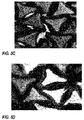
- FIGS. 5A-5D are images depicting a plurality of bi-component filaments, arranged in a sheath-core relationship, having parameters similar to that of the bi-component filaments 210 of FIG. 3 .
- the test data associated with the images of FIGS. 5A-5D are summarized below in Table 1 .
- Table 1 Image Bi-Component Filament Denier / filament % Elongation Tenacity % Boiling Water Shrinkage % Crimp Contrac tion
- FIG. 5A Nylon 6/PET (no Binding Agent) 1200/60 37.88 3 2.5 20.41
- FIG. 5A Nylon 6/PET (no Binding Agent) 1200/60 37.88 3 2.5 20.41
- FIG. 5B Nylon 6/PET (50/50) (with Binding Agent) 1200/60 37.64 3.85 1.25 20.58
- FIG. 5C Nylon 6/PET (33/67) (with Binding Agent) 1200/60 35.39 3.39 0.92 19.27
- FIG. 5D Nylon 6/PET (67/33) (with Binding Agent) 1200/60 33.61 3.55 1.81 21.64
- FIG. 5A depicts a cross-sectional view of bi-component filaments, with a tri-lobal cross-sectional shape, having a sheath formed of a polyamide that includes nylon 6 and a core formed of a polyester that includes polyethylene terephthalate (PET).
- PET polyethylene terephthalate
- the bi-component filament depicted in FIG. 5A does not include a binding agent.
- FIGS. 5B-5D likewise depicts a cross-sectional view of bi-component filament, with a tri-lobal cross-sectional shape, having a sheath formed of a polyamide that includes nylon 6 and a core formed of a polyester that includes polyethylene terephthalate (PET).
- PET polyethylene terephthalate
- the percentage of each polymer component relative to the whole varies across the three samples, as presented in the second column of Table 1.
- Each of the samples of FIGS. 5B-5D was prepared using a binding agent as described above.
- the bi-component filament samples of FIGS. 5B-5D exhibit higher tenacity levels (i.e., strength) than the bi-component filament sample of FIG. 5A , which was prepared without a binding agent.
- the bi-component filament samples of FIGS. 5B-5D maintain relatively high elongation percent in conjunction with increased tenacity. Accordingly, the bi-component filament samples of FIGS. 5B-5D support an increase in overall strength with the use of a binding agent as described above.
- FIG. 5A illustrates that some bi-component filaments of FIG. 5A exhibit delamination between the sheath 512 and the core 514 .
- FIG. 5A illustrates that gaps 518 have already formed between the sheath 512 and the core 514 , where the polymer components are no longer adhered to one another.
- FIG. 5B illustrates well as FIGS. 5C and 5D .
- the bi-component filaments exhibit a high degree of lamination, with little to no gaps, where the binding agent has effectively bound the sheath 612 and the core 614 together along their respective lengths.
- either or both of the first and second polymer components of bi-component filaments 10 , 110 , 210 , 310 is solution-dyed (i.e., dope-dyed) to enhance certain physical attributes of the resulting bi-component filaments.
- solution-dyed i.e., dope-dyed
- polymers can be treated using a solution dyeing process prior to spinning a bi-component filament.
- the polymer components themselves can be permeated with a desired pigment via solution dyeing so that the color exists in the extruded polymer mix. Filaments prepared using a solution dyeing process have demonstrated enhanced ability to retain color (i.e., color fastness).
- the solution is prepared using a pigment dyestuff to add a desired color to the polymer mix.
- the pigment is typically a pure color pigment that is added during the melt stage and extruded with either or both polymer components to deliver a spun filament exhibiting the selected color. It is contemplated that the pigment can be in an organic or an inorganic form, as might be desired. In many cases, use of a pure color pigment in connection with solution dyeing results in filaments with strong, vivid color, although a range of color variability (i.e., subtle changes of hues) can sometimes be difficult to achieve.
- the solution is prepared using each of a pigment dyestuff and a solvent.
- a solvent added to the solution dyeing process can introduce added strength to an extruded polymer.
- inclusion of a solvent can facilitate enhanced color variability.
- the solvent can soften the effect of the pure color pigment, standing alone, so that a wider range of color shades and hues can be obtained in an extruded polymer.
- first component the second component or both the first and second components can be treated via a solution dyeing process.
- first polymer component neither the first polymer component nor the second polymer component is solution dyed so as to preserve the raw white characteristic of color-free polymer.
- each of the first and second polymer components is solution-dyed prior to extrusion-either using a pigment alone or using a pigment in combination with a solvent.
- each of the first and second polymer components can be treated using the same solution dyeing process (i.e., using the same solvent and/or pigment) or using a different solution dyeing processes (i.e., using different solvents and/or pigments for each polymer component).
- a resultant bi-component filament 10 , 110 , 210 , 310 can exhibit a sheath of one color and a core of a different color.
- Example 1 In one contemplated bi-component filament in accordance with one or more aspects of the present invention, first and second polymer components of the bi-component filament are arranged in a sheath-core relationship.
- each of the first polymer component (i.e., the sheath) and the second polymer component (i.e., the core) is solution-dyed during or prior to the extrusion process.
- the solution-dyeing process in this example includes: (a) solution dyeing with a pigment (using a pigment in either an organic or an inorganic form); or (b) solution dyeing with a combination of a pigment and a solvent.
- the first polymer component i.e., the sheath
- the first polymer component includes a polyamide, a polyolefin, or a polyester.
- the polyamide includes, for example, nylon 6.
- the polyolefin includes, for example, polypropylene (PP).
- the polyester includes, for example, polyethylene terephthalate (PET), polybutylene terephthalate (PBT), or polytrimethylene terephthalate (PTT).
- the second polymer component includes a polyamide, a polyolefin, or a polyester.
- the polyamide includes, for example, nylon 6.
- the polyolefin includes, for example, polypropylene (PP).
- the polyester includes, for example, polyethylene terephthalate (PET), polybutylene terephthalate (PBT), or polytrimethylene terephthalate (PTT).
- Example 2 In another contemplated bi-component filament in accordance with one or more aspects of the present invention, first and second polymer components of the bi-component filament are arranged in a sheath-core relationship. Although not required, one or both of the first polymer component (i.e., the sheath) and the second polymer component (i.e., the core) are solution-dyed during or prior to the extrusion process.
- the solution-dyeing process in this example includes: (a) solution dyeing with a pigment (using a pigment in either an organic or an inorganic form); or (b) solution dyeing with a combination of a pigment and a solvent.
- each of the first polymer component and the second polymer can be color-free (i.e., raw white). It is further contemplated that the first polymer component (i.e. the sheath) can be solution-dyed in accordance with one of the above-described processes, while the second polymer component (i.e., the core) is color-free, or that the second polymer component (i.e., the core) can be solution-dyed in accordance with one of the above-described processes, while the first polymer component (i.e., the sheath) is color-free.
- a binding agent is mixed with one or both of the and second polymer components. As the polymers are extruded into the bi-component continuous filament, the binding agent facilitates strong adhesion qualities between the first and second polymer components.
- the binding agent includes, for example, a polyolefin modified by maleic anhydride.
- the first polymer component i.e., the sheath
- the first polymer component includes a polyamide, a polyolefin, or a polyester.
- the polyamide includes, for example, nylon 6.
- the polyolefin includes, for example, polypropylene (PP).
- the polyester includes, for example, polyethylene terephthalate (PET), polybutylene terephthalate (PBT), or polytrimethylene terephthalate (PTT).
- the second polymer component includes a polyamide, a polyolefin, or a polyester.
- the polyamide includes, for example, nylon 6.
- the polyolefin includes, for example, polypropylene (PP).
- the polyester includes, for example, polyethylene terephthalate (PET), polybutylene terephthalate (PBT), or polytrimethylene terephthalate (PTT).
- Example 3 In another contemplated bi-component filament in accordance with one or more aspects of the present invention, first and second polymer components of the bi-component filament are arranged in a sheath-core relationship.
- each of the first polymer component (i.e., the sheath) and the second polymer component (i.e., the core) is solution-dyed during or prior to the extrusion process.
- the solution-dyeing process in this example includes: (a) solution dyeing with a pigment (using a pigment in either an organic or an inorganic form); or (b) solution dyeing with a combination of a pigment and a solvent.
- the first polymer component i.e., the sheath
- the first polymer component includes a polyamide in cationic form, a polyolefin in cationic form, or a polyester in cationic form.
- the polyamide includes, for example, a cationic form of nylon 6.
- the polyolefin includes, for example, a cationic form of polypropylene (PP).
- the polyester includes, for example, a cationic form of polyethylene terephthalate (PET), a cationic form of polybutylene terephthalate (PBT), or a cationic form of polytrimethylene terephthalate (PTT).
- the second polymer component includes a polyamide, a polyolefin, or a polyester.
- the polyamide includes, for example, nylon 6.
- the polyolefin includes, for example, polypropylene (PP).
- the polyester includes, for example, polyethylene terephthalate (PET), polybutylene terephthalate (PBT), or polytrimethylene terephthalate (PTT).
- Example 4 In still another contemplated bi-component filament in accordance with one or more aspects of the present invention, first and second polymer components of the bi-component filament are arranged in a sheath-core relationship.
- first polymer component i.e., the sheath
- second polymer component i.e., the core
- the solution-dyeing process in this example includes: (a) solution dyeing with a pigment (using a pigment in either an organic or an inorganic form); or (b) solution dyeing with a combination of a pigment and a solvent.
- each of the first polymer component and the second polymer can be color-free (i.e., raw white). It is further contemplated that the first polymer component (i.e. the sheath) can be solution-dyed in accordance with one of the above-described processes, while the second polymer component (i.e., the core) is color-free, or that the second polymer component (i.e., the core) can be solution-dyed in accordance with one of the above-described processes, while the first polymer component (i.e., the sheath) is color-free.
- a binding agent is mixed with one or both of the and second polymer components. As the bi-component filament is extruded, the binding agent facilitates strong adhesion qualities between the first and second polymer components.
- the binding agent includes, for example, a polyolefin modified by maleic anhydride.
- the first polymer component i.e., the sheath
- the first polymer component includes a polyamide, a polyolefin, or a polyester.
- the polyamide includes, for example, nylon 6.
- the polyolefin includes, for example, polypropylene (PP).
- the polyester includes, for example, polyethylene terephthalate (PET), polybutylene terephthalate (PBT), or polytrimethylene terephthalate (PTT).
- the second polymer component includes a recycled polyamide or a recycled polyester.
- the polyamide includes, for example, a recycled form of nylon 6.
- the polyester includes, for example, a recycled form of polyethylene terephthalate (PET).
- FIG. 6 a schematic cross-sectional view of an embodiment of a bi-component filament 410 , in accordance with one or more aspects of the present invention, is shown.
- the bi-component filament 410 has a generally circular cross-sectional shape with the polymer components arranged in a side-by-side relationship.
- bi-component filaments in accordance with one or more aspects of the present invention are not limited to the polymer components being arranged in a sheath-core relationship.
- two different polymer components 416 , 418 are shown side by side, and adhered together, to form a single bi-component filament 410 having a generally circular cross-sectional shape.
- bi-component filament 410 of FIG. 6 is depicted as having a generally circular cross-sectional shape, filaments with non-circular cross-sectional shapes (e.g., elliptical, tri-lobal, and the like) are likewise contemplated.
- a bi-component filament with polymer components arranged in a side-by-side relationship can be symmetrically arranged.
- a bi-component filament with polymer components arranged in a side-by-side relationship can be asymmetrically arranged.
- the polymer components of bi-component filaments in accordance with one or more aspects of the present invention may exhibit matrix-fibril type structure, whereby filaments of one polymer component are dispersed in a matrix made using another polymer component, or the polymer components of bi-component filaments in accordance with one or more aspects of the present invention may be arranged in a segmented pie-chart (or citrus) type structure. It is contemplated that these other types of bi-component filament arrangements can have circular or non-circular arrangements, as might be preferred. It is further contemplated that these other types of bi-component filament arrangements can have symmetrical or asymmetrical arrangements, as might be preferred.
- first and second polymer components are selected for inclusion in a bi-component filament.
- the polymer components often exist in a chip or pellet form, other forms of polymer components are contemplated.
- the first and second polymer components are mixed independently of one another.
- a binding agent as described hereinabove, can be included in the polymer mix of one or both of the first and second polymer components.
- the binding agent is mixed with the second polymer component, which, in FIGS. 1-4 , forms the core of the resulting bi-component filament.
- the solution dyeing process includes a pigment or each of a pigment and a solvent.
- solution dyeing the polymer components prior to spinning enables coloration of the polymer components (across a wide spectrum of colors, particularly when a solvent is included in the solution dyeing process).
- the solution-dyeing process can also enhance strength and durability in the polymer components so as to impart the resulting bi-component filament with desirable attributes for various end-use applications.
- Each polymer mix is heated and stirred so that each of the first and second polymer components forms a melt that is ready for extrusion via a spinneret.
- the first and second polymer melts are fed through a spinneret selected to yield a bi-component filament 10 , 110 , 210 , 310 , 410 of a particular cross-sectional shape.
- the resulting bi-component filament 10 , 110 , 210 , 310 , 410 can be further treated and/or texturized for implementation across a wide range of different end-use applications.
- the resulting filament further can be heat set, including, but not limited to, dry heat setting, steam heat setting, or a combination of both.
- the resulting bi-component filament 10 , 110 , 210 , 310 , 410 can be texturized to form bulk continuous filament suitable for tufting and weaving into floor coverings, such as carpets, or other textile products where durability, strength and/or color-fastness may be advantageous.
- bulk continuous filament bundles of the bi-component filaments 10 , 110 , 210 , 310 , 410 can be intermingled with two or three bundles of the same color or a different color.
- bi-component filaments are heat set
- single or multiple bundles of bulk continuous filaments e.g., one, two or three bundles
- Heat setting can afford the filaments with enhanced dimensional stability as well as other desirable attributes, such as wrinkle resistance and/or temperature resistance. It is contemplated that heat setting can be accomplished by steam heating, by dry heating or by a combination of steam and dry heating.
- bulk continuous filament generated using bi-component filaments 10 , 110 , 210 , 310 , 410 in accordance with one or more aspects of the present invention exhibits a denier per filament (DPF) ratio measuring from approximately 2 DPF to approximately 30 DPF.
- DPF denier per filament
- bulk continuous filament generated using bi-component filaments 10 , 110 , 210 , 310 , 410 in accordance with one or more aspects of the present invention exhibits a weight measuring between approximately 500 denier to approximately 3500 denier.
- Bi-component filaments 10 , 110 , 210 , 310 , 410 in accordance with one or more aspects of the present invention have broad utility across a range of end-use textile applications.
- a polyamide sheath can provide a good visual appeal to pile change and, as such, the bi-component filament is well-suited for use in floor covering products.
- a polyester or a polyolefin (e.g., polypropylene) core can provide enhanced moisture-repelling properties so that textile products incorporating such filaments are more durable and are quick-drying.
- bi-component filaments 10 , 110 , 210 , 310 , 410 in accordance with one or more aspects of the present invention can be woven for production of any of a wide range of floor and surface coverings, including, but not limited to, door mats, bath rugs, area rugs, accent rugs, carpet tile rugs, broadloom carpet, automotive floor mats, automotive covering, automotive internal floor covering. It is further contemplated that bi-component filaments 10 , 110 , 210 , 310 , 410 in accordance with one or more aspects of the present invention may likewise be implemented in textile products such as sheeting, towels and other bed and bathroom textile needs.
Landscapes
- Engineering & Computer Science (AREA)
- Textile Engineering (AREA)
- Chemical & Material Sciences (AREA)
- Chemical Kinetics & Catalysis (AREA)
- General Chemical & Material Sciences (AREA)
- Mechanical Engineering (AREA)
- Manufacturing & Machinery (AREA)
- Multicomponent Fibers (AREA)
- Yarns And Mechanical Finishing Of Yarns Or Ropes (AREA)
Applications Claiming Priority (2)
| Application Number | Priority Date | Filing Date | Title |
|---|---|---|---|
| IN201721011143 | 2017-03-29 | ||
| EP18165156.3A EP3382069A1 (de) | 2017-03-29 | 2018-03-29 | Herstellung von zweikomponentigen endlosfilamenten und daraus hergestellte artikel |
Related Parent Applications (1)
| Application Number | Title | Priority Date | Filing Date |
|---|---|---|---|
| EP18165156.3A Division EP3382069A1 (de) | 2017-03-29 | 2018-03-29 | Herstellung von zweikomponentigen endlosfilamenten und daraus hergestellte artikel |
Publications (1)
| Publication Number | Publication Date |
|---|---|
| EP4029976A1 true EP4029976A1 (de) | 2022-07-20 |
Family
ID=61912969
Family Applications (2)
| Application Number | Title | Priority Date | Filing Date |
|---|---|---|---|
| EP18165156.3A Pending EP3382069A1 (de) | 2017-03-29 | 2018-03-29 | Herstellung von zweikomponentigen endlosfilamenten und daraus hergestellte artikel |
| EP22151985.3A Withdrawn EP4029976A1 (de) | 2017-03-29 | 2018-03-29 | Endlosfilamentbauschgarn mit nebeneinanderliegende zweikomponentenfilamente, daraus hergestellte artikel, und verfahren zur herstellung eines solches garn |
Family Applications Before (1)
| Application Number | Title | Priority Date | Filing Date |
|---|---|---|---|
| EP18165156.3A Pending EP3382069A1 (de) | 2017-03-29 | 2018-03-29 | Herstellung von zweikomponentigen endlosfilamenten und daraus hergestellte artikel |
Country Status (3)
| Country | Link |
|---|---|
| US (1) | US10760186B2 (de) |
| EP (2) | EP3382069A1 (de) |
| AU (1) | AU2018202293B2 (de) |
Families Citing this family (7)
| Publication number | Priority date | Publication date | Assignee | Title |
|---|---|---|---|---|
| US20220186427A1 (en) * | 2014-08-22 | 2022-06-16 | San Fang Chemical Industry Co., Ltd. | Composite filament textile and composite filament artificial leather manufactured using the same |
| CN110029408B (zh) * | 2019-05-21 | 2020-05-05 | 上海海凯生物材料有限公司 | 一种弹性复合纤维及其制造方法 |
| JP7730815B2 (ja) * | 2019-12-10 | 2025-08-28 | コベイション・インコーポレイテッド | 自己嵩高性pttを含有する二成分繊維から作製するカーペット |
| WO2021141571A1 (en) * | 2020-01-07 | 2021-07-15 | The Dixie Group, Inc. | Process for improving stain resistance and lightfastness of carpet yarn |
| EP3957782A1 (de) * | 2020-08-21 | 2022-02-23 | Khushboo Abhishek Mandawewala | Bauschgarn mit kontinuierlichem nebeneinanderliegendem zweikomponentenfilament, verfahren zur herstellung und daraus hergestelltes bodenbelagsmaterial |
| US20250389057A1 (en) | 2022-06-28 | 2025-12-25 | Inter Ikea Systems Bv | Filament of recycled polypropylene for pile yarn |
| WO2025046352A1 (en) * | 2023-08-28 | 2025-03-06 | Aladdin Manufacturing Corporation | Yarn made of mixed filaments and multifilament capillary spinnerets |
Citations (7)
| Publication number | Priority date | Publication date | Assignee | Title |
|---|---|---|---|---|
| US4075378A (en) | 1975-09-12 | 1978-02-21 | E. I. Du Pont De Nemours And Company | Polyamide filaments with a basic-dyeable sheath and an acid-dyeable core and dyeing process therefor |
| US4439487A (en) | 1982-12-17 | 1984-03-27 | E. I. Du Pont De Nemours & Company | Polyester/nylon bicomponent flament |
| US5277855A (en) * | 1992-10-05 | 1994-01-11 | Blackmon Lawrence E | Process for forming a yarn having at least one electrically conductive filament by simultaneously cospinning conductive and non-conductive filaments |
| US5780156A (en) * | 1996-10-03 | 1998-07-14 | Basf Corporation | Biocomponet fibers having distinct crystaline and amorphous polymer domains and method making same |
| EP1059372A2 (de) * | 1999-06-08 | 2000-12-13 | Toray Industries, Inc. | Weichelastische Garne und Verfahren zu ihrer Herstellung |
| US20020012794A1 (en) * | 1996-10-03 | 2002-01-31 | Matthew B. Hoyt | Process for producing yarn having reduced heatset shrinkage |
| US20030194529A1 (en) * | 1996-09-16 | 2003-10-16 | Bruce H. Bersted | Propylene polymer fibers and yarns |
Family Cites Families (22)
| Publication number | Priority date | Publication date | Assignee | Title |
|---|---|---|---|---|
| US3700544A (en) | 1965-07-29 | 1972-10-24 | Kanegafuchi Spinning Co Ltd | Composite sheath-core filaments having improved flexural rigidity |
| US3803453A (en) | 1972-07-21 | 1974-04-09 | Du Pont | Synthetic filament having antistatic properties |
| DE2336509B2 (de) | 1973-07-18 | 1976-09-23 | Barmag Barmer Maschinenfabrik Ag, 5600 Wuppertal | Verfahren zur herstellung eines gebauschten und gekraeuselten multifilgarnes |
| US3992499A (en) | 1974-02-15 | 1976-11-16 | E. I. Du Pont De Nemours And Company | Process for sheath-core cospun heather yarns |
| US5372885A (en) * | 1984-08-15 | 1994-12-13 | The Dow Chemical Company | Method for making bicomponent fibers |
| US4987030A (en) | 1987-10-07 | 1991-01-22 | Toray Industries, Inc. | High-tenacity conjugated fiber and process for preparation thereof |
| JPH0241415A (ja) * | 1988-07-25 | 1990-02-09 | Mitsubishi Rayon Co Ltd | 原着繊維 |
| DE3923086A1 (de) * | 1989-07-13 | 1991-01-24 | Hoechst Ag | Antistatisches kern-mantel-filament |
| CA2084866C (en) | 1992-06-18 | 2000-02-08 | Matthew B. Hoyt | Reduced staining carpet yarns and carpet |
| US5958548A (en) * | 1996-08-14 | 1999-09-28 | Nyltec Inc. | Carpet tufted with bulked continuous filament carpet face yarns utilizing new sheathed core filaments and related selection techniques to produce cost savings |
| US6531218B2 (en) | 1996-09-16 | 2003-03-11 | Basf Corporation | Dyed sheath/core fibers and methods of making same |
| CA2214189C (en) | 1997-01-10 | 2001-05-29 | Basf Corporation | Novel bicomponent fibers having core domain formed of regenerated polymeric materials and methods of making the same |
| US5948529A (en) * | 1997-02-26 | 1999-09-07 | Hna Holdings, Inc. | Bicomponent fiber |
| US5888651A (en) | 1997-08-25 | 1999-03-30 | Basf Corporation | Colored bicomponent fibers |
| CA2568263C (en) | 2004-05-26 | 2013-12-24 | Colbond B.V. | Cushioned vinyl floor covering |
| US20080160278A1 (en) | 2006-12-28 | 2008-07-03 | Cheng Paul P | Fade resistant colored sheath/core bicomponent fiber |
| JP4890477B2 (ja) * | 2008-01-31 | 2012-03-07 | 三菱レイヨン株式会社 | ポリプロピレン系繊維及び繊維製品 |
| WO2009146575A1 (zh) | 2008-06-02 | 2009-12-10 | Chen Yi Yung | 原著染色的鞘蕊型复合纤维及其织物 |
| WO2010014556A1 (en) * | 2008-07-28 | 2010-02-04 | The Dow Chemical Company | Fine denier partially oriented bicomponent fibers and flat and textured yarns for use in apparel |
| BR112012013743A2 (pt) | 2009-12-09 | 2016-03-15 | Colbond Bv | forro primário de carpete, e, carpete tufado |
| US20150240389A1 (en) * | 2014-02-25 | 2015-08-27 | Yi-yung Chen | Dope-Dyed Core-Sheath Type Composite Fiber |
| CN104499089A (zh) * | 2014-12-10 | 2015-04-08 | 滨州东方地毯有限公司 | 一种改性丙纶纤维及其制备方法 |
-
2017
- 2017-07-31 US US15/663,887 patent/US10760186B2/en active Active
-
2018
- 2018-03-29 EP EP18165156.3A patent/EP3382069A1/de active Pending
- 2018-03-29 EP EP22151985.3A patent/EP4029976A1/de not_active Withdrawn
- 2018-03-29 AU AU2018202293A patent/AU2018202293B2/en active Active
Patent Citations (7)
| Publication number | Priority date | Publication date | Assignee | Title |
|---|---|---|---|---|
| US4075378A (en) | 1975-09-12 | 1978-02-21 | E. I. Du Pont De Nemours And Company | Polyamide filaments with a basic-dyeable sheath and an acid-dyeable core and dyeing process therefor |
| US4439487A (en) | 1982-12-17 | 1984-03-27 | E. I. Du Pont De Nemours & Company | Polyester/nylon bicomponent flament |
| US5277855A (en) * | 1992-10-05 | 1994-01-11 | Blackmon Lawrence E | Process for forming a yarn having at least one electrically conductive filament by simultaneously cospinning conductive and non-conductive filaments |
| US20030194529A1 (en) * | 1996-09-16 | 2003-10-16 | Bruce H. Bersted | Propylene polymer fibers and yarns |
| US5780156A (en) * | 1996-10-03 | 1998-07-14 | Basf Corporation | Biocomponet fibers having distinct crystaline and amorphous polymer domains and method making same |
| US20020012794A1 (en) * | 1996-10-03 | 2002-01-31 | Matthew B. Hoyt | Process for producing yarn having reduced heatset shrinkage |
| EP1059372A2 (de) * | 1999-06-08 | 2000-12-13 | Toray Industries, Inc. | Weichelastische Garne und Verfahren zu ihrer Herstellung |
Also Published As
| Publication number | Publication date |
|---|---|
| AU2018202293A1 (en) | 2018-10-18 |
| AU2018202293B2 (en) | 2023-07-13 |
| US20180282908A1 (en) | 2018-10-04 |
| EP3382069A1 (de) | 2018-10-03 |
| US10760186B2 (en) | 2020-09-01 |
Similar Documents
| Publication | Publication Date | Title |
|---|---|---|
| US10760186B2 (en) | Manufacture of bi-component continuous filaments and articles made therefrom | |
| US12195884B2 (en) | Bi-component continuous filaments and articles made therefrom | |
| US5958548A (en) | Carpet tufted with bulked continuous filament carpet face yarns utilizing new sheathed core filaments and related selection techniques to produce cost savings | |
| US5549957A (en) | Bulked continuous filament carpet yarn | |
| US4181762A (en) | Fibers, yarns and fabrics of low modulus polymer | |
| US5284009A (en) | Fiber blends for improved carpet texture retention | |
| US4457973A (en) | Conductive composite filaments and methods for producing said composite filaments | |
| DE2337103C3 (de) | Antistatischer synthetischer Zweikomponenten-Faden, Verfahren zu dessen Herstellung und gemischtes Endlosfadengarn oder Stapelfasergemisch | |
| EP0921219B1 (de) | Selbstfixierender Faden | |
| CN103757745B (zh) | 一种聚酯共混纤维及其制备方法 | |
| US20120282431A1 (en) | Mixed polyester yarns and articles made therefrom | |
| EP1205585B1 (de) | Teppichgarn auf Polypropylenbasis | |
| CA3187836A1 (en) | Twisted and heat-set bcf yarn comprising side-by-side bi-component filament, method for forming such yarn and a floor covering material comprising such yarn | |
| TW202129105A (zh) | 由自膨化性含ptt之雙組分纖維製成的地毯 | |
| JPS5831111A (ja) | 導電性複合繊維を含有する混繊糸 | |
| WO2021211934A1 (en) | Sharp color effect yarn | |
| CN114717684A (zh) | 一种由混合聚酯制成的化学纤维材料 | |
| JP4481907B2 (ja) | 原着ポリ乳酸捲縮糸及びその製造方法並びにカーペット | |
| JPS6321940A (ja) | 捲縮糸 | |
| JPS62268839A (ja) | 捲縮糸 | |
| JPH06207335A (ja) | カーペット用繊維およびその製造方法 |
Legal Events
| Date | Code | Title | Description |
|---|---|---|---|
| PUAI | Public reference made under article 153(3) epc to a published international application that has entered the european phase |
Free format text: ORIGINAL CODE: 0009012 |
|
| STAA | Information on the status of an ep patent application or granted ep patent |
Free format text: STATUS: THE APPLICATION HAS BEEN PUBLISHED |
|
| AC | Divisional application: reference to earlier application |
Ref document number: 3382069 Country of ref document: EP Kind code of ref document: P |
|
| AK | Designated contracting states |
Kind code of ref document: A1 Designated state(s): AL AT BE BG CH CY CZ DE DK EE ES FI FR GB GR HR HU IE IS IT LI LT LU LV MC MK MT NL NO PL PT RO RS SE SI SK SM TR |
|
| STAA | Information on the status of an ep patent application or granted ep patent |
Free format text: STATUS: THE APPLICATION IS DEEMED TO BE WITHDRAWN |
|
| 18D | Application deemed to be withdrawn |
Effective date: 20230121 |