EP4035645A2 - Aides au dosage - Google Patents
Aides au dosage Download PDFInfo
- Publication number
- EP4035645A2 EP4035645A2 EP22153768.1A EP22153768A EP4035645A2 EP 4035645 A2 EP4035645 A2 EP 4035645A2 EP 22153768 A EP22153768 A EP 22153768A EP 4035645 A2 EP4035645 A2 EP 4035645A2
- Authority
- EP
- European Patent Office
- Prior art keywords
- section
- dosing
- recesses
- dosing aid
- cross
- Prior art date
- Legal status (The legal status is an assumption and is not a legal conclusion. Google has not performed a legal analysis and makes no representation as to the accuracy of the status listed.)
- Granted
Links
Images




Classifications
-
- A—HUMAN NECESSITIES
- A61—MEDICAL OR VETERINARY SCIENCE; HYGIENE
- A61J—CONTAINERS SPECIALLY ADAPTED FOR MEDICAL OR PHARMACEUTICAL PURPOSES; DEVICES OR METHODS SPECIALLY ADAPTED FOR BRINGING PHARMACEUTICAL PRODUCTS INTO PARTICULAR PHYSICAL OR ADMINISTERING FORMS; DEVICES FOR ADMINISTERING FOOD OR MEDICINES ORALLY; BABY COMFORTERS; DEVICES FOR RECEIVING SPITTLE
- A61J7/00—Devices for administering medicines orally, e.g. spoons; Pill counting devices; Arrangements for time indication or reminder for taking medicine
- A61J7/02—Pill counting devices
Definitions
- the invention relates to dosing aids for predetermined pharmaceutical and homeopathic active substance carriers with a round cross-section.
- Dosing aids for liquid medicines or, in other words, liquids containing pharmaceutical and homeopathic active ingredients are known from the prior art.
- dosing inserts are also available which are used in bottles and which allow drops to be counted. Such dosing inserts are sometimes also used for solids, for example for globules.
- a globule is understood to be a small sphere, usually made of sucrose, with a diameter of approx. 2 mm, which is further processed into a drug by wetting the scattering sphere with a homeopathically potentised active ingredient or complex of active ingredients.
- globules are made of sugar and what they are wetted with, what matters is that such globules are to be understood herein as pharmaceutical or homeopathic active ingredient carriers with a round cross-section.
- Such globules have the usual dimensions for, for example, so-called D and C potencies of approx. 2 mm in diameter at approx. 8 mg. Deviations are production-related. With a diameter of only 2 mm, such a globule is of a size that is difficult for many people to handle.
- Globules are usually sold or transported in dark colored glass vials or similar chemically inert containers. Such vessels can also be provided with plug-in inserts from which the globules are usually poured out during use, for example onto one hand.
- Dragees are often only a few millimeters thick and have a maximum cross-section of 6 - 8 mm, which is already a problem for people with restless hands represents a handling problem. The same can be applied to tablets or capsules of small dimensions (like the ones mentioned above).
- JP H10-24 091 A a rectangular-shaped hygiene or dosing spoon is known which has a receiving section for pills or tablets at a free end.
- This receiving section has cylindrical bores which are closed off with a bottom on an underside of the bucket.
- Such dosing spoons are also out DE 299 07 996 U1 , DE 102010 007 587 A1 and DE CH 242 049 A known.
- removing the pills from the dosing spoons is often difficult because, depending on the shape of the pills, they can jam in the bores.
- a first dosing aid which is designed with a round cross-section for dosing predetermined pharmaceutical or homeopathic active ingredient carriers, this is a flat element, correspondingly having a top and a bottom and having an elongate dimension.
- the shape is thus mouth spatula-like.
- the dosing aid has a receiving section in which a predetermined number of recesses with a round opening cross section are provided on the upper side of the receiving section.
- the recesses have a depth less than the overall diameter and greater than one third the diameter of the predetermined pharmaceutical and homeopathic excipients; in other words, the recesses accommodate at least one third of an active substance carrier, but not all of it.
- active ingredient carriers such as globules can be held securely, they do not roll around in the recess, and the dosing aid is lifted and carried, so the globules remain securely positioned even when the dosing aid is tilted.
- the receiving section merges into a handle section, so that the dosing aid can be held comfortably.
- This configuration of the receiving section according to the invention makes it possible, unlike in the prior art, which usually provides that small pills are simply filled into a hole that is too large, and that the dosing aid can be inserted with the receiving section first into a container with active substance carriers and active substance carriers settle in the receiving sections in a suitable manner and without tilting. Due to the bottlenecks, the active substance carriers are always held through the "inlet” or “outlet” of the recess, even when the dosing aid is held at an angle. The active ingredient carriers cannot roll around in the recess and are therefore stable.
- any number of recesses will be possible, although a dose is often 1 to 10 or 20 globules. Dosing aids with up to 100 recesses are also conceivable for dosing larger amounts of globules.
- “Pharmaceutical or homeopathic active ingredient carriers” are to be understood herein as meaning, for example, globules, capsules, coated tablets or tablets which are medicinal products and contain pharmaceutical or homeopathic active ingredients in some way.
- a dosing aid for globules for example, have round opening cross-sections with 2 mm for taking globules if they have a diameter of 2 mm.
- the opening cross-section at the top of the flat dosing aid would be 8 mm.
- Random cross-section of this active substance carrier means in the case of globules an approximately circular cross-section due to the production process, whereas coated tablets can have an oval longitudinal cross-section, for example. Then the dimensions of the recesses are matched to the oval cross section.
- round cross-section includes both circular and oval geometries, be it of drug carriers or the recesses.
- the dosing aid according to the invention allows the flat element to be inserted with its receiving section in front into a vessel containing the active substance carrier; when the vessel is tilted in the horizontal direction (just so that no active substance carriers tumble out), active substance carriers are deposited in the receiving sections - if a sufficient number of active substance carriers are still contained in the removal vessel, there are always just as many active substance carriers as there are recesses, so that the dosing aid can be removed from the dispensing vessel by its stem section and the desired number of active substance carriers is immediately available to the user. It is advantageous that no active ingredient carriers that have been expelled in excess have to be transferred back into the vessel. According to the invention, therefore, “a predetermined number” of recesses also means that the dosing aid is precisely matched to the number of active ingredient carriers to be removed as desired.
- the flat element has a thickness in the range from 0.5 to 3 mm.
- the thickness can preferably be in a range from 0.7 to 2 mm or in a range from 0.8 to 1.5 mm.
- the flat element is thus thick enough, corresponding to the globules for which it is intended, that on the one hand it is stable and on the other hand it can have recesses of sufficient depth.
- the recesses can be passage openings that extend from the upper side of the planar element to the underside.
- One of the cross-sections of the passage openings on the underside or on the top is at most equal to or smaller than the diameter of the globules, so they are always held by the "input” or “output” of the recess.
- the Through-opening with respect to its circumference be consistent throughout, but they can also have a tapered circumference by countersinking from the top down, alternatively, a chamfer can be provided, the introduced consistently or only up to one level.
- the passage opening then has a shoulder at the appropriate depth.
- a spheroidal recess can also be provided with the materials or manufacturing processes provided.
- a constriction that holds the globule could also be provided in the passage of the passage opening. If there is no passage opening, but only a recess, this should be deep enough for more than half or at least half of the globule to be accommodated in it, i.e. the depth of the recess is smaller than the diameter of the globule - all recesses are therefore according to the invention designed in such a way that they securely hold the spherical globule, the ellipsoidal or circular dragee with a correspondingly ellipsoidal cross-section or a capsule or tablet.
- the dosing aid is intended for a capsule or tablet, it should be noted that a tablet is rectangular in longitudinal cross-section, but a capsule is elliptical, for example: In such cases, provision will be made for recesses not to have a passage opening, for example, but merely an opening cross-section that opens access to a holding trough. Alternatively, it can be provided that the opening cross section on the underside is so much smaller than the diameter of the longitudinal cross section of the capsule, the coated tablet or the tablet that it does not fall through the dosing aid.
- the handle section of the dosing aid opens into a grip section that is wider than the handle section and can be handled appropriately, especially for restless hands.
- an identification can be incorporated into or attached to the handle section, which indicates the number of recesses.
- the handle section can be widened, for example, as is often the case with spoons, so that it can be held comfortably between thumb and forefinger or between thumb and middle finger.
- the number of recesses for example five, can be provided with the help of a depression or punching or also by printing or a sticker on the handle section.
- the material for such pharmaceutical or homeopathic active substance carriers should advantageously be a biochemically inert material such as, for example polypropylene. Basically, metals are all the more inert, the nobler they are: Gold is also accepted in homeopathic active ingredient carriers. In principle, it is also conceivable to use wood or other correspondingly biochemically inert materials. Depending on the choice of material, the person skilled in the art will therefore decide whether to already provide the recesses or the markings in a tool or whether they are to be provided subsequently by punching, laser cutting or in some other way.
- the flat element can be flat overall, that is to say rod-like; then an (extended) angle of 180° would be spanned between the stem section and the receiving section - of course, the stem section and the receiving section can also span an angle in the range from less than 180° to 120°, preferably from 180° to 140° (in any case, except for the 180° exception, an obtuse angle).
- a very favorable angle is approx. 160°: This makes it possible to insert the dosing aid into vessels with a small opening and still cleverly guide the receiving section under the globules without having to tilt the vessel too much when filling the dosing aid.
- the recesses can be arranged according to the selected shape of the dosing aid along the length of the dosing aid in the receiving section, so to speak in one or more rows, or the receiving section forms a receiving plate on which the recesses are arranged around one another, taking up the smallest possible space. It is irrelevant whether the receiving plate describes a round or a flat corner, starting from the stem section. The fewer globules to be taken up, the smaller the receiving plate can be and the more skillfully the receiving aid can be introduced into the vessel in which the globules are located.
- a further invention consists in providing the dosing aids in a dosing aid set:
- a dosing aid set according to the invention for dosing predetermined pharmaceutical and homeopathic active substance carriers with a round cross-section provides that at least two such dosing aids, as disclosed above according to the invention, are provided with different numbers of recesses. For example, with a set of two dosing aids, one of which has two and the other five recesses, the dosing of two, five or seven with the respective multiple of this could be dosed in a targeted manner.
- Another dosing aid according to the invention designed for dosing predetermined pharmaceutical and homeopathic active ingredient carriers with a round cross section refers to a shape with a cylindrical body that has an upper side and a lower side.
- a funnel-like recess extends at the top in the direction of the underside.
- the funnel-like recess has a funnel base and the funnel-like recess has a rim on the upper side of the cylindrical body.
- a predetermined number of recesses for example one to ten or twenty, or even more if necessary, with a round opening cross-section is provided on the top side of the funnel base.
- a channel extends from the base of the funnel along its wall to the upper side of the cylindrical body, which channel opens to the outside through the edging web, which is correspondingly perforated at this point.
- this dosing aid can be used for dosing by pouring them from the vessel containing globules, for example, into the dosing aid, the predetermined number of globules then settles in the correspondingly provided number of recesses, then the dosing aid can be used to over the channel dump the excess globules back into the globule vessel.
- the globules do not have to be picked up to pour them back.
- the desired number of globules remains in the dosing aid and can be used directly from there.
- the channel which opens outwards through the edging web, opens into a spout--this spout advantageously facilitates the return of excess globules to their container.
- the cylindrical body has a grip indentation all or part of the way round. This is ergonomically designed and can safely accommodate two fingers of one hand.
- it can have a gripping section that extends radially away from the cylindrical body and is cut onto it, depending on the manufacturing process for the dosing aid.
- the handle section can advantageously have a marking that indicates the number of recesses provided in the indicates funnel reason.
- it is possible to provide the identification by stamping, lasering or by printing.
- Yet another invention relates to a corresponding dosing aid set for dosing predetermined pharmaceutical and homeopathic active ingredient carriers with a round cross-section, this dosing aid set having at least two dosing aids as disclosed above with a cylindrical body, the at least two dosing aids also having different numbers of recesses.
- the present invention relates to dosing aids for predetermined pharmaceutical and homeopathic active ingredient carriers with a round cross-section, such as, for example and in particular, globules, but also to other forms of administration such as coated tablets, capsules or tablets.
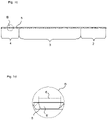
- Fig. 1a shows such a dosing aid 1 designed as a flat element. As can be seen, it has an upper side and an underside and is elongated in shape.
- Fig. 1b makes it clear that this dosing aid is divided into sections: a receiving section 4, in which a predetermined number of recesses 5, here five recesses 5, with a round opening cross section 6 (example shown for only one recess 5) is located. As can be seen, the receiving section opens into a style section 3.
- the dosing aid 1 could already be held by the style section and immersed in a vessel containing globules (the term “globules” is used below, but tablets, capsules or dragees can also always be meant).
- the globules the size of which is matched to the opening cross-sections 6' of the recesses 5 and which are present on the upper side of the dosing aid and are smaller than or equal to the corresponding cross-section of the globules, fall into the recesses 5 and are more or less loosely held therein, so that the dosing aid 1 can be pulled out of the vessel containing globules and thereby leads the desired number of five globules here with it.
- the dosing aid shown also has a holding section 2, which makes it easier to grip the dosing aid.
- this holding section 2 in any suitable manner, since it does not also dip into the vessel. He is here slightly wider than the style section 3, so that the dosing aid 1 can be held relaxed with two or three fingers.
- the dosing aid 1 has a marking 10 in the handle section 2 which indicates the number of recesses 5 in the receiving section 4 .
- the user can effortlessly access the corresponding dosing aid 1 from a number of dosing aids 1, which have, for example, 1 to 10 recesses and which are marked accordingly, with stamped numbers 1 to 10, and can thus select the desired number of globules 50 out of the container - he does not have to laboriously pour Globuli 50 onto a table, hand or spoon in order to then count the tiny parts into his mouth.
- Globules usually have a diameter of 2 mm, which is often difficult to handle. But capsules and tablets are also often difficult to handle for restless hands or people with reduced vision, so that the dosing aid 1 enables the desired number of active ingredient carriers to be dosed without the need for laborious counting and grasping.
- the dosing aid 1 designed as a flat element can have all sections receiving section 4, style section 3 and holding section 2 in one plane; Such a simple dosing aid 1 is particularly easy and inexpensive to manufacture.
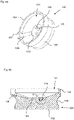
- the detail B is indicated by dashed lines, which in Fig. 1b the shape of a recess 5 clarifies:
- the recess is partially spheroidal here and reproduces the shape of a spherical cap.
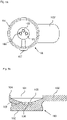
- FIG Fig . 4a a globule 50 in a recess 5
- the opening cross section 6 on the upper side of the dosing aid 1 is much larger than the cross section 6' on the underside of the dosing aid 1.
- the rounded recess 5 reproduces the shape of a spherical cap and holds the globule 50 securely.
- the globule 50 falls into the recess 5 in such a way that half of it protrudes beyond the recess 5 and part of it protrudes beyond the underside of the recess.
- the recess is a through opening there.
- Figure 4b shows the recess 5 with a chamfer, which first tapers downwards from the opening of the recess with the largest cross section 6 and then opens into a bore with a smaller cross section 6 coming from below.
- a globule is accommodated in the recess 5 .
- the opening cross section 6 at the top of the recess is larger than the cross section of the globules.
- Figure 4c shows a further embodiment of the recess 5 in the receiving section 4: There is also a through-opening in the receiving section 4, the outer surface of which runs over a step from the larger opening cross-section 6 to the cross-section 6' of the through-opening on the underside.
- Figure 4d shows a recess 5 closed at the bottom, the depth of which is greater than the radius of the globule 50, or greater than a third of the diameter and but smaller than its entire diameter; it is also hemispherical, whereas the in Figure 4e shown recess 5 closed at the bottom is chamfered from the top, i.e. has an opening cross section which is much larger than the diameter of the globule 50, and then via a step opens into a smaller recess cross section - overall the globule 50 lies loosely in the recess. But because the recess 5 has a depth that is greater than the radius of the globulus 50, it is still safely stored in the dosing aid 1.
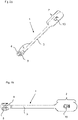
- FIG. 3 shows basically the same item as Figure 2a :
- the dosing aid is designed as a flat element, but in which the receiving section is designed as a round receiving plate 4 - in Figure 2a the receiving plate has an approximately rectangular shape as seen from style 3, whereas in 3 the receiving plate has an approximately round shape; in both cases, five recesses 5 are introduced as an example, as is also shown by the respective marking 10; in order to keep the plate as small as possible so that the receiving section can also be cleverly introduced into the smallest possible globule vessels, the arrangement of the recesses 5 is below Claiming the smallest space, a central arrangement is provided, which is surrounded by four further recesses 5, which are present almost immediately adjacent to the edge of the receiving plate.
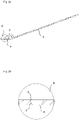
- the receiving section and style are arranged at an angle ⁇ of approx. 160° to one another - this obtuse angling, which can also be somewhat smaller or larger and can be, for example, 140°, 150° or 170°, is achieved that the globules can be lifted out of the container a little more safely by the consumer, like with a spoon, than with a straight 180° angle. All embodiments of the dosing aid can be angled or stretched. Also Figure 2c gives the angle ⁇ as an example.
- a dosing aid 100 for predetermined pharmaceutical and homeopathic active ingredient carriers with a round cross section 50 is also shown, e.g. a globulus 50, as in Figure 6c shown.
- the dosing aid 100 shown has a cylindrical body with an upper side 101, which the viewer can look at in Figure 5a looks. He continues to look at the top of a funnel-like recess extending towards the bottom 102, see Figure 5b extends.
- This funnel-like recess has a funnel base 103 and is surrounded by a boundary web 104 on its upper side. Recesses 105 are in turn made in the funnel base 103 after a predetermined number, which extends from one to ten.
- the dosing aid shown shows that the recess 105 runs downwards, starting from the funnel base 103, in a partially spheroidal or spherical cap shape, and then extends into an expanding bore, so that the globule 50 is received and held by the spheroidal shape, which is precisely the shape of the globule 50 in the area below its half.
- the spherical segment which is not held by the spherical segment-shaped wall of the recess, extends into the recess located underneath.
- the dosing aid in Figures 5a and 5b points exactly like the dosing aid in Figures 6a and 6b a channel 108, which runs along the wall of the funnel-like recess to the top of the cylindrical body 100 and opens through the boundary web 104 to the outside.
- a spout 107 is cut there (not absolutely necessary, but desirable).
- the other globules can be poured back into the vessel via the channel 108, and the remaining three globules can be used immediately.
- a handle section 109' can be cut onto the cylindrical body.
- this handle section 109' can also be provided with an identifier (not shown in the figure) which indicates the number of recesses and thus the number of globules dosed.
- the marking can be incorporated or attached by stamping, lasering, directly by injection molding or casting or in some other way.
- a grip indentation 109 is provided around the circumference or part of the circumference, which allows the cylindrical body, which preferably has a circumference of less than 8 cm, to be held in a skillful manner.
- This dosing aid 100 can also be put together as a dosing aid set according to the invention, which is composed of similar dosing aids 100 but with different numbers of recesses 105 .
Landscapes
- Health & Medical Sciences (AREA)
- Life Sciences & Earth Sciences (AREA)
- Animal Behavior & Ethology (AREA)
- General Health & Medical Sciences (AREA)
- Public Health (AREA)
- Veterinary Medicine (AREA)
- Medical Preparation Storing Or Oral Administration Devices (AREA)
- Medicinal Preparation (AREA)
- Infusion, Injection, And Reservoir Apparatuses (AREA)
Applications Claiming Priority (1)
| Application Number | Priority Date | Filing Date | Title |
|---|---|---|---|
| DE102021000415.9A DE102021000415A1 (de) | 2021-01-28 | 2021-01-28 | Dosierhilfen |
Publications (3)
| Publication Number | Publication Date |
|---|---|
| EP4035645A2 true EP4035645A2 (fr) | 2022-08-03 |
| EP4035645A3 EP4035645A3 (fr) | 2022-11-30 |
| EP4035645B1 EP4035645B1 (fr) | 2026-04-29 |
Family
ID=82199332
Family Applications (1)
| Application Number | Title | Priority Date | Filing Date |
|---|---|---|---|
| EP22153768.1A Active EP4035645B1 (fr) | 2021-01-28 | 2022-01-27 | Aides au dosage |
Country Status (2)
| Country | Link |
|---|---|
| EP (1) | EP4035645B1 (fr) |
| DE (1) | DE102021000415A1 (fr) |
Citations (3)
| Publication number | Priority date | Publication date | Assignee | Title |
|---|---|---|---|---|
| CH242049A (de) | 1945-07-30 | 1946-04-15 | Xaver Muenzel Franz | Löffel zum Zählen und Abfüllen von vielen gleichen, kleinstückigen Gegenständen, insbesondere Pillen und Tabletten. |
| DE29907996U1 (de) | 1999-05-06 | 1999-07-29 | Knoll AG, 67061 Ludwigshafen | Dosierlöffel für Mikrotabletten |
| DE102010007587A1 (de) | 2009-02-10 | 2011-04-07 | Ritter Pharma-Technik Gmbh | Dosierspatel |
Family Cites Families (6)
| Publication number | Priority date | Publication date | Assignee | Title |
|---|---|---|---|---|
| FR2677615B1 (fr) * | 1991-06-11 | 1996-03-15 | Michel Beury | Bouchon distributeur pour granules homeopathiques. |
| JPH1024091A (ja) | 1996-07-10 | 1998-01-27 | Noboru Mori | 粒体物等のためのカウンティングスプーン |
| CN202236382U (zh) * | 2011-09-28 | 2012-05-30 | 赵霞 | 计数药匙 |
| CN202355600U (zh) * | 2011-11-19 | 2012-08-01 | 李家录 | 一种药剂科用药片计数器 |
| CN205286961U (zh) * | 2015-11-27 | 2016-06-08 | 孙翊雅 | 一种方便计数取药勺 |
| WO2018089281A1 (fr) * | 2016-11-09 | 2018-05-17 | Merck Sharp & Dohme Corp. | Dispositif de dosage pour mesurer et distribuer des mini-comprimés |
-
2021
- 2021-01-28 DE DE102021000415.9A patent/DE102021000415A1/de active Pending
-
2022
- 2022-01-27 EP EP22153768.1A patent/EP4035645B1/fr active Active
Patent Citations (3)
| Publication number | Priority date | Publication date | Assignee | Title |
|---|---|---|---|---|
| CH242049A (de) | 1945-07-30 | 1946-04-15 | Xaver Muenzel Franz | Löffel zum Zählen und Abfüllen von vielen gleichen, kleinstückigen Gegenständen, insbesondere Pillen und Tabletten. |
| DE29907996U1 (de) | 1999-05-06 | 1999-07-29 | Knoll AG, 67061 Ludwigshafen | Dosierlöffel für Mikrotabletten |
| DE102010007587A1 (de) | 2009-02-10 | 2011-04-07 | Ritter Pharma-Technik Gmbh | Dosierspatel |
Also Published As
| Publication number | Publication date |
|---|---|
| DE102021000415A1 (de) | 2022-07-28 |
| EP4035645B1 (fr) | 2026-04-29 |
| EP4035645A3 (fr) | 2022-11-30 |
Similar Documents
| Publication | Publication Date | Title |
|---|---|---|
| DE19522451C2 (de) | Vorrichtung zur Abgabe eines fließfähigen Stoffes aus einem Behälter | |
| DE68908575T2 (de) | Etui mit Druckknopfbetätigung und Sicherheitssystem. | |
| DE68909789T2 (de) | Augentropfenverabreichungsvorrichtung. | |
| CH672600A5 (fr) | ||
| WO1985002598A1 (fr) | Dispensateur doseur | |
| DE3722475C2 (fr) | ||
| DE8710421U1 (de) | Vorrichtung zum Aufbewahren von zu injizierenden Medikamenten | |
| DE3735301A1 (de) | Pillenteiler | |
| EP0385055A1 (fr) | Boîte de stockage pour les têtes d'un tournevis | |
| EP1175195B1 (fr) | Cuillere a mesurer pour doser des micropastilles | |
| EP4035645B1 (fr) | Aides au dosage | |
| DE3922763A1 (de) | Aufbewahrungs- und spenderbehaelter fuer in blistern eingesiegelte feste arzneiformen | |
| EP1457203A1 (fr) | Formes galéniques solides, dosables exactements, pour la distribution de doses unitaires à partir de dispositifs de dosage et procédés associés | |
| DE102023204395A1 (de) | Behälter für frei fliessenden puder | |
| DE3202348A1 (de) | Spender | |
| EP0659066A1 (fr) | Conditionnement servant a conserver et a distribuer individuellement des comprimes contenus dans des supports. | |
| DE69505367T2 (de) | Mit einer abgabevorrichtung versehener tablettenbehälter | |
| DE19737746A1 (de) | Fallschacht - Tablettenspender | |
| AT504573A1 (de) | Verpackung für kleinvolumige flaschen | |
| DE102010007587B4 (de) | Dosierspatel | |
| DE3817637A1 (de) | Halterung fuer laengliche kappen von kanuelen | |
| DE69300189T2 (de) | Taschenträger zum Spenden von Produkten in genaue Menge. | |
| DE2217059C3 (de) | Aufsatzgerät für selbsttätige Einzelausgabe von Tabletten u.dgl. aus Originalbehältern | |
| DE8808800U1 (de) | Quetschflasche mit Behälter zum Dosieren von Flüssigkeiten | |
| DE8911216U1 (de) | Taschen-Tablettenspender für insbesondere Globuli |
Legal Events
| Date | Code | Title | Description |
|---|---|---|---|
| PUAI | Public reference made under article 153(3) epc to a published international application that has entered the european phase |
Free format text: ORIGINAL CODE: 0009012 |
|
| STAA | Information on the status of an ep patent application or granted ep patent |
Free format text: STATUS: THE APPLICATION HAS BEEN PUBLISHED |
|
| AK | Designated contracting states |
Kind code of ref document: A2 Designated state(s): AL AT BE BG CH CY CZ DE DK EE ES FI FR GB GR HR HU IE IS IT LI LT LU LV MC MK MT NL NO PL PT RO RS SE SI SK SM TR |
|
| PUAL | Search report despatched |
Free format text: ORIGINAL CODE: 0009013 |
|
| AK | Designated contracting states |
Kind code of ref document: A3 Designated state(s): AL AT BE BG CH CY CZ DE DK EE ES FI FR GB GR HR HU IE IS IT LI LT LU LV MC MK MT NL NO PL PT RO RS SE SI SK SM TR |
|
| RIC1 | Information provided on ipc code assigned before grant |
Ipc: A61J 7/02 20060101AFI20221026BHEP |
|
| STAA | Information on the status of an ep patent application or granted ep patent |
Free format text: STATUS: REQUEST FOR EXAMINATION WAS MADE |
|
| 17P | Request for examination filed |
Effective date: 20230509 |
|
| RBV | Designated contracting states (corrected) |
Designated state(s): AL AT BE BG CH CY CZ DE DK EE ES FI FR GB GR HR HU IE IS IT LI LT LU LV MC MK MT NL NO PL PT RO RS SE SI SK SM TR |
|
| STAA | Information on the status of an ep patent application or granted ep patent |
Free format text: STATUS: EXAMINATION IS IN PROGRESS |
|
| 17Q | First examination report despatched |
Effective date: 20240702 |
|
| GRAP | Despatch of communication of intention to grant a patent |
Free format text: ORIGINAL CODE: EPIDOSNIGR1 |
|
| STAA | Information on the status of an ep patent application or granted ep patent |
Free format text: STATUS: GRANT OF PATENT IS INTENDED |
|
| INTG | Intention to grant announced |
Effective date: 20260130 |
|
| GRAS | Grant fee paid |
Free format text: ORIGINAL CODE: EPIDOSNIGR3 |
|
| GRAA | (expected) grant |
Free format text: ORIGINAL CODE: 0009210 |
|
| STAA | Information on the status of an ep patent application or granted ep patent |
Free format text: STATUS: THE PATENT HAS BEEN GRANTED |
|
| AK | Designated contracting states |
Kind code of ref document: B1 Designated state(s): AL AT BE BG CH CY CZ DE DK EE ES FI FR GB GR HR HU IE IS IT LI LT LU LV MC MK MT NL NO PL PT RO RS SE SI SK SM TR |
|
| REG | Reference to a national code |
Ref country code: CH Ref legal event code: F10 Free format text: ST27 STATUS EVENT CODE: U-0-0-F10-F00 (AS PROVIDED BY THE NATIONAL OFFICE) Effective date: 20260429 |