EP4036084A1 - Verfahren zur herstellung von propylenoxid - Google Patents
Verfahren zur herstellung von propylenoxid Download PDFInfo
- Publication number
- EP4036084A1 EP4036084A1 EP20868606.3A EP20868606A EP4036084A1 EP 4036084 A1 EP4036084 A1 EP 4036084A1 EP 20868606 A EP20868606 A EP 20868606A EP 4036084 A1 EP4036084 A1 EP 4036084A1
- Authority
- EP
- European Patent Office
- Prior art keywords
- peroxide
- catalyst
- fixed bed
- bed reactor
- supplying
- Prior art date
- Legal status (The legal status is an assumption and is not a legal conclusion. Google has not performed a legal analysis and makes no representation as to the accuracy of the status listed.)
- Granted
Links
Images
Classifications
-
- C—CHEMISTRY; METALLURGY
- C07—ORGANIC CHEMISTRY
- C07D—HETEROCYCLIC COMPOUNDS
- C07D301/00—Preparation of oxiranes
- C07D301/02—Synthesis of the oxirane ring
- C07D301/03—Synthesis of the oxirane ring by oxidation of unsaturated compounds, or of mixtures of unsaturated and saturated compounds
- C07D301/19—Synthesis of the oxirane ring by oxidation of unsaturated compounds, or of mixtures of unsaturated and saturated compounds with organic hydroperoxides
-
- C—CHEMISTRY; METALLURGY
- C07—ORGANIC CHEMISTRY
- C07B—GENERAL METHODS OF ORGANIC CHEMISTRY; APPARATUS THEREFOR
- C07B61/00—Other general methods
-
- C—CHEMISTRY; METALLURGY
- C07—ORGANIC CHEMISTRY
- C07D—HETEROCYCLIC COMPOUNDS
- C07D301/00—Preparation of oxiranes
- C07D301/02—Synthesis of the oxirane ring
- C07D301/03—Synthesis of the oxirane ring by oxidation of unsaturated compounds, or of mixtures of unsaturated and saturated compounds
- C07D301/12—Synthesis of the oxirane ring by oxidation of unsaturated compounds, or of mixtures of unsaturated and saturated compounds with hydrogen peroxide or inorganic peroxides or peracids
-
- C—CHEMISTRY; METALLURGY
- C07—ORGANIC CHEMISTRY
- C07D—HETEROCYCLIC COMPOUNDS
- C07D301/00—Preparation of oxiranes
- C07D301/02—Synthesis of the oxirane ring
- C07D301/03—Synthesis of the oxirane ring by oxidation of unsaturated compounds, or of mixtures of unsaturated and saturated compounds
- C07D301/14—Synthesis of the oxirane ring by oxidation of unsaturated compounds, or of mixtures of unsaturated and saturated compounds with organic peracids, or salts, anhydrides or esters thereof
-
- C—CHEMISTRY; METALLURGY
- C07—ORGANIC CHEMISTRY
- C07D—HETEROCYCLIC COMPOUNDS
- C07D303/00—Compounds containing three-membered rings having one oxygen atom as the only ring hetero atom
- C07D303/02—Compounds containing oxirane rings
- C07D303/04—Compounds containing oxirane rings containing only hydrogen and carbon atoms in addition to the ring oxygen atoms
-
- C—CHEMISTRY; METALLURGY
- C07—ORGANIC CHEMISTRY
- C07F—ACYCLIC, CARBOCYCLIC OR HETEROCYCLIC COMPOUNDS CONTAINING ELEMENTS OTHER THAN CARBON, HYDROGEN, HALOGEN, OXYGEN, NITROGEN, SULFUR, SELENIUM OR TELLURIUM
- C07F7/00—Compounds containing elements of Groups 4 or 14 of the Periodic Table
- C07F7/28—Titanium compounds
Definitions
- the present invention relates to a method for producing propylene oxide. More specifically, the present invention relates to a method for producing propylene oxide from propylene by epoxidation reaction using a peroxide.
- a method for continuously producing propylene oxide by supplying a peroxide and propylene to an epoxidation reactor filled with a catalyst then conducting epoxidation reaction is publicly known.
- the present invention relates to the following items but is not limited thereto.
- a method for producing propylene oxide comprising:
- the liquefied gas comprises at least one selected from the group consisting of propylene, propane, butane, butene, propylene oxide, and pentane.
- the inert gas comprises at least one selected from the group consisting of helium, neon, argon, nitrogen, water vapor, and carbon dioxide.
- the peroxide is at least one selected from the group consisting of an organic peroxide and hydrogen peroxide.
- the peroxide is at least one selected from the group consisting of cumene hydroperoxide, ethylbenzene hydroperoxide, tert-butyl hydroperoxide, and hydrogen peroxide.
- the present invention allows an organic substance to be efficiently removed when the production of propylene oxide is stopped.
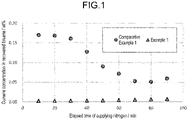
- Fig. 1 is a graph for confirming residual cumene amounts in Example 1 and Comparative Example 1.
- a description representing a numerical value range such as "a lower limit to(-) an upper limit” represents “a lower limit or more and an upper limit or less”. That is, such a description represents a numerical value range including the lower limit and the upper limit.
- propylene oxide is produced by supplying a peroxide(-containing liquid) and propylene to an epoxidation reactor, then conducting epoxidation reaction.
- Examples of the peroxide include hydrogen peroxide and an organic peroxide.
- the peroxide reacts with propylene to produce propylene oxide and the corresponding hydroxyl compound.
- the organic peroxide is a compound having the following formula: R-O-O-H wherein R is a hydrocarbon group.
- R in the formula is preferably a C3-20 hydrocarbon group and more preferably a C3-10 hydrocarbon group.
- the hydrocarbon group may be linear or branched and may be aliphatic or aromatic.
- Examples of the organic peroxide include cumene hydroperoxide (hereinafter also referred to as CMHP), ethylbenzene hydroperoxide, and tert-butyl hydroperoxide. These may be used singly or a mixture of two or more of these may be used.
- CMHP cumene hydroperoxide
- ethylbenzene hydroperoxide ethylbenzene hydroperoxide
- the corresponding hydroxyl compound When hydrogen peroxide is used as the peroxide, the corresponding hydroxyl compound is water. When ethylbenzene hydroperoxide is used as the peroxide, the corresponding hydroxyl compound is 1-phenylethanol. When tert-butyl hydroperoxide is used as the peroxide, the corresponding hydroxyl compound is tert-butyl alcohol. When CMHP is used as the peroxide, the corresponding hydroxyl compound is 2-phenyl-2-propanol. Cumene is obtained from this 2-phenyl-2-propanol through dehydration reaction and hydrogenation reaction. Further, CMHP is obtained again by oxidizing the cumene. From these viewpoints, CMHP is preferably used as the organic peroxide needed for epoxidation reaction.
- Epoxidation reaction can be conducted in a liquid phase by using a solvent, a diluent, or a mixture thereof.
- the solvent and the diluent are liquids at a reaction temperature and a reaction pressure.
- a liquid containing at least one selected from the group consisting of water, methanol, and acetonitrile can be also used as the solvent and the diluent.
- the solvent may consist of a substance existing in a peroxide solution used.
- CMHP is mixed with cumene, which is a raw material of CMHP
- ethylbenzene hydroperoxide is mixed with ethylbenzene
- tert-butyl hydroperoxide is mixed with isobutane, which is a raw material of tert-butyl hydroperoxide
- they can also be substitutes for a solvent without particularly adding a solvent.
- An epoxidation reaction temperature is preferably 10 to 200°C, more preferably 25 to 200°C, and further preferably 30 to 200°C.
- An epoxidation reaction pressure may be a pressure sufficient to keep a reaction phase in a liquid state and is preferably a gauge pressure of 0.1 to 10 MPa and more preferably a gauge pressure of 3 to 9 MPa.
- the epoxidation reactor may be a single column or may comprise multiple columns. When multiple columns are comprised, the columns may be connected in series or in parallel.
- a molar ratio of propylene/(peroxide + the corresponding hydroxyl compound) supplied to the epoxidation reactor is preferably 2/1 to 50/1. If said ratio is less than 2/1, reaction speed decreases, leading low efficiency. Meanwhile, if said ratio exceeds 50/1, a large amount of energy is required in processes of separating and recovering an excess amount of unreacted propylene from an epoxidation reaction solution for recycling.
- a solid catalyst is used for the purpose of obtaining an objective substance at a high yield and/or for the purpose of carrying out reaction under mild conditions.
- the catalyst is not particularly limited as long as it is known as an epoxidation reaction.
- the catalyst include a titanium-containing silicon oxide catalyst.
- the titanium-containing silicon oxide refers to a compound in which a part of Si in porous silicate (SiO 2 ) is substituted with Ti. Said compound has a bond represented by -Si-O-Ti.
- Examples thereof can include a substance in which a titanium compound is supported by a silica carrier, a substance in which it compounded with a silicon oxide by a coprecipitation method or a sol-gel method, and a zeolite compound containing titanium.
- More specific examples can include catalysts described in JP 2004-195379 A , JP 3731384 B2 , JP 3797107 B2 , and the like; catalysts described in US 2005014960 , CN 102311363 B , and the like; Ti-supporting silica described in US 2007260074 ; Ti-MCM-41 described in US 5783167 and the like; Ti-MCM-48 described in JP 7-300312 A and the like; Ti-HMS described in Nature 368 (1994) p321, CN 101348472 B , CN 101307039 B , CN 101279960 B , CN 102872847 B , CN 103030611 B , and the like; Ti-SBA-15 described in Chemistry of Material 14, 1657-1664, (2002 ) and the like; TS-1 described in Journal of Catalysis 130, 1-8, (1991 ) and the like; TS-2 described in Applied Catalysis 58, L1-L4, (1990) and the like
- the catalyst can be used in a form of a fixed bed.
- the titanium-containing silicon oxide may be powder or a molded body, preferably a molded body.
- the reaction herein can be conducted by a semi-continuous method or a continuous method.
- Specific examples of the present invention include a method for continuously producing propylene oxide by continuously supplying an organic peroxide(-containing liquid) and propylene to a fixed bed reactor filled with a titanium-containing silicon oxide catalyst for epoxidation to conduct epoxidation reaction.
- a liquid mixture containing a desired product can be separated from a catalyst composition. Subsequently, the liquid mixture can be purified by an appropriate method. Examples of the method for purification include distillation, extraction, washing, etc. A solvent and unreacted propylene can be recirculated and used again.
- continuous reaction is preferably carried out by using a flow reactor.
- the flow reactor is a reactor comprising an inlet for continuous supply and an outlet for continuous removal of a content.
- Unreacted propylene comprised in a reaction liquid can be separated, recovered, and recycled to the epoxidation reactor. Distillation can be used as a method for separating and recovering unreacted propylene.
- Conditions under which propylene easily vaporizes are usually employed for distillation. While distillation conditions vary depending on a temperature or composition of the reaction liquid supplied to the distillation step, examples thereof can usually include a gauge pressure of 0 to 5 MPa, preferably a gauge pressure of 0 to 3 MPa, a column top temperature of -50 to 150°C, and a column bottom temperature of 50 to 200°C, preferably a column bottom temperature of 80 to 200°C. Additionally, a method in which multiple distillation columns are used to distill propylene in a stepwise manner may be employed.
- Unreacted propylene separated and recovered in this manner can be mixed with propylene newly supplied, and supplied to the epoxidation reactor.
- liquified gas is supplied to the fixed bed reactor, and a liquified gas is contacted with the catalyst in the fixed bed reactor.
- the liquified gas is usually supplied to the fixed bed reactor filled with the catalyst in a continuous flow manner.
- the liquified gas is an organic compound having a boiling point of 40°C or lower under atmospheric pressure. Examples of the liquified gas include propylene, propane, butane, butene, propylene oxide, and pentane, and these may be used singly or a mixture of two or more of these may be used.
- the liquified gas preferably comprises at least one selected from the group consisting of propylene, propane, butane, and butane, and more preferably comprises propylene, which is raw material of propylene oxide.
- propylene When the liquified gas comprises propylene, propylene may be continuously supplied directly after the completion of reaction, or supply may be stopped once and propylene may be supplied again. Additionally, after stopping propylene supply, another kind of the liquified gas may be supplied.
- the liquified gas may comprise an impurity other than the organic compound having a boiling point of 40°C or lower under atmospheric pressure.
- a temperature of the liquified gas, which is supplied after stopping supply of the peroxide(-containing liquid), in the fixed bed reactor is preferably 10 to 200°C, more preferably 20 to 140°C, and further preferably 30 to 100°C.
- the liquified gas supplied after stopping supply of the peroxide(-containing liquid) is usually liquid.
- a part of the liquified gas supplied after stopping supply of the peroxide(-containing liquid) may be gas.
- a ratio of (a volume of the liquified gas)/(a volume of the epoxidation reactor) supplied after stopping supply of the peroxide(-containing liquid) is preferably 0.1/1 to 2000/1.
- the ratio is more preferably 0.5/1 to 500/1 and further preferably 1/1 to 200/1.
- the volume of the liquified gas is calculated with its density as 544 kg/m 3 .
- supply of the liquified gas is stopped after contacting the liquified gas with the catalyst. Stopping of liquified gas supply is carried out before the "stopping of inert gas supply" described later.
- An inert gas is supplied to the reactor after stopping supply of the peroxide(-containing liquid).
- the inert gas may be continuously supplied, or supply may be stopped once and the inert gas may be supplied again thereafter.
- the inert gas include helium, neon, argon, nitrogen, water vapor, and carbon dioxide, and a gas comprising one kind thereof or a gas comprising a mixed gas of two or more kinds thereof may be used.
- an object is efficiently achieved by using nitrogen or water vapor.
- the inert gas may contain oxygen as long as a composition of a gas mixed in the reactor has an oxygen concentration equal to or less than its lower explosive limit.
- Supply of the inert gas may be carried out at any timing including timings before, after, and simultaneously with contact of the liquified gas with the catalyst and may be carried out at any timing including timings before, after, and simultaneously with stopping of liquified gas supply.
- Supply of the inert gas is preferably carried out after stopping of liquified gas supply.
- depressurization is preferably conducted after stopping supply of the peroxide(-containing liquid).
- a gauge pressure may be decreased from 0.1-10 MPa to 0-0.5 MPa.
- depressurization may be carried out at any timing including timings before, after, and simultaneously with supply of the inert gas.
- Depressurization is preferably carried out before the supply of the inert gas.
- depressurization may be carried out at any timing including timings before, after, and simultaneously with liquified gas supply (contact of the liquified gas with the catalyst) or may be carried out at any timing including timings before, after, and simultaneously with stopping of liquified gas supply.
- Depressurization may be carried out once or two or more times. Depressurization is preferably carried out after stopping liquified gas supply. In a case where the liquified gas is supplied after depressurization, a pressure in the reactor is preferably equal to or more than a pressure at which a part of the liquified gas can exist in a liquid state.
- depressurization (D), inert gas supply (I), and stopping of liquified gas supply (L) may be carried out in any of the following orders: “D, then I, and then L”, “D, then L, and then I”, “I, then D, and then L”, “I, then L, and then D”, “L, then D, and then I", "L, then I, and then D", “D and I at the same time, and then L", “D and L at the same time, and then I", "I and L at the same time, and then D", “D, and then I and L at the same time, and then D", “D, and then I and L at the same time", “I, and then D and L at the same time", “L, and then D and I at the same time", and “D, I, and L at the same time".
- a metal reactor having an inner diameter of 16 mm was filled with a catalyst (3.5 g of a titanium-containing silicon oxide catalyst prepared in accordance with Example 1 of JP 2004-195379 A ), the metal reactor comprising a sheath pipe having an outer diameter of 6 mm and comprising a thermometer inside thereof.
- the catalyst was hold as a fixed bed having a filling length of 6 cm.
- Propylene was supplied to a reactor at room temperature in a continuous flow manner at a speed of 0.8 g/min, and heating of the reactor was started at the time when the pressure in the reactor system reached a gauge pressure of 2.4 MPa.
- a cumene solution containing 3.2% by weight of cumene hydroperoxide was supplied at 2.25 g/min at the time when the pressure reached a gauge pressure of 6 MPa and the internal temperature exceeded 80°C. Thereafter, the pressure in the reactor system was adjusted so as to be a gauge pressure of 6.1 to 6.2 MPa, and the temperature of an electric furnace was adjusted so that the highest position in temperature of the catalyst layer was 100°C.
- reactor outlet liquid (1) A reactor outlet liquid was collected for 15 minutes after a lapse of three hours from the start of supply of the cumene solution. This collected liquid is referred to as "reactor outlet liquid (1)".
- Nitrogen was supplied from the inlet of the reactor at 180 ml/min, and organic substances comprised in the gas discharged from the reactor were allowed to be absorbed by a container in which 20 g of toluene with a purity of 99.9% was charged and which was set at the outlet. After a lapse of ten minutes, nitrogen was stopped, and the toluene container at the outlet was exchanged for a new one. This operation was repeated nine times, and nitrogen was supplied for 90 minutes in total. Toluene having absorbed organic substances comprised in the gas was analyzed by gas chromatography to measure the cumene concentration in the recovered toluene. Results are shown in Table 1 and Fig. 1 .
- Toluene that used to absorb organic substances comprised in the gas did not contain cumene.
- the weight of the catalyst taken out after the remaining organic substance amount evaluation (C) was 3.6 g.
- the catalyst was not wet by visual observation at the time of taking the catalyst out.
- the cumene solution containing cumene hydroperoxide, which was a raw material liquid, and the reaction liquid did not remain on the catalyst.
- Epoxidation reaction was conducted in accordance with the method described in Example 1.
- Toluene having absorbed organic substances comprised in the gas was analyzed by gas chromatography in accordance with the method described in Example 1 to measure the cumene concentration in the recovered toluene. Results are shown in Table 1 and Fig. 1 .
- the weight of the catalyst taken out after the remaining organic substance amount evaluation (C) was 5.8 g.
- the catalyst was wet by visual observation at the time of taking the catalyst out.
- the cumene solution containing cumene hydroperoxide, which was a raw material liquid, and the reaction liquid remained on the catalyst.
- the concentration of cumene hydroperoxide contained in reactor outlet liquid (1) was 0.7% by weight.
- the average temperature of the catalyst layer at the time of sampling was 99°C.
- the present invention is useful for producing propylene oxide.
Landscapes
- Chemical & Material Sciences (AREA)
- Organic Chemistry (AREA)
- Inorganic Chemistry (AREA)
- Epoxy Compounds (AREA)
- Organic Low-Molecular-Weight Compounds And Preparation Thereof (AREA)
Applications Claiming Priority (2)
| Application Number | Priority Date | Filing Date | Title |
|---|---|---|---|
| JP2019174095 | 2019-09-25 | ||
| PCT/JP2020/035767 WO2021060263A1 (ja) | 2019-09-25 | 2020-09-23 | プロピレンオキサイドの製造方法 |
Publications (3)
| Publication Number | Publication Date |
|---|---|
| EP4036084A1 true EP4036084A1 (de) | 2022-08-03 |
| EP4036084A4 EP4036084A4 (de) | 2023-10-18 |
| EP4036084B1 EP4036084B1 (de) | 2026-01-28 |
Family
ID=75165818
Family Applications (1)
| Application Number | Title | Priority Date | Filing Date |
|---|---|---|---|
| EP20868606.3A Active EP4036084B1 (de) | 2019-09-25 | 2020-09-23 | Verfahren zur herstellung von propylenoxid |
Country Status (7)
| Country | Link |
|---|---|
| EP (1) | EP4036084B1 (de) |
| JP (1) | JPWO2021060263A1 (de) |
| KR (1) | KR20220069013A (de) |
| CN (1) | CN114341122A (de) |
| ES (1) | ES3063934T3 (de) |
| MX (1) | MX2022003199A (de) |
| WO (1) | WO2021060263A1 (de) |
Families Citing this family (1)
| Publication number | Priority date | Publication date | Assignee | Title |
|---|---|---|---|---|
| CN119930544B (zh) * | 2023-11-06 | 2025-10-31 | 中国石油化工股份有限公司 | 一种环氧烷烃反应系统中反应器失活的处理方法及其应用 |
Family Cites Families (22)
| Publication number | Priority date | Publication date | Assignee | Title |
|---|---|---|---|---|
| ES2092428B1 (es) | 1993-06-15 | 1997-08-01 | Univ Valencia Politecnica | Material de estructura tipo zeolita de poros ultragrandes con un red constituida por oxidos de silicio y titanio; su sintesis y utilizacion para la oxidacion selectiva de productos organicos. |
| JPH07300312A (ja) | 1994-03-09 | 1995-11-14 | Nippon Shokubai Co Ltd | メソポアチタノシリケートおよびその合成方法 |
| JP3731384B2 (ja) | 1998-08-04 | 2006-01-05 | 住友化学株式会社 | チタン含有珪素酸化物触媒、該触媒の製造方法及びプロピレンオキサイドの製造方法 |
| JP3797107B2 (ja) | 2000-02-02 | 2006-07-12 | 住友化学株式会社 | 触媒成型体、該触媒成型体の製造方法及びオキシラン化合物の製造方法 |
| JP4981222B2 (ja) * | 2000-09-29 | 2012-07-18 | 住友化学株式会社 | ε−カプロラクタムの製造方法 |
| JP4265108B2 (ja) * | 2001-03-14 | 2009-05-20 | 住友化学株式会社 | 固体触媒の再生方法 |
| JP4265212B2 (ja) | 2002-12-19 | 2009-05-20 | 住友化学株式会社 | チタン含有珪素酸化物触媒の製造方法 |
| US20050014960A1 (en) | 2003-06-30 | 2005-01-20 | Buijink Jan Karel Frederik | Catalyst preparation |
| JP4433843B2 (ja) | 2004-03-22 | 2010-03-17 | 住友化学株式会社 | プロピレンオキサイド製造用触媒及びプロピレンオキサイドの製造方法 |
| JP2006159058A (ja) * | 2004-12-06 | 2006-06-22 | Sumitomo Chemical Co Ltd | チタン含有珪素酸化物触媒の製造方法及び触媒 |
| JP2009535206A (ja) | 2006-05-02 | 2009-10-01 | シエル・インターナシヨナル・リサーチ・マートスハツペイ・ベー・ヴエー | チタン触媒、これの調製およびエポキシ化反応におけるこれの使用 |
| US8598060B2 (en) * | 2006-07-31 | 2013-12-03 | Basf Se | Method of regenerating ruthenium catalysts for the ring hydrogenation of phthalates |
| CN101279960B (zh) | 2007-04-04 | 2010-12-22 | 中国石油化工股份有限公司 | 制备环氧化物的方法 |
| CN101307039B (zh) | 2007-05-16 | 2010-12-01 | 中国石油化工股份有限公司 | 生产环氧化物的方法 |
| CN101348472B (zh) | 2007-07-18 | 2011-05-18 | 中国石油化工股份有限公司 | 用于制备环氧化物的方法 |
| CN102311363B (zh) | 2010-07-07 | 2014-05-21 | 中国石油化工股份有限公司 | 一种环己酮氨氧化的方法 |
| CN102872847B (zh) | 2011-07-12 | 2014-11-26 | 中国石油化工股份有限公司 | 钛氧化硅材料的改性方法 |
| CN103030612B (zh) * | 2011-09-29 | 2014-11-26 | 中国石油化工股份有限公司 | 过氧化氢异丙苯与丙烯反应生产环氧丙烷的方法 |
| CN103030611B (zh) | 2011-09-30 | 2015-02-11 | 中国石油化工股份有限公司 | 生产环氧丙烷的方法 |
| KR101799718B1 (ko) * | 2014-01-22 | 2017-11-20 | 라이온델 케미칼 테크놀로지, 엘.피. | 에폭시화 촉매의 제조 방법 |
| CN105817271A (zh) * | 2016-04-11 | 2016-08-03 | 广东工业大学 | 一种低碳烷烃脱氢催化剂的再生方法 |
| TWI628146B (zh) * | 2016-11-28 | 2018-07-01 | 東聯化學股份有限公司 | Preparation method and application of titanium-containing cerium oxide material with high thermal stability |
-
2020
- 2020-09-23 WO PCT/JP2020/035767 patent/WO2021060263A1/ja not_active Ceased
- 2020-09-23 KR KR1020227009975A patent/KR20220069013A/ko not_active Ceased
- 2020-09-23 EP EP20868606.3A patent/EP4036084B1/de active Active
- 2020-09-23 ES ES20868606T patent/ES3063934T3/es active Active
- 2020-09-23 MX MX2022003199A patent/MX2022003199A/es unknown
- 2020-09-23 CN CN202080061493.3A patent/CN114341122A/zh active Pending
- 2020-09-23 JP JP2020566002A patent/JPWO2021060263A1/ja active Pending
Also Published As
| Publication number | Publication date |
|---|---|
| JPWO2021060263A1 (de) | 2021-04-01 |
| EP4036084A4 (de) | 2023-10-18 |
| EP4036084B1 (de) | 2026-01-28 |
| CN114341122A (zh) | 2022-04-12 |
| ES3063934T3 (en) | 2026-04-21 |
| KR20220069013A (ko) | 2022-05-26 |
| MX2022003199A (es) | 2022-04-11 |
| WO2021060263A1 (ja) | 2021-04-01 |
Similar Documents
| Publication | Publication Date | Title |
|---|---|---|
| EP0720984B1 (de) | Integriertes Epoxydationsverfahren | |
| US5384418A (en) | Integrated process for epoxide production | |
| JP4555478B2 (ja) | 有機化合物とヒドロペルオキシドとを反応させるための方法 | |
| JP5373240B2 (ja) | 酸化オレフィン類の一体化製造方法 | |
| Russo et al. | Chemical and technical aspects of propene oxide production via hydrogen peroxide (HPPO process) | |
| CA2529730C (en) | Process for the epoxidation of propene | |
| EP2173731B1 (de) | Verfahren zur herstellung von propylenoxid | |
| US6878836B2 (en) | Process for the epoxidation of propene | |
| Beckman | Production of H 2 O 2 in CO 2 and its use in the direct synthesis of propylene oxide | |
| EP3380461B1 (de) | Verfahren zur propylenepoxidation | |
| IL127057A (en) | A product based on epylchlorohydrin and the process of its formation | |
| US5693834A (en) | Integrated process for epoxidation | |
| CN100384829C (zh) | 环氧丙烷的制造方法 | |
| NO328177B1 (no) | Integrert prosess for fremstilling av epoksyder | |
| EP4036084B1 (de) | Verfahren zur herstellung von propylenoxid | |
| EP1907115B1 (de) | Verfahren zur regeneration von titanhaltigem molekularsiebkatalysator | |
| EP2014654A1 (de) | Verfahren zur herstellung von propylenoxid | |
| TWI516482B (zh) | 改良環氧乙烷(eo)催化劑選擇性之方法 | |
| EP1258483A1 (de) | Verfahren zur epoxidierung von olefinen | |
| Xia et al. | Titanosilicate‐Based Alkene Epoxidation Catalysis | |
| JP2004525073A (ja) | オレフィンオキシドの連続製造方法 | |
| JP2004285056A (ja) | プロピレンオキサイドの製造方法 | |
| KR20060112609A (ko) | 사이클로알카논 옥심의 제조 방법 | |
| JP2004525073A5 (de) | ||
| KR20080034172A (ko) | 프로필렌 옥시드의 제조 방법 |
Legal Events
| Date | Code | Title | Description |
|---|---|---|---|
| STAA | Information on the status of an ep patent application or granted ep patent |
Free format text: STATUS: THE INTERNATIONAL PUBLICATION HAS BEEN MADE |
|
| PUAI | Public reference made under article 153(3) epc to a published international application that has entered the european phase |
Free format text: ORIGINAL CODE: 0009012 |
|
| STAA | Information on the status of an ep patent application or granted ep patent |
Free format text: STATUS: REQUEST FOR EXAMINATION WAS MADE |
|
| 17P | Request for examination filed |
Effective date: 20220318 |
|
| AK | Designated contracting states |
Kind code of ref document: A1 Designated state(s): AL AT BE BG CH CY CZ DE DK EE ES FI FR GB GR HR HU IE IS IT LI LT LU LV MC MK MT NL NO PL PT RO RS SE SI SK SM TR |
|
| DAV | Request for validation of the european patent (deleted) | ||
| DAX | Request for extension of the european patent (deleted) | ||
| A4 | Supplementary search report drawn up and despatched |
Effective date: 20230918 |
|
| RIC1 | Information provided on ipc code assigned before grant |
Ipc: C07D 303/04 20060101ALI20230912BHEP Ipc: C07B 61/00 20060101ALI20230912BHEP Ipc: C07D 301/14 20060101ALI20230912BHEP Ipc: C07D 301/12 20060101AFI20230912BHEP |
|
| STAA | Information on the status of an ep patent application or granted ep patent |
Free format text: STATUS: EXAMINATION IS IN PROGRESS |
|
| 17Q | First examination report despatched |
Effective date: 20240704 |
|
| GRAP | Despatch of communication of intention to grant a patent |
Free format text: ORIGINAL CODE: EPIDOSNIGR1 |
|
| STAA | Information on the status of an ep patent application or granted ep patent |
Free format text: STATUS: GRANT OF PATENT IS INTENDED |
|
| INTG | Intention to grant announced |
Effective date: 20250919 |
|
| GRAS | Grant fee paid |
Free format text: ORIGINAL CODE: EPIDOSNIGR3 |
|
| GRAA | (expected) grant |
Free format text: ORIGINAL CODE: 0009210 |
|
| STAA | Information on the status of an ep patent application or granted ep patent |
Free format text: STATUS: THE PATENT HAS BEEN GRANTED |
|
| AK | Designated contracting states |
Kind code of ref document: B1 Designated state(s): AL AT BE BG CH CY CZ DE DK EE ES FI FR GB GR HR HU IE IS IT LI LT LU LV MC MK MT NL NO PL PT RO RS SE SI SK SM TR |
|
| P01 | Opt-out of the competence of the unified patent court (upc) registered |
Free format text: CASE NUMBER: UPC_APP_0018385_4036084/2025 Effective date: 20251218 |
|
| REG | Reference to a national code |
Ref country code: CH Ref legal event code: F10 Free format text: ST27 STATUS EVENT CODE: U-0-0-F10-F00 (AS PROVIDED BY THE NATIONAL OFFICE) Effective date: 20260128 Ref country code: GB Ref legal event code: FG4D |
|
| REG | Reference to a national code |
Ref country code: DE Ref legal event code: R096 Ref document number: 602020066258 Country of ref document: DE |
|
| REG | Reference to a national code |
Ref country code: IE Ref legal event code: FG4D Ref country code: NL Ref legal event code: FP |
|
| REG | Reference to a national code |
Ref country code: ES Ref legal event code: FG2A Ref document number: 3063934 Country of ref document: ES Kind code of ref document: T3 Effective date: 20260421 |