EP4037567B1 - Verfahren und system zur bewertung der qualität des verhältnisses von verhältniswerten - Google Patents
Verfahren und system zur bewertung der qualität des verhältnisses von verhältniswerten Download PDFInfo
- Publication number
- EP4037567B1 EP4037567B1 EP20781543.2A EP20781543A EP4037567B1 EP 4037567 B1 EP4037567 B1 EP 4037567B1 EP 20781543 A EP20781543 A EP 20781543A EP 4037567 B1 EP4037567 B1 EP 4037567B1
- Authority
- EP
- European Patent Office
- Prior art keywords
- ppg
- signal
- computed
- values
- heartbeat
- Prior art date
- Legal status (The legal status is an assumption and is not a legal conclusion. Google has not performed a legal analysis and makes no representation as to the accuracy of the status listed.)
- Active
Links
Images


Classifications
-
- A—HUMAN NECESSITIES
- A61—MEDICAL OR VETERINARY SCIENCE; HYGIENE
- A61B—DIAGNOSIS; SURGERY; IDENTIFICATION
- A61B5/00—Measuring for diagnostic purposes; Identification of persons
- A61B5/72—Signal processing specially adapted for physiological signals or for diagnostic purposes
- A61B5/7221—Determining signal validity, reliability or quality
-
- A—HUMAN NECESSITIES
- A61—MEDICAL OR VETERINARY SCIENCE; HYGIENE
- A61B—DIAGNOSIS; SURGERY; IDENTIFICATION
- A61B5/00—Measuring for diagnostic purposes; Identification of persons
- A61B5/145—Measuring characteristics of blood in vivo, e.g. gas concentration or pH-value ; Measuring characteristics of body fluids or tissues, e.g. interstitial fluid or cerebral tissue
- A61B5/1455—Measuring characteristics of blood in vivo, e.g. gas concentration or pH-value ; Measuring characteristics of body fluids or tissues, e.g. interstitial fluid or cerebral tissue using optical sensors, e.g. spectral photometrical oximeters
- A61B5/14551—Measuring characteristics of blood in vivo, e.g. gas concentration or pH-value ; Measuring characteristics of body fluids or tissues, e.g. interstitial fluid or cerebral tissue using optical sensors, e.g. spectral photometrical oximeters for measuring blood gases
-
- A—HUMAN NECESSITIES
- A61—MEDICAL OR VETERINARY SCIENCE; HYGIENE
- A61B—DIAGNOSIS; SURGERY; IDENTIFICATION
- A61B5/00—Measuring for diagnostic purposes; Identification of persons
- A61B5/72—Signal processing specially adapted for physiological signals or for diagnostic purposes
-
- A—HUMAN NECESSITIES
- A61—MEDICAL OR VETERINARY SCIENCE; HYGIENE
- A61B—DIAGNOSIS; SURGERY; IDENTIFICATION
- A61B5/00—Measuring for diagnostic purposes; Identification of persons
- A61B5/02—Detecting, measuring or recording for evaluating the cardiovascular system, e.g. pulse, heart rate, blood pressure or blood flow
- A61B5/024—Measuring pulse rate or heart rate
- A61B5/02416—Measuring pulse rate or heart rate using photoplethysmograph signals, e.g. generated by infrared radiation
-
- A—HUMAN NECESSITIES
- A61—MEDICAL OR VETERINARY SCIENCE; HYGIENE
- A61B—DIAGNOSIS; SURGERY; IDENTIFICATION
- A61B5/00—Measuring for diagnostic purposes; Identification of persons
- A61B5/68—Arrangements of detecting, measuring or recording means, e.g. sensors, in relation to patient
- A61B5/6801—Arrangements of detecting, measuring or recording means, e.g. sensors, in relation to patient specially adapted to be attached to or worn on the body surface
- A61B5/6802—Sensor mounted on worn items
- A61B5/681—Wristwatch-type devices
-
- A—HUMAN NECESSITIES
- A61—MEDICAL OR VETERINARY SCIENCE; HYGIENE
- A61B—DIAGNOSIS; SURGERY; IDENTIFICATION
- A61B5/00—Measuring for diagnostic purposes; Identification of persons
- A61B5/72—Signal processing specially adapted for physiological signals or for diagnostic purposes
- A61B5/7203—Signal processing specially adapted for physiological signals or for diagnostic purposes for noise prevention, reduction or removal
- A61B5/7207—Signal processing specially adapted for physiological signals or for diagnostic purposes for noise prevention, reduction or removal of noise induced by motion artifacts
-
- A—HUMAN NECESSITIES
- A61—MEDICAL OR VETERINARY SCIENCE; HYGIENE
- A61B—DIAGNOSIS; SURGERY; IDENTIFICATION
- A61B5/00—Measuring for diagnostic purposes; Identification of persons
- A61B5/72—Signal processing specially adapted for physiological signals or for diagnostic purposes
- A61B5/7203—Signal processing specially adapted for physiological signals or for diagnostic purposes for noise prevention, reduction or removal
- A61B5/7207—Signal processing specially adapted for physiological signals or for diagnostic purposes for noise prevention, reduction or removal of noise induced by motion artifacts
- A61B5/721—Signal processing specially adapted for physiological signals or for diagnostic purposes for noise prevention, reduction or removal of noise induced by motion artifacts using a separate sensor to detect motion or using motion information derived from signals other than the physiological signal to be measured
Definitions
- the present invention relates to a method and a system for evaluating the quality of ratio of ratios (RR) values computed for at least two photoplethysmographic (PPG) signals corresponding to distinct wavelengths.
- the invention is advantageous for the determination of blood oxygen saturation (SpO2) with ambulatory measurement devices, as it allows to discriminate, for the computation of ratio of ratios (RR) values, between acquisitions that are exploitable and those that are to be rejected, for example due to motion artifacts, noisy environments, or unsuitable values of parameters influencing the physiological signal, in particular low peripheral perfusion.
- SpO2 blood oxygen saturation
- the European patent application EP 3 491 999 discloses the determination of a quality indicator of ratio of ratios values for two PPG signals: a first PPG signal corresponding to a red wavelength and a second PPG signal corresponding to an infrared wavelength.
- reflectance pulse oximetry in ambulatory setups is much more complex than transmittance pulse oximetry at the finger under human supervision, as is most common.
- the ratio of light passing through the blood vessels in a reflectance setup is much lower than that observed in a transmittance setup.
- the AC signal is highly attenuated and the AC-to-DC ratio, also called the "perfusion index”, is much lower.
- perfusion index also called the "perfusion index”
- the invention is intended more particularly to remedy by proposing a method and a system for evaluating the quality of RR values computed for PPG signals corresponding to distinct wavelengths, which make it possible to automatically reject RR values that are not exploitable, for example due to motion artifacts, noisy environments, or unsuitable values of parameters influencing the physiological signal, in particular low peripheral perfusion, so that the SpO2 of a subject can be determined with improved accuracy even in ambulatory setups.
- a subject of the invention is a method for evaluating the quality of ratio of ratios (RR) values computed for at least three photoplethysmographic (PPG) signals corresponding to distinct wavelengths, wherein each PPG signal comprises successive heartbeat patterns, said method comprising:
- the quality index of a sequence of computed RR values involves a term resulting from a comparison between the number of heartbeat patterns in the period of time on which the computed RR values are determined and the number of heartbeats calculated from the computed heart rate for said period of time.
- the computed heart rate is obtained by identifying a maximum peak in the frequency domain in the third PPG signal (x g ) corresponding to a third wavelength.
- each heartbeat instant t b,r [ n ] and t b,ir [ n ] is determined, respectively for the first and second PPG signals, by searching the local maximum of the PPG signal closest to the corresponding value of t b,g [ n ].
- the quality index of a sequence of computed RR values involves a term resulting from a comparison between a measured peripheral temperature and a reference temperature.
- information from a peripheral temperature sensor is integrated at the input of the RR quality assessment. This is particularly interesting in the context of wrist-based measurements in an ambulatory setup as low peripheral temperature is typically correlated with low perfusion and therefore low RR estimation quality.
- the quality index of a sequence of computed RR values involves a term resulting from the calculation of the dispersion of the computed RR values for the different signal segments.
- the quality index of a sequence of computed RR values is a product of at least two among the terms resulting from the dispersion calculation, the heartbeat comparison and the temperature comparison.
- the method further comprises steps of:
- Another subject of the invention is a method for evaluating an SpO2 value based on a ratio of ratios ( RR ) value evaluated according to the method described above, wherein the photoplethysmographic (PPG) signals are obtained by using LEDs as light sources, the SpO2 value being obtained using a calibration model having as parameters the RR value and the LED current of at least one of the LEDs.
- PPG photoplethysmographic
- the calibration model is a second order polynomial calibration model having as parameters:
- Another subject of the invention is a computer program comprising instructions for the implementation of the steps of a method as described above when the program is executed by a computer.
- Another subject of the invention is a non-transitory computer readable medium comprising instructions for the implementation of the steps of a method as described above when the instructions are executed by a computer.
- Another subject of the invention is a system configured for evaluating the quality of ratio of ratios (RR) values computed for at least three photoplethysmographic (PPG) signals corresponding to distinct wavelengths, wherein each PPG signal comprises successive heartbeat patterns, said system comprising:
- Another subject of the invention is a system for performing a pulse oximetry comprising:
- the system for performing a pulse oximetry further comprises a third light source configured to emit at a third wavelength and located at a position facilitating the measurement of heart rate and a peripheral temperature sensor.
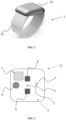
- the monitoring device 1 comprises an attachment band 11 and a casing 12 fixed to the attachment band 11.
- the monitoring device 1 also comprises several active elements housed inside the casing 12, i.e. a PPG sensor 2 (or photoplethysmograph), an inertial motion unit (IMU) 3 and a temperature sensor 4.
- the attachment band 11 is advantageously flexible and/or compliant so as to conform to the shape of a wrist of a subject. In this way, when the attachment band 11 is in place around a wrist of a subject, the casing 12 and its active elements 2, 3, 4 are close to the skin of the subject, i.e. with little to no gap between the skin-side of the casing 12 and the adjacent surface of the skin of the subject.
- the attachment band 11 may have an adjustable circumference, therefore allowing it to be closely fitted to the wrist of the subject.
- the attachment band 11 may be detachable from the casing 12 and, if necessary, replaceable.
- the casing 12 may also be associated to attachment bands 11 of various shapes and dimensions, so that it can be worn by a subject in different locations, e.g. on the wrist, the arm, the chest, the forehead, the ankle, the leg, the hip of the subject.
- the various attachment bands 11 associated to the casings 12 in the different locations have not been represented.
- the PPG sensor 2 of the monitoring device 1 comprises at least two light sources 5 (LED, laser, etc.) and at least one photodetector 6 (photodiode, phototransistor, etc.) arranged relative to one another so that each photodetector 6 receives the light emitted by the light sources 5 after interaction with the tissues of a subject wearing the monitoring device 1.
- the light sources 5 and the photodetector(s) 6 may be placed on a flexible PCB.
- the monitoring device 1 also comprises a circuitry configured to determine physiological data of the subject based on the measurements of each photodetector 6, i.e. PPG signals resulting from the emission of the light sources 5, possibly combined with other measurements e.g. from the inertial motion unit 3 and the temperature sensor 4. Examples of physiological data of the subject that can be determined by means of the monitoring device 1 include the heart rate, the respiratory rate and/or the blood oxygen saturation (SpO2) of the subject.
- SpO2 blood oxygen saturation
- the PPG sensor 2 includes three light sources 5 which are three LEDs emitting light at, respectively, a red wavelength, an infrared wavelength, and a green wavelength.
- the PPG sensor 2 also includes two photodetectors 6 placed on both sides of the green LED, whereas the red and infrared LEDs are offset laterally relative to the interspace between the two photodetectors 6.
- Green light PPG reflects the volume change in blood vessels in the skin surface due to the relatively shallow penetration depth of the green light in tissue.
- the positioning of the green LED in proximity of the photodetectors 6 is particularly advantageous for the measurement of heart rate since the close distance between the green light LED and the photodetectors contributes to the collection of light reflected at shallow penetration depth in the tissue.
- Light pipes may be used to optically connect the LEDs 5 and the photodetectors 6 with the surface of the skin of the subject. Beneath the skin, the light from the LEDs 5 scatters off of blood in the body, some of which may be scattered or reflected back into the photodetectors 6. Due to the different positions of the three LEDs 5 in the casing 12 and the different depths of penetration of light into the tissues of the subject for the three wavelengths, different optical paths are obtained for the light of the three LEDs 5, resulting in multiple measurements by the two photodetectors 6. Such multiple measurements ensure a robust evaluation of the physiological data of the subject such as the heart rate, the respiratory rate and/or the SpO 2 of the subject.
- the inertial motion unit 3 is a 6-axis unit comprising a 3-axis gyroscope and a 3-axis accelerometer.
- the inertial motion unit 3 is entirely housed inside the casing 12, without emerging on the skin-side of the casing 12. This is represented by the dotted lines around the inertial motion unit 3 in Figure 2 , which shows the skin-side of the casing 12.
- the temperature sensor 4 is configured to monitor the skin temperature of the subject in the vicinity of the PPG sensor. The monitoring of the skin temperature is important because low peripheral temperature is typically correlated with low perfusion and therefore low RR estimation quality. In addition, skin temperature may affect the temperature of the LEDs 5 and thus their emitted wavelength.
- the successive steps of a method according to the invention are detailed below with reference to Figure 4 .
- the method allows the determination of the blood oxygen saturation (SpO2) of a subject, e.g. by means of the portable monitoring device 1 described previously, with improved accuracy.
- SpO2 blood oxygen saturation
- the pulsatile AC signal is obtained thanks to a Butterworth or Chebyschev filter of order comprised between 2 and 4, with cutoff frequencies of 0.5 Hz and 4 Hz.
- the DC signal is obtained using a low-pass filter having a cutoff frequency of 0.5 Hz.
- preprocessed AC and DC components of the PPG signal corresponding to the IR channel of the pulse oximeter are shown in Figure 5 .
- heartbeat signal segment or heartbeat instant signal segment (also called heartbeat pattern) it has to be understood the segment of signal comprising only one complete pulsation of the heart.
- each value of t b,r [ n ] and t b,ir [ n ] is determined, respectively on the red PPG channel and on the IR PPG channel, by searching the local maximum of the PPG signal closest to the corresponding value of t b,g [ n ].
- the AC value is measured on each channel by computing the standard variation of the signal on each heartbeat signal segment or by computing the peak-to-peak amplitude of the signal on each heartbeat signal segment.
- the DC value is measured by computing the average signal level on each heartbeat signal segment.
- the outputs are the vector RR as well as the instant associated to each computed RR, depicted as t RR .
- G m is the vector containing the subsequent values of the gyroscope magnitude.
- ⁇ max ⁇ ⁇ w , gyr 2 .
- ⁇ is set by measuring the norm of the gyroscope signal on signals corresponding to movement-free periods, in which the gyroscope signal is only composed of noise and imperceptible signals caused by natural body movements such as respiration.
- the proposed algorithm relies on the analysis of the green channel of the PPG signal to measure the heart rate, as it is on this channel that the heart rate signal is the most visible.
- the incoming green PPG signal is split into sliding windows of length T w,HR separated by steps of length ⁇ T HR .
- the length T w,HR is comprised in the range between 6 s and 10 s while the length of the steps ⁇ T HR is comprises in between 0.5 s and 3 s .
- a detrend operation may be performed to remove the average values as well as low-frequency trends.
- the obtained signal is fed to a FFT processing stage which computes a FFT on N FFT,HR points which yields a frequency representation of the signal.
- the N med,HR latest estimates are stored in a buffer, and the median value of this buffer is returned as the final heart rate estimate.
- the N med,HR value may range between 5 and 15.
- the pulse rate computation block in Figure 4 outputs a value of HR every two seconds in the vector HR.
- the purpose of the RR quality assessment block is, based on the sequence of ratios-of-ratios computed on each heartbeat signal segment and the output of the signal quality assessment block, to provide both:
- the RR quality assessment block implements the following algorithm.
- the RR values are filtered using the following strategy:
- the RR values lower than 0.2 or higher than 1.3 are removed as not corresponding to a credible SpO 2 value.
- RR n measurements are performed to determine how the RR values stored in the buffer used to compute the median are scattered. In other words, the measurement of the variance of this buffer is used to estimate how reliable the value of RR n is. This information is useful for two purposes.
- var ( rr ) is the variance of the RR values stored in the buffer
- ⁇ ⁇ rr 2 is a scaling parameter controlling how quality is affected by the variance of RR values.
- ⁇ rr 2 0,01 .
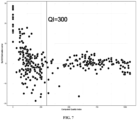
- QI n A ⁇ ⁇ n + 1 ⁇ n
- A is a multiplicative factor (for example equal to 1000)
- ⁇ n is the ratio between the number of RR values stored in the RR buffer, which corresponds to the number of acceptable detected heartbeats in the buffer, and the number of heartbeats predicted according to the value of heart rate computed with the algorithm detailed above for the pulse rate computation block.
- the quality index QI is the product of at least two of three terms ⁇ , ⁇ , ⁇ such that:
- the SpO2 value is obtained by applying a calibration model to the measured value of RR n ⁇ .
- This theoretical model cannot encompass all details of the photodetector design and is bound to yield under-optimal performance.
- LED currents are correlated to the phototype of the subject.
- the phototype will affect the ratio of DC values of the signal. Therefore, it is desirable to adjust the calibration model according to the phototype of the subject.
- LED currents affect the exact value of the wavelength emitted by each LED. In particular, it has been determined that the relationship of the centroid wavelength to the logarithm of the LED current can be approximated by a second order polynomial.
- the calibration model is a second order polynomial calibration model having as parameters:
Landscapes
- Health & Medical Sciences (AREA)
- Life Sciences & Earth Sciences (AREA)
- Physics & Mathematics (AREA)
- Engineering & Computer Science (AREA)
- Public Health (AREA)
- Medical Informatics (AREA)
- Veterinary Medicine (AREA)
- General Health & Medical Sciences (AREA)
- Animal Behavior & Ethology (AREA)
- Biophysics (AREA)
- Pathology (AREA)
- Biomedical Technology (AREA)
- Heart & Thoracic Surgery (AREA)
- Surgery (AREA)
- Molecular Biology (AREA)
- Physiology (AREA)
- Cardiology (AREA)
- Psychiatry (AREA)
- Computer Vision & Pattern Recognition (AREA)
- Artificial Intelligence (AREA)
- Signal Processing (AREA)
- Spectroscopy & Molecular Physics (AREA)
- Optics & Photonics (AREA)
- Measuring Pulse, Heart Rate, Blood Pressure Or Blood Flow (AREA)
Claims (14)
- Computerimplementiertes Verfahren zum Bewerten der Qualität von Verhältnisder-Verhältnisse-Werten (RR-Werten), die für mindestens drei photoplethysmographische Signale (PPG-Signale) (xr, xir) berechnet wurden, die unterschiedlichen Wellenlängen entsprechen, wobei jedes PPG-Signal aufeinanderfolgende Herzschlagsignalsegmente umfasst, dadurch gekennzeichnet, dass das Verfahren Folgendes umfasst:- Segmentieren eines ersten PPG-Signals (xr), das einer roten Wellenlänge entspricht, und eines zweiten PPG-Signals (xir), das einer Infrarotwellenlänge entspricht, in eine Vielzahl von Signalsegmenten, die jeweils einem Herzschlag entsprechen, durch:∘ Extrahieren einer Folge von Herzschlagzeitpunkten (tb,g[n]) aus einem dritten PPG-Signal (xg), das einer dritten Wellenlänge entspricht;∘ Segmentieren des ersten und des zweiten PPG-Signals (xr, xir) in eine Vielzahl von Signalsegmenten (xr[n,:], xir[n,:]), wobei jedes Signalsegment einem Herzschlag entspricht, unter Verwendung der Folge von Herzschlagzeitpunkten (tb,g[n]), die aus dem dritten PPG-Signal (xg) extrahiert wurde,- Berechnen einer Folge von RR-Werten für jedes gegebene Signalsegment (xr[n,:], xir[n,:]),- Bewerten eines Qualitätsindex (q) der Folge von berechneten RR-Werten für jedes gegebene Signalsegment (xr[n,:], xir[n,:]) auf der Grundlage einer berechneten Herzfrequenz und/oder einer gemessenen peripheren Temperatur, die dem gegebenen Signalsegment entspricht.
- Verfahren nach Anspruch 1, wobei der Qualitätsindex (q) einer Folge von berechneten RR-Werten einen Term (β) einbezieht, der aus einem Vergleich zwischen der Anzahl von Herzschlägen in dem Zeitraum, in dem die berechneten RR-Werte bestimmt werden, und der Anzahl von Herzschlägen, die aus der berechneten Herzfrequenz für diesen Zeitraum errechnet wird, resultiert.
- Verfahren nach einem von Anspruch 1 oder 2, wobei die berechnete Herzfrequenz durch Identifizieren eines maximalen Peaks im Frequenzbereich in einem dritten PPG-Signal (xg), das einer dritten Wellenlänge entspricht, erhalten wird.
- Verfahren nach einem der Ansprüche 1 bis 3, wobei die Folge von Herzschlagzeitpunkten (tb,g[n]) auf das erste und das zweite PPG-Signal (xr, xjr) angewendet wird, so dass:



- Verfahren nach Anspruch 4, wobei jeder Herzschlagzeitpunkt (tb,r[n]) und (tb,ir[n]) jeweils für das erste und das zweite PPG-Signal (xr, xir) durch Suchen des lokalen Maximums des PPG-Signals, das dem entsprechenden Wert von (tb,g[n]) am nächsten kommt, bestimmt wird.
- Verfahren nach einem der Ansprüche 1 bis 5, wobei der Qualitätsindex (q) einer Folge von berechneten RR-Werten einen Term (γ) einbezieht, der aus einem Vergleich zwischen einer gemessenen peripheren Temperatur (T) und einer Referenztemperatur (Tth) resultiert.
- Verfahren nach einem der Ansprüche 1 bis 6, wobei der Qualitätsindex (q) einer Folge von berechneten RR-Werten einen Term (α) einbezieht, der aus der Errechnung der Streuung der berechneten RR-Werte für die verschiedenen Signalsegmente resultiert.
- Verfahren nach den Ansprüchen 2, 6 und 7, wobei der Qualitätsindex (q) einer Folge von berechneten RR-Werten ein Produkt von mindestens zwei aus den Termen (α, β, y) ist, die aus der Streuungserrechnung, dem Herzschlagvergleich und dem Temperaturvergleich resultieren.
- Verfahren nach einem der vorhergehenden Ansprüche, das ferner Folgendes umfasst:- für jedes gegebene Signalsegment, Schätzen der Eignung des gegebenen Signalsegments für die RR-Schätzung und Ausgeben eines Signalqualitätsindex (q) für das gegebene Signalsegment,- für jedes gegebene Signalsegment, Bewerten der Qualität des berechneten RR-Werts auf der Grundlage des Signalqualitätsindex für das gegebene Signalsegment.
- Verfahren zum Bewerten eines SpO2-Werts auf der Grundlage eines Verhältnis-von-Verhältnissen-Werts (RR-Werts), der gemäß dem Verfahren nach einem der vorhergehenden Ansprüche bewertet wird, wobei die photoplethysmographischen Signale (PPG-Signale) (xr, xir) durch Verwenden von LEDs als Lichtquellen erhalten werden, wobei der SpO2-Wert unter Verwendung eines Kalibrierungsmodells erhalten wird, das als Parameter den RR-Wert und den LED-Strom mindestens einer der LEDs aufweist.
- Verfahren nach Anspruch 10, wobei das Kalibrierungsmodell ein polynomiales Kalibrierungsmodell zweiter Ordnung ist, das als Parameter Folgendes aufweist:- den RR-Wert und seinen quadrierten Wert RR2,- den Logarithmus des LED-Stroms mindestens einer der LEDs und seinen quadrierten Wert.
- Computerprogramm, das Anweisungen zum Implementieren eines Verfahrens nach einem der Ansprüche 1 bis 11, wenn das Programm von einem Computer ausgeführt wird, umfasst.
- System, das zum Bewerten der Qualität von Verhältnis-von-Verhältnissen-Werten (RR-Werten) konfiguriert ist, die für mindestens drei photoplethysmographische Signale (PPG-Signale) (xr, xir) berechnet wurden, die unterschiedlichen Wellenlängen entsprechen, wobei jedes PPG-Signal aufeinanderfolgende Herzschläge umfasst, dadurch gekennzeichnet, dass das System Folgendes umfasst:- ein Segmentierungsmodul, das zum Segmentieren eines ersten PPG-Signals (xr), das einer roten Wellenlänge entspricht, und eines zweiten PPG-Signals (xir), das einer Infrarotwellenlänge entspricht, in eine Vielzahl von Signalsegmenten, die jeweils einem Herzschlagmuster entsprechen, konfiguriert ist,- ein Berechnungsmodul, das zum Berechnen einer Folge von RR-Werten für jedes gegebene Signalsegment (xr[n,:], xir[n,:]) konfiguriert ist durch:∘ Extrahieren einer Folge von Herzschlagzeitpunkten tb,g[n] aus einem dritten PPG-Signal (xg), das einer dritten Wellenlänge entspricht;∘ Segmentieren des ersten und des zweiten PPG-Signals (xr, xir) in eine Vielzahl von Signalsegmenten (xr[n,:], xir[n,:]) unter Verwendung der Herzschlagmuster, die aus dem dritten PPG-Signal (xg) extrahiert wurden,- ein Bewertungsmodul, das zum Bewerten eines Qualitätsindex (q) der Folge von berechneten RR-Werten für jedes gegebene Signalsegment (xr[n,:], xir[n,:]) auf der Grundlage einer berechneten Herzfrequenz und/oder einer gemessenen peripheren Temperatur, die dem gegebenen Signalsegment entspricht, konfiguriert ist.
- System zum Durchführen einer Pulsoximetrie, das Folgendes umfasst:- mindestens zwei Lichtquellen, die dazu konfiguriert sind, Licht mit zwei unterschiedlichen Wellenlängen (λr, λir) zu emittieren,- ein Erfassungsmodul, das dazu konfiguriert ist, die photoplethysmographische Signale (PPG-Signale) zu erfassen, die aus der Beleuchtung von Geweben eines Patienten mittels der Lichtquellen resultieren,- ein System nach Anspruch 13 zum Bewerten der Qualität von Verhältnis-von-Verhältnissen-Werten (RR-Werten), die für die PPG-Signale (xr, xir) berechnet wurden, die den beiden unterschiedlichen Wellenlängen (λr, λir) entsprechen.
Applications Claiming Priority (2)
| Application Number | Priority Date | Filing Date | Title |
|---|---|---|---|
| EP19306266 | 2019-10-02 | ||
| PCT/EP2020/077727 WO2021064212A1 (en) | 2019-10-02 | 2020-10-02 | Method and system for evaluating the quality of ratio of ratios values |
Publications (3)
| Publication Number | Publication Date |
|---|---|
| EP4037567A1 EP4037567A1 (de) | 2022-08-10 |
| EP4037567B1 true EP4037567B1 (de) | 2024-07-17 |
| EP4037567C0 EP4037567C0 (de) | 2024-07-17 |
Family
ID=68296414
Family Applications (1)
| Application Number | Title | Priority Date | Filing Date |
|---|---|---|---|
| EP20781543.2A Active EP4037567B1 (de) | 2019-10-02 | 2020-10-02 | Verfahren und system zur bewertung der qualität des verhältnisses von verhältniswerten |
Country Status (4)
| Country | Link |
|---|---|
| US (1) | US12329503B2 (de) |
| EP (1) | EP4037567B1 (de) |
| CA (1) | CA3156652A1 (de) |
| WO (1) | WO2021064212A1 (de) |
Families Citing this family (4)
| Publication number | Priority date | Publication date | Assignee | Title |
|---|---|---|---|---|
| CN113995394B (zh) * | 2021-12-17 | 2022-11-11 | 珠海格力电器股份有限公司 | 一种生理信号的处理方法、装置、设备及存储介质 |
| JP2024060460A (ja) * | 2022-10-19 | 2024-05-02 | オムロン株式会社 | 酸素飽和度測定装置、酸素飽和度測定方法及び酸素飽和度測定プログラム |
| EP4403096A1 (de) | 2023-01-17 | 2024-07-24 | Biosency | Verfahren und system zur überwachung eines entfernten patienten und auslösung entsprechender alarme und aktionen |
| JP2025022180A (ja) * | 2023-08-02 | 2025-02-14 | テルモ株式会社 | プログラム、情報処理方法及び情報処理装置 |
Family Cites Families (6)
| Publication number | Priority date | Publication date | Assignee | Title |
|---|---|---|---|---|
| US7194293B2 (en) * | 2004-03-08 | 2007-03-20 | Nellcor Puritan Bennett Incorporated | Selection of ensemble averaging weights for a pulse oximeter based on signal quality metrics |
| US20140275890A1 (en) * | 2013-03-15 | 2014-09-18 | Covidien Lp | Systems and methods for sensor calibration in photoplethsymography |
| US20160360984A1 (en) * | 2015-06-15 | 2016-12-15 | Microsoft Technology Licensing, Llc | Optical Photoplethysmogram Signal Shape Feature Biological Monitor |
| WO2017001955A1 (en) * | 2015-06-30 | 2017-01-05 | Koninklijke Philips N.V. | Green light photoplethysmography in transmission geometry |
| JP6811773B2 (ja) * | 2015-11-24 | 2021-01-13 | コーニンクレッカ フィリップス エヌ ヴェKoninklijke Philips N.V. | フォトプレチスモグラム(ppg)信号品質を定量化する方法 |
| FR3069149B1 (fr) * | 2017-07-20 | 2023-12-15 | Commissariat Energie Atomique | Dispositif d'estimation de la spo2 et methode d'estimation de la spo2 |
-
2020
- 2020-10-02 EP EP20781543.2A patent/EP4037567B1/de active Active
- 2020-10-02 WO PCT/EP2020/077727 patent/WO2021064212A1/en not_active Ceased
- 2020-10-02 US US17/764,311 patent/US12329503B2/en active Active
- 2020-10-02 CA CA3156652A patent/CA3156652A1/en active Pending
Also Published As
| Publication number | Publication date |
|---|---|
| EP4037567C0 (de) | 2024-07-17 |
| US12329503B2 (en) | 2025-06-17 |
| US20220369943A1 (en) | 2022-11-24 |
| CA3156652A1 (en) | 2021-04-08 |
| EP4037567A1 (de) | 2022-08-10 |
| WO2021064212A1 (en) | 2021-04-08 |
Similar Documents
| Publication | Publication Date | Title |
|---|---|---|
| EP3496603B1 (de) | Vorrichtung zur verwendung bei der blutsauerstoffsättigungsmessung | |
| EP4037567B1 (de) | Verfahren und system zur bewertung der qualität des verhältnisses von verhältniswerten | |
| EP3383258B1 (de) | Vorrichtung, system und verfahren zur bestimmung der vitalzeicheninformationen eines patienten | |
| EP3709883B1 (de) | System und verfahren zur erfassung physiologischer parameter | |
| US12303293B2 (en) | Systems and methods for computationally efficient non-invasive blood quality measurement | |
| EP0904727B1 (de) | Pulsfrequenz- und Herzfrequenz-Übereinstimmungsdetektion für die Pulsoxymetrie | |
| US9659229B2 (en) | Method and system for signal analysis | |
| EP2973394B1 (de) | Vorrichtung und verfahren zur bestimmung der blutsauerstoffsättigung einer person | |
| EP1437087B1 (de) | System zur Spektroskopieanalyse von Blutkomponenten und zum Beseitigen von abnormalen Daten | |
| EP3292813B1 (de) | Verfahren und vorrichtung zur verarbeitung von biosignalen | |
| US20010037059A1 (en) | Method and apparatus for determining physiological characteristics | |
| CN108937957B (zh) | 检测方法、装置及检测设备 | |
| JP2005516642A6 (ja) | 信号対ノイズ比改善のための信号処理方法及び装置 | |
| JP2005516642A (ja) | 信号対ノイズ比改善のための信号処理方法及び装置 | |
| US20120259190A1 (en) | Detection of oximetry sensor sites based on waveform characteristics | |
| EP4037556B1 (de) | Verfahren und system zur bewertung der qualität eines physiologischen signals | |
| EP3838128A1 (de) | Vorrichtung und verfahren zur bestimmung eines vitalzeichens eines probanden | |
| CN111588385B (zh) | 一种血氧饱和度测量方法、装置、存储介质及电子设备 | |
| EP3517034A1 (de) | Vorrichtung, system und verfahren zur bestimmung mindestens eines lebenszeichens eines subjekts | |
| WO2009088799A1 (en) | Method and apparatus for assessing contact of a sensor with arterialized tissue | |
| Nahler et al. | Exploring the usage of Time-of-Flight Cameras for contact and remote Photoplethysmography | |
| Huang et al. | Pulse rate guided oxygen saturation monitoring using a wearable armband sensor | |
| Chatterjee et al. | Algorithm To Calculate Heart Rate By Removing Touch Errors And Algorithm Analysis | |
| Tone | Automated signal quality assessment for wearable SCG and NIRS brain monitoring | |
| Alkhoury et al. | Mitigation of Motion Artifacts in Pulse Oximetry through Redundant Sensors |
Legal Events
| Date | Code | Title | Description |
|---|---|---|---|
| STAA | Information on the status of an ep patent application or granted ep patent |
Free format text: STATUS: UNKNOWN |
|
| STAA | Information on the status of an ep patent application or granted ep patent |
Free format text: STATUS: THE INTERNATIONAL PUBLICATION HAS BEEN MADE |
|
| PUAI | Public reference made under article 153(3) epc to a published international application that has entered the european phase |
Free format text: ORIGINAL CODE: 0009012 |
|
| STAA | Information on the status of an ep patent application or granted ep patent |
Free format text: STATUS: REQUEST FOR EXAMINATION WAS MADE |
|
| 17P | Request for examination filed |
Effective date: 20220502 |
|
| AK | Designated contracting states |
Kind code of ref document: A1 Designated state(s): AL AT BE BG CH CY CZ DE DK EE ES FI FR GB GR HR HU IE IS IT LI LT LU LV MC MK MT NL NO PL PT RO RS SE SI SK SM TR |
|
| DAX | Request for extension of the european patent (deleted) | ||
| RAV | Requested validation state of the european patent: fee paid |
Extension state: TN Effective date: 20220502 Extension state: MA Effective date: 20220502 |
|
| GRAP | Despatch of communication of intention to grant a patent |
Free format text: ORIGINAL CODE: EPIDOSNIGR1 |
|
| STAA | Information on the status of an ep patent application or granted ep patent |
Free format text: STATUS: GRANT OF PATENT IS INTENDED |
|
| INTG | Intention to grant announced |
Effective date: 20240208 |
|
| GRAS | Grant fee paid |
Free format text: ORIGINAL CODE: EPIDOSNIGR3 |
|
| GRAA | (expected) grant |
Free format text: ORIGINAL CODE: 0009210 |
|
| STAA | Information on the status of an ep patent application or granted ep patent |
Free format text: STATUS: THE PATENT HAS BEEN GRANTED |
|
| AK | Designated contracting states |
Kind code of ref document: B1 Designated state(s): AL AT BE BG CH CY CZ DE DK EE ES FI FR GB GR HR HU IE IS IT LI LT LU LV MC MK MT NL NO PL PT RO RS SE SI SK SM TR |
|
| REG | Reference to a national code |
Ref country code: CH Ref legal event code: EP |
|
| REG | Reference to a national code |
Ref country code: DE Ref legal event code: R096 Ref document number: 602020034180 Country of ref document: DE |
|
| REG | Reference to a national code |
Ref country code: IE Ref legal event code: FG4D |
|
| U01 | Request for unitary effect filed |
Effective date: 20240814 |
|
| U07 | Unitary effect registered |
Designated state(s): AT BE BG DE DK EE FI FR IT LT LU LV MT NL PT SE SI Effective date: 20240827 |
|
| U20 | Renewal fee for the european patent with unitary effect paid |
Year of fee payment: 5 Effective date: 20241025 |
|
| PG25 | Lapsed in a contracting state [announced via postgrant information from national office to epo] |
Ref country code: NO Free format text: LAPSE BECAUSE OF FAILURE TO SUBMIT A TRANSLATION OF THE DESCRIPTION OR TO PAY THE FEE WITHIN THE PRESCRIBED TIME-LIMIT Effective date: 20241017 |
|
| PG25 | Lapsed in a contracting state [announced via postgrant information from national office to epo] |
Ref country code: PL Free format text: LAPSE BECAUSE OF FAILURE TO SUBMIT A TRANSLATION OF THE DESCRIPTION OR TO PAY THE FEE WITHIN THE PRESCRIBED TIME-LIMIT Effective date: 20240717 Ref country code: GR Free format text: LAPSE BECAUSE OF FAILURE TO SUBMIT A TRANSLATION OF THE DESCRIPTION OR TO PAY THE FEE WITHIN THE PRESCRIBED TIME-LIMIT Effective date: 20241018 |
|
| PG25 | Lapsed in a contracting state [announced via postgrant information from national office to epo] |
Ref country code: IS Free format text: LAPSE BECAUSE OF FAILURE TO SUBMIT A TRANSLATION OF THE DESCRIPTION OR TO PAY THE FEE WITHIN THE PRESCRIBED TIME-LIMIT Effective date: 20241117 |
|
| PG25 | Lapsed in a contracting state [announced via postgrant information from national office to epo] |
Ref country code: HR Free format text: LAPSE BECAUSE OF FAILURE TO SUBMIT A TRANSLATION OF THE DESCRIPTION OR TO PAY THE FEE WITHIN THE PRESCRIBED TIME-LIMIT Effective date: 20240717 |
|
| PG25 | Lapsed in a contracting state [announced via postgrant information from national office to epo] |
Ref country code: ES Free format text: LAPSE BECAUSE OF FAILURE TO SUBMIT A TRANSLATION OF THE DESCRIPTION OR TO PAY THE FEE WITHIN THE PRESCRIBED TIME-LIMIT Effective date: 20240717 Ref country code: RS Free format text: LAPSE BECAUSE OF FAILURE TO SUBMIT A TRANSLATION OF THE DESCRIPTION OR TO PAY THE FEE WITHIN THE PRESCRIBED TIME-LIMIT Effective date: 20241017 |
|
| PG25 | Lapsed in a contracting state [announced via postgrant information from national office to epo] |
Ref country code: RS Free format text: LAPSE BECAUSE OF FAILURE TO SUBMIT A TRANSLATION OF THE DESCRIPTION OR TO PAY THE FEE WITHIN THE PRESCRIBED TIME-LIMIT Effective date: 20241017 Ref country code: PL Free format text: LAPSE BECAUSE OF FAILURE TO SUBMIT A TRANSLATION OF THE DESCRIPTION OR TO PAY THE FEE WITHIN THE PRESCRIBED TIME-LIMIT Effective date: 20240717 Ref country code: NO Free format text: LAPSE BECAUSE OF FAILURE TO SUBMIT A TRANSLATION OF THE DESCRIPTION OR TO PAY THE FEE WITHIN THE PRESCRIBED TIME-LIMIT Effective date: 20241017 Ref country code: IS Free format text: LAPSE BECAUSE OF FAILURE TO SUBMIT A TRANSLATION OF THE DESCRIPTION OR TO PAY THE FEE WITHIN THE PRESCRIBED TIME-LIMIT Effective date: 20241117 Ref country code: HR Free format text: LAPSE BECAUSE OF FAILURE TO SUBMIT A TRANSLATION OF THE DESCRIPTION OR TO PAY THE FEE WITHIN THE PRESCRIBED TIME-LIMIT Effective date: 20240717 Ref country code: GR Free format text: LAPSE BECAUSE OF FAILURE TO SUBMIT A TRANSLATION OF THE DESCRIPTION OR TO PAY THE FEE WITHIN THE PRESCRIBED TIME-LIMIT Effective date: 20241018 Ref country code: ES Free format text: LAPSE BECAUSE OF FAILURE TO SUBMIT A TRANSLATION OF THE DESCRIPTION OR TO PAY THE FEE WITHIN THE PRESCRIBED TIME-LIMIT Effective date: 20240717 |
|
| PG25 | Lapsed in a contracting state [announced via postgrant information from national office to epo] |
Ref country code: SM Free format text: LAPSE BECAUSE OF FAILURE TO SUBMIT A TRANSLATION OF THE DESCRIPTION OR TO PAY THE FEE WITHIN THE PRESCRIBED TIME-LIMIT Effective date: 20240717 |
|
| PG25 | Lapsed in a contracting state [announced via postgrant information from national office to epo] |
Ref country code: CZ Free format text: LAPSE BECAUSE OF FAILURE TO SUBMIT A TRANSLATION OF THE DESCRIPTION OR TO PAY THE FEE WITHIN THE PRESCRIBED TIME-LIMIT Effective date: 20240717 |
|
| PG25 | Lapsed in a contracting state [announced via postgrant information from national office to epo] |
Ref country code: SK Free format text: LAPSE BECAUSE OF FAILURE TO SUBMIT A TRANSLATION OF THE DESCRIPTION OR TO PAY THE FEE WITHIN THE PRESCRIBED TIME-LIMIT Effective date: 20240717 |
|
| PLBE | No opposition filed within time limit |
Free format text: ORIGINAL CODE: 0009261 |
|
| STAA | Information on the status of an ep patent application or granted ep patent |
Free format text: STATUS: NO OPPOSITION FILED WITHIN TIME LIMIT |
|
| 26N | No opposition filed |
Effective date: 20250422 |
|
| PG25 | Lapsed in a contracting state [announced via postgrant information from national office to epo] |
Ref country code: MC Free format text: LAPSE BECAUSE OF FAILURE TO SUBMIT A TRANSLATION OF THE DESCRIPTION OR TO PAY THE FEE WITHIN THE PRESCRIBED TIME-LIMIT Effective date: 20240717 |
|
| PG25 | Lapsed in a contracting state [announced via postgrant information from national office to epo] |
Ref country code: IE Free format text: LAPSE BECAUSE OF NON-PAYMENT OF DUE FEES Effective date: 20241002 |
|
| REG | Reference to a national code |
Ref country code: CH Ref legal event code: U11 Free format text: ST27 STATUS EVENT CODE: U-0-0-U10-U11 (AS PROVIDED BY THE NATIONAL OFFICE) Effective date: 20251113 |
|
| PG25 | Lapsed in a contracting state [announced via postgrant information from national office to epo] |
Ref country code: RO Free format text: LAPSE BECAUSE OF FAILURE TO SUBMIT A TRANSLATION OF THE DESCRIPTION OR TO PAY THE FEE WITHIN THE PRESCRIBED TIME-LIMIT Effective date: 20240717 |
|
| U20 | Renewal fee for the european patent with unitary effect paid |
Year of fee payment: 6 Effective date: 20251028 |
|
| PGFP | Annual fee paid to national office [announced via postgrant information from national office to epo] |
Ref country code: GB Payment date: 20251030 Year of fee payment: 6 |
|
| PGFP | Annual fee paid to national office [announced via postgrant information from national office to epo] |
Ref country code: CH Payment date: 20251113 Year of fee payment: 6 |
|
| PG25 | Lapsed in a contracting state [announced via postgrant information from national office to epo] |
Ref country code: CY Free format text: LAPSE BECAUSE OF FAILURE TO SUBMIT A TRANSLATION OF THE DESCRIPTION OR TO PAY THE FEE WITHIN THE PRESCRIBED TIME-LIMIT; INVALID AB INITIO Effective date: 20201002 |
|
| VS25 | Lapsed in a validation state [announced via postgrant information from nat. office to epo] |
Ref country code: MA Free format text: FAILURE TO ELECT DOMICILE IN THE NATIONAL COUNTRY Effective date: 20241018 |
|
| PG25 | Lapsed in a contracting state [announced via postgrant information from national office to epo] |
Ref country code: HU Free format text: LAPSE BECAUSE OF FAILURE TO SUBMIT A TRANSLATION OF THE DESCRIPTION OR TO PAY THE FEE WITHIN THE PRESCRIBED TIME-LIMIT; INVALID AB INITIO Effective date: 20201002 |
|
| VS25 | Lapsed in a validation state [announced via postgrant information from nat. office to epo] |
Ref country code: MA Free format text: LAPSE BECAUSE OF FAILURE TO SUBMIT A TRANSLATION OF THE DESCRIPTION OR TO PAY THE FEE WITHIN THE PRESCRIBED TIME-LIMIT Effective date: 20240717 |